

ASTM F1789-23
(Terminology)Standard Terminology for F16 Mechanical Fasteners
General Information
- Abstract
SCOPE
1.1 This terminology standard provides a compilation of definitions for terminology used for mechanical fasteners.
1.2 Terms in this terminology are organized alphabetically. In Appendix X1 they are listed under fastener characteristic.
1.3 Additional definitions are shown in ANSI/ASME B18.12; IFI Glossary of Terms, IFI-139 and IFI-140; and SAE J412.
1.4 This international standard was developed in accordance with internationally recognized principles on standardization established in the Decision on Principles for the Development of International Standards, Guides and Recommendations issued by the World Trade Organization Technical Barriers to Trade (TBT) Committee.
- Status
- Published
- Publication Date
- 31-Oct-2023
- Technical Committee
- F16 - Fasteners
- Drafting Committee
- F16.91 - Editorial
Overview
ASTM F1789-23: Standard Terminology for F16 Mechanical Fasteners provides a comprehensive collection of definitions and terminology relevant to mechanical fasteners. This international standard, developed by ASTM International, is essential for manufacturers, suppliers, engineers, and stakeholders involved in the design, production, and quality assurance of fasteners. Alphabetically organized, this standard aids in uniform understanding, communication, and specification related to mechanical fasteners, including bolts, nuts, washers, and related components commonly used across various industries.
By establishing standardized terminology, ASTM F1789-23 ensures that all parties involved in the fastener supply and usage chain can refer to consistent definitions, reducing ambiguity and minimizing the risk of misinterpretation in documentation, procurement, and product evaluation.
Key Topics
- Comprehensive Definitions: The standard compiles terminologies specific to mechanical fasteners, including terms relating to characteristics, manufacturing processes, and quality assurance.
- Alphabetical Organization: Definitions are listed alphabetically for ease of reference. Appendix X1 organizes terms further by fastener characteristic.
- Reference to Other Glossaries: It acknowledges additional definitions in standards such as ANSI/ASME B18.12, IFI Glossary of Terms, IFI-139, IFI-140, and SAE J412, ensuring broad and consistent coverage.
- International Standardization Principles: Developed under World Trade Organization (WTO) guidelines, ASTM F1789-23 aligns with global best practices for terminology standardization.
- Highlighted Fastener Attributes: Includes terms for key properties such as hardness, tensile strength, annealing, coating thickness, torque, compliance, and traceability.
- Quality and Testing Terminology: Defines terms related to quality control, inspections, batch and lot sampling, and testing methods relevant to fastener production and application.
Applications
ASTM F1789-23 is widely applicable in various sectors utilizing mechanical fasteners, including:
- Manufacturing and Production: Ensures clear communication on fastener requirements, quality, and testing procedures among designers, engineers, and production staff.
- Procurement and Supply Chain: Provides a common language for buyers and suppliers, aiding in accurate product selection, order specification, and delivery of compliant components.
- Engineering Design and Documentation: Helps engineers and technical writers produce precise and unambiguous documentation, reducing the risk of errors during assembly or maintenance.
- Quality Control and Assurance: Enables quality professionals to reference standardized definitions during inspection, testing, and certification processes.
- Training and Education: Supports training programs for new staff or stakeholders, ensuring a consistent understanding of fastener-related terminology.
- International Trade and Compliance: Facilitates global commerce by aligning terminology with internationally recognized standards, ensuring mutual understanding and regulatory compliance.
Related Standards
Organizations often use ASTM F1789-23 alongside other key standards and resources to support comprehensive fastener standardization:
- ASTM Standards:
- ASTM A563/A563M – Carbon and Alloy Steel Nuts
- ASTM E456 – Terminology Relating to Quality and Statistics
- ASTM F432 – Roof and Rock Bolts and Accessories
- ASTM F2482 – Load-Indicating Externally Threaded Fasteners
- ANSI/ASME B18.12 – Glossary of Terms for Mechanical Fasteners
- IFI Standards:
- IFI Glossary of Terms Relating to Aerospace Fasteners
- IFI-139 – Quality Assurance Requirements for Fastener Testing Laboratories
- IFI-140 – Carbon and Alloy Steel Wire, Rods, and Bars for Mechanical Fasteners
- SAE J412 – General Characteristics and Heat Treatments of Steels
- ISO/IEC 17011 – Conformity Assessment for Accreditation Bodies
- ISO/IEC 17025 – Competence Requirements for Testing and Calibration Laboratories
Practical Value
Adoption of ASTM F1789-23 promotes standardization, enhances product quality, and improves communication throughout the fastener industry. By providing a single authoritative reference for fastener terminology, this standard supports better decision-making, reduces risk, and ensures compliance with international trade and technical regulations. It is an essential document for anyone involved in fastener specification, manufacturing, testing, or procurement.
Relations
- Effective Date
- 01-Nov-2023
- Effective Date
- 01-Dec-2023
- Effective Date
- 01-Apr-2022
- Effective Date
- 01-Apr-2022
- Effective Date
- 01-Nov-2023
- Effective Date
- 01-Nov-2023
- Effective Date
- 01-Nov-2023
- Effective Date
- 01-Nov-2023
- Effective Date
- 01-Nov-2023
- Referred By
ASTM F1554-20 - Standard Specification for Anchor Bolts, Steel, 36, 55, and 105-ksi Yield Strength - Effective Date
- 01-Nov-2023
- Effective Date
- 01-Nov-2023
- Effective Date
- 01-Nov-2023
- Effective Date
- 01-Nov-2023
- Referred By
ASTM F2482/F2482M-21 - Standard Specification for Load-Indicating Externally Threaded Fasteners - Effective Date
- 01-Nov-2023
- Effective Date
- 01-Nov-2023
Frequently Asked Questions
ASTM F1789-23 is a standard published by ASTM International. Its full title is "Standard Terminology for F16 Mechanical Fasteners". This standard covers: SCOPE 1.1 This terminology standard provides a compilation of definitions for terminology used for mechanical fasteners. 1.2 Terms in this terminology are organized alphabetically. In Appendix X1 they are listed under fastener characteristic. 1.3 Additional definitions are shown in ANSI/ASME B18.12; IFI Glossary of Terms, IFI-139 and IFI-140; and SAE J412. 1.4 This international standard was developed in accordance with internationally recognized principles on standardization established in the Decision on Principles for the Development of International Standards, Guides and Recommendations issued by the World Trade Organization Technical Barriers to Trade (TBT) Committee.
SCOPE 1.1 This terminology standard provides a compilation of definitions for terminology used for mechanical fasteners. 1.2 Terms in this terminology are organized alphabetically. In Appendix X1 they are listed under fastener characteristic. 1.3 Additional definitions are shown in ANSI/ASME B18.12; IFI Glossary of Terms, IFI-139 and IFI-140; and SAE J412. 1.4 This international standard was developed in accordance with internationally recognized principles on standardization established in the Decision on Principles for the Development of International Standards, Guides and Recommendations issued by the World Trade Organization Technical Barriers to Trade (TBT) Committee.
ASTM F1789-23 is classified under the following ICS (International Classification for Standards) categories: 01.040.21 - Mechanical systems and components for general use (Vocabularies); 21.060.01 - Fasteners in general. The ICS classification helps identify the subject area and facilitates finding related standards.
ASTM F1789-23 has the following relationships with other standards: It is inter standard links to ASTM F1789-22, ASTM A563/A563M-23, ASTM E456-13a(2022)e1, ASTM E456-13a(2022), ASTM F1470-19, ASTM F2437/F2437M-17(2023), ASTM F2328M-17(2022), ASTM F2329/F2329M-15(2023), ASTM F3148-17a, ASTM F1554-20, ASTM A449-14(2020), ASTM F2282-23, ASTM A574-21, ASTM F2482/F2482M-21, ASTM F3043-15. Understanding these relationships helps ensure you are using the most current and applicable version of the standard.
ASTM F1789-23 is available in PDF format for immediate download after purchase. The document can be added to your cart and obtained through the secure checkout process. Digital delivery ensures instant access to the complete standard document.
Standards Content (Sample)
This international standard was developed in accordance with internationally recognized principles on standardization established in the Decision on Principles for the
Development of International Standards, Guides and Recommendations issued by the World Trade Organization Technical Barriers to Trade (TBT) Committee.
Designation: F1789 − 23
Standard Terminology for
F16 Mechanical Fasteners
This standard is issued under the fixed designation F1789; the number immediately following the designation indicates the year of
original adoption or, in the case of revision, the year of last revision. A number in parentheses indicates the year of last reapproval. A
superscript epsilon (´) indicates an editorial change since the last revision or reapproval.
1. Scope 2.4 SAE Standard:
SAE J412 General Characteristics and Heat Treatments of
1.1 This terminology standard provides a compilation of
Steels
definitions for terminology used for mechanical fasteners.
2.5 ISO/IEC Standards:
1.2 Terms in this terminology are organized alphabetically.
ISO/IEC 17011 Conformity assessment -- General require-
In Appendix X1 they are listed under fastener characteristic.
ments for accreditation bodies accrediting conformity
1.3 Additional definitions are shown in ANSI/ASME
assessment bodies
B18.12; IFI Glossary of Terms, IFI-139 and IFI-140; and SAE
ISO/IEC 17025 General requirements for the competence of
J412.
testing and calibration laboratories
1.4 This international standard was developed in accor-
dance with internationally recognized principles on standard-
3. Terminology
ization established in the Decision on Principles for the
Mechanical Fastener Definitions
Development of International Standards, Guides and Recom-
mendations issued by the World Trade Organization Technical
acceptance number—numerical value representing the maxi-
Barriers to Trade (TBT) Committee.
mum number of permissible non-conformances within a
sample submitted for testing and acceptance of the popula-
2. Referenced Documents
tion.
2.1 ASTM Standards:
accredited laboratory—an organization found to be operating
A563/A563M Specification for Carbon and Alloy Steel Nuts
in conformance with the requirements of ISO/IEC 17025 by
(Inch and Metric)
an accrediting body that has been found to be compliant to
E456 Terminology Relating to Quality and Statistics
ISO/IEC 17011, and is recognized as a signatory to the
F432 Specification for Roof and Rock Bolts and Accessories
International Laboratory Accreditation Cooperation (ILAC)
F2482 Specification for Load-Indicating Externally
Mutual Recognition Arrangement (MRA).
Threaded Fasteners
2.2 ANSI/ASME Standard:
age hardened—precipitation of constituents within certain
B18.12 Glossary of Terms for Mechanical Fasteners
alloy metals to increase mechanical properties.
2.3 IFI Standards:
alloy group—materials grouped by their chemical designation
Glossary of Terms Relating to Aerospace Fasteners
and considered to be functionally or chemically similar for
IFI-139 Quality Assurance Requirements for Fastener Test-
general purpose use.
ing Laboratories
IFI-140 Carbon and Alloy Steel Wire, Rods, and Bars for
alloy steel—steel is considered to be alloy when the maximum
Mechanical Fasteners
range given for manganese exceeds 1.65 % or a definite
minimum quantity for any of the following elements is
specified or required within the limits of the recognized field
This terminology is under the jurisdiction of ASTM Committee F16 on
Fasteners and is the direct responsibility of Subcommittee F16.91 on Editorial.
of constructional alloy steels: chromium, molybdenum,
Current edition approved Nov. 1, 2023. Published November 2023. Originally
nickel, or any other alloying element added to obtain a
approved in 1997. Last previous edition approved in 2022 as F1789 – 22. DOI:
desired alloying effect.
10.1520/F1789-23.
For referenced ASTM standards, visit the ASTM website, www.astm.org, or
contact ASTM Customer Service at service@astm.org. For Annual Book of ASTM
Standards volume information, refer to the standard’s Document Summary page on
the ASTM website. Available from Society of Automotive Engineers (SAE), 400 Commonwealth
Available from American National Standards Institute (ANSI), 25 W. 43rd St., Dr., Warrendale, PA 15096-0001, http://www.sae.org.
4th Floor, New York, NY 10036, http://www.ansi.org. Available from International Organization for Standardization (ISO), 1, ch. de
Available from Industrial Fasteners Institute, 1717 E. 9th Street, Suite 1105, la Voie-Creuse, Case postale 56, CH-1211, Geneva 20, Switzerland, http://
Cleveland, OH 44114. http://www.indfast.org www.iso.ch.
Copyright © ASTM International, 100 Barr Harbor Drive, PO Box C700, West Conshohocken, PA 19428-2959. United States
F1789 − 23
alter—to change fastener properties such as hardness, tensile process annealing—sometimes called subcritical annealing or
strength, surface finish, length, or other characteristics of the stress relieving, performed at temperatures just below the
fastener through such processes as heat treatment, plating, lower critical temperature. Process annealing neither refines
and machining. grains nor redissolves cementite, but does improve the
ductility and decreases residual stress in work-hardened
alteration
steel.
insignificant alteration—any change to the fastener from its
purchased condition that results in no diminished or modi-
solution annealing—heating an austenitic stainless steel to a
fied mechanical, metallurgical, or functional properties.
temperature that puts the carbides into solution. The steel is
held at this temperature long enough to achieve grain
significant alteration—any change to the fastener from its as
growth. It is then quenched in a medium for fast cooling,
purchased condition that results in modified mechanical,
which prevents most of the carbides from reprecipitating.
metallurgical, or functional properties.
The process achieves optimum creep strength.
alteration distributor—distributor of fasteners who alters a
fastener prior to sale and assumes the full responsibilities of spheroidize annealing—type of subcritical annealing used to
the alteration and its affected mechanical and performance
soften steel and improve machinability. Heat treating fine
characteristics. pearlite for a long time just below the lower critical
temperature of the steel, followed by a very slow cooling,
anchor bolt—steel rod or bar, one end of which is intended to
produces a spheroidal or globular form of the pearlite.
be cast in concrete while the opposite end is threaded and
projects from the concrete for anchoring other material to the
stabilization annealing—heating an austenitic stainless steel
concrete. The end cast in concrete may be either straight or
used in severe aqueous corrosion environments by first
provided with an anchor, such as a bent hook, forged head,
solution annealing and then reheating to about 1600 °F, and
or a tapped or welded attachment to resist forces imposed on
holding at that temperature. The treatment causes grain
the anchor bolt as required.
boundary precipitation of carbides, but also the hold time
permits the chromium remaining in the austenite solution to
annealing—general term applied to a variety of thermal
redistribute within the grains, restoring corrosion resistance,
treatments applied to fasteners for the purpose of softening
even adjacent to the grain boundaries.
or homogenizing material properties. The specific types of
annealing are:
applicable standards—those having the capability of being
full annealing—heating steel above the upper critical transfor-
applied in some fashion to the host standard.
mation temperature, holding it there long enough to fully
arbitration hardness location—prescribed location on the
transform the steel to austenite, and then cooling it at a
fastener, such as at mid-radius, using 90° intervals taken
controlled rate, in a furnace, to below a specified tempera-
through the cross section, one diameter from the threaded
ture. A full anneal refines grain structure and provides a
end for bolts and screws.
relatively soft, ductile material that is free of internal
stresses.
assembly lot—assembly lot may consist of a combination of
intercritical annealing/isothermal annealing—heating a steel
different products. As long as the products that make up the
above the lower critical transformation temperature, but
assembly are in accordance with lot, the quantity of assem-
below the upper-critical transformation temperature, to dis-
blies determine the sample size. Example: ten assemblies
solve all the iron carbides, but not transform all the ferrite to
consisting of a bolt, nut, and a washer would have a lot size
austenite. Cooling slowly from this temperature, through the
of ten if the bolts, nuts, and washers meet the criteria of lot.
lower critical temperature, produces a structure of ferrite and
However, if any of the components in the assembly are not
pearlite that is free of internal stresses. In intercritical in accordance with lot then the ten assemblies will have to be
annealing, the steel continues to cool slowly in the furnace,
separated into lots that meet all the requirements of lot.
similarly to full annealing. In isothermal annealing, cooling
austenitic stainless alloys—steel alloys that contain a mini-
is stopped just below the lower critical, assuring complete
mum of 15 % chromium and from a residual to 20 % nickel.
transformation to ferrite and coarse pearlite, and eliminating
Some alloys may contain as much as 18 % manganese. The
the potential for bainite formation. The coarse pearlite
metal is predominantly face centered cubic in structure and
structure greatly improves machinability of medium carbon
hardenable only by cold working. Essentially nonmagnetic
steels.
in its wire form, it may become slightly magnetic from cold
normalizing—variation of full annealing in which steel is
working. Austenitic stainless steels can be grouped into three
heated above the upper critical temperature and is then air
categories: 300 series alloy, Cr-Ni-Mn alloys, and Cr-Ni-
cooled in air, rather than in a furnace. Normalizing relieves
Mo-Ti.
the internal stresses caused by previous working, and while
it produces sufficient softness and ductility for many average coating thickness—determined as either the value
purposes, it leaves the steel harder and with a higher tensile obtained by analytical methods or the mean value of a
strength than full annealing. To remove cooling stresses, specified number of local thickness measurements that are
normalizing if often followed by tempering. evenly distributed over the significant surface.
F1789 − 23
baking duration—time measured from when the plated prod- of a flanged or circular headed bolt or screw, or on the flats
uct reaches a specified temperature in the baking furnace or or corners of the nut.
oven until it is removed.
carbide precipitation “sensitization”—condition which af-
bar—solid rolled or forged section that is long in relationship fects some austenitic stainless steels which have been
subjected to temperatures in the critical range, typically 800°
to its cross-sectional dimensions with a relatively constant
cross-section throughout its length. Carbon and alloy steel to 1400 °F. Complex chromium carbides precipitate and
reside primarily at the grain boundaries, causing deteriora-
bars are produced from hot rolled or cast billets, or from
blooms rolled single strand into coils. tion of its corrosion resistance by depleting its adjacent areas
of chromium.
barrel-plating process—fastener-coating process which em-
ploys a containment vessel called a barrel that is designed to carbon boron steel—carbon steel in which boron has been
intentionally added at a minimum of 0.0005 % and a
move a given batch of fasteners together through each of the
process steps, allowing ready ingress and egress of process- maximum of 0.003 % in order to obtain an expected hard-
enability.
ing solutions and rinses. As the barrel moves through the
process steps, it is rotated or oscillated, causing the fasteners
carbon steel—steel for which no minimum content is specified
to cascade over one another, and in the electrocleaning and
or required for chromium, molybdenum, nickel, or any other
electroplating steps, and electric current is applied.
element added to obtain a desired alloying effect; or steel for
which maximum content specified for manganese does not
batch average thickness—calculated average thickness of a
exceed 1.65 %. When specified, boron may be added to
coating if it were uniformly distributed on the surfaces of the
killed carbon steel with a maximum allowable of 0.003 %.
items.
carburization—process or result of increasing carbon content
batch lot—a quantity of identical fasteners of the same part
of the surface layers of the steel fastener product. F2482
number, taken from a production lot subjected as one batch
to the same fastener manufacturing processes such as plating
case hardening—a process which intentionally produces a
or heat treatment, etc.
surface hardness for a steel fastener that is harder than its
core.
bend test—various tests in which a fastener is bent through its
axis or on a round mandrel to determine the toughness and
center hardness—hardness of the core of a bolt, screw, or stud
ductility of the fastener.
measured at the center of a transverse section. Center
hardness measurement is not the location for determining
bendable bolts—bolts furnished with an altered section at
conformance of hardness to product specifications. Refer to
some location at which the bolt will bend.
mid-radius hardness and surface hardness.
beveled washer—a washer which is square or rectangular with
certificate of compliance—document or electronic record,
a beveled one to six ratio surface for use with American
signed by an authorized party, affirming that the supplier of
Standard beams and channels.
the fastener or related service, or both, has met the require-
bilateral specifications—specifications that have both an up-
ments of the relevant specifications, contract, or regulation.
per and a lower value.
certificate of conformance—document or electronic record
bolt—headed and externally threaded fastener designed to be
affirming that the fastener has met the requirements of the
assembled with a nut.
relevant specifications, contract, or regulation.
bolt load - elongation behavior—when tensile loaded, a bolt
certification—procedure and action by a duly authorized body
will elongate elastically until stressed beyond its propor-
of determining, verifying, and attesting in writing to the
tional limit where it will behave plastically.
qualifications of personnel, processes, procedures, or items
in accordance with applicable requirements.
bolt-nut-washer assembly—a combination of bolt, nut, and
washer components from singular lots that have been
certified quality assurance system—system so designated
assembled, lubricated as necessary, tested as required, and
officially by a recognized accrediting body as having met all
prepared for shipment to a customer creating a unique set
of the criteria within a national or an international third party
and certifiable lot.
quality system standard.
break loose torque—torque applied in a removal direction
chemical anchors—chemical materials that provide anchor-
necessary to start the fastener in motion from its fully
age between a bolt or bar and a drilled hole.
preloaded installed position.
check analysis—see product analysis.
breakaway torque—torque necessary to start a fastener in
clamp load—sometimes called preload or initial load. It is a
motion after the axial load of the mating components has
tension on a bolt or screw, which results in equal and
been reduced to zero.
opposite forces which exist at the interface between two
burst—open break in the metal during forging located on the members generated through the cumulative effect of tight-
flats or corners of bolt and screw heads, or at the periphery ening one or more fasteners.
F1789 − 23
cold forged—formed by hammering or pressing with the
material at or near ambient temperature. To meet the requirements of the cone proof load test, the nut
shall support its specified cone proof load without stripping or
cold forming—process of forming material below the recrys-
rupture.
tallization temperature by forcing or pressing metal into
various dies. cone proof load test—test performed using a conical washer
and threaded mandrel to determine the influence of surface
cold heading quality material—material that has
discontinuities (that is, forging cracks or seams) on the
dimensional, chemical, and residual limits such that it will
load-carrying capability of hardened steel nuts. The test
successfully form a given fastener geometry when machine-
includes a simultaneous dilation and stripping action of the
applied pressure produces a metal flow that results in the
nut.
desired geometry. Additionally, subsequent treatment as
necessary to achieve given mechanical properties results in a conical washer—washer that has a crown height that flattens
under load and is partially recovered following load re-
fastener with freedom from internal or external imperfec-
tions that would impair its intended use. moval.
consensus standard—widely available standard developed by
cold heading wire—wire produced by specially controlled
manufacturing practices to provide satisfactory quality for ASTM, ASME, SAE, ISO, or any other standards-setting
organization which has under its structure those parties
heading, forging, and roll threading.
which include users, producers, and other interested persons.
commingling—mixing of fasteners from different lots that are
control limit—limits on a control chart which are used as
of the same grade and size in the same container.
criteria for signaling the need for action, or for judging
common cause—common cause variation affects all the indi-
whether a set of data does or does not indicate a state of
vidual values of the process output being studied. In control
statistical control. E456
chart analysis, it appears as part of the random process
control plan—written description of a system for controlling
variation.
fasteners and the processes used in their manufacture. Three
compressible-washer-type direct tension indicator
distinct phases are used in a control plan, including
(DTI)—a washer-type element inserted under the cap screw
prototype, pre-launch, and production.
or bolt head, hex nut, or hardened washer, having the
conversion coating—the conversion of the surface of a metal
capability of indicating the achievement of a required bolt
into a superficial coating by a chemical or electrochemical
tension by the degree of direct tension plastic indicator
process in which compounds of the metal in question
deformation.
become part of the coating.
compression load—load which tends to compress or shorten
core—part of the body of a fastener beginning beneath the
the member. The value for compressive strength may depend
surface, at the point where subsurface hardness ends. For
upon the degree of distortion.
example, if a bolt is either carburized or decarburized, the
cone proof load—inch series—a calculated value derived
core beings at the point where the effect of carburization or
from the formula
decarburization is no longer measurable. The core is not a
CPL 5 1 2 0.30D × f × A (1) precise location; therefore, fastener standards universally
~ !
s
require that the core hardness be measured at mid-radius.
where:
corrosion resistance—ability of a fastener to resist corrosion
CPL = cone proof load (lbs),
under specified conditions.
D = nominal diameter of nut (in.),
f = specified proof stress of nut (psi), and
2 crack—crystalline fracture passing through or along the grain
A = tensile stress area of nut (in. ).
s
boundaries which is normally caused by overstressing the
metal during manufacturing, such as forging, forming, or
To meet the requirements of the cone proof load test, the nut
heat treating.
shall support its specified cone proof load without stripping or
rupture. cut thread—produced by removing material from the surface
with a form cutting tool.
cone proof load—metric series—a calculated value derived
from the formula decarburization—loss of carbon from the surface layer of the
fastener, normally associated with heat treatment.
CPL 5 1 2 0.012D f × A × 0.001 (2)
~ !
s
gross decarburization—a complete decarburization character-
where:
ized by a sufficient carbon loss to show only clearly defined
CPL = cone proof load (kN),
ferrite grains.
D = nominal diameter of nut (mm),
f = specified proof stress of nut (MPa), and
partial decarburization—a loss of carbon sufficient to cause a
A = tensile stress area of nut (mm ).
s
lighter shade of tempered martensite than of the immediately
F1789 − 23
adjacent base metal, but as being of insufficient carbon loss dud—incomplete, mutilated, or foreign part.
to show clearly defined ferrite grains.
effective case depth—perpendicular distance from the surface
defect—departure of a quality characteristic from its intended of a hardened case to the furthest point where a specified
level or state (or the sum of departures of different quality level of hardness is maintained.
characteristics) that occurs with a severity sufficient to cause
elongation—increase in length of the gage length expressed as
a fastener not to satisfy intended normal, or reasonably
a percentage of the original gage length.
foreseeable, usage requirements. The term defect is appro-
priate for use when a quality characteristic is evaluated in
endurance limit—maximum stress below which a bolt or
terms of its usage.
screw can presumably endure an infinite number of stress
cycles.
deoxidation—process of reducing the oxygen content from
steel during the process of steel making, either by adding
end user—party that installs the mechanical fastener during
strong oxide forming elements, such as silicon or aluminum,
assembly of a component or product.
or by the process of vacuum degassing to such a level that no
environmental hydrogen embrittlement—can be “corrosion-
oxidation of carbon or other elements takes place during
assisted hydrogen embrittlement” caused by the liberation of
solidification of steel.
hydrogen during the corrosion process, which is absorbed as
destructive test—test to determine the properties of a material
atomic hydrogen, resulting in embrittlement under certain
or the behavior of an item which results in the destruction of
conditions of material strength and applied external stress.
the sample or item.
The end result is brittle failure. The hydrogen may also be
absorbed from other external chemical sources.
detection process—past-oriented strategy of quality control
that attempts to identify the nonconforming product after it
exogenous inclusions—non-metallic particles contained in
has been produced, and then to separate it from the conform-
steel that are unexpected and may not occur within typical
ing product.
size distributions. These particles may result from incidental
reoxidation, slag entrainment, refractory erosion, or other
detection system—system which relies on final inspection as
sources, that can occur during the processes of steel making,
the primary means of controlling the quality of finished
refining, and casting.
fasteners.
expansion shells—anchorage devices that expand to grip the
distributor—person or organization who purchases fasteners
sides of a drilled hole mechanically, and transfer load from
for the purpose of reselling them. A distributor may or may
the location of the anchor to the bar or bolt F432
not alter the fasteners prior to resale. (Significant alterations
and insignificant alterations are defined separately.)
extensometer—device for sensing the elongation of fastener
material while it is subjected to tensile stress, for the purpose
drill-drive test—test in which a self-drilling screw is driven
of measuring linear deformation under controlled test con-
into and through a test plate, under specified test conditions,
ditions.
to determine drilling and thread forming performance char-
acteristics of the screw.
eye bolt—bolt having a head which is a closed or open ring
which as a threaded shank and has a defined breaking
drive test—test in which a tapping screw is driven into a test
strength, proof load, and tensile strength.
plate hole to determine thread forming or thread cutting
performance characteristics.
fastener—see mechanical fastener.
drive torque—the maximum torque to install a screw prior to
fastener electroplating—electro-deposition by electrolysis of
contact of the head of the fastener with the surface of the test
an adherent metallic coating upon a fastener serving as an
plate.
electrode. This coating may function as protective,
decorative, or in a defined engineering function such as
dry-to-touch—a condition of coated fasteners in which no
wearability or abrasive resistance.
significant visibly discernable material is transferred when
they are manually gripped with an absorbent material.
fastener manufacturer—organization or firm that procures a
raw material, fabricates it into a mechanical fastener, and
ductility of externally threaded fasteners—ability of a fas-
processes it to have certain mechanical properties.
tener to deform before it fractures. Machined test specimens
made from a fastener allow the measurement of elongation
fastener quality—conformance of a fastener to its specifica-
and reduction of area which are criteria used to evaluate the
tion for dimensions, mechanical properties, performance
specimen. However, since yielding and fracture normally
requirements, and other requirements of a specification.
occur in the screw threads, these are impractical for the
actual fastener. Hardness and the wedge tensile test are fastener specification—precise statement of a set of require-
ductility indicators for the actual fastener. The lower the ments to be satisfied by a fastener, its material, or its
ratio of its specified minimum yield strength to its specified processing. It also indicates the procedure used to determine
minimum tensile strength, the greater the fastener ductility. whether the requirements given are satisfied.
F1789 − 23
fastener standard—document which details the attributes of a heat resistance—extent to which a material retains useful
finished fastener and includes such characteristics as properties as measured during exposure of the material to a
geometry, material or chemistry, heat treatment, finish, lot specified temperature and environment for a specified time.
size, and packaging.
hexavalent chromium—corrosion inhibitor often used in
fastener tensile stress area—assumed cross sectional area of passivation and conversion coatings. It consists of chromium
a threaded fastener through the thread, which is used when in the +6 (hexavalent) oxidation state.
computing the load a fastener can support in tension.
high strength bolts—term which is used commercially to
fastener testing—determination or verification that the fas- denote ASTM A325 or A490 bolts which are primarily used
tener meets its specification requirements. in construction applications.
fatigue limit—see endurance limit.
high temperature bolts—bolts that are specifically manufac-
tured of high temperature alloys to sustain tensile loads at
fatigue strength—maximum stress on an externally threaded
temperatures between 500°F and 1800°F, depending upon
fastener which can be tolerated for a specified number of
the alloy and processing during manufacture.
repeated cycles prior to failure.
high temperature fastener alloys—those alloys that will
fold—doubling over of metal which occurs during forging at or
maintain their anticipated strength and characteristics within
near the intersection of diameter changes which are found on
the high temperature range.
the shoulders, heads, or shanks of bolts and screws, or on
nuts at the intersection of diameter changes on the top face
high temperature galvanizing—a galvanizing process carried
or on the bottom face. out in a ceramic vessel (kettle) at an approximate tempera-
ture between 530 and 560°C (990 to 1040°F).
forging cracks—occur during fastener manufacturing at the
cutoff or forging operations and are located on the top of the
high temperature for mechanical fasteners —this term is
head or on the raised periphery of indented head bolts and generally understood to refer to a temperature range of
screws.
approximately 500°F (260°C) to 1800°F (982°C).
hot dip galvanizing—immersion of fasteners in a bath of
forming—primary operation in the fastener industry which
molten zinc for a controlled time period to obtain specified
includes heading, upsetting, extruding and forging.
coating weight or thickness.
fracture—the separation of a fastener or test specimen into
hot forged—formed by hammering or pressing of metal at a
two or more separate pieces in service or during testing.
temperature which allows recrystallization to occur simulta-
brittle fracture—a separation accompanied by little or no neously with deformation, and avoids strain hardening.
macroscopic or microscopic plastic deformation. The frac-
hot forming—heat is applied to wire or rod to enhance metal
ture typically has a bright granular appearance with little or
flow into dies using machine applied pressures as opposed to
no necking apparent.
metal removal by cutting for forming purposes.
ductile fracture—a separation accompanied by tearing with
hydrogen embrittlement, internal—see internal hydrogen
appreciable gross plastic deformation.
embrittlement.
full size specimen—tension test specimen consisting of a
hydrogen embrittlement relief—process applied to fasteners
completed fastener for testing in the ready to use condition
which reduces or eliminates embrittlement caused by the
without altering the configuration.
absorption of hydrogen during processing. Normally, this is
grade identification symbols—inch series standardized sym- described as a baking operation.
bols denoting the combination of the fastener’s base
impact strength—often referred to as impact energy; it is the
material, its strength properties, its performance capabilities,
amount of energy required to fracture a fastener, usually
and the engineering standard against which it was produced.
measured by either an Izod or Charpy test.
hardness—measure of a material’s ability to resist abrasion or
inch threaded Class 2A coating thickness—a coating thick-
indentation, or both.
ness which does not exceed ⁄6 of the allowance for Class 2A
head-to-shank integrity—assurance that a headed fastener threads to avoid interference.
under load is able to meet its mechanical and performance
indentation hardness—resistance of a material to indentation.
requirements without failure at the junction of the head to
This is the usual type of hardness test in which a pointed or
shank.
rounded indenter is pressed into a surface under a substan-
heat analysis—chemical analysis of a given heat by the tially static load.
producer which determines the percentages of its elements.
indigenous/endogenous inclusions—non-metallic particles
heat control—the control by a manufacturer at any step in the contained in steel that are expected and roughly fit standard
processing of a fastener, which allows identification of the size distributions. These particles may result from deoxida-
heat of material from which it is manufactured. tion during the steelmaking process.
F1789 − 23
in-process control—system that provides a method to detect same heat treatment lot and produced from one mill heat of
the variation of product characteristic(s) during manufactur- material and submitted for inspection at one time.
ing and processing and initiates corrective action to maintain
lots from blanks—A quantity of bolts or screws having the
the product characteristic(s) within its specified limits.
same diameter which has been manufactured from preformed
blanks, processed essentially under the same conditions from
in-process material control and traceability—a system that
the same heat treatment lot and produced from one mill heat of
maintains product traceability back to the original mill heat
material and submitted for inspection at one time. Lots of bolts
of raw material.
or screws manufactured from preformed blanks may consist of
in-process sampling inspection—random sample of product
multiple lengths and different part numbers as applicable.
drawn from prescribed points of the processing stream
lot sampling inspection—random sample drawn from a lot
(usually characteristic sensitive) and performing specific
and performing specified inspections and tests to determine
inspections and tests to determine conformance of the
the acceptability of the lot.
product at that point of the processing stream.
inspection—process of measuring, examining, testing, gaging, low carbon martensite—as-quenched phase of low carbon
or using other procedures to ascertain the quality or state of, steels, particularly to which Boron has been intentionally
detect errors or defects in, or otherwise appraise materials, added to increase the hardenability of the material, and some
stainless steels.
products, services, systems, or environments to a preestab-
lished standard.
machine process capability study—study conducted to pro-
inspection plan—set of instructions defining product
vide a level of confidence in the ability of a machine/process
characteristics, specifications, or frequency of inspection, or
to meet engineering specification requirements.
a combination thereof, for product at a specified operation.
machined specimen—test specimen machined from a full-size
inspection test—fastener or its selected characteristics tested
fastener to specific dimensions to standardize test results;
in process or after manufacture to determine conformance of
often specified when a full-size fastener cannot be reason-
the fastener or its selected characteristics to the manufactur-
ably or practically tested.
ing specifications.
macro-etch test—immersion of a prepared fastener specimen
inspection torque—torque necessary to maintain tightening
into a hot acid or aggressive media followed by examination
motion in a fastener at its fully preloaded installed tension.
of the etched surface. The examination is done with the
unaided eye or at magnification not exceeding 10×.
installation failure—a failure that occurs during installation of
a fastener such that the fastener is no longer able to fulfill its
macrograph—photographic reproduction of any object that
intended function.
has not been magnified more than ten times.
internal hydrogen embrittlement—embrittlement caused by
macroscopic—visible either with the naked eye or under low
residual hydrogen from fastener processing, such as
magnification (as great as about ten diameters).
cleaning, pickling, phosphating, or electroplating.
macrostructure—structure of metal as revealed by macro-
ladle analysis—see heat analysis.
scopic examination.
liquid medium—liquid used to quench a steel fastener to
magnetic permeability—degree which a material becomes
achieve desired mechanical properties. The selection of the
magnetically attractive.
medium must be compatible with the basic material and
geometry to avoid quench cracks.
manufacturer—see fastener manufacturer.
load-indicating externally threaded fastener—these fasten-
martensitic alloys—iron-chromium alloys with 12% to 17%
ers utilze mechanical, electronic, or ultrasonic means to
chromium and sufficient carbon to permit strengthening by
indicate fastener tension. F2482
conventional heat treatment.
load indicating fastener—externally threaded fastener
material lap—longitudinal surface discontinuity extending
equipped with a load indicating device capable of measuring
into rod, bar, or wire, caused by doubling over of metal
fastener tension during the tightening process or residual
during hot rolling.
tension after tightening, or both.
material review—evaluation by a team of fastener experts to
local thickness—mean of the thickness measurements of
determine the fasteners’s fitness for general use, fitness for
which a specified number is made within a reference area.
intended use, or fitness for specified use.
locking ability—characteristic intentionally manufactured or
material specification—proprietary or consensus standards
added to a fastener to resist loosening.
document which defines the material, acceptable chemical
lot—quantity of product of one part number that has been limits, and other requirements used in fastener manufactur-
processed essentially under the same conditions from the ing.
F1789 − 23
material test report—written document or electronic record, nonferrous alloys—alloys that do not contain iron as their
signed by an authorized party, attesting that the raw material main constituent although iron may be present as an impu-
is in accordance with specified requirements, including the rity. The most common nonferrous groups are copper, nickel,
actual results of all required chemical analyses, tests, and aluminum, and titanium alloys.
examinations.
nut—internally threaded product intended for use on external
maximum hardness—hardness specified in fastener standards
or male screw threads such as a bolt or a stud for the purpose
above which the fastener is considered nonconforming to the
of tightening or assembling two or more components.
standard.
organic coating—a layer of material on a fastener that has a
mechanical deposition—coating process in which particles of
compound containing a carbon chain as its binder.
the plating metal are impacted against the fastener surface
part identifying number (PIN)—alphanumeric sequence
such that cold welding of the plating metal to the fastener
used to code B18 fasteners. The system was developed by
surface is accomplished.
ASME Standards Committee B18.
mechanical fastener—mechanical device that holds or joins
two or more components in definite positions with respect to passivation—process of forming an oxide film on the surface
of stainless steel fasteners by chemical treatment, usually
each other and is often described as a bolt, nut, rivet, screw,
washer, or special formed part. nitric acid solution, to improve corrosion resistance of
stainless steel fasteners.
mechanical properties—fastener characteristics which relate
to its reaction to applied loads; these properties may be those
performance properties—design feature(s) manufactured
of the basic raw material or result from the manufacturing into the fastener to achieve a specific characteristic relative
process.
to the fastener application, such as torque-tension.
metallography—study of the structure of fastener metals
physical properties—those properties inherent in the raw
using optical or electronic microscopes that produce a
material which remain unchanged or exhibit only slight
magnified image of the material structure of the fastener.
alteration in the fastener following manufacture.
microstructure—structure of a given metal revealed by mi-
plain washer—fastener accessory that accepts a bolt or screw
croscopic observation of an etched surface.
through its center hole and provides a surface to distribute
bearing stress. It also serves to provide a surface for head or
mid-radius hardness—hardness of the core of a bolt, screw,
nut rotation during tightening.
or stud, measured at mid-radius of a transverse section
approximately one diameter from the point end.
plastic deformation—permanent distortion of a material un-
der the action of applied stresses.
minimum hardness—hardness value of a fastener below
which it is not in conformance with the specification.
plasticity—ability of the metal to undergo permanent defor-
minimum local thickness—lowest local thickness value on mation without rupture.
the significant surface of a single article.
plating—deposition of an adherent metal onto the surface of
modulus of elasticity—for a given material, the ratio of unit
the base metal of the fastener. A specific process should be
stress to unit strain within its elastic range which may be
specified; that is, electroplating, hot dip galvanizing, me-
used as a measure of stiffness. Sometimes called Young’s
chanical deposition, etc.
Modulus.
PPM—an acronym for parts per million used as a description
nick—indentation on the surface of a bolt, nut, screw, or stud.
of perceived quality. For mechanical fasteners, it is an
Also referred to as a gouge.
expression of the maximum theoretical number of noncon-
formances in a theoretical million-piece lot.
nominal—a convenient numerical term used to express the
approximate dimension of a fastener without listing toler-
precipitation hardening alloys—group of alloys that can be
ances or other factors.
hardened by participation of second phases or intermetallic
compounds by cooling during a thermal or thermal-
non-alteration distributor—distributor of mechanical fasten-
mechanical aging treatment.
ers who buys, resells, and may repackage the fasteners, but
does not change the individual fasteners in any way.
pre-launch production plan—written description of the
dimensional, mechanical, chemical, and performance testing
non-metallic inclusions—subsurface particles such as oxides,
that will be carried out during initial production, prior to full
nitrides, carbides, or sulfides contained in the steel that are
production.
resultant of physical contamination, deoxidation,
precipitation, or subsequent reactions during the steelmaking
prevailing torque—torque necessary to rotate a fastener
process.
relative to its mating component with the torque being
nonconformance—fastener or fastener component which does measured with the fastener in motion and zero axial load in
not conform to a specification or other inspection standard. the assembly.
F1789 − 23
prevention process—future-oriented strategy that, through prototype plan—written description of the dimensional,
analysis and action toward correcting the process itself, mechanical, chemical, and performance tests that will be
enriches quality through continuous improvement activities. used to facilitate the building of a prototype.
prevention system—system which outlines advance quality
qualification (personal)—characteristics or abilities gained
planning, in–process inspection, process controls, and statis-
through training or experience, or both, that enable an
tical methods to control the processes and seek continuous
individual to perform a required function.
improvement.
quality assurance—all of the planned and systematic activi-
private label distributor—distributor who, by prearrange-
ties carried out for the purpose of establishing that a fastener
ment with a manufacturer, markets fasteners identified with
lot is within specified tolerances, limits, and other require-
the distributor’s unique identification marking and who
ments.
assumes responsibility for the fasteners.
quality assurance program—specific requirements within a
process flow—current or anticipated sequential process steps
quality system which serves to focus the activities of a
required to produce a fastener.
fastener organization in pursuit of stated requirements of the
quality plan.
process parameters—combination of conditions originating
from people, measurement, materials, method, and environ-
quality assurance system—manufacturing system for assur-
ment that contribute to a given output.
ing quality that incorporates either a written control plan or
employs other acceptable methods for controlling quality.
product analysis—chemical analysis performed on the fin-
This may include provisions for prototype development,
ished fastener to verify that the chemical composition is
initial production, and full production including advanced
within specified limits.
quality planning, continuous improvement, defect
production lot: zinc coating, hot-dip—batches of fasteners
prevention, and in-process controls of dimensional,
originating from the same manufacturing lot, processed
mechanical, and performance characteristics of the fastener.
continuously through cleaning, pickling, fluxing, dipping in
quench cracks—surface discontinuities which usually trans-
molten zinc, and, spun in a centrifuge, or other means,
without any significant change in time, temperature, and verse an irregular or erratic course on the surface of the
fastener which may occur because of excessive high thermal
concentration of constituents of the process.
or transformation stresses, or both, during fastener heat
production plan—complete written plan of fasten
...
This document is not an ASTM standard and is intended only to provide the user of an ASTM standard an indication of what changes have been made to the previous version. Because
it may not be technically possible to adequately depict all changes accurately, ASTM recommends that users consult prior editions as appropriate. In all cases only the current version
of the standard as published by ASTM is to be considered the official document.
Designation: F1789 − 22 F1789 − 23
Standard Terminology for
F16 Mechanical Fasteners
This standard is issued under the fixed designation F1789; the number immediately following the designation indicates the year of
original adoption or, in the case of revision, the year of last revision. A number in parentheses indicates the year of last reapproval. A
superscript epsilon (´) indicates an editorial change since the last revision or reapproval.
1. Scope
1.1 This terminology standard provides a compilation of definitions for terminology used for mechanical fasteners.
1.2 Terms in this terminology are organized alphabetically. In Appendix X1 they are listed under fastener characteristic.
1.3 Additional definitions are shown in ANSI/ASME B18.12; IFI Glossary of Terms, IFI-139 and IFI-140; and SAE J412.
1.4 This international standard was developed in accordance with internationally recognized principles on standardization
established in the Decision on Principles for the Development of International Standards, Guides and Recommendations issued
by the World Trade Organization Technical Barriers to Trade (TBT) Committee.
2. Referenced Documents
2.1 ASTM Standards:
A563/A563M Specification for Carbon and Alloy Steel Nuts (Inch and Metric)
E456 Terminology Relating to Quality and Statistics
F432 Specification for Roof and Rock Bolts and Accessories
F2482 Specification for Load-Indicating Externally Threaded Fasteners
2.2 ANSI/ASME Standard:
B18.12 Glossary of Terms for Mechanical Fasteners
2.3 IFI Standards:
Glossary of Terms Relating to Aerospace Fasteners
IFI-139 Quality Assurance Requirements for Fastener Testing Laboratories
IFI-140 Carbon and Alloy Steel Wire, Rods, and Bars for Mechanical Fasteners
2.4 SAE Standard:
SAE J412 General Characteristics and Heat Treatments of Steels
2.5 ISO/IEC Standards:
ISO/IEC 17011 Conformity assessment -- General requirements for accreditation bodies accrediting conformity assessment
bodies
This terminology is under the jurisdiction of ASTM Committee F16 on Fasteners and is the direct responsibility of Subcommittee F16.91 on Editorial.
Current edition approved Nov. 1, 2022Nov. 1, 2023. Published December 2022November 2023. Originally approved in 1997. Last previous edition approved in 20172022
ɛ1
as F1789 – 17aF1789 – 22. . DOI: 10.1520/F1789-22.10.1520/F1789-23.
For referenced ASTM standards, visit the ASTM website, www.astm.org, or contact ASTM Customer Service at service@astm.org. For Annual Book of ASTM Standards
volume information, refer to the standard’s Document Summary page on the ASTM website.
Available from American National Standards Institute (ANSI), 25 W. 43rd St., 4th Floor, New York, NY 10036, http://www.ansi.org.
Available from Industrial Fasteners Institute, 1717 E. 9th Street, Suite 1105, Cleveland, OH 44114. http://www.indfast.org
Available from Society of Automotive Engineers (SAE), 400 Commonwealth Dr., Warrendale, PA 15096-0001, http://www.sae.org.
Available from International Organization for Standardization (ISO), 1, ch. de la Voie-Creuse, Case postale 56, CH-1211, Geneva 20, Switzerland, http://www.iso.ch.
Copyright © ASTM International, 100 Barr Harbor Drive, PO Box C700, West Conshohocken, PA 19428-2959. United States
F1789 − 23
ISO/IEC 17025 General requirements for the competence of testing and calibration laboratories
3. Terminology
Mechanical Fastener Definitions
acceptance number—numerical value representing the maximum number of permissible non-conformances within a sample
submitted for testing and acceptance of the population.
accredited laboratory—an organization found to be operating in conformance with the requirements of ISO/IEC 17025 by an
accrediting body that has been found to be compliant to ISO/IEC 17011, and is recognized as a signatory to the International
Laboratory Accreditation Cooperation (ILAC) Mutual Recognition Arrangement (MRA).
age hardened—precipitation of constituents within certain alloy metals to increase mechanical properties.
alloy group—materials grouped by their chemical designation and considered to be functionally or chemically similar for
general purpose use.
alloy steel—steel is considered to be alloy when the maximum range given for manganese exceeds 1.65 % or a definite
minimum quantity for any of the following elements is specified or required within the limits of the recognized field of
constructional alloy steels: chromium, molybdenum, nickel, or any other alloying element added to obtain a desired alloying
effect.
alter—to change fastener properties such as hardness, tensile strength, surface finish, length, or other characteristics of the
fastener through such processes as heat treatment, plating, and machining.
alteration
insignificant alteration—any change to the fastener from its purchased condition that results in no diminished or modified
mechanical, metallurgical, or functional properties.
significant alteration—any change to the fastener from its as purchased condition that results in modified mechanical,
metallurgical, or functional properties.
alteration distributor—distributor of fasteners who alters a fastener prior to sale and assumes the full responsibilities of the
alteration and its affected mechanical and performance characteristics.
anchor bolt—steel rod or bar, one end of which is intended to be cast in concrete while the opposite end is threaded and projects
from the concrete for anchoring other material to the concrete. The end cast in concrete may be either straight or provided with
an anchor, such as a bent hook, forged head, or a tapped or welded attachment to resist forces imposed on the anchor bolt as
required.
annealing—general term applied to a variety of thermal treatments applied to fasteners for the purpose of softening or
homogenizing material properties. The specific types of annealing are:
full annealing—heating steel above the upper critical transformation temperature, holding it there long enough to fully transform
the steel to austenite, and then cooling it at a controlled rate, in a furnace, to below a specified temperature. A full anneal refines
grain structure and provides a relatively soft, ductile material that is free of internal stresses.
intercritical annealing/isothermal annealing—heating a steel above the lower critical transformation temperature, but below the
upper-critical transformation temperature, to dissolve all the iron carbides, but not transform all the ferrite to austenite. Cooling
F1789 − 23
slowly from this temperature, through the lower critical temperature, produces a structure of ferrite and pearlite that is free of
internal stresses. In intercritical annealing, the steel continues to cool slowly in the furnace, similarly to full annealing. In
isothermal annealing, cooling is stopped just below the lower critical, assuring complete transformation to ferrite and coarse
pearlite, and eliminating the potential for bainite formation. The coarse pearlite structure greatly improves machinability of
medium carbon steels.
normalizing—variation of full annealing in which steel is heated above the upper critical temperature and is then air cooled in
air, rather than in a furnace. Normalizing relieves the internal stresses caused by previous working, and while it produces
sufficient softness and ductility for many purposes, it leaves the steel harder and with a higher tensile strength than full annealing.
To remove cooling stresses, normalizing if often followed by tempering.
process annealing—sometimes called subcritical annealing or stress relieving, performed at temperatures just below the lower
critical temperature. Process annealing neither refines grains nor redissolves cementite, but does improve the ductility and
decreases residual stress in work-hardened steel.
solution annealing—heating an austenitic stainless steel to a temperature that puts the carbides into solution. The steel is held
at this temperature long enough to achieve grain growth. It is then quenched in a medium for fast cooling, which prevents most
of the carbides from reprecipitating. The process achieves optimum creep strength.
spheroidize annealing—type of subcritical annealing used to soften steel and improve machinability. Heat treating fine pearlite
for a long time just below the lower critical temperature of the steel, followed by a very slow cooling, produces a spheroidal
or globular form of the pearlite.
stabilization annealing—heating an austenitic stainless steel used in severe aqueous corrosion environments by first solution
annealing and then reheating to about 1600 °F, and holding at that temperature. The treatment causes grain boundary
precipitation of carbides, but also the hold time permits the chromium remaining in the austenite solution to redistribute within
the grains, restoring corrosion resistance, even adjacent to the grain boundaries.
applicable standards—those having the capability of being applied in some fashion to the host standard.
arbitration hardness location—prescribed location on the fastener, such as at mid-radius, using 90° intervals taken through the
cross section, one diameter from the threaded end for bolts and screws.
assembly lot—assembly lot may consist of a combination of different products. As long as the products that make up the
assembly are in accordance with lot, the quantity of assemblies determine the sample size. Example: ten assemblies consisting
of a bolt, nut, and a washer would have a lot size of ten if the bolts, nuts, and washers meet the criteria of lot. However, if any
of the components in the assembly are not in accordance with lot then the ten assemblies will have to be separated into lots that
meet all the requirements of lot.
austenitic stainless alloys—steel alloys that contain a minimum of 15 % chromium and from a residual to 20 % nickel. Some
alloys may contain as much as 18 % manganese. The metal is predominantly face centered cubic in structure and hardenable
only by cold working. Essentially nonmagnetic in its wire form, it may become slightly magnetic from cold working. Austenitic
stainless steels can be grouped into three categories: 300 series alloy, Cr-Ni-Mn alloys, and Cr-Ni-Mo-Ti.
average coating thickness—determined as either the value obtained by analytical methods or the mean value of a specified
number of local thickness measurements that are evenly distributed over the significant surface.
baking duration—time measured from when the plated product reaches a specified temperature in the baking furnace or oven
until it is removed.
F1789 − 23
bar—solid rolled or forged section that is long in relationship to its cross-sectional dimensions with a relatively constant
cross-section throughout its length. Carbon and alloy steel bars are produced from hot rolled or cast billets, or from blooms rolled
single strand into coils.
barrel-plating process—fastener-coating process which employs a containment vessel called a barrel that is designed to move
a given batch of fasteners together through each of the process steps, allowing ready ingress and egress of processing solutions
and rinses. As the barrel moves through the process steps, it is rotated or oscillated, causing the fasteners to cascade over one
another, and in the electrocleaning and electroplating steps, and electric current is applied.
batch average thickness—calculated average thickness of a coating if it were uniformly distributed on the surfaces of the items.
batch lot—a quantity of identical fasteners of the same part number, taken from a production lot subjected as one batch to the
same fastener manufacturing processes such as plating or heat treatment, etc.
bend test—various tests in which a fastener is bent through its axis or on a round mandrel to determine the toughness and
ductility of the fastener.
bendable bolts—bolts furnished with an altered section at some location at which the bolt will bend.
beveled washer—a washer which is square or rectangular with a beveled one to six ratio surface for use with American Standard
beams and channels.
bilateral specifications—specifications that have both an upper and a lower value.
bolt—headed and externally threaded fastener designed to be assembled with a nut.
bolt load - elongation behavior—when tensile loaded, a bolt will elongate elastically until stressed beyond its proportional limit
where it will behave plastically.
bolt-nut-washer assembly—a combination of bolt, nut, and washer components from singular lots that have been assembled,
lubricated as necessary, tested as required, and prepared for shipment to a customer creating a unique set and certifiable lot.
break loose torque—torque applied in a removal direction necessary to start the fastener in motion from its fully preloaded
installed position.
breakaway torque—torque necessary to start a fastener in motion after the axial load of the mating components has been
reduced to zero.
burst—open break in the metal during forging located on the flats or corners of bolt and screw heads, or at the periphery of a
flanged or circular headed bolt or screw, or on the flats or corners of the nut.
carbide precipitation “sensitization”—condition which affects some austenitic stainless steels which have been subjected to
temperatures in the critical range, typically 800° to 1400 °F. Complex chromium carbides precipitate and reside primarily at the
grain boundaries, causing deterioration of its corrosion resistance by depleting its adjacent areas of chromium.
carbon boron steel—carbon steel in which boron has been intentionally added at a minimum of 0.0005 % and a maximum of
0.003 % in order to obtain an expected hardenability.
F1789 − 23
carbon steel—steel for which no minimum content is specified or required for chromium, molybdenum, nickel, or any other
element added to obtain a desired alloying effect; or steel for which maximum content specified for manganese does not exceed
1.65 %. When specified, boron may be added to killed carbon steel with a maximum allowable of 0.003 %.
carburization—process or result of increasing carbon content of the surface layers of the steel fastener product. F2482
case hardening—a process which intentionally produces a surface hardness for a steel fastener that is harder than its core.
center hardness—hardness of the core of a bolt, screw, or stud measured at the center of a transverse section. Center hardness
measurement is not the location for determining conformance of hardness to product specifications. Refer to mid-radius
hardness and surface hardness.
certificate of compliance—document or electronic record, signed by an authorized party, affirming that the supplier of the
fastener or related service, or both, has met the requirements of the relevant specifications, contract, or regulation.
certificate of conformance—document or electronic record affirming that the fastener has met the requirements of the relevant
specifications, contract, or regulation.
certification—procedure and action by a duly authorized body of determining, verifying, and attesting in writing to the
qualifications of personnel, processes, procedures, or items in accordance with applicable requirements.
certified quality assurance system—system so designated officially by a recognized accrediting body as having met all of the
criteria within a national or an international third party quality system standard.
chemical anchors—chemical materials that provide anchorage between a bolt or bar and a drilled hole.
check analysis—see product analysis.
clamp load—sometimes called preload or initial load. It is a tension on a bolt or screw, which results in equal and opposite
forces which exist at the interface between two members generated through the cumulative effect of tightening one or more
fasteners.
cold forged—formed by hammering or pressing with the material at or near ambient temperature.
cold forming—process of forming material below the recrystallization temperature by forcing or pressing metal into various
dies.
cold heading quality material—material that has dimensional, chemical, and residual limits such that it will successfully form
a given fastener geometry when machine-applied pressure produces a metal flow that results in the desired geometry.
Additionally, subsequent treatment as necessary to achieve given mechanical properties results in a fastener with freedom from
internal or external imperfections that would impair its intended use.
cold heading wire—wire produced by specially controlled manufacturing practices to provide satisfactory quality for heading,
forging, and roll threading.
commingling—mixing of fasteners from different lots that are of the same grade and size in the same container.
F1789 − 23
common cause—common cause variation affects all the individual values of the process output being studied. In control chart
analysis, it appears as part of the random process variation.
compressible-washer-type direct tension indicator (DTI)—a washer-type element inserted under the cap screw or bolt head,
hex nut, or hardened washer, having the capability of indicating the achievement of a required bolt tension by the degree of direct
tension plastic indicator deformation.
compression load—load which tends to compress or shorten the member. The value for compressive strength may depend upon
the degree of distortion.
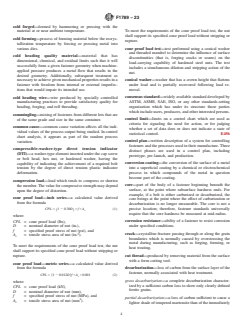
cone proof load—inch series—a calculated value derived from the formula
CPL 5 12 0.30D ×f ×A (1)
~ !
s
where:
CPL = cone proof load (lbs),
D = nominal diameter of nut (in.),
f = specified proof stress of nut (psi), and
A = tensile stress area of nut (in. ).
s
To meet the requirements of the cone proof load test, the nut shall support its specified cone proof load without stripping or rupture.
cone proof load—metric series—a calculated value derived from the formula
CPL 5 ~12 0.012D!f ×A ×0.001 (2)
s
where:
CPL = cone proof load (kN),
D = nominal diameter of nut (mm),
f = specified proof stress of nut (MPa), and
A = tensile stress area of nut (mm ).
s
To meet the requirements of the cone proof load test, the nut shall support its specified cone proof load without stripping or rupture.
cone proof load test—test performed using a conical washer and threaded mandrel to determine the influence of surface
discontinuities (that is, forging cracks or seams) on the load-carrying capability of hardened steel nuts. The test includes a
simultaneous dilation and stripping action of the nut.
conical washer—washer that has a crown height that flattens under load and is partially recovered following load removal.
consensus standard—widely available standard developed by ASTM, ASME, SAE, ISO, or any other standards-setting
organization which has under its structure those parties which include users, producers, and other interested persons.
control limit—limits on a control chart which are used as criteria for signaling the need for action, or for judging whether a
set of data does or does not indicate a state of statistical control. E456
control plan—written description of a system for controlling fasteners and the processes used in their manufacture. Three
distinct phases are used in a control plan, including prototype, pre-launch, and production.
conversion coating—the conversion of the surface of a metal into a superficial coating by a chemical or electrochemical process
in which compounds of the metal in question become part of the coating.
F1789 − 23
core—part of the body of a fastener beginning beneath the surface, at the point where subsurface hardness ends. For example,
if a bolt is either carburized or decarburized, the core beings at the point where the effect of carburization or decarburization
is no longer measurable. The core is not a precise location; therefore, fastener standards universally require that the core hardness
be measured at mid-radius.
corrosion resistance—ability of a fastener to resist corrosion under specified conditions.
crack—crystalline fracture passing through or along the grain boundaries which is normally caused by overstressing the metal
during manufacturing, such as forging, forming, or heat treating.
cut thread—produced by removing material from the surface with a form cutting tool.
decarburization—loss of carbon from the surface layer of the fastener, normally associated with heat treatment.
gross decarburization—a complete decarburization characterized by a sufficient carbon loss to show only clearly defined ferrite
grains.
partial decarburization—a loss of carbon sufficient to cause a lighter shade of tempered martensite than of the immediately
adjacent base metal, but as being of insufficient carbon loss to show clearly defined ferrite grains.
defect—departure of a quality characteristic from its intended level or state (or the sum of departures of different quality
characteristics) that occurs with a severity sufficient to cause a fastener not to satisfy intended normal, or reasonably foreseeable,
usage requirements. The term defect is appropriate for use when a quality characteristic is evaluated in terms of its usage.
deoxidation—process of reducing the oxygen content from steel during the process of steel making, either by adding strong
oxide forming elements, such as silicon or aluminum, or by the process of vacuum degassing to such a level that no oxidation
of carbon or other elements takes place during solidification of steel.
destructive test—test to determine the properties of a material or the behavior of an item which results in the destruction of
the sample or item.
detection process—past-oriented strategy of quality control that attempts to identify the nonconforming product after it has been
produced, and then to separate it from the conforming product.
detection system—system which relies on final inspection as the primary means of controlling the quality of finished fasteners.
distributor—person or organization who purchases fasteners for the purpose of reselling them. A distributor may or may not
alter the fasteners prior to resale. (Significant alterations and insignificant alterations are defined separately.)
drill-drive test—test in which a self-drilling screw is driven into and through a test plate, under specified test conditions, to
determine drilling and thread forming performance characteristics of the screw.
drive test—test in which a tapping screw is driven into a test plate hole to determine thread forming or thread cutting
performance characteristics.
drive torque—the maximum torque to install a screw prior to contact of the head of the fastener with the surface of the test
plate.
F1789 − 23
dry-to-touch—a condition of coated fasteners in which no significant visibly discernable material is transferred when they are
manually gripped with an absorbent material.
ductility of externally threaded fasteners—ability of a fastener to deform before it fractures. Machined test specimens made
from a fastener allow the measurement of elongation and reduction of area which are criteria used to evaluate the specimen.
However, since yielding and fracture normally occur in the screw threads, these are impractical for the actual fastener. Hardness
and the wedge tensile test are ductility indicators for the actual fastener. The lower the ratio of its specified minimum yield
strength to its specified minimum tensile strength, the greater the fastener ductility.
dud—incomplete, mutilated, or foreign part.
effective case depth—perpendicular distance from the surface of a hardened case to the furthest point where a specified level
of hardness is maintained.
elongation—increase in length of the gage length expressed as a percentage of the original gage length.
endurance limit—maximum stress below which a bolt or screw can presumably endure an infinite number of stress cycles.
end user—party that installs the mechanical fastener during assembly of a component or product.
environmental hydrogen embrittlement—can be “corrosion-assisted hydrogen embrittlement” caused by the liberation of
hydrogen during the corrosion process, which is absorbed as atomic hydrogen, resulting in embrittlement under certain
conditions of material strength and applied external stress. The end result is brittle failure. The hydrogen may also be absorbed
from other external chemical sources.
exogenous inclusions—non-metallic particles contained in steel resulting that are unexpected and may not occur within typical
size distributions. These particles may result from incidental reoxidation, slag entrainment, refractory erosion, or other sources,
that can occur during the processes of steel making, refining, and casting.
expansion shells—anchorage devices that expand to grip the sides of a drilled hole mechanically, and transfer load from the
location of the anchor to the bar or bolt F432
extensometer—device for sensing the elongation of fastener material while it is subjected to tensile stress, for the purpose of
measuring linear deformation under controlled test conditions.
eye bolt—bolt having a head which is a closed or open ring which as a threaded shank and has a defined breaking strength, proof
load, and tensile strength.
fastener—see mechanical fastener.
fastener electroplating—electro-deposition by electrolysis of an adherent metallic coating upon a fastener serving as an
electrode. This coating may function as protective, decorative, or in a defined engineering function such as wearability or
abrasive resistance.
fastener manufacturer—organization or firm that procures a raw material, fabricates it into a mechanical fastener, and
processes it to have certain mechanical properties.
fastener quality—conformance of a fastener to its specification for dimensions, mechanical properties, performance
requirements, and other requirements of a specification.
F1789 − 23
fastener specification—precise statement of a set of requirements to be satisfied by a fastener, its material, or its processing.
It also indicates the procedure used to determine whether the requirements given are satisfied.
fastener standard—document which details the attributes of a finished fastener and includes such characteristics as geometry,
material or chemistry, heat treatment, finish, lot size, and packaging.
fastener tensile stress area—assumed cross sectional area of a threaded fastener through the thread, which is used when
computing the load a fastener can support in tension.
fastener testing—determination or verification that the fastener meets its specification requirements.
fatigue limit—see endurance limit.
fatigue strength—maximum stress on an externally threaded fastener which can be tolerated for a specified number of repeated
cycles prior to failure.
fold—doubling over of metal which occurs during forging at or near the intersection of diameter changes which are found on
the shoulders, heads, or shanks of bolts and screws, or on nuts at the intersection of diameter changes on the top face or on the
bottom face.
forging cracks—occur during fastener manufacturing at the cutoff or forging operations and are located on the top of the head
or on the raised periphery of indented head bolts and screws.
forming—primary operation in the fastener industry which includes heading, upsetting, extruding and forging.
fracture—the separation of a fastener or test specimen into two or more separate pieces in service or during testing.
brittle fracture—a separation accompanied by little or no macroscopic or microscopic plastic deformation. The fracture typically
has a bright granular appearance with little or no necking apparent.
ductile fracture—a separation accompanied by tearing with appreciable gross plastic deformation.
full size specimen—tension test specimen consisting of a completed fastener for testing in the ready to use condition without
altering the configuration.
grade identification symbols—inch series standardized symbols denoting the combination of the fastener’s base material, its
strength properties, its performance capabilities, and the engineering standard against which it was produced.
hardness—measure of a material’s ability to resist abrasion or indentation, or both.
head-to-shank integrity—assurance that a headed fastener under load is able to meet its mechanical and performance
requirements without failure at the junction of the head to shank.
heat analysis—chemical analysis of a given heat by the producer which determines the percentages of its elements.
heat control—the control by a manufacturer at any step in the processing of a fastener, which allows identification of the heat
of material from which it is manufactured.
F1789 − 23
heat resistance—extent to which a material retains useful properties as measured during exposure of the material to a specified
temperature and environment for a specified time.
hexavalent chromium—corrosion inhibitor often used in passivation and conversion coatings. It consists of chromium in the
+6 (hexavalent) oxidation state.
high strength bolts—term which is used commercially to denote ASTM A325 or A490 bolts which are primarily used in
construction applications.
high temperature bolts—bolts that are specifically manufactured of high temperature alloys to sustain tensile loads at
temperatures between 500°F and 1800°F, depending upon the alloy and processing during manufacture.
high temperature fastener alloys—those alloys that will maintain their anticipated strength and characteristics within the high
temperature range.
high temperature galvanizing—a galvanizing process carried out in a ceramic vessel (kettle) at an approximate temperature
between 530 and 560°C (990 to 1040°F).
high temperature for mechanical fasteners —this term is generally understood to refer to a temperature range of
approximately 500°F (260°C) to 1800°F (982°C).
hot dip galvanizing—immersion of fasteners in a bath of molten zinc for a controlled time period to obtain specified coating
weight or thickness.
hot forged—formed by hammering or pressing of metal at a temperature which allows recrystallization to occur simultaneously
with deformation, and avoids strain hardening.
hot forming—heat is applied to wire or rod to enhance metal flow into dies using machine applied pressures as opposed to metal
removal by cutting for forming purposes.
hydrogen embrittlement, internal—see internal hydrogen embrittlement.
hydrogen embrittlement relief—process applied to fasteners which reduces or eliminates embrittlement caused by the
absorption of hydrogen during processing. Normally, this is described as a baking operation.
impact strength—often referred to as impact energy; it is the amount of energy required to fracture a fastener, usually measured
by either an Izod or Charpy test.
inch threaded Class 2A coating thickness—a coating thickness which does not exceed ⁄6 of the allowance for Class 2A threads
to avoid interference.
indentation hardness—resistance of a material to indentation. This is the usual type of hardness test in which a pointed or
rounded indenter is pressed into a surface under a substantially static load.
indigenous/endogenous inclusions—non-metallic particles contained in steel that are expected and roughly fit standard size
distributions. These particles may result from deoxidation during the steelmaking process.
in-process control—system that provides a method to detect the variation of product characteristic(s) during manufacturing and
processing and initiates corrective action to maintain the product characteristic(s) within its specified limits.
F1789 − 23
in-process material control and traceability—a system that maintains product traceability back to the original mill heat of raw
material.
in-process sampling inspection—random sample of product drawn from prescribed points of the processing stream (usually
characteristic sensitive) and performing specific inspections and tests to determine conformance of the product at that point of
the processing stream.
inspection—process of measuring, examining, testing, gaging, or using other procedures to ascertain the quality or state of,
detect errors or defects in, or otherwise appraise materials, products, services, systems, or environments to a preestablished
standard.
inspection plan—set of instructions defining product characteristics, specifications, or frequency of inspection, or a combination
thereof, for product at a specified operation.
inspection test—fastener or its selected characteristics tested in process or after manufacture to determine conformance of the
fastener or its selected characteristics to the manufacturing specifications.
inspection torque—torque necessary to maintain tightening motion in a fastener at its fully preloaded installed tension.
installation failure—a failure that occurs during installation of a fastener such that the fastener is no longer able to fulfill its
intended function.
internal hydrogen embrittlement—embrittlement caused by residual hydrogen from fastener processing, such as cleaning,
pickling, phosphating, or electroplating.
ladle analysis—see heat analysis.
liquid medium—liquid used to quench a steel fastener to achieve desired mechanical properties. The selection of the medium
must be compatible with the basic material and geometry to avoid quench cracks.
load-indicating externally threaded fastener—these fasteners utilze mechanical, electronic, or ultrasonic means to indicate
fastener tension. F2482
load indicating fastener—externally threaded fastener equipped with a load indicating device capable of measuring fastener
tension during the tightening process or residual tension after tightening, or both.
local thickness—mean of the thickness measurements of which a specified number is made within a reference area.
locking ability—characteristic intentionally manufactured or added to a fastener to resist loosening.
lot—quantity of product of one part number that has been processed essentially under the same conditions from the same heat
treatment lot and produced from one mill heat of material and submitted for inspection at one time.
lots from blanks—A quantity of bolts or screws having the same diameter which has been manufactured from preformed blanks,
processed essentially under the same conditions from the same heat treatment lot and produced from one mill heat of material and
submitted for inspection at one time. Lots of bolts or screws manufactured from preformed blanks may consist of multiple lengths
and different part numbers as applicable.
lot sampling inspection—random sample drawn from a lot and performing specified inspections and tests to determine the
acceptability of the lot.
F1789 − 23
low carbon martensite—as-quenched phase of low carbon steels, particularly to which Boron has been intentionally added to
increase the hardenability of the material, and some stainless steels.
machine process capability study—study conducted to provide a level of confidence in the ability of a machine/process to meet
engineering specification requirements.
machined specimen—test specimen machined from a full-size fastener to specific dimensions to standardize test results; often
specified when a full-size fastener cannot be reasonably or practically tested.
macro-etch test—immersion of a prepared fastener specimen into a hot acid or aggressive media followed by examination of
the etched surface. The examination is done with the unaided eye or at magnification not exceeding 10×.
macrograph—photographic reproduction of any object that has not been magnified more than ten times.
macroscopic—visible either with the naked eye or under low magnification (as great as about ten diameters).
macrostructure—structure of metal as revealed by macroscopic examination.
magnetic permeability—degree which a material becomes magnetically attractive.
manufacturer—see fastener manufacturermanufacturer. .
martensitic alloys—iron-chromium alloys with 12% to 17% chromium and sufficient carbon to permit strengthening by
conventional heat treatment.
material lap—longitudinal surface discontinuity extending into rod, bar, or wire, caused by doubling over of metal during hot
rolling.
material review—evaluation by a team of fastener experts to determine the fasteners’s fitness for general use, fitness for
intended use, or fitness for specified use.
material specification—proprietary or consensus standards document which defines the material, acceptable chemical limits,
and other requirements used in fastener manufacturing.
material test report—written document or electronic record, signed by an authorized party, attesting that the raw material is
in accordance with specified requirements, including the actual results of all required chemical analyses, tests, and examinations.
maximum hardness—hardness specified in fastener standards above which the fastener is considered nonconforming to the
standard.
mechanical deposition—coating process in which particles of the plating metal are impacted against the fastener surface such
that cold welding of the plating metal to the fastener surface is accomplished.
mechanical fastener—mechanical device that holds or joins two or more components in definite positions with respect to each
other and is often described as a bolt, nut, rivet, screw, washer, or special formed part.
mechanical properties—fastener characteristics which relate to its reaction to applied loads; these properties may be those of
the basic raw material or result from the manufacturing process.
F1789 − 23
metallography—study of the structure of fastener metals using optical or electronic microscopes that produce a magnified
image of the material structure of the fastener.
microstructure—structure of a given metal revealed by microscopic observation of an etched surface.
mid-radius hardness—hardness of the core of a bolt, screw, or stud, measured at mid-radius of a transverse section
approximately one diameter from the point end.
minimum hardness—hardness value of a fastener below which it is not in conformance with the specification.
minimum local thickness—lowest local thickness value on the significant surface of a single article.
modulus of elasticity—for a given material, the ratio of unit stress to unit strain within its elastic range which may be used as
a measure of stiffness. Sometimes called Young’s Modulus.
nick—indentation on the surface of a bolt, nut, screw, or stud. Also referred to as a gouge.
nominal—a convenient numerical term used to express the approximate dimension of a fastener without listing tolerances or
other factors.
non-alteration distributor—distributor of mechanical fasteners who buys, resells, and may repackage the fasteners, but does
not change the individual fasteners in any way.
non-metallic inclusions—subsurface particles such as oxides, nitrides, carbides, or sulfides contained in the steel that are
resultant of physical contamination, deoxidation, precipitation, or subsequent reactions during the steelmaking process.
nonconformance—fastener or fastener component which does not conform to a specification or other inspection standard.
nonferrous alloys—alloys that do not contain iron as their main constituent although iron may be present as an impurity. The
most common nonferrous groups are copper, nickel, aluminum, and titanium alloys.
nut—internally threaded product intended for use on external or male screw threads such as a bolt or a stud for the purpose of
tightening or assembling two or more components.
organic coating—a layer of material on a fastener that has a compound containing a carbon chain as its binder.
part identifying number (PIN)—alphanumeric sequence used to code B18 fasteners. The system was developed by ASME
Standards Committee B18.
passivation—process of forming an oxide film on the surface of stainless steel fasteners by chemical treatment, usually nitric
acid solution, to improve corrosion resistance of stainless steel fasteners.
performance properties—design feature(s) manufactured into the fastener to achieve a specific characteristic relative to the
fastener application, such as torque-tension.
physical properties—those properties inherent in the raw material which remain unchanged or exhibit only slight alteration in
the fastener following manufacture.
F1789 − 23
plain washer—fastener accessory that accepts a bolt or screw through its center hole and provides a surface to distribute bearing
stress. It also serves to provide a surface for head or nut rotation during tightening.
plastic deformation—permanent distortion of a material under the action of applied stresses.
plasticity—ability of the metal to undergo permanent deformation without rupture.
plating—deposition of an adherent metal onto the surface of the base metal of the fastener. A specific process should be
specified; that is, electroplating, hot dip galvanizing, mechanical deposition, etc.
PPM—an acronym for parts per million used as a description of perceived quality. For mechanical fasteners, it is an expression
of the maximum theoretical number of nonconformances in a theoretical million-piece lot.
precipitation hardening alloys—group of alloys that can be hardened by participation of second phases or intermetallic
compounds by cooling during a thermal or thermal-mechanical aging treatment.
pre-launch production plan—written description of the dimensional, mechanical, chemical, and performance testing that will
be carried out during initial production, prior to full production.
prevailing torque—torque necessary to rotate a fastener relative to its mating component with the torque being measured with
the fastener in motion and zero axial load in the assembly.
prevention process—future-oriented strategy that, through analysis and action toward correcting the process itself, enriches
quality through continuous improvement activities.
prevention system—system which outlines advance quality planning, in–process inspection, process controls, and statistical
methods to control the processes and seek continuous improvement.
private label distributor—distributor who, by prearrangement with a manufacturer, markets fasteners identified with the
distributor’s unique identification marking and who assumes responsibility for the fasteners.
process flow—current or anticipated sequential process steps required to produce a fastener.
process parameters—combination of conditions originating from people, measurement, materials, method, and environment
that contribute to a given output.
product analysis—chemical analysis performed on the finished fastener to verify that the chemical composition is within
specified limits.
production lot: zinc coating, hot-dip—batches of fasteners originating from the same manufacturing lot, processed
continuously through cleaning, pickling, fluxing, dipping in molten zinc, and, spun in a centrifuge, or other means, without any
significant change in time, temperature, and concentration of constituents of the process.
production plan—complete written plan of fastener and process characteristics, process controls, tests, and acceptance
procedures that will occur during full production.
proof load, externally threaded fastener—tension applied load that the fastener must support without evidence of permanent
F1789 − 23
deformation (for most carbon or alloy steel fastener strength grades or property classes, proof loads are established at
approximately 90 % to 93 % of the expected minimum yield strength).
proof load, internally threaded fastener—axially-applied load using a bolt or mandrel that must be supported by a nut without
evidence of thread stripping or rupture.
property class—system of strength classifications used for bolts, nuts, and screws manufactured to metric standards.
property class symbols—metric series standardized symbols denoting the combination of the fastener’s base material, its
strength properties, its performance capabi
...