

ASTM E456-13a(2022)e1
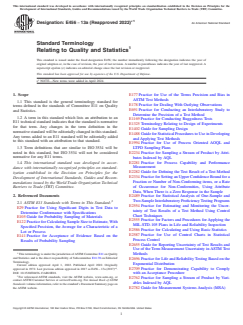
(Terminology)Standard Terminology Relating to Quality and Statistics
General Information
- Abstract
ABSTRACT
This standard is the general terminology standard for terms defined in the standards of Committee E11 on Quality and Statistics. A term in this standard which lists an attribution to an E11 technical standard indicates that the standard is normative for that term. Term definitions that are similar to ISO 3534 will be noted in this standard, but ISO 3534 will not be considered normative for any E11 terms.
SCOPE
1.1 This standard is the general terminology standard for terms defined in the standards of Committee E11 on Quality and Statistics.
1.2 A term in this standard which lists an attribution to an E11 technical standard indicates that the standard is normative for that term. Any changes in the term definition in the normative standard will be editorially changed in this standard. Any terms added to an E11 standard will be editorially added to this standard with an attribution to that standard.
1.3 Term definitions that are similar to ISO 3534 will be noted in this standard, but ISO 3534 will not be considered normative for any E11 terms.
1.4 This international standard was developed in accordance with internationally recognized principles on standardization established in the Decision on Principles for the Development of International Standards, Guides and Recommendations issued by the World Trade Organization Technical Barriers to Trade (TBT) Committee.
- Status
- Published
- Publication Date
- 31-Mar-2022
- Technical Committee
- E11 - Quality and Statistics
- Drafting Committee
- E11.70 - Editorial/Terminology
Overview
ASTM E456-13a(2022)e1 – Standard Terminology Relating to Quality and Statistics establishes a comprehensive set of terms and definitions used in ASTM Committee E11 standards on quality and statistics. This terminology standard serves as a foundational reference, enabling consistent communication and understanding of key concepts in quality assurance, statistics, and related testing procedures. The document is editorially updated as new terms or revised definitions are introduced in associated E11 standards and notes similarities with ISO 3534 Statistical Vocabulary but does not consider ISO 3534 normative for E11.
By aligning with internationally recognized principles-such as those recommended by the World Trade Organization Technical Barriers to Trade (TBT) Committee-ASTM E456 ensures clarity and harmonization in global trade and scientific practice.
Key Topics
- Terminology Harmonization: Provides authoritative definitions for terms commonly used in quality and statistics, ensuring consistency across ASTM E11 standards.
- Attribution to Normative Standards: Notes when a term is defined normatively in another E11 standard, allowing for traceability and editorial updates.
- Comparison to ISO 3534: Identifies where definitions are similar to international terminology, aiding cross-reference while maintaining ASTM-specific guidance.
- Broad Coverage: Addresses statistical concepts like accuracy, precision, bias, sampling, measurement systems, control charts, acceptance sampling, and more.
- Application Flexibility: Terms are applicable to a variety of quality control, testing, and statistical analysis contexts across industries.
Applications
ASTM E456 is valuable for a wide variety of professionals and organizations, including:
- Quality Control and Assurance Personnel: Use the standard for consistent vocabulary in process capability analysis, acceptance sampling plans, and measurement system analysis.
- Laboratory Managers and Analysts: Apply standardized terminology for proficiency testing, interlaboratory studies, and uncertainty assessment.
- Test Method Developers: Reference clear, consistent definitions during method validation, ruggedness testing, and statistical interpretation.
- Auditors and Regulators: Align reporting and assessment with globally recognized terms, facilitating regulatory compliance and audit transparency.
- Trainers and Educators: Standardize training materials and curriculum for quality engineering, statistics, and laboratory science.
Examples of practical use include:
- Establishing clear acceptance criteria using terms like "acceptance quality limit (AQL)" and "average outgoing quality limit (AOQL)."
- Communicating about statistical process control with terms such as "control chart," "confidence interval," and "outlier."
- Clarifying uncertainty reporting and analysis with definitions for "expanded uncertainty," "repeatability," and "reproducibility."
Related Standards
ASTM E456 references and supports terminology across numerous related standards, including:
- ASTM E177 – Practice for Use of the Terms Precision and Bias in ASTM Test Methods
- ASTM E178 – Practice for Dealing With Outlying Observations
- ASTM E691 – Practice for Conducting Interlaboratory Studies to Determine the Precision of a Test Method
- ASTM E2587 – Practice for Use of Control Charts in Statistical Process Control
- ASTM E105 – Guide for Probability Sampling of Materials
- ASTM E2281 – Practice for Process Capability and Performance Measurement
- ASTM E2655 – Guide for Reporting Uncertainty of Test Results and Use of the Term Measurement Uncertainty in ASTM Test Methods
These referenced documents offer expanded guidance for implementing statistical quality control, designing experiments, proficiency testing, and measurement system analysis, complementing the foundational terminology provided in ASTM E456.
Keywords: ASTM E456, standard terminology, quality control, statistics, acceptance sampling, measurement systems analysis, control charts, precision, accuracy, reproducibility, international standards, ISO 3534, laboratory testing.
Relations
- Effective Date
- 01-Apr-2022
- Effective Date
- 01-Apr-2022
- Effective Date
- 01-Apr-2022
- Effective Date
- 01-Apr-2022
- Effective Date
- 01-Apr-2022
- Effective Date
- 01-Apr-2022
- Effective Date
- 01-Apr-2022
- Referred By
ASTM C1271-99(2020) - Standard Test Method for X-ray Spectrometric Analysis of Lime and Limestone - Effective Date
- 01-Apr-2022
- Effective Date
- 01-Apr-2022
- Effective Date
- 01-Apr-2022
- Effective Date
- 01-Apr-2022
- Referred By
ASTM E2862-23 - Standard Practice for Probability of Detection Analysis for Hit/Miss Data - Effective Date
- 01-Apr-2022
- Referred By
ASTM E2943-15(2021) - Standard Guide for Two-Sample Acceptance and Preference Testing With Consumers - Effective Date
- 01-Apr-2022
- Effective Date
- 01-Apr-2022
- Effective Date
- 01-Apr-2022
Frequently Asked Questions
ASTM E456-13a(2022)e1 is a standard published by ASTM International. Its full title is "Standard Terminology Relating to Quality and Statistics". This standard covers: ABSTRACT This standard is the general terminology standard for terms defined in the standards of Committee E11 on Quality and Statistics. A term in this standard which lists an attribution to an E11 technical standard indicates that the standard is normative for that term. Term definitions that are similar to ISO 3534 will be noted in this standard, but ISO 3534 will not be considered normative for any E11 terms. SCOPE 1.1 This standard is the general terminology standard for terms defined in the standards of Committee E11 on Quality and Statistics. 1.2 A term in this standard which lists an attribution to an E11 technical standard indicates that the standard is normative for that term. Any changes in the term definition in the normative standard will be editorially changed in this standard. Any terms added to an E11 standard will be editorially added to this standard with an attribution to that standard. 1.3 Term definitions that are similar to ISO 3534 will be noted in this standard, but ISO 3534 will not be considered normative for any E11 terms. 1.4 This international standard was developed in accordance with internationally recognized principles on standardization established in the Decision on Principles for the Development of International Standards, Guides and Recommendations issued by the World Trade Organization Technical Barriers to Trade (TBT) Committee.
ABSTRACT This standard is the general terminology standard for terms defined in the standards of Committee E11 on Quality and Statistics. A term in this standard which lists an attribution to an E11 technical standard indicates that the standard is normative for that term. Term definitions that are similar to ISO 3534 will be noted in this standard, but ISO 3534 will not be considered normative for any E11 terms. SCOPE 1.1 This standard is the general terminology standard for terms defined in the standards of Committee E11 on Quality and Statistics. 1.2 A term in this standard which lists an attribution to an E11 technical standard indicates that the standard is normative for that term. Any changes in the term definition in the normative standard will be editorially changed in this standard. Any terms added to an E11 standard will be editorially added to this standard with an attribution to that standard. 1.3 Term definitions that are similar to ISO 3534 will be noted in this standard, but ISO 3534 will not be considered normative for any E11 terms. 1.4 This international standard was developed in accordance with internationally recognized principles on standardization established in the Decision on Principles for the Development of International Standards, Guides and Recommendations issued by the World Trade Organization Technical Barriers to Trade (TBT) Committee.
ASTM E456-13a(2022)e1 is classified under the following ICS (International Classification for Standards) categories: 01.040.07 - Natural and applied sciences (Vocabularies); 07.020 - Mathematics. The ICS classification helps identify the subject area and facilitates finding related standards.
ASTM E456-13a(2022)e1 has the following relationships with other standards: It is inter standard links to ASTM E456-13a(2022), ASTM D7705/D7705M-12(2019), ASTM D4781-03(2018)e1, ASTM D8285/D8285M-19, ASTM E2819-11(2021), ASTM E2282-23, ASTM D7914/D7914M-21, ASTM C1271-99(2020), ASTM E1605-22, ASTM D8393-21, ASTM D2344/D2344M-22, ASTM E2862-23, ASTM E2943-15(2021), ASTM D2777-21, ASTM D8287/D8287M-22. Understanding these relationships helps ensure you are using the most current and applicable version of the standard.
ASTM E456-13a(2022)e1 is available in PDF format for immediate download after purchase. The document can be added to your cart and obtained through the secure checkout process. Digital delivery ensures instant access to the complete standard document.
Standards Content (Sample)
This international standard was developed in accordance with internationally recognized principles on standardization established in the Decision on Principles for the
Development of International Standards, Guides and Recommendations issued by the World Trade Organization Technical Barriers to Trade (TBT) Committee.
´1
Designation: E456 − 13a (Reapproved 2022) An American National Standard
Standard Terminology
Relating to Quality and Statistics
This standard is issued under the fixed designation E456; the number immediately following the designation indicates the year of
original adoption or, in the case of revision, the year of last revision. A number in parentheses indicates the year of last reapproval. A
superscript epsilon (´) indicates an editorial change since the last revision or reapproval.
This standard has been approved for use by agencies of the U.S. Department of Defense.
ε NOTE—New terms were added in April 2024.
1. Scope E177 Practice for Use of the Terms Precision and Bias in
ASTM Test Methods
1.1 This standard is the general terminology standard for
E178 Practice for Dealing With Outlying Observations
terms defined in the standards of Committee E11 on Quality
E691 Practice for Conducting an Interlaboratory Study to
and Statistics.
Determine the Precision of a Test Method
1.2 A term in this standard which lists an attribution to an
E1169 Practice for Conducting Ruggedness Tests
E11 technical standard indicates that the standard is normative
E1325 Terminology Relating to Design of Experiments
for that term. Any changes in the term definition in the
E1402 Guide for Sampling Design
normative standard will be editorially changed in this standard.
E1488 Guide for Statistical Procedures to Use in Developing
Any terms added to an E11 standard will be editorially added
and Applying Test Methods
to this standard with an attribution to that standard.
E1994 Practice for Use of Process Oriented AOQL and
1.3 Term definitions that are similar to ISO 3534 will be LTPD Sampling Plans
noted in this standard, but ISO 3534 will not be considered
E2234 Practice for Sampling a Stream of Product by Attri-
normative for any E11 terms.
butes Indexed by AQL
E2281 Practice for Process Capability and Performance
1.4 This international standard was developed in accor-
Measurement
dance with internationally recognized principles on standard-
E2282 Guide for Defining the Test Result of a Test Method
ization established in the Decision on Principles for the
E2334 Practice for Setting an Upper Confidence Bound for a
Development of International Standards, Guides and Recom-
Fraction or Number of Non-Conforming items, or a Rate
mendations issued by the World Trade Organization Technical
of Occurrence for Non-Conformities, Using Attribute
Barriers to Trade (TBT) Committee.
Data, When There is a Zero Response in the Sample
2. Referenced Documents
E2489 Practice for Statistical Analysis of One-Sample and
2 Two-Sample Interlaboratory Proficiency Testing Programs
2.1 ASTM E11 Standards with Terms in This Standard:
E2554 Practice for Estimating and Monitoring the Uncer-
E29 Practice for Using Significant Digits in Test Data to
tainty of Test Results of a Test Method Using Control
Determine Conformance with Specifications
Chart Techniques
E105 Guide for Probability Sampling of Materials
E2555 Practice for Factors and Procedures for Applying the
E122 Practice for Calculating Sample Size to Estimate, With
MIL-STD-105 Plans in Life and Reliability Inspection
Specified Precision, the Average for a Characteristic of a
E2586 Practice for Calculating and Using Basic Statistics
Lot or Process
E2587 Practice for Use of Control Charts in Statistical
E141 Practice for Acceptance of Evidence Based on the
Process Control
Results of Probability Sampling
E2655 Guide for Reporting Uncertainty of Test Results and
Use of the Term Measurement Uncertainty in ASTM Test
This terminology is under the jurisdiction of ASTM Committee E11 on Quality Methods
and Statistics and is the direct responsibility of Subcommittee E11.70 on Editorial/
E2696 Practice for Life and Reliability Testing Based on the
Terminology.
Exponential Distribution
Current edition approved April 1, 2022. Published April 2022. Originally
ɛ6
E2709 Practice for Demonstrating Capability to Comply
approved in 1972. Last previous edition approved in 2017 as E456 – 13a (2017) .
DOI: 10.1520/E0456-13AR22E01.
with an Acceptance Procedure
For referenced ASTM standards, visit the ASTM website, www.astm.org, or
E2762 Practice for Sampling a Stream of Product by Vari-
contact ASTM Customer Service at service@astm.org. For Annual Book of ASTM
ables Indexed by AQL
Standards volume information, refer to the standard’s Document Summary page on
the ASTM website. E2782 Guide for Measurement Systems Analysis (MSA)
Copyright © ASTM International, 100 Barr Harbor Drive, PO Box C700, West Conshohocken, PA 19428-2959. United States
´1
E456 − 13a (2022)
E2819 Practice for Single- and Multi-Level Continuous attributes, method of, n—measurement of quality by the
Sampling of a Stream of Product by Attributes Indexed by method of attributes consists of noting the presence (or
AQL absence) of some characteristic or attribute in each of the
E2935 Practice for Evaluating Equivalence of Two Testing units in the group under consideration, and counting how
Processes many units do (or do not) possess the quality attribute, or
E3080 Practice for Regression Analysis with a Single Pre- how many such events occur in the unit, group, or area.
dictor Variable E2334
E3159 Guide for General Reliability
audit subsample, n—a small subsample of a sample selected
E3264 Guide for Homogeneity of Samples and Reference
for review of all sample selection and data collection
Materials Used for Inter- and Intra-Laboratory Studies
procedures. E141
2.2 ISO Standards:
ISO 3534 Statistics—Vocabulary and Symbols
average outgoing quality (AOQ), n—the average percent
Part 2 Applied Statistics
defective of outgoing product including all accepted lots or
batches, after any defective units found in them are replaced
3. Terminology
by acceptable units, plus all lots or batches which are not
acceptance quality limit (AQL), n—quality limit that is the accepted after such lots or batches have been effectively
worst tolerable process average when a continuing series of 100 % inspected and all defective units replaced by accept-
lots is submitted for acceptance sampling. E2234 able units. E1994
accepted reference value, n—a value that serves as an
average outgoing quality limit (AOQL), n—the maximum of
agreed-upon reference for comparison, and which is derived
the AOQs for all possible incoming percentages defective for
as: (1) a theoretical or established value, based on scientific
the process, for a given acceptance sampling plan. E1994
principles, (2) an assigned or certified value, based on
average quality protection, n—a type of protection in which
experimental work of some national or international
there is prescribed some chosen value of average percent
organization, or (3) a consensus or certified value, based on
defective in the product after inspection (average outgoing
collaborative experimental work under the auspices of a
quality limit (AOQL), that shall not be exceeded in the long
scientific or engineering group. E177
run no matter what may be the level of percent defective in
accuracy, n—the closeness of agreement between a test result
the product submitted to the inspector. E1994
and an accepted reference value. E177
average run length (ARL), n—the average number of times
aliases, n—in a fractional factorial design, two or more effects
that a process will have been sampled and evaluated before
which are estimated by the same contrast and which,
a shift in process level is signaled. E2587
therefore, cannot be estimated separately. E1325
B life, n—for continuous variables, the life at which there is
p
alternative hypothesis, H , n—a probability distribution or
a
a probability (expressed as a percentage) of failure at or less
type of probability distribution distinguished from the null
than this value. E3159
hypothesis. E2586
balanced incomplete block design (BIB), n—an incomplete
analysis of variance (ANOVA), n—statistical models and
block design in which each block contains the same number
associated procedures, in which the observed variance is
k of different versions from the t versions of a single
partitioned into components due to different explanatory
principal factor arranged so that every pair of versions
variables. E1325
occurs together in the same number, λ, of blocks from the b
blocks. E1325
analysis of variance table, n—a tabular summary of results
from a regression model or an experimental design for the
bias, n—the difference between the expectation of the test
purpose of evaluating effects of factors. E1325
results and an accepted reference value. E177
area sampling, n—probability sampling in which a map, rather
binary scale, n—nominal scale with only two possible
than a tabulation of sampling units, serves as the sampling
categories. E2282
frame. E1402
binary test result, n—a test result for which the final value is
assignable cause, n—factor that contributes to variation in a
one of two possible categories. E2282
process or product output that is feasible to detect and
identify (see special cause). E2587
block factor, n—a factor that indexes division of experimental
units into disjoint subsets. E1325
attributes data, n—observed values or test results that indicate
the presence or absence of specific characteristics or counts
bulk sampling, n—sampling to prepare a portion of a mass of
of occurrences of events in time or space. E2587
material that is representative of the whole. E1402
c chart, n—control chart that monitors the count of occur-
Available from International Organization for Standardization (ISO), ISO
rences of an event in a defined increment of time or space.
Central Secretariat, BIBC II, Chemin de Blandonnet 8, CP 401, 1214 Vernier,
Geneva, Switzerland, http://www.iso.org. E2587
´1
E456 − 13a (2022)
calibration, n—process of establishing a relationship between confidence limit, n—each of the limits, L and U, of a
a measurement device and a known standard value(s). confidence interval, or the limit of a one-sided confidence
E2782 interval. E2586
center line, n—line on a control chart depicting the average confounded factorial design, n—a factorial experiment in
level of the statistic being monitored. E2587
which only a fraction of the treatment combinations are run
in each block and where the selection of the treatment
chance cause, n—source of inherent random variation in a
combinations assigned to each block is arranged so that one
process which is predictable within statistical limits (see
or more prescribed effects is (are) confounded with the block
common cause). E2587
effect(s), while the other effects remain free from
confounding. E1325
characteristic, n—a property of items in a sample or popula-
tion which, when measured, counted or otherwise observed,
confounding, n—combining indistinguishably the main effect
helps to distinguish among the items. E2282
of a factor or a differential effect between factors (interac-
tions) with the effect of other factor(s), block factor(s) or
check sample, n—see control sample. E2554
interactions(s). E1325
classification of defects, n—the enumeration of possible de-
consumer’s risk, n—probability that a lot having specified
fects of the unit of product arranged according to their
rejectable quality level will be accepted under a defined
seriousness, that is, critical, major, or minor defect. E2234
sampling plan. E2555
cluster sampling, n—sampling in which the sampling unit
continuous sampling inspection, n—a method of sampling a
consists of a group of subunits, all of which are measured for
stream of product in order of production where the sampling
sampled clusters. E1402
frequency is adjusted based on ongoing inspection results.
coefficient of variation (CV), n—for a nonnegative
E2819
characteristic, the ratio of the standard deviation to the mean
for a population or sample. E2586 contrast, n—a linear function of the observations for which the
sum of the coefficients is zero. E1325
collaborative study, n—interlaboratory study in which each
contrast analysis, n—a technique for estimating the param-
laboratory uses the defined method of analysis to analyze
identical portions of homogeneous materials to assess the eters of a model and making hypothesis tests on preselected
linear combinations of the treatments (contrasts). E1325
performance characteristics obtained for that method of
analysis. E2489
control chart, n—chart on which are plotted a statistical
collaborative trial, n—see collaborative study. E2489
measure of a subgroup versus time of sampling along with
limits based on the statistical distribution of that measure so
common cause, n—see chance cause. E2587
as to indicate how much common, or chance, cause variation
is inherent in the process or product. E2587
completely randomized design, n—a design in which the
treatments are assigned at random to the full set of experi-
control chart factor, n—a tabulated constant, depending on
mental units. E1325
sample size, used to convert specified statistics or parameters
completely randomized factorial design, n—a factorial ex- into a central line value or control limit appropriate to the
control chart. E2587
periment (including all replications) run in a completely
randomized design. E1325
control limits, n—limits on a control chart that are used as
component of variance, n—a part of a total variance identified criteria for signaling the need for action or judging whether
a set of data does or does not indicate a state of statistical
with a specified source of variability. E1488
control based on a prescribed degree of risk. E2587
composite design, n—a design developed specifically for
fitting second order response surfaces to study curvature, control sample, n—sample taken from a stable, homogeneous
constructed by adding further selected treatments to those material for the purposes of monitoring the performance of
n
obtained from a 2 factorial (or its fraction). E1325 a test method in a laboratory. E2554
confidence bound, n—see confidence limit. E2586
critical defect, n—a defect that judgment and experience
indicate would result in hazardous or unsafe conditions for
confidence coefficient, n—see confidence level. E2586
individuals using, maintaining, or depending upon the
confidence interval, n—an interval estimate [L, U] with the product, or a defect that judgment and experience indicate is
statistics L and U as limits for the parameter θ and with likely to prevent performance of the function of a major end
confidence level 1-α, where Pr(L ≤ θ ≤ U) ≥ 1-α. E2586 item. E2234
confidence level, n—the value, 1-α, of the probability associ- critical value, n—in hypothesis testing, the boundary (number)
ated with a confidence interval, often expressed as a of the rejection region for a test statistic in a hypothesis test.
percentage. E2586 E2586
´1
E456 − 13a (2022)
defect, n—any nonconformance of the unit of product with factorial experiment (general), n—in general, an experiment
specified requirements. E2234 in which all possible treatments formed from two or more
factors, each being studied at two or more levels (versions)
degrees of freedom, df, n—the number of independent data
are examined so that interactions (differential effects) as well
points minus the number of parameters that have to be
as main effects can be estimated. E1325
estimated before calculating the variance. E2586
n
2 factorial experiment, n—a factorial experiment in which n
design of experiments, n—the arrangement in which an
factors are studied, each of them in two levels (versions).
experimental program is to be conducted, and the selection
E1325
of the levels (versions) of one or more factors or factor
failure mode, n—the way in which a device, process or system
combinations to be included in the experiment. Synonyms
has failed. E3159
include experiment design and experimental design. E1325
fractional factorial design, n—a factorial experiment in which
double sampling plan, n—a multiple sampling plan in which
only an adequately chosen fraction of the treatments required
up to two samplings can be taken and evaluated to accept or
for the complete factorial experiment is selected to be run.
reject a lot. E2234
E1325
equal complete coverage result, n—the numerical character-
frame, n—a list, compiled for sampling purposes, which
istic of interest calculated from observations made by
designates all of the sampling units (items or groups) of a
drawing randomly from the frame, all of the sampling units
population or universe to be considered in a specific study.
covered by the frame. E141
E1402
equivalence, n—condition that two population parameters
fully nested experiment, n—a nested experiment in which the
differ by no more than predetermined limits. E2935
second factor is nested within levels (versions) of the first
error of result, n—a test result minus the accepted reference
factor and each succeeding factor is nested within versions
value of the characteristic. E2655
of the previous factor. E1325
estimate, n—sample statistic used to approximate a population gage, n—device used as part of the measurement process to
parameter. E2586
obtain a measurement result. E2782
evolutionary operation (EVOP), n—a sequential form of hazard rate, n—differential fraction of items failing at time t
among those surviving up to time t, symbolized by h(t).
experimentation conducted in production facilities during
regular production. E1325 E2555
heterogeneity, n—the condition of a population under which
EWMA chart, n—control chart that monitors the exponen-
items of the population are not of uniform structure or
tially weighted moving averages of consecutive subgroups.
composition with respect to the characteristic of interest.
E2587
E3264
EWMV chart, n—control chart that monitors the exponen-
hierarchical experiment, n—see nested experiment. E1325
tially weighted moving variance. E2587
histogram, n—graphical representation of the frequency dis-
expanded uncertainty, U, n—uncertainty reported as a mul-
tribution of a characteristic consisting of a set of rectangles
tiple of the standard uncertainty. E2655
with area proportional to the frequency. ISO 3534-1, E2586
experimental design, n—see design of experiments. E1325
I chart, n—control chart that monitors the individual subgroup
experimental unit, n—a portion of the experiment space to
observations. E2587
which a treatment is applied or assigned in the experiment.
incomplete block design, n—a design in which the experiment
E1325
space is subdivided into blocks in which there are insuffi-
experiment space, n—the materials, equipment, environmen-
cient experimental units available to run a complete set of
tal conditions and so forth that are available for conducting
treatments or replicate of the experiment. E1325
an experiment. E1325
inspection, n—the process of measuring, examining, testing, or
exponentially weighted moving average (EWMA),
otherwise comparing the unit of product with the
n—weighted average of time-ordered data where the weights
requirements. E2234
of past observations decrease geometrically with age. E2587
inspection by attributes, n—inspection whereby either the
exponentially weighted moving variance (EWMV),
unit of product is classified simply as defective or non-
n—weighted average of squared deviations of observations defective, or the number of defects in the unit of product is
from their current estimate of the process average for time
counted, with respect to a given requirement or set of
ordered observations, where the weights of past squared requirements. E2234
deviations decrease geometrically with age. E2587
inspection by variables, n—inspection wherein the unit of
factor, n—independent variable in an experimental design. product is measured on a continuous scale with respect to a
E1325 given requirement or set of requirements. E2762
´1
E456 − 13a (2022)
inspection lot, n—a collection of units of product produced equal numbers of levels, and for which each treatment
under conditions that are considered uniform and from occurs once in each row and column. E1325
which a sample is drawn and inspected. E2234
level (of a factor), n—a given value, a specification of
interaction, n—differences in responses to a factor among procedure or a specific setting of a factor. E1325
levels (versions) of other factors in the experiment. E1325
life test, n—process of placing one or more units of product
under a specified set of test conditions and measuring the
interlaboratory comparison, n—organization, performance,
time until failure for each unit. E2696
and evaluation of tests on the same or similar test items by
two or more laboratories in accordance with predetermined
limiting quality level (LQL), n—quality level having a
conditions. E2489
specified consumer’s risk for a given sampling plan. E2555
interlaboratory study (ILS), n—a designed procedure for
long term standard deviation, σ , n—sample standard
LT
obtaining a precision statement for a test method, involving
deviation of all individual (observed) values taken over a
multiple laboratories, each generating replicate test results
long period of time. E2281
on one or more materials. E691
lot, n—a definite quantity of a product or material accumulated
intermediate precision, n—precision of test results from tests
under conditions that are considered uniform for sampling
conducted on identical material by the same test method in a
purposes. E2555
single laboratory at the same or various times with one or
more known sources of variability controlled at multiple
lot quality protection, n—a type of protection in which there
levels. E177
is prescribed some chosen value of limiting percent defective
in a lot (lot tolerance percent defective (LTPD)) and also
intermediate precision conditions, n—conditions under
some chosen value for the probability (called the consumer’s
which test results are obtained with the same test method
risk) of accepting a submitted lot that has a percent defective
using test units or test specimens taken at random from a
equal to the lot tolerance percent defective. E1994
single quantity of material that is as nearly homogeneous as
possible, and with changing conditions such as operator,
lot tolerance percent defective (LTPD), n—for purposes of
measuring equipment, location within the laboratory, and acceptance sampling, the percentage of defective units in a
time. E177
lot for which the consumer has a stated low probability of
acceptance of the lot. E1994
th
interquartile range (IQR), n—the 75 percentile (0.75 quan-
th
tile) minus the 25 percentile (0.25 quantile), for a data set. lower control limit (LCL), n—minimum value of the control
E2586 chart statistic that indicates statistical control. E2587
interval scale, n—continuous scale or discrete scale with equal main effect, average effect, n—a term describing a measure
sized scale values and an arbitrary zero. ISO 3534-2, E2282 for the comparison of the responses at each level (version) of
a factor averaged over all levels (versions) of other factors in
item, n—an object or quantity of material on which a set of
the experiment. E1325
observations can be made. E2334
major defect, n—a defect, other than critical, that is likely to
judgment sampling, n—a procedure whereby enumerators
result in failure, or to reduce materially the usability of the
select a few items of the population, based on visual,
unit of product for its intended purpose. E2234
positional or other cues that are believed to be related to the
mean, n—of a population, μ, average or expected value of a
variable of interest, so that the selected items appear to
characteristic in a population; of a sample, x¯, sum of the
match the population. E105
observed values in the sample divided by the sample size.
kurtosis, γ , g , n—for a population or a sample, a measure of
2 2 E2586
the weight of the tails of a distribution relative to the center,
mean time between failures (MTBF), n—the average time to
calculated as the ratio of the fourth central moment (empiri-
failure for a repairable item. E3159
cal if a sample, theoretical if a population applies) to the
standard deviation (sample, s, or population, σ) raised to the
mean time to failure (MTTF), θ, n—in life testing, the
fourth power, minus 3 (also referred to as excess kurtosis).
average length of life of items in a lot. E2696
E2586
measurement process, n—process used to assign a number to
laboratory precision, n—the precision of test results obtained
a property of an object or other physical entity. E2782
within a laboratory for identical material under conditions
that include all known sources of variation within the measurement result, n—number assigned to a property of an
laboratory over extended periods of time, often months.
object or other physical entity being measured. E2782
E177
measurement system, n—the collection of hardware,
latin square, n—a factorial experiment having two block software, procedures and methods, human effort, environ-
factors (rows and columns) and a treatment factor, with mental conditions, associated devices, and the objects that
´1
E456 − 13a (2022)
are measured for the purpose of producing a measurement. distribution, tentatively regarded as true until rejected using
E2782 a statistical hypothesis test. E2586
measurement systems analysis (MSA), n—any of a number number of failures, n—number of failures
...