

ASTM F319-19(2024)
(Practice)Standard Practice for Polarized Light Detection of Flaws in Aerospace Transparency Heating Elements
General Information
- Abstract
SIGNIFICANCE AND USE
4.1 This practice is useful as a screening basis for acceptance or rejection of transparencies during manufacturing so that units with identifiable flaws will not be carried to final inspection for rejection at that time.
4.2 This practice may also be employed as a go-no go technique for acceptance or rejection of the finished product.
4.3 This practice is simple, inexpensive, and effective. Flaws identified by this practice, as with other optical methods, are limited to those that produce temperature gradients when electrically powered. Any other type of flaw, such as minor scratches parallel to the direction of electrical flow, are not detectable.
SCOPE
1.1 This practice covers a standard procedure for detecting flaws in the conductive coating (heater element) by the observation of polarized light patterns.
1.2 This practice applies to coatings on surfaces of monolithic transparencies as well as to coatings imbedded in laminated structures.
1.3 The values stated in SI units are to be regarded as standard. No other units of measurement are included in this standard.
1.4 This standard does not purport to address all of the safety concerns, if any, associated with its use. It is the responsibility of the user of this standard to establish appropriate safety, health, and environmental practices and determine the applicability of regulatory limitations prior to use. For specific precautionary statements, see Section 6.
1.5 This international standard was developed in accordance with internationally recognized principles on standardization established in the Decision on Principles for the Development of International Standards, Guides and Recommendations issued by the World Trade Organization Technical Barriers to Trade (TBT) Committee.
- Status
- Published
- Publication Date
- 30-Apr-2024
- Technical Committee
- F07 - Aerospace and Aircraft
- Drafting Committee
- F07.08 - Transparent Enclosures and Materials

Overview
ASTM F319-19(2024): Standard Practice for Polarized Light Detection of Flaws in Aerospace Transparency Heating Elements defines a reliable optical inspection method for detecting flaws in conductive coatings used as heater elements in aerospace transparencies. This international standard, established by ASTM International, is crucial for both manufacturing and quality assurance in the aerospace sector, enabling early identification of defects that can impact the function and longevity of transparent components such as aircraft windshields and windows.
The standard details a procedure utilizing polarized light to reveal flaws that manifest as hot spots, which can decrease service life or distort vision during operation. The practice applies to coatings on both monolithic and laminated transparency materials, supporting consistent quality across various transparency designs.
Key Topics
Core concepts covered in ASTM F319-19(2024) include:
- Detection of electrically conductive coating flaws: The standard focuses on using polarized light to identify cracks, pinholes, threads, and scratches in heater elements, which can lead to localized heating anomalies.
- Optical inspection process: The method involves directing polarized light through an energized transparency specimen and observing transmitted light patterns with a polarizing filter. Flaws appear as distinct patterns-often 'butterfly' shaped-indicating temperature gradients caused by electrical discontinuities.
- Screening and acceptance: The practice serves as a cost-effective, straightforward screening tool during manufacturing as well as a 'go-no-go' acceptance or rejection step for finished aerospace transparencies.
- Limitations: The technique detects flaws only if they generate temperature gradients when electrically powered. Minor surface flaws aligned with electrical flow, such as fine parallel scratches, are not evident using this method.
- Safety considerations: Proper training and safety precautions are needed due to the use of high voltages and possible handling of glass materials.
Applications
ASTM F319-19(2024) is widely applied in the following contexts:
- Aerospace manufacturing: Used during the manufacturing and assembly of aircraft windows, windshields, and other transparent enclosures that incorporate electrically conductive heating elements.
- Quality control and inspection: Adopted as a quality assurance measure to screen out defective transparencies early in production, reducing waste and rework.
- Maintenance and repair: Useful for field inspections and maintenance of in-service aircraft transparencies to assess functional integrity and identify issues before in-flight deployment.
- Material testing: Applicable to various substrates, including monolithic and laminated plastics or glass, ensuring comprehensive inspection standards across transparency product lines.
The method's simplicity, low cost, and effectiveness make it a preferred option in high-reliability industries such as aerospace, where transparent heating elements must meet strict safety and performance criteria.
Related Standards
A number of other ASTM and international standards are pertinent to aerospace transparency inspection and conductive coating quality:
- ASTM F3002: Standard Guide for Evaluating Articles of Transparent Materials Used in Aerospace Applications
- ASTM D1003: Standard Test Method for Haze and Luminous Transmittance of Transparent Plastics
- ASTM F1915: Standard Specification for Transparent Enclosures, Aircraft
- ISO 14646: Aircraft - Transparent Plastics - Visual Inspection Methods
- SAE ARP 1524: Aerospace Recommended Practice for Inspection of Transparent Panels
Compliance with ASTM F319-19(2024) supports alignment with internationally recognized quality management and product safety requirements in the aerospace industry, as well as with guidelines established by the World Trade Organization Technical Barriers to Trade (TBT) Committee.
Keywords: ASTM F319-19, polarized light inspection, aerospace transparency, conductive coating flaws, heater elements, optical inspection, quality control, aerospace standards
Get Certified
Connect with accredited certification bodies for this standard

BUREAU VERITAS Certification Germany
Bureau Veritas certification in Germany.

Element Materials Technology
Materials testing and product certification.

AQMS Ltd.
AQMS provides ISO certification to SMEs across the UK.
Sponsored listings
Frequently Asked Questions
ASTM F319-19(2024) is a standard published by ASTM International. Its full title is "Standard Practice for Polarized Light Detection of Flaws in Aerospace Transparency Heating Elements". This standard covers: SIGNIFICANCE AND USE 4.1 This practice is useful as a screening basis for acceptance or rejection of transparencies during manufacturing so that units with identifiable flaws will not be carried to final inspection for rejection at that time. 4.2 This practice may also be employed as a go-no go technique for acceptance or rejection of the finished product. 4.3 This practice is simple, inexpensive, and effective. Flaws identified by this practice, as with other optical methods, are limited to those that produce temperature gradients when electrically powered. Any other type of flaw, such as minor scratches parallel to the direction of electrical flow, are not detectable. SCOPE 1.1 This practice covers a standard procedure for detecting flaws in the conductive coating (heater element) by the observation of polarized light patterns. 1.2 This practice applies to coatings on surfaces of monolithic transparencies as well as to coatings imbedded in laminated structures. 1.3 The values stated in SI units are to be regarded as standard. No other units of measurement are included in this standard. 1.4 This standard does not purport to address all of the safety concerns, if any, associated with its use. It is the responsibility of the user of this standard to establish appropriate safety, health, and environmental practices and determine the applicability of regulatory limitations prior to use. For specific precautionary statements, see Section 6. 1.5 This international standard was developed in accordance with internationally recognized principles on standardization established in the Decision on Principles for the Development of International Standards, Guides and Recommendations issued by the World Trade Organization Technical Barriers to Trade (TBT) Committee.
SIGNIFICANCE AND USE 4.1 This practice is useful as a screening basis for acceptance or rejection of transparencies during manufacturing so that units with identifiable flaws will not be carried to final inspection for rejection at that time. 4.2 This practice may also be employed as a go-no go technique for acceptance or rejection of the finished product. 4.3 This practice is simple, inexpensive, and effective. Flaws identified by this practice, as with other optical methods, are limited to those that produce temperature gradients when electrically powered. Any other type of flaw, such as minor scratches parallel to the direction of electrical flow, are not detectable. SCOPE 1.1 This practice covers a standard procedure for detecting flaws in the conductive coating (heater element) by the observation of polarized light patterns. 1.2 This practice applies to coatings on surfaces of monolithic transparencies as well as to coatings imbedded in laminated structures. 1.3 The values stated in SI units are to be regarded as standard. No other units of measurement are included in this standard. 1.4 This standard does not purport to address all of the safety concerns, if any, associated with its use. It is the responsibility of the user of this standard to establish appropriate safety, health, and environmental practices and determine the applicability of regulatory limitations prior to use. For specific precautionary statements, see Section 6. 1.5 This international standard was developed in accordance with internationally recognized principles on standardization established in the Decision on Principles for the Development of International Standards, Guides and Recommendations issued by the World Trade Organization Technical Barriers to Trade (TBT) Committee.
ASTM F319-19(2024) is classified under the following ICS (International Classification for Standards) categories: 49.060 - Aerospace electric equipment and systems. The ICS classification helps identify the subject area and facilitates finding related standards.
ASTM F319-19(2024) is available in PDF format for immediate download after purchase. The document can be added to your cart and obtained through the secure checkout process. Digital delivery ensures instant access to the complete standard document.
Standards Content (Sample)
This international standard was developed in accordance with internationally recognized principles on standardization established in the Decision on Principles for the
Development of International Standards, Guides and Recommendations issued by the World Trade Organization Technical Barriers to Trade (TBT) Committee.
Designation: F319 − 19 (Reapproved 2024)
Standard Practice for
Polarized Light Detection of Flaws in Aerospace
Transparency Heating Elements
This standard is issued under the fixed designation F319; the number immediately following the designation indicates the year of original
adoption or, in the case of revision, the year of last revision. A number in parentheses indicates the year of last reapproval. A superscript
epsilon (´) indicates an editorial change since the last revision or reapproval.
INTRODUCTION
Electrically conductive coatings used in aerospace transparencies for heating purposes often contain
flaws resulting from imperfections of materials, imperfections of manufacturing techniques, handling
damage, or contamination. Flaws develop before, during, or after coating and processing and usually
appear as hairline cracks, scratches, or pin holes. When these flaws are of sufficient size, hot spots
occur as a result of disruption and concentration of the flow of electrical current adjacent to the flaws.
These hot spots may result in reduced service life of the transparency. Hot spot flaws in the
transparency may also produce undesirable temporary distortion of vision during powered operation
of the heater and permanent vision distortion after repeated cycling of the heater.
Polarized light is widely used to detect electrically conductive coating flaws during aerospace
transparency processing.
1. Scope 2. Terminology
1.1 This practice covers a standard procedure for detecting 2.1 Definitions:
flaws in the conductive coating (heater element) by the 2.1.1 transparent conductive coating, n—a transparent thin
observation of polarized light patterns. film of electrically conductive material such as gold, silver, tin
oxide, or indium tin oxide applied to plastic or glass which,
1.2 This practice applies to coatings on surfaces of mono-
when bounded by connecting bus-bars energized by electricity,
lithic transparencies as well as to coatings imbedded in
becomes a resistance type heating element.
laminated structures.
2.1.2 electrically conductive coating flaw, n—an electrical
1.3 The values stated in SI units are to be regarded as
discontinuity in the coating, caused generally by coating
standard. No other units of measurement are included in this
cracks, pin holes, fine threads, scratches, and so forth.
standard.
1.4 This standard does not purport to address all of the 3. Summary of Practice
safety concerns, if any, associated with its use. It is the
3.1 Flaws in electrically powered conductive coatings pro-
responsibility of the user of this standard to establish appro-
duce local concentrations of current, which result in tempera-
priate safety, health, and environmental practices and deter-
ture gradients and stresses. Since glass and plastic transparen-
mine the applicability of regulatory limitations prior to use.
cies are birefringent when stressed, flaws are detectable by
For specific precautionary statements, see Section 6.
optical methods, and in this case by the use of polarized light.
1.5 This international standard was developed in accor-
3.2 This practice consists of directing polarized light
dance with internationally recognized principles on standard-
through a heated transparent test specimen and reading the
ization established in the Decision on Principles for the
transmitted light with a polarizing screen or filter. Diffracted
Development of International Standards, Guides and Recom-
light from the region of the flaw will become visible, in the
mendations issued by the World Trade Organization Technical
form of a brighter or more intense local image, usually shaped
Barriers to Trade (TBT) Committee.
like a butterfly.
4. Significance and Use
This practice is under the jurisdiction of ASTM Committee F07 on Aerospace
and Aircraft and is the direct responsibility of Subcommittee F07.08 on Transparent
4.1 This practice is useful as a screening basis for accep-
Enclosures and Materials.
tance or rejection of transparencies during manufacturing so
Current edition approved May 1, 2024. Published May 2024. Originally
that units with identifiable flaws will not be carried to final
approved in 1977. Last previous edition approved in 2019 as F319 – 19. DOI:
10.1520/F0319-19R24. inspection for rejection at that time.
Copyright © ASTM International, 100 Barr Harbor Drive, PO Box C700, West Conshohocken, PA 19428-2959. United States
F319 − 19 (2024)
4.2 This practice may also be employed as a go-no go test specimen is curved severely, its position may have to be
technique for acceptance or rejection of the finished product. adjusted during inspection so that the light path is within 20° of
normal to the location being viewed. Since specimen size and
4.3 This practice is simple, inexpensive, and effective.
curvature vary considerably, a dimensionally fixed standard is
Flaws identified by this practice, as with other optical methods,
not given.
are limited to those that produce temperature gradients when
electrically powered. Any other type of flaw, such as minor 5.2 The apparatus, in the order of assembly, consists of the
scratches parallel to the direction of electrical flow, are not following:
detectable. 5.2.1 Uniform Light Source, such as a bank of fluorescent
lamps.
5. Apparatus
5.2.2 Translucent Light Diffusion Plate, such as milk-white
glass located so as to provide a uniform light distribution.
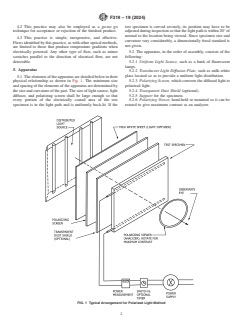
5.1 The elements of the apparatus are detailed below in their
5.2.3 Polarizing Screen, which converts the diffused light to
physical relationship as shown in Fig. 1. The minimum size
polarized light.
and spacing of the elements of the apparatus are determined by
the size and curvature of the part. The size of light source, light 5.2.4 Transparent Dust Shield (optional).
diffuser, and polarizing screen shall be large enough so that 5.2.5 Support for the specimen.
every portion of the electrically coated area of the test 5.2.6 Polarizing Viewer, hand-held or mounted so it can be
specimen is in the light path and is uniformly back-lit. If the rotated to give maximum contrast as an analyzer.
FIG. 1 Typical Arrangement for Polarized Light Method
F319 − 19 (2024)
5.2.7 Electrical Power Supply, regulated. The object of this step is to record defects that are unrelated to
5.2.8 Timer, for controlling power application. the energized conductive coating.
5.2.9 Meters, for measuring power input to
...