

ASTM F2490-20
(Guide)Standard Guide for Aircraft Electrical Load and Power Source Capacity Analysis
General Information
- Abstract
SIGNIFICANCE AND USE
4.1 To show compliance with 14 CFR 23.1351, you must determine the electrical system capacity.
4.2 14 CFR 23.1351(a)(2) states that:
4.2.1 For normal, utility, and acrobatic category airplanes, by an electrical load analysis or by electrical measurements that account for the electrical loads applied to the electrical system in probable combinations and for probable durations; and
4.2.2 For commuter category airplanes, by an electrical load analysis that accounts for the electrical loads applied to the electrical system in probable combinations and for probable durations.
4.3 The primary purpose of the electrical load analysis (ELA) is to determine electrical system capacity (including generating sources, converters, contactors, bus bars, and so forth) needed to supply the worst-case combinations of electrical loads. This is achieved by evaluating the average demand and maximum demands under all applicable flight conditions. A summary can then be used to relate the ELA to the system capacity and can establish the adequacy of the power sources under normal, abnormal, and emergency conditions.
Note 1: The ELA should be maintained throughout the life of the aircraft to record changes to the electrical system, which may add or remove electrical loads to the system.
4.4 The ELA that is produced for aircraft-type certification should be used as the baseline document for any subsequent changes. When possible, the basic format of the original ELA should be followed to ensure consistency in the methodology and approach.
4.5 The original ELA may be lacking in certain information, for instance, time available on emergency battery. It may be necessary to update the ELA using the guidance material contained in this guide.
SCOPE
1.1 This guide covers how to prepare an electrical load analysis (ELA) to meet Federal Aviation Administration (FAA) requirements.
1.2 This guide is intended to address aircraft level electrical load analysis. Electric propulsive power load analysis was not considered in the development of this guide.
1.3 The values stated in SI units are to be regarded as standard.
1.4 This standard does not purport to address all of the safety concerns, if any, associated with its use. It is the responsibility of the user of this standard to establish appropriate safety, health, and environmental practices and determine the applicability of regulatory limitations prior to use.
1.5 This international standard was developed in accordance with internationally recognized principles on standardization established in the Decision on Principles for the Development of International Standards, Guides and Recommendations issued by the World Trade Organization Technical Barriers to Trade (TBT) Committee.
- Status
- Published
- Publication Date
- 31-May-2020
- Technical Committee
- F39 - Aircraft Systems
- Drafting Committee
- F39.01 - Design, Alteration, and Certification of Electrical Systems
Overview
ASTM F2490-20 – Standard Guide for Aircraft Electrical Load and Power Source Capacity Analysis provides comprehensive procedures to evaluate and document the capacity and adequacy of aircraft electrical systems. Developed by ASTM International, this standard supports compliance with Federal Aviation Administration (FAA) requirements, notably 14 CFR 23.1351. This guide assists in preparing an electrical load analysis (ELA) at the aircraft system level, promoting safety and operational reliability.
The standard is applicable to normal, utility, acrobatic, and commuter category airplanes. While it does not address electric propulsive power systems, it ensures that all aircraft electrical loads-under both standard and emergency conditions-are properly accounted for in system capacity analysis. Maintaining an up-to-date ELA is critical for ongoing airworthiness and for managing any changes to the aircraft’s electrical system.
Key Topics
Electrical Load Analysis (ELA) Essentials
The ELA is a core process that identifies all electrical loads, their combinations, and durations under various aircraft operating phases (such as ground, taxi, takeoff, cruise, and landing). Both average and worst-case (peak) loads are considered to verify system capabilities.Regulatory Compliance
To meet FAA regulations (e.g., 14 CFR 23.1351), aircraft manufacturers and operators must use the ELA to demonstrate the sufficiency of electrical sources-including generators, alternators, and batteries-through analytical or measurement-based methods.Phased Load Evaluation
Operators must assess system performance for multiple operational scenarios:- Normal operation: All systems functioning as intended
- Abnormal operation: System components failed but protected
- Emergency operation: Only standby sources (e.g., batteries, auxiliary power units) providing power
System Change Management
The initial ELA prepared for type certification should serve as the baseline for future modifications. Any changes to electrical equipment or configurations require a reevaluation and update of the ELA, maintaining consistent methodology.Battery Capacity and Emergency Loads
Special attention is given to emergency power scenarios, including minimum required operating times (5 or 30 minutes as per regulatory mandates) and battery performance under load.
Applications
Aircraft Type Certification
The primary application of ASTM F2490-20 is in the type certification process, where manufacturers must show that their designs meet FAA standards for electrical system capacity and reliability.Life-Cycle Airworthiness Management
Aircraft operators use the standard to update ELAs following any equipment changes, ensuring continued regulatory compliance and safe operation.Maintenance and Troubleshooting
By providing a structured approach to documenting load and source relationships, the standard aids in identifying system weak points and supports troubleshooting during maintenance.Safety and Operational Assurance
Ensuring that all phases of operation-including emergency conditions-are covered by the ELA provides confidence that essential systems will remain operational under all expected scenarios.
Related Standards
Various documents complement ASTM F2490-20, including:
Federal Regulations
- 14 CFR 23.1351 – General requirements for electrical systems
- 14 CFR 23.1353 – Storage battery design and installation
- 14 CFR 91 and 135 – Operating and flight rules
FAA Advisory Circulars
- AC 23.1309-1C – Equipment, Systems, and Installations in Part 23 Airplanes
- AC 120-136 – Protection of Aircraft Electrical/Electronic Systems Against Lightning
Other Standards and Guides
- MIL-E-7016F – Military analysis of aircraft electric load and power source capacity
- MIL-STD-704F – Aircraft electric power characteristics
- RTCA/DO-160 – Environmental conditions and test procedures for airborne equipment
Key terms: aircraft electrical load analysis, ELA, FAA compliance, power source capacity, aviation safety, aircraft type certification, emergency operation, ASTM F2490-20.
By adhering to ASTM F2490-20, manufacturers and operators help ensure that aircraft electrical systems are robust, compliant with regulatory requirements, and capable of supporting all necessary functions-enhancing both safety and operational effectiveness throughout the aircraft’s service life.
Get Certified
Connect with accredited certification bodies for this standard

BUREAU VERITAS Certification Germany
Bureau Veritas certification in Germany.

Element Materials Technology
Materials testing and product certification.

AQMS Ltd.
AQMS provides ISO certification to SMEs across the UK.
Sponsored listings
Frequently Asked Questions
ASTM F2490-20 is a guide published by ASTM International. Its full title is "Standard Guide for Aircraft Electrical Load and Power Source Capacity Analysis". This standard covers: SIGNIFICANCE AND USE 4.1 To show compliance with 14 CFR 23.1351, you must determine the electrical system capacity. 4.2 14 CFR 23.1351(a)(2) states that: 4.2.1 For normal, utility, and acrobatic category airplanes, by an electrical load analysis or by electrical measurements that account for the electrical loads applied to the electrical system in probable combinations and for probable durations; and 4.2.2 For commuter category airplanes, by an electrical load analysis that accounts for the electrical loads applied to the electrical system in probable combinations and for probable durations. 4.3 The primary purpose of the electrical load analysis (ELA) is to determine electrical system capacity (including generating sources, converters, contactors, bus bars, and so forth) needed to supply the worst-case combinations of electrical loads. This is achieved by evaluating the average demand and maximum demands under all applicable flight conditions. A summary can then be used to relate the ELA to the system capacity and can establish the adequacy of the power sources under normal, abnormal, and emergency conditions. Note 1: The ELA should be maintained throughout the life of the aircraft to record changes to the electrical system, which may add or remove electrical loads to the system. 4.4 The ELA that is produced for aircraft-type certification should be used as the baseline document for any subsequent changes. When possible, the basic format of the original ELA should be followed to ensure consistency in the methodology and approach. 4.5 The original ELA may be lacking in certain information, for instance, time available on emergency battery. It may be necessary to update the ELA using the guidance material contained in this guide. SCOPE 1.1 This guide covers how to prepare an electrical load analysis (ELA) to meet Federal Aviation Administration (FAA) requirements. 1.2 This guide is intended to address aircraft level electrical load analysis. Electric propulsive power load analysis was not considered in the development of this guide. 1.3 The values stated in SI units are to be regarded as standard. 1.4 This standard does not purport to address all of the safety concerns, if any, associated with its use. It is the responsibility of the user of this standard to establish appropriate safety, health, and environmental practices and determine the applicability of regulatory limitations prior to use. 1.5 This international standard was developed in accordance with internationally recognized principles on standardization established in the Decision on Principles for the Development of International Standards, Guides and Recommendations issued by the World Trade Organization Technical Barriers to Trade (TBT) Committee.
SIGNIFICANCE AND USE 4.1 To show compliance with 14 CFR 23.1351, you must determine the electrical system capacity. 4.2 14 CFR 23.1351(a)(2) states that: 4.2.1 For normal, utility, and acrobatic category airplanes, by an electrical load analysis or by electrical measurements that account for the electrical loads applied to the electrical system in probable combinations and for probable durations; and 4.2.2 For commuter category airplanes, by an electrical load analysis that accounts for the electrical loads applied to the electrical system in probable combinations and for probable durations. 4.3 The primary purpose of the electrical load analysis (ELA) is to determine electrical system capacity (including generating sources, converters, contactors, bus bars, and so forth) needed to supply the worst-case combinations of electrical loads. This is achieved by evaluating the average demand and maximum demands under all applicable flight conditions. A summary can then be used to relate the ELA to the system capacity and can establish the adequacy of the power sources under normal, abnormal, and emergency conditions. Note 1: The ELA should be maintained throughout the life of the aircraft to record changes to the electrical system, which may add or remove electrical loads to the system. 4.4 The ELA that is produced for aircraft-type certification should be used as the baseline document for any subsequent changes. When possible, the basic format of the original ELA should be followed to ensure consistency in the methodology and approach. 4.5 The original ELA may be lacking in certain information, for instance, time available on emergency battery. It may be necessary to update the ELA using the guidance material contained in this guide. SCOPE 1.1 This guide covers how to prepare an electrical load analysis (ELA) to meet Federal Aviation Administration (FAA) requirements. 1.2 This guide is intended to address aircraft level electrical load analysis. Electric propulsive power load analysis was not considered in the development of this guide. 1.3 The values stated in SI units are to be regarded as standard. 1.4 This standard does not purport to address all of the safety concerns, if any, associated with its use. It is the responsibility of the user of this standard to establish appropriate safety, health, and environmental practices and determine the applicability of regulatory limitations prior to use. 1.5 This international standard was developed in accordance with internationally recognized principles on standardization established in the Decision on Principles for the Development of International Standards, Guides and Recommendations issued by the World Trade Organization Technical Barriers to Trade (TBT) Committee.
ASTM F2490-20 is classified under the following ICS (International Classification for Standards) categories: 49.060 - Aerospace electric equipment and systems. The ICS classification helps identify the subject area and facilitates finding related standards.
ASTM F2490-20 is available in PDF format for immediate download after purchase. The document can be added to your cart and obtained through the secure checkout process. Digital delivery ensures instant access to the complete standard document.
Standards Content (Sample)
This international standard was developed in accordance with internationally recognized principles on standardization established in the Decision on Principles for the
Development of International Standards, Guides and Recommendations issued by the World Trade Organization Technical Barriers to Trade (TBT) Committee.
Designation: F2490 − 20
Standard Guide for
Aircraft Electrical Load and Power Source Capacity
Analysis
This standard is issued under the fixed designation F2490; the number immediately following the designation indicates the year of
original adoption or, in the case of revision, the year of last revision.Anumber in parentheses indicates the year of last reapproval.A
superscript epsilon (´) indicates an editorial change since the last revision or reapproval.
1. Scope 14 CFR 23.1529Normal, Utility, Acrobatic, and Commuter
Category Airplanes—Instructions for Continued Airwor-
1.1 This guide covers how to prepare an electrical load
thiness
analysis(ELA)tomeetFederalAviationAdministration(FAA)
14 CFR 91General Operating and Flight Rules
requirements.
14 CFR 135.163Operating Requirements: Commuter and
1.2 This guide is intended to address aircraft level electrical
On Demand Operations and Rules Governing Persons on
load analysis. Electric propulsive power load analysis was not
Board Such Aircraft—Equipment Requirements: Aircraft
considered in the development of this guide.
Carrying Passengers under IFR
1.3 The values stated in SI units are to be regarded as
standard. 3. Terminology
1.4 This standard does not purport to address all of the
3.1 Definitions of Terms Specific to This Standard:
safety concerns, if any, associated with its use. It is the
3.1.1 abnormal electrical power operation (or abnormal
responsibility of the user of this standard to establish appro-
operation), n—occurs when a malfunction or failure in the
priate safety, health, and environmental practices and deter-
electric system has taken place and the protective devices of
mine the applicability of regulatory limitations prior to use.
the system are operating to remove the malfunction or failure
1.5 This international standard was developed in accor-
fromtheremainderofthesystembeforethelimitsofabnormal
dance with internationally recognized principles on standard-
operation are exceeded.
ization established in the Decision on Principles for the
3.1.1.1 Discussion—The power source may operate in a
Development of International Standards, Guides and Recom-
degraded mode on a continuous basis when the power charac-
mendations issued by the World Trade Organization Technical
teristics supplied to the using equipment exceed normal opera-
Barriers to Trade (TBT) Committee.
tionlimitsbutremainwithinthelimitsforabnormaloperation.
3.1.2 alternate source, n—secondpowersourcethatmaybe
2. Referenced Documents
used instead of the normal source, usually on failure of the
2.1 FAA Aeronautics and Space Airworthiness Standards:
normal source.
14 CFR 23.1309Normal, Utility, Acrobatic, and Commuter
3.1.2.1 Discussion—The use of alternate sources creates a
Category Airplanes—Equipment, Systems, and Installa-
new load and power configuration and, therefore, a new
tions
electrical system that may require separate source capacity
14 CFR 23.1351Normal, Utility, Acrobatic, and Commuter
analysis.
Category Airplanes—General
3.1.3 cruise, n—condition during which the aircraft is in
14 CFR 23.1353Normal, Utility, Acrobatic, and Commuter
level flight.
Category Airplanes—Storage Battery Design and Instal-
3.1.4 electrical source, n—electrical equipment that
lation
produces, converts, or transforms electrical power.
14 CFR 23.1419Normal, Utility, Acrobatic, and Commuter
Category Airplanes—Ice Protection 3.1.5 electrical system, n—consists of an electrical power
source, the electrical wiring interconnection system, and the
electrical load(s) connected to that system.
This guide is under the jurisdiction of ASTM Committee F39 on Aircraft
3.1.6 emergency electrical power operation (or emergency
Systems and is the direct responsibility of Subcommittee F39.01 on Design,
operation), n—condition that occurs following a loss of all
Alteration, and Certification of Electrical Systems.
CurrenteditionapprovedJune1,2020.PublishedJuly2020.Originallyapproved
normalelectricalgeneratingpowersourcesoranothermalfunc-
in 2005. Last previous edition approved in 2013 as F2490–05 (2013). DOI:
tion that results in operation on standby power (batteries or
10.1520/F2490-20.
other emergency generating source such as an auxiliary power
Available from U.S. Government Publishing Office (GPO), 732 N. Capitol St.,
NW, Washington, DC 20401, http://www.gpo.gov. unit (APU) or ram air turbine (RAT)) only, or both).
Copyright © ASTM International, 100 Barr Harbor Drive, PO Box C700, West Conshohocken, PA 19428-2959. United States
F2490 − 20
3.1.7 ground operation and loading, n—time spent in pre- changes. When possible, the basic format of the original ELA
paring the aircraft before the aircraft engine starts. should be followed to ensure consistency in the methodology
3.1.7.1 Discussion—During this period, the APU, internal and approach.
batteries,oranexternalpowersourcesupplieselectricalpower.
4.5 TheoriginalELAmaybelackingincertaininformation,
3.1.8 landing, n—condition starting with the operation of
for instance, time available on emergency battery. It may be
navigational and indication equipment specific to the landing
necessary to update the ELA using the guidance material
approach and following until the completion of the rollout.
contained in this guide.
3.1.9 nominalrating,n—thisratingofaunitpowersourceis
its nameplate rating and is usually a continuous duty rating for 5. Basic Principles
specified operating conditions.
5.1 Aloadanalysisisessentiallyasummationoftheelectric
3.1.10 normal ambient conditions, n—typical operating
loadsappliedtotheelectricalsystemduringspecifiedoperating
conditions such as temperature and pressure as defined by the
conditions of the aircraft. The ELArequires the listing of each
manufacturer’s technical documentation.
item or circuit of electrically powered equipment and the
associated power requirement. Note that the power require-
3.1.11 normal electrical power operation (or normal
ment for an item may have several values, depending on the
operation), n—assumes that all the available electrical power
utilization for each phase of aircraft operation.
system is functioning correctly with no failures or within the
Master Minimum Equipment List (MMEL) limitations, if a
5.2 To arrive at an overall evaluation of electrical power
MMEL has been approved (for example, direct current (DC)
requirement, it is necessary to give adequate consideration to
generators,transformerrectifierunits,inverters,mainbatteries,
transient demand requirements, which are of orders of magni-
APU, and so forth).
tude or duration to impair system voltage or frequency
3.1.12 normal source, n—provides electrical power
stability, or both, or to exceed short-time ratings of power
throughout the routine aircraft operation. sources, that is, intermittent/momentary and cyclic loads. This
isessential,sincetheultimateuseofanaircraft’sELAisforthe
3.1.13 takeoff and climb, n—condition starting with the
proper selection of characteristics and capacity of power-
takeoff run and ending with the aircraft leveled off and set for
source components and the resulting assurance of satisfactory
cruising.
performance of equipment under normal, abnormal, and emer-
3.1.14 taxi, n—condition from the aircraft’s first movement
gency operating power conditions.
under its own power to the start of the takeoff run and from
5.3 A large majority of general aviation aircraft uses only
completion of landing rollout to engine shutdown.
DCpower.IfanaircraftalsousesACpower,theELAwillhave
to include the AC loads as well.
4. Significance and Use
4.1 To show compliance with 14 CFR 23.1351, you must
6. Procedure for Preparation of Electrical Load Analysis
determine the electrical system capacity.
6.1 Content—The load and power source capacity analysis
4.2 14 CFR 23.1351(a)(2) states that:
report should include the following sections:
4.2.1 For normal, utility, and acrobatic category airplanes,
6.1.1 Introduction,
by an electrical load analysis or by electrical measurements
6.1.2 Assumptions and Criteria,
that account for the electrical loads applied to the electrical
system in probable combinations and for probable durations; 6.1.3 Load Analysis—Tabulation of Values,
and
6.1.4 Emergency and Standby Power Operation, and
4.2.2 Forcommutercategoryairplanes,byanelectricalload
6.1.5 Summary and Conclusions.
analysis that accounts for the electrical loads applied to the
6.2 Introduction:
electrical system in probable combinations and for probable
6.2.1 The introduction to the ELA report should include
durations.
informationtoassistthereaderinunderstandingthefunctionof
4.3 The primary purpose of the electrical load analysis
the electrical system with respect to the operational phases of
(ELA) is to determine electrical system capacity (including
the aircraft.
generating sources, converters, contactors, bus bars, and so
6.2.2 Typically, the introduction to the ELAshould contain
forth) needed to supply the worst-case combinations of elec-
the following:
tricalloads.Thisisachievedbyevaluatingtheaveragedemand
6.2.2.1 Brief description of aircraft type, which may also
and maximum demands under all applicable flight conditions.
include the expected operating role for the aircraft;
A summary can then be used to relate the ELA to the system
6.2.2.2 Electricalsystemoperation,whichdescribesnormal,
capacity and can establish the adequacy of the power sources
abnormal, and emergency operations, bus configuration with
under normal, abnormal, and emergency conditions.
circuit breakers, and connected loads for each bus. A copy of
NOTE 1—The ELA should be maintained throughout the life of the
the bus wiring diagram or electrical schematic should also be
aircraft to record changes to the electrical system, which may add or
remove electrical loads to the system.
included in the report;
4.4 The ELA that is produced for aircraft-type certification 6.2.2.3 Generator, alternator, and other power source de-
should be used as the baseline document for any subsequent scription and related data (including such items as battery
F2490 − 20
discharge curves, inverter, emergency battery, and so forth). 6.4.1.2 Condition of Power Sources—Normal, abnormal
Typical data supplied for power sources would be as shown in (abnormal conditions to be specified, for example, one genera-
Table 1; tor inoperative, two generators inoperative, and so forth), and
6.2.2.4 Operating logic of system (for example, automatic emergency.
switching, loading shedding, and so forth); and
6.4.1.3 Aircraft Operating Phases—The following aircraft
6.2.2.5 List of installed equipment.
operating phases should be considered for the ELA. Assume
“night” conditions as the worst-case scenario.
6.3 Assumptions and Criteria—All assumptions and design
criteria used for the analysis should be stated in this section of
NOTE 2—Icing conditions should be considered for worst-case sce-
the ELA. For example, typical assumptions for the analysis
narios if the aircraft is approved for flight into known icing in accordance
may be identified as follows: with 14 CFR 23.1419. However, in some cases, the icing system is
deactivated or not installed, so icing may not always be the worst-case.
6.3.1 Most severe loading conditions and operational envi-
ronment in which the airplane will be expected to operate are
6.4.1.4 Permissible Nonserviceable Conditions—Theanaly-
assumed to be night and in icing conditions;
sis should also identify permissible nonserviceable conditions
6.3.2 Momentary/intermittent loads, such as electrically op-
likely to be authorized in the MMEL, if approved, during the
erated valves, that open and close in a few seconds are not
certification of the airplane and should include calculations
included in the calculations;
appropriatetothesecases.AllMMELitemsmustbeaccounted
6.3.3 Motor load demands are shown for steady-state op-
for in the load analysis to ensure that the electrical system
eration and do not include starting inrush power. The overload
capacity is not exceeded when all items are functional.
ratingsofthepowersourcesshouldbeshowntobeadequateto
6.4.1.5 Circuit Breaker—Identify each circuit breaker by
provide motor starting inrush requirements;
circuit name or identification number.
6.3.4 Intermittent loads such as communications equipment
6.4.1.6 Load at Circuit Breaker—The ampere loading for
(radios, for example, VHF/HF communication systems) that
each circuit.
may have different current consumption depending on operat-
6.4.1.7 Operating Time:
ing mode (that is, transmit or receive);
(1)The operating time is usually expressed as a period of
6.3.5 Maximum continuous demand of the electrical power
time (seconds/minutes) or may be continuous, as appropriate.
system must not exceed 100% of the load limits of the
Equipment operating time is often related to the average
alternator(s) or generator(s) that are equipped with current
operatingtimeoftheaircraft.Ifthe“on”timeoftheequipment
monitoring capability;
is the same or close to the average operating time of the
6.3.6 Cyclicloadssuchasheaters,pumps,andsoforth(duty
aircraft, then it could be considered that the equipment is
cycle); and
operating continuously for all flight phases.
6.3.7 Estimation of load current, assuming a voltage drop
(2)In such cases in which suitable provisions have been
between bus bar and load.
made to ensure that certain loads cannot operate
6.4 Load Analysis—Tabulation of Values—A typical load
simultaneously, or there is reason for assuming certain combi-
and power source analysis would identify the following details
nations of load will not occur, appropriate allowances may be
in tabular form:
made. Adequate explanation should be given in the summary.
6.4.1 Connected Load Table—See Appendix X1.
(3)In some instances, it may be useful to tabulate the data
6.4.1.1 Aircraft Bus—Identify the appropriate electrical bus
using a specified range for equipment operating times, such as
being evaluated. In a multiple bus configuration, there will be
follows:
a set of tables for each bus (that is, DC Bus 1, DC Bus 2,AC
5 s Analysis All loads that last longer than 0.3 s
Bus 1, Battery Bus, and so forth).
should be entered in this column.
5 min Analysis All loads that last longer than 5 s
should be entered in this column.
TABLE 1 Typical Data for Power Sources
Continuous Analysis All loads that last longer than 5
Identification 1 2 3
min should be entered in this column.
Item DC Generator Inverter Battery
(4)Alternatively, the equipment operating times could be
Number of units 2 1 1
expressed as actual operating time of equipment in seconds or
Continuous rating 250 A 300 VA (total) 35 Ah
(Nameplate) . . . . . . . . . minutes or as continuous operation. In the example given in
5srating 400A . .
Appendix X1, the approach taken is to show either continuous
2 min rating 300 A . . . . . .
operation or to identify a specific operating time in seconds/
Voltage 30 V 115 VAC 24 VDC
Frequency . . . 400 Hz . . . minutes.
Power factor . . . 0.8 . . .
6.4.1.8 Condition of Aircraft Operation—Phase of preflight
Manufacturer ABC XYZ ABC
Model number 123 456 789
and flight (such as ground operation and loading, taxi, takeoff,
Voltage regulation ±0.6 V ±2 % . . .
cruise, and land). For aircraft, the conditions in Table 2 could
Frequency regulation . . . 400 Hz ± 1 % . . .
be considered.
F2490 − 20
TABLE 2 Condition of Aircraft Operation to the flight crew. Where automatic load shedding is provided, a
description of the load(s) that will be shed should be provided with any
Ground operations and loading 15 min typically
specific sequencing, if applicable.
Engine start 5 min typically
Taxi 10 min typically
6.5 Emergency or Standby Power Operations:
Takeoff and climb 20 min typically
6.5.1 Wherestandbypowerisprovidedbynon-time-limited
Cruise as appropriate for aircraft type
Landing 20 min typically
sources such as a RAT, APU, and pneumatic or hydraulic
motor,theemergencyloadsshouldbelistedandevaluatedsuch
that the demand does not exceed the capacity of the standby
6.4.2 Calculations:
power source.
6.4.2.1 The following equations can be used to estimate
6.5.2 When a battery is used to provide a time-limited
totalcurrent,totalcurrentrate,andaveragedemandforeachof
emergency supply, an analysis of battery capacity should be
the aircraft operating phases (ground operation and loading,
undertaken. This should be compared with the time necessary
engine start, taxi, takeoff and climb, cruise, and landing):
for the particular phase (for example, from gear extension to
landing, including rollout) of the flight in which batteries are
TotalCurrent A 5SumofAllCurrentLoads (1)
~ !
used instead of normal electrical power sources.
Operatingata GivenTime
6.5.3 Five Minutes of Electrical Power Requirement by
14 CFR 23.1351(g):
TotalCurrentRate ~A 2min!5 (2)
6.5.3.1 The ELAmust show the airplane can operate safely
NumberofUnitsOperatingSimultaneously 3CurrentperUnit ~A!3
in visual flight rules (VFR) conditions and initially at the
maximum certificated altitude for a period of not less than 5
OperatingTime min
~ !
min during emergency operation conditions.
AverageDemandorAverageLoad A 5TotalCurrent A
~ ! ~ 6.5.4 Thirty Minutes of Electrical Power Requirement by
14 CFR 23.1353(h):
2min!÷DurationofGroundorFlightPhase ~min! (3)
6.5.4.1 Thissectionaddressesthe30minofelectricalpower
6.4.2.2 It can be considered that at the start of each
requirement under 14 CFR 23.1353(h) incorporated by
operating period (for example, taxi, takeoff, and so forth), all
Amendment 23-49. This guide only addresses the requirement
equipment that operates during that phase is switched “on,”
of 14 CFR 23.1353(h) and not the electrical power require-
with intermittent loads gradually being switched “off.”
ments that an airplane can operate safely in VFR conditions
6.4.3 Additional Considerations for Non-Ohmic or Con-
under 14 CFR 23.1351(g) or the electrical power sources
stant Power Devices (for example, Inverters)—In some cases,
require
...
This document is not an ASTM standard and is intended only to provide the user of an ASTM standard an indication of what changes have been made to the previous version. Because
it may not be technically possible to adequately depict all changes accurately, ASTM recommends that users consult prior editions as appropriate. In all cases only the current version
of the standard as published by ASTM is to be considered the official document.
Designation: F2490 − 05 (Reapproved 2013) F2490 − 20
Standard Guide for
Aircraft Electrical Load and Power Source Capacity
Analysis
This standard is issued under the fixed designation F2490; the number immediately following the designation indicates the year of
original adoption or, in the case of revision, the year of last revision. A number in parentheses indicates the year of last reapproval. A
superscript epsilon (´) indicates an editorial change since the last revision or reapproval.
1. Scope
1.1 This guide covers how to prepare an electrical load analysis (ELA) to meet Federal Aviation Administration (FAA)
requirements.
1.2 This guide is intended to address aircraft level electrical load analysis. Electric propulsive power load analysis was not
considered in the development of this guide.
1.3 The values givenstated in SI units are to be regarded as the standard.
1.4 This standard does not purport to address all of the safety concerns, if any, associated with its use. It is the responsibility
of the user of this standard to establish appropriate safety safety, health, and healthenvironmental practices and determine the
applicability of regulatory limitations prior to use.
1.5 This international standard was developed in accordance with internationally recognized principles on standardization
established in the Decision on Principles for the Development of International Standards, Guides and Recommendations issued
by the World Trade Organization Technical Barriers to Trade (TBT) Committee.
2. Referenced Documents
2.1 FAA Aeronautics and Space Airworthiness Standards:
14 CFR 23.1309 Normal, Utility, Acrobatic, and Commuter Category Airplanes—Equipment, Systems, and Installations
14 CFR 23.1351 Normal, Utility, Acrobatic, and Commuter Category Airplanes—General
14 CFR 23.1353 Normal, Utility, Acrobatic, and Commuter Category Airplanes—Storage Battery Design and Installation
14 CFR 23.1419 Normal, Utility, Acrobatic, and Commuter Category Airplanes—Ice Protection
14 CFR 23.1529 Normal, Utility, Acrobatic, and Commuter Category Airplanes—Instructions for Continued Airworthiness
14 CFR 91 General Operating and Flight Rules
14 CFR 135.163 Operating Requirements: Commuter and On Demand Operations and Rules Governing Persons on Board Such
Aircraft—Equipment Requirements: Aircraft Carrying Passengers under IFR
3. Terminology
3.1 Definitions of Terms Specific to This Standard:
3.1.1 abnormal electrical power operation (or abnormal operation), n—occurs when a malfunction or failure in the electric
system has taken place and the protective devices of the system are operating to remove the malfunction or failure from the
remainder of the system before the limits of abnormal operation are exceeded.
3.1.1.1 Discussion—
The power source may operate in a degraded mode on a continuous basis when the power characteristics supplied to the using
equipment exceed normal operation limits but remain within the limits for abnormal operation.
3.1.2 alternate source, n—second power source that may be used instead of the normal source, usually on failure of the normal
source.
This guide is under the jurisdiction of ASTM Committee F39 on Aircraft Systems and is the direct responsibility of Subcommittee F39.01 on Design, Alteration, and
Certification of Electrical Systems.
Current edition approved July 1, 2013June 1, 2020. Published September 2013July 2020. Originally approved in 2005. Last previous edition approved in 20052013 as
ε1
F2490 – 05 (2013). . DOI: 10.1520/F2490-05R13.10.1520/F2490-20.
Available from U.S. Government Printing Office Superintendent of Documents, Publishing Office (GPO), 732 N. Capitol St., NW, Mail Stop: SDE, Washington, DC
20401.20401, http://www.gpo.gov.
Copyright © ASTM International, 100 Barr Harbor Drive, PO Box C700, West Conshohocken, PA 19428-2959. United States
F2490 − 20
3.1.2.1 Discussion—
The use of alternate sources creates a new load and power configuration and, therefore, a new electrical system that may require
separate source capacity analysis.
3.1.3 cruise, n—condition during which the aircraft is in level flight.
3.1.4 electrical source, n—electrical equipment that produces, converts, or transforms electrical power.
3.1.5 electrical system, n—consists of an electrical power source, the electrical wiring interconnection system, and the electrical
load(s) connected to that system.
3.1.6 emergency electrical power operation (or emergency operation), n—condition that occurs following a loss of all normal
electrical generating power sources or another malfunction that results in operation on standby power (batteries or other emergency
generating source such as an auxiliary power unit (APU) or ram air turbine (RAT)) only, or both).
3.1.7 ground operation and loading, n—time spent in preparing the aircraft before the aircraft engine starts.
3.1.7.1 Discussion—
During this period, the APU, internal batteries, or an external power source supplies electrical power.
3.1.8 landing, n—condition starting with the operation of navigational and indication equipment specific to the landing approach
and following until the completion of the rollout.
3.1.9 nominal rating, n—this rating of a unit power source is its nameplate rating and is usually a continuous duty rating for
specified operating conditions.
3.1.10 normal ambient conditions, n—typical operating conditions such as temperature and pressure as defined by the
manufacturer’s technical documentation.
3.1.11 normal electrical power operation (or normal operation) , operation), n—assumes that all the available electrical power
system is functioning correctly with no failures or within the Master Minimum Equipment List (MMEL) limitations, if a MMEL
has been approved (for example, direct current (DC) generators, transformer rectifier units, inverters, main batteries, APU, and so
forth).
3.1.12 normal source, n—provides electrical power throughout the routine aircraft operation.
3.1.13 takeoff and climb, n—condition starting with the takeoff run and ending with the aircraft leveled off and set for cruising.
3.1.14 taxi, n—condition from the aircraft’saircraft’s first movement under its own power to the start of the takeoff run and from
completion of landing rollout to engine shutdown.
4. Significance and Use
4.1 To show compliance with 14 CFR 23.1351, you must determine the electrical system capacity.
4.2 14 CFR 23.1351(a)(2) states that:
4.2.1 For normal, utility, and acrobatic category airplanes, by an electrical load analysis or by electrical measurements that
account for the electrical loads applied to the electrical system in probable combinations and for probable durations; and
4.2.2 For commuter category airplanes, by an electrical load analysis that accounts for the electrical loads applied to the
electrical system in probable combinations and for probable durations.
4.3 The primary purpose of the electrical load analysis (ELA) is to determine electrical system capacity (including generating
sources, converters, contactors, bus bars, and so forth) needed to supply the worst-case combinations of electrical loads. This is
achieved by evaluating the average demand and maximum demands under all applicable flight conditions. A summary can then
be used to relate the ELA to the system capacity and can establish the adequacy of the power sources under normal, abnormal,
and emergency conditions.
NOTE 1—The ELA should be maintained throughout the life of the aircraft to record changes to the electrical system, which may add or remove
electrical loads to the system.
4.4 The ELA that is produced for aircraft-type certification should be used as the baseline document for any subsequent changes.
When possible, the basic format of the original ELA should be followed to ensure consistency in the methodology and approach.
4.5 The original ELA may be lacking in certain information, for instance, time available on emergency battery. It may be
necessary to update the ELA using the guidance material contained in this guide.
5. Basic Principles
5.1 A load analysis is essentially a summation of the electric loads applied to the electrical system during specified operating
conditions of the aircraft. The ELA requires the listing of each item or circuit of electrically powered equipment and the associated
power requirement. Note that the power requirement for an item may have several values, depending on the utilization for each
phase of aircraft operation.
F2490 − 20
5.2 To arrive at an overall evaluation of electrical power requirement, it is necessary to give adequate consideration to transient
demand requirements, which are of orders of magnitude or duration to impair system voltage or frequency stability, or both, or
to exceed short-time ratings of power sources, that is, intermittent/momentary and cyclic loads. This is essential, since the ultimate
use of an aircraft’saircraft’s ELA is for the proper selection of characteristics and capacity of power-source components and the
resulting assurance of satisfactory performance of equipment under normal, abnormal, and emergency operating power conditions.
5.3 A large majority of general aviation aircraft uses only DC power. If an aircraft also uses AC power, the ELA will have to
include the AC loads as well.
6. Procedure for Preparation of Electrical Load Analysis
6.1 Content—The load and power source capacity analysis report should include the following sections:
6.1.1 Introduction,
6.1.2 Assumptions and Criteria,
6.1.3 Load Analysis—Tabulation of Values,
6.1.4 Emergency and Standby Power Operation, and
6.1.5 Summary and Conclusions.
6.2 Introduction:
6.2.1 The introduction to the ELA report should include information to assist the reader in understanding the function of the
electrical system with respect to the operational phases of the aircraft.
6.2.2 Typically, the introduction to the ELA should contain the following:
6.2.2.1 Brief description of aircraft type, which may also include the expected operating role for the aircraft;
6.2.2.2 Electrical system operation, which describes normal, abnormal, and emergency operations, bus configuration with
circuit breakers, and connected loads for each bus. A copy of the bus wiring diagram or electrical schematic should also be included
in the report;
6.2.2.3 Generator, alternator, and other power source description and related data (including such items as battery discharge
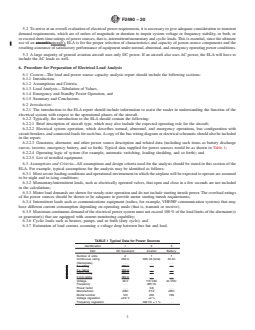
curves, inverter, emergency battery, and so forth). Typical data supplied for power sources would be as shown in Table 1;
6.2.2.4 Operating logic of system (for example, automatic switching, loading shedding, and so forth); and
6.2.2.5 List of installed equipment.
6.3 Assumptions and Criteria—All assumptions and design criteria used for the analysis should be stated in this section of the
ELA. For example, typical assumptions for the analysis may be identified as follows:
6.3.1 Most severe loading conditions and operational environment in which the airplane will be expected to operate are assumed
to be night and in icing conditions;
6.3.2 Momentary/intermittent loads, such as electrically operated valves, that open and close in a few seconds are not included
in the calculations;
6.3.3 Motor load demands are shown for steady-state operation and do not include starting inrush power. The overload ratings
of the power sources should be shown to be adequate to provide motor starting inrush requirements;
6.3.4 Intermittent loads such as communications equipment (radios, for example, VHF/HF communication systems) that may
have different current consumption depending on operating mode (that is, transmit or receive);
6.3.5 Maximum continuous demand of the electrical power system must not exceed 100 % of the load limits of the alternator(s)
or generator(s) that are equipped with current monitoring capability;
6.3.6 Cyclic loads such as heaters, pumps, and so forth (duty cycle); and
6.3.7 Estimation of load current, assuming a voltage drop between bus bar and load.
TABLE 1 Typical Data for Power Sources
Identification 1 2 3
Item DC Generator Inverter Battery
Number of units 2 1 1
Continuous rating 250 A 300 VA (total) 35 Ah
(Nameplate) . . . . . . . . .
5-s rating 400 A . . . . . .
5 s rating 400 A . . . . . .
2-min rating 300 A . . . . . .
2 min rating 300 A . . . . . .
Voltage 30 V 115 VAC 24 VDC
Frequency . . . 400 Hz . . .
Power factor . . . 0.8 . . .
Manufacturer ABC XYZ ABC
Model number 123 456 789
Voltage regulation ±0.6 V ±2 % . . .
Frequency regulation . . . 400 Hz ± 1 % . . .
F2490 − 20
6.4 Load Analysis—Tabulation of Values—A typical load and power source analysis would identify the following details in
tabular form:
6.4.1 Connected Load Table—See Appendix X1.
6.4.1.1 Aircraft Bus—Identify the appropriate electrical bus being evaluated. In a multiple bus configuration, there will be a set
of tables for each bus (that is, DC Bus 1, DC Bus 2, AC Bus 1, Battery Bus, and so forth).
6.4.1.2 Condition of Power Sources—Normal, abnormal (abnormal conditions to be specified, for example, one generator
inoperative, two generators inoperative, and so forth), and emergency.
6.4.1.3 Aircraft Operating Phases—The following aircraft operating phases should be considered for the ELA. Assume “night”
conditions as the worst-case scenario.
NOTE 2—Icing conditions should be considered for worst-case scenarios if the aircraft is approved for flight into known icing in accordance with 14
CFR 23.1419. However, in some cases, the icing system is deactivated or not installed, so icing may not always be the worst-case.
6.4.1.4 Permissible Nonserviceable Conditions—The analysis should also identify permissible nonserviceable conditions likely
to be authorized in the MMEL, if approved, during the certification of the airplane and should include calculations appropriate to
these cases. All MMEL items must be accounted for in the load analysis to ensure that the electrical system capacity is not exceeded
when all items are functional.
6.4.1.5 Circuit Breaker—Identify each circuit breaker by circuit name or identification number.
6.4.1.6 Load at Circuit Breaker—The ampere loading for each circuit.
6.4.1.7 Operating Time:
(1) The operating time is usually expressed as a period of time (seconds/minutes) or may be continuous, as appropriate.
Equipment operating time is often related to the average operating time of the aircraft. If the “on” time of the equipment is the
same or close to the average operating time of the aircraft, then it could be considered that the equipment is operating continuously
for all flight phases.
(2) In such cases in which suitable provisions have been made to ensure that certain loads cannot operate simultaneously, or
there is reason for assuming certain combinations of load will not occur, appropriate allowances may be made. Adequate
explanation should be given in the summary.
(3) In some instances, it may be useful to tabulate the data using a specified range for equipment operating times, such as
follows:
5-s Analysis All loads that last longer than 0.3 s
should be entered in this column.
5 s Analysis All loads that last longer than 0.3 s
should be entered in this column.
5-min Analysis All loads that last longer than 5 s
should be entered in this column.
5 min Analysis All loads that last longer than 5 s
should be entered in this column.
Continuous Analysis All loads that last longer than 5
min should be entered in this column.
(4) Alternatively, the equipment operating times could be expressed as actual operating time of equipment in seconds or
minutes or as continuous operation. In the example given in Appendix X1, the approach taken is to show either continuous
operation or to identify a specific operating time in seconds/minutes.
6.4.1.8 Condition of Aircraft Operation—Phase of preflight and flight (such as ground operation and loading, taxi, takeoff,
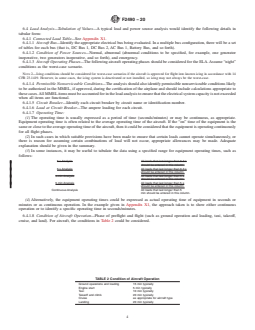
cruise, and land). For aircraft, the conditions in Table 2 could be considered.
TABLE 2 Condition of Aircraft Operation
Ground operations and loading 15 min typically
Engine start 5 min typically
Taxi 10 min typically
Takeoff and climb 20 min typically
Cruise as appropriate for aircraft type
Landing 20 min typically
F2490 − 20
6.4.2 Calculations:
6.4.2.1 The following equations can be used to estimate total current, total current rate, and average demand for each of the
aircraft operating phases (ground operation and loading, engine start, taxi, takeoff and climb, cruise, and landing):
Total Current A 5 Sum of All Current Loads (1)
~ !
Operating at a Given Time
Total Current Rate ~A2 min!5 (2)
Number of Units Operating Simultaneously 3Current per Unit ~A!3
Operating Time min
~ !
Average Demand or Average Load A 5 Total Current A2 min ÷Duration of Ground or Flight Phase min (3)
~ ! ~ ! ~ !
6.4.2.2 It can be considered that at the start of each operating period (for example, taxi, takeoff, and so forth), all equipment
that operates during that phase is switched “on,” with intermittent loads gradually being switched “off.”
6.4.3 Additional Considerations for Non-Ohmic or Constant Power Devices (for example, Inverters)—In some cases, the
currents drawn at battery voltage (for example, 20 VDC to 24 VDC) are higher than at the generated voltage (for example, 28
VDC) and will influence the emergency flight conditions on battery. However, for resistive loads, the current drawn will be reduced
because of the lower battery voltage.
6.4.4 System Regulation:
6.4.4.1 The system voltage and frequency should be regulated to ensure reliable and continued safe operation of all essential
equipment while operating under the normal and emergency conditions, taking into account the voltage drops that occur in the
cables and connections to the equipment.
6.4.4.2 The defined voltages are those supplied at the equipment terminals and allow for variation in the output of the supply
equipment (for example, generators, alternators, and batteries), as well as voltage drops caused by cable and connection resistance.
NOTE 3—Voltage drop between bus bar and equipment should be considered in conjunction with bus bar voltages under normal, abnormal, and
emergency operating conditions in the estimation of the terminal voltage at the equipment (that is, reduced bus bar voltage in conjunction with cable volt
drop could lead to malfunction or shutdown of equipment).
6.4.5 Load Shedding—Following the loss of a generator/alternator, it is assumed a 5-min 5 min period will elapse before any
manual load shedding by the flight crew, provided tha
...