

ASTM D7914/D7914M-21
(Test Method)Standard Test Method for Strength of Fiber Reinforced Polymer (FRP) Bent Bars in Bend Locations
General Information
- Abstract
SIGNIFICANCE AND USE
5.1 This test method is intended to determine the bend strength of FRP composite concrete reinforcements, developed at a standard twelve bar diameters of embedment. From this test, a variety of data are acquired that are needed for design purposes. Material-related factors that influence the tensile response of bars include the following: constituent materials, void content, volume percent reinforcement, methods of fabrication, and fiber reinforcement architecture. Similarly, factors relevant to the measured tensile response of bars include specimen preparation, specimen conditioning, environment of testing, specimen alignment, and speed of testing. The results may be used for material specifications, research and development, and structural design and analysis.
Note 1: Two FRP bends are tested simultaneously in this test method, but in some cases, only one bend may fail. While resulting in a valid failure, notice should be taken that only one bend has been effectively measured and that the final compiled test results using this method could differ from those resulting from single FRP bend testing.
SCOPE
1.1 This test method determines the quasi-static ultimate strength of fiber reinforced polymer (FRP) composite bent bars commonly used as anchorages for stirrups in reinforced, prestressed, or post-tensioned concrete structures. This test method only applies to bars with a solid cross section.
1.2 FRP bent bars are often used in reinforced concrete applications to shorten the development length of the bar or to act as a tie or a stirrup to resist shear forces. Bent bars can be produced with varying angles of bend in order to fit their intended purpose.
1.3 For this test method, the FRP bars are bent at a 90 degree angle. In general, bars have a regular pattern of surface undulations, a coating of bonded particles, or both, that promote mechanical interlock between the bar and concrete.
1.4 This test method may be completed on standardized bars, produced according to Specification D7957/D7957M. In this case, the nominal cross-sectional areas and effective diameters are taken from D7957/D7957M. This test method may also be used for bars that are not standardized. In this case, the cross-sectional areas and effective diameters should be measured and calculated as described in Test Method D7205/D7205M.
1.5 The strength values provided by this method are short-term, quasi-static tensile strengths that do not account for sustained static or cyclic loading. If bars are to be used under high levels of sustained or repeated loading, additional material characterization may be required.
1.6 The characteristic values obtained from this test method are intended to represent the quasi-static ultimate strength of FRP bent bars with a tail length of twelve bar diameters.
1.7 Units—The values stated in either SI units or inch-pound units are to be regarded separately as standard. The values stated in each system are not necessarily exact equivalents; therefore, to ensure conformance with the standard, each system shall be used independently of the other, and values from the two systems shall not be combined.
1.7.1 Within the text, the inch-pound units are shown in brackets.
1.8 This standard does not purport to address all of the safety concerns, if any, associated with its use. It is the responsibility of the user of this standard to establish appropriate safety, health, and environmental practices and determine the applicability of regulatory limitations prior to use.
1.9 This international standard was developed in accordance with internationally recognized principles on standardization established in the Decision on Principles for the Development of International Standards, Guides and Recommendations issued by the World Trade Organization Technical Barriers to Trade (TBT) Committee.
- Status
- Published
- Publication Date
- 31-Dec-2020
- Technical Committee
- D30 - Composite Materials
- Drafting Committee
- D30.10 - Composites for Civil Structures
Buy Documents
ASTM D7914/D7914M-21 - Standard Test Method for Strength of Fiber Reinforced Polymer (FRP) Bent Bars in Bend Locations
REDLINE ASTM D7914/D7914M-21 - Standard Test Method for Strength of Fiber Reinforced Polymer (FRP) Bent Bars in Bend Locations
Overview
ASTM D7914/D7914M-21 is the internationally recognized standard test method for determining the quasi-static ultimate strength of Fiber Reinforced Polymer (FRP) bent bars at bend locations. FRP bent bars are increasingly used as concrete reinforcement, particularly as anchorages for stirrups in reinforced, prestressed, and post-tensioned concrete structures. This testing standard specifically applies to solid-section FRP bars bent at a 90-degree angle, ensuring reliable performance data for engineering design, material specification, and product development in the civil engineering and construction sectors.
Key Topics
- Quasi-Static Bend Strength: Measures the short-term, ultimate tensile strength of FRP bars in bent conditions, focusing on failure occurring at the bend itself.
- Standardized Testing: Provides uniform procedures for specimen preparation, concrete embedding, mechanical loading, and the calculation of bend strength and tensile retention.
- Critical Test Variables:
- Bar geometry (cross-sectional area, bend diameter)
- Surface characteristics (undulations, coatings)
- Material composition and manufacturing techniques
- Environmental conditioning and test atmosphere
- Reporting Requirements: Test results report trade names, bar dimensions, failure modes, and percentage of straight-bar tensile strength retained at the bend.
- Design and Specification Use: The data acquired support design considerations and compliance with codes related to FRP reinforced concrete, particularly where bars are bent for anchorage or tie applications.
Applications
ASTM D7914/D7914M-21 is widely applicable in construction and materials engineering, especially in:
- Reinforced Concrete Structures: Evaluation and quality assurance of FRP bent bars used in beams, columns, and slabs, where bends are critical points for anchorage and shear resistance.
- Structural Design: Enables engineers to incorporate accurate strength reduction factors and development lengths for FRP stirrups and tie bars in concrete design.
- Research and Development: Supports the analysis and comparison of different FRP materials and fabrication methods, driving innovations in composite reinforcement technology.
- Material Specification Compliance: Ensures that FRP products meet project-specific or regulatory requirements for strength and performance in bent bar configurations.
- Quality Control: Assists manufacturers and construction quality managers in verifying production consistency and structural safety.
Related Standards
Several ASTM and industry standards complement and reference ASTM D7914/D7914M-21, ensuring a comprehensive approach to FRP materials testing and application:
- ASTM D7957/D7957M - Specification for Solid Round Glass Fiber Reinforced Polymer Bars for Concrete Reinforcement
- ASTM D7205/D7205M - Test Method for Tensile Properties of Fiber Reinforced Polymer Matrix Composite Bars
- ASTM C39/C39M - Test Method for Compressive Strength of Cylindrical Concrete Specimens
- ASTM C143/C143M - Test Method for Slump of Hydraulic-Cement Concrete
- ASTM D792 - Test Methods for Density and Specific Gravity of Plastics
- ASTM D3171 - Test Methods for Constituent Content of Composite Materials
- ASTM E4 - Practices for Force Verification of Testing Machines
By following ASTM D7914/D7914M-21, construction professionals, test laboratories, and product developers can ensure that FRP bent bars deliver consistent, reliable performance in critical structural applications involving concrete reinforcement. Using this standard helps to reduce the risk of structural failure at bend locations and supports the advancement of FRP composites in modern construction.
Relations
- Effective Date
- 01-Feb-2024
- Refers
ASTM C39/C39M-23 - Standard Test Method for Compressive Strength of Cylindrical Concrete Specimens - Effective Date
- 01-Dec-2023
- Effective Date
- 01-Nov-2023
- Effective Date
- 01-Apr-2022
- Effective Date
- 01-Mar-2020
- Effective Date
- 01-Jan-2020
- Effective Date
- 15-Oct-2019
- Effective Date
- 01-Aug-2019
- Effective Date
- 15-Apr-2019
- Effective Date
- 15-Apr-2019
- Effective Date
- 01-Feb-2019
- Effective Date
- 01-Dec-2018
- Effective Date
- 01-Nov-2018
- Effective Date
- 01-Apr-2018
- Effective Date
- 01-Oct-2017
Buy Documents
ASTM D7914/D7914M-21 - Standard Test Method for Strength of Fiber Reinforced Polymer (FRP) Bent Bars in Bend Locations
REDLINE ASTM D7914/D7914M-21 - Standard Test Method for Strength of Fiber Reinforced Polymer (FRP) Bent Bars in Bend Locations
Get Certified
Connect with accredited certification bodies for this standard

DIN CERTCO
DIN Group product certification.
DIBt (Deutsches Institut für Bautechnik)
German Institute for Building Technology.

Aboma Certification B.V.
Specialized in construction, metal, and transport sectors.
Sponsored listings
Frequently Asked Questions
ASTM D7914/D7914M-21 is a standard published by ASTM International. Its full title is "Standard Test Method for Strength of Fiber Reinforced Polymer (FRP) Bent Bars in Bend Locations". This standard covers: SIGNIFICANCE AND USE 5.1 This test method is intended to determine the bend strength of FRP composite concrete reinforcements, developed at a standard twelve bar diameters of embedment. From this test, a variety of data are acquired that are needed for design purposes. Material-related factors that influence the tensile response of bars include the following: constituent materials, void content, volume percent reinforcement, methods of fabrication, and fiber reinforcement architecture. Similarly, factors relevant to the measured tensile response of bars include specimen preparation, specimen conditioning, environment of testing, specimen alignment, and speed of testing. The results may be used for material specifications, research and development, and structural design and analysis. Note 1: Two FRP bends are tested simultaneously in this test method, but in some cases, only one bend may fail. While resulting in a valid failure, notice should be taken that only one bend has been effectively measured and that the final compiled test results using this method could differ from those resulting from single FRP bend testing. SCOPE 1.1 This test method determines the quasi-static ultimate strength of fiber reinforced polymer (FRP) composite bent bars commonly used as anchorages for stirrups in reinforced, prestressed, or post-tensioned concrete structures. This test method only applies to bars with a solid cross section. 1.2 FRP bent bars are often used in reinforced concrete applications to shorten the development length of the bar or to act as a tie or a stirrup to resist shear forces. Bent bars can be produced with varying angles of bend in order to fit their intended purpose. 1.3 For this test method, the FRP bars are bent at a 90 degree angle. In general, bars have a regular pattern of surface undulations, a coating of bonded particles, or both, that promote mechanical interlock between the bar and concrete. 1.4 This test method may be completed on standardized bars, produced according to Specification D7957/D7957M. In this case, the nominal cross-sectional areas and effective diameters are taken from D7957/D7957M. This test method may also be used for bars that are not standardized. In this case, the cross-sectional areas and effective diameters should be measured and calculated as described in Test Method D7205/D7205M. 1.5 The strength values provided by this method are short-term, quasi-static tensile strengths that do not account for sustained static or cyclic loading. If bars are to be used under high levels of sustained or repeated loading, additional material characterization may be required. 1.6 The characteristic values obtained from this test method are intended to represent the quasi-static ultimate strength of FRP bent bars with a tail length of twelve bar diameters. 1.7 Units—The values stated in either SI units or inch-pound units are to be regarded separately as standard. The values stated in each system are not necessarily exact equivalents; therefore, to ensure conformance with the standard, each system shall be used independently of the other, and values from the two systems shall not be combined. 1.7.1 Within the text, the inch-pound units are shown in brackets. 1.8 This standard does not purport to address all of the safety concerns, if any, associated with its use. It is the responsibility of the user of this standard to establish appropriate safety, health, and environmental practices and determine the applicability of regulatory limitations prior to use. 1.9 This international standard was developed in accordance with internationally recognized principles on standardization established in the Decision on Principles for the Development of International Standards, Guides and Recommendations issued by the World Trade Organization Technical Barriers to Trade (TBT) Committee.
SIGNIFICANCE AND USE 5.1 This test method is intended to determine the bend strength of FRP composite concrete reinforcements, developed at a standard twelve bar diameters of embedment. From this test, a variety of data are acquired that are needed for design purposes. Material-related factors that influence the tensile response of bars include the following: constituent materials, void content, volume percent reinforcement, methods of fabrication, and fiber reinforcement architecture. Similarly, factors relevant to the measured tensile response of bars include specimen preparation, specimen conditioning, environment of testing, specimen alignment, and speed of testing. The results may be used for material specifications, research and development, and structural design and analysis. Note 1: Two FRP bends are tested simultaneously in this test method, but in some cases, only one bend may fail. While resulting in a valid failure, notice should be taken that only one bend has been effectively measured and that the final compiled test results using this method could differ from those resulting from single FRP bend testing. SCOPE 1.1 This test method determines the quasi-static ultimate strength of fiber reinforced polymer (FRP) composite bent bars commonly used as anchorages for stirrups in reinforced, prestressed, or post-tensioned concrete structures. This test method only applies to bars with a solid cross section. 1.2 FRP bent bars are often used in reinforced concrete applications to shorten the development length of the bar or to act as a tie or a stirrup to resist shear forces. Bent bars can be produced with varying angles of bend in order to fit their intended purpose. 1.3 For this test method, the FRP bars are bent at a 90 degree angle. In general, bars have a regular pattern of surface undulations, a coating of bonded particles, or both, that promote mechanical interlock between the bar and concrete. 1.4 This test method may be completed on standardized bars, produced according to Specification D7957/D7957M. In this case, the nominal cross-sectional areas and effective diameters are taken from D7957/D7957M. This test method may also be used for bars that are not standardized. In this case, the cross-sectional areas and effective diameters should be measured and calculated as described in Test Method D7205/D7205M. 1.5 The strength values provided by this method are short-term, quasi-static tensile strengths that do not account for sustained static or cyclic loading. If bars are to be used under high levels of sustained or repeated loading, additional material characterization may be required. 1.6 The characteristic values obtained from this test method are intended to represent the quasi-static ultimate strength of FRP bent bars with a tail length of twelve bar diameters. 1.7 Units—The values stated in either SI units or inch-pound units are to be regarded separately as standard. The values stated in each system are not necessarily exact equivalents; therefore, to ensure conformance with the standard, each system shall be used independently of the other, and values from the two systems shall not be combined. 1.7.1 Within the text, the inch-pound units are shown in brackets. 1.8 This standard does not purport to address all of the safety concerns, if any, associated with its use. It is the responsibility of the user of this standard to establish appropriate safety, health, and environmental practices and determine the applicability of regulatory limitations prior to use. 1.9 This international standard was developed in accordance with internationally recognized principles on standardization established in the Decision on Principles for the Development of International Standards, Guides and Recommendations issued by the World Trade Organization Technical Barriers to Trade (TBT) Committee.
ASTM D7914/D7914M-21 is classified under the following ICS (International Classification for Standards) categories: 83.120 - Reinforced plastics; 91.080.40 - Concrete structures. The ICS classification helps identify the subject area and facilitates finding related standards.
ASTM D7914/D7914M-21 has the following relationships with other standards: It is inter standard links to ASTM D883-24, ASTM C39/C39M-23, ASTM D883-23, ASTM E456-13a(2022)e1, ASTM D5229/D5229M-20, ASTM D883-20, ASTM D3878-19a, ASTM D883-19c, ASTM D883-19a, ASTM D3878-19, ASTM D883-19, ASTM D883-18a, ASTM D883-18, ASTM D3878-18, ASTM E456-13A(2017)e3. Understanding these relationships helps ensure you are using the most current and applicable version of the standard.
ASTM D7914/D7914M-21 is available in PDF format for immediate download after purchase. The document can be added to your cart and obtained through the secure checkout process. Digital delivery ensures instant access to the complete standard document.
Standards Content (Sample)
This international standard was developed in accordance with internationally recognized principles on standardization established in the Decision on Principles for the
Development of International Standards, Guides and Recommendations issued by the World Trade Organization Technical Barriers to Trade (TBT) Committee.
Designation: D7914/D7914M −21
Standard Test Method for
Strength of Fiber Reinforced Polymer (FRP) Bent Bars in
Bend Locations
This standard is issued under the fixed designation D7914/D7914M; the number immediately following the designation indicates the
year of original adoption or, in the case of revision, the year of last revision. A number in parentheses indicates the year of last
reapproval. A superscript epsilon (´) indicates an editorial change since the last revision or reapproval.
1. Scope lents; therefore, to ensure conformance with the standard, each
system shall be used independently of the other, and values
1.1 This test method determines the quasi-static ultimate
from the two systems shall not be combined.
strengthoffiberreinforcedpolymer(FRP)compositebentbars
1.7.1 Within the text, the inch-pound units are shown in
commonly used as anchorages for stirrups in reinforced,
brackets.
prestressed, or post-tensioned concrete structures. This test
1.8 This standard does not purport to address all of the
method only applies to bars with a solid cross section.
safety concerns, if any, associated with its use. It is the
1.2 FRP bent bars are often used in reinforced concrete
responsibility of the user of this standard to establish appro-
applications to shorten the development length of the bar or to
priate safety, health, and environmental practices and deter-
act as a tie or a stirrup to resist shear forces. Bent bars can be
mine the applicability of regulatory limitations prior to use.
produced with varying angles of bend in order to fit their
1.9 This international standard was developed in accor-
intended purpose.
dance with internationally recognized principles on standard-
1.3 For this test method, the FRP bars are bent at a 90
ization established in the Decision on Principles for the
degree angle. In general, bars have a regular pattern of surface
Development of International Standards, Guides and Recom-
undulations, a coating of bonded particles, or both, that
mendations issued by the World Trade Organization Technical
promote mechanical interlock between the bar and concrete.
Barriers to Trade (TBT) Committee.
1.4 This test method may be completed on standardized
2. Referenced Documents
bars, produced according to Specification D7957/D7957M.In
this case, the nominal cross-sectional areas and effective
2.1 ASTM Standards:
diameters are taken from D7957/D7957M. This test method
C39/C39MTest Method for Compressive Strength of Cylin-
mayalsobeusedforbarsthatarenotstandardized.Inthiscase,
drical Concrete Specimens
the cross-sectional areas and effective diameters should be
C143/C143MTest Method for Slump of Hydraulic-Cement
measured and calculated as described in Test Method D7205/
Concrete
D7205M.
C192/C192MPracticeforMakingandCuringConcreteTest
Specimens in the Laboratory
1.5 The strength values provided by this method are short-
D883Terminology Relating to Plastics
term, quasi-static tensile strengths that do not account for
D3878Terminology for Composite Materials
sustained static or cyclic loading. If bars are to be used under
D5229/D5229MTestMethodforMoistureAbsorptionProp-
highlevelsofsustainedorrepeatedloading,additionalmaterial
erties and Equilibrium Conditioning of Polymer Matrix
characterization may be required.
Composite Materials
1.6 The characteristic values obtained from this test method
D7205/D7205MTest Method forTensile Properties of Fiber
are intended to represent the quasi-static ultimate strength of
Reinforced Polymer Matrix Composite Bars
FRP bent bars with a tail length of twelve bar diameters.
D7957/D7957MSpecification for Solid Round Glass Fiber
1.7 Units—The values stated in either SI units or inch-
Reinforced Polymer Bars for Concrete Reinforcement
pound units are to be regarded separately as standard. The
E4Practices for Force Verification of Testing Machines
values stated in each system are not necessarily exact equiva-
E6Terminology Relating to Methods of Mechanical Testing
E122PracticeforCalculatingSampleSizetoEstimate,With
This test method is under the jurisdiction of ASTM Committee D30 on
Composite Materials and is the direct responsibility of Subcommittee D30.10 on
Composites for Civil Structures. For referenced ASTM standards, visit the ASTM website, www.astm.org, or
Current edition approved Jan. 1, 2021. Published February 2021. Originally contact ASTM Customer Service at service@astm.org. For Annual Book of ASTM
approved in 2014. Last previous edition approved in 2014 as D7914/D7914M–14. Standards volume information, refer to the standard’s Document Summary page on
DOI: 10.1520/D7914_D7914M-21. the ASTM website.
Copyright © ASTM International, 100 Barr Harbor Drive, PO Box C700, West Conshohocken, PA 19428-2959. United States
D7914/D7914M − 21
Specified Precision, the Average for a Characteristic of a 3.2.8 quasi-static, adj—loading where inertial effects (time
Lot or Process and inertial mass) are irrelevant.
E456Terminology Relating to Quality and Statistics
3.2.9 standardized bar, n—a bar produced according to
Specification D7957/D7957M.
3. Terminology
3.2.10 stirrup, n—a bar shape comprised of one or more
3.1 Terminology D3878 defines terms relating to high-
bent bars used to resist shear forces in reinforced concrete.
modulus fibers and their composites. Terminology D883 de-
3.2.11 tail length, n—the length provided beyond the bend
fines terms relating to plastics. Terminology E6 defines terms
portion of a bent bar.
relating to mechanical testing. Terminology E456 and Practice
3.2.12 tensile strength, n—ultimate tensile strength of FRP
E122 define terms relating to statistics and the selection of
bars in the direction parallel to the fibers.
sample sizes. In the event of a conflict between terms,
Terminology D3878 shall have precedence over the other
3.3 Symbols:
terminology standards.
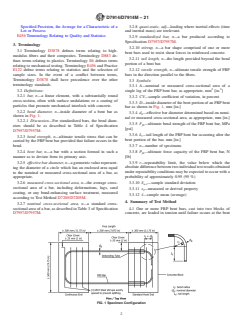
3.3.1 A—nominal or measured cross-sectional area of a
2 2
single leg of the FRP bent bar, as appropriate, mm [in. ]
3.2 Definitions:
3.2.1 bar, n—a linear element, with a substantially round
3.3.2 CV—sample coefficient of variation, in percent
cross-section, often with surface undulations or a coating of
3.3.3 D—inside diameter of the bent portion of an FRPbent
particles that promote mechanical interlock with concrete.
bar as shown in Fig. 1, mm [in.]
3.2.2 bend diameter, n—inside diameter of a bent bar as
3.3.4 d —effective bar diameter determined based on nomi-
b
shown in Fig. 1.
nal or measured cross-sectional area, as appropriate, mm [in.]
3.2.2.1 Discussion—For standardized bars, the bend diam-
3.3.5 F —ultimate bend strength of the FRPbent bar, MPa
fb
eters should be as described in Table 4 of Specification
[psi]
D7957/D7957M.
3.3.6 L —tail length of the FRPbent bar occurring after the
t
3.2.3 bend strength, n—ultimate tensile stress that can be
bent portion of the bar, mm [in.]
carried by the FRPbent bar provided that failure occurs in the
3.3.7 n—number of specimens
bend.
3.3.8 P —ultimate force capacity of the FRP bent bar, N
3.2.4 bent bar, n—a bar with a section formed in such a
fb
[lb]
manner as to deviate from its primary axis.
3.3.9 r—repeatability limit, the value below which the
3.2.5 effective bar diameter, n—ageometricvaluerepresent-
absolutedifferencebetweentwoindividualtestresultsobtained
ing the diameter of a circle which has an enclosed area equal
under repeatability conditions may be expected to occur with a
to the nominal or measured cross-sectional area of a bar, as
probability of approximately 0.95 (95 %)
appropriate.
3.3.10 S —sample standard deviation
3.2.6 measured cross-sectional area, n—the average cross-
n-1
sectional area of a bar, including deformations, lugs, sand
3.3.11 x —measured or derived property
I
coating, or any bond-enhancing surface treatment, measured
3.3.12 x¯—sample mean (average)
according to Test Method D7205/D7205M.
4. Summary of Test Method
3.2.7 nominal cross-sectional area, n—a standard cross-
sectional area of a bar, as described in Table 3 of Specification 4.1 One or more FRP bent bars, cast into two blocks of
D7957/D7957M. concrete, are loaded in tension until failure occurs at the bent
FIG. 1 Specimen Configuration
D7914/D7914M − 21
portionofthebar.Anactuationdeviceisplacedinbetweenthe capable of applying force at the required loading rate. Hand
two concrete blocks so that the blocks are forced apart, operated testing machines, electro-mechanical cylinders, or
inducing tension on the FRP bent bars. motorized pumps having sufficient volume in one or more
strokes to complete a test may be used if they satisfy the
4.2 Force is recorded throughout the test.
loading provisions in 11.2.5.
4.3 The principal variables used in the tests are the bar
7.2 Force Indicator—The testing apparatus force-sensing
cross-sectional area, bend diameter, and type of FRP bent bar.
device(aloadcellorsimilar)shallbecapableofindicatingthe
5. Significance and Use
total force being carried by the specimen. This device shall be
essentially free from inertia-lag at the specified rate of testing
5.1 This test method is intended to determine the bend
and shall indicate the force with an accuracy over the load
strength of FRPcomposite concrete reinforcements, developed
range(s) of interest of within 6 1% of the indicated value, as
at a standard twelve bar diameters of embedment. From this
specified by Practices E4.
test, a variety of data are acquired that are needed for design
purposes. Material-related factors that influence the tensile
7.3 Environmental Test Chamber—Anenvironmentalcham-
response of bars include the following: constituent materials,
ber is required for conditioning and test environments other
void content, volume percent reinforcement, methods of
than ambient laboratory conditions. These chambers shall be
fabrication, and fiber reinforcement architecture. Similarly,
capable of maintaining the required relative temperature to
factors relevant to the measured tensile response of bars
within 63°C[65°F] and the required relative humidity level
includespecimenpreparation,specimenconditioning,environ-
to within 65% RH. In addition, the chambers may have to be
ment of testing, specimen alignment, and speed of testing.The
capable of maintaining environmental conditions such as fluid
results may be used for material specifications, research and
exposure or relative humidity during the conditioning and
development, and structural design and analysis.
testing.
NOTE 1—Two FRPbends are tested simultaneously in this test method,
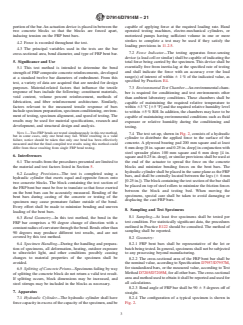
7.4 The test set-up, shown in Fig. 2, consists of a hydraulic
but in some cases, only one bend may fail. While resulting in a valid
cylinder to distribute the applied force to the surface of the
failure, notice should be taken that only one bend has been effectively
concrete. A plywood bearing pad 200 mm square and at least
measured and that the final compiled test results using this method could
6mmdeep[8in.squareand0.25in.deep]inconjunction with
differ from those resulting from single FRP bend testing.
steel spreader plates 100 mm square and 6 mm deep [4 in.
6. Interferences
squareand0.25in.deep],orsimilarprovisionsshallbeusedat
the end of the actuator to spread the force on the concrete
6.1 The results from the procedures presented are limited to
blocks and minimize bending forces on the bent bars. The
the material and test factors listed in Section 5.
hydrauliccylindershallbeplacedinthesameplaneastheFRP
6.2 Loading Provisions—The test is completed using a
bars, and shall be centrally located between the legs (66mm
hydraulic cylinder that exerts equal and opposite forces onto
[0.25in.]).Theblockcontainingthetestsectionofthebarshall
two concrete blocks. The block containing the test section of
be placed on top of steel rollers to minimize the friction forces
the FRPbent bar must be free to translate so that force exerted
between the block and testing bed. When moving the
on the bent bars can be accurately measured. Bending of the
specimens, special care shall be taken to avoid damaging or
bent bars during casting of the concrete or testing of the
displacing the cast FRP bars.
specimen may cause premature failure outside of the bend.
Every effort shall be made to minimize bending and uneven
8. Sampling and Test Specimens
loading of the bent bars.
8.1 Sampling—At least five specimens shall be tested per
6.3 Bend Geometry—In this test method, the bend in the
test condition. For statistically significant data, the procedures
FRP bar comprises a 90 degree change of direction with a
outlined in Practice E122 should be consulted. The method of
constantradiusofcurvaturethroughthebend.Bendsotherthan
sampling shall be reported.
90 degrees may produce different test results, and are not
covered by this test method.
8.2 Geometry:
6.4 Specimen Handling—During the handling and prepara- 8.2.1 FRP bent bars shall be representative of the lot or
tion of specimens, all deformation, heating, outdoor exposure batchbeingtested.Ingeneral,specimensshallnotbesubjected
to ultraviolet light, and other conditions possibly causing to any processing beyond manufacturing.
changes to material properties of the specimen shall be
8.2.2 The cross-sectional area of the FRP bent bar shall be
avoided.
thenominalvalue,accordingtoSpecificationD7957/D7957M,
for
...
This document is not an ASTM standard and is intended only to provide the user of an ASTM standard an indication of what changes have been made to the previous version. Because
it may not be technically possible to adequately depict all changes accurately, ASTM recommends that users consult prior editions as appropriate. In all cases only the current version
of the standard as published by ASTM is to be considered the official document.
Designation: D7914/D7914M − 14 D7914/D7914M − 21
Standard Test Method for
Strength of Fiber Reinforced Polymer (FRP) Bent Bars in
Bend Locations
This standard is issued under the fixed designation D7914/D7914M; the number immediately following the designation indicates the
year of original adoption or, in the case of revision, the year of last revision. A number in parentheses indicates the year of last
reapproval. A superscript epsilon (´) indicates an editorial change since the last revision or reapproval.
1. Scope
1.1 This test method determines the quasi-static ultimate strength of fiber reinforced polymer (FRP) composite bent bars
commonly used as anchorages for stirrups in reinforced, prestressed, or post-tensioned concrete structures. This test method only
applies to bars with a solid cross section.
1.2 FRP bent bars are often used in reinforced concrete applications to shorten the development length of the bar or to act as a
tie or a stirrup to resist shear forces. Bent bars can be produced with varying angles of bend in order to fit their intended purpose.
1.3 For this test method, the FRP bars are bent at a 90 degree angle. In general, bars have a regular pattern of surface undulations,
a coating of bonded particles, or both, that promote mechanical interlock between the bar and concrete.
1.4 This test method may be completed on standardized bars, produced according to Specification D7957/D7957M. In this case,
the nominal cross-sectional areas and effective diameters are taken from D7957/D7957M. This test method may also be used for
bars that are not standardized. In this case, the cross-sectional areas and effective diameters should be measured and calculated as
described in Test Method D7205/D7205M.
1.5 The strength values provided by this method are short-term, quasi-static tensile strengths that do not account for sustained
static or cyclic loading. If bars are to be used under high levels of sustained or repeated loading, additional material characterization
may be required.
1.6 The characteristic values obtained from this test method are intended to represent the quasi-static ultimate strength of FRP bent
bars with a tail length of twelve bar diameters.
1.7 Units—The values stated in either SI units or inch-pound units are to be regarded separately as standard. The values stated in
each system are not necessarily exact equivalents; therefore, to ensure conformance with the standard, each system shall be used
independently of the other, and values from the two systems shall not be combined.
1.7.1 Within the text, the inch-pound units are shown in brackets.
1.8 This standard does not purport to address all of the safety concerns, if any, associated with its use. It is the responsibility
of the user of this standard to establish appropriate safety safety, health, and healthenvironmental practices and determine the
applicability of regulatory limitations prior to use.
This test method is under the jurisdiction of ASTM Committee D30 on Composite Materials and is the direct responsibility of Subcommittee D30.10 on Composites
for Civil Structures.
Current edition approved Aug. 1, 2014Jan. 1, 2021. Published December 2014February 2021. Originally approved in 2014. Last previous edition approved in 2014 as
D7914/D7914M – 14. DOI: 10.1520/D7914_D7914M-14.10.1520/D7914_D7914M-21.
Copyright © ASTM International, 100 Barr Harbor Drive, PO Box C700, West Conshohocken, PA 19428-2959. United States
D7914/D7914M − 21
1.9 This international standard was developed in accordance with internationally recognized principles on standardization
established in the Decision on Principles for the Development of International Standards, Guides and Recommendations issued
by the World Trade Organization Technical Barriers to Trade (TBT) Committee.
2. Referenced Documents
2.1 ASTM Standards:
A615/A615M Specification for Deformed and Plain Carbon-Steel Bars for Concrete Reinforcement
C39/C39M Test Method for Compressive Strength of Cylindrical Concrete Specimens
C143/C143M Test Method for Slump of Hydraulic-Cement Concrete
C192/C192M Practice for Making and Curing Concrete Test Specimens in the Laboratory
D792 Test Methods for Density and Specific Gravity (Relative Density) of Plastics by Displacement
D883 Terminology Relating to Plastics
D3171 Test Methods for Constituent Content of Composite Materials
D3878 Terminology for Composite Materials
D5229/D5229M Test Method for Moisture Absorption Properties and Equilibrium Conditioning of Polymer Matrix Composite
Materials
D7205/D7205M Test Method for Tensile Properties of Fiber Reinforced Polymer Matrix Composite Bars
D7957/D7957M Specification for Solid Round Glass Fiber Reinforced Polymer Bars for Concrete Reinforcement
E4 Practices for Force Verification of Testing Machines
E6 Terminology Relating to Methods of Mechanical Testing
E122 Practice for Calculating Sample Size to Estimate, With Specified Precision, the Average for a Characteristic of a Lot or
Process
E456 Terminology Relating to Quality and Statistics
3. Terminology
3.1 Terminology in D3878 defines terms relating to high-modulus fibers and their composites. Terminology in D883 defines terms
relating to plastics. Terminology in E6 defines terms relating to mechanical testing. Terminology in E456 and in Practice E122
define terms relating to statistics and the selection of sample sizes. In the event of a conflict between terms, Terminology in D3878
shall have precedence over the other terminology standards.
3.2 Definitions:
3.2.1 bar, n—a linear element, with a substantially round cross-section, often with surface undulations or a coating of particles that
promote mechanical interlock with concrete.
3.2.2 bend radius,diameter, n—inside radius of the bend.diameter of a bent bar as shown in Fig. 1.
FIG. 21 Specimen Configuration
For referenced ASTM standards, visit the ASTM website, www.astm.org, or contact ASTM Customer Service at service@astm.org. For Annual Book of ASTM Standards
volume information, refer to the standard’s Document Summary page on the ASTM website.
D7914/D7914M − 21
3.2.2.1 Discussion—
For standardized bars, the bend diameters should be as described in Table 4 of Specification D7957/D7957M.
3.2.3 bend strength, n—ultimate tensile stress that can be carried by the FRP bent bar provided that failure occurs in the bend.
3.2.4 bent bar, n—a bar with a section formed in such a manner as to deviate from its primary axis.
3.2.5 equivalenteffective bar diameter, n—the equivalent bar diameter is determined according to Test Methoda geometric value
representing the diameter of a circle which has an D7205/D7205M and is based upon the standard enclosed area equal to the
nominal or measured cross-sectional area of the FRP bar.a bar, as appropriate.
3.2.6 measured cross-sectional area, n—the average cross-sectional area of a bar, including deformations, lugs, sand coating, or
any bond-enhancing surface treatment, measured according to Test Method D7205/D7205M.
3.2.7 nominal cross-sectional area, n—a standard cross-sectional area of a bar, as described in Table 3 of Specification
D7957/D7957M.
3.2.8 quasi-static, adj—loading where inertial effects (time and inertial mass) are irrelevant.
3.2.9 standard cross-sectional area, standardized bar, n—the cross-sectional area of a standard numbered steel concrete
reinforcing bar as given ina bar produced according to Specification A615/A615MD7957/D7957M, Table 1, and based upon a
circular cross section and determined over at least one representative length.
3.2.10 stirrup, n—a bar shape comprised of one or more bent bars used to resist shear forces in reinforced concrete.
3.2.11 tail length, n—the length provided beyond the bend portion of a bent bar.
3.2.12 tensile strength, n—ultimate tensile strength of FRP bars in the direction parallel to the fibers.
3.3 Symbols:
3.3.1 A—standard nominal or measured cross-sectional area of a single leg of the FRP bent bar determined according to Test
2 2
Method bar, as appropriate, D7205/D7205M, mm [in. ]
3.3.2 CV—sample coefficient of variation, in percent
3.3.3 D—inside diameter of the bent portion of an FRP bent bar as shown in Fig. 1, mm [in.]
3.3.4 d —effective bar diameter taken as the equivalent bar diameter determined according to Test Method determined
b
D7205/D7205M and is based upon the standard cross-sectional area of the FRP bar, based on nominal or measured cross-sectional
area, as appropriate, mm [in.]
3.3.4 F —ultimate tensile strength parallel to the fibers determined according to Test Method D7205/D7205M, MPa [psi]
fu
3.3.5 F —ultimate bend strength of the FRP bent bar, MPa [psi]
fb
3.3.6 L —tail length of the FRP bent bar occurring after the bent portion of the bar, mm [in.]
t
3.3.7 n—number of specimens
3.3.8 P —ultimate force capacity of the FRP bent bar, N [lb]
fb
3.3.9 r—repeatability limit, the value below which the absolute difference between two individual test results obtained under
repeatability conditions may be expected to occur with a probability of approximately 0.95 (95 %)
D7914/D7914M − 21
3.3.10 r —inside radius of the bent portion of an FRP bent bar, mm [in.]
t
3.3.10 S —sample standard deviation
n-1
3.3.12 χ—percentage of the guaranteed tensile strength of the straight portion of the bar that is retained in the bend location
3.3.11 x —measured or derived property
I
3.3.12 x¯—sample mean (average)
4. Summary of Test Method
4.1 One or more FRP bent bars, cast into two blocks of concrete, are loaded in tension until failure occurs at the bent portion of
the bar. An actuation device is placed in between the two concrete blocks so that the blocks are forced apart, inducing tension on
the FRP bent bar.bars.
4.2 Force is recorded throughout the test.
4.3 The principal variables used in the tests are the bar cross-sectional area, bend radius,diameter, and type of FRP bent bar.
5. Significance and Use
5.1 This test method is intended to determine the bend strength of FRP composite concrete reinforcements, developed at a standard
twelve bar diameters of embedment and the strength reduction factors of FRP bent bars that are typically used as anchorages in
concrete. embedment. From this test, a variety of data are acquired that are needed for design purposes. Material-related factors
that influence the tensile response of bars and should therefore be reported include the following: constituent materials, void
content, volume percent reinforcement, methods of fabrication, and fiber reinforcement architecture. Similarly, factors relevant to
the measured tensile response of bars include specimen preparation, specimen conditioning, environment of testing, specimen
alignment, and speed of testing. Properties, in the test direction, that may be obtained from this test method include:The results
may be used for material specifications, research and development, and structural design and analysis.
5.1.1 Ultimate bend strength of the FRP bent bar and
NOTE 1—Two FRP bends are tested simultaneously in this test method, but in some cases, only one bend may fail. While resulting in a valid failure, notice
should be taken that only one bend has been effectively measured and that the final compiled test results using this method could differ from those resulting
from single FRP bend testing.
5.1.2 Percentage of the guaranteed tensile strength of the straight portion of the bar that is retained in the bend location.
5.2 The results may be used for material specifications, research and development, and structural design and analysis.
NOTE 1—Two FRP bends are tested simultaneously in this test method, but in some cases only one bend may rupture. While resulting in a valid failure,
notice should be taken that only one bend has been effectively measured and that the final compiled test results using this method could differ from those
resulting from single FRP bend testing.
6. Interferences
6.1 The results from the procedures presented are limited to the material and test factors listed in Section 5.
6.2 Loading Provisions—The test is completed using a hydraulic jackcylinder that exerts equal and opposite forces onto two
concrete blocks. The block containing the test section of the FRP bent bar must be free to translate so that force exerted on the
bent bars can be accurately measured. Bending of the bent bars during casting of the concrete or testing of the specimen may cause
premature failure outside of the bend. Every effort shall be made to minimize bending and uneven loading of the bent bars.
D7914/D7914M − 21
6.3 Bend Geometry—In this test standard,method, the bend in the FRP bar comprises a 90 degree change of direction with a
constant radius of curvature through the bend. Bends other than 90 degrees may produce different test results, and are not covered
by this standard.test method.
6.4 Measurement of Actual Cross-Sectional Area—The actual cross-sectional area of the bar is measured by immersing a
prescribed length of the specimen in water to determine its buoyant weight. Bar configurations that trap air during immersion (aside
from minor porosity) cannot be assessed using this method. This method may not be appropriate for bars that have large variations
in cross-sectional area along the length of the bar.
6.5 Variation Tolerance Between Actual and Standard Cross-Sectional Area—All specimens shall have an actual cross-sectional
area that varies no more than +20% and -0% from the bar’s standard cross-sectional area
6.4 Specimen Handling—During the handling and preparation of specimens, all deformation, heating, outdoor exposure to
ultraviolet light, and other conditions possibly causing changes to material properties of the specimen shall be avoided.
6.5 Splitting of Concrete Prisms—Specimens failing by way of splitting the concrete block do not return a valid test result. If
splitting occurs, block dimensions may be increased, and steel stirrups may be included in the blocks as necessary.
7. Apparatus
7.1 Hydraulic Cylinder—The hydraulic cylinder shall have force capacity in excess of the capacity of the specimen, and be
capable of applying force at the required loading rate. Hand operated testing machines, electro-mechanical cylinders, or motorized
pumps having sufficient volume in one or more strokes to complete a test may be used if they satisfy the loading provisions in
11.2.611.2.5.
7.2 Force Indicator—The testing apparatus force-sensing device (a load cell or similar) shall be capable of indicating the total
force being carried by the specimen. This device shall be essentially free from inertia-lag at the specified rate of testing and shall
indicate the force with an accuracy over the load range(s) of interest of within 6 1%1 % of the indicated value, as specified by
Practices E4.
7.3 Environmental Test Chamber—An environmental chamber is required for conditioning and test environments other than
ambient laboratory conditions. These chambers shall be capable of maintaining the required relative temperature to within 63°C
[65°F]63 °C [65 °F] and the required relative humidity level to within 65%65 % RH. In addition, the chambers may have to
be capable of maintaining environmental conditions such as fluid exposure or relative humidity during the conditioning and testing.
7.4 The test set-up, shown in Fig. 12, consists of a hydraulic jackcylinder to distribute the applied force to the surface of the
concrete. A plywood bearing pad 200 mm square and at least 6 mm deep [8 in. square and 0.25 in. deep] in conjunction with steel
spreader plates 100 mm square and 6 mm deep [4 in. square and 0.25 in. deep], or similar provisions shall be used at the end of
the actuator to spread the force on the concrete blocks and minimize bending forces on the bent bars. Hydraulic The hydraulic
cylinder shall be placed in the same plane as the FRP bars, and shall be centrally located between the legs (6 6mm [0.25 in.]).
6 mm [0.25 in.]). The block containing the test section of the bar shall be placed on top of steel rollers to minimize the friction
forces between the block and testing bed. When moving the specimens, special care shall be taken to avoid damaging or displacing
the cast FRP bars.
8. Sampling and Test Specimens
8.1 Sampling—At least five specimens shall be tested per test condition. For statistically significant data, the procedures outlined
in Practice E122 should be consulted. The method of sampling shall be reported.
8.2 Geometry:
8.2.1 FRP bent bars shall be representative of the lot or batch being tested. In general, specimens shall not be subjected to any
pro
...