

ASTM D7913/D7913M-14(2020)
(Test Method)Standard Test Method for Bond Strength of Fiber-Reinforced Polymer Matrix Composite Bars to Concrete by Pullout Testing
General Information
- Abstract
SIGNIFICANCE AND USE
5.1 The behavior of the bond between concrete and FRP reinforcing bars is an important performance aspect that has been used in material specifications and design standards. This test method serves as a means for uniformly preparing specimens and testing FRP bar-to-concrete bond, and for providing a standard method to calculate, evaluate and report bond strength.
5.2 This test method for measuring bond strength by pullout testing is intended for use in laboratory tests in which the principal variable is the size or type of FRP bars.
Note 1: This test method should not be used to establish design bond values and development lengths for FRP bars embedded in concrete, as it does not represent the state of bond stress observed in concrete flexural members reinforced with FRP bars. See Test Method A944 for a beam-end test configuration, used for determining bond stress in steel bars.
5.3 This test method is intended to determine the bond behavior for material specifications, research and development. The bond behavior will be specimen-configuration dependent, which may affect both analysis and design. The primary test result is the bond strength of the specimen to normal weight concrete.
5.4 This test method may also be used to determine the conformance of a product or a treatment to a requirement relating to its effect on the bond developed between FRP bar and concrete. The result obtained from this test method should be used only for comparative purposes to compare parameters or variables of bond strength. The method may be used as part of a protocol to establish long-term environmental effects on bond to concrete, including environmental reduction factors for FRP bars embedded in concrete.
SCOPE
1.1 This test method covers the determination of the bond strength of fiber-reinforced polymer (FRP) composite bars used as reinforcing bars or pre-stressing tendons in concrete.
1.2 Two procedures for casting test specimens are provided. The first procedure aligns the bar with the concrete casting direction. The second procedure aligns the bar’s transverse to the concrete casting direction.
1.3 The values stated in either SI units or inch-pound units are to be regarded separately as standard. The values stated in each system are not necessarily exact equivalents; therefore, to ensure conformance with the standard, each system shall be used independently of the other, and values from the two systems shall not be combined.
1.4 This standard does not purport to address all of the safety concerns, if any, associated with its use. It is the responsibility of the user of this standard to establish appropriate safety, health, and environmental practices and determine the applicability of regulatory limitations prior to use.
1.5 This international standard was developed in accordance with internationally recognized principles on standardization established in the Decision on Principles for the Development of International Standards, Guides and Recommendations issued by the World Trade Organization Technical Barriers to Trade (TBT) Committee.
- Status
- Published
- Publication Date
- 31-Jan-2020
- Technical Committee
- D30 - Composite Materials
- Drafting Committee
- D30.10 - Composites for Civil Structures
Overview
ASTM D7913/D7913M-14(2020) is a standardized test method developed by ASTM International for evaluating the bond strength between fiber-reinforced polymer (FRP) composite bars and concrete using the pullout testing procedure. As FRP bars are increasingly used as reinforcement in concrete structures due to their high corrosion resistance and strength-to-weight ratio, understanding and assessing their bond performance is critical for both material development and quality assurance. This standard provides a uniform approach for preparing specimens and testing the bond, ensuring consistency and reliability in test results across laboratories and manufacturers.
Key Topics
- Purpose of the Test: The method is designed to determine the bond strength of FRP composite bars used as reinforcement or pre-stressing tendons in concrete, focusing primarily on comparative and quality control applications, material specifications, and research investigations.
- Specimen Preparation: Provides procedures for casting specimens with FRP bars aligned either parallel or perpendicular to the direction of concrete casting, allowing flexibility depending on research or quality control needs.
- Pullout Test Procedure: Details a systematic process for measuring and calculating the average bond stress (bond strength) developed between the FRP bar and the concrete, employing calibrated testing equipment and specified measurement devices.
- Comparative Use: Results are intended for comparative assessments, such as evaluating the effect of different bar types, surface treatments, or environmental exposures on bond strength.
- Limitations: The test is not suitable for establishing design bond values or development lengths for FRP-reinforced concrete elements, as it does not replicate the stress state found in flexural concrete members.
Applications
ASTM D7913/D7913M is widely used by:
- Manufacturers: To verify and compare the bond performance of different FRP bar products or surface treatments.
- Material Developers: As a research tool to understand how modifications in bar geometry, surface characteristics, or material composition affect bond strength to concrete.
- Third-Party Testing Laboratories: For product certification, compliance, and quality assurance by conducting repeatable and standardized bond tests.
- Academic and Industrial Researchers: Seeking to establish baseline performance data and to evaluate the impact of various environmental exposures (such as moisture, alkali, or temperature) on the FRP-concrete bond.
- Specification Writing Authorities: To incorporate comparative data into materials specifications or research protocols related to FRP-reinforced concrete.
This standard can be part of broader protocols assessing long-term durability and environmental reduction factors affecting FRP bar bond to concrete.
Related Standards
Several ASTM and related standards are frequently used in conjunction with ASTM D7913/D7913M, including:
- ASTM A944 – Bond of Steel Reinforcing Bars to Concrete (beam-end test method)
- ASTM C39/C39M – Compressive Strength of Concrete Specimens
- ASTM C143/C143M – Slump of Hydraulic-Cement Concrete
- ASTM C150/C150M – Specification for Portland Cement
- ASTM C192/C192M – Making and Curing Concrete Test Specimens in the Laboratory
- ASTM D7205/D7205M – Tensile Properties of FRP Composite Bars
- ASTM D7705 – Alkali Resistance of FRP Composite Bars
- ASTM D5229/D5229M – Moisture Absorption Properties and Conditioning of Polymer Matrix Materials
These related standards help ensure the consistency, reliability, and comparability of test data, supporting comprehensive material evaluations and compliance with international construction and civil engineering requirements.
Keywords: ASTM D7913, FRP bar bond strength, pullout testing, fiber-reinforced polymer reinforcement, concrete bond test, composite rebar, ASTM standards for construction materials.
Relations
- Effective Date
- 01-Feb-2020
- Effective Date
- 01-Feb-2024
- Refers
ASTM C39/C39M-23 - Standard Test Method for Compressive Strength of Cylindrical Concrete Specimens - Effective Date
- 01-Dec-2023
- Effective Date
- 01-Nov-2023
- Effective Date
- 01-Oct-2023
- Effective Date
- 01-Apr-2022
- Effective Date
- 01-Mar-2020
- Effective Date
- 01-Jan-2020
- Effective Date
- 15-Oct-2019
- Effective Date
- 01-Aug-2019
- Effective Date
- 15-Apr-2019
- Effective Date
- 15-Apr-2019
- Effective Date
- 01-Apr-2019
- Effective Date
- 01-Feb-2019
- Effective Date
- 01-Dec-2018
Get Certified
Connect with accredited certification bodies for this standard

DIN CERTCO
DIN Group product certification.
DIBt (Deutsches Institut für Bautechnik)
German Institute for Building Technology.

Aboma Certification B.V.
Specialized in construction, metal, and transport sectors.
Sponsored listings
Frequently Asked Questions
ASTM D7913/D7913M-14(2020) is a standard published by ASTM International. Its full title is "Standard Test Method for Bond Strength of Fiber-Reinforced Polymer Matrix Composite Bars to Concrete by Pullout Testing". This standard covers: SIGNIFICANCE AND USE 5.1 The behavior of the bond between concrete and FRP reinforcing bars is an important performance aspect that has been used in material specifications and design standards. This test method serves as a means for uniformly preparing specimens and testing FRP bar-to-concrete bond, and for providing a standard method to calculate, evaluate and report bond strength. 5.2 This test method for measuring bond strength by pullout testing is intended for use in laboratory tests in which the principal variable is the size or type of FRP bars. Note 1: This test method should not be used to establish design bond values and development lengths for FRP bars embedded in concrete, as it does not represent the state of bond stress observed in concrete flexural members reinforced with FRP bars. See Test Method A944 for a beam-end test configuration, used for determining bond stress in steel bars. 5.3 This test method is intended to determine the bond behavior for material specifications, research and development. The bond behavior will be specimen-configuration dependent, which may affect both analysis and design. The primary test result is the bond strength of the specimen to normal weight concrete. 5.4 This test method may also be used to determine the conformance of a product or a treatment to a requirement relating to its effect on the bond developed between FRP bar and concrete. The result obtained from this test method should be used only for comparative purposes to compare parameters or variables of bond strength. The method may be used as part of a protocol to establish long-term environmental effects on bond to concrete, including environmental reduction factors for FRP bars embedded in concrete. SCOPE 1.1 This test method covers the determination of the bond strength of fiber-reinforced polymer (FRP) composite bars used as reinforcing bars or pre-stressing tendons in concrete. 1.2 Two procedures for casting test specimens are provided. The first procedure aligns the bar with the concrete casting direction. The second procedure aligns the bar’s transverse to the concrete casting direction. 1.3 The values stated in either SI units or inch-pound units are to be regarded separately as standard. The values stated in each system are not necessarily exact equivalents; therefore, to ensure conformance with the standard, each system shall be used independently of the other, and values from the two systems shall not be combined. 1.4 This standard does not purport to address all of the safety concerns, if any, associated with its use. It is the responsibility of the user of this standard to establish appropriate safety, health, and environmental practices and determine the applicability of regulatory limitations prior to use. 1.5 This international standard was developed in accordance with internationally recognized principles on standardization established in the Decision on Principles for the Development of International Standards, Guides and Recommendations issued by the World Trade Organization Technical Barriers to Trade (TBT) Committee.
SIGNIFICANCE AND USE 5.1 The behavior of the bond between concrete and FRP reinforcing bars is an important performance aspect that has been used in material specifications and design standards. This test method serves as a means for uniformly preparing specimens and testing FRP bar-to-concrete bond, and for providing a standard method to calculate, evaluate and report bond strength. 5.2 This test method for measuring bond strength by pullout testing is intended for use in laboratory tests in which the principal variable is the size or type of FRP bars. Note 1: This test method should not be used to establish design bond values and development lengths for FRP bars embedded in concrete, as it does not represent the state of bond stress observed in concrete flexural members reinforced with FRP bars. See Test Method A944 for a beam-end test configuration, used for determining bond stress in steel bars. 5.3 This test method is intended to determine the bond behavior for material specifications, research and development. The bond behavior will be specimen-configuration dependent, which may affect both analysis and design. The primary test result is the bond strength of the specimen to normal weight concrete. 5.4 This test method may also be used to determine the conformance of a product or a treatment to a requirement relating to its effect on the bond developed between FRP bar and concrete. The result obtained from this test method should be used only for comparative purposes to compare parameters or variables of bond strength. The method may be used as part of a protocol to establish long-term environmental effects on bond to concrete, including environmental reduction factors for FRP bars embedded in concrete. SCOPE 1.1 This test method covers the determination of the bond strength of fiber-reinforced polymer (FRP) composite bars used as reinforcing bars or pre-stressing tendons in concrete. 1.2 Two procedures for casting test specimens are provided. The first procedure aligns the bar with the concrete casting direction. The second procedure aligns the bar’s transverse to the concrete casting direction. 1.3 The values stated in either SI units or inch-pound units are to be regarded separately as standard. The values stated in each system are not necessarily exact equivalents; therefore, to ensure conformance with the standard, each system shall be used independently of the other, and values from the two systems shall not be combined. 1.4 This standard does not purport to address all of the safety concerns, if any, associated with its use. It is the responsibility of the user of this standard to establish appropriate safety, health, and environmental practices and determine the applicability of regulatory limitations prior to use. 1.5 This international standard was developed in accordance with internationally recognized principles on standardization established in the Decision on Principles for the Development of International Standards, Guides and Recommendations issued by the World Trade Organization Technical Barriers to Trade (TBT) Committee.
ASTM D7913/D7913M-14(2020) is classified under the following ICS (International Classification for Standards) categories: 83.120 - Reinforced plastics; 91.080.40 - Concrete structures. The ICS classification helps identify the subject area and facilitates finding related standards.
ASTM D7913/D7913M-14(2020) has the following relationships with other standards: It is inter standard links to ASTM D7913/D7913M-14, ASTM D883-24, ASTM C39/C39M-23, ASTM D883-23, ASTM C617/C617M-23, ASTM E456-13a(2022)e1, ASTM D5229/D5229M-20, ASTM D883-20, ASTM D3878-19a, ASTM D883-19c, ASTM D883-19a, ASTM D3878-19, ASTM C150/C150M-19, ASTM D883-19, ASTM D883-18a. Understanding these relationships helps ensure you are using the most current and applicable version of the standard.
ASTM D7913/D7913M-14(2020) is available in PDF format for immediate download after purchase. The document can be added to your cart and obtained through the secure checkout process. Digital delivery ensures instant access to the complete standard document.
Standards Content (Sample)
This international standard was developed in accordance with internationally recognized principles on standardization established in the Decision on Principles for the
Development of International Standards, Guides and Recommendations issued by the World Trade Organization Technical Barriers to Trade (TBT) Committee.
Designation: D7913/D7913M − 14 (Reapproved 2020)
Standard Test Method for
Bond Strength of Fiber-Reinforced Polymer Matrix
Composite Bars to Concrete by Pullout Testing
This standard is issued under the fixed designation D7913/D7913M; the number immediately following the designation indicates the
year of original adoption or, in the case of revision, the year of last revision. A number in parentheses indicates the year of last
reapproval. A superscript epsilon (´) indicates an editorial change since the last revision or reapproval.
1. Scope C39/C39MTest Method for Compressive Strength of Cylin-
drical Concrete Specimens
1.1 This test method covers the determination of the bond
C143/C143MTest Method for Slump of Hydraulic-Cement
strength of fiber-reinforced polymer (FRP) composite bars
Concrete
used as reinforcing bars or pre-stressing tendons in concrete.
C150/C150MSpecification for Portland Cement
1.2 Twoproceduresforcastingtestspecimensareprovided.
C192/C192MPracticeforMakingandCuringConcreteTest
The first procedure aligns the bar with the concrete casting
Specimens in the Laboratory
direction. The second procedure aligns the bar’s transverse to
C293/C293MTestMethodforFlexuralStrengthofConcrete
the concrete casting direction.
(Using Simple Beam With Center-Point Loading)
C511Specification for Mixing Rooms, Moist Cabinets,
1.3 The values stated in either SI units or inch-pound units
are to be regarded separately as standard. The values stated in Moist Rooms, and Water Storage Tanks Used in the
Testing of Hydraulic Cements and Concretes
each system are not necessarily exact equivalents; therefore, to
ensure conformance with the standard, each system shall be C617/C617MPractice for Capping Cylindrical Concrete
Specimens
used independently of the other, and values from the two
systems shall not be combined. D792Test Methods for Density and Specific Gravity (Rela-
tive Density) of Plastics by Displacement
1.4 This standard does not purport to address all of the
D883Terminology Relating to Plastics
safety concerns, if any, associated with its use. It is the
D3878Terminology for Composite Materials
responsibility of the user of this standard to establish appro-
D5229/D5229MTestMethodforMoistureAbsorptionProp-
priate safety, health, and environmental practices and deter-
erties and Equilibrium Conditioning of Polymer Matrix
mine the applicability of regulatory limitations prior to use.
Composite Materials
1.5 This international standard was developed in accor-
D7205/D7205MTest Method forTensile Properties of Fiber
dance with internationally recognized principles on standard-
Reinforced Polymer Matrix Composite Bars
ization established in the Decision on Principles for the
D7705Test Method for Alkali Resistance of Fiber Rein-
Development of International Standards, Guides and Recom-
forced Polymer (FRP) Matrix Composite Bars used in
mendations issued by the World Trade Organization Technical
Concrete Construction
Barriers to Trade (TBT) Committee.
E4Practices for Force Verification of Testing Machines
2. Referenced Documents E6Terminology Relating to Methods of Mechanical Testing
E83Practice for Verification and Classification of Exten-
2.1 ASTM Standards:
someter Systems
A944Test Method for Comparing Bond Strength of Steel
E122PracticeforCalculatingSampleSizetoEstimate,With
Reinforcing Bars to Concrete Using Beam-End Speci-
Specified Precision, the Average for a Characteristic of a
mens
Lot or Process
C33/C33MSpecification for Concrete Aggregates
E456Terminology Relating to Quality and Statistics
E1012Practice for Verification of Testing Frame and Speci-
This test method is under the jurisdiction of ASTM Committee D30 on
men Alignment Under Tensile and Compressive Axial
Composite Materials and is the direct responsibility of Subcommittee D30.10 on
Force Application
Composites for Civil Structures.
F2203TestMethodforLinearMeasurementUsingPrecision
Current edition approved Feb. 1, 2020. Published March 2020. Originally
approved in 2014. Last previous edition approved in 2014 as D7913/D7913M–14. Steel Rule
DOI: 10.1520/D7913_D7913M-14R20.
For referenced ASTM standards, visit the ASTM website, www.astm.org, or 3. Terminology
contact ASTM Customer Service at service@astm.org. For Annual Book of ASTM
3.1 Terminology in D3878 defines terms relating to high
Standards volume information, refer to the standard’s Document Summary page on
the ASTM website. modulus fibers and their composites. Terminology in D883
Copyright © ASTM International, 100 Barr Harbor Drive, PO Box C700, West Conshohocken, PA 19428-2959. United States
D7913/D7913M − 14 (2020)
defines terms relating to plastics. Terminology in E6 defines 3.3.10 L —length from the top of the embedded bar to the
c
terms relating to mechanical testing. Terminology in E456 and point of attachment of the slip measuring device
in Practice E122 define terms relating to statistics and the
3.3.11 n—number of specimens
selection of sample sizes. In the event of a conflict between
3.3.12 r—repeatability limit, the value below which the
terms, Terminology in D3878 shall have precedence over the
absolutedifferencebetweentwoindividualtestresultsobtained
other terminology standards.
under repeatability conditions may be expected to occur with a
3.2 Definitions of Terms Specific to This Standard:
probability of approximately 0.95 (95 %)
3.2.1 anchor, n—a protective device placed on one end of a
3.3.13 Sc—elastic elongation
bar, between the bar and the grips of the tensile testing
3.3.14 s —sample standard deviation
n-1
machine, to prevent grip-induced damage. Usually used on
bars with irregular surfaces. D7205/D7205M 3.3.15 x¯—sample mean
3.3.16 x—measured or derived property
3.2.2 bar, n—a linear element, often with surface undula- i
tions or a coating of particles that promote mechanical inter-
3.3.17 w/c—water to cement ratio
lock with concrete.
3.3.18 τ—average bond stress
3.2.3 bonded length, n—the length of the test bar that is in
contact with concrete.
4. Summary of Test Method
3.2.4 effective circumference, n—a geometric value repre-
4.1 FRP bars are cast in concrete prisms in one of two
senting the circumference of a circle which has an enclosed
orientations and the concrete is allowed to cure for 28 days.
area equal to the nominal cross-sectional area of a bar.
Cured specimens are placed in a test fixture consisting of a
compression platen at one end. The loaded-end of the bar is
3.2.5 effective diameter, n—a geometric value representing
gripped in a tension anchor and loaded in tension until failure.
thediameterofacirclewhichhasanenclosedareaequaltothe
The average bond stress is calculated as the maximum force
nominal cross-sectional area of a bar.
observed during the test divided by the surface area of the bar
3.2.6 nominal cross-sectional area, n—a measure of cross-
bonded to the concrete prism.
sectional area of a bar, determined over at least one represen-
tative length, used to calculate stress.
5. Significance and Use
3.2.7 nominal value, n—a value, existing in name only,
5.1 The behavior of the bond between concrete and FRP
assigned to a measurable property for the purpose of conve-
reinforcing bars is an important performance aspect that has
nient designation. Tolerances may be applied to a nominal
been used in material specifications and design standards.This
value to define an acceptable range for the property.
test method serves as a means for uniformly preparing speci-
3.2.8 representative length, n—the minimum length of a bar mens and testing FRP bar-to-concrete bond, and for providing
that contains a repeating geometric pattern that, placed end-to-
a standard method to calculate, evaluate and report bond
end, reproduces the geometric pattern of a continuous bar strength.
(usually used in reference to bars having surface undulations
5.2 Thistestmethodformeasuringbondstrengthbypullout
for enhancing interlock with concrete).
testing is intended for use in laboratory tests in which the
3.2.9 surface undulation, n—variation in the area,
principal variable is the size or type of FRP bars.
orientation, or shape of the cross-section of a bar along its
NOTE 1—This test method should not be used to establish design bond
length,intendedtoenhancemechanicalinterlockbetweenabar
values and development lengths for FRPbars embedded in concrete, as it
and concrete, made by any of a number of processes such as,
does not represent the state of bond stress observed in concrete flexural
for example, indentation, addition of extra materials, and membersreinforcedwithFRPbars.SeeTestMethodA944forabeam-end
test configuration, used for determining bond stress in steel bars.
twisting.
5.3 This test method is intended to determine the bond
3.3 Symbols:
behaviorformaterialspecifications,researchanddevelopment.
3.3.1 A—nominal cross-sectional area of a bar
The bond behavior will be specimen-configuration dependent,
3.3.2 d —effective bar diameter per Test Method D7205/
b
which may affect both analysis and design. The primary test
D7205M
result is the bond strength of the specimen to normal weight
concrete.
3.3.3 C —effective circumference of FRP bar
b
5.4 This test method may also be used to determine the
3.3.4 CV—sample coefficient of variation
conformance of a product or a treatment to a requirement
3.3.5 E —tensile chord modulus of elasticity in the
CHORD
relating to its effect on the bond developed between FRP bar
test direction per Test Method D7205/D7205M
and concrete. The result obtained from this test method should
3.3.6 F—tensile force in bar
be used only for comparative purposes to compare parameters
or variables of bond strength. The method may be used as part
3.3.7 f ’—compressive strength of concrete
c
of a protocol to establish long-term environmental effects on
3.3.8 l—bonded length
bondtoconcrete,includingenvironmentalreductionfactorsfor
3.3.9 L—free length of the loaded-end of the bar FRP bars embedded in concrete.
D7913/D7913M − 14 (2020)
6. Interferences Modifications to this texture are likely to affect bond strength
and any such modifications made during specimen preparation
6.1 The results from the procedures presented are limited to
shouldbereported.Ifthebarhasarepresentativelengththatis
the material and test factors listed in Section 5.
greater than the bonded length, the bond strength may vary
6.2 Gripping—The method of gripping has been known to
depending on the location of the bonded section in relation to
cause premature tensile failures in bars. Anchors, if used,
the representative length.
should be designed in such a way that the required tensile
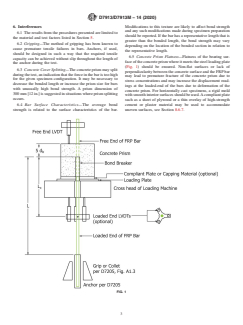
6.5 Concrete Prism Flatness—Flatness of the bearing sur-
capacity can be achieved without slip throughout the length of
faceoftheconcreteprismwhereitmeetsthesteelloadingplate
the anchor during the test.
(Fig. 1) should be ensured. Non-flat surfaces or lack of
6.3 Concrete Cover Splitting—Theconcreteprismmaysplit
perpendicularity between the concrete surface and the FRPbar
duringthetest,anindicationthattheforceinthebaristoohigh
may lead to premature fracture of the concrete prism due to
for the given specimen configuration. It may be necessary to
stress concentrations and may increase the displacement read-
decrease the bonded length or increase the prism size for bars
ings at the loaded-end of the bars due to deformation of the
with unusually high bond strength. A prism dimension of
concrete prism. For horizontally cast specimens, a rigid mold
300mm[12in.]issuggestedinsituationswhereprismsplitting
withsmoothinteriorsurfacesshouldbeused.Acompliantplate
occurs.
such as a sheet of plywood or a thin overlay of high-strength
6.4 Bar Surface Characteristics—The average bond
cement or plaster material may be used to accommodate
strength is related to the surface characteristics of the bar. uneven surfaces, see Section 8.6.7.
FIG. 1
D7913/D7913M − 14 (2020)
6.6 Concrete Strength—The bond strength is related to the dimensions on the specimen.The plate shall be at least 20 mm
concrete compressive strength.Therefore the concrete must be [0.75 in.] thick with a surface finish of 1.6 µm [64 µin.] or
composed of known constituents and the specimens must be better. The hole drilled through the loading plate should be
cured in a controlled environment. 10mm 6 5 mm [0.4 in. 6 0.2 in.] larger in diameter than the
maximum transverse dimension of the FRP bar. The loading
6.7 System Alignment—Excessive bending may cause pre-
plate may be fabricated in two parts to accommodate the
mature failure, as well as a highly inaccurate bond stress
testing of specimens fitted with end anchors.
determination. Every effort should be made to eliminate
7.4.2 If used, the anchor on the loaded-end of the FRP bar
bending from the test system. Bending may occur due to
shall conform to Test Method D7205/D7205M, and may be
misalignment of the bar within the anchor or grips or due to
attached to a tension grip body, to a collet, or to the second
lack of perpendicularity between the face of the compression
head of the testing machine, if so equipped.
platen, the cast face of the prism that mates with the compres-
sion platen, and the bar. See Practice E1012 for verification of
NOTE 2—The tensile forces transmitted through the anchor will be
below those required to rupture the FRPbar in tension. Therefore, it may
specimen alignment under tensile loading.
be appropriate to use v-groove tension wedge grips, instead of the anchor
6.8 Measurement of Cross-Sectional Area—The nominal
as recommended in Test Method D7205/D7205M. If excessive slip or
rupture at the grip body occurs, then a suitable anchor should be used.
cross-sectional area of the bar is measured by immersing a
prescribed length of the specimen in water to determine its
7.4.3 The free-end LVDT clamp shall accommodate one
buoyant weight per Test Methods D792 and D7205/D7205M.
LVDT to measure the free-end slip of the FRP bar, relative to
Bar configurations that trap air during immersion (aside from
the end of the concrete prism, during the test.
minor porosity) cannot be assessed using this method. This
7.4.4 The optional loaded-end LVDT fixture shall accom-
method may not be appropriate for bars that have large
modate one or more LVDTs. An arrangement of three LVDTs
variations in cross-sectional area along the length of the bar.
arranged 120° apart is suggested to measure the loaded-end
slip plus elastic elongation over the distance Lc and to
6.9 Environmental Conditions at Time of Testing—Test
characterize and account for bending in the specimen.
results may be affected by the laboratory conditions. Test
conditions shall be reported.
7.5 Displacement Devices—The displacement measuring
devices fitted to both the free end and optionally at the
7. Apparatus
loaded-end of the FRPbars shall be LVDTs or similar devices,
reading accurately to 0.01 mm [0.0004 in.]. An extensometer
7.1 Testing Machine—The testing machine used shall con-
corresponding to Type 2, Class B-2 of Practice E83 may be
form to the requirements of the sections on Basis of
used to measure free-end slip.
Verification, Corrections, and Time Interval Between Verifica-
tions of Practices E4. Motorized pumps or hand operated
7.6 Concrete Molds—Two types of molds for bond test
positive displacement pumps shall be capable of applying
specimens are described: for 200 mm [8 in.] concrete prisms,
forces at a uniform rate without shock or interruption. The
containing either a vertically or horizontally embedded bar;
testing machine shall have a force capacity in excess of the
andfor200×200×400mm[8×8×16in.]prisms,containing
bond capacity of the test specimen.
two horizontally embedded bars.
7.1.1 The force indicator on the testing machine shall be
7.6.1 Themoldsshouldbemadeofmetalnolessthan6mm
calibrated to a range of not greater than 10 times the observed
[0.25 in.] or rigid plastic or wood no less than 12 mm [0.5 in.]
failure force of the specimen.
thick.Themoldsshouldbewatertightandconstructedforeasy
removal without disturbing the embedded bars. Mold surface
7.2 Steel Rule—Linear measuring device for measuring
treatments and oiling of surfaces to promote easy removal of
bonded length per Test Method F2203.
the specimens from the molds are acceptable.
7.3 Drive Mechanism—The testing machine with either
7.7 Concrete Curing Apparatus or Chamber—The pullout
loading-rate or displacement-rate control. The testing machine
specimens and the concrete compression specimens should be
drive mechanism shall be capable of imparting to the movable
cured according to Practice C192/C192M in a moist cabinet or
headacontrolledforceordisplacementratewithrespecttothe
water storage tank according to Specification C511.
stationary head. The rate of the movable head shall be capable
of being regulated as specified in 11.2.4.
8. Specimen Preparation and Sampling
7.4 Test Fixture—Thetestfixtureconsistsofaloadingplate,
8.1 Each FRP bar should be cut into lengths so that the
anchor, free-end LVDT (linear variable differential trans-
loaded-end of the specimen, L, is 1200 mm 6 5 mm [47 in. 6
former) clamp and optional loaded-end LVDT clamp (see Fig.
0.2 in.] (see Fig. 1). An anchor meeting the requirements of
1).The loading plate should rest on a support that transfers the
Test Method D7205/D7205M, Annex A, may be fitted to the
reaction from this block to the force indicator of the testing
loaded-end of the bar.
machine. As an alternative, the force indicator of the testing
machine can be attached to the tension grip at the loaded-end 8.2 The test specimens should contain either one FRP bar
of the bar.
embedded parallel or perpendicular to the direction of casting
7.4.1 Loading Plate—The loading plate should be a ma- of the concrete (Fig. 2), or two FRP bars embedded perpen-
chinedsteelplateatleast200mm[8in.]squareandthesurface dicular to the direction of casting of the concrete (Fig. 3). Five
dimensions of the plate must be larger than the mating specimensofagiventypeprovidingvalidtestresultsconstitute
D7913/D7913M − 14 (2020)
FIG. 2 Dimensions of Singly-Cast Specimens
FIG. 3 Ganged Horizontal Specimens
a minimum set of test specimens. If a specimen ruptures in cover, an additional test should be performed on a separate
tension, or slips at the anchoring section, or splits the concrete specimen taken from the same lot as the failed specimen. It is
D7913/D7913M − 14 (2020)
suggested that additional specimens be prepared with the same 8.6.3 Beforecastingtheconcrete,itisaccepta
...