

ASTM D8287/D8287M-22
(Test Method)Standard Test Method for Compressive Residual Strength Properties of Damaged Sandwich Composite Panels
General Information
- Abstract
SIGNIFICANCE AND USE
5.1 Susceptibility to damage from concentrated out-of-plane forces is one of the major design concerns of many structures made of sandwich constructions. Knowledge of the damage resistance and residual strength properties of a sandwich construction is useful for product development and material selection.
5.2 The residual strength data obtained using this test method is most commonly used in material selection, research and development activities, and establishing design allowables.
5.3 The properties obtained using this test method can provide guidance in regard to the anticipated residual strength capability of sandwich constructions of similar facesheet and core material, adhesive, facesheet and core thickness, facesheet stacking sequence, and so forth. However, it must be understood that the residual strength of sandwich constructions is highly dependent upon several factors including geometry, thickness, stiffness, support conditions, and so forth. Significant differences in the relationships between the damage state and the residual compressive strength can result due to differences in these parameters.
5.4 The compression strength from this test may not be equivalent to the compression strength of sandwich structures subjected to flexural compression testing.
5.5 The reporting section requires items that tend to influence residual compressive strength to be reported; these include the following: facesheet and core materials, core density, cell size and wall thickness if applicable, film adhesive, methods of material fabrication, accuracy of lay-up orientation, facesheet stacking sequence and thickness, core thickness, overall specimen thickness, specimen geometry, specimen preparation, specimen conditioning, environment of testing, type, size and location of damage (including method of non-destructive inspection), specimen/fixture alignment and gripping, time at temperature, and speed of testing.
5.6 Results from the residual strength assessmen...
SCOPE
1.1 This test method covers compression residual strength properties of sandwich constructions that have been subjected to quasi-static indentation or drop-weight impact per Practice D7766/D7766M.
Note 1: When used to determine the residual strength of drop-weight impacted plates, this test method is commonly referred to as the Sandwich Compression After Impact test method.
1.2 Several important test specimen parameters (for example, facesheet thickness, core thickness, and core density) are not mandated by this test method; however, repeatable results require that these parameters be specified and reported.
1.3 The method utilizes a flat, rectangular specimen, previously subjected to a damaging event, which is tested under edgewise compressive loading using a stabilization fixture.
1.4 The properties generated by this test method are highly dependent upon several factors, which include; specimen geometry, sandwich component materials and dimensions (facesheet, core, and adhesive), methods of fabrication, the type, size, and location of damage and boundary conditions. Thus, results are generally not scalable to other sandwich constructions, and are particular to the combination of geometric and physical conditions tested.
1.5 This test method can be used to test undamaged specimens, but care should be taken to prevent undesirable failure modes such as end crushing. Test Methods C364 and D7249/D7249M are the recommended test methods for undamaged sandwich panel compression strength by edgewise compression or long beam flexure, respectively.
1.6 Units—The values stated in either SI units or inch-pound units are to be regarded separately as standard. The values stated in each system are not necessarily exact equivalents; therefore, to ensure conformance with the standard, each system shall be used independently of the other, and values from the two systems shall not be combined.
1.6.1 Within the text, t...
- Status
- Published
- Publication Date
- 31-Oct-2022
- Technical Committee
- D30 - Composite Materials
- Drafting Committee
- D30.09 - Sandwich Construction
Overview
ASTM D8287/D8287M-22 is the internationally recognized standard developed by ASTM for determining the compressive residual strength properties of damaged sandwich composite panels. This test method assesses the structure’s performance after being subjected to localized out-of-plane impacts, such as those occurring due to quasi-static indentation or drop-weight impacts, as outlined in Practice D7766/D7766M. The data collected helps engineers, researchers, and material specifiers understand the residual strength behavior of sandwich constructions-which is key for applications where impact damage poses a critical design concern.
Sandwich composite panels, widely used in aerospace, marine, transportation, and wind energy sectors, rely heavily on their ability to maintain structural integrity following damage. Understanding their residual compressive strength aids in material selection, product development, and setting conservative design allowables.
Key Topics
- Compressive Residual Strength Evaluation: This method provides a systematic approach to measure the ultimate compressive strength of flat, rectangular sandwich specimens after damage is inflicted.
- Damage Simulation: Damage is introduced via quasi-static indentation or drop-weight impact, replicating real-world impact scenarios.
- Testing Protocol: The specimen is tested in a specially designed fixture, loaded edgewise under compression, after the imparted damage.
- Parameter Sensitivity: Results are highly dependent on factors such as specimen geometry, facesheet and core properties, adhesive selection, fabrication techniques, support conditions, and the type and location of damage.
- Reporting Requirements: Complete documentation includes facesheet and core materials, densities, thicknesses, fabrication methods, stack sequences, geometry, environmental conditions, damage details, alignment, and test settings-ensuring repeatability and comparability.
Applications
The ASTM D8287/D8287M-22 test method is especially valuable for industries and professionals who:
- Develop New Sandwich Panels: Critical for R&D teams improving impact resistance and optimizing layered materials.
- Select Materials for High-Performance Structures: Supports engineers in choosing composite systems for scenarios where out-of-plane impact is a risk.
- Establish Design Allowables: Provides data necessary for setting conservative safety margins and design criteria in aerospace, automotive, marine, and wind energy applications.
- Assess In-service Damage Tolerance: Guides maintenance and repair decisions by evaluating the strength remaining after impact damage.
- Benchmark Manufacturing Processes: Helps validate different fabrication or bonding techniques concerning damage tolerance.
This method is referred to as the "Sandwich Compression After Impact" test, highlighting its relevance for impact-prone environments. While it is primarily intended for damaged specimens, it may also be adapted for undamaged panels-but refer to ASTM C364 and D7249/D7249M for those cases.
Related Standards
Those implementing ASTM D8287/D8287M-22 should be aware of other significant ASTM standards for composite and sandwich materials, including:
- ASTM D7766/D7766M - Practice for Damage Resistance Testing of Sandwich Constructions (method for inducing damage for this test)
- ASTM C364 - Test Method for Edgewise Compressive Strength of Sandwich Constructions
- ASTM D7249/D7249M - Test Method for Facesheet Properties by Long Beam Flexure
- ASTM D7137 - Test Method for Compressive Residual Strength of Damaged Composite Plates (laminates, not sandwich)
- ASTM D5687/D5687M - Guide for Preparation of Flat Composite Panels and Specimens
- ASTM D792 - Methods for Density and Specific Gravity of Plastics
- ASTM D883 & D3878 - Terminology for Plastics and Composite Materials
Conclusion
Implementing ASTM D8287/D8287M-22 ensures consistent, comprehensive assessment of sandwich composite panels’ residual compressive strength after damage. The data supports safer, more effective engineering by informing both material choice and design strategies for structures where impact tolerance is vital. By following this standard, organizations can confidently address key design concerns, optimize product reliability, and maintain compliance with international best practices in composite engineering.
Keywords: sandwich composite panels, compressive residual strength, ASTM D8287, impact damage, material selection, composite testing, residual strength assessment, compressed sandwich panel, structural composites, impact resistance, design allowables, composite standards.
Relations
- Effective Date
- 01-Feb-2024
- Effective Date
- 01-Nov-2023
- Effective Date
- 01-Apr-2022
- Effective Date
- 01-Mar-2020
- Effective Date
- 01-Feb-2020
- Effective Date
- 01-Jan-2020
- Effective Date
- 15-Oct-2019
- Effective Date
- 01-Aug-2019
- Effective Date
- 15-Apr-2019
- Effective Date
- 15-Apr-2019
- Effective Date
- 01-Feb-2019
- Effective Date
- 01-Dec-2018
- Effective Date
- 01-Nov-2018
- Effective Date
- 01-Apr-2018
- Effective Date
- 01-Apr-2018
Get Certified
Connect with accredited certification bodies for this standard

DIN CERTCO
DIN Group product certification.

Smithers Quality Assessments
US management systems and product certification.
Sponsored listings
Frequently Asked Questions
ASTM D8287/D8287M-22 is a standard published by ASTM International. Its full title is "Standard Test Method for Compressive Residual Strength Properties of Damaged Sandwich Composite Panels". This standard covers: SIGNIFICANCE AND USE 5.1 Susceptibility to damage from concentrated out-of-plane forces is one of the major design concerns of many structures made of sandwich constructions. Knowledge of the damage resistance and residual strength properties of a sandwich construction is useful for product development and material selection. 5.2 The residual strength data obtained using this test method is most commonly used in material selection, research and development activities, and establishing design allowables. 5.3 The properties obtained using this test method can provide guidance in regard to the anticipated residual strength capability of sandwich constructions of similar facesheet and core material, adhesive, facesheet and core thickness, facesheet stacking sequence, and so forth. However, it must be understood that the residual strength of sandwich constructions is highly dependent upon several factors including geometry, thickness, stiffness, support conditions, and so forth. Significant differences in the relationships between the damage state and the residual compressive strength can result due to differences in these parameters. 5.4 The compression strength from this test may not be equivalent to the compression strength of sandwich structures subjected to flexural compression testing. 5.5 The reporting section requires items that tend to influence residual compressive strength to be reported; these include the following: facesheet and core materials, core density, cell size and wall thickness if applicable, film adhesive, methods of material fabrication, accuracy of lay-up orientation, facesheet stacking sequence and thickness, core thickness, overall specimen thickness, specimen geometry, specimen preparation, specimen conditioning, environment of testing, type, size and location of damage (including method of non-destructive inspection), specimen/fixture alignment and gripping, time at temperature, and speed of testing. 5.6 Results from the residual strength assessmen... SCOPE 1.1 This test method covers compression residual strength properties of sandwich constructions that have been subjected to quasi-static indentation or drop-weight impact per Practice D7766/D7766M. Note 1: When used to determine the residual strength of drop-weight impacted plates, this test method is commonly referred to as the Sandwich Compression After Impact test method. 1.2 Several important test specimen parameters (for example, facesheet thickness, core thickness, and core density) are not mandated by this test method; however, repeatable results require that these parameters be specified and reported. 1.3 The method utilizes a flat, rectangular specimen, previously subjected to a damaging event, which is tested under edgewise compressive loading using a stabilization fixture. 1.4 The properties generated by this test method are highly dependent upon several factors, which include; specimen geometry, sandwich component materials and dimensions (facesheet, core, and adhesive), methods of fabrication, the type, size, and location of damage and boundary conditions. Thus, results are generally not scalable to other sandwich constructions, and are particular to the combination of geometric and physical conditions tested. 1.5 This test method can be used to test undamaged specimens, but care should be taken to prevent undesirable failure modes such as end crushing. Test Methods C364 and D7249/D7249M are the recommended test methods for undamaged sandwich panel compression strength by edgewise compression or long beam flexure, respectively. 1.6 Units—The values stated in either SI units or inch-pound units are to be regarded separately as standard. The values stated in each system are not necessarily exact equivalents; therefore, to ensure conformance with the standard, each system shall be used independently of the other, and values from the two systems shall not be combined. 1.6.1 Within the text, t...
SIGNIFICANCE AND USE 5.1 Susceptibility to damage from concentrated out-of-plane forces is one of the major design concerns of many structures made of sandwich constructions. Knowledge of the damage resistance and residual strength properties of a sandwich construction is useful for product development and material selection. 5.2 The residual strength data obtained using this test method is most commonly used in material selection, research and development activities, and establishing design allowables. 5.3 The properties obtained using this test method can provide guidance in regard to the anticipated residual strength capability of sandwich constructions of similar facesheet and core material, adhesive, facesheet and core thickness, facesheet stacking sequence, and so forth. However, it must be understood that the residual strength of sandwich constructions is highly dependent upon several factors including geometry, thickness, stiffness, support conditions, and so forth. Significant differences in the relationships between the damage state and the residual compressive strength can result due to differences in these parameters. 5.4 The compression strength from this test may not be equivalent to the compression strength of sandwich structures subjected to flexural compression testing. 5.5 The reporting section requires items that tend to influence residual compressive strength to be reported; these include the following: facesheet and core materials, core density, cell size and wall thickness if applicable, film adhesive, methods of material fabrication, accuracy of lay-up orientation, facesheet stacking sequence and thickness, core thickness, overall specimen thickness, specimen geometry, specimen preparation, specimen conditioning, environment of testing, type, size and location of damage (including method of non-destructive inspection), specimen/fixture alignment and gripping, time at temperature, and speed of testing. 5.6 Results from the residual strength assessmen... SCOPE 1.1 This test method covers compression residual strength properties of sandwich constructions that have been subjected to quasi-static indentation or drop-weight impact per Practice D7766/D7766M. Note 1: When used to determine the residual strength of drop-weight impacted plates, this test method is commonly referred to as the Sandwich Compression After Impact test method. 1.2 Several important test specimen parameters (for example, facesheet thickness, core thickness, and core density) are not mandated by this test method; however, repeatable results require that these parameters be specified and reported. 1.3 The method utilizes a flat, rectangular specimen, previously subjected to a damaging event, which is tested under edgewise compressive loading using a stabilization fixture. 1.4 The properties generated by this test method are highly dependent upon several factors, which include; specimen geometry, sandwich component materials and dimensions (facesheet, core, and adhesive), methods of fabrication, the type, size, and location of damage and boundary conditions. Thus, results are generally not scalable to other sandwich constructions, and are particular to the combination of geometric and physical conditions tested. 1.5 This test method can be used to test undamaged specimens, but care should be taken to prevent undesirable failure modes such as end crushing. Test Methods C364 and D7249/D7249M are the recommended test methods for undamaged sandwich panel compression strength by edgewise compression or long beam flexure, respectively. 1.6 Units—The values stated in either SI units or inch-pound units are to be regarded separately as standard. The values stated in each system are not necessarily exact equivalents; therefore, to ensure conformance with the standard, each system shall be used independently of the other, and values from the two systems shall not be combined. 1.6.1 Within the text, t...
ASTM D8287/D8287M-22 is classified under the following ICS (International Classification for Standards) categories: 83.120 - Reinforced plastics. The ICS classification helps identify the subject area and facilitates finding related standards.
ASTM D8287/D8287M-22 has the following relationships with other standards: It is inter standard links to ASTM D883-24, ASTM D883-23, ASTM E456-13a(2022)e1, ASTM D5229/D5229M-20, ASTM D7249/D7249M-20, ASTM D883-20, ASTM D3878-19a, ASTM D883-19c, ASTM D3878-19, ASTM D883-19a, ASTM D883-19, ASTM D883-18a, ASTM D883-18, ASTM D7249/D7249M-18, ASTM D3878-18. Understanding these relationships helps ensure you are using the most current and applicable version of the standard.
ASTM D8287/D8287M-22 is available in PDF format for immediate download after purchase. The document can be added to your cart and obtained through the secure checkout process. Digital delivery ensures instant access to the complete standard document.
Standards Content (Sample)
This international standard was developed in accordance with internationally recognized principles on standardization established in the Decision on Principles for the
Development of International Standards, Guides and Recommendations issued by the World Trade Organization Technical Barriers to Trade (TBT) Committee.
Designation: D8287/D8287M − 22
Standard Test Method for
Compressive Residual Strength Properties of Damaged
Sandwich Composite Panels
This standard is issued under the fixed designation D8287/D8287M; the number immediately following the designation indicates the
year of original adoption or, in the case of revision, the year of last revision. A number in parentheses indicates the year of last
reapproval. A superscript epsilon (´) indicates an editorial change since the last revision or reapproval.
1. Scope 1.6.1 Within the text, the inch-pound units are shown in
brackets.
1.1 This test method covers compression residual strength
1.7 This standard does not purport to address all of the
properties of sandwich constructions that have been subjected
safety concerns, if any, associated with its use. It is the
to quasi-static indentation or drop-weight impact per Practice
responsibility of the user of this standard to establish appro-
D7766/D7766M.
priate safety, health, and environmental practices and deter-
NOTE 1—When used to determine the residual strength of drop-weight
mine the applicability of regulatory limitations prior to use.
impacted plates, this test method is commonly referred to as the Sandwich
1.8 This international standard was developed in accor-
Compression After Impact test method.
dance with internationally recognized principles on standard-
1.2 Several important test specimen parameters (for
ization established in the Decision on Principles for the
example, facesheet thickness, core thickness, and core density)
Development of International Standards, Guides and Recom-
are not mandated by this test method; however, repeatable
mendations issued by the World Trade Organization Technical
results require that these parameters be specified and reported.
Barriers to Trade (TBT) Committee.
1.3 The method utilizes a flat, rectangular specimen, previ-
ously subjected to a damaging event, which is tested under
2. Referenced Documents
edgewise compressive loading using a stabilization fixture.
2.1 ASTM Standards:
1.4 The properties generated by this test method are highly
C364 Test Method for Edgewise Compressive Strength of
dependent upon several factors, which include; specimen
Sandwich Constructions
geometry, sandwich component materials and dimensions
D792 Test Methods for Density and Specific Gravity (Rela-
(facesheet, core, and adhesive), methods of fabrication, the
tive Density) of Plastics by Displacement
type, size, and location of damage and boundary conditions.
D883 Terminology Relating to Plastics
Thus, results are generally not scalable to other sandwich
D3171 Test Methods for Constituent Content of Composite
constructions, and are particular to the combination of geomet-
Materials
ric and physical conditions tested.
D3878 Terminology for Composite Materials
D5229/D5229M Test Method for MoistureAbsorption Prop-
1.5 This test method can be used to test undamaged
erties and Equilibrium Conditioning of Polymer Matrix
specimens, but care should be taken to prevent undesirable
Composite Materials
failure modes such as end crushing. Test Methods C364 and
D5687/D5687M Guide for Preparation of Flat Composite
D7249/D7249M are the recommended test methods for un-
Panels with Processing Guidelines for Specimen Prepara-
damaged sandwich panel compression strength by edgewise
tion
compression or long beam flexure, respectively.
D7137 Test Method for Compressive Residual Strength
1.6 Units—The values stated in either SI units or inch-
Properties of Damaged Polymer Matrix Composite Plates
pound units are to be regarded separately as standard. The
D7249/D7249M Test Method for Facesheet Properties of
values stated in each system are not necessarily exact equiva-
Sandwich Constructions by Long Beam Flexure
lents; therefore, to ensure conformance with the standard, each
D7766/D7766M Practice for Damage Resistance Testing of
system shall be used independently of the other, and values
Sandwich Constructions
from the two systems shall not be combined.
D8388/D8388M Practice for Flexural Residual Strength
This test method is under the jurisdiction of ASTM Committee D30 on
Composite Materials and is the direct responsibility of Subcommittee D30.09 on For referenced ASTM standards, visit the ASTM website, www.astm.org, or
Sandwich Construction. contact ASTM Customer Service at service@astm.org. For Annual Book of ASTM
Current edition approved Nov. 1, 2022. Published February 2023. DOI: 10.1520/ Standards volume information, refer to the standard’s Document Summary page on
D8287_D8287M-22. theASTM website.
Copyright © ASTM International, 100 Barr Harbor Drive, PO Box C700, West Conshohocken, PA 19428-2959. United States
D8287/D8287M − 22
Testing of Damaged Sandwich Constructions 4.1.2 Drop-Weight Impact—The rectangular specimen is
E4 Practices for Force Calibration and Verification of Test- damaged due to application of an out-of-plane drop-weight
ing Machines impact in accordance with Practice D7766/D7766M Procedure
E6 Terminology Relating to Methods of Mechanical Testing C.
E122 Practice for Calculating Sample Size to Estimate,With
4.2 The damaged specimen is installed in a multi-piece
Specified Precision, the Average for a Characteristic of a
support fixture, that has been aligned to minimize loading
Lot or Process
eccentricities and induced specimen bending. The specimen/
E177 Practice for Use of the Terms Precision and Bias in
fixture assembly is placed between flat platens and end-loaded
ASTM Test Methods
under compressive force until failure.Applied force, crosshead
E456 Terminology Relating to Quality and Statistics
displacement, and strain data are recorded while loading.
4.3 Preferred failure modes pass through the damage in the
3. Terminology
specimen. However, acceptable failures may initiate away
3.1 Definitions—Terminology D3878 defines terms relating
from the damage site, in instances when the damage produces
to high-modulus fibers and their composites, as well as terms
a relatively low stress concentration or if the extent of damage
relating to sandwich constructions. Terminology D883 defines
is small, or both. Unacceptable failure modes are those related
terms relating to plastics. Terminology E6 defines terms
to load introduction by the support fixture, local edge support
relating to mechanical testing. Terminology E456 and Practice
conditions, and specimen instability (unless the specimen is
E177 define terms relating to statistics. In the event of conflict
dimensionally representative of a particular structural applica-
between terms, Terminology D3878 shall have precedence
tion).
over the other terminology standards.
5. Significance and Use
NOTE 2—If the term represents a physical quantity, its analytical
dimensionsarestatedimmediatelyfollowingtheterm(orlettersymbol)in 5.1 Susceptibilitytodamagefromconcentratedout-of-plane
fundamental dimension form, using the following ASTM standard sym-
forces is one of the major design concerns of many structures
bology for fundamental dimensions, shown within square brackets: [M]
made of sandwich constructions. Knowledge of the damage
for mass, [L] for length, [T] for time, [θ] for thermodynamic temperature,
resistance and residual strength properties of a sandwich
and[nd]fornon-dimensionalquantities.Useofthesesymbolsisrestricted
construction is useful for product development and material
to analytical dimensions when used with square brackets, as the symbols
may have other definitions when used without the brackets. selection.
3.2 Symbols: 5.2 The residual strength data obtained using this test
CV—coefficient of variation statistic of a sample population
method is most commonly used in material selection, research
for a given property (in percent) anddevelopmentactivities,andestablishingdesignallowables.
h—specimen thickness
5.3 The properties obtained using this test method can
l—specimen length
provide guidance in regard to the anticipated residual strength
n—number of specimens per sample population
capability of sandwich constructions of similar facesheet and
CAI
N —ultimate normalized compressive force in the test
corematerial,adhesive,facesheetandcorethickness,facesheet
direction
stacking sequence, and so forth. However, it must be under-
P —maximum force carried by test specimen prior to
max
stood that the residual strength of sandwich constructions is
failure
highly dependent upon several factors including geometry,
S —standard deviation statistic of a sample population for
n-1
thickness, stiffness, support conditions, and so forth. Signifi-
a given property
cant differences in the relationships between the damage state
t—nominal facesheet thickness
and the residual compressive strength can result due to
w—specimen width
differences in these parameters.
x—test result for an individual specimen from the sample
i
5.4 The compression strength from this test may not be
population for a given property
equivalent to the compression strength of sandwich structures
x¯—mean or average (estimate of mean) of a sample popu-
subjected to flexural compression testing.
lation for a given property
5.5 The reporting section requires items that tend to influ-
∆—percent difference
ence residual compressive strength to be reported; these
ε—indicated strain from gage
include the following: facesheet and core materials, core
4. Summary of Test Method
density, cell size and wall thickness if applicable, film
adhesive, methods of material fabrication, accuracy of lay-up
4.1 A uniaxial compression test is performed using a speci-
orientation, facesheet stacking sequence and thickness, core
men which has been damaged and inspected prior to the
thickness, overall specimen thickness, specimen geometry,
application of compressive force.The damage state is imparted
specimen preparation, specimen conditioning, environment of
throughout-of-planeloadingcausedbyquasi-staticindentation
testing, type, size and location of damage (including method of
or drop-weight impact.
non-destructive inspection), specimen/fixture alignment and
4.1.1 Quasi-Static Indentation—The rectangular specimen
gripping, time at temperature, and speed of testing.
is damaged due to application of an out-of-plane static inden-
tation force in accordance with Practice D7766/D7766M 5.6 Results from the residual strength assessment include
CAI
Procedure A or Procedure B. the following: normalized compressive residual strength N ,
D8287/D8287M − 22
compressiveforceasafunctionofcrossheaddisplacement,and supports must be co-planar. Results may be affected by the
far-fieldsurfacestrainsasfunctionsofcrossheaddisplacement. geometry of the various slide plates local to the specimen.
Results may also be affected by the presence of gaps between
6. Interferences
the slide plates and the specimen, which can reduce the
effective edge support and can result in concentrated load
6.1 The response of a damaged specimen is dependent upon
introduction conditions at the top and bottom specimen sur-
many factors, such as facesheet material, facesheet thickness,
faces. Additionally, results may be affected by variations in
facesheet ply thickness, facesheet stacking sequence, facesheet
torque applied to the slide plate fasteners; loose fasteners may
surface flatness (toolside or bagside surface), core material,
also reduce the effective edge support.
core thickness, core density, cell size, cell wall thickness,
adhesive, construction methods, environment, damage type,
6.6 System Alignment—Errors can result if the test fixture is
damage geometry, damage location, and loading/support con-
not centered with respect to the loading axis of the test
ditions. Consequently, comparisons cannot be made between
machine, and aligned or shimmed to apply an essentially
materials unless identical test configurations, test conditions,
uniaxial displacement to the loaded end of the specimen.
and sandwich constructions are used. Therefore, all deviations
from the standard test configuration shall be reported in the 6.7 Non-Destructive Inspection—Non-destructive inspec-
tion (NDI) results are affected by the particular method
results. Specific structural configurations and boundary condi-
tions must be considered when applying the data generated utilized, the inherent variability of the NDI method, the
using this test method to design applications. experienceoftheoperator,andsoforth.DifferentNDImethods
may be required for assessing the various damage modes that
6.2 Material and Specimen Preparation—Poormaterialfab-
may arise during sandwich damage resistance testing. Damage
rication practices, lack of control of fiber alignment, poor core
location may also influence the selection of NDI methods.
bonding, and damage induced by improper specimen machin-
ing are known causes of high material data scatter in compos-
6.8 Specimen Instability—Accurate detection of instability
ites in general. Important aspects of sandwich construction
or incipient instability of the facesheets or the specimen may
preparationthatcontributetodatascatterincludeincompleteor
not be possible. The nature of the damage can have a
nonuniform core bonding to facesheets, misalignment of core
significant effect upon local flexural rigidity, which may
and facesheet elements, the existence of joints, voids or other
complicate the failure mode, limiting results to the unique
core and facesheet discontinuities, out-of-plane curvature,
configuration tested.
facesheet thickness variation, surface roughness, and failure to
6.9 Facesheet Load Distribution—This test method effec-
meet the dimensional and squareness tolerances (parallelism
tively applies a uniform axial displacement to the test speci-
and perpendicularity) specified in 8.2.
men. If the stiffness of the two facesheets is different, either
6.3 Damage Mode—Variations in the specimen damage
due to the damage inflicted on one facesheet or due to one
modes produced during the damaging event can contribute to
facesheet having more dimpling due to cocuring (bagside
strength, stiffness, and strain data scatter.
versus toolside effects), then accurate calculation of the
6.4 Damage Geometry and Location—The size, shape, and
facesheet stress in the damaged facesheet requires the use of
location of damage (both within the plane of the specimen and
strain gages on both facesheets to determine the load distribu-
through-the-thickness) can affect the deformation and strength
tion. Where there is a significant difference in facesheet
behavior of the specimen significantly. Edge effects, boundary
stiffnesses, use of Practice D8388/D8388M with damage
constraints, and the damaged stress/strain field can interact if
applied to the compressive side facesheet may be more useful
the damage size becomes too large relative to the length and
and appropriate.
width dimensions of the specimen. The damage size, as
6.10 Out of Plane Deformation—Depending on the damage
measured in accordance with Practice D7766/D7766M,is
limitedtoone-thirdoftheunsupportedspecimenwidth(65mm state, facesheets, and core material, the stiffness differences
between the damaged and undamaged facesheets may be
[2.6 in.]) to minimize interaction between damage and edge-
related stress/strain fields. significant.Visually monitor the test for excessive out-of-plane
deformation.
NOTE 3—It is recommended that the damage be limited to one-fifth the
NOTE 4—While Digital Image Correlation (DIC) currently is not
specimen unsupported width (40 mm [1.6 in.]); however, this may not be
formally used for strain measurement inASTM standards (since there are
practical in all cases.Also, it may not be possible to accurately predict the
no ASTM accepted calibration methods), it may be used to help quantify
damage sizes prior to fabrication of the specimens; therefore, a pre-test
the amount of out-of-plane deformation and strain distributions as well as
impact survey program is recommended prior to specimen fabrication.
assess test validity.
6.5 Test Fixture Characteristics—The configuration of the
6.11 Potting—Potting is commonly used to avoid facesheet
panel edge-constraint structure can have a significant effect on
separation and end brooming prior to specimen failure. Potting
test results. In the standard test fixture, the top and bottom
of the core may occur during or prior to bonding to the
supports provide no clamp-up force, but provide some restraint
facesheets if the potting material is compatible with the
to local out-of-plane rotation due to the fixture geometry. The
knife-edge side supports provide resistance to out-of-plane facesheet cure cycle. Potting mayalsooccur after the specimen
is cured by removing the core at the ends and inserting potting
movement at the edges, which increases the compressive force
that would result in global buckling of the specimen. Edge material.
D8287/D8287M − 22
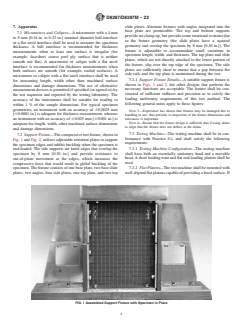
7. Apparatus slide plates. Alternate fixtures with angles integrated into the
base plate are permissible. The top and bottom supports
7.1 Micrometers and Calipers—A micrometer with a 4 mm
provide no clamp-up, but provide some rotational restraint due
to 8 mm [0.16 in. to 0.32 in.] nominal diameter ball-interface
to the fixture geometry (the slide plates have a squared
or a flat anvil interface shall be used to measure the specimen
geometry and overlap the specimen by 8 mm [0.30 in.]). The
thickness. A ball interface is recommended for thickness
fixture is adjustable to accommodate small variations in
measurements when at least one surface is irregular (for
specimen length, width, and thickness. The top plate and slide
example, facesheet coarse peel ply surface that is neither
plates, which are not directly attached to the lower portion of
smooth nor flat). A micrometer or caliper with a flat anvil
the fixture, slip over the top edge of the specimen. The side
interface is recommended for thickness measurements when
plates are sufficiently short to ensure that a gap between the
both surfaces are smooth (for example, tooled surfaces). A
side rails and the top plate is maintained during the test.
micrometer or caliper with a flat anvil interface shall be used
7.2.1 Support Fixture Details—A suitable support fixture is
for measuring length, width other than machined surface
shown in Figs. 1 and 2, but other designs that perform the
dimensions and damage dimensions. The use of alternative
necessary functions are acceptable. The fixture shall be con-
measurement devices is permitted if specified (or agreed to) by
structed of sufficient stiffness and precision as to satisfy the
the test requestor and reported by the testing laboratory. The
loading uniformity requirements of this test method. The
accuracy of the instruments shall be suitable for reading to
following general notes apply to these figures:
within1%ofthe sample dimensions. For typical specimen
geometries, an instrument with an accuracy of 60.0025 mm
NOTE 5—Experience has shown that fixtures may be damaged due to
[60.0001 in.] is adequate for thickness measurement, whereas
handling in use, thus periodic re-inspection of the fixture dimensions and
an instrument with an accuracy of 60.025 mm [60.001 in.] is tolerances is important.
NOTE 6—Ensure that the fixture design is sufficient that if using shims
adequate for length, width, other machined surface dimensions
to align that the fixture does not deflect at the shims.
and damage dimensions.
7.3 Testing Machine—The testing machine shall be in con-
7.2 Support Fixture—Thecompressivetestfixture,shownin
formance with Practice E4, and shall satisfy the following
Fig. 1 and Fig. 2, utilizes adjustable retention plates to support
requirements:
the specimen edges and inhibit buckling when the specimen is
7.3.1 Testing Machine Configuration—The testing machine
end-loaded. The side supports are knife edges that overlap the
shall have both an essentially stationary head and a movable
specimen by 8 mm [0.30 in.] and provide resistance to
head.Ashort loading train and flat end-loading platens shall be
out-of-plane movement at the edges, which increases the
used.
compressive force that would result in global buckling of the
specimen.The fixture consists of one base plate, two base slide 7.3.2 Flat Platens—The test machine shall be mounted with
plates, two angles, four side plates, one top plate, and two top well-alignedflatplatenscapableofprovidingafixedsurface.If
FIG. 1 Assembled Support Fixture with Specimen in Place
D8287/D8287M − 22
FIG. 2 Support Fixture Base Assembly and Top Assembly
the platens are not sufficiently hardened, or simply to protect If machine compliance is significant, it is acceptable to
the platen surfaces, a hardened plate (with parallel surfaces) measure the displacement of the movable head using a LVDT
can be inserted between each end of the fixture and the
or similar device with 61 % precision on displacement.
corresponding platen. The lower platen should be marked to
7.4 Conditioning Chamber—When conditioning materials
help center the test fixture between the platens.
at non-laboratory environments, a temperature-/vapor-level
7.3.2.1 The use of a spherical seat platen that includes a
controlledenvironmentalconditioningchamberisrequiredthat
position locking feature is encouraged; however, the use of
shall be capable of maintaining the required temperature to
fixed flat platens is acceptable. When using fixed flat platens,
within 63°C[65 °F] and the required relative humidity level
the platen surfaces shall be parallel within 0.025 mm
to within 63 %. Chamber conditions shall be monitored either
[0.001 in.] across the test fixture top plate length of 215 mm
on an automated continuous basis or on a manual basis at
[8.5 in.]. When using a spherical seat platen, it must be locked
regular intervals.
intoafixedpositionaftereitheraligningitwiththefixedplaten
or aligning the specimen through the use of strain gages
7.5 Environmental Test Chamber—An environmental test
bonded to the specimen surface. The spherical seat platen may
chamber is required for test environments other than ambient
be placed either below or above the support fixture.
testing laboratory conditions. This chamber shall be capable of
maintaining the test specimen and fixture at the required test
NOTE 7—While the use of a locking spherical seat platen is preferred
for specimen alignment, the use of thin metallic shims placed between the environment during the mechanical test. The test temperature
fixture and the fixed flat platens is permissible for specimen alignment.
shall be maintained within 63°C [65 °F] of the required
NOTE8—Whenusingasphericalseatplaten,itispreferabletoplacethe
temperature, and the relative humidity level shall be main-
platen above the loading fixture for specimen alignment.
tained to within 63 % of the required humidity level.
7.3.3 Drive Mechanism—The testing machine drive mecha-
7.6 Strain-Indicating Device—Strain measurement of the
nism shall be capable of imparting to the movable head a
specimens is required. The longitudinal strain should be
controlled velocity with respect to the stationary head. The
measured simultaneously at four locations (two locations on
velocity of the movable head shall be capable of being
opposite faces of the specimen as shown in Fig. 3 and Fig. 4)
regulated as specified in 11.5.
7.3.4 Force Indicator—The testing machine force-sensing to aid in ensuring application of pure compressive loading and
to detect bending or buckling, or both, if any. If the ends of the
device shall be capable of indicating the total force being
carried by the test specimen. This device shall be essentially specimens are potted, the vertical location of the strain gages
shall be either 25 mm [1.0 in.] below the top of the specimen
free from inertia-lag at the specified rate of testing and shall
indicate the force with an accuracy over the force range(s) of or 12 mm [0.5 in.] below the top of the potting, whichever is
greater. The same type of strain transducer shall be used for all
interest of within 61 % of the indicated value.
7.3.5 Crosshead Displacement Indicator—The testing ma- strain measurements on any single specimen. The gages,
chine shall be capable of monitoring and recording the cross- surface preparation, and bonding agents should be chosen to
head displacement (stroke) with a precision of at least 61%. provide for optimal performance on the subject material for the
D8287/D8287M − 22
FIG. 3 Compressive Residual Strength Specimen (Inch-Pound Version)
prescribed test environment. Attachment of the strain- specimens, as in the case of a designed experiment. For
indicatingdevicetothespecimenshallnotcausedamagetothe statistically significant data, the procedures outlined in Practice
specimen surface. E122 should be consulted. The method of sampling shall be
NOTE 9—Although the compression test may be performed without the
reported.
use of strain-indicating devices, lack of instrumentation for the damaged
8.2 Standard Specimen Configuration—The test specimen
specimens makes the detection of poor alignment or undesirable specimen
instability, or both, much more difficult. For this reason, strain measure- shall be a uniform specimen with a constant thickness. The
ment of the specimens during compressive loading is required.
core and facesheet thickness should be representative of
NOTE 10—Moisture proofing of the strain gage installations on the
intended use. The standard width is 215 mm [8.5 in.] and
specimen needs to be done very carefully with multiple layers of
length of 265 mm [10.5 in.]. The geometry of the specimen is
protectivecoatings(suchasmicrofinedwax,hightemperatureTeflontape,
shown in Fig. 3 and Fig. 4.
adhesively-bonded aluminum foil, and room temperature curing vulcaniz-
ing (RTV) compound) before subjecting them to moisture conditioning
8.3 Non-Standard Specimen Configuration—For non-
inside the environmental conditioning chamber . Foil strain gages, pro-
standard specimen geometries, the width shall be not less than
tected simply with RTV compound, are likely to become corroded and
unfit for hot-wet testing after approximately 100 days of moisture three times the damage diameter as measured in accordance
conditioning.
with Practice D7766/D7766M. The recommended specimen
width is five times the damage diameter. The specimen length
7.7 Data Acquisition Equipment—Equipment capable of
shall be at least 1.2 times the width.
recording force, crosshead displacement, and strain data is
NOTE 11—If using a non-standard specimen configuration, the length
required.
and width of the specimen must be sufficient so that strain gages can be
placed in the far-field strain field.
8. Sampling and Test Specimens
8.4 Specimen Preparation—Guide D5687/D5687M pro-
8.1 Sampling—Test at least five specimens per test condi-
vides recommended specimen preparation practices and should
tion unless valid results can be gained through the use of fewer
be followed where practical.
8.4.1 Facesheets—Control of fiber alignment is critical.
Vijayaraju, K., Mangalgiri, P. D., and Parida B. K., “Hot-Wet Compression
Improper fiber alignment as well as intra-cell facesheet dim-
Testing of Impact Damaged Composite Laminates,” Proceedings of the Ninth
pling of co-cured composite sandwich panels with honeycomb
International Conference on Fracture (ICF-9), Sydney, Australia, 1997, pp.
909–916. coreswillchangethemeasuredproperties.Thefacesheetsmust
...