

ASTM F3043-15
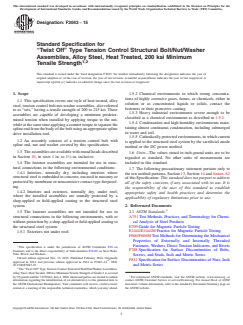
(Specification)Standard Specification for “Twist Off” Type Tension Control Structural Bolt/Nut/Washer Assemblies, Alloy Steel, Heat Treated, 200 ksi Minimum Tensile Strength
General Information
- Abstract
ABSTRACT
This specification establishes the basic requirements for one style of heat treated, alloy steel, tension control bolt-nut-washer assemblies, also known as "sets," having a tensile strength of 200 to 215 ksi. These assemblies are intended for use in structural connections in the following environmental conditions: interiors, normally dry, including interiors where structural steel is embedded in concrete, encased in masonry or protected by membrane or noncorrosive contact type fireproofing; and interiors and exteriors, normally dry, under roof, where the installed assemblies are soundly protected by a shop-applied or field-applied coating to the structural steel system.
The fastener assemblies are not intended for use in structural connections in the following environments, with or without protection by a shop-applied or field-applied coating to the structural steel system: exteriors not under roof; chemical environments in which strong concentrations of highly corrosive gases, fumes, or chemicals, either in solution or as concentrated liquids or solids, contact the fasteners or their protective coating; heavy industrial environments severe enough to be classified as a chemical environment; condensation and high humidity environments maintaining almost continuous condensation, including submerged in water and soil; and cathodically protected environments, in which current is applied to the structural steel system by the sacrificial anode method or the DC power method. This specification covers materials and manufacture, chemical composition, mechanical property, assembly lot tension test, carburization/decarburization of bolts, and magnetic particle inspection for tension control bolt longitudinal discontinuities and transverse cracks.
SIGNIFICANCE AND USE
A2.4 Significance and Use
A2.4.1 This test method describes the testing procedure that shall be used to qualify material for use in ASTM F3043 bolts made of any steel composition permitted by this specification. The test method measures the susceptibility of the material to the influence of an externally applied potential (see A2.7.2.3.2) by testing for the threshold of embrittlement in a salt solution environment.
SCOPE
1.1 This specification covers one style of heat treated, alloy steel, tension control bolt-nut-washer assemblies, also referred to as “sets,” having a tensile strength of 200 to 215 ksi. These assemblies are capable of developing a minimum predetermined tension when installed by applying torque to the nut, while at the same time applying a counter torque to separate the spline end from the body of the bolt using an appropriate spline drive installation tool.
1.2 An assembly consists of a tension control bolt with spline end, nut and washer covered by this specification.
1.3 The assemblies are available with round heads described in Section 10, in sizes 1 in. to 11/4 in. inclusive.
1.4 The fastener assemblies are intended for use in structural connections in the following environmental conditions:
1.4.1 Interiors, normally dry, including interiors where structural steel is embedded in concrete, encased in masonry or protected by membrane or noncorrosive contact type fireproofing.
1.4.2 Interiors and exteriors, normally dry, under roof, where the installed assemblies are soundly protected by a shop-applied or field-applied coating to the structural steel system.
1.5 The fastener assemblies are not intended for use in structural connections in the following environments, with or without protection by a shop-applied or field-applied coating to the structural steel system:
1.5.1 Exteriors not under roof.
1.5.2 Chemical environments in which strong concentrations of highly corrosive gases, fumes, or chemicals, either in solution or as concentrated liquids or solids, contact the fasteners or their protective coating.
1.5.3 Heavy industrial environments severe enough to be classified as a chemical environmen...
- Status
- Published
- Publication Date
- 14-Nov-2015
- Technical Committee
- F16 - Fasteners
- Drafting Committee
- F16.02 - Steel Bolts, Studs and Nuts
Buy Documents
ASTM F3043-15 - Standard Specification for “Twist Off” Type Tension Control Structural Bolt/Nut/Washer Assemblies, Alloy Steel, Heat Treated, 200 ksi Minimum Tensile Strength
REDLINE ASTM F3043-15 - Standard Specification for “Twist Off” Type Tension Control Structural Bolt/Nut/Washer Assemblies, Alloy Steel, Heat Treated, 200 ksi Minimum Tensile Strength
Overview
ASTM F3043-15 is the standard specification for “twist off” type tension control structural bolt/nut/washer assemblies made from heat treated alloy steel with a minimum tensile strength of 200 ksi. These fastener assemblies are engineered to ensure reliable, high-strength structural connections, primarily for use in buildings, bridges, and similar steel construction applications. The standard covers the requirements for composition, mechanical properties, manufacturing processes, and essential quality controls for these assemblies, promoting consistency and safety in critical load-bearing structures.
Key Topics
- Assemblies: Covers the complete set, including a tension control bolt with a spline end, hex nut, and through-hardened washer.
- Strength Requirements: Specifies a tensile strength of 200–215 ksi to ensure robust structural performance.
- Environmental Conditions: Intended for use in dry interior environments or protected exteriors under roof where the fasteners are shielded by coatings. Not suitable for exposed exteriors, highly corrosive, or constantly wet environments.
- Materials and Heat Treatment: Mandates alloy steel, precise chemical composition, and rigorous heat treatment for bolts and nuts.
- Testing and Inspection: Includes requirements for mechanical property testing, assembly lot tension testing, hardness, magnetic particle inspection, and resistance to environmental hydrogen embrittlement.
- Marking and Certification: Requires traceable product marking on each component and thorough certification documentation for each lot.
- Packaging and Delivery: Details standards for assembly packaging and package marking to support secure shipping and identity verification.
Applications
Tension control structural bolt assemblies per ASTM F3043-15 are essential components in the following applications:
- Steel Framed Structures: Used in steel buildings, bridges, towers, and infrastructure requiring high tensile strength and reliable pre-tensioning.
- Concrete-Embedded Connections: Suitable for connections where structural steel is embedded in concrete, encased in masonry, or protected by noncorrosive fireproofing.
- Protected Exterior Installations: Permitted for exterior connections under a roof, provided assemblies are soundly protected by shop or field-applied coatings.
- Prefabricated Construction: Ideal for modular steel structures and assemblies fabricated offsite where environmental control can be ensured.
- Critical Structural Joints: Utilized wherever precise, high-strength, and pre-tensioned bolted connections are required for safety and code compliance.
Restrictions:
These assemblies are not intended for use in exposed exterior situations, chemical or corrosive environments, areas with continuous condensation or submersion, or cathodically protected systems. They should not be hot dip galvanized or mechanically coated with zinc or other metals.
Related Standards
- ASTM F3125: Standard Specification for High Strength Structural Bolts, Steel and Alloy Steel, Heat Treated, 120 ksi and 150 ksi Minimum Tensile Strength.
- ASME B18.2.6: Fasteners for Use in Structural Applications.
- ASTM A751: Test Methods, Practices, and Terminology for Chemical Analysis of Steel Products.
- ASTM E709 / E1444: Magnetic particle inspection standards for fastener quality control.
- ASTM F606: Mechanical property testing methods for externally and internally threaded fasteners.
- ASTM F788 / F812: Specifications for surface discontinuities of bolts and nuts.
Practical Value
- Consistent Quality: Ensures all supplied assemblies meet defined structural performance metrics and traceability requirements.
- Structural Safety: Provides the critical standards needed for load-bearing structures where failure is not an option.
- Project Efficiency: Standardized assembly and installation procedures promote faster, safer construction.
- Regulatory Compliance: Simplifies compliance for specifiers, engineers, and inspectors working on major construction projects.
ASTM F3043-15 enables engineers, specifiers, and fabricators to confidently select, install, and verify high-strength, tension control structural fasteners for mission-critical connections in protected structural environments.
Relations
- Effective Date
- 15-Nov-2015
- Effective Date
- 01-Jan-2024
- Effective Date
- 01-Jan-2024
- Effective Date
- 01-Dec-2023
- Effective Date
- 01-Nov-2023
- Effective Date
- 01-Apr-2020
- Effective Date
- 01-May-2019
- Effective Date
- 01-Nov-2018
- Effective Date
- 01-Nov-2018
- Effective Date
- 01-Sep-2018
- Effective Date
- 01-Feb-2018
- Effective Date
- 01-Dec-2017
- Effective Date
- 01-Jun-2017
- Effective Date
- 01-Mar-2017
- Effective Date
- 01-Sep-2016
Buy Documents
ASTM F3043-15 - Standard Specification for “Twist Off” Type Tension Control Structural Bolt/Nut/Washer Assemblies, Alloy Steel, Heat Treated, 200 ksi Minimum Tensile Strength
REDLINE ASTM F3043-15 - Standard Specification for “Twist Off” Type Tension Control Structural Bolt/Nut/Washer Assemblies, Alloy Steel, Heat Treated, 200 ksi Minimum Tensile Strength
Frequently Asked Questions
ASTM F3043-15 is a technical specification published by ASTM International. Its full title is "Standard Specification for “Twist Off” Type Tension Control Structural Bolt/Nut/Washer Assemblies, Alloy Steel, Heat Treated, 200 ksi Minimum Tensile Strength". This standard covers: ABSTRACT This specification establishes the basic requirements for one style of heat treated, alloy steel, tension control bolt-nut-washer assemblies, also known as "sets," having a tensile strength of 200 to 215 ksi. These assemblies are intended for use in structural connections in the following environmental conditions: interiors, normally dry, including interiors where structural steel is embedded in concrete, encased in masonry or protected by membrane or noncorrosive contact type fireproofing; and interiors and exteriors, normally dry, under roof, where the installed assemblies are soundly protected by a shop-applied or field-applied coating to the structural steel system. The fastener assemblies are not intended for use in structural connections in the following environments, with or without protection by a shop-applied or field-applied coating to the structural steel system: exteriors not under roof; chemical environments in which strong concentrations of highly corrosive gases, fumes, or chemicals, either in solution or as concentrated liquids or solids, contact the fasteners or their protective coating; heavy industrial environments severe enough to be classified as a chemical environment; condensation and high humidity environments maintaining almost continuous condensation, including submerged in water and soil; and cathodically protected environments, in which current is applied to the structural steel system by the sacrificial anode method or the DC power method. This specification covers materials and manufacture, chemical composition, mechanical property, assembly lot tension test, carburization/decarburization of bolts, and magnetic particle inspection for tension control bolt longitudinal discontinuities and transverse cracks. SIGNIFICANCE AND USE A2.4 Significance and Use A2.4.1 This test method describes the testing procedure that shall be used to qualify material for use in ASTM F3043 bolts made of any steel composition permitted by this specification. The test method measures the susceptibility of the material to the influence of an externally applied potential (see A2.7.2.3.2) by testing for the threshold of embrittlement in a salt solution environment. SCOPE 1.1 This specification covers one style of heat treated, alloy steel, tension control bolt-nut-washer assemblies, also referred to as “sets,” having a tensile strength of 200 to 215 ksi. These assemblies are capable of developing a minimum predetermined tension when installed by applying torque to the nut, while at the same time applying a counter torque to separate the spline end from the body of the bolt using an appropriate spline drive installation tool. 1.2 An assembly consists of a tension control bolt with spline end, nut and washer covered by this specification. 1.3 The assemblies are available with round heads described in Section 10, in sizes 1 in. to 11/4 in. inclusive. 1.4 The fastener assemblies are intended for use in structural connections in the following environmental conditions: 1.4.1 Interiors, normally dry, including interiors where structural steel is embedded in concrete, encased in masonry or protected by membrane or noncorrosive contact type fireproofing. 1.4.2 Interiors and exteriors, normally dry, under roof, where the installed assemblies are soundly protected by a shop-applied or field-applied coating to the structural steel system. 1.5 The fastener assemblies are not intended for use in structural connections in the following environments, with or without protection by a shop-applied or field-applied coating to the structural steel system: 1.5.1 Exteriors not under roof. 1.5.2 Chemical environments in which strong concentrations of highly corrosive gases, fumes, or chemicals, either in solution or as concentrated liquids or solids, contact the fasteners or their protective coating. 1.5.3 Heavy industrial environments severe enough to be classified as a chemical environmen...
ABSTRACT This specification establishes the basic requirements for one style of heat treated, alloy steel, tension control bolt-nut-washer assemblies, also known as "sets," having a tensile strength of 200 to 215 ksi. These assemblies are intended for use in structural connections in the following environmental conditions: interiors, normally dry, including interiors where structural steel is embedded in concrete, encased in masonry or protected by membrane or noncorrosive contact type fireproofing; and interiors and exteriors, normally dry, under roof, where the installed assemblies are soundly protected by a shop-applied or field-applied coating to the structural steel system. The fastener assemblies are not intended for use in structural connections in the following environments, with or without protection by a shop-applied or field-applied coating to the structural steel system: exteriors not under roof; chemical environments in which strong concentrations of highly corrosive gases, fumes, or chemicals, either in solution or as concentrated liquids or solids, contact the fasteners or their protective coating; heavy industrial environments severe enough to be classified as a chemical environment; condensation and high humidity environments maintaining almost continuous condensation, including submerged in water and soil; and cathodically protected environments, in which current is applied to the structural steel system by the sacrificial anode method or the DC power method. This specification covers materials and manufacture, chemical composition, mechanical property, assembly lot tension test, carburization/decarburization of bolts, and magnetic particle inspection for tension control bolt longitudinal discontinuities and transverse cracks. SIGNIFICANCE AND USE A2.4 Significance and Use A2.4.1 This test method describes the testing procedure that shall be used to qualify material for use in ASTM F3043 bolts made of any steel composition permitted by this specification. The test method measures the susceptibility of the material to the influence of an externally applied potential (see A2.7.2.3.2) by testing for the threshold of embrittlement in a salt solution environment. SCOPE 1.1 This specification covers one style of heat treated, alloy steel, tension control bolt-nut-washer assemblies, also referred to as “sets,” having a tensile strength of 200 to 215 ksi. These assemblies are capable of developing a minimum predetermined tension when installed by applying torque to the nut, while at the same time applying a counter torque to separate the spline end from the body of the bolt using an appropriate spline drive installation tool. 1.2 An assembly consists of a tension control bolt with spline end, nut and washer covered by this specification. 1.3 The assemblies are available with round heads described in Section 10, in sizes 1 in. to 11/4 in. inclusive. 1.4 The fastener assemblies are intended for use in structural connections in the following environmental conditions: 1.4.1 Interiors, normally dry, including interiors where structural steel is embedded in concrete, encased in masonry or protected by membrane or noncorrosive contact type fireproofing. 1.4.2 Interiors and exteriors, normally dry, under roof, where the installed assemblies are soundly protected by a shop-applied or field-applied coating to the structural steel system. 1.5 The fastener assemblies are not intended for use in structural connections in the following environments, with or without protection by a shop-applied or field-applied coating to the structural steel system: 1.5.1 Exteriors not under roof. 1.5.2 Chemical environments in which strong concentrations of highly corrosive gases, fumes, or chemicals, either in solution or as concentrated liquids or solids, contact the fasteners or their protective coating. 1.5.3 Heavy industrial environments severe enough to be classified as a chemical environmen...
ASTM F3043-15 is classified under the following ICS (International Classification for Standards) categories: 21.060.01 - Fasteners in general. The ICS classification helps identify the subject area and facilitates finding related standards.
ASTM F3043-15 has the following relationships with other standards: It is inter standard links to ASTM F3043-14e1, ASTM E8/E8M-24, ASTM F1470-24, ASTM F519-23, ASTM F1789-23, ASTM F2660-20, ASTM G3-14(2019), ASTM F1624-12(2018), ASTM F519-18, ASTM F788-13(2018), ASTM F1470-18, ASTM F519-17a, ASTM F1789-17, ASTM F519-17, ASTM F606/F606M-16. Understanding these relationships helps ensure you are using the most current and applicable version of the standard.
ASTM F3043-15 is available in PDF format for immediate download after purchase. The document can be added to your cart and obtained through the secure checkout process. Digital delivery ensures instant access to the complete standard document.
Standards Content (Sample)
This international standard was developed in accordance with internationally recognized principles on standardization established in the Decision on Principles for the
Development of International Standards, Guides and Recommendations issued by the World Trade Organization Technical Barriers to Trade (TBT) Committee.
Designation:F3043 −15
Standard Specification for
“Twist Off” Type Tension Control Structural Bolt/Nut/Washer
Assemblies, Alloy Steel, Heat Treated, 200 ksi Minimum
1,2
Tensile Strength
This standard is issued under the fixed designation F3043; the number immediately following the designation indicates the year of
original adoption or, in the case of revision, the year of last revision. A number in parentheses indicates the year of last reapproval. A
superscript epsilon (´) indicates an editorial change since the last revision or reapproval.
1. Scope 1.5.2 Chemical environments in which strong concentra-
tions of highly corrosive gases, fumes, or chemicals, either in
1.1 This specification covers one style of heat treated, alloy
solution or as concentrated liquids or solids, contact the
steel, tension control bolt-nut-washer assemblies, also referred
fasteners or their protective coating.
to as “sets,” having a tensile strength of 200 to 215 ksi. These
1.5.3 Heavy industrial environments severe enough to be
assemblies are capable of developing a minimum predeter-
classified as a chemical environment as described in 1.5.2.
mined tension when installed by applying torque to the nut,
1.5.4 Condensation and high humidity environments main-
whileatthesametimeapplyingacountertorquetoseparatethe
taining almost continuous condensation, including submerged
splineendfromthebodyoftheboltusinganappropriatespline
in water and soil.
drive installation tool.
1.5.5 Cathodicallyprotectedenvironments,inwhichcurrent
1.2 An assembly consists of a tension control bolt with
is applied to the structural steel system by the sacrificial anode
spline end, nut and washer covered by this specification.
method or the DC power method.
1.3 Theassembliesareavailablewithroundheadsdescribed
1.6 Units—The values stated in inch-pound units are to be
in Section 10, in sizes 1 in. to 1 ⁄4 in. inclusive.
regarded as standard. No other units of measurement are
1.4 The fastener assemblies are intended for use in struc- included in this standard.
tural connections in the following environmental conditions:
1.7 The following precautionary statement pertains only to
1.4.1 Interiors, normally dry, including interiors where
the test method portions, Section 13, Section 14 and AnnexA2
structural steel is embedded in concrete, encased in masonry or
ofthisSpecification: This standard does not purport to address
protected by membrane or noncorrosive contact type fireproof-
all of the safety concerns, if any, associated with its use. It is
ing.
the responsibility of the user of this standard to establish
1.4.2 Interiors and exteriors, normally dry, under roof,
appropriate safety and health practices and determine the
where the installed assemblies are soundly protected by a
applicability of regulatory limitations prior to use.
shop-applied or field-applied coating to the structural steel
system. 2. Referenced Documents
2.1 ASTM Standards:
1.5 The fastener assemblies are not intended for use in
structural connections in the following environments, with or A751 Test Methods, Practices, and Terminology for Chemi-
cal Analysis of Steel Products
withoutprotectionbyashop-appliedorfield-appliedcoatingto
the structural steel system: E709 Guide for Magnetic Particle Testing
E1444/E1444M Practice for Magnetic Particle Testing
1.5.1 Exteriors not under roof.
F606/F606M Test Methods for Determining the Mechanical
Properties of Externally and Internally Threaded
1 Fasteners, Washers, Direct Tension Indicators, and Rivets
This specification is under the jurisdiction of ASTM Committee F16 on
Fasteners and is the direct responsibility of Subcommittee F16.02 on Steel Bolts, F788 Specification for Surface Discontinuities of Bolts,
Nuts, Rivets and Washers.
Screws, and Studs, Inch and Metric Series
Current edition approved Nov. 15, 2015. Published February 2016. Originally
F812 Specification for Surface Discontinuities of Nuts, Inch
ɛ1
approved in 2014. last previous edition approved in 2014 as F3043–14 . DOI:
and Metric Series
10.1520/F3043-15.
The "Twist Off" Type Tension Control Structural Bolt/Nut/WasherAssemblies,
Alloy Steel, Heat Treated, 200 ksi Minimum Tensile Strength of Grade 2 is covered
byUSpatentnumber7070664,July4,2006.Interestedpartiesareinvitedtosubmit For referenced ASTM standards, visit the ASTM website, www.astm.org, or
information regarding the identification of an alternative(s) to this patented item to contact ASTM Customer Service at service@astm.org. For Annual Book of ASTM
the ASTM International Headquarters. Your comments will receive careful consid- Standards volume information, refer to the standard’s Document Summary page on
eration at a meeting of the responsible technical committee, which you may attend. the ASTM website.
Copyright © ASTM International, 100 Barr Harbor Drive, PO Box C700, West Conshohocken, PA 19428-2959. United States
F3043−15
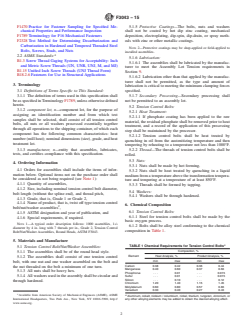
F1470 Practice for Fastener Sampling for Specified Me- 5.1.5 Protective Coatings—The bolts, nuts and washers
chanical Properties and Performance Inspection shall not be coated by hot dip zinc coating, mechanical
F1789 Terminology for F16 Mechanical Fasteners deposition, electroplating, dip-spin, dip-drain, or spray meth-
F2328 Test Method for Determining Decarburization and ods with zinc or other metallic coatings.
Carburization in Hardened and Tempered Threaded Steel
NOTE 2—Protective coatings may be shop-applied or field-applied to
Bolts, Screws, Studs, and Nuts
installed assemblies.
2.2 ASME Standards:
5.1.6 Lubrication:
B1.3 Screw Thread Gaging Systems for Acceptability: Inch
5.1.6.1 The assemblies shall be lubricated by the manufac-
and Metric Screw Threads (UN, UNR, UNJ, M, and MJ)
turer to meet the Assembly Lot Tension requirements in
B1.15 Unified Inch Screw Threads (UNJ Thread Form)
Section 9.
B18.2.6 Fasteners for Use in Structural Applications
5.1.6.2 Lubrication other than that applied by the manufac-
turer shall not be permitted, as the type and amount of
3. Terminology
lubrication is critical to meeting the minimum clamping forces
3.1 Definitions of Terms Specific to This Standard: specified.
3.1.1 The definition of terms used in this specification shall
5.1.7 Secondary Processing—Secondary processing shall
beasspecifiedinTerminologyF1789,unlessotherwisedefined not be permitted to an assembly lot.
herein.
5.2 Tension Control Bolts:
3.1.2 component lot, n—component lot, for the purpose of
5.2.1 Heat Treatment:
assigning an identification number and from which test
5.2.1.1 If phosphate coating has been applied to the raw
samples shall be selected, shall consist of all tension control
material, the residual phosphate shall be removed prior to heat
bolts, all nuts or all washers processed essentially together
treatment, and a record of the application of this processing
through all operations to the shipping container, of which each
step shall be maintained by the processor.
component has the following common characteristics: heat
5.2.1.2 Tension control bolts shall be heat treated by
number (mill heat); nominal dimensions (size), grade, and heat
quenching in oil from the austenitizing temperature and then
treatment lot.
tempering by reheating to a temperature not less than 1000°F.
3.1.3 manufacturer, n—entity that assembles, lubricates,
5.2.2 Thread—The threads of tension control bolts shall be
tests, and certifies compliance with this specification.
rolled.
5.3 Nuts:
4. Ordering Information
5.3.1 Nuts shall be made by hot forming.
4.1 Orders for assemblies shall include the items of infor-
5.3.2 Nuts shall be heat treated by quenching in a liquid
mation below. Optional items not on the purchase order shall
medium from a temperature above the transformation tempera-
be considered as not being required (see Note 1):
ture and tempering at a temperature of at least 850°F.
4.1.1 Quantity of assemblies,
5.3.3 Threads shall be formed by tapping.
4.1.2 Size, including nominal tension control bolt diameter,
5.4 Washers:
bolt length (without the spline end), and thread pitch,
5.4.1 Washers shall be through hardened.
4.1.3 Grade, that is, Grade 1 or Grade 2,
4.1.4 Name of product, that is, twist off type tension control
6. Chemical Composition
bolt/nut/washer assemblies ,
6.1 Tension Control Bolts:
4.1.5 ASTM designation and year of publication, and
6.1.1 Steel for tension control bolts shall be made by the
4.1.6 Special requirements, if required.
basic oxygen process.
NOTE 1—A typical order description follows: 1000 assemblies, 1 ⁄4
6.1.2 Bolts shall be alloy steel conforming to the chemical
diameter by 4 in. long with 7 threads per in., Grade 2, Tension Control
composition in Table 1.
Bolt/Nut/Washer Assemblies, Round Heads, ASTM F3043.
5. Materials and Manufacture
A
TABLE 1 Chemical Requirements for Tension Control Bolts
5.1 Tension Control Bolt/Nut/Washer Assemblies:
Composition, %
5.1.1 The assemblies shall be of the round head style.
Element Heat Analysis, % Product Analysis, %
5.1.2 The assemblies shall consist of one tension control
min max min max
bolt, with one nut and one washer assembled on the bolt and
Carbon 0.38 0.42 0.36 0.44
the nut threaded on the bolt a minimum of one turn.
Manganese 0.40 0.60 0.37 0.63
5.1.3 All nuts shall be heavy hex.
Phosphorus . . . 0.01 . . . 0.015
5.1.4 All washers used in the assembly shall be circular and Sulfur . . . 0.01 . . . 0.015
Silicon . . . 0.10 . . . 0.12
through hardened.
Chromium 1.20 1.40 1.15 1.45
Molybdenum 0.60 0.80 0.57 0.83
Vanadium 0.30 0.40 0.27 0.43
A
Available from American Society of Mechanical Engineers (ASME), ASME
Aluminum, cobalt, niobium / columbium, nickel, titanium, tungsten, zirconium, or
International Headquarters, Two Park Ave., New York, NY 10016-5990, http://
any other alloying elements may be added to obtain the desired alloying effect.
www.asme.org.
F3043−15
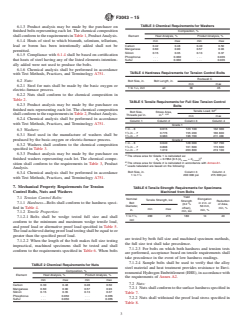
TABLE 3 Chemical Requirements for Washers
6.1.3 Product analysis may be made by the purchaser on
finished bolts representing each lot. The chemical composition Composition, %
shall conform to the requirements inTable 1, ProductAnalysis. Element Heat Analysis, % Product Analysis, %
6.1.4 Heats of steel to which bismuth, selenium, tellurium, min max min max
lead or boron has been intentionally added shall not be Carbon 0.42 0.48 0.40 0.50
Manganese 0.60 0.90 0.57 0.93
permitted.
Silicon 0.15 0.35 0.13 0.37
6.1.5 Compliance with 6.1.4 shall be based on certification
Phosphorus . . . 0.030 . . . 0.035
that heats of steel having any of the listed elements intention- Sulfur . . . 0.030 . . . 0.035
ally added were not used to produce the bolts.
6.1.6 Chemical analysis shall be performed in accordance
TABLE 4 Hardness Requirements for Tension Control Bolts
with Test Methods, Practices, and Terminology A751.
Rockwell C
6.2 Nuts: Bolt Size, in. Bolt Length, in.
min max
6.2.1 Steel for nuts shall be made by the basic oxygen or
1to1 ⁄4, incl all 38 45
electric-furnace process.
6.2.2 Nuts shall conform to the chemical composition in
Table 2.
TABLE 5 Tensile Requirements for Full Size Tension Control
6.2.3 Product analysis may be made by the purchaser on
Bolts
finished nuts representing each lot. The chemical composition
C
Tensile Load, lbf
Bolt Size, Stress Area,
2 A,B
shall conform to the requirements inTable 2, ProductAnalysis.
Threads per in. in.
min max
6.2.4 Chemical analysis shall be performed in accordance
Column 1 Column 2 Column 3 Column 4
with Test Methods, Practices, and Terminology A751.
Grade 1
1 in. - 8 0.615 123 100 132 300
6.3 Washers:
1 ⁄8 in. - 7 0.776 155 200 166 800
6.3.1 Steel used in the manufacture of washers shall be
1 ⁄4 in. - 7 0.983 196 700 211 400
produced by the basic-oxygen or electric-furnace process. Grade 2
1 in. - 8 0.640 128 000 137 700
6.3.2 Washers shall conform to the chemical composition
1 ⁄8 in. - 7 0.808 161 600 173 600
specified in Table 3.
1 ⁄4 in. - 7 1.019 203 800 219 100
6.3.3 Product analysis may be made by the purchaser on
A
The stress area for Grade 1 is calculated as:
finished washers representing each lot. The chemical compo-
A = 0.7854 [0.5 (d +d )]
s 3 max 2 max
B
The stress area for Grade 2 is calculated in accordance with Annex A1.
sition shall conform to the requirements in Table 3, Product
C
Loads tabulated are based on the following:
Analysis.
Bolt Size, in. Column 3 Column 4
6.3.4 Chemical analysis shall be performed in accordance
1to1 ⁄4 200 000 psi 215 000 psi
with Test Methods, Practices, and Terminology A751.
7. Mechanical Property Requirements for Tension
TABLE 6 Tensile Strength Requirements for Specimens
Control Bolts, Nuts and Washers
Machined from Bolts
Yield
7.1 Tension Control Bolts:
Nominal Elongation
Tensile Strength, ksi
Strength Reduction
Bolt in 2 in. or
7.1.1 Hardness—Bolts shall conform to the hardness speci-
(0.2 % of Area,
Diameter, 50 mm,
fied in Table 4.
offset), min, %
min max
in. min, %
min, ksi
7.1.2 Tensile Properties:
1to1 ⁄4, 200 215 180 14 40
7.1.2.1 Bolts shall be wedge tested full size and shall
incl
conform to the minimum and maximum wedge tensile load,
and proof load or alternative proof load specified in Table 5.
Theloadachievedduringproofloadtestingshallbeequaltoor
greater than the specified proof load.
are tested by both full size and machined specimen methods,
7.1.2.2 When the length of the bolt makes full size testing
the full size test shall take precedence.
impractical, machined specimens shall be tested and shall
7.1.2.3 For bolts on which both hardness and tension tests
conform to the requirements specified in Table 6. When bolts
are performed, acceptance based on tensile requirements shall
take precedence in the event of low hardness readings.
7.1.2.4 Sample bolts shall be used to verify that the alloy
TABLE 2 Chemical Requirements for Nuts
steel material and heat treatment provides resistance to Envi-
Composition, %
ronmental Hydrogen Embrittlement (EHE), in accordance with
Element Heat Analysis, % Product Analysis, %
the requirements of Annex A2.
min max min max
7.2 Nuts:
Carbon 0.30 0.48 0.28 0.50
Manganese 0.60 0.90 0.57 0.93 7.2.1 Nutsshallconformtothesurfacehardnessspecifiedin
Silicon 0.15 0.35 0.13 0.37
Table 7.
Phosphorus . . . 0.050 . . . 0.055
7.2.2 Nuts shall withstand the proof load stress specified in
Sulfur . . . 0.050 . . . 0.055
Table 8.
F3043−15
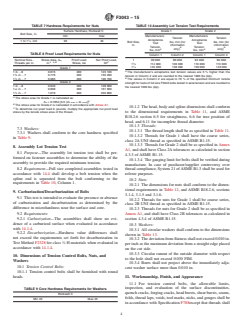
TABLE 7 Hardness Requirements for Nuts TABLE 10 Assembly Lot Tension Test Requirements
Surface Hardness, Rockwell C Grade 1 Grade 2
Bolt Size, in.
min max Manufacturers Manufacturers
Tension Tension
Acceptance Acceptance
1to1 ⁄4, incl 30 40
Bolt Size, lbs, min (for lbs, min (for
Test Test
in. information information
Tension, Tension,
B B
only) only)
A A
lbs, min lbs, min
TABLE 8 Proof Load Requirements for Nuts
Column 1 Column 2 Column 1 Column 2
Nominal Size - Stress Area, A , Proof Load Nut Proof Load, 1 90 000 86 000 94 000 90 000
s
2 A,B C
Threads per in. in. Stress, ksi lbf
1 ⁄8 114 000 109 000 119 000 113 000
1 ⁄4 145 000 138 000 150 000 143 000
Grade 1
A
1 in. - 8 0.615 200 123 100
The manufacturer’s acceptance test tension values are 5 % higher than the
1 ⁄8 in. - 7 0.776 200 155 200
tension in Column 2 and are rounded to the nearest 1000 lbs (kip).
1 B
1 ⁄4 in. - 7 0.983 200 196 700
The values in Column 2 are equal to 70 % of the specified minimum tensile
Grade 2
strength for tests of full size F3043 bolts tested in axial tension and are rounded to
1 in. - 8 0.640 200 128 000
the nearest 1000 lbs (kip).
1 ⁄8 in. - 7 0.808 200 161 600
1 ⁄4 in. - 7 1.019 200 203 800
A
The stress area for Grade 1 is calculated as:
A = 0.7854 [0.5 (d +d )]
s 3 max 2 max
B
The stress area for Grade 2 is calculated in accordance with Annex A1.
10.1.2 The head, body and spline dimensions shall conform
C
To determine nut proof load in pounds, multiply the appropriate nut proof load
to the dimensional requirements in Table 11, and ASME
stress by the tensile stress area of the thread.
B18.2.6 section 6.5 for straightness, 6.6 for true position of
head, and 6.11 for incomplete thread diameter.
10.1.3 Threads:
7.3 Washers:
10.1.3.1 The thread length shall be as specified in Table 11.
7.3.1 Washers shall conform to the core hardness specified
10.1.3.2 Threads for Grade 1 shall have the coarse series,
in Table 9.
class 2A UNJ thread as specified in ASME B1.15.
10.1.3.3 Threads for Grade 2 shall be as specified in Annex
8. Assembly Lot Tension Test
A1, and shall have Class 2Atolerances as calculated in section
8.1 Purpose—The assembly lot tension test shall be per-
4.3.3 of ASME B1.15.
formed on fastener assemblies to determine the ability of the
10.1.3.4 The gauging limit for bolts shall be verified during
assembly to provide the required minimum tension.
manufacture. In case of purchaser/supplier controversy over
8.2 Requirement—Full size completed assemblies tested in thread compliance, System 21 ofASME B1.3 shall be used for
accordance with 14.4 shall develop a bolt tension when the
referee purposes.
spline end is separated from the bolt conforming to the
10.2 Nuts:
requirements in Table 10, Column 1.
10.2.1 The dimensions for nuts shall conform to the dimen-
sional requirements in Table 12, and ASME B18.2.6, sections
9. Carburization/Decarburization of Bolts
3.1.4, 3.1.5 and 3.1.6.
9.1 This test is intended to evaluate the presence or absence
10.2.2 Threads for nuts for Grade 1 shall be coarse series,
of carburization and decarburization as determined by the
class 2B UNJ thread as specified in ASME B1.15.
difference in microhardness near the surface and core.
10.2.3 Threads for nuts for Grade 2 shall be as specified in
AnnexA1, and shall have Class 2B tolerances as calculated in
9.2 Requirements:
section 4.3.4 of ASME B1.15.
9.2.1 Carburization—The assemblies shall show no evi-
dence of a carburized surface when evaluated in accordance
10.3 Washers:
with 14.1.4.
10.3.1 All circular washers shall conform to the dimensions
9.2.2 Decarburization—Hardness value differences shall
shown in Table 13.
not exceed the requirements set forth for decarburization in
10.3.2 Thedeviationfromflatnessshallnotexceed0.010in.
Test Method F2328 for class ⁄4 H materials when evaluated in
per inch as the maximum deviation from a straight edge placed
accordance with 14.1.4.
on the cut side.
10.3.3 Circular runout of the outside diameter with respect
10. Dimensions of Tension Control Bolts, Nuts, and
to the hole shall not exceed 0.030 FIM.
Washers
10.3.4 Burrs shall not project above the immediately adja-
10.1 Tension Control Bolts:
cent washer surface more than 0.010 in.
10.1.1 Tension control bolts shall be furnished with round
heads.
11. Workmanship, Finish, and Appearance
11.1 For tension control bolts, the allowable limits,
inspection, and evaluation of the surface discontinuities,
TABLE 9 Core Hardness Requirements for Washers
quenchcracks,forgingcracks,headbursts,shearbursts,seams,
Rockwell C
folds, thread laps, voids, tool marks, nicks, and gouges shall be
Min 40 Max 45
in accordance with Specification F788except that threads shall
F3043−15
TABLE 11 Tension Control Bolts
NOTE 1—The bolt length L shall be the distance measured parallel to the axis of the bolt from the bearing surface of the head to the center point of
the groove through which shear will occur. Bolts are normally supplied in ⁄4 in. length increments.
NOTE 2—For bolts 1 in. diameter with length up to 6 in., inclusive, length tolerance is ⁄16 in. underlength. For longer 1 in. diameter bolts and other
diameters, length tolerance is ⁄4 in. underlength.
1 1
Nominal Size 11 ⁄8 1 ⁄4
A
Basic Diameter, E, in. 1.000 1.125 1.250
Full-Size Body Diameter E, in. max 1.022 1.149 1.277
min 0.976 1.098 1.223
B
Head Height, H, in. nom 39/64 11/16 25/32
max 0.643 0.738 0.824
min 0.607 0.678 0.759
C
1 3 1
Head Diameter, D, in. nom 2 ⁄8 2 ⁄8 2 ⁄2
max 2.158 2.375 2.589
D
1 1
Bearing Diameter, C, in. nom 2 2 ⁄4 2 ⁄2
min 1.771 1.991 2.224
3 3 7
Radius of Fillet, R, in. nom ⁄32 ⁄32 ⁄64
max 0.110 0.110 0.138
min 0.087 0.087 0.098
1 5
Transition Body Diameter, E , in. nom 59/64 1 ⁄32 1 ⁄32
R
max 0.933 1.046 1.171
min 0.917 1.030 1.155
Body Transition Length, Y , in. nom 0.305 0.354 0.354
max 0.394 0.450 0.450
min 0.207 0.244 0.244
1 9 9
Reduced Body Length, L , in. nom ⁄2 ⁄16 ⁄16
R
max 0.625 0.715 0.715
min 0.375 0.429 0.429
E
Transition Thread Length Y ,in. Ref 0.31 0.34 0.34
F
Thread Length, L ,in. Ref 2.049 2.322 2.322
T
G
Maximum center of groove to First Fully Formed Thread, U, in. Max 0.455 0.500 0.500
H
Spline Length, L,in. Ref 0.80 0.90 0.984
s
H
Spline Width Across Flats, S, in. Ref 0.700 0.787 0.897
A
Where specifying nominal size in decimals, zeros preceding the decimal shall be used and the fourth decimal place shall be omitted.
B
The head height shall be that overall distance measured parallel to the axis of the product from the top of the head to the bearing surface and shall include the thickness
of the washer face. Raised grade and manufacturer’s identification are excluded from head height.
C
The circumference may be irregular with a rounded or flat edge.
D
The bearing surface shall be flat and perpendicular to the body within the FIM limits specified for total runout. Measurement of FIM shall extend as close to the periphery
of the bearing surface as possible while the bolt is being held in a collet or other gripping device at a distance of one bolt diameter from the underside of the head. A die
seam across the bearing surface is not permissible.
E
Transition thread length, Y , is a reference dimension, intended for calculation purposes only, that represents the length of incomplete threads and tolerance on grip
gaging length.
F
See ASME B18.2.6, section 6.10.
G
Unless otherwise specified, bolts need not be pointed. The distance, U, is from the center of the groove to the first fully formed thread crest. This shall be determined
by measuring how far the point enters into a cylindrical NOT GO major diameter ring gage.
H
The spline dimensions and groove dimensions are reference dimensions and shall be at the discretion of the manufacturer. Users should consult with the supplier to
assure wrenchability.
have no laps at the root or on the flanks located below the pitch cracks, forging cracks, inclusion cracks, bursts, shear bursts,
line, when inspected in accordance with Specification F788, seams, voids, tool marks, nicks and gouges shall be in
S1.2. accordance with Specification F812.
11.2 For the nut component, the allowable limits, 11.3 Washers shall be free of excess mill scale and foreign
inspection, and evaluation of surface discontinuities, quench material on bearing surfaces.
F3043−15
TABLE 12 Nut Dimensions
NOTE 1—The tops of washer faced nuts shall be flat and the diameter of chamfer circle shall be equal to the maximum width across flats within a
tolerance of -15%. The length of chamfer at hex comers shall be 5% to 15% of the basic thread diameter. The surface of chamfer may be slightly convex
or rounded.
NOTE 2—Bearing surfaces shall be flat and perpendicular to the axis of the threaded hole within the total runout (FIM) tabulated for the respective nut
size.
NOTE 3—FIM = Full Indicator Movement
A
1 1
Nominal Size 11 ⁄8 1 ⁄4
1.000 1.125 1.250
B
5 13
Width Across Flats, F nom 1 ⁄8 1 ⁄16 2
max 1.625 1.812 2.000
min 1.575 1.756 1.938
C
Width Across Corners, G max 1.876 2.093 2.309
min 1.796 2.002 2.209
D
3 11 15
Thickness, H nom 1 ⁄16 1 ⁄32 1 ⁄32
max 1.214 1.367 1.501
min 1.147 1.295 1.424
1 1 1
Washer Face Height nom ⁄64 ⁄64 ⁄64
E
Total Runout of Bearing Face FIM 0.024 0.027 0.030
A
Where specifying nominal size in decimals, zeros preceding the decimal shall be used and the fourth decimal place shall be omitted.
B
Thewidthacrossflatsofheavyhexnutsshallbetheoveralldistancemeasured,perpendiculartotheaxisofthenut,betweentwooppositesidesofthenut.Notransverse
section through the nut between 25% and 75% of the actual nut thickness, as measured from the bearing surface, shall be less than the minimum width across flats.
C
Arounding or lack of fill at junction of hex comers with chamfer shall be permissible, provided the width across comers is within specified limits at and beyond a distance
equal to 17.5% of the basic thread diameter from the chamfered faces.
D
The nut thickness shall be the overall distance measured parallel to the axis of the nut, from the top of the nut to the bearing surface, and shall include the thickness
of the washer face where provided.
E
Nuts shall have a washer faced bearing surface and chamfered top. The diameter of washer face shall be within the limits of the maximum width across flats and 95%
of the minimum width across flats.
12. Magnetic Particle Inspection for Tension Control Bolt the lot selected in 12.2.1, the lot shall be 100 % magnetic
Longitudinal Discontinuities and Transverse Cracks particle tested and all nonconforming bolts shall be removed
and scrapped or destroyed.
12.1 Requirements:
12.2.3 Eddy current or liquid penetrant inspection may be
12.1.1 Each sample representative of the bolt lot shall be
substituted for the 100 % magnetic particle inspection when
magnetic particle inspected for longitudinal discontinuities and
nonconforming bolts are found and 100 % inspection is
transverse cracks.
12.1.2 The lot, as represented by the sample, shall be free required. On completion of the eddy current or liquid penetrant
from nonconforming bolts, as defined in Specification F788,
inspection, a random sample selected from each bolt lot in
when inspected in accordance with Section 12.2. accordance with Guide F1470, shall be reexamined by the
magnetic particle method. In case of controversy, the magnetic
12.2 Inspection Procedure:
particle test shall take precedence.
12.2.1 The inspection sample shall be selected at random
12.2.4 Magnetic particle indications of themselves shall not
from each bolt lot in accordance with 13.4.2.4 and examined
be cause for rejection. If in the opinion of the quality assurance
for longitudinal discontinuities and transverse cracks in the
threads, body, fillet, and underside of the head. representative the indications may be cause for rejection, a
sample taken in accordance with Guide F1470 shall be
12.2.2 Magnetic particle inspection shall be conducted in
accordance with Guide E709 or Practice E1444/E1444M. examined by microscopic examination or removal by surface
Guide E709 shall be used for referee purposes. If any noncon- grinding to determine if the indicated discontinuities are within
forming bolt is found during the manufacturers examination of Specification F788 limits.
F3043−15
TABLE 13 Hardened Circular Washers Dimensions
1 1
Nominal Size 11 ⁄8 1 ⁄4
1 3 3
Inside Diameter (ID), in. nom 1 ⁄16 1 ⁄16 1 ⁄8
max 1.085 1.251 1.438
min 1.063 1.188 1.375
1 1
Outside Diameter (OD), in. nom 2 2 ⁄4 2 ⁄2
max 2.063 2.313 2.563
min 1.937 2.187 2.437
1 1 5
Thickness (T), in. nom ⁄4 ⁄4 ⁄16
max 0.264 0.264 0.343
min 0.209 0.209 0.287
13. Testing 13.4.2.1 Tensile strength, proof load, product hardness and
carburization/decarburization sampling shall be in accordance
13.1 Testing Responsibility:
with Guide F1470.
13.1.1 Each component lot and assembly lot shall be tested
13.4.2.2 Chemical composition sampling shall be one test
by the manufacturer prior to shipment in accordance with the
per heat conducted by the steel producer.
lot identification control quality assurance plan in 13.4.
13.4.2.3 Sampling for dimensional and thread fit compli-
13.1.2 When components or assemblies are furnished by a
ance shall be in accordance with the quality assurance provi-
source other than the manufacturer, the responsible party as
sions of ASME B18.2.6.
defined in Section 18 shall be responsible for assuring all tests
13.4.2.4 Sampling for workmanship, surface
have been performed and the components and assemblies
discontinuities, including head bursts, and magnetic particle
comply with the requirements of this specification.
inspection shall be in accordance with Guide F1470.
13.2 Purpose of Lot Inspection—The purpose of a lot
13.4.2.5 Sampling for resistance to Environmental Hydro-
inspection program is to ensure that each lot conforms to the
gen Embrittlement shall be in accordance with Annex A2.
requirements of this specification. For such a plan to be fully
13.4.3 Sampling of Nuts:
effective, it is essential that distributors and purchasers main-
13.4.3.1 Proof load and product hardness sampling shall be
tain the identification and integrity of each lot until the
in accordance with Guide F1470.
assemblies are installed.
13.4.3.2 Chemical composition sampling shall be one test
13.3 Lot Control—All components shall be manufactured, per heat conducted by the steel producer.
processed, and tested in accordance with a lot control plan that 13.4.3.3 Sampling for dimensional and thread fit compli-
ance shall be in accordance with the quality assurance provi-
provides lot purity and lot identification.The manufacturer and
distributors shall identify and maintain the integrity of each lot sions of ASME B18.2.6.
13.4.4 Sampling of Washers:
of components and finished assemblies from raw material
selection through all processing operations and treatments to 13.4.4.1 Product hardness sampling shall be in accordance
with Guide F1470.
final packing and shipment. Each component lot shall be
assigned its own component lot number and each assembly lot 13.4.4.2 Chemical composition sampling shall be one test
per heat conducted by the steel producer.
its own assembly lot number.
13.4 Number of Tests:
14. Test Methods
13.4.1 Sampling of Assemblies:
13.4.1.1 Assembly lot tension test sample size shall be in 14.1 Tension Control Bolts:
accordance with Guide F1470, Sample Level C, Table 3, with 14.1.1 Chemical analyses shall be conducted in accordance
a minimum of two assemblies. with Test Methods, Practices
...
This document is not an ASTM standard and is intended only to provide the user of an ASTM standard an indication of what changes have been made to the previous version. Because
it may not be technically possible to adequately depict all changes accurately, ASTM recommends that users consult prior editions as appropriate. In all cases only the current version
of the standard as published by ASTM is to be considered the official document.
´1
Designation: F3043 − 14 F3043 − 15
Standard Specification for
“Twist Off” Type Tension Control Structural Bolt/Nut/Washer
Assemblies, Alloy Steel, Heat Treated, 200 ksi Minimum
1,2
Tensile Strength
This standard is issued under the fixed designation F3043; the number immediately following the designation indicates the year of
original adoption or, in the case of revision, the year of last revision. A number in parentheses indicates the year of last reapproval. A
superscript epsilon (´) indicates an editorial change since the last revision or reapproval.
ε NOTE—Section 1.7 and the title of Annex A1 were editorially corrected in February 2015.
1. Scope
1.1 This specification covers one style of heat treated, alloy steel, tension control bolt-nut-washer assemblies, also referred to
as “sets,” having a tensile strength of 200 to 215 ksi. These assemblies are capable of developing a minimum predetermined tension
when installed by applying torque to the nut, while at the same time applying a counter torque to separate the spline end from the
body of the bolt using an appropriate spline drive installation tool.
1.2 An assembly consists of a tension control bolt with spline end, nut and washer covered by this specification.
1.3 The assemblies are available with round heads described in Section 10, in sizes 1 in. to 1 ⁄4 in. inclusive.
1.4 The fastener assemblies are intended for use in structural connections in the following environmental conditions:
1.4.1 Interiors, normally dry, including interiors where structural steel is embedded in concrete, encased in masonry or protected
by membrane or noncorrosive contact type fireproofing.
1.4.2 Interiors and exteriors, normally dry, under roof, where the installed assemblies are soundly protected by a shop-applied
or field-applied coating to the structural steel system.
1.5 The fastener assemblies are not intended for use in structural connections in the following environments, with or without
protection by a shop-applied or field-applied coating to the structural steel system:
1.5.1 Exteriors not under roof.
1.5.2 Chemical environments in which strong concentrations of highly corrosive gases, fumes, or chemicals, either in solution
or as concentrated liquids or solids, contact the fasteners or their protective coating.
1.5.3 Heavy industrial environments severe enough to be classified as a chemical environment as described in 1.5.2.
1.5.4 Condensation and high humidity environments maintaining almost continuous condensation, including submerged in
water and soil.
1.5.5 Cathodically protected environments, in which current is applied to the structural steel system by the sacrificial anode
method or the DC power method.
1.6 Units—The values stated in inch-pound units are to be regarded as standard. No other units of measurement are included
in this standard.
1.7 The following precautionary statement pertains only to the test method portions, Section 13, Section 14 and Annex A2 of
this Specification: This standard does not purport to address all of the safety concerns, if any, associated with its use. It is the
responsibility of the user of this standard to establish appropriate safety and health practices and determine the applicability of
regulatory limitations prior to use.
This specification is under the jurisdiction of ASTM Committee F16 on Fasteners and is the direct responsibility of Subcommittee F16.02 on Steel Bolts, Nuts, Rivets
and Washers.
Current edition approved Oct. 1, 2014Nov. 15, 2015. Published December 2014February 2016. Originally approved in 2014. last previous edition approved in 2014 as
ɛ1
F3043–14 . DOI: 10.1520/F3043-14E01.10.1520/F3043-15.
The "Twist Off" Type Tension Control Structural Bolt/Nut/Washer Assemblies, Alloy Steel, Heat Treated, 200 ksi Minimum Tensile Strength of Grade 2 is covered by
US patent number 7 070 664, July 4, 2006. Interested parties are invited to submit information regarding the identification of an alternative(s) to this patented item to the
ASTM International Headquarters. Your comments will receive careful consideration at a meeting of the responsible technical committee, which you may attend.
Copyright © ASTM International, 100 Barr Harbor Drive, PO Box C700, West Conshohocken, PA 19428-2959. United States
F3043 − 15
2. Referenced Documents
2.1 ASTM Standards:
A751 Test Methods, Practices, and Terminology for Chemical Analysis of Steel Products
E709 Guide for Magnetic Particle Testing
E1444E1444/E1444M Practice for Magnetic Particle Testing
F606F606/F606M Test Methods for Determining the Mechanical Properties of Externally and Internally Threaded Fasteners,
Washers, and Rivets (Metric) F0606_F0606M Direct Tension Indicators, and Rivets
F788/F788MF788 Specification for Surface Discontinuities of Bolts, Screws, and Studs, Inch and Metric Series
F812/F812MF812 Specification for Surface Discontinuities of Nuts, Inch and Metric Series
F1470 Practice for Fastener Sampling for Specified Mechanical Properties and Performance Inspection
F1789 Terminology for F16 Mechanical Fasteners
F2328 Test Method for Determining Decarburization and Carburization in Hardened and Tempered Threaded Steel Bolts,
Screws, Studs, and Nuts
2.2 ASME Standards:
B1.3 Screw Thread Gaging Systems for Acceptability: Inch and Metric Screw Threads (UN, UNR, UNJ, M, and MJ)
B1.15 Unified Inch Screw Threads (UNJ Thread Form)
B18.2.6 Fasteners for Use in Structural Applications
3. Terminology
3.1 Definitions of Terms Specific to This Standard:
3.1.1 The definition of terms used in this specification shall be as specified in Terminology F1789, unless otherwise defined
herein.
3.1.2 component lot, n—component lot, for the purpose of assigning an identification number and from which test samples shall
be selected, shall consist of all tension control bolts, all nuts or all washers processed essentially together through all operations
to the shipping container, of which each component has the following common characteristics: heat number (mill heat); nominal
dimensions (size), grade, and heat treatment lot.
3.1.3 manufacturer, n—entity that assembles, lubricates, tests, and certifies compliance with this specification.
4. Ordering Information
4.1 Orders for assemblies shall include the items of information below. Optional items not on the purchase order shall be
considered as not being required (see Note 1):
4.1.1 Quantity of assemblies,
4.1.2 Size, including nominal tension control bolt diameter, bolt length (without the spline end), and thread pitch,
4.1.3 Grade, that is, Grade 1 or Grade 2,
4.1.4 Name of product, that is, twist off type tension control bolt/nut/washer assemblies ,
4.1.5 ASTM designation and year of publication, and
4.1.6 Special requirements, if required.
NOTE 1—A typical order description follows: 1000 assemblies, 1 ⁄4 diameter by 4 in. long with 7 threads per in., Grade 2, Tension Control
Bolt/Nut/Washer Assemblies, Round Heads, ASTM F3043.
5. Materials and Manufacture
5.1 Tension Control Bolt/Nut/Washer Assemblies:
5.1.1 The assemblies shall be of the round head style.
5.1.2 The assemblies shall consist of one tension control bolt, with one nut and one washer assembled on the bolt and the nut
threaded on the bolt a minimum of one turn.
5.1.3 All nuts shall be heavy hex.
5.1.4 All washers used in the assembly shall be circular and through hardened.
5.1.5 Protective Coatings—The bolts, nuts and washers shall not be coated by hot dip zinc coating, mechanical deposition,
electroplating, dip-spin, dip-drain, or spray methods with zinc or other metallic coatings.
NOTE 2—Protective coatings may be shop-applied or field-applied to installed assemblies.
5.1.6 Lubrication:
5.1.6.1 The assemblies shall be lubricated by the manufacturer to meet the Assembly Lot Tension requirements in Section 9.
For referenced ASTM standards, visit the ASTM website, www.astm.org, or contact ASTM Customer Service at service@astm.org. For Annual Book of ASTM Standards
volume information, refer to the standard’s Document Summary page on the ASTM website.
Available from American Society of Mechanical Engineers (ASME), ASME International Headquarters, Two Park Ave., New York, NY 10016-5990, http://
www.asme.org.
F3043 − 15
5.1.6.2 Lubrication other than that applied by the manufacturer shall not be permitted, as the type and amount of lubrication
is critical to meeting the minimum clamping forces specified.
5.1.7 Secondary Processing—Secondary processing shall not be permitted to an assembly lot.
5.2 Tension Control Bolts:
5.2.1 Heat Treatment:
5.2.1.1 If phosphate coating has been applied to the raw material, the residual phosphate shall be removed prior to heat
treatment, and a record of the application of this processing step shall be maintained by the processor.
5.2.1.2 Tension control bolts shall be heat treated by quenching in oil from the austenitizing temperature and then tempering
by reheating to a temperature not less than 1000°F.
5.2.2 Thread—The threads of tension control bolts shall be rolled.
5.3 Nuts:
5.3.1 Nuts shall be made by hot forming.
5.3.2 Nuts shall be heat treated by quenching in a liquid medium from a temperature above the transformation temperature and
tempering at a temperature of at least 850°F.
5.3.3 Threads shall be formed by tapping.
5.4 Washers:
5.4.1 Washers shall be through hardened.
6. Chemical Composition
6.1 Tension Control Bolts:
6.1.1 Steel for tension control bolts shall be made by the basic oxygen process.
6.1.2 Bolts shall be alloy steel conforming to the chemical composition in Table 1.
6.1.3 Product analysis may be made by the purchaser on finished bolts representing each lot. The chemical composition shall
conform to the requirements in Table 1, Product Analysis.
6.1.4 Heats of steel to which bismuth, selenium, tellurium, lead or boron has been intentionally added shall not be permitted.
6.1.5 Compliance with 6.1.4 shall be based on certification that heats of steel having any of the listed elements intentionally
added were not used to produce the bolts.
6.1.6 Chemical analysis shall be performed in accordance with Test Methods, Practices, and Terminology A751.
6.2 Nuts:
6.2.1 Steel for nuts shall be made by the basic oxygen or electric-furnace process.
6.2.2 Nuts shall conform to the chemical composition in Table 2.
6.2.3 Product analysis may be made by the purchaser on finished nuts representing each lot. The chemical composition shall
conform to the requirements in Table 2, Product Analysis.
6.2.4 Chemical analysis shall be performed in accordance with Test Methods, Practices, and Terminology A751.
6.3 Washers:
6.3.1 Steel used in the manufacture of washers shall be produced by the basic-oxygen or electric-furnace process.
6.3.2 Washers shall conform to the chemical composition specified in Table 3.
6.3.3 Product analysis may be made by the purchaser on finished washers representing each lot. The chemical composition shall
conform to the requirements in Table 3, Product Analysis.
6.3.4 Chemical analysis shall be performed in accordance with Test Methods, Practices, and Terminology A751.
A
TABLE 1 Chemical Requirements for Tension Control Bolts
Composition, %
Element Heat Analysis, % Product Analysis, %
min max min max
Carbon 0.38 0.42 0.36 0.44
Manganese 0.40 0.60 0.37 0.63
Phosphorus . . . 0.01 . . . 0.015
Sulfur . . . 0.01 . . . 0.015
Silicon . . . 0.10 . . . 0.12
Chromium 1.20 1.40 1.15 1.45
Molybdenum 0.60 0.80 0.57 0.83
Vanadium 0.30 0.40 0.27 0.43
A
Aluminum, cobalt, niobium / columbium, nickel, titanium, tungsten, zirconium, or
any other alloying elements may be added to obtain the desired alloying effect.
F3043 − 15
TABLE 2 Chemical Requirements for Nuts
Composition, %
Element Heat Analysis, % Product Analysis, %
min max min max
Carbon 0.30 0.48 0.28 0.50
Manganese 0.60 0.90 0.57 0.93
Silicon 0.15 0.35 0.13 0.37
Phosphorus . . . 0.050 . . . 0.055
Sulfur . . . 0.050 . . . 0.055
TABLE 3 Chemical Requirements for Washers
Composition, %
Element Heat Analysis, % Product Analysis, %
min max min max
Carbon 0.42 0.48 0.40 0.50
Manganese 0.60 0.90 0.57 0.93
Silicon 0.15 0.35 0.13 0.37
Phosphorus . . . 0.030 . . . 0.035
Sulfur . . . 0.030 . . . 0.035
7. Mechanical Property Requirements for Tension Control Bolts, Nuts and Washers
7.1 Tension Control Bolts:
7.1.1 Hardness—Bolts shall conform to the hardness specified in Table 4.
7.1.2 Tensile Properties:
7.1.2.1 Bolts shall be wedge tested full size and shall conform to the minimum and maximum wedge tensile load, and proof
load or alternative proof load specified in Table 5. The load achieved during proof load testing shall be equal to or greater than
the specified proof load.
7.1.2.2 When the length of the bolt makes full size testing impractical, machined specimens shall be tested and shall conform
to the requirements specified in Table 6. When bolts are tested by both full size and machined specimen methods, the full size test
shall take precedence.
7.1.2.3 For bolts on which both hardness and tension tests are performed, acceptance based on tensile requirements shall take
precedence in the event of low hardness readings.
7.1.2.4 Sample bolts shall be used to verify that the alloy steel material and heat treatment provides resistance to Environmental
Hydrogen Embrittlement (EHE), in accordance with the requirements of Annex A2.
7.2 Nuts:
7.2.1 Nuts shall conform to the surface hardness specified in Table 7.
7.2.2 Nuts shall withstand the proof load stress specified in Table 8.
7.3 Washers:
7.3.1 Washers shall conform to the core hardness specified in Table 9.
8. Assembly Lot Tension Test
8.1 Purpose—The assembly lot tension test shall be performed on fastener assemblies to determine the ability of the assembly
to provide the required minimum tension.
8.2 Requirement—Full size completed assemblies tested in accordance with 14.4 shall develop a bolt tension when the spline
end is separated from the bolt conforming to the requirements in Table 10, Column 1.
9. Carburization/Decarburization of Bolts
9.1 This test is intended to evaluate the presence or absence of carburization and decarburization as determined by the difference
in microhardness near the surface and core.
9.2 Requirements:
9.2.1 Carburization—The assemblies shall show no evidence of a carburized surface when evaluated in accordance with 14.1.4.
TABLE 4 Hardness Requirements for Tension Control Bolts
Rockwell C
Bolt Size, in. Bolt Length, in.
min max
1 to 1 ⁄4, incl all 38 45
F3043 − 15
TABLE 5 Tensile Requirements for Full Size Tension Control
Bolts
C
Tensile Load, lbf
Bolt Size, Stress Area,
2 A,B
Threads per in. in.
min max
Column 1 Column 2 Column 3 Column 4
Grade 1
1 in. - 8 0.615 123 100 132 300
1 ⁄8 in. - 7 0.776 155 200 166 800
1 ⁄4 in. - 7 0.983 196 700 211 400
Grade 2
1 in. - 8 0.640 128 000 137 700
1 ⁄8 in. - 7 0.808 161 600 173 600
1 ⁄4 in. - 7 1.019 203 800 219 100
A
The stress area for Grade 1 is calculated as:
A = 0.7854 [0.5 (d + d )]
s 3 max 2 max
B
The stress area for Grade 2 is calculated in accordance with Annex A1.
C
Loads tabulated are based on the following:
Bolt Size, in. Column 3 Column 4
1 to 1 ⁄4 200 000 psi 215 000 psi
TABLE 6 Tensile Strength Requirements for Specimens
Machined from Bolts
Yield
Nominal Elongation
Tensile Strength, ksi
Strength Reduction
Bolt in 2 in. or
(0.2 % of Area,
Diameter, 50 mm,
offset), min, %
min max
in. min, %
min, ksi
1 to 1 ⁄4, 200 215 180 14 40
incl
TABLE 7 Hardness Requirements for Nuts
Surface Hardness, Rockwell C
Bolt Size, in.
min max
1 to 1 ⁄4, incl 30 40
TABLE 8 Proof Load Requirements for Nuts
Nominal Size - Stress Area, A , Proof Load Nut Proof Load,
s
2 A,B C
Threads per in. in. Stress, ksi lbf
Grade 1
1 in. - 8 0.615 200 123 100
1 ⁄8 in. - 7 0.776 200 155 200
1 ⁄4 in. - 7 0.983 200 196 700
Grade 2
1 in. - 8 0.640 200 128 000
1 ⁄8 in. - 7 0.808 200 161 600
1 ⁄4 in. - 7 1.019 200 203 800
A
The stress area for Grade 1 is calculated as:
A = 0.7854 [0.5 (d + d )]
s 3 max 2 max
B
The stress area for Grade 2 is calculated in accordance with Annex A1.
C
To determine nut proof load in pounds, multiply the appropriate nut proof load
stress by the tensile stress area of the thread.
TABLE 9 Core Hardness Requirements for Washers
Rockwell C
Min 40 Max 45
9.2.2 Decarburization—Hardness value differences shall not exceed the requirements set forth for decarburization in Test
Method F2328 for class ⁄4 H materials when evaluated in accordance with 14.1.4.
10. Dimensions of Tension Control Bolts, Nuts, and Washers
10.1 Tension Control Bolts:
10.1.1 Tension control bolts shall be furnished with round heads.
F3043 − 15
TABLE 10 Assembly Lot Tension Test Requirements
Grade 1 Grade 2
Manufacturers Manufacturers
Tension Tension
Acceptance Acceptance
Bolt Size, lbs, min (for lbs, min (for
Test Test
in. information information
Tension, Tension,
B B
only) only)
A A
lbs, min lbs, min
Column 1 Column 2 Column 1 Column 2
1 90 000 86 000 94 000 90 000
1 ⁄8 114 000 109 000 119 000 113 000
1 ⁄4 145 000 138 000 150 000 143 000
A
The manufacturer’s acceptance test tension values are 5 % higher than the
tension in Column 2 and are rounded to the nearest 1000 lbs (kip).
B
The values in Column 2 are equal to 70 % of the specified minimum tensile
strength for tests of full size F3043 bolts tested in axial tension and are rounded to
the nearest 1000 lbs (kip).
10.1.2 The head, body and spline dimensions shall conform to the dimensional requirements in Table 11, and ASME B18.2.6
section 6.5 for straightness, 6.6 for true position of head, and 6.11 for incomplete thread diameter.
10.1.3 Threads:
10.1.3.1 The thread length shall be as specified in Table 11.
10.1.3.2 Threads for Grade 1 shall have the coarse series, class 2A UNJ thread as specified in ASME B1.15.
10.1.3.3 Threads for Grade 2 shall be as specified in Annex A1, and shall have Class 2A tolerances as calculated in section 4.3.3
of ASME B1.15.
10.1.3.4 The gauging limit for bolts shall be verified during manufacture. In case of purchaser/supplier controversy over thread
compliance, System 21 of ASME B1.3 shall be used for referee purposes.
10.2 Nuts:
10.2.1 The dimensions for nuts shall conform to the dimensional requirements in Table 12, and ASME B18.2.6, sections 3.1.4,
3.1.5 and 3.1.6.
10.2.2 Threads for nuts for Grade 1 shall be coarse series, class 2B UNJ thread as specified in ASME B1.15.
10.2.3 Threads for nuts for Grade 2 shall be as specified in Annex A1, with UNJ thread and without root radius, and and shall
have Class 2B tolerances as calculated in section 4.3.4 of ASME B1.15.
10.3 Washers:
10.3.1 All circular washers shall conform to the dimensions shown in Table 13.
10.3.2 The deviation from flatness shall not exceed 0.010 in. per inch as the maximum deviation from a straight edge placed
on the cut side.
10.3.3 Circular runout of the outside diameter with respect to the hole shall not exceed 0.030 FIM.
10.3.4 Burrs shall not project above the immediately adjacent washer surface more than 0.010 in.
11. Workmanship, Finish, and Appearance
11.1 For tension control bolts, the allowable limits, inspection, and evaluation of the surface discontinuities, quench cracks,
forging cracks, head bursts, shear bursts, seams, folds, thread laps, voids, tool marks, nicks, and gouges shall be in accordance with
Specification F788/F788MF788.except that threads shall have no laps at the root or on the flanks located below the pitch line, when
inspected in accordance with Specification F788, S1.2.
11.2 For the nut component, the allowable limits, inspection, and evaluation of surface discontinuities, quench cracks, forging
cracks, inclusion cracks, bursts, shear bursts, seams, voids, tool marks, nicks and gouges shall be in accordance with Specification
F812/F812MF812.
11.3 Washers shall be free of excess mill scale and foreign material on bearing surfaces.
12. Magnetic Particle Inspection for Tension Control Bolt Longitudinal Discontinuities and Transverse Cracks
12.1 Requirements:
12.1.1 Each sample representative of the bolt lot shall be magnetic particle inspected for longitudinal discontinuities and
transverse cracks.
12.1.2 The lot, as represented by the sample, shall be free from nonconforming bolts, as defined in Specification
F788/F788MF788, when inspected in accordance with Section 12.2.
12.2 Inspection Procedure:
12.2.1 The inspection sample shall be selected at random from each bolt lot in accordance with 13.4.2.4 and examined for
longitudinal discontinuities and transverse cracks in the threads, body, fillet, and underside of the head.
F3043 − 15
TABLE 11 Tension Control Bolts
NOTE 1—The bolt length L shall be the distance measured parallel to the axis of the bolt from the bearing surface of the head to the center point of
the groove through which shear will occur. Bolts are normally supplied in ⁄4 in. length increments.
NOTE 2—For bolts 1 in. diameter with length up to 6 in., inclusive, length tolerance is ⁄16 in. underlength. For longer 1 in. diameter bolts and other
diameters, length tolerance is ⁄4 in. underlength.
1 1
Nominal Size 1 1 ⁄8 1 ⁄4
A
Basic Diameter, E, in. 1.000 1.125 1.250
Full-Size Body Diameter E, in. max 1.022 1.149 1.277
min 0.976 1.098 1.223
B
Head Height, H, in. nom 39/64 11/16 25/32
max 0.643 0.738 0.824
min 0.607 0.678 0.759
C
1 3 1
Head Diameter, D, in. nom 2 ⁄8 2 ⁄8 2 ⁄2
max 2.158 2.375 2.589
D
1 1
Bearing Diameter, C, in. nom 2 2 ⁄4 2 ⁄2
min 1.771 1.991 2.224
3 3 7
Radius of Fillet, R, in. nom ⁄32 ⁄32 ⁄64
max 0.110 0.110 0.138
min 0.087 0.087 0.098
1 5
Transition Body Diameter, E , in. nom 59/64 1 ⁄32 1 ⁄32
R
max 0.933 1.046 1.171
min 0.917 1.030 1.155
Body Transition Length, Y , in. nom 0.305 0.354 0.354
max 0.394 0.450 0.450
min 0.207 0.244 0.244
1 9 9
Reduced Body Length, L , in. nom ⁄2 ⁄16 ⁄16
R
max 0.625 0.715 0.715
min 0.375 0.429 0.429
E
Transition Thread Length Y , in. Ref 0.31 0.34 0.34
F
Thread Length, L , in. Ref 2.049 2.322 2.322
T
G
Maximum center of groove to First Fully Formed Thread, U, in. Max 0.455 0.500 0.500
H
Spline Length, L , in. Ref 0.80 0.90 0.984
s
H
Spline Width Across Flats, S, in. Ref 0.700 0.787 0.897
A
Where specifying nominal size in decimals, zeros preceding the decimal shall be used and the fourth decimal place shall be omitted.
B
The head height shall be that overall distance measured parallel to the axis of the product from the top of the head to the bearing surface and shall include the thickness
of the washer face. Raised grade and manufacturer’s identification are excluded from head height.
C
The circumference may be irregular with a rounded or flat edge.
D
The bearing surface shall be flat and perpendicular to the body within the FIM limits specified for total runout. Measurement of FIM shall extend as close to the periphery
of the bearing surface as possible while the bolt is being held in a collet or other gripping device at a distance of one bolt diameter from the underside of the head. A die
seam across the bearing surface is not permissible.
E
Transition thread length, Y , is a reference dimension, intended for calculation purposes only, that represents the length of incomplete threads and tolerance on grip
gaging length.
F
See ASME B18.2.6, section 6.10.
G
Unless otherwise specified, bolts need not be pointed. The distance, U, is from the center of the groove to the first fully formed thread crest. This shall be determined
by measuring how far the point enters into a cylindrical NOT GO major diameter ring gage.
H
The spline dimensions and groove dimensions are reference dimensions and shall be at the discretion of the manufacturer. Users should consult with the supplier to
assure wrenchability.
12.2.2 Magnetic particle inspection shall be conducted in accordance with Guide E709 or Practice E1444E1444/E1444M.
Guide E709 shall be used for referee purposes. If any nonconforming bolt is found during the manufacturers examination of the
lot selected in 12.2.1, the lot shall be 100 % magnetic particle tested and all nonconforming bolts shall be removed and scrapped
or destroyed.
12.2.3 Eddy current or liquid penetrant inspection may be substituted for the 100 % magnetic particle inspection when
nonconforming bolts are found and 100 % inspection is required. On completion of the eddy current or liquid penetrant inspection,
F3043 − 15
TABLE 12 Nut Dimensions
NOTE 1—The tops of washer faced nuts shall be flat and the diameter of chamfer circle shall be equal to the maximum width across flats within a
tolerance of -15%. The length of chamfer at hex comers shall be 5% to 15% of the basic thread diameter. The surface of chamfer may be slightly convex
or rounded.
NOTE 2—Bearing surfaces shall be flat and perpendicular to the axis of the threaded hole within the total runout (FIM) tabulated for the respective nut
size.
NOTE 3—FIM = Full Indicator Movement
A
1 1
Nominal Size 1 1 ⁄8 1 ⁄4
1.000 1.125 1.250
B
5 13
Width Across Flats, F nom 1 ⁄8 1 ⁄16 2
max 1.625 1.812 2.000
min 1.575 1.756 1.938
C
Width Across Corners, G max 1.876 2.093 2.309
min 1.796 2.002 2.209
D
3 11 15
Thickness, H nom 1 ⁄16 1 ⁄32 1 ⁄32
max 1.214 1.367 1.501
min 1.147 1.295 1.424
1 1 1
Washer Face Height nom ⁄64 ⁄64 ⁄64
E
Total Runout of Bearing Face FIM 0.024 0.027 0.030
A
Where specifying nominal size in decimals, zeros preceding the decimal shall be used and the fourth decimal place shall be omitted.
B
The width across flats of heavy hex nuts shall be the overall distance measured, perpendicular to the axis of the nut, between two opposite sides of the nut. No transverse
section through the nut between 25% and 75% of the actual nut thickness, as measured from the bearing surface, shall be less than the minimum width across flats.
C
A rounding or lack of fill at junction of hex comers with chamfer shall be permissible, provided the width across comers is within specified limits at and beyond a distance
equal to 17.5% of the basic thread diameter from the chamfered faces.
D
The nut thickness shall be the overall distance measured parallel to the axis of the nut, from the top of the nut to the bearing surface, and shall include the thickness
of the washer face where provided.
E
Nuts shall have a washer faced bearing surface and chamfered top. The diameter of washer face shall be within the limits of the maximum width across flats and 95%
of the minimum width across flats.
a random sample selected from each bolt lot in accordance with Guide F1470, shall be reexamined by the magnetic particle
method. In case of controversy, the magnetic particle test shall take precedence.
12.2.4 Magnetic particle indications of themselves shall not be cause for rejection. If in the opinion of the quality assurance
representative the indications may be cause for rejection, a sample taken in accordance with Guide F1470 shall be examined by
microscopic examination or removal by surface grinding to determine if the indicated discontinuities are within Specification
F788/F788MF788 limits.
13. Testing
13.1 Testing Responsibility:
13.1.1 Each component lot and assembly lot shall be tested by the manufacturer prior to shipment in accordance with the lot
identification control quality assurance plan in 13.4.
13.1.2 When components or assemblies are furnished by a source other than the manufacturer, the responsible party as defined
in Section 18 shall be responsible for assuring all tests have been performed and the components and assemblies comply with the
requirements of this specification.
13.2 Purpose of Lot Inspection—The purpose of a lot inspection program is to ensure that each lot conforms to the requirements
of this specification. For such a plan to be fully effective, it is essential that distributors and purchasers maintain the identification
and integrity of each lot until the assemblies are installed.
13.3 Lot Control—All components shall be manufactured, processed, and tested in accordance with a lot control plan that
provides lot purity and lot identification. The manufacturer and distributors shall identify and maintain the integrity of each lot of
F3043 − 15
TABLE 13 Hardened Circular Washers Dimensions
1 1
Nominal Size 1 1 ⁄8 1 ⁄4
1 3 3
Inside Diameter (ID), in. nom 1 ⁄16 1 ⁄16 1 ⁄8
max 1.085 1.251 1.438
min 1.063 1.188 1.375
1 1
Outside Diameter (OD), in. nom 2 2 ⁄4 2 ⁄2
max 2.063 2.313 2.563
min 1.937 2.187 2.437
1 1 5
Thickness (T), in. nom ⁄4 ⁄4 ⁄16
max 0.264 0.264 0.343
min 0.209 0.209 0.287
components and finished assemblies from raw material selection through all processing operations and treatments to final packing
and shipment. Each component lot shall be assigned its own component lot number and each assembly lot its own assembly lot
number.
13.4 Number of Tests:
13.4.1 Sampling of Assemblies:
13.4.1.1 Assembly lot tension test sample size shall be in accordance with Guide F1470, Sample Level C, Table 3, with a
minimum of two assemblies.
13.4.1.2 When tested in accordance with the required sampling plan, a component lot shall be rejected if any of the test
specimens fail to meet the applicable requirements.
13.4.2 Sampling of Tension Control Bolts:
13.4.2.1 Tensile strength, proof load, product hardness and carburization/decarburization sampling shall be in accordance with
Guide F1470.
13.4.2.2 Chemical composition sampling shall be one test per heat conducted by the steel producer.
13.4.2.3 Sampling for dimensional and thread fit compliance shall be in accordance with the quality assurance provisions of
ASME B18.2.6.
13.4.2.4 Sampling for workmanship, surface discontinuities, including head bursts, and magnetic particle inspection shall be in
accordance with Guide F1470.
13.4.2.5 Sampling for resistance to Environmental Hydrogen Embrittlement shall be in accordance with Annex A2.
13.4.3 Sampling of Nuts:
13.4.3.1 Proof load, cone proof load and product hardness sampling shall be in accordance with Guide F1470.
13.4.3.2 Chemical composition sampling shall be one test per heat conducted by the steel producer.
13.4.3.3 Sampling for dimensional and thread fit compliance shall be in accordance with the quality assurance provisions of
ASME B18.2.6.
13.4.4 Sampling of Washers:
13.4.
...