

ASTM F1554-20
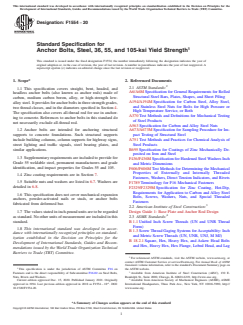
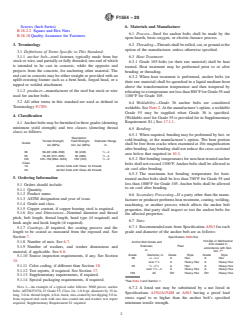
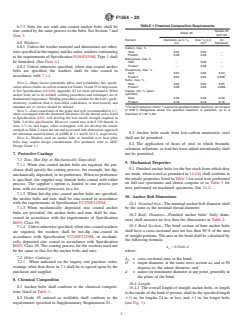
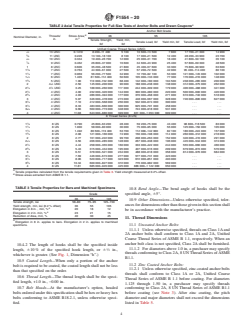
(Specification)Standard Specification for Anchor Bolts, Steel, 36, 55, and 105-ksi Yield Strength
General Information
- Abstract
ABSTRACT
This specification covers the chemical, mechanical, and dimensional requirements, and associated test methods for straight and bent, headed and headless anchor bolts (also known as anchor rods) made of carbon, carbon boron, alloy, or high-strength low-alloy steel and having specified yield strengths. The anchor bolts are furnished in three strength grades, two thread classes, and various sizes, and are intended for anchoring structural supports to concrete foundations such as building columns, column supports for highway signs, street lighting and traffic signals, steel bearing plates, and similar applications. This specification, however, does not cover the requirements for mechanical expansion anchors, powder-activated nails or studs, and anchor bolts fabricated from deformed bars. The bolts shall adhere to specified elemental chemical compositions as examined by heat and product analysis. They shall also be tested for their conformance with mechanical properties such as tensile strength, yield strength, elongation, reduction of area, and stress area. The anchor bolts shall also meet specified values for nominal size, body diameter, bend section, length, bend angle, and coated length.
SCOPE
1.1 This specification covers straight, bent, headed, and headless anchor bolts (also known as anchor rods) made of carbon, medium carbon boron, alloy, or high-strength low-alloy steel. It provides for anchor bolts in three strength grades, two thread classes, and in the diameters specified in Section 4. The specification also covers all-thread rod for use in anchoring to concrete. References to anchor bolts in this standard do not necessarily exclude all-thread rod.
1.2 Anchor bolts are intended for anchoring structural supports to concrete foundations. Such structural supports include building columns, column supports for highway signs, street lighting and traffic signals, steel bearing plates, and similar applications.
1.3 Supplementary requirements are included to provide for Grade 55 weldable steel, permanent manufacturers and grade identification, and impact properties for Grades 55 and 105.
1.4 Zinc coating requirements are in Section 7.
1.5 Suitable nuts and washers are listed in 6.7. Washers are detailed in 6.8.
1.6 This specification does not cover mechanical expansion anchors, powder-activated nails or studs, or anchor bolts fabricated from deformed bar.
1.7 The values stated in inch-pound units are to be regarded as standard. No other units of measurement are included in this standard.
1.8 This international standard was developed in accordance with internationally recognized principles on standardization established in the Decision on Principles for the Development of International Standards, Guides and Recommendations issued by the World Trade Organization Technical Barriers to Trade (TBT) Committee.
- Status
- Published
- Publication Date
- 14-Dec-2020
- Technical Committee
- F16 - Fasteners
- Drafting Committee
- F16.02 - Steel Bolts, Studs and Nuts
Buy Documents
ASTM F1554-20 - Standard Specification for Anchor Bolts, Steel, 36, 55, and 105-ksi Yield Strength
REDLINE ASTM F1554-20 - Standard Specification for Anchor Bolts, Steel, 36, 55, and 105-ksi Yield Strength
Overview
ASTM F1554-20 is an international standard specification developed by ASTM International for anchor bolts, also known as anchor rods, used in anchoring structural supports to concrete foundations. The standard addresses the chemical, mechanical, and dimensional requirements for straight, bent, headed, and headless anchor bolts made from carbon steel, carbon boron, alloy steel, or high-strength low-alloy steel. ASTM F1554-20 provides for three yield strength grades (36, 55, and 105 ksi), two thread classes, and various sizes, ensuring broad applicability in construction and infrastructure projects. This standard plays a critical role in ensuring the safety, reliability, and performance of anchor bolts in structural applications.
Key Topics
- Grades and Materials:
- Three strength grades: 36, 55, and 105 ksi minimum yield strength
- Applicable to carbon steel, carbon boron, alloy, or high-strength low-alloy steel
- Product Types:
- Straight and bent anchor bolts
- Headed and headless configurations
- All-thread rods suitable for anchoring to concrete
- Thread Classes:
- Two thread classes: Class 1A and 2A, based on ASME B1.1
- Chemical and Mechanical Properties:
- Detailed requirements for chemical composition and mechanical properties, including tensile strength, yield strength, elongation, and reduction of area
- Specific provisions for weldable Grade 55 steel
- Dimensional Requirements:
- Specifications for diameter, length, thread pitch, bend angles, and minimum body diameters
- Coated lengths and tolerance allowances for threads and bends
- Coating and Corrosion Protection:
- Zinc-coating options (hot-dip or mechanically deposited) addressed under the standard
- Requirements for coatings on compatible nuts and washers
- Identification and Marking:
- Color coding or permanent stamping to indicate grade and manufacturer
- Supplementary requirements for permanent identification and impact properties for specific grades
Applications
ASTM F1554-20 anchor bolts are widely used in construction and infrastructure sectors where secure anchoring of structural components to concrete is vital. Typical applications include:
- Structural Supports:
- Connection of building columns to foundations
- Attachment of steel bearing plates
- Transportation Infrastructure:
- Mounting columns for highway signs, street lighting, and traffic signals
- Industrial and Commercial Projects:
- Anchoring machinery and heavy equipment to concrete pads
- Secure installation of poles, towers, and support structures
Using anchor bolts conforming to ASTM F1554-20 ensures a reliable load transfer from structures to their concrete supports, enhancing the safety and longevity of critical infrastructure. The availability of multiple strength grades, sizes, and thread types provides designers and engineers with flexibility to meet diverse project requirements.
Related Standards
To ensure comprehensive compatibility and performance, ASTM F1554-20 references and works in conjunction with other industry standards, including:
- ASTM A563: Specification for Carbon and Alloy Steel Nuts
- ASTM A563/A194: Specifications for Nuts suitable for high-strength anchor bolts
- ASTM F436/F436M: Specification for hardened steel washers
- ASTM F606/F606M: Test methods for mechanical properties of fasteners
- ASTM A370: Testing methods for mechanical properties of steel
- ASTM F2329/F2329M and ASTM B695: Zinc coating requirements for bolts, nuts, and washers
- ASME B1.1: Unified Inch Screw Thread standards
ASTM F1554-20 is essential for any project involving structural anchor bolts, ensuring consistency, compatibility, and safety across construction and infrastructure markets globally.
Relations
- Effective Date
- 01-Mar-2024
- Effective Date
- 01-Mar-2024
- Effective Date
- 01-Nov-2023
- Effective Date
- 01-Nov-2023
- Effective Date
- 01-Nov-2023
- Effective Date
- 01-May-2020
- Effective Date
- 01-Jul-2019
- Refers
ASTM F436/F436M-18a - Standard Specification for Hardened Steel Washers Inch and Metric Dimensions - Effective Date
- 01-Sep-2018
- Refers
ASTM F436/F436M-18 - Standard Specification for Hardened Steel Washers Inch and Metric Dimensions - Effective Date
- 01-Jun-2018
- Refers
ASTM A370-17a - Standard Test Methods and Definitions for Mechanical Testing of Steel Products - Effective Date
- 15-Nov-2017
- Effective Date
- 15-Nov-2017
- Effective Date
- 01-Nov-2017
- Effective Date
- 01-Jun-2017
- Effective Date
- 15-Mar-2017
- Effective Date
- 01-Jan-2017
Buy Documents
ASTM F1554-20 - Standard Specification for Anchor Bolts, Steel, 36, 55, and 105-ksi Yield Strength
REDLINE ASTM F1554-20 - Standard Specification for Anchor Bolts, Steel, 36, 55, and 105-ksi Yield Strength
Frequently Asked Questions
ASTM F1554-20 is a technical specification published by ASTM International. Its full title is "Standard Specification for Anchor Bolts, Steel, 36, 55, and 105-ksi Yield Strength". This standard covers: ABSTRACT This specification covers the chemical, mechanical, and dimensional requirements, and associated test methods for straight and bent, headed and headless anchor bolts (also known as anchor rods) made of carbon, carbon boron, alloy, or high-strength low-alloy steel and having specified yield strengths. The anchor bolts are furnished in three strength grades, two thread classes, and various sizes, and are intended for anchoring structural supports to concrete foundations such as building columns, column supports for highway signs, street lighting and traffic signals, steel bearing plates, and similar applications. This specification, however, does not cover the requirements for mechanical expansion anchors, powder-activated nails or studs, and anchor bolts fabricated from deformed bars. The bolts shall adhere to specified elemental chemical compositions as examined by heat and product analysis. They shall also be tested for their conformance with mechanical properties such as tensile strength, yield strength, elongation, reduction of area, and stress area. The anchor bolts shall also meet specified values for nominal size, body diameter, bend section, length, bend angle, and coated length. SCOPE 1.1 This specification covers straight, bent, headed, and headless anchor bolts (also known as anchor rods) made of carbon, medium carbon boron, alloy, or high-strength low-alloy steel. It provides for anchor bolts in three strength grades, two thread classes, and in the diameters specified in Section 4. The specification also covers all-thread rod for use in anchoring to concrete. References to anchor bolts in this standard do not necessarily exclude all-thread rod. 1.2 Anchor bolts are intended for anchoring structural supports to concrete foundations. Such structural supports include building columns, column supports for highway signs, street lighting and traffic signals, steel bearing plates, and similar applications. 1.3 Supplementary requirements are included to provide for Grade 55 weldable steel, permanent manufacturers and grade identification, and impact properties for Grades 55 and 105. 1.4 Zinc coating requirements are in Section 7. 1.5 Suitable nuts and washers are listed in 6.7. Washers are detailed in 6.8. 1.6 This specification does not cover mechanical expansion anchors, powder-activated nails or studs, or anchor bolts fabricated from deformed bar. 1.7 The values stated in inch-pound units are to be regarded as standard. No other units of measurement are included in this standard. 1.8 This international standard was developed in accordance with internationally recognized principles on standardization established in the Decision on Principles for the Development of International Standards, Guides and Recommendations issued by the World Trade Organization Technical Barriers to Trade (TBT) Committee.
ABSTRACT This specification covers the chemical, mechanical, and dimensional requirements, and associated test methods for straight and bent, headed and headless anchor bolts (also known as anchor rods) made of carbon, carbon boron, alloy, or high-strength low-alloy steel and having specified yield strengths. The anchor bolts are furnished in three strength grades, two thread classes, and various sizes, and are intended for anchoring structural supports to concrete foundations such as building columns, column supports for highway signs, street lighting and traffic signals, steel bearing plates, and similar applications. This specification, however, does not cover the requirements for mechanical expansion anchors, powder-activated nails or studs, and anchor bolts fabricated from deformed bars. The bolts shall adhere to specified elemental chemical compositions as examined by heat and product analysis. They shall also be tested for their conformance with mechanical properties such as tensile strength, yield strength, elongation, reduction of area, and stress area. The anchor bolts shall also meet specified values for nominal size, body diameter, bend section, length, bend angle, and coated length. SCOPE 1.1 This specification covers straight, bent, headed, and headless anchor bolts (also known as anchor rods) made of carbon, medium carbon boron, alloy, or high-strength low-alloy steel. It provides for anchor bolts in three strength grades, two thread classes, and in the diameters specified in Section 4. The specification also covers all-thread rod for use in anchoring to concrete. References to anchor bolts in this standard do not necessarily exclude all-thread rod. 1.2 Anchor bolts are intended for anchoring structural supports to concrete foundations. Such structural supports include building columns, column supports for highway signs, street lighting and traffic signals, steel bearing plates, and similar applications. 1.3 Supplementary requirements are included to provide for Grade 55 weldable steel, permanent manufacturers and grade identification, and impact properties for Grades 55 and 105. 1.4 Zinc coating requirements are in Section 7. 1.5 Suitable nuts and washers are listed in 6.7. Washers are detailed in 6.8. 1.6 This specification does not cover mechanical expansion anchors, powder-activated nails or studs, or anchor bolts fabricated from deformed bar. 1.7 The values stated in inch-pound units are to be regarded as standard. No other units of measurement are included in this standard. 1.8 This international standard was developed in accordance with internationally recognized principles on standardization established in the Decision on Principles for the Development of International Standards, Guides and Recommendations issued by the World Trade Organization Technical Barriers to Trade (TBT) Committee.
ASTM F1554-20 is classified under the following ICS (International Classification for Standards) categories: 21.060.10 - Bolts, screws, studs. The ICS classification helps identify the subject area and facilitates finding related standards.
ASTM F1554-20 has the following relationships with other standards: It is inter standard links to ASTM A370-24, ASTM A6/A6M-24, ASTM F1789-23, ASTM A6/A6M-23, ASTM F2329/F2329M-15(2023), ASTM A194/A194M-20, ASTM A370-19, ASTM F436/F436M-18a, ASTM F436/F436M-18, ASTM A370-17a, ASTM A673/A673M-17, ASTM A6/A6M-17a, ASTM F1789-17, ASTM A194/A194M-17, ASTM A370-17. Understanding these relationships helps ensure you are using the most current and applicable version of the standard.
ASTM F1554-20 is available in PDF format for immediate download after purchase. The document can be added to your cart and obtained through the secure checkout process. Digital delivery ensures instant access to the complete standard document.
Standards Content (Sample)
This international standard was developed in accordance with internationally recognized principles on standardization established in the Decision on Principles for the
Development of International Standards, Guides and Recommendations issued by the World Trade Organization Technical Barriers to Trade (TBT) Committee.
Designation:F1554 −20
Standard Specification for
Anchor Bolts, Steel, 36, 55, and 105-ksi Yield Strength
This standard is issued under the fixed designation F1554; the number immediately following the designation indicates the year of
original adoption or, in the case of revision, the year of last revision.Anumber in parentheses indicates the year of last reapproval.A
superscript epsilon (´) indicates an editorial change since the last revision or reapproval.
1. Scope* 2. Referenced Documents
2.1 ASTM Standards:
1.1 This specification covers straight, bent, headed, and
A6/A6MSpecification for General Requirements for Rolled
headless anchor bolts (also known as anchor rods) made of
Structural Steel Bars, Plates, Shapes, and Sheet Piling
carbon, medium carbon boron, alloy, or high-strength low-
A194/A194MSpecification for Carbon Steel, Alloy Steel,
alloysteel.Itprovidesforanchorboltsinthreestrengthgrades,
and Stainless Steel Nuts for Bolts for High Pressure or
two thread classes, and in the diameters specified in Section 4.
High Temperature Service, or Both
The specification also covers all-thread rod for use in anchor-
A370Test Methods and Definitions for Mechanical Testing
ing to concrete. References to anchor bolts in this standard do
of Steel Products
not necessarily exclude all-thread rod.
A563Specification for Carbon and Alloy Steel Nuts
1.2 Anchor bolts are intended for anchoring structural A673/A673MSpecification for Sampling Procedure for Im-
pact Testing of Structural Steel
supports to concrete foundations. Such structural supports
A751Test Methods and Practices for Chemical Analysis of
include building columns, column supports for highway signs,
Steel Products
street lighting and traffic signals, steel bearing plates, and
B695Specification for Coatings of Zinc Mechanically De-
similar applications.
posited on Iron and Steel
1.3 Supplementary requirements are included to provide for
F436/F436MSpecification for Hardened SteelWashers Inch
Grade 55 weldable steel, permanent manufacturers and grade
and Metric Dimensions
identification, and impact properties for Grades 55 and 105.
F606/F606MTest Methods for Determining the Mechanical
Properties of Externally and Internally Threaded
1.4 Zinc coating requirements are in Section 7.
Fasteners, Washers, Direct Tension Indicators, and Rivets
1.5 Suitable nuts and washers are listed in 6.7. Washers are
F1789Terminology for F16 Mechanical Fasteners
detailed in 6.8.
F2329/F2329MSpecification for Zinc Coating, Hot-Dip,
Requirements for Application to Carbon and Alloy Steel
1.6 This specification does not cover mechanical expansion
Bolts, Screws, Washers, Nuts, and Special Threaded
anchors, powder-activated nails or studs, or anchor bolts
Fasteners
fabricated from deformed bar.
2.2 American Institute of Steel Construction:
1.7 The values stated in inch-pound units are to be regarded
Design Guide 1: Base Plate and Anchor Rod Design
asstandard.Nootherunitsofmeasurementareincludedinthis
2.3 ASME Standards:
standard. B1.1Unified Inch Screw Threads (UN and UNR Thread
Form)
1.8 This international standard was developed in accor-
B1.3Screw Thread Gaging Systems forAcceptability: Inch
dance with internationally recognized principles on standard-
and Metric Screw Threads (UN, UNR, UNJ, M MJ)
ization established in the Decision on Principles for the
B 18.2.1Square, Hex, Heavy Hex, and Askew Head Bolts
Development of International Standards, Guides and Recom-
and Hex, Heavy Hex, Hex Flange, Lobed Head, and Lag
mendations issued by the World Trade Organization Technical
Barriers to Trade (TBT) Committee.
For referenced ASTM standards, visit the ASTM website, www.astm.org, or
contact ASTM Customer Service at service@astm.org. For Annual Book of ASTM
Standards volume information, refer to the standard’s Document Summary page on
This specification is under the jurisdiction of ASTM Committee F16 on the ASTM website.
Fasteners and is the direct responsibility of Subcommittee F16.02 on Steel Bolts, Available from American Institute of Steel Construction (AISC), 130 E.
Nuts, Rivets and Washers. Randolph St., Suite 2000, Chicago, IL 60601-6219, http://www.aisc.org.
Current edition approved Dec. 15, 2020. Published January 2021. Originally Available from American Society of Mechanical Engineers (ASME), ASME
ɛ1
approved in 1994. Last previous edition approved in 2018 as F1554–18 . DOI: International Headquarters, Three Park Ave., New York, NY 10016-5990, http://
10.1520/F1554-20. www.asme.org.
*A Summary of Changes section appears at the end of this standard
Copyright © ASTM International, 100 Barr Harbor Drive, PO Box C700, West Conshohocken, PA 19428-2959. United States
F1554−20
Screws (Inch Series) 6. Materials and Manufacture
B18.2.2 Square and Hex Nuts
6.1 Process—Steel for anchor bolts shall be made by the
B18.18Quality Assurance for Fasteners
open-hearth, basic-oxygen, or electric-furnace process.
3. Terminology 6.2 Threading—Threadsshallberolled,cut,orgroundatthe
option of the manufacturer, unless otherwise specified.
3.1 Definitions of Terms Specific to This Standard:
3.1.1 anchor bolt—steel fastener, typically made from bar
6.3 Heat Treatment:
stock or wire, and partially or fully threaded, one end of which
6.3.1 Grade 105 bolts (or their raw material) shall be heat
is intended to be cast in concrete, while the opposite end
treated. Heat treatment may be performed prior to or after
projects from the concrete, for anchoring other material. The
bending or threading.
end cast in concrete may be either straight or provided with an
6.3.2 When heat treatment is performed, anchor bolts (or
uplift-resisting feature such as a bent hook, forged head, or a
their raw material) shall be quenched in a liquid medium from
tapped or welded attachment.
above the transformation temperature and then tempered by
3.1.2 producer—manufacturer of the steel bar stock or wire
reheatingtoatemperaturenotlessthan800°FforGrade55and
used for anchor bolts.
1100°F for Grade 105.
3.2 All other terms in this standard are used as defined in
6.4 Weldability—Grade 36 anchor bolts are considered
Terminology F1789.
weldable.SeeNote2.Atthemanufacturer’soption,aweldable
Grade 55 may be supplied when Grade 36 is specified.
4. Classification
(Weldable steel for Grade 55 is provided for in Supplementary
4.1 Anchorboltsmaybefurnishedinthreegrades(denoting Requirement S1.) See 17.1.1.
minimum yield strength) and two classes (denoting thread
6.5 Bending:
class) as follows:
6.5.1 When required, bending may be performed by hot- or
Description
cold-bending, at the manufacturer’s option. The bent portion
Tensile Strength, Yield Strength, Diameter Range,
Grade
shall be free from cracks when examined at 10× magnification
ksi (MPa) min, ksi (MPa) in.
afterbending.Anybendingshallnotreducethecross-sectional
36 58–80 (400–558) 36 (248) ⁄2 –4
area below that required in 10.3.
55 75–95 (517–655) 55 (380) ⁄2 –4
105 125–150 (862–1034) 105 (724) ⁄2 –3 6.5.2 Hot bending temperatures for non-heat-treated anchor
Class
boltsshallnotexceed1300°F.Anchorboltsshallbeallowedto
1A anchor bolts with Class 1A threads
air cool after bending.
2A anchor bolts with Class 2A threads
6.5.3 The maximum hot bending temperature for heat-
5. Ordering Information
treated anchor bolts shall be less than 700°F for Grade 55 and
less than 1000°F for Grade 105.Anchor bolts shall be allowed
5.1 Orders should include:
to air cool after bending.
5.1.1 Quantity.
5.1.2 Product name.
6.6 Secondary Processing—If a party other than the manu-
5.1.3 ASTM designation and year of issue.
facturerorproducerperformsheattreatment,coating,welding,
5.1.4 Grade and class.
machining, or another process which affects the anchor bolt
5.1.5 Copper content, if copper bearing steel is required.
properties, that party shall inspect or test the anchor bolts for
5.1.6 Size and Dimensions—Nominal diameter and thread
the affected properties.
pitch, bolt length, thread length, head type (if required) and
6.7 Nuts:
hook angle and hook length (if required).
6.7.1 Recommended nuts from Specification A563 for each
5.1.7 Coatings—If required, the coating process and the
grade and diameter of the anchor bolt are as follows:
length to be coated as measured from the exposed end. See
Section 7. Specification A563 Nut
Hot-Dip or Mechanical
5.1.8 Number of nuts. See 6.7.
Anchor Bolt Grade and
Zinc-coated in
Diameter, Plain
5.1.9 Number of washers, and washer dimensions and
accordance with Sec-
in.
A
tion 7
material, if applicable. See 6.8.
Grade Diameter, in. Grade Style Grade Style
5.1.10 Source inspection requirements, if any. See Section
1 1
36 ⁄2 –1 ⁄2 A Hex A Hex
15. 1
over 1 ⁄2 A Heavy Hex A Heavy Hex
1 1
55 ⁄2 –1 ⁄2 A Hex A Heavy Hex
5.1.11 Color coding, if different than Section 18.
over 1 ⁄2 –4 A Heavy Hex A Heavy Hex
5.1.12 Test reports, if required. See Section 17.
105 All DH Heavy Hex DH Heavy Hex
5.1.13 Supplementary requirements, if required.
A
5.1.14 Special packaging requirements, if required.
See Note 3 and Section 7.
NOTE 1—An example of a typical order follows: 5000 pieces; anchor
6.7.2 A listed nut may be substituted by a nut listed in
bolts;ASTM F1554-15 Grade 55; Class 2A; 1.0-8 tpi. diameter by 15-in.
Specifications A194/A194M or A563 having a proof load
long,3.0-in.threadlength,4.0-in.hook;zinc-coatedbyhotdipping5.0in.
stress equal to or higher than the anchor bolt’s specified
from exposed end; each with one zinc-coated nut and washer; test report
required; Supplementary Requirement S1 required. minimum tensile strength.
F1554−20
TABLE 1 Chemical Composition Requirements
6.7.3 Nuts for use with zinc-coated anchor bolts shall be
zinc-coatedbythesameprocessasthebolts.SeeSection7and Grades 55
Grade 36
and 105
Note 3.
3 7
Element Diameters up to ⁄4, Over ⁄8 to 4, All
A
6.8 Washers:
incl incl Diameters
6.8.1 Unless the washer material and dimensions are other-
Carbon, max, %
Heat 0.25 0.25 .
wisespecifiedintheinquiryandtheorder,washersconforming
Product 0.28 0.28 .
totherequirementsofSpecificationF436/F436M,Type1shall
Manganese, max %
be furnished. (See Note 4.)
Heat . 0.90 .
Product . 0.98 .
6.8.2 Unless otherwise specified, when zinc-coated anchor
Phosphorus, max, %
bolts are specified, the washers shall be zinc coated in
Heat 0.04 0.04 0.04
†
accordance with 7.1.4.
Product 0.05 0.05 0.048
Sulfur, max, %
NOTE 2—Many factors potentially affect steel weldability; this specifi-
Heat 0.05 0.05 0.05
cationutilizeslimitsoncarboncontentforGrades36and55tohelpassure
Product 0.06 0.06 0.058
it. See Specification A6/A6M,Appendix X3 for more information. When
Copper, min, % (when
specified)
anchor bolts are to be welded, welding procedures and techniques are of
Heat 0.20 0.20 0.20
fundamentalimportance.Weldingproceduressuitableforthebolt’sgrade,
Product 0.18 0.18 0.18
chemistry, condition (that is, hot-rolled, cold-drawn, or heat-treated), and
A
intended use or service should be utilized.
For each reduction of 0.01 % below the specified Carbon maximum, an increase
of 0.06 % Manganese above the specified maximum is permitted, up to a
NOTE 3—Zinc-coated nuts of the grade and style recommended in 6.7,
maximum of 1.35 % Mn.
when overtapped with the diametral allowance for the thread series listed
in Specification A563, will develop the bolt tensile strength required in
Table 2 of this specification. However, coated nuts with 8 UN threads in
sizes 1- ⁄4 in. and larger, when overtapped, will not develop the tensile
strength inTable 2 when the nut and associated bolt dimensions approach
8.3 Anchor bolts made from low-carbon martensitic steel
the minimum material limits of ASME B 1.1 and B 18.2.2, respectively.
shall not be permitted.
NOTE 4—Washers used on anchor bolts or installed over base plate
holes may require design consideration. (For guidance, refer to AISC
8.4 The application of heats of steel to which bismuth,
Design Guide 1.)
selenium, tellurium, or lead has been added intentionally shall
7. Protective Coatings not be permitted.
7.1 Zinc, Hot Dip or Mechanically Deposited:
9. Mechanical Properties
7.1.1 When zinc-coated anchor bolts are required, the pur-
9.1 Finished anchor bolts (or the bar stock from which they
chaser shall specify the coating process, for example, hot dip,
are made, when tested as permitted in 14.2.6) shall conform to
mechanically deposited, or no preference.When no preference
the tensile properties listed in Table 2 for axial tests performed
is specified, the supplier may furnish bolts coated with either
on full-size specimens and drawn coupons or in Table 3 for
process. The supplier’s option is limited to one process per
tests performed on machined specimens. See 14.2.
item, with no mixed processes in a lot.
7.1.2 When hot-dip zinc coated anchor bolts are specified,
10. Anchor Bolt Dimensions
the anchor bolts and nuts shall be zinc-coated in accordance
with the requirements of Specification F2329/F2329M.
10.1 Nominal Size—The nominal anchor bolt diameter shall
7.1.3 When mechanically deposited zinc coated anchor be the same as the nominal thread diameter.
bolts are provided, the anchor bolts and nuts shall be zinc-
10.2 Body Diameter—Finished anchor bolts’ body diam-
coated in accordance with the requirements of Specification
eters shall measure no less than the dimensions in Table 4.
B695, Class 55.
10.3 Bend Section—The bend section of bent anchor bolts
7.1.4 Unlessotherwisespecified,whenzinc-coatedwashers
shall have a cross-sectional area not less than 90% of the area
are required, the washers shall be hot-dip zinc-coated in
ofstraightportions.Theareainthebendshallbecalculatedby
accordance with Specification F2329/F2329M, or mechani-
the following formula:
cally deposited zinc coated in accordance with Specification
B695, Class 55. The coating process for the washers need not
A 50.25πD·d
b
where:
be the same as that for the anchor bolts and nuts.
7.2 Other Coatings:
A = cross-sectional area in the bend,
b
7.2.1 When indicated on the inquiry and purchase order,
D = major diameter, at the same cross section as, and at 90
coatings other than those in 7.1 shall be as agreed upon by the
degrees to, the minor diameter, and
purchaser and supplier.
d = minor(orminimum)diameteratanypoint,generallyin
the plane of the bend.
8. Chemical Composition
10.4 Length:
8.1 Anchor bolts shall conform to the chemical composi-
10.4.1 The overall length of straight anchor bolts, or length
tions listed in Table 1.
totheinsideofthehookifpresent,shallbethespecifiedlength
8.2 Grade 55 ordered as weldable shall conform to the 6 ⁄2 in. for lengths 24 in. or less, and 61 in. for longer bolts
requirements specified in Supplementary Requirement S1. (see Fig. 1).
F1554−20
A
TABLE 2 Axial Tensile Properties for Full-Size Tests of Anchor Bolts and Drawn Coupons
Anchor Bolt Grade
B
Threads/ 36 55 105
Stress Area,
Nominal Diameter, in.
in. in.
Tensile Strength, Yield, min,
Tensile Load, lbf Yield min, lbf Tensile Load, lbf Yield min, lbf
lbf lbf
Unified Coarse Thread Series (UNC)
⁄2 13 UNC 0.1419 8 200–11 400 5 100 10 600–13 500 7 800 17 700–21 300 14 900
⁄8 11 UNC 0.226 13 100–18 100 8 100 17 000–21 500 12 400 28 200–33 900 23 700
⁄4 10 UNC 0.334 19 400–26 700 12 000 25 000–31 700 18 400 41 800–50 100 35 100
⁄8 9 UNC 0.462 26 800–37 000 16 600 34 600–43 900 25 400 57 800–69 300 48 500
1 8 UNC 0.606 35 200–48 500 21 800 45 400–57 600 33 300 75 800–90 900 63 600
1 ⁄8 7 UNC 0.763 44 300–61 000 27 500 57 200–72 500 42 000 95 400–114 400 80 100
1 ⁄4 7 UNC 0.969 56 200–77 500 34 900 72 700–92 100 53 300 121 000–145 000 102 000
1 ⁄2 6 UNC 1.405 81 500–112 400 50 600 105 000–133 000 77 300 176 000–216 000 148 000
1 ⁄4 5 UNC 1.90 110 000–152 000 68 400 142 000–180 000 104 500 238 000–285 000 200 000
24 ⁄2 UNC 2.50 145 000–200 000 90 000 188 000–238 000 138 000 312 000–375 000 262 000
1 1
2 ⁄4 4 ⁄2 UNC 3.25 188 000–260 000 117 000 244 000–309 000 179 000 406 000–488 000 341 000
2 ⁄2 4 UNC 4.00 232 000–320 000 144 000 300 000–380 000 220 000 500 000–600 000 420 000
2 ⁄4 4 UNC 4.93 286 000–394 000 177 000 370 000–468 000 271 000 616 000–740 000 518 000
3 4 UNC 5.97 346 000–478 000 215 000 448 000–567 000 328 000 746 000–896 000 627 000
3 ⁄4 4 UNC 7.10 412 000–568 000 256 000 532 000–674 000 390 000 . . . . . .
3 ⁄2 4 UNC 8.33 483 000–666 000 300 000 625 000–791 000 458 000 . . . . . .
3 ⁄4 4 UNC 9.66 560 000–773 000 348 000 724 000–918 000 531 000 . . . . . .
4 4 UNC 11.08 643 000–886 000 399 000 831 000–1 053 000 609 000 . . . . . .
8 Thread Series (8 UN)
1 ⁄8 8 UN 0.790 45 800–63 200 28 400 59 200–75 000 43 400 98 800–118 500 83 000
1 ⁄4 8 UN 1.000 58 000–80 000 36 000 75 000–95 000 55 000 125 000–150 000 105 000
1 ⁄2 8 UN 1.492 86 500–119 400 53 700 112 000–142 000 82 100 186 000–224 000 157 000
1 ⁄4 8 UN 2.08 121 000–166 000 74 900 156 000–198 000 114 000 260 000–312 000 218 000
2 8 UN 2.77 161 000–222 000 99 700 208 000–263 000 152 000 346 000–416 000 291 000
2 ⁄4 8 UN 3.56 206 000–285 000 128 000 267 000–338 000 196 000 445 000–534 000 374 000
2 ⁄2 8 UN 4.44 258 000–355 000 160 000 333 000–422 000 244 000 555 000–666 000 466 000
2 ⁄4 8 UN 5.43 315 000–434 000 195 000 407 000–516 000 299 000 679 000–815 000 570 000
3 8 UN 6.51 378 000–521 000 234 000 488 000–618 000 358 000 814 000–976 000 684 000
3 ⁄4 8 UN 7.69 446 000–615 000 277 000 577 000–731 000 423 000 . . . .
...
This document is not an ASTM standard and is intended only to provide the user of an ASTM standard an indication of what changes have been made to the previous version. Because
it may not be technically possible to adequately depict all changes accurately, ASTM recommends that users consult prior editions as appropriate. In all cases only the current version
of the standard as published by ASTM is to be considered the official document.
Designation: F1554 − 18 F1554 − 20
Standard Specification for
Anchor Bolts, Steel, 36, 55, and 105-ksi Yield Strength
This standard is issued under the fixed designation F1554; the number immediately following the designation indicates the year of
original adoption or, in the case of revision, the year of last revision. A number in parentheses indicates the year of last reapproval. A
superscript epsilon (´) indicates an editorial change since the last revision or reapproval.
1. Scope*
1.1 This specification covers straight, bent, headed, and headless anchor bolts (also known as anchor rods) made of carbon,
medium carbon boron, alloy, or high-strength low-alloy steel. It provides for anchor bolts in three strength grades, two thread
classes, and in the diameters specified in Section 4. The specification also covers all-thread rod for use in anchoring to concrete.
References to anchor bolts in this standard do not necessarily exclude all-thread rod.
1.2 Anchor bolts are intended for anchoring structural supports to concrete foundations. Such structural supports include building
columns, column supports for highway signs, street lighting and traffic signals, steel bearing plates, and similar applications.
1.3 Supplementary requirements are included to provide for Grade 55 weldable steel, permanent manufacturers and grade
identification, and impact properties for Grades 55 and 105.
1.4 Zinc coating requirements are in Section 7.
1.5 Suitable nuts and washers are listed in 6.7. Washers are detailed in 6.8.
1.6 This specification does not cover mechanical expansion anchors, powder-activated nails or studs, or anchor bolts fabricated
from deformed bar.
1.7 The values stated in inch-pound units are to be regarded as standard. No other units of measurement are included in this
standard.
1.8 This international standard was developed in accordance with internationally recognized principles on standardization
established in the Decision on Principles for the Development of International Standards, Guides and Recommendations issued
by the World Trade Organization Technical Barriers to Trade (TBT) Committee.
2. Referenced Documents
2.1 ASTM Standards:
A6/A6M Specification for General Requirements for Rolled Structural Steel Bars, Plates, Shapes, and Sheet Piling
This specification is under the jurisdiction of ASTM Committee F16 on Fasteners and is the direct responsibility of Subcommittee F16.02 on Steel Bolts, Nuts, Rivets
and Washers.
Current edition approved Sept. 1, 2018Dec. 15, 2020. Published October 2018January 2021. Originally approved in 1994. Last previous edition approved in 20172018
ɛ1
as F1554 – 17F1554 – 18 . DOI: 10.1520/F1554-18.10.1520/F1554-20.
For referenced ASTM standards, visit the ASTM website, www.astm.org, or contact ASTM Customer Service at service@astm.org. For Annual Book of ASTM Standards
volume information, refer to the standard’s Document Summary page on the ASTM website.
*A Summary of Changes section appears at the end of this standard
Copyright © ASTM International, 100 Barr Harbor Drive, PO Box C700, West Conshohocken, PA 19428-2959. United States
F1554 − 20
A194/A194M Specification for Carbon Steel, Alloy Steel, and Stainless Steel Nuts for Bolts for High Pressure or High
Temperature Service, or Both
A370 Test Methods and Definitions for Mechanical Testing of Steel Products
A563 Specification for Carbon and Alloy Steel Nuts
A673/A673M Specification for Sampling Procedure for Impact Testing of Structural Steel
A751 Test Methods and Practices for Chemical Analysis of Steel Products
B695 Specification for Coatings of Zinc Mechanically Deposited on Iron and Steel
F436/F436M Specification for Hardened Steel Washers Inch and Metric Dimensions
F606/F606M Test Methods for Determining the Mechanical Properties of Externally and Internally Threaded Fasteners,
Washers, Direct Tension Indicators, and Rivets
F1789 Terminology for F16 Mechanical Fasteners
F2329/F2329M Specification for Zinc Coating, Hot-Dip, Requirements for Application to Carbon and Alloy Steel Bolts, Screws,
Washers, Nuts, and Special Threaded Fasteners
2.2 American Institute of Steel Construction:
Design Guide 1: Base Plate and Anchor Rod Design
2.3 ASME Standards:
B 1.1 Unified Inch Screw Threads (UN and UNR Thread Form)
B 1.3 Screw Thread Gaging Systems for Acceptability: Inch and Metric Screw Threads (UN, UNR, UNJ, M MJ)
B 18.2.1 Square, Hex, Heavy Hex, and Askew Head Bolts and Hex, Heavy Hex, Hex Flange, Lobed Head, and Lag Screws (Inch
Series)
B 18.2.2 Square and Hex Nuts
B 18.18 Quality Assurance for Fasteners
3. Terminology
3.1 Definitions of Terms Specific to This Standard:
3.1.1 anchor bolt—steel fastener, typically made from bar stock or wire, and partially or fully threaded, one end of which is
intended to be cast in concrete, while the opposite end projects from the concrete, for anchoring other material. The end cast in
concrete may be either straight or provided with an uplift-resisting feature such as a bent hook, forged head, or a tapped or welded
attachment.
3.1.2 producer—manufacturer of the steel bar stock or wire used for anchor bolts.
3.2 All other terms in this standard are used as defined in Terminology F1789.
4. Classification
4.1 Anchor bolts may be furnished in three grades (denoting minimum yield strength) and two classes (denoting thread class) as
follows:
Description
Tensile Strength, Yield Strength, Diameter Range,
Grade
ksi (MPa) min, ksi (MPa) in.
36 58–80 (400–558) 36 (248) ⁄2 –4
55 75–95 (517–655) 55 (380) ⁄2 –4
105 125–150 (862–1034) 105 (724) ⁄2 –3
Class
1A anchor bolts with Class 1A threads
2A anchor bolts with Class 2A threads
5. Ordering Information
5.1 Orders should include:
5.1.1 Quantity.
Available from American Institute of Steel Construction (AISC), 130 E. Randolph St., Suite 2000, Chicago, IL 60601-6219, http://www.aisc.org.
Available from American Society of Mechanical Engineers (ASME), ASME International Headquarters, Three Park Ave., New York, NY 10016-5990, http://
www.asme.org.
F1554 − 20
5.1.2 Product name.
5.1.3 ASTM designation and year of issue.
5.1.4 Grade and class.
5.1.5 Copper content, if copper bearing steel is required.
5.1.6 Size and Dimensions—Nominal diameter and thread pitch, bolt length, thread length, head type (if required) and hook angle
and hook length (if required).
5.1.7 Coatings—If required, the coating process and the length to be coated as measured from the exposed end. See Section 7.
5.1.8 Number of nuts. See 6.7.
5.1.9 Number of washers, and washer dimensions and material, if applicable. See 6.8.
5.1.10 Source inspection requirements, if any. See Section 15.
5.1.11 Color coding, if different than Section 18.
5.1.12 Test reports, if required. See Section 17.
5.1.13 Supplementary requirements, if required.
5.1.14 Special packaging requirements, if required.
NOTE 1—An example of a typical order follows: 5000 pieces; anchor bolts; ASTM F1554-15 Grade 55; Class 2A; 1.0-8 tpi. diameter by 15-in. long, 3.0-in.
thread length, 4.0-in. hook; zinc-coated by hot dipping 5.0 in. from exposed end; each with one zinc-coated nut and washer; test report required;
Supplementary Requirement S1 required.
6. Materials and Manufacture
6.1 Process—Steel for anchor bolts shall be made by the open-hearth, basic-oxygen, or electric-furnace process.
6.2 Threading—Threads shall be rolled, cut, or ground at the option of the manufacturer, unless otherwise specified.
6.3 Heat Treatment:
6.3.1 Grade 105 bolts (or their raw material) shall be heat treated. Heat treatment may be performed prior to or after bending or
threading.
6.3.2 When heat treatment is performed, anchor bolts (or their raw material) shall be quenched in a liquid medium from above
the transformation temperature and then tempered by reheating to a temperature not less than 800°F for Grade 55 and 1100°F for
Grade 105.
6.4 Weldability—Grade 36 anchor bolts are considered weldable. See Note 2. At the manufacturer’s option, a weldable Grade 55
may be supplied when Grade 36 is specified. (Weldable steel for Grade 55 is provided for in Supplementary Requirement S1.) See
17.1.1.
6.5 Bending:
6.5.1 When required, bending may be performed by hot- or cold-bending, at the manufacturer’s option. The bent portion shall be
free from cracks when examined at 10× magnification after bending. Any bending shall not reduce the cross-sectional area below
that required in 10.3.
F1554 − 20
6.5.2 Hot bending temperatures for non-heat-treated anchor bolts shall not exceed 1300°F. Anchor bolts shall be allowed to air
cool after bending.
6.5.3 The maximum hot bending temperature for heat-treated anchor bolts shall be less than 700°F for Grade 55 and less than
1000°F for Grade 105. Anchor bolts shall be allowed to air cool after bending.
6.6 Secondary Processing—If a party other than the manufacturer or producer performs heat treatment, coating, welding,
machining, or another process which affects the anchor bolt properties, that party shall inspect or test the anchor bolts for the
affected properties.
6.7 Nuts:
6.7.1 Recommended nuts from Specification A563 for each grade and diameter of the anchor bolt are as follows:
Specification A563 Nut
Hot-Dip or Mechanical Zinc-coated
Anchor Bolt Grade and Diameter,
Plain in
in.
A
accordance with Section 7
Grade Diameter, in. Grade Style Grade Style
1 1
36 ⁄2 –1 ⁄2 A Hex A Hex
over 1 ⁄2 A Heavy Hex A Heavy Hex
1 1
55 ⁄2 –1 ⁄2 A Hex A Heavy Hex
over 1 ⁄2 –4 A Heavy Hex A Heavy Hex
105 All DH Heavy Hex DH Heavy Hex
A
See Note 3 and Section 7.
6.7.2 A listed nut may be substituted by a nut listed in Specifications A194/A194M or A563 having a proof load stress equal to
or higher than the anchor bolt’s specified minimum tensile strength.
6.7.3 Nuts for use with zinc-coated anchor bolts shall be zinc-coated by the same process as the bolts. See Section 7 and Note
3.
6.8 Washers:
6.8.1 Unless the washer material and dimensions are otherwise specified in the inquiry and the order, washers conforming to the
requirements of Specification F436/F436M, Type 1 shall be furnished. (See Note 4.)
6.8.2 Unless otherwise specified, when zinc-coated anchor bolts are specified, the washers shall be zinc coated in accordance with
7.1.4.
NOTE 2—Many factors potentially affect steel weldability; this specification utilizes limits on carbon content for Grades 36 and 55 to help assure it. See
Specification A6/A6M, Appendix X3 for more information. When anchor bolts are to be welded, welding procedures and techniques are of fundamental
importance. Welding procedures suitable for the bolt’s grade, chemistry, condition (that is, hot-rolled, cold-drawn, or heat-treated), and intended use or
service should be utilized.
NOTE 3—Zinc-coated nuts of the grade and style recommended in 6.7, when overtapped with the diametral allowance for the thread series listed in
Specification A563, will develop the bolt tensile strength required in Table 2 of this specification. However, coated nuts with 8 UN threads in sizes 1- ⁄4
in. and larger, when overtapped, will not develop the tensile strength in Table 2 when the nut and associated bolt dimensions approach the minimum
material limits of ASME B 1.1 and B 18.2.2, respectively.
NOTE 4—Washers used on anchor bolts or installed over base plate holes may require design consideration. (For guidance, refer to AISC Design Guide
1.)
7. Protective Coatings
7.1 Zinc, Hot Dip or Mechanically Deposited:
7.1.1 When zinc-coated anchor bolts are required, the purchaser shall specify the coating process, for example, hot dip,
F1554 − 20
mechanically deposited, or no preference. When no preference is specified, the supplier may furnish bolts coated with either
process. The supplier’s option is limited to one process per item, with no mixed processes in a lot.
7.1.2 When hot-dip zinc coated anchor bolts are specified, the anchor bolts and nuts shall be zinc-coated in accordance with the
requirements of Specification F2329/F2329M.
7.1.3 When mechanically deposited zinc coated anchor bolts are provided, the anchor bolts and nuts shall be zinc-coated in
accordance with the requirements of Specification B695, Class 55.
7.1.4 Unless otherwise specified, when zinc-coated washers are required, the washers shall be hot-dip zinc-coated in accordance
with Specification F2329/F2329M, or mechanically deposited zinc coated in accordance with Specification B695, Class 55. The
coating process for the washers need not be the same as that for the anchor bolts and nuts.
7.2 Other Coatings:
7.2.1 When indicated on the inquiry and purchase order, coatings other than those in 7.1 shall be as agreed upon by the purchaser
and supplier.
8. Chemical Composition
8.1 Anchor bolts shall conform to the chemical compositions listed in Table 1.
8.2 Grade 55 ordered as weldable shall conform to the requirements specified in Supplementary Requirement S1.
8.3 Anchor bolts made from low-carbon martensitic steel shall not be permitted.
8.4 The application of heats of steel to which bismuth, selenium, tellurium, or lead has been added intentionally shall not be
permitted.
9. Mechanical Properties
9.1 Finished anchor bolts (or the bar stock from which they are made, when tested as permitted in 14.2.6) shall conform to the
tensile properties listed in Table 2 for axial tests performed on full-size specimens and drawn coupons or in Table 3 for tests
performed on machined specimens. See 14.2.
TABLE 1 Chemical Composition Requirements
Grades 55
Grade 36
and 105
3 7
Element Diameters up to ⁄4, Over ⁄8 to 4, All
A
incl incl Diameters
Carbon, max, %
Heat 0.25 0.25 .
Product 0.28 0.28 .
Manganese, max %
Heat . 0.90 .
Product . 0.98 .
Phosphorus, max, %
Heat 0.04 0.04 0.04
†
Product 0.05 0.05 0.048
Sulfur, max, %
Heat 0.05 0.05 0.05
Product 0.06 0.06 0.058
Copper, min, % (when
specified)
Heat 0.20 0.20 0.20
Product 0.18 0.18 0.18
A
For each reduction of 0.01 % below the specified Carbon maximum, an increase
of 0.06 % Manganese above the specified maximum is permitted, up to a
maximum of 1.35 % Mn.
F1554 − 20
A
TABLE 2 Axial Tensile Properties for Full-Size Tests of Anchor Bolts and Drawn Coupons
Anchor Bolt Grade
B
Threads/ 36 55 105
Stress Area,
Nominal Diameter, in.
in. in.
Tensile Strength, Yield, min,
Tensile Load, lbf Yield min, lbf Tensile Load, lbf Yield min, lbf
lbf lbf
Unified Coarse Thread Series (UNC)
⁄2 13 UNC 0.1419 8 200–11 400 5 100 10 600–13 500 7 800 17 700–21 300 14 900
⁄8 11 UNC 0.226 13 100–18 100 8 100 17 000–21 500 12 400 28 200–33 900 23 700
⁄4 10 UNC 0.334 19 400–26 700 12 000 25 000–31 700 18 400 41 800–50 100 35 100
⁄8 9 UNC 0.462 26 800–37 000 16 600 34 600–43 900 25 400 57 800–69 300 48 500
1 8 UNC 0.606 35 200–48 500 21 800 45 400–57 600 33 300 75 800–90 900 63 600
1 ⁄8 7 UNC 0.763 44 300–61 000 27 500 57 200–72 500 42 000 95 400–114 400 80 100
1 ⁄4 7 UNC 0.969 56 200–77 500 34 900 72 700–92 100 53 300 121 000–145 000 102 000
1 ⁄2 6 UNC 1.405 81 500–112 400 50 600 105 000–133 000 77 300 176 000–216 000 148 000
1 ⁄4 5 UNC 1.90 110 000–152 000 68 400 142 000–180 000 104 500 238 000–285 000 200 000
2 4 ⁄2 UNC 2.50 145 000–200 000 90 000 188 000–238 000 138 000 312 000–375 000 262 000
1 1
2 ⁄4 4 ⁄2 UNC 3.25 188 000–260 000 117 000 244 000–309 000 179 000 406 000–488 000 341 000
2 ⁄2 4 UNC 4.00 232 000–320 000 144 000 300 000–380 000 220 000 500 000–600 000 420 000
2 ⁄4 4 UNC 4.93 286 000–394 000 177 000 370 000–468 000 271 000 616 000–740 000 518 000
3 4 UNC 5.97 346 000–478 000 215 000 448 000–567 000 328 000 746 000–896 000 627 000
3 ⁄4 4 UNC 7.10 412 000–568 000 256 000 532 000–674 000 390 000 . . . . . .
3 ⁄2 4 UNC 8.33 483 000–666 000 300 000 625 000–791 000 458 000 . . . . . .
3 ⁄4 4 UNC 9.66 560 000–773 000 348 000 724 000–918 000 531 000 . . . . . .
4 4 UNC 11.08 643 000–886 000 399 000 831 000–1 053 000 609 000 . . . . . .
8 Thread Series (8 UN)
1 ⁄8 8 UN 0.790 45 800–63 200 28 400 59 200–75 000 43 400 98 800–118 500 83 000
1 ⁄4 8 UN 1.000 58 000–80 000 36 000 75 000–95 000 55 000 125 000–150 000 105 000
1 ⁄2 8 UN 1.492 86 500–119 400 53 700 112 000–142 000 82 100 186 000–224 000 157 000
1 ⁄4 8 UN 2.08 121 000–166 000 74 900 156 000–198 000 114 000 260 000–312 000 218 000
2 8 UN 2.77 161 000–222 000 99 700 208 000–263 000 152 000 346 000–416 000 291 000
2 ⁄4 8 UN 3.56 206 000–285 000 128 000 267 000–338 000 196 000 445 000–534 000 374 000
2 ⁄2 8 UN 4.44 258 000–355 000 160 000 333 000–422 000 244 000 555 000–666 000 466 000
2 ⁄4 8 UN 5.43 315 000–434 000 195 000 407 000–516 000 299 000 679 000–815 000 570 000
3 8 UN 6.51 378 000–521 000 234 000 488 000–618 000 358 000 814 000–976 000 684 000
3 ⁄4 8 UN 7.69 446 000–615 000 277 000 577 000–731 000 423 000 . . . . . .
3 ⁄2 8 UN 8.96 520 000–717 000 323 000 672 000–851 000 493 000 . . . . . .
3 ⁄4 8 UN 10.34 600 000–827 000 372 000 776 000–982 000 569 000 . . . . . .
4 8 UN 11.81 685 000–945 000 425 000 886 000–1 122 000 650 000 . . . . . .
A
Tensile properties calculated from the tensile requirements given in Table 3. Yield strength measured at 0.2% offset.
B
Stress areas extracted from ASME B 1.1.
TABLE 3 Tensile Properties for Bars and Machined Specimens
Grade
36 55 105
Tensile strength, ksi 58–80 75–95 125–150
Yield strength, min, ksi (0.2 % offset) 36 55 105
A
Elongation in 8 in. , min, % 20 18 12
A
Elongation in 2 in. min, % 23 21 15
Reduction of Area, min, % 40 30 45
A
Elongation in 8 in. applies to bars. Elongation in 2 in. applies to machined
specimens.
10. Anchor Bolt Dimensions
10.1 Nominal Size—The nominal anchor bolt diameter shall be the same as the nominal thread diameter.
10.2 Body Diameter—Finished anchor bolts’ body diameters shall measure no less than the dimensions in Table 4.
10.3 Bend Section—The bend section of bent anchor bolts shall have a cross-sectional area not less than 90 % of the area of
straight portions. The area in the bend shall be calculated by the foll
...