


ASTM F3125/F3125M-23
(Specification)Standard Specification for High Strength Structural Bolts and Assemblies, Steel and Alloy Steel, Heat Treated, Inch Dimensions 120 ksi and 150 ksi Minimum Tensile Strength, and Metric Dimensions 830 MPa and 1040 MPa Minimum Tensile Strength
Standard Specification for High Strength Structural Bolts and Assemblies, Steel and Alloy Steel, Heat Treated, Inch Dimensions 120 ksi and 150 ksi Minimum Tensile Strength, and Metric Dimensions 830 MPa and 1040 MPa Minimum Tensile Strength
ABSTRACT
This specification provides the chemical, physical and mechanical requirements for quenched and tempered bolts manufactured from steel and alloy steel, in inch and metric dimensions, in two strength grades, two types and two styles. It is intended to ensure alignment between standards with the same intended end use and to simplify the use and maintenance of structural bolt specifications.
SCOPE
1.1 This specification covers chemical, physical and mechanical requirements for quenched and tempered bolts manufactured from steel and alloy steel, in inch and metric dimensions, in two strength grades, two types and two styles.
1.1.1 This specification is a consolidation and replacement of six ASTM standards, including; A325, A325M, A490, A490M, F1852 and F2280.
1.1.2 This consolidated standard is to ensure alignment between standards with the same intended end use and to simplify the use and maintenance of structural bolt specifications.
1.2 Intended Use:
1.2.1 Bolts manufactured under this specification are intended for use in structural connections covered in the Specification for Structural Joints Using High-Strength Bolts, as approved by the Research Council on Structural Connections.
1.2.2 Bolts in this specification are furnished in sizes from 1/2 to 1-1/2 in. inclusive and from M12 to M36 inclusive.
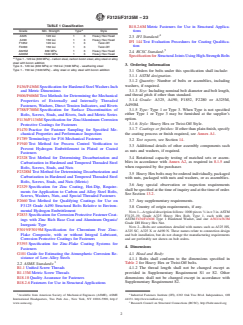
1.3 Classification, Table 1:
1.3.1 Bolts are designated by grade, which indicates inch or metric strength and style.
1.3.2 Bolts are designated by type denoting raw material chemical composition.
1.3.3 Bolts are designated by style denoting Heavy Hex bolts or “Twist-Off” Style assemblies.
1.4 Terms used in this specification are defined in F1789.
1.5 Units—The values stated in either SI units or inch pound units are to be regarded separately as standard. The values stated in each system may not be exact equivalents; therefore, each system shall be used independently of the other. Combining values from the two systems may result in non-conformance with the standard.
1.6 Table footnotes are requirements. Notes are advisory.
1.7 This standard does not purport to address all of the safety concerns, if any, associated with its use. It is the responsibility of the user of this standard to establish appropriate safety, health, and environmental practices and determine the applicability of regulatory limitations prior to use.
1.8 This international standard was developed in accordance with internationally recognized principles on standardization established in the Decision on Principles for the Development of International Standards, Guides and Recommendations issued by the World Trade Organization Technical Barriers to Trade (TBT) Committee.
General Information
- Status
- Published
- Publication Date
- 31-Oct-2023
- Technical Committee
- F16 - Fasteners
- Drafting Committee
- F16.02 - Steel Bolts, Studs and Nuts
Relations
- Effective Date
- 01-Nov-2023
- Effective Date
- 01-Jan-2024
- Effective Date
- 01-Dec-2023
- Effective Date
- 01-Nov-2023
- Effective Date
- 01-Nov-2022
- Effective Date
- 01-Dec-2019
- Effective Date
- 01-Aug-2019
- Referred By
ASTM A563/A563M-21ae1 - Standard Specification for Carbon and Alloy Steel Nuts (Inch and Metric) - Effective Date
- 01-Nov-2023
- Referred By
ASTM B695-21 - Standard Specification for Coatings of Zinc Mechanically Deposited on Iron and Steel - Effective Date
- 01-Nov-2023
- Effective Date
- 01-Nov-2023
- Effective Date
- 01-Nov-2023
Overview
ASTM F3125/F3125M-23 is the internationally recognized standard specification for high strength structural bolts and assemblies made from steel and alloy steel, quenched and tempered. It covers both inch and metric dimensions-specifically, bolts with minimum tensile strengths of 120 ksi and 150 ksi (or 830 MPa and 1040 MPa in SI units). This consolidated standard streamlines and harmonizes previous ASTM bolt standards (A325, A325M, A490, A490M, F1852, and F2280) to facilitate easier selection, specification, and maintenance for engineers, contractors, and manufacturers worldwide.
Key Topics
- Material Composition: Defines the chemical and mechanical properties for carbon steel, alloy steel, and weathering steel options used in high strength structural bolts.
- Strength Grades: Specifies two minimum tensile strength levels-120 ksi and 150 ksi (830 MPa and 1040 MPa for metric).
- Types & Styles: Bolts are classified by type (indicating chemical composition) and style, including Heavy Hex Head and Twist-Off (tension control) assemblies.
- Dimensional Standards: Covers inch dimensions from 1/2 in. to 1-1/2 in. and metric dimensions from M12 to M36.
- Mechanical Requirements: Includes testing for tensile strength, proof load, hardness, and rotational capacity, ensuring product quality and performance.
- Coatings and Finishes: Details permitted coatings and associated requirements for corrosion protection without compromising mechanical properties.
- Traceability & Quality Control: Lot control and identification, ensuring traceability from raw material to shipment.
Applications
This standard is essential for the design, manufacture, and selection of high strength bolts used in critical structural connections:
- Steel Construction: Used in steel buildings, bridges, towers, and industrial structures where reliable high strength bolted joints are required.
- Infrastructure Projects: Integral to applications involving bridge construction, stadiums, and transportation infrastructure.
- Heavy Machinery Assembly: Applicable in engineered systems needing high load-bearing joints.
- Retrofit and Repair: Aligns newly supplied bolts with historical standards, enabling compatible replacements.
Bolts compliant with ASTM F3125/F3125M-23 are intended for use in structural joints that must meet stringent requirements established by governing bodies such as the Research Council on Structural Connections (RCSC). The standard ensures bolts are suitable for safety-critical applications by requiring stringent testing and documentation.
Related Standards
ASTM F3125/F3125M-23 references and is intended to be used in conjunction with several related standards for fasteners and structural assemblies, including:
- ASTM A194/A194M: Nuts for high pressure or high temperature service
- ASTM A354, A449, A563/A563M: Additional fastener specifications for various applications
- ASTM F436/F436M: Hardened steel washers
- ASTM F606/F606M: Mechanical property testing of fasteners
- ASTM F788, F1470, F1789: Surface discontinuities, sampling, and terminology for mechanical fasteners
- ASME B1.1 & B1.13M: Unified and metric screw thread standards
- ASME B18.2.6 & B18.2.6M: Fasteners for structural applications
These standards, together with ASTM F3125/F3125M-23, provide a comprehensive framework for specifying and ensuring quality and compatibility of structural bolted connections in modern engineering projects.
Keywords: high strength structural bolts, ASTM F3125, steel bolts, alloy steel bolts, quenched and tempered bolts, heavy hex, tension control bolts, metric structural bolts, bolt standards, structural connections, fastener specification
Buy Documents
ASTM F3125/F3125M-23 - Standard Specification for High Strength Structural Bolts and Assemblies, Steel and Alloy Steel, Heat Treated, Inch Dimensions 120 ksi and 150 ksi Minimum Tensile Strength, and Metric Dimensions 830 MPa and 1040 MPa Minimum Tensile Strength
REDLINE ASTM F3125/F3125M-23 - Standard Specification for High Strength Structural Bolts and Assemblies, Steel and Alloy Steel, Heat Treated, Inch Dimensions 120 ksi and 150 ksi Minimum Tensile Strength, and Metric Dimensions 830 MPa and 1040 MPa Minimum Tensile Strength
Frequently Asked Questions
ASTM F3125/F3125M-23 is a technical specification published by ASTM International. Its full title is "Standard Specification for High Strength Structural Bolts and Assemblies, Steel and Alloy Steel, Heat Treated, Inch Dimensions 120 ksi and 150 ksi Minimum Tensile Strength, and Metric Dimensions 830 MPa and 1040 MPa Minimum Tensile Strength". This standard covers: ABSTRACT This specification provides the chemical, physical and mechanical requirements for quenched and tempered bolts manufactured from steel and alloy steel, in inch and metric dimensions, in two strength grades, two types and two styles. It is intended to ensure alignment between standards with the same intended end use and to simplify the use and maintenance of structural bolt specifications. SCOPE 1.1 This specification covers chemical, physical and mechanical requirements for quenched and tempered bolts manufactured from steel and alloy steel, in inch and metric dimensions, in two strength grades, two types and two styles. 1.1.1 This specification is a consolidation and replacement of six ASTM standards, including; A325, A325M, A490, A490M, F1852 and F2280. 1.1.2 This consolidated standard is to ensure alignment between standards with the same intended end use and to simplify the use and maintenance of structural bolt specifications. 1.2 Intended Use: 1.2.1 Bolts manufactured under this specification are intended for use in structural connections covered in the Specification for Structural Joints Using High-Strength Bolts, as approved by the Research Council on Structural Connections. 1.2.2 Bolts in this specification are furnished in sizes from 1/2 to 1-1/2 in. inclusive and from M12 to M36 inclusive. 1.3 Classification, Table 1: 1.3.1 Bolts are designated by grade, which indicates inch or metric strength and style. 1.3.2 Bolts are designated by type denoting raw material chemical composition. 1.3.3 Bolts are designated by style denoting Heavy Hex bolts or “Twist-Off” Style assemblies. 1.4 Terms used in this specification are defined in F1789. 1.5 Units—The values stated in either SI units or inch pound units are to be regarded separately as standard. The values stated in each system may not be exact equivalents; therefore, each system shall be used independently of the other. Combining values from the two systems may result in non-conformance with the standard. 1.6 Table footnotes are requirements. Notes are advisory. 1.7 This standard does not purport to address all of the safety concerns, if any, associated with its use. It is the responsibility of the user of this standard to establish appropriate safety, health, and environmental practices and determine the applicability of regulatory limitations prior to use. 1.8 This international standard was developed in accordance with internationally recognized principles on standardization established in the Decision on Principles for the Development of International Standards, Guides and Recommendations issued by the World Trade Organization Technical Barriers to Trade (TBT) Committee.
ABSTRACT This specification provides the chemical, physical and mechanical requirements for quenched and tempered bolts manufactured from steel and alloy steel, in inch and metric dimensions, in two strength grades, two types and two styles. It is intended to ensure alignment between standards with the same intended end use and to simplify the use and maintenance of structural bolt specifications. SCOPE 1.1 This specification covers chemical, physical and mechanical requirements for quenched and tempered bolts manufactured from steel and alloy steel, in inch and metric dimensions, in two strength grades, two types and two styles. 1.1.1 This specification is a consolidation and replacement of six ASTM standards, including; A325, A325M, A490, A490M, F1852 and F2280. 1.1.2 This consolidated standard is to ensure alignment between standards with the same intended end use and to simplify the use and maintenance of structural bolt specifications. 1.2 Intended Use: 1.2.1 Bolts manufactured under this specification are intended for use in structural connections covered in the Specification for Structural Joints Using High-Strength Bolts, as approved by the Research Council on Structural Connections. 1.2.2 Bolts in this specification are furnished in sizes from 1/2 to 1-1/2 in. inclusive and from M12 to M36 inclusive. 1.3 Classification, Table 1: 1.3.1 Bolts are designated by grade, which indicates inch or metric strength and style. 1.3.2 Bolts are designated by type denoting raw material chemical composition. 1.3.3 Bolts are designated by style denoting Heavy Hex bolts or “Twist-Off” Style assemblies. 1.4 Terms used in this specification are defined in F1789. 1.5 Units—The values stated in either SI units or inch pound units are to be regarded separately as standard. The values stated in each system may not be exact equivalents; therefore, each system shall be used independently of the other. Combining values from the two systems may result in non-conformance with the standard. 1.6 Table footnotes are requirements. Notes are advisory. 1.7 This standard does not purport to address all of the safety concerns, if any, associated with its use. It is the responsibility of the user of this standard to establish appropriate safety, health, and environmental practices and determine the applicability of regulatory limitations prior to use. 1.8 This international standard was developed in accordance with internationally recognized principles on standardization established in the Decision on Principles for the Development of International Standards, Guides and Recommendations issued by the World Trade Organization Technical Barriers to Trade (TBT) Committee.
ASTM F3125/F3125M-23 is classified under the following ICS (International Classification for Standards) categories: 21.060.10 - Bolts, screws, studs. The ICS classification helps identify the subject area and facilitates finding related standards.
ASTM F3125/F3125M-23 has the following relationships with other standards: It is inter standard links to ASTM F3125/F3125M-22, ASTM F1470-24, ASTM A563/A563M-23, ASTM F1789-23, ASTM F1789-22, ASTM F3019/F3019M-19, ASTM F1470-19, ASTM A563/A563M-21ae1, ASTM B695-21, ASTM A354-17e2, ASTM A36/A36M-19. Understanding these relationships helps ensure you are using the most current and applicable version of the standard.
ASTM F3125/F3125M-23 is available in PDF format for immediate download after purchase. The document can be added to your cart and obtained through the secure checkout process. Digital delivery ensures instant access to the complete standard document.
Standards Content (Sample)
This international standard was developed in accordance with internationally recognized principles on standardization established in the Decision on Principles for the
Development of International Standards, Guides and Recommendations issued by the World Trade Organization Technical Barriers to Trade (TBT) Committee.
Designation: F3125/F3125M − 23
Standard Specification for
High Strength Structural Bolts and Assemblies, Steel and
Alloy Steel, Heat Treated, Inch Dimensions 120 ksi and 150
ksi Minimum Tensile Strength, and Metric Dimensions 830
MPa and 1040 MPa Minimum Tensile Strength
This standard is issued under the fixed designation F3125/F3125M; the number immediately following the designation indicates the year
of original adoption or, in the case of revision, the year of last revision. A number in parentheses indicates the year of last reapproval.
A superscript epsilon (´) indicates an editorial change since the last revision or reapproval.
1. Scope* ing values from the two systems may result in non-
conformance with the standard.
1.1 This specification covers chemical, physical and me-
chanical requirements for quenched and tempered bolts manu- 1.6 Table footnotes are requirements. Notes are advisory.
factured from steel and alloy steel, in inch and metric
1.7 This standard does not purport to address all of the
dimensions, in two strength grades, two types and two styles.
safety concerns, if any, associated with its use. It is the
1.1.1 This specification is a consolidation and replacement
responsibility of the user of this standard to establish appro-
of six ASTM standards, including; A325, A325M, A490,
priate safety, health, and environmental practices and deter-
A490M, F1852 and F2280.
mine the applicability of regulatory limitations prior to use.
1.1.2 This consolidated standard is to ensure alignment
1.8 This international standard was developed in accor-
between standards with the same intended end use and to
dance with internationally recognized principles on standard-
simplify the use and maintenance of structural bolt specifica-
ization established in the Decision on Principles for the
tions.
Development of International Standards, Guides and Recom-
mendations issued by the World Trade Organization Technical
1.2 Intended Use:
Barriers to Trade (TBT) Committee.
1.2.1 Bolts manufactured under this specification are in-
tended for use in structural connections covered in the Speci-
2. Referenced Documents
fication for Structural Joints Using High-Strength Bolts, as
approved by the Research Council on Structural Connections.
2.1 ASTM Standards:
1.2.2 Bolts in this specification are furnished in sizes from
A194/A194M Specification for Carbon Steel, Alloy Steel,
1 1
⁄2 to 1- ⁄2 in. inclusive and from M12 to M36 inclusive.
and Stainless Steel Nuts for Bolts for High Pressure or
High Temperature Service, or Both
1.3 Classification, Table 1:
A354 Specification for Quenched and Tempered Alloy Steel
1.3.1 Bolts are designated by grade, which indicates inch or
Bolts, Studs, and Other Externally Threaded Fasteners
metric strength and style.
A449 Specification for Hex Cap Screws, Bolts and Studs,
1.3.2 Bolts are designated by type denoting raw material
Steel, Heat Treated, 120/105/90 ksi Minimum Tensile
chemical composition.
Strength, General Use
1.3.3 Bolts are designated by style denoting Heavy Hex
A563/A563M Specification for Carbon and Alloy Steel Nuts
bolts or “Twist-Off” Style assemblies.
(Inch and Metric)
1.4 Terms used in this specification are defined in F1789.
A751 Test Methods and Practices for Chemical Analysis of
1.5 Units—The values stated in either SI units or inch pound Steel Products
units are to be regarded separately as standard. The values B695 Specification for Coatings of Zinc Mechanically De-
stated in each system may not be exact equivalents; therefore, posited on Iron and Steel
each system shall be used independently of the other. Combin- E709 Guide for Magnetic Particle Testing
E1444/E1444M Practice for Magnetic Particle Testing for
Aerospace
This specification is under the jurisdiction of ASTM Committee F16 on
Fasteners and is the direct responsibility of Subcommittee F16.02 on Steel Bolts,
Studs and Nuts. For referenced ASTM standards, visit the ASTM website, www.astm.org, or
Current edition approved Nov. 1, 2023. Published November 2023. Originally contact ASTM Customer Service at service@astm.org. For Annual Book of ASTM
published in 2015. Last previous edition published in 2022 as F3125 – 22. DOI: Standards volume information, refer to the standard’s Document Summary page on
10.1520/F3125_F3125M-23. the ASTM website.
*A Summary of Changes section appears at the end of this standard
Copyright © ASTM International, 100 Barr Harbor Drive, PO Box C700, West Conshohocken, PA 19428-2959. United States
F3125/F3125M − 23
TABLE 1 Classification
B18.2.6M Metric Fasteners for Use in Structural Applica-
A
Grade Min. Strength Type Style tions
A325 120 ksi 1 3 Heavy Hex Head
2.3 IFI Standard:
A490 150 ksi 1 3 Heavy Hex Head
IFI 144 Test Evaluation Procedures for Coating Qualifica-
F1852 120 ksi 1 3 Twist-Off
tion
F2280 150 ksi 1 3 Twist-Off
A325M 830 MPa 1 3 Heavy Hex Head
2.4 RCSC Standard:
A490M 1040 MPa 1 3 Heavy Hex Head
Specification for Structural Joints Using High-Strength Bolts
A
Type 1 - 120 ksi (830 MPa) - carbon steel, carbon boron steel, alloy steel or alloy
steel with boron addition
3. Ordering Information
Type 3 - 120 ksi (830 MPa) or 150 ksi (1040 MPa) - weathering steel
Type 1 - 150 ksi (1040 MPa) - alloy steel or alloy steel with boron addition
3.1 Orders for bolts under this specification shall include:
3.1.1 ASTM designation.
3.1.2 Quantity: Number of bolts or assemblies, including
washers, if required.
F436/F436M Specification for Hardened Steel Washers Inch
3.1.3 Size: Including nominal bolt diameter and bolt length,
and Metric Dimensions
and thread pitch if other than standard.
F606/F606M Test Methods for Determining the Mechanical
3.1.4 Grade: A325, A490, F1852, F2280 or A325M,
Properties of Externally and Internally Threaded
A490M.
Fasteners, Washers, Direct Tension Indicators, and Rivets
3.1.5 Type: Type 1 or Type 3. When Type is not specified
F788/F788M Specification for Surface Discontinuities of
either Type 1 or Type 3 may be furnished at the supplier’s
Bolts, Screws, Studs, and Rivets, Inch and Metric Series
option.
F1136/F1136M Specification for Zinc/Aluminum Corrosion
3.1.6 Style: Heavy Hex or Twist-Off Style.
Protective Coatings for Fasteners
3.1.7 Coatings or finishes: If other than plain finish, specify
F1470 Practice for Fastener Sampling for Specified Me-
the coating process or finish required, see Annex A1.
chanical Properties and Performance Inspection
F1789 Terminology for F16 Mechanical Fasteners
3.2 Test reports, see Section 14.
F1940 Test Method for Process Control Verification to
3.3 Additional details of other assembly components such
Prevent Hydrogen Embrittlement in Plated or Coated
as nuts and washers, if required.
Fasteners
3.4 Rotational capacity testing of matched sets or assem-
F2328 Test Method for Determining Decarburization and
blies in accordance with Annex A2, as required in 8.1.5 and
Carburization in Hardened and Tempered Threaded Steel
when requested by the purchaser.
Bolts, Screws, Studs, and Nuts
F2328M Test Method for Determining Decarburization and
3.5 Heavy Hex bolts may be ordered individually, packaged
Carburization in Hardened and Tempered Threaded Steel
with nuts, packaged with nuts and washers, or as assemblies.
Bolts, Screws, Studs, and Nuts (Metric)
3.6 Any special observation or inspection requirements
F2329 Specification for Zinc Coating, Hot-Dip, Require-
shall be specified at the time of inquiry and at the time of order.
ments for Application to Carbon and Alloy Steel Bolts,
See Section 13.2.
Screws, Washers, Nuts, and Special Threaded Fasteners
3.7 Any supplementary requirements.
F2660 Test Method for Qualifying Coatings for Use on
F3125 Grade A490 Structural Bolts Relative to Environ-
3.8 Country of origin requirements, if any.
mental Hydrogen Embrittlement
NOTE 1—A typical description follows: 1000 pieces ⁄4 in.× 3 in. ASTM
F2833 Specification for Corrosion Protective Fastener Coat- F3125–19, Grade A325 Heavy Hex Bolt, Type 1, each with one
ASTM F436/F436M Type 1 Hardened Washer, and one A563/A563M
ings with Zinc Rich Base Coat and Aluminum Organic/
Grade DH Heavy Hex Nut.
Inorganic Type
NOTE 2—Bolts are sometimes detailed with names such as A325 HS,
F3019/F3019M Specification for Chromium Free Zinc-
A325 SC, A325 X or A490 N. These names relate to connection design
Flake Composite, with or without Integral Lubricant,
and bolt installation, but do not change the manufacturing requirements
Corrosion Protective Coatings for Fasteners and are preferably not shown on bolt orders.
F3393 Specification for Zinc-Flake Coating Systems for
4. Dimensions
Fasteners
G101 Guide for Estimating the Atmospheric Corrosion Re- 4.1 Head and Body:
sistance of Low-Alloy Steels
4.1.1 Bolts shall conform to the dimensions specified in
Table 2 for Heavy Hex or Twist-Off bolts.
2.2 ASME Standards:
B1.1 Unified Screw Threads 4.1.2 The thread length shall not be changed except as
provided in Supplementary Requirement S1 or S2. Other
B1.13M Metric Screw Threads
B18.18 Quality Assurance for Fasteners dimensions shall not be changed except in accordance with
Supplementary Requirement S2.
B18.2.6 Fasteners for Use in Structural Applications
3 4
Available from American Society of Mechanical Engineers (ASME), ASME Industrial Fasteners Institute (IFI), 6363 Oak Tree Blvd. Independence, OH
International Headquarters, Two Park Ave., New York, NY 10016-5990, http:// 44131. http://www.indfast.org
www.asme.org. Research Council on Structural Connections (RCSC), http://boltcouncil.org
F3125/F3125M − 23
TABLE 2 Dimensions, Threads, Marking, Matching Components
Inch Metric
120 ksi Min Tensile 150 ksi Min Tensile 830 MPa Min Tensile 1040 MPa Min Tensile
Type 1 Type 3 Type 1 Type 3 Type 1 Type 3 Type 1 Type 3
Style - Heavy Hex
Bolts
B
Dimensions, ASME B18.2.6 B18.2.6 B18.2.6 B18.2.6 B18.2.6M B18.2.6M B18.2.6M B18.2.6M
B
Thread Fit, ASME B1.1 UNC 2A B1.1 UNC 2A B1.1 UNC 2A B1.1 UNC 2A B1.13M MC 6g B1.13M MC 6g B1.13M MC 6g B1.13M MC 6g
A,D
Grade Marking A325 A325 A490 A490 A325M A325M A490M A490M
Style - Twist-Off
Bolts
B F F F F
Dimensions, ASME B18.2.6 B18.2.6 B18.2.6 B18.2.6
B F F F F
Thread Fit, ASME B1.1 UNC 2A B1.1 UNC 2A B1.1 UNC 2A B1.1 UNC 2A
A,D F F F F
Grade Marking A325TC A325TC A490TC A490TC
A,C F F F F
Alt. Marking A325 A325 A490 A490
Recommended Nut
and Washer
Plain Nut A563/A563M DH A563/A563M DH3 A563/A563M DH A563/A563M A563/A563M A563/A563M A563/A563M A563/A563M
DH3 10S 10S3 10S 10S3
E
Suitable Alternative DH3, D, C, C3 C3 8S, 8S3, 10S3 8S3 10S3
Coated Nut A563/A563M DH A563/A563M DH3 A563/A563M DH A563/A563M A563/A563M A563/A563M A563/A563M A563/A563M
DH3 10S 10S3 10S 10S3
Flat, Bevel or
Thick Washer if F436/F436M - 1 F436/F436M - 3 F436/F436M - 1 F436/F436M - 3 F436/F436M - 1 F436/F436M - 3 F436/F436M - 1 F436/F436M - 3
used
A
A325 and A325M bolts lengths up to 4D which are fully threaded but which are not required to be fully threaded by the relevant ASME standard shall be marked with
a “T”, see Supplementary Requirement S1. Bolts with any other non-standard dimensions, including non-standard thread length (except for bolts up to 4D threaded fully
and marked with “T” per S1 requirement), shall be marked with an “S”, see Supplementary Requirement S2.
B
Manufactured to the latest revision at the time of manufacture, UNC for inch series and Metric Coarse (MC) for Metric Series.
C
Previously used markings may be sold and used indefinitely, bolts must be manufactured to current marking requirements upon initial publication of this standard.
D
Other distinguishing markings for type 3 are permitted at the manufacturers option.
E
ASTM A194/A194M 2H Heavy Hex inch Nuts may be used in place of A563/A563M DH nuts on type 1 A325, A490, F1852 and F2280 bolts. 2H Heavy Hex metric Nuts
may be used in place of A563/A563M 10S nuts on type 1 A325M and A490M bolts. When coated 2H nuts are used in place of DH or 10S nuts, the same requirements
of A563/A563M and this specification, including Annex A1, shall apply. These requirements include, but are not limited to, thread dimensions and overtapping allowances,
coating grade, lubrication requirements, and proof load testing.
F
Metric dimensions and requirements for this style have not been established.
A
TABLE 3 Chemical Requirements
120 ksi/830 MPa Minimum 150 ksi/1040 MPa Minimum
Grade A325, A325M, F1852 Grade A490, A490M, F2280
Type 1 Type 3 Type 1 Type 3
Heat Analysis
Carbon or Alloy
Alloy Steel
Steel Composition Composition Based on Based on
with or without
B B
with or without A B Corrosion Index Corrosion Index
Boron
Boron
C
Carbon 0.30 - 0.52 0.33 - 0.40 0.38 -0.48 0.30 - 0.52 max 0.30 - 0.48 0.30 - 0.53
Manganese 0.60 min 0.90 - 1.20 0.70 - 0.90 0.60 min 0.60 min 0.60 min
Phosphorus, max 0.035 0.035 0.035 0.035 0.035 0.035
Sulfur, max 0.040 0.040 0.040 0.040 0.040 0.040
D D D
Silicon 0.15 - 0.30 0.15 - .30 0.30 - 0.50
D D D D
Boron 0.003 max 0.003 max
D D
Copper 0.25 - 0.45 0.20 - 0.40 0.20 - 0.60 0.20 - 0.60
D E D E
Nickel 0.25 - 0.45 0.50 - 0.80 0.20 min 0.20 min
D D
Chromium 0.45 - 0.65 0.50 - 0.75 0.45 min 0.45 min
D D D D D D
Vanadium
D D E D E
Molybdenum 0.06 max 0.10 min 0.10 min
D D D D D D
Titanium
A
Based on heat analysis.
B
See 6.3.
C 1
Carbon requirement is 0.35-0.53 for 1- ⁄2 in. and M36 diameter bolts.
D
Not Specified.
E
Material that satisfies the criteria for either Nickel or Molybdenum shall be considered as satisfying the requirements for both elements.
4.1.3 Bolts with thread lengths or dimensional requirements 4.2 Threads:
which differ from this specification may also be ordered under
4.2.1 Uncoated bolt threads shall be as specified in Table 2.
Specification A449 or A354. Users should note that A449 and
4.2.2 Coated bolts shall have threads meeting Table 2
A354 are not exact equivalents to the structural grades in this
requirements before coating.
specification.
F3125/F3125M − 23
4.3 The gauging limit for coated bolts shall be verified 7.2 Heat Treatment:
during manufacture. In case of dispute, a calibrated thread ring 7.2.1 All bolts shall be quenched in oil from the austenitiz-
gauge of the same size as the oversize limit in Annex A1 (Class ing temperature.
X tolerance, gauge tolerance plus) shall be used to verify 7.2.2 All bolts shall be tempered by reheating to not less
compliance. The gauge shall assemble with hand effort follow-
than 800°F/427°C.
ing application of light machine oil to prevent galling and
7.3 Threads may be rolled or cut.
damage to the gauge. These inspections, when performed to
7.4 Coatings and Other Finishes:
resolve controversy, shall be conducted at the frequency
7.4.1 Permitted coatings, including supplementary lubrica-
specified in the quality provisions of ASME B18.18.
tion and nut oversize requirements, are provided in Annex A1.
NOTE 3—It is the intent of this specification that coated nuts and bolts
assemble freely when ordered together. It is recognized that the batch
7.4.2 When coated fasteners are required, the purchaser
nature of coating process and the cumulative effect of coating thickness
shall specify the process and any additional special require-
may create intermittent assembly problems. Staying within the material
ments.
limits is important for assembly strength. Users are encouraged to use the
7.4.3 Threaded components (bolts and nuts) shall be coated
smallest nut overtap which permits consistent free assembly.
by the same process, limited to one process per item with no
mixed processes in a lot.
5. Product Marking
5.1 At a minimum, all bolts shall be marked as required in 7.5 Secondary Processing:
Table 2. Marking shall be on the bolt head and may be raised 7.5.1 Lot control and full traceability shall be maintained
or depressed at the manufacturer’s option. The marking shall throughout all outside or secondary processes.
be visible after coating. 7.5.2 Lots to which secondary processing has been per-
formed by any party after sale from the manufacturer must be
5.2 Grade and Type marking, and the manufacturer’s mark
traceable using a lot number which differs from the manufac-
shall be in separate and distinct locations on the head. Other
turer’s original lot number.
markings, if used, such as private label distributor’s mark shall
7.5.3 If processing that can affect mechanical properties is
also be separate and distinct.
performed after initial testing, the bolts shall be retested for all
specified mechanical properties and performance requirements
6. Chemical Composition
affected by the processing. This processing includes heat
6.1 120ksi/830MPA Type 1 bolts shall be carbon steel,
treatment, hot-dip zinc coating and other processing that could
carbon boron steel, alloy steel or alloy steel with boron
affect mechanical properties.
addition at the manufacturer’s option, conforming to the
7.5.4 Secondary processing, including lubrication, by any
chemical composition specified in Table 3.
party other than that which certified the assembly lot shall not
6.2 150ksi/1040MPa bolts Type 1 shall be alloy steel or
be permitted on a Twist-Off style bolt assembly lot unless
alloy steel with boron addition at the manufacturer’s option,
under the direction of the manufacturer.
conforming to the chemical composition specified in Table 3.
NOTE 4—Twist-Off Style bolt performance is dependent on the torque/
6.3 Type 3 bolts shall be weathering steel and shall conform tension relationship and alteration of this relationship may have an adverse
effect on performance.
to the chemical compositions A or B specified in Table 3 or be
produced from a material with chemical composition “Based
8. Test Methods
on Corrosion Index” that has a corrosion index of 6 or greater,
as calculated from the heat analysis, and as described in G101.
8.1 Tensile strength, proof load, surface discontinuities,
Calculation of the corrosion index shall be done using the
hardness, micro-hardness, carburization/decarburization, coat-
predictive method based on the data of Larabee and Coburn or
ing thickness, magnetic particle, rotational capacity, assembly
the predictive method based on the data of Townsend. (see
tension testing and coating thickness tests, as applicable, shall
Guide G101 for methods of estimating the atmospheric corro-
be in accordance with Table 4.
sion resistance of low alloy steels).
8.1.1 Tensile strength shall be determined using the F606/
F606M Wedge or Axial Tension Testing of Full Size Product
6.4 If performed, product analysis made on finished bolts
Method or the Machined Test Specimens Method depending on
representing each lot shall be within 10% of the value required
size and nominal length as specified in 10.1.
of the heat analysis. For example; heat analysis C 0.30–0.52 =
8.1.2 Proof load shall be determined using F606/F606M
product analysis C 0.27– 0.57.
Method 1, Length Measurement, or Method 2, Yield Strength,
6.5 Heats to which bismuth, selenium, tellurium, or lead has
at the option of the manufacturer.
been intentionally added shall not be permitted.
8.1.3 Magnetic Particle Inspection shall be conducted on
6.6 Chemical analysis shall be performed in accordance
150 ksi (1040 MPa) bolts, in accordance with Table 4 and 12.1.
with A751.
8.1.4 Carburization/Decarburization Inspection shall be
conducted on 150 ksi (1040 MPa) bolts, in accordance with
7. Materials and Manufacture
12.2.
7.1 Production Method: 8.1.5 Rotational Capacity Testing shall be performed on
7.1.1 Bolts shall be cold formed, warm formed, hot formed, galvanized heavy hex assemblies by the responsible party.
hot forged, machined, or any combination thereof. Plain finish and other coated heavy hex assemblies shall be
F3125/F3125M − 23
TABLE 4 Number of Tests and Test Method or Criteria
Sample Size (Per Lot) Test Method Test Method Notes
Inch Metric
All grades, types, styles
Tensile Strength F1470 F606/F606M F606/F606M Wedge or axial Full size. Machined.
See 8.1.1 and 10.1
Proof Load F1470 F606/F606M F606/F606M Method 1 or 2 optional. See 8.1.2
Hardness F1470 F606/F606M F606/F606M
Dimensions and Thread Fit ASME B18.18 ASME B18.2.6 ASME B18.2.6M
B1.1 2A B1.13M 6g
Surface Discontinuities F1470 F788/F788M F788/F788M
A
Coating Weight/Thickness F1470 Product Specification Product Specification
150 ksi grades all types and
styles
Magnetic Particle F1470 F788/F788M F788/F788M Guide E709 or Practice E1444/E1444M
Carburization/Decarburization At least 1 F2328 F2328M
All Twist Off assemblies
Assembly Tension Test (Fastener F1470 This standard
Tension)
Rotational Capacity F1470 Annex A2 Annex A2
A
Use F1470 for sampling if sample requirements are not in the coating specification.
rotationally capacity tested by the responsible party when capacity lot number shall be created for each change in
specified on the inquiry and purchase order, see Supplementary assembly component lot number, such as nuts or washers.
NOTE 6—The purpose of a lot inspection and control program is to
Requirement S4. Test method is as described in Annex A2.
ensure that each lot conforms to this specification and that lot integrity is
NOTE 5—Rotational capacity testing of assemblies intended to be
maintained to the point of use. It is essential that secondary processors,
installed using a twist-off feature and having been qualified in accordance
distributors, and users maintain lot identification and integrity until
with Section 11, may offer some limited qualitative information, but does
installation.
not provide relevant engineering data.
9.6 Number of Tests:
9.6.1 The minimum number of tests required from each lot
9. Testing and Lot Control
or each assembly lot shall be according to F1470 and ASME
9.1 Testing Responsibility:
B18.18. These tests and sample numbers are for final inspec-
9.1.1 Each lot shall be tested by the manufacturer prior to
tion only and shall be in addition to the manufacturer’s
shipment in accordance with the lot control and identification
established internal quality control system and in-process
quality assurance plan in Sections 9.2 through 9.5.
inspection procedures.
9.1.2 When supplied by a source other than the
9.6.2 Disposition of non-conforming product shall be in
manufacturer, the responsible party shall assure all tests have
accordance with F1470 Section 8.
been performed and the bolts conform to this specification.
NOTE 7—Section 9.6.1 is intended to identify a statistically large
9.2 Bolts shall be processed in accordance with a lot control
number of non-conformances but does not assure 100% freedom from
and identification quality assurance plan. The manufacturer,
non-conforming product.
secondary processors, and distributors shall identify and main-
10. Mechanical Properties
tain the integrity of each production lot from raw material
through all processing operations to final packing and ship-
10.1 Tensile Properties:
ment. Each lot shall be assigned a unique lot identification
10.1.1 Except as permitted in 10.1.2 and 10.1.3, diameters 1
number, each lot shall be tested, and the lot inspection test
in./M24 and smaller having a nominal length of 2 ⁄4 D and
reports retained. longer, and sizes over 1 in./M24 having a nominal length of 3D
and longer, shall be wedge tested full size to F606/F606M and
9.3 Secondary processing shall be processed in accordance
shall conform to the wedge tensile load and proof load or
with a lot control and identification quality assurance plan.
alternative proof load specified in Table 5.
9.4 A lot shall be a quantity of uniquely identified structural
10.1.2 Sizes 1 in./M24 and smaller having a nominal length
bolts of the same nominal size and length produced consecu-
shorter than 2 ⁄4 D down to 2D, inclusive, that cannot be wedge
tively at the initial operation from a single mill heat of material
tensile tested, shall be axially tension tested full size to
and processed at one time, by the same process, in the same
F606/F606M and shall conform to the minimum tensile load
manner so that statistical sampling is valid.
and proof load or alternate proof load specified in Table 5.
9.5 Additional testing for fastener assemblies, such as 10.1.3 Sizes 1 in./M24 and smaller having a nominal length
assembly tension testing and rotational capacity testing also shorter than 2D and sizes larger than 1 in./M24 with nominal
require that the manufacturer or responsible party maintain lengths shorter than 3D that cannot be axially tensile tested
assembly lot traceability. A unique assembly or rotational shall be qualified on the basis of hardness.
F3125/F3125M − 23
TABLE 5 Mechanical Property Requirements for Bolts Tested Full Size
120 ksi - A325, F1852 150 ksi - A490, F2280
Alternative Proof Alternative Proof
Proof Load Proof Load
Load Yield Load Yield
Length Length
A
Stress Area Tensile min Strength Tensile min Tensile max. Strength
Measurement Measurement
Method Method
min min
min min
in. in lbf lbf lbf lbf lbf lbf lbf
⁄2-13 UNC 0.142 17050 12050 13050 21300 24600 17050 18500
⁄8-11 UNC 0.226 27100 19200 20800 33900 39100 27100 29400
⁄4-10 UNC 0.334 40100 28400 30700 50100 57800 40100 43400
⁄8-9 UNC 0.462 55450 39250 42500 69300 79950 55450 60100
1-8 UNC 0.606 72700 51500 55750 90900 104850 72700 78800
B B B
1 ⁄8-7 UNC 0.763 91600 64900 70250 114450 132000 91550 99200
B B B
1 ⁄4-7 UNC 0.969 116300 82400 89200 145350 167650 116300 126000
3 B B B
1 ⁄8-6 UNC 1.155 138600 98200 106300 173250 199850 138600 150200
B B B
1 ⁄2-6 UNC 1.405 168600 119500 129300 210750 243100 168600 182600
Above values
120 ksi 85 ksi 92 ksi 150 ksi 173 ksi 120 ksi 130 ksi
based on
830 MPa - A325M 1040 MPa - A490M
Alternative Proof Alternative Proof
Proof Load Proof Load
Load Yield Load Yield
Length Length
A
Stress Area Tensile min. Strength Tensile min. Tensile max. Strength
Measurement Measurement
Method Method
min min
min min
mm mm kN kN kN kN kN kN kN
M12 x 1.75 MC 84.3 70 50.6 55.6 87.7 101 70 79.2
M16 x 2.0 MC 157 130 94.2 104 163 187 130 148
M20 x 2.5 MC 245 203 147 162 255 292 203 230
M22 x 2.5 MC 303 251 182 200 315 361 251 285
M24 x 3.0 MC 353 293 212 233 367 421 293 332
M27 x 3.0 MC 459 381 275 303 477 548 381 431
M30 x 3.5 MC 561 466 337 370 583 669 466 527
M36 x 4.0 MC 817 678 490 539 850 975 678 768
Above values
830 MPa 600 MPa 660 MPa 1040 MPa 1193 MPa 830 MPa 940 MPa
based on
A 2 2
The stress area is calculated as follows for inch: A = 0.7854 [D – (0.9743/n)] ; for Metric: A = 0.7854 (D – 0.9382P) ; where A = Stress Area, D = Nominal Bolt Size,
S S S
and P = thread pitch.
B
Previous versions of ASTM A325 and F1852 required tensile testing based on 105 ksi min. tensile strength for larger diameters, and proof load testing of 74 ksi (length
measurement method) and 81 ksi (yield strength method). This specification was changed to align with AISC/RCSC design and installation values and metric equivalent
strength levels.
10.1.4 Fracture on full-size tests shall be in the threads of 11.1.1 The assembly lot tension test shall be performed on
the bolt without fracture at the junction of the head and body. twist-off style fastener assemblies to determine the ability of
10.1.5 When the length of the bolt makes full-size testing the assembly to provide the required minimum tension.
impractical, machined specimens shall be tested and shall
11.1.2 Twist-Off style bolt assembly lots shall be tested by
conform to the requirements specified in Table 6. When bolts
the manufacturer or responsible party to verify conformance to
are tested by both full-size and machined specimen methods,
installation tension requirements.
the full-size test shall take precedence.
11.1.3 The test assemblies shall consist of one tension
10.2 Hardness: control bolt, one nut and at least one washer.
10.2.1 Bolts shall conform to the hardness in Table 7. For
11.1.4 Test assemblies shall develop a bolt tension to the
lots on which both hardness and tension tests are performed,
minimum requirements in Table 8 when the spline end is
acceptance based on tensile requirements shall take precedence
separated from the bolt.
in the event of low hardness readings.
NOTE 8—Assembly installation tension test values are based on 70% of
minimum tensile strength, plus 5%, to meet RCSC minimum pre-
11. Requirements Specific to Twist-Off style bolts
installation test values. Previous assembly installation test values were
11.1 Assembly Tension Test (Fastener Tension): calculated indirectly and rounded to the nearest 1000 lbs from RCSC
TABLE 6 Mechanical Property Requirements for Specimens Machined from Bolts
Tensile Tensile Yield Elongation in 4D, Reduction of Area,
min. max. min. min. % min. %
Inch 120 ksi, Grade A325, F1852 120 ksi { 92 ksi 14 35
Inch 150 ksi, Grade A490, F2280 150 ksi 173 ksi 130 ksi 14 40
Metric 830 MPa, Grade A325M 830 MPa { 660 MPa 14 35
Metric 1040 MPa, Grade A490M 1040 MPa 1193 MPa 940 MPa 14 40
F3125/F3125M − 23
TABLE 7 Hardness Requirements for Bolts
120 ksi/830 MPa Tensile, 150 ksi/1040 MPa Tensile,
Grade A325, A325M, F1852 Grade A490, A490M, F2280
Brinell HB Rockwell HRC Brinell HB Rockwell HRC
Min Max Min Max Min Max Min Max
253 319 25 34 311 352 33 38
TABLE 8 Twist-Off Style Assembly Installation Tension Test
12.1.1 Magnetic particle testing shall be performed in ac-
(Minimum Tension, lbf)
cordance with Guide E709 or Practice E1444/E1444M. Guide
Bolt Diameter, in. F1852 F2280
E709 shall be used for referee purposes.
⁄2-13 UNC 12550 15650
12.1.2 The lot, as represented by the samples, shall be free
⁄8-11 UNC 19900 24900
from nonconforming bolts, as defined in F788/F788M. See
⁄4-10 UNC 29450 36800
Note 9.
⁄8-9 UNC 40750 50950
1-8 UNC 53450 66800
12.1.3 If any nonconforming bolt is found during the
1 ⁄8-7 UNC 67350 84100
1 manufacturer’s sample examination the lot shall be 100 %
1 ⁄4-7 UNC 85500 106850
magnetic particle inspected and all nonconforming bolts shall
be removed and scrapped or destroyed.
1 12.1.4 Eddy current or liquid penetrant inspection shall be
pre-installation verification test requirements. 1- ⁄8 in. F1852 is now based
an acceptable substitute for 100 % magnetic particle inspec-
on 120 ksi, up from 105 ksi. 1- ⁄4 in. for both grades (F1852 and F2280)
is new with the publication of this specification.
tion. On completion of the eddy current or liquid penetrant
inspection the lot shall be reexamined by the magnetic particle
11.2 Lubrication:
method in the original sample quantity. In case of c
...
This document is not an ASTM standard and is intended only to provide the user of an ASTM standard an indication of what changes have been made to the previous version. Because
it may not be technically possible to adequately depict all changes accurately, ASTM recommends that users consult prior editions as appropriate. In all cases only the current version
of the standard as published by ASTM is to be considered the official document.
Designation: F3125/F3125M − 22 F3125/F3125M − 23
Standard Specification for
High Strength Structural Bolts and Assemblies, Steel and
Alloy Steel, Heat Treated, Inch Dimensions 120 ksi and 150
ksi Minimum Tensile Strength, and Metric Dimensions 830
MPa and 1040 MPa Minimum Tensile Strength
This standard is issued under the fixed designation F3125/F3125M; the number immediately following the designation indicates the year
of original adoption or, in the case of revision, the year of last revision. A number in parentheses indicates the year of last reapproval.
A superscript epsilon (´) indicates an editorial change since the last revision or reapproval.
1. Scope*
1.1 This specification covers chemical, physical and mechanical requirements for quenched and tempered bolts manufactured
from steel and alloy steel, in inch and metric dimensions, in two strength grades, two types and two styles.
1.1.1 This specification is a consolidation and replacement of six ASTM standards, including; A325, A325M, A490, A490M,
F1852 and F2280.
1.1.2 This consolidated standard is to ensure alignment between standards with the same intended end use and to simplify the use
and maintenance of structural bolt specifications.
1.2 Intended Use:
1.2.1 Bolts manufactured under this specification are intended for use in structural connections covered in the Specification for
Structural Joints Using High-Strength Bolts, as approved by the Research Council on Structural Connections.
1 1
1.2.2 Bolts in this specification are furnished in sizes from ⁄2 to 1- ⁄2 in. inclusive and from M12 to M36 inclusive.
1.3 Classification, Table 1:
1.3.1 Bolts are designated by grade, which indicates inch or metric strength and style.
1.3.2 Bolts are designated by type denoting raw material chemical composition.
1.3.3 Bolts are designated by style denoting Heavy Hex bolts or “Twist-Off” Style assemblies.
1.4 Terms used in this specification are defined in F1789.
1.5 Units—The values stated in either SI units or inch pound units are to be regarded separately as standard. The values stated in
This specification is under the jurisdiction of ASTM Committee F16 on Fasteners and is the direct responsibility of Subcommittee F16.02 on Steel Bolts, Nuts, Rivets
and WashersStuds and Nuts.
Current edition approved June 1, 2022Nov. 1, 2023. Published June 2022November 2023. Originally published in 2015. Last previous edition published in 20212022 as
F3125F3125 – 22.–21. DOI: 10.1520/F3125_F3125M–22.10.1520/F3125_F3125M-23.
*A Summary of Changes section appears at the end of this standard
Copyright © ASTM International, 100 Barr Harbor Drive, PO Box C700, West Conshohocken, PA 19428-2959. United States
F3125/F3125M − 23
TABLE 1 Classification
A
Grade Min. Strength Type Style
A325 120 ksi 1 3 Heavy Hex Head
A490 150 ksi 1 3 Heavy Hex Head
F1852 120 ksi 1 3 Twist-Off
F2280 150 ksi 1 3 Twist-Off
A325M 830 MPa 1 3 Heavy Hex Head
A490M 1040 MPa 1 3 Heavy Hex Head
A
Type 1 - 120 ksi (830 MPa) - carbon steel, carbon boron steel, alloy steel or alloy
steel with boron addition
Type 3 - 120 ksi (830 MPa) or 150 ksi (1040 MPa) - weathering steel
Type 1 - 150 ksi (1040 MPa) - alloy steel or alloy steel with boron addition
each system may not be exact equivalents; therefore, each system shall be used independently of the other. Combining values from
the two systems may result in non-conformance with the standard.
1.6 Table footnotes are requirements. Notes are advisory.
1.7 This standard does not purport to address all of the safety concerns, if any, associated with its use. It is the responsibility
of the user of this standard to establish appropriate safety, health, and environmental practices and determine the applicability of
regulatory limitations prior to use.
1.8 This international standard was developed in accordance with internationally recognized principles on standardization
established in the Decision on Principles for the Development of International Standards, Guides and Recommendations issued
by the World Trade Organization Technical Barriers to Trade (TBT) Committee.
2. Referenced Documents
2.1 ASTM Standards:
A194/A194M Specification for Carbon Steel, Alloy Steel, and Stainless Steel Nuts for Bolts for High Pressure or High
Temperature Service, or Both
A354 Specification for Quenched and Tempered Alloy Steel Bolts, Studs, and Other Externally Threaded Fasteners
A449 Specification for Hex Cap Screws, Bolts and Studs, Steel, Heat Treated, 120/105/90 ksi Minimum Tensile Strength,
General Use
A563/A563M Specification for Carbon and Alloy Steel Nuts (Inch and Metric)
A751 Test Methods and Practices for Chemical Analysis of Steel Products
B695 Specification for Coatings of Zinc Mechanically Deposited on Iron and Steel
E709 Guide for Magnetic Particle Testing
E1444/E1444M Practice for Magnetic Particle Testing for Aerospace
F436/F436M Specification for Hardened Steel Washers Inch and Metric Dimensions
F606/F606M Test Methods for Determining the Mechanical Properties of Externally and Internally Threaded Fasteners,
Washers, Direct Tension Indicators, and Rivets
F788 Specification for Surface Discontinuities of Bolts, Screws, Studs, and Rivets, Inch and Metric Series
F1136/F1136M Specification for Zinc/Aluminum Corrosion Protective Coatings for Fasteners
F1470 Practice for Fastener Sampling for Specified Mechanical Properties and Performance Inspection
F1789 Terminology for F16 Mechanical Fasteners
F1940 Test Method for Process Control Verification to Prevent Hydrogen Embrittlement in Plated or Coated Fasteners
F2328 Test Method for Determining Decarburization and Carburization in Hardened and Tempered Threaded Steel Bolts,
Screws, Studs, and Nuts
F2328M Test Method for Determining Decarburization and Carburization in Hardened and Tempered Threaded Steel Bolts,
Screws, Studs, and Nuts (Metric)
F2329 Specification for Zinc Coating, Hot-Dip, Requirements for Application to Carbon and Alloy Steel Bolts, Screws, Washers,
Nuts, and Special Threaded Fasteners
F2660 Test Method for Qualifying Coatings for Use on F3125 Grade A490 Structural Bolts Relative to Environmental Hydrogen
Embrittlement
F2833 Specification for Corrosion Protective Fastener Coatings with Zinc Rich Base Coat and Aluminum Organic/Inorganic
Type
For referenced ASTM standards, visit the ASTM website, www.astm.org, or contact ASTM Customer Service at service@astm.org. For Annual Book of ASTM Standards
volume information, refer to the standard’s Document Summary page on the ASTM website.
F3125/F3125M − 23
F3019/F3019M Specification for Chromium Free Zinc-Flake Composite, with or without Integral Lubricant, Corrosion
Protective Coatings for Fasteners
F3393 Specification for Zinc-Flake Coating Systems for Fasteners
G101 Guide for Estimating the Atmospheric Corrosion Resistance of Low-Alloy Steels
2.2 ASME Standards:
B1.1 Unified Screw Threads
B1.13M Metric Screw Threads
B18.18 Quality Assurance for Fasteners
B18.2.6 Fasteners for Use in Structural Applications
B18.2.6M Metric Fasteners for Use in Structural Applications
2.3 IFI Standard:
IFI 144 Test Evaluation Procedures for Coating Qualification
2.4 RCSC Standard:
Specification for Structural Joints Using High-Strength Bolts
3. Ordering Information
3.1 Orders for bolts under this specification shall include:
3.1.1 ASTM designation.
3.1.2 Quantity: Number of bolts or assemblies, including washers, if required.
3.1.3 Size: Including nominal bolt diameter and bolt length, and thread pitch if other than standard.
3.1.4 Grade: A325, A490, F1852, F2280 or A325M, A490M.
3.1.5 Type: Type 1 or Type 3. When Type is not specified either Type 1 or Type 3 may be furnished at the supplier’s option.
3.1.6 Style: Heavy Hex or Twist-Off Style.
3.1.7 Coatings or finishes: If other than plain finish, specify the coating process or finish required, see Annex A1.
3.2 Test reports, see Section 14.
3.3 Additional details of other assembly components such as nuts and washers, if required.
3.4 Rotational capacity testing of matched sets or assemblies in accordance with Annex A2, as required in 8.1.5 and when
requested by the purchaser.
3.5 Heavy Hex bolts may be ordered individually, packaged with nuts, packaged with nuts and washers, or as assemblies.
3.6 Any special observation or inspection requirements shall be specified at the time of inquiry and at the time of order. See
Section 13.2.
3.7 Any supplementary requirements.
3.8 Country of origin requirements, if any.
NOTE 1—A typical description follows: 1000 pieces ⁄4 in.× 3 in. ASTM F3125–19, Grade A325 Heavy Hex Bolt, Type 1, each with one
ASTM F436/F436M Type 1 Hardened Washer, and one A563/A563M Grade DH Heavy Hex Nut.
Available from American Society of Mechanical Engineers (ASME), ASME International Headquarters, Two Park Ave., New York, NY 10016-5990, http://
www.asme.org.
Industrial Fasteners Institute (IFI), 6363 Oak Tree Blvd. Independence, OH 44131. http://www.indfast.org
Research Council on Structural Connections (RCSC), http://boltcouncil.org
F3125/F3125M − 23
NOTE 2—Bolts are sometimes detailed with names such as A325 HS, A325 SC, A325 X or A490 N. These names relate to connection design and bolt
installation, but do not change the manufacturing requirements and are preferably not shown on bolt orders.
4. Dimensions
4.1 Head and Body:
4.1.1 Bolts shall conform to the dimensions specified in Table 2 for Heavy Hex or Twist-Off bolts.
4.1.2 The thread length shall not be changed except as provided in Supplementary Requirement S1 or S2. Other dimensions shall
not be changed except in accordance with Supplementary Requirement S2.
4.1.3 Bolts with thread lengths or dimensional requirements which differ from this specification may also be ordered under
Specification A449 or A354. Users should note that A449 and A354 are not exact equivalents to the structural grades in this
specification.
4.2 Threads:
4.2.1 Uncoated bolt threads shall be as specified in Table 2.
4.2.2 Coated bolts shall have threads meeting Table 2 requirements before coating.
4.3 The gauging limit for coated bolts shall be verified during manufacture. In case of dispute, a calibrated thread ring gauge of
the same size as the oversize limit in Annex A1 (Class X tolerance, gauge tolerance plus) shall be used to verify compliance. The
gauge shall assemble with hand effort following application of light machine oil to prevent galling and damage to the gauge. These
inspections, when performed to resolve controversy, shall be conducted at the frequency specified in the quality provisions of
ASME B18.18.
TABLE 2 Dimensions, Threads, Marking, Matching Components
Inch Metric
120 ksi Min Tensile 150 ksi Min Tensile 830 MPa Min Tensile 1040 MPa Min Tensile
Type 1 Type 3 Type 1 Type 3 Type 1 Type 3 Type 1 Type 3
Style - Heavy Hex
Bolts
B
Dimensions, ASME B18.2.6 B18.2.6 B18.2.6 B18.2.6 B18.2.6M B18.2.6M B18.2.6M B18.2.6M
B
Thread Fit, ASME B1.1 UNC 2A B1.1 UNC 2A B1.1 UNC 2A B1.1 UNC 2A B1.13M MC 6g B1.13M MC 6g B1.13M MC 6g B1.13M MC 6g
A,D
Grade Marking A325 A325 A490 A490 A325M A325M A490M A490M
Style - Twist-Off
Bolts
B F F F F
Dimensions, ASME B18.2.6 B18.2.6 B18.2.6 B18.2.6
B F F F F
Thread Fit, ASME B1.1 UNC 2A B1.1 UNC 2A B1.1 UNC 2A B1.1 UNC 2A
A,D F F F F
Grade Marking A325TC A325TC A490TC A490TC
A,C F F F F
Alt. Marking A325 A325 A490 A490
Recommended Nut
and Washer
Plain Nut A563/A563M DH A563/A563M DH3 A563/A563M DH A563/A563M A563/A563M A563/A563M A563/A563M A563/A563M
DH3 10S 10S3 10S 10S3
E
Suitable Alternative DH3, D, C, C3 C3 8S, 8S3, 10S3 8S3 10S3
Coated Nut A563/A563M DH A563/A563M DH3 A563/A563M DH A563/A563M A563/A563M A563/A563M A563/A563M A563/A563M
DH3 10S 10S3 10S 10S3
Flat, Bevel or
Thick Washer if F436/F436M - 1 F436/F436M - 3 F436/F436M - 1 F436/F436M - 3 F436/F436M - 1 F436/F436M - 3 F436/F436M - 1 F436/F436M - 3
used
A
A325 and A325M bolts lengths up to 4D which are fully threaded but which are not required to be fully threaded by the relevant ASME standard shall be marked with
a “T”, see Supplementary Requirement S1. Bolts with any other non-standard dimensions, including non-standard thread length (except for bolts up to 4D threaded fully
and marked with “T” per S1 requirement), shall be marked with an “S”, see Supplementary Requirement S2.
B
Manufactured to the latest revision at the time of manufacture, UNC for inch series and Metric Coarse (MC) for Metric Series.
C
Previously used markings may be sold and used indefinitely, bolts must be manufactured to current marking requirements upon initial publication of this standard.
D
Other distinguishing markings for type 3 are permitted at the manufacturers option.
E
ASTM A194/A194M 2H Heavy Hex inch Nuts may be used in place of A563/A563M DH nuts on type 1 A325, A490, F1852 and F2280 bolts. 2H Heavy Hex metric Nuts
may be used in place of A563/A563M 10S nuts on type 1 A325M and A490M bolts. When coated 2H nuts are used in place of DH or 10S nuts, the same requirements
of A563/A563M and this specification, including Annex A1, shall apply. These requirements include, but are not limited to, thread dimensions and overtapping allowances,
coating grade, lubrication requirements, and proof load testing.
F
Metric dimensions and requirements for this style have not been established.
F3125/F3125M − 23
A
TABLE 3 Chemical Requirements
120 ksi/830 MPa Minimum 150 ksi/1040 MPa Minimum
Grade A325, A325M, F1852 Grade A490, A490M, F2280
Type 1 Type 3 Type 1 Type 3
Heat Analysis
Carbon or Alloy
Alloy Steel
Steel Composition Composition Based on Based on
with or without
B B
with or without A B Corrosion Index Corrosion Index
Boron
Boron
C
Carbon 0.30 - 0.52 0.33 - 0.40 0.38 -0.48 0.30 - 0.52 max 0.30 - 0.48 0.30 - 0.53
Manganese 0.60 min 0.90 - 1.20 0.70 - 0.90 0.60 min 0.60 min 0.60 min
Phosphorus, max 0.035 0.035 0.035 0.035 0.035 0.035
Sulfur, max 0.040 0.040 0.040 0.040 0.040 0.040
D D D
Silicon 0.15 - 0.30 0.15 - .30 0.30 - 0.50
D D D D
Boron 0.003 max 0.003 max
D D
Copper 0.25 - 0.45 0.20 - 0.40 0.20 - 0.60 0.20 - 0.60
D E D E
Nickel 0.25 - 0.45 0.50 - 0.80 0.20 min 0.20 min
D D
Chromium 0.45 - 0.65 0.50 - 0.75 0.45 min 0.45 min
D D D D D D
Vanadium
D D E D E
Molybdenum 0.06 max 0.10 min 0.10 min
D D D D D D
Titanium
A
Based on heat analysis.
B
See 6.3.
C
Carbon requirement is 0.35-0.53 for 1- ⁄2 in. and M36 diameter bolts.
D
Not Specified.
E
Material that satisfies the criteria for either Nickel or Molybdenum shall be considered as satisfying the requirements for both elements.
NOTE 3—It is the intent of this specification that coated nuts and bolts assemble freely when ordered together. It is recognized that the batch nature of
coating process and the cumulative effect of coating thickness may create intermittent assembly problems. Staying within the material limits is important
for assembly strength. Users are encouraged to use the smallest nut overtap which permits consistent free assembly.
5. Product Marking
5.1 At a minimum, all bolts shall be marked as required in Table 2. Marking shall be on the bolt head and may be raised or
depressed at the manufacturer’s option. The marking shall be visible after coating.
5.2 Grade and Type marking, and the manufacturer’s mark shall be in separate and distinct locations on the head. Other markings,
if used, such as private label distributor’s mark shall also be separate and distinct.
6. Chemical Composition
6.1 120ksi/830MPA Type 1 bolts shall be carbon steel, carbon boron steel, alloy steel or alloy steel with boron addition at the
manufacturer’s option, conforming to the chemical composition specified in Table 3.
6.2 150ksi/1040MPa bolts Type 1 shall be alloy steel or alloy steel with boron addition at the manufacturer’s option, conforming
to the chemical composition specified in Table 3.
6.3 Type 3 bolts shall be weathering steel and shall conform to the chemical compositions A or B specified in Table 3 or be
produced from a material with chemical composition “Based on Corrosion Index” that has a corrosion index of 6 or greater, as
calculated from the heat analysis, and as described in G101. Calculation of the corrosion index shall be done using the predictive
method based on the data of Larabee and Coburn or the predictive method based on the data of Townsend. (see Guide G101 for
methods of estimating the atmospheric corrosion resistance of low alloy steels).
6.4 If performed, product analysis made on finished bolts representing each lot shall be within 10% of the value required of the
heat analysis. For example; heat analysis C 0.30–0.52 = product analysis C 0.27– 0.57.
6.5 Heats to which bismuth, selenium, tellurium, or lead has been intentionally added shall not be permitted.
6.6 Chemical analysis shall be performed in accordance with A751.
F3125/F3125M − 23
7. Materials and Manufacture
7.1 Production Method:
7.1.1 Bolts shall be cold formed, warm formed, hot formed, hot forged, machined, or any combination thereof.
7.2 Heat Treatment:
7.2.1 All bolts shall be quenched in oil from the austenitizing temperature.
7.2.2 All bolts shall be tempered by reheating to not less than 800°F/427°C.
7.3 Threads may be rolled or cut.
7.4 Coatings and Other Finishes:
7.4.1 Permitted coatings, including supplementary lubrication and nut oversize requirements, are provided in Annex A1.
7.4.2 When coated fasteners are required, the purchaser shall specify the process and any additional special requirements.
7.4.3 Threaded components (bolts and nuts) shall be coated by the same process, limited to one process per item with no mixed
processes in a lot.
7.5 Secondary Processing:
7.5.1 Lot control and full traceability shall be maintained throughout all outside or secondary processes.
7.5.2 Lots to which secondary processing has been performed by any party after sale from the manufacturer must be traceable
using a lot number which differs from the manufacturer’s original lot number.
7.5.3 If processing that can affect mechanical properties is performed after initial testing, the bolts shall be retested for all specified
mechanical properties and performance requirements affected by the processing. This processing includes heat treatment, hot-dip
zinc coating and other processing that could affect mechanical properties.
7.5.4 Secondary processing, including lubrication, by any party other than that which certified the assembly lot shall not be
permitted on a Twist-Off style bolt assembly lot unless under the direction of the manufacturer.
NOTE 4—Twist-Off Style bolt performance is dependent on the torque/tension relationship and alteration of this relationship may have an adverse effect
on performance.
8. Test Methods
8.1 Tensile strength, proof load, surface discontinuities, hardness, micro-hardness, carburization/decarburization, coating
thickness, magnetic particle, rotational capacity, assembly tension testing and coating thickness tests, as applicable, shall be in
accordance with Table 4.
8.1.1 Tensile strength shall be determined using the F606/F606M Wedge or Axial Tension Testing of Full Size Product Method
or the Machined Test Specimens Method depending on size and nominal length as specified in 10.1.
8.1.2 Proof load shall be determined using F606/F606M Method 1, Length Measurement, or Method 2, Yield Strength, at the
option of the manufacturer.
8.1.3 Magnetic Particle Inspection shall be conducted on 150 ksi (1040 MPa) bolts, in accordance with Table 4 and 12.1.
8.1.4 Carburization/Decarburization Inspection shall be conducted on 150 ksi (1040 MPa) bolts, in accordance with 12.2.
8.1.5 Rotational Capacity Testing shall be performed on galvanized heavy hex assemblies by the responsible party. Plain finish
F3125/F3125M − 23
TABLE 4 Number of Tests and Test Method or Criteria
Sample Size (Per Lot) Test Method Test Method Notes
Inch Metric
All grades, types, styles
Tensile Strength F1470 F606/F606M F606/F606M Wedge or axial Full size. Machined.
See 8.1.1 and 10.1
Proof Load F1470 F606/F606M F606/F606M Method 1 or 2 optional. See 8.1.2
Hardness F1470 F606/F606M F606/F606M
Dimensions and Thread Fit ASME B18.18 ASME B18.2.6 ASME B18.2.6M
B1.1 2A B1.13M 6g
Surface Discontinuities F1470 F788 F788
A
Coating Weight/Thickness F1470 Product Specification Product Specification
150 ksi grades all types and
styles
Magnetic Particle F1470 F788 F788 Guide E709 or Practice E1444/E1444M
Carburization/Decarburization At least 1 F2328 F2328M
All Twist Off assemblies
Assembly Tension Test (Fastener F1470 This standard
Tension)
Rotational Capacity F1470 Annex A2 Annex A2
A
Use F1470 for sampling if sample requirements are not in the coating specification.
and other coated heavy hex assemblies shall be rotationally capacity tested by the responsible party when specified on the inquiry
and purchase order, see Supplementary Requirement S4. Test method is as described in Annex A2.
NOTE 5—Rotational capacity testing of assemblies intended to be installed using a twist-off feature and having been qualified in accordance with Section
11, may offer some limited qualitative information, but does not provide relevant engineering data.
9. Testing and Lot Control
9.1 Testing Responsibility:
9.1.1 Each lot shall be tested by the manufacturer prior to shipment in accordance with the lot control and identification quality
assurance plan in Sections 9.2 through 9.5.
9.1.2 When supplied by a source other than the manufacturer, the responsible party shall assure all tests have been performed and
the bolts conform to this specification.
9.2 Bolts shall be processed in accordance with a lot control and identification quality assurance plan. The manufacturer,
secondary processors, and distributors shall identify and maintain the integrity of each production lot from raw material through
all processing operations to final packing and shipment. Each lot shall be assigned a unique lot identification number, each lot shall
be tested, and the lot inspection test reports retained.
9.3 Secondary processing shall be processed in accordance with a lot control and identification quality assurance plan.
9.4 A lot shall be a quantity of uniquely identified structural bolts of the same nominal size and length produced consecutively
at the initial operation from a single mill heat of material and processed at one time, by the same process, in the same manner so
that statistical sampling is valid.
9.5 Additional testing for fastener assemblies, such as assembly tension testing and rotational capacity testing also require that the
manufacturer or responsible party maintain assembly lot traceability. A unique assembly or rotational capacity lot number shall be
created for each change in assembly component lot number, such as nuts or washers.
NOTE 6—The purpose of a lot inspection and control program is to ensure that each lot conforms to this specification and that lot integrity is maintained
to the point of use. It is essential that secondary processors, distributors, and users maintain lot identification and integrity until installation.
9.6 Number of Tests:
F3125/F3125M − 23
9.6.1 The minimum number of tests required from each lot or each assembly lot shall be according to F1470 and ASME B18.18.
These tests and sample numbers are for final inspection only and shall be in addition to the manufacturer’s established internal
quality control system and in-process inspection procedures.
9.6.2 Disposition of non-conforming product shall be in accordance with F1470 Section 8.
NOTE 7—Section 9.6.1 is intended to identify a statistically large number of non-conformances but does not assure 100% freedom from non-conforming
product.
10. Mechanical Properties
10.1 Tensile Properties:
10.1.1 Except as permitted in 10.1.2 and 10.1.3, diameters 1 in./M24 and smaller having a nominal length of 2 ⁄4 D and longer,
and sizes over 1 in./M24 having a nominal length of 3D and longer, shall be wedge tested full size to F606/F606M and shall
conform to the wedge tensile load and proof load or alternative proof load specified in Table 5.
10.1.2 Sizes 1 in./M24 and smaller having a nominal length shorter than 2 ⁄4 D down to 2D, inclusive, that cannot be wedge tensile
tested, shall be axially tension tested full size to F606/F606M and shall conform to the minimum tensile load and proof load or
alternate proof load specified in Table 5.
10.1.3 Sizes 1 in./M24 and smaller having a nominal length shorter than 2D and sizes larger than 1 in./M24 with nominal lengths
shorter than 3D that cannot be axially tensile tested shall be qualified on the basis of hardness.
TABLE 5 Mechanical Property Requirements for Bolts Tested Full Size
120 ksi - A325, F1852 150 ksi - A490, F2280
Alternative Proof Alternative Proof
Proof Load Proof Load
Load Yield Load Yield
Length Length
A
Stress Area Tensile min Strength Tensile min Tensile max. Strength
Measurement Measurement
Method Method
min min
min min
in. in lbf lbf lbf lbf lbf lbf lbf
⁄2-13 UNC 0.142 17050 12050 13050 21300 24600 17050 18500
⁄8-11 UNC 0.226 27100 19200 20800 33900 39100 27100 29400
⁄4-10 UNC 0.334 40100 28400 30700 50100 57800 40100 43400
⁄8-9 UNC 0.462 55450 39250 42500 69300 79950 55450 60100
1-8 UNC 0.606 72700 51500 55750 90900 104850 72700 78800
1 B B B
1 ⁄8-7 UNC 0.763 91600 64900 70250 114450 132000 91550 99200
B B B
1 ⁄4-7 UNC 0.969 116300 82400 89200 145350 167650 116300 126000
B B B
1 ⁄8-6 UNC 1.155 138600 98200 106300 173250 199850 138600 150200
B B B
1 ⁄2-6 UNC 1.405 168600 119500 129300 210750 243100 168600 182600
Above values
120 ksi 85 ksi 92 ksi 150 ksi 173 ksi 120 ksi 130 ksi
based on
830 MPa - A325M 1040 MPa - A490M
Alternative Proof Alternative Proof
Proof Load Proof Load
Load Yield Load Yield
Length Length
A
Stress Area Tensile min. Strength Tensile min. Tensile max. Strength
Measurement Measurement
Method Method
min min
min min
mm mm kN kN kN kN kN kN kN
M12 x 1.75 MC 84.3 70 50.6 55.6 87.7 101 70 79.2
M16 x 2.0 MC 157 130 94.2 104 163 187 130 148
M20 x 2.5 MC 245 203 147 162 255 292 203 230
M22 x 2.5 MC 303 251 182 200 315 361 251 285
M24 x 3.0 MC 353 293 212 233 367 421 293 332
M27 x 3.0 MC 459 381 275 303 477 548 381 431
M30 x 3.5 MC 561 466 337 370 583 669 466 527
M36 x 4.0 MC 817 678 490 539 850 975 678 768
Above values
830 MPa 600 MPa 660 MPa 1040 MPa 1193 MPa 830 MPa 940 MPa
based on
A 2 2
The stress area is calculated as follows for inch: A = 0.7854 [D – (0.9743/n)] ; for Metric: A = 0.7854 (D – 0.9382P) ; where A = Stress Area, D = Nominal Bolt Size,
S S S
and P = thread pitch.
B
Previous versions of ASTM A325 and F1852 required tensile testing based on 105 ksi min. tensile strength for larger diameters, and proof load testing of 74 ksi (length
measurement method) and 81 ksi (yield strength method). This specification was changed to align with AISC/RCSC design and installation values and metric equivalent
strength levels.
F3125/F3125M − 23
10.1.4 Fracture on full-size tests shall be in the threads of the bolt without fracture at the junction of the head and body.
10.1.5 When the length of the bolt makes full-size testing impractical, machined specimens shall be tested and shall conform to
the requirements specified in Table 6. When bolts are tested by both full-size and machined specimen methods, the full-size test
shall take precedence.
10.2 Hardness:
10.2.1 Bolts shall conform to the hardness in Table 7. For lots on which both hardness and tension tests are performed, acceptance
based on tensile requirements shall take precedence in the event of low hardness readings.
11. Requirements Specific to Twist-Off style bolts
11.1 Assembly Tension Test (Fastener Tension):
11.1.1 The assembly lot tension test shall be performed on twist-off style fastener assemblies to determine the ability of the
assembly to provide the required minimum tension.
11.1.2 Twist-Off style bolt assembly lots shall be tested by the manufacturer or responsible party to verify conformance to
installation tension requirements.
11.1.3 The test assemblies shall consist of one tension control bolt, one nut and at least one washer.
11.1.4 Test assemblies shall develop a bolt tension to the minimum requirements in Table 8 when ththe spline end is
seperatedseparated from the bolt.
NOTE 8—Assembly installation tension test values are based on 70% of minimum tensile strength, plus 5%, to meet RCSC minimum pre-installation test
values. Previous assembly installation test values were calculated indirectly and rounded to the nearest 1000 lbs from RCSC pre-installation verification
1 1
test requirements. 1- ⁄8 in. F1852 is now based on 120 ksi, up from 105 ksi. 1- ⁄4 in. for both grades (F1852 and F2280) is new with the publication of
this specification.
11.2 Lubrication:
11.2.1 Assemblies shall have at least one component lubricated by the manufacturer or responsible party to meet the assembly lot
tension requirements.
11.3 Secondary processing of Twist-Off style bolts, including coatings and lubrication, shall not be permitted to an assembly lot
after final assembly lot installation tension testing. See 7.5.4.
11.4 Test Requirements:
11.4.1 Tests shall be conducted at an ambient temperature between 50 °F and 90 °F (10 and 32 °C).
11.4.2 The tension measuring device shall be calibrated per the manufacturer’s recommendation not less than once per year.
11.4.3 Lot sample size shall be in accordance with F1470.
11.5 Installation and Tension Test:
TABLE 6 Mechanical Property Requirements for Specimens Machined from Bolts
Tensile Tensile Yield Elongation in 4D, Reduction of Area,
min. max. min. min. % min. %
Inch 120 ksi, Grade A325, F1852 120 ksi { 92 ksi 14 35
Inch 150 ksi, Grade A490, F2280 150 ksi 173 ksi 130 ksi 14 40
Metric 830 MPa, Grade A325M 830 MPa { 660 MPa 14 35
Metric 1040 MPa, Grade A490M 1040 MPa 1193 MPa 940 MPa 14 40
F3125/F3125M − 23
TABLE 7 Hardness Requirements for Bolts
120 ksi/830 MPa Tensile, 150 ksi/1040 MPa Tensile,
Grade A325, A325M, F1852 Grade A490, A490M, F2280
Brinell HB Rockwell HRC Brinell HB Rockwell HRC
Min Max Min Max Min Max Min Max
253 319 25 34 311 352 33 38
TABLE 8 Twist-Off Style Assembly Installation Tension Test
(Minimum Tension, lbf)
Bolt Diameter, in. F1852 F2280
⁄2-13 UNC 12550 15650
⁄8-11 UNC 19900 24900
⁄4-10 UNC 29450 36800
⁄8-9 UNC 40750 50950
1-8 UNC 53450 66800
1 ⁄8-7 UNC 67350 84100
1 ⁄4-7 UNC 85500 106850
11.5.1 Install the bolt, nut, washer and appropriate spacer(s) in the tension m
...
Questions, Comments and Discussion
Ask us and Technical Secretary will try to provide an answer. You can facilitate discussion about the standard in here.
Loading comments...