

ASTM F835-23
(Specification)Standard Specification for Alloy Steel Socket Button, Low and Flat Countersunk Head Cap Screws
General Information
- Abstract
ABSTRACT
This specification covers the requirements for quenched and tempered alloy steel hexagon socket button (SBHCS) and flat countersunk (SFHCS) head cap screws. The screws shall be fabricated from alloy steel made to fine grain practice. The chemical composition of the screw material shall conform to the heat analysis specified. Hardness, tensile strength, yield strength, elongation, and area reduction shall be tested to meet the requirements prescribed.
SCOPE
1.1 This specification covers the requirements for quenched and tempered alloy steel hexagon socket button (SBHCS) 0.060 through 0.625 thread sizes, flat countersunk (SFHCS) 0.060 through 1.5 thread sizes and low (SLHCS) 0.1120 through 0.625 thread sizes head cap screws having material properties for high-strength requirements.
1.2 Fasteners meeting this specification are intended for shear-type applications and have tensile requirements ranging from 122 to 150 ksi.
1.3 The values stated in inch-pound units are to be regarded as standard. No other units of measurement are included in this standard.
1.4 The hazard statement applies only to the test method section, Section 11, of this specification. This standard does not purport to address all of the safety concerns, if any, associated with its use. It is the responsibility of the user of this standard to establish appropriate safety, health, and environmental practices and determine the applicability of regulatory limitations prior to use.
1.5 This international standard was developed in accordance with internationally recognized principles on standardization established in the Decision on Principles for the Development of International Standards, Guides and Recommendations issued by the World Trade Organization Technical Barriers to Trade (TBT) Committee.
- Status
- Published
- Publication Date
- 31-May-2023
- Technical Committee
- F16 - Fasteners
- Drafting Committee
- F16.02 - Steel Bolts, Studs and Nuts
Buy Documents
ASTM F835-23 - Standard Specification for Alloy Steel Socket Button, Low and Flat Countersunk Head Cap Screws
REDLINE ASTM F835-23 - Standard Specification for Alloy Steel Socket Button, Low and Flat Countersunk Head Cap Screws
Overview
ASTM F835-23 is the standard specification established by ASTM International for quenched and tempered alloy steel socket button head cap screws, low head, and flat countersunk head cap screws. This document outlines detailed requirements regarding material properties, dimensions, mechanical strength, chemical composition, testing protocols, workmanship, and packaging for these high-strength fasteners. Products covered by ASTM F835-23 are manufactured from fine grain alloy steel and intended for applications requiring reliable shear and tensile strength.
Key Topics
Product Variants Covered
- Socket Button Head Cap Screws (SBHCS): Thread sizes 0.060 to 0.625 in.
- Socket Flat Countersunk Head Cap Screws (SFHCS): Thread sizes 0.060 to 1.5 in.
- Socket Low Head Cap Screws (SLHCS): Thread sizes 0.1120 to 0.625 in.
Material and Heat Treatment
- Screws are made from alloy steel conforming to fine grain practice.
- Products undergo oil quenching and tempering to achieve specified mechanical properties.
- Minimum and maximum carbon, phosphorus, and sulfur contents are strictly regulated.
Mechanical and Chemical Requirements
- High strength: Tensile strength requirements range from 122 ksi to 150 ksi depending on size.
- The screws must also demonstrate adequate hardness, yield strength, elongation, and area reduction.
Testing and Inspection
- Screws are subject to a variety of mechanical and metallurgical tests:
- Tensile testing
- Hardness testing (Rockwell and Vickers)
- Chemical composition analysis
- Decarburization and carburization assessment
- Products must meet embrittlement resistance criteria, particularly for coated screws.
- Surface discontinuities and defects are strictly limited in depth and location.
- Screws are subject to a variety of mechanical and metallurgical tests:
Dimensional and Workmanship Standards
- Unless specified otherwise, dimensions conform to ASME B18.3.
- Standard finish is black oxide unless an alternative is stated.
- Surface quality, including avoidance of forging and thread defects, is closely regulated.
Applications
ASTM F835-23 alloy steel socket head cap screws are widely used in industries where high strength and precision are critical:
- Automotive and Transportation: Fastening of chassis, engine, and critical structural components.
- Aerospace: Shear-type fasteners for assemblies subject to high mechanical loads.
- Infrastructure and Construction: Reliable fasteners in steel frameworks and machinery.
- Manufacturing and Equipment Assembly: Applications demanding consistent torque, high tensile strength, and precise fit.
Their use is recommended when:
- Components are subject to frequent assembly and disassembly.
- Space constraints demand a low-profile or flush-fastening solution.
- High load-bearing and shear-resistance are essential.
Related Standards
For compatibility and comprehensive quality assurance, ASTM F835-23 references several related industry standards:
- ASTM A751: Practices for Chemical Analysis of Steel Products
- ASTM E18: Rockwell Hardness Testing Methods
- ASTM E112: Methods for Determining Average Grain Size
- ASTM F606/F606M: Mechanical Properties of Threaded Fasteners
- ASTM F788: Surface Discontinuity Standards for Bolts and Screws
- ASME B18.3: Dimensional Standards for Socket Cap, Shoulder, and Set Screws
- ASME B18.24: PIN Code System Standard for Fastener Products
Practical Value
By adhering to ASTM F835-23, manufacturers and end-users ensure:
- Increased reliability of critical joints and assemblies
- Enhanced safety due to standardized material and mechanical properties
- Reduced risk of fastener failure from improper processing or inferior steel quality
- Efficient quality control and streamlined procurement through clearly defined technical criteria
Keywords: ASTM F835-23, alloy steel socket head cap screws, button head screws, flat countersunk screws, low head screws, high-strength fasteners, quenched and tempered steel, mechanical performance, fastener standards, ASME B18.3
Relations
- Effective Date
- 01-Oct-2023
- Effective Date
- 01-Sep-2018
- Effective Date
- 01-Jul-2018
- Effective Date
- 01-May-2018
- Effective Date
- 01-Jul-2017
- Effective Date
- 01-Sep-2016
- Effective Date
- 01-Dec-2015
- Effective Date
- 01-Nov-2014
- Effective Date
- 01-Aug-2014
- Effective Date
- 01-Mar-2014
- Effective Date
- 01-Apr-2013
- Effective Date
- 01-Dec-2012
- Effective Date
- 15-Nov-2012
- Effective Date
- 01-Nov-2011
- Effective Date
- 01-May-2011
Buy Documents
ASTM F835-23 - Standard Specification for Alloy Steel Socket Button, Low and Flat Countersunk Head Cap Screws
REDLINE ASTM F835-23 - Standard Specification for Alloy Steel Socket Button, Low and Flat Countersunk Head Cap Screws
Frequently Asked Questions
ASTM F835-23 is a technical specification published by ASTM International. Its full title is "Standard Specification for Alloy Steel Socket Button, Low and Flat Countersunk Head Cap Screws". This standard covers: ABSTRACT This specification covers the requirements for quenched and tempered alloy steel hexagon socket button (SBHCS) and flat countersunk (SFHCS) head cap screws. The screws shall be fabricated from alloy steel made to fine grain practice. The chemical composition of the screw material shall conform to the heat analysis specified. Hardness, tensile strength, yield strength, elongation, and area reduction shall be tested to meet the requirements prescribed. SCOPE 1.1 This specification covers the requirements for quenched and tempered alloy steel hexagon socket button (SBHCS) 0.060 through 0.625 thread sizes, flat countersunk (SFHCS) 0.060 through 1.5 thread sizes and low (SLHCS) 0.1120 through 0.625 thread sizes head cap screws having material properties for high-strength requirements. 1.2 Fasteners meeting this specification are intended for shear-type applications and have tensile requirements ranging from 122 to 150 ksi. 1.3 The values stated in inch-pound units are to be regarded as standard. No other units of measurement are included in this standard. 1.4 The hazard statement applies only to the test method section, Section 11, of this specification. This standard does not purport to address all of the safety concerns, if any, associated with its use. It is the responsibility of the user of this standard to establish appropriate safety, health, and environmental practices and determine the applicability of regulatory limitations prior to use. 1.5 This international standard was developed in accordance with internationally recognized principles on standardization established in the Decision on Principles for the Development of International Standards, Guides and Recommendations issued by the World Trade Organization Technical Barriers to Trade (TBT) Committee.
ABSTRACT This specification covers the requirements for quenched and tempered alloy steel hexagon socket button (SBHCS) and flat countersunk (SFHCS) head cap screws. The screws shall be fabricated from alloy steel made to fine grain practice. The chemical composition of the screw material shall conform to the heat analysis specified. Hardness, tensile strength, yield strength, elongation, and area reduction shall be tested to meet the requirements prescribed. SCOPE 1.1 This specification covers the requirements for quenched and tempered alloy steel hexagon socket button (SBHCS) 0.060 through 0.625 thread sizes, flat countersunk (SFHCS) 0.060 through 1.5 thread sizes and low (SLHCS) 0.1120 through 0.625 thread sizes head cap screws having material properties for high-strength requirements. 1.2 Fasteners meeting this specification are intended for shear-type applications and have tensile requirements ranging from 122 to 150 ksi. 1.3 The values stated in inch-pound units are to be regarded as standard. No other units of measurement are included in this standard. 1.4 The hazard statement applies only to the test method section, Section 11, of this specification. This standard does not purport to address all of the safety concerns, if any, associated with its use. It is the responsibility of the user of this standard to establish appropriate safety, health, and environmental practices and determine the applicability of regulatory limitations prior to use. 1.5 This international standard was developed in accordance with internationally recognized principles on standardization established in the Decision on Principles for the Development of International Standards, Guides and Recommendations issued by the World Trade Organization Technical Barriers to Trade (TBT) Committee.
ASTM F835-23 is classified under the following ICS (International Classification for Standards) categories: 21.060.10 - Bolts, screws, studs. The ICS classification helps identify the subject area and facilitates finding related standards.
ASTM F835-23 has the following relationships with other standards: It is inter standard links to ASTM D3951-18(2023), ASTM F788-13(2018), ASTM E18-18, ASTM D3951-18, ASTM E18-17, ASTM F606/F606M-16, ASTM D3951-15, ASTM F606/F606M-14a, ASTM F2328-14, ASTM A751-14, ASTM F788-13, ASTM E18-12, ASTM E112-12, ASTM E18-11, ASTM F2328-05(2011). Understanding these relationships helps ensure you are using the most current and applicable version of the standard.
ASTM F835-23 is available in PDF format for immediate download after purchase. The document can be added to your cart and obtained through the secure checkout process. Digital delivery ensures instant access to the complete standard document.
Standards Content (Sample)
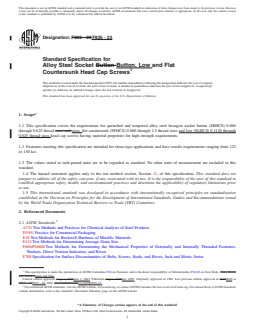
This international standard was developed in accordance with internationally recognized principles on standardization established in the Decision on Principles for the
Development of International Standards, Guides and Recommendations issued by the World Trade Organization Technical Barriers to Trade (TBT) Committee.
Designation: F835 − 23
Standard Specification for
Alloy Steel Socket Button, Low and Flat Countersunk Head
Cap Screws
This standard is issued under the fixed designation F835; the number immediately following the designation indicates the year of original
adoption or, in the case of revision, the year of last revision. A number in parentheses indicates the year of last reapproval. A superscript
epsilon (´) indicates an editorial change since the last revision or reapproval.
This standard has been approved for use by agencies of the U.S. Department of Defense.
1. Scope* D3951 Practice for Commercial Packaging
E18 Test Methods for Rockwell Hardness of Metallic Ma-
1.1 This specification covers the requirements for quenched
terials
and tempered alloy steel hexagon socket button (SBHCS)
E112 Test Methods for Determining Average Grain Size
0.060 through 0.625 thread sizes, flat countersunk (SFHCS)
F606/F606M Test Methods for Determining the Mechanical
0.060 through 1.5 thread sizes and low (SLHCS) 0.1120
Properties of Externally and Internally Threaded
through 0.625 thread sizes head cap screws having material
Fasteners, Washers, Direct Tension Indicators, and Rivets
properties for high-strength requirements.
F788 Specification for Surface Discontinuities of Bolts,
1.2 Fasteners meeting this specification are intended for
Screws, Studs, and Rivets, Inch and Metric Series
shear-type applications and have tensile requirements ranging
F2328 Test Method for Determining Decarburization and
from 122 to 150 ksi.
Carburization in Hardened and Tempered Threaded Steel
Bolts, Screws, Studs, and Nuts
1.3 The values stated in inch-pound units are to be regarded
as standard. No other units of measurement are included in this
2.2 ASME Standards:
standard.
B18.3 Socket Cap, Shoulder and Set Screws—Inch Series
1.4 The hazard statement applies only to the test method B18.24 Part Identifying Number (PIN) Code System Stan-
dard for B18 Fastener Products
section, Section 11, of this specification. This standard does
not purport to address all of the safety concerns, if any,
3. Ordering Information
associated with its use. It is the responsibility of the user of this
standard to establish appropriate safety, health, and environ-
3.1 Orders for material under this specification shall include
mental practices and determine the applicability of regulatory
the following:
limitations prior to use.
3.1.1 Quantity (number of screws).
1.5 This international standard was developed in accor-
3.1.2 Dimensions, including nominal thread designation,
dance with internationally recognized principles on standard-
thread pitch, and nominal screw length (inches). A standard
ization established in the Decision on Principles for the
part number may be used for this definition.
Development of International Standards, Guides and Recom-
3.1.3 Name of the screw: SBHCS, SLHCS or SFHCS.
mendations issued by the World Trade Organization Technical
3.1.4 Coating, if required. If a protective finish other than
Barriers to Trade (TBT) Committee.
black oxide is required, it must be specified on the order or
product standard.
2. Referenced Documents
3.1.5 Lot testing, if required (see 10.3).
2.1 ASTM Standards:
3.1.6 Certification, if required (see 14.1).
A751 Test Methods and Practices for Chemical Analysis of
3.1.7 ASTM designation and year of issue.
Steel Products
3.1.8 Any special requirements.
3.1.9 For establishment of a part identifying system, see
This specification is under the jurisdiction of ASTM Committee F16 on ASME B18.24.
Fasteners and is the direct responsibility of Subcommittee F16.02 on Steel Bolts,
3.2 Example—1000 pieces 0.250 − 20 × 0.375 SBHCS lot
Studs and Nuts.
Current edition approved June 1, 2023. Published July 2023. Originally approved tensile test. ASTM F835–XX.
in 1986. Last previous edition approved in 2020 as F835 – 20. DOI: 10.1520/F0835-
23.
For referenced ASTM standards, visit the ASTM website, www.astm.org, or
contact ASTM Customer Service at service@astm.org. For Annual Book of ASTM Available from American Society of Mechanical Engineers (ASME), ASME
Standards volume information, refer to the standard’s Document Summary page on International Headquarters, Two Park Ave., New York, NY 10016-5990, http://
the ASTM website. www.asme.org.
*A Summary of Changes section appears at the end of this standard
Copyright © ASTM International, 100 Barr Harbor Drive, PO Box C700, West Conshohocken, PA 19428-2959. United States
F835 − 23
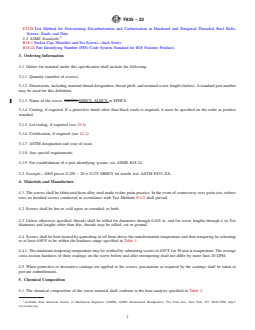
TABLE 2 Chemical Requirements
4. Materials and Manufacture
Composition, %
4.1 The screws shall be fabricated from alloy steel made to
Element
Heat Product
fine grain practice. In the event of controversy over grain size,
Analysis Analysis
referee tests on finished screws conducted in accordance with
Test Methods E112 shall prevail.
Carbon 0.30 to 0.48 0.28 to 0.50
Phosphorus, max 0.035 0.040
4.2 Screws shall be hot or cold upset or extruded, or both.
Sulfur, max 0.040 0.045
Alloying elements see 5.2 see 5.2
4.3 Unless otherwise specified, threads shall be rolled for
diameters through 0.625 in. and for screw lengths through 4 in.
For diameters and lengths other than this, threads may be
rolled, cut or ground.
6. Mechanical Properties
4.4 Screws shall be heat treated by quenching in oil from
6.1 The finished screws shall conform to the mechanical
above the transformation temperature and then tempering by
requirements specified in Table 1.
reheating to at least 650°F to be within the hardness range
6.2 Screws having a nominal length equal to or greater than
specified in Table 1.
3 diameters shall be tested full size and shall conform to the
4.4.1 The minimum tempering temperature may be verified
full-size tensile requirements specified in Table 3. Tensile
by submitting screws to 635°F for 30 min at temperature. The
failures through the head are acceptable provided the load
average cross-section hardness of three readings on the screw
requirements are satisfied.
before and after retempering shall not differ by more than 20
DPH.
6.3 Screws having a nominal thread diameter-length com-
bination as specified in 6.2 and a breaking load exceeding
4.5 When protective or decorative coatings are applied to
200 000 lb preferably shall be tested full size and shall meet the
the screws, precautions as required by the coatings shall be
full-size tensile properties in Table 3. When equipment of
taken to prevent embrittlement.
sufficient capacity for such tests is not available or if excessive
length of the screws makes full-size testing impractical, stan-
5. Chemical Composition
dard round machined specimens may be used that shall meet
5.1 The chemical composition of the screw material shall
the machined test specimen tensile properties in Table 1. If
conform to the heat analysis specified in Table 2.
discrepancy between full-size and machined specimen results,
5.2 One or more of the following alloying elements,
full-size tests shall be used as the referee method to determine
chromium, nickel, molybdenum, or vanadium, shall be present
acceptance.
in the steel in sufficient quantity to ensure the specific strength
6.4 Screws that are too short (lengths less than three times
properties are met after oil quenching and tempering. The steel
nominal size) or that have insufficient threads for tension
shall meet the AISI definition of alloy steel, that is, maximum
testing shall not be subject to tension tests but shall conform to
and minimum element content requirement or minimum ele-
the hardness (minimum and maximum) requirements of Table
ment limits specified.
1.
5.3 Steel to which bismuth, selenium, tellurium, or lead has
6.5 All screws, regardless of size, shall conform to the
been added intentionally shall not be permitted.
hardness specified in Table 1. Hardness shall be met anywhere
5.4 Material analysis may be made by the purchaser from on the cross section through the threaded portion one diameter
finished products and the chemical composition thus deter-
from the screw point.
mined shall conform to the requirements specified for the
7. Other Requirements
product analysis in Table 2.
7.1 Carburization or Decarburization:
7.1.1 There shall be no evidence of carburization or gross
decarburization on the surfaces of the heat-treated screws when
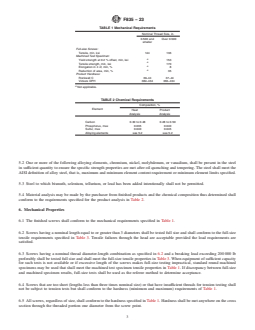
TABLE 1 Mechanical Requirements
evaluated in accordance with Test Method F2328 (Class 3
Nominal Thread Size, in.
Product).
0.500 and Over 0.500
7.1.2 Partial decarburization shall be limited to the criteria
smaller
in Test Method F2328 (Class 3 Product) when evaluated as
Full-size Screws: described therein.
Tensile, min, ksi 144 136
7.2 Embrittlement—Coated screws shall withstand the em-
Machined Test Specimen:
A
Yield strength at 0.2 % offset, min, ksi 153
brittlement test in accordance with 11.4 without showing
A
Tensile strength, min, ksi 170
indications of discontinuities. The loading shall be calculated
A
Elongation in 4 D, min, % 8
A
with minimum screw tensile requirements.
Reduction of area, min, % 35
Product Hardness:
Rockwell C 39–44 37–44
8. Dimensions
Vickers DPH 382–434 363–434
A 8.1 Unless otherwise specified, the dimensions shall con-
Not applicable.
form to the requirements of ASME B 18.3.
F835 − 23
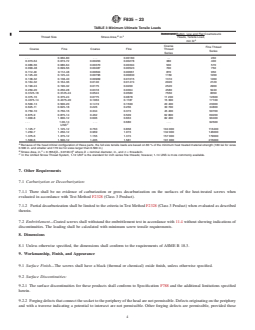
TABLE 3 Minimum Ultimate Tensile Loads
Button, Low and Flat Countersunk
B 2
Thread Size Stre
...
This document is not an ASTM standard and is intended only to provide the user of an ASTM standard an indication of what changes have been made to the previous version. Because
it may not be technically possible to adequately depict all changes accurately, ASTM recommends that users consult prior editions as appropriate. In all cases only the current version
of the standard as published by ASTM is to be considered the official document.
Designation: F835 − 20 F835 − 23
Standard Specification for
Alloy Steel Socket Button Button, Low and Flat
Countersunk Head Cap Screws
This standard is issued under the fixed designation F835; the number immediately following the designation indicates the year of original
adoption or, in the case of revision, the year of last revision. A number in parentheses indicates the year of last reapproval. A superscript
epsilon (´) indicates an editorial change since the last revision or reapproval.
This standard has been approved for use by agencies of the U.S. Department of Defense.
1. Scope*
1.1 This specification covers the requirements for quenched and tempered alloy steel hexagon socket button (SBHCS) 0.060
through 0.625 thread sizes and sizes, flat countersunk (SFHCS) 0.060 through 1.5 thread sizes and low (SLHCS) 0.1120 through
0.625 thread sizes head cap screws having material properties for high-strength requirements.
1.2 Fasteners meeting this specification are intended for shear-type applications and have tensile requirements ranging from 122
to 150 ksi.
1.3 The values stated in inch-pound units are to be regarded as standard. No other units of measurement are included in this
standard.
1.4 The hazard statement applies only to the test method section, Section 11, of this specification. This standard does not
purport to address all of the safety concerns, if any, associated with its use. It is the responsibility of the user of this standard to
establish appropriate safety, health, and environmental practices and determine the applicability of regulatory limitations prior
to use.
1.5 This international standard was developed in accordance with internationally recognized principles on standardization
established in the Decision on Principles for the Development of International Standards, Guides and Recommendations issued
by the World Trade Organization Technical Barriers to Trade (TBT) Committee.
2. Referenced Documents
2.1 ASTM Standards:
A751 Test Methods and Practices for Chemical Analysis of Steel Products
D3951 Practice for Commercial Packaging
E18 Test Methods for Rockwell Hardness of Metallic Materials
E112 Test Methods for Determining Average Grain Size
F606/F606M Test Methods for Determining the Mechanical Properties of Externally and Internally Threaded Fasteners,
Washers, Direct Tension Indicators, and Rivets
F788 Specification for Surface Discontinuities of Bolts, Screws, Studs, and Rivets, Inch and Metric Series
This specification is under the jurisdiction of ASTM Committee F16 on Fasteners and is the direct responsibility of Subcommittee F16.02 on Steel Bolts, Nuts, Rivets
and WashersStuds and Nuts.
Current edition approved Aug. 1, 2020June 1, 2023. Published August 2020July 2023. Originally approved in 1986. Last previous edition approved in 20182020 as
F835 – 18.F835 – 20. DOI: 10.1520/F0835-20.10.1520/F0835-23.
For referenced ASTM standards, visit the ASTM website, www.astm.org, or contact ASTM Customer Service at service@astm.org. For Annual Book of ASTM Standards
volume information, refer to the standard’s Document Summary page on the ASTM website.
*A Summary of Changes section appears at the end of this standard
Copyright © ASTM International, 100 Barr Harbor Drive, PO Box C700, West Conshohocken, PA 19428-2959. United States
F835 − 23
F2328 Test Method for Determining Decarburization and Carburization in Hardened and Tempered Threaded Steel Bolts,
Screws, Studs, and Nuts
2.2 ASME Standards:
B18.3 Socket Cap, Shoulder and Set Screws—Inch Series
B18.24 Part Identifying Number (PIN) Code System Standard for B18 Fastener Products
3. Ordering Information
3.1 Orders for material under this specification shall include the following:
3.1.1 Quantity (number of screws).
3.1.2 Dimensions, including nominal thread designation, thread pitch, and nominal screw length (inches). A standard part number
may be used for this definition.
3.1.3 Name of the screw: SBHCS SBHCS, SLHCS or SFHCS.
3.1.4 Coating, if required. If a protective finish other than black oxide is required, it must be specified on the order or product
standard.
3.1.5 Lot testing, if required (see 10.3).
3.1.6 Certification, if required (see 14.1).
3.1.7 ASTM designation and year of issue.
3.1.8 Any special requirements.
3.1.9 For establishment of a part identifying system, see ASME B18.24.
3.2 Example—1000 pieces 0.250 − 20 × 0.375 SBHCS lot tensile test. ASTM F835–XX.
4. Materials and Manufacture
4.1 The screws shall be fabricated from alloy steel made to fine grain practice. In the event of controversy over grain size, referee
tests on finished screws conducted in accordance with Test Methods E112 shall prevail.
4.2 Screws shall be hot or cold upset or extruded, or both.
4.3 Unless otherwise specified, threads shall be rolled for diameters through 0.625 in. and for screw lengths through 4 in. For
diameters and lengths other than this, threads may be rolled, cut or ground.
4.4 Screws shall be heat treated by quenching in oil from above the transformation temperature and then tempering by reheating
to at least 650°F to be within the hardness range specified in Table 1.
4.4.1 The minimum tempering temperature may be verified by submitting screws to 635°F for 30 min at temperature. The average
cross-section hardness of three readings on the screw before and after retempering shall not differ by more than 20 DPH.
4.5 When protective or decorative coatings are applied to the screws, precautions as required by the coatings shall be taken to
prevent embrittlement.
5. Chemical Composition
5.1 The chemical composition of the screw material shall conform to the heat analysis specified in Table 2.
Available from American Society of Mechanical Engineers (ASME), ASME International Headquarters, Two Park Ave., New York, NY 10016-5990, http://
www.asme.org.
F835 − 23
TABLE 1 Mechanical Requirements
Nominal Thread Size, in.
0.500 and Over 0.500
smaller
Full-size Screws:
Tensile, min, ksi 144 136
Machined Test Specimen:
A
Yield strength at 0.2 % offset, min, ksi 153
A
Tensile strength, min, ksi 170
A
Elongation in 4 D, min, % 8
A
Reduction of area, min, % 35
Product Hardness:
Rockwell C 39–44 37–44
Vickers DPH 382–434 363–434
A
Not applicable.
TABLE 2 Chemical Requirements
Composition, %
Element
Heat Product
Analysis Analysis
Carbon 0.30 to 0.48 0.28 to 0.50
Phosphorus, max 0.035 0.040
Sulfur, max 0.040 0.045
Alloying elements see 5.2 see 5.2
5.2 One or more of the following alloying elements, chromium, nickel, molybdenum, or vanadium, shall be present in the steel
in sufficient quantity to ensure the specific strength properties are met after oil quenching and tempering. The steel shall meet the
AISI definition of alloy steel, that is, maximum and minimum element content requirement or minimum element limits specified.
5.3 Steel to which bismuth, selenium, tellurium, or lead has been added intentionally shall not be permitted.
5.4 Material analysis may be made by the purchaser from finished products and the chemical composition thus determined shall
conform to the requirements specified for the product analysis in Table 2.
6. Mechanical Properties
6.1 The finished screws shall conform to the mechanical requirements specified in Table 1.
6.2 Screws having a nominal length equal to or greater than 3 diameters shall be tested full size and shall conform to the full-size
tensile requirements specified in Table 3. Tensile failures through the head are acceptable provided the load requirements are
satisfied.
6.3 Screws having a nominal thread diameter-length combination as specified in 6.2 and a breaking load exceeding 200 000 lb
preferably shall be tested full size and shall meet the full-size tensile properties in Table 3. When equipment of sufficient capacity
for such tests is not available or if excessive length of the screws makes full-size testing impractical, standard round machined
specimens may be used that shall meet the machined test specimen tensile properties in Table 1. If discrepancy between full-size
and machined specimen results, full-size tests shall be used as the referee method to determine acceptance.
6.4 Screws that are too short (lengths less than three times nominal size) or that have insufficient threads for tension testing shall
not be subject to tension tests but shall conform to the hardness (minimum and maximum) requirements of Table 1.
6.5 All screws, regardless of size, shall conform to the hardness specified in Table 1. Hardness shall be met anywhere on the cross
section through the threaded portion one diameter from the screw point.
F835 − 23
TABLE 3 Minimum Ultimate Tensile Loads
Button and Button, Low and Flat Countersunk
B 2
Thread Size Stress Area, in. Heads, Tensile Load,
A
min lb
Coarse
Fine Thread
Coarse Fine Coarse Fine Thread
Series
Series
. . . 0.060-80 . . . 0.00180 . 260
0.073-64 0.073-72 0.00263 0.00278 380 400
0.086-56 0.086-64 0.00370 0.00394 530 570
0.099-48 0.099-56 0.00487 0.00523 700 750
0.112-40 0.112-48 0.00604 0.00661 870 950
0.125-40 0.125-44 0.00796 0.00830 1150 1200
0.138-32 0.138-40 0.00909 0.01015 1310 1460
0.164-32 0.164-36 0.0140 0.01474 2020 2120
0.190-24 0.190-32 0.0175 0.0200 2520 2900
0.250-20 0.250-28 0.0318 0.0364 4580 5240
0.3125-18 0.3125-24 0.0524 0.0580 7550 8350
0.375-16 0.375-24 0.0775 0.0878 11 200 12600
0.4375-14 0.4375-20 0.1063 0.1187 15 300 17100
0.500-13 0.500-20
...