

ASTM C1615/C1615M-17(2022)
(Guide)Standard Guide for Mechanical Drive Systems for Remote Operation in Hot Cell Facilities
General Information
- Abstract
SIGNIFICANCE AND USE
4.1 Mechanical drive systems operability and long-term integrity are concerns that should be addressed primarily during the design phase; however, problems identified during fabrication and testing should be resolved and the changes in the design documented. Equipment operability and integrity can be compromised during handling and installation sequences. For this reason, the subject equipment should be handled and installed under closely controlled and supervised conditions.
4.2 This standard is intended as a supplement to other standards, and to federal and state regulations, codes, and criteria applicable to the design of equipment intended for this use.
4.3 This standard is intended to be generic and to apply to a wide range of types and configurations of mechanical drive systems.
SCOPE
1.1 Intent:
1.1.1 The intent of this standard is to provide general guidelines for the design, selection, quality assurance, installation, operation, and maintenance of mechanical drive systems used in remote hot cell environments. The term mechanical drive systems used herein, encompasses all individual components used for imparting motion to equipment systems, subsystems, assemblies, and other components. It also includes complete positioning systems and individual units that provide motive power and any position indicators necessary to monitor the motion.
1.2 Applicability:
1.2.1 This standard is intended to be applicable to equipment used under one or more of the following conditions:
1.2.1.1 The materials handled or processed constitute a significant radiation hazard to man or to the environment.
1.2.1.2 The equipment will generally be used over a long-term life cycle (for example, in excess of two years), but equipment intended for use over a shorter life cycle is not excluded.
1.2.1.3 The equipment can neither be accessed directly for purposes of operation or maintenance, nor can the equipment be viewed directly, for example, without radiation shielding windows, periscopes, or a video monitoring system (Guides C1572 and C1661).
1.2.2 The values stated in either SI units or inch-pound units are to be regarded separately as standard. The values stated in each system may not be exact equivalents; therefore, each system shall be used independently of the other. Combining values from the two systems may result in non-conformance with the standard.
1.3 User Caveats:
1.3.1 This standard is not a substitute for applied engineering skills, proven practices and experience. Its purpose is to provide guidance.
1.3.1.1 The guidance set forth in this standard relating to design of equipment is intended only to alert designers and engineers to those features, conditions, and procedures that have been found necessary or highly desirable to the design, selection, operation and maintenance of mechanical drive systems for the subject service conditions.
1.3.1.2 The guidance set forth results from discoveries of conditions, practices, features, or lack of features that were found to be sources of operational or maintenance problems, or causes of failure.
1.3.2 This standard does not supersede federal or state regulations, or both, and codes applicable to equipment under any conditions.
1.3.3 This standard does not purport to address all of the safety concerns, if any, associated with its use. It is the responsibility of the user of this standard to establish appropriate safety, health, and environmental practices and determine the applicability of regulatory limitations prior to use.
1.4 This international standard was developed in accordance with internationally recognized principles on standardization established in the Decision on Principles for the Development of International Standards, Guides and Recommendations issued by the World Trade Organization Technical Barriers to Trade (TBT) Committee.
- Status
- Published
- Publication Date
- 30-Jun-2022
- Technical Committee
- C26 - Nuclear Fuel Cycle
- Drafting Committee
- C26.14 - Remote Systems
Overview
ASTM C1615/C1615M-17(2022), published by ASTM International, provides guidelines for the design, selection, installation, operation, and maintenance of mechanical drive systems for remote operation in hot cell facilities. Hot cells are shielded environments used for handling radioactive materials, where direct access is restricted due to hazardous conditions. The standard focuses on ensuring operability and long-term reliability of mechanical drive components subjected to high radiation, limited accessibility, and stringent safety requirements. Its recommendations are applicable throughout the equipment lifecycle, from concept and design through deployment and maintenance.
Key Topics
- Design Guidelines: Emphasizes incorporating operability and integrity during the initial design, considering long-term reliability and minimizing the necessary inventory of tools and spare parts.
- Equipment Selection: Outlines considerations for selecting motors, gears, bearings, and materials suitable for high-radiation and remote-operation environments. Recommends material qualification testing before use.
- Quality Assurance: Stresses the importance of robust quality assurance (QA) programs aligned with regulatory requirements, such as ISO 9001, ASME NQA-1, and relevant federal regulations.
- Installation and Handling: Specifies strict protocols for transferring, installing, and handling equipment to prevent damage and maintain system integrity.
- Maintenance and Repair: Encourages modularity and standardization to facilitate remote maintenance and reduce downtime, with a focus on ease of replacement for components prone to failure.
- Material Considerations: Highlights the effects of radiation on various materials, recommending the avoidance or careful qualification of susceptible plastics and elastomers. Provides direction on material compatibility with hot cell atmospheres, such as argon or nitrogen.
- Documentation and Compliance: Advises that all changes during fabrication or testing be documented, aligning with both industry standards and regulatory frameworks.
Applications
This ASTM guide is essential for organizations involved in:
- Nuclear Facility Operations: Especially for facilities facing significant radiation hazards, such as nuclear medicine production, fuel reprocessing, or radioactive waste management.
- Equipment Manufacturers: Engineers and designers creating or adapting mechanical drive systems for use in shielded remote-operation cells.
- Maintenance and Facility Managers: Planning for long service life, remote repairability, and cost-effective operation in environments where manual access is restricted or impossible.
- Regulatory Compliance: Supplementing mandatory state, federal, or international codes for equipment used in hazardous environments, ensuring safety, reliability, and traceability.
Related Standards
ASTM C1615/C1615M-17(2022) supplements and references a range of standards and technical guides, including but not limited to:
- ASTM C1533 - General Design Considerations for Hot Cell Equipment
- ASTM C1554 - Materials Handling Equipment for Hot Cells
- ASTM C1572 & C1661 - Viewing systems and shielding window components for remote facilities
- ASTM/IEEE SI-10 - Use of the International System of Units
- NEMA MG1 - Motors and Generators
- AGMA 390.0 - Gear Handbook
- ASME NQA-1 - Quality Assurance for Nuclear Facility Applications
- ANSI/ISO/ASQ Q9001 - Quality Management Systems
The guide is intended as a supplementary resource and does not supersede applicable laws or regulations. Its adoption supports compatibility with international best practices, in line with guidance from the World Trade Organization Technical Barriers to Trade (TBT) Committee.
By following ASTM C1615/C1615M-17(2022), organizations can enhance the safety, efficiency, and longevity of mechanical drive systems in remote, high-risk environments, ensuring their operations meet recognized industry standards and regulatory expectations. This ultimately reduces operational risks and facilitates compliance in nuclear and hazardous material handling sectors.
Relations
- Effective Date
- 01-Jan-2024
- Effective Date
- 01-Oct-2023
- Effective Date
- 01-Nov-2018
- Effective Date
- 15-Jun-2014
- Effective Date
- 15-Jan-2014
- Effective Date
- 01-Jun-2013
- Effective Date
- 01-May-2013
- Effective Date
- 01-Jan-2013
- Effective Date
- 01-Feb-2011
- Effective Date
- 01-Nov-2010
- Effective Date
- 01-Nov-2010
- Effective Date
- 01-Aug-2010
- Effective Date
- 01-Feb-2010
- Effective Date
- 15-Feb-2009
- Effective Date
- 01-Dec-2008
Get Certified
Connect with accredited certification bodies for this standard

DNV
DNV is an independent assurance and risk management provider.

Lloyd's Register
Lloyd's Register is a global professional services organisation specialising in engineering and technology.
DNV Energy Systems
Energy and renewable energy certification.
Sponsored listings
Frequently Asked Questions
ASTM C1615/C1615M-17(2022) is a guide published by ASTM International. Its full title is "Standard Guide for Mechanical Drive Systems for Remote Operation in Hot Cell Facilities". This standard covers: SIGNIFICANCE AND USE 4.1 Mechanical drive systems operability and long-term integrity are concerns that should be addressed primarily during the design phase; however, problems identified during fabrication and testing should be resolved and the changes in the design documented. Equipment operability and integrity can be compromised during handling and installation sequences. For this reason, the subject equipment should be handled and installed under closely controlled and supervised conditions. 4.2 This standard is intended as a supplement to other standards, and to federal and state regulations, codes, and criteria applicable to the design of equipment intended for this use. 4.3 This standard is intended to be generic and to apply to a wide range of types and configurations of mechanical drive systems. SCOPE 1.1 Intent: 1.1.1 The intent of this standard is to provide general guidelines for the design, selection, quality assurance, installation, operation, and maintenance of mechanical drive systems used in remote hot cell environments. The term mechanical drive systems used herein, encompasses all individual components used for imparting motion to equipment systems, subsystems, assemblies, and other components. It also includes complete positioning systems and individual units that provide motive power and any position indicators necessary to monitor the motion. 1.2 Applicability: 1.2.1 This standard is intended to be applicable to equipment used under one or more of the following conditions: 1.2.1.1 The materials handled or processed constitute a significant radiation hazard to man or to the environment. 1.2.1.2 The equipment will generally be used over a long-term life cycle (for example, in excess of two years), but equipment intended for use over a shorter life cycle is not excluded. 1.2.1.3 The equipment can neither be accessed directly for purposes of operation or maintenance, nor can the equipment be viewed directly, for example, without radiation shielding windows, periscopes, or a video monitoring system (Guides C1572 and C1661). 1.2.2 The values stated in either SI units or inch-pound units are to be regarded separately as standard. The values stated in each system may not be exact equivalents; therefore, each system shall be used independently of the other. Combining values from the two systems may result in non-conformance with the standard. 1.3 User Caveats: 1.3.1 This standard is not a substitute for applied engineering skills, proven practices and experience. Its purpose is to provide guidance. 1.3.1.1 The guidance set forth in this standard relating to design of equipment is intended only to alert designers and engineers to those features, conditions, and procedures that have been found necessary or highly desirable to the design, selection, operation and maintenance of mechanical drive systems for the subject service conditions. 1.3.1.2 The guidance set forth results from discoveries of conditions, practices, features, or lack of features that were found to be sources of operational or maintenance problems, or causes of failure. 1.3.2 This standard does not supersede federal or state regulations, or both, and codes applicable to equipment under any conditions. 1.3.3 This standard does not purport to address all of the safety concerns, if any, associated with its use. It is the responsibility of the user of this standard to establish appropriate safety, health, and environmental practices and determine the applicability of regulatory limitations prior to use. 1.4 This international standard was developed in accordance with internationally recognized principles on standardization established in the Decision on Principles for the Development of International Standards, Guides and Recommendations issued by the World Trade Organization Technical Barriers to Trade (TBT) Committee.
SIGNIFICANCE AND USE 4.1 Mechanical drive systems operability and long-term integrity are concerns that should be addressed primarily during the design phase; however, problems identified during fabrication and testing should be resolved and the changes in the design documented. Equipment operability and integrity can be compromised during handling and installation sequences. For this reason, the subject equipment should be handled and installed under closely controlled and supervised conditions. 4.2 This standard is intended as a supplement to other standards, and to federal and state regulations, codes, and criteria applicable to the design of equipment intended for this use. 4.3 This standard is intended to be generic and to apply to a wide range of types and configurations of mechanical drive systems. SCOPE 1.1 Intent: 1.1.1 The intent of this standard is to provide general guidelines for the design, selection, quality assurance, installation, operation, and maintenance of mechanical drive systems used in remote hot cell environments. The term mechanical drive systems used herein, encompasses all individual components used for imparting motion to equipment systems, subsystems, assemblies, and other components. It also includes complete positioning systems and individual units that provide motive power and any position indicators necessary to monitor the motion. 1.2 Applicability: 1.2.1 This standard is intended to be applicable to equipment used under one or more of the following conditions: 1.2.1.1 The materials handled or processed constitute a significant radiation hazard to man or to the environment. 1.2.1.2 The equipment will generally be used over a long-term life cycle (for example, in excess of two years), but equipment intended for use over a shorter life cycle is not excluded. 1.2.1.3 The equipment can neither be accessed directly for purposes of operation or maintenance, nor can the equipment be viewed directly, for example, without radiation shielding windows, periscopes, or a video monitoring system (Guides C1572 and C1661). 1.2.2 The values stated in either SI units or inch-pound units are to be regarded separately as standard. The values stated in each system may not be exact equivalents; therefore, each system shall be used independently of the other. Combining values from the two systems may result in non-conformance with the standard. 1.3 User Caveats: 1.3.1 This standard is not a substitute for applied engineering skills, proven practices and experience. Its purpose is to provide guidance. 1.3.1.1 The guidance set forth in this standard relating to design of equipment is intended only to alert designers and engineers to those features, conditions, and procedures that have been found necessary or highly desirable to the design, selection, operation and maintenance of mechanical drive systems for the subject service conditions. 1.3.1.2 The guidance set forth results from discoveries of conditions, practices, features, or lack of features that were found to be sources of operational or maintenance problems, or causes of failure. 1.3.2 This standard does not supersede federal or state regulations, or both, and codes applicable to equipment under any conditions. 1.3.3 This standard does not purport to address all of the safety concerns, if any, associated with its use. It is the responsibility of the user of this standard to establish appropriate safety, health, and environmental practices and determine the applicability of regulatory limitations prior to use. 1.4 This international standard was developed in accordance with internationally recognized principles on standardization established in the Decision on Principles for the Development of International Standards, Guides and Recommendations issued by the World Trade Organization Technical Barriers to Trade (TBT) Committee.
ASTM C1615/C1615M-17(2022) is classified under the following ICS (International Classification for Standards) categories: 27.120.10 - Reactor engineering. The ICS classification helps identify the subject area and facilitates finding related standards.
ASTM C1615/C1615M-17(2022) has the following relationships with other standards: It is inter standard links to ASTM C859-24, ASTM C1661-23, ASTM C1661-18, ASTM C859-14a, ASTM C859-14, ASTM C859-13a, ASTM C859-13, ASTM C1661-13, ASTM C1554-11, ASTM C1572-10, ASTM C859-10b, ASTM C859-10a, ASTM C859-10, ASTM C859-09, ASTM C1533-08. Understanding these relationships helps ensure you are using the most current and applicable version of the standard.
ASTM C1615/C1615M-17(2022) is available in PDF format for immediate download after purchase. The document can be added to your cart and obtained through the secure checkout process. Digital delivery ensures instant access to the complete standard document.
Standards Content (Sample)
This international standard was developed in accordance with internationally recognized principles on standardization established in the Decision on Principles for the
Development of International Standards, Guides and Recommendations issued by the World Trade Organization Technical Barriers to Trade (TBT) Committee.
Designation: C1615/C1615M − 17 (Reapproved 2022)
Standard Guide for
Mechanical Drive Systems for Remote Operation in Hot Cell
Facilities
This standard is issued under the fixed designation C1615/C1615M; the number immediately following the designation indicates the
year of original adoption or, in the case of revision, the year of last revision. A number in parentheses indicates the year of last
reapproval. A superscript epsilon (´) indicates an editorial change since the last revision or reapproval.
1. Scope 1.3.1.1 The guidance set forth in this standard relating to
design of equipment is intended only to alert designers and
1.1 Intent:
engineers to those features, conditions, and procedures that
1.1.1 The intent of this standard is to provide general
have been found necessary or highly desirable to the design,
guidelines for the design, selection, quality assurance,
selection, operation and maintenance of mechanical drive
installation, operation, and maintenance of mechanical drive
systems for the subject service conditions.
systems used in remote hot cell environments. The term
1.3.1.2 The guidance set forth results from discoveries of
mechanical drive systems used herein, encompasses all indi-
conditions, practices, features, or lack of features that were
vidual components used for imparting motion to equipment
foundtobesourcesofoperationalormaintenanceproblems,or
systems,subsystems,assemblies,andothercomponents.Italso
causes of failure.
includescompletepositioningsystemsandindividualunitsthat
1.3.2 This standard does not supersede federal or state
provide motive power and any position indicators necessary to
regulations, or both, and codes applicable to equipment under
monitor the motion.
any conditions.
1.2 Applicability:
1.3.3 This standard does not purport to address all of the
1.2.1 This standard is intended to be applicable to equip-
safety concerns, if any, associated with its use. It is the
ment used under one or more of the following conditions:
responsibility of the user of this standard to establish appro-
1.2.1.1 The materials handled or processed constitute a
priate safety, health, and environmental practices and deter-
significant radiation hazard to man or to the environment.
mine the applicability of regulatory limitations prior to use.
1.2.1.2 The equipment will generally be used over a long-
1.4 This international standard was developed in accor-
term life cycle (for example, in excess of two years), but
dance with internationally recognized principles on standard-
equipment intended for use over a shorter life cycle is not
ization established in the Decision on Principles for the
excluded.
Development of International Standards, Guides and Recom-
1.2.1.3 The equipment can neither be accessed directly for
mendations issued by the World Trade Organization Technical
purposes of operation or maintenance, nor can the equipment
Barriers to Trade (TBT) Committee.
be viewed directly, for example, without radiation shielding
windows, periscopes, or a video monitoring system (Guides
2. Referenced Documents
C1572 and C1661).
2.1 Industry and National Consensus Standards—
1.2.2 ThevaluesstatedineitherSIunitsorinch-poundunits
Nationally recognized industry and consensus standards which
are to be regarded separately as standard. The values stated in
may be applicable in whole or in part to the design, selection,
each system may not be exact equivalents; therefore, each
quality insurance, installation, operation, and maintenance of
system shall be used independently of the other. Combining
equipment are referenced throughout this standard and include
values from the two systems may result in non-conformance
the following:
with the standard.
2.2 ASTM Standards:
1.3 User Caveats:
ASTM/IEEE SI-10 Standard for Use of the International
1.3.1 This standard is not a substitute for applied engineer-
System of Units
ing skills, proven practices and experience. Its purpose is to
C859 Terminology Relating to Nuclear Materials
provide guidance.
C1533 Guide for General Design Considerations for Hot
Cell Equipment
This guide is under the jurisdiction ofASTM Committee C26 on Nuclear Fuel
Cycle and is the direct responsibility of Subcommittee C26.14 on Remote Systems. For referenced ASTM standards, visit the ASTM website, www.astm.org, or
Current edition approved July 1, 2022. Published July 2022. Originally approved contact ASTM Customer Service at service@astm.org. For Annual Book of ASTM
in 2005. Last previous edition approved in 2017 as C1615/C1615M – 17. DOI: Standards volume information, refer to the standard’s Document Summary page on
10.1520/C1615_C1615M-17R22. the ASTM website.
Copyright © ASTM International, 100 Barr Harbor Drive, PO Box C700, West Conshohocken, PA 19428-2959. United States
C1615/C1615M − 17 (2022)
C1554 Guide for Materials Handling Equipment for Hot 3.1.2 For definitions of general terms used to describe
Cells nuclear materials, hot cells, and hot cell equipment, refer to
C1572 Guide for Dry Lead Glass and Oil-Filled Lead Glass Terminology C859.
Radiation Shielding Window Components for Remotely 3.2 Definitions:
Operated Facilities 3.2.1 encoders, n—for the purpose of this standard, are
C1661 Guide for Viewing Systems for Remotely Operated measuring devices that detect changes in rotary or linear
Facilities motion, direction of movement, and relative position by
2.3 Other Standards: producing electrical signals using sensors and an optical disk.
NEMA MG1 Motors and Generators
3.2.2 inert gas, n—atypeofcommercialgrademoisturefree
AGMA 390.0 American Gear Manufacturers Association,
gas, usually argon or nitrogen that is present in the hot cell.
Gear Handbook
3.2.3 linear variable differential transformer (LVDT), n—a
ANS Design Guides for Radioactive Material Handling
transducer for linear displacement measurement that converts
Facilities and Equipment
mechanical motion into an electrical signal that can be
ASME B17.1 Keys and Keyseats
metered, recorded, or transmitted.
NLGI American Standard Classification of Lubricating
3.2.4 mechanical drive systems, n—refers to but is not
Grease
limited to motors, gears, resolvers, encoders, bearings,
ASME NOG-1 American Society of Mechanical Engineers
couplings, bushings, lubricants, solenoids, shafts, pneumatic
Committee on Cranes for Nuclear Facilities – Rules for
cylinders, and lead screws.
Construction of Overhead and Gantry Cranes
ANSI/ASME NQA-1 Quality Assurance Requirements for
3.2.5 resolvers, n—for the purpose of this standard, are
Nuclear Facility Applications rotationalpositionmeasuringdevicesthatareessentiallyrotary
ANSI/ISO/ASQ Q9001 Quality Management Standard Re-
transformerswithsecondarywindingsontherotorandstatorat
quirements right angles to the other windings.
NCRP Report No. 82 SI Units in Radiation Protection and
4. Significance and Use
Measurements
ICRU Report 10b Physical Aspects of Irradiation
4.1 Mechanical drive systems operability and long-term
CERN 70-5 Effects of Radiation on Materials and Compo-
integrity are concerns that should be addressed primarily
nents
during the design phase; however, problems identified during
2.4 Federal Standards and Regulations:
fabrication and testing should be resolved and the changes in
10CFR 830.120, Subpart A Nuclear Safety Management
the design documented. Equipment operability and integrity
Quality Assurance Requirements
can be compromised during handling and installation se-
10CFR 50 Quality Assurance Criteria for Nuclear Power
quences. For this reason, the subject equipment should be
Plants and Fuel Reprocessing Plants
handled and installed under closely controlled and supervised
40CFR 260-279 Solid Waste Regulations – Resource Con-
conditions.
servation and Recovery Act (RCRA)
4.2 This standard is intended as a supplement to other
standards, and to federal and state regulations, codes, and
3. Terminology
criteria applicable to the design of equipment intended for this
3.1 General Considerations:
use.
3.1.1 The terminology employed in this standard conforms
with industry practice insofar as practicable. 4.3 This standard is intended to be generic and to apply to a
wide range of types and configurations of mechanical drive
systems.
Available from National Electrical Manufacturers Association (NEMA), 1300
N. 17th St., Suite 1752, Rosslyn, VA 22209, http://www.nema.org.
Available from American Gear Manufacturers Association (AGMA), 500 5. Quality Assurance and Quality Requirements
Montgomery St., Suite 350, Alexandria, VA 22314-1581, http://www.agma.org.
5.1 The owner-operator should administer a quality assur-
Available from ANS, 555 North Kensington Avenue, LaGrange Park, Ilinois
ance program approved by the agency of jurisdiction. QA
60526.
Available from American Society of Mechanical Engineers (ASME), ASME
programs may be required to comply with 10CFR 50, Appen-
International Headquarters, Two Park Ave., New York, NY 10016-5990, http://
dix B, 10CFR 830.120, Subpart A, ASME NQA-1, or ISO
www.asme.org.
7 Q9001.
Available from NLGI, 4635 Wyondotte Street, Kansas City, MO 64112.
Available fromAmerican National Standards Institute (ANSI), 25 W. 43rd St.,
5.2 The owner-operator should require appropriate quality
4th Floor, New York, NY 10036, http://www.ansi.org.
9 assurance of purchased mechanical drive systems and compo-
Available from National Council of Radiation Protection and Measurements,
7910 Woodmont Avenue, Suite 400, Bethesda, MD 20814-3095. nents to assure proper fit up, operation and reliability of the
Available from International Commission on Radiation Units and
equipment in the hot cell.
Measurements, Inc., 7910 Woodmont Avenue, Suite 400, Bethesda, MD 20814-
3095.
6. General Requirements
Available from CERN European Organization for Nuclear Research, CH-
1211, Geneva 23, Switzerland.
6.1 For safe and efficient operation, a minimum number of
Available from U.S. Government Printing Office Superintendent of
mechanical drive system components should be placed in a hot
Documents, 732 N. Capitol St., NW, Mail Stop: SDE, Washington, DC 20401,
http://www.access.gpo.gov. cell. Unnecessary equipment in a cell adds to the cost of
C1615/C1615M − 17 (2022)
operating and maintaining the cell and adds to the eventual 7.5 Polyetheretherketone is a recommended plastic material
decontamination and disposal costs of hot cell equipment. A for seals, valve seats, and other applications because of its
thorough review of the mechanical drive systems necessary to resistance to beta and gamma radiation.
perform the hot cell operations should be performed prior to
introducing the equipment into the hot cell.
8. Equipment Selection
8.1 General:
6.2 All hot cell equipment should be handled with extreme
8.1.1 Mechanical drive system components should be se-
care during transfers and installation sequences to ensure
lected based on their operability and reliability in a high
against collision damage.
radiationorhighcontaminationenvironment,orbemodifiedin
6.3 Installation should be planned and sequenced so that
awaythatwillextendtheequipmentservicelifeoreaseofuse.
other equipment is not handled above and around previously
The installation position, the orientation, and the attachment
installed components to the extent practicable.
methods should be such as to simplify removal and replace-
6.4 Principles of good modular design and standardization ment of mechanical equipment susceptible to periodic mainte-
should be considered for maintainability of equipment during nance or unpredictable failure.
its design life. Determination should be made early in the
8.2 Motors:
design at which level of subassembly the equipment will be
8.2.1 General:
disassembled and replaced if necessary. The optimal level is
8.2.1.1 Avariety of motors may be used in a high radiation
strongly influenced by the estimated maintenance time and
hot cell environment. More than one type of motor may work
associated cell down time costs, radiation exposure to
for the same application. Motor selection depends on many
personnel, and disposal costs for the failed subassembly.
factors, such as the required speed, torque or horsepower,
Design with standardized fasteners and other components to
physical frame size, voltage requirements, enclosure type,
limit the inventory of tools needed for maintenance. Use
mounting requirements, bearing type, service factor, and duty
prudent judgement in the selection of fastening materials to
cycle. The longevity of a motor in a hot cell environment
avoid galling problems, especially when using stainless steel
depends on several variables such as the hot cell atmosphere,
fasteners.
the amount of moisture and corrosive fumes in the atmosphere,
the quality of the motor, the materials of construction, and the
6.5 Equipment intended for use in hot cells should be tested
radiation exposure to the motor.
and qualified in a mock-up facility prior to installation in the
8.2.1.2 Motors smaller than 7500 watts [10 hp] are usually
hot cell. C1533
pre-lubricated at the factory and will operate for long periods
6.6 Where possible, electrical and instrumentation controls,
of time under normal service conditions without requiring
readouts, and alarms for mechanical drive systems should be
periodic lubrication. The bearings of larger motors however,
located outside of the hot cell.
mayrequireperiodiclubricationusinghigh-qualitygreasewith
6.7 Consideration should be given to the materials of a consistency suitable for the motor’s insulation class. Motors
with sealed-for-life lubricated bearings are preferred over
construction for hot cell equipment and their ultimate disposal
per RCRA jurisdiction. 40CFR260-279 motors that require periodic lubrication. Refer to the section on
lubrication for lubricants recommended for hot cell
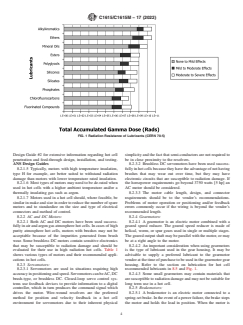
applications, 8.5 and Fig. 1.
7. Materials of Construction
8.2.1.3 Capacitor start, single-phase, alternating current
7.1 Plastics, elastomers, resins, bonding agents, solid state
(AC) motors have proven to be reliable in hot cells and are
devices, wire insulation, thermal insulation materials, paints,
typically less expensive than direct current (DC) motors of
coatings, and other materials are subject to radiation damage
equivalent horsepower. Generally, AC motors are also smaller
and possible failure. Not all such materials and components
than DC motors for the same horsepower. This can be an
can be excluded from service in the subject environment.Their
advantage in some uses where a larger motor may adversely
use should be carefully considered for their particular applica-
affect the design. Three-phase induction AC motors are the
tion and material qualification testing under expected condi-
preferred choice because of their robustness and starting
tions prior to use should also be considered.
simplicity. In lower radiation areas, that is, less than
7.2 Alpha and beta irradiation can severely and rapidly 250 mGy⁄hr [25 rad/hr], an off-the-shelf single phase AC
motor usually works well and will typically last for several
damage sensitive components when they are exposed to the
radiation source. Special consideration should be given to years.
8.2.1.4 Lower voltage motors are generally preferable to
material selection in applications where the equipment is
exposed to alpha or beta radiation. high voltage motors when used in an argon gas environment
hot cell. For example, a 240-volt AC three-phase motor is
7.3 The method of replacement, the ease of replacement,
preferredovera480-voltACmotorbecauseofthepotentialfor
and/or the substitution of more radiation resistant materials
arcing at higher voltages particularly inside electrical feed-
should be considered for components having materials subject
throughs. However, 208/440-volt AC three-phase motors will
to radiation damage.
often be used in low horsepower applications in place of
7.4 Polytetrafluoroethylene (PTFE) should be avoided since 110-volt AC single phase motors in order to minimize the
it degrades rapidly in radiation environments. required wire size and connector ampacity. Refer to the ANS
C1615/C1615M − 17 (2022)
FIG. 1 Radiation Resistance of Lubricants (CERN 70-5)
Design Guide #2 for extensive information regarding hot cell simplicity and the fact that semi-conductors are not required to
penetration and feed-through design, installation, and testing. be in close proximity to the resolvers.
ANS Design Guides 8.2.3.2 Brushless DC servomotors have been used success-
8.2.1.5 Typically, motors with high temperature insulation, fullyinhotcellsbecausetheyhavetheadvantageofnothaving
type H for example, are better suited to withstand radiation brushes that may wear out over time, but they may have
damage than motors with lower temperature rated insulation. electronic circuits that are susceptible to radiation damage. If
8.2.1.6 Most types of motors may need to be de-rated when the horsepower requirements go beyond 3750 watts [5 hp] an
used in hot cells with a higher ambient temperature and/or a AC motor should be considered.
thermally insulating gas such as argon. 8.2.3.3 The motor cable length, design, and connector
8.2.1.7 Motors used in a hot cell should, where feasible, be requirements should be to the vendor’s recommendations.
similar in make and size in order to reduce the number of spare Problems of motor operation or positioning and/or feedback
motors and to standardize on the size and type of electrical errors commonly occur if the wiring is beyond the vendor’s
connectors and method of control. recommended length.
8.2.2 AC and DC Motors: 8.2.4 Gearmotors:
8.2.2.1 Both AC and DC motors have been used success- 8.2.4.1 A gearmotor is an electric motor combined with a
fully in air and argon gas atmosphere hot cells. In cases of high geared speed reducer. The geared speed reducer is made of
purity atmosphere hot cells, motors with brushes may not be helical, worm, or spur gears used in single or multiple stages.
acceptable because of the impurities generated from brush The geared output shaft may be parallel with the motor, or may
wear. Some brushless DC motors contain sensitive electronics be at a right angle to the motor.
that may be susceptible to radiation damage and should be 8.2.4.2 An important consideration when using gearmotors
evaluated for their use in high radiation hot cells. Table 1 is the type of lubricant used in the gear housing. It may be
shows various types of motors and their recommended appli- advisable to supply a preferred lubricant to the gearmotor
cations in hot cells. vendor at the time of purchase to be used in the gearmotor gear
8.2.3 Servomotors: housing. Refer to the section on lubrication for hot cell
8.2.3.1 Servomotors are used in situations requiring high recommended lubricants in 8.5 and Fig. 1.
accuracyinpositioningandspeed.ServomotorscanbeAC,DC 8.2.4.3 Some small gearmotors may contain materials that
brush-type, or brushless DC. Closed-loop servo control sys- are susceptible to radiation damage and may not be suitable for
tems use feedback devices to provide information to a digital long term use in a hot cell.
controller, which in turn produces the command signal which 8.2.5 Brakemotors:
drives the motor. Wire-wound resolvers are the preferred 8.2.5.1 A brakemotor is an electric motor connected to a
method for position and velocity feedback in a hot cell spring-setbrake.Intheeventofapowerfailure,thebrakestops
environment for servomotors due to their inherent physical the motor and holds the load in position. When the motor is
C1615/C1615M − 17 (2022)
TABLE 1 Motors and Their Recommended Applications for Hot Cells
Type Horsepower Typical Size (dia.) Application Comments
(1 Hp = 750 watts) (1 in. = 25.4 mm)
AC Shaded Pole 0 – 1 3" – 6" Fans and blowers Inexpensive Non reversible
115/208-2300-VAC
Light duty Low starting torque
Simple controller Non-precision positioning
No position or velocity feedback Applications requiring small
motors
AC capacitor start, 115 VAC, ⁄2 – Up 6" – Up Pumps and blowers Inexpensive General purpose motor
single phase Fixed speed High current per horsepower
Moderate to high starting torques Light duty
AC Three-phase 208-230 VAC ⁄2 – Up 6" – Up pumps, blowers, Inexpensive Reversible
fans, compressors, High starting torque Requires three-phase source
agitators, hoists, Generally fixed speed, but variable speed can be achieved by
general purpose using variable freq.drive (VFD)
motor
DC brush (permanent magnet) ⁄16 – 1 1" – 8" Variable speed Can be low voltage Inexpensive motor and
drives, mixers, controller
conveyors, high Variable speed No position feedback
torque small Non-precision positioning
gearmotors Brushes may require replacement with high altitude brushes for
longer life
DC Brushless – (permanent ⁄32 – 5 1" – 8" High torque small Compact Expensive
magnet ⁄servo) gearmotors, robotics, Precision positioning Reversible
linear actuators Velocity control
Can be low voltage
Long life in high radiation fields if the drive electronics are moved
out of cell
DC Shunt-Wound 5 – Up 6" – Up Larger loads Variable speed/torque control available
requiring variable Larger motors operated at low speeds require forced cooling
speed, direction, Limited use
and position
control
1 1
Stepper (Brushless DC) ⁄4 – ⁄2 3" – 5" Robotics Consumes power to hold position (heat buildup)
Requires feedback for closed-loop position indication
Requires computer/micro processor control system
Can be operated open-loop
Expensive motor controls
Universal AC or DC Fractional 3" – 6" Power tools and High torque available in a small Inexpensive
vacuum cleaners motor
Low efficiency
Brushes may require replacement if motor is used in low moisture
or inert gas environment
Normally powered by 120 VAC
operated, electric current is applied to the brake, releasing the motor in a hot cell, it may be necessary to separate the
set. Brakemotors are commonly used on hoists or other lifting electronic drives from the motor and move them out of the cell
devices. The electronics for brakemotors should be removed or to a lower radiation area. Note that motor performance may
from the brakemotors before installation and placed in a be affected when separating the electronics and the motor.
non-radiation area. In the event that a brake does not release, Consideration should be given to reduce the generation or
careful consideration must be given to the proper method for reception of electrical noise on the cables between the drive
supporting the load while the brake is repaired or replaced. and the motor.
8.2.6 Stepper Motor: 8.2.7 Induction Motors:
8.2.6.1 A stepper motor operates by rotating a shaft in 8.2.7.1 Induction motors come in either three phase or
incremental steps. Electrical pulses are supplied to the motor single phase. At lower horsepower ratings, the single-phase
using a translator drive or indexer. The motor converts the motor is more commonly used by equipment vendors. The
digital signals into fixed mechanical increments of motion. single-phase induction motor requires an internal wiring
This allows the stepping motor to accurately position a load method to develop starting torque such as a starting winding
without using a feedback system, such as a resolver or and capacitor. The start winding and capacitor also determine
compatible encoder. Feedback systems may be incorporated the starting direction of the motor. Three phase induction
into the stepping motor system to provide a comparative motors (squirrel cage) are simple, dependable and work well in
function or to provide a true closed-loop system, although as a hot cells. In an induction motor, the AC voltage is supplied
rule, stepper motors are run open-loop. A position sensor may directly to the stationary stator winding and this generates a
be required to determine a “home” position if control power is rotating magnetic field in the stator winding. The rotating
interrupted.Steppermotorsbecomethermallyhotregardlessof magnetic field of the stator induces a current in the rotor of the
whether they are turning or not. Also, when power is lost, the motor. The current flowing in the rotor generates a magnetic
motorcannolongersupportaload.Wheninstallingthestepper field that causes the rotor to rotate. Variable frequency drives
C1615/C1615M − 17 (2022)
are commonly used to control motor speed when using a three de-rated by at least 30 % because convection heat removal in
phase induction motor. argon gas is less than in air.
8.2.9.3 Totally Enclosed Fan Cooled (TEFC)—These mo-
8.2.8 Linear Motors:
tors are the same as TENV except that they have an external
8.2.8.1 Linear motors are typically used to move objects
fan that provides cooling air over the outside of the motor
along a horizontal track. The linear motor and track can be
frame.
straight or may contain slight curves. In hot cell applications,
8.2.9.4 Explosion Proof—These motors are specifically de-
their primary use would be to move material in carts. Linear
signed for use in hazardous (explosive) locations. Explosion
motors produce linear motion with only a stationary
proof motors can be TENV or TEFC.
component, usually the stator, and a moving component,
8.2.10 Motor Mounting:
usually a reaction plate or a permanent magnet, located on the
8.2.10.1 Commercially available or off-the-shelf motors
cart.Thesimplicityofalinearmotorgivesitanadvantageover
used in a hot cell should be of a standard NEMA frame size.
conventional motors and cylinders used to produce a linear
Standard NEMA motor frames come in a variety of sizes and
motion because the linear motors do not require additional
often have a letter suffix which provides more specific frame
hardwaretoconvertrotarymotiontolinearmotion.Also,linear
information. If necessary, the frame mounting can be modified
motors typically can control acceleration, speed and multiple
as required to accommodate different mounting schemes. Note
(more than two) positions more precisely than a pneumatic or
that stepper and servomotors may not be available in NEMA
hydraulic cylinder. There are two types of linear motors; linear
motor frame sizes. NEMA MG1
induction motors and linear synchronous motors.
8.2.10.2 The standard motor frames should be mounted to
8.2.8.2 Linear Induction Motor: (1) A linear induction
brackets or to remotely removable mountings. These mount-
motor is essentially a three-phase, rotary, induction motor with
ings may in turn be held in place using toggle clamps and
the squirrel cage, or stator, laid flat. When energized, a
alignedusingdowelpinsortaperedguidepins.Otherfastening
three-phase, AC, traveling-wave magnetic field is produced in
systems include ball-lock pins or captured bolts. Occasionally,
the stator. The reaction plate is the equivalent of the rotor.
it is advantageous to make the motor and its mount sufficiently
Currents are induced in the reaction plate by the traveling
heavy to keep them in place by gravity and eliminate the need
wave. The reaction between these two fields produces linear
for fasteners.
thrust. The primary induces a magnetic field in the secondary
8.2.11 Causes of Electric Motor Failure in a Hot Cell:
that is opposite the field produced in the excited primary. This
8.2.11.1 Motor failure in a hot cell is generally from the
produces the motive force. When stopped, no induced field is
motor brushes or the electrical connecting cables. Motor
produced in the secondary, and therefore no holding force is
windings are rarely the cause of motor failure in a hot cell.
available without using ancillary braking systems. Also, since
8.2.11.2 A common reason for motor failure in a hot cell is
itisaninductiveprocess,heatisproducedinthesecondarythat
that over time, the constant exposure to radiation embrittles the
must be dissipated. Duty cycle, secondary surface area, posi-
wire insulation, and the constant flexing of the wire cables
tion sensors, and convection cooling requirements must be
causes the brittle insulation to crack and the wires to short
considered when selecting a linear induction motor.
circuit.Asilicone rubber coated glass fiber-reinforced sleeving
8.2.8.3 Linear Synchronous Motor: (1) A linear synchro-
over the wire insulation has sometimes been used to minimize
nous motor is similar to a linear induction motor; however, the
the effects of insulation failure.
reaction plate is replaced by a permanent magnet, so that the
8.2.11.3 In argon gas atmosphere hot cells, over-heating is a
magnetic field is permanent, not induced. Typically, there is no
cause of motor failure because of the poor heat transfer
significant heating of the magnet of a linear synchronous
characteristics of argon gas. Additional failures may result
motor.Alinear synchronous motor may hold the loadinafixed
from higher electrical conductivity or low breakdown voltage
position with no significant heating of the magnet, which can
of argon gas. Experience has shown that in an argon atmo-
be a significant advantage in hot cell applications.
spherehotcell,moisturecontentlessthan50ppmwatercauses
8.2.9 Motor Enclosure Types:
motor brush failure. The lubrication properties of the motor
8.2.9.1 Open Drip Proof (ODP)—These motors have vent-
brush depend on the graphite content of the brush and on the
ing in the end frame situated to prevent drops of liquid from
layer of copper oxide (commutator surface) that normally
falling into the motor within a 15 degree angle from vertical.
forms in the presence of oxygen and moisture. In argon
These motors are designed for use in areas that are reasonably
atmosphere hot cells with low moisture, the standard motor
dry, clean, and well ventilated.
brushes have been replaced with high altitude brushes made of
8.2.9.2 Totally Enclosed Non-Ventilated (TENV)—These silver-loaded self-lubricating carbon to extend the life of the
motor.
motors have no vent openings. They are tightly enclosed to
8.2.12 Pneumatic Motors:
prevent the free exchange of air, but are not airtight. TENV
motorsrelyonconvectionforcooling.Theyaresuitableforuse
8.2.12.1 Pneumatic motors are generally less expensive and
in areas where the atmosphere is damp or dirty. TENV motors smallerthanelectricalmotors,buttheyarenottypicallyusedin
are preferred over ODP motors for hot cell use because of the
hot cells for several reasons. First, the high volume and
reduced potential for internal contamination. If used in an velocity of the gas required to operate the tool contributes to
atmosphere other than air, the motor should be de-rated. For
the spread of radioactive contamination inside the hot cell;
example, in argon gas atmospheres, the motor should be second, the introduction of an increased volume of gas into the
C1615/C1615M − 17 (2022)
hot cell may cause problems with the hot cell pressure control discard and replace motors that fail in service. The motors
system; and third, they generally require frequent lubrication. should be equipped with a mounting scheme that allows easy
Pneumatic motors and tools may be useful in applications
change-out of the failed motor using the remote handling
where the motor may experience frequent stalls. The type of
methods. Otherwise, the equipment may have to be transferred
gas used to power the motor/tool must be compatible with the
toaradioactiverepairareawherepersonnelsuitedinprotective
hot cell atmosphere. The type of application and the conse-
clothing enter to repair and/or replace the failed motor. C1554
quencesofusingapneumaticmotor/toolinahotcellshouldbe
8.2.14.3 Motors should be periodically checked for loose
thoroughly evaluated before placing the motor into service.
connections. Also, the heat sink areas should be cleaned
8.2.13 Hydraulic Motors:
regularlyandtheventslotsshouldbeclearedofdustanddebris
8.2.13.1 Hydraulic motors are not typically used in hot cells
on motors that require forced cooling.
because it is generally undesirable to introduce a moderator
(hydraulic fluid) into the hot cell and because there is a 8.3 Bearings/Bushings:
potential for a hydraulic fluid leak. In cases where hydraulic
8.3.1 General:
motors are used in hot cells, the reservoir and pumping system
8.3.1.1 Bearings and bushings are often designed as part of
componentsarelocatedoutsidethecellandthehydraulichoses
a larger subassembly that will be replaced if needed due to the
pass through the cell wall boundary through a feed-through.
problems of replacing individual pieces installed with typical
Another potential problem would be the cleanup and disposal
clearances. If desired, commercial split-housing bearings can
of radioactively contaminated hydraulic fluid in the event of a
be mounted with more complex tapered shafts as shown in
leak inside the hot cell. When hydraulic systems are used,
Figs. 2 and 3 for individual remote disassembly and replace-
consideration should be given to using fluids that are non-
ment. Any advantages gained with this approach must offset
hazardous (RCRA) and do not present flammability or mixed
the increased initial costs. It is recommended that a proper
waste disposal problems if they become radioactively contami-
lubricant be selected and that bearings used in-cell be lubri-
nated.
cated for the life of the bearing. Only bearings and bushings
8.2.13.2 The hydraulic hose should be made of a material
designed to be operated and replaced in a remote hot cell
suitable for hot cell environments and be rated for the expected
environment should be considered for use in this type of
hydraulic pressure.
facility,unlessthemodulecontainingthebearingisdesignedto
8.2.14 Motor Maintenance/Repair/Replacement:
be replaced in its entirety. Bearings should be a self-contained
8.2.14.1 Maintenance,troubleshooting,andrepairofmotors
unit to avoid loss of parts during maintenance. Typically,
shouldbeperformedbypersonnelfamiliarwiththeequipment.
8.2.14.2 Repair of motors that have been used in a hot cell bearingsusedinhotcellscanbeclassifiedas (1)ball, (2)roller,
canbedifficultandtimeconsuming.Itisgenerallyadvisableto (3) needle, (4) tapered roller, and (5) thrust types. The bearing
FIG. 2 Example of a Large Shaft Mounting For Remote Bearing
Replacement
C1615/C1615M − 17 (2022)
FIG. 3 Example of a Small Shaft Mounting for Remote Bearing
Replacement
vendor should be consulted in determining the type of bearing 8.3.1.3 Pneumatic (air) bearings are typically not suitable
to utilize for the service intended.
for radioactively contaminated hot cell environments. Intro-
8.3.1.2 An alternative to the standard lubricated bearing is
duction of large volumes of air into a hot cell in air bearing
one that has been modified for hot cell use. This bearing
applications may be detrimental to the cell ventilation param-
modification involves replacing the inner-cage with high alti-
eters and may contribute to the spread of radioactive contami-
tude graphite blocks, see Fig. 4. The graphite blocks provide a
nation throughout the hot cell.Apneumatic bearing uses a film
dry lubrication without a medium to trap radioactive contami-
of air supplied from a compressed air source between the two
nation and also provide the spacing for the balls around the
surfaces. The compressed air is at a higher pressure than the
bearing races. These modified bearings have been used suc-
surrounding environment and if allowed to work over a large
cessfully in hot cells at low to moderate speeds at high
surface, can provide ease of movement for large and heavy
temperatures in a highly radioactive and contaminated argon
objects. Pneumatic bearings require that the two surfaces be
atmosphere hot cell where conventional sealed and lubricated
flat and smooth and the object being moved must have
for life bearings were unable to provide satisfactory service.
FIG. 4 Cross Section of a Bearing Modified with Graphite Blocks
C1615/C1615M − 17 (2022)
sufficient underneath surface area to provide the lifting capac- stand point if a cost trade-off can show that this an economical
ity. They have also been used in rotating devices that rotate at approach to a given design situation. Plastic gears, by the very
high revolutions per minute, but these units tend to be very nature of the non-metallic material, can be more quiet running
small. Pneumatic bearings may be considered for limited than metallic gears, which may be of some importance in
applications such as in cases where zero friction is critical. generaldesignapplications,buttypicallyisnotselectedforuse
They require additional hardware such as pumps, filters, valves in a hot cell environment. Typical applications in a hot cell
and piping to operate and they require high gas velocities and environment for plastic gears would include small fractional
pressures which increase the potential for dispersal of contami- horsepower motors with geared shafts on laboratory type
nation. equipment that has a finite life span and is easily replaceable.
8.4.1.2 Gears are typically produced in commercially avail-
8.3.1.4 Bushings generally fall into two categories, impreg-
nated and non-impregnated. Impregnated bushings generally able types and sizes and are manufactured to the American
Standard and American Gear Manufacturers Association stan-
are of a sintered powder metal with a porous substrate. A
suitable grease or oil has been forced into the interstitial spaces dards. Proper gear alignment is crucial for the life cycle and
performance of gearing systems. Often, a motor having a gear
of the substrate to provide a reservoir for the lubricating
material. This approach can provide sufficient lubrication for a mountedontheshaftwillhaveprecisionalignmentholesinthe
mounting bracket that mate with dowel pins on the parent part.
finite period of time depending on the application. However,
replenishment of the lubricating material should be provided in Consideration should be given to using the lowest diametrical
pitch possible to minimize the need for precision fit between
the form of an oil or grease reservoir outside of the bushing
area. Non-impregnated bushings must be supplied with oil or mating gears. Mating gears should be mounted on the same
grease from an external reservoir. Some bushings may have a module to provide alignment without requiring in-cell adjust-
surface treatment such as a silver deposit, hard chromium, ment. AGMA 390.03
molybdenum disulfide, or a graphite deposit, that reduces or
8.4.1.3 Radiation resistance lubricants should be used. Re-
eliminates the need for external lubrication. fer to 8.5 and Fig. 1.
8.3.1.5 Non-metallic bearings are generally made from
8.4.1.4 Safety factors of 3:1 or greater based on the yield
plastic type materials which in general offer poorer radiation strength of the material should be used when designing gearing
resistancethanmetalliccounter-parts.Thesebearingsgenerally
systems. Larger safety factors should be used if shock or
are of the sleeve type and rely on the slick or slippery nature of vibration is present.
the material surface properties for lubrication. In this type of
8.4.1.5 Pressure relief provisions should be included in the
configuration (sleeve type), the plastic bearing is generally
design of enclosed gear housing to prevent lubricant leakage or
designed to accommodate light to moderate radial loading
damage to seals when the housing is transferred across cell
(depending on contact loads and frictional temperatures). The
boundaries through transfer locks having high pressure differ-
plastic type bearings typically do not require additional lubri-
entials.
cation from grease or oil materials and are generally employed
8.4.1.6 Consider the specific application in order to choose
in items that are of a disposable nature. Without having a
the appropriate gear type, that is, the self-locking capability
lubrication medium such as grease or oil to provide the
from a worm gear, a high torque in a compact design from a
lubrication properties, the plastic material can fail due to
planetary gear, or linear motion provided by a rack and pinion
excessive heat build-up, which destroys the specific purposes
gear.
for which the bearing was used. This problem is aggravated by
8.4.2 Composite Belts:
the general nature of radiation degradation of plastic materials.
8.4.2.1 Composite belts are not generally used in hot cells
Plastic bearings can offer better corrosion resistance than
except in temporary applications. The belt material is typically
metallic counter-parts, depending on the environment. Plastic
sensitive to radiation damage and embrittles, cracks, and
materials such as the polyetheretherketones, have shown to be
breaks over time.
good candidates for bearing surfaces where low speeds are
8.4.3 Chains and Sprockets:
involved such as in valve stem seals and seats in ball valves.
8.4.3.1 Chains and sprockets are typically not used in hot
Plastic bearings should only be used after giving careful
cells because of the difficulty in lubrication and in replacing a
consideration to the particular application.
broken chain remotely.
8.4 Torque Transfer Components:
8.4.4 Rigid Shafts:
8.4.1 Gears:
8.4.4.1 Rigid shafts may be round, square, or hexagonal
8.4.1.1 Most gears used in hot cell applications are metallic. shaped. A typical round shaft requires a shaft key or set screw
Non-metallic gears should be evaluated for their resistance to to provide the power transmission. Shaft keys are used to
radiation damage prior to use in a hot cell. The use of transmit the torsional force from the shaft into another rotating
non-metallic gears, typically manufactured from plastic type component. The keys are typically produced in standard
materials, has many of the same limitations as mentioned commercially available sizes and the key ways are cut to
regarding plastic bearings. Typically, components using plastic standard dimensions. Since shaft keys are difficult to replace in
gears that would be selected for use in a hot cell environment a hot cell using the master-slave manipulators, the components
would be of a disposable nature requiring routine replacement. are usually transferred into a contaminated repair area where
Gears limited to light duty load ratings with a limited life-span suited personnel perform the repairs and replacements. The
use in a hot cell environment may be justifiable from a cost shaft key should be held in place using a set screw through the
C1615/C1615M − 17 (2022)
mating part and the screw should be held in place using a characteristics will cause the brake to run hotter which may
thread locking compound. Square or hexagonal shafts have the result in reduced capacity.
advantage of being easy to assemble remotely since there is no
8.4.8 Couplings/Splines:
key and key slot. Shaft material selection is important to avoid
8.4.8.1 Couplings are used extensively in hot cells to
galling. Excessive shaft length should be avoided to prevent
connect motor shafts to drive shafts and allow the motor to be
shaft wobble or whirring. ASME B17.1
easily disconnected and replaced in the event of a failure.
Couplings also provide for some degree of misalignment,
8.4.5 Flexible Shafts:
reducing the cost for precision alignment features. Couplings
8.4.5.1 Flexible shafts transmit rotary motion in a curved
used in hot cells are typically made of metal. Couplings should
pathandaremadeofhightensilestrengthmetalcablesencased
be selected based on their degree to accommodate
in a flexible protective casing. They are used in applications to
misalignment, their ability to accommodate shock loads, and
replacecomplexassembliesoflinkages,gears,andotherpower
the required rotational speed requirements.
transmission devices. They also have the advantage of absorb-
8.4.8.2 Splines are similar to couplings except that the
ing vibration, and can withstand load changes caused by
spline shaft is made with concave races along the length of the
sudden starting and stopping. In hot cell use, they can be used
shaft.The spline has matching features that engage the races in
inside a feed-through to allow an out-of-cell motor to provide
the shaft. The spline is typically mounted onto the motor shaft
rotar
...