

ASTM F3600-22
(Guide)Standard Guide for Unmanned Aircraft System (UAS) Maintenance Technician Qualification
General Information
- Abstract
SIGNIFICANCE AND USE
4.1 This guide is intended to be used to assess competencies of qualified individuals who wish to become certified as a UAS Technician through a certification program.
4.2 This guide is intended to be used in concert with a certification provider’s structure and materials for management, exam delivery, and candidate preparation.
4.3 This guide is intended to be used in conjunction with any civil aviation authority’s (CAA’s) guidance or regulations.
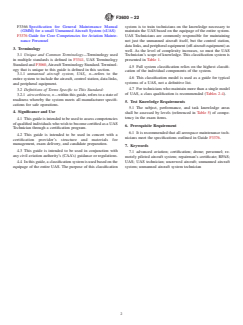
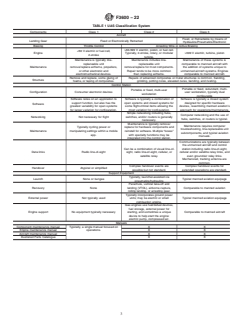
4.4 In this guide, a classification system is used based on the equipage of the entire UAS. The purpose of this classification system is to train technicians on the knowledge necessary to maintain the UAS based on the equipage of the entire system. UAS Technicians are commonly responsible for maintaining not just the unmanned aircraft itself, but the control station, data links, and peripheral equipment (off-aircraft equipment) as well. As the level of complexity increases, so must the UAS Technician’s scope of knowledge. This classification system is presented in Table 1.
4.5 Full system classification relies on the highest classification of the individual components of the system.
4.6 This classification model is used as a guide for typical systems of a UAS, not a definitive list.
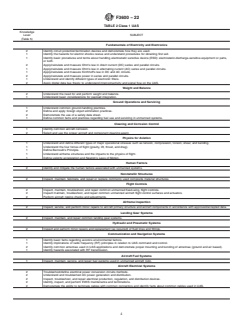
4.7 For technicians who maintain more than a single model of UAS, a class qualification is recommended (Tables 2-4).
SCOPE
1.1 The purpose of this guide is to address the fundamental subject knowledge, task performance, and task knowledge activities and functions for unmanned aircraft system professionals to be titled unmanned aircraft system technician.
1.2 Technician qualifications include:
1.2.1 Type ratings on specific systems or families of systems can draw appropriate technical content from this guide, as needed, to be applicable to specific models;
1.2.2 The minimum knowledge, skills, and abilities to perform maintenance on Class 1 UAS;
1.2.3 The minimum knowledge, skills, and abilities to perform maintenance on Class 2 UAS; and
1.2.4 The minimum knowledge, skills, and abilities to perform maintenance on Class 3 UAS.
1.3 Units—The values stated in SI units are to be regarded as standard. No other units of measurement are included in this standard.
1.4 This standard does not purport to address all of the safety concerns, if any, associated with its use. It is the responsibility of the user of this standard to establish appropriate safety, health, and environmental practices and determine the applicability of regulatory limitations prior to use.
1.5 This international standard was developed in accordance with internationally recognized principles on standardization established in the Decision on Principles for the Development of International Standards, Guides and Recommendations issued by the World Trade Organization Technical Barriers to Trade (TBT) Committee.
- Status
- Published
- Publication Date
- 30-Nov-2022
- Technical Committee
- F46 - Aerospace Personnel
- Drafting Committee
- F46.06 - Autonomous and Electric Aircraft Maintenance Personnel
Overview
ASTM F3600-22: Standard Guide for Unmanned Aircraft System (UAS) Maintenance Technician Qualification is an international standard developed by ASTM to support competency-based qualification and certification of maintenance technicians who work with unmanned aircraft systems. This guide outlines foundational knowledge, skills, and abilities (KSAs) required by UAS technicians, covering a wide range of UAS models and system complexities. The guide is structured to benefit UAS manufacturers, operators, regulators, and training organizations in developing education programs and assessment methods for technician certification.
Key Topics
Competency-Based Assessment
- The standard provides a framework for evaluating the subject knowledge, task performance, and functional skills necessary to qualify as a UAS Maintenance Technician.
- It supports certification programs tailored to unmanned aircraft maintenance.
Integration with Regulatory Guidance
- This guideline is compatible with civil aviation authority (CAA) requirements and can be used alongside national and international regulatory materials.
UAS System Classification
- UAS are classified into three classes (Class 1, 2, and 3) according to system complexity, technical equipage, and the maintenance technician’s required scope of knowledge.
- Full system classification depends on the most complex component within the UAS.
Knowledge and Task Levels
- The guide defines three levels of educational requirements: familiarity, general knowledge with application, and detailed theoretical and practical understanding.
- Subjects span from fundamentals of electricity and electronics, aircraft and engine systems, physics for aviation, human factors, cybersecurity, flight controls, propulsion systems, airframe inspection, to information technology.
Comprehensive Maintenance Coverage
- UAS technicians are expected to maintain the entire system, not just the aircraft itself, including ground control stations, data links, and peripheral equipment.
Emphasis on Safety and Best Practice
- The standard encourages appropriate safety, health, and environmental practices and aligns with globally recognized standardization principles, supporting cross-border acceptance.
Applications
UAS Technician Certification
- Serves as a primary reference for organizations and regulatory bodies developing or implementing qualification and certification programs for unmanned aircraft system maintenance personnel.
Training Program Development
- Used by educational institutions and UAS operators to design course curricula and training materials that meet industry and regulatory standards for technician proficiency.
Manufacturer and Operator Reference
- Enables UAS manufacturers and operators to align maintenance technician role requirements and training content to recognized international standards.
Support for Regulators
- Provides a harmonized approach for national and international regulators to assess and recognize UAS maintenance credentials.
Industry Standardization
- Promotes consistency in maintenance practices, supporting reliability, safety, and operational efficiency across diverse unmanned aircraft platforms and applications.
Related Standards
- ASTM F2909 - Specification for Continued Airworthiness of Lightweight Unmanned Aircraft Systems
- ASTM F3060 - Terminology for Aircraft
- ASTM F3341 - Terminology for Unmanned Aircraft Systems
- ASTM F3366 - Specification for General Maintenance Manual for a Small Unmanned Aircraft System
- ASTM F3376 - Guide for Core Competencies for Aviation Maintenance Personnel
- 14 CFR Part 43 - Maintenance, Preventive Maintenance, Rebuilding, and Alteration (US regulation)
- 14 CFR Part 65 - Certification: Airmen Other Than Flight Crewmembers
- 14 CFR Part 147 - Aviation Maintenance Technician Schools
- EASA Part 66 B1/B2 - European aircraft maintenance licensing standard
- NCATT UAS Maintenance Standard - National Center for Aerospace & Transportation Technologies standard for UAS maintenance
By leveraging ASTM F3600-22, the unmanned aircraft industry can ensure UAS technician qualifications are consistent, robust, and globally recognized, supporting workforce mobility and operational safety in the rapidly evolving field of drone maintenance.
Relations
- Effective Date
- 01-Jan-2020
- Effective Date
- 01-Sep-2019
- Effective Date
- 01-May-2019
- Effective Date
- 01-Apr-2019
- Effective Date
- 01-Nov-2016
- Effective Date
- 01-Apr-2016
- Effective Date
- 15-Sep-2015
- Effective Date
- 01-May-2015
- Effective Date
- 01-Mar-2015
- Effective Date
- 01-Dec-2014
- Effective Date
- 15-Jan-2014
Get Certified
Connect with accredited certification bodies for this standard

BSI Group
BSI (British Standards Institution) is the business standards company that helps organizations make excellence a habit.

Bureau Veritas
Bureau Veritas is a world leader in laboratory testing, inspection and certification services.

DNV
DNV is an independent assurance and risk management provider.
Sponsored listings
Frequently Asked Questions
ASTM F3600-22 is a guide published by ASTM International. Its full title is "Standard Guide for Unmanned Aircraft System (UAS) Maintenance Technician Qualification". This standard covers: SIGNIFICANCE AND USE 4.1 This guide is intended to be used to assess competencies of qualified individuals who wish to become certified as a UAS Technician through a certification program. 4.2 This guide is intended to be used in concert with a certification provider’s structure and materials for management, exam delivery, and candidate preparation. 4.3 This guide is intended to be used in conjunction with any civil aviation authority’s (CAA’s) guidance or regulations. 4.4 In this guide, a classification system is used based on the equipage of the entire UAS. The purpose of this classification system is to train technicians on the knowledge necessary to maintain the UAS based on the equipage of the entire system. UAS Technicians are commonly responsible for maintaining not just the unmanned aircraft itself, but the control station, data links, and peripheral equipment (off-aircraft equipment) as well. As the level of complexity increases, so must the UAS Technician’s scope of knowledge. This classification system is presented in Table 1. 4.5 Full system classification relies on the highest classification of the individual components of the system. 4.6 This classification model is used as a guide for typical systems of a UAS, not a definitive list. 4.7 For technicians who maintain more than a single model of UAS, a class qualification is recommended (Tables 2-4). SCOPE 1.1 The purpose of this guide is to address the fundamental subject knowledge, task performance, and task knowledge activities and functions for unmanned aircraft system professionals to be titled unmanned aircraft system technician. 1.2 Technician qualifications include: 1.2.1 Type ratings on specific systems or families of systems can draw appropriate technical content from this guide, as needed, to be applicable to specific models; 1.2.2 The minimum knowledge, skills, and abilities to perform maintenance on Class 1 UAS; 1.2.3 The minimum knowledge, skills, and abilities to perform maintenance on Class 2 UAS; and 1.2.4 The minimum knowledge, skills, and abilities to perform maintenance on Class 3 UAS. 1.3 Units—The values stated in SI units are to be regarded as standard. No other units of measurement are included in this standard. 1.4 This standard does not purport to address all of the safety concerns, if any, associated with its use. It is the responsibility of the user of this standard to establish appropriate safety, health, and environmental practices and determine the applicability of regulatory limitations prior to use. 1.5 This international standard was developed in accordance with internationally recognized principles on standardization established in the Decision on Principles for the Development of International Standards, Guides and Recommendations issued by the World Trade Organization Technical Barriers to Trade (TBT) Committee.
SIGNIFICANCE AND USE 4.1 This guide is intended to be used to assess competencies of qualified individuals who wish to become certified as a UAS Technician through a certification program. 4.2 This guide is intended to be used in concert with a certification provider’s structure and materials for management, exam delivery, and candidate preparation. 4.3 This guide is intended to be used in conjunction with any civil aviation authority’s (CAA’s) guidance or regulations. 4.4 In this guide, a classification system is used based on the equipage of the entire UAS. The purpose of this classification system is to train technicians on the knowledge necessary to maintain the UAS based on the equipage of the entire system. UAS Technicians are commonly responsible for maintaining not just the unmanned aircraft itself, but the control station, data links, and peripheral equipment (off-aircraft equipment) as well. As the level of complexity increases, so must the UAS Technician’s scope of knowledge. This classification system is presented in Table 1. 4.5 Full system classification relies on the highest classification of the individual components of the system. 4.6 This classification model is used as a guide for typical systems of a UAS, not a definitive list. 4.7 For technicians who maintain more than a single model of UAS, a class qualification is recommended (Tables 2-4). SCOPE 1.1 The purpose of this guide is to address the fundamental subject knowledge, task performance, and task knowledge activities and functions for unmanned aircraft system professionals to be titled unmanned aircraft system technician. 1.2 Technician qualifications include: 1.2.1 Type ratings on specific systems or families of systems can draw appropriate technical content from this guide, as needed, to be applicable to specific models; 1.2.2 The minimum knowledge, skills, and abilities to perform maintenance on Class 1 UAS; 1.2.3 The minimum knowledge, skills, and abilities to perform maintenance on Class 2 UAS; and 1.2.4 The minimum knowledge, skills, and abilities to perform maintenance on Class 3 UAS. 1.3 Units—The values stated in SI units are to be regarded as standard. No other units of measurement are included in this standard. 1.4 This standard does not purport to address all of the safety concerns, if any, associated with its use. It is the responsibility of the user of this standard to establish appropriate safety, health, and environmental practices and determine the applicability of regulatory limitations prior to use. 1.5 This international standard was developed in accordance with internationally recognized principles on standardization established in the Decision on Principles for the Development of International Standards, Guides and Recommendations issued by the World Trade Organization Technical Barriers to Trade (TBT) Committee.
ASTM F3600-22 is classified under the following ICS (International Classification for Standards) categories: 03.100.30 - Management of human resources; 49.020 - Aircraft and space vehicles in general. The ICS classification helps identify the subject area and facilitates finding related standards.
ASTM F3600-22 has the following relationships with other standards: It is inter standard links to ASTM F3060-20, ASTM F2909-19, ASTM F3366-19, ASTM F3376-19, ASTM F3060-16a, ASTM F3060-16, ASTM F3060-15b, ASTM F3060-15a, ASTM F3060-15, ASTM F3060-14, ASTM F2909-14. Understanding these relationships helps ensure you are using the most current and applicable version of the standard.
ASTM F3600-22 is available in PDF format for immediate download after purchase. The document can be added to your cart and obtained through the secure checkout process. Digital delivery ensures instant access to the complete standard document.
Standards Content (Sample)
This international standard was developed in accordance with internationally recognized principles on standardization established in the Decision on Principles for the
Development of International Standards, Guides and Recommendations issued by the World Trade Organization Technical Barriers to Trade (TBT) Committee.
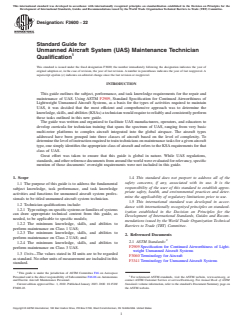
Designation:F3600 −22
Standard Guide for
Unmanned Aircraft System (UAS) Maintenance Technician
Qualification
This standard is issued under the fixed designation F3600; the number immediately following the designation indicates the year of
original adoption or, in the case of revision, the year of last revision. A number in parentheses indicates the year of last reapproval. A
superscript epsilon (´) indicates an editorial change since the last revision or reapproval.
INTRODUCTION
This guide outlines the subject, performance, and task knowledge requirements for the repair and
maintenance of UAS. Using ASTM F2909, Standard Specification for Continued Airworthiness of
Lightweight Unmanned Aircraft Systems, as a basis for the types of activities required to maintain
UAS, it was decided that the most efficient and comprehensive approach was to determine the
knowledge,skills,andabilities(KSAs)atechnicianwouldrequiretoreliablyandconsistentlyperform
these tasks outlined in this new guide.
The guide was written and organized to facilitate UAS manufacturers, operators, and educators to
develop curricula for technician training that spans the spectrum of UAS, ranging from very basic
multi-rotor platforms to complex aircraft integrated into the global airspace. The aircraft types
addressed have been grouped into three classes of aircraft based on the level of complexity. To
determinethelevelofinstructionrequiredtotraintechniciansonmaintenancetasksforagivenaircraft
type, one simply identifies the appropriate class of aircraft and refers to the KSArequirements for that
class of UAS.
Great effort was taken to ensure that this guide is global in nature. While UAS regulations,
standards,andotherreferencedocumentsfromaroundtheworldwereevaluatedforrelevancy,specific
mention of those documents’ oversight requirements were not included in this guide.
1. Scope 1.4 This standard does not purport to address all of the
safety concerns, if any, associated with its use. It is the
1.1 The purpose of this guide is to address the fundamental
responsibility of the user of this standard to establish appro-
subject knowledge, task performance, and task knowledge
priate safety, health, and environmental practices and deter-
activities and functions for unmanned aircraft system profes-
mine the applicability of regulatory limitations prior to use.
sionals to be titled unmanned aircraft system technician.
1.5 This international standard was developed in accor-
1.2 Technician qualifications include:
dance with internationally recognized principles on standard-
1.2.1 Typeratingsonspecificsystemsorfamiliesofsystems
ization established in the Decision on Principles for the
can draw appropriate technical content from this guide, as
Development of International Standards, Guides and Recom-
needed, to be applicable to specific models;
mendations issued by the World Trade Organization Technical
1.2.2 The minimum knowledge, skills, and abilities to
Barriers to Trade (TBT) Committee.
perform maintenance on Class 1 UAS;
1.2.3 The minimum knowledge, skills, and abilities to
2. Referenced Documents
perform maintenance on Class 2 UAS; and
2.1 ASTM Standards:
1.2.4 The minimum knowledge, skills, and abilities to
F2909 Specification for Continued Airworthiness of Light-
perform maintenance on Class 3 UAS.
weight Unmanned Aircraft Systems
1.3 Units—The values stated in SI units are to be regarded
F3060 Terminology for Aircraft
as standard. No other units of measurement are included in this
F3341 Terminology for Unmanned Aircraft Systems
standard.
This guide is under the jurisdiction of ASTM Committee F46 on Aerospace
Personnel and is the direct responsibility of Subcommittee F46.06 on Autonomous For referenced ASTM standards, visit the ASTM website, www.astm.org, or
and Electric Aircraft Maintenance Personnel. contact ASTM Customer Service at service@astm.org. For Annual Book of ASTM
Current edition approved Dec. 1, 2022. Published January 2023. DOI: 10.1520/ Standards volume information, refer to the standard’s Document Summary page on
F3600-22. the ASTM website.
Copyright © ASTM International, 100 Barr Harbor Drive, PO Box C700, West Conshohocken, PA 19428-2959. United States
F3600−22
F3366 Specification for General Maintenance Manual system is to train technicians on the knowledge necessary to
(GMM) for a small Unmanned Aircraft System (sUAS) maintain the UAS based on the equipage of the entire system.
F3376 Guide for Core Competencies for Aviation Mainte- UAS Technicians are commonly responsible for maintaining
nance Personnel not just the unmanned aircraft itself, but the control station,
datalinks,andperipheralequipment(off-aircraftequipment)as
3. Terminology
well. As the level of complexity increases, so must the UAS
3.1 Unique and Common Terminology—Terminology used Technician’s scope of knowledge. This classification system is
in multiple standards is defined in F3341, UAS Terminology
presented in Table 1.
StandardandF3060,AircraftTerminologyStandard.Terminol-
4.5 Full system classification relies on the highest classifi-
ogy that is unique to this guide is defined in this section.
cation of the individual components of the system.
3.1.1 unmanned aircraft system, UAS,, n—refers to the
4.6 This classification model is used as a guide for typical
entire system to include the aircraft, control station, data links,
systems of a UAS, not a definitive list.
and peripheral equipment.
4.7 For technicians who maintain more than a single model
3.2 Definitions of Terms Specific to This Standard:
of UAS, a class qualification is recommended (Tables 2-4).
3.2.1 airworthiness, n—within this guide, refers to a state of
readiness whereby the system meets all manufacturer specifi-
5. Test Knowledge Requirements
cations for safe operations.
5.1 The subject, performance, and task knowledge areas
4. Significance and Use
shall be assessed by levels (referenced in Table 5) of compe-
tency in the exam items.
4.1 This guide is intended to be used to assess competencies
of qualified individuals who wish to become certified as a UAS
6. Prerequisite Requirement
Technician through a certification program.
6.1 It is recommended that all aerospace maintenance tech-
4.2 This guide is intended to be used in concert with a
nicians meet the specifications outlined in Guide F3376.
certification provider’s structure and materials for
management, exam delivery, and candidate preparation.
7. Keywords
4.3 This guide is intended to be used in conjunction with
7.1 advanced aviation; certification; drone; personnel; re-
any civil aviation authority’s (CAA’s) guidance or regulations.
motely piloted aircraft system; repairman’s certificate; RPAS;
4.4 Inthisguide,aclassificationsystemisusedbasedonthe UAS; UAS technician; uncrewed aircraft; unmanned aircraft
equipage of the entire UAS. The purpose of this classification system; unmanned aircraft system technician
F3600−22
TABLE 1 UAS Classification System
Components Class 1 Class 2 Class 3
Aircraft
Fixed, or Retractable by means of
Landing Gear Fixed or Electronically Retracted
Hydraulics/Pneumatics/Electronic
Braking Throttle Control Arresting Wire or Active Braking
>60-599 V electric, piston, or fuel cell.
<60 V electric or fuel cell,
Engine Typically, 2-stroke, rotary, or modular >599 V electric, turbine, piston
2-stroke
turbine.
Maintenance is typically line- Maintenance includes line- Maintenance of these systems is
replaceable unit replaceable unit comparable to manned aircraft with
Maintenance remove/replace airframe, propellers, remove/replace for most components. the addition of systems unique to
or other electronic and Repair tends to be more common unmanned aircraft systems. Engines
electromechanical devices. than replacing airframe. comparable to manned aircraft.
Remove and replace, some gluing of Repairs of advanced composites or metal structures is common. Sanding,
Structure
foams, or taping of composites. grinding, potting cores, elevated cures, bending, and riveting.
Control Station
Portable or fixed, redundant, multi-
Portable or fixed, multi-user
Configuration Consumer electronic devices user workstation, typically dual
workstation
configurable
Software relies on an application to Software is typically a combination of Software is typically a closed system
support function, but also has the open systems and closed systems for designed for specific hardware
Software
greatest variability for open systems some flight-critical items allowing the devices, resembling manned aviation’s
for larger variation for configuration. most variation for configuration. approach for operations/maintenance.
Simple networking including hubs,
Computer networking and the use of
Networking Not necessary for flight switches, and/or routers is generally
hubs, switches, or routers is typical.
necessary.
Maintenance is typically remove/
Maintenance requires computer
Typically cycling power or replace for hardware components and
troubleshooting, line-replaceable unit
Maintenance manipulating settings within a mobile reinstall for software. Multiple “boxes”
subcomponents, and typical aviation
app. with specialty functions may be
manuals.
integrated into the control station.
Communications are typically between
the unmanned aircraft and control
Can be a combination of visual line-of- station including radio line-of-sight,
Data links Radio line-of-sight sight, radio line-of-sight, cellular, or cellular and/or satellite relay links, and
satellite relay. even ground/air relay links.
Mechanized, tracking antenna are
common.
Complex handover events are Complex handover events for
Handover Atypical or simplified
possible but not standard. extended operations are standard.
Support Equipment
Typically, launcher-assisted via
Launch None or bungee Typical manned aviation equipage
pneumatics/hydraulics
Parachute, vertical take-off and
Recovery None landing (VTOL), airborne capture, Comparable to manned aviation
rolling landing, or arresting gear.
Typically incorporates ground power
External power Not typically used units; may be electric or small Typical manned aviation equipage
combustion engine.
Gas engines use fuel/defuel devices,
fuel storage, external power for
Engine support No equipment typically necessary starting, and sometimes a unique Comparable to manned aircraft
device to help start the engine:
electric pump, compressed air.
Manuals
Component maintenance manual Typically, a single manual focused on XX
Engine maintenance manual operations. X X
Aircraft maintenance manual X X
Illustrated Parts Catalogue X X
F3600−22
TABLE 2 Class 1 UAS
Knowledge
Level SUBJECT
(Table 5)
Fundamentals of Electricity and Electronics
2 Identify circuit protection/termination devices and demonstrate how they are used.
1 Identify the hazards for electric shocks rescue and understand procedures for obtaining first aid.
1 Identify basic procedures and terms about handling electrostatic sensitive device (ESD): electrostatic-discharge-sensitive equipment or parts,
or both.
2 Apply/calculate and measure Ohm’s law in direct current (DC) series and parallel circuits.
1 Apply/calculate and measure Ohm’s law in alternating current (AC) series and parallel circuits.
1 Apply/calculate and measure Kirchhoff’s law in DC and AC circuits.
2 Apply/calculate and measure power in series and parallel circuits.
1 Understand and identify different types of electronic filters.
2 Apply digital data bus theory to understand interconnectivity and signal flow on the UAS.
Weight and Balance
2 Understand the need for and perform weight and balance.
1 Understand basic considerations for payload integration.
Ground Operations and Servicing
1 Understand common ground-handling practices.
2 Define and apply foreign object elimination practices.
2 Demonstrate the use of a safety data sheet.
1 Define common facts and practices regarding fuel use and servicing in unmanned systems.
Cleaning and Corrosion Control
1 Identify common aircraft corrosion.
2 Select and use the proper aircraft and component cleaning agent.
Physics for Aviation
1 Understand and define different types of major operational stresses such as tension, compression, torsion, shear, and bending.
1 Understand the four forces of flight (gravity, lift, thrust, and drag).
1 Define Bernoulli’s Principle.
1 Understand airframe structures and the impacts to the physics of flight.
1 Define velocity acceleration and Newton’s Laws of Motion.
Human Factors
2 Identify and mitigate the human factors associated with unmanned systems.
Nonmetallic Structures
2 Inspect, maintain, fabricate, and repair or replace commonly used composite material structures.
Flight Controls
2 Inspect, maintain, troubleshoot, and repair common unmanned fixed-wing, flight controls.
2 Inspect maintain, troubleshoot, and repair common unmanned aircraft flight control surfaces and actuators.
2 Perform aircraft rigging checks and adjustments.
Airframe Inspection
2 Inspect, service, and perform minor repairs to aircraft primary structure and aircraft components in accordance with approved/accepted data.
Landing Gear Systems
2 Inspect, maintain, and repair common landing gear systems.
Hydraulic and Pneumatic Systems
2 Inspect and perform minor repairs and replacement (as required) of fluid lines and fittings.
Communication and Navigation Systems
1 Identify basic facts regarding avionics environmental factors.
1 Identify implications of radio frequency (RF) principles in relation to UAS command and control.
2 Identify common antennae used in UAS applications and demonstrate proper mounting and bonding of antennae (ground and air based).
1 Identify hazards associated with RF transmission.
Aircraft Fuel Systems
1 Inspect, maintain, service, and repair fuel systems used in unmanned aircraft (UA).
Aircraft Electrical Systems
2 Troubleshoot/define electrical power conversion circuits methods.
2 Understand and troubleshoot AC power generation and distribution.
2 Inspect, troubleshoot, and repair electrical production, regulation, and distribution devices.
2 Identify, inspect, and perform EWIS maintenance and terminations.
2 Demonstrate the ability to terminate cables with common connectors and identify facts about common cables used in UAS.
F3600−22
TABLE2 Continued
Knowledge
Level SUBJECT
(Table 5)
Rotorcraft Fundamentals
2 Inspect, maintain, troubleshoot, and repair common unmanned rotary wing, aircraft components.
2 Inspect, maintain, troubleshoot, and repair common, unmanned rotary wing, flight controls.
2 Inspect, maintain, troubleshoot, and repair common unmanned rotor systems.
Powerplant Theory and Maintenance
2 Inspect, maintain, troubleshoot, and repair common unmanned aircraft propulsion systems.
2 Inspection, installation, and removal of engine and accessories.
2 Inspection and troubleshooting of aircraft engine and engine instrumentation and ignition systems.
2 Inspect, maintain, troubleshoot, and repair common unmanned propellers.
Command and Control
1 Describe different types of control station (CS) configurations and capabilities.
1 Understand CS airworthiness criteria.
1 Describe UAS flight management systems and modes of operation to include autonomous and semi-autonomous.
Data Links
1 Understand the interdependent relationship between the control station, datalink station, and aircraft.
UAS General Maintenance Actions
1 Understand the principles of UAS assembly and disassembly.
2 Inspect, maintain, troubleshoot, and repair common unmanned aircraft components.
2 Understand and apply fault isolation techniques/aircraft and ground control units.
1 Understand importance of systems check/aircraft and ground control unit.
1 Understand troubleshooting system basics and using approved procedures.
1 Understand and compare different launch and recovery systems.
1 Identify common principles of preflight and function checks for UAS.
2 Identify hazards and demonstrate basic safety practices related to the maintenance and operation of UAS.
1 Identify hazards associated with laser systems.
1 Identify sources of hazardous noise to the crew and public.
1 Identify methods used to mitigate hazardous noise.
1 Identify hazards associated with ballistic parachute systems.
2 Use industry standard test equipment (continuity tester, digital multimeter, and so forth).
Fundamentals of Information Technology
1 Define and Identify computer and networking fundamentals.
1 Describe cryptology applications.
1 Understand basic concepts of cyber security.
F3600−22
TABLE 3 Class 2 UAS
Knowledge
SUBJECT
Level
Fundamentals of Electricity and Electronics
2 Identify circuit protection/termination devices and demonstrate how they are used.
1 Identify the hazards for electric shocks rescue and understand procedures for obtaining first aid.
1 Identify basic procedures and terms about handling ESD: electrostatic-discharge-sensitive equipment or parts, or both.
2 Apply/calculate and measure Ohm’s law in DC series and parallel circuits.
2 Apply/calculate and measure Ohm’s law in AC series and parallel circuits.
2 Apply/calculate and measure Kirchhoff’s law in DC and AC circuits.
2 Apply/calculate and measure power in series and parallel circuits.
1 Understand and identify analog circuit and devices.
1 Understand and identify different types of power supply circuits.
1 Understand power supply circuits in relation to overall system operation.
1 Understand and identify different types of electronic filters.
1 Identify the purpose and application of oscillators.
1 Identify and understand wave-shaping circuits.
2 Identify, understand, and test analog solid-state devices.
1 Understand different types of digital numbering systems.
1 Understand, identify, and analyze different types of digital logic gates.
2 Apply digital data bus theory to understand interconnectivity and si
...