

ASTM F3376-19
(Guide)Standard Guide for Core Competencies for Aviation Maintenance Personnel
General Information
- Abstract
SIGNIFICANCE AND USE
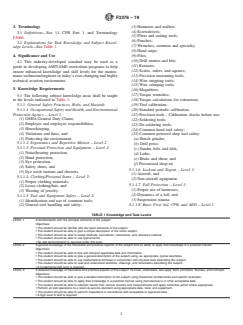
4.1 This industry-developed standard may be used as a guide in developing AMT/AME curriculum programs to help ensure enhanced knowledge and skill levels for the maintenance technician/engineer in today’s ever-changing and highly technical aviation environment.
SCOPE
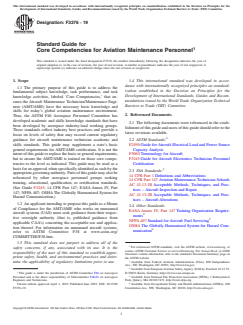
1.1 The primary purpose of this guide is to address the fundamental subject knowledge, task performance, and task knowledge activities, labeled ‘Core Competencies,’ that ensures the Aircraft Maintenance Technician/Maintenance Engineer (AMT/AME) have the necessary basic knowledge and skills for today’s global aviation maintenance environment. Thus, the ASTM F46 Aerospace Personnel Committee has developed academic and skills knowledge standards that have been developed by aerospace industry-lead working groups. These standards reflect industry best practices and provide a focus on levels of safety that may exceed current regulatory guidance for aircraft maintenance technician academic and skills standards. This guide may supplement a state’s basic general requirements for AMT/AME certification. It is not the intent of this guide to replace the basic or general requirements, but to ensure the AMT/AME is trained on these core competencies to the level as indicated. This guide may be used as a basis for an approval when specifically identified as such by the appropriate governing authority. Parts of this guide may also be referenced by other aerospace personnel groups seeking training, educational, qualification, or certification standards. (See Guide F3245; 14 CFR Part 147; EASA Annex IV, Part 147; NFPA 407; OSHA The Globally Harmonized System for Hazard Communication.)
1.2 An applicant intending to propose this guide as a Means of Compliance for the AMT/AME who works on unmanned aircraft systems (UAS) must seek guidance from their respective oversight authority (that is, published guidance from applicable CAA’s) concerting the acceptable use and application thereof. For information on unmanned aircraft systems, refer to ASTM Committee F38 at www.astm.org/COMMITTEE/F38.htm.
1.3 This standard does not purport to address all of the safety concerns, if any, associated with its use. It is the responsibility of the user of this standard to establish appropriate safety, health, and environmental practices and determine the applicability of regulatory limitations prior to use.
1.4 This international standard was developed in accordance with internationally recognized principles on standardization established in the Decision on Principles for the Development of International Standards, Guides and Recommendations issued by the World Trade Organization Technical Barriers to Trade (TBT) Committee.
- Status
- Published
- Publication Date
- 31-Mar-2019
- Technical Committee
- F46 - Aerospace Personnel
- Drafting Committee
- F46.01 - Aerospace Engineers and Technicians
Overview
ASTM F3376-19: Standard Guide for Core Competencies for Aviation Maintenance Personnel is a key international standard developed by ASTM for the global aviation maintenance community. This guide defines the essential subject knowledge, task performance, and skill requirements-referred to as "core competencies"-that Aircraft Maintenance Technicians and Maintenance Engineers (AMT/AME) must possess to operate effectively in a complex and evolving aviation environment. Developed by the ASTM F46 Aerospace Personnel Committee and reflecting industry best practices, this standard is intended to supplement, not replace, national certification or regulatory requirements and can serve as a foundation for curriculum development and personnel qualification in aviation maintenance.
Key Topics
ASTM F3376-19 addresses several core subject areas and practical skills critical to aviation maintenance personnel, including:
- General Safety Practices: Emphasis on occupational health, environment protection, ergonomic hazards, and personal protective equipment.
- Tool and Equipment Safety: Identification, correct use, and calibration of common and specialized aviation tools.
- Chemical Handling and Hazard Communication: Knowledge of hazardous materials, proper chemical handling, spill response, and globally harmonized system labeling.
- Human Factors in Aviation Maintenance: Understanding the impact of ethics, fatigue, error management, and safety systems.
- Aircraft Handling and Line Safety: Safe procedures for working with aircraft-covering fueling, towing, maintenance on the ramp, and use of hand signals.
- Technical Documentation: Familiarity with maintenance manuals, regulatory documentation, service bulletins, and technical drawings.
- Aviation Regulations and Certification: Awareness of international and national maintenance regulations, certification standards, and airworthiness directives.
- Aircraft Structures and Systems: Basic knowledge of aircraft structures, flight controls, corrosion control, and hardware identification.
- Non-Destructive Testing and Troubleshooting: Fundamental principles in inspection techniques and systematic problem-solving for aircraft systems.
- Emerging Technologies: Addressing competencies related to digital devices, composite materials, and additive manufacturing.
Each competency is mapped to a progressive knowledge level, from basic awareness to detailed technical expertise requiring hands-on proficiency.
Applications
This standard offers significant practical value for a wide spectrum of aviation stakeholders:
- Aviation Training Academies and Schools: Provides a reliable framework for developing AMT/AME training curricula, ensuring comprehensive coverage of fundamental competencies and practical skills needed for contemporary aviation maintenance environments.
- Regulators and Certification Authorities: Serves as supplemental guidance for evaluating training programs, or as a basis for approval when incorporated by reference.
- Aerospace Employers: Assists in defining recruitment criteria, workforce development, and in identifying additional training needs to maintain compliance with best industry practices and above-minimum regulatory safety standards.
- Maintenance, Repair, and Overhaul (MRO) Organizations: Supplies a benchmark for internal skills audits, employee qualification, and continuous improvement programs.
- Unmanned Aircraft System (UAS) Maintenance: While focused on manned aircraft maintenance, the guide may also inform UAS maintenance personnel training with the consultation of appropriate oversight authorities.
- Other Aerospace Personnel Groups: Can be referenced to establish training and qualification programs for related technical aerospace roles.
Related Standards
ASTM F3376-19 connects with several other industry standards and regulatory references, including:
- ASTM F3245: Guide for Aircraft Electronics Technician Personnel Certification
- ASTM F2490: Guide for Aircraft Electrical Load and Power Source Capacity Analysis
- ASTM F3060: Terminology for Aircraft
- 14 CFR Part 147: U.S. FAA regulations for Aviation Maintenance Technician Schools
- EASA Annex IV, Part 147: European training organization requirements
- NFPA 407: Standard for Aircraft Fuel Servicing
- OSHA Globally Harmonized System (GHS): For hazard communication and chemical labeling
Adhering to internationally recognized principles, ASTM F3376-19 supports enhanced aviation safety, regulatory compliance, and harmonization of maintenance training standards across jurisdictions.
Keywords: aviation maintenance personnel, core competencies, AMT/AME training, aviation safety, ASTM F3376-19, aircraft maintenance certification, aerospace standards, curriculum development, regulatory compliance, MRO.
Relations
- Effective Date
- 01-Jan-2020
- Effective Date
- 01-Apr-2019
- Effective Date
- 01-Mar-2017
- Effective Date
- 01-Nov-2016
- Effective Date
- 01-Apr-2016
- Effective Date
- 15-Sep-2015
- Effective Date
- 01-May-2015
- Effective Date
- 01-Mar-2015
- Effective Date
- 01-Dec-2014
- Refers
ASTM F2490-05(2013) - Standard Guide for Aircraft Electrical Load and Power Source Capacity Analysis - Effective Date
- 01-Jul-2013
- Refers
ASTM F2490-05e1 - Standard Guide for Aircraft Electrical Load and Power Source Capacity Analysis - Effective Date
- 01-Oct-2005
- Refers
ASTM F2490-05 - Standard Guide for Aircraft Electrical Load and Power Source Capacity Analysis - Effective Date
- 01-Oct-2005
- Effective Date
- 01-Apr-2019
- Effective Date
- 01-Apr-2019
- Effective Date
- 01-Apr-2019
Get Certified
Connect with accredited certification bodies for this standard

BSI Group
BSI (British Standards Institution) is the business standards company that helps organizations make excellence a habit.

Bureau Veritas
Bureau Veritas is a world leader in laboratory testing, inspection and certification services.

DNV
DNV is an independent assurance and risk management provider.
Sponsored listings
Frequently Asked Questions
ASTM F3376-19 is a guide published by ASTM International. Its full title is "Standard Guide for Core Competencies for Aviation Maintenance Personnel". This standard covers: SIGNIFICANCE AND USE 4.1 This industry-developed standard may be used as a guide in developing AMT/AME curriculum programs to help ensure enhanced knowledge and skill levels for the maintenance technician/engineer in today’s ever-changing and highly technical aviation environment. SCOPE 1.1 The primary purpose of this guide is to address the fundamental subject knowledge, task performance, and task knowledge activities, labeled ‘Core Competencies,’ that ensures the Aircraft Maintenance Technician/Maintenance Engineer (AMT/AME) have the necessary basic knowledge and skills for today’s global aviation maintenance environment. Thus, the ASTM F46 Aerospace Personnel Committee has developed academic and skills knowledge standards that have been developed by aerospace industry-lead working groups. These standards reflect industry best practices and provide a focus on levels of safety that may exceed current regulatory guidance for aircraft maintenance technician academic and skills standards. This guide may supplement a state’s basic general requirements for AMT/AME certification. It is not the intent of this guide to replace the basic or general requirements, but to ensure the AMT/AME is trained on these core competencies to the level as indicated. This guide may be used as a basis for an approval when specifically identified as such by the appropriate governing authority. Parts of this guide may also be referenced by other aerospace personnel groups seeking training, educational, qualification, or certification standards. (See Guide F3245; 14 CFR Part 147; EASA Annex IV, Part 147; NFPA 407; OSHA The Globally Harmonized System for Hazard Communication.) 1.2 An applicant intending to propose this guide as a Means of Compliance for the AMT/AME who works on unmanned aircraft systems (UAS) must seek guidance from their respective oversight authority (that is, published guidance from applicable CAA’s) concerting the acceptable use and application thereof. For information on unmanned aircraft systems, refer to ASTM Committee F38 at www.astm.org/COMMITTEE/F38.htm. 1.3 This standard does not purport to address all of the safety concerns, if any, associated with its use. It is the responsibility of the user of this standard to establish appropriate safety, health, and environmental practices and determine the applicability of regulatory limitations prior to use. 1.4 This international standard was developed in accordance with internationally recognized principles on standardization established in the Decision on Principles for the Development of International Standards, Guides and Recommendations issued by the World Trade Organization Technical Barriers to Trade (TBT) Committee.
SIGNIFICANCE AND USE 4.1 This industry-developed standard may be used as a guide in developing AMT/AME curriculum programs to help ensure enhanced knowledge and skill levels for the maintenance technician/engineer in today’s ever-changing and highly technical aviation environment. SCOPE 1.1 The primary purpose of this guide is to address the fundamental subject knowledge, task performance, and task knowledge activities, labeled ‘Core Competencies,’ that ensures the Aircraft Maintenance Technician/Maintenance Engineer (AMT/AME) have the necessary basic knowledge and skills for today’s global aviation maintenance environment. Thus, the ASTM F46 Aerospace Personnel Committee has developed academic and skills knowledge standards that have been developed by aerospace industry-lead working groups. These standards reflect industry best practices and provide a focus on levels of safety that may exceed current regulatory guidance for aircraft maintenance technician academic and skills standards. This guide may supplement a state’s basic general requirements for AMT/AME certification. It is not the intent of this guide to replace the basic or general requirements, but to ensure the AMT/AME is trained on these core competencies to the level as indicated. This guide may be used as a basis for an approval when specifically identified as such by the appropriate governing authority. Parts of this guide may also be referenced by other aerospace personnel groups seeking training, educational, qualification, or certification standards. (See Guide F3245; 14 CFR Part 147; EASA Annex IV, Part 147; NFPA 407; OSHA The Globally Harmonized System for Hazard Communication.) 1.2 An applicant intending to propose this guide as a Means of Compliance for the AMT/AME who works on unmanned aircraft systems (UAS) must seek guidance from their respective oversight authority (that is, published guidance from applicable CAA’s) concerting the acceptable use and application thereof. For information on unmanned aircraft systems, refer to ASTM Committee F38 at www.astm.org/COMMITTEE/F38.htm. 1.3 This standard does not purport to address all of the safety concerns, if any, associated with its use. It is the responsibility of the user of this standard to establish appropriate safety, health, and environmental practices and determine the applicability of regulatory limitations prior to use. 1.4 This international standard was developed in accordance with internationally recognized principles on standardization established in the Decision on Principles for the Development of International Standards, Guides and Recommendations issued by the World Trade Organization Technical Barriers to Trade (TBT) Committee.
ASTM F3376-19 is classified under the following ICS (International Classification for Standards) categories: 49.020 - Aircraft and space vehicles in general; 49.100 - Ground service and maintenance equipment. The ICS classification helps identify the subject area and facilitates finding related standards.
ASTM F3376-19 has the following relationships with other standards: It is inter standard links to ASTM F3060-20, ASTM F3245-19, ASTM F3245-17, ASTM F3060-16a, ASTM F3060-16, ASTM F3060-15b, ASTM F3060-15a, ASTM F3060-15, ASTM F3060-14, ASTM F2490-05(2013), ASTM F2490-05e1, ASTM F2490-05, ASTM F3600-22, ASTM F3476-21, ASTM F3457-20. Understanding these relationships helps ensure you are using the most current and applicable version of the standard.
ASTM F3376-19 is available in PDF format for immediate download after purchase. The document can be added to your cart and obtained through the secure checkout process. Digital delivery ensures instant access to the complete standard document.
Standards Content (Sample)
This international standard was developed in accordance with internationally recognized principles on standardization established in the Decision on Principles for the
Development of International Standards, Guides and Recommendations issued by the World Trade Organization Technical Barriers to Trade (TBT) Committee.
Designation: F3376 − 19
Standard Guide for
Core Competencies for Aviation Maintenance Personnel
This standard is issued under the fixed designation F3376; the number immediately following the designation indicates the year of
original adoption or, in the case of revision, the year of last revision. A number in parentheses indicates the year of last reapproval. A
superscript epsilon (´) indicates an editorial change since the last revision or reapproval.
1. Scope 1.4 This international standard was developed in accor-
dance with internationally recognized principles on standard-
1.1 The primary purpose of this guide is to address the
ization established in the Decision on Principles for the
fundamental subject knowledge, task performance, and task
Development of International Standards, Guides and Recom-
knowledge activities, labeled ‘Core Competencies,’ that en-
mendations issued by the World Trade Organization Technical
sures the Aircraft Maintenance Technician/Maintenance Engi-
Barriers to Trade (TBT) Committee.
neer (AMT/AME) have the necessary basic knowledge and
skills for today’s global aviation maintenance environment.
2. Referenced Documents
Thus, the ASTM F46 Aerospace Personnel Committee has
developed academic and skills knowledge standards that have
2.1 The following documents were referenced in the estab-
been developed by aerospace industry-lead working groups.
lishmentofthisguideandusersofthisguideshouldrefertothe
These standards reflect industry best practices and provide a
latest revisions available.
focus on levels of safety that may exceed current regulatory
2.2 ASTM Standards:
guidance for aircraft maintenance technician academic and
skills standards. This guide may supplement a state’s basic F2490 Guide forAircraft Electrical Load and Power Source
general requirements for AMT/AME certification. It is not the Capacity Analysis
intentofthisguidetoreplacethebasicorgeneralrequirements, F3060 Terminology for Aircraft
but to ensure the AMT/AME is trained on these core compe- F3245 Guide for Aircraft Electronics Technician Personnel
tencies to the level as indicated. This guide may be used as a
Certification
basisforanapprovalwhenspecificallyidentifiedassuchbythe 3
2.3 FAA Standards:
appropriategoverningauthority.Partsofthisguidemayalsobe
14 CFR Part 1 Definitions and Abbreviations
referenced by other aerospace personnel groups seeking
14 CFR Part 147 Aviation Maintenance Technician Schools
training, educational, qualification, or certification standards.
AC 43.13-1B Acceptable Methods, Techniques, and Prac-
(See Guide F3245; 14 CFR Part 147; EASA Annex IV, Part
tices – Aircraft Inspection and Repair
147; NFPA 407; OSHAThe Globally Harmonized System for
AC 43.13-2B Acceptable Methods, Techniques, and Prac-
Hazard Communication.)
tices – Aircraft Alterations
1.2 An applicant intending to propose this guide as a Means
2.4 Other Standards:
of Compliance for the AMT/AME who works on unmanned
EASA Annex IV, Part 147 Training Organisation Require-
aircraft systems (UAS) must seek guidance from their respec-
ments
tive oversight authority (that is, published guidance from
NFPA 407 Standard for Aircraft Fuel Servicing
applicable CAA’s) concerting the acceptable use and applica-
OSHA The Globally Harmonized System for Hazard Com-
tion thereof. For information on unmanned aircraft systems,
munication
refer to ASTM Committee F38 at www.astm.org/
COMMITTEE/F38.htm.
1.3 This standard does not purport to address all of the
For referenced ASTM standards, visit the ASTM website, www.astm.org, or
safety concerns, if any, associated with its use. It is the
contact ASTM Customer Service at service@astm.org. For Annual Book of ASTM
responsibility of the user of this standard to establish appro-
Standards volume information, refer to the standard’s Document Summary page on
priate safety, health, and environmental practices and deter-
the ASTM website.
Available from Federal Aviation Administration (FAA), 800 Independence
mine the applicability of regulatory limitations prior to use.
Ave., SW, Washington, DC 20591, http://www.faa.gov.
Available from EuropeanAviation SafetyAgency (EASA), Postfach 10 12 53,
This guide is under the jurisdiction of ASTM Committee F46 on Aerospace D-50452 Koeln, Germany, https://www.easa.europa.eu.
Personnel and is the direct responsibility of Subcommittee F46.01 on Aerospace Available from National Fire Protection Association (NFPA), 1 Batterymarch
Engineers and Technicians. Park, Quincy, MA 02169-7471, http://www.nfpa.org.
Current edition approved April 1, 2019. Published June 2019. DOI: 10.1520/ Available from Occupational Safety and Health Administration (OSHA), 200
F3376–19. Constitution Ave., NW, Washington, DC 20210, http://www.osha.gov.
Copyright © ASTM International, 100 Barr Harbor Drive, PO Box C700, West Conshohocken, PA 19428-2959. United States
F3376 − 19
3. Terminology (3) Hammers and mallets;
(4) Screwdrivers;
3.1 Definitions—See 14 CFR Part 1 and Terminology
(5) Pliers and cutting tools;
F3060.
(6) Punches;
3.2 Explanations for Task Knowledge and Subject Knowl-
(7) Wrenches, common and specialty;
edge Levels—See Table 1.
(8) Hand snips;
4. Significance and Use
(9) Files;
(10) Drill motors and bits;
4.1 This industry-developed standard may be used as a
(11) Reamers;
guide in developing AMT/AME curriculum programs to help
(12) Scales, rulers, and squares;
ensure enhanced knowledge and skill levels for the mainte-
(13) Precision measuring tools;
nance technician/engineer in today’s ever-changing and highly
(14) Wire stripping tools;
technical aviation environment.
(15) Wire crimping tools;
5. Knowledge Requirements
(16) Magnifiers;
(17) Torque wrenches;
5.1 The following subject knowledge areas shall be taught
to the levels indicated in Table 1: (18) Torque calculations for extensions;
5.1.1 General Safety Practices, Risks, and Hazards (19) Tool calibration;
5.1.1.1 Occupational Safety and Health, and Environmental (20) Standard periodic calibration;
Protection Agency – Level 1: (21) Precision tools - Calibration checks before use;
(1) OSHA General Duty Clause,
(22) Soldering tools;
(2) Employer and employee responsibilities,
(23) De-soldering tools;
(3) Housekeeping,
(24) Common hand tool safety;
(4) Violations and fines, and
(25) Common powered shop tool safety:
(5) Protecting the environment.
(a) Bench grinder;
5.1.1.2 Ergonomics and Repetitive Motion – Level 2
(b) Drill press;
5.1.1.3 Personal Protection and Equipment – Level 2:
(c) Sander, belt, and disk;
(1) Noise/hearing protection,
(d) Lathe;
(2) Hand protection,
(e) Brake and shear; and
(3) Eye protection,
(f) Pressurized shop air
(4) Safety shoes, and
5.1.1.6 Lockout and Tagout – Level 1:
(5) Eye wash stations and showers.
(1) Aircraft, and
5.1.1.4 Clothing/Personal Items – Level 2:
(2) Non-aircraft equipment.
(1) Proper clothing materials,
5.1.1.7 Fall Protection – Level 1:
(2) Loose clothing/hair, and
(1) Proper use of harnesses,
(3) Wearing of jewelry.
(2) Dynamics of a fall, and
5.1.1.5 Tool and Equipment Safety – Level 2:
(3) Suspension trauma.
(1) Identification and use of common tools;
(2) General tool handling and safety; 5.1.1.8 Basic First Aid, CPR, and AED – Level 1
TABLE 1 Knowledge and Task Levels
LEVEL 1 A familiarization with the principal elements of the subject.
Objectives:
The student should be familiar with the basic elements of the subject.
The student should be able to give a simple description of the entire subject.
The student should be able to locate methods, procedures, instructions, and reference material.
The student should be able to use typical terms.
No skill demonstration is required under this level.
LEVEL 2 A general knowledge of the theoretical and practical aspects of the subject and an ability to apply that knowledge in a practical manner.
Objectives:
The student should be able to find and interpret applicable data and information.
The student should be able to give a general description of the subject using, as appropriate, typical examples.
The student should be able to use mathematical formulae in conjunction with physical laws describing the subject.
The student should be able to read and understand sketches, drawings, and schematics describing the subject.
A fundamental skill level is required.
LEVEL 3 A detailed knowledge of theoretical and practical aspects of the subject. To know, understand, and apply facts, principles, theories, and concepts.
Objectives:
The student should be able to give a detailed description of the subject using theoretical fundamentals and specific examples.
The student should be able to apply their knowledge in a practical manner using manufacturer’s or other acceptable data.
The student should be able to interpret results from various sources and measurements and apply corrective action where appropriate.
Perform all skill operations to a return-to-service standard using appropriate data, tools, and equipment.
The student should be able to perform inspections in accordance with acceptable or approved data.
A high level of skill is required.
F3376 − 19
5.1.1.9 Electrical Power Safety – Level 1: (2) Situational awareness,
(1) RF Energy; (3) Fatigue management,
(2) Electrical shock, rescue, and first aid; (4) Distractions,
(3) Circuit protection devices; (5) Dirty dozen,
(4) Elimination/termination of circuit power; (6) Active and latent errors,
(5) Microwave energy; and (7) Failure to follow procedures,
(6) Battery safety: (8) Safety management systems, and
(a) Precautions and handling, (9) Identifying and mitigating risk.
(b) Lead-acid batteries,
5.1.1.17 Global Harmonized System, International Classifi-
(c) Ni-Cad batteries, and cation and Labelling of Chemicals – Level 2:
(d) Lithium and lithium-ion batteries.
(1) Safety data sheets,
(2) Types of hazardous materials and fluids,
5.1.1.10 Classifications of Fires & Extinguishers – Level 2:
(1) Identification and use of fire extinguishers, (3) Chemical handling safety,
(4) Storage of hazardous materials,
(2) Fire triangle and tetrahedron, and
(5) Labeling of chemicals,
(3) Types of extinguishing materials.
(6) Shipping of hazardous materials,
5.1.1.11 Aircraft Fueling and Fire Safety – Level 2:
(7) Disposal of hazardous materials, and
(1) Fueling and defueling operations,
(8) Chemical spills.
(2) Fuel types,
5.1.1.18 Aircraft Handling and Line Safety – Level 2:
(3) Fueling nozzles,
(1) Conventional propeller safety,
(4) Aircraft fueling placards,
(2) Electrically-powered propeller safety:
(5) Bonding,
(a) Manned and unmanned aerial vehicles
(6) Grounding,
(3) Helicopter rotor safety;
(7) Spills—procedures and fire safety,
(4) Jet engine inlets and exhaust;
(8) Use of personal protective equipment during fueling,
(5) Common hand signals;
and
(6) Towing;
(9) Use of portable electronic devices during fueling op-
(7) Brake riders and wing walkers;
erations.
(8) Proper towing speed;
5.1.1.12 High Pressure Systems, Equipment, and Safety –
(9) Tow bar inspection and integrity;
Level 2:
(10) Proper chocking, braking, and securing of aircraft;
(1) Fluid, air, hydraulics, oxygen, nitrogen; and
(11) Mooring and shoring;
(2) High pressure fittings:
(12) Aircraft jacking; and
(a) Swaged fittings,
(13) Aircraft and engine covers, and plugs.
(b) Cryogenic fittings, and
5.1.2 Ground Deicing and Anti-Icing – Level 1:
(c) Servicing safety.
5.1.2.1 Types of deicing systems,
5.1.1.13 Oxygen Systems and Safety – Level 2:
5.1.2.2 Types of deicing and anti-icing fluid,
(1) Clothing,
5.1.2.3 Holdover time tables,
(2) Greases and oils,
5.1.2.4 Visibility charts,
(3) Servicing safety, and
5.1.2.5 Fluid application,
(4) Tools and cleanliness.
5.1.2.6 Failed fluid identification, and
5.1.1.14 Foreign Object Debris and Damage (FOD) – Level
5.1.2.7 Fluid collection and disposal.
2:
5.1.3 Spill Prevention, Containment, and Control - Level 1:
(1) Identification and types of FOD,
5.1.3.1 Environmental impact of spills,
(2) FOD critical areas,
5.1.3.2 Proper spill protocol and cleanup,
(3) Tool control, and
(4) Lost tools and procedures.
5.1.3.3 Proper notification in event of a spill, and
5.1.1.15 Specific Chemical Handling and Exposure – Level 5.1.3.4 Spill disposal.
2: 5.1.4 Aircraft Structures/Flight Controls
(1) Methyl ethyl ketone,
5.1.4.1 Terminology – Level 2:
(2) Alcohols,
(1) Fuselage and components,
(3) Safety solvents,
(2) Wings and components,
(4) Fuels and oils,
(3) Empennage and components,
(5) Cadmium,
(4) Landing gear and components, and
(6) Asbestos,
(5) Zones and stations.
(7) Hexavalent chromium,
5.1.4.2 Theory of Flight – Level 2:
(8) Carbons and dusts, and
(1) Fixed wing and rotor wing;
(9) Acids an
...