

ASTM F3476-21
(Guide)Standard Guide for Airframe and Systems Aviation Maintenance Personnel
General Information
- Abstract
SIGNIFICANCE AND USE
4.1 This industry developed standard is to be used in conjunction with AMT/AME curriculum programs to help ensure enhanced knowledge and skill levels for the maintenance technician/engineer in today’s ever-changing and highly technical aviation environment.
4.2 Task requirements are divided by Air Transport Association of America (ATA) category and listed in ATA order.
4.3 If a task is only listed as Level 3, it is understood the task will require knowledge at Level 1 and Level 2 as well.
4.4 Advanced, specific, or specialized knowledge standards may be developed in future endorsements. Aircraft model specific courses and aircraft painting are examples of endorsement areas.
SCOPE
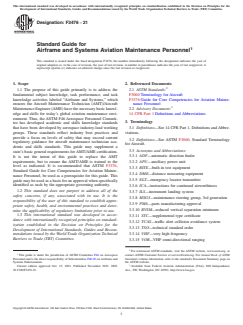
1.1 The purpose of this guide primarily is to address the fundamental subject knowledge, task performance, and task knowledge activities labeled “Airframe and Systems,” which ensures the Aircraft Maintenance Technician (AMT)/Aircraft Maintenance Engineer (AME) have the necessary basic knowledge and skills for today’s global aviation maintenance environment. Thus, the ASTM F46 Aerospace Personnel Committee has developed academic and skills knowledge standards that have been developed by aerospace industry-lead working groups. These standards reflect industry best practices and provide a focus on levels of safety that may exceed current regulatory guidance for aircraft maintenance technician academic and skills standards. This guide may supplement a state’s basic general requirements for AMT/AME certification. It is not the intent of this guide to replace the AMT requirements, but to ensure the AMT/AME is trained to the level as indicated. It is recommended that ASTM F3376, Standard Guide for Core Competencies for Aviation Maintenance Personnel, be used as a prerequisite for this guide. This guide may be used as a basis for an approval when specifically identified as such by the appropriate governing authority.
1.2 This standard does not purport to address all of the safety concerns, if any, associated with its use. It is the responsibility of the user of this standard to establish appropriate safety, health, and environmental practices and determine the applicability of regulatory limitations prior to use.
1.3 This international standard was developed in accordance with internationally recognized principles on standardization established in the Decision on Principles for the Development of International Standards, Guides and Recommendations issued by the World Trade Organization Technical Barriers to Trade (TBT) Committee.
- Status
- Published
- Publication Date
- 14-Oct-2021
- Technical Committee
- F46 - Aerospace Personnel
- Drafting Committee
- F46.03 - Airframe and Systems Endorsements
Overview
ASTM F3476-21: Standard Guide for Airframe and Systems Aviation Maintenance Personnel provides a comprehensive framework for the education and evaluation of Aircraft Maintenance Technicians (AMTs) and Aircraft Maintenance Engineers (AMEs). Developed by ASTM Committee F46, this industry-led standard addresses the core knowledge, task performance, and practical skills required in today's rapidly evolving, safety-critical aviation environment. Its purpose is to supplement existing national or regulatory requirements for maintenance personnel and ensure a consistent, high level of competency across aviation maintenance organizations worldwide.
Key Topics
ASTM F3476-21 is organized around the Air Transport Association (ATA) categories, covering both theoretical understanding and practical competency for essential airframe and systems maintenance areas:
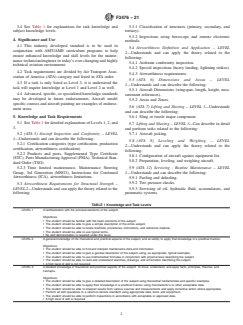
- Knowledge Levels: Structured into Level 1 (familiarization), Level 2 (general knowledge/application), and Level 3 (detailed knowledge and skill application).
- Core System Areas: Maintenance fundamentals for aircraft inspection and conformity, airworthiness, lifting and shoring, leveling and weighing, and routine servicing.
- Complex Systems Maintenance: Guidance for communication systems, electrical power systems, air conditioning, flight controls, fire protection, navigation, and hydraulics.
- Specialized Topics: Includes structural practices, landing gear, fuel systems, ice and rain protection, cabin systems, inert gas, and windows.
- Advanced and Emerging Areas: Recognizes the need for continual development in advanced topics such as model-specific courses and new systems as aviation technology progresses.
Applications
The practical value of ASTM F3476-21 extends across global aviation sectors:
- Training Programs: Serves as a core reference for AMT/AME curriculum development, ensuring aviation maintenance education aligns with industry best practices and exceeds baseline regulatory safety requirements.
- Certification Preparation: Provides a detailed knowledge and skill matrix to support personnel seeking certification or recertification as aircraft maintenance technicians or engineers.
- Skills Assessment: Used by maintenance organizations to benchmark staff competence and identify areas for targeted professional development.
- Regulatory Supplement: Can be adopted or referenced by authorities as a basis for approval of training programs or for compliance with international safety standards.
- Ongoing Professional Development: As aviation technologies and regulations evolve, this guide assists in identifying new areas for further training and future endorsements.
Related Standards
ASTM F3476-21 is complemented and strengthened by a range of related standards and regulatory documents, supporting a holistic approach to aviation maintenance personnel competency:
- ASTM F3376: Guide for Core Competencies for Aviation Maintenance Personnel (intended as a prerequisite)
- ASTM F3060: Terminology for Aircraft
- Title 14 CFR Part 1 & 147: Aviation-related definitions and technician schools (FAA)
- ATA iSpec 2200 and Spec 100: Information standards and technical data for aviation maintenance
- EASA Part-66: Maintenance Certifying Staff requirements (Europe)
- FAA Advisory Circulars: Including AC43.13-1B and AC43.13-2B on acceptable maintenance methods
- FAA-S-8081 and FAA-S-ACS-1: Aviation mechanic practical test standards
Summary
Implementing ASTM F3476-21 equips aviation maintenance organizations, training providers, and regulators with a robust, standardized foundation for maintaining airworthiness, safety, and competence in the complex world of aviation maintenance. By aligning educational and operational practices with this standard, the global aviation industry can better address regulatory requirements, technological advancements, and the ongoing demand for highly skilled aircraft maintenance professionals.
Keywords: aircraft maintenance technician, aviation maintenance engineer, airframe systems, AMT/AME training, aviation maintenance standard, maintenance technician certification, aviation safety, ASTM F3476-21, airframe maintenance, compliance, international aviation standards.
Relations
- Effective Date
- 01-Jan-2020
- Effective Date
- 01-Apr-2019
- Effective Date
- 01-Nov-2016
- Effective Date
- 01-Apr-2016
- Effective Date
- 15-Sep-2015
- Effective Date
- 01-May-2015
- Effective Date
- 01-Mar-2015
- Effective Date
- 01-Dec-2014
Get Certified
Connect with accredited certification bodies for this standard

BSI Group
BSI (British Standards Institution) is the business standards company that helps organizations make excellence a habit.

Bureau Veritas
Bureau Veritas is a world leader in laboratory testing, inspection and certification services.

DNV
DNV is an independent assurance and risk management provider.
Sponsored listings
Frequently Asked Questions
ASTM F3476-21 is a guide published by ASTM International. Its full title is "Standard Guide for Airframe and Systems Aviation Maintenance Personnel". This standard covers: SIGNIFICANCE AND USE 4.1 This industry developed standard is to be used in conjunction with AMT/AME curriculum programs to help ensure enhanced knowledge and skill levels for the maintenance technician/engineer in today’s ever-changing and highly technical aviation environment. 4.2 Task requirements are divided by Air Transport Association of America (ATA) category and listed in ATA order. 4.3 If a task is only listed as Level 3, it is understood the task will require knowledge at Level 1 and Level 2 as well. 4.4 Advanced, specific, or specialized knowledge standards may be developed in future endorsements. Aircraft model specific courses and aircraft painting are examples of endorsement areas. SCOPE 1.1 The purpose of this guide primarily is to address the fundamental subject knowledge, task performance, and task knowledge activities labeled “Airframe and Systems,” which ensures the Aircraft Maintenance Technician (AMT)/Aircraft Maintenance Engineer (AME) have the necessary basic knowledge and skills for today’s global aviation maintenance environment. Thus, the ASTM F46 Aerospace Personnel Committee has developed academic and skills knowledge standards that have been developed by aerospace industry-lead working groups. These standards reflect industry best practices and provide a focus on levels of safety that may exceed current regulatory guidance for aircraft maintenance technician academic and skills standards. This guide may supplement a state’s basic general requirements for AMT/AME certification. It is not the intent of this guide to replace the AMT requirements, but to ensure the AMT/AME is trained to the level as indicated. It is recommended that ASTM F3376, Standard Guide for Core Competencies for Aviation Maintenance Personnel, be used as a prerequisite for this guide. This guide may be used as a basis for an approval when specifically identified as such by the appropriate governing authority. 1.2 This standard does not purport to address all of the safety concerns, if any, associated with its use. It is the responsibility of the user of this standard to establish appropriate safety, health, and environmental practices and determine the applicability of regulatory limitations prior to use. 1.3 This international standard was developed in accordance with internationally recognized principles on standardization established in the Decision on Principles for the Development of International Standards, Guides and Recommendations issued by the World Trade Organization Technical Barriers to Trade (TBT) Committee.
SIGNIFICANCE AND USE 4.1 This industry developed standard is to be used in conjunction with AMT/AME curriculum programs to help ensure enhanced knowledge and skill levels for the maintenance technician/engineer in today’s ever-changing and highly technical aviation environment. 4.2 Task requirements are divided by Air Transport Association of America (ATA) category and listed in ATA order. 4.3 If a task is only listed as Level 3, it is understood the task will require knowledge at Level 1 and Level 2 as well. 4.4 Advanced, specific, or specialized knowledge standards may be developed in future endorsements. Aircraft model specific courses and aircraft painting are examples of endorsement areas. SCOPE 1.1 The purpose of this guide primarily is to address the fundamental subject knowledge, task performance, and task knowledge activities labeled “Airframe and Systems,” which ensures the Aircraft Maintenance Technician (AMT)/Aircraft Maintenance Engineer (AME) have the necessary basic knowledge and skills for today’s global aviation maintenance environment. Thus, the ASTM F46 Aerospace Personnel Committee has developed academic and skills knowledge standards that have been developed by aerospace industry-lead working groups. These standards reflect industry best practices and provide a focus on levels of safety that may exceed current regulatory guidance for aircraft maintenance technician academic and skills standards. This guide may supplement a state’s basic general requirements for AMT/AME certification. It is not the intent of this guide to replace the AMT requirements, but to ensure the AMT/AME is trained to the level as indicated. It is recommended that ASTM F3376, Standard Guide for Core Competencies for Aviation Maintenance Personnel, be used as a prerequisite for this guide. This guide may be used as a basis for an approval when specifically identified as such by the appropriate governing authority. 1.2 This standard does not purport to address all of the safety concerns, if any, associated with its use. It is the responsibility of the user of this standard to establish appropriate safety, health, and environmental practices and determine the applicability of regulatory limitations prior to use. 1.3 This international standard was developed in accordance with internationally recognized principles on standardization established in the Decision on Principles for the Development of International Standards, Guides and Recommendations issued by the World Trade Organization Technical Barriers to Trade (TBT) Committee.
ASTM F3476-21 is classified under the following ICS (International Classification for Standards) categories: 03.100.30 - Management of human resources; 49.100 - Ground service and maintenance equipment. The ICS classification helps identify the subject area and facilitates finding related standards.
ASTM F3476-21 has the following relationships with other standards: It is inter standard links to ASTM F3060-20, ASTM F3376-19, ASTM F3060-16a, ASTM F3060-16, ASTM F3060-15b, ASTM F3060-15a, ASTM F3060-15, ASTM F3060-14. Understanding these relationships helps ensure you are using the most current and applicable version of the standard.
ASTM F3476-21 is available in PDF format for immediate download after purchase. The document can be added to your cart and obtained through the secure checkout process. Digital delivery ensures instant access to the complete standard document.
Standards Content (Sample)
This international standard was developed in accordance with internationally recognized principles on standardization established in the Decision on Principles for the
Development of International Standards, Guides and Recommendations issued by the World Trade Organization Technical Barriers to Trade (TBT) Committee.
Designation: F3476 − 21
Standard Guide for
Airframe and Systems Aviation Maintenance Personnel
This standard is issued under the fixed designation F3476; the number immediately following the designation indicates the year of
original adoption or, in the case of revision, the year of last revision. A number in parentheses indicates the year of last reapproval. A
superscript epsilon (´) indicates an editorial change since the last revision or reapproval.
1. Scope 2. Referenced Documents
1.1 The purpose of this guide primarily is to address the 2.1 ASTM Standards:
fundamental subject knowledge, task performance, and task F3060 Terminology for Aircraft
knowledge activities labeled “Airframe and Systems,” which F3376 Guide for Core Competencies for Aviation Mainte-
ensures the Aircraft Maintenance Technician (AMT)/Aircraft nance Personnel
MaintenanceEngineer(AME)havethenecessarybasicknowl- 2.2 Advisory Document:
edge and skills for today’s global aviation maintenance envi- 14 CFR Part 1 Definitions and Abbreviations
ronment. Thus, the ASTM F46 Aerospace Personnel Commit-
3. Terminology
tee has developed academic and skills knowledge standards
that have been developed by aerospace industry-lead working
3.1 Definitions—See 14 CFR Part 1, Definitions andAbbre-
groups. These standards reflect industry best practices and viations.
provide a focus on levels of safety that may exceed current
3.2 Definitions—See ASTM F3060, Standard Terminology
regulatory guidance for aircraft maintenance technician aca-
for Aircraft.
demic and skills standards. This guide may supplement a
3.3 Acronyms and Abbreviations:
state’s basic general requirements forAMT/AME certification.
3.3.1 ADF—automatic direction finder
It is not the intent of this guide to replace the AMT
requirements, but to ensure the AMT/AME is trained to the 3.3.2 APU—auxiliary power unit
level as indicated. It is recommended that ASTM F3376,
3.3.3 BITE—built-in test equipment
Standard Guide for Core Competencies for Aviation Mainte-
3.3.4 DME—distance measuring equipment
nance Personnel, be used as a prerequisite for this guide. This
3.3.5 ELT—emergency locator transmitter
guide may be used as a basis for an approval when specifically
identified as such by the appropriate governing authority. 3.3.6 ICA—instructions for continued airworthiness
1.2 This standard does not purport to address all of the
3.3.7 ILS—instrument landing system
safety concerns, if any, associated with its use. It is the
3.3.8 MSG3—maintenance steering group, 3rd generation
responsibility of the user of this standard to establish appro-
3.3.9 PMA—parts manufacturing approval
priate safety, health, and environmental practices and deter-
3.3.10 RVSM—reduced vertical separation minimum
mine the applicability of regulatory limitations prior to use.
1.3 This international standard was developed in accor-
3.3.11 STC—supplemental type certificate
dance with internationally recognized principles on standard-
3.3.12 TCAS—traffic alert collision avoidance system
ization established in the Decision on Principles for the
3.3.13 TSO—technical standard order
Development of International Standards, Guides and Recom-
3.3.14 VHF—very high frequency
mendations issued by the World Trade Organization Technical
Barriers to Trade (TBT) Committee.
3.3.15 VOR—VHF omni-directional ranging
For referenced ASTM standards, visit the ASTM website, www.astm.org, or
This guide is under the jurisdiction of ASTM Committee F46 on Aerospace contact ASTM Customer Service at service@astm.org. For Annual Book of ASTM
Personnel and is the direct responsibility of Subcommittee F46.03 on Airframe and Standards volume information, refer to the standard’s Document Summary page on
Systems Endorsements. the ASTM website.
Current edition approved Oct. 15, 2021. Published November 2021. DOI: Available from Federal Aviation Administration (FAA), 800 Independence
10.1520/F3476-21. Ave., SW, Washington, DC 20591, http://www.faa.gov.
Copyright © ASTM International, 100 Barr Harbor Drive, PO Box C700, West Conshohocken, PA 19428-2959. United States
F3476 − 21
3.4 See Table 1 for explanations for task knowledge and 5.3.1 Classification of structures (primary, secondary, and
subject knowledge levels. tertiary).
5.3.2 Inspections using borescope and remote electronic
4. Significance and Use
methods.
4.1 This industry developed standard is to be used in
5.4 Airworthiness Definition and Application – LEVEL
conjunction with AMT/AME curriculum programs to help
2—Understands and can apply the theory related to the
ensure enhanced knowledge and skill levels for the mainte-
following:
nance technician/engineer in today’s ever-changing and highly
5.4.1 Airframe conformity inspection.
technical aviation environment.
5.4.2 Special inspections (heavy landing, lightning strikes).
4.2 Task requirements are divided by Air Transport Asso-
5.4.3 Airworthiness requirements.
ciation of America (ATA) category and listed in ATA order.
5.5 (ATA 6) Dimensions and Areas – LEVEL
4.3 If a task is only listed as Level 3, it is understood the
1—Understands and can describe the following:
task will require knowledge at Level 1 and Level 2 as well.
5.5.1 Aircraft Dimensions (wingspan, length, height, mea-
4.4 Advanced, specific, or specialized knowledge standards
surement references).
may be developed in future endorsements. Aircraft model
5.5.2 Areas and Zones.
specific courses and aircraft painting are examples of endorse-
5.6 (ATA 7) Lifting and Shoring – LEVEL 1—Understands
ment areas.
and can describe the following:
5. Knowledge and Task Requirements
5.6.1 Sling or trestle major component.
5.1 See Table 1 for detailed explanations of Levels 1, 2, and
5.7 Lifting and Shoring – LEVEL 3—Can describe in detail
3.
and perform tasks related to the following:
5.2 (ATA 5) Aircraft Inspection and Conformity – LEVEL 5.7.1 Aircraft jacking.
1—Understands and can describe the following:
5.8 (ATA 8) Leveling and Weighing – LEVEL
5.2.1 Certification categories (type certification, production
2—Understands and can apply the theory related to the
certification, airworthiness certification).
following:
5.2.2 Products and parts, Supplemental Type Certificate
5.8.1 Configuration of aircraft against equipment list.
(STC), Parts ManufacturingApproval (PMA), Technical Stan-
5.8.2 Preparation, leveling, and weighing aircraft.
dard Order (TSO).
5.2.3 Time limited maintenance, Maintenance Steering 5.9 (ATA 12) Servicing - Routine Maintenance – LEVEL
Group, 3rd Generation (MSG3), Instructions for Continued
1—Understands and can describe the following:
Airworthiness (ICA), airworthiness limitations.
5.9.1 Fueling and defueling.
5.9.2 Tire pressure checks.
5.3 Airworthiness Requirements for Structural Strength –
LEVEL 2—Understands and can apply the theory related to the 5.9.3 Servicing of oil, hydraulic fluid, accumulators, and
following: pneumatic systems.
TABLE 1 Knowledge and Task Levels
LEVEL 1 A familiarization with the principal elements of the subject.
Objectives:
The student should be familiar with the basic elements of the subject.
The student should be able to give a simple description of the entire subject.
The student should be able to locate methods, procedures, instructions, and reference material.
The student should be able to use typical terms.
No skill demonstration is required under this level.
LEVEL 2 A general knowledge of the theoretical and practical aspects of the subject, and an ability to apply that knowledge in a practical manner.
Objectives:
The student should be able to find and interpret maintenance data and information.
The student should be able to give a general description of the subject using, as appropriate, typical examples.
The student should be able to use mathematical formulae in conjunction with physical laws describing the subject.
The student should be able to read and understand sketches, drawings, and schematics describing the subject.
A high level of skill is not required.
LEVEL 3 A detailed knowledge of theoretical and practical aspects of the subject. To know, understand, and apply facts, principles, theories, and
concepts.
Objectives:
The student should be able to give a detailed description of the subject using theoretical fundamentals and specific examples.
The student should be able to apply their knowledge in a practical manner using manufacturer’s or other acceptable data.
The student should be able to interpret results from various sources and measurements and apply corrective action where appropriate.
Perform all skill operations to a return-to-service standard using appropriate data, tools, and equipment.
The student should be able to perform inspections in accordance with acceptable or approved data.
A high level of skill is required.
F3476 − 21
5.9.4 Servicing grease-fitted components and other areas 5.14 (ATA 22) Autoflight System:
that require grease.
5.14.1 Autoflight System Theory of Operation – LEVEL
5.9.5 Use of ground power.
1—Understands and can describe the following:
5.9.6 Servicing water and toilet systems.
5.14.1.1 Autoflight systems including auto-throttle and
5.9.7 Verification of fluid levels during preflight checks.
auto-brake systems.
5.14.2 Autoflight System Maintenance – LEVEL 3—Can
5.10 (ATA 20) Standard Practices (Basic) – LEVEL
describe in detail and perform tasks related to the following:
1—Understands and can describe the following:
5.14.2.1 Inspection, testing, and troubleshooting of
5.10.1 Soldering, brazing, and welding techniques using
autopilot, servos, and approach coupling systems.
Oxy-Acetylene gas, Shield Metal Arc (SMAW), Metal Inert
Gas (MIG), and Tungsten Inert Gas (TIG).
5.15 (ATA 23) Communication Systems:
5.10.2 Identification and use of digital databus systems.
5.15.1 Communication Systems Theory of Operation –
5.11 Standard Practices (Intermediate) – LEVEL
LEVEL 1—Understands and can describe the following:
2—Understands and can apply the theory related to the
5.15.1.1 Communication Systems including High Fre-
following:
quency (HF), Very High Frequency (VHF), Satellite Commu-
5.11.1 Identification of pipes and unions.
nication (SATCOM), PassengerAddress (PA), and Interphone/
5.11.2 Soldering of stainless steel and copper/bronze mate-
Intercom.
rials.
5.15.1.2 Emergency Locator Transmitter (ELT) awareness
5.11.3 Fabrication of tubular structures.
to prevent false activation.
5.11.4 Inspection of aluminum, steel, and stainless steel
5.15.2 Communication Systems Maintenance – LEVEL
welds.
3—Can describe in detail and perform tasks related to the
5.11.5 Inspection of magnesium and titanium welds.
following:
5.11.6 Understand fail safe, life limits, and damage toler-
5.15.2.1 Inspection, testing, troubleshooting, and repair of
ance concepts.
communication systems and antennas.
5.11.7 Inspection and repair of aircraft electrical system
5.16 (ATA 24) Electrical Power System:
components (crimp and splice wiring to manufacturer’s
5.16.1 Electrical Power System Theory of Operation –
specifications, repair of pins and sockets of aircraft connec-
LEVEL 1—Understands and can describe the following:
tors).
5.16.1.1 DC power generation.
5.11.8 Inspection and testing of proximity switches and
5.16.1.2 AC power generation.
printed circuit boards.
5.11.9 Understand and use of Built-In Test Equipment 5.16.1.3 Emergency power generation.
(BITE). 5.16.1.4 Voltage regulation.
5.16.1.5 Power distribution.
5.12 Standard Practices (Advanced) – LEVEL 3—Can de-
5.16.1.6 Inverters, transformers, and rectifiers.
scribe in detail and perform tasks related to the following:
5.16.1.7 Circuit protection.
5.12.1 Torque applications.
5.12.2 Installation, testing, and servicing of airframe elec- 5.16.1.8 External power and ground power.
trical wiring, controls, switches, indicators, and protective
5.16.2 Electrical Power System Maintenance – LEVEL
devices.
3—Can describe in detail and perform tasks related to the
following:
5.13 (ATA21)AirConditioningandPressurizationSystems:
5.16.2.1 Inspection, testing, troubleshooting, servicing, and
5.13.1 Air Conditioning and Pressurization Systems Theory
repair of alternating and direct-current electrical systems.
of Operation – LEVEL 1—Understands and can describe the
5.16.2.2 Inspection, testing, and troubleshooting of constant
following:
speed and integrated drive generators.
5.13.1.1 Air conditioning and air conditioning systems.
5.16.2.3 Inspection, installation, and servicing of aircraft
5.13.1.2 Air cycle and vapor cycle machines.
batteries (all types).
5.13.1.3 Air distribution systems.
5.13.1.4 Air flow, temperature, and humidity control sys-
5.17 (ATA 25) Equipment and Furnishings:
tems.
5.17.1 Equipment and Furnishings General Knowledge –
5.13.1.5 Pressurization and pressurization systems.
LEVEL 1—Understands and can describe the following:
5.13.1.6 Control and indication systems, including outflow
5.17.1.1 Identification of interior burn certification require-
control and safety valves.
ments.
5.13.1.7 Cabin pressure controllers.
5.17.1.2 Cabin lay-out.
5.13.1.8 Safety and warning devices.
5.17.1.3 Cabin equipment lay-out.
5.13.2 Air Conditioning and Pressurization Systems Main-
5.17.1.4 Cabin furnishings installation.
tenance – LEVEL 3—Can describe in detail and perform tasks
5.17.1.5 Cabin entertainment equipment.
related to the following:
5.17.1.6 Galley installations.
5.13.2.1 Inspection, testing, troubleshooting, servicing, and
5.17.1.7 Cargo handling and retention equipment.
repair of air conditioning systems, pressurization systems, air
cycle and air vapor machines. 5.17.1.8 Air stairs and main entry doors.
F3476 − 21
5.17.2 Equipment and Furnishings Installations and Re- 5.19.3.11 Operation of artificial feel, yaw damper, mach
quirements – LEVEL 2—Understands and can apply the theory trim, and rudder limiter.
related to the following: 5.19.3.12 Operation of flight control locking systems.
5.17.2.1 Emergency equipment requirements. 5.19.3.13 Operation of stall protection/warning systems.
5.17.2.2 Seats, harnesses, seat belts, and seat installations.
5.20 (ATA 28) Fuel Systems:
5.17.2.3 Cargo loading systems.
5.20.1 Fuel Systems Theory of Operation – LEVEL
5.18 (ATA 26) Fire Protection System:
1—Understands and can describe the following:
5.18.1 Fire Protection System Theory of Operation –
5.20.1.1 Fuel system architecture.
LEVEL 1—Understands and can describe the following:
5.20.1.2 Fuel tanks and bladders.
5.18.1.1 Fire and smoke detection and warning systems.
5.20.1.3 Fuel supply systems.
5.18.1.2 Fire extinguishing systems and system tests.
5.20.1.4 Fuel dumping, venting, and draining.
5.18.2 Fire Protection System Maintenance – LEVEL
5.20.1.5 Fuel cross-feed and transfer.
3—Can describe in detail and perform tasks related to the
5.20.1.6 Fuel quantity and temperature indicating and warn-
following:
ing systems.
5.18.2.1 Inspection, testing, servicing, troubleshooting, and
5.20.1.7 Refueling and defueling.
repair of aircraft fire detection and extinguishing systems.
5.20.1.8 Lateral and longitudinal balance of fuel systems.
5.18.2.2 Inspection and servicing of portable fire extin-
5.20.2 Fuel Systems Maintenance – LEVEL 3—Can de-
guishers.
scribe in detail and perform tasks related to the following:
5.20.2.1 Operation, testing, troubleshooting, servicing, and
5.19 (ATA 27) Flight Control System:
repair of fuel pressure and temperature warning systems.
5.19.1 Flight Control System Theory of Operation – LEVEL
5.20.2.2 Testing and servicing of fuel dump systems.
1—Understands and can describe the following:
5.20.2.3 Fuel management transfers and defueling.
5.19.1.1 Cable and pulley systems.
5.20.2.4 Inspection, testing, and repair of pressure fueling
5.19.1.2 Hydraulic systems.
5.19.1.3 Fly-by-Wire systems. systems.
5.20.2.5 Inspection, testing, servicing, troubleshooting, and
5.19.2 Flight Control System Installation and Requirements
– LEVEL 2—Understands and can apply the theory related to repair of aircraft fuel systems.
the following:
5.21 (ATA 29) Hydraulic Power System:
5.19.2.1 Flight control surface construction and attachment.
5.21.1 Hydraulic Power System Theory of Operation –
5.19.2.2 Rigging of mechanical and electric-hydro flight
LEVEL 1—Understands and can describe the following:
control systems in fixed-win
...