

ASTM F3457-20
(Guide)Standard Guide for Aircraft Certification Education Standards for Engineers and Professionals in Aerospace Industry
General Information
- Abstract
SIGNIFICANCE AND USE
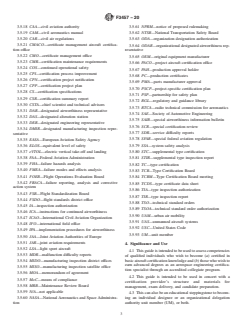
4.1 This guide is intended to be used to assess competencies of qualified individuals who wish to become (a) certified in basic aircraft certification knowledge and (b) those who wish to earn advanced degrees as an aerospace engineering certification specialist through an accredited collegiate program.
4.2 This guide is intended to be used in concert with a certification provider’s structure and materials for management, exam delivery, and candidate preparation.
4.3 This can also be an educational steppingstone to becoming an individual designee or an organizational delegation authority unit member (UM), or both.
SCOPE
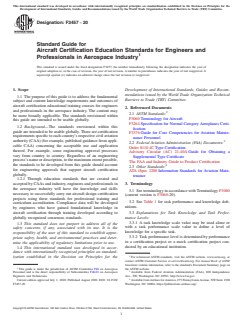
1.1 The purpose of this guide is to address the fundamental subject and content knowledge requirements and outcomes of aircraft certification educational training courses for engineers and professionals in the aerospace industry. The content may be more broadly applicable. The standards envisioned within this guide are intended to be usable globally.
1.2 Background—The standards envisioned within this guide are intended to be usable globally. There are certification requirements specific to each country’s respective civil aviation authority (CAA) (for example, published guidance from applicable CAA) concerning the acceptable use and application thereof. For example, some engineering approval processes vary from country to country. Regardless of an engineering process’s name or description, to the maximum extent possible, the standards to be developed from this guide should account for engineering approvals that support aircraft certification globally.
1.2.1 Through education standards that are created and accepted by CAAs and industry, engineers and professionals in the aerospace industry will have the knowledge and skills necessary to successfully carry out aircraft design certification projects using these standards for professional training and curriculum accreditation. Compliance data will be developed by engineers who have gained foundational knowledge in aircraft certification through training developed according to globally recognized consensus standards.
1.3 This standard does not purport to address all of the safety concerns, if any, associated with its use. It is the responsibility of the user of this standard to establish appropriate safety, health, and environmental practices and determine the applicability of regulatory limitations prior to use.
1.4 This international standard was developed in accordance with internationally recognized principles on standardization established in the Decision on Principles for the Development of International Standards, Guides and Recommendations issued by the World Trade Organization Technical Barriers to Trade (TBT) Committee.
- Status
- Published
- Publication Date
- 30-Jun-2020
- Technical Committee
- F46 - Aerospace Personnel
- Drafting Committee
- F46.01 - Aerospace Engineers and Technicians
Overview
ASTM F3457-20, titled Standard Guide for Aircraft Certification Education Standards for Engineers and Professionals in Aerospace Industry, is a globally applicable standard developed by ASTM International. This guide aims to define and assess the fundamental subject matter and content knowledge required for aircraft certification education and training. By providing a structured framework, it helps ensure that aerospace engineers and industry professionals possess the competencies needed for effective participation in aircraft design and certification projects. The guide is especially relevant to those seeking basic certification knowledge, advanced degrees in aerospace engineering certification, or roles involving individual and organizational delegation authority.
Key Topics
The standard addresses several essential topics within aircraft certification education:
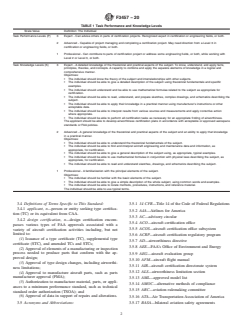
- Competency Assessment: Outlines criteria for evaluating the knowledge and performance levels required for certification-related tasks in the aerospace sector.
- Certification Knowledge Levels:
- Professional: Familiarity with basic concepts, terminology, and reference materials.
- Advanced: Ability to understand theoretical fundamentals and practical applications.
- Expert: Mastery of detailed theoretical and practical knowledge, with the ability to apply concepts comprehensively.
- Performance Levels: Defines roles from contributing professional to recognized expert and project manager within certification projects.
- Aircraft Certification Fundamentals: Covers the history, legal basis, and regulatory evolution of aircraft design and engine certifications, including new and novel aircraft types (such as eVTOLs and unmanned systems).
- Regulatory Framework: Reviews key Federal Aviation Regulations (FARs), international agreements, and guidance from various Civil Aviation Authorities (CAAs).
- Applicant and Certificate Holder Responsibilities: Explains the roles, responsibilities, and professional expectations of applicants and certificate holders within the certification process.
- Type Validation and Compliance: Discusses type certificate validation in a global context, emphasizing international harmonization of certification principles.
Applications
ASTM F3457-20 delivers practical benefits and is widely applicable in:
- Aerospace Engineering Education: Supports universities and training providers in developing or accrediting programs focused on aircraft certification competencies.
- Professional Development: Allows engineers and industry professionals to benchmark and expand their certification knowledge-facilitating credentialing, upskilling, or career advancement.
- Certification Provider Support: Aligns with certification providers’ examination, candidate preparation, and management frameworks to ensure consistent competency assessment.
- Global Regulatory Compliance: Assists individuals and organizations in navigating diverse regulatory requirements across jurisdictions, supporting international mobility and recognition.
- Pathway to Specialized Roles: Serves as a steppingstone for professionals aiming for roles such as individual designee or organizational delegation authority unit member.
Related Standards
ASTM F3457-20 references and aligns with several key industry standards and guidance documents, including:
- ASTM F3060 - Terminology for Aircraft
- ASTM F3264 - Specification for Normal Category Aeroplanes Certification
- ASTM F3376 - Guide for Core Competencies for Aviation Maintenance Personnel
- FAA Order 8110.4C - Type Certification
- FAA Advisory Circular 21-40A - Guide for Obtaining a Supplemental Type Certificate
- ATA iSpec 2200 - Information Standards for Aviation Maintenance
These documents collectively support the development of robust, internationally relevant aircraft certification education and training, ensuring the global recognition and interoperability of aerospace engineering standards.
By establishing a universal framework for aircraft certification education, ASTM F3457-20 facilitates the advancement of aerospace industry professionals and drives global consistency in certification processes, supporting safety, compliance, and technological innovation in aviation.
Relations
- Effective Date
- 01-Jan-2020
- Effective Date
- 01-Apr-2019
- Effective Date
- 01-Nov-2018
- Effective Date
- 01-Oct-2018
- Effective Date
- 01-Sep-2017
- Effective Date
- 01-Nov-2016
- Effective Date
- 01-Apr-2016
- Effective Date
- 15-Sep-2015
- Effective Date
- 01-May-2015
- Effective Date
- 01-Mar-2015
- Effective Date
- 01-Dec-2014
Get Certified
Connect with accredited certification bodies for this standard

BSI Group
BSI (British Standards Institution) is the business standards company that helps organizations make excellence a habit.

Bureau Veritas
Bureau Veritas is a world leader in laboratory testing, inspection and certification services.

DNV
DNV is an independent assurance and risk management provider.
Sponsored listings
Frequently Asked Questions
ASTM F3457-20 is a guide published by ASTM International. Its full title is "Standard Guide for Aircraft Certification Education Standards for Engineers and Professionals in Aerospace Industry". This standard covers: SIGNIFICANCE AND USE 4.1 This guide is intended to be used to assess competencies of qualified individuals who wish to become (a) certified in basic aircraft certification knowledge and (b) those who wish to earn advanced degrees as an aerospace engineering certification specialist through an accredited collegiate program. 4.2 This guide is intended to be used in concert with a certification provider’s structure and materials for management, exam delivery, and candidate preparation. 4.3 This can also be an educational steppingstone to becoming an individual designee or an organizational delegation authority unit member (UM), or both. SCOPE 1.1 The purpose of this guide is to address the fundamental subject and content knowledge requirements and outcomes of aircraft certification educational training courses for engineers and professionals in the aerospace industry. The content may be more broadly applicable. The standards envisioned within this guide are intended to be usable globally. 1.2 Background—The standards envisioned within this guide are intended to be usable globally. There are certification requirements specific to each country’s respective civil aviation authority (CAA) (for example, published guidance from applicable CAA) concerning the acceptable use and application thereof. For example, some engineering approval processes vary from country to country. Regardless of an engineering process’s name or description, to the maximum extent possible, the standards to be developed from this guide should account for engineering approvals that support aircraft certification globally. 1.2.1 Through education standards that are created and accepted by CAAs and industry, engineers and professionals in the aerospace industry will have the knowledge and skills necessary to successfully carry out aircraft design certification projects using these standards for professional training and curriculum accreditation. Compliance data will be developed by engineers who have gained foundational knowledge in aircraft certification through training developed according to globally recognized consensus standards. 1.3 This standard does not purport to address all of the safety concerns, if any, associated with its use. It is the responsibility of the user of this standard to establish appropriate safety, health, and environmental practices and determine the applicability of regulatory limitations prior to use. 1.4 This international standard was developed in accordance with internationally recognized principles on standardization established in the Decision on Principles for the Development of International Standards, Guides and Recommendations issued by the World Trade Organization Technical Barriers to Trade (TBT) Committee.
SIGNIFICANCE AND USE 4.1 This guide is intended to be used to assess competencies of qualified individuals who wish to become (a) certified in basic aircraft certification knowledge and (b) those who wish to earn advanced degrees as an aerospace engineering certification specialist through an accredited collegiate program. 4.2 This guide is intended to be used in concert with a certification provider’s structure and materials for management, exam delivery, and candidate preparation. 4.3 This can also be an educational steppingstone to becoming an individual designee or an organizational delegation authority unit member (UM), or both. SCOPE 1.1 The purpose of this guide is to address the fundamental subject and content knowledge requirements and outcomes of aircraft certification educational training courses for engineers and professionals in the aerospace industry. The content may be more broadly applicable. The standards envisioned within this guide are intended to be usable globally. 1.2 Background—The standards envisioned within this guide are intended to be usable globally. There are certification requirements specific to each country’s respective civil aviation authority (CAA) (for example, published guidance from applicable CAA) concerning the acceptable use and application thereof. For example, some engineering approval processes vary from country to country. Regardless of an engineering process’s name or description, to the maximum extent possible, the standards to be developed from this guide should account for engineering approvals that support aircraft certification globally. 1.2.1 Through education standards that are created and accepted by CAAs and industry, engineers and professionals in the aerospace industry will have the knowledge and skills necessary to successfully carry out aircraft design certification projects using these standards for professional training and curriculum accreditation. Compliance data will be developed by engineers who have gained foundational knowledge in aircraft certification through training developed according to globally recognized consensus standards. 1.3 This standard does not purport to address all of the safety concerns, if any, associated with its use. It is the responsibility of the user of this standard to establish appropriate safety, health, and environmental practices and determine the applicability of regulatory limitations prior to use. 1.4 This international standard was developed in accordance with internationally recognized principles on standardization established in the Decision on Principles for the Development of International Standards, Guides and Recommendations issued by the World Trade Organization Technical Barriers to Trade (TBT) Committee.
ASTM F3457-20 is classified under the following ICS (International Classification for Standards) categories: 03.100.30 - Management of human resources; 49.020 - Aircraft and space vehicles in general. The ICS classification helps identify the subject area and facilitates finding related standards.
ASTM F3457-20 has the following relationships with other standards: It is inter standard links to ASTM F3060-20, ASTM F3376-19, ASTM F3264-18b, ASTM F3264-18a, ASTM F3264-17, ASTM F3060-16a, ASTM F3060-16, ASTM F3060-15b, ASTM F3060-15a, ASTM F3060-15, ASTM F3060-14. Understanding these relationships helps ensure you are using the most current and applicable version of the standard.
ASTM F3457-20 is available in PDF format for immediate download after purchase. The document can be added to your cart and obtained through the secure checkout process. Digital delivery ensures instant access to the complete standard document.
Standards Content (Sample)
This international standard was developed in accordance with internationally recognized principles on standardization established in the Decision on Principles for the
Development of International Standards, Guides and Recommendations issued by the World Trade Organization Technical Barriers to Trade (TBT) Committee.
Designation:F3457 −20
Standard Guide for
Aircraft Certification Education Standards for Engineers and
Professionals in Aerospace Industry
This standard is issued under the fixed designation F3457; the number immediately following the designation indicates the year of
original adoption or, in the case of revision, the year of last revision. A number in parentheses indicates the year of last reapproval. A
superscript epsilon (´) indicates an editorial change since the last revision or reapproval.
1. Scope Development of International Standards, Guides and Recom-
mendations issued by the World Trade Organization Technical
1.1 The purpose of this guide is to address the fundamental
Barriers to Trade (TBT) Committee.
subject and content knowledge requirements and outcomes of
aircraft certification educational training courses for engineers
2. Referenced Documents
and professionals in the aerospace industry. The content may
2.1 ASTM Standards:
be more broadly applicable. The standards envisioned within
F3060 Terminology for Aircraft
this guide are intended to be usable globally.
F3264 Specification for Normal Category Aeroplanes Certi-
1.2 Background—The standards envisioned within this
fication
guide are intended to be usable globally.There are certification
F3376 Guide for Core Competencies for Aviation Mainte-
requirementsspecifictoeachcountry’srespectivecivilaviation
nance Personnel
authority (CAA) (for example, published guidance from appli-
2.2 Federal Aviation Administration (FAA) Documents:
cable CAA) concerning the acceptable use and application
Order 8110.4C Type Certification
thereof. For example, some engineering approval processes
Advisory Circular (AC) 21-40A Guide for Obtaining a
vary from country to country. Regardless of an engineering
Supplemental Type Certificate
process’snameordescription,tothemaximumextentpossible,
The FAA and Industry Guide to Product Certification
the standards to be developed from this guide should account 4
2.3 Other Standards:
for engineering approvals that support aircraft certification
ATA iSpec 2200 Information Standards for Aviation Main-
globally.
tenance
1.2.1 Through education standards that are created and
accepted by CAAs and industry, engineers and professionals in 3. Terminology
the aerospace industry will have the knowledge and skills
3.1 SeeterminologyinaccordancewithTerminologyF3060
necessary to successfully carry out aircraft design certification
(current version is F3060-20).
projects using these standards for professional training and
3.2 See Table 1 for task performance and knowledge defi-
curriculum accreditation. Compliance data will be developed
nitions.
by engineers who have gained foundational knowledge in
aircraft certification through training developed according to 3.3 Explanations for Task Knowledge and Task Perfor-
globally recognized consensus standards.
mance Levels:
3.3.1 A task knowledge scale value may be used alone or
1.3 This standard does not purport to address all of the
with a task performance scale value to define a level of
safety concerns, if any, associated with its use. It is the
knowledge for a specific task.
responsibility of the user of this standard to establish appro-
3.3.2 Task performance level is determined by performance
priate safety, health, and environmental practices and deter-
in a certification project or a mock certification project con-
mine the applicability of regulatory limitations prior to use.
ducted by an educational institution.
1.4 This international standard was developed in accor-
dance with internationally recognized principles on standard-
ization established in the Decision on Principles for the
For referenced ASTM standards, visit the ASTM website, www.astm.org, or
contact ASTM Customer Service at service@astm.org. For Annual Book of ASTM
Standards volume information, refer to the standard’s Document Summary page on
This guide is under the jurisdiction of ASTM Committee F46 on Aerospace the ASTM website.
Personnel and is the direct responsibility of Subcommittee F46.01 on Aerospace Available from Federal Aviation Administration (FAA), 800 Independence
Engineers and Technicians. Ave., SW, Washington, DC 20591, http://www.faa.gov.
Current edition approved July 1, 2020. Published August 2020. DOI: 10.1520/ AvailablefromAirlinesforAmerica,275PennsylvaniaAvenue,NWSuite1300
F3457-20. Washington, DC 20004, https://publications.airlines.org/.
Copyright © ASTM International, 100 Barr Harbor Drive, PO Box C700, West Conshohocken, PA 19428-2959. United States
F3457−20
TABLE 1 Task Performance and Knowledge Levels
Scale Value Definition: The Individual
Task Performance Levels (P) 3 Expert - Can advise others in parts of certification projects. Recognized expert in certification or engineering fields, or both.
2 Advanced - Capable of project managing and completing a certification project. May need direction from a Level 3 in
certification or engineering fields, or both.
1 Professional - Can contribute to parts of certification project or address some engineering fields, or both, while working with
Level 2 or Level 3, or both.
Task Knowledge Levels (K) 3 Expert - A detailed knowledge of the theoretical and practical aspects of the subject. To know, understand, and apply facts,
principles, theories, and concepts. A capacity to combine and apply the separate elements of knowledge in a logical and
comprehensive manner.
Objectives:
• The individual should know the theory of the subject and interrelationships with other subjects.
• The individual should be able to give a detailed description of the subject using theoretical fundamentals and specific
examples.
• The individual should understand and be able to use mathematical formulae related to the subject as appropriate for
certification.
• The individual should be able to read, understand, and prepare sketches, complex drawings, and schematics describing the
subject.
• The individual should be able to apply their knowledge in a practical manner using manufacturer’s instructions or other
acceptable data.
• The individual should be able to interpret results from various sources and measurements and apply corrective action
where appropriate.
• The individual should be able to perform all certification tasks as necessary for an appropriate finding of airworthiness.
The applicant should be able to develop airworthiness certification plans in accordance with acceptable or approved aerospace
standards or FAA policies.
2 Advanced - A general knowledge of the theoretical and practical aspects of the subject and an ability to apply that knowledge
in a practical manner.
Objectives:
• The individual should be able to understand the theoretical fundamentals of the subject.
• The individual should be able to find and interpret aircraft engineering and maintenance data and information, as
appropriate, for certification.
• The individual should be able to give a general description of the subject using, as appropriate, typical examples.
• The individual should be able to use mathematical formulae in conjunction with physical laws describing the subject, as
appropriate, for certification.
• The individual should be able to read and understand sketches, drawings, and schematics describing the subject.
1 Professional - A familiarization with the principal elements of the subject.
Objectives:
• The individual should be familiar with the basic elements of the subject.
• The individual should be able to give a simple description of the whole subject, using common words and examples.
• The individual should be able to locate methods, procedures, instructions, and reference material.
The individual should be able to use typical terms.
3.4 Definitions of Terms Specific to This Standard: 3.5.1 14 CFR—Title 14 of the Code of Federal Regulations
3.4.1 applicant, n—person or entity seeking type certifica-
3.5.2 A4A—Airlines for America
tion (TC) or its equivalent from CAA.
3.5.3 AC—advisory circular
3.4.2 design certification, n—design certification encom-
3.5.4 ACO—aircraft certification office
passes various types of FAA approvals associated with a
3.5.5 ACOS—aircraft certification office subsystem
variety of aircraft certification activities including, but not
limited to:
3.5.6 ACRP—aircraft certification regulatory program
(1) Issuance of a type certificate (TC), supplemental type
3.5.7 AD—airworthiness directive
certificate (STC), and amended TCs and STCs;
3.5.8 AEE—FAA’s Office of Environment and Energy
(2) Approval of elements of a manufacturing or inspection
process needed to produce parts that conform with the ap-
3.5.9 AEG—aircraft evaluation group
proved design;
3.5.10 AFM—aircraft flight manual
(3) Approval of type design changes, including airworthi-
3.5.11 AIR—aircraft certification directorate system
ness limitations;
3.5.12 ALS—airworthiness limitation section
(4) Approval to manufacture aircraft parts, such as parts
manufacturer approval (PMA);
3.5.13 AML—approved model list
(5) Authorization to manufacture material, parts, or appli-
3.5.14 AMOC—alternative methods of compliance
ances to a minimum performance standard, such as technical
3.5.15 ARC—aviation rulemaking committee
standard order authorization (TSOA); and
(6) Approval of data in support of repairs and alterations. 3.5.16 ATA—Air Transportation Association of America
3.5 Acronyms and Abbreviations: 3.5.17 BASA—bilateral aviation safety agreements
F3457−20
3.5.18 CAA—civil aviation authority 3.5.61 NPRM—notice of proposed rulemaking
3.5.19 CAM—civil aeronautics manual 3.5.62 NTSB—National Transportation Safety Board
3.5.20 CAR—civil air regulations
3.5.63 ODA—organization designation authorization
3.5.21 CMACO—certificate management aircraft certifica-
3.5.64 ODAR—organizational designated airworthiness rep-
tion office
resentative
3.5.22 CMO—certificate management office
3.5.65 OEM—original equipment manufacturer
3.5.23 CMR—certification maintenance requirements
3.5.66 PACO—project aircraft certification office
3.5.24 COS—continued operational safety
3.5.67 PAH—production approval holder
3.5.25 CPI—certification process improvement
3.5.68 PC—production certificates
3.5.26 CPN—certification project notification
3.5.69 PMA—parts manufacturer approval
3.5.27 CPP—certification project plan
3.5.70 PSCP—project-specific certification plan
3.5.28 CS—certification specifications
3.5.71 PSP—partnership for safety plan
3.5.29 CSR—certification summary report
3.5.72 RGL—regulatory and guidance library
3.5.30 CSTA—chief scientist and technical advisors
3.5.73 RTCA—radio technical commission for aeronautics
3.5.31 DAR—designated airworthiness representative
3.5.74 SAE—Society of Automotive Engineering
3.5.32 DAS—designated alteration station
3.5.75 SAIB—special airworthiness information bulletin
3.5.33 DER—designated engineering representative
3.5.76 SCR—special certification review
3.5.34 DMIR—designated manufacturing inspection repre-
3.5.77 SDR—service difficulty reports
sentative
3.5.78 SFAR—special federal aviation regulation
3.5.35 EASA—European Aviation Safety Agency
3.5.79 SSA—system safety analysis
3.5.36 ELOS—equivalent level of safety
3.5.37 eVTOL—electric vertical take-off and landing 3.5.80 STC—supplemental type certification
3.5.38 FAA—Federal Aviation Administration 3.5.81 STIR—supplemental type inspection report
3.5.39 FHA—failure hazards analysis
3.5.82 TC—type certification
3.5.40 FMEA—failure modes and effects analysis
3.5.83 TCB—Type Certification Board
3.5.41 FOEB—Flight Operations Evaluation Board
3.5.84 TCBM—Type Certification Board meeting
3.5.42 FRACA—failure reporting, analysis and corrective
3.5.85 TCDS—type certificate data sheet
action system
3.5.86 TIA—type inspection authorization
3.5.43 FSB—Flight Standardization Board
3.5.87 TIR—type inspection report
3.5.44 FSDO—flight standards district office
3.5.88 TSO—technical standard orders
3.5.45 IA—inspection authorization
3.5.89 TSOA—technical standard order authorization
3.5.46 ICA—instructions for continued airworthiness
3.5.90 UAM—urban air mobility
3.5.47 ICAO—International Civil Aviation Organization
3.5.91 UAS—unmanned aircraft systems
3.5.48 IFO—international field office
3.5.92 USC—United States Code
3.5.49 IPA—implementation procedures for airworthiness
3.5.93 UM—unit member
3.5.50 JAA—Joint Aviation Authorities of Europe
3.5.51 JAR—joint aviation requirements
4. Significance and Use
3.5.52 LSA—light sport aircraft
4.1 This guide is intended to be used to assess competencies
3.5.53 MDR—malfunction difficulty reports
of qualified individuals who wish to become (a) certified in
basicaircraftcertificationknowledgeand(b)thosewhowishto
3.5.54 MIDO—manufacturing inspection district offices
earn advanced degrees as an aerospace engineering certifica-
3.5.55 MISO—manufacturing inspection satellite office
tion specialist through an accredited collegiate program.
3.5.56 MOA—memorandum of agreement
4.2 This guide is intended to be used in concert with a
3.5.57 MoC—means of compliance
certification provider’s structure and materials for
3.5.58 MRB—Maintenance Review Board
management, exam delivery, and candidate preparation.
3.5.59 N/A—not applicable
4.3 This can also be an educational steppingstone to becom-
3.5.60 NASA—NationalAeronautics and SpaceAdministra- ing an individual designee or an organizational delegation
tion authority unit member (UM), or both.
F3457−20
5. Test Knowledge Requirements 5.3.1.2 1934—Civial air regulations (CAR) started to be
issued.
5.1 The following subject, performance, and task knowl-
5.3.1.3 1935—The accident that led Congress to create the
edgeareasshallbeassessedbylevels(referencedinTable1)of
CAA.
competency in the exam items.
5.3.1.4 1938—The CAA is created by Congress.
5.2 Aircraft Certification Overview:
5.3.1.5 1958—The Federal Aviation Act is passed, which
5.2.1 Overview of aircraft designs and the aviation system.
authorizes the Federal Aviation Authority (and replaces the
NOTE 1—Guide F3376 is equivalent to 5.2.1.1 thru 5.2.1.3. CAA).
5.3.1.6 1982—In February 1982, the FAA’s aircraft certifi-
5.2.1.1 Variation in Aircraft Designs – (Levels P1 and
cation directorate system (AIR) was created by means of Order
K1)—Knows and can identify the relationship of basic facts
8000.51. This was a result of the post-accident recommenda-
and state general principles in regard to aircraft designs, from
tions from theAmericanAirlines accident at O’HareAirport in
early aviation pioneering designs (that is, the Wright Brothers
Chicago (May 25, 1979). Reference Table 3 for website
Wright Flyer) to today’s modern jets and contemporary aero-
information.
space vehicle designs.
5.3.1.7 1994—In July 1994, the Act of 1958 was recodified
5.2.1.2 Variation in Engine Designs – (Levels P1 and
as Subtitle VII of Title 49 of the United States Code (USC),
K1)—Knows and can identify the relationship of basic facts
which currently provides the FAA’s regulatory authority. Air-
andstategeneralprinciplesinregardtoaircraftenginedesigns,
worthiness standards are separately codified in Chapter I of
from reciprocating engines to jet engines. Electric engines are
Title 14 of the Code of Federal Regulations. Title 49 of the
an advanced technology.
USC is defined by federal legislation and can only be changed
5.2.1.3 Variation in Aircraft Configurations – (Levels P1
by new legislation.Title 14 of the Code of Federal Regulations
and K1—Knows and can identify the relationship of basic facts
isdefinedbyregulationsissuedbyfederalagencies,suchasthe
and state general principles in regard to aircraft configurations,
FAA, in accordance with relevant sections of the USC.
from singe engine general aviation aircraft to multiengine
transport aircraft, including rotorcraft and balloons (reference
5.3.2 FAA’s Legal Authorization – (Levels P2 and K2)—
14 CFR Parts 21, 23, 25, 27, 29, and 31 in Table 2). Knows and can identify the relationship of basic facts and state
Understands how aircraft are organized by categories, classes,
general principles in regard to the FAA’s legal authorization, as
and types, such as experimental, military, and supersonic granted by Congress, from rulemaking powers to regulate air
aircraft. transport, therein codified by means of 14 CFR Parts; knows
and can identify the different types of certificates issued by the
5.2.1.4 Variation in New and Novel Aircraft – (Levels P1
FAA, such as TC, production certificate (PC), standard airwor-
and K1)—Knows and understands the relationship of basic
thiness certificate, and special airworthiness certificate (experi-
facts in regard to new and novel aircraft, from eVTOL(electric
mental).
vertical take-off and landing), UAS (unmanned aircraft
systems), UAM (urban air mobility), and spacecraft. This
5.3.3 FAA Documents – (Levels P2 and K2)—Knows and
guide addresses traditional aircraft certification and, at this
can identify the relationship of basic facts and state general
time, does not address the additional topics required for
principles in regard to FAA documents from regulations to
unmanned aircraft systems as a whole.
procedures; legal priority of orders, advisory circulars, and
5.2.1.5 Variation in Engineering Philosophies – (Levels P1 other various policies; and can identify mandatory actions
and K1)—Knows and can identify the relationship of basic versus recommendations. This will include a look back at
facts and state general principles in regard to engineering earlier policies found in Bulletin 7 through the Civil Aeronau-
philosophies between aircraft designs, including differences in tics Manual (CAM).
performanceversuscertificationsafetygoals;also,overviewof
5.3.4 FAA Safety Organizations – (Levels P2 and K2)—
the life of an aircraft, from design, to manufacturing, to
Knows and can identify the relationship of basic facts and state
in-service deployment, to maintenance, and finally to retire-
general principles in regard to the FAA safety organizations,
ment.
from aircraft certification’s engineering and manufacturing
5.2.1.6 The National Airspace System – (Levels P1 and
organizations to flight standards’ maintenance and operations
K1)—Knows and understands the relationship of basic facts in
organizations. The following is a minimum list of organiza-
regard to the national aviation system, from air traffic control,
tional subjects to be reviewed:
airspaces classAto G, and various aircraft operations (private,
5.3.4.1 Historical review of FAA organization, including
charter, commercial, and freight).
organizational charts and geographical jurisdictions;
5.3 History and Evolution of Certification: 5.3.4.2 Review of current FAAsafety organizations, includ-
ing roles and responsibilities and rulemaking and documents,
5.3.1 Legal Basis for Certification – (Levels P2 and K2)—
including relationships with National Transportation Safety
Knows and can identify the relationship of basic facts and state
Board (NTSB), foreign authorities, U.S. military, National
general principles in regard to certification laws created by
AeronauticsandSpaceAdministration(NASA),andsafetyand
Congress. The following is a minimum list of laws associated
standards associations;
with this subject and noteworthy historical events:
5.3.1.1 1926—Air Commerce Act and Aeronautics Bulletin 5.3.4.3 Review of any new changes to FAA’s safety
7. organizations, including roles and responsibilities.
F3457−20
TABLE2 Continued
TABLE 2 List of Applicable Federal Aviation Regulations that
Focus on Various Certification Methodologies
Prioritization:
A is Mandatory,
Prioritization:
National Archives
whileBandCare
A is Mandatory,
National Archives
Recommendations
whileBandCare
Recommendations 14 CFR Part 39 Airworthiness Directives (ADs) A
Aircraft
CFR TITLE 14 A
Aviation safety
List of Subjects revised as of October 1, 2018
Reporting and recordkeeping requirements
14 CFR Part 1 Definitions and abbreviations A
14 CFR Part 43 Maintenance, preventive maintenance, A
Air transportation
rebuilding, and alteration
14 CFR Part 3 General requirements A
Aircraft
Aviation safety
Aviation safety
14 CFR Part 5 Safety management systems B
Reporting and recordkeeping requirements
Air carriers
14 CFR Part 45 Identification and registration marking A
Aircraft
Aircraft
Airmen
Exports
Aviation safety
Signs and symbols
Reporting and recordkeeping requirements
14 CFR Part 47 Aircraft registration A
Safety
Aircraft
Transportation
Reporting and recordkeeping requirements
14 CFR Part 11 General rulemaking procedures A
14 CFR Part 61 Certification: Pilots, flight instructors, and A
Administrative practice and procedure
ground instructors
Reporting and recordkeeping requirements
Aircraft
14 CFR Part 13 Investigative and enforcement procedures A
Airmen
Administrative practice and procedure
Alcohol abuse
Air transportation
Aviation safety
Aviation safety
Drug abuse
Hazardous materials transportation
Recreation and recreation areas
Investigations
Reporting and recordkeeping requirements
Law enforcement
Security measures
Penalties
Teachers
14 CFR Part 21 Certification procedures for products and A
Reporting and recordkeeping requirements
articles
Security measures
Aircraft
14 CFR Part 65 Certification of airmen other than flight A
Aviation safety
crewmembers
Exports
Subpart D: Mechanics. This subpart also contains
Imports
information regarding inspection authorizations (IAs) and
Reporting and recordkeeping requirements
their authority. (Major repairs, major alterations, Form 337s,
14 CFR Part 23 Airworthiness standards: Normal category A
etc.)
airplanes
14 CFR Part 71 Designation of Class A, B, C, D, and E B
Aircraft
airspace areas; air traffic service routes; and reporting
Aviation safety
points
Signs and symbols
Airspace
14 CFR Part 25 Airworthiness standards: Transport category A
Navigation (air)
airplanes
14 CFR Part 73 Special use airspace B
Aircraft
Airspace
Aviation safety
Navigation (air)
Reporting and recordkeeping requirements
Security measures
14 CFR Part 26 Continued airworthiness and safety A
Aircraft
improvements for transport category airplanes
Aviation safety
Aircraft
Recreation and recreation areas
Aviation safety
Reporting and recordkeeping requirements
14 CFR Part 27 Airworthiness standards: Normal category A
Aviation safety
rotorcraft
Reporting and recordkeeping requirements
Aircraft
Security measures
Aviation safety
Smoking
14 CFR Part 29 Airworthiness standards: Transport category A
14 Part 91 General operating and flight rules A
rotorcraft
14 CFR Part 101 Moored balloons, kites, amateur rockets, A
Aircraft
unmanned free balloons, and certain model aircraft
Aviation safety
14 CFR Part 103 Ultralight vehicles A
14 CFR Part 31 Airworthiness standards: Manned Free A
14 CFR Part 105 Parachute operations (Note: this is for a B
Balloons
person, not an aircraft)
14 CFR Part 33 Airworthiness standards: Aircraft engines A
14 CFR Part 121 Air carrier certification A
Aircraft
14 CFR Part 125 Certification and operations: Airplanes C
Aviation safety
having a seating capacity of 20 or more passengers or a
14 CFR Part 34 Fuel venting and exhaust emission A
maximum payload capacity of 6,000 pounds or more; and
requirements for turbine engine powered airplanes
Rules governing persons on board such aircraft
Air pollution control
14 CFR 129 Operations: Foreign air carriers and foreign C
Aircraft
operators of U.S.-registered aircraft engaged in common
14 CFR Part 35 Airworthiness standards: Propellers A
carriage
Aircraft
14 CFR Part 133 Rotorcraft external-load operations B
Aviation safety
Aircraft
14 CFR Part 36 Noise standards: Aircraft type and A
Aviation safety
airworthiness certification
Reporting and recordkeeping requirements
Agriculture
Aircraft
Noise control
F3457−20
TABLE2 Continued
conformities, and witnessing; professional way to deal with
Prioritization:
problems during testing and conformities; and analyzing and
A is Mandatory,
documenting test results and developing test reports, including
National Archives
whileBandCare
identification of life limits and mandatory inspections. Review
Recommendations
of various ground versus flight tests. Review of new 14 CFR
14 CFR Part 135 Operating requirements: Commuter and C
on demand operations and rules governing persons on
Part 23 (see Table 2), Amendment 64, requirement for means
board such aircraft
of compliance (MoC), in addition to the needs for methods of
14 CFR Part 136, Subpart A National Air Tour Safety C
compliance. Review of an FAA accepted MoC, Specification
Standards
14 CFR Part 137 Agricultural aircraft operations C
F3264, and review of the Federal Register Notice No.
14 CFR 145 Repair stations A
23–18–01–NOA “FAA 14 CFR Part 23 Accepted Means of
14 CFR 183 Representatives of the Administrator A
Compliance; Airworthiness Standards: Normal Category Air-
PART 185 Testimony by employees and production of C
records in legal proceedings, and service of legal process
planes; Action: Notification of Availability; Request for Com-
and pleadings
ments” (released May 11, 2018).
PART 187 FAA fees C
5.5.1.4 Showing and finding of compliance, compliance
matrix, project-specific certification plans (PSCPs), overall
development of certification plans and timelines, and maintain-
5.4 Overview of Aviation Regulations and Significant Acci-
ing open and positive communication between the ACO,
dents:
manufacturing inspection district offices (MIDO), the
5.4.1 Review of Certification-focused Regulations – (Levels
applicant, and the designees.
P2 and K2)—Knows and can identify the relationship of basic
5.5.1.5 Three principal types of TCs: aircraft, engine, and
facts and state general principles in regard to certification
propellers. Review of other aircraft airworthiness certificates
regulations in the fields of engineering, manufacturing, and
for balloons, light sport aircraft (LSA), experimental, etc.
flight standards’ maintenance and operations organizations.
Review of various regulations, orders, and policies.
Reference Table 2 for list of regulations.
5.4.2 Review of Engineering Certification Regulations, 5.5.1.6 Engine and propeller TC regulations, orders, and
policies.
Philosophies, and Significant Accidents – (Levels P2 and
K2)—Knows and can identify the relationship of basic and 5.5.1.7 Flight test regulations, orders, and policies and
advanced fact
...