

ASTM F3617-22
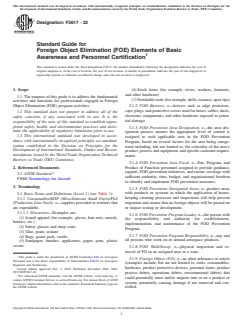
(Guide)Standard Guide for Foreign Object Elimination (FOE) Elements of Basic Awareness and Personnel Certification
General Information
- Abstract
SIGNIFICANCE AND USE
4.1 This guide is intended to be used by individuals and organizations who wish to document an understanding of FOE through a certification program. It is intended to be used in candidate preparation in concert with a certification provider’s structure and materials for certification management, including exam delivery and certification administration.
SCOPE
1.1 The purpose of this guide is to address the fundamental activities and functions for professionals engaged in Foreign Object Elimination (FOE) program activities.
1.2 This standard does not purport to address all of the safety concerns, if any, associated with its use. It is the responsibility of the user of this standard to establish appropriate safety, health, and environmental practices and determine the applicability of regulatory limitations prior to use.
1.3 This international standard was developed in accordance with internationally recognized principles on standardization established in the Decision on Principles for the Development of International Standards, Guides and Recommendations issued by the World Trade Organization Technical Barriers to Trade (TBT) Committee.
- Status
- Published
- Publication Date
- 31-Oct-2022
- Technical Committee
- F46 - Aerospace Personnel
- Drafting Committee
- F46.01 - Aerospace Engineers and Technicians

Overview
ASTM F3617-22: Standard Guide for Foreign Object Elimination (FOE) Elements of Basic Awareness and Personnel Certification provides foundational guidance for professionals and organizations involved in Foreign Object Elimination (FOE) program activities. Developed by ASTM Committee F46 on Aerospace Personnel, this internationally recognized standard establishes clear knowledge levels, terminology, and essential functions for personnel certification and basic awareness related to FOE. It enables organizations to structure effective certification programs, ensuring consistent understanding and application of FOE principles, particularly in environments where the risk of Foreign Object Damage (FOD) is significant.
Key Topics
The standard addresses a broad range of topics related to foreign object control, risk mitigation, and process management:
- Knowledge Levels: Defines three tiers-familiarization, general knowledge, and detailed knowledge-to support certification and training objectives.
- Terminology: Standardizes key terms such as Foreign Object (FO), Foreign Object Damage (FOD), Foreign Object Debris, and Foreign Object Elimination (FOE).
- Roles and Responsibilities:
- FOD Prevention Program Leader and Area Focal
- All personnel engaged in FOE-related activities
- Consumables and Hardware Control:
- Accountability for small parts, tools, materials, and issued items
- Processes for tracking, storing, and handling to prevent FOD incidents
- Housekeeping and Clean-As-You-Go: Emphasizes the importance of maintaining clean, orderly workspaces using methods such as 5S, FOD cans/bags, and clean-as-you-go processes.
- Reporting and Investigation: Outlines basic reporting protocols for FOD incidents, investigation processes, corrective actions, and follow-up.
- Tool Accountability: Provides guidance on tool control techniques, such as inventory logs, tool identification (e.g., RFID, barcodes, color coding), and consolidated tool kits.
Applications
ASTM F3617-22 is most applicable to industries and professionals who must minimize the risk of foreign object introduction and subsequent damage:
- Aerospace Manufacturing & Maintenance: Critical for preventing FOD during production, assembly, maintenance, and repair of aircraft and spacecraft components.
- Aviation Operations: Supports airport, airline, and service providers in implementing FOE certification and awareness programs.
- Defense & Military Equipment Production: Helps secure defense manufacturing environments facing high-reliability demands.
- Industrial Sectors with Cleanroom or High-Reliability Demands: Electronics, medical device production, and other sectors benefit from structured FOE prevention programs and personnel certification.
- Certification Bodies and Training Providers: Offers a framework for developing and delivering FOE certification, including exam administration and candidate preparation.
By adopting this standard, organizations can strengthen their FOD prevention strategies, standardize procedures, and foster a culture of accountability, housekeeping, and safety.
Related Standards
Organizations implementing ASTM F3617-22 should consider integrating or referencing these related documents for a comprehensive FOE/FOD management system:
- ASTM F3060 - Terminology for Aircraft
- FAA Advisory Circular 150/5370-2E - Operational Safety on Airports During Construction
- FAA Advisory Circular 150/5380-5B - Debris Hazards at Civil Airports
- NAS412 - Foreign Object Damage (FOD) Prevention Guidance Document
- Industry Guidelines - FOD Prevention Inc. Guidelines; FOD Control Corporation resources
Summary
ASTM F3617-22 establishes best practices and core knowledge for FOE programs, delivering practical and structured support for personnel certification, training, and ongoing FOD prevention in critical industries. Adhering to this standard improves safety, product quality, and operational reliability in any environment vulnerable to foreign object damage.
Keywords: FOE, FOD, Foreign Object Elimination, Foreign Object Damage, FOD prevention, FOE certification, housekeeping, tool accountability, 5S, aerospace standards, ASTM F3617.
Relations
- Effective Date
- 01-Jan-2020
- Effective Date
- 01-Nov-2016
- Effective Date
- 01-Apr-2016
- Effective Date
- 15-Sep-2015
- Effective Date
- 01-May-2015
- Effective Date
- 01-Mar-2015
- Effective Date
- 01-Dec-2014
Get Certified
Connect with accredited certification bodies for this standard

BSI Group
BSI (British Standards Institution) is the business standards company that helps organizations make excellence a habit.

Bureau Veritas
Bureau Veritas is a world leader in laboratory testing, inspection and certification services.

DNV
DNV is an independent assurance and risk management provider.
Sponsored listings
Frequently Asked Questions
ASTM F3617-22 is a guide published by ASTM International. Its full title is "Standard Guide for Foreign Object Elimination (FOE) Elements of Basic Awareness and Personnel Certification". This standard covers: SIGNIFICANCE AND USE 4.1 This guide is intended to be used by individuals and organizations who wish to document an understanding of FOE through a certification program. It is intended to be used in candidate preparation in concert with a certification provider’s structure and materials for certification management, including exam delivery and certification administration. SCOPE 1.1 The purpose of this guide is to address the fundamental activities and functions for professionals engaged in Foreign Object Elimination (FOE) program activities. 1.2 This standard does not purport to address all of the safety concerns, if any, associated with its use. It is the responsibility of the user of this standard to establish appropriate safety, health, and environmental practices and determine the applicability of regulatory limitations prior to use. 1.3 This international standard was developed in accordance with internationally recognized principles on standardization established in the Decision on Principles for the Development of International Standards, Guides and Recommendations issued by the World Trade Organization Technical Barriers to Trade (TBT) Committee.
SIGNIFICANCE AND USE 4.1 This guide is intended to be used by individuals and organizations who wish to document an understanding of FOE through a certification program. It is intended to be used in candidate preparation in concert with a certification provider’s structure and materials for certification management, including exam delivery and certification administration. SCOPE 1.1 The purpose of this guide is to address the fundamental activities and functions for professionals engaged in Foreign Object Elimination (FOE) program activities. 1.2 This standard does not purport to address all of the safety concerns, if any, associated with its use. It is the responsibility of the user of this standard to establish appropriate safety, health, and environmental practices and determine the applicability of regulatory limitations prior to use. 1.3 This international standard was developed in accordance with internationally recognized principles on standardization established in the Decision on Principles for the Development of International Standards, Guides and Recommendations issued by the World Trade Organization Technical Barriers to Trade (TBT) Committee.
ASTM F3617-22 is classified under the following ICS (International Classification for Standards) categories: 03.100.30 - Management of human resources; 49.020 - Aircraft and space vehicles in general. The ICS classification helps identify the subject area and facilitates finding related standards.
ASTM F3617-22 has the following relationships with other standards: It is inter standard links to ASTM F3060-20, ASTM F3060-16a, ASTM F3060-16, ASTM F3060-15b, ASTM F3060-15a, ASTM F3060-15, ASTM F3060-14. Understanding these relationships helps ensure you are using the most current and applicable version of the standard.
ASTM F3617-22 is available in PDF format for immediate download after purchase. The document can be added to your cart and obtained through the secure checkout process. Digital delivery ensures instant access to the complete standard document.
Standards Content (Sample)
This international standard was developed in accordance with internationally recognized principles on standardization established in the Decision on Principles for the
Development of International Standards, Guides and Recommendations issued by the World Trade Organization Technical Barriers to Trade (TBT) Committee.
Designation:F3617 −22
Standard Guide for
Foreign Object Elimination (FOE) Elements of Basic
Awareness and Personnel Certification
This standard is issued under the fixed designation F3617; the number immediately following the designation indicates the year of
original adoption or, in the case of revision, the year of last revision. A number in parentheses indicates the year of last reapproval. A
superscript epsilon (´) indicates an editorial change since the last revision or reapproval.
1. Scope (6) Stock items (for example, rivets, washers, fasteners,
and other hardware)
1.1 The purpose of this guide is to address the fundamental
(7) Perishabletools(forexample,drills,reamers,apextips)
activities and functions for professionals engaged in Foreign
Object Elimination (FOE) program activities.
3.1.2 FOD Barriers, n—devices such as edge protectors,
caps, plugs, and protective covers used for hoses, cables, ducts,
1.2 This standard does not purport to address all of the
electronic components, and other hardware exposed to poten-
safety concerns, if any, associated with its use. It is the
tial damage.
responsibility of the user of this standard to establish appro-
priate safety, health, and environmental practices and deter-
3.1.3 FOD Prevention Area Designation, n—the area des-
mine the applicability of regulatory limitations prior to use.
ignation process ensures the appropriate level of control is
1.3 This international standard was developed in accor-
assigned to each applicable area in the FOD Prevention
dance with internationally recognized principles on standard-
Program, based on several factors for the area being catego-
ization established in the Decision on Principles for the
rized including, but not limited to, the criticality of the area’s
Development of International Standards, Guides and Recom-
product, process and equipment, and specific customer require-
mendations issued by the World Trade Organization Technical
ments.
Barriers to Trade (TBT) Committee.
3.1.4 FOD Prevention Area Focal, n—Site, Program, and
Product of Function personnel assigned to provide guidance,
2. Referenced Documents
2 support, FOD prevention initiatives, and ensure coverage with
2.1 ASTM Standard:
sufficient authority, time, budget, and organizational freedom
F3060 Terminology for Aircraft
to identify and implement FOD prevention measures.
3. Terminology
3.1.5 FOD Prevention Designated Areas, n—product areas
with products or systems in which the application of house-
3.1 Basic Terms and Definitions (Level 1) (see Table 1):
3.1.1 Consumables/MSP (Miscellaneous Small Parts)/PLS keeping cleaning processes and inspections will help prevent
migration and ensure that no foreign objects will be passed on
(Production Line Stock), n—supplies provided to workers that
are expendable. or impact testing or development.
3.1.1.1 Discussion—Examples are:
3.1.6 FOD Prevention Program Leader, n—the person with
(1) Issued apparel (for example, gloves, hair nets, snoods,
the responsibility and authority for establishment,
booties, etc.)
implementation, and maintenance of the FOD Prevention
(2) Safety glasses and shop coats
Program.
(3) Glue, paint, sealant
3.1.7 FOD Prevention Program Responsibility, n—any and
(4) Rags, gauze pads, swabs
all persons who work on or around aerospace products.
(5) Sandpaper, brushes, applicators, paper, pens, plastic
covers
3.1.8 FOD Walk/Sweep, n—physical inspection and re-
moval of FO in an assigned area or a zone.
This guide is under the jurisdiction of ASTM Committee F46 on Aerospace
3.1.9 Foreign Object (FO), n—an alien substance or article
Personnel and is the direct responsibility of Subcommittee F46.01 on Aerospace
(examples include, but are not limited to, tools, consumables,
Engineers and Technicians.
hardware, product protective devices, personal items, product
Current edition approved Nov. 1, 2022. Published December 2022. DOI:
10.1520/F3617-22.
process debris, operations debris, environmental debris) that
For referenced ASTM standards, visit the ASTM website, www.astm.org, or
could potentially enter and/or migrate into or on a product or
contact ASTM Customer Service at service@astm.org. For Annual Book of ASTM
system, potentially causing damage if not removed and con-
Standards volume information, refer to the standard’s Document Summary page on
the ASTM website. trolled.
Copyright © ASTM International, 100 Barr Harbor Drive, PO Box C700, West Conshohocken, PA 19428-2959. United States
F3617−22
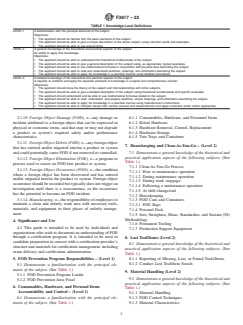
TABLE 1 Knowledge Level Definitions
LEVEL 1 A familiarization with the principal elements of the subject.
Objectives:
The applicant should be familiar with the basic elements of the subject.
The applicant should be able to give a simple description of the whole subject, using common words and examples.
The applicant should be able to use typical terms.
LEVEL 2 A general knowledge of the theoretical and practical aspects of the subject.
An ability to apply that knowledge.
Objectives:
The applicant should be able to understand the theoretical fundamentals of the subject.
The applicant should be able to give a general description of the subject using, as appropriate, typical examples.
The applicant should be able to use mathematical formulae in conjunction with physical laws describing the subject.
The applicant should be able to read and understand sketches, drawings, and schematics describing the subject.
The applicant should be able to apply his knowledge in a practical manner using detailed procedures.
LEVEL 3 A detailed knowledge of the theoretical and practical aspects of the subject.
A capacity to combine and apply the separate elements of knowledge in a logical and comprehensive manner.
Objectives:
The applicant should know the theory of the subject and interrelationships with other subjects.
The applicant should be able to give a detailed description of the subject using theoretical fundamentals and specific examples.
The applicant should understand and be able to use mathematical formulae related to the subject.
The applicant should be able to read, understand, and prepare sketches, simple drawings, and schematics describing the subject.
The applicant should be able to apply his knowledge in a practical manner using manufacturer’s instructions.
The applicant should be able to interpret results from various sources and measurements and apply corrective action where appropriate.
3.1.10 Foreign Object Damage (FOD), n—any damage or 6.1.1 Consumables, Hardware, and Personnel Items
incident attributed to a foreign object that can be expressed in 6.1.2 Kitted Hardware
physical or economic terms, and that may or may not degrade 6.1.3 Hardware Removal, Control, Replacement
a product or system’s required safety and/or performance 6.1.4 Hardware Storage
characteristics. 6.1.5 Tote Trays and Containers
3.1.11 Foreign Object Debris (FOD), n—any foreign object
7. Housekeeping and Clean-As-You-Go – (Level 2)
that has entered and/or migrated into/on a product or system
7.1 Demonstrate a general knowledge of the theoretical and
and could potentially cause FOD if not removed or controlled.
practical application aspects of the following subjects. (See
3.1
...