

ASTM F3330-23
(Specification)Standard Specification for Training and the Development of Training Manuals for the UAS Operator
General Information
- Abstract
SCOPE
1.1 This specification defines the requirements for training and the development of training manuals for the unmanned aircraft systems (UAS) operator.
1.2 The specification addresses the requirements or best practices, or both, for documentation and organization of a professional operator (that is, for compensation and hire) for the purposes of internal training programs and for programs offered to the general public.
1.3 This specification supports professional entities that will receive operator certification by a CAA, and provide standards of practice for self- or third-party audit of operators of UAS.
1.4 The standard case study used to develop this specification focused on operators of light UAS (below 1320 lb/600 kg as defined by EASA), but the specification may be applied to larger aircraft for using other methods of classification (that is, risk based classes and pilot privileges classes).
1.5 Training manuals that do not include all the minimum requirements of this specification may not be referred to as meeting this specification.
1.6 The values stated in inch-pound units are to be regarded as standard. The values given in parentheses are mathematical conversions to SI units that are provided for information only and are not considered standard.
1.7 This standard does not purport to address all of the safety concerns, if any, associated with its use. It is the responsibility of the user of this standard to establish appropriate safety, health, and environmental practices and determine the applicability of regulatory limitations prior to use.
1.8 This international standard was developed in accordance with internationally recognized principles on standardization established in the Decision on Principles for the Development of International Standards, Guides and Recommendations issued by the World Trade Organization Technical Barriers to Trade (TBT) Committee.
- Status
- Published
- Publication Date
- 14-Jan-2023
- Technical Committee
- F38 - Unmanned Aircraft Systems
- Drafting Committee
- F38.03 - Personnel Training, Qualification and Certification
Buy Documents


ASTM F3330-23 - Standard Specification for Training and the Development of Training Manuals for the UAS Operator
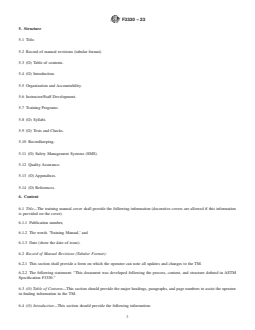
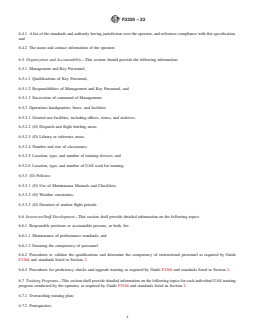
REDLINE ASTM F3330-23 - Standard Specification for Training and the Development of Training Manuals for the UAS Operator
Overview
ASTM F3330-23: Standard Specification for Training and the Development of Training Manuals for the UAS Operator sets the requirements for developing and maintaining training manuals and programs for unmanned aircraft systems (UAS) operators. This internationally recognized standard, developed by ASTM Committee F38, prescribes best practices for both organizational documentation and professional training, supporting the certification of UAS operators by civil aviation authorities (CAA).
The standard is designed for entities conducting internal or public training for professional UAS operators, particularly those operating for compensation or hire. While initially focused on operators of light UAS (aircraft under 1320 lb/600 kg, as defined by EASA), ASTM F3330-23 also provides foundational requirements applicable to larger UAS through risk-based classification or pilot privilege classes.
Key Topics
- Training Manual Development: Outlines the structure, content, and required sections of UAS operator training manuals, ensuring completeness and clarity.
- Organizational Requirements: Specifies necessary documentation related to management, operations, roles and responsibilities, and training facilities or devices.
- Instructor/Staff Qualifications: Details procedures for ensuring staff competency, including qualification validation, proficiency checks, and ongoing development.
- Training Program Content: Mandates inclusion of overarching training plans, program prerequisites, objectives, required resources, and student assessment methods.
- Quality Assurance & Recordkeeping: Requires formalized review systems, standardized recordkeeping for student and staff records, internal and external audit procedures, and corrective action processes.
- Safety and Compliance: Encourages adoption of Safety Management Systems (SMS) and ensures that manuals conform to relevant standards and regulatory requirements.
Applications
The implementation of ASTM F3330-23 provides measurable value in the rapidly growing UAS industry:
- Professional UAS Operator Training: Ensures training programs meet high industry standards, resulting in safer and more effective UAS operations.
- Certification Support: Assists organizations in meeting CAA requirements for operator certification, facilitating legal and regulatory compliance.
- Internal Training Programs: Enables organizations to design, revise, and audit internal training protocols, ensuring consistency and quality across teams.
- Public Training Offerings: Sets a benchmark for commercial training organizations delivering UAS operator courses to the general public.
- Audit and Oversight: Supplies a clear framework for conducting self-assessments or third-party audits of UAS operator training programs.
By adhering to ASTM F3330-23, organizations can improve safety, establish operational credibility, and streamline the certification process for UAS operations.
Related Standards
ASTM F3330-23 references and aligns with several foundational standards and guides that further support UAS operator training and terminology, including:
- ASTM E2521: Terminology for Evaluating Response Robot Capabilities
- ASTM F2909: Specification for Continued Airworthiness of Lightweight Unmanned Aircraft Systems
- ASTM F3060: Terminology for Aircraft
- ASTM F3178: Practice for Operational Risk Assessment of Small Unmanned Aircraft Systems (sUAS)
- ASTM F3266: Guide for Training for Remote Pilot in Command of Unmanned Aircraft Systems (UAS) Endorsement
- ASTM F3341/F3341M: Terminology for Unmanned Aircraft Systems
- ICAO Doc 9841: Manual on the Approval of Training Organizations
Professionals seeking to develop or audit UAS operator training manuals should use ASTM F3330-23 in conjunction with these standards to ensure comprehensive, compliant, and effective training outcomes.
Keywords: UAS training manual, unmanned aircraft systems, ASTM F3330-23, operator certification, UAS training program, quality assurance, safety management, professional UAS operator, training documentation, civil aviation authority compliance.
Relations
- Effective Date
- 01-Jan-2020
- Effective Date
- 01-Sep-2019
- Effective Date
- 01-Nov-2016
- Effective Date
- 01-Nov-2016
- Effective Date
- 01-Apr-2016
- Effective Date
- 15-Sep-2015
- Effective Date
- 01-May-2015
- Effective Date
- 01-Mar-2015
- Effective Date
- 01-Dec-2014
- Effective Date
- 15-Jan-2014
- Effective Date
- 01-Aug-2007
- Effective Date
- 01-Feb-2007
Buy Documents
ASTM F3330-23 - Standard Specification for Training and the Development of Training Manuals for the UAS Operator
REDLINE ASTM F3330-23 - Standard Specification for Training and the Development of Training Manuals for the UAS Operator
Get Certified
Connect with accredited certification bodies for this standard

BSI Group
BSI (British Standards Institution) is the business standards company that helps organizations make excellence a habit.

Bureau Veritas
Bureau Veritas is a world leader in laboratory testing, inspection and certification services.

DNV
DNV is an independent assurance and risk management provider.
Sponsored listings
Frequently Asked Questions
ASTM F3330-23 is a technical specification published by ASTM International. Its full title is "Standard Specification for Training and the Development of Training Manuals for the UAS Operator". This standard covers: SCOPE 1.1 This specification defines the requirements for training and the development of training manuals for the unmanned aircraft systems (UAS) operator. 1.2 The specification addresses the requirements or best practices, or both, for documentation and organization of a professional operator (that is, for compensation and hire) for the purposes of internal training programs and for programs offered to the general public. 1.3 This specification supports professional entities that will receive operator certification by a CAA, and provide standards of practice for self- or third-party audit of operators of UAS. 1.4 The standard case study used to develop this specification focused on operators of light UAS (below 1320 lb/600 kg as defined by EASA), but the specification may be applied to larger aircraft for using other methods of classification (that is, risk based classes and pilot privileges classes). 1.5 Training manuals that do not include all the minimum requirements of this specification may not be referred to as meeting this specification. 1.6 The values stated in inch-pound units are to be regarded as standard. The values given in parentheses are mathematical conversions to SI units that are provided for information only and are not considered standard. 1.7 This standard does not purport to address all of the safety concerns, if any, associated with its use. It is the responsibility of the user of this standard to establish appropriate safety, health, and environmental practices and determine the applicability of regulatory limitations prior to use. 1.8 This international standard was developed in accordance with internationally recognized principles on standardization established in the Decision on Principles for the Development of International Standards, Guides and Recommendations issued by the World Trade Organization Technical Barriers to Trade (TBT) Committee.
SCOPE 1.1 This specification defines the requirements for training and the development of training manuals for the unmanned aircraft systems (UAS) operator. 1.2 The specification addresses the requirements or best practices, or both, for documentation and organization of a professional operator (that is, for compensation and hire) for the purposes of internal training programs and for programs offered to the general public. 1.3 This specification supports professional entities that will receive operator certification by a CAA, and provide standards of practice for self- or third-party audit of operators of UAS. 1.4 The standard case study used to develop this specification focused on operators of light UAS (below 1320 lb/600 kg as defined by EASA), but the specification may be applied to larger aircraft for using other methods of classification (that is, risk based classes and pilot privileges classes). 1.5 Training manuals that do not include all the minimum requirements of this specification may not be referred to as meeting this specification. 1.6 The values stated in inch-pound units are to be regarded as standard. The values given in parentheses are mathematical conversions to SI units that are provided for information only and are not considered standard. 1.7 This standard does not purport to address all of the safety concerns, if any, associated with its use. It is the responsibility of the user of this standard to establish appropriate safety, health, and environmental practices and determine the applicability of regulatory limitations prior to use. 1.8 This international standard was developed in accordance with internationally recognized principles on standardization established in the Decision on Principles for the Development of International Standards, Guides and Recommendations issued by the World Trade Organization Technical Barriers to Trade (TBT) Committee.
ASTM F3330-23 is classified under the following ICS (International Classification for Standards) categories: 03.100.30 - Management of human resources; 49.020 - Aircraft and space vehicles in general. The ICS classification helps identify the subject area and facilitates finding related standards.
ASTM F3330-23 has the following relationships with other standards: It is inter standard links to ASTM F3060-20, ASTM F2909-19, ASTM F3178-16, ASTM F3060-16a, ASTM F3060-16, ASTM F3060-15b, ASTM F3060-15a, ASTM F3060-15, ASTM F3060-14, ASTM F2909-14, ASTM E2521-07a, ASTM E2521-07. Understanding these relationships helps ensure you are using the most current and applicable version of the standard.
ASTM F3330-23 is available in PDF format for immediate download after purchase. The document can be added to your cart and obtained through the secure checkout process. Digital delivery ensures instant access to the complete standard document.
Standards Content (Sample)
This international standard was developed in accordance with internationally recognized principles on standardization established in the Decision on Principles for the
Development of International Standards, Guides and Recommendations issued by the World Trade Organization Technical Barriers to Trade (TBT) Committee.
Designation: F3330 − 23
Standard Specification for
Training and the Development of Training Manuals for the
UAS Operator
This standard is issued under the fixed designation F3330; the number immediately following the designation indicates the year of
original adoption or, in the case of revision, the year of last revision. A number in parentheses indicates the year of last reapproval. A
superscript epsilon (´) indicates an editorial change since the last revision or reapproval.
1. Scope mendations issued by the World Trade Organization Technical
Barriers to Trade (TBT) Committee.
1.1 This specification defines the requirements for training
and the development of training manuals for the unmanned
2. Referenced Documents
aircraft systems (UAS) operator.
2.1 ASTM Standards:
1.2 The specification addresses the requirements or best
E2521 Terminology for Evaluating Response Robot Capa-
practices, or both, for documentation and organization of a
bilities
professional operator (that is, for compensation and hire) for
F2909 Specification for Continued Airworthiness of Light-
the purposes of internal training programs and for programs
weight Unmanned Aircraft Systems
offered to the general public.
F3060 Terminology for Aircraft
F3178 Practice for Operational Risk Assessment of Small
1.3 This specification supports professional entities that will
Unmanned Aircraft Systems (sUAS)
receive operator certification by a CAA, and provide standards
F3266 Guide for Training for Remote Pilot in Command of
of practice for self- or third-party audit of operators of UAS.
Unmanned Aircraft Systems (UAS) Endorsement
1.4 The standard case study used to develop this specifica-
F3341/F3341M Terminology for Unmanned Aircraft Sys-
tion focused on operators of light UAS (below 1320 lb/600 kg
tems
as defined by EASA), but the specification may be applied to
2.2 ICAO Standards:
larger aircraft for using other methods of classification (that is,
Doc 9841 Manual on the Approval of Training Organiza-
risk based classes and pilot privileges classes).
tions
1.5 Training manuals that do not include all the minimum
3. Terminology
requirements of this specification may not be referred to as
meeting this specification.
3.1 Unique and Common Terminology—Terminology used
in multiple standards is defined in F3341/F3341M, UAS
1.6 The values stated in inch-pound units are to be regarded
Terminology Standard, and F3060, Aircraft Terminology Stan-
as standard. The values given in parentheses are mathematical
dard. Terminology that is unique to this specification is defined
conversions to SI units that are provided for information only
in this section.
and are not considered standard.
3.1.1 light UAS, n—an unmanned aircraft system with the
1.7 This standard does not purport to address all of the
unmanned aircraft weighing less than 1320 lb (600 kg).
safety concerns, if any, associated with its use. It is the
Derived from the EASA definition in harmonized specifica-
responsibility of the user of this standard to establish appro-
tions for Light Unmanned Rotorcraft Systems (CS-LURS).
priate safety, health, and environmental practices and deter-
3.1.2 maintenance manual(s), n—manual provided by a
mine the applicability of regulatory limitations prior to use.
UAS manufacturer or supplier that specifies all maintenance,
1.8 This international standard was developed in accor-
repairs, and alterations authorized by the manufacturer.
dance with internationally recognized principles on standard-
ization established in the Decision on Principles for the 3.1.3 operator, n—any owner of UAS that operates the
Development of International Standards, Guides and Recom- UAS, that is, uses, causes to use, or authorizes the use of the
UAS.
1 2
This specification is under the jurisdiction of ASTM Committee F38 on For referenced ASTM standards, visit the ASTM website, www.astm.org, or
Unmanned Aircraft Systems and is the direct responsibility of Subcommittee F38.03 contact ASTM Customer Service at service@astm.org. For Annual Book of ASTM
on Personnel Training, Qualification and Certification. Standards volume information, refer to the standard’s Document Summary page on
Current edition approved Jan. 15, 2023. Published February 2023. Originally the ASTM website.
approved in 2018. Last previous edition approved in 2018 as F3330–18. DOI: Available from International Civil Aviation Organization (ICAO), 999 Robert-
10.1520/F3330-23. Bourassa Blvd, Montréal, Québec H3C 5H7, Canada, https://www.icao.int.
Copyright © ASTM International, 100 Barr Harbor Drive, PO Box C700, West Conshohocken, PA 19428-2959. United States
F3330 − 23
3.1.3.1 Discussion—In this standard, the connotation is 6.1.1 Publication number,
towards an organization, rather than an individual (that is, 6.1.2 The words ‘Training Manual,’ and
“company” versus “owner-operator”).
6.1.3 Date (show the date of issue).
3.2 This standard uses terminology contained within Termi- 6.2 Record of Manual Revisions (Tabular Format):
nology E2521. These terms are not duplicated within this
6.2.1 This section shall provide a form on which the
document: omni bucket stand, perch, visual/thermal acuity operator can note all updates and changes to the TM.
target, fault.
6.2.2 The following statement: “This document was devel-
oped following the process, content, and structure defined in
4. General Requirements
ASTM Specification F3330.”
4.1 The applicant shall prepare a program to show how
6.3 (O) Table of Contents—This section should provide the
changes to the training manual made by the applicant or by the
major headings, paragraphs, and page numbers to assist the
manufacturers of products and appliances installed in the UAS
operator in finding information in the TM.
will be distributed.
6.4 (O) Introduction—This section should provide the fol-
4.2 The training manual shall be in the form of a manual or
lowing information:
manuals as appropriate for the quantity of data to be provided.
6.4.1 A list of the standards and authority having jurisdic-
4.3 The format of the manual or manuals shall provide for a
tion over the operator, and reference compliance with this
practical arrangement. specification, and
6.4.2 The name and contact information of the operator.
4.4 The contents of the manual or manuals shall be pr
...
This document is not an ASTM standard and is intended only to provide the user of an ASTM standard an indication of what changes have been made to the previous version. Because
it may not be technically possible to adequately depict all changes accurately, ASTM recommends that users consult prior editions as appropriate. In all cases only the current version
of the standard as published by ASTM is to be considered the official document.
Designation: F3330 − 18 F3330 − 23
Standard Specification for
Training and the Development of Training Manuals for the
UAS Operator
This standard is issued under the fixed designation F3330; the number immediately following the designation indicates the year of
original adoption or, in the case of revision, the year of last revision. A number in parentheses indicates the year of last reapproval. A
superscript epsilon (´) indicates an editorial change since the last revision or reapproval.
1. Scope
1.1 This specification defines the requirements for training and the development of training manuals for the unmanned aircraft
systems (UAS) operator.
1.2 The specification addresses the requirements or best practices, or both, for documentation and organization of a professional
operator (that is, for compensation and hire) for the purposes of internal training programs and for programs offered to the general
public.
1.3 This specification supports professional entities that will receive operator certification by a CAA, and provide standards of
practice for self- or third-party audit of operators of UAS.
1.4 The standard case study used to develop this specification focused on operators of light UAS (below 1320 lb/600 kg as defined
by EASA), but the specification may be applied to larger aircraft for using other methods of classification (that is, risk based classes
and pilot privileges classes).
1.5 Training manuals that do not include all the minimum requirements of this specification may not be referred to as meeting this
specification.
1.6 The values stated in inch-pound units are to be regarded as standard. The values given in parentheses are mathematical
conversions to SI units that are provided for information only and are not considered standard.
1.7 This standard does not purport to address all of the safety concerns, if any, associated with its use. It is the responsibility
of the user of this standard to establish appropriate safety, health, and environmental practices and determine the applicability of
regulatory limitations prior to use.
1.8 This international standard was developed in accordance with internationally recognized principles on standardization
established in the Decision on Principles for the Development of International Standards, Guides and Recommendations issued
by the World Trade Organization Technical Barriers to Trade (TBT) Committee.
This specification is under the jurisdiction of ASTM Committee F38 on Unmanned Aircraft Systems and is the direct responsibility of Subcommittee F38.03 on Personnel
Training, Qualification and Certification.
Current edition approved Sept. 1, 2018Jan. 15, 2023. Published September 2018February 2023. Originally approved in 2018. Last previous edition approved in 2018 as
F3330–18. DOI: 10.1520/F3330-18.10.1520/F3330-23.
Copyright © ASTM International, 100 Barr Harbor Drive, PO Box C700, West Conshohocken, PA 19428-2959. United States
F3330 − 23
2. Referenced Documents
2.1 ASTM Standards:
E2521 Terminology for Evaluating Response Robot Capabilities
F2909 Specification for Continued Airworthiness of Lightweight Unmanned Aircraft Systems
F3060 Terminology for Aircraft
F3178 Practice for Operational Risk Assessment of Small Unmanned Aircraft Systems (sUAS)
F3266 Guide for Training for Remote Pilot in Command of Unmanned Aircraft Systems (UAS) Endorsement
F3341/F3341M Terminology for Unmanned Aircraft Systems
2.2 ICAO Standards:
Doc 9841 Manual on the Approval of Training Organizations
3. Terminology
3.1 Definitions:Unique and Common Terminology—Terminology used in multiple standards is defined in F3341/F3341M, UAS
Terminology Standard, and F3060, Aircraft Terminology Standard. Terminology that is unique to this specification is defined in
this section.
3.1.1 light UAS, n—an unmanned aircraft system with the unmanned aircraft weighing less than 1320 lb (600 kg). Derived from
the EASA definition in harmonized specifications for Light Unmanned Rotorcraft Systems (CS-LURS).
3.1.2 maintenance manual(s)—manual(s), n—manual provided by a UAS manufacturer or supplier that specifies all maintenance,
repairs, and alterations authorized by the manufacturer.
3.1.3 operator, n—any owner of UAS that operates the UAS, that is, uses, causes to use, or authorizes the use of the UAS.
3.1.3.1 Discussion—
In this standard, the connotation is towards an organization, rather than an individual (that is, “company” versus “owner-operator”).
3.2 This standard uses terminology contained within Terminology E2521. These terms are not duplicated within this document:
omni bucket stand, perch, visual/thermal acuity target, fault.
4. General Requirements
4.1 The applicant shall prepare a program to show how changes to the training manual made by the applicant or by the
manufacturers of products and appliances installed in the UAS will be distributed.
4.2 The training manual shall be in the form of a manual or manuals as appropriate for the quantity of data to be provided.
4.3 The format of the manual or manuals shall provide for a practical arrangement.
4.4 The contents of the manual or manuals shall be prepared in the English language or other language acceptable to the certifying
authority.
4.5 The training manual shall contain the following manuals or sections, as appropriate, and information described in Sections 5
and 6.
4.6 Due to the wide variety in size, weight, and system complexity of UAS, not all items will apply to all systems. Optional items
are marked by (O). Components required for the safe operation of the UAS may not be identified as optional (O) in the training
manual. All other items are considered mandatory for inclusion. However, if an applicant wishes to exclude a mandatory item, a
statement of justification shall be included in the training manual.
For referenced ASTM standards, visit the ASTM website, www.astm.org, or contact ASTM Customer Service at service@astm.org. For Annual Book of ASTM Standards
volume information, refer to the standard’sstandard’s Document Summary page on the ASTM website.
Available from International Civil Aviation Organization (ICAO), 999 Robert-Bourassa Blvd, Montréal, Québec H3C 5H7, Canada, https://www.icao.int.
F3330 − 23
5. Structure
5.1 Title.
5.2 Record of manual revisions (tabular format).
5.3 (O) Table of con
...