

ASTM F2909-19
(Specification)Standard Specification for Continued Airworthiness of Lightweight Unmanned Aircraft Systems
General Information
- Abstract
SCOPE
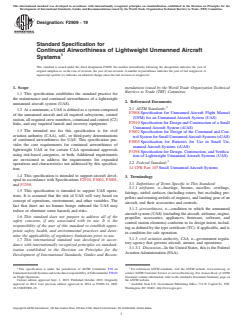
1.1 This specification establishes the standard practice for the maintenance and continued airworthiness of a lightweight unmanned aircraft system (UAS).
1.2 At a minimum, a UAS is defined as a system composed of the unmanned aircraft and all required subsystems, control station, all required crew members, command and control (C2) links, and any required launch and recovery equipment.
1.3 The intended use for this specification is for civil aviation authority (CAA), self-, or third-party determinations of continued airworthiness for UAS. This specification provides the core requirements for continued airworthiness of lightweight UAS or for certain CAA operational approvals using risk-based categories, or both. Additional requirements are envisioned to address the requirements for expanded operations and characteristics not addressed by this specification.
1.4 This specification is intended to support aircraft developed in accordance with Specifications F2910, F3002, F3005, and F3298.
1.5 This specification is intended to support UAS operations. It is assumed that the risk of UAS will vary based on concept of operations, environment, and other variables. The fact that there are no human beings onboard the UAS may reduce or eliminate some hazards and risks.
1.6 This standard does not purport to address all of the safety concerns, if any, associated with its use. It is the responsibility of the user of this standard to establish appropriate safety, health, and environmental practices and determine the applicability of regulatory limitations prior to use.
1.7 This international standard was developed in accordance with internationally recognized principles on standardization established in the Decision on Principles for the Development of International Standards, Guides and Recommendations issued by the World Trade Organization Technical Barriers to Trade (TBT) Committee.
- Status
- Published
- Publication Date
- 31-Aug-2019
- Technical Committee
- F38 - Unmanned Aircraft Systems
- Drafting Committee
- F38.02 - Flight Operations
Buy Documents
ASTM F2909-19 - Standard Specification for Continued Airworthiness of Lightweight Unmanned Aircraft Systems
REDLINE ASTM F2909-19 - Standard Specification for Continued Airworthiness of Lightweight Unmanned Aircraft Systems
Overview
ASTM F2909-19: Standard Specification for Continued Airworthiness of Lightweight Unmanned Aircraft Systems establishes requirements and best practices for the ongoing maintenance and airworthiness of lightweight unmanned aircraft systems (UAS). Developed by ASTM International Committee F38, this specification supports consistent operational safety and regulatory compliance for operators, manufacturers, and civil aviation authorities (CAA).
A lightweight UAS, as defined here, includes not only the unmanned aircraft itself but also all required onboard systems, ground control components, command and control (C2) links, personnel, and all necessary launch and recovery equipment. ASTM F2909-19 is designed to align with evolving regulatory and technical landscapes, and is intended for application in civil sectors where risk-based categorization and operational approval are necessary.
Key Topics
Continued Airworthiness: Establishes requirements for maintaining UAS in a condition for safe operation, ensuring all systems meet performance and reliability expectations over time.
Inspection and Maintenance Programs:
- Scheduled Maintenance: Manufacturers must define and document required intervals for inspections and include them in the Aircraft Flight Manual. Regular periodic and preflight inspections are emphasized.
- Preflight Inspections: Outlines key checks, such as visual examination of airframes, control surfaces, propulsion systems, batteries, and communications links to ensure readiness for each flight.
- Periodic Inspections: Focuses on deeper, recurring checks of systems like fuel, engine, wiring, and critical electronic subsystems.
Repairs and Alterations: Manufacturers must define what constitutes major and minor repairs or alterations, specify who is authorized for such work, and ensure weight and balance verifications after maintenance.
Maintenance Records: Comprehensive logs are mandatory for all UAS components, including details of inspections, maintenance actions, repairs, and alterations. Logbooks must be kept up-to-date for each major subcomponent.
Safety Directives and Corrective Actions: Procedures for issuing mandatory safety directives or notices of corrective action are defined, including risk assessments, communication protocols with operators, and instructions for compliance.
Manufacturer and Owner/Operator Responsibilities:
- Manufacturers must provide ongoing support, safety monitoring, and proper documentation for continued airworthiness.
- Owners/operators are obligated to comply with directives, maintain records, report issues, and provide contact information for safety notifications.
Applications
ASTM F2909-19 delivers significant practical value to various stakeholders involved with lightweight and small unmanned aircraft systems:
- UAS Manufacturers: Use the standard to develop maintenance manuals, inspection checklists, and airworthiness documentation supporting safe, reliable products.
- Operators and Service Providers: Apply these practices to establish robust maintenance cycles that help prevent failures, reduce downtime, extend aircraft life, and demonstrate regulatory compliance.
- Civil Aviation Authorities: Reference the standard when granting operational approval or assessing compliance in risk-based operational categories.
- Third-party Maintenance Organizations: Align maintenance and inspection services with recognized international best practices, ensuring technical consistency and traceable records.
By fostering proactive maintenance programs and robust recordkeeping, ASTM F2909-19 helps prevent system failures, enhances operational safety, supports regulatory approval, and underpins the evolving ecosystem of commercial or civil drone operations.
Related Standards
ASTM F2909-19 is part of a broader suite of UAS standards. Key related documents include:
- ASTM F2910: Design and construction of small unmanned aircraft systems
- ASTM F3002: Design of command and control systems for sUAS
- ASTM F3005: Battery specifications for small UAS
- ASTM F2908: Aircraft flight manual specifications for UAS
- ASTM F3298: Design, construction, and verification of lightweight UAS
- 14 CFR Part 107: Federal regulations relating to small UAS operations (U.S.)
Keywords
continued airworthiness, UAS maintenance, unmanned aircraft systems, sUAS, ASTM F2909-19, drone inspection, UAS regulatory compliance, small drone standards, airworthiness directives
Relations
- Effective Date
- 01-Sep-2019
- Effective Date
- 01-Feb-2019
- Effective Date
- 01-May-2018
- Effective Date
- 15-Feb-2016
- Effective Date
- 15-Jan-2014
- Effective Date
- 15-Jan-2014
- Effective Date
- 15-Jan-2014
- Effective Date
- 01-Sep-2019
- Effective Date
- 01-Sep-2019
- Referred By
ASTM F3322-22 - Standard Specification for Small Unmanned Aircraft System (sUAS) Parachutes - Effective Date
- 01-Sep-2019
- Effective Date
- 01-Sep-2019
- Effective Date
- 01-Sep-2019
- Effective Date
- 01-Sep-2019
- Effective Date
- 01-Sep-2019
- Effective Date
- 01-Sep-2019
Buy Documents
ASTM F2909-19 - Standard Specification for Continued Airworthiness of Lightweight Unmanned Aircraft Systems
REDLINE ASTM F2909-19 - Standard Specification for Continued Airworthiness of Lightweight Unmanned Aircraft Systems
Get Certified
Connect with accredited certification bodies for this standard

BSI Group
BSI (British Standards Institution) is the business standards company that helps organizations make excellence a habit.

Bureau Veritas
Bureau Veritas is a world leader in laboratory testing, inspection and certification services.

DNV
DNV is an independent assurance and risk management provider.
Sponsored listings
Frequently Asked Questions
ASTM F2909-19 is a technical specification published by ASTM International. Its full title is "Standard Specification for Continued Airworthiness of Lightweight Unmanned Aircraft Systems". This standard covers: SCOPE 1.1 This specification establishes the standard practice for the maintenance and continued airworthiness of a lightweight unmanned aircraft system (UAS). 1.2 At a minimum, a UAS is defined as a system composed of the unmanned aircraft and all required subsystems, control station, all required crew members, command and control (C2) links, and any required launch and recovery equipment. 1.3 The intended use for this specification is for civil aviation authority (CAA), self-, or third-party determinations of continued airworthiness for UAS. This specification provides the core requirements for continued airworthiness of lightweight UAS or for certain CAA operational approvals using risk-based categories, or both. Additional requirements are envisioned to address the requirements for expanded operations and characteristics not addressed by this specification. 1.4 This specification is intended to support aircraft developed in accordance with Specifications F2910, F3002, F3005, and F3298. 1.5 This specification is intended to support UAS operations. It is assumed that the risk of UAS will vary based on concept of operations, environment, and other variables. The fact that there are no human beings onboard the UAS may reduce or eliminate some hazards and risks. 1.6 This standard does not purport to address all of the safety concerns, if any, associated with its use. It is the responsibility of the user of this standard to establish appropriate safety, health, and environmental practices and determine the applicability of regulatory limitations prior to use. 1.7 This international standard was developed in accordance with internationally recognized principles on standardization established in the Decision on Principles for the Development of International Standards, Guides and Recommendations issued by the World Trade Organization Technical Barriers to Trade (TBT) Committee.
SCOPE 1.1 This specification establishes the standard practice for the maintenance and continued airworthiness of a lightweight unmanned aircraft system (UAS). 1.2 At a minimum, a UAS is defined as a system composed of the unmanned aircraft and all required subsystems, control station, all required crew members, command and control (C2) links, and any required launch and recovery equipment. 1.3 The intended use for this specification is for civil aviation authority (CAA), self-, or third-party determinations of continued airworthiness for UAS. This specification provides the core requirements for continued airworthiness of lightweight UAS or for certain CAA operational approvals using risk-based categories, or both. Additional requirements are envisioned to address the requirements for expanded operations and characteristics not addressed by this specification. 1.4 This specification is intended to support aircraft developed in accordance with Specifications F2910, F3002, F3005, and F3298. 1.5 This specification is intended to support UAS operations. It is assumed that the risk of UAS will vary based on concept of operations, environment, and other variables. The fact that there are no human beings onboard the UAS may reduce or eliminate some hazards and risks. 1.6 This standard does not purport to address all of the safety concerns, if any, associated with its use. It is the responsibility of the user of this standard to establish appropriate safety, health, and environmental practices and determine the applicability of regulatory limitations prior to use. 1.7 This international standard was developed in accordance with internationally recognized principles on standardization established in the Decision on Principles for the Development of International Standards, Guides and Recommendations issued by the World Trade Organization Technical Barriers to Trade (TBT) Committee.
ASTM F2909-19 is classified under the following ICS (International Classification for Standards) categories: 49.020 - Aircraft and space vehicles in general. The ICS classification helps identify the subject area and facilitates finding related standards.
ASTM F2909-19 has the following relationships with other standards: It is inter standard links to ASTM F2909-14, ASTM F3298-19, ASTM F3298-18, ASTM F2908-16, ASTM F3005-14, ASTM F3002-14, ASTM F2908-14, ASTM F3196-18, ASTM F2908-23, ASTM F3322-22, ASTM F3366-19, ASTM F3478-20, ASTM F3341/F3341M-23, ASTM F3330-23, ASTM F2910-22. Understanding these relationships helps ensure you are using the most current and applicable version of the standard.
ASTM F2909-19 is available in PDF format for immediate download after purchase. The document can be added to your cart and obtained through the secure checkout process. Digital delivery ensures instant access to the complete standard document.
Standards Content (Sample)
This international standard was developed in accordance with internationally recognized principles on standardization established in the Decision on Principles for the
Development of International Standards, Guides and Recommendations issued by the World Trade Organization Technical Barriers to Trade (TBT) Committee.
Designation:F2909 −19
Standard Specification for
Continued Airworthiness of Lightweight Unmanned Aircraft
Systems
This standard is issued under the fixed designation F2909; the number immediately following the designation indicates the year of
original adoption or, in the case of revision, the year of last revision. A number in parentheses indicates the year of last reapproval. A
superscript epsilon (´) indicates an editorial change since the last revision or reapproval.
1. Scope mendations issued by the World Trade Organization Technical
Barriers to Trade (TBT) Committee.
1.1 This specification establishes the standard practice for
the maintenance and continued airworthiness of a lightweight
2. Referenced Documents
unmanned aircraft system (UAS).
2.1 ASTM Standards:
1.2 At a minimum, a UAS is defined as a system composed
F2908 Specification for Unmanned Aircraft Flight Manual
of the unmanned aircraft and all required subsystems, control
(UFM) for an Unmanned Aircraft System (UAS)
station, all required crew members, command and control (C2)
F2910 Specification for Design and Construction of a Small
links, and any required launch and recovery equipment.
Unmanned Aircraft System (sUAS)
1.3 The intended use for this specification is for civil
F3002 Specification for Design of the Command and Con-
aviation authority (CAA), self-, or third-party determinations
trolSystemforSmallUnmannedAircraftSystems(sUAS)
of continued airworthiness for UAS. This specification pro-
F3005 Specification for Batteries for Use in Small Un-
vides the core requirements for continued airworthiness of
manned Aircraft Systems (sUAS)
lightweight UAS or for certain CAA operational approvals
F3298 Specification for Design, Construction, and Verifica-
using risk-based categories, or both. Additional requirements
tion of Lightweight Unmanned Aircraft Systems (UAS)
are envisioned to address the requirements for expanded
2.2 Federal Standard:
operations and characteristics not addressed by this specifica-
14 CFR Part 107 Small Unmanned Aircraft Systems
tion.
1.4 This specification is intended to support aircraft devel-
3. Terminology
oped in accordance with Specifications F2910, F3002, F3005,
3.1 Definitions of Terms Specific to This Standard:
and F3298.
3.1.1 airframe, n—fuselage, booms, nacelles, cowlings,
1.5 This specification is intended to support UAS opera-
fairings, airfoil surfaces (including rotors, but excluding pro-
tions. It is assumed that the risk of UAS will vary based on
pellers and rotating airfoils of engines), and landing gear of an
concept of operations, environment, and other variables. The
aircraft, and their accessories and controls.
fact that there are no human beings onboard the UAS may
3.1.2 airworthiness, n—condition in which the unmanned
reduce or eliminate some hazards and risks.
aircraft system (UAS) (including the aircraft, airframe, engine,
1.6 This standard does not purport to address all of the
propeller, accessories, appliances, firmware, software, and
safety concerns, if any, associated with its use. It is the
control station elements) conforms to its design intent, includ-
responsibility of the user of this standard to establish appro-
ing as defined by the type certificate (TC), if applicable, and is
priate safety, health, and environmental practices and deter-
in condition for safe operation.
mine the applicability of regulatory limitations prior to use.
3.1.3 civil aviation authority, CAA, n—government regula-
1.7 This international standard was developed in accor-
tory agency that governs aircraft, airmen, and operations.
dance with internationally recognized principles on standard-
3.1.3.1 Discussion—In the United States, this is the Federal
ization established in the Decision on Principles for the
Aviation Administration (FAA).
Development of International Standards, Guides and Recom-
1 2
This specification is under the jurisdiction of ASTM Committee F38 on For referenced ASTM standards, visit the ASTM website, www.astm.org, or
UnmannedAircraftSystemsandisthedirectresponsibilityofSubcommitteeF38.02 contact ASTM Customer Service at service@astm.org. For Annual Book of ASTM
on Flight Operations. Standards volume information, refer to the standard’s Document Summary page on
Current edition approved Sept. 1, 2019. Published October 2019. Originally the ASTM website.
approved in 2014. Last previous edition approved in 2014 as F2909–14. DOI: Available from U.S. Government Publishing Office, 732 N. Capitol St., NW,
10.1520/F2909–19. Washington, DC 20401, http://www.gpo.gov.
Copyright © ASTM International, 100 Barr Harbor Drive, PO Box C700, West Conshohocken, PA 19428-2959. United States
F2909−19
3.1.4 command and control (C2) link(s), n—safety critical 3.1.17 manufacturer, n—person or organization who causes
radio frequency (RF) link(s) between the control station (CS) production of a product or article.
and the unmanned aircraft (UA).
3.1.17.1 Discussion—Amanufacturer can also be an owner/
operator.
3.1.5 control station, CS, n—ground-, air-, or marine-based
interface used by the remote pilot or the person manipulating 3.1.18 operator, n—person or organization granted UAS
the controls to control the flight path of the UA. operational approval by a CAA.
3.1.6 fail-safe system, n—safety feature that, in the event of 3.1.19 original equipment manufacturer, OEM, n—person
a specific type of failure, inherently responds in a way that will or organization who first produced that product or article.
cause no undo hazards to people, the environment, or equip- 3.1.19.1 Discussion—An OEM may also be an operator.
ment.
3.1.20 payload, n—any instrument, mechanism, equipment,
3.1.7 flight control system, FCS, n—composed of system part, apparatus, appurtenance, or accessory, including commu-
components that are necessary to control the aircraft in flight. nications equipment, that is installed in or attached to the
aircraft; is not used or intended to be used in operating or
3.1.8 flight-critical system, n—systemthat,shoulditfail,the
controlling an aircraft in flight; and is not part of an airframe,
UAwouldnolongerbeinaconditionforsafeoperationslikely
engine, or propeller.
resulting in loss of control.
3.1.21 periodic inspections, n—periodic inspections proce-
3.1.9 flight manual, FM, n—manual describing the opera-
dures shall be used to ensure the UAS components/subsystems
tion of the aircraft and includes any limitations; normal,
that cannot be verified during preflight inspections, if any, are
abnormal, and emergency procedures; and provides specific
in a condition for safe operation.
facts, information, or instructions, or combinations thereof,
3.1.21.1 Discussion—Periodic inspections should occur at
about a particular aircraft and the operation of that aircraft.
an interval that can identify component/subsystem degradation
3.1.10 flight manual supplement, FMS, n—document that
before failure.
provides supplemental information for equipment that is not
3.1.22 preflight inspections, n—preflight inspections proce-
partofthebasicaircraftandincludedinthemainflightmanual.
dures shall determine before each flight that the UAS is in a
3.1.11 flight termination system, FTS, n—consists of the
conditionforsafeoperationandencompassvisualorfunctional
components of a UA that provide the ability to command an
checks, or both, as defined by the unmanned aircraft flight
end to that vehicle’s flight in an acceptable manner.
manual (UFM), unmanned aircraft maintenance manual
3.1.12 inspection, n—technique based on visual or dimen-
(UMM), or a supporting maintenance and inspection program.
sional examination of an element; inspection is generally
3.1.22.1 Discussion—More information can be found in
nondestructive, limited in its disruption to the system, and may
Specification F2908.
typically include the use of sight, hearing, smell, and touch,
3.1.23 preventative maintenance and servicing, n—simple
simple physical manipulation, mechanical and electrical
or minor preservation operations and the replacement of small
gauging, and measurement, and no stimuli (tests) are neces-
standard parts not involving complex assembly operations that
sary.
support the condition for safe operation of the aircraft system.
3.1.13 inspection programs, n—provide guidance in the
3.1.23.1 Discussion—This may include both hardware- and
“when, what” is inspected—unscheduled and scheduled in-
sofware-related preventative maintenance and servicing. Air-
spection intervals for determining aircraft system conditions.
craftsystemsareservicedataminimumtime,orcycle,interval
that will prevent system or component failure because of
3.1.14 lightweight UAS, n—as defined in Specification
insufficient servicing.
F3298.
3.1.24 propeller, n—device for propelling an aircraft that
3.1.15 maintenance, n—UAS maintenance means
has blades on a powerplant-driven shaft and, when rotated,
inspection, overhaul, repair, preservation, and the replacement
produces by its action on the air a thrust approximately
of parts and system software upgrades of the UAS and its
perpendicular to its plane of rotation.
components necessary for continued safe flight operations.
3.1.24.1 Discussion—It includes control components nor-
3.1.16 maintenance programs, n—provide guidance in the
mally supplied by its manufacturer but does not necessarily
“what, when, and how” maintenance actions that take place
includemainandauxiliaryrotorsorrotatingairfoilsofengines.
related to unscheduled inspections (that is, result of damage),
3.1.25 propulsion system, n—consists of one or more pow-
overhaul, and scheduled part replacement (life limited), and so
erplants (for example, a combustion engine or an electric
forth.
propulsion unit and, if used, a propeller or rotor) together with
3.1.16.1 Discussion—In regard to maintenance programs
theassociatedinstallationoffuelsystem,control,andelectrical
versus inspection programs, maintenance personnel should not
powersupply(forexample,batteries,electronicspeedcontrols,
confuse an inspection program with the elements that make up
fuel cells, or other energy supply).
amoreextensivemaintenanceprogram.Aninspectionprogram
will only capture a list of scheduled inspections, whereas a 3.1.26 qualified maintainer, n—person trained in the tools,
maintenance program will encompass many elements includ- techniques, and practices necessary to assure completion of the
inginspections,overhaulrequirements,repairschemes,andthe work in accordance with accepted industry practices, OEM
scheduled replacement of parts. instructions, or the nation’s CAA.
F2909−19
3.1.27 remote pilot in command, RPIC, n—person who is 4. General Requirements
directly responsible for and is the final authority as to the
4.1 This specification is intended for lightweight UAS
operation of the UAS, has been designated as remote pilot in
permitted to operate over a defined area and in airspace
command before or during the flight of a UAS, and holds the
controlled by a nation’s CAA.
appropriate CAA certificate for the conduct of the flight.
4.2 The baseline covered by this specification should not
3.1.28 repairs and alterations, n—instructions from the
require an authorization by a CAAfor the flight but stay within
manufacturer that define a major and minor “repair” and a
defined boundaries for the operation (for example, distance
majorandminor“alteration”intheUMMortheUFM,orboth,
from airports, from people, maximum weight, altitude,
as well as identify who is authorized to perform each classifi-
airspeed, and operational envelope). However, unless other-
cation of repair or authorization.
wise allowed by a nation’s CAA or subject to voluntarily
3.1.29 rotor, n—propeller that is positioned to provide
compliance by an applicant, this specification applies to UA
principle lift/vertical thrust and is capable of being driven
that conduct expanded operations that typically require autho-
entirelybyactionoftheairwhentherotorcraftisinmotion(for
rization from the CAA (for example, operations authorization
example, autorotative state).
for specific category UAS or an applicable certificate of
waiver/authorization) with specific limitations adapted to the
3.1.30 scheduledmaintenance,n—includesanyofthemain-
operation.
tenance actions accomplished on a regular basis that support
the condition for safe operation of the aircraft system.
4.3 These requirements apply to UAS that are:
3.1.30.1 Discussion—This may include inspections and
4.3.1 Fixed-Wing—Heavier than air and supported in flight
other activities that are performed to detect potential failures of
by the dynamic reaction of the air against its wings. The UA
system components before failure occurs.
may be powered or unpowered; the UA may have rigid,
semi-rigid, or flexible wings.
3.1.31 shall versus should versus may, v—use of the word
4.3.2 VTOL—Heaver than air and capable of vertical or
“shall” means that a procedure or statement is mandatory and
near-vertical takeoffs and landings. The rotor system may be
shall be followed to comply with this specification, “should”
powered or unpowered; rotors may be either fixed collective
means recommended, and “may” means optional at the discre-
pitch or collective pitch control that are not adjustable in flight.
tion of the applicant/proponent.
4.3.3 Hybrid UAS—Combination of fixed-wing and VTOL
3.1.32 supplier, n—any entity engaged in the design and
design.
production of components (other than payload if it is not
required for safe operation of the UAS) used on a UAS.
5. Maintenance and Inspection Requirements
3.1.33 support equipment, n—all associated equipment,
5.1 The UAS shall be maintained for continued
whether ground based or airborne, used to enable safe opera-
airworthiness, being in a condition for safe operation, and in
tion of the UA.
accordance with any and all rules and regulations applicable to
3.1.33.1 Discussion—This may include all elements of the
UAS limitations and performance capabilities required by the
control station, C2 links, telemetry, navigation, communica-
nation’s CAA.
tions equipment, as well as equipment that may be used to
launch and recover the aircraft. NOTE 1—“Continued airworthiness” and “condition for safe operation”
refer to the condition of the aircraft, control station(s), and other
3.1.34 unmanned aircraft, UA, n—aircraft operated without
associated elements relative to wear, deterioration, equipment
the possibility of direct human intervention from within or on
malfunctions, structural damage, or any other discrepancy that renders the
the aircraft. aircraft in a condition that is determined not safe for flight operations.
NOTE 2—Initial airworthiness of the aircraft, required on-board and
3.1.35 unscheduled maintenance, n—includes procedures,
off-board systems, and miscellaneous equipment is established by confor-
instructions, and standards for troubleshooting and mainte-
mance to the appropriate ASTM International design and construct
nance that occurs on an unscheduled or unpredictable basis. standards or the nation’s CAA.
NOTE 3—In regard to maintenance programs versus inspection
3.1.35.1 Discussion—A need for unscheduled maintenance
programs, maintenance personnel should not confuse an inspection
may result from scheduled maintenance task, inspections, or
program with the elements that make up a more extensive maintenance
unforeseeneventssuchas,butnotlimitedto,hardlandings,tail
program. An inspection program will only capture a list of scheduled
strikes, or any other mishap in which a maintenance action is
inspections, whereas a maintenance program will encompass many
elements to include inspections, overhaul requirements, repair schemes,
required to correct a known condition to ensure the UAS is in
and the scheduled replacement of parts.
a condition for safe operation before further flight.
5.2 Maintenance:
3.2 Acronyms:
5.2.1 The manufacturer should provide instructions for
3.2.1 EO/IR—electro-optical/infrared
continued airworthiness and maintaining the system in condi-
3.2.2 GAA—governing aviation authority
tionforsafeoperationinamanufacturer-providedmaintenance
3.2.3 GPS—global positioning system program. The aircraft maintenance program shall include
unscheduled and scheduled maintenance instructions.
3.2.4 UFM—unmanned aircraft flight manual
5.2.2 In the absence of a manufacturer-provided mainte-
3.2.5 UMM—unmanned aircraft maintenance manual
nance program, it is the responsibility of the owner/operator to
3.2.6 VTOL—vertical takeoff and landing determine the requirements to maintain the system in condition
F2909−19
process,suchinspectionsperformedduringanoverhaul,arealsoclassified
forsafeoperationanddeveloptheirownmaintenanceprogram.
as a maintenance action and not a part of an inspection program for the
The UAS owner/operator creating a maintenance program for
reasons previously stated.
a specific UAS may find sufficient details to assist in the
development of a suitable inspection program tailored to a
5.3.6 Inspection Items—Periodic and unscheduled inspec-
specific UAS in a variety of industry resources. Owner/
tionsshallbeperformedtodeterminetheUASisinacondition
operator developed maintenance programs should be added to
for safe operation. Items included in this section describe
the unmanned aircraft maintenance manual as described in
inspections normally performed in addition to preflight inspec-
Specification F2908.
tions items.
5.2.3 Each person performing maintenance, alteration, or
5.3.6.1 General Inspection Items:
preventive maintenance on a UAS or any of its components
(1) The FCS shall be tested on the ground by exercising
shall use the methods, techniques, and practices prescribed in
manual and automated functions and verifying proper execu-
the manufacturer’s maintenance manual, instructions for con-
tion of the flight controls and oper
...
This document is not an ASTM standard and is intended only to provide the user of an ASTM standard an indication of what changes have been made to the previous version. Because
it may not be technically possible to adequately depict all changes accurately, ASTM recommends that users consult prior editions as appropriate. In all cases only the current version
of the standard as published by ASTM is to be considered the official document.
Designation: F2909 − 14 F2909 − 19
Standard PracticeSpecification for
Maintenance and Continued Airworthiness of
SmallLightweight Unmanned Aircraft Systems (sUAS)
This standard is issued under the fixed designation F2909; the number immediately following the designation indicates the year of
original adoption or, in the case of revision, the year of last revision. A number in parentheses indicates the year of last reapproval. A
superscript epsilon (´) indicates an editorial change since the last revision or reapproval.
1. Scope
1.1 This specification establishes the standard practice for the maintenance and continued airworthiness of sUAS.
1.2 This standard does not purport to address all of the safety concerns, if any, associated with its use. It is the responsibility
of the user of this standard to establish appropriate safety and health practices and determine the applicability of regulatory
limitations prior to use.
2. Referenced Documents
2.1 ASTM Standards:
F2908 Specification for Aircraft Flight Manual (AFM) for a Small Unmanned Aircraft System (sUAS)
F3005 Specification for Batteries for Use in Small Unmanned Aircraft Systems (sUAS)
3. Terminology
3.1 Definitions of Terms Specific to This Standard:
3.1.1 command and control (C2) link(s), n—safety-critical radio-frequency (RF) link(s) between ground control station (GCS)
and the small unmanned aircraft (sUA).
3.1.2 flight control system, FCS, n—composed of system components intended to take GCS commands via a C2 link and control
flight control surfaces and propulsion systems.
3.1.3 ground control station, GCS, n—a land- or sea-based control center that provides the facilities for human control of sUA.
3.1.4 manufacturer, n—entity responsible for assembly and integration of components and subsystems to create a safe operating
sUAS.
3.1.5 propulsion system, n—consists of one or more power plants (for example, a combustion engine or an electric motor and,
if used, a propeller or rotor) together with the associated installation of fuel system, control and electrical power supply (for
example, batteries, electronic speed controls, fuel cells, or other energy supply).
3.1.6 shall versus should versus may, v—use of the word “shall” implies that a procedure or statement is mandatory and must
be followed to comply with this standard, “should” implies recommended, and “may” implies optional at the discretion of the
supplier, manufacturer, or operator. Since “shall” statements are requirements, they include sufficient detail needed to define
compliance (for example, threshold values, test methods, oversight, reference to other standards). “Should” statements are provided
as guidance towards the overall goal of improving safety, and could include only subjective statements. “Should” statements also
represent parameters that could be used in safety evaluations, and could lead to development of future requirements. “May”
statements are provided to clarify acceptability of a specific item or practice, and offer options for satisfying requirements.
3.1.7 small unmanned aircraft system, sUAS, n—composed of the small unmanned aircraft (sUA) and all required on-board
subsystems, payload, control station, other required off-board subsystems, any required launch and recovery equipment, and C2
links between the sUA and the control station. For purposes of this standard UAS is synonymous with the ICAO definition of a
Remotely Piloted Aircraft System (RPAS) and UA is synonymous with the ICAO definition of a Remotely Piloted Aircraft (RPA).
This practicespecification is under the jurisdiction of ASTM Committee F38 on Unmanned Aircraft Systems and is the direct responsibility of Subcommittee F38.02 on
Flight Operations.
Current edition approved Jan. 15, 2014Sept. 1, 2019. Published January 2014October 2019. Originally approved in 2014. Last previous edition approved in 2014 as
F2909–14. DOI: 10.1520/F2909-14.10.1520/F2909–19.
For referenced ASTM standards, visit the ASTM website, www.astm.org, or contact ASTM Customer Service at service@astm.org. For Annual Book of ASTM Standards
volume information, refer to the standard’sstandard’s Document Summary page on the ASTM website.
Copyright © ASTM International, 100 Barr Harbor Drive, PO Box C700, West Conshohocken, PA 19428-2959. United States
F2909 − 19
3.1.8 supplier, n—any entity engaged in the design and production of components (other than payload if it is not required for
safe operation of the sUAS) used on an sUAS.
3.1.8.1 Discussion—
Where the supplier is not the manufacturer, the supplier can only ensure that the components comply with accepted consensus
standards.
3.1.9 support equipment, n—all associated equipment, whether ground based or airborne, used to enable safe operation of the
sUA. This includes all elements of the control station, C2 links, telemetry, navigation, communications equipment, as well as
equipment that may be used to launch and recover the aircraft.
3.2 Acronyms:
3.2.1 AFM—Aircraft Flight Manual
3.2.2 ATC—Air Traffic Control
3.2.3 C2—Command and Control
3.2.4 CG—Center of Gravity
3.2.5 FCS—Flight Control System
3.2.6 FTS—Flight Termination System
3.2.7 GAA—Governing Aviation Authority
3.2.8 GCS—Ground Control Station
3.2.9 GPS—Global Positioning System
3.2.10 INS—Inertial Navigation System
3.2.11 PIC—Pilot in Command
3.2.12 RF—Radio Frequency
3.2.13 sUA—Small Unmanned Aircraft
3.2.14 sUAS—Small Unmanned Aircraft System
4. Applicability
4.1 This standard is written for all sUAS that are permitted to operate over a defined area and in airspace authorized by a
nation’s governing aviation authority (GAA). It is assumed that a visual observer(s) will provide for the sense and avoid
requirement to avoid collisions with other aircraft and that the maximum range and altitude at which the sUAS can be flown will
be specified by the nation’s GAA. Unless otherwise specified by a nation’s GAA this standard applies only to UA that have a
maximum take off gross weight of 25 kg (55 lb) or less.
5. Requirements
5.1 Continued Airworthiness:
5.1.1 The sUAS shall be maintained for continued airworthiness to meet sUAS limitations and performance capabilities
required by the nation’s GAA.
5.2 Small Unmanned Aircraft System (sUAS) Inspections:
5.2.1 Scheduled Maintenance:
5.2.1.1 The manufacturer shall establish the required intervals for scheduled inspections and publish this schedule in the Aircraft
Flight Manual (AFM) conforming to Specification F2908.
5.2.1.2 As a minimum, the sUAS shall not be operated in the GAA’s airspace system unless it has undergone a scheduled
inspection within the preceding 12 calendar months and has been approved for return to service by a person authorized by the
manufacturer or GAA.
5.2.1.3 The manufacturer shall designate the maximum number of hours to be flown between scheduled inspections.
5.2.1.4 The manufacturer shall specify preflight inspection procedures necessary to ensure safe operation of the sUAS.
5.2.1.5 Inspections should address the requirements specified in 5.2.2, as well as any additional items deemed necessary by the
manufacturer for safe flight.
5.2.2 Inspection Requirements:
5.2.2.1 Preflight Inspections:
(1) Airframe shall be visually inspected in order to detect defects resulting from any collision with foreign objects on the
ground and in the air.
(2) All critical components as defined by the manufacturer shall be visually inspected for corrosion, degradation, or any
anomalies.
F2909 − 19
(3) The airframe shall be visually inspected to detect potential loose parts or missing fasteners at critical joints and interfaces.
(4) All critical flight controls shall be visually inspected to detect potential loose parts or missing fasteners at critical joints and
interfaces.
(5) All critical flight controls shall be inspected to ensure integrity and proper control travel (inclusive of deflection and
direction).
(6) If equipped with an internal combustion engine, the fuel shall be verified for correct grade and checked for contamination
and degradation. The fuel quantity shall be verified to be adequate for the planned mission.
(7) If equipped with an electric motor, the installed battery shall be of the correct type, properly secured, and adequate charge
verified for the flight.
NOTE 1—For certain types of battery chemistry, proper current, temperature, and voltage monitoring may also be required to avoid fire, explosion, or
overheating. The inspections shall be performed in accordance with manufacturer’s requirements and Specification F3005.
(8) The propeller/rotor components shall be inspected for degradation beyond allowable manufacturer limitations/
specifications. Clearance of blades from adjacent structure and/or components as it rotates through its full motion shall be ensured.
(9) The engine control unit(s) shall be inspected and/or tested to ensure functionality without system degradation beyond
allowable manufacturer limitations/specifications.
(10) The powerplant components shall be visually inspected for degradation of a material beyond allowable manufacturer
limitations/specifications.
(11) The powerplant system areas shall be inspected for extraneous materials and debris.
(12) Each critical electrical sub-system should be checked for component degradation using built in test procedures that will
identify component mal-function, if the sUAS has this capability.
(13) The Flight Control System (FCS) computer should be tested on the ground by exercising key functions and visually
verifying proper execution of the FCS as per manufacturer’s instructions.
(14) The navigation system including, but not limited to, the GPS and INS shall be checked to verify that all systems are
providing accurate information.
NOTE 2—This check may be combined with the FCS built-in-test.
(15) If applicable, the hydraulic system shall be visually inspected to detect any fluid leaks, contamination, and proper quantity.
(16) The cooling system shall be visually inspected to detect blockage of any air intake used for cooling critical electronics.
Avionics equipment should be checked for proper cooling.
(17) Other critical systems, including Flight Termination Systems (FTS), shall be checked for proper operation.
(18) Latency between command from the GCS and feedback from the airplane shall be measured and within acceptable range
per manufacturer’s instructions.
(19) GCS software should be tested per manufacturer’s instructions.
(20) The commanded inputs shall be verified to be received by the intended aircraft only without any “cross control”. The
frequency usage shall be per the approved frequency spectrum requirements.
NOTE 3—Cross control means signals meant for one test air vehicle, but received by another sUA in-flight. It may be due to accidental takeover or
interference via frequency.
(21) Link between sUA and GCS should be tested per manufacturer’s instructions.
(22) Control input devices at GCS should be tested for correct operation.
(23) The GCS shall be verified for proper display operation.
(24) If automatic landing system exists, critical sub-systems needed for auto-land shall be tested prior to take-off per
manufacturer’s instructions.
(25) Autopilot test procedure shall be executed prior to each flight in accordance with manufacturer’s instructions.
(26) The GCS configuration shall be verified prior to flight.
(27) The software loads for GCS and sUA, including firmware for system radios, shall be verified for proper configuration.
(28) All sensors, if related to safe aircraft operations, shall be free from any type of blockage and shall be visually inspected
for any potential damage or degradation. Some examples may include: blocked pitot-tube, obstructed EO/IR camera, etc.
(29) Launch and recovery systems including landing gear, catapult, etc. shall be visually inspected for potential damage or
degradation.
(30) All system antennas shall be visually inspected for potential damage or degradation.
(31) Proper communication between the sUA pilot, safety pilot/trained observer, ATC, and other flight critical decision
elements which would reduce and/or eliminate the pilot’s ability to control the sUAS shall be verified. Verify proper radio
communications between the following:
(a) ATC to Pilot-in-Command (PIC), if applicable.
(b) PIC to ATC, if applicable.
(c) Observer (OBS) to pilot (ground or aerial based, as applicable).
(d) Pilot to OBS (ground or aerial based, as applicable).
(32) Each basic control function shall be exercised with each sUA prior to launch.
F2909 − 19
(33) All onboard batteries shall be checked to determine battery state. All batteries should have been recharged and balanced
per manufacturer’s instructions to ensure maximum capacity.
(34) Landing gear, wheels, and tires, if installed, shall be visually inspected for potential damage or degradation.
(35) The aircraft brake system, if installed, shall be inspected for proper operation. Pneumatic brake systems should be serviced
per manufacturer’s instructions.
5.2.2.2 Periodic Inspections—The following inspections (if applicable) shall be performed at the interval established by the
manufacturer:
(1) If installed, the fuel quantity indicator(s) shall give an accurate indication of fuel quantity when the aircraft is in a level
flight position.
(2) The sUAS fluid system(s) shall be maintained in accordance with the manufacturer’s instructions so that the original
performance characteristics of the fluid system(s) are not degraded and the reliability of the system(s) is ensured.
(3) The engine fuel, ignition, and intake system shall be inspected and operationally checked to ensure proper operation of each
system.
(4) Engine fuel lines shall be inspected for integrity and correct installation. Fuel leaks shall be corrected in accordance with
the manufacturer’s recommended procedures.
(5) Fuel system filters shall be cleaned, or replaced, at the intervals specified by the manufacturer.
(6) Engine integrity shall be monitored through the use of compression checks, oil analysis, and visual inspections as per
manufacturer’s instructions.
(7) Battery system indicators shall give an accurate indication of stored electrical capacity.
(8) The engine installation shall be visually inspected for adequate clearance of the engine from the strut/pylon or mount
fixtures and/or hardware.
(9) The propeller/rotor components shall be visually inspected for degradation of material beyond allowable manufacturer
limitations/specifications. Separation of blades from adjacent structure and/or components as it rotates through its full motion shall
be verified.
(10) Perform inspection of, and/or system test of, engine control unit to ensure functionality without system degradation
beyond allowable manufacturer limitations/specifications.
(11) The engine case shall be visually inspected for signs of case rupture or burn through.
(12) Powerplant components shall be visually inspected for condition and security.
(13) Powerplant system areas shall be visually inspected for extraneous materials and debris.
(14) The FCS computer shall be tested on the ground by exercising key functions and visually verifying proper execution of
the FCS as per manufacturer’s instructions.
(15) The electrical wiring shall be visually inspected and tested to avoid degradation due to insulation loss, shorting, etc.
(16) The GCS shall be visually inspected for structural integrity and degradation.
(17) The sUAS health monitoring system shall be inspected as per manufacturer’s instructions.
(18) The sUAS shall have contingency plans in place and operational for degraded controllability modes (for example, in-flight
emergency, latency, limited response, damage, etc.).
(19) Loss of link “fly home” should be tested by sending simulated information and verifying that autopilot executes
appropriately.
5.2.3 Other Maintenance:
5.2.3.1 If an engine over speed is encountered during ground or flight operations, a complete engine system inspection in
accordance with the manufacturer’s recommended procedures shall be conducted.
5.2.3.2 If an aircraft experiences a propeller/rotor strike, as defined by the manufacturer, the propulsion system shall be
inspected in accordance with the manufacturer’s instructions.
5.2.3.3 The aircraft system(s) shall be maintained in accordance with the manufacturer’s instructions and material specifica-
tions. The proper use of materials and procedures shall meet the original performance characteristics of the system(s) to prevent
degradation or reliability of the system(s).
5.2.3.4 Viewable airframe and powerplant areas should be inspected for extraneous materials and debris anytime maintenance
is performed on the sUA.
5.2.3.5 Aircraft fluids, such as lubricating oil, cooling, and hydraulic fluid (if applicable), shall be replaced per the
manufacturer’s instructions.
5.2.4 Repairs and Alterations:
5.2.4.1 The manufacturer shall define a major and minor “repair” and a major and minor “alteration” in the maintenance manual
and/or AFM, as well as identify who is authorized to perform each classification of repair or authorization.
5.2.4.2 The manufacturer may require the person performing a major repair or alteration to first obtain written approval from
the manufacturer to complete the task.
5.2.4.3 Aircraft weight and balance shall be checked after any aircraft maintenance or modification that may cause a change in
the weight and balance.
F2909 − 19
6. Maintenance Records
6.1 Logbooks:
6.1.1 A record of all periodic inspections, maintenance, preventative maintenance, repairs, and alterations performed on the
sUAS shall be kept in a logbook. This includes all components of the sUAS, including: sUA, GCS, launch and recovery equipment,
C2 link equipment, payload and any other components required to safely operate the sUAS.
6.1.1.1 Individual sUAS components, such as the GCS and sUA, shall have separate logbooks.
6.2 Return to Service Procedure:
6.2.1 After scheduled (excluding preflight and postflight) maintenance, repairs, or alterations are performed on any major
component(s) of the sUAS, the sUAS can only be returned to service by a person authorized by the manufacturer or GAA.
6.2.2 The sUAS shall be returned to service by an entry in the component’s logbook that includes the date, description of work
performed, and signature of the authorized person.
6.3 Deferred Maintenance:
6.3.1 The manufacturer may define maintenance items that can be deferred by the owner/operator of the sUAS.
6.3.1.1 The manufacturer shall define the maximum duration that the specified maintenance item(s) may be deferred, and any
operational restrictions that result from deferral of the item(s).
6.3.2 Deferred maintenance items shall not include any discrepancies that may affect the operational safety of the sUAS.
7. Continued Airworthiness Support
7.1 The manufacturer of a sUAS shall maintain an Operational Safety Monitoring System as a normal business conduct.
7.2 Assignment of Duties—Manufacturers may assign operational safety monitoring and continued airworthiness support duties
to other entities.
7.3 Manufacturer’s Responsibilities—sUAS manufacturers shall develop and implement a system of receiving, evaluating, and
correcting safety of flight and service difficulty issues.
7.3.1 Manufacturer shall evaluate all safety of flight and service difficulty reports and shall initiate a notice of corrective action
(recommended action) or safety directive (mandatory action) as needed to correct any safety of flight related issues.
7.3.2 Manufacturers shall not use notices of corrective action or safety directives to promote or make mandatory non-safety of
flight related equipment upgrades or additions.
7.3.3 The manufacturer shall provide with the delivery of each sUAS documented continued airworthiness instructions in the
English language. These instructions shall include at least the following:
7.3.3.1 A method for the owner/operator to report maintenance, service, and safety difficulties to the manufacturer, in
accordance with 7.4.
7.3.3.2 A method for the owner/operator to obtain and verify that they have the latest safety of flight information developed by
the manufacturer in accordance with 7.4.
7.3.3.3 Instructions pertaining to inspection items as needed.
7.4 Owner/Operator Responsibilities:
7.4.1 Each owner/operator of a sUAS shall read and comply with the maintenance and continued airworthiness information and
instructions provided by the manufacturer.
7.4.2 Each owner/operator of a sUAS shall be responsible for providing the manufacturer with current contact information
where the manufacturer may send the owner/operator supplemental notification bulletins.
7.4.3 The owner/operator of a sUAS shall be responsible for notifying the manufacturer of any safety of flight issue or
significant service difficulty upon discovery.
NOTE 4—Any issue that may render the sUAS in an unairworthy condition will constitute a safety of flight condition.
7.4.4 The owner/operator of a sUAS shall be responsible for complying with all manufacturer-issued notices of corrective action
and/or safety directives and for complying with all applicable GAA regulations in regard to maintaining the airworthiness of the
sUAS.
7.4.5 An owner of a sUAS shall ensure that any needed corrective action be completed as specified in a notice.
7.4.6 Should an owner/operator not comply with any mandatory service requirement, the sUAS shall be considered not in
compliance with the applicable ASTM standards and may be subject to regulatory action by the presiding aviation authority.
8. Determination of Corrective Action
8.1 The manufacturer of a sUAS shall evaluate and determine corrective action for a safety of flight issue by performing a risk
assessment of the issue.
8.2 Manufacturer shall maintain a record of all safety of flight related risk assessments and the resolution thereof.
F2909 − 19
9. Safety Directives
9.1 A sUAS may have a safety directive issued against an aircraft, GCS, or other component part. The original aircraft
manufacturer issues the directive as outlined in Section 8.
9.2 The original sUAS manufacturer is responsible for providing the applicable instructions to comply with any safety directive,
which will include:
9.2.1 A list of the tools needed to accomplish the task,
9.2.2 A list of the parts needed to perform the task,
9.2.3 Authorized persons who may perform the task,
9.2.4 Detailed instructions and diagrams as needed to perform the task, and
9.2.5 Method to test/inspect to verify that the task was accomplished properly.
9.3 Safety directives are considered mandatory tasks in order to maintain a condition of safe operation and compliance with the
applicable original ASTM design specification and must be completed as specified in the directive.
10. Notice of Corrective Action
10.1 When corrective action is determined to be warranted (based upon risk assessment as described in Section 9), the
manufacturer shall issue a notice to the known owner/operators of the affected sUAS’s.
10.2 Notices:
10.2.1 Notices shall have a page header that contains the following information, when available:
10.2.1.1 The name, postal address, web address, and telephone number of the issuing entity,
10.2.1.2 The date the notice is released,
10.2.1.3 The date the notice takes effect,
10.2.1.4 Limitations for completion of any required corrective action,
10.2.1.5 The make and model of the affected sUAS,
10.2.1.6 The serial number(s) of the affected sUAS,
10.2.1.7 A number that uniquely identifies the notice,
10.2.1.8 The number of the superseded notice, if applicable, and
10.2.1.9 The page number and number of total pages.
10.2.2 The first page shall contain, in large bold uppercase letters, one of the following titles:
10.2.2.1 “SAFETY ALERT” for notifications that require immediate action.
10.2.2.2 “SERVICE BULLETIN” for notifications that do not require immediate action but do recommend future action.
10.2.2.3 “NOTIFICATION” for notifications that do not necessarily recommend future action but are primarily for
promulgation of continued airworthiness information.
11. Discontinued Airworthiness Support
11.1 Should a manufacturer no longer be able to support the sUAS produced, the manufacturer should make a timely and
diligent effort to contractually transfer any design data needed for continued airworthiness support to a viable entity, such as
another manufacturer, type club, user group, or other interested party.
NOTE 5—This section shall not be construed as a requirement for a manufacturer to forfeit for any reason, any patents, copyrights, design ownership,
commercial rights, proprietary information, intellectual property, monetary rights, or financial interests in the sale or transfer, or both, of any design data.
Should a significant airworthiness issue arise that cannot be satisfactorily resolved, affected sUAS’s may be subject to regulatory action by the presiding
GAA.
12. Keywords
12.1 airworthiness; continued operational safety; small unmanned aircraft system; sUAS
ASTM International takes no position respecting the validity of any patent rights asserted in connection with any item mentioned
in this standard. Users of this standard are expressly advised that determination of the validity of any such patent rights, and the risk
of infringement of such rights, are entirely their own responsibility.
This standard is subject to revision at any time by the responsible technical committee and must be reviewed every five years and
if not revised, either reapproved or withdrawn. Your comments are invited either for revision of this standard or for additional standards
and should be addressed to ASTM International Headquarters. Your comments will receive careful consideration at a meeting of the
responsible technical committee, which you may attend. If you feel that your comments have not received a fair hearing you should
make your views known to the ASTM Committee on Standards, at the address shown below.
This standard is copyrighted by ASTM International, 100 Barr Harbor Drive, PO Box C700, West Conshohocken, PA 19428-2959,
United States. Individual reprints (single or multiple copies) of this standard may be obtained by contacting ASTM at the above
address or at 610-832-9585 (phone), 610-832-9555 (fax), or service@astm.org (e-mail); or through the ASTM website
(www.astm.org). Permission rights to photocopy the standard may also be secured from the Copyright Clearance Center, 222
Rosewood Drive, Danvers, MA 01923, Tel: (978) 646-2600; http://www.copyright.com/
F2909 − 19
1. Scope
1.1 This specification establishes the standard practice for the maintenance and continued airworthiness of a lightweight
unmanned aircraft system (UAS).
1.2 At a minimum, a UAS is defined as a system composed of the unmanned aircraft and all required subsystems, control
station, all required crew members, command and control (C2) links, and any required launch and recovery equipment.
1.3 The intended use for this specification is for civil aviation authority (CAA), self-, or third-party determinations of continued
airworthiness for UAS. This specification provides the core requirements for continued airworthiness of lightweight UAS or for
certain CAA operational approvals using risk-based categories, or both. Additional requirements are envisioned to address the
requirements for expanded operations and characteristics not addressed by this specification.
1.4 This specification is intended to support aircraft developed in accordance with Specifications F2910, F3002, F3005, and
F3298.
1.5 This specification is intended to support UAS operations. It is assumed that the risk of UAS will vary based on concept of
operations, environment, and other variables. The fact that there are no human beings onboard the UAS may reduce or eliminate
some hazards and risks.
1.6 This standard does not purport to address all of the safety concerns, if any, associated with its use. It is the responsibility
of the user of this standard to establish appropriate safety, health, and environmental practices and determine the applicability of
regulatory limitations prior to use.
1.7 This international standard was developed in accordance with internationally recognized principles on standardization
established in the Decision on Principles for the Development of International Standards, Guides and Recommendations issued
by the World Trade Organization Technical Barriers to Trade (TBT) Committee.
2. Referenced Documents
2.1 ASTM Standards:
F2908 Specification for Unmanned Aircraft Flight Manual (UFM) for an Unmanned Aircraft System (UAS)
F2910 Specification for Design and Construction of a Small Unmanned Aircraft System (sUAS)
F3002 Specification for Design of the Command and Control System for Small Unmanned Aircraft Systems (sUAS)
F3005 Specification for Batteries for Use in Small Unmanned Aircraft Systems (sUAS)
F3298 Specification for Design, Construction, and Verification of Lightweight Unmanned Aircraft Systems (UAS)
2.2 Federal Standard:
14 CFR Part 107 Small Unmanned Aircraft Systems
3. Terminology
3.1 Definitions of Terms Specific to This Standard:
3.1.1 airframe, n—fuselage, booms, nacelles, cowlings, fairings, airfoil surfaces (including rotors, but excluding propellers and
rotating airfoils of engines), and landing gear of an aircraft, and their accessories and controls.
3.1.2 airworthiness, n—condition in which the unmanned aircraft system (UAS) (including the aircraft, airframe, engine,
propeller, accessories, appliances, firmware, software, and control station elements) conforms to its design intent, including as
defined by the type certificate (TC), if applicable, and is in condition for safe operation.
3.1.3 civil aviation authority, CAA, n—government regulatory agency that governs aircraft, airmen, and operations.
3.1.3.1 Discussion—
In the United States, this is the Federal Aviation Administration (FAA).
3.1.4 command and control (C2) link(s), n—safety critical radio frequency (RF) link(s) between the control station (CS) and the
unmanned aircraft (UA).
3.1.5 control station, CS, n—ground-, air-, or marine-based interface used by the remote pilot or the person manipulating the
controls to control the flight path of the UA.
3.1.6 fail-safe system, n—safety feature that, in the event of a specific type of failure, inherently responds in a way that will
cause no undo hazards to people, the environment, or equipment.
3.1.7 flight control system, FCS, n—composed of system components that are necessary to control the aircraft in flight.
3.1.8 flight-critical system, n—syste
...