

ASTM F3365-23
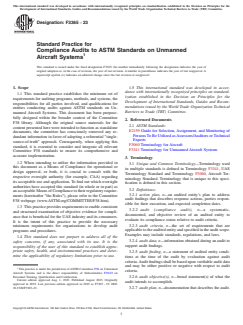
(Practice)Standard Practice for Compliance Audits to ASTM Standards on Unmanned Aircraft Systems
General Information
- Abstract
SIGNIFICANCE AND USE
4.1 The purpose of this standard practice is to provide the minimum requirements for the conduct of compliance audits.
4.2 The intended use of this practice is to provide a basis for an internal or external entity to develop an audit program. An audit program defines specific requirements for the execution of audits for a particular objective. An example of an audit program would be an external (third party) audit of UAS manufacturer’s quality assurance system.
4.3 Compliance to this practice would ensure that audit programs and those who develop and execute them are following a consensus set of minimum requirements.
4.4 This practice does not mandate either internal or external audits.
4.5 An auditing entity cannot request or approve an audit.
4.6 Other Audit Criteria—Other audit criteria may be included in the audit scope if specified in the audit plan. Examples include safety, technical, operational, and management requirements. Items that are outside the scope of auditable criteria may be submitted as observations for possible resolution. However, these are not binding and are not mandatory.
4.7 Additional Services—Additional services are outside the scope of an audit objective. Examples of such services are consultation to resolve negative or open findings or any other service where the auditing entity conducts an activity other than an audit for the audited entity.
4.8 Compliance Assurance—An audit is only an indicator of the compliance health of the facility or organization, or both, during only the period under review and therefore has limited compliance assurance and is not assumed to be exhaustive.
4.9 Level of Review is Variable—The audit scope may vary to meet different audit objectives. For example, the audit scope may include only selected audit criteria, selected period under review, or selected portions of a facility or organization.
SCOPE
1.1 This standard practice establishes the minimum set of requirements for auditing programs, methods, and systems, the responsibilities for all parties involved, and qualifications for entities conducting audits against ASTM standards on Unmanned Aircraft Systems. This document has been purposefully designed within the broader context of the Committee F38 library. Although the original source materials for the content presented here were intended to function as standalone documents, the committee has consciously removed any redundant information in favor of adopting a referential "single-source-of-truth" approach. Consequently, when applying this standard, it is essential to consider and integrate all relevant Committee F38 standards to ensure its comprehensive and accurate implementation.
1.2 When intending to utilize the information provided in this document as a Means of Compliance for operational or design approval, or both, it is crucial to consult with the respective oversight authority (for example, CAA) regarding its acceptable use and application. To find out which oversight authorities have accepted this standard (in whole or in part) as an acceptable Means of Compliance to their regulatory requirements (hereinafter "the Rules"), please refer to the Committee F38 webpage (www.ASTM.org/COMMITTEE/F38.htm).
1.3 This practice provides requirements to enable consistent and structured examination of objective evidence for compliance that is beneficial for the UAS industry and its consumers. It is the intent of this practice to provide the necessary minimum requirements for organizations to develop audit programs and procedures.
1.4 This standard does not purport to address all of the safety concerns, if any, associated with its use. It is the responsibility of the user of this standard to establish appropriate safety, health, and environmental practices and determine the applicability of regulatory limitations prior to use.
1.5 This international standard was developed in accordance with internationa...
- Status
- Published
- Publication Date
- 31-Jul-2023
- Technical Committee
- F38 - Unmanned Aircraft Systems
- Drafting Committee
- F38.03 - Personnel Training, Qualification and Certification
Buy Documents
ASTM F3365-23 - Standard Practice for Compliance Audits to ASTM Standards on Unmanned Aircraft Systems
REDLINE ASTM F3365-23 - Standard Practice for Compliance Audits to ASTM Standards on Unmanned Aircraft Systems
Overview
ASTM F3365-23: Standard Practice for Compliance Audits to ASTM Standards on Unmanned Aircraft Systems provides a comprehensive framework for conducting and managing compliance audits within the unmanned aircraft systems (UAS) industry. Developed by ASTM Committee F38, this practice outlines the minimum requirements for audit programs, auditing methods, and the responsibilities and qualifications necessary for entities involved in UAS compliance audits. It is designed to support both internal and external audit activities, promoting standardized, objective, and reliable approaches to evaluating UAS organizations against relevant ASTM standards.
Key Topics
- Minimum Audit Requirements: The standard establishes a baseline for how compliance audits should be conducted, focusing on objective evidence, documentation, and structured processes.
- Audit Program Development: It guides organizations in creating documented audit programs that specify purposes, objectives, auditor qualifications, procedures, and record management.
- Roles and Responsibilities: Clearly outlines the respective duties of auditing entities, lead auditors, auditors, and audited entities to ensure audit integrity and effectiveness.
- Independence and Objectivity: Emphasizes the importance of independence for auditors and objective review to avoid conflicts of interest and bias in audit findings.
- Audit Process Structure: Details the audit life cycle, including preparation (audit planning), execution (data gathering, inspections, interviews, records review), and reporting (audit findings, action plans).
- Management of Records: Requires secure, confidential handling of audit data, reports, and working papers, including retention and disclosure practices.
- Variability and Scope: Recognizes that audit scope and depth can be adapted to the specific objectives of the audit, allowing for flexible, goal-oriented approaches.
Applications
ASTM F3365-23 is highly applicable in various UAS industry contexts where compliance with ASTM standards is critical. Practical applications include:
- Quality Assurance Reviews: Used for third-party audits of UAS manufacturers’ quality management systems to ensure adherence to ASTM and regulatory requirements.
- Regulatory Compliance: Supports organizations in demonstrating conformance with industry standards, aiding in operational or design approval processes required by oversight authorities (e.g., Civil Aviation Authorities).
- Internal Audit Programs: Assists UAS operators and manufacturers in establishing robust internal compliance monitoring systems, helping organizations maintain continuous adherence to pertinent standards.
- Supply Chain Audits: Enables audits across suppliers and service providers to ensure consistent compliance within the wider UAS ecosystem.
- Operational Safety Assessments: Provides a method for structured reviews of safety, technical, operational, and management criteria as part of broader risk management strategies.
Related Standards
ASTM F3365-23 is intended to be applied in conjunction with other ASTM Committee F38 standards to create a comprehensive compliance framework for unmanned aircraft systems. Key related standards include:
- ASTM F3341: Terminology for Unmanned Aircraft Systems, providing consistent definitions.
- ASTM F3060: Terminology for Aircraft, offering a foundational vocabulary.
- ASTM E2159: Guidance on the selection and management of auditors or technical experts.
- Other ASTM F38 Standards: Covering various aspects of UAS operations, performance, and safety, which may be referenced within the audit criteria or scope.
Summary
Adopting ASTM F3365-23 enables UAS organizations to conduct structured and credible compliance audits aligned with industry best practices and international standardization principles. By adhering to these guidelines, stakeholders in the unmanned aircraft systems sector can demonstrate regulatory compliance, enhance operational reliability, and foster continuous improvement across their operations. For the latest information on oversight authority acceptance and implementation specifics, consult the ASTM Committee F38 resources.
Keywords: ASTM F3365-23, UAS compliance audits, unmanned aircraft system audit, audit program, auditor qualifications, quality assurance, regulatory compliance, ASTM F38.
Relations
- Effective Date
- 01-Nov-2023
- Effective Date
- 01-Jan-2020
- Effective Date
- 01-Nov-2016
- Effective Date
- 01-Apr-2016
- Effective Date
- 15-Sep-2015
- Effective Date
- 01-May-2015
- Effective Date
- 01-Mar-2015
- Effective Date
- 01-Dec-2014
- Effective Date
- 01-May-2008
- Effective Date
- 10-Sep-2001
Buy Documents
ASTM F3365-23 - Standard Practice for Compliance Audits to ASTM Standards on Unmanned Aircraft Systems
REDLINE ASTM F3365-23 - Standard Practice for Compliance Audits to ASTM Standards on Unmanned Aircraft Systems
Get Certified
Connect with accredited certification bodies for this standard

BSI Group
BSI (British Standards Institution) is the business standards company that helps organizations make excellence a habit.

Bureau Veritas
Bureau Veritas is a world leader in laboratory testing, inspection and certification services.

DNV
DNV is an independent assurance and risk management provider.
Sponsored listings
Frequently Asked Questions
ASTM F3365-23 is a standard published by ASTM International. Its full title is "Standard Practice for Compliance Audits to ASTM Standards on Unmanned Aircraft Systems". This standard covers: SIGNIFICANCE AND USE 4.1 The purpose of this standard practice is to provide the minimum requirements for the conduct of compliance audits. 4.2 The intended use of this practice is to provide a basis for an internal or external entity to develop an audit program. An audit program defines specific requirements for the execution of audits for a particular objective. An example of an audit program would be an external (third party) audit of UAS manufacturer’s quality assurance system. 4.3 Compliance to this practice would ensure that audit programs and those who develop and execute them are following a consensus set of minimum requirements. 4.4 This practice does not mandate either internal or external audits. 4.5 An auditing entity cannot request or approve an audit. 4.6 Other Audit Criteria—Other audit criteria may be included in the audit scope if specified in the audit plan. Examples include safety, technical, operational, and management requirements. Items that are outside the scope of auditable criteria may be submitted as observations for possible resolution. However, these are not binding and are not mandatory. 4.7 Additional Services—Additional services are outside the scope of an audit objective. Examples of such services are consultation to resolve negative or open findings or any other service where the auditing entity conducts an activity other than an audit for the audited entity. 4.8 Compliance Assurance—An audit is only an indicator of the compliance health of the facility or organization, or both, during only the period under review and therefore has limited compliance assurance and is not assumed to be exhaustive. 4.9 Level of Review is Variable—The audit scope may vary to meet different audit objectives. For example, the audit scope may include only selected audit criteria, selected period under review, or selected portions of a facility or organization. SCOPE 1.1 This standard practice establishes the minimum set of requirements for auditing programs, methods, and systems, the responsibilities for all parties involved, and qualifications for entities conducting audits against ASTM standards on Unmanned Aircraft Systems. This document has been purposefully designed within the broader context of the Committee F38 library. Although the original source materials for the content presented here were intended to function as standalone documents, the committee has consciously removed any redundant information in favor of adopting a referential "single-source-of-truth" approach. Consequently, when applying this standard, it is essential to consider and integrate all relevant Committee F38 standards to ensure its comprehensive and accurate implementation. 1.2 When intending to utilize the information provided in this document as a Means of Compliance for operational or design approval, or both, it is crucial to consult with the respective oversight authority (for example, CAA) regarding its acceptable use and application. To find out which oversight authorities have accepted this standard (in whole or in part) as an acceptable Means of Compliance to their regulatory requirements (hereinafter "the Rules"), please refer to the Committee F38 webpage (www.ASTM.org/COMMITTEE/F38.htm). 1.3 This practice provides requirements to enable consistent and structured examination of objective evidence for compliance that is beneficial for the UAS industry and its consumers. It is the intent of this practice to provide the necessary minimum requirements for organizations to develop audit programs and procedures. 1.4 This standard does not purport to address all of the safety concerns, if any, associated with its use. It is the responsibility of the user of this standard to establish appropriate safety, health, and environmental practices and determine the applicability of regulatory limitations prior to use. 1.5 This international standard was developed in accordance with internationa...
SIGNIFICANCE AND USE 4.1 The purpose of this standard practice is to provide the minimum requirements for the conduct of compliance audits. 4.2 The intended use of this practice is to provide a basis for an internal or external entity to develop an audit program. An audit program defines specific requirements for the execution of audits for a particular objective. An example of an audit program would be an external (third party) audit of UAS manufacturer’s quality assurance system. 4.3 Compliance to this practice would ensure that audit programs and those who develop and execute them are following a consensus set of minimum requirements. 4.4 This practice does not mandate either internal or external audits. 4.5 An auditing entity cannot request or approve an audit. 4.6 Other Audit Criteria—Other audit criteria may be included in the audit scope if specified in the audit plan. Examples include safety, technical, operational, and management requirements. Items that are outside the scope of auditable criteria may be submitted as observations for possible resolution. However, these are not binding and are not mandatory. 4.7 Additional Services—Additional services are outside the scope of an audit objective. Examples of such services are consultation to resolve negative or open findings or any other service where the auditing entity conducts an activity other than an audit for the audited entity. 4.8 Compliance Assurance—An audit is only an indicator of the compliance health of the facility or organization, or both, during only the period under review and therefore has limited compliance assurance and is not assumed to be exhaustive. 4.9 Level of Review is Variable—The audit scope may vary to meet different audit objectives. For example, the audit scope may include only selected audit criteria, selected period under review, or selected portions of a facility or organization. SCOPE 1.1 This standard practice establishes the minimum set of requirements for auditing programs, methods, and systems, the responsibilities for all parties involved, and qualifications for entities conducting audits against ASTM standards on Unmanned Aircraft Systems. This document has been purposefully designed within the broader context of the Committee F38 library. Although the original source materials for the content presented here were intended to function as standalone documents, the committee has consciously removed any redundant information in favor of adopting a referential "single-source-of-truth" approach. Consequently, when applying this standard, it is essential to consider and integrate all relevant Committee F38 standards to ensure its comprehensive and accurate implementation. 1.2 When intending to utilize the information provided in this document as a Means of Compliance for operational or design approval, or both, it is crucial to consult with the respective oversight authority (for example, CAA) regarding its acceptable use and application. To find out which oversight authorities have accepted this standard (in whole or in part) as an acceptable Means of Compliance to their regulatory requirements (hereinafter "the Rules"), please refer to the Committee F38 webpage (www.ASTM.org/COMMITTEE/F38.htm). 1.3 This practice provides requirements to enable consistent and structured examination of objective evidence for compliance that is beneficial for the UAS industry and its consumers. It is the intent of this practice to provide the necessary minimum requirements for organizations to develop audit programs and procedures. 1.4 This standard does not purport to address all of the safety concerns, if any, associated with its use. It is the responsibility of the user of this standard to establish appropriate safety, health, and environmental practices and determine the applicability of regulatory limitations prior to use. 1.5 This international standard was developed in accordance with internationa...
ASTM F3365-23 is classified under the following ICS (International Classification for Standards) categories: 49.020 - Aircraft and space vehicles in general. The ICS classification helps identify the subject area and facilitates finding related standards.
ASTM F3365-23 has the following relationships with other standards: It is inter standard links to ASTM E2159-23, ASTM F3060-20, ASTM F3060-16a, ASTM F3060-16, ASTM F3060-15b, ASTM F3060-15a, ASTM F3060-15, ASTM F3060-14, ASTM E2159-01(2008), ASTM E2159-01. Understanding these relationships helps ensure you are using the most current and applicable version of the standard.
ASTM F3365-23 is available in PDF format for immediate download after purchase. The document can be added to your cart and obtained through the secure checkout process. Digital delivery ensures instant access to the complete standard document.
Standards Content (Sample)
This international standard was developed in accordance with internationally recognized principles on standardization established in the Decision on Principles for the
Development of International Standards, Guides and Recommendations issued by the World Trade Organization Technical Barriers to Trade (TBT) Committee.
Designation: F3365 − 23
Standard Practice for
Compliance Audits to ASTM Standards on Unmanned
Aircraft Systems
This standard is issued under the fixed designation F3365; the number immediately following the designation indicates the year of
original adoption or, in the case of revision, the year of last revision. A number in parentheses indicates the year of last reapproval. A
superscript epsilon (´) indicates an editorial change since the last revision or reapproval.
1. Scope 1.5 This international standard was developed in accor-
dance with internationally recognized principles on standard-
1.1 This standard practice establishes the minimum set of
ization established in the Decision on Principles for the
requirements for auditing programs, methods, and systems, the
Development of International Standards, Guides and Recom-
responsibilities for all parties involved, and qualifications for
mendations issued by the World Trade Organization Technical
entities conducting audits against ASTM standards on Un-
Barriers to Trade (TBT) Committee.
manned Aircraft Systems. This document has been purpose-
fully designed within the broader context of the Committee
2. Referenced Documents
F38 library. Although the original source materials for the
2.1 ASTM Standards:
content presented here were intended to function as standalone
E2159 Guide for Selection, Assignment, and Monitoring of
documents, the committee has consciously removed any re-
Persons To Be Utilized as Assessors/Auditors or Technical
dundant information in favor of adopting a referential "single-
Experts
source-of-truth" approach. Consequently, when applying this
F3060 Terminology for Aircraft
standard, it is essential to consider and integrate all relevant
F3341 Terminology for Unmanned Aircraft Systems
Committee F38 standards to ensure its comprehensive and
accurate implementation.
3. Terminology
1.2 When intending to utilize the information provided in
3.1 Unique and Common Terminology—Terminology used
this document as a Means of Compliance for operational or
in multiple standards is defined in Terminology F3341, UAS
design approval, or both, it is crucial to consult with the
Terminology Standard and Terminology F3060, Aircraft Ter-
respective oversight authority (for example, CAA) regarding
minology Standard. Terminology that is unique to this speci-
its acceptable use and application. To find out which oversight
fication is defined in this section.
authorities have accepted this standard (in whole or in part) as
3.2 Definitions:
an acceptable Means of Compliance to their regulatory require-
3.2.1 action plan, n—an audited entity’s plan to address
ments (hereinafter "the Rules"), please refer to the Committee
audit findings that describes response actions, parties respon-
F38 webpage (www.ASTM.org/COMMITTEE/F38.htm).
sible for their execution, and expected completion dates.
1.3 This practice provides requirements to enable consistent
3.2.2 audit (compliance audit), n—a systematic,
and structured examination of objective evidence for compli-
documented, and objective review of an audited entity to
ance that is beneficial for the UAS industry and its consumers.
evaluate its compliance status relative to audit criteria.
It is the intent of this practice to provide the necessary
3.2.3 audit criteria, n—the set of requirements that are
minimum requirements for organizations to develop audit
applicable to the audited entity and specified in the audit scope.
programs and procedures.
Examples may include standards, regulations, and laws.
1.4 This standard does not purport to address all of the
3.2.4 audit data, n—information obtained during an audit to
safety concerns, if any, associated with its use. It is the
support audit findings.
responsibility of the user of this standard to establish appro-
priate safety, health, and environmental practices and deter-
3.2.5 audit finding, n—a statement of audited entity condi-
mine the applicability of regulatory limitations prior to use.
tions at the time of the audit by evaluation against audit
criteria. Audit findings shall be based upon verifiable audit data
and may be either positive or negative with respect to audit
This practice is under the jurisdiction of ASTM Committee F38 on Unmanned
criteria.
Aircraft Systems and is the direct responsibility of Subcommittee F38.03 on
Personnel Training, Qualification and Certification.
3.2.6 audit objective(s), n—broad statement(s) of what the
Current edition approved Aug. 1, 2023. Published August 2023. Originally
audit intends to accomplish.
approved in 2019. Last previous edition approved in 2019 as F3365 – 19. DOI:
10.1520/F3365–23. 3.2.7 audit plan, n—documentation that describes the audit.
Copyright © ASTM International, 100 Barr Harbor Drive, PO Box C700, West Conshohocken, PA 19428-2959. United States
F3365 − 23
3.2.8 audit program, n—an auditing entity’s overarching 4.5 An auditing entity cannot request or approve an audit.
collection of approaches, methods, systems, etc. toward the
4.6 Other Audit Criteria—Other audit criteria may be in-
goal of achieving an audit objective(s) and in compliance with
cluded in the audit scope if specified in the audit plan.
this standard.
Examples include safety, technical, operational, and manage-
3.2.9 audit protocol, n—a method designed to collect infor-
ment requirements. Items that are outside the scope of audit-
mation to support the audit objective(s) based upon audit
able criteria may be submitted as observations for possible
criteria.
resolution. However, these are not binding and are not man-
datory.
3.2.10 audit purpose, n—reason for the audit.
3.2.11 audit report, n—a written summary of audit findings
4.7 Additional Services—Additional services are outside the
that is objective, clear, concise, constructive, and timely.
scope of an audit objective. Examples of such services are
consultation to resolve negative or open findings or any other
3.2.12 audit scope, n—a description of what is to be audited.
service where the auditing entity conducts an activity other
The audit scope shall include a description of the period under
than an audit for the audited entity.
review, the audited entity, and the audit criteria.
3.2.13 audit team, n—one or more auditors responsible for
4.8 Compliance Assurance—An audit is only an indicator of
conducting an audit. The audit team may be supported by the compliance health of the facility or organization, or both,
technical experts and auditors-in-training.
during only the period under review and therefore has limited
compliance assurance and is not assumed to be exhaustive.
3.2.14 audited entity, n—a facility, organization, or part
thereof, that is the subject of an audit.
4.9 Level of Review is Variable—The audit scope may vary
to meet different audit objectives. For example, the audit scope
3.2.15 auditing entity, n—the organization that provides the
audit program and authorizes, or initiates the audit process. The may include only selected audit criteria, selected period under
review, or selected portions of a facility or organization.
auditing entity may be internal or external to the audited entity.
3.2.16 auditor, n—a person qualified to conduct an audit.
5. Audit Program
3.2.17 independence, n—a condition characterized by orga-
5.1 The auditing entity shall develop and document an audit
nizational standing where an auditor is free to conduct an audit
program that conforms to this practice prior to carrying out an
without being controlled or influenced by others.
audit. The audit program and its documentation is internal to
3.2.18 lead auditor, n—an auditor designated to lead and
the auditing entity.
manage the audit.
5.2 The audit program shall specify an audit purpose and
3.2.19 objectivity, n—a condition characterized by the ab-
audit objective(s).
sence of bias, influences, and conflicts of interest that affect or
have the potential to compromise audit findings.
5.3 The audit program shall specify the procedures and
3.2.20 open issues, n—potential audit findings that cannot
guidelines that will be used to conduct the audit process in
be verified or resolved without additional information. Section 6, including target timelines. As practical, the program
should also provide drafts of audit-specific information such as
3.2.21 period under review, n—the time interval over which
audit scope, audit plan, and audit reports.
conditions at the audited entity are evaluated against audit
criteria.
5.4 The audit program shall contain requirements for record
management as specified in Section 11.
3.2.22 records, n—documentation and other forms of re-
corded information.
5.5 The audit program shall define criteria for audit status
3.2.23 working papers, n—records collected and developed
levels. Examples of audit status include pass/fail, open/closed,
by an auditor through the use of audit protocols.
or complete/incomplete.
4. Significance and Use 5.6 The audit program shall include auditor qualifications as
specified in Section 12.
4.1 The purpose of this standard practice is to provide the
minimum requirements for the conduct of compliance audits.
5.7 The audit program shall define guidelines and proce-
dures for identifying and reporting any compromise of auditor
4.2 The intended use of this practice is to provide a basis for
qualifications.
an internal or external entity to develop an audit program. An
audit program defines specific requirements for the execution
6. Audit Process
of audits for a particular objective. An example of an audit
program would be an external (third party) audit of UAS
6.1 An audit shall, at a minimum, involve three activities.
manufacturer’s quality assurance system.
These are: preparation activities, execution activities, and
reporting activities.
4.3 Compliance to this practice would ensure that audit
programs and those who develop and execute them are
6.2 Preparation—Preparation activities occur before execu-
following a consensus set of minimum requirements.
tion and are intended to plan, organize, and communicate the
4.4 This practice does not mandate either internal or exter- execution and reporting activities for a specific audit. The
nal audits. result of the preparation activities is the audit plan (Section 7).
F3365 − 23
The audit plan shall be agreed upon between the auditor and tion by the audit team and encourage discussion of any
the audited entity in a timely manner prior to the execution of questions or concerns. The audited entity should provide an
an audit. overview of the facility operations for the audit team during the
opening conference.
6.3 Execution—The audit plan is carried out between the
audit team and audited entity during this activity. These 8.3 Closing Conference—The closing conference summa-
activities may occur remotely or during an on-site visit, or rizes the overall results of the audit and provides an opportu-
both, as specified by the audit plan. Execution activities shall nity for audited entity personnel to discuss and question draft
include communication activities (Section 8) and data gather- audit findings. Reporting procedures should be discussed at the
ing activities (Section 9). closing conference including time frames, a process for resolv-
ing challenged audit findings, and for closing or reporting any
6.4 Reporting—Reporting activities occur after audit execu-
open issues.
tion between the auditor and audited entity. Reporting deliver-
ables and milestones occur following execution; however, 8.4 Team Meeting(s)—Meetings of the audit team should be
preparatory work may occur at other times during the process. conducted as necessary to share information and ensure timely
Reporting shall include documentation activities specified in and consistent completion of the audit. Draft audit findings and
Section 10. audit plan issues should be discussed among audit team
members prior to the closing conference.
7. Audit Plan
9. Protocols
7.1 An audit plan shall contain the following:
7.1.1 The audit objective;
9.1 Audit data shall be gathered and evaluated by the audit
7.1.2 Audit scope;
team to support audit findings consistent with the audit
7.1.3 Identities of the auditing entity, audited entity, and
obj
...
This document is not an ASTM standard and is intended only to provide the user of an ASTM standard an indication of what changes have been made to the previous version. Because
it may not be technically possible to adequately depict all changes accurately, ASTM recommends that users consult prior editions as appropriate. In all cases only the current version
of the standard as published by ASTM is to be considered the official document.
Designation: F3365 − 19 F3365 − 23
Standard Practice for
Compliance Audits to ASTM Standards on Unmanned
Aircraft Systems
This standard is issued under the fixed designation F3365; the number immediately following the designation indicates the year of
original adoption or, in the case of revision, the year of last revision. A number in parentheses indicates the year of last reapproval. A
superscript epsilon (´) indicates an editorial change since the last revision or reapproval.
1. Scope
1.1 This standard practice establishes the minimum set of requirements for auditing programs, methods, and systems, the
responsibilities for all parties involved, and qualifications for entities conducting audits against ASTM standards on Unmanned
Aircraft Systems. This document has been purposefully designed within the broader context of the Committee F38 library.
Although the original source materials for the content presented here were intended to function as standalone documents, the
committee has consciously removed any redundant information in favor of adopting a referential "single-source-of-truth"
approach. Consequently, when applying this standard, it is essential to consider and integrate all relevant Committee F38 standards
to ensure its comprehensive and accurate implementation.
1.2 When intending to utilize the information provided in this document as a Means of Compliance for operational or design
approval, or both, it is crucial to consult with the respective oversight authority (for example, CAA) regarding its acceptable use
and application. To find out which oversight authorities have accepted this standard (in whole or in part) as an acceptable Means
of Compliance to their regulatory requirements (hereinafter "the Rules"), please refer to the Committee F38 webpage
(www.ASTM.org/COMMITTEE/F38.htm).
1.3 This practice provides requirements to enable consistent and structured examination of objective evidence for compliance that
is beneficial for the UAS industry and its consumers. It is the intent of this practice to provide the necessary minimum requirements
for organizations to develop audit programs and procedures.
1.4 This standard does not purport to address all of the safety concerns, if any, associated with its use. It is the responsibility
of the user of this standard to establish appropriate safety, health, and environmental practices and determine the applicability of
regulatory limitations prior to use.
1.5 This international standard was developed in accordance with internationally recognized principles on standardization
established in the Decision on Principles for the Development of International Standards, Guides and Recommendations issued
by the World Trade Organization Technical Barriers to Trade (TBT) Committee.
2. Referenced Documents
2.1 ASTM Standards:
E2159 Guide for Selection, Assignment, and Monitoring of Persons To Be Utilized as Assessors/Auditors or Technical Experts
F3060 Terminology for Aircraft
F3341 Terminology for Unmanned Aircraft Systems
This practice is under the jurisdiction of ASTM Committee F38 on Unmanned Aircraft Systems and is the direct responsibility of Subcommittee F38.03 on Personnel
Training, Qualification and Certification.
Current edition approved Feb. 1, 2019Aug. 1, 2023. Published March 2019August 2023. Originally approved in 2019. Last previous edition approved in 2019 as
F3365 – 19. DOI: 10.1520/F3365–19.10.1520/F3365–23.
Copyright © ASTM International, 100 Barr Harbor Drive, PO Box C700, West Conshohocken, PA 19428-2959. United States
F3365 − 23
3. Terminology
3.1 Unique and Common Terminology—Terminology used in multiple standards is defined in Terminology F3341, UAS
Terminology Standard and Terminology F3060, Aircraft Terminology Standard. Terminology that is unique to this specification is
defined in this section.
3.2 Definitions:
3.2.1 action plan, n—an audited entity’s plan to address audit findings that describes response actions, parties responsible for their
execution, and expected completion dates.
3.2.2 audit (compliance audit), n—a systematic, documented, and objective review of an audited entity to evaluate its compliance
status relative to audit criteria.
3.2.3 audit criteria, n—the set of requirements that are applicable to the audited entity and specified in the audit scope. Examples
may include standards, regulations, and laws.
3.2.4 audit data, n—information obtained during an audit to support audit findings.
3.2.5 audit finding, n—a statement of audited entity conditions at the time of the audit by evaluation against audit criteria. Audit
findings shall be based upon verifiable audit data and may be either positive or negative with respect to audit criteria.
3.2.6 audit objective(s), n—broad statement(s) of what the audit intends to accomplish.
3.2.7 audit plan, n—documentation that describes the audit.
3.2.8 audit program, n—an auditing entity’s overarching collection of approaches, methods, systems, etc. toward the goal of
achieving an audit objective(s) and in compliance with this standard.
3.2.9 audit protocol, n—a method designed to collect information to support the audit objective(s) based upon audit criteria.
3.2.10 audit purpose, n—reason for the audit.
3.2.11 audit report, n—a written summary of audit findings that is objective, clear, concise, constructive, and timely.
3.2.12 audit scope, n—a description of what is to be audited. The audit scope shall include a description of the period under review,
the audited entity, and the audit criteria.
3.2.13 audit team, n—one or more auditors responsible for conducting an audit. The audit team may be supported by technical
experts and auditors-in-training.
3.2.14 audited entity, n—a facility, organization, or part thereof, that is the subject of an audit.
3.2.15 auditing entity, n—the organization that provides the audit program and authorizes, or initiates the audit process. The
auditing entity may be internal or external to the audited entity.
3.2.16 auditor, n—a person qualified to conduct an audit.
3.2.17 independence, n—a condition characterized by organizational standing where an auditor is free to conduct an audit without
being controlled or influenced by others.
3.2.18 lead auditor, n—an auditor designated to lead and manage the audit.
F3365 − 23
3.2.19 objectivity, n—a condition characterized by the absence of bias, influences, and conflicts of interest that affect or have the
potential to compromise audit findings.
3.2.20 open issues, n—potential audit findings that cannot be verified or resolved without additional information.
3.2.21 period under review, n—the time interval over which conditions at the audited entity are evaluated against audit criteria.
3.2.22 records, n—documentation and other forms of recorded information.
3.2.23 working papers, n—records collected and developed by an auditor through the use of audit protocols.
4. Significance and Use
4.1 The purpose of this standard practice is to provide the minimum requirements for the conduct of compliance audits.
4.2 The intended use of this practice is to provide a basis for an internal or external entity to develop an audit program. An audit
program defines specific requirements for the execution of audits for a particular objective. An example of an audit program would
be an external (third party) audit of UAS manufacturer’s quality assurance system.
4.3 Compliance to this practice would ensure that audit programs and those who develop and execute them are following a
consensus set of minimum requirements.
4.4 This practice does not mandate either internal or external audits.
4.5 An auditing entity cannot request or approve an audit.
4.6 Other Audit Criteria—Other audit criteria may be included in the audit scope if specified in the audit plan. Examples include
safety, technical, operational, and management requirements. Items that are outside the scope of auditable criteria may be
submitted as observations for possible resolution. However, these are not binding and are not mandatory.
4.7 Additional Services—Additional services are outside the scope of an audit objective. Examples of such services are
consultation to resolve negative or open findings or any other service where the auditing entity conducts an activity other than an
audit for the audited entity.
4.8 Compliance Assurance—An audit is only an indicator of the compliance health of the facility or organization, or both, during
only the period under review and therefore has limited compliance assurance and is not assumed to be exhaustive.
4.9 Level of Review is Variable—The audit scope may vary to meet different audit objectives. For example, the audit scope may
include only selected audit criteria, selected period under review, or selected portions of a facility or organization.
5. Audit Program
5.1 The auditing entity shall develop and document an audit program that conforms to this practice prior to carrying out an audit.
The audit program and its documentation is internal to the auditing entity.
5.2 The audit program shall specify an audit purpose and audit objective(s).
5.3 The audit program shall specify the procedures and guidelines that will be used to conduct the audit process in Section 56,
including target timelines. As practical, the program should also provide drafts of audit-specific information such as audit scope,
audit plan, and audit reports.
5.4 The audit program shall contain requirements for record management as specified in Section 1011.
F3365 − 23
5.5 The audit program shall define criteria for audit status levels. Examples of audit status include pass/fail, open/closed, or
complete/incomplete.
5.6 The audit program shall include auditor qualifications as specified in Section 1112.
5.7 The audit program shall define guidelines and procedures for identifying and reporting any compromise of auditor
qualifications.
6. Audit Process
6.1 An audit shall, at a minimum, involve three activities. These are: preparation activities, execution activities, and reporting
activities.
6.2 Preparation—Preparation activities occur before execution and are intended to plan, organize, and communicate the execution
and reporting activities for a specific audit. The result of the preparation activities is the audit plan (Section 67). The audit plan
shall be agreed upon between the auditor and the audited entity in a timely manner prior to the execution of an audit.
6.3 Execution—The audit plan is carried out between the audit team and audited entity during this activity. These activities may
occur remotely or during an on-site visit, or both, as specified by the audit plan. Execution activities shall include communication
activities (Section 78) and data gathering activities (Section 89).
6.4 Reporting—Reporting activities occur after audit execution between the auditor and audited entity. Reporting deliverables and
milestones occur following execution; however, preparatory work may occur at other times during the process. Reporting shall
include documentation activities specified in Section 910.
7. Audit Plan
7.1 An audit plan shall contain the following:
7.1.1 The audit objective;
7.1.2 Audit scope;
7.1.3 Identities of the auditing entity, audited entity, and audit team;
7.1.4 Audit schedule;
7.1.5 Record management and confidentiality procedures; and
7.1.6 Logistics.
7.2 Background Information—Background information should be used as appropriate to develop the audit plan or refine an
existing audit plan. Background information may consist of records, process, site descriptions, operation and maintenance manuals,
compliance inspection reports, previous audit reports, notices of violations, and other relevant information.
7.3 Schedule—A schedule of audit activities shall be developed and documented. The schedule shall clearly document the
expected timeline between the auditing and audited entity with respect to audit execution, reporting audit findings, and action plans
as applicable.
7.4 On-site Logistics—If an on-site visit is planned, issues such as scheduling a site orientation meeting, identifying site contacts,
scheduling the site visit dates, and resolution of lodging and transportation logistics should be addressed.
...