

ASTM F3266-23
(Guide)Standard Guide for Training for Remote Pilot in Command of Unmanned Aircraft Systems (UAS) Endorsement
General Information
- Abstract
SIGNIFICANCE AND USE
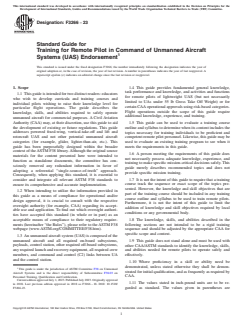
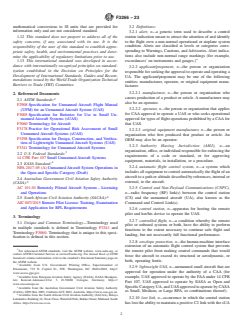
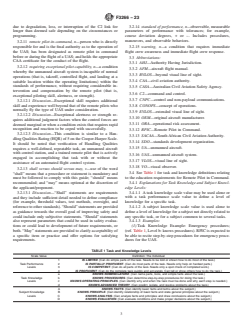
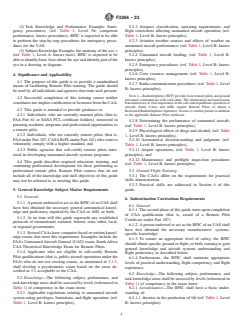
4.1 The purpose of this guide is to provide a standardized means of facilitating Remote Pilot training. The guide should be used by all individuals and agencies that train such persons.
4.2 Successful completion of this training course neither constitutes nor implies certification or licensure from the CAA.
4.3 This guide is intended to provide guidance to:
4.3.1 Individuals, who are currently manned pilots (that is, FAA Part 61 or EASA FCL certificate holders), interested in pursuing academic programs and professional opportunities as a remote pilot,
4.3.2 Individuals, who are currently remote pilots (that is, FAA under Part 107, CASA RePL under Part 101) who want to voluntarily comply with a higher standard, and
4.3.3 Public agencies that self-certify remote pilots interested in developing unmanned aircraft systems programs.
4.4 This guide describes required education, training, and continuing professional development for those performing as professional remote pilot. Remote Pilot courses that do not include all of the knowledge and skill objectives of this guide may not be referred to as meeting this guide.
SCOPE
1.1 This guide is intended for two distinct readers: educators who wish to develop curricula and training courses and individual pilots wishing to raise their knowledge level for particular flight operations. The guide describes the knowledge, skills, and abilities required to safely operate unmanned aircraft for commercial purposes. A Civil Aviation Authority (CAA) may, at their discretion, use this guide to aid the development of existing or future regulations. This guide addresses powered fixed-wing, vertical-take-off and lift and rotorcraft UAS and not other potential unmanned aircraft categories (for example, glider, lighter-than-air, etc.). This guide has been purposefully designed within the broader context of the ASTM F38 library. Although the original source materials for the content presented here were intended to function as standalone documents, the committee has consciously removed any redundant information in favor of adopting a referential “single-source-of-truth” approach. Consequently, when applying this standard, it is essential to consider and integrate all relevant ASTM F38 standards to ensure its comprehensive and accurate implementation.
1.2 When intending to utilize the information provided in this guide as a means of compliance for operational and/or design approval, it is crucial to consult with the respective oversight authority (for example, CAA) regarding its acceptable use and application. To find out which oversight authorities have accepted this standard (in whole or in part) as an acceptable means of compliance to their regulatory requirements (hereinafter “the Rules”), please refer to the ASTM F38 webpage (www.ASTM.org/COMMITTEE/F38.htm).
1.3 An unmanned aircraft system (UAS) is composed of the unmanned aircraft and all required on-board subsystems, payloads, control station, other required off-board subsystems, any required launch and recovery equipment, all required crew members, and command and control (C2) links between UA and the control station.
1.4 This guide provides fundamental general knowledge, task performance and knowledge, and activities and functions for remote pilots of lightweight UAS (but not necessarily limited to UAs under 55 lb Gross Take Off Weight) or for certain CAA operational approvals using risk-based categories. Flight operations outside the scope of this guide require additional knowledge, experience, and training.
1.5 This guide can be used to evaluate a training course outline and syllabus to determine when its content includes the topics necessary for training individuals to be proficient and competent remote pilot personnel. Likewise, this guide may be used to evaluate an existing training program to see when it meets the requirements in this guide.
1.6 A person meeting the requirem...
- Status
- Published
- Publication Date
- 30-Jun-2023
- Technical Committee
- F38 - Unmanned Aircraft Systems
- Drafting Committee
- F38.03 - Personnel Training, Qualification and Certification
Buy Documents
ASTM F3266-23 - Standard Guide for Training for Remote Pilot in Command of Unmanned Aircraft Systems (UAS) Endorsement
REDLINE ASTM F3266-23 - Standard Guide for Training for Remote Pilot in Command of Unmanned Aircraft Systems (UAS) Endorsement
Overview
ASTM F3266-23: Standard Guide for Training for Remote Pilot in Command of Unmanned Aircraft Systems (UAS) Endorsement provides a comprehensive framework for developing and evaluating remote pilot training programs. Published by ASTM International, this guide is designed to standardize education, training, and professional development for individuals and agencies involved in unmanned aircraft systems (UAS) operations, focusing particularly on the role of Remote Pilot in Command (RPIC).
This guide is beneficial for two main audiences: educators seeking to create robust UAS training curricula, and pilots aiming to deepen their knowledge and proficiency for commercial drone operations. Additionally, regulatory authorities may use this standard as a reference when developing or refining policies and requirements for remote pilot qualifications.
Key Topics
Training Curriculum Development
The guide outlines the essential knowledge, skills, and abilities required for safe and proficient UAS operation. It covers general aeronautical knowledge, manufacturer-specific systems training, and the practical skills needed for commercial UAS flight operations.Assessment of Competency
A detailed competency matrix is provided, enabling trainers and oversight bodies to evaluate both knowledge (facts, principles, analysis) and performance (competency, proficiency).Applicability to Multiple Users
- Individuals holding manned pilot certificates (e.g., FAA Part 61, EASA FCL) transitioning to UAS operations
- Current remote pilots aiming for higher training standards
- Public sector agencies self-certifying remote pilots or building governmental UAS programs
Guidance for Regulatory Compliance
The guide explicitly states it does not confer certification or licensure by civil aviation authorities (CAA) but can serve as a reference for compliance or further regulatory development by CAAs worldwide.Integration with Other Standards
The document is developed within the ASTM F38 framework, emphasizing harmonization with other UAS standards to avoid redundancy and ensure completeness.
Applications
ASTM F3266-23 is widely applicable for the following practical purposes:
Development of UAS Training Courses:
Training organizations and educators can use the guide to design, update, or audit remote pilot curriculum, ensuring all critical knowledge and performance areas are addressed.Pilot Professional Development:
Individuals seeking to advance their drone piloting skills or transition from manned to unmanned flight can rely on the guide's checklists to self-assess and target areas for improvement.Evaluation of Existing Programs:
Training officials or government agencies can use the standard to benchmark their current training programs and identify gaps related to regulatory, operational, or technical UAS requirements.Regulatory Reference:
Civil aviation authorities can reference ASTM F3266-23 when developing rules, risk-based operational categories, or approval processes for UAS operations.Industry Adoption:
Commercial drone service providers can align internal pilot qualification processes with the guide, demonstrating commitment to high training standards and operational safety.
Related Standards
ASTM F3266-23 should not be used in isolation for remote pilot training. Key related standards include:
- ASTM F2908: Specification for Unmanned Aircraft Flight Manual (UFM) for UAS
- ASTM F3005: Specification for Batteries for Use in Small Unmanned Aircraft Systems (sUAS)
- ASTM F3060: Terminology for Aircraft
- ASTM F3178: Practice for Operational Risk Assessment of Small Unmanned Aircraft Systems
- ASTM F3298: Specification for Design, Construction, and Verification of Fixed-Wing Lightweight UAS
- ASTM F3341: Terminology for Unmanned Aircraft Systems
Regulatory references include:
- 14 CFR Part 107 (US FAA requirements)
- EASA's operational guidance for UAS
- CASA (Australia) AC 101-01
- SACAA (South Africa) AIC 007/2015
Summary
By following ASTM F3266-23, UAS educators, operators, and oversight bodies can ensure a consistent, high-quality training approach for remote pilots. This guide supports the safe, effective, and professional integration of unmanned aircraft into national airspace, fostering international alignment and best practices across the growing drone industry. For comprehensive training solutions, always consult this guideline alongside related ASTM and regulatory standards.
Relations
- Effective Date
- 01-Jan-2020
- Effective Date
- 01-Feb-2019
- Effective Date
- 01-May-2018
- Effective Date
- 01-Nov-2016
- Effective Date
- 01-Nov-2016
- Effective Date
- 01-Apr-2016
- Effective Date
- 15-Feb-2016
- Effective Date
- 15-Sep-2015
- Effective Date
- 01-May-2015
- Effective Date
- 01-Mar-2015
- Effective Date
- 01-Dec-2014
- Effective Date
- 15-Jan-2014
- Effective Date
- 15-Jan-2014
Buy Documents
ASTM F3266-23 - Standard Guide for Training for Remote Pilot in Command of Unmanned Aircraft Systems (UAS) Endorsement
REDLINE ASTM F3266-23 - Standard Guide for Training for Remote Pilot in Command of Unmanned Aircraft Systems (UAS) Endorsement
Get Certified
Connect with accredited certification bodies for this standard

BSI Group
BSI (British Standards Institution) is the business standards company that helps organizations make excellence a habit.

Bureau Veritas
Bureau Veritas is a world leader in laboratory testing, inspection and certification services.

DNV
DNV is an independent assurance and risk management provider.
Sponsored listings
Frequently Asked Questions
ASTM F3266-23 is a guide published by ASTM International. Its full title is "Standard Guide for Training for Remote Pilot in Command of Unmanned Aircraft Systems (UAS) Endorsement". This standard covers: SIGNIFICANCE AND USE 4.1 The purpose of this guide is to provide a standardized means of facilitating Remote Pilot training. The guide should be used by all individuals and agencies that train such persons. 4.2 Successful completion of this training course neither constitutes nor implies certification or licensure from the CAA. 4.3 This guide is intended to provide guidance to: 4.3.1 Individuals, who are currently manned pilots (that is, FAA Part 61 or EASA FCL certificate holders), interested in pursuing academic programs and professional opportunities as a remote pilot, 4.3.2 Individuals, who are currently remote pilots (that is, FAA under Part 107, CASA RePL under Part 101) who want to voluntarily comply with a higher standard, and 4.3.3 Public agencies that self-certify remote pilots interested in developing unmanned aircraft systems programs. 4.4 This guide describes required education, training, and continuing professional development for those performing as professional remote pilot. Remote Pilot courses that do not include all of the knowledge and skill objectives of this guide may not be referred to as meeting this guide. SCOPE 1.1 This guide is intended for two distinct readers: educators who wish to develop curricula and training courses and individual pilots wishing to raise their knowledge level for particular flight operations. The guide describes the knowledge, skills, and abilities required to safely operate unmanned aircraft for commercial purposes. A Civil Aviation Authority (CAA) may, at their discretion, use this guide to aid the development of existing or future regulations. This guide addresses powered fixed-wing, vertical-take-off and lift and rotorcraft UAS and not other potential unmanned aircraft categories (for example, glider, lighter-than-air, etc.). This guide has been purposefully designed within the broader context of the ASTM F38 library. Although the original source materials for the content presented here were intended to function as standalone documents, the committee has consciously removed any redundant information in favor of adopting a referential “single-source-of-truth” approach. Consequently, when applying this standard, it is essential to consider and integrate all relevant ASTM F38 standards to ensure its comprehensive and accurate implementation. 1.2 When intending to utilize the information provided in this guide as a means of compliance for operational and/or design approval, it is crucial to consult with the respective oversight authority (for example, CAA) regarding its acceptable use and application. To find out which oversight authorities have accepted this standard (in whole or in part) as an acceptable means of compliance to their regulatory requirements (hereinafter “the Rules”), please refer to the ASTM F38 webpage (www.ASTM.org/COMMITTEE/F38.htm). 1.3 An unmanned aircraft system (UAS) is composed of the unmanned aircraft and all required on-board subsystems, payloads, control station, other required off-board subsystems, any required launch and recovery equipment, all required crew members, and command and control (C2) links between UA and the control station. 1.4 This guide provides fundamental general knowledge, task performance and knowledge, and activities and functions for remote pilots of lightweight UAS (but not necessarily limited to UAs under 55 lb Gross Take Off Weight) or for certain CAA operational approvals using risk-based categories. Flight operations outside the scope of this guide require additional knowledge, experience, and training. 1.5 This guide can be used to evaluate a training course outline and syllabus to determine when its content includes the topics necessary for training individuals to be proficient and competent remote pilot personnel. Likewise, this guide may be used to evaluate an existing training program to see when it meets the requirements in this guide. 1.6 A person meeting the requirem...
SIGNIFICANCE AND USE 4.1 The purpose of this guide is to provide a standardized means of facilitating Remote Pilot training. The guide should be used by all individuals and agencies that train such persons. 4.2 Successful completion of this training course neither constitutes nor implies certification or licensure from the CAA. 4.3 This guide is intended to provide guidance to: 4.3.1 Individuals, who are currently manned pilots (that is, FAA Part 61 or EASA FCL certificate holders), interested in pursuing academic programs and professional opportunities as a remote pilot, 4.3.2 Individuals, who are currently remote pilots (that is, FAA under Part 107, CASA RePL under Part 101) who want to voluntarily comply with a higher standard, and 4.3.3 Public agencies that self-certify remote pilots interested in developing unmanned aircraft systems programs. 4.4 This guide describes required education, training, and continuing professional development for those performing as professional remote pilot. Remote Pilot courses that do not include all of the knowledge and skill objectives of this guide may not be referred to as meeting this guide. SCOPE 1.1 This guide is intended for two distinct readers: educators who wish to develop curricula and training courses and individual pilots wishing to raise their knowledge level for particular flight operations. The guide describes the knowledge, skills, and abilities required to safely operate unmanned aircraft for commercial purposes. A Civil Aviation Authority (CAA) may, at their discretion, use this guide to aid the development of existing or future regulations. This guide addresses powered fixed-wing, vertical-take-off and lift and rotorcraft UAS and not other potential unmanned aircraft categories (for example, glider, lighter-than-air, etc.). This guide has been purposefully designed within the broader context of the ASTM F38 library. Although the original source materials for the content presented here were intended to function as standalone documents, the committee has consciously removed any redundant information in favor of adopting a referential “single-source-of-truth” approach. Consequently, when applying this standard, it is essential to consider and integrate all relevant ASTM F38 standards to ensure its comprehensive and accurate implementation. 1.2 When intending to utilize the information provided in this guide as a means of compliance for operational and/or design approval, it is crucial to consult with the respective oversight authority (for example, CAA) regarding its acceptable use and application. To find out which oversight authorities have accepted this standard (in whole or in part) as an acceptable means of compliance to their regulatory requirements (hereinafter “the Rules”), please refer to the ASTM F38 webpage (www.ASTM.org/COMMITTEE/F38.htm). 1.3 An unmanned aircraft system (UAS) is composed of the unmanned aircraft and all required on-board subsystems, payloads, control station, other required off-board subsystems, any required launch and recovery equipment, all required crew members, and command and control (C2) links between UA and the control station. 1.4 This guide provides fundamental general knowledge, task performance and knowledge, and activities and functions for remote pilots of lightweight UAS (but not necessarily limited to UAs under 55 lb Gross Take Off Weight) or for certain CAA operational approvals using risk-based categories. Flight operations outside the scope of this guide require additional knowledge, experience, and training. 1.5 This guide can be used to evaluate a training course outline and syllabus to determine when its content includes the topics necessary for training individuals to be proficient and competent remote pilot personnel. Likewise, this guide may be used to evaluate an existing training program to see when it meets the requirements in this guide. 1.6 A person meeting the requirem...
ASTM F3266-23 is classified under the following ICS (International Classification for Standards) categories: 49.020 - Aircraft and space vehicles in general. The ICS classification helps identify the subject area and facilitates finding related standards.
ASTM F3266-23 has the following relationships with other standards: It is inter standard links to ASTM F3060-20, ASTM F3298-19, ASTM F3298-18, ASTM F3178-16, ASTM F3060-16a, ASTM F3060-16, ASTM F2908-16, ASTM F3060-15b, ASTM F3060-15a, ASTM F3060-15, ASTM F3060-14, ASTM F3005-14, ASTM F2908-14. Understanding these relationships helps ensure you are using the most current and applicable version of the standard.
ASTM F3266-23 is available in PDF format for immediate download after purchase. The document can be added to your cart and obtained through the secure checkout process. Digital delivery ensures instant access to the complete standard document.
Standards Content (Sample)
This international standard was developed in accordance with internationally recognized principles on standardization established in the Decision on Principles for the
Development of International Standards, Guides and Recommendations issued by the World Trade Organization Technical Barriers to Trade (TBT) Committee.
Designation: F3266 − 23
Standard Guide for
Training for Remote Pilot in Command of Unmanned Aircraft
Systems (UAS) Endorsement
This standard is issued under the fixed designation F3266; the number immediately following the designation indicates the year of
original adoption or, in the case of revision, the year of last revision. A number in parentheses indicates the year of last reapproval. A
superscript epsilon (´) indicates an editorial change since the last revision or reapproval.
1. Scope 1.4 This guide provides fundamental general knowledge,
task performance and knowledge, and activities and functions
1.1 This guide is intended for two distinct readers: educators
for remote pilots of lightweight UAS (but not necessarily
who wish to develop curricula and training courses and
limited to UAs under 55 lb Gross Take Off Weight) or for
individual pilots wishing to raise their knowledge level for
certain CAA operational approvals using risk-based categories.
particular flight operations. The guide describes the
Flight operations outside the scope of this guide require
knowledge, skills, and abilities required to safely operate
additional knowledge, experience, and training.
unmanned aircraft for commercial purposes. A Civil Aviation
Authority (CAA) may, at their discretion, use this guide to aid
1.5 This guide can be used to evaluate a training course
the development of existing or future regulations. This guide
outline and syllabus to determine when its content includes the
addresses powered fixed-wing, vertical-take-off and lift and
topics necessary for training individuals to be proficient and
rotorcraft UAS and not other potential unmanned aircraft
competent remote pilot personnel. Likewise, this guide may be
categories (for example, glider, lighter-than-air, etc.). This
used to evaluate an existing training program to see when it
guide has been purposefully designed within the broader meets the requirements in this guide.
context of the ASTM F38 library. Although the original source
1.6 A person meeting the requirements of this guide does
materials for the content presented here were intended to
not necessarily possess adequate knowledge, experience, and
function as standalone documents, the committee has con-
training to make specific mission-critical decisions safely. This
sciously removed any redundant information in favor of
guide merely describes recommended topics and does not
adopting a referential “single-source-of-truth” approach.
provide specific mission training.
Consequently, when applying this standard, it is essential to
1.7 It is not the intent of this guide to require that a training
consider and integrate all relevant ASTM F38 standards to
course track the sequence or exact scope of the topics pre-
ensure its comprehensive and accurate implementation.
sented. However, the knowledge and skill objectives that are
1.2 When intending to utilize the information provided in
part of the training course should be included in any training
this guide as a means of compliance for operational and/or
course outline and syllabus to be used to train remote pilots.
design approval, it is crucial to consult with the respective
Furthermore, it is not the intent of this guide to limit the
oversight authority (for example, CAA) regarding its accept-
addition of knowledge and skill objectives required by local
able use and application. To find out which oversight authori-
conditions or any governmental body.
ties have accepted this standard (in whole or in part) as an
1.8 The knowledge, skills, and abilities described in the
acceptable means of compliance to their regulatory require-
ments (hereinafter “the Rules”), please refer to the ASTM F38 following sections are not intended to be a rigid training
sequence and should be adjusted by the appropriate CAA for
webpage (www.ASTM.org/COMMITTEE/F38.htm).
specific scope and context.
1.3 An unmanned aircraft system (UAS) is composed of the
unmanned aircraft and all required on-board subsystems, 1.9 This guide does not stand alone and must be used with
payloads, control station, other required off-board subsystems,
other CAA/ASTM standards to identify the knowledge, skills,
any required launch and recovery equipment, all required crew
and abilities needed for remote pilots to operate safely and
members, and command and control (C2) links between UA
effectively.
and the control station.
1.10 Where proficiency in a skill or ability need be
demonstrated, unless stated otherwise they shall be demon-
This guide is under the jurisdiction of ASTM Committee F38 on Unmanned
strated for initial qualification, and as frequently as required by
Aircraft Systems and is the direct responsibility of Subcommittee F38.03 on
CAA.
Personnel Training, Qualification and Certification.
Current edition approved July 1, 2023. Published July 2023. Originally approved
1.11 The values stated in inch-pound units are to be re-
in 2018. Last previous edition approved in 2018 as F3266 – 18. DOI: 10.1520/
F3266-23. garded as standard. The values given in parentheses are
Copyright © ASTM International, 100 Barr Harbor Drive, PO Box C700, West Conshohocken, PA 19428-2959. United States
F3266 − 23
mathematical conversions to SI units that are provided for 3.2 Definitions:
information only and are not considered standard.
3.2.1 alert, n—a generic term used to describe a control
station indication meant to attract the attention of and identify
1.12 This standard does not purport to address all of the
to the flight crew a non-normal operational or airplane system
safety concerns, if any, associated with its use. It is the
condition. Alerts are classified at levels or categories corre-
responsibility of the user of this standard to establish appro-
sponding to Warnings, Cautions, and Advisories. Alert indica-
priate safety, health, and environmental practices and deter-
tions also include non-normal range markings (for example,
mine the applicability of regulatory limitations prior to use.
exceedances’ on instruments and gauges.)”
1.13 This international standard was developed in accor-
dance with internationally recognized principles on standard-
3.2.2 applicant/proponent, n—the person or organization
ization established in the Decision on Principles for the
responsible for seeking the approval to operate and operating a
Development of International Standards, Guides and Recom-
UA. The applicant/proponent may be one of the following
mendations issued by the World Trade Organization Technical
entities: manufacturer, operator, or original equipment manu-
Barriers to Trade (TBT) Committee.
facturer.
3.2.2.1 manufacturer, n—the person or organization who
2. Referenced Documents
causes production of a product or article. A manufacturer may
2.1 ASTM Standards:
also be an operator.
F2908 Specification for Unmanned Aircraft Flight Manual
3.2.2.2 operator, n—the person or organization that applies
(UFM) for an Unmanned Aircraft System (UAS)
for CAA approval to operate a UAS or who seeks operational
F3005 Specification for Batteries for Use in Small Un-
approval for types of flight operations prohibited by a CAA for
manned Aircraft Systems (sUAS)
that UAS.
F3060 Terminology for Aircraft
F3178 Practice for Operational Risk Assessment of Small
3.2.2.3 original equipment manufacturer, n—the person or
Unmanned Aircraft Systems (sUAS)
organization who first produced that product or article. An
F3298 Specification for Design, Construction, and Verifica-
OEM may also be an operator.
tion of Lightweight Unmanned Aircraft Systems (UAS)
3.2.3 Authority Having Jurisdiction (AHJ), n—an
F3341 Terminology for Unmanned Aircraft Systems
organization, office, or individual responsible for enforcing the
2.2 U.S. Federal Standards:
requirements of a code or standard, or for approving
14 CFR Part 107 Small Unmanned Aircraft Systems
equipment, materials, in installation, or a procedure.
2.3 EASA Standard:
3.2.4 automatic flight control system, n—a system which
NPA 2017-05 (A) Unmanned Aircraft System Operations in
includes all equipment to control automatically the flight of an
the Open and Specific Category (Draft)
aircraft to a path or altitude described by references, internal or
2.4 Australian Government Civil Aviation Safety Authority
5 external, to the aircraft.
(CASA):
AC 101-01 Remotely Piloted Aircraft Systems – Licensing
3.2.5 Control and Non-Payload Communications (CNPC),
and Operations n—radio frequency (RF) link(s) between the control station
(CS) and the unmanned aircraft (UA), also known as the
2.5 South African Civil Aviation Authority (SACAA):
Command and Control Link(s).
AIC 007/2015 Remote Pilot License: Training, Examination
and Application for RPL Requirements
3.2.6 control station, n—apparatus for hosting the remote
pilot and her/his device to operate the UAS.
3. Terminology
3.2.7 controlled flight, n—a condition whereby the remote
3.1 Unique and Common Terminology—Terminology used
pilot or onboard systems or both, have the ability to perform
in multiple standards is defined in Terminology F3341 and
functions to the extent necessary to continue safe flight and
Terminology F3060. Terminology that is unique to this speci-
landing, but not necessarily full functional performance.
fication is defined in this section.
3.2.8 envelope protection, n—the human-machine interface
extension of an automatic flight control system that prevents
For referenced ASTM standards, visit the ASTM website, www.astm.org, or
the remote pilot from making control commands that would
contact ASTM Customer Service at service@astm.org. For Annual Book of ASTM
force the aircraft to exceed its structural or aerodynamic, or
Standards volume information, refer to the standard’s Document Summary page on
both, operating limits.
the ASTM website.
Available from U.S. Government Printing Office, Superintendent of
3.2.9 lightweight UAS, n—unmanned small aircraft that are
Documents, 732 N. Capitol St., NW, Washington, DC 20401-0001, http://
approved for operation under the authority of a CAA (for
www.access.gpo.gov.
Available from European Aviation Safety Agency (EASA), EASA Headquar-
example, UAS approved to operate by the FAA under 14 CFR
ters Konrad-Adenauer-Ufer 3, D-50668 Cologne, Germany, https://
Part 107, UAS approved to operate by EASA as Open and
www.easa.europa.eu.
5 Specific Category UA, and UAS approved to operate by CASA
Available from the Australian Government Civil Aviation Safety Authority
(CASA), GPO Box 2005, Canberra ACT 2601, Australia, https://www.casa.gov.au. as Small, Medium, or Large RPA, or combinations thereof).
Available from the South African Civil Aviation Authority (SACAA), Ikhaya
3.2.10 lost link, n—occurrence in which the control station
Lokundiza, Building 16, Treur Close, Waterfall Park, Bekker Street, Midrand, South
Africa, https://www.caa.co.za. has lost the ability to maintain a positive C2 link with the sUA
F3266 − 23
due to degradation, loss, or interruption of the C2 link for 3.2.14 standard of performance, n—observable, measurable
longer than deemed safe depending on the circumstances or parameters of performance with tolerances; for example,
programming. course deviation degrees, + or –. Includes procedures,
maneuvers, and observable behaviors.
3.2.11 remote pilot-in-command, n—person who is directly
responsible for and is the final authority as to the operation of 3.2.15 warning, n—a condition that requires immediate
the UAS; has been designated as remote pilot in command flight crew awareness and immediate flight crew response.
before or during the flight of a UAS; and holds the appropriate
3.3 Abbreviations:
CAA certificate for the conduct of the flight.
3.3.1 AHJ—Authority Having Jurisdiction.
3.2.12 requiring exceptional pilot capability, n—a condition
3.3.2 AFM—aircraft flight manual.
whereby the unmanned aircraft system is incapable of normal
3.3.3 BVLOS—beyond visual line of sight.
operations (that is, takeoff, controlled flight, and landing at a
3.3.4 CAA—civil aviation authority.
suitable location within the operating limitations) within the
standards of performance, without requiring considerable in-
3.3.5 CASA—Australian Civil Aviation Safety Agency.
tervention and compensation by the remote pilot (that is,
3.3.6 C2—command and control.
exceptional piloting skill, alertness, or strength).
3.3.7 CNPC—control and non-payload communications.
3.2.12.1 Discussion—Exceptional skill requires additional
skill and experience well beyond that of the remote pilots who 3.3.8 CONOPS—concept of operations.
normally fly the type of UAS under consideration.
3.3.9 EVLOS—extended visual line of sight.
3.2.12.2 Discussion—Exceptional alertness or strength re-
3.3.10 OEM—original aircraft manufacturer.
quires additional judgment factors when the control forces are
3.3.11 ORA—operational risk assessment.
deemed marginal or when a condition exists that requires rapid
recognition and reaction to be coped with successfully.
3.3.12 RPIC—Remote Pilot in Command.
3.2.12.3 Discussion—This condition is similar to a Han-
3.3.13 SACAA—South African Civil Aviation Authority.
dling Qualities Rating (HQR) of 5 on the Cooper-Harper Scale.
3.3.14 SDO—standards development organization.
It should be noted that verification of Handling Qualities
requires a well-defined, repeatable task, an unmanned aircraft 3.3.15 UA—unmanned aircraft.
with control station, and a trained remote pilot that is actively
3.3.16 UAS—unmanned aircraft system.
engaged in accomplishing that task with or without the
3.3.17 VLOS—visual line of sight.
assistance of an automated flight control system.
3.3.18 VO—visual observer.
3.2.13 shall versus should versus may, v—use of the word
3.4 See Table 1 for task and knowledge definitions relating
“shall” means that a procedure or statement is mandatory and
to the education requirements for Remote Pilot in Command.
must be followed to comply with this guide; “should” means
3.4.1 Explanations for Task Knowledge and Subject Knowl-
recommended; and “may” means optional at the discretion of
edge Levels:
the applicant/proponent.
3.2.13.1 Discussion—“Shall” statements are requirements 3.4.1.1 A task knowledge scale value may be used alone or
and they include sufficient detail needed to define compliance with a task performance scale value to define a level of
(for example, threshold values, test methods, oversight, and knowledge for a specific task.
reference to other standards). “Should” statements are provided 3.4.1.2 A subject knowledge scale value is used alone to
as guidance towards the overall goal of improving safety and define a level of knowledge for a subject not directly related to
could include only subjective statements. “Should” statements any specific task, or for a subject common to several tasks.
also represent parameters that could be used in safety evalua- 3.4.1.3 Examples:
tions or could lead to development of future requirements, or (1) Task Knowledge Example: Emergency procedures;
both. “May” statements are provided to clarify acceptability of (ref. Table 1, Level b: knows procedures). RPIC is expected to
a specific item or practice and offer options for satisfying be able to recite step-by-step procedures for emergency proce-
requirements. dures for the UAS.
TABLE 1 Task and Knowledge Levels
Scale Value Definition: The Individual
1 IS LIMITED. (Can do simple parts of the task. Needs to be told or shown how to do most of the task.)
Task Performance 2 IS PARTIALLY PROFICIENT. (Can do most parts of the task. Needs only help on hardest parts.)
Levels 3 IS COMPETENT. (Can do all parts of the task. Needs only a spot check of completed work.)
4 IS PROFICIENT. (Can do the complete task quickly and accurately. Can tell or show others how to do the task.)
a KNOWS NOMENCLATURE. (Can name parts, tools, and simple facts about the task.)
Task Knowledge b KNOWS PROCEDURES. (Can determine step-by-step procedures for doing the task.)
Levels c KNOWS OPERATING PRINCIPLES. (Can identify why and when the task must be done and why each step is needed.)
d KNOWS ADVANCED THEORY. (Can predict, isolate, and resolve problems about the task.)
A KNOWS FACTS. (Can identify basic facts and terms about the subject.)
Subject Knowledge B KNOWS PRINCIPLE. (Can identify relationship of basic facts and state general principles about the subject.)
Levels C KNOWS ANALYSIS. (Can analyze facts and principles and draw conclusions about the subject.)
D KNOWS EVALUATION. (Can evaluate conditions and make proper decisions about the subject.)
F3266 − 23
(2) Task Knowledge and Performance Example: Emer- 5.2.2 Airspace classification, operating requirements, and
gency procedures; (ref. Table 1, Level 3b: competent flight restrictions affecting unmanned aircraft operation; (ref.
performance, knows procedures). RPIC is expected to be able Table 1, Level B: knows principles),
to perform the step-by-step procedures for emergency proce- 5.2.3 Aviation weather sources and effects of weather on
dures for the UAS. unmanned aircraft performance; (ref. Table 1, Level B: knows
(3) Subject Knowledge Example: the anatomy of the eye = principles),
(ref. Table 1, Level A: knows facts). RPIC is expected to be 5.2.4 Unmanned aircraft loading; (ref. Table 1, Level B:
able to identify basic facts about the eye and identify part of the knows principles),
eye in a drawing or diagram. 5.2.5 Emergency procedures; (ref. Table 1, Level B: knows
principles),
5.2.6 Crew resource management; (ref. Table 1, Level B:
4. Significance and Applicability
knows principles),
4.1 The purpose of this guide is to provide a standardized
5.2.7 Radio communication procedures; (ref. Table 1, Level
means of facilitating Remote Pilot training. The guide should
B: knows principles),
be used by all individuals and agencies that train such persons.
NOTE 1—Radiotelephony (RTF) provides how remote pilots and ground
4.2 Successful completion of this training course neither
personnel communicate with each other. The information and instructions
constitutes nor implies certification or licensure from the CAA.
transmitted are of vital importance in the safe and expeditious operation of
aircraft. Some CAAs and AHJs require Remote Pilots to obtain a
4.3 This guide is intended to provide guidance to:
Restricted Radiotelephone Operators’ license or similar permit in addition
4.3.1 Individuals, who are currently manned pilots (that is, to the applicable Remote Pilot certificate.
FAA Part 61 or EASA FCL certificate holders), interested in
5.2.8 Determining the performance of unmanned aircraft;
pursuing academic programs and professional opportunities as
(ref. Table 1, Level B: knows principles),
a remote pilot,
5.2.9 Physiological effects of drugs and alcohol; (ref. Table
4.3.2 Individuals, who are currently remote pilots (that is,
1, Level B: knows principles),
FAA under Part 107, CASA RePL under Part 101) who want to
5.2.10 Aeronautical decision-making and judgment; (ref.
voluntarily comply with a higher standard, and
Table 1, Level B: knows principles),
4.3.3 Public agencies that self-certify remote pilots inter-
5.2.11 Airport operations; (ref. Table 1, Level B: knows
ested in developing unmanned aircraft systems programs. principles), and
5.2.12 Maintenance and preflight inspection procedures
4.4 This guide describes required education, training, and
(ref. Table 1, Level B: knows principles).
continuing professional development for those performing as
5.3 Ground Flight Training:
professional remote pilot. Remote Pilot courses that do not
5.3.1 The CAA’s differ on the requirements for practical
include all of the knowledge and skill objectives of this guide
skills demonstration.
may not be referred to as meeting this guide.
5.3.2 Practical skills are addressed in Section 6 of this
guide.
5. General Knowledge Subject Matter Requirements
5.1 General:
6. Indoctrination Curriculum Requirements
5.1.1 A person endorsed to act as the RPIC of an UAS shall
6.1 General:
have first obtained the necessary general aeronautical knowl-
6.1.1 The second phase of this guide starts upon completion
edge and proficiency required by the CAA or AHJ, or both.
of CAA qualification (that is, award of a Remote Pilot
5.1.2 At no time will this guide supersede any established
Certificate under Part 107).
protocols of international, national, federal, state, tribal, local,
6.1.2 A person endorsed to act as the RPIC of an UAS shall
or regional governments.
have first obtained the necessary manufacturers’ systems-
5.1.3 Several CAAs have computer-based or written knowl-
specific knowledge.
edge exams that meet this requirement. Examples include the
6.1.3 To ensure an appropriate level of safety, the RPIC
FAA’s Unmanned Aircraft General (UAG) exam, South Africa
should obtain specific ground or flight, or both, training to gain
CAA Theoretical Knowledge Exam for Remote Pilots.
general knowledge and aircraft systems understanding and
5.1.4 Applicants who are eligible to self-certify Remote
flight proficiency as described below.
Pilot qualifications (that is, public aircraft operations under the
6.1.4 Furthermore, the RPIC shall maintain appropriate
FAA) who do not use existing exams, as mentioned in 5.1.3,
levels of practical understanding, flight competency, and flight
shall develop a psychometric exam based on the areas de-
experience.
scribed in 5.2 acceptable to the CAA.
6.2 Knowledge—The following subject, performance, and
5.2 Knowledge—The following subject, performance, and
task knowledge areas shall be assessed by levels (referenced in
task knowledge areas shall be assessed by levels (referenced in
Table 1) of competency in the exam items:
Table 1) of competency in the exam items:
6.2.1 Aerodynamics—The RPIC shall have a basic under-
5.2.1 Applicable regulations relating to unmanned aircraft standing of:
system rating privileges, limitations, and flight operation; (ref. 6.2.1.1 theories in the production of lift (ref. Table 1, Level
Table 1, Level B: knows principles), B: knows principles)
F3266 − 23
6.2.1.2 fundamental forces of flight (Lift/Weight/Drag/ 6.2.8.1 Depictions of all airspace classes (ref. Table 1, Level
Thrust) (ref. Table 1, Level B: knows principles) B: knows principles)
6.2.8.2 Depictions of altitude/height limitations for different
6.2.1.3 fundamental flight maneuvers (straight and level
classes of airspace, (ref. Table 1, Level B: knows principles)
flight, turns, climbs, and descents) (ref. Table 1, Level B:
knows principles) 6.2.8.3 MOA/MTR and temporary/permanent restricted
areas, (ref. Table 1, Level B: knows principles)
6.2.2 Aircraft Systems.
6.2.8.4 Use of aeronautical charts and a magnetic compass
6.2.3 The RPIC shall be familiar with the individual air-
for pilotage and dead reckoning. (ref. Table 1, Level B: knows
frame and system components of the sUA as detailed in the
principles)
following sections and be able to readily identify them and
6.2.8.5 Understanding of Digital Terrain Elevation Data
possess a basic understanding of their operation.
(DTED) data, (ref. Table 1, Level B: knows principles)
6.2.3.1 Airplane Structures—Including fuselage, wings,
6.2.8.6 Magnetic deviation and plotting of latitude and
horizontal stabilizer, vertical stabilizer. (ref. Table 1, Level B:
longitude. (ref. Table 1, Level B: knows principles)
knows principles)
6.2.9 Air Traffıc Organizations:
6.2.3.2 Rotor-wing Structures—Including hub, boom and
6.2.9.1 General flight plan and NOTAM filing and contact
configurations including plus and X layout; Tri / Quad / Hex /
procedures, (ref. Table 1, Level B: knows principles)
Octo and larger. (ref. Table 1, Level B: knows principles)
6.2.9.2 ATO information related to UAS operations, (ref.
6.2.3.3 Airplane Flight Controls—Including ailerons, flaps,
Table 1, Level B: knows principles).
rudder, and elevator. (ref. Table 1, Level B: knows principles)
6.2.10 NOTAMS and other CAA Documents. (ref. Table 1,
6.2.
...
This document is not an ASTM standard and is intended only to provide the user of an ASTM standard an indication of what changes have been made to the previous version. Because
it may not be technically possible to adequately depict all changes accurately, ASTM recommends that users consult prior editions as appropriate. In all cases only the current version
of the standard as published by ASTM is to be considered the official document.
Designation: F3266 − 18 F3266 − 23
Standard Guide for
Training for Remote Pilot in Command of Unmanned Aircraft
Systems (UAS) Endorsement
This standard is issued under the fixed designation F3266; the number immediately following the designation indicates the year of
original adoption or, in the case of revision, the year of last revision. A number in parentheses indicates the year of last reapproval. A
superscript epsilon (´) indicates an editorial change since the last revision or reapproval.
1. Scope
1.1 This guide is intended for two distinct readers: educators who wish to develop curricula and training courses and individual
pilots wishing to raise their knowledge level for particular flight operations. The guide describes the knowledge, skills, and abilities
required to safely operate unmanned aircraft for commercial purposes. A Civil Aviation Authority (CAA) may, at their discretion,
use this guide to aid the development of existing or future regulations. This guide addresses powered fixed-wing, vertical-take-off
and lift and rotorcraft UAS and not other potential unmanned aircraft categories (for example, glider, lighter-than-air, etc.). This
guide has been purposefully designed within the broader context of the ASTM F38 library. Although the original source materials
for the content presented here were intended to function as standalone documents, the committee has consciously removed any
redundant information in favor of adopting a referential “single-source-of-truth” approach. Consequently, when applying this
standard, it is essential to consider and integrate all relevant ASTM F38 standards to ensure its comprehensive and accurate
implementation.
1.2 When intending to utilize the information provided in this guide as a means of compliance for operational and/or design
approval, it is crucial to consult with the respective oversight authority (for example, CAA) regarding its acceptable use and
application. To find out which oversight authorities have accepted this standard (in whole or in part) as an acceptable means of
compliance to their regulatory requirements (hereinafter “the Rules”), please refer to the ASTM F38 webpage (www.ASTM.org/
COMMITTEE/F38.htm).
1.3 An unmanned aircraft system (UAS) is composed of the unmanned aircraft and all required on-board subsystems, payloads,
control station, other required off-board subsystems, any required launch and recovery equipment, all required crew members, and
command and control (C2) links between UA and the control station.
1.4 This guide provides fundamental general knowledge, task performance and knowledge, and activities and functions for remote
pilots of lightweight UAS (but not necessarily limited to UAs under 55 lb Gross Take Off Weight) or for certain CAA operational
approvals using risk-based categories. Flight operations outside the scope of this guide require additional knowledge, experience,
and training.
1.5 This guide can be used to evaluate a training course outline and syllabus to determine when its content includes the topics
necessary for training individuals to be proficient and competent remote pilot personnel. Likewise, this guide may be used to
evaluate an existing training program to see when it meets the requirements in this guide.
This guide is under the jurisdiction of ASTM Committee F38 on Unmanned Aircraft Systems and is the direct responsibility of Subcommittee F38.03 on Personnel
Training, Qualification and Certification.
Current edition approved April 15, 2018July 1, 2023. Published May 2018July 2023. Originally approved in 2018. Last previous edition approved in 2018 as F3266 – 18.
DOI: 10.1520/F3266-18.10.1520/F3266-23.
Copyright © ASTM International, 100 Barr Harbor Drive, PO Box C700, West Conshohocken, PA 19428-2959. United States
F3266 − 23
1.6 A person meeting the requirements of this guide does not necessarily possess adequate knowledge, experience, and training
to make specific mission-critical decisions safely. This guide merely describes recommended topics and does not provide specific
mission training.
1.7 It is not the intent of this guide to require that a training course track the sequence or exact scope of the topics presented.
However, the knowledge and skill objectives that are part of the training course should be included in any training course outline
and syllabus to be used to train remote pilots. Furthermore, it is not the intent of this guide to limit the addition of knowledge and
skill objectives required by local conditions or any governmental body.
1.8 The knowledge, skills, and abilities described in the following sections are not intended to be a rigid training sequence and
should be adjusted by the appropriate CAA for specific scope and context.
1.9 This guide does not stand alone and must be used with other CAA/ASTM standards to identify the knowledge, skills, and
abilities needed for remote pilots to operate safely and effectively.
1.10 Where proficiency in a skill or ability need be demonstrated, unless stated otherwise they shall be demonstrated for initial
qualification, and as frequently as required by CAA.
1.11 The values stated in inch-pound units are to be regarded as standard. The values given in parentheses are mathematical
conversions to SI units that are provided for information only and are not considered standard.
1.12 This standard does not purport to address all of the safety concerns, if any, associated with its use. It is the responsibility
of the user of this standard to establish appropriate safety, health, and environmental practices and determine the applicability of
regulatory limitations prior to use.
1.13 This international standard was developed in accordance with internationally recognized principles on standardization
established in the Decision on Principles for the Development of International Standards, Guides and Recommendations issued
by the World Trade Organization Technical Barriers to Trade (TBT) Committee.
2. Referenced Documents
2.1 ASTM Standards:
F2908 Specification for Unmanned Aircraft Flight Manual (UFM) for an Unmanned Aircraft System (UAS)
F3005 Specification for Batteries for Use in Small Unmanned Aircraft Systems (sUAS)
F3060 Terminology for Aircraft
F3178 Practice for Operational Risk Assessment of Small Unmanned Aircraft Systems (sUAS)
F3298 Specification for Design, Construction, and Verification of Fixed-WingLightweight Unmanned Aircraft SystemSystems
(UAS)
F3341 Terminology for Unmanned Aircraft Systems
2.2 U.S. Federal Standards:
14 CFR Part 107 Small Unmanned Aircraft Systems
2.3 EASA Standard:
NPA 2017-05 (A) Unmanned Aircraft System Operations in the Open and Specific Category (Draft)
2.4 Australian Government Civil Aviation Safety Authority (CASA):
AC 101-01 Remotely Piloted Aircraft Systems – Licensing and Operations
2.5 South African Civil Aviation Authority (SACAA):
AIC 007/2015 Remote Pilot License: Training, Examination and Application for RPL Requirements
For referenced ASTM standards, visit the ASTM website, www.astm.org, or contact ASTM Customer Service at service@astm.org. For Annual Book of ASTM Standards
volume information, refer to the standard’s Document Summary page on the ASTM website.
Available from U.S. Government Printing Office, Superintendent of Documents, 732 N. Capitol St., NW, Washington, DC 20401-0001, http://www.access.gpo.gov.
Available from European Aviation Safety Agency (EASA), EASA Headquarters Konrad-Adenauer-Ufer 3, D-50668 Cologne, Germany, https://www.easa.europa.eu.
Available from the Australian Government Civil Aviation Safety Authority (CASA), GPO Box 2005, Canberra ACT 2601, Australia, https://www.casa.gov.au.
Available from the South African Civil Aviation Authority (SACAA), Ikhaya Lokundiza, Building 16, Treur Close, Waterfall Park, Bekker Street, Midrand, South Africa,
https://www.caa.co.za.
F3266 − 23
3. Terminology
3.1 Unique and Common Terminology—Terminology used in multiple standards is defined in Terminology F3341 and
Terminology F3060. Terminology that is unique to this specification is defined in this section.
3.2 Definitions:
3.2.1 alert, n—a generic term used to describe a control station indication meant to attract the attention of and identify to the flight
crew a non-normal operational or airplane system condition. Alerts are classified at levels or categories corresponding to Warnings,
Cautions, and Advisories. Alert indications also include non-normal range markings (for example, exceedances’ on instruments and
gauges.)”
3.2.2 applicant/proponent, n—the person or organization responsible for seeking the approval to operate and operating a UA. The
applicant/proponent may be one of the following entities: manufacturer, operator, or original equipment manufacturer.
3.2.2.1 manufacturer, n—the person or organization who causes production of a product or article. A manufacturer may also be
an operator.
3.2.2.2 operator, n—the person or organization that applies for CAA approval to operate a UAS or who seeks operational
approval for types of flight operations prohibited by a CAA for that UAS.
3.2.2.3 original equipment manufacturer, n—the person or organization who first produced that product or article. An OEM may
also be an operator.
3.2.3 Authority Having Jurisdiction (AHJ), n—an organization, office, or individual responsible for enforcing the requirements of
a code or standard, or for approving equipment, materials, in installation, or a procedure.
3.2.4 automatic flight control system, n—a system which includes all equipment to control automatically the flight of an aircraft
to a path or altitude described by references, internal or external, to the aircraft.
3.2.5 Control and Non-Payload Communications (CNPC), n—radio frequency (RF) link(s) between the control station (CS) and
the unmanned aircraft (UA), also known as the Command and Control Link(s).
3.2.6 control station, n—apparatus for hosting the remote pilot and her/his device to operate the UAS.
3.2.7 controlled flight, n—a condition whereby the remote pilot or onboard systems or both, have the ability to perform functions
to the extent necessary to continue safe flight and landing, but not necessarily full functional performance.
3.2.8 envelope protection, n—the human-machine interface extension of an automatic flight control system that prevents the
remote pilot from making control commands that would force the aircraft to exceed its structural or aerodynamic, or both,
operating limits.
3.2.9 lightweight UAS, n—unmanned small aircraft that are approved for operation under the authority of a CAA (for example,
UAS approved to operate by the FAA under 14 CFR Part 107, UAS approved to operate by EASA as Open and Specific Category
UA, and UAS approved to operate by CASA as Small, Medium, or Large RPA, or combinations thereof).
3.2.10 lost link, n—occurrence in which the control station has lost the ability to maintain a positive C2 link with the sUA due
to degradation, loss, or interruption of the C2 link for longer than deemed safe depending on the circumstances or programming.
3.2.11 remote pilot-in-command, n—person who is directly responsible for and is the final authority as to the operation of the UAS;
has been designated as remote pilot in command before or during the flight of a UAS; and holds the appropriate CAA certificate
for the conduct of the flight.
3.2.12 requiring exceptional pilot capability, n—a condition whereby the unmanned aircraft system is incapable of normal
operations (that is, takeoff, controlled flight, and landing at a suitable location within the operating limitations) within the standards
of performance, without requiring considerable intervention and compensation by the remote pilot (that is, exceptional piloting
skill, alertness, or strength).
F3266 − 23
3.2.12.1 Discussion—
Exceptional skill requires additional skill and experience well beyond that of the remote pilots who normally fly the type of UAS
under consideration.
3.2.12.2 Discussion—
Exceptional alertness or strength requires additional judgment factors when the control forces are deemed marginal or when a
condition exists that requires rapid recognition and reaction to be coped with successfully.
3.2.12.3 Discussion—
This condition is similar to a Handling Qualities Rating (HQR) of 5 on the Cooper-Harper Scale. It should be noted that verification
of Handling Qualities requires a well-defined, repeatable task, an unmanned aircraft with control station, and a trained remote pilot
that is actively engaged in accomplishing that task with or without the assistance of an automated flight control system.
3.2.13 shall versus should versus may, v—use of the word “shall” means that a procedure or statement is mandatory and must be
followed to comply with this guide; “should” means recommended; and “may” means optional at the discretion of the
applicant/proponent.
3.2.13.1 Discussion—
“Shall” statements are requirements and they include sufficient detail needed to define compliance (for example, threshold values,
test methods, oversight, and reference to other standards). “Should” statements are provided as guidance towards the overall goal
of improving safety and could include only subjective statements. “Should” statements also represent parameters that could be used
in safety evaluations or could lead to development of future requirements, or both. “May” statements are provided to clarify
acceptability of a specific item or practice and offer options for satisfying requirements.
3.2.14 standard of performance, n—observable, measurable parameters of performance with tolerances; for example, course
deviation degrees, + or –. Includes procedures, maneuvers, and observable behaviors.
3.2.15 warning, n—a condition that requires immediate flight crew awareness and immediate flight crew response.
3.3 Abbreviations:
3.3.1 AHJ—Authority Having Jurisdiction.
3.3.2 AFM—aircraft flight manual.
3.3.3 BVLOS—beyond visual line of sight.
3.3.4 CAA—civil aviation authority.
3.3.5 CASA—Australian Civil Aviation Safety Agency.
3.3.6 C2—command and control.
3.3.7 CNPC—control and non-payload communications.
3.3.8 CONOPS—concept of operations.
3.3.9 EVLOS—extended visual line of sight.
3.3.10 OEM—original aircraft manufacturer.
3.3.11 ORA—operational risk assessment.
3.3.12 RPIC—Remote Pilot in Command.
3.3.13 SACAA—South African Civil Aviation Authority.
3.3.14 SDO—standards development organization.
F3266 − 23
3.3.15 UA—unmanned aircraft.
3.3.16 UAS—unmanned aircraft system.
3.3.17 VLOS—visual line of sight.
3.3.18 VO—visual observer.
3.4 See Table 1 for task and knowledge definitions relating to the education requirements for Remote Pilot in Command.
3.4.1 Explanations for Task Knowledge and Subject Knowledge Levels:
3.4.1.1 A task knowledge scale value may be used alone or with a task performance scale value to define a level of knowledge
for a specific task.
3.4.1.2 A subject knowledge scale value is used alone to define a level of knowledge for a subject not directly related to any
specific task, or for a subject common to several tasks.
3.4.1.3 Examples:
(1) Task Knowledge Example: Emergency procedures; (ref. Table 1, Level b: knows procedures). RPIC is expected to be able
to recite step-by-step procedures for emergency procedures for the UAS.
(2) Task Knowledge and Performance Example: Emergency procedures; (ref. Table 1, Level 3b: competent performance,
knows procedures). RPIC is expected to be able to perform the step-by-step procedures for emergency procedures for the UAS.
(3) Subject Knowledge Example: the anatomy of the eye = (ref. Table 1, Level A: knows facts). RPIC is expected to be able
to identify basic facts about the eye and identify part of the eye in a drawing or diagram.
4. Significance and Applicability
4.1 The purpose of this guide is to provide a standardized means of facilitating Remote Pilot training. The guide should be used
by all individuals and agencies that train such persons.
4.2 Successful completion of this training course neither constitutes nor implies certification or licensure from the CAA.
4.3 This guide is intended to provide guidance to:
4.3.1 Individuals, who are currently manned pilots (that is, FAA Part 61 or EASA FCL certificate holders), interested in pursuing
academic programs and professional opportunities as a remote pilot,
4.3.2 Individuals, who are currently remote pilots (that is, FAA under Part 107, CASA RePL under Part 101) who want to
voluntarily comply with a higher standard, and
4.3.3 Public agencies that self-certify remote pilots interested in developing unmanned aircraft systems programs.
TABLE 1 Task and Knowledge Levels
Scale Value Definition: The Individual
1 IS LIMITED. (Can do simple parts of the task. Needs to be told or shown how to do most of the task.)
Task Performance 2 IS PARTIALLY PROFICIENT. (Can do most parts of the task. Needs only help on hardest parts.)
Levels 3 IS COMPETENT. (Can do all parts of the task. Needs only a spot check of completed work.)
4 IS PROFICIENT. (Can do the complete task quickly and accurately. Can tell or show others how to do the task.)
a KNOWS NOMENCLATURE. (Can name parts, tools, and simple facts about the task.)
Task Knowledge b KNOWS PROCEDURES. (Can determine step-by-step procedures for doing the task.)
Levels c KNOWS OPERATING PRINCIPLES. (Can identify why and when the task must be done and why each step is needed.)
d KNOWS ADVANCED THEORY. (Can predict, isolate, and resolve problems about the task.)
A KNOWS FACTS. (Can identify basic facts and terms about the subject.)
Subject Knowledge B KNOWS PRINCIPLE. (Can identify relationship of basic facts and state general principles about the subject.)
Levels C KNOWS ANALYSIS. (Can analyze facts and principles and draw conclusions about the subject.)
D KNOWS EVALUATION. (Can evaluate conditions and make proper decisions about the subject.)
F3266 − 23
4.4 This guide describes required education, training, and continuing professional development for those performing as
professional remote pilot. Remote Pilot courses that do not include all of the knowledge and skill objectives of this guide may not
be referred to as meeting this guide.
5. General Knowledge Subject Matter Requirements
5.1 General:
5.1.1 A person endorsed to act as the RPIC of an UAS shall have first obtained the necessary general aeronautical knowledge and
proficiency required by the CAA or AHJ, or both.
5.1.2 At no time will this guide supersede any established protocols of international, national, federal, state, tribal, local, or
regional governments.
5.1.3 Several CAAs have computer-based or written knowledge exams that meet this requirement. Examples include the FAA’s
Unmanned Aircraft General (UAG) exam, South Africa CAA Theoretical Knowledge Exam for Remote Pilots.
5.1.4 Applicants who are eligible to self-certify Remote Pilot qualifications (that is, public aircraft operations under the FAA) who
do not use existing exams, as mentioned in 5.1.3, shall develop a psychometric exam based on the areas described in 5.2 acceptable
to the CAA.
5.2 Knowledge—The following subject, performance, and task knowledge areas shall be assessed by levels (referenced in Table
1) of competency in the exam items:
5.2.1 Applicable regulations relating to unmanned aircraft system rating privileges, limitations, and flight operation; (ref. Table
1, Level B: knows principles),
5.2.2 Airspace classification, operating requirements, and flight restrictions affecting unmanned aircraft operation; (ref. Table 1,
Level B: knows principles),
5.2.3 Aviation weather sources and effects of weather on unmanned aircraft performance; (ref. Table 1, Level B: knows
principles),
5.2.4 Unmanned aircraft loading; (ref. Table 1, Level B: knows principles),
5.2.5 Emergency procedures; (ref. Table 1, Level B: knows principles),
5.2.6 Crew resource management; (ref. Table 1, Level B: knows principles),
5.2.7 Radio communication procedures; (ref. Table 1, Level B: knows principles),
NOTE 1—Radiotelephony (RTF) provides how remote pilots and ground personnel communicate with each other. The information and instructions
transmitted are of vital importance in the safe and expeditious operation of aircraft. Some CAAs and AHJs require Remote Pilots to obtain a Restricted
Radiotelephone Operators’ license or similar permit in addition to the applicable Remote Pilot certificate.
5.2.8 Determining the performance of unmanned aircraft; (ref. Table 1, Level B: knows principles),
5.2.9 Physiological effects of drugs and alcohol; (ref. Table 1, Level B: knows principles),
5.2.10 Aeronautical decision-making and judgment; (ref. Table 1, Level B: knows principles),
5.2.11 Airport operations; (ref. Table 1, Level B: knows principles), and
5.2.12 Maintenance and preflight inspection procedures (ref. Table 1, Level B: knows principles).
5.3 Ground Flight Training:
F3266 − 23
5.3.1 The CAA’s differ on the requirements for practical skills demonstration.
5.3.2 Practical skills are addressed in Section 6 of this guide.
6. Indoctrination Curriculum Requirements
6.1 General:
6.1.1 The second phase of this guide starts upon completion of CAA qualification (that is, award of a Remote Pilot Certificate
under Part 107).
6.1.2 A person endorsed to act as the RPIC of an UAS shall have first obtained the necessary manufacturers’ systems-specific
knowledge.
6.1.3 To ensure an appropriate level of safety, the RPIC should obtain specific ground or flight, or both, training to gain general
knowledge and aircraft systems understanding and flight proficiency as described below.
6.1.4 Furthermore, the RPIC shall maintain appropriate levels of practical understanding, flight competency, and flight experience.
6.2 Knowledge—The following subject, performance, and task knowledge areas shall be assessed by levels (referenced in Table
1) of competency in the exam items:
6.2.1 Aerodynamics—The RPIC shall have a basic understanding of:
6.2.1.1 theories in the production of lift (ref. Table 1, Level B: knows principles)
6.2.1.2 fundamental forces of flight (Lift/Weight/Drag/Thrust) (ref. Table 1, Level B: knows principles)
6.2.1.3 fundamental flight maneuvers (straight and level flight, turns, climbs, and descents) (ref. Table 1, Level B: knows
principles)
6.2.2 Aircraft Systems.
6.2.3 The RPIC shall be familiar with the individual airframe and system components of the sUA as detailed in the following
sections and be able to readily identify them and possess a basic understanding of their operation.
6.2.3.1 Airplane Structures—Including fuselage, wings, horizontal stabilizer, vertical stabilizer. (ref. Table 1, Level B: knows
principles)
6.2.3.2 Rotor-wing Structures—Including hub, boom and configurations including plus and X layout; Tri / Quad / Hex / Octo and
larger. (ref. Table 1, Level B: knows principles)
6.2.3.3 Airplane Flight Controls—Including ailerons, flaps, rudder, and elevator. (ref. Table 1, Level B: knows principles)
6.2.3.4 Single Rotor Flight Controls—Include cyclic, throttle, collective, and anti-torque. (ref. Table 1, Level B: knows principles)
6.2.3.5 Multi-Rotor Flight Controls—Including differential motor RPM/torque and combined motor RPM to effect aircraft
movement. (ref. Table 1, Level B: knows principles)
6.2.3.6 Command and Control Link—Understanding of radio control (ref. Table 1, Level B: knows principles) including:
(1) Transmitters,
(2) Receivers,
(3) Propagation/shielding,
(4) Antennae types and orientation,
(5) Frequency bands,
(6) Signal strength,
(7) UAS behavior on loss of link.
F3266 − 23
6.2.4 Automated Flight Control System—Understanding of flight modes and stability augmentation technology (ref. Table 1, Level
B: knows principles)
6.2.5 GNSS Navigation Control System—Understanding of:
6.2.5.1 GNSS technology used to provide posit
...