

ASTM F3341/F3341M-23
(Terminology)Standard Terminology for Unmanned Aircraft Systems
General Information
- Abstract
SCOPE
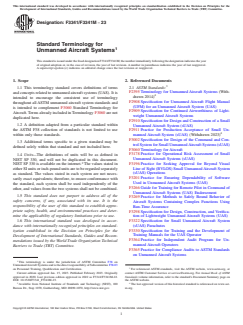
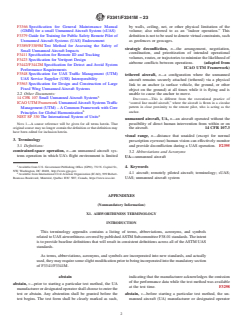
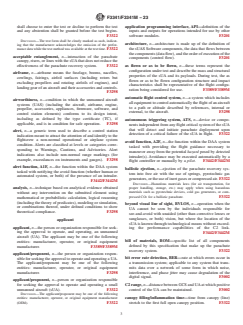
1.1 This terminology standard covers definitions of terms and concepts related to unmanned aircraft systems (UAS). It is intended to encourage the consistent use of terminology throughout all ASTM unmanned aircraft system standards and is intended to complement F3060 Standard Terminology for Aircraft. Terms already included in Terminology F3060 are not duplicated here.
1.2 A definition adapted from a particular standard within the ASTM F38 collection of standards is not limited to use within only those standards.
1.3 Additional terms specific to a given standard may be defined solely within that standard and not included here.
1.4 Units—The definitions of units will be as defined in NIST SP 330, and will not be duplicated in this document. NIST SP 330 is available on the internet.2 The values stated in either SI units or inch-pound units are to be regarded separately as standard. The values stated in each system are not necessarily exact equivalents; therefore, to ensure conformance with the standard, each system shall be used independently of the other, and values from the two systems shall not be combined.
1.5 This standard does not purport to address all of the safety concerns, if any, associated with its use. It is the responsibility of the user of this standard to establish appropriate safety, health, and environmental practices and determine the applicability of regulatory limitations prior to use.
1.6 This international standard was developed in accordance with internationally recognized principles on standardization established in the Decision on Principles for the Development of International Standards, Guides and Recommendations issued by the World Trade Organization Technical Barriers to Trade (TBT) Committee.
- Status
- Published
- Publication Date
- 14-Jan-2023
- Technical Committee
- F38 - Unmanned Aircraft Systems
- Drafting Committee
- F38.03 - Personnel Training, Qualification and Certification
Overview
ASTM F3341/F3341M-23: Standard Terminology for Unmanned Aircraft Systems provides industry-wide definitions for terms and concepts related to unmanned aircraft systems (UAS), including remotely piloted aircraft (RPA) and small unmanned aircraft systems (sUAS). Developed by ASTM International’s Committee F38, this terminology standard aims to ensure clear and consistent communication across all ASTM standards concerning UAS operations, manufacturing, safety, training, and regulatory compliance.
By harmonizing vocabulary, ASTM F3341/F3341M-23 supports manufacturers, operators, authorities, and stakeholders, helping to avoid misunderstandings and streamline documentation and compliance with international and regional requirements.
Key Topics
- Standardized Definitions: Establishes clear, authoritative meanings for UAS-specific terms, avoiding redundancy with related standards such as ASTM F3060 for aircraft terminology.
- Scope of Coverage: Focuses on terminology relevant to various UAS applications and technical areas, including airworthiness, software, control systems, and safety protocols.
- Global Harmonization: Facilitates international collaboration and regulatory alignment by adopting principles from globally recognized bodies such as the World Trade Organization’s TBT Committee.
- Unit Consistency: References NIST SP 330 for units of measurement, ensuring standards-compliant use of both SI and inch-pound units.
- Evolving Terminology: Allows the addition and updating of specialized vocabulary as UAS technology and practices advance.
Applications
This standard terminology is an essential reference for:
- Manufacturers and Developers: Ensures accurate, uniform terminology in design specifications, technical documentation, and product certifications.
- Operators and Training Providers: Supports creation of training materials, operational manuals, and instructional courses aligned with industry-recognized language.
- Regulatory Authorities: Assists in regulatory development, compliance audits, safety assessments, and certification processes for UAS and sUAS.
- Software and Systems Engineers: Clarifies definitions for concepts such as command and control, detect-and-avoid (DAA), autonomous systems, and software dependability.
- Academics and Researchers: Aids in the development of UAS research, ensuring consistency in terminology across studies and publications.
- Stakeholders and End Users: Improves understanding for customers, insurance assessors, risk managers, and legal experts involved in UAV operations.
Related Standards
ASTM F3341/F3341M-23 complements a comprehensive ecosystem of UAS standards, including but not limited to:
- ASTM F3060 - Standard Terminology for Aircraft
- ASTM F2908 - Specification for Unmanned Aircraft Flight Manual (UFM) for UAS
- ASTM F2910 - Specification for Design and Construction of Small Unmanned Aircraft Systems
- ASTM F3002 - Specification for Design of the Command and Control System for sUAS
- ASTM F3442/F3442M - Specification for Detect and Avoid System Performance Requirements
- ASTM F3322 - Specification for Small Unmanned Aircraft System (sUAS) Parachutes
- ASTM F3548 - Specification for UAS Traffic Management (UTM)
These standards, together with ASTM F3341/F3341M-23, provide a robust framework supporting consistent terminology, design practices, compliance protocols, and operational safety for the unmanned aircraft systems industry.
Keywords: unmanned aircraft system terminology, UAS standard, ASTM F3341, sUAS, UAS regulatory compliance, unmanned aircraft definitions, UAS safety, UAS industry standards, UTM, DAA systems, UAS airworthiness.
Relations
- Effective Date
- 01-Jan-2020
- Effective Date
- 01-Jan-2020
- Effective Date
- 01-Sep-2019
- Effective Date
- 01-May-2019
- Effective Date
- 01-Feb-2019
- Effective Date
- 15-Sep-2018
- Effective Date
- 01-May-2018
- Effective Date
- 15-Feb-2017
- Effective Date
- 01-Nov-2016
- Effective Date
- 01-Nov-2016
- Effective Date
- 01-Sep-2016
- Effective Date
- 01-Apr-2016
- Effective Date
- 15-Feb-2016
- Effective Date
- 15-Sep-2015
- Effective Date
- 01-May-2015
Get Certified
Connect with accredited certification bodies for this standard

BSI Group
BSI (British Standards Institution) is the business standards company that helps organizations make excellence a habit.

Bureau Veritas
Bureau Veritas is a world leader in laboratory testing, inspection and certification services.

DNV
DNV is an independent assurance and risk management provider.
Sponsored listings
Frequently Asked Questions
ASTM F3341/F3341M-23 is a standard published by ASTM International. Its full title is "Standard Terminology for Unmanned Aircraft Systems". This standard covers: SCOPE 1.1 This terminology standard covers definitions of terms and concepts related to unmanned aircraft systems (UAS). It is intended to encourage the consistent use of terminology throughout all ASTM unmanned aircraft system standards and is intended to complement F3060 Standard Terminology for Aircraft. Terms already included in Terminology F3060 are not duplicated here. 1.2 A definition adapted from a particular standard within the ASTM F38 collection of standards is not limited to use within only those standards. 1.3 Additional terms specific to a given standard may be defined solely within that standard and not included here. 1.4 Units—The definitions of units will be as defined in NIST SP 330, and will not be duplicated in this document. NIST SP 330 is available on the internet.2 The values stated in either SI units or inch-pound units are to be regarded separately as standard. The values stated in each system are not necessarily exact equivalents; therefore, to ensure conformance with the standard, each system shall be used independently of the other, and values from the two systems shall not be combined. 1.5 This standard does not purport to address all of the safety concerns, if any, associated with its use. It is the responsibility of the user of this standard to establish appropriate safety, health, and environmental practices and determine the applicability of regulatory limitations prior to use. 1.6 This international standard was developed in accordance with internationally recognized principles on standardization established in the Decision on Principles for the Development of International Standards, Guides and Recommendations issued by the World Trade Organization Technical Barriers to Trade (TBT) Committee.
SCOPE 1.1 This terminology standard covers definitions of terms and concepts related to unmanned aircraft systems (UAS). It is intended to encourage the consistent use of terminology throughout all ASTM unmanned aircraft system standards and is intended to complement F3060 Standard Terminology for Aircraft. Terms already included in Terminology F3060 are not duplicated here. 1.2 A definition adapted from a particular standard within the ASTM F38 collection of standards is not limited to use within only those standards. 1.3 Additional terms specific to a given standard may be defined solely within that standard and not included here. 1.4 Units—The definitions of units will be as defined in NIST SP 330, and will not be duplicated in this document. NIST SP 330 is available on the internet.2 The values stated in either SI units or inch-pound units are to be regarded separately as standard. The values stated in each system are not necessarily exact equivalents; therefore, to ensure conformance with the standard, each system shall be used independently of the other, and values from the two systems shall not be combined. 1.5 This standard does not purport to address all of the safety concerns, if any, associated with its use. It is the responsibility of the user of this standard to establish appropriate safety, health, and environmental practices and determine the applicability of regulatory limitations prior to use. 1.6 This international standard was developed in accordance with internationally recognized principles on standardization established in the Decision on Principles for the Development of International Standards, Guides and Recommendations issued by the World Trade Organization Technical Barriers to Trade (TBT) Committee.
ASTM F3341/F3341M-23 is classified under the following ICS (International Classification for Standards) categories: 01.040.49 - Aircraft and space vehicle engineering (Vocabularies); 49.020 - Aircraft and space vehicles in general. The ICS classification helps identify the subject area and facilitates finding related standards.
ASTM F3341/F3341M-23 has the following relationships with other standards: It is inter standard links to ASTM F3379-20, ASTM F3060-20, ASTM F2909-19, ASTM F3366-19, ASTM F3298-19, ASTM F3196-18, ASTM F3298-18, ASTM F3196-17, ASTM F3060-16a, ASTM F3178-16, ASTM F3201-16, ASTM F3060-16, ASTM F2908-16, ASTM F3060-15b, ASTM F3060-15a. Understanding these relationships helps ensure you are using the most current and applicable version of the standard.
ASTM F3341/F3341M-23 is available in PDF format for immediate download after purchase. The document can be added to your cart and obtained through the secure checkout process. Digital delivery ensures instant access to the complete standard document.
Standards Content (Sample)
This international standard was developed in accordance with internationally recognized principles on standardization established in the Decision on Principles for the
Development of International Standards, Guides and Recommendations issued by the World Trade Organization Technical Barriers to Trade (TBT) Committee.
Designation: F3341/F3341M − 23
Standard Terminology for
Unmanned Aircraft Systems
This standard is issued under the fixed designation F3341/F3341M; the number immediately following the designation indicates the year
of original adoption or, in the case of revision, the year of last revision. A number in parentheses indicates the year of last reapproval.
A superscript epsilon (´) indicates an editorial change since the last revision or reapproval.
1. Scope 2. Referenced Documents
2.1 ASTM Standards:
1.1 This terminology standard covers definitions of terms
F2395 Terminology for Unmanned Aircraft Systems (With-
and concepts related to unmanned aircraft systems (UAS). It is
drawn 2014)
intended to encourage the consistent use of terminology
F2908 Specification for Unmanned Aircraft Flight Manual
throughout all ASTM unmanned aircraft system standards and
(UFM) for an Unmanned Aircraft System (UAS)
is intended to complement F3060 Standard Terminology for
F2909 Specification for Continued Airworthiness of Light-
Aircraft. Terms already included in Terminology F3060 are not
weight Unmanned Aircraft Systems
duplicated here.
F2910 Specification for Design and Construction of a Small
1.2 A definition adapted from a particular standard within
Unmanned Aircraft System (sUAS)
the ASTM F38 collection of standards is not limited to use
F2911 Practice for Production Acceptance of Small Un-
within only those standards. manned Aircraft System (sUAS) (Withdrawn 2023)
F3002 Specification for Design of the Command and Con-
1.3 Additional terms specific to a given standard may be
trol System for Small Unmanned Aircraft Systems (sUAS)
defined solely within that standard and not included here.
F3060 Terminology for Aircraft
F3178 Practice for Operational Risk Assessment of Small
1.4 Units—The definitions of units will be as defined in
Unmanned Aircraft Systems (sUAS)
NIST SP 330, and will not be duplicated in this document.
F3196 Practice for Seeking Approval for Beyond Visual
NIST SP 330 is available on the internet. The values stated in
Line of Sight (BVLOS) Small Unmanned Aircraft System
either SI units or inch-pound units are to be regarded separately
(sUAS) Operations
as standard. The values stated in each system are not neces-
F3201 Practice for Ensuring Dependability of Software
sarily exact equivalents; therefore, to ensure conformance with
Used in Unmanned Aircraft Systems (UAS)
the standard, each system shall be used independently of the
F3266 Guide for Training for Remote Pilot in Command of
other, and values from the two systems shall not be combined.
Unmanned Aircraft Systems (UAS) Endorsement
1.5 This standard does not purport to address all of the
F3269 Practice for Methods to Safely Bound Behavior of
safety concerns, if any, associated with its use. It is the
Aircraft Systems Containing Complex Functions Using
responsibility of the user of this standard to establish appro-
Run-Time Assurance
priate safety, health, and environmental practices and deter-
F3298 Specification for Design, Construction, and Verifica-
mine the applicability of regulatory limitations prior to use.
tion of Lightweight Unmanned Aircraft Systems (UAS)
1.6 This international standard was developed in accor- F3322 Specification for Small Unmanned Aircraft System
(sUAS) Parachutes
dance with internationally recognized principles on standard-
ization established in the Decision on Principles for the F3330 Specification for Training and the Development of
Training Manuals for the UAS Operator
Development of International Standards, Guides and Recom-
F3364 Practice for Independent Audit Program for Un-
mendations issued by the World Trade Organization Technical
manned Aircraft Operators
Barriers to Trade (TBT) Committee.
F3365 Practice for Compliance Audits to ASTM Standards
on Unmanned Aircraft Systems
This terminology is under the jurisdiction of ASTM Committee F38 on
Unmanned Aircraft Systems and is the direct responsibility of Subcommittee F38.03
on Personnel Training, Qualification and Certification. For referenced ASTM standards, visit the ASTM website, www.astm.org, or
Current edition approved Jan. 15, 2023. Published February 2023. Originally contact ASTM Customer Service at service@astm.org. For Annual Book of ASTM
approved in 2020. Last previous edition approved in 2022 as F3341/F3341M-22. Standards volume information, refer to the standard’s Document Summary page on
DOI: 10.1520/F3341_F3341M-23. the ASTM website.
2 4
Available from National Institute of Standards and Technology (NIST), 100 The last approved version of this historical standard is referenced on www.ast-
Bureau Dr., Stop 1070, Gaithersburg, MD 20899-1070, http://www.nist.gov. m.org.
Copyright © ASTM International, 100 Barr Harbor Drive, PO Box C700, West Conshohocken, PA 19428-2959. United States
F3341/F3341M − 23
F3366 Specification for General Maintenance Manual by walls, ceiling, net, or other physical limitation of the
(GMM) for a small Unmanned Aircraft System (sUAS) volume; also referred to as an “indoor operation.” This
F3379 Guide for Training for Public Safety Remote Pilot of definition is not to be used to denote virtual constraints, such
Unmanned Aircraft Systems (UAS) Endorsement as geofences or geocages.
F3389/F3389M Test Method for Assessing the Safety of
strategic deconfliction, n—the arrangement, negotiation,
Small Unmanned Aircraft Impacts
coordination, and prioritization of intended operational
F3411 Specification for Remote ID and Tracking
volumes, routes, or trajectories to minimize the likelihood of
F3423 Specification for Vertiport Design
airborne conflicts between operations. (adapted from
F3442/F3442M Specification for Detect and Avoid System
ICAO UTM Framework)
Performance Requirements
F3548 Specification for UAS Traffic Management (UTM)
tethered aircraft, n—a configuration where the unmanned
UAS Service Supplier (USS) Interoperability
aircraft remains securely attached (tethered) via a physical
F3563 Specification for Design and Construction of Large
link to an anchor (a surface vehicle, the ground, or other
Fixed Wing Unmanned Aircraft Systems
object on the ground) at all times while it is flying and is
2.2 Other Documents:
unable to cause the anchor to move.
14 CFR 107 Small Unmanned Aircraft Systems
DISCUSSION—This is different from the recreational practice of
ICAO UTM Framework Unmanned Aircraft Systems Traffic “control line model aircraft,” where the aircraft is flown in a circular
pattern in close proximity to the remote pilot, who is acting as the
Management (UTM) – A Common Framework with Core
anchor.
Principles for Global Harmonization
NIST SP 330 The International System of Units
unmanned aircraft, UA, n—an aircraft operated without the
possibility of direct human intervention from within or on
NOTE 1—A source reference will be given for all terms herein. That
original source may no longer contain the definition or that definition may
the aircraft. 14 CFR 107.3
have been edited for inclusion herein.
visual range, n—distance that unaided (except for normal
3. Terminology
prescription eyewear) human vision can effectively monitor
and provide deconfliction during a UAS operation. F2395
3.1 Definitions:
constrained-space operation, n—an unmanned aircraft sys-
3.2 Abbreviations and Acronyms:
tems operation in which UA’s flight environment is limited
UA—unmanned aircraft
Available from U.S. Government Publishing Office (GPO), 732 N. Capitol St., 4. Keywords
NW, Washington, DC 20401, http://www.gpo.gov.
6 4.1 aircraft; remotely piloted aircraft; terminology; sUAS;
Available from International Civil Aviation Organization (ICAO), 999 Robert-
UAS; unmanned aircraft system
Bourassa Boulevard, Montréal, Québec H3C 5H7, Canada, https://www.icao.int.
APPENDIXES
(Nonmandatory Information)
X1. AIRWORTHINESS TERMINOLOGY
INTRODUCTION
This terminology appendix contains a listing of terms, abbreviations, acronyms, and symbols
related to UAS airworthiness covered by published ASTM Subcommittee F38.01 standards. The intent
is to provide baseline definitions that will result in consistent definitions across all of the ASTM UAS
standards.
As terms, abbreviations, acronyms, and symbols are incorporated into new standards, and actually
used, they may require some slight modification prior to being incorporated into the mandatory section
of F3341/F3341M.
abstain indicating that the manufacturer acknowledges the omission
of the performance data while the test method was available
abstain, v—prior to starting a particular test method, the UA
at the test time. F3298
manufacturer or designated operator shall choose to enter the
test or abstain. Any abstention shall be granted before the abstain, v—before starting a particular test method, the un-
test begins. The test form shall be clearly marked as such, manned aircraft (UA) manufacturer or designated operator
F3341/F3341M − 23
shall choose to enter the test or decline to perform the test application programming interface, API—definition of the
and any abstention shall be granted before the test begins. inputs and outputs for operations intended for use by other
F3322 software modules. F3201
DISCUSSION—The test form shall be clearly marked as such, indicat-
architecture, n—architecture is made up of the definition of
ing that the manufacturer acknowledges the omission of the perfor-
the sUAS Software components, the data that flows between
mance data while the test method was available at the test time. F3322
the components (data flow), and the order of execution of the
acceptable entanglement, n—interaction of the parachute
components (control flow). F3201
canopy, risers, or lines with the sUA that does not reduce the
effectiveness of the parachute recovery system. F3322 as flown or as to be flown, n—these terms represent the
configuration under test and describe the mass and structural
airframe, n—airframe means the fuselage, booms, nacelles,
properties of the sUA and its payloads. During test, the as
cowlings, fairings, airfoil surfaces (including rotors but
flown or as to be flown configuration structure and impact
excluding propellers and rotating airfoils of engines), and
characteristics shall be representative of the flight configu-
landing gear of an aircraft and their accessories and controls.
ration being considered for use. F3389/F3389M
F3298
automatic flight control system, n—a system which includes
airworthiness, n—condition in which the unmanned aircraft
all equipment to control automatically the flight of an aircraft
systems (UAS) (including the aircraft, airframe, engine,
to a path or altitude described by references, internal or
propeller, accessories, appliances, firmware, software, and
external, to the aircraft. F3298
control station elements) conforms to its design intent,
including as defined by the type certificate (TC), if
autonomous triggering system, ATS, n—device or compo-
applicable, and is in condition for safe operation. F3298
nents independent from any flight critical system of the sUA
that will detect and initiate parachute deployment upon
alert, n—a generic term used to describe a control station
detection of a critical failure of the sUA in flight. F3322
indication meant to attract the attention of and identify to the
flightcrew a non-normal operational or airplane system
avoid function, A2F, n—the function within the DAA system
condition. Alerts are classified at levels or categories corre-
tasked with providing the flight guidance necessary to
sponding to Warnings, Cautions, and Advisories. Alert
maneuver away from the potential hazard posed by detected
indications also include non-normal range markings (for
intruder(s). Avoidance may be executed automatically by a
example, exceedances on instruments and gauges). F3298
flight controller or manually by a pilot. F3442/F3442M
alert function, A1F, n—the function within the DAA system
ballistic ejection, n—ejection of the parachute recovery sys-
tasked with notifying the avoid function (whether human or
tem into free air with the use of springs, pyrotechnic gas
automated system, or both) of the presence of an intruder.
generators, or the use of inert gases or compressed air. F3322
F3442/F3442M
DISCUSSION—Hazardous materials laws (for air transportation, for
proper handling, storage, etc.) may apply when using hazardous
analysis, n—technique based on analytical evidence obtained
materials such as pyrotechnic devices, cold gas generators, or com-
without any intervention on the submitted element using
pressed CO for a ballistic parachute. F3322
mathematical or probabilistic calculation, logical reasoning
(including the theory of predicates), modeling or simulation,
beyond visual line of sight, BVLOS, n—operation when the
or combinations thereof, under defined conditions to show
UA cannot be seen by the individuals responsible for
theoretical compliance. F3298
see-and-avoid with unaided (other than corrective lenses or
sunglasses, or both) vision, but where the location of the
applicant
sUA is known through technological means without exceed-
applicant, n—the person or organization responsible for seek-
ing the performance capabilities of the C2 link.
ing the approval to operate, and operating, an unmanned
F3442/F3442M
aircraft (UA). The applicant may be one of the following
bill of materials, BOM—specific list of all components
entities: manufacturer, operator, or original equipment
defined by this specification that make up the parachute
manufacturer. F3389/F3389M
recovery system. F3322
applicant/proponent, n—the person or organization respon-
bit error rate detection, BER—rate at which errors occur in
sible for seeking the approval to operate and operating a UA.
The applicant/proponent may be one of the following a transmission system; applicable to any system that trans-
mits data over a network of some form in which noise,
entities: manufacturer, operator, or original equipment
manufacturer. F3298 interference, and phase jitter may cause degradation of the
digital signal. F3002
applicant/proponent, n—person or organization responsible
for seeking the approval to operate and operating a small
C2 range, n—distance between GCS and UA at which positive
unmanned aircraft (sUA). F3322
control of the UA can be maintained. F3002
DISCUSSION—The applicant/proponent may be one of the following
entities: manufacturer, operator, or original equipment manufacturer canopy filling/inflammation time—time from canopy (line)
(OEM). F3322 stretch to the first full open canopy position. F3322
F3341/F3341M − 23
category 2 operations, n—under the Micro UAS Advisory control and non-payload communications, CNPC, n—radio
Rulemaking Committee (ARC), a Category 2 operation is an frequency (RF) link(s) between the control station (CS) and
sUA permitted to operate over people if it weighed more the unmanned aircraft (UA), also known as the Command
than 0.55 lb, but still presented a 1 % or less chance of and Control Link(s). F3298
“serious injury” (Abbreviated Injury Scale (AIS) level 3 or
controlled airspace, n—an airspace of defined dimensions
greater) upon impact with a person. F3389/F3389M
within which air traffic control service is provided in
category 3 operations, n—under the Micro UAS ARC, a accordance with the airspace classification. F3442/F3442M
Category 3 operation is an sUA permitted to operate over DISCUSSION—For example, in the United States, Classes A, B, C, D,
and E airspace. F3442/F3442M
people if it presented a 30 % or less chance of causing an
AIS level 3 or greater injury upon impact with a person. The
DISCUSSION—Controlled airspace does not automatically imply sepa-
manufacturer of the small UAS would be required to certify
ration services, or that the location of all traffic is known.
to the FAA that the small UAS did not, in the most probable
F3442/F3442M
failure modes, exceed the typical or likely impact energy
threshold. F3389/F3389M controlled flight, n—a condition whereby the remote pilot or
onboard systems or both, have the ability to perform
code churn, n—the quantity and frequency of additions,
functions to the extent necessary to continue safe flight and
deletions, and modifications to the source code for software.
landing, but not necessarily full functional performance.
F3201
F3298
code coverage, n—a measure used to describe the degree to
control station, n—apparatus for hosting the remote pilot and
which the source code of a program is tested by a particular
her/his device to teleoperate the UAS. F3298
test suite. F3201
critical number motor failure, CNMF, n—number of motors
command and control (C2) link(s), n—safety-critical radio-
required to remove a sUA from stable flight. The subject
frequency (RF) link(s) between the ground control station
motors shall be adjacent to one another in cases in which
(GCS) and the unmanned aircraft (UA). F3002
more than one motor is being tested. In the case of an odd
number of motors, the number of “failure” motors shall be
complex function, n—software function or algorithm that may
rounded up to the next even number. If the integrator can
cause the UAS to operate in a manner that is difficult to
demonstrate that the sUA being tested with the PRS needs to
predict due to compounded implications from factors such as
have thrust cut from more motors than defined in the
sensor measurement precision, algorithm complexity, envi-
example below in order to remove the aircraft from stable
ronmental variables (for example, gusts, traffic, electromag-
flight it is up to the integrator to define the number of motors
netic effects, etc.), multi-core processing, probabilistic
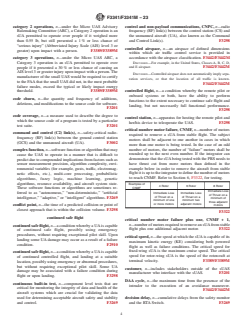
to reach CNMF. Refer to Section 6, F3322, for testing.
algorithms, fuzzy logic, machine learning, genetic
algorithms, resource availability, and aircraft system state.
Examples of
4 Rotor 6 Rotor 8 Rotor
CNMF
These software functions or algorithms are sometimes re-
Immediate Loss
ferred to as “autonomous,” “non-deterministic,” “artificial Immediate Loss Immediate Loss
of Thrust on a
of Thrust on a of Thrust on a
intelligence,” “adaptive,” or “intelligent” algorithms. F3269
minimum of
minimum of one minimum two
three adjacent
or more motors adjacent motors
conflict point, n—the time of a predicted collision or point of motors
closest approach that is within the collision volume. F3298
F3322
continued safe flight
critical number motor failure plus one, CNMF + 1,
n—number of motors required to remove an sUA from stable
continued safe flight, n—a condition whereby a UA is capable
flight plus one additional adjacent motor. F3322
of continued safe flight, possibly using emergency
procedures, without requiring exceptional pilot skill. Upon
critical speed, n—the speed at which the sUA is capable of its
landing some UA damage may occur as a result of a failure
maximum kinetic energy (KE) considering both powered
condition. F2910
flight as well as failure conditions. The critical speed for
fixed-wing sUA is the maximum cruise speed. The critical
continued safe flight, n—a condition whereby a UA is capable
speed for rotor-wing sUA is the speed of the rotorcraft at
of continued controlled flight, and landing at a suitable
terminal velocity. F3389/F3389M
location, possibly using emergency or abnormal procedures,
but without requiring exceptional pilot skill. Some UA
customer, n—includes stakeholders outside of the sUAS
damage may be associated with a failure condition during
manufacturer who interface with the sUAS. F3201
flight or upon landing. F3298
DAA cycle, n—the maximum time from the presence of the
continuous built-in test, n—component level tests that are
intruder to the execution of an avoidance maneuver.
critical for monitoring the integrity of data and health of the
F3442/F3442M
aircraft systems which are crucial for validating the data
used for determining acceptable aircraft safety and stability decision delay, n—cumulative delays from the safety monitor
and control. F3269 and the RTA Switch. F3269
F3341/F3341M − 23
declaration of compliance, n—mechanism for thorough self- EDS quality plan, n—a plan to address the software quality in
assessment and validation of compliance with this specifi- the event that EDS source code is not available. See
cation in which specific reporting or testing protocols are not Appendix X2, F3201 for more details. F3201
listed. F3322
electric propulsion unit, EPU, n—any electric motor and all
DISCUSSION—The integrator will keep documentation to support any
associated devices used to provide thrust for an electric
declarations of compliance. The following information shall be retained
aircraft. F3298
on file at the manufacturer’s facility for as long as systems remain in
service: (1) technical data that defines the parachute recovery system’s
encounter, n—the event associated with the presence of an
installation in the aircraft; (2) technical data that define the components,
intruder. F3442/F3442M
assemblies, and fabrication of the system; and (3) engineering analyses
and test data prepared for qualification with this specification. F3322
encounter rate, n—the number of encounters per unit time.
F3442/F3442M
demonstration
energy measurement, n—Kinetic energy is calculated as: KE
demonstration, n—technique used to demonstrate correct
= ⁄2 mv . Whereas “m” equals sUAs takeoff mass and “v”
operation of the submitted element against operational and
equals descent speed. F3322
observable characteristics without using physical measure-
ments (no or minimal instrumentation or test equipment). It
energy storage device, ESD, n—used to store energy as part of
generally consists of a set of tests selected by the supplier to
an Electric Propulsion Unit (EPU). Typical energy storage
show that the element response to stimuli is suitable or to
devices include but are not limited to batteries, fuel cells, or
show that operators can perform their assigned tasks when
capacitors. F3298
using the element. Observations are made and compared
entanglement, n—unintended physical interaction of the para-
with predetermined/expected responses. F3298
chute risers, lines, or canopy with the sUA during a PRS
demonstration, n—a practical exhibition of how the PRS or
deployment that compromises the functionality and effec-
components, or both, work. F3322
tiveness of the PRS. F3322
dependability, n—attribute of the software code that produces
envelope protection, n—the human-machine interface exten-
the consequences for which it was written, without adverse sion of an automatic flight control system that prevents the
effects, in its intended environment. F3201
remote pilot from making control commands that would
force the aircraft to exceed its structural and aerodynamic
descent rate, n—final steady state rate of decreasing vertical
operating limits. UAS with envelope protection are intended
altitude of the sUA at sea level conditions. F3322
for non-acrobatic operation. Non-acrobatic operation in-
DISCUSSION—It shall be noted that horizontal speed and the calcula-
cludes: any maneuver incident to normal flying; stalls
tion of horizontal impact should be considered based on the worst-case
(except whip stalls); and lazy eights, chandelles, and steep
scenario but for the purpose of this specification it is not used as a
turns, in which the angle of bank is not more than 60°.
determining factor. The horizontal impact can be influenced by the
F3298
construction or deconstruction of the combination of wind or the
pendulum effect, or both, both of which are greatly affected by the
expanded operations, n—UAS operations that typically re-
direction of travel and orientation of the sUA in relation to the PRS
quire authorization from the CAA (for example, Operations
during deployment. F3322
Authorization for Specific Category UAS or Part 107 Cer-
design maximum aircraft weight, W , n—aircraft design
MAX tificate of Waiver/Authorization) with specific limitations
maximum weight for unmanned aircraft shall be the highest
adapted to the operation. F3298
weight at which compliance with each applicable structural
externally developed software, EDS, n—software developed
loading condition and all requirements for flight regimes is
outside of the sUAS manufacturer for which adequate
shown. F3298
records of the development process may not be available.
detect and avoid, DAA, n—a subsystem within the UAS F3201
providing the situational awareness, alerting, and avoidance
extremely improbable, n—a probability no greater than one
necessary to maintain safe BVLOS operation of the ownship
-6
occurrence every 1 000 000 (10 ) flight hours F3298
in the presence of intruders. F3442/F3442M
extremely remote probability, n—a probability no greater
detect function, DF, n—the function within the DAA system
-5
than one occurrence every 100 000 (10 ) flight hours.
tasked with maintaining temporal and spatial awareness of
F3298
intruders. F3442/F3442M
fail box/orange wire, n—an independent system from the sUA
downlink, n—any RF link from UA to GCS. F3002
that is not a normal component of the sUA during operation
dynamic program analysis, n—the practice of analyzing and is used for introducing the various failure modes
software while it is executing, for example monitoring independently of the sUA, the parachute recovery system
memory access, allocation, and deallocation during program (PRS), and its flight termination system (FTS) and autono-
execution. For example, Valgrind is a popular open-source mous triggering system (ATS) and manual triggering device
tool that performs this type of analysis. F3201 (MTD) of the PRS. F3322
F3341/F3341M − 23
false deployment, n—an unintentional deployment of the PRS fly away protection system
by the ATS during stable flight. F3322
fly-away protection system, n—a system that will return the
flight control system, FCS, n—composed of system compo- UA safely to the surface, or keep the UA within the intended
nents intended to take GCS commands via a C2 link and operational area, when the C2 link between the pilot and the
control flight control surfaces and propulsion systems. UA is lost. F3002
F3002
fly-away protection system, n—system that will safely re-
DISCUSSION—The FCS may include autopilot functions, lost-link
cover the sUA, or keep the sUA within the intended
functions, fly-away protection functions, payload functions, and navi-
operational area, in the event of a fly-away as defined in
gation functions. The FCS may be contained in one discrete component
3.1.26, F3298. F3298
or multiple discrete components. F3002
forebody, n—object connected to the parachute canopy and
flight critical system
accompanying drogue chutes, if applicable.
flight-critical system, n—a system that, should it fail, will
DISCUSSION—The forebody shall be considered the sUA with any
cause loss of control of the UA, or the UA will no longer stay
additional attachments (that is, parachute deployment system, payload,
capable of continued safe flight. F3298
electronics, propellers, and so forth). F3322
flight-critical system, n—system that, should it fail, will cause
full power failure/full power cut, n—sudden and immediate
the sUA to no longer maintain stable flight. F3322 loss of power function to the critical flight systems of the
sUA such as motors, electronic speed controllers (ESC), and
flight envelope, n—range of combinations of speed, direction
avionics.
of travel, altitude, roll, angle of attack, and so forth within
DISCUSSION—Throttling down the motors is not the same as a full
which the sUA is able to be safely operated without
power cut in a test as the former gives the operator control and advance
exceeding its structural design load factor. F3322
knowledge that loss of stable flight is going to occur. F3322
flight manual, FM, n—manual describing the operation of the
fuzz testing, n—a testing technique wherein the input to a unit
aircraft and includes any limitations; normal, abnormal, and
under test is unexpected in some way. Examples include
emergency procedures; and provides specific facts,
testing with input that is invalid, unexpected, or random.
information, or instructions, or combinations thereof, about a
F3201
particular aircraft and the operation of that aircraft. F3298
geo-fence—a virtual geographic boundary, defined by
DISCUSSION—For airplanes, this is identified as an airplane flight
manual (AFM). For UAS, this is identified as an unmanned aircraft location-based services, that enables software to trigger a
flight manual (UFM). F3298 response when a mobile device enters or leaves a particular
area. F3298
flight manual supplement, FMS, n—document that provides
supplemental information, usually for equipment that is not
ground control station, GCS—a land- or sea-based control
part of the basic aircraft and included in the main flight center that provides the facilities for human control of UA.
manual. F3298
F3002
flight termination system ground roll distance, n—the horizontal distance between start
of takeoff or at a low height above ground (as used in
flight termination system, n—a system that terminates the
rail-assisted launch), or both, and should be of sufficient
flight of a UAS in the event that all other contingencies have
distance to allow the UA to gain the manufacturer’s pub-
been exhausted and further flight of the aircraft cannot be
lished climb-out speed (that is, the point when V is
T
safely achieved, or other potential hazards exist that imme-
reached). This may begin at the release of brakes (that is,
diate discontinuation of flight. F3298
with traditional aircraft) or at the point of launch (for
example, via hand-launch or catapult system). Alternatively
flight termination system, FTS, n—device or components that
referred to as “departure roll.” F3298
will disable the propulsion system of the sUA. F3322
improbable, n—a probability no greater than one occurrence
flight training supplement, FTS, n—document providing
-2
every 100 flight hours (10 ). F3298
guidance for training for unmanned aircraft. F3298
input delay—cumulative delay from the sensed inputs and the
fly away
RTA Input Manager. F3269
fly away, n—unintended flight outside of operational boundar-
inspection, n—technique based on visual or dimensional
ies (altitude/airspeed/lateral) as the result of a failure of the
examination of an element; inspection is generally non-
control element or onboard systems, or both. F3002
destructive, and typically includes the use of sight, hearing,
fly-away, n—flight outside of operational boundaries (altitude/ smell, touch, and taste, simple physical manipulation, me-
airspeed/lateral limits) as the result of a failure, interruption, chanical and electrical gauging, and measurement (F3298,
or degradation of the control station or onboard systems, or F3322). No stimuli (tests) are necessary. The technique is
both. F3298 used to check properties or characteristics best determined
F3341/F3341M − 23
by observation (for example, paint color, weight, ground handling load, n—those loads experienced during
documentation, listing of code, etc.). F3298 regular operation while the aircraft is not in flight (for example,
assembly, flight preparation, taxi, and maintenance). F3298
integrator, n—entity responsible for the integration of all the
launch and recovery load, n—those loads experienced dur-
various parachute components, the sUA, and the testing of
ing normal launch and recovery. F3298
the entire system. F3322
DISCUSSION—The integrator could also be the parachute recovery
landing loads, n—the load exerted upon an aircraft at
system manufacturer or the sUA manufacturer. The integrator may also
touchdown or upon a runway by an airplane during touchdown
work with other named third parties to delegate various tasks. Tasks the
and in the landing roll. F3298
integrator has are: (1) selection and integration of the parachute
components, parachute deployment device, and any other electronics limit load, n—the maximum load experienced in the normal
needed; (2) installation of the parachute recovery system on the sUA
operation and maintenance of the UA. F3298
and working with the sUA manufacturer to integrate the system
load factor, n—the ratio of a specified load to the total weight
properly; (3) pulling together all the various component specifications
of the aircraft. The specified load is expressed in terms of any
to be sure they meet the requirements called out in this specification;
and (4) performing and coordinating with a test facility all the various of the following: aerodynamic forces, inertia forces, or ground
flight tests called out in this specification. F3322
or water reactions. F3298
opening shock load, n—this is the maximum load force
internal user, n—includes stakeholders within the sUAS
under any conditions that occurs on the main parachute during
manufacturer’s organization who interface with the sUAS.
the process of the parachute opening. F3322
F3201
ultimate load, n—limit load multiplied by the factor of safety
internally developed software, IDS, n—software developed
(as determined by the CAA, but heuristically 1.5). F3298
within the sUAS manufacturer’s organization. F3201
loss of tailrotor effectiveness, n—an unanticipated yaw is
intruder, n—a manned aircraft external to ownship within or
defined as an uncommanded, rapid yaw towards the advanc-
projected to be in the ownship’s vicinity in the near future.
ing blade that does not subside of its own accord. F3298
F3442/F3442M
DISCUSSION—This definition is deliberately equivocal since the DAA
loss of well-clear risk ratio (LR) measurement, n—the LR is
system architecture and technologies employed, as well as ownship
the quotient of the probability of a loss of well-clear (LoWC)
maneuvering capabilities, will shape the specific definitions of “vicin-
given an encounter with a DAA system, and the probability
ity” and “near future.” F3442/F3442M
of loss of well-clear given an encounter without a DAA
launch and recovery load, n—those loads experienced during
system. The lower the LR, the better the DAA system is at
normal launch and recovery of the UA. F2910
preventing a loss of well-clear. The LR is a measurement to
ensure that a portion of the mitigation happens before loss of
licensed band, n—any frequency or range of frequencies in
well-clear as opposed to after loss of WC. F3442/F3442M
which transmission requires permission from a governing
body (for example, the Federal Communications Commis-
lost link, n—occurrence in which the pilot in command (PIC)
sion [FCC]). F3002
has lost the ability to control positively the sUAS because of
degradation, loss or interruption of the necessary control or
lightweight UAS, n—unmanned small aircraft that are ap-
monitoring link(s), or both. F3002
proved for operation under the authority of a CAA (for
example, UAS approved to operate by the FAA under 14
maneuver time, T, n—the maneuver time, T, should be the
CFR Part 107, UAS approved to operate by EASA as Open
time required for the specific UA to execute a maneuver that
and Specific Category UA, and UAS approved to operate by
ensures the point of closest approach of a conflicting aircraft
CASA as Small, Medium, or Large RPA, or combinations
remains outside the collision volume. The manufacturer of
thereof). F3298
the UAS should determine and document this value or the
means of how it is determined in real time. F3298
limit load, n—those loads experienced in the normal operation
and maintenance of the UA. F2910
manual triggering device, MTD, n—device or component
that can initiate deployment of the parachute recovery
link error, n—degradation of the digital signal between the
system at the discretion of the remote pilot in command
GCS and the UA that can be monitored by techniques
(RPIC). F3322
including BER detection. F3002
manufacturer
link integrity, n—acceptable rate of transactions completed
with undetected error. F3002
manufacturer, n—entity responsible for assembly and integra-
link timeout, n—time between the actual lost-link event being tion of components and subsystems to create a safe operating
sUAS. F2910, F3002
validated and the system initiating the lost-link procedure.
F3002
manufacturer, n—entity responsible for assembly and integra-
loads— tion of components and subsystems to create a safe operating
flight load, n—those loads experienced within the opera- sUAS. The builder of kit-built systems provided by a
tional flight envelope. F3298 manufacturer must conform to the manufacturer’s assembly
F3341/F3341M − 23
and test instructions without deviation in order for that operator
kit-built system to meet this standard. F2911
operator, n—the person or organization that applies for CAA
approval to operate a UAS or who seeks operational ap-
manufacturer, n—the person or organization who causes
production of a product or article. A manufacturer may also proval for types of flight operations prohibited by a CAA for
that UAS. F3298
be an operator. F3298, F3389/F3389M
manufacturer, n—entity responsible for the creation of the operator, n—the person or organization who applies for CAA
approval to operate an sUAS or who seeks operational
various components of the parachute recovery system.
F3322 approval for types of flight operations prohibited by a CAA
DISCUSSION—These can consist of the parachute, parachute ejection for that sUAS. F3389/F3389M
device, flight termination system, parachute deployment controller, or
operational envelope, n—the subset which bounds the full set
other components. There can be any number of manufacturers. F3322
of operational cases by all associated variables (for example,
original equipment manufacturer, n—the person or organi-
speed, altitude, attitude, etc.). F3298
zation who first produced that product or article. An OEM
operational environment, n—all allowed environmental con-
may also be an operator.
ditions (temperature operating range, humidity range, dust
sUAS manufacturer, n—the organization and personnel with
and other debris tolerances, and so forth) that the manufac-
design responsibility for the sUAS, including the depend-
turer will define in the environmental envelope for
ability of the system software. F3201
operation/use for the product life of the parachute recovery
system. F3322
mean time between critical failure, MTBCF, n—there are
two criteria for reliability that are relevant for parachute
operational speed, n—the maximum speed at which the sUA
recovery systems: (1) MTBCF for positive activation—the
can normally operate (considering the usage expectations
probability that the parachute recovery system including its
and limitations within the flight manual). F3389/F3389M
ATS and FTS will open the parachute in case of emergency
out of ground effect, n—condition where the downwash of air
and (2) MTBCF for false positive event—the probability
from the main rotor (or propellers of a vertical flight aircraft)
that the parachute recovery system will deploy
is unable to react with a hard surface (the ground), and
unintentionally. F3322
commonly begins at altitude above ground level of approxi-
Means of Compliance (MoC), n—a method or process that is
mately 0.5 to 1.0 times the diameter of the main rotor (or
used to show that a rule has been complied with through
propellers of a vertical flight aircraft). F3298
either design, analysis, test, or a combination of design,
packing/parachute packing, v—process of folding and con-
analysis, and test. F3563
densing the main canopy, connected cables, and other
minimum deployable altitude, MDA, n—difference in alti- attached mechanisms to fit in a design compartment of the
tude from the point of failure to the point of stabilized sUA aircraft to hold the parachute. F3322
DISCUSSION—The packing process shall be done in such a fashion to
descent under parachute; is airframe/speed dependent and
allow for full deployment and acceptable opening behavior in the event
certified through testing in Section 6, F3322. F3322
of parachute deployment. Parachute packing procedures shall be
minimum flight altitude, MFA, n—minimum altitude above
defined by the parachute manufacturer in the PM. F3322
ground level of the sUA in cases in which a parachute
parachute, n—any aerodynamic deceleration device designed
recovery system is used for flight over people. The MFA
to slow the descent of sUA when not under stable safe flight.
shall be defined per the results of testing in Section 6, F3322.
F3322
F3322
parachute manual, PM, n—the minimum material provided
most probable, worst case (MPWC), n—the sUA orientation
from the manufacturer to the operator/owner of the sUA that
used in impact testing. The orientation is found by first using
discusses topics such as instructions and procedures for
operational data, failure modes, and engineering judgment to
inspection, maintenance, re-pack along with any PRS limi-
determine the most probable impact orientations. Testing is
tations in regard to operational or environmental limitations
conducted to determine the worst case (most damaging)
and approved payloads. F3322
orientation among the most probable impact orientations.
F3389/F3389M
parachute maximum dynamic shock load, MDSL,
n—maximum opening shock load force the parachute is
non-pedigreed components, n—hardware and software items
rated for under any condition. F3322
for which the UAS manufacturer does not or cannot produce
sufficient evidence that these items on their own will operate
parachute recovery system, PRS, n—summation of the com-
within an acceptable level of risk based on the operational ponents of a parachute recovery system that work to reduce
risk assessment. F3269
descent velocity. F3322
opening shock load, n—this is the maximum load force under payload, n—any instrument, mechanism, equipment, part,
any conditions that occurs on the main parachute during the apparatus, appurtenance, or accessory, including communi-
process of the parachute opening. F3322 cations equipment, that is installed in or attached to the
F3341/F3341M − 23
aircraft, is not used or intended to be used in operating or ments. The history may be part of revision control system,
controlling an aircraft in flight, and is not part of an airframe, printed papers in a binder, or any other auditable system.
engine, or propeller. F3298 F3201
quality assurance, n—the practice of internally monitoring or
pedigreed components, n—hardware and software items for
which the UAS manufacturer produces sufficient evidence auditing the development process. F3201
that these items on their own will operate within an
recovery control function, RCF, n—a pedigreed function or
acceptable level of risk based on the operational risk
software algorithm to return the UAS to a safe state. For
assessment. F3269
example, a sequence of commands that causes the UAS to
land safely, to maneuver in space, return to level flight, or
penetration testing, n—a testing method intended to identify
deploy a flight recovery system. F3269
and correct vulnerabilities and security defects by attempting
to break, bypass, or tamper with software security controls.
RCF complete, n—the system state where the RCF has been
F3201
effective in ensuring the UAS will not violate its pre-defined
limits. F3269
permanent deformation
RCF delay, n—the cumulative delay from each RCF. F3269
permanent deformation, n—a condition whereby a UA struc-
ture is altered such that it does not return to the shape
RCF response delay, n—the delay between the initiation of the
required for normal flight. F2910
RCF and RCF complete. F3269
permanent deformation, n—a condition whereby a UA struc-
RCF trigger thresholds, n—the thresholds in the safety
ture is altered such that it does not return to the shape
monitor which the UAS manufacturer sets to ensure that
required for normal flight upon removal of external loads.
action is taken before the UAS violates a pre-defined limit.
F3298
These “soft limits” trigger the safety monitor to command
the RTA switch to an appropriate RCF and account for all
pilot chute, n—smaller parachute than the main canopy that is
delays between command of the RTA switch and the
connected to the main canopy. F3322
execution of the recovery action. F3269
DISCUSSION—The main purpose of the pilot chute is to be deployed
before the main canopy to pull the main canopy out of a container into
red team evaluation, n—a process designed to detect network
free air to produce full canopy. The
...
This document is not an ASTM standard and is intended only to provide the user of an ASTM standard an indication of what changes have been made to the previous version. Because
it may not be technically possible to adequately depict all changes accurately, ASTM recommends that users consult prior editions as appropriate. In all cases only the current version
of the standard as published by ASTM is to be considered the official document.
Designation: F3341/F3341M − 22 F3341/F3341M − 23
Standard Terminology for
Unmanned Aircraft Systems
This standard is issued under the fixed designation F3341/F3341M; the number immediately following the designation indicates the year
of original adoption or, in the case of revision, the year of last revision. A number in parentheses indicates the year of last reapproval.
A superscript epsilon (´) indicates an editorial change since the last revision or reapproval.
1. Scope
1.1 This terminology standard covers definitions of terms and concepts related to unmanned aircraft systems (UAS). It is intended
to encourage the consistent use of terminology throughout all ASTM unmanned aircraft system standards and is intended to
complement F3060 Standard Terminology for Aircraft. Terms already included in Terminology F3060 are not duplicated here.
1.2 A definition adapted from a particular standard within the ASTM F38 collection of standards is not limited to use within only
those standards.
1.3 Additional terms specific to a given standard may be defined solely within that standard and not included here.
1.4 Units—The definitions of units will be as defined in NIST SP 330, and will not be duplicated in this document. NIST SP 330
is available on the internet. The values stated in either SI units or inch-pound units are to be regarded separately as standard. The
values stated in each system are not necessarily exact equivalents; therefore, to ensure conformance with the standard, each system
shall be used independently of the other, and values from the two systems shall not be combined.
1.5 This standard does not purport to address all of the safety concerns, if any, associated with its use. It is the responsibility
of the user of this standard to establish appropriate safety, health, and environmental practices and determine the applicability of
regulatory limitations prior to use.
1.6 This international standard was developed in accordance with internationally recognized principles on standardization
established in the Decision on Principles for the Development of International Standards, Guides and Recommendations issued
by the World Trade Organization Technical Barriers to Trade (TBT) Committee.
2. Referenced Documents
2.1 ASTM Standards:
F2395 Terminology for Unmanned Aircraft Systems (Withdrawn 2014)
F2908 Specification for Unmanned Aircraft Flight Manual (UFM) for an Unmanned Aircraft System (UAS)
F2909 Specification for Continued Airworthiness of Lightweight Unmanned Aircraft Systems
F2910 Specification for Design and Construction of a Small Unmanned Aircraft System (sUAS)
F2911 Practice for Production Acceptance of Small Unmanned Aircraft System (sUAS) (Withdrawn 2023)
F3002 Specification for Design of the Command and Control System for Small Unmanned Aircraft Systems (sUAS)
This terminology is under the jurisdiction of ASTM Committee F38 on Unmanned Aircraft Systems and is the direct responsibility of Subcommittee F38.03 on Personnel
Training, Qualification and Certification.
Current edition approved Sept. 1, 2022Jan. 15, 2023. Published October 2022February 2023. Originally approved in 2020. Last previous edition approved in 20202022
as F3341/F3341M-20a. DOI: 10.1520/F3341_F3341M-22.-22. DOI: 10.1520/F3341_F3341M-23.
Available from National Institute of Standards and Technology (NIST), 100 Bureau Dr., Stop 1070, Gaithersburg, MD 20899-1070, http://www.nist.gov.
For referenced ASTM standards, visit the ASTM website, www.astm.org, or contact ASTM Customer Service at service@astm.org. For Annual Book of ASTM Standards
volume information, refer to the standard’s Document Summary page on the ASTM website.
The last approved version of this historical standard is referenced on www.astm.org.
Copyright © ASTM International, 100 Barr Harbor Drive, PO Box C700, West Conshohocken, PA 19428-2959. United States
F3341/F3341M − 23
F3060 Terminology for Aircraft
F3178 Practice for Operational Risk Assessment of Small Unmanned Aircraft Systems (sUAS)
F3196 Practice for Seeking Approval for Beyond Visual Line of Sight (BVLOS) Small Unmanned Aircraft System (sUAS)
Operations
F3201 Practice for Ensuring Dependability of Software Used in Unmanned Aircraft Systems (UAS)
F3266 Guide for Training for Remote Pilot in Command of Unmanned Aircraft Systems (UAS) Endorsement
F3269 Practice for Methods to Safely Bound Behavior of Aircraft Systems Containing Complex Functions Using Run-Time
Assurance
F3298 Specification for Design, Construction, and Verification of Lightweight Unmanned Aircraft Systems (UAS)
F3322 Specification for Small Unmanned Aircraft System (sUAS) Parachutes
F3330 Specification for Training and the Development of Training Manuals for the UAS Operator
F3364 Practice for Independent Audit Program for Unmanned Aircraft Operators
F3365 Practice for Compliance Audits to ASTM Standards on Unmanned Aircraft Systems
F3366 Specification for General Maintenance Manual (GMM) for a small Unmanned Aircraft System (sUAS)
F3379 Guide for Training for Public Safety Remote Pilot of Unmanned Aircraft Systems (UAS) Endorsement
F3389/F3389M Test Method for Assessing the Safety of Small Unmanned Aircraft Impacts
F3411 Specification for Remote ID and Tracking
F3423 Specification for Vertiport Design
F3442/F3442M Specification for Detect and Avoid System Performance Requirements
F3548 Specification for UAS Traffic Management (UTM) UAS Service Supplier (USS) Interoperability
F3563 Specification for Design and Construction of Large Fixed Wing Unmanned Aircraft Systems
2.2 Other Documents:
14 CFR 107 Small Unmanned Aircraft Systems
ICAO UTM Framework Unmanned Aircraft Systems Traffic Management (UTM) – A Common Framework with Core
Principles for Global Harmonization
NIST SP 330 The International System of Units
NOTE 1—A source reference will be given for all terms herein. That original source may no longer contain the definition or that definition may have been
edited for inclusion herein.
3. Terminology
3.1 Definitions:
constrained-space operation, n—an unmanned aircraft systems operation in which UA’s flight environment is limited by walls,
ceiling, net, or other physical limitation of the volume; also referred to as an “indoor operation.” This definition is not to be used
to denote virtual constraints, such as geofences or geocages.
strategic deconfliction, n—the arrangement, negotiation, coordination, and prioritization of intended operational volumes,
routes, or trajectories to minimize the likelihood of airborne conflicts between operations. (adapted from ICAO UTM
Framework)
tethered aircraft, n—a configuration where the unmanned aircraft remains securely attached (tethered) via a physical link to
an anchor (a surface vehicle, the ground, or other object on the ground) at all times while it is flying and is unable to cause the
anchor to move.
DISCUSSION—
This is different from the recreational practice of “control line model aircraft,” where the aircraft is flown in a circular pattern in close proximity to
the remote pilot, who is acting as the anchor.
unmanned aircraft, UA, n—an aircraft operated without the possibility of direct human intervention from within or on the
aircraft. 14 CFR 107.3
visual range, n—distance that unaided (except for normal prescription eyewear) human vision can effectively monitor and
provide deconfliction during a UAS operation. F2395
Available from U.S. Government Publishing Office (GPO), 732 N. Capitol St., NW, Washington, DC 20401, http://www.gpo.gov.
Available from International Civil Aviation Organization (ICAO), 999 Robert-Bourassa Boulevard, Montréal, Québec H3C 5H7, Canada, https://www.icao.int.
F3341/F3341M − 23
3.2 Abbreviations and Acronyms:
UA—unmanned aircraft
4. Keywords
4.1 aircraft; remotely piloted aircraft; terminology; sUAS; UAS; unmanned aircraft system
APPENDIXES
(Nonmandatory Information)
X1. AIRWORTHINESS TERMINOLOGY
INTRODUCTION
This terminology appendix contains a listing of terms, abbreviations, acronyms, and symbols
related to UAS airworthiness covered by published ASTM Subcommittee F38.01 standards. The intent
is to provide baseline definitions that will result in consistent definitions across all of the ASTM UAS
standards.
As terms, abbreviations, acronyms, and symbols are incorporated into new standards, and actually
used, they may require some slight modification prior to being incorporated into the mandatory section
of F3341/F3341M.
abstain
abstain, v—prior to starting a particular test method, the UA manufacturer or designated operator shall choose to enter the test
or abstain. Any abstention shall be granted before the test begins. The test form shall be clearly marked as such, indicating that
the manufacturer acknowledges the omission of the performance data while the test method was available at the test time. F3298
abstain, v—before starting a particular test method, the unmanned aircraft (UA) manufacturer or designated operator shall
choose to enter the test or decline to perform the test and any abstention shall be granted before the test begins. F3322
DISCUSSION—
The test form shall be clearly marked as such, indicating that the manufacturer acknowledges the omission of the performance data while the test
method was available at the test time. F3322
acceptable entanglement, n—interaction of the parachute canopy, risers, or lines with the sUA that does not reduce the
effectiveness of the parachute recovery system. F3322
F3341/F3341M − 23
airframe, n—airframe means the fuselage, booms, nacelles, cowlings, fairings, airfoil surfaces (including rotors but excluding
propellers and rotating airfoils of engines), and landing gear of an aircraft and their accessories and controls. F3298
airworthiness, n—condition in which the unmanned aircraft systems (UAS) (including the aircraft, airframe, engine, propeller,
accessories, appliances, firmware, software, and control station elements) conforms to its design intent, including as defined by
the type certificate (TC), if applicable, and is in condition for safe operation. F3298
alert, n—a generic term used to describe a control station indication meant to attract the attention of and identify to the flightcrew
a non-normal operational or airplane system condition. Alerts are classified at levels or categories corresponding to Warnings,
Cautions, and Advisories. Alert indications also include non-normal range markings (for example, exceedances on instruments
and gauges). F3298
alert function, A1F, n—the function within the DAA system tasked with notifying the avoid function (whether human or
automated system, or both) of the presence of an intruder. F3442/F3442M
analysis, n—technique based on analytical evidence obtained without any intervention on the submitted element using
mathematical or probabilistic calculation, logical reasoning (including the theory of predicates), modeling or simulation, or
combinations thereof, under defined conditions to show theoretical compliance. F3298
applicant
applicant, n—the person or organization responsible for seeking the approval to operate, and operating, an unmanned aircraft
(UA). The applicant may be one of the following entities: manufacturer, operator, or original equipment manufacturer.
F3389/F3389M
applicant/proponent, n—the person or organization responsible for seeking the approval to operate and operating a UA. The
applicant/proponent may be one of the following entities: manufacturer, operator, or original equipment manufacturer. F3298
applicant/proponent, n—person or organization responsible for seeking the approval to operate and operating a small
unmanned aircraft (sUA). F3322
DISCUSSION—
The applicant/proponent may be one of the following entities: manufacturer, operator, or original equipment manufacturer (OEM). F3322
application programming interface, API—definition of the inputs and outputs for operations intended for use by other
software modules. F3201
architecture, n—architecture is made up of the definition of the sUAS Software components, the data that flows between the
components (data flow), and the order of execution of the components (control flow). F3201
F3341/F3341M − 23
as flown or as to be flown, n—these terms represent the configuration under test and describe the mass and structural properties
of the sUA and its payloads. During test, the as flown or as to be flown configuration structure and impact characteristics shall
be representative of the flight configuration being considered for use. F3389/F3389M
automatic flight control system, n—a system which includes all equipment to control automatically the flight of an aircraft to
a path or altitude described by references, internal or external, to the aircraft. F3298
autonomous triggering system, ATS, n—device or components independent from any flight critical system of the sUA that will
detect and initiate parachute deployment upon detection of a critical failure of the sUA in flight. F3322
avoid function, A2F, n—the function within the DAA system tasked with providing the flight guidance necessary to maneuver
away from the potential hazard posed by detected intruder(s). Avoidance may be executed automatically by a flight controller
or manually by a pilot. F3442/F3442M
ballistic ejection, n—ejection of the parachute recovery system into free air with the use of springs, pyrotechnic gas generators,
or the use of inert gases or compressed air. F3322
DISCUSSION—
Hazardous materials laws (for air transportation, for proper handling, storage, etc.) may apply when using hazardous materials such as pyrotechnic
devices, cold gas generators, or compressed CO for a ballistic parachute. F3322
beyond visual line of sight, BVLOS, n—operation when the UA cannot be seen by the individuals responsible for see-and-avoid
with unaided (other than corrective lenses or sunglasses, or both) vision, but where the location of the sUA is known through
technological means without exceeding the performance capabilities of the C2 link. F3442/F3442M
bill of materials, BOM—specific list of all components defined by this specification that make up the parachute recovery
system. F3322
bit error rate detection, BER—rate at which errors occur in a transmission system; applicable to any system that transmits data
over a network of some form in which noise, interference, and phase jitter may cause degradation of the digital signal. F3002
C2 range, n—distance between GCS and UA at which positive control of the UA can be maintained. F3002
canopy filling/inflammation time—time from canopy (line) stretch to the first full open canopy position. F3322
category 2 operations, n—under the Micro UAS Advisory Rulemaking Committee (ARC), a Category 2 operation is an sUA
permitted to operate over people if it weighed more than 0.55 lb, but still presented a 1 % or less chance of “serious injury”
(Abbreviated Injury Scale (AIS) level 3 or greater) upon impact with a person. F3389/F3389M
category 3 operations, n—under the Micro UAS ARC, a Category 3 operation is an sUA permitted to operate over people if
it presented a 30 % or less chance of causing an AIS level 3 or greater injury upon impact with a person. The manufacturer of
F3341/F3341M − 23
the small UAS would be required to certify to the FAA that the small UAS did not, in the most probable failure modes, exceed
the typical or likely impact energy threshold. F3389/F3389M
code churn, n—the quantity and frequency of additions, deletions, and modifications to the source code for software. F3201
code coverage, n—a measure used to describe the degree to which the source code of a program is tested by a particular test
suite. F3201
command and control (C2) link(s), n—safety-critical radio-frequency (RF) link(s) between the ground control station (GCS)
and the unmanned aircraft (UA). F3002
complex function, n—software function or algorithm that may cause the UAS to operate in a manner that is difficult to predict
due to compounded implications from factors such as sensor measurement precision, algorithm complexity, environmental
variables (for example, gusts, traffic, electromagnetic effects, etc.), multi-core processing, probabilistic algorithms, fuzzy logic,
machine learning, genetic algorithms, resource availability, and aircraft system state. These software functions or algorithms are
sometimes referred to as “autonomous,” “non-deterministic,” “artificial intelligence,” “adaptive,” or “intelligent” algorithms.
F3269
conflict point, n—the time of a predicted collision or point of closest approach that is within the collision volume. F3298
continued safe flight
continued safe flight, n—a condition whereby a UA is capable of continued safe flight, possibly using emergency procedures,
without requiring exceptional pilot skill. Upon landing some UA damage may occur as a result of a failure condition. F2910
continued safe flight, n—a condition whereby a UA is capable of continued controlled flight, and landing at a suitable location,
possibly using emergency or abnormal procedures, but without requiring exceptional pilot skill. Some UA damage may be
associated with a failure condition during flight or upon landing. F3298
continuous built-in test, n—component level tests that are critical for monitoring the integrity of data and health of the aircraft
systems which are crucial for validating the data used for determining acceptable aircraft safety and stability and control. F3269
control and non-payload communications, CNPC, n—radio frequency (RF) link(s) between the control station (CS) and the
unmanned aircraft (UA), also known as the Command and Control Link(s). F3298
controlled airspace, n—an airspace of defined dimensions within which air traffic control service is provided in accordance with
the airspace classification. F3442/F3442M
DISCUSSION—
For example, in the United States, Classes A, B, C, D, and E airspace. F3442/F3442M
F3341/F3341M − 23
DISCUSSION—
Controlled airspace does not automatically imply separation services, or that the location of all traffic is known. F3442/F3442M
controlled flight, n—a condition whereby the remote pilot or onboard systems or both, have the ability to perform functions to
the extent necessary to continue safe flight and landing, but not necessarily full functional performance. F3298
control station, n—apparatus for hosting the remote pilot and her/his device to teleoperate the UAS. F3298
critical number motor failure, CNMF, n—number of motors required to remove a sUA from stable flight. The subject motors
shall be adjacent to one another in cases in which more than one motor is being tested. In the case of an odd number of motors,
the number of “failure” motors shall be rounded up to the next even number. If the integrator can demonstrate that the sUA being
tested with the PRS needs to have thrust cut from more motors than defined in the example below in order to remove the aircraft
from stable flight it is up to the integrator to define the number of motors to reach CNMF. Refer to Section 6, F3322, for testing.
Examples of CNMF 4 Rotor 6 Rotor 8 Rotor
Immediate Loss of Thrust on a Immediate Loss of Thrust on a Immediate Loss of Thrust on a
minimum of one or more motors minimum two adjacent motors minimum of three adjacent motors
F3322
critical number motor failure plus one, CNMF + 1, n—number of motors required to remove an sUA from stable flight plus
one additional adjacent motor. F3322
critical speed, n—the speed at which the sUA is capable of its maximum kinetic energy (KE) considering both powered flight
as well as failure conditions. The critical speed for fixed-wing sUA is the maximum cruise speed. The critical speed for
rotor-wing sUA is the speed of the rotorcraft at terminal velocity. F3389/F3389M
customer, n—includes stakeholders outside of the sUAS manufacturer who interface with the sUAS. F3201
DAA cycle, n—the maximum time from the presence of the intruder to the execution of an avoidance maneuver. F3442/F3442M
decision delay, n—cumulative delays from the safety monitor and the RTA Switch. F3269
declaration of compliance, n—mechanism for thorough self-assessment and validation of compliance with this specification in
which specific reporting or testing protocols are not listed. F3322
DISCUSSION—
The integrator will keep documentation to support any declarations of compliance. The following information shall be retained on file at the
manufacturer’s facility for as long as systems remain in service: (1) technical data that defines the parachute recovery system’s installation in the
aircraft; (2) technical data that define the components, assemblies, and fabrication of the system; and (3) engineering analyses and test data prepared
for qualification with this specification. F3322
F3341/F3341M − 23
demonstration
demonstration, n—technique used to demonstrate correct operation of the submitted element against operational and observable
characteristics without using physical measurements (no or minimal instrumentation or test equipment). It generally consists of
a set of tests selected by the supplier to show that the element response to stimuli is suitable or to show that operators can
perform their assigned tasks when using the element. Observations are made and compared with predetermined/expected
responses. F3298
demonstration, n—a practical exhibition of how the PRS or components, or both, work. F3322
dependability, n—attribute of the software code that produces the consequences for which it was written, without adverse
effects, in its intended environment. F3201
descent rate, n—final steady state rate of decreasing vertical altitude of the sUA at sea level conditions. F3322
DISCUSSION—
It shall be noted that horizontal speed and the calculation of horizontal impact should be considered based on the worst-case scenario but for the
purpose of this specification it is not used as a determining factor. The horizontal impact can be influenced by the construction or deconstruction of
the combination of wind or the pendulum effect, or both, both of which are greatly affected by the direction of travel and orientation of the sUA in
relation to the PRS during deployment. F3322
design maximum aircraft weight, W , n—aircraft design maximum weight for unmanned aircraft shall be the highest
MAX
weight at which compliance with each applicable structural loading condition and all requirements for flight regimes is shown.
F3298
detect and avoid, DAA, n—a subsystem within the UAS providing the situational awareness, alerting, and avoidance necessary
to maintain safe BVLOS operation of the ownship in the presence of intruders. F3442/F3442M
detect function, DF, n—the function within the DAA system tasked with maintaining temporal and spatial awareness of
intruders. F3442/F3442M
downlink, n—any RF link from UA to GCS. F3002
dynamic program analysis, n—the practice of analyzing software while it is executing, for example monitoring memory access,
allocation, and deallocation during program execution. For example, Valgrind is a popular open-source tool that performs this
type of analysis. F3201
EDS quality plan, n—a plan to address the software quality in the event that EDS source code is not available. See Appendix
X2, F3201 for more details. F3201
F3341/F3341M − 23
electric propulsion unit, EPU, n—any electric motor and all associated devices used to provide thrust for an electric aircraft.
F3298
encounter, n—the event associated with the presence of an intruder. F3442/F3442M
encounter rate, n—the number of encounters per unit time. F3442/F3442M
energy measurement, n—Kinetic energy is calculated as: KE = ⁄2 mv . Whereas “m” equals sUAs takeoff mass and “v” equals
descent speed. F3322
energy storage device, ESD, n—used to store energy as part of an Electric Propulsion Unit (EPU). Typical energy storage
devices include but are not limited to batteries, fuel cells, or capacitors. F3298
entanglement, n—unintended physical interaction of the parachute risers, lines, or canopy with the sUA during a PRS
deployment that compromises the functionality and effectiveness of the PRS. F3322
envelope protection, n—the human-machine interface extension of an automatic flight control system that prevents the remote
pilot from making control commands that would force the aircraft to exceed its structural and aerodynamic operating limits. UAS
with envelope protection are intended for non-acrobatic operation. Non-acrobatic operation includes: any maneuver incident to
normal flying; stalls (except whip stalls); and lazy eights, chandelles, and steep turns, in which the angle of bank is not more
than 60°. F3298
expanded operations, n—UAS operations that typically require authorization from the CAA (for example, Operations
Authorization for Specific Category UAS or Part 107 Certificate of Waiver/Authorization) with specific limitations adapted to
the operation. F3298
externally developed software, EDS, n—software developed outside of the sUAS manufacturer for which adequate records of
the development process may not be available. F3201
-6
extremely improbable, n—a probability no greater than one occurrence every 1 000 000 (10 ) flight hours F3298
-5
extremely remote probability, n—a probability no greater than one occurrence every 100 000 (10 ) flight hours. F3298
fail box/orange wire, n—an independent system from the sUA that is not a normal component of the sUA during operation and
is used for introducing the various failure modes independently of the sUA, the parachute recovery system (PRS), and its flight
termination system (FTS) and autonomous triggering system (ATS) and manual triggering device (MTD) of the PRS. F3322
false deployment, n—an unintentional deployment of the PRS by the ATS during stable flight. F3322
F3341/F3341M − 23
flight control system, FCS, n—composed of system components intended to take GCS commands via a C2 link and control
flight control surfaces and propulsion systems. F3002
DISCUSSION—
The FCS may include autopilot functions, lost-link functions, fly-away protection functions, payload functions, and navigation functions. The FCS may
be contained in one discrete component or multiple discrete components. F3002
flight critical system
flight-critical system, n—a system that, should it fail, will cause loss of control of the UA, or the UA will no longer stay capable
of continued safe flight. F3298
flight-critical system, n—system that, should it fail, will cause the sUA to no longer maintain stable flight. F3322
flight envelope, n—range of combinations of speed, direction of travel, altitude, roll, angle of attack, and so forth within which
the sUA is able to be safely operated without exceeding its structural design load factor. F3322
flight manual, FM, n—manual describing the operation of the aircraft and includes any limitations; normal, abnormal, and
emergency procedures; and provides specific facts, information, or instructions, or combinations thereof, about a particular
aircraft and the operation of that aircraft. F3298
DISCUSSION—
For airplanes, this is identified as an airplane flight manual (AFM). For UAS, this is identified as an unmanned aircraft flight manual (UFM). F3298
flight manual supplement, FMS, n—document that provides supplemental information, usually for equipment that is not part
of the basic aircraft and included in the main flight manual. F3298
flight termination system
flight termination system, n—a system that terminates the flight of a UAS in the event that all other contingencies have been
exhausted and further flight of the aircraft cannot be safely achieved, or other potential hazards exist that immediate
discontinuation of flight. F3298
flight termination system, FTS, n—device or components that will disable the propulsion system of the sUA. F3322
flight training supplement, FTS, n—document providing guidance for training for unmanned aircraft. F3298
F3341/F3341M − 23
fly away
fly away, n—unintended flight outside of operational boundaries (altitude/airspeed/lateral) as the result of a failure of the control
element or onboard systems, or both. F3002
fly-away, n—flight outside of operational boundaries (altitude/airspeed/lateral limits) as the result of a failure, interruption, or
degradation of the control station or onboard systems, or both. F3298
fly away protection system
fly-away protection system, n—a system that will return the UA safely to the surface, or keep the UA within the intended
operational area, when the C2 link between the pilot and the UA is lost. F3002
fly-away protection system, n—system that will safely recover the sUA, or keep the sUA within the intended operational area,
in the event of a fly-away as defined in 3.1.26, F3298. F3298
forebody, n—object connected to the parachute canopy and accompanying drogue chutes, if applicable.
DISCUSSION—
The forebody shall be considered the sUA with any additional attachments (that is, parachute deployment system, payload, electronics, propellers, and
so forth). F3322
full power failure/full power cut, n—sudden and immediate loss of power function to the critical flight systems of the sUA such
as motors, electronic speed controllers (ESC), and avionics.
DISCUSSION—
Throttling down the motors is not the same as a full power cut in a test as the former gives the operator control and advance knowledge that loss of
stable flight is going to occur. F3322
fuzz testing, n—a testing technique wherein the input to a unit under test is unexpected in some way. Examples include testing
with input that is invalid, unexpected, or random. F3201
geo-fence—a virtual geographic boundary, defined by location-based services, that enables software to trigger a response when
a mobile device enters or leaves a particular area. F3298
ground control station, GCS—a land- or sea-based control center that provides the facilities for human control of UA. F3002
ground roll distance, n—the horizontal distance between start of takeoff or at a low height above ground (as used in rail-assisted
launch), or both, and should be of sufficient distance to allow the UA to gain the manufacturer’s published climb-out speed (that
F3341/F3341M − 23
is, the point when V is reached). This may begin at the release of brakes (that is, with traditional aircraft) or at the point of
T
launch (for example, via hand-launch or catapult system). Alternatively referred to as “departure roll.” F3298
-2
improbable, n—a probability no greater than one occurrence every 100 flight hours (10 ). F3298
input delay—cumulative delay from the sensed inputs and the RTA Input Manager. F3269
inspection, n—technique based on visual or dimensional examination of an element; inspection is generally non-destructive, and
typically includes the use of sight, hearing, smell, touch, and taste, simple physical manipulation, mechanical and electrical
gauging, and measurement (F3298, F3322). No stimuli (tests) are necessary. The technique is used to check properties or
characteristics best determined by observation (for example, paint color, weight, documentation, listing of code, etc.). F3298
integrator, n—entity responsible for the integration of all the various parachute components, the sUA, and the testing of the
entire system. F3322
DISCUSSION—
The integrator could also be the parachute recovery system manufacturer or the sUA manufacturer. The integrator may also work with other named
third parties to delegate various tasks. Tasks the integrator has are: (1) selection and integration of the parachute components, parachute deployment
device, and any other electronics needed; (2) installation of the parachute recovery system on the sUA and working with the sUA manufacturer to
integrate the system properly; (3) pulling together all the various component specifications to be sure they meet the requirements called out in this
specification; and (4) performing and coordinating with a test facility all the various flight tests called out in this specification. F3322
internal user, n—includes stakeholders within the sUAS manufacturer’s organization who interface with the sUAS. F3201
internally developed software, IDS, n—software developed within the sUAS manufacturer’s organization. F3201
intruder, n—a manned aircraft external to ownship within or projected to be in the ownship’s vicinity in the near future.
F3442/F3442M
DISCUSSION—
This definition is deliberately equivocal since the DAA system architecture and technologies employed, as well as ownship maneuvering capabilities,
will shape the specific definitions of “vicinity” and “near future.” F3442/F3442M
launch and recovery load, n—those loads experienced during normal launch and recovery of the UA. F2910
licensed band, n—any frequency or range of frequencies in which transmission requires permission from a governing body (for
example, the Federal Communications Commission [FCC]). F3002
lightweight UAS, n—unmanned small aircraft that are approved for operation under the authority of a CAA (for example, UAS
approved to operate by the FAA under 14 CFR Part 107, UAS approved to operate by EASA as Open and Specific Category
UA, and UAS approved to operate by CASA as Small, Medium, or Large RPA, or combinations thereof). F3298
limit load, n—those loads experienced in the normal operation and maintenance of the UA. F2910
F3341/F3341M − 23
link error, n—degradation of the digital signal between the GCS and the UA that can be monitored by techniques including BER
detection. F3002
link integrity, n—acceptable rate of transactions completed with undetected error. F3002
link timeout, n—time between the actual lost-link event being validated and the system initiating the lost-link procedure. F3002
loads—
flight load, n—those loads experienced within the operational flight envelope. F3298
ground handling load, n—those loads experienced during regular operation while the aircraft is not in flight (for example,
assembly, flight preparation, taxi, and maintenance). F3298
launch and recovery load, n—those loads experienced during normal launch and recovery. F3298
landing loads, n—the load exerted upon an aircraft at touchdown or upon a runway by an airplane during touchdown and in the
landing roll. F3298
limit load, n—the maximum load experienced in the normal operation and maintenance of the UA. F3298
load factor, n—the ratio of a specified load to the total weight of the aircraft. The specified load is expressed in terms of any
of the following: aerodynamic forces, inertia forces, or ground or water reactions. F3298
opening shock load, n—this is the maximum load force under any conditions that occurs on the main parachute during the
process of the parachute opening. F3322
ultimate load, n—limit load multiplied by the factor of safety (as determined by the CAA, but heuristically 1.5). F3298
loss of tailrotor effectiveness, n—an unanticipated yaw is defined as an uncommanded, rapid yaw towards the advancing blade
that does not subside of its own accord. F3298
loss of well-clear risk ratio (LR) measurement, n—the LR is the quotient of the probability of a loss of well-clear (LoWC)
given an encounter with a DAA system, and the probability of loss of well-clear given an encounter without a DAA system. The
lower the LR, the better the DAA system is at preventing a loss of well-clear. The LR is a measurement to ensure that a portion
of the mitigation happens before loss of well-clear as opposed to after loss of WC. F3442/F3442M
lost link, n—occurrence in which the pilot in command (PIC) has lost the ability to control positively the sUAS because of
degradation, loss or interruption of the necessary control or monitoring link(s), or both. F3002
maneuver time, T, n—the maneuver time, T, should be the time required for the specific UA to execute a maneuver that ensures
the point of closest approach of a conflicting aircraft remains outside the collision volume. The manufacturer of the UAS should
determine and document this value or the means of how it is determined in real time. F3298
manual triggering device, MTD, n—device or component that can initiate deployment of the parachute recovery system at the
discretion of the remote pilot in command (RPIC). F3322
F3341/F3341M − 23
manufacturer
manufacturer, n—entity responsible for assembly and integration of components and subsystems to create a safe operating
sUAS. F2910, F3002
manufacturer, n—entity responsible for assembly and integration of components and subsystems to create a safe operating
sUAS. The builder of kit-built systems provided by a manufacturer must conform to the manufacturer’s assembly and test
instructions without deviation in order for that kit-built system to meet this standard. F2911
manufacturer, n—the person or organization who causes production of a product or article. A manufacturer may also be an
operator. F3298, F3389/F3389M
manufacturer, n—entity responsible for the creation of the various components of the parachute recovery system. F3322
DISCUSSION—
These can consist of the parachute, parachute ejection device, flight termination system, parachute deployment controller, or other components. There
can be any number of manufacturers. F3322
original equipment manufacturer, n—the person or organization who first produced that product or article. An OEM may also
be an operator.
sUAS manufacturer, n—the organization and personnel with design responsibility for the sUAS, including the dependability
of the system software. F3201
mean time between critical failure, MTBCF, n—there are two criteria for reliability that are relevant for parachute recovery
systems: (1) MTBCF for positive activation—the probability that the parachute recovery system including its ATS and FTS will
open the parachute in case of emergency and (2) MTBCF for false positive event—the probability that the parachute recovery
system will deploy unintentionally. F3322
Means of Compliance (MoC), n—a method or process that is used to show that a rule has been complied with through either
design, analysis, test, or a combination of design, analysis, and test. F3563
minimum deployable altitude, MDA, n—difference in altitude from the point of failure to the point of stabilized sUA descent
under parachute; is airframe/speed dependent and certified through testing in Section 6, F3322. F3322
minimum flight altitude, MFA, n—minimum altitude above ground level of the sUA in cases in which a parachute recovery
system is used for flight over people. The MFA shall be defined per the results of testing in Section 6, F3322. F3322
most probable, worst case (MPWC), n—the sUA orientation used in impact testing. The orientation is found by first using
operational data, failure modes, and engineering judgment to determine the most probable impact orientations. Testing is
F3341/F3341M − 23
conducted to determine the worst case (most damaging) orientation among the most probable impact orientations.
F3389/F3389M
non-pedigreed components, n—hardware and software items for which the UAS manufacturer does not or cannot produce
sufficient evidence that these items on their own will operate within an acceptable level of risk based on the operational risk
assessment. F3269
opening shock load, n—this is the maximum load force under any conditions that occurs on the main parachute during the
process of the parachute opening. F3322
operator
operator, n—the person or organization that applies for CAA approval to operate a UAS or who seeks operational approval for
types of flight operations prohibited by a CAA for that UAS. F3298
operator, n—the person or organization who applies for CAA approval to operate an sUAS or who seeks operational approval
for types of flight operations prohibited by a CAA for that sUAS. F3389/F3389M
operational envelope, n—the subset which bounds the full set of operational cases by all associated variables (for example,
speed, altitude, attitude, etc.). F3298
operational environment, n—all allowed environmental conditions (temperature operating range, humidity range, dust and
other debris tolerances, and so forth) that the manufacturer will define in the environmental envelope for operation/use for the
product life of the parachute recovery system. F3322
operational speed, n—the maximum speed at which the sUA can normally operate (considering the usage expectations and
limitations within the flight manual). F3389/F3389M
out of ground effect, n—condition where the downwash of air from the main rotor (or propellers of a vertical flight aircraft)
is unable to react with a hard surface (the ground), and commonly begins at altitude above ground level of approximately 0.5
to 1.0 times the diameter of the main rotor (or propellers of a vertical flight aircraft). F3298
packing/parachute packing, v—process of folding and condensing the main canopy, connected cables, and other attached
mechanisms to fit in a design compartment of the aircraft to hold the parachute. F3322
DISCUSSION—
The packing process shall be done in such a fashion to allow for full deployment and acceptable opening behavior in the event of parachute deployment.
Parachute packing procedures shall be defined by the parachute manufacturer in the PM. F3322
parachute, n—any aerodynamic deceleration device designed to slow the descent of sUA when not under stable safe flight.
F3322
F3341/F3341M − 23
parachute manual, PM, n—the minimum material provided from the manufacturer to the operator/owner of the sUA that
discusses topics such as instructions and procedures for inspection, maintenance, re-pack along with any PRS limitations in
regard to operational or environmental limitations and approved payloads. F3322
parachute maximum dynamic shock load, MDSL, n—maximum opening shock load force the parachute is rated for under
any condition. F3322
parachute recovery system, PRS, n—summation of the components of a parachute recovery system that work to reduce descent
velocity. F3322
payload, n—any instrument, mechanism, equipment, part, apparatus, appurtenance, or accessory, including communications
equipment, that is installed in or attached to the aircraft, is not used or intended to be used in operating or controlling an aircraft
in flight, and is not part of an airframe, engine, or propeller. F3298
pedigreed components, n—hardware and software items for which the UAS manufacturer produces sufficient evidence that
these items on their own will operate within an acceptable level of risk based on the operational risk assessment. F3269
penetration testing, n—a testing method intended to identify and correct vulnerabilities and security defects by attempting to
break, bypass, or tamper with software security controls. F3201
permanent deformation
permanent deformation, n—a condition whereby a UA structure is altered such that it does not return to the shape required
for normal flight. F2910
permanent deformation, n—a condition whereby a UA structure is altered such that it does not return to the shape required
for normal flight upon removal of external loads. F3298
pilot chute, n—smaller parachute than the main canopy that is connected to the main canopy. F3322
DISCUSSION—
The main purpose of the pilot chute is to be deployed before the main canopy to pull the main canopy out of a container into free air to produce full
canopy. The need for a pilot chute is determined by either the parachute manufacturer or the parachute recovery system integrator. F3322
pilot in command, PIC, n—the pilot responsible for the operation and safety of the UA during flight time. F3002
positive control, n—a condition in which commanded changes in the UA flight path result in the expected maneuver(s) within
an expected period of time. F3002
F3341/F3341M − 23
pre-defined limits, n—defined not-to-exceed restrictions that, if exceeded, would create a safety h
...