

ASTM F3379-20
(Guide)Standard Guide for Training for Public Safety Remote Pilot of Unmanned Aircraft Systems (UAS) Endorsement
General Information
- Abstract
SIGNIFICANCE AND USE
4.1 Every person who is identified as a PS-RP shall have met the requirements of this guide.
4.2 This guide is to be used by individuals and agencies having jurisdiction who wish to identify the minimum training standards for PS-RP.
4.3 This guide is only the first level of training for PS-RP personnel, and as such, only establishes the minimum knowledge, skills, and abilities required for a person to perform as a PS-RP.
4.4 Nothing in this guide precludes a user of this guide from adding additional requirements for its own members. The US-specific examples are intended to establish a common frame of reference.
4.5 This guide by itself is not a training document. It is only an outline of the topics required for training or evaluating a PS-RP, but it can be used to develop a training document or program.
4.6 It is up to the training authority to determine the depth or detail of training to meet its needs. Terminologies and requirements for secondary or associated training should be task/specialization-specific—not all operators require all types and levels of training. This guide supports alternatives and subsets of knowledge requirements appropriate to the type of operation, when part of a documented training program according to Specification F3330.
4.7 This guide does not stand alone and must be used with the referenced documents to provide the specific information needed by the user.
4.8 This guide can be used to evaluate a book or other document to determine if its content meets the necessary topics for training a PS-RP. Likewise, the guide can be used to evaluate an existing training program to see if it meets the requirements of this guide.
4.9 The knowledge, skill, and ability requirements presented in the following sections are not presented in any particular order and do not represent a training sequence.
SCOPE
1.1 This guide covers the minimum training requirements for public safety remote pilots (PS-RPs) as it relates to their general, field, and search specific knowledge and skills.
1.2 This guide does not provide the minimum training requirements for sUAS operations in partially or fully collapsed structures, in or on water, in confined spaces, or underground (such as caves, mines, and tunnels.)
1.2.1 Basic remote piloting skills and knowledge are found in Guide F3266.
1.3 Personnel trained to this guide are not qualified to operate in leadership positions outside of UAS teams.
1.4 Further training may be required before a PS-RP can participate on a particular kind of UAS team, depending on local needs, regulations, or policies of the authority holding jurisdiction (AHJ).
1.5 This guide is created without regard to the type of unmanned aircraft system or personal protective equipment that is used by a PS-RP individual. It is expected that all UAS are compliant with Specification F3298 or Specification F2910.
1.6 The values stated in SI units are to be regarded as standard. The values given in parentheses after SI units are provided for information only and are not considered standard.
1.7 This standard does not purport to address all of the safety concerns, if any, associated with its use. It is the responsibility of the user of this standard to establish appropriate safety, health, and environmental practices and determine the applicability of regulatory limitations prior to use.
1.8 This international standard was developed in accordance with internationally recognized principles on standardization established in the Decision on Principles for the Development of International Standards, Guides and Recommendations issued by the World Trade Organization Technical Barriers to Trade (TBT) Committee.
- Status
- Published
- Publication Date
- 31-Dec-2019
- Technical Committee
- F38 - Unmanned Aircraft Systems
- Drafting Committee
- F38.03 - Personnel Training, Qualification and Certification
Overview
ASTM F3379-20: Standard Guide for Training for Public Safety Remote Pilot of Unmanned Aircraft Systems (UAS) Endorsement provides a structured outline for the minimum training requirements for public safety remote pilots (PS-RPs) operating unmanned aircraft systems. Issued by ASTM International, this guide supports individuals and agencies in developing or evaluating training programs that ensure PS-RPs possess the necessary knowledge, skills, and abilities to operate UAS effectively and safely during public safety operations such as search, rescue, or emergency response.
This standard establishes a foundational competency framework for PS-RPs, enabling a common understanding of minimum expectations for general, field, and search-specific knowledge and operational proficiency. While it outlines the essential subjects and abilities, it does not itself function as a training manual but serves as a critical reference point when constructing or auditing training programs for public safety UAS operators.
Key Topics
ASTM F3379-20 addresses several important topics to ensure a comprehensive public safety remote pilot training program, including:
- Minimum Training Requirements: Details foundational knowledge, skills, and abilities required for PS-RPs to operate UAS in public safety scenarios.
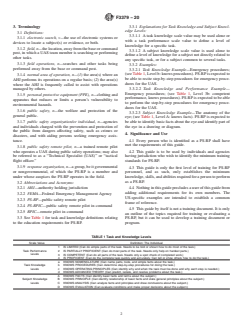
- Competency Framework: Outlines performance and knowledge levels needed for various tasks, from basic nomenclature to advanced problem-solving.
- Safety and Hazard Recognition: Covers environmental, structural, and operational hazards, personal protective equipment (PPE), and procedures for risk assessment.
- Incident Command System (ICS) Fundamentals: Recommends completion of FEMA and NIMS courses (including ICS-100, ICS-200, NIMS IS-700, and IS-800).
- Communications Proficiency: Requires demonstration of effective radio and verbal communication, essential for coordination during missions.
- Physical and Medical Fitness: Establishes fitness benchmarks appropriate to agency requirements and national fire team standards (NWCG PMS 307).
- Continuing Qualification: Includes ongoing proficiency and evaluation requirements for long-term PS-RP competence.
- Alignment with National and International Standards: Designed for use with referenced standards and guides per the WTO Technical Barriers to Trade (TBT) Committee principles.
Applications
ASTM F3379-20 is practically applied in several areas:
- Public Safety Agency Training Programs: As an outline for developing initial and continuous training curricula for remote pilots within police, fire, emergency medical, and disaster response teams.
- Program Audit and Evaluation: Agencies use the guide to benchmark or evaluate existing UAS remote pilot training documents or programs, ensuring alignment with minimum standards.
- Qualification and Endorsement: Serves as a prerequisite guide for certifying PS-RPs and instructors through documented demonstration of required skills and knowledge.
- Risk Mitigation: By establishing minimum training, agencies can reduce operational risks and improve UAS mission effectiveness.
- Cross-Jurisdictional Consistency: Promotes a common reference for training across local, state, tribal, federal, or international response organizations.
Related Standards
ASTM F3379-20 references and is intended to be used in conjunction with other important standards, including:
- ASTM F3266: Guide for Training for Remote Pilot in Command of UAS Endorsement (general UAS piloting skills)
- ASTM F2910 & F3298: Specifications for the design and construction of small and lightweight UAS
- ASTM F3330: Specification for training and development of UAS operator training manuals
- ASTM F3196: Practice for seeking approval for beyond visual line of sight (BVLOS) UAS operations
- FEMA & NIMS Documents: National Incident Management System, National Response Framework, Incident Command System training modules
- NWCG PMS 307: Medical and physical performance standards for UAS team members in public safety
- OSHA 29 CFR 1910.120: Hazardous waste and emergency response operations standards
- NIST Standard Test Methods for Response Robots: Standards for evaluating robotic systems, including UAS, in public safety contexts
Summary
By implementing ASTM F3379-20, organizations ensure public safety remote pilots meet recognized minimum training standards, supporting safe, effective, and consistent UAS operations during emergency responses. This guide is a vital reference for agencies looking to boost their UAS program's credibility, operational safety, and regulatory compliance.
Keywords: public safety remote pilot, unmanned aircraft systems, UAS, drone training, ASTM F3379, training standards, public safety UAS operations, competency framework, emergency response, qualification, curriculum, search and rescue.
Relations
- Effective Date
- 01-Feb-2019
- Effective Date
- 15-Sep-2018
- Effective Date
- 01-May-2018
- Effective Date
- 15-Feb-2017
- Effective Date
- 15-Feb-2016
- Effective Date
- 15-Jan-2014
- Effective Date
- 01-Jan-2020
Get Certified
Connect with accredited certification bodies for this standard

BSI Group
BSI (British Standards Institution) is the business standards company that helps organizations make excellence a habit.

Bureau Veritas
Bureau Veritas is a world leader in laboratory testing, inspection and certification services.

DNV
DNV is an independent assurance and risk management provider.
Sponsored listings
Frequently Asked Questions
ASTM F3379-20 is a guide published by ASTM International. Its full title is "Standard Guide for Training for Public Safety Remote Pilot of Unmanned Aircraft Systems (UAS) Endorsement". This standard covers: SIGNIFICANCE AND USE 4.1 Every person who is identified as a PS-RP shall have met the requirements of this guide. 4.2 This guide is to be used by individuals and agencies having jurisdiction who wish to identify the minimum training standards for PS-RP. 4.3 This guide is only the first level of training for PS-RP personnel, and as such, only establishes the minimum knowledge, skills, and abilities required for a person to perform as a PS-RP. 4.4 Nothing in this guide precludes a user of this guide from adding additional requirements for its own members. The US-specific examples are intended to establish a common frame of reference. 4.5 This guide by itself is not a training document. It is only an outline of the topics required for training or evaluating a PS-RP, but it can be used to develop a training document or program. 4.6 It is up to the training authority to determine the depth or detail of training to meet its needs. Terminologies and requirements for secondary or associated training should be task/specialization-specific—not all operators require all types and levels of training. This guide supports alternatives and subsets of knowledge requirements appropriate to the type of operation, when part of a documented training program according to Specification F3330. 4.7 This guide does not stand alone and must be used with the referenced documents to provide the specific information needed by the user. 4.8 This guide can be used to evaluate a book or other document to determine if its content meets the necessary topics for training a PS-RP. Likewise, the guide can be used to evaluate an existing training program to see if it meets the requirements of this guide. 4.9 The knowledge, skill, and ability requirements presented in the following sections are not presented in any particular order and do not represent a training sequence. SCOPE 1.1 This guide covers the minimum training requirements for public safety remote pilots (PS-RPs) as it relates to their general, field, and search specific knowledge and skills. 1.2 This guide does not provide the minimum training requirements for sUAS operations in partially or fully collapsed structures, in or on water, in confined spaces, or underground (such as caves, mines, and tunnels.) 1.2.1 Basic remote piloting skills and knowledge are found in Guide F3266. 1.3 Personnel trained to this guide are not qualified to operate in leadership positions outside of UAS teams. 1.4 Further training may be required before a PS-RP can participate on a particular kind of UAS team, depending on local needs, regulations, or policies of the authority holding jurisdiction (AHJ). 1.5 This guide is created without regard to the type of unmanned aircraft system or personal protective equipment that is used by a PS-RP individual. It is expected that all UAS are compliant with Specification F3298 or Specification F2910. 1.6 The values stated in SI units are to be regarded as standard. The values given in parentheses after SI units are provided for information only and are not considered standard. 1.7 This standard does not purport to address all of the safety concerns, if any, associated with its use. It is the responsibility of the user of this standard to establish appropriate safety, health, and environmental practices and determine the applicability of regulatory limitations prior to use. 1.8 This international standard was developed in accordance with internationally recognized principles on standardization established in the Decision on Principles for the Development of International Standards, Guides and Recommendations issued by the World Trade Organization Technical Barriers to Trade (TBT) Committee.
SIGNIFICANCE AND USE 4.1 Every person who is identified as a PS-RP shall have met the requirements of this guide. 4.2 This guide is to be used by individuals and agencies having jurisdiction who wish to identify the minimum training standards for PS-RP. 4.3 This guide is only the first level of training for PS-RP personnel, and as such, only establishes the minimum knowledge, skills, and abilities required for a person to perform as a PS-RP. 4.4 Nothing in this guide precludes a user of this guide from adding additional requirements for its own members. The US-specific examples are intended to establish a common frame of reference. 4.5 This guide by itself is not a training document. It is only an outline of the topics required for training or evaluating a PS-RP, but it can be used to develop a training document or program. 4.6 It is up to the training authority to determine the depth or detail of training to meet its needs. Terminologies and requirements for secondary or associated training should be task/specialization-specific—not all operators require all types and levels of training. This guide supports alternatives and subsets of knowledge requirements appropriate to the type of operation, when part of a documented training program according to Specification F3330. 4.7 This guide does not stand alone and must be used with the referenced documents to provide the specific information needed by the user. 4.8 This guide can be used to evaluate a book or other document to determine if its content meets the necessary topics for training a PS-RP. Likewise, the guide can be used to evaluate an existing training program to see if it meets the requirements of this guide. 4.9 The knowledge, skill, and ability requirements presented in the following sections are not presented in any particular order and do not represent a training sequence. SCOPE 1.1 This guide covers the minimum training requirements for public safety remote pilots (PS-RPs) as it relates to their general, field, and search specific knowledge and skills. 1.2 This guide does not provide the minimum training requirements for sUAS operations in partially or fully collapsed structures, in or on water, in confined spaces, or underground (such as caves, mines, and tunnels.) 1.2.1 Basic remote piloting skills and knowledge are found in Guide F3266. 1.3 Personnel trained to this guide are not qualified to operate in leadership positions outside of UAS teams. 1.4 Further training may be required before a PS-RP can participate on a particular kind of UAS team, depending on local needs, regulations, or policies of the authority holding jurisdiction (AHJ). 1.5 This guide is created without regard to the type of unmanned aircraft system or personal protective equipment that is used by a PS-RP individual. It is expected that all UAS are compliant with Specification F3298 or Specification F2910. 1.6 The values stated in SI units are to be regarded as standard. The values given in parentheses after SI units are provided for information only and are not considered standard. 1.7 This standard does not purport to address all of the safety concerns, if any, associated with its use. It is the responsibility of the user of this standard to establish appropriate safety, health, and environmental practices and determine the applicability of regulatory limitations prior to use. 1.8 This international standard was developed in accordance with internationally recognized principles on standardization established in the Decision on Principles for the Development of International Standards, Guides and Recommendations issued by the World Trade Organization Technical Barriers to Trade (TBT) Committee.
ASTM F3379-20 is classified under the following ICS (International Classification for Standards) categories: 49.020 - Aircraft and space vehicles in general. The ICS classification helps identify the subject area and facilitates finding related standards.
ASTM F3379-20 has the following relationships with other standards: It is inter standard links to ASTM F3298-19, ASTM F3196-18, ASTM F3298-18, ASTM F3196-17, ASTM F2908-16, ASTM F2908-14, ASTM F3341/F3341M-23. Understanding these relationships helps ensure you are using the most current and applicable version of the standard.
ASTM F3379-20 is available in PDF format for immediate download after purchase. The document can be added to your cart and obtained through the secure checkout process. Digital delivery ensures instant access to the complete standard document.
Standards Content (Sample)
This international standard was developed in accordance with internationally recognized principles on standardization established in the Decision on Principles for the
Development of International Standards, Guides and Recommendations issued by the World Trade Organization Technical Barriers to Trade (TBT) Committee.
Designation: F3379 − 20
Standard Guide for
Training for Public Safety Remote Pilot of Unmanned
Aircraft Systems (UAS) Endorsement
This standard is issued under the fixed designation F3379; the number immediately following the designation indicates the year of
original adoption or, in the case of revision, the year of last revision. A number in parentheses indicates the year of last reapproval. A
superscript epsilon (´) indicates an editorial change since the last revision or reapproval.
1. Scope 2. Referenced Documents
1.1 This guide covers the minimum training requirements 2.1 ASTM Standards:
for public safety remote pilots (PS-RPs) as it relates to their F2908 Specification for Unmanned Aircraft Flight Manual
general, field, and search specific knowledge and skills. (UFM) for an Unmanned Aircraft System (UAS)
F2910 Specification for Design and Construction of a Small
1.2 This guide does not provide the minimum training
Unmanned Aircraft System (sUAS)
requirements for sUAS operations in partially or fully col-
F3196 Practice for Seeking Approval for Beyond Visual
lapsed structures, in or on water, in confined spaces, or
Line of Sight (BVLOS) Small UnmannedAircraft System
underground (such as caves, mines, and tunnels.)
(sUAS) Operations
1.2.1 Basic remote piloting skills and knowledge are found
F3266 Guide for Training for Remote Pilot in Command of
in Guide F3266.
Unmanned Aircraft Systems (UAS) Endorsement
1.3 Personnel trained to this guide are not qualified to
F3298 Specification for Design, Construction, and Verifica-
operate in leadership positions outside of UAS teams.
tion of Lightweight Unmanned Aircraft Systems (UAS)
F3330 Specification for Training and the Development of
1.4 Further training may be required before a PS-RP can
participate on a particular kind of UAS team, depending on Training Manuals for the UAS Operator
local needs, regulations, or policies of the authority holding
2.2 National Wildfire Coordinating Group (NWCG) Docu-
jurisdiction (AHJ).
ment:
PMS 307 Work Capacity Test: Administrator’s Guide
1.5 This guide is created without regard to the type of
unmanned aircraft system or personal protective equipment
2.3 OSHA Code of Regulations:
that is used by a PS-RP individual. It is expected that all UAS
CFR 29 1910.120 Hazardous waste operations and emer-
arecompliantwithSpecificationF3298orSpecificationF2910.
gency response
1.6 The values stated in SI units are to be regarded as
2.4 U.S. Department of Homeland Security (DHS) Docu-
standard. The values given in parentheses after SI units are
ments:
provided for information only and are not considered standard.
NIMS National Incident Management System
NRF National Response Framework
1.7 This standard does not purport to address all of the
FEMA501-8 NIMS Basic - The Incident Command System
safety concerns, if any, associated with its use. It is the
responsibility of the user of this standard to establish appro-
2.5 U.S. National Institute of Standards and Technology
priate safety, health, and environmental practices and deter-
(NIST) Standards:
mine the applicability of regulatory limitations prior to use.
Standard Test Methods for Response Robots
1.8 This international standard was developed in accor-
dance with internationally recognized principles on standard-
ization established in the Decision on Principles for the
For referenced ASTM standards, visit the ASTM website, www.astm.org, or
Development of International Standards, Guides and Recom-
contact ASTM Customer Service at service@astm.org. For Annual Book of ASTM
mendations issued by the World Trade Organization Technical Standards volume information, refer to the standard’s Document Summary page on
the ASTM website.
Barriers to Trade (TBT) Committee.
Available from https://www.nwcg.gov.
Available from Occupational Safety and Health Administration (OSHA), 200
This guide is under the jurisdiction of ASTM Committee F38 on Unmanned Constitution Ave., NW, Washington, DC 20210, http://www.osha.gov.
Aircraft Systems and is the direct responsibility of Subcommittee F38.03 on Available from Federal Emergency Management Agency (FEMA), 500 C St.,
Personnel Training, Qualification and Certification. SW, Washington, DC 20472, http://www.fema.gov.
Current edition approved Jan. 1, 2020. Published February 2020. DOI: 10.1520/ Available from National Institute of Standards and Technology (NIST), 100
F3379–20. Bureau Dr., Stop 1070, Gaithersburg, MD 20899-1070, http://www.nist.gov.
Copyright © ASTM International, 100 Barr Harbor Drive, PO Box C700, West Conshohocken, PA 19428-2959. United States
F3379 − 20
3. Terminology 3.3.1 Explanations for Task Knowledge and Subject Knowl-
edge Levels:
3.1 Definitions:
3.3.1.1 A task knowledge scale value may be used alone or
3.1.1 electronic search, v—the use of electronic systems or
with a task performance scale value to define a level of
devices to locate a subject(s) or evidence, or both.
knowledge for a specific task.
3.1.2 field, n—thelocation,awayfromthebaseorcommand
3.3.1.2 A subject knowledge scale value is used alone to
post, in which a UAS team member is searching or performing
define a level of knowledge for a subject not directly related to
other tasks.
any specific task, or for a subject common to several tasks.
3.1.3 field operations, n—searches and other tasks being
3.3.2 Examples:
performed away from the base or command post.
3.3.2.1 Task Knowledge Example—Emergency procedures;
(seeTable1,Levelb:knowsprocedures).PS-RPisexpectedto
3.1.4 normal area of operation, n—(1) the area(s) where an
be able to recite step-by-step procedures for emergency proce-
AHJ performs its operations on a regular basis; (2) the area(s)
dures for the UAS.
where the AHJ is frequently called to assist with operations
3.3.2.2 Task Knowledge and Performance Example—
managed by others.
Emergency procedures; (see Table 1, Level 3b: competent
3.1.5 personal protective equipment (PPE), n—clothing and
performance, knows procedures). PS-RPis expected to be able
apparatus that reduces or limits a person’s vulnerability to
to perform the step-by-step procedures for emergency proce-
environmental hazards.
dures for the UAS.
3.1.6 public safety, n—the welfare and protection of the
3.3.2.3 Subject Knowledge Example—The anatomy of the
general public.
eye; (see Table 1, LevelA: knows facts). PS-RPis expected to
3.1.7 public safety organization/or individual, n—agencies
be able to identify basic facts about the eye and identify part of
and individuals charged with the prevention and protection of
the eye in a drawing or diagram.
the public from dangers affecting safety, such as crimes or
4. Significance and Use
disasters, and with aiding persons seeking emergency assis-
4.1 Every person who is identified as a PS-RP shall have
tance.
met the requirements of this guide.
3.1.8 public safety remote pilot, n—a trained remote pilot
who operates a UAS during public safety operations; may also 4.2 This guide is to be used by individuals and agencies
be referred to as a “Technical Specialist (UAS)” or “tactical having jurisdiction who wish to identify the minimum training
flight officer.” standards for PS-RP.
3.1.9 response organization, n—a group, be it governmental
4.3 This guide is only the first level of training for PS-RP
or nongovernmental, of which the PS-RP is a member and personnel, and as such, only establishes the minimum
under whose auspices the PS-RP operates in the field.
knowledge,skills,andabilitiesrequiredforapersontoperform
as a PS-RP.
3.2 Abbreviations and Acronyms:
3.2.1 AHJ—authority holding jurisdiction
4.4 Nothinginthisguideprecludesauserofthisguidefrom
adding additional requirements for its own members. The
3.2.2 FEMA—Federal Emergency Management Agency
US-specific examples are intended to establish a common
3.2.3 PS-RP—public safety remote pilot
frame of reference.
3.2.4 PS-RPIC—public safety remote pilot in command
4.5 This guide by itself is not a training document. It is only
3.2.5 RPIC—remote pilot in command
an outline of the topics required for training or evaluating a
3.3 See Table 1 for task and knowledge definitions relating PS-RP, but it can be used to develop a training document or
to the education requirements for PS-RP. program.
TABLE 1 Task and Knowledge Levels
Scale Value Definition: The Individual
1 IS LIMITED (Can do simple parts of the task. Needs to be told or shown how to do most of the task.)
Task Performance 2 IS PARTIALLY PROFICIENT (Can do most parts of the task. Needs only help on hardest parts.)
Levels 3 IS COMPETENT (Can do all parts of the task. Needs only a spot check of completed work.)
4 IS PROFICIENT (Can do the complete task quickly and accurately. Can tell or show others how to do the task.)
a KNOWS NOMENCLATURE (Can name parts, tools, and simple facts about the task.)
Task Knowledge b KNOWS PROCEDURES (Can determine step-by-step procedures for doing the task.)
Levels c KNOWS OPERATING PRINCIPLES (Can identify why and when the task must be done and why each step is needed.)
d KNOWS ADVANCED THEORY (Can predict, isolate, and resolve problems about the task.)
A KNOWS FACTS (Can identify basic facts and terms about the subject.)
Subject Knowledge B KNOWS PRINCIPLE (Can identify relationship of basic facts and state general principles about the subject.)
Levels C KNOWS ANALYSIS (Can analyze facts and principles and draw conclusions about the subject.)
D KNOWS EVALUATION (Can evaluate conditions and make proper decisions about the subject.)
F3379 − 20
4.6 It is up to the training authority to determine the depth 6.5 A PS-RP should complete the Department of Interior,
or detail of training to meet its needs. Terminologies and Office of Aviation Management (DOI OAM), Course A-100
requirements for secondary or associated training should be Basic Aviation Safety, or equivalent training.
task/specialization-specific—not all operators require all types
and levels of training. This guide supports alternatives and
7. Public Safety Remote Pilot Skills
subsets of knowledge requirements appropriate to the type of
7.1 A PS-RP should meet the skills requirements of Guide
operation,whenpartofadocumentedtrainingprogramaccord-
F3266 for endorsement as a RPIC.
ing to Specification F3330.
7.2 A PS-RP shall demonstrate the ability to complete the
4.7 This guide does not stand alone and must be used with
public safety remote pilot competency lane described in Annex
the referenced documents to provide the specific information
A1.
needed by the user.
7.3 APS-RPshoulddemonstratetheabilitytoperformflight
4.8 This guide can be used to evaluate a book or other
tasks in a variety of personal protective equipment, as deter-
documenttodetermineifitscontentmeetsthenecessarytopics
mined by the organization.
for training a PS-RP. Likewise, the guide can be used to
7.4 APS-RPshall demonstrate the ability to perform, to the
evaluate an existing training program to see if it meets the
trainer’s satisfaction, a sufficient number and variety of actual
requirements of this guide.
or mock UAS incidents that are likely to occur in their normal
4.9 The knowledge, skill, and ability requirements pre-
area of operations, including the selection and dispatch of
sented in the following sections are not presented in any
appropriate resources, conduct of the flight operations, and
particular order and do not represent a training sequence.
follow-up reports.
5. Program Management
8. Public Safety Remote Pilot in Command Skills
5.1 A PS-RP training program shall be developed as de-
8.1 A PS-RPIC shall meet the skills requirements of Guide
scribed by Specification F3330.
F3266 for endorsement as a RPIC.
5.2 Except where a physical skill needs to be shown, it is up
8.2 APS-RPIC shall demonstrate the ability to complete the
to the instructor, evaluator, or tester to determine the best way
public safety remote pilot competency lane described in Annex
to evaluate a person’s knowledge. This may be by written
A1, indoors and outdoors, and in day and night conditions.
exam, oral exam, demonstration, or by some combination of
8.3 A PS-RPIC shall know the six phases of UAS opera-
the three.
tions:
5.3 A PS-RP training program shall use Table 1 when
8.3.1 Preplanning,
establishing requirements.
8.3.2 Notification,
8.3.3 Planning and Strategy,
6. General Knowledge
8.3.4 Tactics and Techniques,
6.1 The following subject, performance, and task knowl-
8.3.5 Suspension, and
edge areas shall be assessed by levels (see Table 1)of
8.3.6 After action review or critique.
competency in the exam items:
8.4 To the extent determined by the AHJ, PS-RPIC shall
6.2 APS-RPshallmeetthegeneralknowledgerequirements
know the roles of other agencies or organizations, at the
of Guide F3266 for endorsement as a RPIC.
following levels, that coordinate, provide resources, provide
6.3 A PS-RP shall complete the following FEMA and services, or perform other functions in search and rescue for
National Incident Management System (NIMS) training, or
the AHJ:
equivalent: 8.4.1 National,
6.3.1 IS-100: Introduction to the Incident Command 8.4.2 State or Provincial,
System, ICS-100.
8.4.3 Tribal, and
6.3.2 IS-200: Incident Command System for Single Re-
8.4.4 Local.
source and Initial Action Incidents.
6.3.3 IS-700: National Incident Management System, An
9. Public Safety Remote Pilot Instructor Skills
Introduction.
9.1 PS-RP instructor shall meet the skills requirements of
6.3.4 IS-800: National Response Framework, An Introduc-
Section 8 and Section 9 for endorsement as a PS-RPIC.
tion.
9.2 All instructors shall be thoroughly knowledgeable about
6.4 Hazardous materials awareness training, such as:
the unmanned aircraft environment and with the working
6.4.1 Training in accordance with the Occupational Safety
environment of public safety.
and HealthAdministration (OSHA) 29 Code of Federal Regu-
lations (CFR) Part 1910.120: Hazardous Materials Awareness,
10. Incident-Specific Knowledge and Skills
or
6.4.2 IS-5.A: An Introduction to Hazardous Materials, and 10.1 Personnel shall be trained to recognize visible and
IS-3: Radiological Emergency Management. potential hazards or environments associated with a UAS
F3379 − 20
supporttopublicsafety(seeTable1,LevelC:knowsanalysis). 10.7.1 Personnel shall be trained to recognize the additional
Such hazards or environments may include, but are not limited hazards associated with a structural collapse incident (see
to: Table 1, Level B: knows principles). These may include the
following:
10.1.1 Any environmental/weather conditions that fall out-
10.7.2 Potential for secondary collapse;
side the normal operating environment of the AHJ;
10.7.3 Potential for fire or explosion;
10.1.2 Terrain considerations, such as high angle or moving
10.7.4 Exposure to respiratory contaminants or asphyxiants;
water;
10.7.5 Hazardous material spills; and
10.1.3 Natural phenomena;
10.7.6 Risk of electrocution.
10.1.4 Atmospheres that are immediately deadly or hazard-
10.8 Water-Related Incidents:
ous;
10.8.1 Personnel shall be trained to recognize the additional
10.1.5 Spaces that require special equipment or skills, such
hazards associated with a water rescue incident (see Table 1,
as confined spaces, mines or tunnels, or trenches;
Level B: knows principles). These may include the following:
10.1.6 Lack or loss of infrastructure (that is, no power,
10.8.1.1 Risk of drowning;
water, or equipment, or combinations thereof);
10.8.1.2 Risk of hypothermia;
10.1.7 Industrial acc
...