

ASTM F3002-22
(Specification)Standard Specification for Design of the Command and Control System for Small Unmanned Aircraft Systems (sUAS)
General Information
- Abstract
ABSTRACT
This specification provides a consensus standard for an application to a nation's governing aviation authority (GAA) for a permit to operate a small unmanned aircraft system (sUAS) for commercial or public use purposes. It is intended for all sUAS that are allowed to operate over a defined area and in airspace authorized by a nation's GAA. Unless otherwise specified by a nation's GAA, this specification applies only to UA that have a maximum gross takeoff weight of 25 kg (55 lb) or less. This specification covers general command and control (C2) requirements, C2 system spectrum requirements, C2 link requirements, UA requirements, and fly-away functionality.
SCOPE
1.1 This specification is provided as a consensus standard in support of an application to a nation’s governing aviation authority (GAA) for a permit to operate a small unmanned aircraft system (sUAS) for commercial or public use purposes.
1.2 This standard does not purport to address all of the safety concerns, if any, associated with its use. It is the responsibility of the user of this standard to establish appropriate safety, health, and environmental practices and determine the applicability of regulatory limitations prior to use.
1.3 This international standard was developed in accordance with internationally recognized principles on standardization established in the Decision on Principles for the Development of International Standards, Guides and Recommendations issued by the World Trade Organization Technical Barriers to Trade (TBT) Committee.
- Status
- Published
- Publication Date
- 30-Sep-2022
- Technical Committee
- F38 - Unmanned Aircraft Systems
- Drafting Committee
- F38.01 - Airworthiness
Buy Documents
ASTM F3002-22 - Standard Specification for Design of the Command and Control System for Small Unmanned Aircraft Systems (sUAS)
REDLINE ASTM F3002-22 - Standard Specification for Design of the Command and Control System for Small Unmanned Aircraft Systems (sUAS)
Overview
ASTM F3002-22: Standard Specification for Design of the Command and Control System for Small Unmanned Aircraft Systems (sUAS) provides a consensus-based framework for demonstrating compliance with national aviation authority requirements when seeking permits for commercial and public operations of small unmanned aircraft systems (sUAS). This international standard defines the necessary performance, operational, and design requirements for command and control (C2) systems of sUAS with a maximum gross takeoff weight of 25 kg (55 lb) or less that operate within authorized airspace.
The standard, published by ASTM International, supports safe and reliable operation of sUAS by addressing the unique challenges associated with remote C2 systems, radio frequency integrity, airborne recovery in the event of lost connectivity, and system interoperability.
Key Topics
Command and Control (C2) System Requirements:
- C2 systems and components must minimize radio frequency interference (RFI)
- Robust data integrity and protection from environmental and impact hazards
- Reliable signal and power connector design, requiring positive locking features
- Proper mounting and labelling of electronic devices with power and operating frequencies
Spectrum and Link Requirements:
- Use of licensed and unlicensed frequency bands must adhere to regulatory requirements
- C2 links must provide status monitoring and trigger lost-link protocols upon disconnection
- Protection against unauthorized pairing and strict data transmission integrity is mandated
Ground Control Station (GCS):
- Functional alerts for lost-link conditions, system errors, and operational incompatibilities
- Capability to monitor bit error rates, C2 link status, and transmit flight-critical information
- Required backup power supply to ensure safe aircraft recovery
Unmanned Aircraft (UA) Functionality:
- Lost-link response procedures, such as return-to-home, safe landing, or loitering
- UA must record lost-link events and execute pre-defined recovery logic
- Labeling of transmitters, receivers, and antenna mounting for optimal performance
Fly-Away Protection:
- Automatic fly-away functionality to return the aircraft or safely terminate flight when control is lost
- Required data logging of any fly-away events for post-operation review
Applications
ASTM F3002-22 is essential for:
- Manufacturers and system integrators designing or assembling sUAS intended for commercial or governmental operations, ensuring system compliance with aviation authority requirements.
- Operators and pilots in command (PIC) to verify that their sUAS meets safety and operational standards needed for permit application and ongoing airworthiness.
- Regulatory bodies and governing aviation authorities (GAA) in their oversight of sUAS permitting, operational approval, and enforcement of standardized C2 system performance.
- Quality assurance teams assessing the reliability and regulatory conformity of C2 links and sUAS operational protocols.
- Product acceptance and testing for establishing interoperability, conducting range and data integrity verification, and implementing routine maintenance checks.
This standard supports safe integration of drones into national airspace by mitigating risks associated with lost-link events, RFI, and unauthorized system access, thereby assisting in the safe commercialization and public operation of sUAS.
Related Standards
For comprehensive compliance and robust system design, ASTM F3002-22 references and is complemented by several related standards:
- ASTM F2910: Design, Construction, and Test of Small Unmanned Aircraft Systems
- ASTM F2911: Practice for Production Acceptance of Small Unmanned Aircraft Systems
- ASTM F3003: Quality Assurance for Small Unmanned Aircraft Systems
- ASTM F3060: Terminology for Aircraft
- ASTM F3341/F3341M: Terminology for Unmanned Aircraft Systems
- EN 62262: Degrees of protection (IK code) for electrical equipment enclosures
- IEC 60529: Degrees of protection (IP code) for electrical equipment enclosures
These documents together provide a comprehensive framework for design, terminology, quality assurance, and operation of unmanned aircraft and their command and control systems.
Keywords: ASTM F3002-22, small unmanned aircraft system, sUAS, command and control system, drone operations standard, C2 system, lost-link protection, regulatory compliance, GAA permit, commercial UAV standard.
Relations
- Effective Date
- 01-Jan-2020
- Effective Date
- 01-Nov-2016
- Effective Date
- 01-Apr-2016
- Effective Date
- 15-Sep-2015
- Effective Date
- 01-May-2015
- Effective Date
- 01-Mar-2015
- Effective Date
- 01-Dec-2014
- Effective Date
- 15-Jan-2014
Buy Documents
ASTM F3002-22 - Standard Specification for Design of the Command and Control System for Small Unmanned Aircraft Systems (sUAS)
REDLINE ASTM F3002-22 - Standard Specification for Design of the Command and Control System for Small Unmanned Aircraft Systems (sUAS)
Get Certified
Connect with accredited certification bodies for this standard

BSI Group
BSI (British Standards Institution) is the business standards company that helps organizations make excellence a habit.

Bureau Veritas
Bureau Veritas is a world leader in laboratory testing, inspection and certification services.

DNV
DNV is an independent assurance and risk management provider.
Sponsored listings
Frequently Asked Questions
ASTM F3002-22 is a technical specification published by ASTM International. Its full title is "Standard Specification for Design of the Command and Control System for Small Unmanned Aircraft Systems (sUAS)". This standard covers: ABSTRACT This specification provides a consensus standard for an application to a nation's governing aviation authority (GAA) for a permit to operate a small unmanned aircraft system (sUAS) for commercial or public use purposes. It is intended for all sUAS that are allowed to operate over a defined area and in airspace authorized by a nation's GAA. Unless otherwise specified by a nation's GAA, this specification applies only to UA that have a maximum gross takeoff weight of 25 kg (55 lb) or less. This specification covers general command and control (C2) requirements, C2 system spectrum requirements, C2 link requirements, UA requirements, and fly-away functionality. SCOPE 1.1 This specification is provided as a consensus standard in support of an application to a nation’s governing aviation authority (GAA) for a permit to operate a small unmanned aircraft system (sUAS) for commercial or public use purposes. 1.2 This standard does not purport to address all of the safety concerns, if any, associated with its use. It is the responsibility of the user of this standard to establish appropriate safety, health, and environmental practices and determine the applicability of regulatory limitations prior to use. 1.3 This international standard was developed in accordance with internationally recognized principles on standardization established in the Decision on Principles for the Development of International Standards, Guides and Recommendations issued by the World Trade Organization Technical Barriers to Trade (TBT) Committee.
ABSTRACT This specification provides a consensus standard for an application to a nation's governing aviation authority (GAA) for a permit to operate a small unmanned aircraft system (sUAS) for commercial or public use purposes. It is intended for all sUAS that are allowed to operate over a defined area and in airspace authorized by a nation's GAA. Unless otherwise specified by a nation's GAA, this specification applies only to UA that have a maximum gross takeoff weight of 25 kg (55 lb) or less. This specification covers general command and control (C2) requirements, C2 system spectrum requirements, C2 link requirements, UA requirements, and fly-away functionality. SCOPE 1.1 This specification is provided as a consensus standard in support of an application to a nation’s governing aviation authority (GAA) for a permit to operate a small unmanned aircraft system (sUAS) for commercial or public use purposes. 1.2 This standard does not purport to address all of the safety concerns, if any, associated with its use. It is the responsibility of the user of this standard to establish appropriate safety, health, and environmental practices and determine the applicability of regulatory limitations prior to use. 1.3 This international standard was developed in accordance with internationally recognized principles on standardization established in the Decision on Principles for the Development of International Standards, Guides and Recommendations issued by the World Trade Organization Technical Barriers to Trade (TBT) Committee.
ASTM F3002-22 is classified under the following ICS (International Classification for Standards) categories: 49.020 - Aircraft and space vehicles in general. The ICS classification helps identify the subject area and facilitates finding related standards.
ASTM F3002-22 has the following relationships with other standards: It is inter standard links to ASTM F3060-20, ASTM F3060-16a, ASTM F3060-16, ASTM F3060-15b, ASTM F3060-15a, ASTM F3060-15, ASTM F3060-14, ASTM F2911-14. Understanding these relationships helps ensure you are using the most current and applicable version of the standard.
ASTM F3002-22 is available in PDF format for immediate download after purchase. The document can be added to your cart and obtained through the secure checkout process. Digital delivery ensures instant access to the complete standard document.
Standards Content (Sample)
This international standard was developed in accordance with internationally recognized principles on standardization established in the Decision on Principles for the
Development of International Standards, Guides and Recommendations issued by the World Trade Organization Technical Barriers to Trade (TBT) Committee.
Designation: F3002 −22
Standard Specification for
Design of the Command and Control System for Small
Unmanned Aircraft Systems (sUAS)
This standard is issued under the fixed designation F3002; the number immediately following the designation indicates the year of
original adoption or, in the case of revision, the year of last revision. A number in parentheses indicates the year of last reapproval. A
superscript epsilon (´) indicates an editorial change since the last revision or reapproval.
1. Scope 2.3 IEC Standard:
IEC 60529 Degrees of protection provided by enclosures (IP
1.1 This specification is provided as a consensus standard in
Code)
support of an application to a nation’s governing aviation
authority (GAA) for a permit to operate a small unmanned
3. Terminology
aircraft system (sUAS) for commercial or public use purposes.
3.1 Unique and Common Terminology—Terminology used
1.2 This standard does not purport to address all of the
in multiple standards is defined in F3341/F3341M, UAS
safety concerns, if any, associated with its use. It is the
Terminology Standard and F3060, Aircraft Terminology Stan-
responsibility of the user of this standard to establish appro-
dard.Terminology that is unique to this specification is defined
priate safety, health, and environmental practices and deter-
mine the applicability of regulatory limitations prior to use. in this section.
1.3 This international standard was developed in accor-
3.1.1 bit error rate detection, BER, n—rate at which errors
dance with internationally recognized principles on standard-
occur in a transmission system; applicable to any system that
ization established in the Decision on Principles for the
transmits data over a network of some form in which noise,
Development of International Standards, Guides and Recom-
interference, and phase jitter may cause degradation of the
mendations issued by the World Trade Organization Technical
digital signal.
Barriers to Trade (TBT) Committee.
3.1.2 command and control (C2) link(s), n—safety-critical
2. Referenced Documents
radio-frequency (RF) link(s) between the ground control sta-
tion (GCS) and the unmanned aircraft (UA).
2.1 ASTM Standards:
F2910 Specification for Design and Construction of a Small
3.1.3 C2 range, n—distance between GCS and UAat which
Unmanned Aircraft System (sUAS)
positive control of the UA can be maintained.
F2911 Practice for Production Acceptance of Small Un-
3.1.4 downlink, n—any RF link from UA to GCS.
manned Aircraft System (sUAS)
F3003 Specification for Quality Assurance of a Small Un-
3.1.5 flight control system, FCS, n—composed of system
manned Aircraft System (sUAS)
componentsintendedtotakeGCScommandsviaaC2linkand
F3060 Terminology for Aircraft
control flight control surfaces and propulsion systems.
F3341/F3341M Terminology for Unmanned Aircraft Sys-
3.1.5.1 Discussion—The FCS may include autopilot
tems
functions, lost-link functions, fly-away protection functions,
2.2 EN Standard:
payload functions, and navigation functions. The FCS may be
EN 62262 Degrees of protection provided by enclosures for
contained in one discrete component or multiple discrete
electrical equipment against external mechanical impacts
components.
(IK code)
3.1.6 fly away, n—unintended flight outside of operational
boundaries(altitude/airspeed/lateral)astheresultofafailureof
This specification is under the jurisdiction of ASTM Committee F38 on
UnmannedAircraftSystemsandisthedirectresponsibilityofSubcommitteeF38.01 the control element or onboard systems, or both.
on Airworthiness.
3.1.7 fly-away protection system, n—a system that will
Current edition approved Oct. 1, 2022. Published December 2022. Originally
approved in 2014. Last previous edition approved in 2014 as F3002 – 14a. DOI:
return the UA safely to the surface, or keep the UA within the
10.1520/F3002-22.
intended operational area, when the C2 link between the pilot
For referenced ASTM standards, visit the ASTM website, www.astm.org, or
and the UA is lost.
contact ASTM Customer Service at service@astm.org. For Annual Book of ASTM
Standards volume information, refer to the standard’s Document Summary page on
3.1.8 ground control station, GCS, n—a land- or sea-based
the ASTM website.
3 control center that provides the facilities for human control of
Available fromAmerican National Standards Institute (ANSI), 25 W. 43rd St.,
4th Floor, New York, NY 10036, http://www.ansi.org. UA.
Copyright © ASTM International, 100 Barr Harbor Drive, PO Box C700, West Conshohocken, PA 19428-2959. United States
F3002 − 22
3.1.9 licensed band, n—any frequency or range of frequen- 4. Applicability
cies in which transmission requires permission from a govern-
4.1 This standard is written for all sUAS that are permitted
ing body (for example, the Federal Communications Commis-
to operate over a defined area and in airspace authorized by a
sion [FCC]).
nation’s GAA. It is assumed that one or more visual observers
3.1.10 link error, n—degradation of the digital signal be- will provide for the sense and avoid requirement to avoid
tween the GCS and the UA that can be monitored by
collisions with other aircraft and that the maximum range and
techniques including BER detection. altitude at which the sUAS can be flown will be specified by
the nation’s GAA. Unless otherwise specified by a nation’s
3.1.11 link integrity, n—acceptable rate of transactions com-
GAA, this standard applies only to UA that have a maximum
pleted with undetected error.
gross takeoff weight of 25 kg (55 lb) or less.
3.1.12 link timeout, n—time between the actual lost-link
event being validated and the system initiating the lost-link 5. Functional Architecture
procedure.
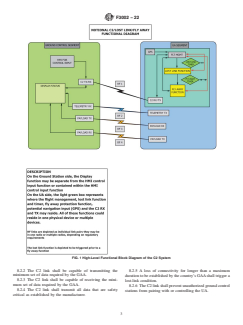
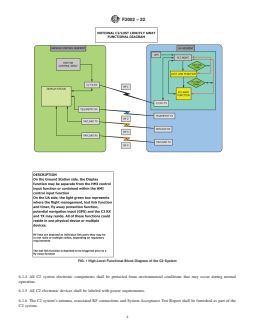
5.1 Ahigh-level functional block diagram of the C2 system
3.1.13 lost link, n—occurrence in which the pilot in com- is presented in Fig. 1.
mand (PIC) has lost the ability to control positively the sUAS
6. General Requirements
because of degradation, loss or interruption of the necessary
6.1 The following are general C2 requirements involving
control or monitoring link(s), or both.
the system components listed below:
3.1.14 manufacturer, n—entityresponsibleforassemblyand
6.1.1 All C2 system and UA components shall minimize
integration of components and subsystems to create a safe
RFIsoasnottodegradeC2linkperformancebelowacceptable
operating sUAS.
levels.
3.1.15 pilot in command, PIC, n—the pilot responsible for
6.1.2 All C2 system and UA components shall minimize
the operation and safety of the UA during flight time.
RFI so as not to corrupt data transmitted or received over the
C2 link.
3.1.16 positive control, n—aconditioninwhichcommanded
changes in the UA flight path result in the expected maneu- 6.1.3 All C2 system electronic components shall be pro-
tected from impacts that may occur during normal operation
ver(s) within an expected period of time.
(an impact rating of EN 62262 IK06 is recommended).
3.1.17 small unmanned aircraft system, sUAS,
6.1.4 All C2 system electronic components shall be pro-
n—composed of the small unmanned aircraft (sUA) and all
tected from environmental conditions that may occur during
required on-board subsystems, payload, control station, other
normal operation.
required off-board subsystems, any required launch and recov-
6.1.5 All C2 electronic devices shall be labeled with power
ery equipment, and C2 links between the sUA and the control
requirements.
station.
6.1.6 The C2 system’s antenna, associated RF connections
3.1.18 unmanned aircraft, UA, n—airborne portion of the
and System Acceptance Test Report shall be furnished as part
sUAS.
of the C2 system.
6.1.7 SignalandpowerconnectorsforC2electronicdevices
3.1.19 uplink, n—any RF link from GCS to UA.
shall provide self-locking or positive locking connectors to
3.2 Acronyms:
ensure continuity of power and signal transmission during
3.2.1 BER—Bit Error Rate
normal operation.
3.2.2 C2—Command and Control
6.1.8 The C2 system shall provide for mounting to a fixed
surface using rigid or semi-rigid fasteners. (Non-rigid
3.2.3 FCC—Federal Communications Commission
fasteners, such as strings, rubber bands, and glue, are not
3.2.4 FCS—Flight Control Station
permitted for this purpose.)
3.2.5 GAA—Governing Aviation Authority
7. C2 System Spectrum Requirements
3.2.6 GCS—Ground Control Station
7.1 Small UAS operations using unlicensed bands shall be
3.2.7 GPS—Global Positioning System
conducted in accordance with applicable regulations.
3.2.8 HMI—Human/Machine Interface
7.2 SmallUASoperationsusingalicensedbandshallobtain
3.2.9 PIC—Pilot in Command
approval to use that band from the appropriate governing
agency.
3.2.10 RF—Radio Frequency
3.2.11 RFI—Radio Frequency Interference 8. C2 Link
3.2.12 RX—Receiver 8.1 Functional Requirements—TheC2linkshallprovideC2
link status to the UA FCS to allow the UA FCS to initiate
3.2.13 sUA—Small Unmanned Aircraft
lost-link logic when C2 link connectivity is lost.
3.2.14 sUAS—Small Unmanned Aircraft System
8.2 Performance Requirements:
3.2.15 TX—Tr
...
This document is not an ASTM standard and is intended only to provide the user of an ASTM standard an indication of what changes have been made to the previous version. Because
it may not be technically possible to adequately depict all changes accurately, ASTM recommends that users consult prior editions as appropriate. In all cases only the current version
of the standard as published by ASTM is to be considered the official document.
Designation: F3002 − 14a F3002 − 22
Standard Specification for
Design of the Command and Control System for Small
Unmanned Aircraft Systems (sUAS)
This standard is issued under the fixed designation F3002; the number immediately following the designation indicates the year of
original adoption or, in the case of revision, the year of last revision. A number in parentheses indicates the year of last reapproval. A
superscript epsilon (´) indicates an editorial change since the last revision or reapproval.
1. Scope
1.1 This specification is provided as a consensus standard in support of an application to a nation’s governing aviation authority
(GAA) for a permit to operate a small unmanned aircraft system (sUAS) for commercial or public use purposes.
1.2 This standard does not purport to address all of the safety concerns, if any, associated with its use. It is the responsibility
of the user of this standard to establish appropriate safety safety, health, and healthenvironmental practices and determine the
applicability of regulatory limitations prior to use.
1.3 This international standard was developed in accordance with internationally recognized principles on standardization
established in the Decision on Principles for the Development of International Standards, Guides and Recommendations issued
by the World Trade Organization Technical Barriers to Trade (TBT) Committee.
2. Referenced Documents
2.1 ASTM Standards:
F2910 Specification for Design, Construction, Design and TestConstruction of a Small Unmanned Aircraft System (sUAS)
F2911 Practice for Production Acceptance of a Small Unmanned Aircraft System (sUAS)
F3003 Specification for Quality Assurance of a Small Unmanned Aircraft System (sUAS)
F3060 Terminology for Aircraft
F3341/F3341M Terminology for Unmanned Aircraft Systems
2.2 EN Standard:
EN 62262 Degrees of protection provided by enclosures for electrical equipment against external mechanical impacts (IK code)
2.3 IEC Standard:
IEC 60529 Degrees of protection provided by enclosures (IP Code)
3. Terminology
3.1 Definitions:Unique and Common Terminology—Terminology used in multiple standards is defined in F3341/F3341M, UAS
Terminology Standard and F3060, Aircraft Terminology Standard. Terminology that is unique to this specification is defined in this
section.
3.1.1 bit error rate detection, BER, n—rate at which errors occur in a transmission system; applicable to any system that transmits
data over a network of some form in which noise, interference, and phase jitter may cause degradation of the digital signal.
This specification is under the jurisdiction of ASTM Committee F38 on Unmanned Aircraft Systems and is the direct responsibility of Subcommittee F38.01 on
Airworthiness.
Current edition approved June 1, 2014Oct. 1, 2022. Published July 2014December 2022. Originally approved in 2014. Last previous edition approved in 2014 as
F3002 – 14.F3002 – 14a. DOI: 10.1520/F3002-14A.10.1520/F3002-22.
For referenced ASTM standards, visit the ASTM website, www.astm.org, or contact ASTM Customer Service at service@astm.org. For Annual Book of ASTM Standards
volume information, refer to the standard’sstandard’s Document Summary page on the ASTM website.
Available from American National Standards Institute (ANSI), 25 W. 43rd St., 4th Floor, New York, NY 10036, http://www.ansi.org.
Copyright © ASTM International, 100 Barr Harbor Drive, PO Box C700, West Conshohocken, PA 19428-2959. United States
F3002 − 22
3.1.2 command and control (C2) link(s), n—safety-critical radio-frequency (RF) link(s) between the ground control station (GCS)
and the unmanned aircraft (UA).
3.1.3 C2 range, n—distance between GCS and UA at which positive control of the UA can be maintained.
3.1.4 downlink, n—any RF link from UA to GCS.
3.1.5 flight control system, FCS, n—composed of system components intended to take GCS commands via a C2 link and control
flight control surfaces and propulsion systems.
3.1.5.1 Discussion—
The FCS may include autopilot functions, lost-link functions, fly-away protection functions, payload functions, and navigation
functions. The FCS may be contained in one discrete component or multiple discrete components.
3.1.6 fly away, n—unintended flight outside of operational boundaries (altitude/airspeed/lateral) as the result of a failure of the
control element or onboard systems, or both.
3.1.7 fly-away protection system, n—a system that will return the UA safely to the surface, or keep the UA within the intended
operational area, when the C2 link between the pilot and the UA is lost.
3.1.8 ground control station, GCS, n—a land- or sea-based control center that provides the facilities for human control of UA.
3.1.9 licensed band, n—any frequency or range of frequencies in which transmission requires permission from a governing body
(for example, the Federal Communications Commission [FCC]).
3.1.10 link error, n—degradation of the digital signal between the GCS and the UA that can be monitored by techniques including
BER detection.
3.1.11 link integrity, n—acceptable rate of transactions completed with undetected error.
3.1.12 link timeout, n—time between the actual lost-link event being validated and the system initiating the lost-link procedure.
3.1.13 lost link, n—occurrence in which the pilot in command (PIC) has lost the ability to control positively the sUAS because
of degradation, loss or interruption of the necessary control or monitoring link(s), or both.
3.1.14 manufacturer, n—entity responsible for assembly and integration of components and subsystems to create a safe operating
sUAS.
3.1.15 pilot in command, PIC, n—the pilot responsible for the operation and safety of the UA during flight time.
3.1.16 positive control, n—a condition in which commanded changes in the UA flight path result in the expected maneuver(s)
within an expected period of time.
3.1.17 small unmanned aircraft system, sUAS, n—composed of the small unmanned aircraft (sUA) and all required on-board
subsystems, payload, control station, other required off-board subsystems, any required launch and recovery equipment, and C2
links between the sUA and the control station.
3.1.18 unmanned aircraft, UA, n—airborne portion of the sUAS.
3.1.19 uplink, n—any RF link from GCS to UA.
3.2 Acronyms:
3.2.1 BER—Bit Error Rate
F3002 − 22
3.2.2 C2—Command and Control
3.2.3 FCC—Federal Communications Commission
3.2.4 FCS—Flight Control Station
3.2.5 GAA—Governing Aviation Authority
3.2.6 GCS—Ground Control Station
3.2.7 GPS—Global Positioning System
3.2.8 HMI—Human/Machine Interface
3.2.9 PIC—Pilot in Command
3.2.10 RF—Radio Frequency
3.2.11 RFI—Radio Frequency Interference
3.2.12 RX—Receiver
3.2.13 sUA—Small Unmanned Aircraft
3.2.14 sUAS—Small Unmanned Aircraft System
3.2.15 TX—Transmitter
3.2.16 UA—Unmanned Aircraft
4. Applicability
4.1 This standard is written for all sUAS that are permitted to operate over a defined area and in airspace authorized by a
nation’snation’s GAA. It is assumed that one or more visual observers will provide for the sense and avoid requirement to avoid
collisions with other aircraft and that the maximum range and altitude at which the sUAS can be flown will be specified by the
nation’s GAA. Unless otherwise specified by a nation’s GAA, this standard applies only to UA that have a maximum gross takeoff
weight of 25 kg (55 lb) or less.
5. Functional Architecture
5.1 A high-level functional block diagram of the C2 system is presented in Fig. 1.
6. General Requirements
6.1 The following are general C2 requirements involving the system components listed below:
6.1.1 All C2 system and UA components shall minimize RFI so as not to degrade C2 link performance below acceptable levels.
6.1.2 All C2 system and UA components shall minimize RFI so as not to corrupt data transmitted or received over the C2 link.
6.1.3 All C2 system electronic components shall be protected from impacts that may occur during normal operation (an impact
rating of EN 62262 IK06 is recommended).
F3002 − 22
FIG. 1 High-Level Functional Block Diagram of the C2 System
6.1.4 All C2 system electronic components shall be protected from environmental conditions that may occur during normal
operation.
6.1.5 All C2 electronic devices shall be labeled with power requirements.
6.1.6 The C2 system’s antenna, associated RF connections and System Acceptance Test Report shall be furnished as part of the
C2 system.
F3002 − 22
6.1.7 Signal and power connectors for C2 electronic devices shall provide self-locking or positive locking connectors to ensure
continuity of power and signal transmission during normal operation.
6.1.8 The C2 system shall provide for mounting to a fixed surface using rigid or semi-rigid fasteners. (Non-rigid fasteners, such
as strings, rubber bands, and glue, are not permitted for this purpose.)
7. C2 System Spectrum Requirements
7.1 Small UAS operations using unlicensed bands shall be conducted in accordance with applicable regulations.
7.2 Small UA
...