

ASTM F2908-23
(Specification)Standard Specification for Unmanned Aircraft Flight Manual (UFM) for an Unmanned Aircraft System (UAS)
General Information
- Abstract
SCOPE
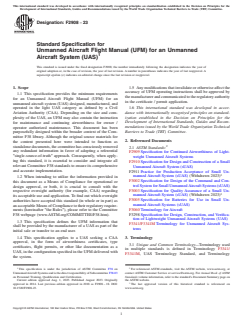
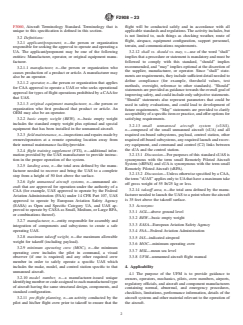
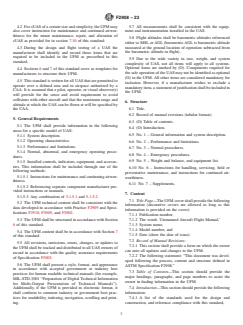
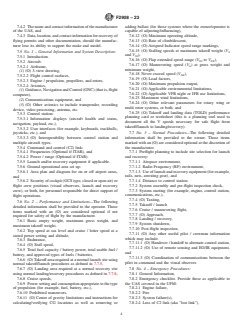
1.1 This specification provides the minimum requirements for an Unmanned Aircraft Flight Manual (UFM) for an unmanned aircraft system (UAS) designed, manufactured, and operated in the light UAS category as defined by a Civil Aviation Authority (CAA). Depending on the size and complexity of the UAS, an UFM may also contain the instruction for maintenance and continuing airworthiness for owner / operator authorized maintenance. This document has been purposefully designed within the broader context of the Committee F38 library. Although the original source materials for the content presented here were intended to function as standalone documents, the committee has consciously removed any redundant information in favor of adopting a referential "single-source-of-truth" approach. Consequently, when applying this standard, it is essential to consider and integrate all relevant Committee F38 standards to ensure its comprehensive and accurate implementation.
1.2 When intending to utilize the information provided in this document as a Means of Compliance for operational or design approval, or both, it is crucial to consult with the respective oversight authority (for example, CAA) regarding its acceptable use and application. To find out which oversight authorities have accepted this standard (in whole or in part) as an acceptable Means of Compliance to their regulatory requirements (hereinafter "the Rules"), please refer to the Committee F38 webpage (www.ASTM.org/COMMITTEE/F38.htm).
1.3 This specification defines the UFM information that shall be provided by the manufacturer of a UAS as part of the initial sale or transfer to an end user.
1.4 This specification applies to a UAS seeking a CAA approval, in the form of airworthiness certificates, type certificates, flight permits, or other like documentation as a UAS, in the configuration specified in the UFM delivered with the system.
1.5 Any modifications that invalidate or otherwise affect the accuracy of UFM operating instructions shall be approved by the manufacturer and communicated to the regulatory authority in the certificate / permit application.
1.6 This international standard was developed in accordance with internationally recognized principles on standardization established in the Decision on Principles for the Development of International Standards, Guides and Recommendations issued by the World Trade Organization Technical Barriers to Trade (TBT) Committee.
- Status
- Published
- Publication Date
- 31-Jul-2023
- Technical Committee
- F38 - Unmanned Aircraft Systems
- Drafting Committee
- F38.03 - Personnel Training, Qualification and Certification
Buy Documents
ASTM F2908-23 - Standard Specification for Unmanned Aircraft Flight Manual (UFM) for an Unmanned Aircraft System (UAS)
REDLINE ASTM F2908-23 - Standard Specification for Unmanned Aircraft Flight Manual (UFM) for an Unmanned Aircraft System (UAS)
Overview
ASTM F2908-23 specifies the minimum requirements for an Unmanned Aircraft Flight Manual (UFM) for an unmanned aircraft system (UAS) in the light UAS category as defined by a Civil Aviation Authority (CAA). This international standard provides a comprehensive framework for manufacturers to supply essential flight and operational documentation as part of the sale or transfer of a UAS. The standard also guides compliance with regulatory requirements for airworthiness and operational approval, ensuring the end user receives clear, accurate, and maintenance-ready information for safe UAS operation.
ASTM F2908-23 is developed by ASTM Committee F38 on Unmanned Aircraft Systems and is designed to integrate seamlessly with other related UAS standards, promoting a “single-source-of-truth” approach. As such, this standard is inherently referential, minimizing redundancy and ensuring users consult all relevant and current Committee F38 standards for comprehensive implementation.
Key Topics
ASTM F2908-23 covers key elements required in a UAS flight manual, including:
- Scope and Applicability: Defines the light UAS category, conditions for inclusion, and addresses any modifications that affect UFM accuracy.
- Terminology: Standardizes essential terms such as minimum operating crew (MOC), basic empty weight (BEW), pre-flight planning, and others relevant to unmanned aircraft systems.
- General UFM Requirements:
- System description
- Performance and limitations
- Normal, abnormal, and emergency operating procedures
- Installed equipment and controls documentation
- Maintenance and continued airworthiness instructions
- Revision control and distribution requirements
- UFM Structure and Content:
- Title and revision record
- Table of contents and introduction
- System and aircraft description
- Performance data and limitations
- Operating procedures (normal and emergency)
- Weighing and balancing information
- Maintenance, servicing, and supplements for optional equipment
The standard also specifies that UFMs be developed following widely recognized best practices for technical documentation, whether provided in print or electronic formats.
Applications
ASTM F2908-23 is essential for:
- Manufacturers: Ensures delivery of consistent and compliant flight manuals for UAS products, supporting regulatory submissions and customer information needs.
- Operators and Owners: Provides pilots, visual observers, and ground crew with detailed procedures for safe normal, abnormal, and emergency UAS operations.
- Regulatory Authorities (CAA, FAA, EASA, etc.): Acts as a means of compliance for UAS seeking official approval, such as airworthiness or type certificates and flight permits.
- Maintenance and Airworthiness: Details required maintenance actions and references standards for the ongoing airworthiness of UAS, supporting field-level and preventative maintenance when authorized.
- Training and Qualification: Assists in developing training programs aligned with standardized operating procedures and maintenance practices.
The standard is applicable internationally wherever light UAS must meet airworthiness and operational documentation requirements.
Related Standards
ASTM F2908-23 references and is complemented by several other UAS-relevant ASTM standards:
- ASTM F2909: Specification for Continued Airworthiness of Lightweight Unmanned Aircraft Systems
- ASTM F2910: Specification for Design and Construction of a Small Unmanned Aircraft System (sUAS)
- ASTM F3002: Specification for Design of the Command and Control System for Small Unmanned Aircraft Systems
- ASTM F3060: Aircraft Terminology
- ASTM F3341/F3341M: Terminology for Unmanned Aircraft Systems
When implementing ASTM F2908-23, it is critical to review the current editions of all referenced Committee F38 standards to ensure full regulatory compliance and safe operational integration of unmanned aircraft systems.
Keywords: unmanned aircraft flight manual, UAS, light unmanned aircraft systems, UFM, maintenance manual, flight operations, ASTM F2908-23, airworthiness, regulatory compliance.
Relations
- Effective Date
- 01-Jan-2020
- Effective Date
- 01-Sep-2019
- Effective Date
- 01-Feb-2019
- Effective Date
- 01-May-2018
- Effective Date
- 01-Nov-2016
- Effective Date
- 01-Apr-2016
- Effective Date
- 15-Sep-2015
- Effective Date
- 01-May-2015
- Effective Date
- 01-Mar-2015
- Effective Date
- 01-Dec-2014
- Effective Date
- 15-Jan-2014
- Effective Date
- 15-Jan-2014
- Effective Date
- 15-Jan-2014
- Effective Date
- 15-Jan-2014
Buy Documents
ASTM F2908-23 - Standard Specification for Unmanned Aircraft Flight Manual (UFM) for an Unmanned Aircraft System (UAS)
REDLINE ASTM F2908-23 - Standard Specification for Unmanned Aircraft Flight Manual (UFM) for an Unmanned Aircraft System (UAS)
Get Certified
Connect with accredited certification bodies for this standard

BSI Group
BSI (British Standards Institution) is the business standards company that helps organizations make excellence a habit.

Bureau Veritas
Bureau Veritas is a world leader in laboratory testing, inspection and certification services.

DNV
DNV is an independent assurance and risk management provider.
Sponsored listings
Frequently Asked Questions
ASTM F2908-23 is a technical specification published by ASTM International. Its full title is "Standard Specification for Unmanned Aircraft Flight Manual (UFM) for an Unmanned Aircraft System (UAS)". This standard covers: SCOPE 1.1 This specification provides the minimum requirements for an Unmanned Aircraft Flight Manual (UFM) for an unmanned aircraft system (UAS) designed, manufactured, and operated in the light UAS category as defined by a Civil Aviation Authority (CAA). Depending on the size and complexity of the UAS, an UFM may also contain the instruction for maintenance and continuing airworthiness for owner / operator authorized maintenance. This document has been purposefully designed within the broader context of the Committee F38 library. Although the original source materials for the content presented here were intended to function as standalone documents, the committee has consciously removed any redundant information in favor of adopting a referential "single-source-of-truth" approach. Consequently, when applying this standard, it is essential to consider and integrate all relevant Committee F38 standards to ensure its comprehensive and accurate implementation. 1.2 When intending to utilize the information provided in this document as a Means of Compliance for operational or design approval, or both, it is crucial to consult with the respective oversight authority (for example, CAA) regarding its acceptable use and application. To find out which oversight authorities have accepted this standard (in whole or in part) as an acceptable Means of Compliance to their regulatory requirements (hereinafter "the Rules"), please refer to the Committee F38 webpage (www.ASTM.org/COMMITTEE/F38.htm). 1.3 This specification defines the UFM information that shall be provided by the manufacturer of a UAS as part of the initial sale or transfer to an end user. 1.4 This specification applies to a UAS seeking a CAA approval, in the form of airworthiness certificates, type certificates, flight permits, or other like documentation as a UAS, in the configuration specified in the UFM delivered with the system. 1.5 Any modifications that invalidate or otherwise affect the accuracy of UFM operating instructions shall be approved by the manufacturer and communicated to the regulatory authority in the certificate / permit application. 1.6 This international standard was developed in accordance with internationally recognized principles on standardization established in the Decision on Principles for the Development of International Standards, Guides and Recommendations issued by the World Trade Organization Technical Barriers to Trade (TBT) Committee.
SCOPE 1.1 This specification provides the minimum requirements for an Unmanned Aircraft Flight Manual (UFM) for an unmanned aircraft system (UAS) designed, manufactured, and operated in the light UAS category as defined by a Civil Aviation Authority (CAA). Depending on the size and complexity of the UAS, an UFM may also contain the instruction for maintenance and continuing airworthiness for owner / operator authorized maintenance. This document has been purposefully designed within the broader context of the Committee F38 library. Although the original source materials for the content presented here were intended to function as standalone documents, the committee has consciously removed any redundant information in favor of adopting a referential "single-source-of-truth" approach. Consequently, when applying this standard, it is essential to consider and integrate all relevant Committee F38 standards to ensure its comprehensive and accurate implementation. 1.2 When intending to utilize the information provided in this document as a Means of Compliance for operational or design approval, or both, it is crucial to consult with the respective oversight authority (for example, CAA) regarding its acceptable use and application. To find out which oversight authorities have accepted this standard (in whole or in part) as an acceptable Means of Compliance to their regulatory requirements (hereinafter "the Rules"), please refer to the Committee F38 webpage (www.ASTM.org/COMMITTEE/F38.htm). 1.3 This specification defines the UFM information that shall be provided by the manufacturer of a UAS as part of the initial sale or transfer to an end user. 1.4 This specification applies to a UAS seeking a CAA approval, in the form of airworthiness certificates, type certificates, flight permits, or other like documentation as a UAS, in the configuration specified in the UFM delivered with the system. 1.5 Any modifications that invalidate or otherwise affect the accuracy of UFM operating instructions shall be approved by the manufacturer and communicated to the regulatory authority in the certificate / permit application. 1.6 This international standard was developed in accordance with internationally recognized principles on standardization established in the Decision on Principles for the Development of International Standards, Guides and Recommendations issued by the World Trade Organization Technical Barriers to Trade (TBT) Committee.
ASTM F2908-23 is classified under the following ICS (International Classification for Standards) categories: 49.020 - Aircraft and space vehicles in general. The ICS classification helps identify the subject area and facilitates finding related standards.
ASTM F2908-23 has the following relationships with other standards: It is inter standard links to ASTM F3060-20, ASTM F2909-19, ASTM F3298-19, ASTM F3298-18, ASTM F3060-16a, ASTM F3060-16, ASTM F3060-15b, ASTM F3060-15a, ASTM F3060-15, ASTM F3060-14, ASTM F2911-14, ASTM F3002-14, ASTM F3005-14, ASTM F2909-14. Understanding these relationships helps ensure you are using the most current and applicable version of the standard.
ASTM F2908-23 is available in PDF format for immediate download after purchase. The document can be added to your cart and obtained through the secure checkout process. Digital delivery ensures instant access to the complete standard document.
Standards Content (Sample)
This international standard was developed in accordance with internationally recognized principles on standardization established in the Decision on Principles for the
Development of International Standards, Guides and Recommendations issued by the World Trade Organization Technical Barriers to Trade (TBT) Committee.
Designation: F2908 − 23
Standard Specification for
Unmanned Aircraft Flight Manual (UFM) for an Unmanned
Aircraft System (UAS)
This standard is issued under the fixed designation F2908; the number immediately following the designation indicates the year of
original adoption or, in the case of revision, the year of last revision. A number in parentheses indicates the year of last reapproval. A
superscript epsilon (´) indicates an editorial change since the last revision or reapproval.
1. Scope 1.5 Any modifications that invalidate or otherwise affect the
accuracy of UFM operating instructions shall be approved by
1.1 This specification provides the minimum requirements
the manufacturer and communicated to the regulatory authority
for an Unmanned Aircraft Flight Manual (UFM) for an
in the certificate / permit application.
unmanned aircraft system (UAS) designed, manufactured, and
1.6 This international standard was developed in accor-
operated in the light UAS category as defined by a Civil
dance with internationally recognized principles on standard-
Aviation Authority (CAA). Depending on the size and com-
ization established in the Decision on Principles for the
plexity of the UAS, an UFM may also contain the instruction
Development of International Standards, Guides and Recom-
for maintenance and continuing airworthiness for owner /
mendations issued by the World Trade Organization Technical
operator authorized maintenance. This document has been
Barriers to Trade (TBT) Committee.
purposefully designed within the broader context of the Com-
mittee F38 library. Although the original source materials for
2. Referenced Documents
the content presented here were intended to function as
standalone documents, the committee has consciously removed
2.1 ASTM Standards:
any redundant information in favor of adopting a referential
F2909 Specification for Continued Airworthiness of Light-
"single-source-of-truth" approach. Consequently, when apply-
weight Unmanned Aircraft Systems
ing this standard, it is essential to consider and integrate all
F2910 Specification for Design and Construction of a Small
relevant Committee F38 standards to ensure its comprehensive
Unmanned Aircraft System (sUAS)
and accurate implementation.
F2911 Practice for Production Acceptance of Small Un-
manned Aircraft System (sUAS) (Withdrawn 2023)
1.2 When intending to utilize the information provided in
F3002 Specification for Design of the Command and Con-
this document as a Means of Compliance for operational or
trol System for Small Unmanned Aircraft Systems (sUAS)
design approval, or both, it is crucial to consult with the
F3003 Specification for Quality Assurance of a Small Un-
respective oversight authority (for example, CAA) regarding
manned Aircraft System (sUAS) (Withdrawn 2023)
its acceptable use and application. To find out which oversight
F3005 Specification for Batteries for Use in Small Un-
authorities have accepted this standard (in whole or in part) as
manned Aircraft Systems (sUAS)
an acceptable Means of Compliance to their regulatory require-
F3060 Terminology for Aircraft
ments (hereinafter "the Rules"), please refer to the Committee
F3298 Specification for Design, Construction, and Verifica-
F38 webpage (www.ASTM.org/COMMITTEE/F38.htm).
tion of Lightweight Unmanned Aircraft Systems (UAS)
1.3 This specification defines the UFM information that
F3341/F3341M Terminology for Unmanned Aircraft Sys-
shall be provided by the manufacturer of a UAS as part of the
tems
initial sale or transfer to an end user.
1.4 This specification applies to a UAS seeking a CAA
3. Terminology
approval, in the form of airworthiness certificates, type
3.1 Unique and Common Terminology—Terminology used
certificates, flight permits, or other like documentation as a
in multiple standards is defined in Terminology F3341/
UAS, in the configuration specified in the UFM delivered with
F3341M, UAS Terminology Standard, and Terminology
the system.
1 2
This specification is under the jurisdiction of ASTM Committee F38 on For referenced ASTM standards, visit the ASTM website, www.astm.org, or
Unmanned Aircraft Systems and is the direct responsibility of Subcommittee F38.03 contact ASTM Customer Service at service@astm.org. For Annual Book of ASTM
on Personnel Training, Qualification and Certification. Standards volume information, refer to the standard’s Document Summary page on
Current edition approved Aug. 1, 2023. Published August 2023. Originally the ASTM website.
approved in 2014. Last previous edition approved in 2018 as F2908 – 18. DOI: The last approved version of this historical standard is referenced on
10.1520/F2908-23. www.astm.org.
Copyright © ASTM International, 100 Barr Harbor Drive, PO Box C700, West Conshohocken, PA 19428-2959. United States
F2908 − 23
F3060, Aircraft Terminology Standard. Terminology that is flight will be conducted safely and in accordance with all
unique to this specification is defined in this section. applicable standards and regulations. The activity includes, but
is not limited to, such things as checking weather, route of
3.2 Definitions:
flight, airspace, equipment configuration, support personnel,
3.2.1 applicant/proponent, n—the person or organization
terrain, and communications requirements.
responsible for seeking the approval to operate and operating a
UA. The applicant/proponent may be one of the following 3.2.12 shall vs. should vs. may, v—use of the word “shall”
entities: Manufacturer, operator, or original equipment manu- implies that a procedure or statement is mandatory and must be
facturer. followed to comply with this standard, “should” implies
recommended, and “may” implies optional at the discretion of
3.2.1.1 manufacturer, n—the person or organization who
the supplier, manufacturer, or operator. Since “shall” state-
causes production of a product or article. A manufacturer may
ments are requirements, they include sufficient detail needed to
also be an operator.
define compliance (for example, threshold values, test
3.2.1.2 operator, n—the person or organization that applies
methods, oversight, reference to other standards). “Should”
for CAA approval to operate a UAS or who seeks operational
statements are provided as guidance towards the overall goal of
approval for types of flight operations prohibited by a CAA for
improving safety, and could include only subjective statements.
that UAS.
“Should” statements also represent parameters that could be
3.2.1.3 original equipment manufacturer, n—the person or
used in safety evaluations, and could lead to development of
organization who first produced that product or article. An
future requirements. “May” statements are provided to clarify
OEM may also be an operator.
acceptability of a specific item or practice, and offer options for
3.2.2 basic empty weight (BEW), n—basic empty weight satisfying requirements.
includes the standard empty weight plus optional and special
3.2.13 small unmanned aircraft system (sUAS),
equipment that has been installed in the unmanned aircraft.
n—composed of the small unmanned aircraft (sUA) and all
3.2.3 field maintenance, n—inspections and repairs made by required on-board subsystems, payload, control station, other
owners/operators at a remote operating location away from
required off-board subsystems, any required launch and recov-
their normal maintenance facility/provider. ery equipment, and command and control (C2) links between
the sUA and the control station.
3.2.4 flight training supplement (FTS), n—additional infor-
3.2.13.1 Discussion—For purposes of this standard sUAS is
mation provided by the UAS manufacturer to provide instruc-
synonymous with the term small Remotely Piloted Aircraft
tion in the proper operation of the system.
System (sRPAS) and sUA is synonymous with the term small
3.2.5 landing area, n—the total area defined by the manu-
Remotely Piloted Aircraft (sRPA).
facturer needed to recover and bring the UAS to a complete
3.2.13.2 Discussion—Unless otherwise specified by a CAA,
stop from a height of 50 feet above the surface.
the term “sUAS” applies only to UA that have a maximum take
3.2.6 light unmanned aircraft systems, n—unmanned air-
off gross weight of 55 lb/25 kg or less.
craft that are approved for operation under the authority of a
3.2.14 takeoff area, n—the total area defined by the manu-
CAA (for example, UAS approved to operate by the Federal
facturer needed to launch the UAS to a point where the aircraft
Aviation Administration (FAA) under 14 CFR Part 107, UAS
is 35 feet above the takeoff surface.
approved to operate by European Aviation Safety Agency
(EASA) as Open and Specific Category UA, and UAS ap-
3.3 Acronyms:
proved to operate by CASA as Small, Medium, or Large RPA,
3.3.1 AGL—above ground level
or combinations thereof).
3.3.2 BEW—basic empty weight
3.2.7 manufacturer, n—entity responsible for assembly and
3.3.3 EASA—European Aviation Safety Agency
integration of components and subsystems to create a safe
operating UAS.
3.3.4 FAA—Federal Aviation Administration
3.2.8 maximum takeoff weight, n—the maximum allowable
3.3.5 IAS—indicated airspeed
weight for takeoff (including payload).
3.3.6 MOC—minimum operating crew
3.2.9 minimum operating crew (MOC), n—the minimum
3.3.7 MSL—mean sea level
operating crew includes the pilot in command, a visual
observer (if one is required) and any other required crew 3.3.8 UFM—unmanned aircraft flight manual
member in order to safely operate a specific UAS which
includes the make, model, and control station specific to that 4. Applicability
unmanned aircraft.
4.1 The purpose of the UFM is to provide guidance to
3.2.10 model number, n—a manufacturer-issued unique
owners, operators, mechanics, pilots, crew members, airports,
identifying number or code assigned to each manufactured type
regulatory officials, and aircraft and component manufacturers
of aircraft having the same structural design, components, and
containing normal, abnormal, and emergency procedures,
standard configuration.
checklists, limitations, performance information, details of the
3.2.11 pre-flight planning, n—an activity conducted by the aircraft systems and other material relevant to the operation of
pilot and his/her flight crew prior to takeoff to ensure that the the aircraft.
F2908 − 23
4.2 For sUAS of a certain size and simplicity, the UFM may 5.7 All measurements shall be consistent with the equip-
also cover instruction for maintenance and continued airwor- ment and instrumentation installed in the UAS.
thiness for the minor maintenance, repair, and alteration of
5.8 Flight altitudes shall be barometric altitudes referenced
sUAS as provided for in section 7.10 of this standard.
either to MSL or AGL (barometric AGL is barometric altitude
4.3 During the design and flight testing of a UAS the measured at the ground location of operation subtracted from
the barometric altitude in flight).
manufacturer shall identify and record those items that are
required to be included in the UFM as prescribed in this
5.9 Due to the wide variety in size, weight, and system
standard.
complexity of UAS, not all items will apply to all systems.
Optional items are marked by (O). Components required for
4.4 Sections 6 and 7 of this standard serve as templates for
the safe operation of the UAS may not be identified as optional
manufacturers to structure their UFM.
(O) in the UFM. All other items are considered mandatory for
4.5 This standard is written for all UAS that are permitted to
i
...
This document is not an ASTM standard and is intended only to provide the user of an ASTM standard an indication of what changes have been made to the previous version. Because
it may not be technically possible to adequately depict all changes accurately, ASTM recommends that users consult prior editions as appropriate. In all cases only the current version
of the standard as published by ASTM is to be considered the official document.
Designation: F2908 − 18 F2908 − 23
Standard Specification for
Unmanned Aircraft Flight Manual (UFM) for an Unmanned
Aircraft System (UAS)
This standard is issued under the fixed designation F2908; the number immediately following the designation indicates the year of
original adoption or, in the case of revision, the year of last revision. A number in parentheses indicates the year of last reapproval. A
superscript epsilon (´) indicates an editorial change since the last revision or reapproval.
1. Scope
1.1 This specification provides the minimum requirements for an Unmanned Aircraft Flight Manual (UFM) for an unmanned
aircraft system (UAS) designed, manufactured, and operated in the light UAS category as defined by a Civil Aviation Authority
(CAA). Depending on the size and complexity of the UAS, an UFM may also contain the instruction for maintenance and
continuing airworthiness for owner / operator authorized maintenance. This document has been purposefully designed within the
broader context of the Committee F38 library. Although the original source materials for the content presented here were intended
to function as standalone documents, the committee has consciously removed any redundant information in favor of adopting a
referential "single-source-of-truth" approach. Consequently, when applying this standard, it is essential to consider and integrate
all relevant Committee F38 standards to ensure its comprehensive and accurate implementation.
1.2 When intending to utilize the information provided in this document as a Means of Compliance for operational or design
approval, or both, it is crucial to consult with the respective oversight authority (for example, CAA) regarding its acceptable use
and application. To find out which oversight authorities have accepted this standard (in whole or in part) as an acceptable Means
of Compliance to their regulatory requirements (hereinafter "the Rules"), please refer to the Committee F38 webpage
(www.ASTM.org/COMMITTEE/F38.htm).
1.3 This specification defines the UFM information that shall be provided by the manufacturer of a UAS as part of the initial sale
or transfer to an end user.
1.4 This specification applies to a UAS seeking a CAA approval, in the form of airworthiness certificates, type certificates, flight
permits, or other like documentation as a UAS, in the configuration specified in the UFM delivered with the system.
1.5 Any modifications that invalidate or otherwise affect the accuracy of UFM operating instructions shall be approved by the
manufacturer and communicated to the regulatory authority in the certificate / permit application.
1.6 This international standard was developed in accordance with internationally recognized principles on standardization
established in the Decision on Principles for the Development of International Standards, Guides and Recommendations issued
by the World Trade Organization Technical Barriers to Trade (TBT) Committee.
This specification is under the jurisdiction of ASTM Committee F38 on Unmanned Aircraft Systems and is the direct responsibility of Subcommittee F38.03 on Personnel
Training, Qualification and Certification.
Current edition approved Aug. 1, 2018Aug. 1, 2023. Published September 2018August 2023. Originally approved in 2014. Last previous edition approved in 20162018
as F2908 – 16.F2908 – 18. DOI: 10.1520/F2908-18.10.1520/F2908-23.
Copyright © ASTM International, 100 Barr Harbor Drive, PO Box C700, West Conshohocken, PA 19428-2959. United States
F2908 − 23
2. Referenced Documents
2.1 ASTM Standards:
F2909 Specification for Continued Airworthiness of Lightweight Unmanned Aircraft Systems
F2910 Specification for Design and Construction of a Small Unmanned Aircraft System (sUAS)
F2911 Practice for Production Acceptance of Small Unmanned Aircraft System (sUAS) (Withdrawn 2023)
F3002 Specification for Design of the Command and Control System for Small Unmanned Aircraft Systems (sUAS)
F3003 Specification for Quality Assurance of a Small Unmanned Aircraft System (sUAS) (Withdrawn 2023)
F3005 Specification for Batteries for Use in Small Unmanned Aircraft Systems (sUAS)
F3060 Terminology for Aircraft
F3298 Specification for Design, Construction, and Verification of Lightweight Unmanned Aircraft Systems (UAS)
F3341/F3341M Terminology for Unmanned Aircraft Systems
3. Terminology
3.1 Unique and Common Terminology—Terminology used in multiple standards is defined in Terminology F3341/F3341M, UAS
Terminology Standard, and Terminology F3060, Aircraft Terminology Standard. Terminology that is unique to this specification
is defined in this section.
3.2 Definitions:
3.2.1 applicant/proponent, n—the person or organization responsible for seeking the approval to operate and operating a UA. The
applicant/proponent may be one of the following entities: Manufacturer, operator, or original equipment manufacturer.
3.2.1.1 manufacturer, n—the person or organization who causes production of a product or article. A manufacturer may also be
an operator.
3.2.1.2 operator, n—the person or organization that applies for CAA approval to operate a UAS or who seeks operational
approval for types of flight operations prohibited by a CAA for that UAS.
3.2.1.3 original equipment manufacturer, n—the person or organization who first produced that product or article. An OEM may
also be an operator.
3.2.2 basic empty weight (BEW), n—basic empty weight includes the standard empty weight plus optional and special equipment
that has been installed in the unmanned aircraft.
3.2.3 field maintenance, n—inspections and repairs made by owners/operators at a remote operating location away from their
normal maintenance facility/provider.
3.2.4 flight training supplement (FTS), n—additional information provided by the UAS manufacturer to provide instruction in the
proper operation of the system.
3.2.5 landing area, n—the total area defined by the manufacturer needed to recover and bring the UAS to a complete stop from
a height of 50 feet above the surface.
3.2.6 light unmanned aircraft systems, n—unmanned aircraft that are approved for operation under the authority of a CAA (for
example, UAS approved to operate by the Federal Aviation Administration (FAA) under 14 CFR Part 107, UAS approved to
operate by European Aviation Safety Agency (EASA) as Open and Specific Category UA, and UAS approved to operate by CASA
as Small, Medium, or Large RPA, or combinations thereof).
3.2.7 manufacturer, n—entity responsible for assembly and integration of components and subsystems to create a safe operating
UAS.
3.2.8 maximum takeoff weight, n—the maximum allowable weight for takeoff (including payload).
For referenced ASTM standards, visit the ASTM website, www.astm.org, or contact ASTM Customer Service at service@astm.org. For Annual Book of ASTM Standards
volume information, refer to the standard’s Document Summary page on the ASTM website.
The last approved version of this historical standard is referenced on www.astm.org.
F2908 − 23
3.2.9 minimum operating crew (MOC), n—the minimum operating crew includes the pilot in command, a visual observer (if one
is required) and any other required crew member in order to safely operate a specific UAS which includes the make, model, and
control station specific to that unmanned aircraft.
3.2.10 model number, n—a manufacturer-issued unique identifying number or code assigned to each manufactured type of aircraft
having the same structural design, components, and standard configuration.
3.2.11 pre-flight planning, n—an activity conducted by the pilot and his/her flight crew prior to takeoff to ensure that the flight
will be conducted safely and in accordance with all applicable standards and regulations. The activity includes, but is not limited
to, such things as checking weather, route of flight, airspace, equipment configuration, support personnel, terrain, and
communications requirements.
3.2.12 shall vs. should vs. may, v—use of the word “shall” implies that a procedure or statement is mandatory and must be followed
to comply with this standard, “should” implies recommended, and “may” implies optional at the discretion of the supplier,
manufacturer, or operator. Since “shall” statements are requirements, they include sufficient detail needed to define compliance (for
example, threshold values, test methods, oversight, reference to other standards). “Should” statements are provided as guidance
towards the overall goal of improving safety, and could include only subjective statements. “Should” statements also represent
parameters that could be used in safety evaluations, and could lead to development of future requirements. “May” statements are
provided to clarify acceptability of a specific item or practice, and offer options for satisfying requirements.
3.2.13 small unmanned aircraft system (sUAS), n—composed of the small unmanned aircraft (sUA) and all required on-board
subsystems, payload, control station, other required off-board subsystems, any required launch and recovery equipment, and
command and control (C2) links between the sUA and the control station.
3.2.13.1 Discussion—
For purposes of this standard sUAS is synonymous with the term small Remotely Piloted Aircraft System (sRPAS) and sUA is
synonymous with the term small Remotely Piloted Aircraft (sRPA).
3.2.13.2 Discussion—
Unless otherwise specified by a CAA, the term “sUAS” applies only to UA that have a maximum take off gross weight of 55 lb/25
kg or less.
3.2.14 takeoff area, n—the total area defined by the manufacturer needed to launch the UAS to a point where the aircraft is 35
feet above the takeoff surface.
3.3 Acronyms:
3.3.1 AGL—above ground level
3.3.2 BEW—basic empty weight
3.3.3 EASA—European Aviation Safety Agency
3.3.4 FAA—Federal Aviation Administration
3.3.5 IAS—indicated airspeed
3.3.6 MOC—minimum operating crew
3.3.7 MSL—mean sea level
3.3.8 UFM—unmanned aircraft flight manual
4. Applicability
4.1 The purpose of the UFM is to provide guidance to owners, operators, mechanics, pilots, crew members, airports, regulatory
F2908 − 23
officials, and aircraft and component manufacturers containing normal, abnormal, and emergency procedures, checklists,
limitations, performance information, details of the aircraft systems and other material relevant to the operation of the aircraft.
4.2 For sUAS of a certain size and simplicity, the UFM may also cover instruction for maintenance and continued airworthiness
for the minor maintenance, repair, and alteration of sUAS as provided for in section 7.10 of this standard.
4.3 During the design and flight testing of a UAS the manufacturer shall identify and record those items that are required to be
included in the UFM as prescribed in this standard.
4.4 Sections 6 and 7 of this standard serve as templates for manufacturers to structure their UFM.
4.5 This standard is written for all UAS that are permitted to operate over a defined area and in airspace authorized by a CAA.
It is assumed that a pilot, operator, or visual observer(s) will provide for the sense and avoid requirement to avoid collisions with
other aircraft and that the maximum range and altitude at which the UAS can be flown at will be specified by the CAA.
5. General Requirements
5.1 The UFM shall provide information in the following areas for a specific model of UAS:
5.1.1 System description.
5.1.2 Operating characteristics.
5.1.3 Performance and limitations.
5.1.4 Normal, abnormal, and emergency operating procedures.
5.1.5 Installed controls,
...