

SIST-TP CEN/TR 18290-1:2026
(Main)Sustainable construction with concrete - Part 1 - Practical guidance
General Information
- Abstract
This document gives guidance, what measures can be taken in daily business already today to contribute to decarbonisation, resource efficiency and sustainability in the concrete sector.
Although concrete structural elements can be supplemented by other materials either for new construction or the retrofit of a structure, this document addresses concrete elements, bearing in mind the possibilities to increase resource efficiency and reuse of structures.
- Status
- Published
- Publication Date
- 17-Jun-2026
- Technical Committee
- BBB - Concrete, reinforced concrete and prestressed concrete
- Current Stage
- 6060 - National Implementation/Publication (Adopted Project)
- Start Date
- 10-Jun-2026
- Due Date
- 15-Aug-2026
- Completion Date
- 18-Jun-2026

Overview
SIST-TP CEN/TR 18290-1:2026 – Sustainable Construction with Concrete – Part 1: Practical Guidance, developed by CEN/TC 104, provides actionable measures to advance sustainability, decarbonisation, and resource efficiency in the concrete sector. The standard targets professionals such as investors, designers, contractors, and building supervisors, helping align construction projects with environmental goals using current practices and technologies. Its recommendations support sector-wide climate change mitigation, material optimization, and sustainable resource consumption for both new and retrofit concrete construction.
Key Topics
- Decarbonisation Strategies: The report emphasizes immediate actions to reduce greenhouse gas emissions through optimized material usage, building design, and efficient construction processes in the concrete industry.
- Resource Efficiency: Practical measures detail minimizing primary resource use by optimizing component dimensions, integrating recycled aggregates, and designing for future adaptability and material reuse.
- Holistic Sustainable Planning: Emphasizes a multi-criteria decision process covering environmental, economic, and social factors-balancing comfort, durability, and flexibility in construction.
- Life Cycle Assessment: Encourages the use of Environmental Product Declarations (EPDs) and platforms like ÖKOBAUDAT to inform and quantify the environmental impacts of concrete throughout the building’s life cycle.
- Material Selection and Optimization: Guidance on choosing low-carbon cements, integrating industrial by-products, and balancing technical performance with environmental benefit.
- Design for Flexibility & Future Use: Advocates planning for adaptability, convertibility, and deconstruction-achieved via modular structural systems, flexible load-bearing designs, and the use of detachable connections for easier recycling or component reuse.
- Thermal, Acoustic, and Fire Performance: Outlines how concrete’s inherent properties support sustainability goals for occupant comfort, energy efficiency, fire safety, and noise reduction.
- Durability and Maintenance: Highlights measures prolonging service life, reducing maintenance needs, and lowering environmental impacts over time.
Applications
Sustainable construction with concrete as outlined in SIST-TP CEN/TR 18290-1:2026 applies throughout the building life cycle, benefitting various stakeholders and use cases:
- Building Design and Planning: Architects and engineers use the guidance to integrate sustainability from the conceptual phase, ensuring resource-efficient layouts, floor plans, and materials specification.
- Construction and Prefabrication: Contractors implement measures for reducing waste, optimizing production processes, and utilizing recycled or locally-sourced aggregates.
- Building Retrofit and Extension: Enables sustainable refurbishment through flexible design approaches, modular components, and strategies that favor structural preservation over demolition.
- Life Cycle Sustainability Certification: Supports organizations pursuing building sustainability certifications by providing up-to-date references, performance metrics, and guidance on quantifying sustainability through EPDs and LCAs.
- Policy and Urban Development: Facilitates national and municipal governments in implementing sustainable building standards aligned with European environmental and economic goals.
Related Standards
Organizations and professionals working with SIST-TP CEN/TR 18290-1:2026 should also be aware of the following standards that complement its scope:
- EN 15804: Sustainability of construction works – EPD core rules for building products.
- EN 16757: Product Category Rules for concrete and concrete products.
- EN 15978: Sustainability assessment of buildings – Calculation method.
- EN 197-x Series: Specifications for cements, including low-carbon varieties.
- EN 206: Specification, performance, production, and conformity of concrete.
- EN 15941: Data quality for environmental performance assessment of buildings.
- ÖKOBAUDAT and OpenDAP: Platforms for life cycle assessment data and EPDs.
- DIN 1045-2: Application document for concrete in Germany.
For project teams, aligning practices with SIST-TP CEN/TR 18290-1:2026 ensures that sustainable construction goals are met using readily available technologies and current best practices in the concrete sector, supporting optimized resource use, lower carbon emissions, and holistic project sustainability.
Relations
- Effective Date
- 28-Jan-2026
Get Certified
Connect with accredited certification bodies for this standard

BSI Group
BSI (British Standards Institution) is the business standards company that helps organizations make excellence a habit.

Bureau Veritas
Bureau Veritas is a world leader in laboratory testing, inspection and certification services.

DNV
DNV is an independent assurance and risk management provider.
Sponsored listings
Frequently Asked Questions
SIST-TP CEN/TR 18290-1:2026 is a technical report published by the Slovenian Institute for Standardization (SIST). Its full title is "Sustainable construction with concrete - Part 1 - Practical guidance". This standard covers: This document gives guidance, what measures can be taken in daily business already today to contribute to decarbonisation, resource efficiency and sustainability in the concrete sector. Although concrete structural elements can be supplemented by other materials either for new construction or the retrofit of a structure, this document addresses concrete elements, bearing in mind the possibilities to increase resource efficiency and reuse of structures.
This document gives guidance, what measures can be taken in daily business already today to contribute to decarbonisation, resource efficiency and sustainability in the concrete sector. Although concrete structural elements can be supplemented by other materials either for new construction or the retrofit of a structure, this document addresses concrete elements, bearing in mind the possibilities to increase resource efficiency and reuse of structures.
SIST-TP CEN/TR 18290-1:2026 is classified under the following ICS (International Classification for Standards) categories: 13.020.20 - Environmental economics. Sustainability; 91.080.40 - Concrete structures. The ICS classification helps identify the subject area and facilitates finding related standards.
SIST-TP CEN/TR 18290-1:2026 has the following relationships with other standards: It is inter standard links to SIST EN ISO 13585:2024. Understanding these relationships helps ensure you are using the most current and applicable version of the standard.
SIST-TP CEN/TR 18290-1:2026 is available in PDF format for immediate download after purchase. The document can be added to your cart and obtained through the secure checkout process. Digital delivery ensures instant access to the complete standard document.
Standards Content (Sample)
SLOVENSKI STANDARD
01-julij-2026
Trajnostna gradnja z betonom - 1. del: Praktična navodila
Sustainable construction with concrete - Part 1 - Practical guidance
Nachhaltig Bauen mit Beton - Teil 1 - Planungshilfe
Construction durable avec du béton - Partie 1 - Aide à la planification
Ta slovenski standard je istoveten z: CEN/TR 18290-1:2026
ICS:
13.020.20 Okoljska ekonomija. Environmental economics.
Trajnostnost Sustainability
91.080.40 Betonske konstrukcije Concrete structures
2003-01.Slovenski inštitut za standardizacijo. Razmnoževanje celote ali delov tega standarda ni dovoljeno.
CEN/TR 18290-1
TECHNICAL REPORT
RAPPORT TECHNIQUE
April 2026
TECHNISCHER REPORT
ICS 13.020.20; 91.080.40
English Version
Sustainable construction with concrete - Part 1 - Practical
guidance
Construction durable avec du béton - Partie 1 - Aide à Nachhaltig Bauen mit Beton - Teil 1 - Planungshilfe
la planification
This Technical Report was approved by CEN on 6 April 2026. It has been drawn up by the Technical Committee CEN/TC 104.
CEN members are the national standards bodies of Austria, Belgium, Bulgaria, Croatia, Cyprus, Czech Republic, Denmark, Estonia,
Finland, France, Germany, Greece, Hungary, Iceland, Ireland, Italy, Latvia, Lithuania, Luxembourg, Malta, Netherlands, Norway,
Poland, Portugal, Republic of North Macedonia, Romania, Serbia, Slovakia, Slovenia, Spain, Sweden, Switzerland, Türkiye and
United Kingdom.
EUROPEAN COMMITTEE FOR STANDARDIZATION
COMITÉ EUROPÉEN DE NORMALISATION
EUROPÄISCHES KOMITEE FÜR NORMUNG
CEN-CENELEC Management Centre: Rue de la Science 23, B-1040 Brussels
© 2026 CEN All rights of exploitation in any form and by any means reserved Ref. No. CEN/TR 18290-1:2026 E
worldwide for CEN national Members.
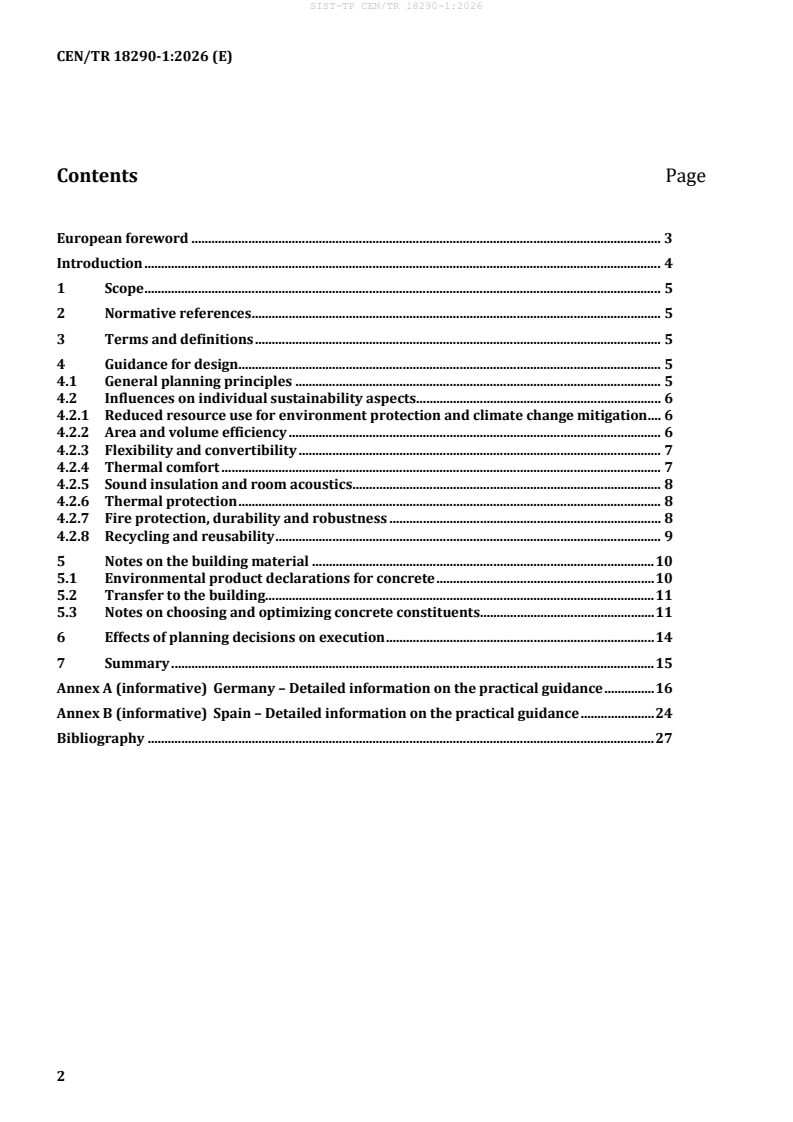
Contents Page
European foreword . 3
Introduction . 4
1 Scope . 5
2 Normative references . 5
3 Terms and definitions . 5
4 Guidance for design. 5
4.1 General planning principles . 5
4.2 Influences on individual sustainability aspects . 6
4.2.1 Reduced resource use for environment protection and climate change mitigation . 6
4.2.2 Area and volume efficiency . 6
4.2.3 Flexibility and convertibility . 7
4.2.4 Thermal comfort . 7
4.2.5 Sound insulation and room acoustics . 8
4.2.6 Thermal protection . 8
4.2.7 Fire protection, durability and robustness . 8
4.2.8 Recycling and reusability . 9
5 Notes on the building material . 10
5.1 Environmental product declarations for concrete . 10
5.2 Transfer to the building. 11
5.3 Notes on choosing and optimizing concrete constituents . 11
6 Effects of planning decisions on execution . 14
7 Summary . 15
Annex A (informative) Germany – Detailed information on the practical guidance . 16
Annex B (informative) Spain – Detailed information on the practical guidance . 24
Bibliography . 27
European foreword
This document (CEN/TR 18290-1:2026) has been prepared by Technical Committee CEN/TC 104
“Concrete and related products”, the secretariat of which is held by SN.
Attention is drawn to the possibility that some of the elements of this document may be the subject of
patent rights. CEN shall not be held responsible for identifying any or all such patent rights.
Any feedback and questions on this document should be directed to the users’ national standards body.
A complete listing of these bodies can be found on the CEN website.
Introduction
Increasing scarcity of raw materials, limited landfill space and the need to reduce GHG challenges facing
society today. Sustainable buildings require a low consumption of raw materials and energy as well as
the greatest possible flexibility of use and reusability or durability of the function in the building.
Sustainable buildings have to meet environmental, economic and socio-cultural requirements, at the
same time offer a high technical quality. Furthermore, ensuring the comfort of the user within the
buildings while maintaining their health is essential. The specific requirement profile of the client
therefore determines the priorities and the order of the numerous criteria of sustainability (e.g. in a
certification). All measures in this practical guidance are based on the following key sustainability goals:
— An immediate and drastic reduction in CO equivalent emissions as a measure for climate change
mitigation,
— Take precautions for, and adapt to, the already existing consequences of climate change,
— Resource conservation and material optimization.
When considering whether to preserve a structure or to dismantle it, prioritizing the preservation
approach aligns with sustainability goals. Extending the service life can be achieved through appropriate
maintenance measures.
Since the value of a building in terms of sustainability does not only depend on its production costs, the
planned service life and the pure property value, a large number of criteria are checked and incorporated
into the design, construction or maintenance of the building. This results in holistic planning, rational
architecture, optimized structural design, efficient building technology, a suitable choice of materials and
a reasonable implementation process.
The following practical guidance for concrete construction serves investors, clients, designers,
contractors and representatives of the building supervision for decision-making processes in sustainable
construction with concrete. The guidance can be understood as a preparatory step for the
conceptualisation and design of construction projects by the aforementioned target users, as well as for
possible sustainability certification of a proposed or completed construction project, and show how
sustainable design and construction is carried out with the existing technical specifications and authority
regulations in concrete construction.
The basic documents for this guidance were [27].
This document is part 1 of two parts. Part 1 has the intention to give guidance, what measures can be
taken in daily business already today to contribute to decarbonisation, resource efficiency and
sustainability in the concrete sector. Part 2 shows further measures and potentials to contribute to
decarbonisation, resource efficiency and sustainability in the concrete sector in the medium and long
term.
1 Scope
This document gives guidance, what measures can be taken in daily business already today to contribute
to decarbonisation, resource efficiency and sustainability in the concrete sector.
Although concrete structural elements can be supplemented by other materials either for new
construction or the retrofit of a structure, this document addresses concrete elements, bearing in mind
the possibilities to increase resource efficiency and reuse of structures.
2 Normative references
There are no normative references in this document.
3 Terms and definitions
No terms and definitions are listed in this document.
ISO and IEC maintain terminology databases for use in standardization at the following addresses:
— ISO Online browsing platform: available at https://www.iso.org/obp/
— IEC Electropedia: available at https://www.electropedia.org/
4 Guidance for design
4.1 General planning principles
Sustainable construction requires all those involved in construction to work together as partners. Basics
are:
— The duly definition of the essential goals
— Holistic planning over the foreseeable life cycle and future lifecycles of the structure and building
elements as well as
— Efficient quality management with the definition of tasks, responsibilities and communication
processes
— Durability of the structure and structural elements. The longest possible life cycle is to be taken into
account when possible.
Architects, building physicists, structural engineers and company technicians collaborate with the client
to develop a holistic building concept. This concept addresses current usage requirements, property-
specific environmental effects, and considers realistic assessments of potential future usage changes. In
principle, particular attention is paid to the interactions between the various criteria of sustainability
considerations, because very often several criteria are influenced by one decision. This can also have
opposite effects.
This symbol within the practical guidance indicates possible interactions.
The advantages of each building material can be optimally used if the relevant specialists (property
planners, structural engineers, building physicists, etc.) are involved in the planning phase in required
time. Concrete has considerable advantages for sustainable and durable constructions, especially in
terms of affordability, the possibility of predominantly using locally available resources, technical quality
(see also [6]), specially for long term use. This can be achieved through intensive collaboration along the
value chain. There are hardly any limits to the freedom of design through the variety of shapes of
buildings and components made of concrete.
4.2 Influences on individual sustainability aspects
4.2.1 Reduced resource use for environment protection and climate change mitigation
During the project conception stage, designers and developers often evaluate building and user needs
across multiple lifecycles of the structure. This evaluation typically identifies opportunities to minimize
primary resource use and environmental impacts. In concrete construction, reducing resource use is
commonly achieved through various approaches, such as optimizing material use and minimizing the
environmental footprint of materials.
— Static optimization of structures or components made of reinforced concrete with simple, straight
load paths has been observed to lead to material and weight savings (less concrete, less
reinforcement). Designing in accordance with the characteristics of the material is generally
practiced. Concrete structures working in compression within the in-service conditions have shown
to be more durable due to less generation of microcracking.
— In the case of concrete structures, the optimization of the technical manufacturing process can be
used to reduce waste and ensure a shorter production time (e.g. production of as many identical
component cross-sections as possible or optimization of individual components of the structure).
— Optimization of the technical manufacturing process in concrete structures is used to reduce waste
and ensure shorter production times. This includes producing as many identical component cross-
sections as possible or optimizing individual components of the structure.
— Optimizing concrete composition is crucial for reducing CO emissions while maintaining resistance
and durability. Durable concrete requires less maintenance and has a lower impact on the life cycle
of the structure in the long term.
In multi-storey buildings, the overall environmental impact of the entire supporting structure can
essentially be improved by clever planning of the storey-ceilings. The amount of concrete used could have
a greater influence on the environmental impact than the strength class of the concrete. In order to ensure
an optimal transfer of the loads, arranging all load-bearing elements directly above one another is best
practice. This measure can reduce the amount of concrete and reinforcing steel.
Interactions: It is observed that optimizing component cross-sections to use less
material can influence the flexibility and convertibility of the load-bearing
structure by potentially reducing load reserves. The focus for optimization is
typically determined based on the specific requirements and specifications of
those involved in the construction process.
4.2.2 Area and volume efficiency
In the field of housing and non-residential buildings the available floor space is best utilized not only for
economic efficiency, but also from the perspective of sustainability in order to cover existing space
requirements with the least possible consumption of space [27].
Column-free floor plans or as few vertical support members as possible over several floors increase the
space efficiency and also serve the flexibility and convertibility of the building.
The compactness of a building plays a crucial role in its energy efficiency and minimizing energy loss.
Measured as the Surface Area to Volume Ratio, a compact building design, reduces this ratio, which
minimizes heat loss in winter and heat gain in summer.
The volume-efficiency of floor slabs can be optimized by choosing appropriate cross-sections, spans and
way of reinforcement (pre-stressed vs. conventional).
EXAMPLE 1 Prestressed components and high-strength concretes even enable the realization of wide-span
ceiling systems with a reasonable slab thickness. Optimizations are to be carried out here in accordance with the
foreseeable possible uses.
EXAMPLE 2 Storey-frames can also be used as a static system in an efficient and balanced manner with regard
to the stress, which generally requires less reinforcement.
EXAMPLE 3 With slender column cross-sections, e g. optimized through the use of high-strength concrete or
butt-joints, the floor area can be used just as efficiently.
Interactions:
It is observed that using slender, highly-utilized component cross-sections
optimizes resource use and can improve the flexibility and convertibility of the
building. In cases of generous, free floor plans, the effects on the assessment of
fire compartments are typically considered.
4.2.3 Flexibility and convertibility
For the sustainable use of real estate, the flexibility and convertibility of the structure are of great
importance. For this purpose, adapting to changed usage requirements with minimal cost and resource
consumption can be considered.
Column-free floor plans offer maximum flexibility for interior design. Floor ceilings can be constructed
with a span of up to 20 m [8], industrial halls with girder spans of up to 60 m. In the case of main and
secondary girder ceilings, a flexible arrangement of the supports along the main girder increases the
flexibility of the usable areas on the ground floor [7].
Load bearing reserves for later changes of use can be planned in advance in an appropriate framework.
For example, buildings in mixed areas on the lower floors could be designed for increased working loads
2 2
e.g. of 3,5 kN/m to 5 kN/m in order to enable variable usage options. In addition, it is important to
consider reserves for changed expansion loads, e.g. for lightweight partition walls. In the case of
industrial/commercial use, dynamic traffic loads and, if necessary, additional load cases such as “lift truck
impact” or the subsequent installation of a crane runway can be taken into account for later functional
changes or expansions. These principles are established with the building developers or owners first.
With an appropriate design of the bagle frames and eaves supports, subsequent hall expansions are
possible without any problems. In this context, modular concepts can be important because they contain
reproducible interfaces and (re)combination options. When separating the facade from the supporting
structure and using detachable connections, facade panels can be dismantled in the event of expansion
and reassembled at another location. In multi-storey buildings, the possibility of adding a later floor can
be planned in advance through structural details and taking the corresponding loads into account.
Interactions: It is observed that planning for subsequent working load changes
or extensions often involves larger, initially unused cross-sections and
corresponding connection details, which can lead to greater material
expenditure in the manufacturing phase. This typically affects the life cycle
assessment (LCA) of the manufacturing phase.
4.2.4 Thermal comfort
The concrete core activation makes use of the thermal storage capacity of the concrete and stabilizes the
interior temperatures in summer (avoid overheating) and winter. but also reduces the energy required
for heating and cooling the building. The thermal properties of the concrete have a positive effect on the
room climate in summer heat protection; Thermal energy can also be specifically stored. Further
information is available in e.g. [7].
Interactions: It is observed that office rooms designed with lightweight interior
finishes, double floors, and suspended ceilings often lack thermally effective
storage mass, particularly when solid inner walls are not available for thermal
use.
4.2.5 Sound insulation and room acoustics
Acoustic comfort is, as well as properties described in 4.2.7, one fundamental element of social
sustainability. Concrete structures and concrete elements, due to their heavy weight, offer ideal
conditions for optimal sound insulation and optimal aerial sound insulation.
To improve the room acoustics on unclad surfaces, and to avoid the transmission of impact noises that
could be originated inside the building, suspended ceiling sails, baffles or other plane absorbers can be
arranged. Special concretes or structured concrete surfaces can also contribute to a better room
acoustics. Especially with regard to thermally activated reinforced concrete ceilings (see 4.2.4), absorber
strips concreted into the ceiling can be used, which achieve practical absorption spectra for office use
with very little influence on the thermal performance. Further information is available e.g. in [11].
Interactions:
It is observed that sound-absorbing materials on concrete surfaces can reduce
thermal effectiveness. When cavities are arranged in the ceiling cross-section
for resource efficiency, sound insulation properties are typically evaluated.
4.2.6 Thermal protection
Heat and moisture protection properties of the building envelope influence the energy demand, the
comfort and the durability of a building. With appropriate detailed planning and training, concrete
structures can be constructed with practically no thermal bridges and with a high-quality appearance.
Buildings can be thermally optimized in particular with reinforced concrete sandwich facades. Guidance
on this sustainability aspect as well as an extensive collection of details is provided in [12]. However,
greater attention are paid to the recyclability and sustainability of the thermal insulation materials used.
Interesting alternatives can also arise with new concepts of graded or open structures concrete cross-
sections, especially in ceiling systems.
Interactions: It is observed that using the supporting shell of reinforced
concrete sandwich facades as a load-bearing outer wall can eliminate the need
for additional supports. However, this typically affects flexibility, as facade
panels cannot be easily exchanged or reused during structural expansion.
4.2.7 Fire protection, durability and robustness
Structural concrete can last more than 100 years. Buildings, although calculated for 50 years ought to
extend the service to such timespan when possible. To ensure durability, the effects from the
environment and the requirements in use are realistically assessed. The concrete is composed to match
the resulting stress (exposure classes). A high, constant quality is guaranteed by controlled
manufacturing conditions and permanent self-control.
The required fire resistance time of components made of concrete can be achieved simply and cost-
effectively by choosing a suitable cross-section and/or the use of PP-micro fibre as anti-spalling measure,
depending on the requirements in use taking into account the cover depth needed by the criteria of fire
behaviour. Concrete does not increase the fire load and does not develop toxic gases or strong smoke in
the event of a fire.
Concrete structures are practically maintenance-free due to the durability and resilience of the building
material, assuming that the concrete is properly designed, manufactured and placed.
Interactions: It is observed that maintaining or dismantling a building is often
considered 'PRO value retention' in terms of sustainability. Under certain
conditions, a 'Replacement building' can be considered a sustainable option
[13] .
4.2.8 Recycling and reusability
Considering the subsequent dismantling at the end of the structure’s life cycle is important during the
planning stage.
Whenever possible, although it is not the common practice, in the interests of sustainability, aiming to
reuse the entire building or individual components is beneficial. Designing and building with reused
building components and materials is increasingly common, and guidance for projects can be found for a
range of materials [28]. It is appropriate for users of concrete to consider what can be reused from the
existing site of construction, or from another local source of resources for the project. The comparative
environmental performance evaluation of different options when considering the reuse of building
components is expected to be conducted as early as possible in the project, e.g. [29].
In terms of fostering reuse in the future, reusable precast concrete parts which can be dismounted non-
destructively, as well as the reuse of concrete cast-in situ is increasingly viable, especially when
considered at the early phase of any construction project, in both cases design for disassembly is a key
technique to deploy to foster building element reuse. However, it is important to ensure that reused
elements are not overly carbonated or chloride contaminated since this could compromise the duration
of their extended service life.
If detachable connections are used, this allows for a planned dismantling of the building and contributes
to reducing the amount of waste and the consumption of resources. In the case of innovative concrete
construction methods with non-metallic reinforcement, the questions of recyclability and reusability is
considered in the planning as cited above. In some cases, with these concrete construction methods, the
pure separation of concrete and reinforcement is not yet technically or economically possible.
Crushed concrete has proven itself as a coarse aggregate in concrete or as an unbound filling material in
road construction and earthworks, where it replaces primary raw materials.
In 2018, the recycling rate of crushed concrete was over 90 % [14] in Germany.
Reinforcement that is separated from the concrete is 100 % recycled as steel
scrap. The use of coarse recycled aggregates in load-bearing components for
Germany is regulated in [7]. Depending on the exposure class and type of
recycled aggregate, up to 45 % by volume (concrete components inside
Case
buildings) of the coarse natural aggregates can be replaced by coarse recycled
study
aggregates without the need for a separate or significantly more difficult design
and construction of the components.
In Switzerland, the annual quantity of recycled aggregate is currently sufficient
for around 20 % to 30 % of concrete production.
It can be noted that recycled aggregate is currently only available regionally for the production of
concrete for load-bearing components. A sufficient supply of suitable crushed concrete aggregates (CCA)
is not yet widely available for concrete manufacturers.
Interactions: It is observed that using recycled aggregates in concrete affects its
workability due to the increased water demand from the angular and rough
surface of the crushed grains. This is typically considered in concrete
composition and production.
5 Notes on the building material
5.1 Environmental product declarations for concrete
First and foremost, Environmental Product Declarations (EPDs) provide information about the
environmental impact of a product (see also comments on Section 5.1 in Annex A). They serve the
exchange of information and are used as a basis for the life cycle assessment of buildings in the course of
the sustainability assessment. Environmental Product Declarations (EPDs) for building materials and/or
components serve as input for comparing different options of appropriate functional units on the building
level. EPDs serve the exchange of information and are used as a basis for the life cycle assessment of
buildings in the course of the sustainability assessment. EPDs give an indication of inherent
environmental impacts of construction products per functional unit. However, they are not suitable for a
1 on 1 comparison of construction products. It is worth emphasizing that the evaluation of the
environmental impact is supposed to be conducted at the building or final project level. For concrete
types with equivalent performance and durability, comparing the carbon footprint per m of the different
concrete formulations is an important lever to reduce the footprint of a construction project. The
examples of declarations in Annex A apply to one cubic meter of unreinforced concrete produced in
Germany for structural components (walls, ceilings, beams, stairs, etc.), underground engineering
(components in contact with the ground, foundation elements, etc.) and civil engineering works (e.g.
bridges). It does not matter whether these components are cast and concreted on site or delivered to the
construction site as precast concrete parts. In the environmental product declarations, all life cycle
phases of the concrete from the extraction of the raw materials to the deconstruction/demolition of the
building and its reuse are taken into account (Figure 1).
(x: included in life cycle assessment; MND: module not declared; MNR: module not relevant at product
level)
Figure 1 — Example of the declared life cycle phases for one cubic meter of unreinforced
concrete
Download examples of EPDs for concrete in compressive strength classes
Case
C20/25 to C50/60 as a PDF file at:
study
https://www.beton.org/wissen/nachhaltigkeit/umweltproduktdeklarationen.
Extensive background information on the concrete EPDs as well as assistance
for the use of the data are contained in [16].
The OpenDAP platform provides a standardized database for the life cycle
assesment. Open DAP is the Spanish chapter of the InData community.
https://opendap.es
In addition to core EPD rules (EN 15804), complementary Product Category Rules (cPCR) have been
developed for both cement (EN 16908) and concrete (EN 16757), therefore EPDs using these additional
rules are essential to enable more accurate comparisons within the respective construction product
groups.
5.2 Transfer to the building
With the environmental product declarations for concrete, independently verified environmental impact
data are available in order to determine the environmental impacts that can be assigned to the concrete
used in order to assess the ecological pillar of sustainability of a building in accordance with EN 15978.
The ÖKOBAUDAT platform [18] provides all actors with a standardized
database for the life cycle assessment of buildings. The total concrete volume of
Case
the construction (as far as known, differentiated into different compressive
study
strength classes) only needs to be multiplied by the LCA-values per m of
concrete.
The amount of reinforcement that is usually present is also to be recorded.
In addition to the data records in ÖKOBAUDAT [18], ift Rosenheim published
Case
environmental product declarations for reinforcing steel and welded wire mesh
study
in June 2013 [19].
For more precise consideration of prestressing steel, EPDs already exist in Northern Europe, which can
be used for simple comparative calculations. EN 15941 offers further information on appropriate data
sources, data quality requirements and data preference hierarchy. The life cycle assessor has to make
appropriate assumptions on the basis of approximate degrees of reinforcement, since the amount of
reinforcement has a significant influence on the balance, but is still subject to changes in the early
planning phases. An example building is presented in the comments to Section 5.2 in Annex A.
5.3 Notes on choosing and optimizing concrete constituents
“A sustainable” building material doesn’t exist per se. The choice of building material, however, influences
numerous criteria for sustainability considerations. At the same time, however, there are also many
aspects that are independent of building materials, so that considering the sustainability of a building
solely on the basis of the building materials used is inappropriate. Optimization with respect to concrete
durability is an essential aspect. This relates in particular to the results of the life cycle assessment (LCA).
As a rule, the environmental impact of an individual building product / building material is not a relevant
factor for the sustainability of a building – the primary aim is the optimizing of a building with respect to
sustainability in a holistic sense.
In addition to the currently used concrete compositions, the cement and concrete industries are
developing optimized cements and concretes with the lowest possible environmental impact. One way
to provide –low carbon cements and concretes is to reduce their clinker content. Clinker is the most
important component of cement and ensures the strength of the concrete. In addition to clinker, other
raw materials – so-called main constituents – are also used, depending on the type of cement. The
composition depends on the type of cement and the proportions defined in the cement standard. The
cements have different performance characteristics depending on their application in concrete. These
are important from a structural engineering point of view because they can be used to produce concretes
for different applications. In addition to these structural features, the CO content has also been of great
importance for a number of years. Reducing the clinker content is a lever to reduce the carbon footprint
of cements and concretes.
The challenge is to further improve the CO balance of the concrete or a component without losing sight
of the technical performance and durability. Depending on the field of application, durability is the
focus of considerations in addition to robust fresh concrete properties and practical strength
development. Depending on the ambient conditions, the designer specifies the component-related
exposure classes (see Figure 2).
Key
A inland
B sea side
Figure 2 — Exposure and moisture classes on concrete component samples (Example for
Germany)
The types of cement listed in the comments to Section 5.3 in Annex A can be
used at least for concretes in normal building construction (internal
Case components XC1 and external components XC4/XF1) acc. to German
study application document to EN 206 (DIN 1045-2). The strength development of
concretes with CEM II and CEM III/A-cements, which is important for curing, is
comparable under practical building conditions.
In principle, different cements with comparable technical performance are available for a construction
task (see Table 1), for the production of which a different amount of CO equivalent is released per tonne.
Further possibilities are given in e.g. EN 197-5 and EN 197-6 (see part 2 of this CEN/TR).
Table 1 — The 27 products on the family of common cements acc. to EN 197-1
a
Composition (percentage by mass )
Main constituents
Blast-
Pozzolana Fly ash
Clinke Silica Burnt
Main furnace Limestone
Minor
Notation of the 27 products r fume shale
type slag
additional
(types of common cement)
s
natural calca- constituen
natur siliceou
calcine reous
ts
al s
d
K S b P Q V W T L LL
D
CEM Portland cement CEM I 95– – – – – – – – – – 0–5
I 100
Portland-slag CEM II/A-S 80–94 6–20 – – – – – – – – 0–5
cement CEM II/B-S 65–79 21–35 – – – – – – – – 0–5
Portland-silica
CEM II/A-D 90–94 – 6–10 – – – – – – – 0–5
fume cement
CEM II/A-P 80–94 – – 6–20 – – – – – – 0–5
Portland- CEM II/B-P 65–79 – – 21–35 – – – – – – 0–5
pozzolana
cement CEM II/A-Q 80–94 – – – 6–20 – – – – – 0–5
CEM II/B-Q 65–79 – – – 21–35 – – – – – 0–5
CEM II/A-V 80–94 – – – – 6–20 – – – – 0–5
Portland-fly ash CEM II/B-V 65–79 – – – – 21–35 – – – – 0–5
cement CEM II/A- 80–94 – – – – – 6–20 – – – 0–5
W
CEM II/B- 65–79 – – – – – 21–35 – – – 0–5
CEM
W
II
Portland-burnt CEM II/A-T 80–94 – – – – – – 6–20 – – 0–5
shale cement CEM II/B-T 65–79 – – – – – – 21– – – 0–5
CEM II/A-L 80–94 – – – – – – – 6–20 – 0–5
CEM II/B-L 65–79 – – – – – – – 21– – 0–5
Portland- 35
limestone
CEM II/A- 80–94 – – – – – – – – 6–20 0–5
cement
LL
CEM II/B- 65–79 – – – – – – – – 21– 0–5
LL 35
CEM II/A- 80–88 ‹––––––––––––––––––––––––- 12–20 ––––––––––––––––––––––›
Portland- 0–5
M
composite
CEM II/B- 65–79 ‹––––––––––––––––––––––––– 21–35 –––––––––––––––––––––-›
c
cement
M
CEM III/A 35–64 36–65 – – – – – – – – 0–5
CEM Blast furnace
CEM III/B 20–34 66–80 – – – – – – – – 0–5
III cement
CEM III/C 5–19 81–95 – – – – – – – – 0–5
Pozzolanic CEM IV/A 65–89 – ‹–––––––––- 11–35 ––––––––––› – – – 0–5
CEM
IV c CEM IV/B 45–64 – ‹–––––––––- 36–55 ––––––––––› – – – 0–5
cement
Composite CEM V/A 40–64 18–30 – ‹–––– 18–30 ––––› – – – – 0–5
CEM
V c CEM V/B 20–38 31–49 – ‹–––– 31–49 ––––› – – – – 0–5
cement
a
The values in the table refer to the sum of the main and minor additional constituents.
b The proportion of silica fume is limited to 10 %.
c In Portland-composite cements CEM II/A-M and CEM II/B-M, in pozzolanic cements CEM IV/A and CEM IV/B and in composite
cements CEM V/A and CEM V/B the main constituents other than clinker is declared by designation of the cement (for examples, see
Clause 8).
Thus, it is already possible today to check whether a concrete based on a more low carbon cement has
comparable technical properties and durability for the specific application. The question of which type of
cement is used in a ready-mixed concrete plant, a precast concrete plant or another application with
comparable technical performance also depends largely on the availability of the raw materials. When
specifying the concrete raw materials or concretes to be used, the locally existing and available resources
are therefore always taken into account. As a consequence, it depends on good communication between
those involved in the construction.
In case the use of a CO -optimized cement in a concrete mix is not leading to similar concrete performance
and durability further technological measures can be considered. Reducing the water content can balance
concrete strength reduction saving water and improving durability at the same time. The usual negative
influence on fresh concrete properties can be compensated for by using appropriate superplasticizers.
An alternative with lower impact on fresh concrete properties is offered by adding suitable strength
enhancers. As these lead to a refined concrete micro-structure, they improve concrete durability as well.
Other chemical admixtures that improve freeze–thaw resistance or inhibit steel corrosion provide
further options to enable CO reduced concrete compositions.
Interactions: The choice of building materials and the material-optimized
design of the individual components, taking into account the suitability for
conversion, improve the ecological balance of the supporting structure.
Resource conservation and a reduction in CO emissions can also be achieved by using industrially
produced or recycled aggregates (see 4.2.8). The use of recycled aggregates for concrete is already
recommended for some of the state's own construction projects.
Interactions: When using industrially produced or recycled aggregates, care is
taken that they do not have any negative effects on the soil and groundwater
and that they meet the legal waste requirements. In the case of recycled
aggregates, this can be proven by compliance with national standards (e.g. [21]
and [22]).
The effects of the use of building materials on the local environment is another sustainability criterion
in certification systems. The environmental compatibility of concrete is determined by the environmental
compatibility of the constituents, for which either no separate verification is required on the basis of
experience or for which corresponding verification is provided, see [24].
6 Effects of planning decisions on execution
In the course of the planning and design of concrete structures, it is important to consider that decisions
about the structural design and the specification of building material properties always have an impact
on the possible and necessary methods of execution.
In this respect, the designer considers the corresponding effects on dimensioning/structural design,
choice of building materials and execution.
Case With the German “BBQ approach” in the new German standard DIN 1045, a
study corresponding tool is available for this (BBQ = BetonBauQualität, see also [6]).
Effects of the specifications of the planning are for example:
— Different cement and concrete compositions have different performance characteristics with regard
to time required to develop strength and durability, which need investigation and integration into
any project development and implementation process. Users of concrete take into consideration
curing times and longer service times of the formwork, which contribute to the overall efforts
required.
— Optimizing and reducing cross-sections requires adapting concrete placement. When optimizing
mass in terms of reducing the amount of concrete, it is always important to consider the amount of
work involved in building. The use of external vibrators or SCC can be necessary because the use of
internal vibrators is ruled out for very slim and highly reinforced components.
— The use of recycled aggregates presupposes that they are available locally in the required quality and
uniformity – however, this is beyond the sphere of influence of the concrete manufacturer or the
contractor. When used, there can be increased transport and producing costs on the part of the
building material production, which is taken into account in the overall balance.
— In the case of recycled material (aggregate) that has only been homogenized to a limited extent and
accordingly variating properties, unexpected fluctuations in the properties of the fresh concrete can
result, which require greater attention when placing the concrete and thus lead to greater efforts in
the manufacturing /execution.
— The use of recycled concrete/aggregates is of very high value concerning resource protection. With
regard to GHG emissions the positive impact by the use of recycled aggregates is rather limited,
unless carbon sequestration is considered.
Depending on the construction task, further questions can arise in which specifications in the planning
and in the selection of building materials limit the field of action of the execution and lead to increased
expenditure there. In the case of sustainable construction with concrete, these interactions are
considered together and in the sense of an overall balance.
7 Summary
This practical guidance supports all stakeholders along the concrete value chain in making optimal use
of the potential of concrete construction in terms of sustainability, without having to wait for new climate-
friendly regulations. Nevertheless, a second part (CEN/TR 18290) will deal with further measures and
potentials to contribute to decarbonisation, resource efficiency and sustainability in the concrete sector
in the medium and long term.
An early coordination of all those involved in the construction is indispensable due to the requirements
for sustainable buildings, so that suitable materials and construction methods are taken into account as
early as the preliminary planning phase.
The environmental product declarations for concrete and reinforcing steel enable the designer to assess
the environmental impact of concrete buildings already in the early planning phases, regardless of the
different components, using the expected concrete cubic form and the amount of reinforcement.
Annex A
(informative)
Germany – Detailed information on the practical guidance
Documents describing the situation in Germany are e.g. [1],
...