

SIST-TP CEN/TR 18290-2:2026
(Main)Sustainable construction with concrete – Part 2 – Further potential for optimisation
General Information
- Abstract
This document shows measures and potentials in the medium and long term to contribute to decarbonisation, resource efficiency and sustainability in the concrete sector compared to those measures that can already be taken in daily business today. Reduction of GHG emissions and resource efficiency are to be addressed at the same time and can affect each other; e.g. decreasing amount of fly ash in some countries due to the decommissioning of coal-fired power plants. As the embodied carbon in construction accounts for approx. 25-30 % of the GHG emissions of the life cycle of a typical building today, it has to be embedded into a LCA approach for the whole service life.
On CEN-Level as a consequence the general question is: “What can be done in the standards to go further in supporting decarbonisation, resource efficiency and sustainability in the concrete sector in the best possible way.
Values in the annexes are subject to change over time e.g. based on changes in the respective standards.
- Status
- Published
- Publication Date
- 17-Jun-2026
- Technical Committee
- BBB - Concrete, reinforced concrete and prestressed concrete
- Current Stage
- 6060 - National Implementation/Publication (Adopted Project)
- Start Date
- 10-Jun-2026
- Due Date
- 15-Aug-2026
- Completion Date
- 18-Jun-2026

Overview
SIST-TP CEN/TR 18290-2:2026 is a Slovenian Technical Report that provides guidance on optimizing sustainable construction with concrete, focusing on further decarbonization and resource efficiency in the medium and long term. Established by the Slovenian Institute for Standardization (SIST) and aligned with CEN/TR 18290-2:2026, this report highlights measures and strategies beyond current daily practices to enhance sustainability and reduce greenhouse gas (GHG) emissions within the concrete sector. As embodied carbon in construction accounts for approximately 25-30% of the GHG emissions over a typical building's life cycle, integrating these measures into a life cycle assessment (LCA) framework is essential for meeting climate goals. The standard also addresses the importance of adapting construction processes and materials in response to changes in regulatory frameworks, resource availability, and technological advancements.
Key Topics
- Decarbonization Strategies: Guidance is given on reducing GHG emissions through improved design, material selection, and process innovations.
- Resource Efficiency: Emphasis on optimizing the use of materials, extending building service life, and supporting circular economy principles in construction.
- Innovative Technologies: Consideration of new manufacturing methods, such as prefabrication, additive manufacturing, and digitization (e.g., Building Information Modelling - BIM).
- Material Optimization: Promotion of low-carbon cement formulations, the use of supplementary cementitious materials (SCM), recycled aggregates, and overall reduction of clinker in cement.
- Regulatory Measures: Insights on regulatory frameworks and incentive systems that can accelerate the adoption of sustainable practices in concrete construction.
- Performance-Based Approaches: Introduction of Exposure Resistance Classes (ERC) and alternative performance tests to improve material durability and support inclusion of innovative materials.
- Circular Economy: Encouraging the design for lifetime extension, repair, reuse, and effective recycling of materials to close the loop in material cycles.
Applications
Implementing SIST-TP CEN/TR 18290-2:2026 can provide concrete, practical value across several contexts:
- Design and Construction: Architects and engineers can apply recommendations to optimize structural designs, minimize material waste, and select low-carbon materials, balancing performance, durability, and sustainability.
- Material Selection: Concrete producers and suppliers are encouraged to incorporate new cement formulations, recycled materials, and supplementary components to meet environmental targets.
- Regulatory Compliance: Construction professionals can leverage the report's guidance to align with evolving national and European regulations like the EU Taxonomy Regulation and RE2020.
- Project Planning: Project managers can utilize lean construction principles, digital tools, and performance-based testing to ensure efficient, sustainable operations on-site and in prefabrication environments.
- Lifecycle Assessment: Emphasizing LCA integration aids all stakeholders in quantifying carbon reduction across the building lifecycle, supporting sustainability certifications and long-term asset value.
Related Standards
For a comprehensive approach to sustainable construction with concrete, reference the following standards closely connected with SIST-TP CEN/TR 18290-2:2026:
- EN 197-5: Specifications for CEM II/C- and CEM VI-cements.
- EN 206: Concrete - Specification, performance, production, and conformity.
- EN 13670: Execution of concrete structures.
- EN 13369: Common rules for precast concrete products.
- Other CEN Standards: Work by CEN/TC 51, CEN/TC 104, CEN/TC 250, and related sub-committees addressing cement, concrete, and structural design.
- ISO Standards: For international terminology and sustainability frameworks, refer to the ISO Online Browsing Platform.
SIST-TP CEN/TR 18290-2:2026 serves as a valuable resource for industry professionals, regulators, and innovators striving for high-performance, resource-efficient, and low-carbon concrete construction. Its implementation supports the transition to climate-neutral and sustainable built environments in Slovenia, the EU, and beyond.
Get Certified
Connect with accredited certification bodies for this standard

BSI Group
BSI (British Standards Institution) is the business standards company that helps organizations make excellence a habit.

Bureau Veritas
Bureau Veritas is a world leader in laboratory testing, inspection and certification services.

DNV
DNV is an independent assurance and risk management provider.
Sponsored listings
Frequently Asked Questions
SIST-TP CEN/TR 18290-2:2026 is a technical report published by the Slovenian Institute for Standardization (SIST). Its full title is "Sustainable construction with concrete – Part 2 – Further potential for optimisation". This standard covers: This document shows measures and potentials in the medium and long term to contribute to decarbonisation, resource efficiency and sustainability in the concrete sector compared to those measures that can already be taken in daily business today. Reduction of GHG emissions and resource efficiency are to be addressed at the same time and can affect each other; e.g. decreasing amount of fly ash in some countries due to the decommissioning of coal-fired power plants. As the embodied carbon in construction accounts for approx. 25-30 % of the GHG emissions of the life cycle of a typical building today, it has to be embedded into a LCA approach for the whole service life. On CEN-Level as a consequence the general question is: “What can be done in the standards to go further in supporting decarbonisation, resource efficiency and sustainability in the concrete sector in the best possible way. Values in the annexes are subject to change over time e.g. based on changes in the respective standards.
This document shows measures and potentials in the medium and long term to contribute to decarbonisation, resource efficiency and sustainability in the concrete sector compared to those measures that can already be taken in daily business today. Reduction of GHG emissions and resource efficiency are to be addressed at the same time and can affect each other; e.g. decreasing amount of fly ash in some countries due to the decommissioning of coal-fired power plants. As the embodied carbon in construction accounts for approx. 25-30 % of the GHG emissions of the life cycle of a typical building today, it has to be embedded into a LCA approach for the whole service life. On CEN-Level as a consequence the general question is: “What can be done in the standards to go further in supporting decarbonisation, resource efficiency and sustainability in the concrete sector in the best possible way. Values in the annexes are subject to change over time e.g. based on changes in the respective standards.
SIST-TP CEN/TR 18290-2:2026 is classified under the following ICS (International Classification for Standards) categories: 13.020.20 - Environmental economics. Sustainability; 91.080.40 - Concrete structures. The ICS classification helps identify the subject area and facilitates finding related standards.
SIST-TP CEN/TR 18290-2:2026 is available in PDF format for immediate download after purchase. The document can be added to your cart and obtained through the secure checkout process. Digital delivery ensures instant access to the complete standard document.
Standards Content (Sample)
SLOVENSKI STANDARD
01-julij-2026
Trajnostna gradnja z betonom - 2. del: Nadaljnji potencial za optimizacijo
Sustainable construction with concrete – Part 2 – Further potential for optimisation
Nachhaltig Bauen mit Beton - Teil 2 - Weitere Optimierungswege
Construction durable avec du béton - Partie 2 - Potentiel d'optimisation supplémentaire
Ta slovenski standard je istoveten z: CEN/TR 18290-2:2026
ICS:
13.020.20 Okoljska ekonomija. Environmental economics.
Trajnostnost Sustainability
91.080.40 Betonske konstrukcije Concrete structures
2003-01.Slovenski inštitut za standardizacijo. Razmnoževanje celote ali delov tega standarda ni dovoljeno.
CEN/TR 18290-2
TECHNICAL REPORT
RAPPORT TECHNIQUE
April 2026
TECHNISCHER REPORT
ICS 13.020.20; 91.080.40
English Version
Sustainable construction with concrete - Part 2 - Further
potential for optimisation
Construction durable avec du béton - Partie 2 - Nachhaltig Bauen mit Beton - Teil 2 - Weitere
Potentiel d'optimisation supplémentaire Optimierungswege
This Technical Report was approved by CEN on 6 April 2026. It has been drawn up by the Technical Committee CEN/TC 104.
CEN members are the national standards bodies of Austria, Belgium, Bulgaria, Croatia, Cyprus, Czech Republic, Denmark, Estonia,
Finland, France, Germany, Greece, Hungary, Iceland, Ireland, Italy, Latvia, Lithuania, Luxembourg, Malta, Netherlands, Norway,
Poland, Portugal, Republic of North Macedonia, Romania, Serbia, Slovakia, Slovenia, Spain, Sweden, Switzerland, Türkiye and
United Kingdom.
EUROPEAN COMMITTEE FOR STANDARDIZATION
COMITÉ EUROPÉEN DE NORMALISATION
EUROPÄISCHES KOMITEE FÜR NORMUNG
CEN-CENELEC Management Centre: Rue de la Science 23, B-1040 Brussels
© 2026 CEN All rights of exploitation in any form and by any means reserved Ref. No. CEN/TR 18290-2:2026 E
worldwide for CEN national Members.
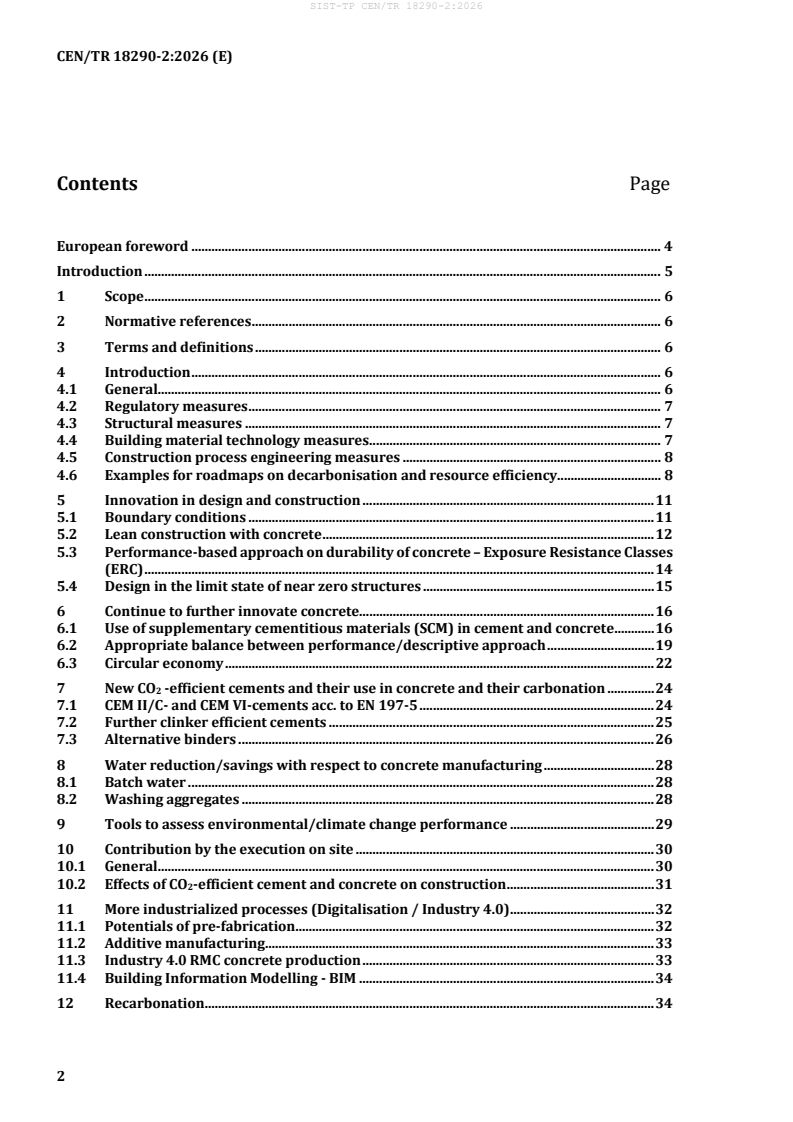
Contents Page
European foreword . 4
Introduction . 5
1 Scope . 6
2 Normative references . 6
3 Terms and definitions . 6
4 Introduction . 6
4.1 General. 6
4.2 Regulatory measures . 7
4.3 Structural measures . 7
4.4 Building material technology measures . 7
4.5 Construction process engineering measures . 8
4.6 Examples for roadmaps on decarbonisation and resource efficiency. 8
5 Innovation in design and construction . 11
5.1 Boundary conditions . 11
5.2 Lean construction with concrete . 12
5.3 Performance-based approach on durability of concrete – Exposure Resistance Classes
(ERC) . 14
5.4 Design in the limit state of near zero structures . 15
6 Continue to further innovate concrete. 16
6.1 Use of supplementary cementitious materials (SCM) in cement and concrete . 16
6.2 Appropriate balance between performance/descriptive approach . 19
6.3 Circular economy . 22
7 New CO -efficient cements and their use in concrete and their carbonation . 24
7.1 CEM II/C- and CEM VI-cements acc. to EN 197-5 . 24
7.2 Further clinker efficient cements . 25
7.3 Alternative binders . 26
8 Water reduction/savings with respect to concrete manufacturing . 28
8.1 Batch water . 28
8.2 Washing aggregates . 28
9 Tools to assess environmental/climate change performance . 29
10 Contribution by the execution on site . 30
10.1 General. 30
10.2 Effects of CO -efficient cement and concrete on construction . 31
11 More industrialized processes (Digitalisation / Industry 4.0) . 32
11.1 Potentials of pre-fabrication. 32
11.2 Additive manufacturing . 33
11.3 Industry 4.0 RMC concrete production . 33
11.4 Building Information Modelling - BIM . 34
12 Recarbonation . 34
13 Summary . 35
14 Proposals for further R&D (Innovation areas) . 37
Annex A (informative) France – Detailed information . 38
Annex B (informative) Germany – Detailed information . 40
B.1 Performance of clinker-efficient cements . 40
B.2 Carbon reinforced concrete . 48
B.3 Potentials of pre-fabrication . 48
B.4 Additive manufacturing . 48
B.5 Complementary information to Figure 6 in Clause 9 . 49
Annex C (informative) Finland – Detailed information on Low-carbon classification of
concrete in Finland [36] . 52
C.1 Introduction . 52
C.2 Principles of Low-Carbon Classification . 52
Annex D (informative) Cement with recycled building materials . 54
Annex E (informative) Requirements of SCM . 55
E.1 General . 55
E.2 Granulated blast furnace slag . 57
E.3 Pozzolanic materials (P, Q) . 57
E.4 Fly ash . 57
E.5 Limestone fines . 58
E.6 Silica Fume . 59
E.7 Burnt Shale . 59
E.8 Calcined materials . 59
Bibliography . 60
European foreword
This document (CEN/TR 18290-2:2026) has been prepared by Technical Committee CEN/TC 104
“Concrete and related products”, the secretariat of which is held by Norway.
Attention is drawn to the possibility that some of the elements of this document may be the subject of
patent rights. CEN shall not be held responsible for identifying any or all such patent rights.
Any feedback and questions on this document should be directed to the users’ national standards body.
A complete listing of these bodies can be found on the CEN website.
Introduction
Currently, the boundary conditions for the erection and the operation of buildings and structures are
changing. National and European laws and legislative procedures, such as the EU Taxonomy Ordinance
and proposals from the Architects4Future initiative – require a restructuring of the construction industry
with regard to climate change and climate change consequences as well as resource efficiency and a
circular economy.
Besides these boundary conditions, increasing scarcity of raw materials, limited landfill space and the
need to reduce GHG emissions are the global requirements that sustainable buildings, among others,
demand a low consumption of raw materials and energy as well as the greatest possible flexibility of use
and reusability or durability of the function in the building. Sustainable buildings have to meet
environmental, economic and socio-cultural requirements, at the same time offer a high technical quality
and have to be aligned to the processes of construction. Furthermore, ensuring user comfort and
prioritizing health considerations are essential aspects of building design. The specific requirement
profile of the client therefore determines the main points with which the numerous criteria of
sustainability, such as for example in a certification, are anchored, are weighed against each other. All
measures are based on the following key sustainability goals:
— An immediate and ambitious reduction in GHG emissions as a measure for climate protection,
— Take precautions for the already existing consequences of climate change,
— Resource conservation and material optimization.
When considering whether to preserve a structure or to dismantle it, the preservation approach has to
always be followed in the interests of sustainability and the service life extended through appropriate
maintenance.
This document is part 2 of two parts. Part 1 has the intention to give guidance, what measures can be
taken in daily business already today to contribute to decarbonisation, resource efficiency and
sustainability in the concrete sector. This Part 2 shows further measures and potentials to contribute to
decarbonisation, resource efficiency and sustainability in the concrete sector in the medium and long
term.
1 Scope
This document shows measures and potentials in the medium and long term to contribute to
decarbonisation, resource efficiency and sustainability in the concrete sector compared to those
measures that can already be taken in daily business today. Reduction of GHG emissions and resource
efficiency are to be addressed at the same time and can affect each other; e.g. decreasing amount of fly
ash in some countries due to the decommissioning of coal-fired power plants. As the embodied carbon in
construction accounts for approx. 25-30 % of the GHG emissions of the life cycle of a typical building
today, it has to be embedded into a LCA approach for the whole service life.
On CEN-Level as a consequence the general question is: “What can be done in the standards to go further
in supporting decarbonisation, resource efficiency and sustainability in the concrete sector in the best
possible way.
Case
Case studies give examples (on a national level) for a deeper look
study
This symbol indicates required action
Values in the annexes are subject to change over time e.g. based on changes in the respective standards.
2 Normative references
There are no normative references in this document.
3 Terms and definitions
No terms and definitions are listed in this document.
ISO and IEC maintain terminology databases for use in standardization at the following addresses:
— ISO Online browsing platform: available at https://www.iso.org/obp/
— IEC Electropedia: available at https://www.electropedia.org/
4 Introduction
4.1 General
Construction is responsible for 36 % of GHG emissions and 40 % of energy consumption in the European
Union – as the European Commission stated in the context of the so-called EU Taxonomy Regulation,
see [1].
Emissions of CO equivalents are attributable to the manufacture, construction, modernisation, use and
operation of buildings, including upstream and downstream processes. In building construction,
approx. 75 % of these emissions are due to use and operation. With engineering and infrastructure
structures the amount of GHG emissions in the construction phase is somewhat higher.
Based on these figures, construction is increasingly the focus of political decisions and legislative
procedures, such as the aforementioned EU Taxonomy Regulation [1] like e.g. the German Federal
Climate Protection Act (https://www.gesetze-im-internet.de/englisch_ksg/index.html) or the
French RE2020 (https://www.ecologie.gouv.fr/sites/default/files/guide_re2020.pdf).
Against this background three essential fields of action can be defined in concrete construction for the
coming years:
1) By means of structural design measures, reduce the amount of concrete and reinforcement: as little
as possible, as much as necessary.
2) The concrete used comes from decarbonised processes.
3) Use of concrete in the most resource efficient way (reduce wastage/wasting of materials by more
optimized processes and concrete mix designs) including extension of service life and circular
economy.
This triad has to be embedded in regulatory boundary conditions such as laws, regulations and standards
[2]. This requires consistent action and can be supported by the following measures:
4.2 Regulatory measures
— Creation of functioning incentive systems for climate-optimized construction.
— Incentive for CO -efficiency by (public) procurement.
— Reversal in regulations: Sustainable building as a standard instead of – as before – as an exception.
— Establishing tools for the rapid implementation of improvements and innovations.
— Shortening approval procedures for new climate-optimized building materials and construction
processes.
— Target setting in regulatory specifications is established on building/structural component level.
In France, the new regulation RE 2020 gives rules for decarbonising construction [9].
Levels (Benchmark) of GHG emissions during construction are given for individual houses,
Case
collective housing, offices and schools. Since 1st of January 2022 this regulation applies for
study
housing, and since 1st of July 2022 for offices and schools. These levels will be reduced
during the following years. For further details see Annex A.
4.3 Structural measures
— Digital planning techniques, such as BIM, and automated construction process chains.
— Innovative construction techniques, such as digital manufacturing and hybrid construction methods.
— Increased efficiency and reduction of wasting through e.g. lean construction and particularly
material-saving, optimized load-bearing structures (e.g. prestressing or post-tensioning techniques
and use of high-performance concretes).
— More precise durability calculations and new durability concepts and lifetime analyses.
4.4 Building material technology measures
— Use of low carbon or near zero materials, such as clinker efficient cements and climate friendly
concretes.
— With the same performance and durability use of non-corroding reinforcements to reduce
component geometry, increase service life or dispense with coatings.
— Use of reused/recycled/repurposed materials or components. Utilize the existing building stock as
much as possible.
— Use of optimized concrete mix-designs in terms of carbon footprint, content of recycled materials
and water consumption.
4.5 Construction process engineering measures
— New manufacturing methods
— Prefabrication of components
— Improved accuracy in construction
It is also foreseeable that the current building stock will have to be preserved, revitalized or upgraded
much more often in the future and that maintenance will subsequently continue to gain in importance
compared to the new building, see [3].
4.6 Examples for roadmaps on decarbonisation and resource efficiency
Roadmaps on decarbonisation and resource efficiency worldwide address the measures and levers to
reach a decarbonised concrete sector by 2050 at the latest (e.g. [4, 5, 6, 7, 8, 9] including the OFICEMEN
roadmap for the Spanish cement industry to 2050).
Even though methodologies are not 100 % comparable some conclusions can be drawn (see Figure 1):
— Without Carbon capture and use (CCU) or Carbon capture and storage (CCS) decarbonization of
cement and concrete will not be possible
— The potential to contribute to decarbonisation by low carbon cement and concrete is seen in a range
between approx. 12-26 %
— The potential to contribute to decarbonisation by innovations in design and construction is seen in a
range between approx. 5-25 %
— As a consequence, a range of 30-40 % reduction of CO in the concrete sector is seen by existing
roadmaps to be possible with the levers and measures that can be supported by standards prepared
by CEN/TC 51, CEN/TC 104, CEN/TC 229, CEN/TC 250 and their sub-committees and working
groups
— This CEN/TR gives guidance how CEN activities and committees dealing with cement and concrete
support that these levers/potentials will be realized
Key
Y Percentage CO reduction
CEMBUREAU
GCCA
Australia
Germany
Mineral Products Association
Figure 1 — Potential of CO reduction as seen in several roadmaps on decarbonisation
(examples)
It is foreseeable that by 2050, around 75 % of the concrete produced globally will be manufactured in
regions with a stressed water situation. Water-reduced concrete mixes is used when possible and
washing of aggregates before using them in concrete is avoided whenever possible [37].
In general, the following measures and levers have been addressed within the existing roadmaps
(Table 1):
Table 1 — Examples of measures and levers that can support decarbonisation have been
addressed within the existing roadmaps
Area Measures and levers (Examples)
Design with a — Prestressed hollow core slabs or voided slabs.
focus on low
— More differentiated selection of the concrete grade.
carbon
— Assessment of the concrete strength, for example, after 56 days.
technologies and
— More industrialized process, for example, by a moderate shift from onsite
material
work to precast.
efficiency
— Design for lifetime extension, repair and reuse.
— Design for the limit state of carbon neutrality.
— Use of high-performance concrete (CO per cubic meter an MPa to compare
to CO at the building level).
Electrification of
manufacturing
process and
transport
Optimizing of the — Packing density optimization of concrete and optimization of aggregate
total binder grading.
volume (sum of
— Appropriate balance between performance/descriptive approach.
cement and SCM)
— Lowering volumes of fresh concrete wastings (better forecasting of the
to reduce of GHG
demand and adapted truck size).
emissions
— Dry mix vs. wet mix.
— Tools to assess CO performance and technical performance of concrete at
the same time.
Further lowering Producing cements with higher content of SCMs, e.g.:
the clinker factor
— Limestone content of 20 per cent or more;
in cement
— “LC3” –50 per cent clinker, 30 per cent calcined clay and 20 per cent
limestone;
— 35 per cent clinker, 45 per cent fly ash / calcined clay / GGBFS and 20 per
cent limestone;
— Standards and application rules which reflect the benefits of CO efficient
cements and enable their (differentiated) use in concrete;
— Introducing these new cements in concrete standards.
To achieve an equivalent strength performance the reduction of clinker and/or supplementary
cementitious content in a concrete mix goes frequently hand in hand with a reduced water content
enabling water saving at the same time. Recently it has been shown, that with a water content
of 130 kg/m , which constitutes a saving of about 20 %, a CO reduced concrete with highest
requirements in terms of pumpability and robustness against temperature variations can be realized
even applying the prescriptive design concept [64].
5 Innovation in design and construction
5.1 Boundary conditions
The success of concrete construction in recent decades is in particular due to the fact that the starting
materials are available almost everywhere in the world and can be obtained at comparatively
manageable costs. In addition, the construction method is very robust: Deviations from the planning
model do not automatically mean that the concrete components are not able to cope with the real
conditions in addition to the longer durability without costly maintenance. However, this robustness is
at the expense of the efficiency of the construction method – both in terms of material requirements and
emission volumes. In this respect, this success of concrete construction is at least partly due to the
preference for economic efficiency and robustness over climate and resource efficiency or sustainability
laid down in building rules. Technologically, this requires at least partially avoidable emissions and partly
also wasting of material resources.
For the construction industry and with that also for concrete construction, becoming “greener” no longer
means improving in small steps by 2030 and then establishing a climate-neutral construction industry.
Rather, all measures to be taken are aligned with the following goals/actions:
— With the same performance immediate and significant reduction of GHG emissions as a measure to
limit climate change,
— adaptation of existing and new buildings to the already existing and expected consequences of
climate change,
— resource conservation, extension of service life and effective circular economy.
Enormous improvements are necessary, which are accompanied by technical and economic changes. For
the medium-term perspective, further optimizations have to be planned. In addition, sustainability and
resilience strategies for the long-term perspective have to be developed and implemented as quickly as
possible.
Designers and architects play a crucial role and will increasingly adopt aspects of resource efficiency and
climate protection in their design and construction considerations. From the point of view of designers,
architects and building owners, the selection and application of concrete (including the type of cement
used) as well as the building structure, including its service life, are the main influencing factors.
Structural optimization, as well as improved design assumptions and methods, are the tools to be used
by designers. Contractors also can contribute to new and improved construction technologies. Both
designers and contractors will increasingly emphasize issues such as lifetime extension, repair and
reuse [5].
Innovation through design and construction focuses on [5]:
— Promoting design of building and infrastructure that includes a clear focus on material efficiency,
specifying lower carbon concrete solutions and improved construction technologies.
— Ensuring structural optimization that allows for lifetime extension, repair and reuse.
— Use of high-performance concrete for an optimization of concrete volumes .
It could be noted that as a first approach, the CO2 footprint varies as the square root of f , for elements where the
ck
compressive strength is the critical factor for sizing, cross section reduction can induce environmental savings
1/2
varying as 1/fck .
High performance concretes are also preferred in the case of truss structures.
Horizontal elements in concrete buildings contribute most to the carbon footprint. To optimize is a
challenging task because of conflicting interests like open space area, flexible use and material
consumption driving carbon footprint. Considering conventionally reinforced concrete elements the
material intensity increases significantly with span width [67] constituting a preference for smaller span
width looking at a concrete structure carbon footprint. Concrete strength and density are further
influencing factors with similar potential for improvement. While the application of lower density
concrete provides especially saving potential in housing structures with a small number of floors, a higher
concrete strength class enables carbon savings especially in multi-storey buildings. Therefore, in
scenarios where the span width is fixed and a greater height is desired, such as in collective housing with
post and beams in concrete, the utilization of higher strength concrete could be advantageous.
The choice of design and materials for a given building is made during a multi-criteria reflection that is
confirmed by a set of calculations, with potentially back and forth between the different actors of the
project taking into account the performance and durability. Minimizing the environmental impact of the
structure is one of these criteria. It is from a global perspective that this impact is assessed, taking into
account above all the performance, durability and functionality brought to the structure.
It is important to note that both design solutions and the choice of materials have influences on the
building environmental impact,
5.2 Lean construction with concrete
5.2.1 Stocktaking
In the sense of a stocktaking the question can be raised whether the concrete sector currently is “wasting”
resources and emitting unnecessary greenhouse gases. If the answer to this question to some extent is
“yes”, the next question is why and how can this be changed. The following text gives some examples of
what types of “wasting” currently exist in concrete construction and how this “wasting” can be reduced.
The term “wasting” here does not mean any material that is left over but in terms of a wasting of
resources.
Wasting of resources results e.g. from an inaccurate description of the needs by the customer, incomplete
planning, inappropriate constructions and wasting of materials as well as insufficiently adapted
production and execution methods. This wasting is also caused in particular by insufficient coordination
of what is built, how it is built and how it will be used later. In this respect, the first and most important
step on the way to sustainability is to optimize the use and durability of material, human and time
resources, as a joint task of all those involved in the construction process. In other words, on aspect of
“going green” means becoming more efficient and leaner – i.e. “lean” – and working better together.
Wasting of resources is currently generated in a number of areas that are addressed immediately, such
as [12]:
— oversized components;
— unnecessarily high demands on the concrete or the component;
— comparatively high variance in the production of concrete and its constituents;
— sometimes unnecessarily high cement and clinker contents;
— often unnecessarily high compressive strengths in the component, e.g. due to disregarded strength
increase;
— neglect of the time-consuming curing due to the immense pressure of deadlines for the entire project;
and
— neglect of an appropriate, value-preserving maintenance/repair.
5.2.2 Examples for wastage of resources in concrete construction and measures to reduce
These forms of wasting can be assigned to the classic aspects that play a role in the design of lean
processes, see Table 2.
Table 2 — Examples for wastage of resources in concrete construction and measures to reduce
[12]
Reference to
Type of wastage Example Countermeasure standards and Remarks
regulations
Oversized components Can require more
Clarification of the actual Relevant standards
and unnecessarily high detailed preliminary
Overproduction needs in a requirement of concrete
demands on the concrete considerations and
for planning construction
or the component advice
Changeover to predictive Evidence is required
Regulatory not yet
Retrospective quality quality control with the that procedures that
recorded, therefore
Waiting control, including 28-day aim of further limiting are already being
approval process can
compressive strength fluctuations in tested work
be necessary
production regularly
Development of Creation of incentive
incentive systems for systems for the
Comparatively high more precise production, entire value chain –
variance in the for example by the fact Regulatory not yet in other words, an
Defects and
production of concrete that these lead to a recorded, therefore “all-win-situation” in
non-utilized
and its constituents and reduction of the partial approval process can which the concrete
talent
high safety factors due to safety factor, whereby a be necessary manufacturer who
variance higher utilization of the optimizes his
building material is production also
achieved benefits
Approval of the incentive
system for more precise
Exceeding In Germany
construction and the
Defects and manufacturing and Tolerance class 2 currently not
associated reduction of
non-utilized manufacturing according provided for in
the partial safety factor
talent tolerances as well as to EN 13670 terms of
with the aim of a higher
limit dimensions standardization
capacity utilization of
the component
Making curing visible as Proposals for
Neglect of the time-
a technologically Transferring curing changes are
consuming curing due to
Non-utilized important measure that to the list of “special submitted to the
the immense pressure of
talent brings advantages in services” in relevant committees
deadlines for the entire
terms of climate contracts on European and
project
protection national level
In principle, it is
possible to add Note the effects on
Raising the testing age
Disregarded strength “sustainability” as a the construction
Overproduction to 56 or 91 days (or even
increase technical process and
beyond)
requirement for durability
increased testing age
Focus is made on the necessary coordination between all the actors: designer/contractor/producer.
What can we do?
Short, medium and long-term measures are taken in various areas of concrete
construction in order to counteract wastage of resources and to make the construction
efficient, durable and sustainable. Table 2 gives an overview of possible measures acc.
to [12]. A prerequisite for optimization from a sustainability perspective, including
decarbonization and resource efficiency, is intensive communication between those
involved, which pursues the goal of joint optimization – right from the start.
In addition to these approaches, there are other topics with which rapid savings could be achieved. These
include the reduction of user comfort (minimum sound insulation), better design with predetermined
crack or expansion joints instead of large crack width-restricting reinforcement quantities, use of
displacement bodies in solid components, use of material-optimized finished parts. Use of single and strip
foundations instead of surface foundations.
A prerequisite for optimization from a sustainability point of view, including decarbonization (see [6])
and resource efficiency, is intensive communication between the parties involved, which pursues the goal
of joint optimization – right from the start. And interactions are also considered [3]. It will therefore only
succeed in making concrete construction fit for a climate-neutral world in a holistic approach.
5.3 Performance-based approach on durability of concrete – Exposure Resistance
Classes (ERC)
5.3.1 Introduction
Until now, the durability design of concrete structures according to current EN 1992-1-1, EN 206,
EN 13670 and EN 13369 uses a concept in which the performance is verified primarily with Deemed-to-
Satisfy (DtS) rules (concrete composition, concrete cover) based on experience. The concrete sector has
expressed a need to amend the current concept to permit alternative verification by performance testing
of concrete. The performance testing of concrete can also lead to new DtS for the designer and the
concrete producer. A new concrete durability concept has been developed named Exposure Resistance
Classes (ERC) system. The ERC concept will create for the first time in concrete sector a manner to classify
the concretes mixes when produced through performance tests, that, although not calibrated at long
term, enable a preliminary ranking. This is a first step to develop a coherent link between feed-back from
long term onsite experience, limit value for the definition of concrete mixes and modelling of concrete
durability. It is acknowledged that today’s durability concept based primarily on DtS works well for
traditional materials for which sufficiently long experience is available. Such experience however, isnot
be available for all constituents on European level and is not available for new cement types, new types
and levels of additions, certain types of admixtures and recycled aggregates, etc. For these cases in
particular, the verification based on performance testing is needed. The corresponding test methods will
be specified such as to provide a ranking based on durability tests as basis for initial type testing and
complementary non-destructive or short-term testing for demonstration of conformity, as required.
5.3.2 Potential for resource- and CO - efficiency
National application rules of many European countries do not differentiate the concrete composition
(e.g. water cement ratio) depending on the type of constituent (e.g. the cement type), see Scenario 1
in Figure 2. One of the countries already having a trade-off between binder, w/c and concrete cover is the
UK. In Scenario 1 the further potential regards resource- and CO -efficiency seems to be relatively low, as
the concrete composition have sometimes limitations to be adapted to the performance of the new
constituents (e.g. new clinker efficient cement) in order to pass respective tests. It has to be assumed that
the tests and the criteria map the behaviour of the concrete structures under real conditions with
sufficient accuracy. The latter is under discussion and might be subject to some optimization.
Scenario 2 assumes that the concrete technological boundary conditions (e.g. water cement ratio) are
changed in a way that the available raw materials can be used: they pass the respective performance and
durability tests. In many cases, this would mean that you have to orient yourself towards the “weakest
candidate”. This in the end might not be the best solution in terms of resource- and CO -efficiency in
building materials with proven suitability in practice as a wide range of different materials is covered.
A further differentiated descriptive application rule for concrete constituents (e.g. cements) dependent
on the exposure resistance class or the exposure class respectively can be acomplement of the CO -
efficient approach (Scenario 3). Beside the option to reduce the water cement ratio dependent, e.g. on
the type of cement, the concrete cover could be adapted within the ERC concept. This is important e.g. for
new clinker efficient cements because there is only a limited amount of materials available that can
replace Portland cement clinker in terms of technical performance and availability at the same time. The
same time this approach allows to safe water.
A very important requirement is, that the methods used (test methods and models) map the behaviour
of the concrete structures under real conditions with sufficient accuracy. The latter is under discussion
and might be subject to some optimization. This is not supposed to be taken as an argument not starting
to take this route.
Figure 2 — Proof of durability performance: From current practice to the ERC-system
5.4 Design in the limit state of near zero structures
The design of building structures is characterized by a careful consideration of benefits, costs and risks
e.g. to prevent failure of a structure or in order to ensure the proper usability and serviceability. Failure
to do so will result in either loss of human life or in economic damages and hardship, which are prevented
by the introduction of so-called limit states, such as the Ultimate Limit State (ULS), the Serviceability Limit
State (SLS) or (Durability) Condition Limit State (CLS) [40][41][43].These limit states e.g. consist in
limiting the mechanical loading to values significantly below the strength of the material, by restricting
deformations of the building member or by establishing certain requirements on the durability.
In various countries such as Germany, France or the Nordic countries, regulatory action has been
implemented or is under way to limit embodied GHG emissions in building structures [44] and in parallel
the introduction of a fourth limit state, i.e. the so-called ‘Climate Limit State’ has been proposed [45] [46].
Such a Climate Limit State consists of limiting the amount of embodied carbon per square meter of floor
area either for an entire building or on a building member level or by additionally referencing these
specific emissions to the service life of the structure. This approach was taken up in a slightly modified
version in fib ModelCode 2020 [41], which introduces a so-called Environmental Performance Limit State
(ELS). The ELS references the quotient of environmental impacts (EI) per year of service life (SL) in an
ecologically optimized design (eco), to that of the same quotient for a reference design (ref),
representative e.g. for the year of 2020 (see Formula 1).
EI
∑
SL
eco
(1)
ELS= ≤≤ELS 1,0
cal predefined
EI
∑
SL
ref
This environmental performance (ELS ) is compared to a predefined limit state (ELS ), which is
cal predefined
e.g. set by politics or regulatory bodies. This approach clearly considers the fact that building structures
are supposed to have a very long service life of up to 100 years, thus considering environmental impacts,
such as the emission of CO as an ‘investment’ into the future. This investment however is ideally
amortized over the longest time span possible, thus requiring that in any ecological state, durability is
not jeopardized. As this approach clearly considers the entire life span of a structure but reducing CO -
emissions is of key immediate relevance, the Environmental Limit State shown above is ideally always
accompanied with the side condition, that the environmental impacts in the ecological state is expected
to be (significantly) lower than those in the reference state, i.e. EI ≪ EI .
eco ref
A simplified version of the limit state shown above is currently being introduced in Germany for housing
structures etc. [47]. Here, Formula (1) was simplified by omitting the service life of the structure both in
the ecological state as well as in the reference state, as it is argued, that both are already subject to the
Condition Limit State or are addressed in performance based concrete design.
Any type of limit state consideration requires data both on the ecological state (i.e. the ecologically
optimized structure) as well as on the reference state. With regard to the latter, substantial progress has
been made in recent years on identifying, how much CO2 was or is being emitted e.g. to construct 1 m of
load carrying structure for housing or office applications (see e.g. [48] [54]) or for bridges or other
infrastructures [49]. On an international or even European basis, these quantification approaches
however are still very heterogeneou
...