

SIST EN 14951:2026
(Main)Solid hardwood panelling and cladding - Machined profiles
- Abstract
This document specifies characteristics of solid wood panelling and cladding with or without tongue and groove machined from hardwoods (wood of trees of the botanical group dicotyledons).
Products are intended for interior or exterior use.
This document covers treated, untreated and surface treated products, including those made of thermally and chemically modified wood, as well as finger jointed products.
This document does not cover processes for treatment, surface coating or modification.
NOTE Where further regulatory provisions (e.g. durability, reaction to fire, dangerous substances and generally CE-marking according to CPR) are required, harmonized EN 14915 applies.
- Status
- Published
- Public Enquiry End Date
- 16-Jul-2025
- Publication Date
- 17-Aug-2026
- Technical Committee
- LLZ - Les, lesni izdelki in zaščita lesa
- Current Stage
- 6060 - National Implementation/Publication (Adopted Project)
- Start Date
- 30-Jul-2026
- Due Date
- 04-Oct-2026
- Completion Date
- 18-Aug-2026

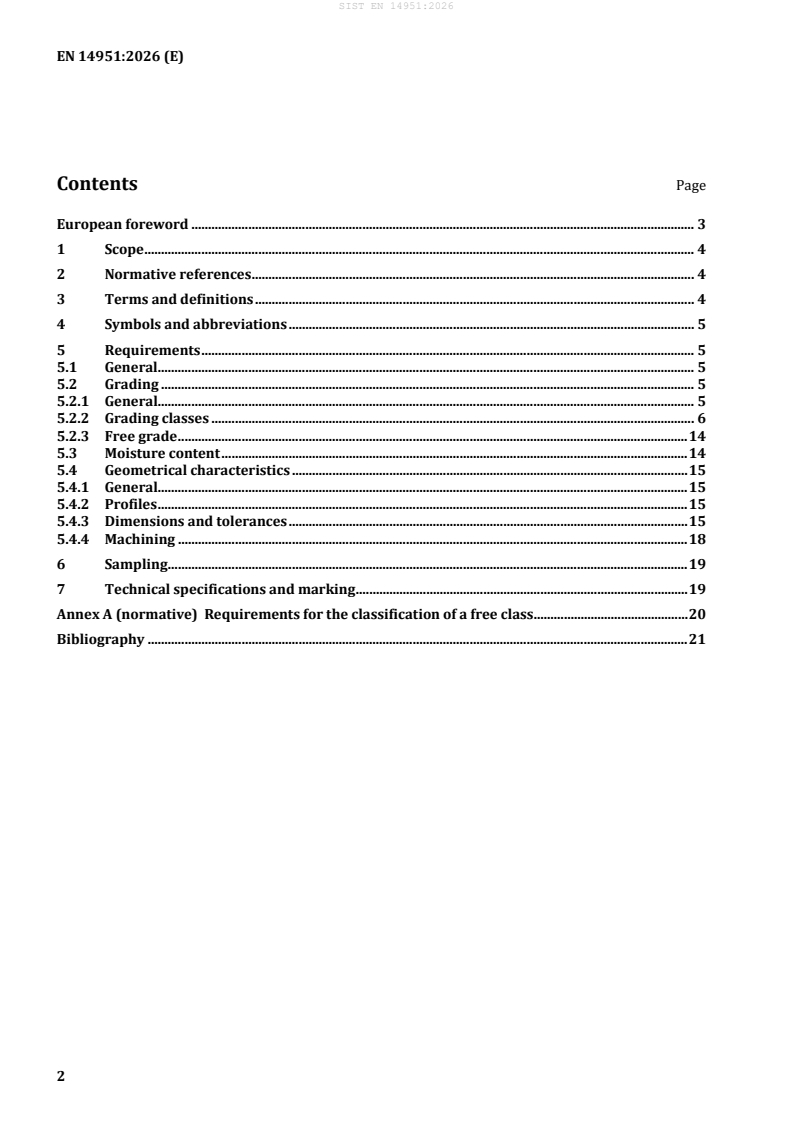
SIST EN 14951:2026 is the Slovenian adoption of EN 14951:2026 from CEN for solid hardwood panelling and cladding with machined profiles. It specifies the characteristics, grading, moisture content, dimensions, machining and marking for hardwood products intended for interior or exterior use, including treated, surface-treated, thermally or chemically modified and finger-jointed products. The standard gives manufacturers, graders, specifiers and buyers a common basis for describing and checking these products.
What does SIST EN 14951:2026 specify?
SIST EN 14951:2026 specifies solid wood panelling and cladding machined from hardwoods, with or without tongue and groove, for interior or exterior use. It covers the product characteristics that matter at production and delivery, while excluding the treatment, coating and modification processes themselves.
The document is organized into clauses for scope, normative references, terms and definitions, symbols and abbreviations, requirements, sampling, and technical specifications and marking. It also has one normative annex for the free grade.
| Annex | What it covers |
|---|---|
| Annex A | Requirements for the classification of a free class |
A note in the scope points readers to EN 14915 when other regulatory provisions are needed, such as durability, reaction to fire, dangerous substances and CE-marking under CPR.
What are the key requirements of SIST EN 14951:2026?
SIST EN 14951:2026 sets the product rules in Clause 5, then adds sampling in Clause 6 and marking in Clause 7. In practice, the standard tells a producer what wood may be used, how the visible quality is graded, what moisture content is acceptable, how dimensions and profiles are checked, and what information must follow the product.
1. General product selection and permitted construction
Clause 5.1 requires the hardwood species to be chosen for appearance, intended use and the species’ general characteristics. The standard permits finger jointing when it is agreed and specified, for example by the manufacturer.
For a buyer or specifier, this means the wood species and any finger-jointed construction should be stated up front, because the standard leaves that choice to agreement rather than fixing one universal option.
2. Grading is based on the face and on species-specific tables
Clause 5.2 says grading applies to the face only unless otherwise agreed, and the features are measured according to EN 1309-3. If the elements are coated, grading is still done before coating.
The species-specific grading classes in Tables 1 to 9 cover features such as knots, checks, splits, end shakes, bark pockets, colour variation, medullary ray and biological alteration. Class A is generally stricter than class B, and a combined class such as A/B is allowed if agreed.
For practice, this means the visible quality must be matched to the species and the intended use, not judged by one general rule for all hardwoods.
3. Free grade is allowed when the standard classes do not fit
Clause 5.2.3 and Annex A allow a declared free grade when the listed grading classes are not suitable. The free grade must state the relevant features, and the parties must agree the limits.
This is useful for special products or project-specific appearance requirements, because it lets the contract define the quality criteria directly instead of forcing the product into a standard class.
4. Moisture content is tied to the intended use
Clause 5.3 sets the moisture content at production at (15 ± 3) % for exterior use and (10 ± 3) % for interior use, unless a different level is specified for a special application or a different production method. Moisture content is determined by EN 13183-1, EN 13183-2 or EN 13183-3.
The clause also limits nonconforming elements in a batch. For the reader, this means moisture control is a conformity check, not just a quality preference, because it affects stability, fit and later movement in service.
5. Geometry, dimensions and tolerances are controlled at reference moisture content
Clause 5.4 requires dimensions to be measured according to EN 13647 at the reference moisture contents from Clause 5.3. Figures 1 and 2 show common profile shapes with and without tongue and groove, while Tables 10 and 11 give the thickness and width tolerances.
Clause 5.4.3.5 also sets length tolerances, depending on whether the product has a target size or is supplied as end-matched or in rough lengths. Clause 5.4.3.6 covers deformation, including cup.
In practice, this is the part that prevents assembly problems on site: the product has to be the right size for the stated moisture condition and still fit when installed.
6. Machining quality and fit are part of the requirement
Clause 5.4.4 requires the face to be planed smooth unless otherwise specified, and limits regular cutter marks. The back may be planed or regularised, and other surface finishes such as rough sawn, brushed, sand blasted or sanded must be specified.
For tongue and groove products, the elements must fit together easily at production and the joint must provide a proper connection along the full length. That matters because profile fit affects installation speed and the finished appearance.
7. Sampling and marking complete the product control
Clause 6 recommends CEN/TS 12169 for sampling, for example in disputes. Clause 7 requires marking to include the product and profile type, the standard number, wood species, grade or free grade, intended field of application, dimensions, end-matched or finger-jointed status, moisture content at production, and any treatment type before grading.
That marking list gives traceability. It allows a receiver, inspector or customer to check that the delivered product matches the ordered specification.
What terms does SIST EN 14951:2026 define?
- Panelling - Solid wood elements mainly for interior use, machined on the face and regularised on the back.
- Cladding - Solid wood elements mainly for exterior use, machined on the face and regularised on the back.
- Face - The visible surfaces of an element when installed, including edges and chamfers.
- Regularised - A surface condition where some areas of the face remain untouched during planing.
- Tongue and groove - A matching edge profile with a groove on one edge and a corresponding tongue on the opposite edge, or a similar interlocking profile.
- End matching - The profile at the end of the panelling or cladding, including tongue and/or groove.
Who uses SIST EN 14951:2026?
SIST EN 14951:2026 is used by hardwood panelling and cladding manufacturers to define product grades, moisture content, profile dimensions and marking. It is also used by grading and quality control staff who inspect visible features and dimensional conformity.
Specifiers, purchasers and installers use it to agree what kind of product is being supplied for interior or exterior use. Laboratories and conformity assessors use it when checking moisture content, geometry, sampling and product description against a declared grade.
What changed in SIST EN 14951:2026 from the previous edition?
SIST EN 14951:2026 supersedes EN 14951:2006. The foreword states these technical changes:
- alignment of the product-standard series with EN 14519, EN 15146 and EN 14951
- updated scope, normative references and terms and definitions
- more precise moisture content ranges for panelling and cladding
- reference to CEN/TS 12169 for sampling instead of Annex B
- merger and alignment of the clauses on technical specifications and marking
- deletion of Annex B
Which standards are used with SIST EN 14951:2026?
| Standard | What it contributes |
|---|---|
| EN 844 | Terminology for round and sawn timber |
| EN 1309-3 | Methods for measuring features and biological degradations |
| EN 13183-1 | Oven-dry method for moisture content |
| EN 13183-2 | Electrical resistance estimation of moisture content |
| EN 13183-3 | Capacitance estimation of moisture content |
| EN 13307-1 | Requirements for timber blanks and semi-finished profiles for non-structural uses |
| EN 13647 | Measurement of geometrical characteristics |
| EN 13756 | Terminology for wood flooring and parquet |
| EN 14915 | Further regulatory provisions such as durability, reaction to fire, dangerous substances and CE-marking under CPR |
| EN 13556 | Botanical name abbreviations used in marking |
| CEN/TS 12169 | Sampling method used when sampling is disputed |
What does the SIST EN 14951:2026 document contain?
SIST EN 14951:2026 contains species-specific grading tables for oak, ash, beech, chestnut, maple, birch, aspen/poplar, alder and other hardwoods. It also contains the free grade criteria in Annex A.
The document includes Figures 1 and 2 for common profile cross-sections with and without tongue and groove, plus Tables 10 and 11 for thickness and width tolerances. Clause 5.4.3.5 gives length tolerances, and Clause 5.4.4 describes surface machining and joint fit.
For checking conformity, the document brings together measurement methods, a sampling recommendation, and a marking list that can be used in production control, delivery inspection and technical documentation.
Relations
- Effective Date
- 02-Sep-2026
- Effective Date
- 02-Sep-2026
- Effective Date
- 02-Sep-2026
- Effective Date
- 02-Sep-2026
- Effective Date
- 02-Sep-2026
- Effective Date
- 02-Sep-2026
- Effective Date
- 02-Sep-2026
- Effective Date
- 02-Sep-2026
- Effective Date
- 28-Jan-2026
- Effective Date
- 19-Jan-2023
Get Certified
Connect with accredited certification bodies for this standard

Gozdarski inštitut Slovenije
Slovenian Forestry Institute. Forest management certification support, timber testing.
Sponsored listings
Frequently Asked Questions
SIST EN 14951:2026 is a standard published by the Slovenian Institute for Standardization (SIST). Its full title is "Solid hardwood panelling and cladding - Machined profiles". This standard covers: This document specifies characteristics of solid wood panelling and cladding with or without tongue and groove machined from hardwoods (wood of trees of the botanical group dicotyledons). Products are intended for interior or exterior use. This document covers treated, untreated and surface treated products, including those made of thermally and chemically modified wood, as well as finger jointed products. This document does not cover processes for treatment, surface coating or modification. NOTE Where further regulatory provisions (e.g. durability, reaction to fire, dangerous substances and generally CE-marking according to CPR) are required, harmonized EN 14915 applies.
This document specifies characteristics of solid wood panelling and cladding with or without tongue and groove machined from hardwoods (wood of trees of the botanical group dicotyledons). Products are intended for interior or exterior use. This document covers treated, untreated and surface treated products, including those made of thermally and chemically modified wood, as well as finger jointed products. This document does not cover processes for treatment, surface coating or modification. NOTE Where further regulatory provisions (e.g. durability, reaction to fire, dangerous substances and generally CE-marking according to CPR) are required, harmonized EN 14915 applies.
SIST EN 14951:2026 is classified under the following ICS (International Classification for Standards) categories: 79.060.99 - Other wood-based panels; 79.080 - Semi-manufactures of timber. The ICS classification helps identify the subject area and facilitates finding related standards.
SIST EN 14951:2026 has the following relationships with other standards: It is inter standard links to SIST EN 13183-3:2005, SIST EN 13647:2021, SIST EN 13183-2:2003, SIST EN 13756:2018, SIST EN 13183-1:2003, SIST EN 1309-3:2018, SIST EN 13307-1:2007, SIST EN 844:2019, SIST-TP CWA 17890:2022, SIST EN 14951:2006. Understanding these relationships helps ensure you are using the most current and applicable version of the standard.
SIST EN 14951:2026 is available in PDF format for immediate download after purchase. The document can be added to your cart and obtained through the secure checkout process. Digital delivery ensures instant access to the complete standard document.
Standards Content (Sample)
Contents
- 1 Scope
- 2 Normative references
- 3 Terms and definitions
- 3.1 panelling
- 3.2 cladding
- 3.3 face
- 3.4 regularised
- 3.5 tongue and groove
- 3.6 end matching
- 4 Symbols and abbreviations
- 5 Requirements
- 5.1 General
- 5.2 Grading
- 5.3 Moisture content
- 5.4 Geometrical characteristics
- 6 Sampling
- 7 Technical specifications and marking
- Annex A
- Bibliography
1 Scope
This document specifies characteristics of solid wood panelling and cladding with or without tongue and groove machined from hardwoods (wood of trees of the botanical group dicotyledons). Products are intended for interior or exterior use.
This document covers treated, untreated and surface treated products, including those made of thermally and chemically modified wood, as well as finger jointed products. This document does not cover processes for treatment, surface coating or modification. NOTE Where further regulatory provisions (e.g. durability, reaction to fire, dangerous substances and generally CE-marking according to CPR) are required, harmonized EN 14915 applies.
2 Normative references
The following documents are referred to in the text in such a way that some or all of their content constitutes requirements of this document. For dated references, only the edition cited applies. For undated references, the latest edition of the referenced document (including any amendments) applies. EN 844, Round and sawn timber — Terminology EN 1309-3, Round and sawn timber — Methods of measurements — Part 3: Features and biological degradations EN 13183-1, Moisture content of a piece of sawn timber — Part 1: Determination by oven dry method EN 13183-2, Moisture content of a piece of sawn timber — Part 2: Estimation by electrical resistance method EN 13183-3, Moisture content of a piece of sawn timber — Part 3: Estimation by capacitance method EN 13307-1, Timber blanks and semi-finished profiles for non-structural uses — Part 1: Requirements EN 13647, Wood flooring and wood panelling and cladding — Determination of geometrical characteristics EN 13756, Wood flooring and parquet — Terminology
3 Terms and definitions
For the purposes of this document, the terms and definitions given in EN 13756, EN 844, and the following apply.
ISO and IEC maintain terminology databases for use in standardization at the following addresses:
- ISO Online browsing platform: available at https://www.iso.org/obp/
- IEC Electropedia: available at https://www.electropedia.org/
3.1 panelling
elements of solid wood mainly for interior use which have been machined on the face and have been regularised on the back
SIST EN 14951:2026 EN 14951:2026 (E)
3.2 cladding
elements of solid wood mainly for exterior use which have been machined on the face and have been regularised on the back
3.3 face
visible surfaces of an element when installed Note 1 to entry: This includes edges and chamfers.
3.4 regularised
<hit or missed> feature of the surface of an element where some areas of a face remain untouched during the planning process
3.5 tongue and groove
elements with groove on one edge and a corresponding tongue on the opposite edge (or similar interlocking profiles)
3.6 end matching
profile at the end of the panelling or cladding including tongue and/or groove
4 Symbols and abbreviations
Symbols and abbreviations used in this document are given in Figure 1 and Figure 2 and in Table 10 and Table 11.
5 Requirements
5.1 General
The hardwood species shall be selected with regard to the appearance expected, the suitability for the intended purpose and the general characteristics of the species itself. All requirements apply at the time of production, unless otherwise specified.
Finger jointing according to EN 13307-1 is permitted if agreed upon and specified e.g. by the manufacturer.
NOTE Regarding the bonding and glue type other standards and regulations can apply.
5.2 Grading
5.2.1 General
Grading applies to the face only, unless otherwise specified. Machining requirements are covered in 5.4.4 and apply to all grades of all species.
The measurement of features shall be in accordance with EN 1309-3. The elements may be finished with surface coating. The grading shall be done before coating. Additionally, to the grading classes given in 5.2.2 different grading classes and quality criteria for panelling and cladding exist on national and company levels in Europe. Hence, free grades according to 5.2.3 may also be used
SIST EN 14951:2026 EN 14951:2026 (E)
5.2.2 Grading classes
Grading classes and the features for hardwoods are given in Tables 1 to 9. A combined grading class, e.g. A/B, is permitted if agreed upon and specified e.g. by the manufacturer. Table 1 — Grading classes for oak (Quercus spp.) Face of the element Grade b c Features A B a Sound sapwood Not permitted for exterior use, Not permitted for exterior permitted for interior use use, permitted for interior use d Knots Permitted if: Permitted if:
≤ 20 % of the width of the ≤ 50 % of the width of the Sound and intergrown element element Unsound knots (if not in clusters) diameter ≤ 2 mm diameter ≤ 10 mm Checks Total length ≤ one width of the Total length ≤ 2 width of element per meter. the element per meter.
Split Not permitted Total length ≤ one width of the element per meter.
End shakes (going through the element) for Not permitted Total length ≤ 1/2 width of end-matched elements the element End shakes (going through the element) for Total length ≤ 1/2 width of the Total length ≤ one width of non end-matched elements element the element Bark pockets Not permitted All features permitted without limit to size or Slope of grain Permitted quantity if these do not impair the use Colour variation Slight variation permitted Medullary ray Permitted Biological alteration (Fungal attack, insect Not permitted Not permitted, except blue damage) stain and black holes Non-visible parts All features permitted without limit to size or quantity if these do not impair the use. In the case of class A sound sapwood is permitted from the back up to the upper part of the tongue (for elements with tongue) and up to 3 mm for elements without tongue and groove. a Grading applies to the face (see 3.3) only, unless otherwise specified (see 5.2.1). b Not more than 5 % of the quantity of the consignment is allowed to be of lower grade.
The classification for appearance does not take into account features which may impair the element when installed. d Cat paws allowed.
SIST EN 14951:2026 EN 14951:2026 (E) Table 2 — Grading classes for ash (Fraxinus excelsior) Face of the element Grade b c Features A B a Sound sapwood Normally not distinguishable from heartwood Knots Permitted if: Permitted if:
Sound and intergrown ≤ 20 % of the width of the element ≤ 50 % of the width of the element Unsound knots diameter ≤ 2 mm diameter ≤ 10 mm Checks Total length ≤ one width of the Total length ≤ 2 width of the element element per m. per m.
Split Not permitted Total length ≤ one width of the element per m.
End shakes (going through Not permitted Total length ≤ 1/2 width of the the element) for end-matched element elements End shakes (going through Total length ≤ 1/2 width of the Total length ≤ one width of the the element) for non end- element element matched elements Bark pockets Not permitted All features permitted without limit to size or quantity if these do not Slope of grain Permitted impair the use Colour variation Natural colour variation accepted Stick marks Not permitted Biological alteration (Fungal Not permitted Not permitted, except blue stain and attack, insect damage) black holes Non-visible parts All features permitted without limit to size or quantity if these do not impair the use. a See Clause 5.2.1.
b Not more than 5 % of the quantity of the consignment is allowed to be of lower grade.
The classification for appearance does not take into account features which may impair the element when installed.
SIST EN 14951:2026 EN 14951:2026 (E) Table 3 — Grading classes for beech (Fagus sylvatica) Face of the element Grade c d Features A B b Sound sapwood Normally not distinguishable from heartwood Knots Permitted if: Permitted if:
Sound and intergrown ≤ 20 % of the width of the element ≤ 50 % of the width of the element Unsound knots diameter ≤ 2 mm diameter ≤ 10 mm Checks Total length ≤ one width of the Total length ≤ 2 width of the element element per m. per m.
Split Not permitted Total length ≤ one width of the element per m.
End shakes (going through Not permitted Total length ≤ 1/2 width of the the element) for end-matched element elements End shakes (going through Total length ≤ 1/2 width of the Total length ≤ one width of the the element) for non end- element element matched elements Slope of grain Permitted All features permitted without limit to size or quantity if these do not a Colour variation Slight variation permitted . Slight impair the use traces of natural discoloration permitted.
Red heart Not permitted Sticks marks Not permitted Permitted Medullary ray Permitted Permitted Biological alteration (Fungal Not permitted Not permitted, except blue stain and attack, insect damage) black holes Non-visible parts All features permitted without limit to size or quantity if these do not impair the use. a Only permitted for steamed beech.
b See Clause 5.2.1.
...