

oSIST prEN 14975:2025
(Main)Loft ladders - Requirements, marking and testing
General Information
- Abstract
This document specifies terms and definitions, product requirements and test methods for the construction and performance of loft ladders.
Loft ladders are applicable for infrequent temporary internal access in both domestic and commercial premises.
- Status
- Not Published
- Public Enquiry End Date
- 30-Dec-2025
- Technical Committee
- I13 - Imaginarni 13
- Current Stage
- 4020 - Public enquire (PE) (Adopted Project)
- Start Date
- 29-Oct-2025
- Due Date
- 18-Mar-2026
- Completion Date
- 05-Jan-2026

Overview
prEN 14975:2025 - "Loft ladders - Requirements, marking and testing" is a CEN draft European standard (prepared by CEN/TC 93) that updates and will supersede EN 14975:2006+A1:2010. It defines terms, product requirements and test methods for fixed loft ladders intended for infrequent temporary internal access in domestic and commercial premises. The standard covers ladder types (hinged/folding, concertina, sliding, telescopic), safety and performance criteria, marking and user instructions.
Key topics and technical requirements
- Scope & definitions: Clear definitions for loft ladder types, parts (rungs, steps, stiles, handrails, trapdoor, locking device) and intended use.
- Maximum load: Base design/load requirements are for a maximum total load of 150 kg (one person at a time). Higher declared loads are allowed if test forces are extrapolated proportionally using the formula: P = (2700 N / 150 kg) × new load in kg.
- Materials: Lists suitable timber species (e.g., spruce, pine, beech, ash, oak) and prohibits specific species (e.g., Parana Pine, Hem Fir, Corsican Pine).
- Test methods: Detailed laboratory tests with tolerances and ambient conditions (room temperature 15–25 °C; tolerances such as ±1 mm, ±1°, ±1% static forces):
- Static load test: 2 700 N applied to specified rungs/steps; ladder must remain functional and stowable after test.
- Fatigue test: cyclic application (e.g., 1 500 N repeated cycles).
- Torsion, handrail, ladder stops, rungs/steps strength tests.
- Additional tests for telescopic and sliding loft ladders.
- Design & construction requirements: Climbing angle, slip-resistance, step/rung pitch and dimensions, bearing surfaces, handrail requirements, distances to trapdoor and floor, operability (descent control, upward pressure), sharp edges, shear/squeeze points, feet and connections.
- Marking & user information: Revised and extended clauses for product marking, packaging marking and comprehensive user instructions. Annex A provides inspection checklist examples.
Applications and users
- Useful for manufacturers and designers of loft ladders to demonstrate regulatory compliance and to design safe products.
- Employed by testing laboratories and certification bodies for conformity assessment and type testing.
- Relevant to architects, specifiers, building inspectors, installers and facility managers for safe selection, installation and maintenance.
- Helpful for procurement teams and safety officers to verify performance, marking and user documentation.
Related standards
- EN 131-2: Ladders - Part 2: Requirements, testing, marking (referenced)
- EN 131-3: Ladders - Part 3: Marking and user instructions
Keywords: prEN 14975, loft ladders, requirements, marking, testing, CEN, static load test, fatigue test, telescopic ladder, sliding ladder, ladder safety.
Relations
- Effective Date
- 28-Jan-2026
- Effective Date
- 28-Jan-2026
- Effective Date
- 28-Jan-2023
Get Certified
Connect with accredited certification bodies for this standard

DIBt (Deutsches Institut für Bautechnik)
German Institute for Building Technology.
DIN CERTCO
DIN Group product certification.

Aboma Certification B.V.
Specialized in construction, metal, and transport sectors.
Sponsored listings
Frequently Asked Questions
oSIST prEN 14975:2025 is a draft published by the Slovenian Institute for Standardization (SIST). Its full title is "Loft ladders - Requirements, marking and testing". This standard covers: This document specifies terms and definitions, product requirements and test methods for the construction and performance of loft ladders. Loft ladders are applicable for infrequent temporary internal access in both domestic and commercial premises.
This document specifies terms and definitions, product requirements and test methods for the construction and performance of loft ladders. Loft ladders are applicable for infrequent temporary internal access in both domestic and commercial premises.
oSIST prEN 14975:2025 is classified under the following ICS (International Classification for Standards) categories: 91.060.30 - Ceilings. Floors. Stairs. The ICS classification helps identify the subject area and facilitates finding related standards.
oSIST prEN 14975:2025 has the following relationships with other standards: It is inter standard links to SIST EN 16510-1:2023, SIST EN ISO 8130-4:2022, SIST EN 14975:2007+A1:2010. Understanding these relationships helps ensure you are using the most current and applicable version of the standard.
oSIST prEN 14975:2025 is available in PDF format for immediate download after purchase. The document can be added to your cart and obtained through the secure checkout process. Digital delivery ensures instant access to the complete standard document.
Standards Content (Sample)
SLOVENSKI STANDARD
01-december-2025
Podstrešne letvene stopnice - Zahteve, označevanje in preskušanje
Loft ladders - Requirements, marking and testing
Bodentreppen - Anforderungen, Kennzeichnung und Prüfung
Echelles de grenier - Exigences, marquage et essais
Ta slovenski standard je istoveten z: prEN 14975
ICS:
91.060.30 Stropi. Tla. Stopnice Ceilings. Floors. Stairs
2003-01.Slovenski inštitut za standardizacijo. Razmnoževanje celote ali delov tega standarda ni dovoljeno.
DRAFT
EUROPEAN STANDARD
NORME EUROPÉENNE
EUROPÄISCHE NORM
October 2025
ICS 91.060.30 Will supersede EN 14975:2006+A1:2010
English Version
Loft ladders - Requirements, marking and testing
Echelles de grenier - Exigences, marquage et essais Bodentreppen - Anforderungen, Kennzeichnung und
Prüfung
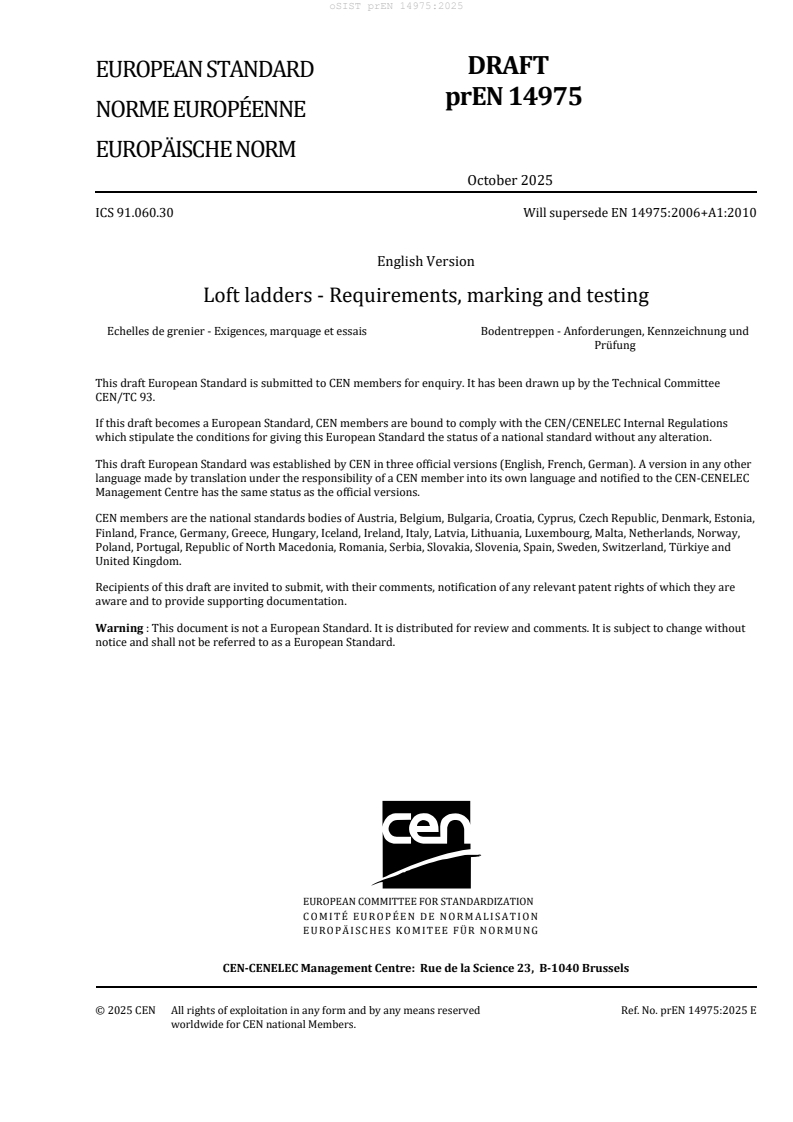
This draft European Standard is submitted to CEN members for enquiry. It has been drawn up by the Technical Committee
CEN/TC 93.
If this draft becomes a European Standard, CEN members are bound to comply with the CEN/CENELEC Internal Regulations
which stipulate the conditions for giving this European Standard the status of a national standard without any alteration.
This draft European Standard was established by CEN in three official versions (English, French, German). A version in any other
language made by translation under the responsibility of a CEN member into its own language and notified to the CEN-CENELEC
Management Centre has the same status as the official versions.
CEN members are the national standards bodies of Austria, Belgium, Bulgaria, Croatia, Cyprus, Czech Republic, Denmark, Estonia,
Finland, France, Germany, Greece, Hungary, Iceland, Ireland, Italy, Latvia, Lithuania, Luxembourg, Malta, Netherlands, Norway,
Poland, Portugal, Republic of North Macedonia, Romania, Serbia, Slovakia, Slovenia, Spain, Sweden, Switzerland, Türkiye and
United Kingdom.
Recipients of this draft are invited to submit, with their comments, notification of any relevant patent rights of which they are
aware and to provide supporting documentation.
Warning : This document is not a European Standard. It is distributed for review and comments. It is subject to change without
notice and shall not be referred to as a European Standard.
EUROPEAN COMMITTEE FOR STANDARDIZATION
COMITÉ EUROPÉEN DE NORMALISATION
EUROPÄISCHES KOMITEE FÜR NORMUNG
CEN-CENELEC Management Centre: Rue de la Science 23, B-1040 Brussels
© 2025 CEN All rights of exploitation in any form and by any means reserved Ref. No. prEN 14975:2025 E
worldwide for CEN national Members.
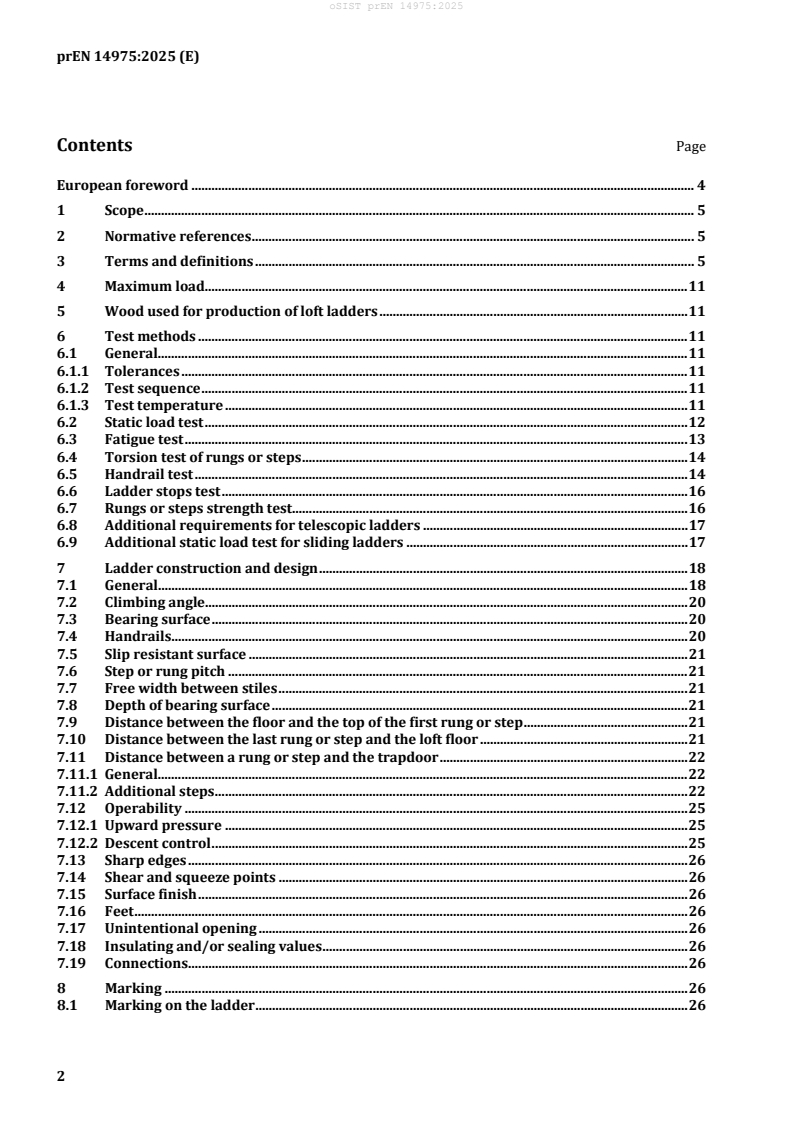
Contents Page
European foreword . 4
1 Scope . 5
2 Normative references . 5
3 Terms and definitions . 5
4 Maximum load. 11
5 Wood used for production of loft ladders . 11
6 Test methods . 11
6.1 General. 11
6.1.1 Tolerances . 11
6.1.2 Test sequence . 11
6.1.3 Test temperature . 11
6.2 Static load test . 12
6.3 Fatigue test . 13
6.4 Torsion test of rungs or steps . 14
6.5 Handrail test . 14
6.6 Ladder stops test . 16
6.7 Rungs or steps strength test. 16
6.8 Additional requirements for telescopic ladders . 17
6.9 Additional static load test for sliding ladders . 17
7 Ladder construction and design . 18
7.1 General. 18
7.2 Climbing angle. 20
7.3 Bearing surface . 20
7.4 Handrails. 20
7.5 Slip resistant surface . 21
7.6 Step or rung pitch . 21
7.7 Free width between stiles . 21
7.8 Depth of bearing surface . 21
7.9 Distance between the floor and the top of the first rung or step . 21
7.10 Distance between the last rung or step and the loft floor . 21
7.11 Distance between a rung or step and the trapdoor . 22
7.11.1 General. 22
7.11.2 Additional steps . 22
7.12 Operability . 25
7.12.1 Upward pressure . 25
7.12.2 Descent control . 25
7.13 Sharp edges . 26
7.14 Shear and squeeze points . 26
7.15 Surface finish . 26
7.16 Feet . 26
7.17 Unintentional opening . 26
7.18 Insulating and/or sealing values . 26
7.19 Connections . 26
8 Marking . 26
8.1 Marking on the ladder . 26
8.2 Marking on the packaging . 30
9 User instructions . 30
Annex A (informative) Example of a checklist for inspection of the loft ladder . 32
Bibliography . 33
European foreword
This document (prEN 14975:2025) has been prepared by Technical Committee CEN/TC 93 “Ladders”,
the secretariat of which is held by DIN.
This document is currently submitted to the CEN Enquiry.
This document will supersede EN 14975:2006+A1:2010.
This document includes the following significant technical changes with respect to
EN 14975:2006+A1:2010:
a) provisions for increased maximum total of more than 150 kg included in Clause 4;
b) provisions for additional steps required for ceilings with large thickness included in 7.11.2;
c) static load test in 6.2 modified;
d) requirements for wood added as Clause 5;
e) requirements for telescopic loft ladders added as 6.8;
f) additional test for sliding loft ladders added as 6.9;
g) Clause 8 on marking and Clause 9 on user instructions revised and extended;
h) checklists for inspection added as Annex A.
1 Scope
This document specifies terms and definitions, product requirements and test methods for the
construction and performance of loft ladders.
Loft ladders are applicable for infrequent temporary internal access in both domestic and commercial
premises.
2 Normative references
The following documents are referred to in the text in such a way that some or all of their content
constitutes requirements of this document. For dated references, only the edition cited applies. For
undated references, the latest edition of the referenced document (including any amendments) applies.
EN 131-2:2010+A3:2025, Ladders — Part 2: Requirements, testing, marking
EN 131-3, Ladders — Part 3: Marking and user instructions
3 Terms and definitions
For the purposes of this document, the following terms and definitions apply.
ISO and IEC maintain terminology databases for use in standardization at the following addresses:
— ISO Online browsing platform: available at https://www.iso.org/obp/
— IEC Electropedia: available at https://www.electropedia.org/
3.1
loft ladder
ladder designed to be permanently fixed at its top end with sliding or hinged sections permitting it to be
lowered to and raised from a lower level to provide access to a loft or similar point at a higher level
3.2
types of loft ladder
3.2.1
concertina loft ladder
loft ladder with extendable climbing support
Note 1 to entry: See Figure 1.
Figure 1 — Concertina loft ladder
3.2.2
hinged/folding loft ladder
loft ladder with hinged or folded climbing support
Note 1 to entry: See Figure 2.
Figure 2 — Hinged/folding loft ladder
3.2.3
sliding loft ladder
loft ladder with push-out or pull-out sliding climbing support
Note 1 to entry: Examples are given in Figure 3 and Figure 4.
Figure 3 — Push-out sliding loft ladder
Figure 4 — Pull-out sliding loft ladder
3.2.4
telescopic loft ladder
loft ladder consisting of three or more rung/step sections with telescopic stiles
Note 1 to entry: See example in Figure 5.
Figure 5 — Telescopic ladder
3.3
parts of a loft ladder
3.3.1
handrail
rail fitted to loft ladder to give user support when climbing or descending loft ladder
3.3.2
trapdoor
door giving access to loft or similar point at a higher level
Note 1 to entry: The loft ladder may or may not be attached to the trapdoor.
3.3.3
hinge
connecting element between loft ladder or trapdoor and loft or trapdoor casing similar point at a higher
level
3.3.4
rung
climbing support with a standing surface from front to back of less than 80 mm and more than 20 mm
3.3.5
step
climbing support with a standing surface from front to back equal to or greater than 80 mm
3.3.6
stile
side members to which the rungs, steps or cross-members are fitted
3.3.7
stile hinge
connecting element between folding ladder parts
3.3.8
locking device
mechanism to prevent unintended sliding out, extending or unfolding of the loft ladder
4 Maximum load
The requirements are based upon a maximum total load of 150 kg.
If the load of 150 kg is increased the test loads for the tests specified in 6.2, 6.3, 6.7, 6.8 and 6.9 shall be
extrapolated proportionally. However, the requirements remain unchanged. The tests according to 6.4,
6.5 and 6.6 remain unchanged.
Loft ladders are designed to be used by one person at a time.
5 Wood used for production of loft ladders
Examples of suitable species of wood are:
— Softwood:
Fir (Abies alba), Larch (Larix decidua),Spruce (Picea abies), Pine (Pinus sylvestris), Oregon pine
(Pseudotsuga menziesii),Hemlock (Tsuga heterophylla)
— Hardwood:
Beech (Fagus sylvatica), Ash (Fraxinus excelsior), Oak (Quercus robur),Robina (Robinia pseudoacacia)
Other types of timber having at least the same quality as the mentioned above are permitted too.
The following species of wood are not permitted for the production of ladders:
Parana Pine (Araucaria angustifolia O.Ktze.), Hem Fir (Abies magnifica) and Corsican Pine (Pinus nigra
Arnold).
6 Test methods
6.1 General
6.1.1 Tolerances
For all tests, unless otherwise stated in the particular test, the following tolerances are permitted as
uncertainty of measurement:
— ±1 mm for linear measurements;
— ±1° for the measurement of angles;
— ±1 % for static forces and torque;
— ±3 % for dynamic forces.
6.1.2 Test sequence
Tests shall be performed in the order they are given in the document.
6.1.3 Test temperature
All tests shall be performed at room temperature (15 °C to 25 °C).
6.2 Static load test
Mount the ladder at the top to a rigid construction. Position the feet provided with metal roller bearings
on a rigid surface platform (e.g. concrete, steel). Soft surfaces such as wood are not suitable.
Where a ladder is fitted with both automatic and manual locking devices, only the automatic locking
devices shall be employed. The engagement of a ladders manual locking devices is only permitted where
no automatic devices are fitted. Where locking devices are fitted to only one side of the ladder, apply the
test load F, on the side of the ladder opposite to the locking devices.
For ladders where the inclination angle is limited by the design: Set up the ladder at its maximum length
(fully extended) and adjust it in accordance with the manufacturer’s instructions so that the ladder is at
the particular ladder’s operating angle ±3°.
For ladders where the inclination angle is not fixed by the design: Set up the loft ladder at its maximum
length (fully extended) and at its minimum floor-to-floor height (lowest operating angle), as stated in the
user instructions, ±10 mm.
Sequentially and one at a time, apply a test load of 2 700 N (see Figure 6) over 100 mm × 100 mm with
the centre 50 mm from the stile at:
a) the top tread or rung (F );
b) the tread or rung closest to the middle of the ladder (F );
c) for sliding ladders an additional test is required as specified in 6.9.
In case of overlaps of stiles, the load shall be applied to a tread or rung within the overlap(s) or where
there is no tread or rung in the overlap(s), to the tread or rung nearest to the middle of the overlap(s).
Maintain the test load for 60 s.
Requirements: The ladder shall remain functional with no fracture or visible cracks. The ladder shall
sustain the load without ultimate failure. The ladder shall still be capable of being stowed and un-stowed.
Permanent deformation shall be allowed.
If the manufacturer wants to claim a higher maximum total load than 150 kg the total test force P, in
newtons, is derived from Formula (1):
𝑃𝑃 = (2 700 N/150 kg) × new load in kg (1)
Key
1 front view
2 side view
3 roller
4 hinge
Figure 6 — Static load test
6.3 Fatigue test
Set up the ladder at its maximum length (fully extended) and adjust it in accordance with the
manufacturer’s instructions, perpendicular to the pivot line of the top hinge. If a catch is fitted to one side
only, carry out the test on the side to which the catch is fitted. Apply cyclically a load of 1 500 N, 75 mm
from the inside face of one stile 5 000 times at a maximum rate of 1 cycle per second on the central tread
or rung.
On completion of the test, visually examine the loft ladder. There shall be no structural damage and the
ladder shall be capable of being stowed and un-stowed. The residual deflection of the stiles and rungs or
treads shall not exceed 20 mm per metre of length.
If the manufacturer wants to claim a higher maximum total load than 150 kg the fatigue test shall be
carried out instead of the 1 500 N with the new load.
6.4 Torsion test of rungs or steps
A torque of 50 N m shall be applied on the mid-point of the rung or step via a 100 mm wide clamping
device. The torque shall be applied alternately 10 times in a clockwise and 10 times in a counter-
clockwise direction for a pe
...