

SIST EN 14906:2026
(Main)Leather - Leather for automotive - Test methods and testing parameters
General Information
- Abstract
This document gives guidelines to select the test methods to assess the performance of leather for automotive. This document also specifies the sampling and conditioning procedures of specimens.
NOTE Regulations on chemical substances in consumer goods might differ from country to country requiring
for any given market a special attention to restricted substances.
- Status
- Published
- Public Enquiry End Date
- 23-Apr-2025
- Publication Date
- 15-Jun-2026
- Technical Committee
- IUSN - Leather
- Current Stage
- 6060 - National Implementation/Publication (Adopted Project)
- Start Date
- 10-Jun-2026
- Due Date
- 15-Aug-2026
- Completion Date
- 16-Jun-2026

Overview
SIST EN 14906:2026 – Leather for Automotive: Test Methods and Testing Parameters sets out comprehensive guidelines for selecting appropriate test methods to evaluate the performance of leather materials intended for automotive applications. Developed by the Slovenian Institute for Standardization (SIST) in alignment with European Standardization practices, this document focuses on the key procedures for sampling, conditioning, and testing leather used in car interiors, such as upholstery and trim. By providing a standardized approach, SIST EN 14906:2026 helps ensure consistency, durability, and quality in automotive leather products, supporting both manufacturers and buyers in defining product specifications.
Keywords: automotive leather, test methods, leather performance, sampling procedures, conditioning, quality standards, car interior materials.
Key Topics
Sampling and Conditioning
- Specifies how leather samples are to be selected (in line with EN ISO 2588) and prepared (as per EN ISO 2418 and EN ISO 4044).
- Outlines methods for conditioning samples to ensure accurate and reproducible testing results.
Fundamental and Complementary Properties
- Details essential physical, mechanical, and chemical properties that must be assessed for automotive leather, including:
- Apparent density and thickness
- Tensile strength and elongation
- Flex and abrasion resistance
- Colour fastness to artificial light, rubbing, perspiration, and water
- Details essential physical, mechanical, and chemical properties that must be assessed for automotive leather, including:
Test Methods
- Lists and references standardized test methods (EN and ISO) for each property, incorporating updates from the latest industry standards.
- Addresses additional testing parameters like ageing, odour, fogging, formaldehyde emissions, and flame resistance where relevant.
Test Reporting
- Provides guidance on documentation, ensuring that test reports include all necessary details, methods used, and any special evaluation required by client specification.
Applications
SIST EN 14906:2026 is extensively used across the automotive and leather supply chain:
- Automotive Manufacturers:
- Assess incoming leather materials for compliance with stringent safety, comfort, and aesthetic requirements.
- Establish benchmarks for material negotiations and supplier agreements.
- Leather Producers and Suppliers:
- Use standardized test methods to validate material quality before dispatch to automotive clients.
- Demonstrate adherence to international standards, supporting market access and competitiveness.
- Testing Laboratories:
- Execute specific tests as per the outlined procedures, ensuring consistent and recognized results.
- Help manufacturers meet regulatory and client-driven specifications.
The standard also ensures attention to regulations on restricted chemical substances, which may vary by market and country, highlighting the importance of compliance for global trade.
Related Standards
SIST EN 14906:2026 references and aligns with many recognized international and European standards to ensure reliability and comparability of test results, including:
- EN ISO 2418: Preparation of leather specimens for testing
- EN ISO 2589: Determination of leather thickness
- EN ISO 3376: Tensile strength and elongation
- EN ISO 11640 / 11641 / 105-B06: Colour fastness tests
- EN ISO 17071 / 17074: Fogging and flame resistance
- EN ISO 17226-3: Formaldehyde emission from leather
- EN ISO 26082-1: Soiling and cleanability tests
For additional guidance on specific properties like VOC emissions and odour, the document references established methods such as VDA 277, VDA 278, and VDA 270.
SIST EN 14906:2026 provides a solid foundation for quality assurance of automotive leather, helping manufacturers, suppliers, and laboratories align with industry expectations for safety, durability, and performance. By following its guidelines, stakeholders enhance their product’s quality and regulatory compliance in the highly competitive automotive market.
Relations
- Effective Date
- 12-Aug-2026
- Effective Date
- 01-Jul-2026
- Effective Date
- 08-Apr-2024
Get Certified
Connect with accredited certification bodies for this standard

TÜV Rheinland
TÜV Rheinland is a leading international provider of technical services.

TÜV SÜD
TÜV SÜD is a trusted partner of choice for safety, security and sustainability solutions.

BSI Group
BSI (British Standards Institution) is the business standards company that helps organizations make excellence a habit.
Sponsored listings
Frequently Asked Questions
SIST EN 14906:2026 is a standard published by the Slovenian Institute for Standardization (SIST). Its full title is "Leather - Leather for automotive - Test methods and testing parameters". This standard covers: This document gives guidelines to select the test methods to assess the performance of leather for automotive. This document also specifies the sampling and conditioning procedures of specimens. NOTE Regulations on chemical substances in consumer goods might differ from country to country requiring for any given market a special attention to restricted substances.
This document gives guidelines to select the test methods to assess the performance of leather for automotive. This document also specifies the sampling and conditioning procedures of specimens. NOTE Regulations on chemical substances in consumer goods might differ from country to country requiring for any given market a special attention to restricted substances.
SIST EN 14906:2026 is classified under the following ICS (International Classification for Standards) categories: 43.020 - Road vehicles in general; 59.140.30 - Leather and furs. The ICS classification helps identify the subject area and facilitates finding related standards.
SIST EN 14906:2026 has the following relationships with other standards: It is inter standard links to SIST EN ISO 26082-1:2026, SIST EN ISO 105-B06:2020, SIST EN 14906:2012. Understanding these relationships helps ensure you are using the most current and applicable version of the standard.
SIST EN 14906:2026 is available in PDF format for immediate download after purchase. The document can be added to your cart and obtained through the secure checkout process. Digital delivery ensures instant access to the complete standard document.
Standards Content (Sample)
SLOVENSKI STANDARD
01-julij-2026
Usnje - Usnje za uporabo v avtomobilih - Preskusni postopki in parametri
Leather - Leather for automotive - Test methods and testing parameters
Leder - Automobilleder - Prüfverfahren und Prüfparameter
Cuir - Cuir pour l'automobile - Méthodes et paramètres d’essai
Ta slovenski standard je istoveten z: EN 14906:2026
ICS:
43.020 Cestna vozila na splošno Road vehicles in general
59.140.30 Usnje in krzno Leather and furs
2003-01.Slovenski inštitut za standardizacijo. Razmnoževanje celote ali delov tega standarda ni dovoljeno.
EN 14906
EUROPEAN STANDARD
NORME EUROPÉENNE
May 2026
EUROPÄISCHE NORM
ICS 59.140.30 Supersedes EN 14906:2012
English Version
Leather - Leather for automotive - Test methods and
testing parameters
Cuir - Cuir pour l'automobile - Méthodes et paramètres Leder - Automobilleder - Prüfverfahren und
d'essai Prüfparameter
This European Standard was approved by CEN on 27 April 2026.
CEN members are bound to comply with the CEN/CENELEC Internal Regulations which stipulate the conditions for giving this
European Standard the status of a national standard without any alteration. Up-to-date lists and bibliographical references
concerning such national standards may be obtained on application to the CEN-CENELEC Management Centre or to any CEN
member.
This European Standard exists in three official versions (English, French, German). A version in any other language made by
translation under the responsibility of a CEN member into its own language and notified to the CEN-CENELEC Management
Centre has the same status as the official versions.
CEN members are the national standards bodies of Austria, Belgium, Bulgaria, Croatia, Cyprus, Czech Republic, Denmark, Estonia,
Finland, France, Germany, Greece, Hungary, Iceland, Ireland, Italy, Latvia, Lithuania, Luxembourg, Malta, Netherlands, Norway,
Poland, Portugal, Republic of North Macedonia, Romania, Serbia, Slovakia, Slovenia, Spain, Sweden, Switzerland, Türkiye and
United Kingdom.
EUROPEAN COMMITTEE FOR STANDARDIZATION
COMITÉ EUROPÉEN DE NORMALISATION
EUROPÄISCHES KOMITEE FÜR NORMUNG
CEN-CENELEC Management Centre: Rue de la Science 23, B-1040 Brussels
© 2026 CEN All rights of exploitation in any form and by any means reserved Ref. No. EN 14906:2026 E
worldwide for CEN national Members.
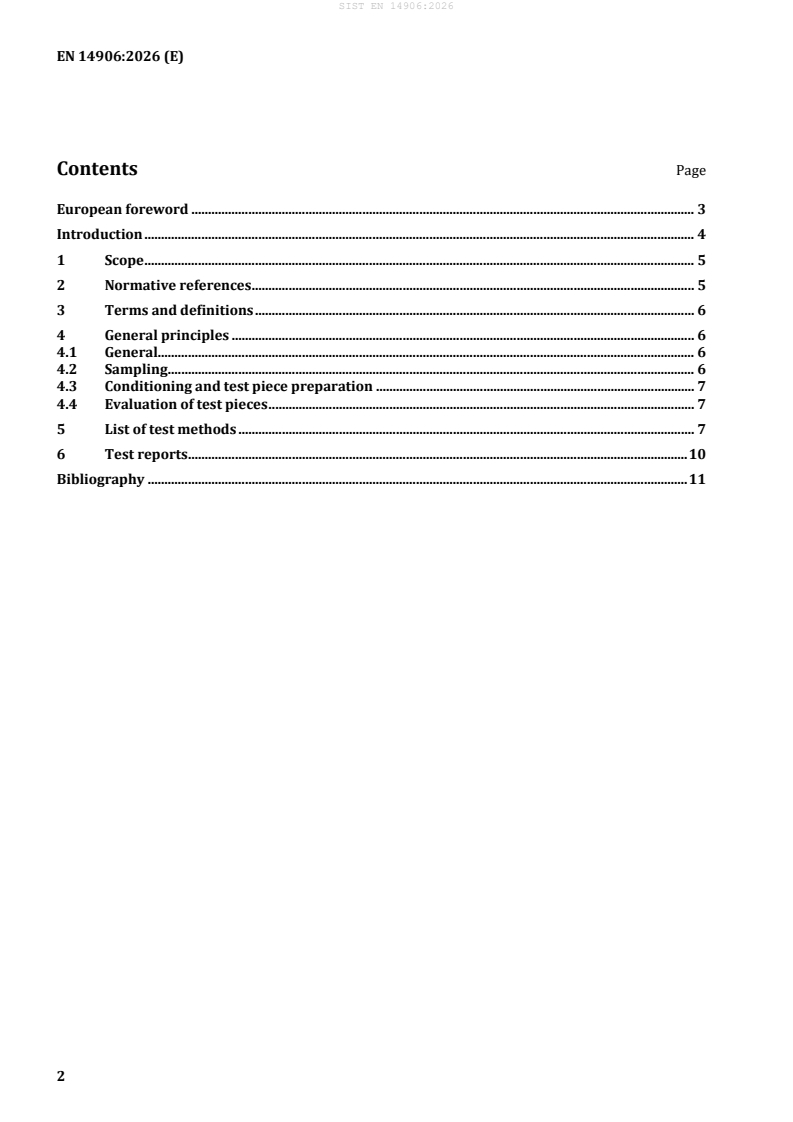
Contents Page
European foreword . 3
Introduction . 4
1 Scope . 5
2 Normative references . 5
3 Terms and definitions . 6
4 General principles . 6
4.1 General. 6
4.2 Sampling . 6
4.3 Conditioning and test piece preparation . 7
4.4 Evaluation of test pieces . 7
5 List of test methods . 7
6 Test reports . 10
Bibliography . 11
European foreword
This document (EN 14906:2026) has been prepared by Technical Committee CEN/TC 289 “Leather”,
the secretariat of which is held by UNI.
This European Standard shall be given the status of a national standard, either by publication of an
identical text or by endorsement, at the latest by November 2026 and conflicting national standards
shall be withdrawn at the latest by November 2026.
Attention is drawn to the possibility that some of the elements of this document may be the subject of
patent rights. CEN shall not be held responsible for identifying any or all such patent rights.
This document supersedes EN 14906:2012.
— update of normative references;
— update of Table 1 and Table 2 of the methods to be used for the test and the general wording of the
procedure to be followed.
Any feedback and questions on this document should be directed to the users’ national standards body.
A complete listing of these bodies can be found on the CEN website.
According to the CEN-CENELEC Internal Regulations, the national standards organizations of the
following countries are bound to implement this European Standard: Austria, Belgium, Bulgaria,
Croatia, Cyprus, Czech Republic, Denmark, Estonia, Finland, France, Germany, Greece, Hungary, Iceland,
Ireland, Italy, Latvia, Lithuania, Luxembourg, Malta, Netherlands, Norway, Poland, Portugal, Republic of
North Macedonia, Romania, Serbia, Slovakia, Slovenia, Spain, Sweden, Switzerland, Türkiye and the
United Kingdom.
Introduction
This document was prepared by CEN/TC 289 “Leather” in order to provide the leather and the
automotive industries with methods to be used for testing on which sellers and buyers can base their
specifications and negotiations.
1 Scope
This document gives guidelines to select the test methods to assess the performance of leather for
automotive. This document also specifies the sampling and conditioning procedures of specimens.
NOTE Regulations on chemical substances in consumer goods might differ from country to country requiring
for any given market a special attention to restricted substances.
2 Normative references
The following documents are referred to in the text in such a way that some or all of their content
constitutes requirements of this document. For dated references, only the edition cited applies. For
undated references, the latest edition of the referenced document (including any amendments) applies.
EN 15987, Leather — Terminology — Key definitions for the leather trade
EN 20105-A02, Textiles — Tests for colour fastness — Part A02: Grey scale for assessing change in colour
(ISO 105-A02)
EN ISO 105-B06, Textiles — Tests for colour fastness — Part B06: Colour fastness and ageing to artificial
light at high temperatures: Xenon arc fading lamp test (ISO 105-B06)
EN ISO 2418, Leather — Chemical, physical, mechanical and fastness tests — Position and preparation of
specimens for testing (ISO 2418)
EN ISO 2419, Leather — Physical and mechanical tests — Specimen and test piece conditioning
(ISO 2419)
EN ISO 2420, Leather — Physical and mechanical tests — Determination of apparent density and mass
per unit area (ISO 2420)
EN ISO 2588, Leather — Sampling — Number of items for a gross sample (ISO 2588)
EN ISO 2589, Leather — Physical and mechanical tests — Determination of thickness (ISO 2589)
EN ISO 3376, Leather — Physical and mechanical tests — Determination of tensile strength and
percentage elongation (ISO 3376)
EN ISO 3377-1, Leather — Physical and mechanical tests — Determination of tear load — Part 1: Single
edge tear (ISO 3377-1)
EN ISO 4044, Leather — Chemical tests — Preparation of chemical test samples (ISO 4044)
EN ISO 5402-1, Leather — Determination of flex resistance — Part 1: Flexometer method (ISO 5402-1)
EN ISO 7906, Leather — Tests for colour fastness — General principles of testing (ISO 7906)
EN ISO 7979, Leather — Tests for colour fastness — Colour fastness to hydroalcoholic mixtures (ISO 7979)
EN ISO 11641, Leather — Tests for colour fastness — Colour fastness to perspiration (ISO 11641)
EN ISO 11644, Leather — Test for adhesion of finish (ISO 11644)
EN ISO 14087, Leather — Physical and mechanical tests — Determination of bending fo
...