

ISO 6396:2008
(Main)Earth-moving machinery — Determination of emission sound pressure level at operator's position — Dynamic test conditions
General Information
- Abstract
ISO 6396:2008 specifies a method for determining the emission sound pressure level of earth-moving machinery at the operator's position, measured in terms of the time-averaged A-weighted emission sound pressure level while the machine is operating under dynamic test conditions. It is applicable to earth-moving machinery as defined in ISO 6165 and as specified in ISO 6395:2008, Annex A.
- Status
- Published
- Publication Date
- 09-Mar-2008
- Technical Committee
- ISO/TC 127/SC 2 - Safety, ergonomics and general requirements
- Drafting Committee
- ISO/TC 127/SC 2 - Safety, ergonomics and general requirements
- Parallel Committee
- ISO/TC 43 - Acoustics
- Current Stage
- 9060 - Close of review
- Completion Date
- 02-Sep-2031
Buy Documents


ISO 6396:2008 - Earth-moving machinery -- Determination of emission sound pressure level at operator's position -- Dynamic test conditions
ISO 6396:2008 - Earth-moving machinery — Determination of emission sound pressure level at operator's position — Dynamic test conditions/10/2008


ISO 6396:2008 - Engins de terrassement -- Détermination du niveau de pression acoustique d'émission au poste de conduite -- Conditions d'essai dynamique
ISO 6396:2008 - Engins de terrassement — Détermination du niveau de pression acoustique d'émission au poste de conduite — Conditions d'essai dynamique/10/2008
Overview
ISO 6396:2008 specifies a repeatable laboratory-style method to determine the emission sound pressure level at the operator's position for earth-moving machinery under dynamic test conditions. The standard defines how to measure the time‑averaged A‑weighted emission sound pressure level (LpA,T) while the machine performs simulated dynamic operations. It is intended for machines defined in ISO 6165 and references complementary acoustics and operator-dimension standards.
Key topics and technical requirements
- Measurement quantity: Time‑averaged A‑weighted sound pressure level at the operator’s ear position during dynamic test conditions.
- Instrumentation: Preferably an integrating‑averaging sound level meter complying with IEC 61672-1 (Class 1); calibrated acoustic calibrator required.
- Operator setup:
- Ride-on and pedestrian operator postures specified; operator stature referenced to ISO 3411 (standing stature 1 715 mm ± 50 mm for pedestrian machines).
- Seat adjustments and clothing restrictions to avoid measurement bias.
- Microphone placement & mounting:
- Preliminary check positions: 200 mm ± 20 mm from the head median plane in line with the eyes; choose side giving higher reading.
- Orientation horizontal, pointing where operator would normally look; mounting on helmet, frame or shoulder harness with vibration isolation and minimum clearances to avoid reflections.
- Machine operation:
- Tests use simulated dynamic modes (travel, stationary work cycle, or combined) as defined in ISO 6395:2008 (Annexes B–L).
- Cab tests: doors/windows closed with air-conditioning/ventilation set per clause; if no HVAC, measure closed and open and report the higher value.
- Measurement procedure & result determination:
- At least three measurements per mode; if two values within 1 dB, stop.
- Report the arithmetic mean of the two highest values that are within 1 dB.
- Recordkeeping & reporting: Detailed machine, environmental, instrumentation and acoustical data required; declaration of measurement uncertainty per Annex A.
Applications and users
ISO 6396:2008 is used for:
- Manufacturers for design validation, product documentation and noise reduction.
- Independent test laboratories and acoustical consultants performing operator noise assessments.
- Regulatory bodies and certification agencies assessing compliance with operator-noise limits.
- Health & safety professionals evaluating operator exposure and controlling workplace noise.
Practical uses include comparing machine models, guiding cab and enclosure design, and supporting noise-control measures.
Related standards
- ISO 6395:2008 (sound power under dynamic conditions)
- ISO 11201 (workstation sound measurements)
- ISO 6165 (machine types and definitions)
- ISO 3411 (operator dimensions)
- ISO 9249 (engine net power)
- IEC 61672‑1 (sound level meter specifications)
Keywords: ISO 6396:2008, earth-moving machinery, operator's position, emission sound pressure level, A-weighted, dynamic test conditions, noise measurement, sound level meter.
Relations
- Effective Date
- 25-Aug-2026
- Referred By
EN 16228-5:2014 - Drilling and foundation equipment - Safety - Part 5: Diaphragm walling equipment - Effective Date
- 25-Aug-2026
- Referred By
EN ISO 19296:2018 - Mining - Mobile machines working underground - Machine safety (ISO 19296:2018) - Effective Date
- 25-Aug-2026
- Effective Date
- 25-Aug-2026
- Effective Date
- 25-Aug-2026
- Effective Date
- 25-Aug-2026
- Effective Date
- 25-Aug-2026
- Effective Date
- 25-Aug-2026
- Effective Date
- 25-Aug-2026
- Effective Date
- 18-Mar-2026
- Effective Date
- 15-Apr-2008
Buy Documents
ISO 6396:2008 - Earth-moving machinery -- Determination of emission sound pressure level at operator's position -- Dynamic test conditions
ISO 6396:2008 - Earth-moving machinery — Determination of emission sound pressure level at operator's position — Dynamic test conditions/10/2008
ISO 6396:2008 - Engins de terrassement -- Détermination du niveau de pression acoustique d'émission au poste de conduite -- Conditions d'essai dynamique
ISO 6396:2008 - Engins de terrassement — Détermination du niveau de pression acoustique d'émission au poste de conduite — Conditions d'essai dynamique/10/2008
Get Certified
Connect with accredited certification bodies for this standard

BSMI (Bureau of Standards, Metrology and Inspection)
Taiwan's standards and inspection authority.
Sponsored listings
Frequently Asked Questions
ISO 6396:2008 is a standard published by the International Organization for Standardization (ISO). Its full title is "Earth-moving machinery — Determination of emission sound pressure level at operator's position — Dynamic test conditions". This standard covers: ISO 6396:2008 specifies a method for determining the emission sound pressure level of earth-moving machinery at the operator's position, measured in terms of the time-averaged A-weighted emission sound pressure level while the machine is operating under dynamic test conditions. It is applicable to earth-moving machinery as defined in ISO 6165 and as specified in ISO 6395:2008, Annex A.
ISO 6396:2008 specifies a method for determining the emission sound pressure level of earth-moving machinery at the operator's position, measured in terms of the time-averaged A-weighted emission sound pressure level while the machine is operating under dynamic test conditions. It is applicable to earth-moving machinery as defined in ISO 6165 and as specified in ISO 6395:2008, Annex A.
ISO 6396:2008 is classified under the following ICS (International Classification for Standards) categories: 17.140.20 - Noise emitted by machines and equipment; 53.100 - Earth-moving machinery. The ICS classification helps identify the subject area and facilitates finding related standards.
ISO 6396:2008 has the following relationships with other standards: It is inter standard links to EN 1889-1:2011, EN 16228-5:2014, EN ISO 19296:2018, EN 474-1:2006+A6:2019, EN 474-1:2006+A4:2013, EN 474-1:2006+A1:2009, EN 474-1:2006+A3:2013, EN 474-1:2006+A5:2018, EN 16228-5:2014+A1:2021, EN 474-1:2022, ISO 6396:1992. Understanding these relationships helps ensure you are using the most current and applicable version of the standard.
ISO 6396:2008 is available in PDF format for immediate download after purchase. The document can be added to your cart and obtained through the secure checkout process. Digital delivery ensures instant access to the complete standard document.
Standards Content (Sample)
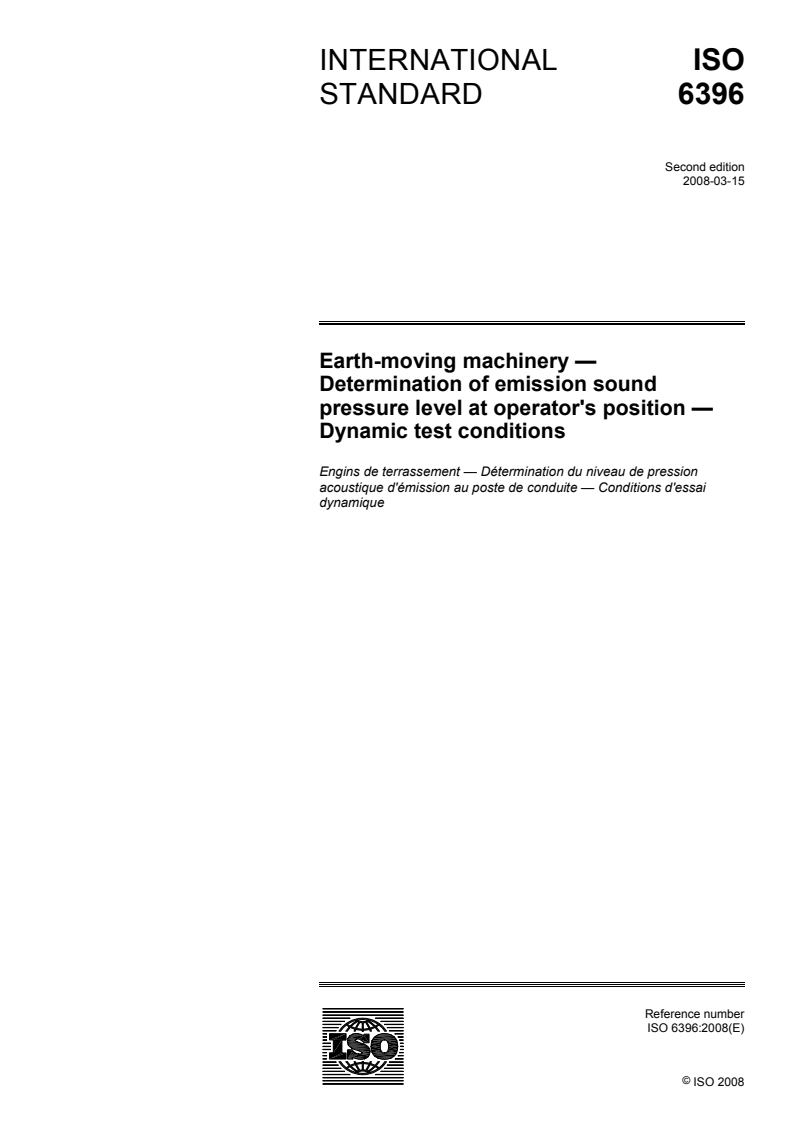
INTERNATIONAL ISO
STANDARD 6396
Second edition
2008-03-15
Earth-moving machinery —
Determination of emission sound
pressure level at operator's position —
Dynamic test conditions
Engins de terrassement — Détermination du niveau de pression
acoustique d'émission au poste de conduite — Conditions d'essai
dynamique
Reference number
©
ISO 2008
PDF disclaimer
This PDF file may contain embedded typefaces. In accordance with Adobe's licensing policy, this file may be printed or viewed but
shall not be edited unless the typefaces which are embedded are licensed to and installed on the computer performing the editing. In
downloading this file, parties accept therein the responsibility of not infringing Adobe's licensing policy. The ISO Central Secretariat
accepts no liability in this area.
Adobe is a trademark of Adobe Systems Incorporated.
Details of the software products used to create this PDF file can be found in the General Info relative to the file; the PDF-creation
parameters were optimized for printing. Every care has been taken to ensure that the file is suitable for use by ISO member bodies. In
the unlikely event that a problem relating to it is found, please inform the Central Secretariat at the address given below.
© ISO 2008
All rights reserved. Unless otherwise specified, no part of this publication may be reproduced or utilized in any form or by any means,
electronic or mechanical, including photocopying and microfilm, without permission in writing from either ISO at the address below or
ISO's member body in the country of the requester.
ISO copyright office
Case postale 56 • CH-1211 Geneva 20
Tel. + 41 22 749 01 11
Fax + 41 22 749 09 47
E-mail copyright@iso.org
Web www.iso.org
Published in Switzerland
ii © ISO 2008 – All rights reserved
Contents Page
Foreword. iv
Introduction . v
1 Scope . 1
2 Normative references . 1
3 Terms and definitions. 1
4 Instrumentation. 2
5 Test environment. 2
6 Measurement of time-averaged A-weighted sound pressure levels . 2
6.1 Operator stature. 2
6.2 Operator presence. 2
6.3 Microphone. 2
7 Set-up and operation of machine, and operator’s position set-up. 3
7.1 Set-up and operation of machine. 3
7.2 Setting-up operator’s position for machines with cab . 4
8 Acoustic measurements . 4
8.1 Measurement procedure . 4
8.2 Determination of measurement result. 4
9 Information to be recorded . 4
10 Information to be reported. 5
10.1 Information . 5
10.2 Declaration of sound emission data and uncertainty. 6
Annex A (normative) Declaration of sound emission data and uncertainty. 7
Bibliography . 8
Foreword
ISO (the International Organization for Standardization) is a worldwide federation of national standards bodies
(ISO member bodies). The work of preparing International Standards is normally carried out through ISO
technical committees. Each member body interested in a subject for which a technical committee has been
established has the right to be represented on that committee. International organizations, governmental and
non-governmental, in liaison with ISO, also take part in the work. ISO collaborates closely with the
International Electrotechnical Commission (IEC) on all matters of electrotechnical standardization.
International Standards are drafted in accordance with the rules given in the ISO/IEC Directives, Part 2.
The main task of technical committees is to prepare International Standards. Draft International Standards
adopted by the technical committees are circulated to the member bodies for voting. Publication as an
International Standard requires approval by at least 75 % of the member bodies casting a vote.
Attention is drawn to the possibility that some of the elements of this document may be the subject of patent
rights. ISO shall not be held responsible for identifying any or all such patent rights.
ISO 6396 was prepared by Technical Committee ISO/TC 127, Earth-moving machinery, Subcommittee SC 2,
Safety requirements and human factors, in collaboration with Technical Committee ISO/TC 43, Acoustics,
Subcommittee SC 1, Noise.
This second edition cancels and replaces the first edition (ISO 6396:1992), which has been technically revised.
iv © ISO 2008 – All rights reserved
Introduction
This International Standard is a specific test code for earth-moving machinery as defined in ISO 6165.
A simulated dynamic test condition, rather than an actual work cycle, is used. Simulated dynamic test
conditions provide noise emission data which are repeatable and representative. Actual work cycle tests are
complex and repeatability can be a problem.
Specific procedures are described in this International Standard to enable the time-averaged A-weighted
emission sound pressure level in dynamic test conditions to be determined in a manner which is repeatable.
Attachments (bucket, dozer, etc.) for the manufacturer’s production version are intended to be fitted since this
is the configuration most likely to exist when the machine is in actual use.
This International Standard enables compliance with noise limits to be determined, if applicable. It can also be
used for evaluation purposes in noise reduction investigations.
A complementary test code is given in ISO 6395. This other specific test code is intended to be used to
determine the noise emitted by earth-moving machinery in terms of the A-weighted sound power level, with
the machine under dynamic test conditions.
Corresponding measurements of noise emitted to the environment and noise at the operator’s position under
stationary test conditions are described in ISO 6393 and ISO 6394, respectively.
INTERNATIONAL STANDARD ISO 6396:2008(E)
Earth-moving machinery — Determination of emission sound
pressure level at operator's position — Dynamic test conditions
1 Scope
This International Standard specifies a method for determining the emission sound pressure level of
earth-moving machinery at the operator’s position, measured in terms of the time-averaged A-weighted
emission sound pressure level while the machine is operating under dynamic test conditions.
It is applicable to earth-moving machinery as defined in ISO 6165 and as specified in ISO 6395:2008,
Annex A.
2 Normative references
The following referenced documents are indispensable for the application of this document. For dated
references, only the edition cited applies. For undated references, the latest edition of the referenced
document (including any amendments) applies.
ISO 3411, Earth-moving machinery — Physical dimensions of operators and minimum operator space
envelope
ISO 6165, Earth-moving machinery — Basic types — Identification and terms and definitions
ISO 6395:2008, Earth-moving machinery — Determination of sound power level — Dynamic test conditions
ISO 9249, Earth-moving machinery — Engine test code — Net power
ISO 11201, Acoustics — Noise emitted by machinery and equipment — Measurement of emission sound
pressure levels at a work station and at other specified positions — Engineering method in an essentially free
field over a reflecting plane
IEC 61672-1, Electroacoustics — Sound level meters — Part 1: Specifications
3 Terms and definitions
For the purposes of this document, the terms and definitions given in ISO 11201, ISO 6165 and the following
apply.
3.1
time-averaged A-weighted sound pressure level
L
pA,T
A-weighted sound pressure level averaged on an energy basis over the whole measurement period, T
4 Instrumentation
The instrumentation shall be capable of being used to carry out measurements as described in Clause 8. The
preferred instrumentation system for acquiring the data is an integrating-averaging sound level meter
complying with the requirements of IEC 61672-1 for a class 1 instrument.
5 Test environment
For the purposes of this International Standard, the test environment specified in ISO 6395 applies.
6 Measurement of time-averaged A-weighted sound pressure levels
6.1 Operator stature
The operator shall have a stature between that of the small operator and the large operator as defined in
ISO 3411. See also 6.2.2.2.
6.2 Operator presence
6.2.1 Ride-on machines
6.2.1.1 Operator’s position
The operator shall be in the driving position and observers shall not be in close proximity or in the cab during
sound measurement. The operator shall wear neither abnormally sound-absorptive clothing nor any hat or
scarf (other than a protective helmet used for safety reasons, or a hel
...
INTERNATIONAL ISO
STANDARD 6396
Second edition
2008-03-15
Earth-moving machinery —
Determination of emission sound
pressure level at operator's position —
Dynamic test conditions
Engins de terrassement — Détermination du niveau de pression
acoustique d'émission au poste de conduite — Conditions d'essai
dynamique
Reference number
©
ISO 2008
PDF disclaimer
This PDF file may contain embedded typefaces. In accordance with Adobe's licensing policy, this file may be printed or viewed but
shall not be edited unless the typefaces which are embedded are licensed to and installed on the computer performing the editing. In
downloading this file, parties accept therein the responsibility of not infringing Adobe's licensing policy. The ISO Central Secretariat
accepts no liability in this area.
Adobe is a trademark of Adobe Systems Incorporated.
Details of the software products used to create this PDF file can be found in the General Info relative to the file; the PDF-creation
parameters were optimized for printing. Every care has been taken to ensure that the file is suitable for use by ISO member bodies. In
the unlikely event that a problem relating to it is found, please inform the Central Secretariat at the address given below.
© ISO 2008
All rights reserved. Unless otherwise specified, no part of this publication may be reproduced or utilized in any form or by any means,
electronic or mechanical, including photocopying and microfilm, without permission in writing from either ISO at the address below or
ISO's member body in the country of the requester.
ISO copyright office
Case postale 56 • CH-1211 Geneva 20
Tel. + 41 22 749 01 11
Fax + 41 22 749 09 47
E-mail copyright@iso.org
Web www.iso.org
Published in Switzerland
ii © ISO 2008 – All rights reserved
Contents Page
Foreword. iv
Introduction . v
1 Scope . 1
2 Normative references . 1
3 Terms and definitions. 1
4 Instrumentation. 2
5 Test environment. 2
6 Measurement of time-averaged A-weighted sound pressure levels . 2
6.1 Operator stature. 2
6.2 Operator presence. 2
6.3 Microphone. 2
7 Set-up and operation of machine, and operator’s position set-up. 3
7.1 Set-up and operation of machine. 3
7.2 Setting-up operator’s position for machines with cab . 4
8 Acoustic measurements . 4
8.1 Measurement procedure . 4
8.2 Determination of measurement result. 4
9 Information to be recorded . 4
10 Information to be reported. 5
10.1 Information . 5
10.2 Declaration of sound emission data and uncertainty. 6
Annex A (normative) Declaration of sound emission data and uncertainty. 7
Bibliography . 8
Foreword
ISO (the International Organization for Standardization) is a worldwide federation of national standards bodies
(ISO member bodies). The work of preparing International Standards is normally carried out through ISO
technical committees. Each member body interested in a subject for which a technical committee has been
established has the right to be represented on that committee. International organizations, governmental and
non-governmental, in liaison with ISO, also take part in the work. ISO collaborates closely with the
International Electrotechnical Commission (IEC) on all matters of electrotechnical standardization.
International Standards are drafted in accordance with the rules given in the ISO/IEC Directives, Part 2.
The main task of technical committees is to prepare International Standards. Draft International Standards
adopted by the technical committees are circulated to the member bodies for voting. Publication as an
International Standard requires approval by at least 75 % of the member bodies casting a vote.
Attention is drawn to the possibility that some of the elements of this document may be the subject of patent
rights. ISO shall not be held responsible for identifying any or all such patent rights.
ISO 6396 was prepared by Technical Committee ISO/TC 127, Earth-moving machinery, Subcommittee SC 2,
Safety requirements and human factors, in collaboration with Technical Committee ISO/TC 43, Acoustics,
Subcommittee SC 1, Noise.
This second edition cancels and replaces the first edition (ISO 6396:1992), which has been technically revised.
iv © ISO 2008 – All rights reserved
Introduction
This International Standard is a specific test code for earth-moving machinery as defined in ISO 6165.
A simulated dynamic test condition, rather than an actual work cycle, is used. Simulated dynamic test
conditions provide noise emission data which are repeatable and representative. Actual work cycle tests are
complex and repeatability can be a problem.
Specific procedures are described in this International Standard to enable the time-averaged A-weighted
emission sound pressure level in dynamic test conditions to be determined in a manner which is repeatable.
Attachments (bucket, dozer, etc.) for the manufacturer’s production version are intended to be fitted since this
is the configuration most likely to exist when the machine is in actual use.
This International Standard enables compliance with noise limits to be determined, if applicable. It can also be
used for evaluation purposes in noise reduction investigations.
A complementary test code is given in ISO 6395. This other specific test code is intended to be used to
determine the noise emitted by earth-moving machinery in terms of the A-weighted sound power level, with
the machine under dynamic test conditions.
Corresponding measurements of noise emitted to the environment and noise at the operator’s position under
stationary test conditions are described in ISO 6393 and ISO 6394, respectively.
INTERNATIONAL STANDARD ISO 6396:2008(E)
Earth-moving machinery — Determination of emission sound
pressure level at operator's position — Dynamic test conditions
1 Scope
This International Standard specifies a method for determining the emission sound pressure level of
earth-moving machinery at the operator’s position, measured in terms of the time-averaged A-weighted
emission sound pressure level while the machine is operating under dynamic test conditions.
It is applicable to earth-moving machinery as defined in ISO 6165 and as specified in ISO 6395:2008,
Annex A.
2 Normative references
The following referenced documents are indispensable for the application of this document. For dated
references, only the edition cited applies. For undated references, the latest edition of the referenced
document (including any amendments) applies.
ISO 3411, Earth-moving machinery — Physical dimensions of operators and minimum operator space
envelope
ISO 6165, Earth-moving machinery — Basic types — Identification and terms and definitions
ISO 6395:2008, Earth-moving machinery — Determination of sound power level — Dynamic test conditions
ISO 9249, Earth-moving machinery — Engine test code — Net power
ISO 11201, Acoustics — Noise emitted by machinery and equipment — Measurement of emission sound
pressure levels at a work station and at other specified positions — Engineering method in an essentially free
field over a reflecting plane
IEC 61672-1, Electroacoustics — Sound level meters — Part 1: Specifications
3 Terms and definitions
For the purposes of this document, the terms and definitions given in ISO 11201, ISO 6165 and the following
apply.
3.1
time-averaged A-weighted sound pressure level
L
pA,T
A-weighted sound pressure level averaged on an energy basis over the whole measurement period, T
4 Instrumentation
The instrumentation shall be capable of being used to carry out measurements as described in Clause 8. The
preferred instrumentation system for acquiring the data is an integrating-averaging sound level meter
complying with the requirements of IEC 61672-1 for a class 1 instrument.
5 Test environment
For the purposes of this International Standard, the test environment specified in ISO 6395 applies.
6 Measurement of time-averaged A-weighted sound pressure levels
6.1 Operator stature
The operator shall have a stature between that of the small operator and the large operator as defined in
ISO 3411. See also 6.2.2.2.
6.2 Operator presence
6.2.1 Ride-on machines
6.2.1.1 Operator’s position
The operator shall be in the driving position and observers shall not be in close proximity or in the cab during
sound measurement. The operator shall wear neither abnormally sound-absorptive clothing nor any hat or
scarf (other than a protective helmet used for safety reasons, or a hel
...
NORME ISO
INTERNATIONALE 6396
Deuxième édition
2008-03-15
Engins de terrassement — Détermination
du niveau de pression acoustique
d'émission au poste de conduite —
Conditions d'essai dynamique
Earth-moving machinery — Determination of emission sound pressure
level at operator's position — Dynamic test conditions
Numéro de référence
©
ISO 2008
PDF – Exonération de responsabilité
Le présent fichier PDF peut contenir des polices de caractères intégrées. Conformément aux conditions de licence d'Adobe, ce fichier
peut être imprimé ou visualisé, mais ne doit pas être modifié à moins que l'ordinateur employé à cet effet ne bénéficie d'une licence
autorisant l'utilisation de ces polices et que celles-ci y soient installées. Lors du téléchargement de ce fichier, les parties concernées
acceptent de fait la responsabilité de ne pas enfreindre les conditions de licence d'Adobe. Le Secrétariat central de l'ISO décline toute
responsabilité en la matière.
Adobe est une marque déposée d'Adobe Systems Incorporated.
Les détails relatifs aux produits logiciels utilisés pour la création du présent fichier PDF sont disponibles dans la rubrique General Info
du fichier; les paramètres de création PDF ont été optimisés pour l'impression. Toutes les mesures ont été prises pour garantir
l'exploitation de ce fichier par les comités membres de l'ISO. Dans le cas peu probable où surviendrait un problème d'utilisation,
veuillez en informer le Secrétariat central à l'adresse donnée ci-dessous.
DOCUMENT PROTÉGÉ PAR COPYRIGHT
© ISO 2008
Droits de reproduction réservés. Sauf prescription différente, aucune partie de cette publication ne peut être reproduite ni utilisée sous
quelque forme que ce soit et par aucun procédé, électronique ou mécanique, y compris la photocopie et les microfilms, sans l'accord écrit
de l'ISO à l'adresse ci-après ou du comité membre de l'ISO dans le pays du demandeur.
ISO copyright office
Case postale 56 • CH-1211 Geneva 20
Tel. + 41 22 749 01 11
Fax. + 41 22 749 09 47
E-mail copyright@iso.org
Web www.iso.org
Publié en Suisse
ii © ISO 2008 – Tous droits réservés
Sommaire Page
Avant-propos. iv
Introduction . v
1 Domaine d'application. 1
2 Références normatives . 1
3 Termes et définitions. 1
4 Appareillage . 2
5 Environnement d'essai. 2
6 Mesurage des niveaux de pression acoustique temporels moyens pondérés A . 2
6.1 Taille du conducteur. 2
6.2 Présence du conducteur. 2
6.3 Microphone. 3
7 Préparation et conditions de fonctionnement de l'engin, et préparation du poste de
conduite . 3
7.1 Préparation et conditions de fonctionnement de l'engin . 3
7.2 Préparation du poste de conduite lorsque l'engin est équipé d'une cabine . 4
8 Mesurages acoustiques . 4
8.1 Mode opératoire du mesurage . 4
8.2 Détermination du résultat de mesurage. 4
9 Informations à relever . 5
10 Informations à consigner. 6
10.1 Informations . 6
10.2 Déclaration des valeurs d'émission sonore et de l'incertitude. 6
Annexe A (normative) Déclaration des valeurs d'émission sonore et de l'incertitude. 7
Bibliographie . 8
Avant-propos
L'ISO (Organisation internationale de normalisation) est une fédération mondiale d'organismes nationaux de
normalisation (comités membres de l'ISO). L'élaboration des Normes internationales est en général confiée
aux comités techniques de l'ISO. Chaque comité membre intéressé par une étude a le droit de faire partie du
comité technique créé à cet effet. Les organisations internationales, gouvernementales et non
gouvernementales, en liaison avec l'ISO participent également aux travaux. L'ISO collabore étroitement avec
la Commission électrotechnique internationale (CEI) en ce qui concerne la normalisation électrotechnique.
Les Normes internationales sont rédigées conformément aux règles données dans les Directives ISO/CEI,
Partie 2.
La tâche principale des comités techniques est d'élaborer les Normes internationales. Les projets de Normes
internationales adoptés par les comités techniques sont soumis aux comités membres pour vote. Leur
publication comme Normes internationales requiert l'approbation de 75 % au moins des comités membres
votants.
L'attention est appelée sur le fait que certains des éléments du présent document peuvent faire l'objet de
droits de propriété intellectuelle ou de droits analogues. L'ISO ne saurait être tenue pour responsable de ne
pas avoir identifié de tels droits de propriété et averti de leur existence.
L'ISO 6396 a été élaborée par le comité technique ISO/TC 127, Engins de terrassement, sous-comité SC 2,
Impératifs de sécurité et facteurs humains, en collaboration avec le comité technique ISO/TC 43, Acoustique,
sous-comité SC 1, Bruit.
Cette deuxième édition annule et remplace la première édition (ISO 6396:1992), qui a fait l'objet d'une
révision technique.
iv © ISO 2008 – Tous droits réservés
Introduction
La présente Norme internationale constitue un code d'essai spécifique aux engins de terrassement tels que
définis dans l'ISO 6165.
Des conditions d'essai dynamiques simulées sont utilisées plutôt que des cycles de travail réels. Les
conditions d'essai dynamiques simulées fournissent des données d'émission sonore répétables et
représentatives, tandis que les essais en cycles de travail réels sont complexes et leur répétabilité peut poser
problème.
La présente Norme internationale décrit des modes opératoires spécifiques pour permettre de déterminer le
niveau de pression acoustique d'émission temporel moyen pondéré A dans des conditions d'essai
dynamiques de manière répétable. Les accessoires (godet, bouclier, etc.) destinés à la version de production
du constructeur sont censés être montés, puisque c'est la configuration de l'engin qui sera le plus
probablement utilisée en conditions réelles.
La présente Norme internationale permet d'établir la conformité avec des limites de bruit à déterminer, le cas
échéant. Elle peut également servir à des fins d'évaluation dans le cadre d'études de réduction du niveau
sonore.
Un code d'essai complémentaire est donné dans l'ISO 6395. Cet autre code d'essai spécifique est destiné à
être utilisé pour déterminer le bruit émis par les engins de terrassement, mesuré en termes de niveau de
puissance acoustique pondéré A, l'engin fonctionnant dans des conditions d'essai dynamiques.
Les mesurages correspondant au bruit émis dans l'environnement et au bruit au poste de conduite dans des
conditions d'essai statique sont décrits respectivement dans l'ISO 6393 et l'ISO 6394.
NORME INTERNATIONALE ISO 6396:2008(F)
Engins de terrassement — Détermination du niveau de pression
acoustique d'émission au poste de conduite — Conditions
d'essai dynamique
1 Domaine d'application
La présente Norme internationale spécifie une méthode pour déterminer le niveau de pression acoustique
d'émission des engins de terrassement, au poste de conduite, mesuré en termes de niveau de pression
acoustique d'émission temporel moyen pondéré A, l'engin fonctionnant dans des conditions d'essai
dynamique.
Elle est applicable aux engins de terrassement tels que définis dans l'ISO 6165 et tels que spécifiés dans
l'ISO 6395:2008, Annexe A.
2 Références normatives
Les documents de référence suivants sont indispensables pour l'application du présent document. Pour les
références datées, seule l'édition citée s'applique. Pour les références non datées, la dernière édition du
document de référence s'applique (y compris les éventuels amendements).
ISO 3411, Engins de terrassement — Dimensions des opérateurs et espace enveloppe minimal pour les
opérateurs
ISO 6165, Engins de terrassement — Principaux types — Identification et termes et définitions
ISO 6395:2008, Engins de terrassement — Détermination du niveau de puissance acoustique — Conditions
d'essai dynamique
ISO 9249, Engins de terrassement — Code d'essai des moteurs — Puissance nette
ISO 11201, Acoustique — Bruit émis par les machines et équipements — Mesurage des niveaux de pression
acoustique d'émission au poste de travail et en d'autres positions spécifiées — Méthode d'expertise dans des
conditions approchant celles du champ libre sur plan réfléchissant
CEI 61672-1, Électroacoustique ― Sonomètres ― Partie 1: Spécifications
3 Termes et définitions
Pour les besoins du présent document, les termes et définitions donnés dans l'ISO 11201 et l'ISO 6165 ainsi
que les suivants s'appliquent.
3.1
niveau de pression acoustique temporel moyen pondéré A
L
pA,T
niveau de pression acoustique pondéré A moyenné sur une base énergétique sur tout l'intervalle de
mesurage, T
4 Appareillage
L'appareillage doit permettre d'effectuer les mesurages décrits à l'Article 8. L'appareil recommandé pour
l'acquisition des données est un sonomètre intégrateur-moyenneur satisfaisant aux exigences de la
CEI 61672-1 pour un appareil de classe 1.
5 Environnement d'essai
Pour les besoins de la présente Norme internationale, l'environnement d'essai spécifié dans l'ISO 6395
s'applique.
6 Mesurage des niveaux de pression acoustique temporels moyens pondérés A
6.1 Taille du conducteur
Le conducteur doit avoir une taille comprise entre celles du «petit opérateur» et du «grand opérateur» telles
que définies dans l'ISO 3411. Voir également 6.2.2.2.
6.2 Présence du conducteur
6.2.1 Engins à conducteur porté
6.2.1.1 Position du conducteur
Le conducteur doit être en position de conduite et aucun observateur ne doit se trouver à proximité de la
cabine, ni à l'intérieur, pendant le mesurage des niveaux sonores. Le conducteur ne doit pas porter de
vêtements présentant une absorption acoustique anormale, ni de chapeau ou d'écharpe (à l'exception d'un
casque de protection pour des raisons de sécurité ou d'un casque ou d'un support destiné à l'installation d'un
microphone) susceptibles de fausser le mesurage acoustique.
6.2.1.2 Réglage du siège
Le siège doit être réglé aussi près que possible du centre de ses courses horizontale et verticale. Tout
système de
...
NORME ISO
INTERNATIONALE 6396
Deuxième édition
2008-03-15
Engins de terrassement — Détermination
du niveau de pression acoustique
d'émission au poste de conduite —
Conditions d'essai dynamique
Earth-moving machinery — Determination of emission sound pressure
level at operator's position — Dynamic test conditions
Numéro de référence
©
ISO 2008
PDF – Exonération de responsabilité
Le présent fichier PDF peut contenir des polices de caractères intégrées. Conformément aux conditions de licence d'Adobe, ce fichier
peut être imprimé ou visualisé, mais ne doit pas être modifié à moins que l'ordinateur employé à cet effet ne bénéficie d'une licence
autorisant l'utilisation de ces polices et que celles-ci y soient installées. Lors du téléchargement de ce fichier, les parties concernées
acceptent de fait la responsabilité de ne pas enfreindre les conditions de licence d'Adobe. Le Secrétariat central de l'ISO décline toute
responsabilité en la matière.
Adobe est une marque déposée d'Adobe Systems Incorporated.
Les détails relatifs aux produits logiciels utilisés pour la création du présent fichier PDF sont disponibles dans la rubrique General Info
du fichier; les paramètres de création PDF ont été optimisés pour l'impression. Toutes les mesures ont été prises pour garantir
l'exploitation de ce fichier par les comités membres de l'ISO. Dans le cas peu probable où surviendrait un problème d'utilisation,
veuillez en informer le Secrétariat central à l'adresse donnée ci-dessous.
DOCUMENT PROTÉGÉ PAR COPYRIGHT
© ISO 2008
Droits de reproduction réservés. Sauf prescription différente, aucune partie de cette publication ne peut être reproduite ni utilisée sous
quelque forme que ce soit et par aucun procédé, électronique ou mécanique, y compris la photocopie et les microfilms, sans l'accord écrit
de l'ISO à l'adresse ci-après ou du comité membre de l'ISO dans le pays du demandeur.
ISO copyright office
Case postale 56 • CH-1211 Geneva 20
Tel. + 41 22 749 01 11
Fax. + 41 22 749 09 47
E-mail copyright@iso.org
Web www.iso.org
Publié en Suisse
ii © ISO 2008 – Tous droits réservés
Sommaire Page
Avant-propos. iv
Introduction . v
1 Domaine d'application. 1
2 Références normatives . 1
3 Termes et définitions. 1
4 Appareillage . 2
5 Environnement d'essai. 2
6 Mesurage des niveaux de pression acoustique temporels moyens pondérés A . 2
6.1 Taille du conducteur. 2
6.2 Présence du conducteur. 2
6.3 Microphone. 3
7 Préparation et conditions de fonctionnement de l'engin, et préparation du poste de
conduite . 3
7.1 Préparation et conditions de fonctionnement de l'engin . 3
7.2 Préparation du poste de conduite lorsque l'engin est équipé d'une cabine . 4
8 Mesurages acoustiques . 4
8.1 Mode opératoire du mesurage . 4
8.2 Détermination du résultat de mesurage. 4
9 Informations à relever . 5
10 Informations à consigner. 6
10.1 Informations . 6
10.2 Déclaration des valeurs d'émission sonore et de l'incertitude. 6
Annexe A (normative) Déclaration des valeurs d'émission sonore et de l'incertitude. 7
Bibliographie . 8
Avant-propos
L'ISO (Organisation internationale de normalisation) est une fédération mondiale d'organismes nationaux de
normalisation (comités membres de l'ISO). L'élaboration des Normes internationales est en général confiée
aux comités techniques de l'ISO. Chaque comité membre intéressé par une étude a le droit de faire partie du
comité technique créé à cet effet. Les organisations internationales, gouvernementales et non
gouvernementales, en liaison avec l'ISO participent également aux travaux. L'ISO collabore étroitement avec
la Commission électrotechnique internationale (CEI) en ce qui concerne la normalisation électrotechnique.
Les Normes internationales sont rédigées conformément aux règles données dans les Directives ISO/CEI,
Partie 2.
La tâche principale des comités techniques est d'élaborer les Normes internationales. Les projets de Normes
internationales adoptés par les comités techniques sont soumis aux comités membres pour vote. Leur
publication comme Normes internationales requiert l'approbation de 75 % au moins des comités membres
votants.
L'attention est appelée sur le fait que certains des éléments du présent document peuvent faire l'objet de
droits de propriété intellectuelle ou de droits analogues. L'ISO ne saurait être tenue pour responsable de ne
pas avoir identifié de tels droits de propriété et averti de leur existence.
L'ISO 6396 a été élaborée par le comité technique ISO/TC 127, Engins de terrassement, sous-comité SC 2,
Impératifs de sécurité et facteurs humains, en collaboration avec le comité technique ISO/TC 43, Acoustique,
sous-comité SC 1, Bruit.
Cette deuxième édition annule et remplace la première édition (ISO 6396:1992), qui a fait l'objet d'une
révision technique.
iv © ISO 2008 – Tous droits réservés
Introduction
La présente Norme internationale constitue un code d'essai spécifique aux engins de terrassement tels que
définis dans l'ISO 6165.
Des conditions d'essai dynamiques simulées sont utilisées plutôt que des cycles de travail réels. Les
conditions d'essai dynamiques simulées fournissent des données d'émission sonore répétables et
représentatives, tandis que les essais en cycles de travail réels sont complexes et leur répétabilité peut poser
problème.
La présente Norme internationale décrit des modes opératoires spécifiques pour permettre de déterminer le
niveau de pression acoustique d'émission temporel moyen pondéré A dans des conditions d'essai
dynamiques de manière répétable. Les accessoires (godet, bouclier, etc.) destinés à la version de production
du constructeur sont censés être montés, puisque c'est la configuration de l'engin qui sera le plus
probablement utilisée en conditions réelles.
La présente Norme internationale permet d'établir la conformité avec des limites de bruit à déterminer, le cas
échéant. Elle peut également servir à des fins d'évaluation dans le cadre d'études de réduction du niveau
sonore.
Un code d'essai complémentaire est donné dans l'ISO 6395. Cet autre code d'essai spécifique est destiné à
être utilisé pour déterminer le bruit émis par les engins de terrassement, mesuré en termes de niveau de
puissance acoustique pondéré A, l'engin fonctionnant dans des conditions d'essai dynamiques.
Les mesurages correspondant au bruit émis dans l'environnement et au bruit au poste de conduite dans des
conditions d'essai statique sont décrits respectivement dans l'ISO 6393 et l'ISO 6394.
NORME INTERNATIONALE ISO 6396:2008(F)
Engins de terrassement — Détermination du niveau de pression
acoustique d'émission au poste de conduite — Conditions
d'essai dynamique
1 Domaine d'application
La présente Norme internationale spécifie une méthode pour déterminer le niveau de pression acoustique
d'émission des engins de terrassement, au poste de conduite, mesuré en termes de niveau de pression
acoustique d'émission temporel moyen pondéré A, l'engin fonctionnant dans des conditions d'essai
dynamique.
Elle est applicable aux engins de terrassement tels que définis dans l'ISO 6165 et tels que spécifiés dans
l'ISO 6395:2008, Annexe A.
2 Références normatives
Les documents de référence suivants sont indispensables pour l'application du présent document. Pour les
références datées, seule l'édition citée s'applique. Pour les références non datées, la dernière édition du
document de référence s'applique (y compris les éventuels amendements).
ISO 3411, Engins de terrassement — Dimensions des opérateurs et espace enveloppe minimal pour les
opérateurs
ISO 6165, Engins de terrassement — Principaux types — Identification et termes et définitions
ISO 6395:2008, Engins de terrassement — Détermination du niveau de puissance acoustique — Conditions
d'essai dynamique
ISO 9249, Engins de terrassement — Code d'essai des moteurs — Puissance nette
ISO 11201, Acoustique — Bruit émis par les machines et équipements — Mesurage des niveaux de pression
acoustique d'émission au poste de travail et en d'autres positions spécifiées — Méthode d'expertise dans des
conditions approchant celles du champ libre sur plan réfléchissant
CEI 61672-1, Électroacoustique ― Sonomètres ― Partie 1: Spécifications
3 Termes et définitions
Pour les besoins du présent document, les termes et définitions donnés dans l'ISO 11201 et l'ISO 6165 ainsi
que les suivants s'appliquent.
3.1
niveau de pression acoustique temporel moyen pondéré A
L
pA,T
niveau de pression acoustique pondéré A moyenné sur une base énergétique sur tout l'intervalle de
mesurage, T
4 Appareillage
L'appareillage doit permettre d'effectuer les mesurages décrits à l'Article 8. L'appareil recommandé pour
l'acquisition des données est un sonomètre intégrateur-moyenneur satisfaisant aux exigences de la
CEI 61672-1 pour un appareil de classe 1.
5 Environnement d'essai
Pour les besoins de la présente Norme internationale, l'environnement d'essai spécifié dans l'ISO 6395
s'applique.
6 Mesurage des niveaux de pression acoustique temporels moyens pondérés A
6.1 Taille du conducteur
Le conducteur doit avoir une taille comprise entre celles du «petit opérateur» et du «grand opérateur» telles
que définies dans l'ISO 3411. Voir également 6.2.2.2.
6.2 Présence du conducteur
6.2.1 Engins à conducteur porté
6.2.1.1 Position du conducteur
Le conducteur doit être en position de conduite et aucun observateur ne doit se trouver à proximité de la
cabine, ni à l'intérieur, pendant le mesurage des niveaux sonores. Le conducteur ne doit pas porter de
vêtements présentant une absorption acoustique anormale, ni de chapeau ou d'écharpe (à l'exception d'un
casque de protection pour des raisons de sécurité ou d'un casque ou d'un support destiné à l'installation d'un
microphone) susceptibles de fausser le mesurage acoustique.
6.2.1.2 Réglage du siège
Le siège doit être réglé aussi près que possible du centre de ses courses horizontale et verticale. Tout
système de
...