

ISO 41011:2024
(Main)Facility management — Vocabulary
General Information
- Abstract
This document defines terms used in facility management.
- Status
- Published
- Publication Date
- 14-Feb-2024
- Technical Committee
- ISO/TC 267 - Facility management
- Drafting Committee
- ISO/TC 267 - Facility management
- Current Stage
- 6060 - International Standard published
- Start Date
- 15-Feb-2024
- Due Date
- 15-Jan-2024
- Completion Date
- 15-Feb-2024
Buy Documents

ISO 41011:2024 - Facility management — Vocabulary Released:15. 02. 2024

ISO 41011:2024 - Facility management — Vocabulaire Released:15. 02. 2024
Overview
ISO 41011:2024 - Facility management - Vocabulary is the International Organization for Standardization’s updated glossary for facility management (FM). This second edition defines consistent terms and definitions used across the FM discipline to improve clarity in planning, delivery and governance of built‑environment services. It replaces ISO 41011:2017 and adds new term categories (notably technology and sustainability) and many contemporary entries such as workspace, constructed asset, service life, smart building, greenhouse gas and well‑being.
Key topics and technical scope
ISO 41011:2024 organizes terminology into focused categories that reflect practical FM domains:
- Terms related to facility management: facility management, facility service, workplace, workspace, service level, SLA.
- Assets and built environment: asset, constructed asset, built environment, facility, infrastructure, service life.
- People and governance: stakeholder, demand organization, top management, responsibility assignment matrix, communication plan.
- Sourcing and contracts: agreement, contract, co‑sourcing, demobilization, procurement plan.
- Processes and measurement: facility process, output vs outcome, post‑occupancy evaluation, measurement and performance terms.
- Finance and whole‑life costing: acquisition cost, maintenance cost, whole‑life cost, cost‑benefit analysis.
- Technology and sustainability: computer aided facility management, smart building, life cycle assessment, greenhouse gas, sustainable development, well‑being.
The standard draws on and harmonizes terminology from related documents (for example ISO 55000, ISO 9000, ISO/TR 15686‑11 and ISO 6707‑4).
Practical applications and users
ISO 41011:2024 is a foundational reference for anyone needing a common FM vocabulary to reduce ambiguity and improve coordination:
- Facility managers and FM organizations – to standardize internal documentation, SLAs and service definitions.
- Asset and real estate managers – for consistent terms around asset life, infrastructure and whole‑life costing.
- Procurement and contract teams – to clarify agreements, performance specifications and demobilization.
- Designers, architects and engineers – to align on workspace, constructed asset and post‑occupancy evaluation terminology.
- Sustainability and building‑technology teams – when addressing greenhouse gas, life‑cycle assessment and smart building concepts.
- Consultants and auditors – for assessments, stakeholder impact analysis and harmonized reporting.
Using ISO 41011:2024 improves communication between stakeholders, supports clearer contracts (SLAs), enables more consistent measurement and reporting, and helps integrate sustainability and digital building concepts into FM practice.
Related standards
- ISO 55000 (asset management)
- ISO 9000 (quality management vocabulary)
- ISO/TR 15686‑11 (service life concepts)
- ISO 6707‑4 (building and civil engineering vocabulary)
- ISO 41012 (assistance on multi‑service agreements)
Relations
- Effective Date
- 25-Aug-2026
- Effective Date
- 25-Aug-2026
- Referred By
CEN ISO/TR 41016:2024 - Facility management - Overview of available technologies (ISO/TR 41016:2024) - Effective Date
- 25-Aug-2026
- Effective Date
- 22-Jul-2026
- Effective Date
- 12-Feb-2026
- Consolidates
ISO 12813:2019 - Electronic fee collection — Compliance check communication for autonomous systems - Effective Date
- 06-Jun-2022
- Effective Date
- 06-Jun-2022
Buy Documents
ISO 41011:2024 - Facility management — Vocabulary Released:15. 02. 2024
ISO 41011:2024 - Facility management — Vocabulaire Released:15. 02. 2024
Get Certified
Connect with accredited certification bodies for this standard

Great Wall Tianjin Quality Assurance Center
Established 1993, first batch to receive national accreditation with IAF recognition.
Hong Kong Quality Assurance Agency (HKQAA)
Hong Kong's leading certification body.

Innovative Quality Certifications Pvt. Ltd. (IQCPL)
Known for integrity, providing ethical & impartial Assessment & Certification. CMMI Institute Partner.
Sponsored listings
Frequently Asked Questions
ISO 41011:2024 is a standard published by the International Organization for Standardization (ISO). Its full title is "Facility management — Vocabulary". This standard covers: This document defines terms used in facility management.
This document defines terms used in facility management.
ISO 41011:2024 is classified under the following ICS (International Classification for Standards) categories: 01.040.03 - Services. Company organization, management and quality. Administration. Transport. Sociology. (Vocabularies); 03.080.10 - Maintenance services. Facilities management. The ICS classification helps identify the subject area and facilitates finding related standards.
ISO 41011:2024 has the following relationships with other standards: It is inter standard links to EN ISO 41017:2024, CEN ISO/TR 41030:2025, CEN ISO/TR 41016:2024, EN ISO 41002:2026, EN ISO 41011:2024, ISO 12813:2019, ISO 41011:2017. Understanding these relationships helps ensure you are using the most current and applicable version of the standard.
ISO 41011:2024 is available in PDF format for immediate download after purchase. The document can be added to your cart and obtained through the secure checkout process. Digital delivery ensures instant access to the complete standard document.
Standards Content (Sample)
International
Standard
ISO 41011
Second edition
Facility management — Vocabulary
2024-02
Facility management — Vocabulaire
Reference number
© ISO 2024
All rights reserved. Unless otherwise specified, or required in the context of its implementation, no part of this publication may
be reproduced or utilized otherwise in any form or by any means, electronic or mechanical, including photocopying, or posting on
the internet or an intranet, without prior written permission. Permission can be requested from either ISO at the address below
or ISO’s member body in the country of the requester.
ISO copyright office
CP 401 • Ch. de Blandonnet 8
CH-1214 Vernier, Geneva
Phone: +41 22 749 01 11
Email: copyright@iso.org
Website: www.iso.org
Published in Switzerland
ii
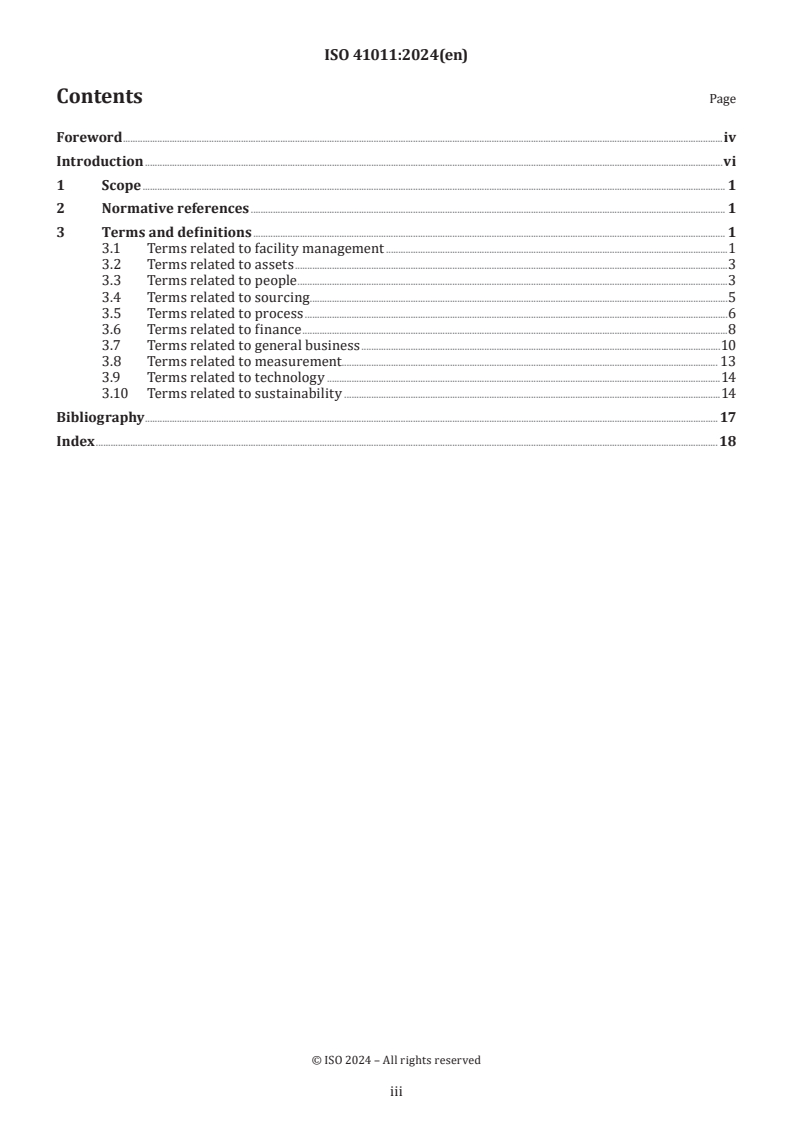
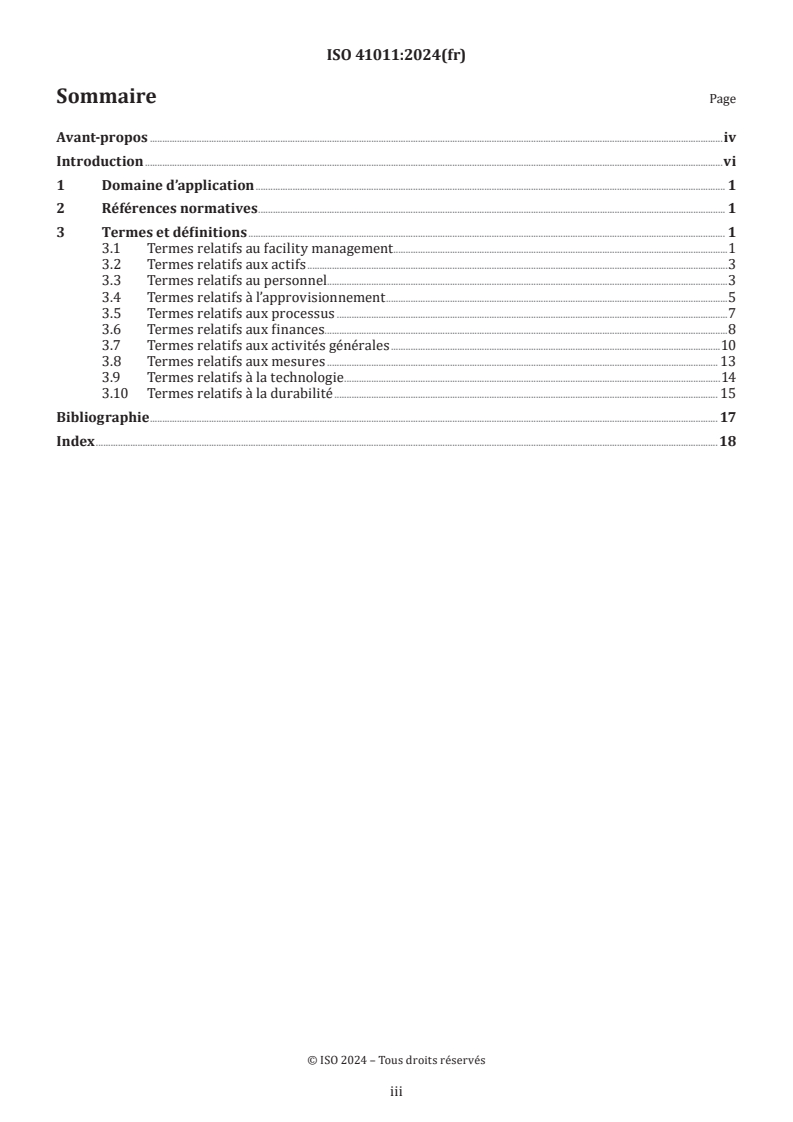
Contents Page
Foreword .iv
Introduction .vi
1 Scope . 1
2 Normative references . 1
3 Terms and definitions . 1
3.1 Terms related to facility management .1
3.2 Terms related to assets .3
3.3 Terms related to people .3
3.4 Terms related to sourcing . .5
3.5 Terms related to process .6
3.6 Terms related to finance .8
3.7 Terms related to general business .10
3.8 Terms related to measurement. 13
3.9 Terms related to technology .14
3.10 Terms related to sustainability .14
Bibliography . 17
Index .18
iii
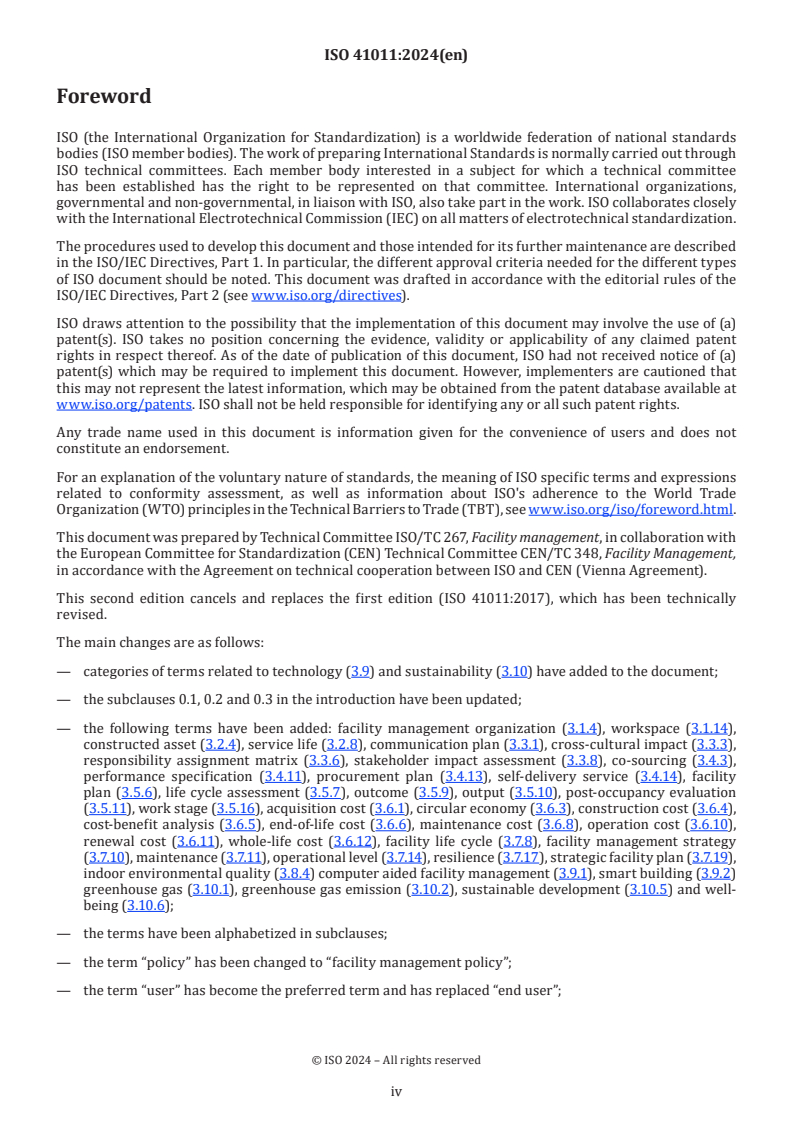
Foreword
ISO (the International Organization for Standardization) is a worldwide federation of national standards
bodies (ISO member bodies). The work of preparing International Standards is normally carried out through
ISO technical committees. Each member body interested in a subject for which a technical committee
has been established has the right to be represented on that committee. International organizations,
governmental and non-governmental, in liaison with ISO, also take part in the work. ISO collaborates closely
with the International Electrotechnical Commission (IEC) on all matters of electrotechnical standardization.
The procedures used to develop this document and those intended for its further maintenance are described
in the ISO/IEC Directives, Part 1. In particular, the different approval criteria needed for the different types
of ISO document should be noted. This document was drafted in accordance with the editorial rules of the
ISO/IEC Directives, Part 2 (see www.iso.org/directives).
ISO draws attention to the possibility that the implementation of this document may involve the use of (a)
patent(s). ISO takes no position concerning the evidence, validity or applicability of any claimed patent
rights in respect thereof. As of the date of publication of this document, ISO had not received notice of (a)
patent(s) which may be required to implement this document. However, implementers are cautioned that
this may not represent the latest information, which may be obtained from the patent database available at
www.iso.org/patents. ISO shall not be held responsible for identifying any or all such patent rights.
Any trade name used in this document is information given for the convenience of users and does not
constitute an endorsement.
For an explanation of the voluntary nature of standards, the meaning of ISO specific terms and expressions
related to conformity assessment, as well as information about ISO's adherence to the World Trade
Organization (WTO) principles in the Technical Barriers to Trade (TBT), see www.iso.org/iso/foreword.html.
This document was prepared by Technical Committee ISO/TC 267, Facility management, in collaboration with
the European Committee for Standardization (CEN) Technical Committee CEN/TC 348, Facility Management,
in accordance with the Agreement on technical cooperation between ISO and CEN (Vienna Agreement).
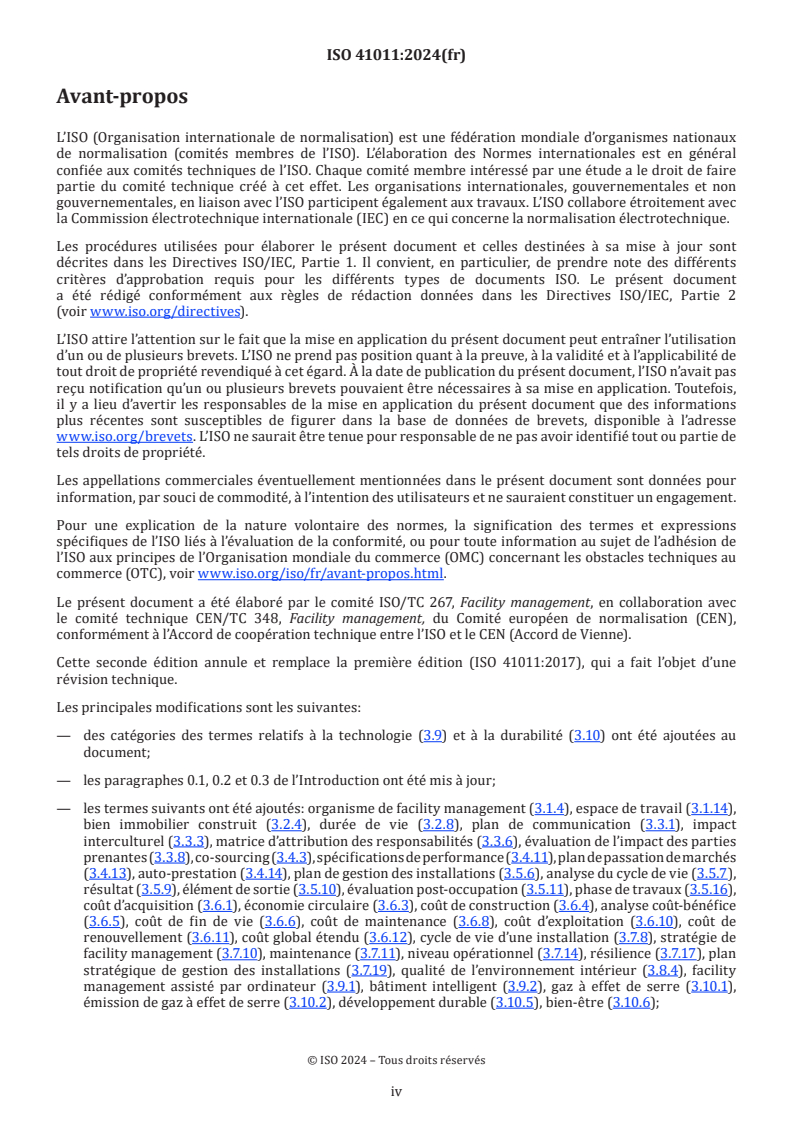
This second edition cancels and replaces the first edition (ISO 41011:2017), which has been technically
revised.
The main changes are as follows:
— categories of terms related to technology (3.9) and sustainability (3.10) have added to the document;
— the subclauses 0.1, 0.2 and 0.3 in the introduction have been updated;
— the following terms have been added: facility management organization (3.1.4), workspace (3.1.14),
constructed asset (3.2.4), service life (3.2.8), communication plan (3.3.1), cross-cultural impact (3.3.3),
responsibility assignment matrix (3.3.6), stakeholder impact assessment (3.3.8), co-sourcing (3.4.3),
performance specification (3.4.11), procurement plan (3.4.13), self-delivery service (3.4.14), facility
plan (3.5.6), life cycle assessment (3.5.7), outcome (3.5.9), output (3.5.10), post-occupancy evaluation
(3.5.11), work stage (3.5.16), acquisition cost (3.6.1), circular economy (3.6.3), construction cost (3.6.4),
cost-benefit analysis (3.6.5), end-of-life cost (3.6.6), maintenance cost (3.6.8), operation cost (3.6.10),
renewal cost (3.6.11), whole-life cost (3.6.12), facility life cycle (3.7.8), facility management strategy
(3.7.10), maintenance (3.7.11), operational level (3.7.14), resilience (3.7.17), strategic facility plan (3.7.19),
indoor environmental quality (3.8.4) computer aided facility management (3.9.1), smart building (3.9.2)
greenhouse gas (3.10.1), greenhouse gas emission (3.10.2), sustainable development (3.10.5) and well-
being (3.10.6);
— the terms have been alphabetized in subclauses;
— the term “policy” has been changed to “facility management policy”;
— the term “user” has become the preferred term and has replaced “end user”;
iv
— the terminological entry for “interested party” has been removed and this term has been added as an
admitted term to the terminological entry for “stakeholder”.
Any feedback or questions on this document should be directed to the user’s national standards body. A
complete listing of these bodies can be found at www.iso.org/members.html.
v
Introduction
0.1 Purpose
The International Standards developed by ISO/TC 267 describe the characteristics of facility management
and are intended for use in both the private and public sectors.
0.2 Relationship with other standards
Common practices have been identified that can be applied across the build environment where people
work, live and play. This includes a wide variety of market sectors, organizational types, process activities
and geographies. Their implementation will help to:
— improve quality, productivity and financial performance;
— enhance sustainability and reduce negative environmental impact;
— develop functional and motivating built environments;
— maintain regulatory compliance and provide safe workplaces;
— optimize facility life cycle performance and costs;
— improve resilience and adaptability;
— project an organization’s identity and image more successfully.
0.3 Target audience
This document is primarily intended for use by:
— those considering how to improve the value for their organization from their facility management base;
— those involved in the establishment, implementation, maintenance and improvement of a facility;
— those involved in the planning, design, implementation and review of facility management activities.
vi
International Standard ISO 41011:2024(en)
Facility management — Vocabulary
1 Scope
This document defines terms used in facility management.
2 Normative references
There are no normative references in this document.
3 Terms and definitions
ISO and IEC maintain terminology databases for use in standardization at the following addresses:
— ISO Online browsing platform: available at https:// www .iso .org/ obp
— IEC Electropedia: available at https:// www .electropedia .org/
3.1 Terms related to facility management
3.1.1
facility management
facilities management
FM
organizational function which integrates people, place and process (3.5.13) within the built environment
(3.2.3) with the purpose of improving the quality of life of people and the productivity of the core business
(3.1.2)
Note 1 to entry: The terms “facility management” and “facilities management” can be used interchangeably.
3.1.2
core business
entity (3.7.7) from which needs (3.1.8) are derived
3.1.3
demand
stated requirement (3.1.9) for a service (3.5.14) or a product (3.5.12) to be delivered
3.1.4
facility management organization
FM organization
organization (3.3.5) responsible for facility management (3.1.1)
3.1.5
facility process
process (3.5.13) which is integrated and managed by a facility management organization (3.1.4)
3.1.6
facility service
support provision to the primary activities (3.7.15) of an organization (3.3.5), delivered by an internal or
external provider
3.1.7
internal service provision
in-house service provision
delivery and management of a service (3.5.14) by staff employed by the demand organization (3.3.5)
3.1.8
need
specific or abstract expectation from the demand organization (3.3.4) which is essential to enable the
achievement of the core purpose and key objectives (3.7.13)
3.1.9
requirement
need (3.1.8) or expectation that is stated, generally implied or obligatory
Note 1 to entry: “Generally implied” means that it is custom or common practice for the organization (3.3.5) and
interested parties (3.3.7) that the need or expectation under consideration is implied.
Note 2 to entry: A specified requirement is one that is stated, for example in documented information (3.7.4).
3.1.10
service level
complete description of requirements (3.1.9) of a product (3.5.12), process (3.5.13) or system (3.5.15) with
their characteristics
3.1.11
service level agreement
SLA
document which has been agreed between the demand organization (3.3.4) and a service provider (3.1.12) on
performance (3.8.8), measurement (3.8.6) and conditions of service (3.5.14) delivery
3.1.12
service provider
organization (3.3.5) that delivers one or more facility services (3.1.6)
Note 1 to entry: A service provider can be internal or external to the demand organization (3.3.4).
3.1.13
support service
non-primary activity (3.5.1) delivered in support of the core business (3.1.2)
3.1.14
workplace
work environment
physical location where work is performed
3.1.15
workspace
zone for completing a work task
Note 1 to entry: A workspace can include more than one workplace (3.1.14).
[SOURCE: ISO 6707-4:2021, 3.3.3]
3.1.16
work station
location containing furniture and supporting equipment (including telephony, information technology and
power connections), specifically designed or suitable for work-related activities (3.5.1)
3.2 Terms related to assets
3.2.1
asset
item, thing or entity (3.7.7) that has potential or actual value to an organization (3.3.5)
[SOURCE: ISO 55000:2014, 3.2.1, modified — Notes 1, 2 and 3 to entry have been deleted.]
3.2.2
asset management
coordinated activity (3.5.1) of an organization (3.3.5) to realize value from assets (3.2.1)
[SOURCE: ISO 55000:2014, 3.3.1, modified — Notes 1, 2 and 3 to entry have been deleted.]
3.2.3
built environment
collection of buildings, external works (landscaped areas), infrastructure (3.2.6) and other construction
works within an area
3.2.4
constructed asset
built asset
anything of value that is constructed or results from construction operations
[SOURCE: ISO/TR 15686-11:2014, 3.1.15, modified — the term “built asset” has been added.]
3.2.5
facility
collection of assets (3.2.1) which is constructed, installed or established to serve an entity’s (3.7.7) needs
(3.1.8)
3.2.6
infrastructure
system (3.5.15) of facilities (3.2.5), equipment and services (3.5.14) needed for the operation of an organization
(3.3.5)
[SOURCE: ISO 9000:2015, 3.5.2, modified — the domain "" has been deleted.]
3.2.7
real estate
immoveable property including structures, grounds and undeveloped land
3.2.8
service life
period of time after installation during which a building or its parts meet(s) or exceed(s) the performance
(3.8.8) requirements (3.1.9)
[SOURCE: ISO/TR 15686-11:2014, 3.1.113.1]
3.3 Terms related to people
3.3.1
communication plan
documented description and communication needs (3.1.8) of stakeholders (3.3.7)
3.3.2
competence
ability to apply knowledge and skills to achieve intended results
[SOURCE: ISO 9000:2015, 3.10.4, modified — Notes 1 and 2 to entry have been deleted.]
3.3.3
cross-cultural impact
effect on an individual, group or community when different cultures are combined
3.3.4
demand organization
entity (3.7.7) which has a need (3.1.8) and the authority to incur costs to have requirements (3.1.9) met
Note 1 to entry: This is typically an authorized representative within a functional unit of an organization (3.3.5).
3.3.5
organization
person or group of people that has its own functions with responsibilities, authorities and relationships to
achieve its objectives (3.7.13)
Note 1 to entry: The concept of organization includes, but is not limited to, sole-trader, company, corporation, firm,
enterprise, authority, partnership, association, charity or institution, or part or combination thereof, whether
incorporated or not, public or private.
Note 2 to entry: If the organization is part of a larger entity (3.7.7), the term “organization” refers only to the part of
the larger entity that is within the scope of the facility management system (3.7.12).
[SOURCE: ISO 9000:2015, 3.2.1, modified — Note 2 to entry has been replaced.]
3.3.6
responsibility assignment matrix
documented structure that shows the allocation of delegated work responsibilities designated for the
delivery of scope or benefits
EXAMPLE RACI and RASCI where, typically: R = responsible, A = accountable, S = supported, C = consulted and
I = informed.
3.3.7
stakeholder
interested party
person or organization (3.3.5) that can affect, be affected by, or perceive itself to be affected by a decision or
an activity (3.5.1)
[SOURCE: ISO 9000:2015, 3.2.3, modified — Example and Note 1to entry have been deleted.]
3.3.8
stakeholder impact assessment
method for evaluating the influence or other attributes that stakeholders (3.3.7) possess in relation to an
organization (3.3.5), facility (3.2.5) or project
3.3.9
top management
executive management
person or group of people who directs and controls an organization (3.3.5) at the highest level
Note 1 to entry: Top management has the power to delegate authority and provide resources within the organization.
Note 2 to entry: If the scope of the management system (3.7.12) covers only part of an organization, then top
management refers to those who direct and control that part of the organization.
3.3.10
user
end user
person or organization (3.3.5) which uses products (3.5.12) or services (3.5.14) from a supplier
3.4 Terms related to sourcing
3.4.1
agreement
statement agreed between the demand organization (3.3.4) and the provider of services (3.5.14) or products
(3.5.12)
Note 1 to entry: An agreement should be in the form of a written statement agreed between the demand organization
and the provider of services or products setting out the requirements (3.1.9), conditions, costs, the level of resources
and outputs (3.5.10) required.
Note 2 to entry: For complex multi-country or multi-service agreements, the type of documentation and content
outlined in ISO 41012:2017, Annexes C and D, can be required. For small or single service agreements, a one-page
document setting out the important terms and conditions can suffice.
3.4.2
contract
binding agreement (3.4.1)
[SOURCE: ISO 9000:2015, 3.4.7]
3.4.3
co-sourcing
combination of in-house and outsourced (3.4.9) service delivery
3.4.4
demobilization
phase to transfer facility services (3.1.6) back to the demand organization (3.3.5) or to a new service provider
(3.1.12) as specified in the facility management (3.1.1) agreement (3.4.1)
3.4.5
due diligence
compilation, comprehensive appraisal and validation of information of a facility (3.2.5) or an asset (3.2.1)
required for assessing adequacy and completeness of relevant documentation and the status of physical,
functional, financial and environmental performance (3.8.8)
3.4.6
insourcing
arrangement of an external service within the organization
3.4.7
method statement
document in which the service provider (3.1.12) translates the demands (3.1.3) set out in the specification
(3.4.16) and service level agreement (3.1.11) into a delivery plan with resources, allocations and methodologies
3.4.8
mobilization
phase to establish and implement all resources, systems (3.5.15), data and procedures prior to taking full
responsibility for the facility services (3.1.6) to be delivered as specified in the facility management (3.1.1)
agreement (3.4.1)
Note 1 to entry: The term "start up" can also be used in this context.
3.4.9
outsourcing
arrangement where an external organization performs part of an organization’s (3.5.5) function or process
Note 1 to entry: An external organization is outside the scope of the management systems, although the outsources
function or process is within the scope.
3.4.10
out-tasking
order of a single service (3.5.14) from an external service provider (3.1.12)
3.4.11
performance specification
document which specifies functional requirements (3.1.9)
[20]
[SOURCE: HB 261:2001, modified]
3.4.12
procurement
activity (3.5.1) of acquiring goods or services (3.5.14) from suppliers
Note 1 to entry: The procurement process (3.5.13) considers the whole cycle from identification of needs (3.1.8)
through to the end of a services contract (3.4.2) or the end of the life of goods, including disposal.
Note 2 to entry: Sourcing (3.4.15) is a part of the procurement process that includes planning, defining specifications
(3.4.16) and selecting suppliers.
[SOURCE: ISO 20400:2017, 3.18]
3.4.13
procurement plan
document defining the process (3.5.13) for acquiring goods and services (3.5.14) from internal or external
suppliers or service providers (3.1.12)
3.4.14
self-delivery service
service delivery based solely upon the demand organization’s (3.3.4) own resources
3.4.15
sourcing
practice which identifies, evaluates and engages internal and external service providers (3.1.12) to deliver a
service (3.5.14) or products (3.5.12) to meet a specification (3.4.15)
3.4.16
specification
description of the performance (3.8.8) and/or technical requirements (3.1.9) for services (3.5.14) or products
(3.5.12) and processes (3.5.13)
Note 1 to entry: This is the documentary interface between the needs (3.1.8) of the demand organization (3.3.4) and
the activities (3.5.1) of the service provider (3.1.12).
3.4.17
subcontracting
process (3.5.13) of engaging a subcontractor (3.4.18)
3.4.18
subcontractor
organization (3.3.5) engaged by the service provider (3.1.12) to perform a specific portion of a facility service
(3.1.6)
3.4.19
supply chain
system (3.5.15) of organizations (3.3.5), people, activities (3.5.1), information and resources involved in
delivering a product (3.5.12) or service (3.5.14) to a user (3.3.10) from a supplier
3.5 Terms related to process
3.5.1
activity
task or tasks that contribute to the completion of deliverables (3.7.3)
3.5.2
baseline
minimum or starting point used for comparisons
3.5.3
conformity
fulfilment of a requirement (3.1.9)
[SOURCE: ISO 9000:2015, 3.6.11, modified — Notes 1 and 2 to entry have been deleted.]
3.5.4
continual improvement
recurring activity (3.5.1) to enhance performance (3.8.8)
[SOURCE: ISO 9000:2015, 3.3.2, modified — Notes 1 and 2 to entry have been deleted.]
3.5.5
corrective action
action to eliminate the cause of a nonconformity (3.5.8) and to prevent recurrence
[SOURCE: ISO 9000:2015, 3.12.2, modified — Notes 1, 2 and 3 to entry have been deleted.]
3.5.6
facility plan
process (3.5.13) of planning an organization’s present and future operational directions and translating
them into facility (3.2.5) requirements (3.1.9)
Note 1 to entry: Facility plan includes facility physical assets (3.2.1) (siteworks, substructure, superstructure,
envelope/shell, interiors, building services and systems, furniture, fixtures and equipment, etc.).
[20]
[SOURCE: HB 261:2001, modified]
3.5.7
life cycle assessment
compilation and evaluation of the inputs, outputs (3.5.10) and the potential environmental impacts of a
facility (3.2.5) or constructed asset (3.2.4) throughout its life cycle
[SOURCE: ISO 14040:2006, 3.2, modified — the abbreviated term “LCA” has been deleted and “product
system” has been replaced with “facility or constructed asset” in the definition.]
3.5.8
nonconformity
non-fulfilment of a requirement (3.1.9)
[SOURCE: ISO 9000:2015, 3.6.9, modified — Note 1 to entry has been deleted.]
3.5.9
outcome
final result or consequence of the output (3.5.10)
Note 1 to entry: The outputs and outcomes can affect each other through a circular process.
3.5.10
output
end product (3.5.12) or service (3.5.14) of a process (3.5.13)
Note 1 to entry: The outputs and outcomes (3.5.9) can affect each other through a circular process.
3.5.11
post-occupancy evaluation
process (3.5.13) of analysing how functional and comfortable a building is after users (3.3.10) have been
occupying it for some time
3.5.12
product
output (3.5.10) of an organization (3.3.5) that can be produced without any transaction taking place between
the organization and the customer
Note 1 to entry: Hardware is tangible, and its amount is a countable characteristic (e.g. tyres). Processed materials are
tangible, and their amount is a continuous characteristic (e.g. fuel and soft drinks). Hardware and processed materials
are often referred to as goods. Software cons
...
Norme
internationale
ISO 41011
Deuxième édition
Facility management — Vocabulaire
2024-02
Facility management — Vocabulary
Numéro de référence
DOCUMENT PROTÉGÉ PAR COPYRIGHT
© ISO 2024
Tous droits réservés. Sauf prescription différente ou nécessité dans le contexte de sa mise en œuvre, aucune partie de cette
publication ne peut être reproduite ni utilisée sous quelque forme que ce soit et par aucun procédé, électronique ou mécanique,
y compris la photocopie, ou la diffusion sur l’internet ou sur un intranet, sans autorisation écrite préalable. Une autorisation peut
être demandée à l’ISO à l’adresse ci-après ou au comité membre de l’ISO dans le pays du demandeur.
ISO copyright office
Case postale 401 • Ch. de Blandonnet 8
CH-1214 Vernier, Genève
Tél.: +41 22 749 01 11
E-mail: copyright@iso.org
Web: www.iso.org
Publié en Suisse
ii
Sommaire Page
Avant-propos .iv
Introduction .vi
1 Domaine d’application . 1
2 Références normatives . 1
3 Termes et définitions . 1
3.1 Termes relatifs au facility management .1
3.2 Termes relatifs aux actifs .3
3.3 Termes relatifs au personnel.3
3.4 Termes relatifs à l’approvisionnement .5
3.5 Termes relatifs aux processus .7
3.6 Termes relatifs aux finances.8
3.7 Termes relatifs aux activités générales .10
3.8 Termes relatifs aux mesures . 13
3.9 Termes relatifs à la technologie .14
3.10 Termes relatifs à la durabilité . 15
Bibliographie . 17
Index .18
iii
Avant-propos
L’ISO (Organisation internationale de normalisation) est une fédération mondiale d’organismes nationaux
de normalisation (comités membres de l’ISO). L’élaboration des Normes internationales est en général
confiée aux comités techniques de l’ISO. Chaque comité membre intéressé par une étude a le droit de faire
partie du comité technique créé à cet effet. Les organisations internationales, gouvernementales et non
gouvernementales, en liaison avec l’ISO participent également aux travaux. L’ISO collabore étroitement avec
la Commission électrotechnique internationale (IEC) en ce qui concerne la normalisation électrotechnique.
Les procédures utilisées pour élaborer le présent document et celles destinées à sa mise à jour sont
décrites dans les Directives ISO/IEC, Partie 1. Il convient, en particulier, de prendre note des différents
critères d’approbation requis pour les différents types de documents ISO. Le présent document
a été rédigé conformément aux règles de rédaction données dans les Directives ISO/IEC, Partie 2
(voir www.iso.org/directives).
L’ISO attire l’attention sur le fait que la mise en application du présent document peut entraîner l’utilisation
d’un ou de plusieurs brevets. L’ISO ne prend pas position quant à la preuve, à la validité et à l’applicabilité de
tout droit de propriété revendiqué à cet égard. À la date de publication du présent document, l’ISO n’avait pas
reçu notification qu’un ou plusieurs brevets pouvaient être nécessaires à sa mise en application. Toutefois,
il y a lieu d’avertir les responsables de la mise en application du présent document que des informations
plus récentes sont susceptibles de figurer dans la base de données de brevets, disponible à l’adresse
www.iso.org/brevets. L’ISO ne saurait être tenue pour responsable de ne pas avoir identifié tout ou partie de
tels droits de propriété.
Les appellations commerciales éventuellement mentionnées dans le présent document sont données pour
information, par souci de commodité, à l’intention des utilisateurs et ne sauraient constituer un engagement.
Pour une explication de la nature volontaire des normes, la signification des termes et expressions
spécifiques de l’ISO liés à l’évaluation de la conformité, ou pour toute information au sujet de l’adhésion de
l’ISO aux principes de l’Organisation mondiale du commerce (OMC) concernant les obstacles techniques au
commerce (OTC), voir www.iso.org/iso/fr/avant-propos.html.
Le présent document a été élaboré par le comité ISO/TC 267, Facility management, en collaboration avec
le comité technique CEN/TC 348, Facility management, du Comité européen de normalisation (CEN),
conformément à l’Accord de coopération technique entre l’ISO et le CEN (Accord de Vienne).
Cette seconde édition annule et remplace la première édition (ISO 41011:2017), qui a fait l’objet d’une
révision technique.
Les principales modifications sont les suivantes:
— des catégories des termes relatifs à la technologie (3.9) et à la durabilité (3.10) ont été ajoutées au
document;
— les paragraphes 0.1, 0.2 et 0.3 de l’Introduction ont été mis à jour;
— les termes suivants ont été ajoutés: organisme de facility management (3.1.4), espace de travail (3.1.14),
bien immobilier construit (3.2.4), durée de vie (3.2.8), plan de communication (3.3.1), impact
interculturel (3.3.3), matrice d’attribution des responsabilités (3.3.6), évaluation de l’impact des parties
prenantes (3.3.8), co-sourcing (3.4.3), spécifications de performance (3.4.11), plan de passation de marchés
(3.4.13), auto-prestation (3.4.14), plan de gestion des installations (3.5.6), analyse du cycle de vie (3.5.7),
résultat (3.5.9), élément de sortie (3.5.10), évaluation post-occupation (3.5.11), phase de travaux (3.5.16),
coût d’acquisition (3.6.1), économie circulaire (3.6.3), coût de construction (3.6.4), analyse coût-bénéfice
(3.6.5), coût de fin de vie (3.6.6), coût de maintenance (3.6.8), coût d’exploitation (3.6.10), coût de
renouvellement (3.6.11), coût global étendu (3.6.12), cycle de vie d’une installation (3.7.8), stratégie de
facility management (3.7.10), maintenance (3.7.11), niveau opérationnel (3.7.14), résilience (3.7.17), plan
stratégique de gestion des installations (3.7.19), qualité de l’environnement intérieur (3.8.4), facility
management assisté par ordinateur (3.9.1), bâtiment intelligent (3.9.2), gaz à effet de serre (3.10.1),
émission de gaz à effet de serre (3.10.2), développement durable (3.10.5), bien-être (3.10.6);
iv
— les termes ont été classés par ordre alphabétique dans les paragraphes;
— le terme «politique» a été remplacé par «politique de facility management»;
— le terme «utilisateur» est devenu le terme privilégié qui a remplacé «utilisateur final»;
— l’article terminologique «partie intéressée» a été supprimé et ce terme a été ajouté comme terme toléré
à l’article terminologique «partie prenante».
Il convient que l’utilisateur adresse tout retour d’information ou toute question concernant le présent
document à l’organisme national de normalisation de son pays. Une liste exhaustive desdits organismes se
trouve à l’adresse www.iso.org/fr/members.html.
v
Introduction
0.1 Objectif
Les Normes internationales élaborées par l’ISO/TC 267 décrivent les caractéristiques du facility management
et sont destinées à être utilisées aussi bien dans le secteur privé que dans le secteur public.
0.2 Relation avec les autres normes
Des pratiques communes ont été identifiées et peuvent être appliquées à l’ensemble de l’environnement bâti
où les personnes travaillent, vivent et se divertissent. Cela inclut une grande variété de secteurs marchands,
de types d’organismes, d’activités de processus et de lieux géographiques. Leur mise en œuvre contribuera
à:
— améliorer la qualité, la productivité et les performances financières;
— améliorer la durabilité et réduire l’impact environnemental négatif;
— développer des environnements bâtis fonctionnels et motivants;
— entretenir la conformité réglementaire et offrir des lieux de travail sécurisés;
— optimiser la performance et les coûts du cycle de vie d’une installation;
— améliorer la résilience et l’adaptabilité;
— projeter l’identité et l’image de l’organisme plus efficacement.
0.3 Public visé
Le présent document est principalement destiné à être utilisé par:
— les personnes qui réfléchissent à la manière d’améliorer la valeur de leur organisme à partir de leur base
de facility management;
— les personnes impliquées dans l’établissement, la mise en œuvre, la maintenance et l’amélioration d’une
installation;
— les personnes impliquées dans la planification, la conception, la mise en œuvre et la revue des activités
de facility management.
vi
Norme internationale ISO 41011:2024(fr)
Facility management — Vocabulaire
1 Domaine d’application
Le présent document définit les termes utilisés en facility management.
2 Références normatives
Le présent document ne contient aucune référence normative.
3 Termes et définitions
L’ISO et l’IEC tiennent à jour des bases de données terminologiques destinées à être utilisées en normalisation,
consultables aux adresses suivantes:
— ISO Online browsing platform: disponible à l’adresse https:// www .iso .org/ obp;
— IEC Electropedia: disponible à l’adresse https:// www .electropedia .org/ .
3.1 Termes relatifs au facility management
3.1.1
facility management
facilities management
FM
fonction de l’organisme qui intègre des personnels, des lieux et des processus (3.5.13) au sein de
l’environnement bâti (3.2.3), ayant pour but d’améliorer la qualité de vie du personnel et la productivité du
cœur de métier (3.1.2)
Note 1 à l'article: Les termes, «facility management» et «facilities management», peuvent être utilisés l’un pour l’autre.
3.1.2
cœur de métier
entité (3.7.7) de laquelle les besoins (3.1.8) sont dérivés
3.1.3
demande
exigence (3.1.9) formulée pour un service (3.5.14) ou un produit (3.5.12) à fournir
3.1.4
organisme de facility management
organisme de FM
organisme (3.3.5) responsable du facility management (3.1.1)
3.1.5
processus de gestion des installations
processus (3.5.13) intégré et géré par un organisme de facility management (3.1.4)
3.1.6
service de gestion des installations
fourniture de support aux activités principales (3.7.15) d’un organisme (3.3.5), par un fournisseur interne ou
externe
3.1.7
fourniture de service interne
fourniture et management d’un service (3.5.14) par le personnel employé par l’organisme demandeur (3.3.5)
3.1.8
besoin
attente spécifique ou abstraite de l’organisme demandeur (3.3.4), essentielle à l’obtention de l’objet et des
objectifs (3.7.13) clés
3.1.9
exigence
besoin (3.1.8) ou attente formulé, généralement implicite ou obligatoire
Note 1 à l'article: «Généralement implicite» signifie qu’il est habituel ou courant, pour l’organisme (3.3.5) et les parties
intéressées (3.3.7), que le besoin ou l’attente en question soit implicite.
Note 2 à l'article: Une exigence spécifiée est une exigence formulée, par exemple une information documentée (3.7.4).
3.1.10
niveau de service
description complète des exigences (3.1.9) d’un produit (3.5.12), d’un processus (3.5.13) ou d’un système
(3.5.15) ainsi que de leurs caractéristiques
3.1.11
accord de niveau de service
ANS
document ayant fait l’objet d’un accord entre l’organisme demandeur (3.3.4) et un prestataire de services
(3.1.12) relativement aux performances (3.8.8), aux mesures (3.8.6) et aux conditions de fourniture du service
(3.5.14)
3.1.12
prestataire de services
organisme (3.3.5) qui fournit un ou plusieurs services de gestion des installations (3.1.6)
Note 1 à l'article: Un prestataire de services peut être interne ou externe à l’organisme demandeur (3.3.4).
3.1.13
service de support
activité (3.5.1) non principale fournie en support au cœur de métier (3.1.2)
3.1.14
lieu de travail
environnement de travail
emplacement physique dans lequel le travail est effectué
3.1.15
espace de travail
zone d’accomplissement d’une tâche
Note 1 à l'article: Un espace de travail peut comprendre plus d’un lieu de travail (3.1.14).
[SOURCE: ISO 6707-4:2021, 3.3.3]
3.1.16
poste de travail
lieu comprenant des meubles et des équipements de support (téléphonie, matériel informatique et raccords
d’alimentation), spécifiquement conçu pour ou adapté aux activités (3.5.1) associées au travail
3.2 Termes relatifs aux actifs
3.2.1
actif
item, chose ou entité (3.7.7) qui a une valeur potentielle ou réelle pour un organisme (3.3.5)
[SOURCE: ISO 55000:2014, 3.2.1, modifié — Les Notes 1, 2 et 3 à l’article ont été supprimées.]
3.2.2
gestion d’actifs
activités (3.5.1) coordonnées d’un organisme (3.3.5) dans le but de réaliser de la valeur à partir d’actifs (3.2.1)
[SOURCE: ISO 55000:2014, 3.3.1, modifié — Les Notes 1, 2 et 3 à l’article ont été supprimées.]
3.2.3
environnement bâti
ensemble de bâtiments, ouvrages externes (zones paysagées), infrastructures (3.2.6) et autres ouvrages de
construction dans une zone
3.2.4
bien immobilier construit
bien immobilier bâti
tout bien construit ou résultant d’opérations de construction
[SOURCE: ISO/TR 15686-11:2014, 3.1.15, modifié —le terme «bien immobilier bâti» a été ajouté.]
3.2.5
installations
ensemble d’actifs (3.2.1) construit, installé ou établi en vue de servir les besoins (3.1.8) d’une entité (3.7.7)
3.2.6
infrastructure
système (3.5.15) des installations (3.2.5), équipements et services (3.5.14) nécessaires au fonctionnement
d’un organisme (3.3.5)
[SOURCE: ISO 9000:2015, 3.5.2, modifié — le domaine «» a été supprimé.]
3.2.7
immobilier
propriété inamovible comprenant des structures, des terres et des terrains non construits
3.2.8
durée de vie
période débutant à la mise en exploitation et durant laquelle un bâtiment ou ses parties satisfont aux
exigences (3.1.9) de performance (3.8.8) ou font mieux
[SOURCE: ISO/TR 15686-11:2014, 3.1.113.1]
3.3 Termes relatifs au personnel
3.3.1
plan de communication
description documentée et besoins (3.1.8) en communication des parties prenantes (3.3.7)
3.3.2
compétence
aptitude à mettre en pratique des connaissances et des savoir-faire pour obtenir les résultats escomptés
[SOURCE: ISO 9000:2015, 3.10.4, modifié — Les Notes 1 et 2 à l’article ont été supprimées.]
3.3.3
impact interculturel
effet sur un individu, un groupe ou une communauté lorsque différentes cultures sont combinées
3.3.4
organisme demandeur
entité (3.7.7) ayant un besoin (3.1.8) et l’autorité nécessaire pour engager les dépenses permettant de
répondre aux exigences (3.1.9)
Note 1 à l'article: Il s’agit généralement d’un représentant autorisé au sein d’une unité fonctionnelle d’un organisme
(3.3.5).
3.3.5
organisme
personne ou groupe de personnes ayant un rôle avec les responsabilités, l’autorité et les relations lui
permettant d’atteindre ses objectifs (3.7.13)
Note 1 à l'article: Le concept d’organisme englobe sans s’y limiter, les travailleurs indépendants, les compagnies, les
sociétés, les firmes, les entreprises, les administrations, les partenariats, les associations, les organisations caritatives
ou les institutions, ou bien une partie ou une combinaison des entités précédentes, à responsabilité limitée ou ayant
un autre statut, de droit public ou privé.
Note 2 à l'article: Si l’organisme fait partie d’une entité (3.7.7) plus grande, le terme «organisme» se réfère uniquement
à la partie de cette entité plus grande qui se trouve dans le périmètre du système de facility management (3.7.12).
[SOURCE: ISO 9000:2015, 3.2.1, modifié — La Note 2 à l’article a été remplacée.]
3.3.6
matrice d’attribution des responsabilités
structure documentée montrant l’attribution des responsabilités déléguées pour les travaux en vue de la
réalisation du périmètre ou des avantages
EXEMPLE RACI et RASCI où, typiquement: R = responsable, A = comptable, S = soutenu, C = consulté et I = informé.
3.3.7
partie prenante
partie intéressée
personne ou organisme (3.3.5) qui peut soit influer sur une décision ou une activité, soit être influencé(e) ou
s’estimer influencé(e) par une décision ou une activité (3.5.1)
[SOURCE: ISO 9000:2015, 3.2.3, modifié — L’Exemple et la Note 1 à l’article ont été supprimés.]
3.3.8
évaluation de l’impact des parties prenantes
méthode d’évaluation de l’influence ou d’autres attributs que les parties prenantes (3.3.7) possèdent par
rapport à un organisme (3.3.5), une installation (3.2.5) ou un projet
3.3.9
direction
direction exécutive
personne ou groupe de personnes qui oriente et dirige un organisme (3.3.5) au plus haut niveau
Note 1 à l'article: La direction a le pouvoir de déléguer son autorité et de fournir des ressources au sein de l’organisme.
Note 2 à l'article: Si le périmètre du système de management (3.7.12) ne couvre qu’une partie de l’organisme, alors la
direction s’adresse à ceux qui orientent et dirigent cette partie de l’organisme.
3.3.10
utilisateur
utilisateur final
personne ou organisme (3.3.5) qui utilise les produits (3.5.12) ou les services (3.5.14) d’un fournisseur
3.4 Termes relatifs à l’approvisionnement
3.4.1
accord
déclaration convenue entre l’organisme demandeur (3.3.4) et le fournisseur de services (3.5.14) ou de produits
(3.5.12)
Note 1 à l'article: Il convient qu’un accord se présente sous la forme d’une déclaration écrite convenue entre l’organisme
demandeur et le fournisseur de services ou de produits, définissant les exigences (3.1.9), conditions, coûts, niveau de
ressources et éléments de sortie (3.5.10) requis.
Note 2 à l'article: Pour les accords complexes impliquant plusieurs pays ou plusieurs services, le type de documentation
et de contenu indiqué dans l’ISO 41012:2017, Annexes C et D, peut être nécessaire. Pour les accords de services simples
ou de faible ampleur, un document d’une page définissant les conditions générales importantes peut suffire.
3.4.2
contrat
accord (3.4.1) engageant au moins deux parties
[SOURCE: ISO 9000:2015, 3.4.7]
3.4.3
co-sourcing
combinaison de la fourniture de services internes et externalisés (3.4.9)
3.4.4
démobilisation
phase de transfert des services de gestion des installations (3.1.6) en retour à l’organisme demandeur (3.3.5)
ou à un nouveau prestataire de services (3.1.12) comme spécifié par l’accord (3.4.1) de facility management
(3.1.1)
3.4.5
diligence raisonnable
compilation, examen exhaustif et validation des informations d’une installation (3.2.5) ou d’un actif (3.2.1)
nécessaires pour évaluer l’adéquation et l’exhaustivité de la documentation pertinente et l’état de la
performance (3.8.8) physique, fonctionnelle, financière et environnementale
3.4.6
internalisation
mise en place d’un service externe au sein de l’organisme
3.4.7
déclaration de méthode
document dans lequel le prestataire de services (3.1.12) traduit les demandes (3.1.3) définies dans la
spécification (3.4.16) et l’accord de niveau de service (3.1.11) en un plan de livraison comprenant les
ressources, les attributions et les méthodologies
3.4.8
mobilisation
phase d’établissement et de mise en œuvre de toutes ressources, systèmes (3.5.15), données et procédures
préalable à la prise de pleine responsabilité de la fourniture des services de gestion des installations (3.1.6) à
livrer comme spécifié par l’accord (3.4.1) de facility management (3.1.1)
Note 1 à l'article: Le terme «démarrage» peut également être utilisé dans ce contexte.
3.4.9
externalisation
arrangement dans le cadre duquel un organisme externe exécute une partie de la fonction ou du processus
d’un organisme (3.5.5)
Note 1 à l'article: L’organisme externe n’est pas inclus dans le périmètre des systèmes de management, contrairement
à la fonction ou au processus externalisé qui en font partie intégrante.
3.4.10
externalisation d’une tâche
commande d’un service (3.5.14) unique auprès d’un prestataire de services (3.1.12) externe
3.4.11
spécifications de performance
document qui spécifie les exigences (3.1.9) fonctionnelles
[20]
[SOURCE: HB 261:2001 , modifié]
3.4.12
achat
activité (3.5.1) d’acquisition de biens ou services (3.5.14) auprès de fournisseurs
Note 1 à l'article: Le processus (3.5.13) achats prend en compte la totalité du cycle allant de l’identification des besoins
(3.1.8) jusqu’à la fin d’un contrat (3.4.2) de services ou la fin de vie d’un bien, incluant son élimination.
Note 2 à l'article: L’approvisionnement (3.4.15) est la partie du processus achats qui inclut la planification, la définition
des spécifications (3.4.16) et le choix des fournisseurs.
[SOURCE: ISO 20400:2017, 3.18]
3.4.13
plan de passation de marchés
document définissant le processus (3.5.13) d’acquisition de biens et de services (3.5.14) auprès de fournisseurs
internes ou externes ou de prestataires de services (3.1.12)
3.4.14
service en auto-prestation
fourniture de services reposant uniquement sur les ressources propres de l’organisme demandeur (3.3.4)
3.4.15
approvisionnement
pratique qui identifie, évalue et engage des prestataires de services (3.1.12) internes et externes afin qu’ils
fournissent un service (3.5.14) ou des produits (3.5.12) permettant de satisfaire à une spécification (3.4.15)
3.4.16
spécification
description de la performance (3.8.8) et/ou des exigences (3.1.9) techniques de services (3.5.14) ou de produits
(3.5.12) et de processus (3.5.13)
Note 1 à l'article: Il s’agit de l’interface documentaire entre les besoins (3.1.8) de l’organisme demandeur (3.3.4) et les
activités (3.5.1) du prestataire de services (3.1.12).
3.4.17
sous-traitance
processus (3.5.13) d’engagement d’un sous-traitant (3.4.18)
3.4.18
sous-traitant
organisme (3.3.5) engagé par le prestataire de service (3.1.12) en vue de réaliser une partie spécifique d’un
service de gestion des installations (3.1.6)
3.4.19
chaîne d’approvisionnement
système (3.5.15) d’organismes (3.3.5), de personnel, d’activités (3.5.1), d’informations et de ressources
impliqués dans la fourniture d’un produit (3.5.12) ou d’un service (3.5.14) à un utilisateur (3.3.10) par un
fournisseur
3.5 Termes relatifs aux processus
3.5.1
activité
tâche ou tâches contribuant à la production de délivrables (3.7.3)
3.5.2
base de référence
minimum ou point de départ utilisé pour les comparaisons
3.5.3
conformité
satisfaction d’une exigence (3.1.9)
[SOURCE: ISO 9000:2015, 3.6.11, modifié — Les Notes 1 et 2 à l’article ont été supprimées.]
3.5.4
amélioration continue
activité (3.5.1) récurrente menée pour améliorer les performances (3.8.8)
[SOURCE: ISO 9000:2015, 3.3.2, modifié — Les Notes 1 et 2 à l’article ont été supprimées.]
3.5.5
action corrective
action visant à éliminer la cause d’une non-conformité (3.5.8) et à éviter qu’elle ne réapparaisse
[SOURCE: ISO 9000:2015, 3.12.2, modifié — Les Notes 1, 2 et 3 à l’article ont été supprimées.]
3.5.6
plan de gestion des installations
processus (3.5.13) consistant à planifier les orientations opérationnelles actuelles et futures d’un organisme
et à les traduire en exigences (3.1.9) en matière d’installations (3.2.5)
Note 1 à l'article: Le plan de gestion des installations comprend les actifs (3.2.1) matériels des installations
(chantiers, sous-structure, superstructure, enveloppe/coque, intérieurs, services et systèmes du bâtiment, mobilier,
aménagements et équipements, etc.).
[20]
[SOURCE: HB 261:2001 , modifié]
3.5.7
analyse du cycle de vie
compilation et évaluation des intrants, des éléments de sortie (3.5.10) et des impacts environnementaux
potentiels d’une installation (3.2.5) ou d’un bien immobilier construit (3.2.4) au cours de son cycle de vie
[SOURCE: ISO 14040:2006, 3.2, modifié — l’abréviation «ACV» a été supprimée et «système de produits» a
été remplacé par «bien immobilier construit» dans la définition.]
3.5.8
non-conformité
non-satisfaction d’une exigence (3.1.9)
[SOURCE: ISO 9000:2015, 3.6.9, modifié — La Note 1 à l’article a été supprimée.]
3.5.9
résultat
résultat final ou conséquence de l’élément de sortie (3.5.10)
Note 1 à l'article: Les éléments de sortie et les résultats peuvent s’influencer mutuellement par un processus circulaire.
3.5.10
élément de sortie
produit (3.5.12) ou service (3.5.14) final d’un processus (3.5.13)
Note 1 à l'article: Les éléments de sortie et les résultats (3.5.9) peuvent s’influencer mutuellement par un processus
circulaire.
3.5.11
évaluation post-occupation
processus (3.5.13) d’analyse du degré de fonctionnalité et de confort d’un bâtiment après que les utilisateurs
(3.3.10) l’ont occupé pendant un certain temps
3.5.12
produit
élément de sortie (3.5.10) d’un organisme (3.3.5) qui peut être produit sans transaction entre l’organisme et
le client
Note 1 à l'article: Un produit matériel est tangible et sa quantité est une caractéristique dénombrable (par exemple
pneus). Les produits issus de processus à caractère continu sont tangibles et leur volume constitue une caractéristique
continue (par exemple carburant et sodas). Les produits matériels et issus de processus à caractère continu sont
souvent appelés biens. Un logiciel est constitué d’informations quel que soit le support de livraison (par exemple
programme informatique, application de téléphonie mobile, manuel d’instructions, contenu d’un dictionnaire, droits
d’auteur de compositions musicales, permis de conduire).
[SOURCE: ISO 9000:2015, 3.7.6, modifié — Les Notes 1 et 2 à l’article ont été supprimées.]
3.5.13
processus
ensemble d’activités (3.5.1) corrélées ou en interaction qui transforme de
...