

EN ISO 41011:2024
(Main)Facility management - Vocabulary (ISO 41011:2024)
- Abstract
This document defines terms used in facility management.
- Status
- Published
- Publication Date
- 27-Feb-2024
- Technical Committee
- CEN/TC 348 - Facility management
- Drafting Committee
- CEN/TC 348 - Facility management
- Current Stage
- 6060 - Definitive text made available (DAV) - Publishing
- Start Date
- 28-Feb-2024
- Completion Date
- 28-Feb-2024


Overview
EN ISO 41011:2024 - Facility management - Vocabulary is the authoritative European adoption of ISO 41011:2024. This second edition standard defines and harmonizes the terminology used across facility management (FM). It supersedes the earlier edition and groups FM vocabulary into practical categories so organizations, consultants and service providers share a consistent language for facilities management, built environment and asset-related activities.
Key topics
The standard collects and defines terms across multiple FM domains, including:
- Facility management fundamentals - definitions for facility management, facility management organization, facility service, workplace, workspace and workstation.
- Assets and built environment - asset, asset management, constructed asset, service life and built environment concepts.
- People and stakeholders - user, stakeholder, communication plan, responsibility assignment matrix and stakeholder impact assessment.
- Sourcing and procurement - service provider, service level, service level agreement (SLA), co-sourcing, procurement plan, performance specification and self-delivery service.
- Processes and measurement - facility process, facility plan, outputs and outcomes, post-occupancy evaluation, performance measurement and work stages.
- Finance and whole-life costing - acquisition cost, construction cost, maintenance cost, whole-life cost, cost–benefit analysis and end-of-life cost.
- Technology and smart buildings - computer aided facility management (CAFM), smart building and related digital FM terminology.
- Sustainability and resilience - greenhouse gas, greenhouse gas emission, life cycle assessment, circular economy, sustainable development and well‑being.
The 2024 edition also alphabetizes entries, updates several introductory sections, and adds new terms to reflect contemporary FM priorities (sustainability, digitalization, resilience and well‑being).
Practical applications
EN ISO 41011:2024 is used to:
- Standardize FM vocabulary across contracts, SLAs, procurement documents and design briefs to reduce ambiguity.
- Support clear communication between core business units, FM organizations and external service providers.
- Enable consistent measurement, reporting and benchmarking by aligning terms for performance, costs and sustainability.
- Guide implementation of FM processes such as post-occupancy evaluation, life‑cycle assessment and CAFM system usage.
- Inform policy, training, documentation and cross-border projects where consistent FM terminology is critical.
Who should use it
- Facility managers and FM organizations
- Asset and property managers
- Procurement teams and contract managers
- Architects, designers and building consultants
- CAFM and smart building solution providers
- Standards bodies and educators
Related standards
EN ISO 41011:2024 is part of the ISO/TC 267 facility management portfolio and is intended to be used alongside other FM guidance and management-system standards to ensure consistent terminology and improved interoperability across FM practice.
Keywords: facility management vocabulary, FM terms, service level agreement, asset management, built environment, CAFM, smart building, whole-life cost, sustainability, resilience.
Relations
- Effective Date
- 16-Mar-2022
- Effective Date
- 28-Jan-2026
- Effective Date
- 28-Jan-2026
- Effective Date
- 28-Jan-2026
- Effective Date
- 28-Jan-2026
- Effective Date
- 28-Jan-2026
- Consolidated By
ISO 41011:2024 - Facility management — Vocabulary - Effective Date
- 12-Feb-2026
Get Certified
Connect with accredited certification bodies for this standard

Great Wall Tianjin Quality Assurance Center
Established 1993, first batch to receive national accreditation with IAF recognition.
Hong Kong Quality Assurance Agency (HKQAA)
Hong Kong's leading certification body.

Innovative Quality Certifications Pvt. Ltd. (IQCPL)
Known for integrity, providing ethical & impartial Assessment & Certification. CMMI Institute Partner.
Sponsored listings
Frequently Asked Questions
EN ISO 41011:2024 is a standard published by the European Committee for Standardization (CEN). Its full title is "Facility management - Vocabulary (ISO 41011:2024)". This standard covers: This document defines terms used in facility management.
This document defines terms used in facility management.
EN ISO 41011:2024 is classified under the following ICS (International Classification for Standards) categories: 01.040.03 - Services. Company organization, management and quality. Administration. Transport. Sociology. (Vocabularies); 03.080.10 - Maintenance services. Facilities management. The ICS classification helps identify the subject area and facilitates finding related standards.
EN ISO 41011:2024 has the following relationships with other standards: It is inter standard links to EN ISO 41011:2018, EN ISO 19299:2020, CEN/TR 15221-9:2025, EN ISO 13143-1:2020, CEN/TS 15379:2006, EN 15221-8:2025, ISO 41011:2024. Understanding these relationships helps ensure you are using the most current and applicable version of the standard.
EN ISO 41011:2024 is available in PDF format for immediate download after purchase. The document can be added to your cart and obtained through the secure checkout process. Digital delivery ensures instant access to the complete standard document.
Standards Content (Sample)
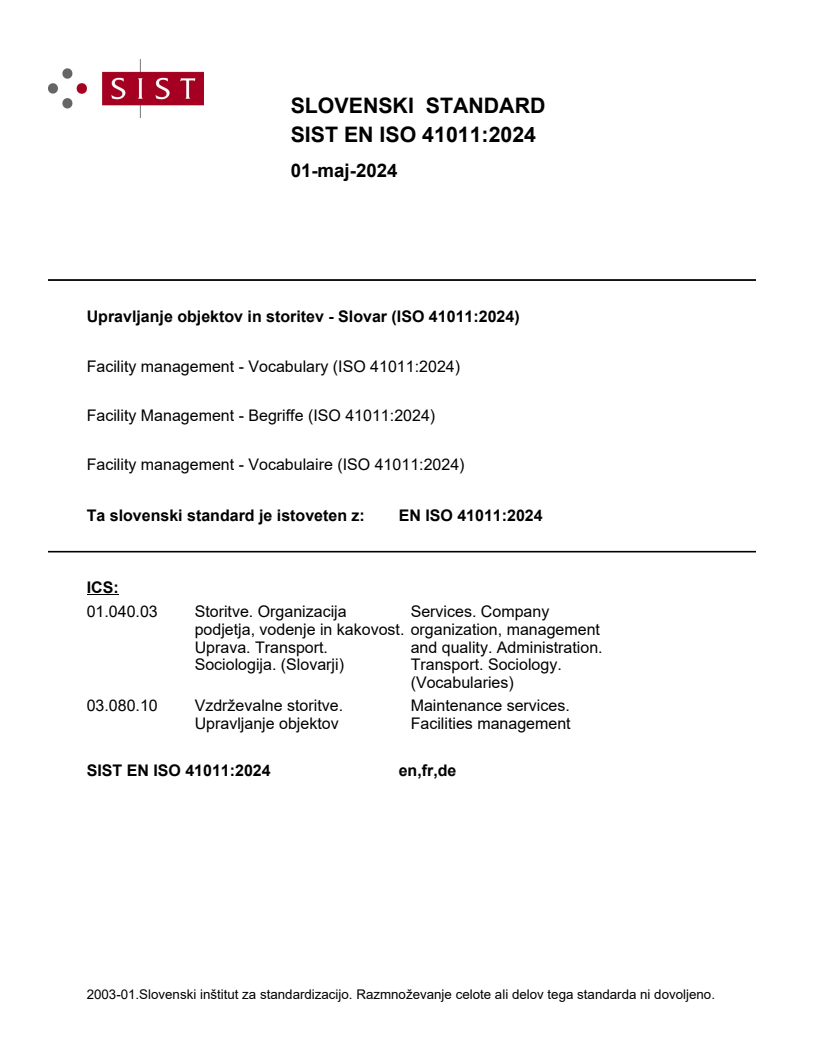
SLOVENSKI STANDARD
01-maj-2024
Upravljanje objektov in storitev - Slovar (ISO 41011:2024)
Facility management - Vocabulary (ISO 41011:2024)
Facility Management - Begriffe (ISO 41011:2024)
Facility management - Vocabulaire (ISO 41011:2024)
Ta slovenski standard je istoveten z: EN ISO 41011:2024
ICS:
01.040.03 Storitve. Organizacija Services. Company
podjetja, vodenje in kakovost. organization, management
Uprava. Transport. and quality. Administration.
Sociologija. (Slovarji) Transport. Sociology.
(Vocabularies)
03.080.10 Vzdrževalne storitve. Maintenance services.
Upravljanje objektov Facilities management
2003-01.Slovenski inštitut za standardizacijo. Razmnoževanje celote ali delov tega standarda ni dovoljeno.
EN ISO 41011
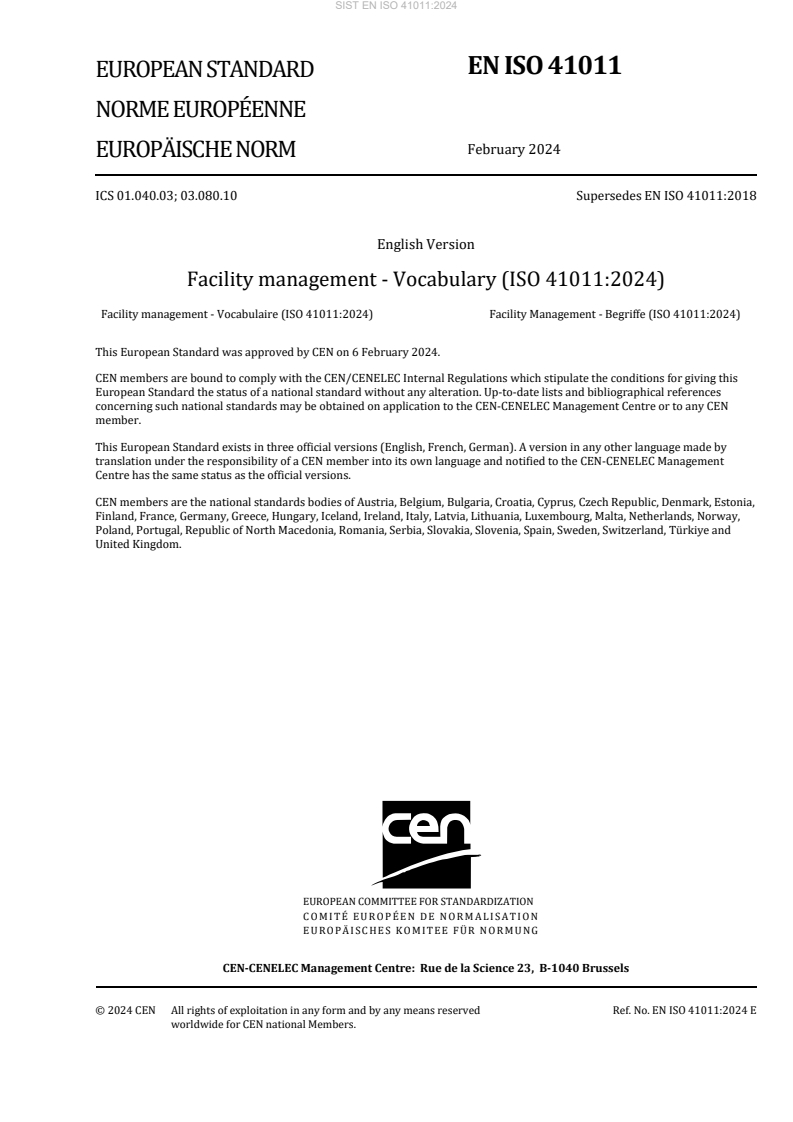
EUROPEAN STANDARD
NORME EUROPÉENNE
February 2024
EUROPÄISCHE NORM
ICS 01.040.03; 03.080.10 Supersedes EN ISO 41011:2018
English Version
Facility management - Vocabulary (ISO 41011:2024)
Facility management - Vocabulaire (ISO 41011:2024) Facility Management - Begriffe (ISO 41011:2024)
This European Standard was approved by CEN on 6 February 2024.
CEN members are bound to comply with the CEN/CENELEC Internal Regulations which stipulate the conditions for giving this
European Standard the status of a national standard without any alteration. Up-to-date lists and bibliographical references
concerning such national standards may be obtained on application to the CEN-CENELEC Management Centre or to any CEN
member.
This European Standard exists in three official versions (English, French, German). A version in any other language made by
translation under the responsibility of a CEN member into its own language and notified to the CEN-CENELEC Management
Centre has the same status as the official versions.
CEN members are the national standards bodies of Austria, Belgium, Bulgaria, Croatia, Cyprus, Czech Republic, Denmark, Estonia,
Finland, France, Germany, Greece, Hungary, Iceland, Ireland, Italy, Latvia, Lithuania, Luxembourg, Malta, Netherlands, Norway,
Poland, Portugal, Republic of North Macedonia, Romania, Serbia, Slovakia, Slovenia, Spain, Sweden, Switzerland, Türkiye and
United Kingdom.
EUROPEAN COMMITTEE FOR STANDARDIZATION
COMITÉ EUROPÉEN DE NORMALISATION
EUROPÄISCHES KOMITEE FÜR NORMUNG
CEN-CENELEC Management Centre: Rue de la Science 23, B-1040 Brussels
© 2024 CEN All rights of exploitation in any form and by any means reserved Ref. No. EN ISO 41011:2024 E
worldwide for CEN national Members.
Contents Page
European foreword . 3
European foreword
This document (EN ISO 41011:2024) has been prepared by Technical Committee ISO/TC 267 "Facility
management" in collaboration with Technical Committee CEN/TC 348 “Facility Management” the
secretariat of which is held by SN.
This European Standard shall be given the status of a national standard, either by publication of an
identical text or by endorsement, at the latest by August 2024, and conflicting national standards shall
be withdrawn at the latest by August 2024.
Attention is drawn to the possibility that some of the elements of this document may be the subject of
patent rights. CEN shall not be held responsible for identifying any or all such patent rights.
This document supersedes EN ISO 41011:2018.
Any feedback and questions on this document should be directed to the users’ national standards
body/national committee. A complete listing of these bodies can be found on the CEN website.
According to the CEN-CENELEC Internal Regulations, the national standards organizations of the
following countries are bound to implement this European Standard: Austria, Belgium, Bulgaria,
Croatia, Cyprus, Czech Republic, Denmark, Estonia, Finland, France, Germany, Greece, Hungary, Iceland,
Ireland, Italy, Latvia, Lithuania, Luxembourg, Malta, Netherlands, Norway, Poland, Portugal, Republic of
North Macedonia, Romania, Serbia, Slovakia, Slovenia, Spain, Sweden, Switzerland, Türkiye and the
United Kingdom.
Endorsement notice
The text of ISO 41011:2024 has been approved by CEN as EN ISO 41011:2024 without any modification.
International
Standard
ISO 41011
Second edition
Facility management — Vocabulary
2024-02
Facility management — Vocabulaire
Reference number
ISO 41011:2024(en) © ISO 2024
ISO 41011:2024(en)
© ISO 2024
All rights reserved. Unless otherwise specified, or required in the context of its implementation, no part of this publication may
be reproduced or utilized otherwise in any form or by any means, electronic or mechanical, including photocopying, or posting on
the internet or an intranet, without prior written permission. Permission can be requested from either ISO at the address below
or ISO’s member body in the country of the requester.
ISO copyright office
CP 401 • Ch. de Blandonnet 8
CH-1214 Vernier, Geneva
Phone: +41 22 749 01 11
Email: copyright@iso.org
Website: www.iso.org
Published in Switzerland
ii
ISO 41011:2024(en)
Contents Page
Foreword .iv
Introduction .vi
1 Scope . 1
2 Normative references . 1
3 Terms and definitions . 1
3.1 Terms related to facility management .1
3.2 Terms related to assets .3
3.3 Terms related to people .3
3.4 Terms related to sourcing . .5
3.5 Terms related to process .6
3.6 Terms related to finance .8
3.7 Terms related to general business .10
3.8 Terms related to measurement. 13
3.9 Terms related to technology .14
3.10 Terms related to sustainability .14
Bibliography . 17
Index .18
iii
ISO 41011:2024(en)
Foreword
ISO (the International Organization for Standardization) is a worldwide federation of national standards
bodies (ISO member bodies). The work of preparing International Standards is normally carried out through
ISO technical committees. Each member body interested in a subject for which a technical committee
has been established has the right to be represented on that committee. International organizations,
governmental and non-governmental, in liaison with ISO, also take part in the work. ISO collaborates closely
with the International Electrotechnical Commission (IEC) on all matters of electrotechnical standardization.
The procedures used to develop this document and those intended for its further maintenance are described
in the ISO/IEC Directives, Part 1. In particular, the different approval criteria needed for the different types
of ISO document should be noted. This document was drafted in accordance with the editorial rules of the
ISO/IEC Directives, Part 2 (see www.iso.org/directives).
ISO draws attention to the possibility that the implementation of this document may involve the use of (a)
patent(s). ISO takes no position concerning the evidence, validity or applicability of any claimed patent
rights in respect thereof. As of the date of publication of this document, ISO had not received notice of (a)
patent(s) which may be required to implement this document. However, implementers are cautioned that
this may not represent the latest information, which may be obtained from the patent database available at
www.iso.org/patents. ISO shall not be held responsible for identifying any or all such patent rights.
Any trade name used in this document is information given for the convenience of users and does not
constitute an endorsement.
For an explanation of the voluntary nature of standards, the meaning of ISO specific terms and expressions
related to conformity assessment, as well as information about ISO's adherence to the World Trade
Organization (WTO) principles in the Technical Barriers to Trade (TBT), see www.iso.org/iso/foreword.html.
This document was prepared by Technical Committee ISO/TC 267, Facility management, in collaboration with
the European Committee for Standardization (CEN) Technical Committee CEN/TC 348, Facility Management,
in accordance with the Agreement on technical cooperation between ISO and CEN (Vienna Agreement).
This second edition cancels and replaces the first edition (ISO 41011:2017), which has been technically
revised.
The main changes are as follows:
— categories of terms related to technology (3.9) and sustainability (3.10) have added to the document;
— the subclauses 0.1, 0.2 and 0.3 in the introduction have been updated;
— the following terms have been added: facility management organization (3.1.4), workspace (3.1.14),
constructed asset (3.2.4), service life (3.2.8), communication plan (3.3.1), cross-cultural impact (3.3.3),
responsibility assignment matrix (3.3.6), stakeholder impact assessment (3.3.8), co-sourcing (3.4.3),
performance specification (3.4.11), procurement plan (3.4.13), self-delivery service (3.4.14), facility
plan (3.5.6), life cycle assessment (3.5.7), outcome (3.5.9), output (3.5.10), post-occupancy evaluation
(3.5.11), work stage (3.5.16), acquisition cost (3.6.1), circular economy (3.6.3), construction cost (3.6.4),
cost-benefit analysis (3.6.5), end-of-life cost (3.6.6), maintenance cost (3.6.8), operation cost (3.6.10),
renewal cost (3.6.11), whole-life cost (3.6.12), facility life cycle (3.7.8), facility management strategy
(3.7.10), maintenance (3.7.11), operational level (3.7.14), resilience (3.7.17), strategic facility plan (3.7.19),
indoor environmental quality (3.8.4) computer aided facility management (3.9.1), smart building (3.9.2)
greenhouse gas (3.10.1), greenhouse gas emission (3.10.2), sustainable development (3.10.5) and well-
being (3.10.6);
— the terms have been alphabetized in subclauses;
— the term “policy” has been changed to “facility management policy”;
— the term “user” has become the preferred term and has replaced “end user”;
iv
ISO 41011:2024(en)
— the terminological entry for “interested party” has been removed and this term has been added as an
admitted term to the terminological entry for “stakeholder”.
Any feedback or questions on this document should be directed to the user’s national standards body. A
complete listing of these bodies can be found at www.iso.org/members.html.
v
ISO 41011:2024(en)
Introduction
0.1 Purpose
The International Standards developed by ISO/TC 267 describe the characteristics of facility management
and are intended for use in both the private and public sectors.
0.2 Relationship with other standards
Common practices have been identified that can be applied across the build environment where people
work, live and play. This includes a wide variety of market sectors, organizational types, process activities
and geographies. Their implementation will help to:
— improve quality, productivity and financial performance;
— enhance sustainability and reduce negative environmental impact;
— develop functional and motivating built environments;
— maintain regulatory compliance and provide safe workplaces;
— optimize facility life cycle performance and costs;
— improve resilience and adaptability;
— project an organization’s identity and image more successfully.
0.3 Target audience
This document is primarily intended for use by:
— those considering how to improve the value for their organization from their facility management base;
— those involved in the establishment, implementation, maintenance and improvement of a facility;
— those involved in the planning, design, implementation and review of facility management activities.
vi
International Standard ISO 41011:2024(en)
Facility management — Vocabulary
1 Scope
This document defines terms used in facility management.
2 Normative references
There are no normative references in this document.
3 Terms and definitions
ISO and IEC maintain terminology databases for use in standardization at the following addresses:
— ISO Online browsing platform: available at https:// www .iso .org/ obp
— IEC Electropedia: available at https:// www .electropedia .org/
3.1 Terms related to facility management
3.1.1
facility management
facilities management
FM
organizational function which integrates people, place and process (3.5.13) within the built environment
(3.2.3) with the purpose of improving the quality of life of people and the productivity of the core business
(3.1.2)
Note 1 to entry: The terms “facility management” and “facilities management” can be used interchangeably.
3.1.2
core business
entity (3.7.7) from which needs (3.1.8) are derived
3.1.3
demand
stated requirement (3.1.9) for a service (3.5.14) or a product (3.5.12) to be delivered
3.1.4
facility management organization
FM organization
organization (3.3.5) responsible for facility management (3.1.1)
3.1.5
facility process
process (3.5.13) which is integrated and managed by a facility management organization (3.1.4)
3.1.6
facility service
support provision to the primary activities (3.7.15) of an organization (3.3.5), delivered by an internal or
external provider
ISO 41011:2024(en)
3.1.7
internal service provision
in-house service provision
delivery and management of a service (3.5.14) by staff employed by the demand organization (3.3.5)
3.1.8
need
specific or abstract expectation from the demand organization (3.3.4) which is essential to enable the
achievement of the core purpose and key objectives (3.7.13)
3.1.9
requirement
need (3.1.8) or expectation that is stated, generally implied or obligatory
Note 1 to entry: “Generally implied” means that it is custom or common practice for the organization (3.3.5) and
interested parties (3.3.7) that the need or expectation under consideration is implied.
Note 2 to entry: A specified requirement is one that is stated, for example in documented information (3.7.4).
3.1.10
service level
complete description of requirements (3.1.9) of a product (3.5.12), process (3.5.13) or system (3.5.15) with
their characteristics
3.1.11
service level agreement
SLA
document which has been agreed between the demand organization (3.3.4) and a service provider (3.1.12) on
performance (3.8.8), measurement (3.8.6) and conditions of service (3.5.14) delivery
3.1.12
service provider
organization (3.3.5) that delivers one or more facility services (3.1.6)
Note 1 to entry: A service provider can be internal or external to the demand organization (3.3.4).
3.1.13
support service
non-primary activity (3.5.1) delivered in support of the core business (3.1.2)
3.1.14
workplace
work environment
physical location where work is performed
3.1.15
workspace
zone for completing a work task
Note 1 to entry: A workspace can include more than one workplace (3.1.14).
[SOURCE: ISO 6707-4:2021, 3.3.3]
3.1.16
work station
location containing furniture and supporting equipment (including telephony, information technology and
power connections), specifically designed or suitable for work-related activities (3.5.1)
ISO 41011:2024(en)
3.2 Terms related to assets
3.2.1
asset
item, thing or entity (3.7.7) that has potential or actual value to an organization (3.3.5)
[SOURCE: ISO 55000:2014, 3.2.1, modified — Notes 1, 2 and 3 to entry have been deleted.]
3.2.2
asset management
coordinated activity (3.5.1) of an organization (3.3.5) to realize value from assets (3.2.1)
[SOURCE: ISO 55000:2014, 3.3.1, modified — Notes 1, 2 and 3 to entry have been deleted.]
3.2.3
built environment
collection of buildings, external works (landscaped areas), infrastructure (3.2.6) and other construction
works within an area
3.2.4
constructed asset
built asset
anything of value that is constructed or results from construction operations
[SOURCE: ISO/TR 15686-11:2014, 3.1.15, modified — the term “built asset” has been added.]
3.2.5
facility
collection of assets (3.2.1) which is constructed, installed or established to serve an entity’s (3.7.7) needs
(3.1.8)
3.2.6
infrastructure
system (3.5.15) of facilities (3.2.5), equipment and services (3.5.14) needed for the operation of an organization
(3.3.5)
[SOURCE: ISO 9000:2015, 3.5.2, modified — the domain "" has been deleted.]
3.2.7
real estate
immoveable property including structures, grounds and undeveloped land
3.2.8
service life
period of time after installation during which a building or its parts meet(s) or exceed(s) the performance
(3.8.8) requirements (3.1.9)
[SOURCE: ISO/TR 15686-11:2014, 3.1.113.1]
3.3 Terms related to people
3.3.1
communication plan
documented description and communication needs (3.1.8) of stakeholders (3.3.7)
3.3.2
competence
ability to apply knowledge and skills to achieve intended results
[SOURCE: ISO 9000:2015, 3.10.4, modified — Notes 1 and 2 to entry have been deleted.]
ISO 41011:2024(en)
3.3.3
cross-cultural impact
effect on an individual, group or community when different cultures are combined
3.3.4
demand organization
entity (3.7.7) which has a need (3.1.8) and the authority to incur costs to have requirements (3.1.9) met
Note 1 to entry: This is typically an authorized representative within a functional unit of an organization (3.3.5).
3.3.5
organization
person or group of people that has its own functions with responsibilities, authorities and relationships to
achieve its objectives (3.7.13)
Note 1 to entry: The concept of organization includes, but is not limited to, sole-trader, company, corporation, firm,
enterprise, authority, partnership, association, charity or institution, or part or combination thereof, whether
incorporated or not, public or private.
Note 2 to entry: If the organization is part of a larger entity (3.7.7), the term “organization” refers only to the part of
the larger entity that is within the scope of the facility management system (3.7.12).
[SOURCE: ISO 9000:2015, 3.2.1, modified — Note 2 to entry has been replaced.]
3.3.6
responsibility assignment matrix
documented structure that shows the allocation of delegated work responsibilities designated for the
delivery of scope or benefits
EXAMPLE RACI and RASCI where, typically: R = responsible, A = accountable, S = supported, C = consulted and
I = informed.
3.3.7
stakeholder
interested party
person or organization (3.3.5) that can affect, be affected by, or perceive itself to be affected by a decision or
an activity (3.5.1)
[SOURCE: ISO 9000:2015, 3.2.3, modified — Example and Note 1to entry have been deleted.]
3.3.8
stakeholder impact assessment
method for evaluating the influence or other attributes that stakeholders (3.3.7) possess in relation to an
organization (3.3.5), facility (3.2.5) or project
3.3.9
top management
executive management
person or group of people who directs and controls an organization (3.3.5) at the highest level
Note 1 to entry: Top management has the power to delegate authority and provide resources within the organization.
Note 2 to entry: If the scope of the management system (3.7.12) covers only part of an organization, then top
management refers to those who direct and control that part of the organization.
3.3.10
user
end user
person or organization (3.3.5) which uses products (3.5.12) or services (3.5.14) from a supplier
ISO 41011:2024(en)
3.4 Terms related to sourcing
3.4.1
agreement
statement agreed between the demand organization (3.3.4) and the provider of services (3.5.14) or products
(3.5.12)
Note 1 to entry: An agreement should be in the form of a written statement agreed between the demand organization
and the provider of services or products setting out the requirements (3.1.9), conditions, costs, the level of resources
and outputs (3.5.10) required.
Note 2 to entry: For complex multi-country or multi-service agreements, the type of documentation and content
outlined in ISO 41012:2017, Annexes C and D, can be required. For small or single service agreements, a one-page
document setting out the important terms and conditions can suffice.
3.4.2
contract
binding agreement (3.4.1)
[SOURCE: ISO 9000:2015, 3.4.7]
3.4.3
co-sourcing
combination of in-house and outsourced (3.4.9) service delivery
3.4.4
demobilization
phase to transfer facility services (3.1.6) back to the demand organization (3.3.5) or to a new service provider
(3.1.12) as specified in the facility management (3.1.1) agreement (3.4.1)
3.4.5
due diligence
compilation, comprehensive appraisal and validation of information of a facility (3.2.5) or an asset (3.2.1)
required for assessing adequacy and completeness of relevant documentation and the status of physical,
functional, financial and environmental performance (3.8.8)
3.4.6
insourcing
arrangement of an external service within the organization
3.4.7
method statement
document in which the service provider (3.1.12) translates the demands (3.1.3) set out in the specification
(3.4.16) and service level agreement (3.1.11) into a delivery plan with resources, allocations and methodologies
3.4.8
mobilization
phase to establish and implement all resources, systems (3.5.15), data and procedures prior to taking full
responsibility for the facility services (3.1.6) to be delivered as specified in the facility management (3.1.1)
agreement (3.4.1)
Note 1 to entry: The term "start up" can also be used in this context.
3.4.9
outsourcing
arrangement where an external organization performs part of an organization’s (3.5.5) function or process
Note 1 to entry: An external organization is outside the scope of the management systems, although the outsources
function or process is within the scope.
3.4.10
out-tasking
order of a single service (3.5.14) from an external service provider (3.1.12)
ISO 41011:2024(en)
3.4.11
performance specification
document which specifies functional requirements (3.1.9)
[20]
[SOURCE: HB 261:2001, modified]
3.4.12
procurement
activity (3.5.1) of acquiring goods or services (3.5.14) from suppliers
Note 1 to entry: The procurement process (3.5.13) considers the whole cycle from identification of needs (3.1.8)
through to the end of a services contract (3.4.2) or the end of the life of goods, including disposal.
Note 2 to entry: Sourcing (3.4.15) is a part of the procurement process that includes planning, defining specifications
(3.4.16) and selecting suppliers.
[SOURCE: ISO 20400:2017, 3.18]
3.4.13
procurement plan
document defining the process (3.5.13) for acquiring goods and services (3.5.14) from internal or external
suppliers or service providers (3.1.12)
3.4.14
self-delivery service
service delivery based solely upon the demand organization’s (3.3.4) own resources
3.4.15
sourcing
practice which identifies, evaluates and engages internal and external service providers (3.1.12) to deliver a
service (3.5.14) or products (3.5.12) to meet a specification (3.4.15)
3.4.16
specification
description of the performance (3.8.8) and/or technical requirements (3.1.9) for services (3.5.14) or products
(3.5.12) and processes (3.5.13)
Note 1 to entry: This is the documentary interface between the needs (3.1.8) of the demand organization (3.3.4) and
the activities (3.5.1) of the service provider (3.1.12).
3.4.17
subcontracting
process (3.5.13) of engaging a subcontractor (3.4.18)
3.4.18
subcontractor
organization (3.3.5) engaged by the service provider (3.1.12) to perform a specific portion of a facility service
(3.1.6)
3.4.19
supply chain
system (3.5.15) of organizations (3.3.5), people, activities (3.5.1), information and resources involved in
delivering a product (3.5.12) or service (3.5.14) to a user (3.3.10) from a supplier
3.5 Terms related to process
3.5.1
activity
task or tasks that contribute to the completion of deliverables (3.7.3)
ISO 41011:2024(en)
3.5.2
baseline
minimum or starting point used for comparisons
...