


ISO 6707-1:2017
(Main)Buildings and civil engineering works — Vocabulary — Part 1: General terms
Buildings and civil engineering works — Vocabulary — Part 1: General terms
ISO 6707-1:2017 contains the terms and definitions of general concepts to establish a vocabulary applicable to buildings and civil engineering works. It comprises: a) fundamental concepts, which can be the starting point for other, more specific, definitions; b) more specific concepts, used in several areas of construction and frequently used in standards, regulations and contracts.
Bâtiments et ouvrages de génie civil — Vocabulaire — Partie 1: Termes généraux
Stavbe in gradbeni inženirski objekti - Slovar - 1. del: Splošni izrazi
Ta dokument vsebuje izraze in opredelitve splošnih konceptov za vzpostavitev besedišča, ki se uporablja za stavbe in gradbena inženirska dela.
Vključuje:
a) osnovne pojme, ki so lahko izhodišče za druge, bolj specifične definicije;
b) bolj specifične pojme, ki se uporabljajo na različnih področjih gradbeništva in pogosto v standardih, predpisih ter pogodbah.
General Information
- Status
- Withdrawn
- Publication Date
- 05-Nov-2017
- Withdrawal Date
- 05-Nov-2017
- Technical Committee
- ISO/TC 59/SC 2 - Terminology and harmonization of languages
- Drafting Committee
- ISO/TC 59/SC 2/WG 4 - Maintenance of terminology standards and policies
- Current Stage
- 9599 - Withdrawal of International Standard
- Start Date
- 10-Aug-2020
- Completion Date
- 14-Feb-2026
Relations
- Effective Date
- 09-Feb-2026
- Effective Date
- 23-Apr-2020
- Effective Date
- 10-Dec-2016
- Effective Date
- 27-Aug-2016
Buy Documents

ISO 6707-1:2017 - Buildings and civil engineering works -- Vocabulary

ISO 6707-1:2017 - Buildings and civil engineering works — Vocabulary — Part 1: General terms Released:11/6/2017


Get Certified
Connect with accredited certification bodies for this standard

ICC Evaluation Service
Building products evaluation and certification.

QAI Laboratories
Building and construction product testing and certification.

Zavod za gradbeništvo Slovenije (ZAG) - Inšpekcija
ZAG inspection body for construction products, structures, and materials.
Sponsored listings
Frequently Asked Questions
ISO 6707-1:2017 is a standard published by the International Organization for Standardization (ISO). Its full title is "Buildings and civil engineering works — Vocabulary — Part 1: General terms". This standard covers: ISO 6707-1:2017 contains the terms and definitions of general concepts to establish a vocabulary applicable to buildings and civil engineering works. It comprises: a) fundamental concepts, which can be the starting point for other, more specific, definitions; b) more specific concepts, used in several areas of construction and frequently used in standards, regulations and contracts.
ISO 6707-1:2017 contains the terms and definitions of general concepts to establish a vocabulary applicable to buildings and civil engineering works. It comprises: a) fundamental concepts, which can be the starting point for other, more specific, definitions; b) more specific concepts, used in several areas of construction and frequently used in standards, regulations and contracts.
ISO 6707-1:2017 is classified under the following ICS (International Classification for Standards) categories: 01.040.91 - Construction materials and building (Vocabularies); 01.040.93 - Civil engineering (Vocabularies); 91.010.01 - Construction industry in general; 93.010 - Civil engineering in general. The ICS classification helps identify the subject area and facilitates finding related standards.
ISO 6707-1:2017 has the following relationships with other standards: It is inter standard links to EN 17549-2:2023, ISO 6707-1:2020, ISO 2444:1988, ISO 6707-1:2014. Understanding these relationships helps ensure you are using the most current and applicable version of the standard.
ISO 6707-1:2017 is available in PDF format for immediate download after purchase. The document can be added to your cart and obtained through the secure checkout process. Digital delivery ensures instant access to the complete standard document.
Standards Content (Sample)
INTERNATIONAL ISO
STANDARD 6707-1
Fifth edition
2017-11
Buildings and civil engineering
works — Vocabulary —
Part 1:
General terms
Bâtiments et ouvrages de génie civil — Vocabulaire —
Partie 1: Termes généraux
Reference number
©
ISO 2017
© ISO 2017, Published in Switzerland
All rights reserved. Unless otherwise specified, no part of this publication may be reproduced or utilized otherwise in any form
or by any means, electronic or mechanical, including photocopying, or posting on the internet or an intranet, without prior
written permission. Permission can be requested from either ISO at the address below or ISO’s member body in the country of
the requester.
ISO copyright office
Ch. de Blandonnet 8 • CP 401
CH-1214 Vernier, Geneva, Switzerland
Tel. +41 22 749 01 11
Fax +41 22 749 09 47
copyright@iso.org
www.iso.org
ii © ISO 2017 – All rights reserved
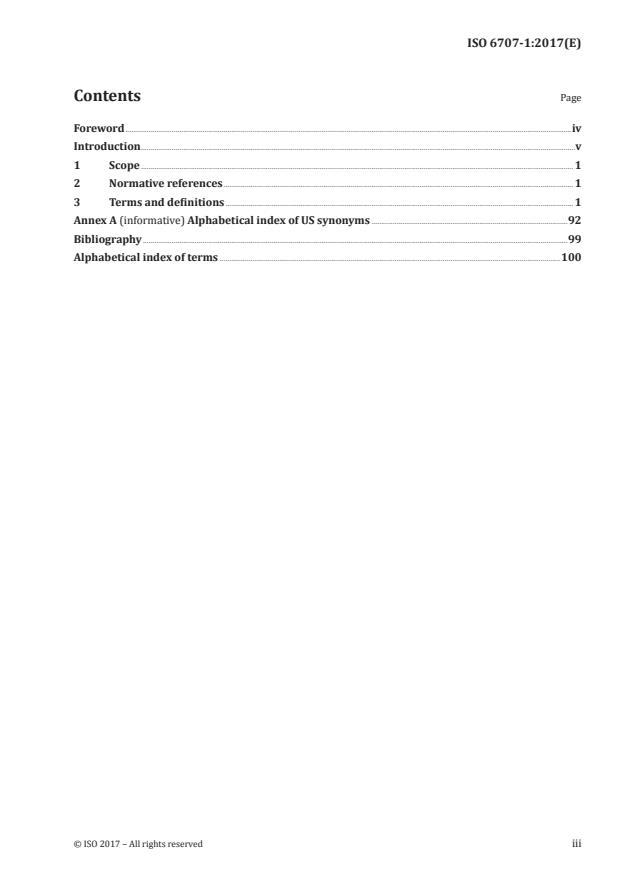
Contents Page
Foreword .iv
Introduction .v
1 Scope . 1
2 Normative references . 1
3 Terms and definitions . 1
Annex A (informative) Alphabetical index of US synonyms .92
Bibliography .99
Alphabetical index of terms .100
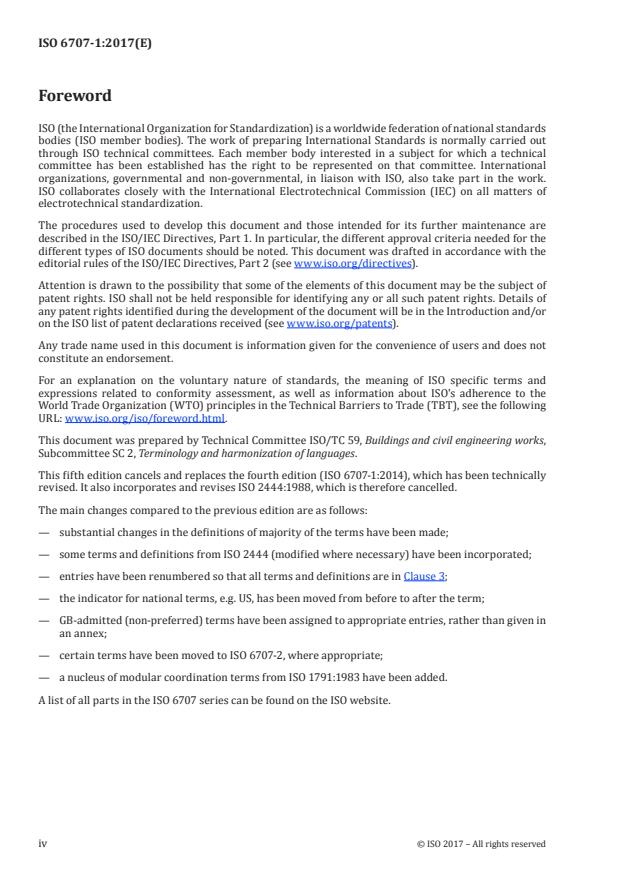
Foreword
ISO (the International Organization for Standardization) is a worldwide federation of national standards
bodies (ISO member bodies). The work of preparing International Standards is normally carried out
through ISO technical committees. Each member body interested in a subject for which a technical
committee has been established has the right to be represented on that committee. International
organizations, governmental and non-governmental, in liaison with ISO, also take part in the work.
ISO collaborates closely with the International Electrotechnical Commission (IEC) on all matters of
electrotechnical standardization.
The procedures used to develop this document and those intended for its further maintenance are
described in the ISO/IEC Directives, Part 1. In particular, the different approval criteria needed for the
different types of ISO documents should be noted. This document was drafted in accordance with the
editorial rules of the ISO/IEC Directives, Part 2 (see www.iso.org/directives).
Attention is drawn to the possibility that some of the elements of this document may be the subject of
patent rights. ISO shall not be held responsible for identifying any or all such patent rights. Details of
any patent rights identified during the development of the document will be in the Introduction and/or
on the ISO list of patent declarations received (see www.iso.org/patents).
Any trade name used in this document is information given for the convenience of users and does not
constitute an endorsement.
For an explanation on the voluntary nature of standards, the meaning of ISO specific terms and
expressions related to conformity assessment, as well as information about ISO's adherence to the
World Trade Organization (WTO) principles in the Technical Barriers to Trade (TBT), see the following
URL: www.iso.org/iso/foreword.html.
This document was prepared by Technical Committee ISO/TC 59, Buildings and civil engineering works,
Subcommittee SC 2, Terminology and harmonization of languages.
This fifth edition cancels and replaces the fourth edition (ISO 6707-1:2014), which has been technically
revised. It also incorporates and revises ISO 2444:1988, which is therefore cancelled.
The main changes compared to the previous edition are as follows:
— substantial changes in the definitions of majority of the terms have been made;
— some terms and definitions from ISO 2444 (modified where necessary) have been incorporated;
— entries have been renumbered so that all terms and definitions are in Clause 3;
— the indicator for national terms, e.g. US, has been moved from before to after the term;
— GB-admitted (non-preferred) terms have been assigned to appropriate entries, rather than given in
an annex;
— certain terms have been moved to ISO 6707-2, where appropriate;
— a nucleus of modular coordination terms from ISO 1791:1983 have been added.
A list of all parts in the ISO 6707 series can be found on the ISO website.
iv © ISO 2017 – All rights reserved
Introduction
With the growth in the number of international construction projects and the development of the
international market for construction products, there is an increasing need for agreement on a common
language in the domain.
This document is a first step toward a complete set of general terms for use by the construction
industry. It will be updated as further terms and definitions are agreed upon.
This document includes terms and concepts that are commonly used in documentation governing
construction work, as well as terms used to specify products and works. It is important to note that
when used in legislation, some general construction terms have a narrower interpretation and hence,
the definition given in this document will not apply.
The adoption of this document by the various national construction industries will improve
communication in the design, execution, and maintenance of construction works within those industries.
Its use in other standards will aid harmonization and provide a basis for specialist terminology.
Structure of this document
Entries are presented under convenient headings. The terms are arranged within categories to allow
ready comparison of related concepts.
International preferred terms are listed in boldface type. Where a preferred term is specific to
a particular English-speaking country, e.g. the United States of America, etc., it is given below the
international preferred term and is annotated with the respective country code. Where no preferred
terms are listed indicating usage in a specific geographical location, this signifies that the international
preferred term is the accepted term in English-speaking countries. A term beneath the preferred
term(s) not given in boldface type is an admitted (non-preferred) synonym. A country code is assigned
to an admitted term if it is specific to an English speaking country.
Where the international term is not used in the US or Canada, five dots (….) are placed where the US
term would normally appear.
In most countries, synonyms and alternative spellings exist for the international preferred terms used
in this document. US synonyms and alternative spellings are given in Annex A.
Where a given preferred term designates more than one concept, each concept has been treated in
a separate entry and a note to entry included to indicate that a homograph exists and to provide a
reference to the other term entry.
Where terms are used in definitions to designate concepts that are defined elsewhere in this document,
the relevant terms are presented in italics and the term number is given after the relevant term.
To facilitate the locating of any term given in the document, irrespective of preference or country of
origin, the alphabetical index lists all preferred and admitted terms.
INTERNATIONAL STANDARD ISO 6707-1:2017(E)
Buildings and civil engineering works — Vocabulary —
Part 1:
General terms
1 Scope
This document contains the terms and definitions of general concepts to establish a vocabulary
applicable to buildings and civil engineering works.
It comprises:
a) fundamental concepts, which can be the starting point for other, more specific, definitions;
b) more specific concepts, used in several areas of construction and frequently used in standards,
regulations and contracts.
2 Normative references
There are no normative references in this document.
3 Terms and definitions
ISO and IEC maintain terminological databases for use in standardization at the following addresses:
— IEC Electropedia: available at http://www.electropedia.org/
— ISO Online browsing platform: available at http://www.iso.org/obp
3.1 Terms relating to types of buildings and civil engineering works
3.1.1 Base terms
3.1.1.1
construction works
construction, US
everything that is constructed or results from construction operations
Note 1 to entry: In the US, there are homographs for the term “construction”. See 3.3.5.6 and 3.5.1.1.
3.1.1.2
civil engineering works
civil engineering project, US
construction works (3.1.1.1) comprising a structure (3.1.1.4), such as a dam (3.1.2.22), bridge (3.1.3.19),
road (3.1.3.1), railway (3.1.3.3), runway, utilities, pipeline (3.1.2.30), or sewerage system (3.3.4.40), or
the result of operations such as dredging, earthwork (3.5.1.6), geotechnical processes (3.5.2.3), but
excluding a building (3.1.1.3) and its associated site (3.1.1.6) works
Note 1 to entry: Associated siteworks are excluded except that in US civil engineering projects, they are included.
3.1.1.3
building
construction works (3.1.1.1) that has the provision of shelter for its occupants or contents as one of its
main purposes, usually partially or totally enclosed and designed to stand permanently in one place
Note 1 to entry: There is a homograph for the term “building”. See 3.5.1.4.
3.1.1.4
structure
construction works (3.1.1.1) having a structure (3.3.1.2)
Note 1 to entry: There is a homograph for the term “structure”. See 3.3.1.2.
3.1.1.5
external works
sitework, US
construction works (3.1.1.1) or landscape work on land (3.8.1) associated with, and adjacent to, civil
engineering works (3.1.1.2) or a building (3.1.1.3)
3.1.1.6
site
area of land (3.8.1) or water where construction work (3.5.1.1) or other development is undertaken
3.1.2 Civil engineering works
3.1.2.1
earthworks
result of change of terrain
3.1.2.2
excavation
result of digging, lifting, and removing earth, fill (3.4.4.9), or other material (3.4.1.2) from the ground
(3.4.2.1)
3.1.2.3
embankment
section of earthworks (3.1.2.1), often formed by cut (3.1.2.5) or fill (3.4.4.9), where the finished ground
level (3.7.2.68) is above or below original ground level (3.7.2.67) and whose length (3.7.2.10) usually
greatly exceeds its width (3.7.2.8)
3.1.2.4
bund
berm, US
low embankment (3.1.2.3)
3.1.2.5
cut
material (3.4.1.2) excavated in bulk
Note 1 to entry: There is a homograph for the term “cut”. See 3.1.2.6.
3.1.2.6
cut
void that results from bulk excavation (3.1.2.2) of material (3.4.1.2)
Note 1 to entry: There is a homograph for the term “cut”. See 3.1.2.5.
2 © ISO 2017 – All rights reserved
3.1.2.7
cut and fill
earthwork (3.5.1.6) technique for lessening or increasing a variation in ground level (3.7.2.67) by using
material (3.4.1.2) excavated from higher ground (3.4.2.1) to raise the level (3.7.2.39) of lower ground or
the reverse
3.1.2.8
adit
nearly level tunnel (3.1.3.18) driven to underground workings
3.1.2.9
made ground
fill, US
ground (3.4.2.1) that has been formed by using material (3.4.1.2) to fill in a depression or to raise the
level (3.7.2.39) of a site (3.1.1.6)
Note 1 to entry: In the US, there is a homograph for the term “fill”. See 3.4.4.9.
3.1.2.10
bund wall
retaining earthworks, US
wall (3.3.2.46) that forms an enclosure around a storage tank and is used to retain the contents in the
event of tank failure
3.1.2.11
dumpling
mound, US
large mass of ground (3.4.2.1) intended to be excavated but temporarily left as a support during
construction work (3.5.1.1)
3.1.2.12
trench
horizontal or slightly inclined long, narrow open excavation (3.1.2.2), usually with vertical sides
3.1.2.13
shaft
vertical or steeply inclined excavation (3.1.2.2), usually of limited cross-section in relation to its depth
(3.7.2.7)
3.1.2.14
borrow pit
area within which earthwork (3.5.1.6) takes place in order to produce material (3.4.1.1) for earthworks
(3.1.2.1)
3.1.2.15
borehole
hole, usually vertical, bored to determine ground (3.4.2.1) conditions, for extraction of water, other
liquids, or gases, or measurement (3.5.1.22) of groundwater level (3.7.2.39)
3.1.2.16
retaining wall
wall (3.3.2.46) that provides lateral support to the ground (3.4.2.1) or that resists pressure from a mass
of other material (3.4.1.2)
3.1.2.17
diaphragm wall
wall (3.3.2.46) made of concrete (3.4.4.15) constructed in a trench (3.1.2.12) temporarily supported by
bentonite (3.1.2.18) suspension
Note 1 to entry: There is a homograph for the term “diaphragm wall”. See 3.3.1.63.
Note 2 to entry: In the US, there are homographs for the term “diaphragm wall”. See 3.3.1.61 and 3.3.1.63.
3.1.2.18
bentonite
clay formed by the decomposition of volcanic ash swelling as it absorbs water
3.1.2.19
water tower
civil engineering works (3.1.1.2) that comprise a large water tank raised above ground level (3.7.2.67)
3.1.2.20
silo
structure (3.1.1.4) for the storage of a large volume of loose material
3.1.2.21
breakwater
mole, GB
long structure (3.1.1.4) in a body of water designed to protect a basin (3.1.3.64) or the shore from waves
3.1.2.22
dam
barrier (3.3.2.9) constructed to retain water in order to raise its level (3.7.2.39), form a reservoir
(3.1.2.36), or reduce or prevent flooding
3.1.2.23
flood bank
dyke, GB
dike, GB
levee, GB
embankment (3.1.2.3) built up to retain or control the level (3.7.2.39) of flood water
3.1.2.24
cofferdam
structure (3.1.1.4), usually temporary, that is built to support the surrounding ground (3.4.2.1) or
to exclude water or soil (3.4.2.2) sufficiently to permit work within it to proceed safely without
excessive pumping
3.1.2.25
swale
slightly inclined, often heavily vegetated or paved with gravel, stone (3.4.2.4), or concrete (3.4.4.15) and
at times swampy, depression, constructed to contain water and other liquids
Note 1 to entry: In the US, there is a homograph for the term “swale”. See 3.8.8.
3.1.2.26
irrigation
artificial distribution of water to land (3.8.1), usually for growing crops
3.1.2.27
weir
structure (3.1.1.4) over which water can flow, used to control the upstream water level (3.7.2.39) in a
watercourse (3.8.8) or other channel (3.3.4.16), and/or to measure the flow (3.7.3.41)
3.1.2.28
penstock
lock gate, US
sluice gate, GB
gate, usually rectangular, that moves vertically between guides
4 © ISO 2017 – All rights reserved
3.1.2.29
spillway
waste weir, GB
passage for the discharge of excess water from a reservoir (3.1.2.36) or channel (3.3.4.16)
3.1.2.30
pipeline
long continuous line of pipes (3.3.4.17), including ancillary equipment, used for transporting liquids
or gases
3.1.2.31
aqueduct
conduit (3.3.4.14) for conveying water over long distances, and including the supporting structure
(3.3.1.2)
3.1.2.32
water supply adit
adit (3.1.2.8) from a shaft (3.1.2.13) to an aquifer to increase available water supply
3.1.2.33
culvert
transverse drain (3.3.4.38) or waterway structure (3.1.1.4) under a road (3.1.3.1), railway (3.1.3.3), or
canal (3.1.3.61), or through an embankment (3.1.2.3), in the form of a large pipe (3.3.4.17) or enclosed
channel (3.3.4.16)
3.1.2.34
headworks
intake and associated works at the upstream end of a water engineering (3.5.1.11) scheme
3.1.2.35
rising main
water main or pressurized section of a drain (3.3.4.38) or sewer (3.3.4.41) through which liquid is
pumped to a higher level (3.7.2.39)
3.1.2.36
reservoir
pond, lake, or basin (3.1.3.64), either naturally occurring or man-made, for storage, regulation, and
control of water and other liquids or gases
3.1.3 Civil engineering works — Transport
3.1.3.1
road
way mainly for vehicles
3.1.3.2
exit
designated point of departure from a road (3.1.3.1)
Note 1 to entry: There is a homograph for the term “exit”. See 3.2.4.18.
3.1.3.3
railway
railroad, US
national or regional transport system for guided passage of wheeled vehicles on rails
3.1.3.4
tramway
streetcar, US
local transport system for guided passage of wheeled vehicles on rails
3.1.3.5
aerial ropeway
cableway, US
lift, US
local transport system for guided passage of cabins or containers carried on cables (3.4.4.54) on
intermediate supports
3.1.3.6
underground railway
subway, US
railway (3.1.3.3) that operates mainly below ground level (3.7.2.67)
3.1.3.7
mass transit railway
railway (3.1.3.3) for the rapid movement of high passenger load densities in urban areas
3.1.3.8
monorail
railway (3.1.3.3) that has a single running rail with beam (3.3.1.11) support
3.1.3.9
track
assembly (3.3.5.5) of rails, fastenings (3.3.5.84), and support, for passage of vehicles
3.1.3.10
sleeper
tie, US
member providing vertical and lateral support to rails of a railway (3.1.3.3) or tramway (3.1.3.4)
Note 1 to entry: In the US, there is a homograph for the term “tie”. See 3.3.1.22.
3.1.3.11
airfield
defined area including any buildings (3.1.1.3), installations (3.3.4.3), and equipment, for the arrival,
departure, and movement of aircraft
3.1.3.12
airport
area containing an airfield (3.1.3.11) and facilities for handling passengers and cargo
3.1.3.13
noise barrier
structure (3.1.1.4) provided to deflect and absorb noise
Note 1 to entry: In the US, there is a homograph for the term “noise barrier”. See 3.1.3.14.
3.1.3.14
noise bund
noise barrier, US
sound barrier, US
noise barrier (3.1.3.13) in the form of an embankment (3.1.2.3)
Note 1 to entry: In the US, there is a homograph for the term “noise barrier”. See 3.1.3.13.
3.1.3.15
subgrade
upper part of the soil (3.4.2.2), natural or constructed, that supports the loads (3.7.3.19) transmitted by
the overlying structure (3.3.1.2) of a road (3.1.3.1), runway, or similar hard surface
6 © ISO 2017 – All rights reserved
3.1.3.16
road formation
grade, US
surface of subgrade (3.1.3.15) in its final shape after completion of earthwork (3.5.1.6)
Note 1 to entry: In the US, there is a homograph for the term “grade”. See 3.7.2.67.
3.1.3.17
pavement
road (3.1.3.1), runway, or similar construction (3.3.5.6) above the subgrade (3.1.3.15)
3.1.3.18
tunnel
horizontal or sloping underground enclosed way of some length (3.7.2.10)
3.1.3.19
bridge
civil engineering works (3.1.1.2) that affords passage to pedestrians, animals, vehicles, and services
(3.3.4.1) above obstacles or between two points at a height (3.7.2.36) above ground (3.4.2.1)
Note 1 to entry: In the US, there is a homograph for the term “bridge”. See 3.5.3.10.
3.1.3.20
arch bridge
bridge (3.1.3.19) that has one or more arches (3.3.1.7) as its main structure (3.3.1.2)
3.1.3.21
bow string bridge
bridge (3.1.3.19) that has an arch (3.3.1.7) and its tie (3.3.1.22) as the main structure (3.3.1.2)
3.1.3.22
cantilever bridge
bridge (3.1.3.19), the main structural members (3.3.1.3) of which are cantilevers (3.3.1.17)
3.1.3.23
cable stayed bridge
bridge (3.1.3.19) with one or more towers and inclined cables (3.4.4.54) that are connected to the top or
the shaft of the tower and support the deck (3.3.1.35)
3.1.3.24
suspension bridge
bridge (3.1.3.19), the main structural members (3.3.1.3) of which are catenary cables (3.4.4.54) from
which the deck (3.3.1.35) is suspended
3.1.3.25
floating bridge
bridge (3.1.3.19) supported by water
3.1.3.26
movable bridge
bridge (3.1.3.19) over a waterway, the deck (3.3.1.35) of which can be moved
3.1.3.27
bascule bridge
movable bridge (3.1.3.26), the deck (3.3.1.35) of which is counterbalanced and hinged on a horizontal axis
3.1.3.28
vertical lift bridge
drawbridge, US
movable bridge (3.1.3.26), the deck (3.3.1.35) of which can be raised vertically
3.1.3.29
swing bridge
movable bridge (3.1.3.26), the deck (3.3.1.35) of which can be rotated about a vertical axis
3.1.3.30
skew bridge
bridge (3.1.3.19) where the angle between the longitudinal axis and the lines of support is not a right angle
3.1.3.31
viaduct
bridge (3.1.3.19) composed of a large number of spans
3.1.3.32
footbridge
bridge (3.1.3.19) for the use of pedestrians
3.1.3.33
railway platform
elevated structure (3.1.1.4) for entraining and detraining passengers and goods
3.1.3.34
highway
parkway, US
freeway, US
way over which the public has the right to pass, this right possibly being restricted to specific classes of
traffic (3.8.5)
Note 1 to entry: In the US, there is a homograph for the term “parkway”. See 3.1.3.37.
Note 2 to entry: In the US, there is a homograph for the term “freeway”. See 3.1.3.37.
3.1.3.35
carriageway
roadway, US
part of the road (3.1.3.1) or highway (3.1.3.34) constructed for use by vehicular traffic (3.8.5), including
auxiliary traffic lanes (3.1.3.49), passing places, and lay-bys (3.1.3.36)
3.1.3.36
lay-by
stopping lane, US
emergency lane, US
part of the highway (3.1.3.34) set aside for vehicles to allow them to draw out of the traffic lanes
(3.1.3.49) and wait for short periods
Note 1 to entry: In the US, there is a homograph for the term “emergency lane”. See 3.1.3.39.
3.1.3.37
motorway
interstate highway, US
freeway, US
parkway, US
limited access road (3.1.3.1) with dual carriageways (3.1.3.35) that is not crossed on the same level
(3.7.2.39) by other traffic lanes (3.1.3.49), for the exclusive use of certain classes of motor vehicles
Note 1 to entry: In the US, there is a homograph for the term “parkway”. See 3.1.3.34.
Note 2 to entry: In the US, there is a homograph for the term “freeway”. See 3.1.3.34.
8 © ISO 2017 – All rights reserved
3.1.3.38
vehicle restraint system
guardrail, US
barricade, US
structure (3.3.1.2) that provides a system of containment for errant vehicles so as to limit damage or injury
Note 1 to entry: In the US, there is a homograph for the term “barricade”. See 3.1.3.41.
3.1.3.39
hard shoulder
emergency lane, US
service lane, US
surfaced strip, adjacent to and abutting a carriageway (3.1.3.35), intended for use by vehicles in the
event of difficulty or during obstruction of the carriageway
Note 1 to entry: In the US, there is a homograph for the term “emergency lane”. See 3.1.3.36.
3.1.3.40
road safety fence
road safety rail, US
vehicle restraint system (3.1.3.38) installed alongside or on a central reserve (3.1.3.48) or a road
(3.1.3.1) in the form of one or more horizontal members mounted on posts (3.3.1.52)
3.1.3.41
road safety barrier
barricade, US
vehicle restraint system (3.1.3.38) alongside a carriageway (3.1.3.35) in the form of a continuous low
wall (3.3.2.46) or similar construction (3.3.5.6)
Note 1 to entry: In the US, there is a homograph for the term “barricade”. See 3.1.3.38.
3.1.3.42
crash cushion
impact barrier, US
energy-absorbing device installed in front of a rigid object to reduce the severity of impact of a vehicle
3.1.3.43
arrester bed
safety ramp, AU
emergency ramp, US
area of land (3.8.1) adjacent to a road (3.1.3.1), filled with a particular material (3.4.1.2) and designed to
decelerate and arrest errant vehicles, generally located on long downhill portions of a road
3.1.3.44
cycleway
bicycle path, US
way or separated part of a road (3.1.3.1) for use only by pedal cycles
3.1.3.45
kerb
curb, US
border, usually upstanding, at the edge of a carriageway (3.1.3.35), hard strip, hard shoulder (3.1.3.39),
or footway (3.1.3.55)
3.1.3.46
soft shoulder
strip alongside a carriageway (3.1.3.35) not intended to support vehicular traffic (3.8.5)
3.1.3.47
verge
shoulder, US
part of a highway (3.1.3.34) alongside a carriageway (3.1.3.35) and at approximately the same level
(3.7.2.39), exclusive of embankment (3.1.2.3) or cutting (3.1.2.5) slopes
Note 1 to entry: It can include footways (3.1.3.55) and cycleways (3.1.3.44).
Note 2 to entry: There is a homograph for the term “verge”. See 3.3.2.42.
3.1.3.48
central reserve
median, US
central reservation, GB
area that separates the carriageways (3.1.3.35) of a road (3.1.3.1) with dual carriageways
3.1.3.49
traffic lane
strip of carriageway (3.1.3.35) intended to accommodate a single line of moving vehicles, frequently
defined by road markings (3.3.5.81)
3.1.3.50
underpass
way below another road (3.1.3.1) or structure (3.1.1.4) designed to facilitate traffic (3.8.5) movement
3.1.3.51
flyover
overpass, US
way above another road (3.1.3.1) or structure (3.1.1.4) designed to facilitate traffic (3.8.5) movement
3.1.3.52
traffic calming
traffic restraint, US
speed bump, US
encouragement of restrained and considerate behaviour by means such as road (3.1.3.1) humps and
reductions in width (3.7.2.8) of the travelled way
3.1.3.53
contraflow
temporary movement of two traffic (3.8.5) streams in opposite directions routed on one side of a road
(3.1.3.1) with dual carriageways (3.1.3.35)
3.1.3.54
footpath
way for the use of pedestrians
3.1.3.55
footway
sidewalk, US
walkway, US
portion of a road (3.1.3.1) reserved exclusively for pedestrians
Note 1 to entry: In the US, there is a homograph for the term “walkway”. See 3.2.4.4.
3.1.3.56
service area
rest area, US
rest area, GB
land (3.8.1) with access to and from a highway (3.1.3.34) used for the provision of certain amenities and
services
10 © ISO 2017 – All rights reserved
3.1.3.57
vehicle park
parking lot, US
parking area, US
area that is prepared and intended for the parking of a number of vehicles
3.1.3.58
multi-storey car park
parking garage, US
building (3.1.1.3) in which motor vehicles are parked on different storeys (3.2.1.2)
3.1.3.59
parking bay
parking space, US
parking stall, US
parking spot, US
area intended, and usually designated and marked, for the parking of a vehicle
3.1.3.60
building line
sight line, US
line that defines the extent of a building (3.1.1.3) beside a road (3.1.3.1) so as to ensure adequate sight lines
3.1.3.61
canal
channel (3.3.4.16) constructed to carry water, usually for navigation, but which can also be used for
water power, irrigation (3.1.2.26), collecting rainwater run-off (3.8.24), or drainage (3.3.4.35) of surface
water (3.8.23)
3.1.3.62
canalized river
river in which the water level (3.7.2.39) has been changed to form a canal (3.1.3.61) by the use of locks
(3.1.3.63) and weirs (3.1.2.27) placed at intervals along its course and thus rendering it navigable
3.1.3.63
lock
enclosure on a river, canal (3.1.3.61), or at the entrance to a non-tidal dock (3.1.3.66), with movable
watertight gates through which vessels pass and proceed from one water level (3.7.2.39) to another
Note 1 to entry: There is a homograph for the term “lock”. See 3.3.5.52.
Note 2 to entry: In the US, there are homographs for the term “lock”. See 3.3.5.49 and 3.3.5.52.
3.1.3.64
basin
harbour, US
partially enclosed or sheltered area of water where vessels are moored or docked
3.1.3.65
berth
pier, US
place where a vessel can be moored, usually for the loading and unloading of cargo or passengers
Note 1 to entry: In the US, there are homographs for the term “pier”. See 3.1.3.68 and 3.3.1.50.
3.1.3.66
dock
port, US
basin (3.1.3.64) for shipping
3.1.3.67
dry dock
dock (3.1.3.66) with gates from which water can be drained or pumped, leaving it dry to enable a vessel
to be built or repaired
3.1.3.68
pier
structure (3.1.1.4), usually open, projecting from the shore and used as a promenade or to provide a
berth (3.1.3.65)
Note 1 to entry: There is a homograph for the term “pier”. See 3.3.1.50.
Note 2 to entry: In the US, there are homographs for the term “pier”. See 3.1.3.65.
3.1.3.69
dolphin
isolated structure (3.1.1.4) or strong point used either to manoeuvre a vessel or to facilitate holding it in
position in a berth (3.1.3.65)
3.1.3.70
cul-de-sac
road (3.1.3.1) accessible from only one end
3.1.3.71
roundabout
rotary, US
portion of a road (3.1.3.1), usually at a junction, on which traffic (3.8.5) moves in one direction around
a central element
3.1.4 Buildings
3.1.4.1
housing
buildings (3.1.1.3) for residential use
3.1.4.2
dwelling
unit of housing (3.1.4.1)
3.1.4.3
flat
apartment, US
dwelling (3.1.4.2), mainly on a single storey (3.2.1.2), within a larger building (3.1.1.3)
3.1.4.4
maisonette
duplex, US
duplex apartment, US
dwelling (3.1.4.2) of more than one storey (3.2.1.2) within a larger building (3.1.1.3)
3.1.4.5
house
building (3.1.1.3) designed as one dwelling (3.1.4.2)
3.1.4.6
bungalow
small house (3.1.4.5) of one storey (3.2.1.2)
12 © ISO 2017 – All rights reserved
3.1.4.7
store
warehouse, US
storage space, US
building (3.1.1.3) or space (3.2.1.1) within a building devoted to the storage or distribution of supplies or
merchandise
3.1.4.8
office building
building (3.1.1.3) used principally for administrative or clerical work
3.1.4.9
shop
store, US
retail shop, US
building (3.1.1.3) or space (3.2.1.1) within a building for the sale of merchandise or the provision of
services involving the receiving and returning of goods
3.1.4.10
factory
building (3.1.1.3) or group of buildings used principally for the manufacture of goods
3.1.4.11
workshop
shop, GB, US
building (3.1.1.3) or space (3.2.1.1) within a building that serves as a work space for a particular manual
or mechanical activity
3.1.4.12
joinery shop
cabinet shop, US
millwork shop, US
building (3.1.1.3) or space (3.2.1.1) where joinery (3.3.5.20) is manufactured
3.1.4.13
air terminal
building (3.1.1.3) or group of buildings where passengers or goods, or both, transfer or are transferred
to or from aircraft
3.1.4.14
framed building
curtain wall building, US
building (3.1.1.3) that relies wholly or mainly on a frame (3.3.1.70) rather than on loadbearing walls
(3.3.2.46) for strength and stability
3.1.4.15
steel-framed building
framed building (3.1.4.14) in which steel is the main structural material (3.4.1.2)
3.1.4.16
timber-framed building
post and beam construction, US
framed building (3.1.4.14) in which timber (3.4.3.2) is the main structural material (3.4.1.2)
Note 1 to entry: In the US, when the width (3.7.2.8) or thickness (3.7.2.49) of the timber (3.4.3.2) used as the main
structural material (3.4.1.2) is less than 100 mm, the term “wood frame construction” is used.
3.1.4.17
platform-frame building
platform frame construction, US
timber-framed building (3.1.4.16) which, for strength and stability, relies wholly or mainly on loadbearing
walls (3.3.2.46) that have studs (3.3.1.51) on sill plates (3.3.3.45) supported by the floor (3.3.2.10)
3.1.4.18
balloon-frame building
balloon frame construction, US
timber-framed building (3.1.4.16) which, for strength and stability, relies wholly or mainly on loadbearing
walls (3.3.2.46) and that has studs (3.3.1.51) in the exterior walls extending in one piece from sill plate
(3.3.3.45) to wall plate (3.3.1.56) below the roof (3.3.2.21)
3.2 Terms relating to spaces
3.2.1 Base terms
3.2.1.1
space
area or volume bounded actually or theoretically
3.2.1.2
storey
story, US
space (3.2.1.1) between two consecutive floors (3.3.2.10) or between a floor and a roof (3.3.2.21)
Note 1 to entry: In the US, this term does not apply to an attic (3.2.2.2) or space (3.2.1.1) partly or wholly below
ground level (3.7.2.67).
3.2.1.3
room
enclosed space (3.2.1.1) within a storey (3.2.1.2), other than a circulation space (3.2.4.1)
3.2.1.4
bay
structural subdivision of a building (3.1.1.3) or other structure (3.1.1.4)
3.2.1.5
extension
addition, US
addition to an existing building (3.1.1.3)
3.2.1.6
protected space
space (3.2.1.1) to which entry by undesired people or objects is prevented
3.2.2 Spaces associated with particular parts of the building
3.2.2.1
loft
attic, US
space (3.2.1.1) below a pitched roof (3.3.2.24) with limited access, not intended for habitation and
frequently used for storage
14 © ISO 2017 – All rights reserved
3.2.2.2
attic
loft, US
room (3.2.1.3) mainly contained within the space (3.2.1.1) below a pitched roof (3.3.2.24)
Note 1 to entry: In the US, an attic (loft) can also be a space (3.2.1.1) having a high ceiling (3.3.2.18) that can
accommodate multiple storeys (3.2.1.2) for habitation.
3.2.2.3
basement storey
storey (3.2.1.2) directly below the ground floor (3.2.2.5)
3.2.2.4
sub-basement
storey (3.2.1.2) under the basement storey (3.2.2.3) of a building (3.1.1.3)
3.2.2.5
ground floor
first floor, US
first storey, US
storey (3.2.1.2) that provides principal access at or near ground level (3.7.2.67)
3.2.2.6
first floor
second floor, US
second storey, US
storey (3.2.1.2) above ground floor (3.2.2.5)
3.2.2.7
second floor
third floor, US
storey (3.2.1.2) above first floor (3.2.2.6)
3.2.2.8
mezzanine
intermediate and partial storey (3.2.1.2), usually between the ground floor (3.2.2.5) and first floor
(3.2.2.6), and usually fully or partially open on one or more sides
Note 1 to entry: In the US, there is a homograph for the term “mezzanine”. See 3.2.2.15.
3.2.2.9
balcony
upper accessible platform within a storey (3.2.1.2), not fully enclosed by walls (3.3.2.46)
3.2.2.10
external balcony
accessible platform that projects from the external face of a building (3.1.1.3)
3.2.2.11
internal balcony
recessed balcony, US
accessible platform recessed from the external face of a building (3.1.1.3)
3.2.2.12
porch
veranda, US
space (3.2.1.1) in front of an external door (3.3.3.3), recessed into a building (3.1.1.3) or covered by a
projection from it
Note 1 to entry: In the US, there is a homograph for the term “porch”. See 3.2.3.9.
Note 2 to entry: In the US, there is a homograph for the term “veranda”. See 3.2.3.9.
3.2.2.13
basement
usable part of a building (3.1.1.3), situated partly or entirely below ground level (3.7.2.67)
Note 1 to entry: In the US, basement is a term for a space (3.2.1.1) having less than half its clear height (3.7.2.36)
below ground level (3.7.2.67), while cellar (3.2.2.18) is a term for a space having more than half its clear height
below ground level.
3.2.2.14
arcade
mall, US
covered passage (3.2.4.4), usually with shops (3.1.4.9) on one or both sides
3.2.2.15
gallery
mezzanine, US
upper space (3.2.1.1), bounded by a balustrade (3.3.2.69) (3.3.2.70), within and open to a larger space
Note 1 to entry: In the US, gallery is a term that is often used to describe a small shop (3.1.4.9), such as an art
gallery.
Note 2 to entry: In the US, there is a homograph for the term “mezzanine”. See 3.2.2.8.
3.2.2.16
forecourt
front yard, US
front garden, US
external space (3.2.1.1), normally bounded on three sides by buildings (3.1.1.3), walls (3.3.2.46), or fences
(3.3.5.86), in front of a building
3.2.2.17
courtyard
external space (3.2.1.1) bounded by buildings (3.1.1.3), walls (3.3.2.46), or fences (3.3.5.86)
3.2.2.18
cellar
basement (3.2.2.13) used for storage, heating plant (3.3.4.11), and for purposes other than habitation
Note 1 to entry: In the US, cellar is a term for a space (3.2.1.1) having more than half its clear height (3.7.2.36)
below ground level (3.7.2.67), while basement (3.2.2.13) is a term for a space having less than half its clear height
below ground level.
3.2.2.19
loading bay
recess containing a platform for the loading and unloading of vehicles
3.2.2.20
wing
part of a building (3.1.1.3) that is subordinate to the main part
3.2.3 Functional spaces
3.2.3.1
activity space
space (3.2.1.1) defined by the spatial extension of an activity
Note 1 to entry: A spatial extension of an activity, for example, a table or a bed, and the activity space around them.
[SOURCE: ISO 12006-2:2015, 3.1.9]
16 © ISO 2017 – All rights reserved
3.2.3.2
working space
staging space, US
staging area, US
additional space (3.2.1.1) formed alongside a trench (3.1.2.12) or other excavation (3.1.2.2) to facilitate
work below ground level (3.7.2.67), or other space required on site (3.1.1.6) to enable construction work
(3.5.1.1) to be carried out
3.2.3.3
toilet
restroom, US
powder room, US
room (3.2.1.3) in which one or more WC suites (3.3.4.9) and/or a urinal or urinals and wash basins, are
installed
Note 1 to entry: In the US, there are homographs for the term “toilet”. See 3.2.3.4 and 3.3.4.9.
3.2.3.4
WC
toilet, US
lavatory, GB
room (3.2.1.3) in which a single WC suite (3.3.4.9) is installed
Note 1 to entry: In the US, there are homographs for the term “toilet”. See 3.2.3.3 and 3.3.4.9.
3.2.3.5
washroom
room (3.2.1.3) in which one or more wash basins are installed
3.2.3.6
office
space (3.2.1.1) within a building (3.1.1.3) used principally for administrative or clerical work
3.2.3.7
hall
auditorium, US
large assembly room (3.2.1.3)
Note 1 to entry: There is a homograph to the term “hall”. See 3.2.4.5.
Note 2 to entry: In the US, there are homographs for the term “hall”. See 3.2.4.3 and 3.2.4.5.
3.2.3.8
terrace
patio, US
external horizontal area, usually for people, often fitted with a balustrade (3.3.2.69) (3.3.2.70)
3.2.3.9
verandah
veranda, US
porch, US
roofed terrace (3.2.3.8) along the side of a building (3.1.1.3)
Note 1 to entry: In the US, there is a homograph for the term “porch”. See 3.2.2.12.
Note 2 to entry: In the US, there is a homograph for the term “veranda”. See 3.2.2.12.
3.2.3.10
inspection pit
test pit, US
pit for inspection of substructures (3.3.1.4) and services (3.3.4.1)
3.2.3.11
light well
light shaft, US
air shaft, US
unroofed space (3.2.1.1), bounded on all sides, which provides daylight to more than one storey (3.2.1.2)
of a building (3.1.1.3) and can provide ventilation
3.2.3.12
basement area
window well, US
unroofed space (3.2.1.1) below ground level (3.7.2.67) and external to a building (3.1.1.3) which provides
light and air to rooms (3.2.1.3) in a basement (3.2.2.13)
3.2.3.13
basement access
areaway, US
unroofed space (3.2.1.1) below ground level (3.7.2.67) which provides access to one or more rooms
(3.2.1.3) in a basement (3.2.2.13)
3.2.4 Spaces associated with circulation and movement
3.2.4.1
circulation space
space (3.2.1.1) for the movement of people, goods, or vehicles
3.2.4.2
means of access
access, US
egress, US
public or private way of approach or entrance for pedestrians or vehicles
3.2.4.3
corridor
hall, US
passage, US
narrow enclosed circulation space (3.2.4.1) that gives access to rooms (3.2.1.3) or other spaces (3.2.1.1)
Note 1 to entry: In the US, there is a homograph for the term “corridor”. See 3.2.4.5.
Note 2 to entry: In the US, there are homographs for the term “hall”. See 3.2.3.7 and 3.2.4.5.
3.2.4.4
passage
walkway, US
narrow circulation space (3.2.4.1) bounded on both sides and intended for pedestrians
Note 1 to entry: A passage might or might not be covered.
Note 2 to entry: In the US, there are homographs for the term “passage”. See 3.2.4.3 and 3.2.4.5.
Note 3 to entry: In the US, there are homographs for the term “walkway”. See 3.1.3.55 and 3.2.4.8.
3.2.4.5
hall
entrance hall, US
hallway, US
corridor, US
passage, US
central circulation space (3.2.4.1) that provides access to one or more rooms (3.2.1.3)
Note 1 to entry: There is a homograph for the term “hall”. See 3.2.3.7.
18 © ISO 2017 – All rights reserved
Note 2 to entry: In the US, there are homographs for the term “hall”. See 3.2.3.7 and 3.2.4.3.
Note 3 to entry: In the US, there is a homograph for the term “corridor”. See 3.2.4.3.
Note 4 to entry: In the US, there are homographs for the term “passage”. See 3.2.4.3 and 3.2.4.4.
Note 5 to entry: In the US, there is a homograph for the term “entrance hall”. See 3.2.4.6.
3.2.4.6
entrance hall
foyer, US
vestibule, US
lobby, US
large circulation space (3.2.4.1) within, and at the entrance to, a building (3.1.1.3)
Note 1 to entry: In the US, there is a homograph for the term “lobby”. See 3.2.4.13.
Note 2 to entry: In the US, there is a homograph for the term “entrance hall”. See 3.2.4.5.
3.2.4.7
access balcony
external corridor, US
balcony (3.2.2.9) that gives access to a number of units of accommodation
Note 1 to entry: The units of accommodation can include dwellings (3.1.4.2) or offices (3.2.3.6).
3.2.4.8
walkway
catwalk, US
construction (3.3.5.6) that provides elevated lateral access for pedestrians
Note 1 to entry: In the US, there is a homograph for the term “catwalk”. See 3.2.4.10.
3.2.4.9
crawlway
crawlspace, US
space (3.2.1.1) that provides access to a service (3.3.4.1), high enough to crawl through
3.2.4.10
gangway
catwalk, US
narrow circulation space (3.2.4.1) that provides access to furniture (3.3.5.3), machinery, and other
equipment
Note 1 to entry: In the US, there is a homograph for the term “catwalk”. See 3.2.4.8.
3.2.4.11
service duct
service space, US
duct (3.3.4.12) that provides activity space (3.2.3.1) for inspection and maintenance (3.5.1.36)
3.2.4.12
air lock
enclosed space (3.2.1.1) having two doors (3.3.3.3), situated between two environments (3.8.3)
with different air conditions, making it possible to pass from one environment to the other without
significant disturbance to either
3.2.4.13
lobby
entry foyer, US
enclosed gathering space (3.2.1.1), usually near an entrance, that gives access to rooms (3.2.1.3) or
other spaces
Note 1 to entry: In the US, there is a homograph for the term “lobby”. See 3.2.4.6.
3.2.4.14
lift well
elevator shaft, US
space (3.2.1.1) in which the lift car (3.3.4.30) and the counterweight or balancing weight move, enclosed
by the bottom of the pit, the approximately vertical walls (3.3.2.46) and the ceiling (3.3.2.18)
3.2.4.15
stairwell
space (3.2.1.1) around which a stair (3.3.5.22) is disposed
3.2.4.16
stair enclosure
space (3.2.1.1) reserved for accommodating a stair (3.3.5.22) and the faces of the walls (3.3.2.46)
limiting the volume
3.2.4.17
stair opening
space (3.2.1.1) reserved in a floor for a stair
3.2.4.18
exit
designated point of departure from a building (3.1.1.3)
Note 1 to entry: There is a homograph for the term “exit”. See 3.1.3.2
3.3 Terms relating to parts of buildings and civil engineering works
3.3.1 Structural parts
3.3.1.
...
INTERNATIONAL ISO
STANDARD 6707-1
Fifth edition
2017-11
Buildings and civil engineering
works — Vocabulary —
Part 1:
General terms
Bâtiments et ouvrages de génie civil — Vocabulaire —
Partie 1: Termes généraux
Reference number
©
ISO 2017
© ISO 2017, Published in Switzerland
All rights reserved. Unless otherwise specified, no part of this publication may be reproduced or utilized otherwise in any form
or by any means, electronic or mechanical, including photocopying, or posting on the internet or an intranet, without prior
written permission. Permission can be requested from either ISO at the address below or ISO’s member body in the country of
the requester.
ISO copyright office
Ch. de Blandonnet 8 • CP 401
CH-1214 Vernier, Geneva, Switzerland
Tel. +41 22 749 01 11
Fax +41 22 749 09 47
copyright@iso.org
www.iso.org
ii © ISO 2017 – All rights reserved
Contents Page
Foreword .iv
Introduction .v
1 Scope . 1
2 Normative references . 1
3 Terms and definitions . 1
Annex A (informative) Alphabetical index of US synonyms .92
Bibliography .99
Alphabetical index of terms .100
Foreword
ISO (the International Organization for Standardization) is a worldwide federation of national standards
bodies (ISO member bodies). The work of preparing International Standards is normally carried out
through ISO technical committees. Each member body interested in a subject for which a technical
committee has been established has the right to be represented on that committee. International
organizations, governmental and non-governmental, in liaison with ISO, also take part in the work.
ISO collaborates closely with the International Electrotechnical Commission (IEC) on all matters of
electrotechnical standardization.
The procedures used to develop this document and those intended for its further maintenance are
described in the ISO/IEC Directives, Part 1. In particular, the different approval criteria needed for the
different types of ISO documents should be noted. This document was drafted in accordance with the
editorial rules of the ISO/IEC Directives, Part 2 (see www.iso.org/directives).
Attention is drawn to the possibility that some of the elements of this document may be the subject of
patent rights. ISO shall not be held responsible for identifying any or all such patent rights. Details of
any patent rights identified during the development of the document will be in the Introduction and/or
on the ISO list of patent declarations received (see www.iso.org/patents).
Any trade name used in this document is information given for the convenience of users and does not
constitute an endorsement.
For an explanation on the voluntary nature of standards, the meaning of ISO specific terms and
expressions related to conformity assessment, as well as information about ISO's adherence to the
World Trade Organization (WTO) principles in the Technical Barriers to Trade (TBT), see the following
URL: www.iso.org/iso/foreword.html.
This document was prepared by Technical Committee ISO/TC 59, Buildings and civil engineering works,
Subcommittee SC 2, Terminology and harmonization of languages.
This fifth edition cancels and replaces the fourth edition (ISO 6707-1:2014), which has been technically
revised. It also incorporates and revises ISO 2444:1988, which is therefore cancelled.
The main changes compared to the previous edition are as follows:
— substantial changes in the definitions of majority of the terms have been made;
— some terms and definitions from ISO 2444 (modified where necessary) have been incorporated;
— entries have been renumbered so that all terms and definitions are in Clause 3;
— the indicator for national terms, e.g. US, has been moved from before to after the term;
— GB-admitted (non-preferred) terms have been assigned to appropriate entries, rather than given in
an annex;
— certain terms have been moved to ISO 6707-2, where appropriate;
— a nucleus of modular coordination terms from ISO 1791:1983 have been added.
A list of all parts in the ISO 6707 series can be found on the ISO website.
iv © ISO 2017 – All rights reserved
Introduction
With the growth in the number of international construction projects and the development of the
international market for construction products, there is an increasing need for agreement on a common
language in the domain.
This document is a first step toward a complete set of general terms for use by the construction
industry. It will be updated as further terms and definitions are agreed upon.
This document includes terms and concepts that are commonly used in documentation governing
construction work, as well as terms used to specify products and works. It is important to note that
when used in legislation, some general construction terms have a narrower interpretation and hence,
the definition given in this document will not apply.
The adoption of this document by the various national construction industries will improve
communication in the design, execution, and maintenance of construction works within those industries.
Its use in other standards will aid harmonization and provide a basis for specialist terminology.
Structure of this document
Entries are presented under convenient headings. The terms are arranged within categories to allow
ready comparison of related concepts.
International preferred terms are listed in boldface type. Where a preferred term is specific to
a particular English-speaking country, e.g. the United States of America, etc., it is given below the
international preferred term and is annotated with the respective country code. Where no preferred
terms are listed indicating usage in a specific geographical location, this signifies that the international
preferred term is the accepted term in English-speaking countries. A term beneath the preferred
term(s) not given in boldface type is an admitted (non-preferred) synonym. A country code is assigned
to an admitted term if it is specific to an English speaking country.
Where the international term is not used in the US or Canada, five dots (….) are placed where the US
term would normally appear.
In most countries, synonyms and alternative spellings exist for the international preferred terms used
in this document. US synonyms and alternative spellings are given in Annex A.
Where a given preferred term designates more than one concept, each concept has been treated in
a separate entry and a note to entry included to indicate that a homograph exists and to provide a
reference to the other term entry.
Where terms are used in definitions to designate concepts that are defined elsewhere in this document,
the relevant terms are presented in italics and the term number is given after the relevant term.
To facilitate the locating of any term given in the document, irrespective of preference or country of
origin, the alphabetical index lists all preferred and admitted terms.
INTERNATIONAL STANDARD ISO 6707-1:2017(E)
Buildings and civil engineering works — Vocabulary —
Part 1:
General terms
1 Scope
This document contains the terms and definitions of general concepts to establish a vocabulary
applicable to buildings and civil engineering works.
It comprises:
a) fundamental concepts, which can be the starting point for other, more specific, definitions;
b) more specific concepts, used in several areas of construction and frequently used in standards,
regulations and contracts.
2 Normative references
There are no normative references in this document.
3 Terms and definitions
ISO and IEC maintain terminological databases for use in standardization at the following addresses:
— IEC Electropedia: available at http://www.electropedia.org/
— ISO Online browsing platform: available at http://www.iso.org/obp
3.1 Terms relating to types of buildings and civil engineering works
3.1.1 Base terms
3.1.1.1
construction works
construction, US
everything that is constructed or results from construction operations
Note 1 to entry: In the US, there are homographs for the term “construction”. See 3.3.5.6 and 3.5.1.1.
3.1.1.2
civil engineering works
civil engineering project, US
construction works (3.1.1.1) comprising a structure (3.1.1.4), such as a dam (3.1.2.22), bridge (3.1.3.19),
road (3.1.3.1), railway (3.1.3.3), runway, utilities, pipeline (3.1.2.30), or sewerage system (3.3.4.40), or
the result of operations such as dredging, earthwork (3.5.1.6), geotechnical processes (3.5.2.3), but
excluding a building (3.1.1.3) and its associated site (3.1.1.6) works
Note 1 to entry: Associated siteworks are excluded except that in US civil engineering projects, they are included.
3.1.1.3
building
construction works (3.1.1.1) that has the provision of shelter for its occupants or contents as one of its
main purposes, usually partially or totally enclosed and designed to stand permanently in one place
Note 1 to entry: There is a homograph for the term “building”. See 3.5.1.4.
3.1.1.4
structure
construction works (3.1.1.1) having a structure (3.3.1.2)
Note 1 to entry: There is a homograph for the term “structure”. See 3.3.1.2.
3.1.1.5
external works
sitework, US
construction works (3.1.1.1) or landscape work on land (3.8.1) associated with, and adjacent to, civil
engineering works (3.1.1.2) or a building (3.1.1.3)
3.1.1.6
site
area of land (3.8.1) or water where construction work (3.5.1.1) or other development is undertaken
3.1.2 Civil engineering works
3.1.2.1
earthworks
result of change of terrain
3.1.2.2
excavation
result of digging, lifting, and removing earth, fill (3.4.4.9), or other material (3.4.1.2) from the ground
(3.4.2.1)
3.1.2.3
embankment
section of earthworks (3.1.2.1), often formed by cut (3.1.2.5) or fill (3.4.4.9), where the finished ground
level (3.7.2.68) is above or below original ground level (3.7.2.67) and whose length (3.7.2.10) usually
greatly exceeds its width (3.7.2.8)
3.1.2.4
bund
berm, US
low embankment (3.1.2.3)
3.1.2.5
cut
material (3.4.1.2) excavated in bulk
Note 1 to entry: There is a homograph for the term “cut”. See 3.1.2.6.
3.1.2.6
cut
void that results from bulk excavation (3.1.2.2) of material (3.4.1.2)
Note 1 to entry: There is a homograph for the term “cut”. See 3.1.2.5.
2 © ISO 2017 – All rights reserved
3.1.2.7
cut and fill
earthwork (3.5.1.6) technique for lessening or increasing a variation in ground level (3.7.2.67) by using
material (3.4.1.2) excavated from higher ground (3.4.2.1) to raise the level (3.7.2.39) of lower ground or
the reverse
3.1.2.8
adit
nearly level tunnel (3.1.3.18) driven to underground workings
3.1.2.9
made ground
fill, US
ground (3.4.2.1) that has been formed by using material (3.4.1.2) to fill in a depression or to raise the
level (3.7.2.39) of a site (3.1.1.6)
Note 1 to entry: In the US, there is a homograph for the term “fill”. See 3.4.4.9.
3.1.2.10
bund wall
retaining earthworks, US
wall (3.3.2.46) that forms an enclosure around a storage tank and is used to retain the contents in the
event of tank failure
3.1.2.11
dumpling
mound, US
large mass of ground (3.4.2.1) intended to be excavated but temporarily left as a support during
construction work (3.5.1.1)
3.1.2.12
trench
horizontal or slightly inclined long, narrow open excavation (3.1.2.2), usually with vertical sides
3.1.2.13
shaft
vertical or steeply inclined excavation (3.1.2.2), usually of limited cross-section in relation to its depth
(3.7.2.7)
3.1.2.14
borrow pit
area within which earthwork (3.5.1.6) takes place in order to produce material (3.4.1.1) for earthworks
(3.1.2.1)
3.1.2.15
borehole
hole, usually vertical, bored to determine ground (3.4.2.1) conditions, for extraction of water, other
liquids, or gases, or measurement (3.5.1.22) of groundwater level (3.7.2.39)
3.1.2.16
retaining wall
wall (3.3.2.46) that provides lateral support to the ground (3.4.2.1) or that resists pressure from a mass
of other material (3.4.1.2)
3.1.2.17
diaphragm wall
wall (3.3.2.46) made of concrete (3.4.4.15) constructed in a trench (3.1.2.12) temporarily supported by
bentonite (3.1.2.18) suspension
Note 1 to entry: There is a homograph for the term “diaphragm wall”. See 3.3.1.63.
Note 2 to entry: In the US, there are homographs for the term “diaphragm wall”. See 3.3.1.61 and 3.3.1.63.
3.1.2.18
bentonite
clay formed by the decomposition of volcanic ash swelling as it absorbs water
3.1.2.19
water tower
civil engineering works (3.1.1.2) that comprise a large water tank raised above ground level (3.7.2.67)
3.1.2.20
silo
structure (3.1.1.4) for the storage of a large volume of loose material
3.1.2.21
breakwater
mole, GB
long structure (3.1.1.4) in a body of water designed to protect a basin (3.1.3.64) or the shore from waves
3.1.2.22
dam
barrier (3.3.2.9) constructed to retain water in order to raise its level (3.7.2.39), form a reservoir
(3.1.2.36), or reduce or prevent flooding
3.1.2.23
flood bank
dyke, GB
dike, GB
levee, GB
embankment (3.1.2.3) built up to retain or control the level (3.7.2.39) of flood water
3.1.2.24
cofferdam
structure (3.1.1.4), usually temporary, that is built to support the surrounding ground (3.4.2.1) or
to exclude water or soil (3.4.2.2) sufficiently to permit work within it to proceed safely without
excessive pumping
3.1.2.25
swale
slightly inclined, often heavily vegetated or paved with gravel, stone (3.4.2.4), or concrete (3.4.4.15) and
at times swampy, depression, constructed to contain water and other liquids
Note 1 to entry: In the US, there is a homograph for the term “swale”. See 3.8.8.
3.1.2.26
irrigation
artificial distribution of water to land (3.8.1), usually for growing crops
3.1.2.27
weir
structure (3.1.1.4) over which water can flow, used to control the upstream water level (3.7.2.39) in a
watercourse (3.8.8) or other channel (3.3.4.16), and/or to measure the flow (3.7.3.41)
3.1.2.28
penstock
lock gate, US
sluice gate, GB
gate, usually rectangular, that moves vertically between guides
4 © ISO 2017 – All rights reserved
3.1.2.29
spillway
waste weir, GB
passage for the discharge of excess water from a reservoir (3.1.2.36) or channel (3.3.4.16)
3.1.2.30
pipeline
long continuous line of pipes (3.3.4.17), including ancillary equipment, used for transporting liquids
or gases
3.1.2.31
aqueduct
conduit (3.3.4.14) for conveying water over long distances, and including the supporting structure
(3.3.1.2)
3.1.2.32
water supply adit
adit (3.1.2.8) from a shaft (3.1.2.13) to an aquifer to increase available water supply
3.1.2.33
culvert
transverse drain (3.3.4.38) or waterway structure (3.1.1.4) under a road (3.1.3.1), railway (3.1.3.3), or
canal (3.1.3.61), or through an embankment (3.1.2.3), in the form of a large pipe (3.3.4.17) or enclosed
channel (3.3.4.16)
3.1.2.34
headworks
intake and associated works at the upstream end of a water engineering (3.5.1.11) scheme
3.1.2.35
rising main
water main or pressurized section of a drain (3.3.4.38) or sewer (3.3.4.41) through which liquid is
pumped to a higher level (3.7.2.39)
3.1.2.36
reservoir
pond, lake, or basin (3.1.3.64), either naturally occurring or man-made, for storage, regulation, and
control of water and other liquids or gases
3.1.3 Civil engineering works — Transport
3.1.3.1
road
way mainly for vehicles
3.1.3.2
exit
designated point of departure from a road (3.1.3.1)
Note 1 to entry: There is a homograph for the term “exit”. See 3.2.4.18.
3.1.3.3
railway
railroad, US
national or regional transport system for guided passage of wheeled vehicles on rails
3.1.3.4
tramway
streetcar, US
local transport system for guided passage of wheeled vehicles on rails
3.1.3.5
aerial ropeway
cableway, US
lift, US
local transport system for guided passage of cabins or containers carried on cables (3.4.4.54) on
intermediate supports
3.1.3.6
underground railway
subway, US
railway (3.1.3.3) that operates mainly below ground level (3.7.2.67)
3.1.3.7
mass transit railway
railway (3.1.3.3) for the rapid movement of high passenger load densities in urban areas
3.1.3.8
monorail
railway (3.1.3.3) that has a single running rail with beam (3.3.1.11) support
3.1.3.9
track
assembly (3.3.5.5) of rails, fastenings (3.3.5.84), and support, for passage of vehicles
3.1.3.10
sleeper
tie, US
member providing vertical and lateral support to rails of a railway (3.1.3.3) or tramway (3.1.3.4)
Note 1 to entry: In the US, there is a homograph for the term “tie”. See 3.3.1.22.
3.1.3.11
airfield
defined area including any buildings (3.1.1.3), installations (3.3.4.3), and equipment, for the arrival,
departure, and movement of aircraft
3.1.3.12
airport
area containing an airfield (3.1.3.11) and facilities for handling passengers and cargo
3.1.3.13
noise barrier
structure (3.1.1.4) provided to deflect and absorb noise
Note 1 to entry: In the US, there is a homograph for the term “noise barrier”. See 3.1.3.14.
3.1.3.14
noise bund
noise barrier, US
sound barrier, US
noise barrier (3.1.3.13) in the form of an embankment (3.1.2.3)
Note 1 to entry: In the US, there is a homograph for the term “noise barrier”. See 3.1.3.13.
3.1.3.15
subgrade
upper part of the soil (3.4.2.2), natural or constructed, that supports the loads (3.7.3.19) transmitted by
the overlying structure (3.3.1.2) of a road (3.1.3.1), runway, or similar hard surface
6 © ISO 2017 – All rights reserved
3.1.3.16
road formation
grade, US
surface of subgrade (3.1.3.15) in its final shape after completion of earthwork (3.5.1.6)
Note 1 to entry: In the US, there is a homograph for the term “grade”. See 3.7.2.67.
3.1.3.17
pavement
road (3.1.3.1), runway, or similar construction (3.3.5.6) above the subgrade (3.1.3.15)
3.1.3.18
tunnel
horizontal or sloping underground enclosed way of some length (3.7.2.10)
3.1.3.19
bridge
civil engineering works (3.1.1.2) that affords passage to pedestrians, animals, vehicles, and services
(3.3.4.1) above obstacles or between two points at a height (3.7.2.36) above ground (3.4.2.1)
Note 1 to entry: In the US, there is a homograph for the term “bridge”. See 3.5.3.10.
3.1.3.20
arch bridge
bridge (3.1.3.19) that has one or more arches (3.3.1.7) as its main structure (3.3.1.2)
3.1.3.21
bow string bridge
bridge (3.1.3.19) that has an arch (3.3.1.7) and its tie (3.3.1.22) as the main structure (3.3.1.2)
3.1.3.22
cantilever bridge
bridge (3.1.3.19), the main structural members (3.3.1.3) of which are cantilevers (3.3.1.17)
3.1.3.23
cable stayed bridge
bridge (3.1.3.19) with one or more towers and inclined cables (3.4.4.54) that are connected to the top or
the shaft of the tower and support the deck (3.3.1.35)
3.1.3.24
suspension bridge
bridge (3.1.3.19), the main structural members (3.3.1.3) of which are catenary cables (3.4.4.54) from
which the deck (3.3.1.35) is suspended
3.1.3.25
floating bridge
bridge (3.1.3.19) supported by water
3.1.3.26
movable bridge
bridge (3.1.3.19) over a waterway, the deck (3.3.1.35) of which can be moved
3.1.3.27
bascule bridge
movable bridge (3.1.3.26), the deck (3.3.1.35) of which is counterbalanced and hinged on a horizontal axis
3.1.3.28
vertical lift bridge
drawbridge, US
movable bridge (3.1.3.26), the deck (3.3.1.35) of which can be raised vertically
3.1.3.29
swing bridge
movable bridge (3.1.3.26), the deck (3.3.1.35) of which can be rotated about a vertical axis
3.1.3.30
skew bridge
bridge (3.1.3.19) where the angle between the longitudinal axis and the lines of support is not a right angle
3.1.3.31
viaduct
bridge (3.1.3.19) composed of a large number of spans
3.1.3.32
footbridge
bridge (3.1.3.19) for the use of pedestrians
3.1.3.33
railway platform
elevated structure (3.1.1.4) for entraining and detraining passengers and goods
3.1.3.34
highway
parkway, US
freeway, US
way over which the public has the right to pass, this right possibly being restricted to specific classes of
traffic (3.8.5)
Note 1 to entry: In the US, there is a homograph for the term “parkway”. See 3.1.3.37.
Note 2 to entry: In the US, there is a homograph for the term “freeway”. See 3.1.3.37.
3.1.3.35
carriageway
roadway, US
part of the road (3.1.3.1) or highway (3.1.3.34) constructed for use by vehicular traffic (3.8.5), including
auxiliary traffic lanes (3.1.3.49), passing places, and lay-bys (3.1.3.36)
3.1.3.36
lay-by
stopping lane, US
emergency lane, US
part of the highway (3.1.3.34) set aside for vehicles to allow them to draw out of the traffic lanes
(3.1.3.49) and wait for short periods
Note 1 to entry: In the US, there is a homograph for the term “emergency lane”. See 3.1.3.39.
3.1.3.37
motorway
interstate highway, US
freeway, US
parkway, US
limited access road (3.1.3.1) with dual carriageways (3.1.3.35) that is not crossed on the same level
(3.7.2.39) by other traffic lanes (3.1.3.49), for the exclusive use of certain classes of motor vehicles
Note 1 to entry: In the US, there is a homograph for the term “parkway”. See 3.1.3.34.
Note 2 to entry: In the US, there is a homograph for the term “freeway”. See 3.1.3.34.
8 © ISO 2017 – All rights reserved
3.1.3.38
vehicle restraint system
guardrail, US
barricade, US
structure (3.3.1.2) that provides a system of containment for errant vehicles so as to limit damage or injury
Note 1 to entry: In the US, there is a homograph for the term “barricade”. See 3.1.3.41.
3.1.3.39
hard shoulder
emergency lane, US
service lane, US
surfaced strip, adjacent to and abutting a carriageway (3.1.3.35), intended for use by vehicles in the
event of difficulty or during obstruction of the carriageway
Note 1 to entry: In the US, there is a homograph for the term “emergency lane”. See 3.1.3.36.
3.1.3.40
road safety fence
road safety rail, US
vehicle restraint system (3.1.3.38) installed alongside or on a central reserve (3.1.3.48) or a road
(3.1.3.1) in the form of one or more horizontal members mounted on posts (3.3.1.52)
3.1.3.41
road safety barrier
barricade, US
vehicle restraint system (3.1.3.38) alongside a carriageway (3.1.3.35) in the form of a continuous low
wall (3.3.2.46) or similar construction (3.3.5.6)
Note 1 to entry: In the US, there is a homograph for the term “barricade”. See 3.1.3.38.
3.1.3.42
crash cushion
impact barrier, US
energy-absorbing device installed in front of a rigid object to reduce the severity of impact of a vehicle
3.1.3.43
arrester bed
safety ramp, AU
emergency ramp, US
area of land (3.8.1) adjacent to a road (3.1.3.1), filled with a particular material (3.4.1.2) and designed to
decelerate and arrest errant vehicles, generally located on long downhill portions of a road
3.1.3.44
cycleway
bicycle path, US
way or separated part of a road (3.1.3.1) for use only by pedal cycles
3.1.3.45
kerb
curb, US
border, usually upstanding, at the edge of a carriageway (3.1.3.35), hard strip, hard shoulder (3.1.3.39),
or footway (3.1.3.55)
3.1.3.46
soft shoulder
strip alongside a carriageway (3.1.3.35) not intended to support vehicular traffic (3.8.5)
3.1.3.47
verge
shoulder, US
part of a highway (3.1.3.34) alongside a carriageway (3.1.3.35) and at approximately the same level
(3.7.2.39), exclusive of embankment (3.1.2.3) or cutting (3.1.2.5) slopes
Note 1 to entry: It can include footways (3.1.3.55) and cycleways (3.1.3.44).
Note 2 to entry: There is a homograph for the term “verge”. See 3.3.2.42.
3.1.3.48
central reserve
median, US
central reservation, GB
area that separates the carriageways (3.1.3.35) of a road (3.1.3.1) with dual carriageways
3.1.3.49
traffic lane
strip of carriageway (3.1.3.35) intended to accommodate a single line of moving vehicles, frequently
defined by road markings (3.3.5.81)
3.1.3.50
underpass
way below another road (3.1.3.1) or structure (3.1.1.4) designed to facilitate traffic (3.8.5) movement
3.1.3.51
flyover
overpass, US
way above another road (3.1.3.1) or structure (3.1.1.4) designed to facilitate traffic (3.8.5) movement
3.1.3.52
traffic calming
traffic restraint, US
speed bump, US
encouragement of restrained and considerate behaviour by means such as road (3.1.3.1) humps and
reductions in width (3.7.2.8) of the travelled way
3.1.3.53
contraflow
temporary movement of two traffic (3.8.5) streams in opposite directions routed on one side of a road
(3.1.3.1) with dual carriageways (3.1.3.35)
3.1.3.54
footpath
way for the use of pedestrians
3.1.3.55
footway
sidewalk, US
walkway, US
portion of a road (3.1.3.1) reserved exclusively for pedestrians
Note 1 to entry: In the US, there is a homograph for the term “walkway”. See 3.2.4.4.
3.1.3.56
service area
rest area, US
rest area, GB
land (3.8.1) with access to and from a highway (3.1.3.34) used for the provision of certain amenities and
services
10 © ISO 2017 – All rights reserved
3.1.3.57
vehicle park
parking lot, US
parking area, US
area that is prepared and intended for the parking of a number of vehicles
3.1.3.58
multi-storey car park
parking garage, US
building (3.1.1.3) in which motor vehicles are parked on different storeys (3.2.1.2)
3.1.3.59
parking bay
parking space, US
parking stall, US
parking spot, US
area intended, and usually designated and marked, for the parking of a vehicle
3.1.3.60
building line
sight line, US
line that defines the extent of a building (3.1.1.3) beside a road (3.1.3.1) so as to ensure adequate sight lines
3.1.3.61
canal
channel (3.3.4.16) constructed to carry water, usually for navigation, but which can also be used for
water power, irrigation (3.1.2.26), collecting rainwater run-off (3.8.24), or drainage (3.3.4.35) of surface
water (3.8.23)
3.1.3.62
canalized river
river in which the water level (3.7.2.39) has been changed to form a canal (3.1.3.61) by the use of locks
(3.1.3.63) and weirs (3.1.2.27) placed at intervals along its course and thus rendering it navigable
3.1.3.63
lock
enclosure on a river, canal (3.1.3.61), or at the entrance to a non-tidal dock (3.1.3.66), with movable
watertight gates through which vessels pass and proceed from one water level (3.7.2.39) to another
Note 1 to entry: There is a homograph for the term “lock”. See 3.3.5.52.
Note 2 to entry: In the US, there are homographs for the term “lock”. See 3.3.5.49 and 3.3.5.52.
3.1.3.64
basin
harbour, US
partially enclosed or sheltered area of water where vessels are moored or docked
3.1.3.65
berth
pier, US
place where a vessel can be moored, usually for the loading and unloading of cargo or passengers
Note 1 to entry: In the US, there are homographs for the term “pier”. See 3.1.3.68 and 3.3.1.50.
3.1.3.66
dock
port, US
basin (3.1.3.64) for shipping
3.1.3.67
dry dock
dock (3.1.3.66) with gates from which water can be drained or pumped, leaving it dry to enable a vessel
to be built or repaired
3.1.3.68
pier
structure (3.1.1.4), usually open, projecting from the shore and used as a promenade or to provide a
berth (3.1.3.65)
Note 1 to entry: There is a homograph for the term “pier”. See 3.3.1.50.
Note 2 to entry: In the US, there are homographs for the term “pier”. See 3.1.3.65.
3.1.3.69
dolphin
isolated structure (3.1.1.4) or strong point used either to manoeuvre a vessel or to facilitate holding it in
position in a berth (3.1.3.65)
3.1.3.70
cul-de-sac
road (3.1.3.1) accessible from only one end
3.1.3.71
roundabout
rotary, US
portion of a road (3.1.3.1), usually at a junction, on which traffic (3.8.5) moves in one direction around
a central element
3.1.4 Buildings
3.1.4.1
housing
buildings (3.1.1.3) for residential use
3.1.4.2
dwelling
unit of housing (3.1.4.1)
3.1.4.3
flat
apartment, US
dwelling (3.1.4.2), mainly on a single storey (3.2.1.2), within a larger building (3.1.1.3)
3.1.4.4
maisonette
duplex, US
duplex apartment, US
dwelling (3.1.4.2) of more than one storey (3.2.1.2) within a larger building (3.1.1.3)
3.1.4.5
house
building (3.1.1.3) designed as one dwelling (3.1.4.2)
3.1.4.6
bungalow
small house (3.1.4.5) of one storey (3.2.1.2)
12 © ISO 2017 – All rights reserved
3.1.4.7
store
warehouse, US
storage space, US
building (3.1.1.3) or space (3.2.1.1) within a building devoted to the storage or distribution of supplies or
merchandise
3.1.4.8
office building
building (3.1.1.3) used principally for administrative or clerical work
3.1.4.9
shop
store, US
retail shop, US
building (3.1.1.3) or space (3.2.1.1) within a building for the sale of merchandise or the provision of
services involving the receiving and returning of goods
3.1.4.10
factory
building (3.1.1.3) or group of buildings used principally for the manufacture of goods
3.1.4.11
workshop
shop, GB, US
building (3.1.1.3) or space (3.2.1.1) within a building that serves as a work space for a particular manual
or mechanical activity
3.1.4.12
joinery shop
cabinet shop, US
millwork shop, US
building (3.1.1.3) or space (3.2.1.1) where joinery (3.3.5.20) is manufactured
3.1.4.13
air terminal
building (3.1.1.3) or group of buildings where passengers or goods, or both, transfer or are transferred
to or from aircraft
3.1.4.14
framed building
curtain wall building, US
building (3.1.1.3) that relies wholly or mainly on a frame (3.3.1.70) rather than on loadbearing walls
(3.3.2.46) for strength and stability
3.1.4.15
steel-framed building
framed building (3.1.4.14) in which steel is the main structural material (3.4.1.2)
3.1.4.16
timber-framed building
post and beam construction, US
framed building (3.1.4.14) in which timber (3.4.3.2) is the main structural material (3.4.1.2)
Note 1 to entry: In the US, when the width (3.7.2.8) or thickness (3.7.2.49) of the timber (3.4.3.2) used as the main
structural material (3.4.1.2) is less than 100 mm, the term “wood frame construction” is used.
3.1.4.17
platform-frame building
platform frame construction, US
timber-framed building (3.1.4.16) which, for strength and stability, relies wholly or mainly on loadbearing
walls (3.3.2.46) that have studs (3.3.1.51) on sill plates (3.3.3.45) supported by the floor (3.3.2.10)
3.1.4.18
balloon-frame building
balloon frame construction, US
timber-framed building (3.1.4.16) which, for strength and stability, relies wholly or mainly on loadbearing
walls (3.3.2.46) and that has studs (3.3.1.51) in the exterior walls extending in one piece from sill plate
(3.3.3.45) to wall plate (3.3.1.56) below the roof (3.3.2.21)
3.2 Terms relating to spaces
3.2.1 Base terms
3.2.1.1
space
area or volume bounded actually or theoretically
3.2.1.2
storey
story, US
space (3.2.1.1) between two consecutive floors (3.3.2.10) or between a floor and a roof (3.3.2.21)
Note 1 to entry: In the US, this term does not apply to an attic (3.2.2.2) or space (3.2.1.1) partly or wholly below
ground level (3.7.2.67).
3.2.1.3
room
enclosed space (3.2.1.1) within a storey (3.2.1.2), other than a circulation space (3.2.4.1)
3.2.1.4
bay
structural subdivision of a building (3.1.1.3) or other structure (3.1.1.4)
3.2.1.5
extension
addition, US
addition to an existing building (3.1.1.3)
3.2.1.6
protected space
space (3.2.1.1) to which entry by undesired people or objects is prevented
3.2.2 Spaces associated with particular parts of the building
3.2.2.1
loft
attic, US
space (3.2.1.1) below a pitched roof (3.3.2.24) with limited access, not intended for habitation and
frequently used for storage
14 © ISO 2017 – All rights reserved
3.2.2.2
attic
loft, US
room (3.2.1.3) mainly contained within the space (3.2.1.1) below a pitched roof (3.3.2.24)
Note 1 to entry: In the US, an attic (loft) can also be a space (3.2.1.1) having a high ceiling (3.3.2.18) that can
accommodate multiple storeys (3.2.1.2) for habitation.
3.2.2.3
basement storey
storey (3.2.1.2) directly below the ground floor (3.2.2.5)
3.2.2.4
sub-basement
storey (3.2.1.2) under the basement storey (3.2.2.3) of a building (3.1.1.3)
3.2.2.5
ground floor
first floor, US
first storey, US
storey (3.2.1.2) that provides principal access at or near ground level (3.7.2.67)
3.2.2.6
first floor
second floor, US
second storey, US
storey (3.2.1.2) above ground floor (3.2.2.5)
3.2.2.7
second floor
third floor, US
storey (3.2.1.2) above first floor (3.2.2.6)
3.2.2.8
mezzanine
intermediate and partial storey (3.2.1.2), usually between the ground floor (3.2.2.5) and first floor
(3.2.2.6), and usually fully or partially open on one or more sides
Note 1 to entry: In the US, there is a homograph for the term “mezzanine”. See 3.2.2.15.
3.2.2.9
balcony
upper accessible platform within a storey (3.2.1.2), not fully enclosed by walls (3.3.2.46)
3.2.2.10
external balcony
accessible platform that projects from the external face of a building (3.1.1.3)
3.2.2.11
internal balcony
recessed balcony, US
accessible platform recessed from the external face of a building (3.1.1.3)
3.2.2.12
porch
veranda, US
space (3.2.1.1) in front of an external door (3.3.3.3), recessed into a building (3.1.1.3) or covered by a
projection from it
Note 1 to entry: In the US, there is a homograph for the term “porch”. See 3.2.3.9.
Note 2 to entry: In the US, there is a homograph for the term “veranda”. See 3.2.3.9.
3.2.2.13
basement
usable part of a building (3.1.1.3), situated partly or entirely below ground level (3.7.2.67)
Note 1 to entry: In the US, basement is a term for a space (3.2.1.1) having less than half its clear height (3.7.2.36)
below ground level (3.7.2.67), while cellar (3.2.2.18) is a term for a space having more than half its clear height
below ground level.
3.2.2.14
arcade
mall, US
covered passage (3.2.4.4), usually with shops (3.1.4.9) on one or both sides
3.2.2.15
gallery
mezzanine, US
upper space (3.2.1.1), bounded by a balustrade (3.3.2.69) (3.3.2.70), within and open to a larger space
Note 1 to entry: In the US, gallery is a term that is often used to describe a small shop (3.1.4.9), such as an art
gallery.
Note 2 to entry: In the US, there is a homograph for the term “mezzanine”. See 3.2.2.8.
3.2.2.16
forecourt
front yard, US
front garden, US
external space (3.2.1.1), normally bounded on three sides by buildings (3.1.1.3), walls (3.3.2.46), or fences
(3.3.5.86), in front of a building
3.2.2.17
courtyard
external space (3.2.1.1) bounded by buildings (3.1.1.3), walls (3.3.2.46), or fences (3.3.5.86)
3.2.2.18
cellar
basement (3.2.2.13) used for storage, heating plant (3.3.4.11), and for purposes other than habitation
Note 1 to entry: In the US, cellar is a term for a space (3.2.1.1) having more than half its clear height (3.7.2.36)
below ground level (3.7.2.67), while basement (3.2.2.13) is a term for a space having less than half its clear height
below ground level.
3.2.2.19
loading bay
recess containing a platform for the loading and unloading of vehicles
3.2.2.20
wing
part of a building (3.1.1.3) that is subordinate to the main part
3.2.3 Functional spaces
3.2.3.1
activity space
space (3.2.1.1) defined by the spatial extension of an activity
Note 1 to entry: A spatial extension of an activity, for example, a table or a bed, and the activity space around them.
[SOURCE: ISO 12006-2:2015, 3.1.9]
16 © ISO 2017 – All rights reserved
3.2.3.2
working space
staging space, US
staging area, US
additional space (3.2.1.1) formed alongside a trench (3.1.2.12) or other excavation (3.1.2.2) to facilitate
work below ground level (3.7.2.67), or other space required on site (3.1.1.6) to enable construction work
(3.5.1.1) to be carried out
3.2.3.3
toilet
restroom, US
powder room, US
room (3.2.1.3) in which one or more WC suites (3.3.4.9) and/or a urinal or urinals and wash basins, are
installed
Note 1 to entry: In the US, there are homographs for the term “toilet”. See 3.2.3.4 and 3.3.4.9.
3.2.3.4
WC
toilet, US
lavatory, GB
room (3.2.1.3) in which a single WC suite (3.3.4.9) is installed
Note 1 to entry: In the US, there are homographs for the term “toilet”. See 3.2.3.3 and 3.3.4.9.
3.2.3.5
washroom
room (3.2.1.3) in which one or more wash basins are installed
3.2.3.6
office
space (3.2.1.1) within a building (3.1.1.3) used principally for administrative or clerical work
3.2.3.7
hall
auditorium, US
large assembly room (3.2.1.3)
Note 1 to entry: There is a homograph to the term “hall”. See 3.2.4.5.
Note 2 to entry: In the US, there are homographs for the term “hall”. See 3.2.4.3 and 3.2.4.5.
3.2.3.8
terrace
patio, US
external horizontal area, usually for people, often fitted with a balustrade (3.3.2.69) (3.3.2.70)
3.2.3.9
verandah
veranda, US
porch, US
roofed terrace (3.2.3.8) along the side of a building (3.1.1.3)
Note 1 to entry: In the US, there is a homograph for the term “porch”. See 3.2.2.12.
Note 2 to entry: In the US, there is a homograph for the term “veranda”. See 3.2.2.12.
3.2.3.10
inspection pit
test pit, US
pit for inspection of substructures (3.3.1.4) and services (3.3.4.1)
3.2.3.11
light well
light shaft, US
air shaft, US
unroofed space (3.2.1.1), bounded on all sides, which provides daylight to more than one storey (3.2.1.2)
of a building (3.1.1.3) and can provide ventilation
3.2.3.12
basement area
window well, US
unroofed space (3.2.1.1) below ground level (3.7.2.67) and external to a building (3.1.1.3) which provides
light and air to rooms (3.2.1.3) in a basement (3.2.2.13)
3.2.3.13
basement access
areaway, US
unroofed space (3.2.1.1) below ground level (3.7.2.67) which provides access to one or more rooms
(3.2.1.3) in a basement (3.2.2.13)
3.2.4 Spaces associated with circulation and movement
3.2.4.1
circulation space
space (3.2.1.1) for the movement of people, goods, or vehicles
3.2.4.2
means of access
access, US
egress, US
public or private way of approach or entrance for pedestrians or vehicles
3.2.4.3
corridor
hall, US
passage, US
narrow enclosed circulation space (3.2.4.1) that gives access to rooms (3.2.1.3) or other spaces (3.2.1.1)
Note 1 to entry: In the US, there is a homograph for the term “corridor”. See 3.2.4.5.
Note 2 to entry: In the US, there are homographs for the term “hall”. See 3.2.3.7 and 3.2.4.5.
3.2.4.4
passage
walkway, US
narrow circulation space (3.2.4.1) bounded on both sides and intended for pedestrians
Note 1 to entry: A passage might or might not be covered.
Note 2 to entry: In the US, there are homographs for the term “passage”. See 3.2.4.3 and 3.2.4.5.
Note 3 to entry: In the US, there are homographs for the term “walkway”. See 3.1.3.55 and 3.2.4.8.
3.2.4.5
hall
entrance hall, US
hallway, US
corridor, US
passage, US
central circulation space (3.2.4.1) that provides access to one or more rooms (3.2.1.3)
Note 1 to entry: There is a homograph for the term “hall”. See 3.2.3.7.
18 © ISO 2017 – All rights reserved
Note 2 to entry: In the US, there are homographs for the term “hall”. See 3.2.3.7 and 3.2.4.3.
Note 3 to entry: In the US, there is a homograph for the term “corridor”. See 3.2.4.3.
Note 4 to entry: In the US, there are homographs for the term “passage”. See 3.2.4.3 and 3.2.4.4.
Note 5 to entry: In the US, there is a homograph for the term “entrance hall”. See 3.2.4.6.
3.2.4.6
entrance hall
foyer, US
vestibule, US
lobby, US
large circulation space (3.2.4.1) within, and at the entrance to, a building (3.1.1.3)
Note 1 to entry: In the US, there is a homograph for the term “lobby”. See 3.2.4.13.
Note 2 to entry: In the US, there is a homograph for the term “entrance hall”. See 3.2.4.5.
3.2.4.7
access balcony
external corridor, US
balcony (3.2.2.9) that gives access to a number of units of accommodation
Note 1 to entry: The units of accommodation can include dwellings (3.1.4.2) or offices (3.2.3.6).
3.2.4.8
walkway
catwalk, US
construction (3.3.5.6) that provides elevated lateral access for pedestrians
Note 1 to entry: In the US, there is a homograph for the term “catwalk”. See 3.2.4.10.
3.2.4.9
crawlway
crawlspace, US
space (3.2.1.1) that provides access to a service (3.3.4.1), high enough to crawl through
3.2.4.10
gangway
catwalk, US
narrow circulation space (3.2.4.1) that provides access to furniture (3.3.5.3), machinery, and other
equipment
Note 1 to entry: In the US, there is a homograph for the term “catwalk”. See 3.2.4.8.
3.2.4.11
service duct
service space, US
duct (3.3.4.12) that provides activity space (3.2.3.1) for inspection and maintenance (3.5.1.36)
3.2.4.12
air lock
enclosed space (3.2.1.1) having two doors (3.3.3.3), situated between two environments (3.8.3)
with different air conditions, making it possible to pass from one environment to the other without
significant disturbance to either
3.2.4.13
lobby
entry foyer, US
enclosed gathering space (3.2.1.1), usually near an entrance, that gives access to rooms (3.2.1.3) or
other spaces
Note 1 to entry: In the US, there is a homograph for the term “lobby”. See 3.2.4.6.
3.2.4.14
lift well
elevator shaft, US
space (3.2.1.1) in which the lift car (3.3.4.30) and the counterweight or balancing weight move, enclosed
by the bottom of the pit, the approximately vertical walls (3.3.2.46) and the ceiling (3.3.2.18)
3.2.4.15
stairwell
space (3.2.1.1) around which a stair (3.3.5.22) is disposed
3.2.4.16
stair enclosure
space (3.2.1.1) reserved for accommodating a stair (3.3.5.22) and the faces of the walls (3.3.2.46)
limiting the volume
3.2.4.17
stair opening
space (3.2.1.1) reserved in a floor for a stair
3.2.4.18
exit
designated point of departure from a building (3.1.1.3)
Note 1 to entry: There is a homograph for the term “exit”. See 3.1.3.2
3.3 Terms relating to parts of buildings and civil engineering works
3.3.1 Structural parts
3.3.1.
...
SLOVENSKI STANDARD
01-september-2019
Nadomešča:
SIST ISO 2444:1997
SIST ISO 6707-1:2015
Stavbe in gradbeni inženirski objekti - Slovar - 1. del: Splošni izrazi
Buildings and civil engineering works -- Vocabulary -- Part 1: General terms
Bâtiments et ouvrages de génie civil -- Vocabulaire -- Partie 1: Termes généraux
Ta slovenski standard je istoveten z: ISO 6707-1:2017
ICS:
01.040.91 Gradbeni materiali in gradnja Construction materials and
(Slovarji) building (Vocabularies)
01.040.93 Nizke gradnje (Slovarji) Civil engineering
(Vocabularies)
91.010.01 Gradbeništvo na splošno Construction industry in
general
93.010 Nizke gradnje na splošno Civil engineering in general
2003-01.Slovenski inštitut za standardizacijo. Razmnoževanje celote ali delov tega standarda ni dovoljeno.
INTERNATIONAL ISO
STANDARD 6707-1
Fifth edition
2017-11
Buildings and civil engineering
works — Vocabulary —
Part 1:
General terms
Bâtiments et ouvrages de génie civil — Vocabulaire —
Partie 1: Termes généraux
Reference number
©
ISO 2017
© ISO 2017, Published in Switzerland
All rights reserved. Unless otherwise specified, no part of this publication may be reproduced or utilized otherwise in any form
or by any means, electronic or mechanical, including photocopying, or posting on the internet or an intranet, without prior
written permission. Permission can be requested from either ISO at the address below or ISO’s member body in the country of
the requester.
ISO copyright office
Ch. de Blandonnet 8 • CP 401
CH-1214 Vernier, Geneva, Switzerland
Tel. +41 22 749 01 11
Fax +41 22 749 09 47
copyright@iso.org
www.iso.org
ii © ISO 2017 – All rights reserved
Contents Page
Foreword .iv
Introduction .v
1 Scope . 1
2 Normative references . 1
3 Terms and definitions . 1
Annex A (informative) Alphabetical index of US synonyms .92
Bibliography .99
Alphabetical index of terms .100
Foreword
ISO (the International Organization for Standardization) is a worldwide federation of national standards
bodies (ISO member bodies). The work of preparing International Standards is normally carried out
through ISO technical committees. Each member body interested in a subject for which a technical
committee has been established has the right to be represented on that committee. International
organizations, governmental and non-governmental, in liaison with ISO, also take part in the work.
ISO collaborates closely with the International Electrotechnical Commission (IEC) on all matters of
electrotechnical standardization.
The procedures used to develop this document and those intended for its further maintenance are
described in the ISO/IEC Directives, Part 1. In particular, the different approval criteria needed for the
different types of ISO documents should be noted. This document was drafted in accordance with the
editorial rules of the ISO/IEC Directives, Part 2 (see www.iso.org/directives).
Attention is drawn to the possibility that some of the elements of this document may be the subject of
patent rights. ISO shall not be held responsible for identifying any or all such patent rights. Details of
any patent rights identified during the development of the document will be in the Introduction and/or
on the ISO list of patent declarations received (see www.iso.org/patents).
Any trade name used in this document is information given for the convenience of users and does not
constitute an endorsement.
For an explanation on the voluntary nature of standards, the meaning of ISO specific terms and
expressions related to conformity assessment, as well as information about ISO's adherence to the
World Trade Organization (WTO) principles in the Technical Barriers to Trade (TBT), see the following
URL: www.iso.org/iso/foreword.html.
This document was prepared by Technical Committee ISO/TC 59, Buildings and civil engineering works,
Subcommittee SC 2, Terminology and harmonization of languages.
This fifth edition cancels and replaces the fourth edition (ISO 6707-1:2014), which has been technically
revised. It also incorporates and revises ISO 2444:1988, which is therefore cancelled.
The main changes compared to the previous edition are as follows:
— substantial changes in the definitions of majority of the terms have been made;
— some terms and definitions from ISO 2444 (modified where necessary) have been incorporated;
— entries have been renumbered so that all terms and definitions are in Clause 3;
— the indicator for national terms, e.g. US, has been moved from before to after the term;
— GB-admitted (non-preferred) terms have been assigned to appropriate entries, rather than given in
an annex;
— certain terms have been moved to ISO 6707-2, where appropriate;
— a nucleus of modular coordination terms from ISO 1791:1983 have been added.
A list of all parts in the ISO 6707 series can be found on the ISO website.
iv © ISO 2017 – All rights reserved
Introduction
With the growth in the number of international construction projects and the development of the
international market for construction products, there is an increasing need for agreement on a common
language in the domain.
This document is a first step toward a complete set of general terms for use by the construction
industry. It will be updated as further terms and definitions are agreed upon.
This document includes terms and concepts that are commonly used in documentation governing
construction work, as well as terms used to specify products and works. It is important to note that
when used in legislation, some general construction terms have a narrower interpretation and hence,
the definition given in this document will not apply.
The adoption of this document by the various national construction industries will improve
communication in the design, execution, and maintenance of construction works within those industries.
Its use in other standards will aid harmonization and provide a basis for specialist terminology.
Structure of this document
Entries are presented under convenient headings. The terms are arranged within categories to allow
ready comparison of related concepts.
International preferred terms are listed in boldface type. Where a preferred term is specific to
a particular English-speaking country, e.g. the United States of America, etc., it is given below the
international preferred term and is annotated with the respective country code. Where no preferred
terms are listed indicating usage in a specific geographical location, this signifies that the international
preferred term is the accepted term in English-speaking countries. A term beneath the preferred
term(s) not given in boldface type is an admitted (non-preferred) synonym. A country code is assigned
to an admitted term if it is specific to an English speaking country.
Where the international term is not used in the US or Canada, five dots (….) are placed where the US
term would normally appear.
In most countries, synonyms and alternative spellings exist for the international preferred terms used
in this document. US synonyms and alternative spellings are given in Annex A.
Where a given preferred term designates more than one concept, each concept has been treated in
a separate entry and a note to entry included to indicate that a homograph exists and to provide a
reference to the other term entry.
Where terms are used in definitions to designate concepts that are defined elsewhere in this document,
the relevant terms are presented in italics and the term number is given after the relevant term.
To facilitate the locating of any term given in the document, irrespective of preference or country of
origin, the alphabetical index lists all preferred and admitted terms.
INTERNATIONAL STANDARD ISO 6707-1:2017(E)
Buildings and civil engineering works — Vocabulary —
Part 1:
General terms
1 Scope
This document contains the terms and definitions of general concepts to establish a vocabulary
applicable to buildings and civil engineering works.
It comprises:
a) fundamental concepts, which can be the starting point for other, more specific, definitions;
b) more specific concepts, used in several areas of construction and frequently used in standards,
regulations and contracts.
2 Normative references
There are no normative references in this document.
3 Terms and definitions
ISO and IEC maintain terminological databases for use in standardization at the following addresses:
— IEC Electropedia: available at http://www.electropedia.org/
— ISO Online browsing platform: available at http://www.iso.org/obp
3.1 Terms relating to types of buildings and civil engineering works
3.1.1 Base terms
3.1.1.1
construction works
construction, US
everything that is constructed or results from construction operations
Note 1 to entry: In the US, there are homographs for the term “construction”. See 3.3.5.6 and 3.5.1.1.
3.1.1.2
civil engineering works
civil engineering project, US
construction works (3.1.1.1) comprising a structure (3.1.1.4), such as a dam (3.1.2.22), bridge (3.1.3.19),
road (3.1.3.1), railway (3.1.3.3), runway, utilities, pipeline (3.1.2.30), or sewerage system (3.3.4.40), or
the result of operations such as dredging, earthwork (3.5.1.6), geotechnical processes (3.5.2.3), but
excluding a building (3.1.1.3) and its associated site (3.1.1.6) works
Note 1 to entry: Associated siteworks are excluded except that in US civil engineering projects, they are included.
3.1.1.3
building
construction works (3.1.1.1) that has the provision of shelter for its occupants or contents as one of its
main purposes, usually partially or totally enclosed and designed to stand permanently in one place
Note 1 to entry: There is a homograph for the term “building”. See 3.5.1.4.
3.1.1.4
structure
construction works (3.1.1.1) having a structure (3.3.1.2)
Note 1 to entry: There is a homograph for the term “structure”. See 3.3.1.2.
3.1.1.5
external works
sitework, US
construction works (3.1.1.1) or landscape work on land (3.8.1) associated with, and adjacent to, civil
engineering works (3.1.1.2) or a building (3.1.1.3)
3.1.1.6
site
area of land (3.8.1) or water where construction work (3.5.1.1) or other development is undertaken
3.1.2 Civil engineering works
3.1.2.1
earthworks
result of change of terrain
3.1.2.2
excavation
result of digging, lifting, and removing earth, fill (3.4.4.9), or other material (3.4.1.2) from the ground
(3.4.2.1)
3.1.2.3
embankment
section of earthworks (3.1.2.1), often formed by cut (3.1.2.5) or fill (3.4.4.9), where the finished ground
level (3.7.2.68) is above or below original ground level (3.7.2.67) and whose length (3.7.2.10) usually
greatly exceeds its width (3.7.2.8)
3.1.2.4
bund
berm, US
low embankment (3.1.2.3)
3.1.2.5
cut
material (3.4.1.2) excavated in bulk
Note 1 to entry: There is a homograph for the term “cut”. See 3.1.2.6.
3.1.2.6
cut
void that results from bulk excavation (3.1.2.2) of material (3.4.1.2)
Note 1 to entry: There is a homograph for the term “cut”. See 3.1.2.5.
2 © ISO 2017 – All rights reserved
3.1.2.7
cut and fill
earthwork (3.5.1.6) technique for lessening or increasing a variation in ground level (3.7.2.67) by using
material (3.4.1.2) excavated from higher ground (3.4.2.1) to raise the level (3.7.2.39) of lower ground or
the reverse
3.1.2.8
adit
nearly level tunnel (3.1.3.18) driven to underground workings
3.1.2.9
made ground
fill, US
ground (3.4.2.1) that has been formed by using material (3.4.1.2) to fill in a depression or to raise the
level (3.7.2.39) of a site (3.1.1.6)
Note 1 to entry: In the US, there is a homograph for the term “fill”. See 3.4.4.9.
3.1.2.10
bund wall
retaining earthworks, US
wall (3.3.2.46) that forms an enclosure around a storage tank and is used to retain the contents in the
event of tank failure
3.1.2.11
dumpling
mound, US
large mass of ground (3.4.2.1) intended to be excavated but temporarily left as a support during
construction work (3.5.1.1)
3.1.2.12
trench
horizontal or slightly inclined long, narrow open excavation (3.1.2.2), usually with vertical sides
3.1.2.13
shaft
vertical or steeply inclined excavation (3.1.2.2), usually of limited cross-section in relation to its depth
(3.7.2.7)
3.1.2.14
borrow pit
area within which earthwork (3.5.1.6) takes place in order to produce material (3.4.1.1) for earthworks
(3.1.2.1)
3.1.2.15
borehole
hole, usually vertical, bored to determine ground (3.4.2.1) conditions, for extraction of water, other
liquids, or gases, or measurement (3.5.1.22) of groundwater level (3.7.2.39)
3.1.2.16
retaining wall
wall (3.3.2.46) that provides lateral support to the ground (3.4.2.1) or that resists pressure from a mass
of other material (3.4.1.2)
3.1.2.17
diaphragm wall
wall (3.3.2.46) made of concrete (3.4.4.15) constructed in a trench (3.1.2.12) temporarily supported by
bentonite (3.1.2.18) suspension
Note 1 to entry: There is a homograph for the term “diaphragm wall”. See 3.3.1.63.
Note 2 to entry: In the US, there are homographs for the term “diaphragm wall”. See 3.3.1.61 and 3.3.1.63.
3.1.2.18
bentonite
clay formed by the decomposition of volcanic ash swelling as it absorbs water
3.1.2.19
water tower
civil engineering works (3.1.1.2) that comprise a large water tank raised above ground level (3.7.2.67)
3.1.2.20
silo
structure (3.1.1.4) for the storage of a large volume of loose material
3.1.2.21
breakwater
mole, GB
long structure (3.1.1.4) in a body of water designed to protect a basin (3.1.3.64) or the shore from waves
3.1.2.22
dam
barrier (3.3.2.9) constructed to retain water in order to raise its level (3.7.2.39), form a reservoir
(3.1.2.36), or reduce or prevent flooding
3.1.2.23
flood bank
dyke, GB
dike, GB
levee, GB
embankment (3.1.2.3) built up to retain or control the level (3.7.2.39) of flood water
3.1.2.24
cofferdam
structure (3.1.1.4), usually temporary, that is built to support the surrounding ground (3.4.2.1) or
to exclude water or soil (3.4.2.2) sufficiently to permit work within it to proceed safely without
excessive pumping
3.1.2.25
swale
slightly inclined, often heavily vegetated or paved with gravel, stone (3.4.2.4), or concrete (3.4.4.15) and
at times swampy, depression, constructed to contain water and other liquids
Note 1 to entry: In the US, there is a homograph for the term “swale”. See 3.8.8.
3.1.2.26
irrigation
artificial distribution of water to land (3.8.1), usually for growing crops
3.1.2.27
weir
structure (3.1.1.4) over which water can flow, used to control the upstream water level (3.7.2.39) in a
watercourse (3.8.8) or other channel (3.3.4.16), and/or to measure the flow (3.7.3.41)
3.1.2.28
penstock
lock gate, US
sluice gate, GB
gate, usually rectangular, that moves vertically between guides
4 © ISO 2017 – All rights reserved
3.1.2.29
spillway
waste weir, GB
passage for the discharge of excess water from a reservoir (3.1.2.36) or channel (3.3.4.16)
3.1.2.30
pipeline
long continuous line of pipes (3.3.4.17), including ancillary equipment, used for transporting liquids
or gases
3.1.2.31
aqueduct
conduit (3.3.4.14) for conveying water over long distances, and including the supporting structure
(3.3.1.2)
3.1.2.32
water supply adit
adit (3.1.2.8) from a shaft (3.1.2.13) to an aquifer to increase available water supply
3.1.2.33
culvert
transverse drain (3.3.4.38) or waterway structure (3.1.1.4) under a road (3.1.3.1), railway (3.1.3.3), or
canal (3.1.3.61), or through an embankment (3.1.2.3), in the form of a large pipe (3.3.4.17) or enclosed
channel (3.3.4.16)
3.1.2.34
headworks
intake and associated works at the upstream end of a water engineering (3.5.1.11) scheme
3.1.2.35
rising main
water main or pressurized section of a drain (3.3.4.38) or sewer (3.3.4.41) through which liquid is
pumped to a higher level (3.7.2.39)
3.1.2.36
reservoir
pond, lake, or basin (3.1.3.64), either naturally occurring or man-made, for storage, regulation, and
control of water and other liquids or gases
3.1.3 Civil engineering works — Transport
3.1.3.1
road
way mainly for vehicles
3.1.3.2
exit
designated point of departure from a road (3.1.3.1)
Note 1 to entry: There is a homograph for the term “exit”. See 3.2.4.18.
3.1.3.3
railway
railroad, US
national or regional transport system for guided passage of wheeled vehicles on rails
3.1.3.4
tramway
streetcar, US
local transport system for guided passage of wheeled vehicles on rails
3.1.3.5
aerial ropeway
cableway, US
lift, US
local transport system for guided passage of cabins or containers carried on cables (3.4.4.54) on
intermediate supports
3.1.3.6
underground railway
subway, US
railway (3.1.3.3) that operates mainly below ground level (3.7.2.67)
3.1.3.7
mass transit railway
railway (3.1.3.3) for the rapid movement of high passenger load densities in urban areas
3.1.3.8
monorail
railway (3.1.3.3) that has a single running rail with beam (3.3.1.11) support
3.1.3.9
track
assembly (3.3.5.5) of rails, fastenings (3.3.5.84), and support, for passage of vehicles
3.1.3.10
sleeper
tie, US
member providing vertical and lateral support to rails of a railway (3.1.3.3) or tramway (3.1.3.4)
Note 1 to entry: In the US, there is a homograph for the term “tie”. See 3.3.1.22.
3.1.3.11
airfield
defined area including any buildings (3.1.1.3), installations (3.3.4.3), and equipment, for the arrival,
departure, and movement of aircraft
3.1.3.12
airport
area containing an airfield (3.1.3.11) and facilities for handling passengers and cargo
3.1.3.13
noise barrier
structure (3.1.1.4) provided to deflect and absorb noise
Note 1 to entry: In the US, there is a homograph for the term “noise barrier”. See 3.1.3.14.
3.1.3.14
noise bund
noise barrier, US
sound barrier, US
noise barrier (3.1.3.13) in the form of an embankment (3.1.2.3)
Note 1 to entry: In the US, there is a homograph for the term “noise barrier”. See 3.1.3.13.
3.1.3.15
subgrade
upper part of the soil (3.4.2.2), natural or constructed, that supports the loads (3.7.3.19) transmitted by
the overlying structure (3.3.1.2) of a road (3.1.3.1), runway, or similar hard surface
6 © ISO 2017 – All rights reserved
3.1.3.16
road formation
grade, US
surface of subgrade (3.1.3.15) in its final shape after completion of earthwork (3.5.1.6)
Note 1 to entry: In the US, there is a homograph for the term “grade”. See 3.7.2.67.
3.1.3.17
pavement
road (3.1.3.1), runway, or similar construction (3.3.5.6) above the subgrade (3.1.3.15)
3.1.3.18
tunnel
horizontal or sloping underground enclosed way of some length (3.7.2.10)
3.1.3.19
bridge
civil engineering works (3.1.1.2) that affords passage to pedestrians, animals, vehicles, and services
(3.3.4.1) above obstacles or between two points at a height (3.7.2.36) above ground (3.4.2.1)
Note 1 to entry: In the US, there is a homograph for the term “bridge”. See 3.5.3.10.
3.1.3.20
arch bridge
bridge (3.1.3.19) that has one or more arches (3.3.1.7) as its main structure (3.3.1.2)
3.1.3.21
bow string bridge
bridge (3.1.3.19) that has an arch (3.3.1.7) and its tie (3.3.1.22) as the main structure (3.3.1.2)
3.1.3.22
cantilever bridge
bridge (3.1.3.19), the main structural members (3.3.1.3) of which are cantilevers (3.3.1.17)
3.1.3.23
cable stayed bridge
bridge (3.1.3.19) with one or more towers and inclined cables (3.4.4.54) that are connected to the top or
the shaft of the tower and support the deck (3.3.1.35)
3.1.3.24
suspension bridge
bridge (3.1.3.19), the main structural members (3.3.1.3) of which are catenary cables (3.4.4.54) from
which the deck (3.3.1.35) is suspended
3.1.3.25
floating bridge
bridge (3.1.3.19) supported by water
3.1.3.26
movable bridge
bridge (3.1.3.19) over a waterway, the deck (3.3.1.35) of which can be moved
3.1.3.27
bascule bridge
movable bridge (3.1.3.26), the deck (3.3.1.35) of which is counterbalanced and hinged on a horizontal axis
3.1.3.28
vertical lift bridge
drawbridge, US
movable bridge (3.1.3.26), the deck (3.3.1.35) of which can be raised vertically
3.1.3.29
swing bridge
movable bridge (3.1.3.26), the deck (3.3.1.35) of which can be rotated about a vertical axis
3.1.3.30
skew bridge
bridge (3.1.3.19) where the angle between the longitudinal axis and the lines of support is not a right angle
3.1.3.31
viaduct
bridge (3.1.3.19) composed of a large number of spans
3.1.3.32
footbridge
bridge (3.1.3.19) for the use of pedestrians
3.1.3.33
railway platform
elevated structure (3.1.1.4) for entraining and detraining passengers and goods
3.1.3.34
highway
parkway, US
freeway, US
way over which the public has the right to pass, this right possibly being restricted to specific classes of
traffic (3.8.5)
Note 1 to entry: In the US, there is a homograph for the term “parkway”. See 3.1.3.37.
Note 2 to entry: In the US, there is a homograph for the term “freeway”. See 3.1.3.37.
3.1.3.35
carriageway
roadway, US
part of the road (3.1.3.1) or highway (3.1.3.34) constructed for use by vehicular traffic (3.8.5), including
auxiliary traffic lanes (3.1.3.49), passing places, and lay-bys (3.1.3.36)
3.1.3.36
lay-by
stopping lane, US
emergency lane, US
part of the highway (3.1.3.34) set aside for vehicles to allow them to draw out of the traffic lanes
(3.1.3.49) and wait for short periods
Note 1 to entry: In the US, there is a homograph for the term “emergency lane”. See 3.1.3.39.
3.1.3.37
motorway
interstate highway, US
freeway, US
parkway, US
limited access road (3.1.3.1) with dual carriageways (3.1.3.35) that is not crossed on the same level
(3.7.2.39) by other traffic lanes (3.1.3.49), for the exclusive use of certain classes of motor vehicles
Note 1 to entry: In the US, there is a homograph for the term “parkway”. See 3.1.3.34.
Note 2 to entry: In the US, there is a homograph for the term “freeway”. See 3.1.3.34.
8 © ISO 2017 – All rights reserved
3.1.3.38
vehicle restraint system
guardrail, US
barricade, US
structure (3.3.1.2) that provides a system of containment for errant vehicles so as to limit damage or injury
Note 1 to entry: In the US, there is a homograph for the term “barricade”. See 3.1.3.41.
3.1.3.39
hard shoulder
emergency lane, US
service lane, US
surfaced strip, adjacent to and abutting a carriageway (3.1.3.35), intended for use by vehicles in the
event of difficulty or during obstruction of the carriageway
Note 1 to entry: In the US, there is a homograph for the term “emergency lane”. See 3.1.3.36.
3.1.3.40
road safety fence
road safety rail, US
vehicle restraint system (3.1.3.38) installed alongside or on a central reserve (3.1.3.48) or a road
(3.1.3.1) in the form of one or more horizontal members mounted on posts (3.3.1.52)
3.1.3.41
road safety barrier
barricade, US
vehicle restraint system (3.1.3.38) alongside a carriageway (3.1.3.35) in the form of a continuous low
wall (3.3.2.46) or similar construction (3.3.5.6)
Note 1 to entry: In the US, there is a homograph for the term “barricade”. See 3.1.3.38.
3.1.3.42
crash cushion
impact barrier, US
energy-absorbing device installed in front of a rigid object to reduce the severity of impact of a vehicle
3.1.3.43
arrester bed
safety ramp, AU
emergency ramp, US
area of land (3.8.1) adjacent to a road (3.1.3.1), filled with a particular material (3.4.1.2) and designed to
decelerate and arrest errant vehicles, generally located on long downhill portions of a road
3.1.3.44
cycleway
bicycle path, US
way or separated part of a road (3.1.3.1) for use only by pedal cycles
3.1.3.45
kerb
curb, US
border, usually upstanding, at the edge of a carriageway (3.1.3.35), hard strip, hard shoulder (3.1.3.39),
or footway (3.1.3.55)
3.1.3.46
soft shoulder
strip alongside a carriageway (3.1.3.35) not intended to support vehicular traffic (3.8.5)
3.1.3.47
verge
shoulder, US
part of a highway (3.1.3.34) alongside a carriageway (3.1.3.35) and at approximately the same level
(3.7.2.39), exclusive of embankment (3.1.2.3) or cutting (3.1.2.5) slopes
Note 1 to entry: It can include footways (3.1.3.55) and cycleways (3.1.3.44).
Note 2 to entry: There is a homograph for the term “verge”. See 3.3.2.42.
3.1.3.48
central reserve
median, US
central reservation, GB
area that separates the carriageways (3.1.3.35) of a road (3.1.3.1) with dual carriageways
3.1.3.49
traffic lane
strip of carriageway (3.1.3.35) intended to accommodate a single line of moving vehicles, frequently
defined by road markings (3.3.5.81)
3.1.3.50
underpass
way below another road (3.1.3.1) or structure (3.1.1.4) designed to facilitate traffic (3.8.5) movement
3.1.3.51
flyover
overpass, US
way above another road (3.1.3.1) or structure (3.1.1.4) designed to facilitate traffic (3.8.5) movement
3.1.3.52
traffic calming
traffic restraint, US
speed bump, US
encouragement of restrained and considerate behaviour by means such as road (3.1.3.1) humps and
reductions in width (3.7.2.8) of the travelled way
3.1.3.53
contraflow
temporary movement of two traffic (3.8.5) streams in opposite directions routed on one side of a road
(3.1.3.1) with dual carriageways (3.1.3.35)
3.1.3.54
footpath
way for the use of pedestrians
3.1.3.55
footway
sidewalk, US
walkway, US
portion of a road (3.1.3.1) reserved exclusively for pedestrians
Note 1 to entry: In the US, there is a homograph for the term “walkway”. See 3.2.4.4.
3.1.3.56
service area
rest area, US
rest area, GB
land (3.8.1) with access to and from a highway (3.1.3.34) used for the provision of certain amenities and
services
10 © ISO 2017 – All rights reserved
3.1.3.57
vehicle park
parking lot, US
parking area, US
area that is prepared and intended for the parking of a number of vehicles
3.1.3.58
multi-storey car park
parking garage, US
building (3.1.1.3) in which motor vehicles are parked on different storeys (3.2.1.2)
3.1.3.59
parking bay
parking space, US
parking stall, US
parking spot, US
area intended, and usually designated and marked, for the parking of a vehicle
3.1.3.60
building line
sight line, US
line that defines the extent of a building (3.1.1.3) beside a road (3.1.3.1) so as to ensure adequate sight lines
3.1.3.61
canal
channel (3.3.4.16) constructed to carry water, usually for navigation, but which can also be used for
water power, irrigation (3.1.2.26), collecting rainwater run-off (3.8.24), or drainage (3.3.4.35) of surface
water (3.8.23)
3.1.3.62
canalized river
river in which the water level (3.7.2.39) has been changed to form a canal (3.1.3.61) by the use of locks
(3.1.3.63) and weirs (3.1.2.27) placed at intervals along its course and thus rendering it navigable
3.1.3.63
lock
enclosure on a river, canal (3.1.3.61), or at the entrance to a non-tidal dock (3.1.3.66), with movable
watertight gates through which vessels pass and proceed from one water level (3.7.2.39) to another
Note 1 to entry: There is a homograph for the term “lock”. See 3.3.5.52.
Note 2 to entry: In the US, there are homographs for the term “lock”. See 3.3.5.49 and 3.3.5.52.
3.1.3.64
basin
harbour, US
partially enclosed or sheltered area of water where vessels are moored or docked
3.1.3.65
berth
pier, US
place where a vessel can be moored, usually for the loading and unloading of cargo or passengers
Note 1 to entry: In the US, there are homographs for the term “pier”. See 3.1.3.68 and 3.3.1.50.
3.1.3.66
dock
port, US
basin (3.1.3.64) for shipping
3.1.3.67
dry dock
dock (3.1.3.66) with gates from which water can be drained or pumped, leaving it dry to enable a vessel
to be built or repaired
3.1.3.68
pier
structure (3.1.1.4), usually open, projecting from the shore and used as a promenade or to provide a
berth (3.1.3.65)
Note 1 to entry: There is a homograph for the term “pier”. See 3.3.1.50.
Note 2 to entry: In the US, there are homographs for the term “pier”. See 3.1.3.65.
3.1.3.69
dolphin
isolated structure (3.1.1.4) or strong point used either to manoeuvre a vessel or to facilitate holding it in
position in a berth (3.1.3.65)
3.1.3.70
cul-de-sac
road (3.1.3.1) accessible from only one end
3.1.3.71
roundabout
rotary, US
portion of a road (3.1.3.1), usually at a junction, on which traffic (3.8.5) moves in one direction around
a central element
3.1.4 Buildings
3.1.4.1
housing
buildings (3.1.1.3) for residential use
3.1.4.2
dwelling
unit of housing (3.1.4.1)
3.1.4.3
flat
apartment, US
dwelling (3.1.4.2), mainly on a single storey (3.2.1.2), within a larger building (3.1.1.3)
3.1.4.4
maisonette
duplex, US
duplex apartment, US
dwelling (3.1.4.2) of more than one storey (3.2.1.2) within a larger building (3.1.1.3)
3.1.4.5
house
building (3.1.1.3) designed as one dwelling (3.1.4.2)
3.1.4.6
bungalow
small house (3.1.4.5) of one storey (3.2.1.2)
12 © ISO 2017 – All rights reserved
3.1.4.7
store
warehouse, US
storage space, US
building (3.1.1.3) or space (3.2.1.1) within a building devoted to the storage or distribution of supplies or
merchandise
3.1.4.8
office building
building (3.1.1.3) used principally for administrative or clerical work
3.1.4.9
shop
store, US
retail shop, US
building (3.1.1.3) or space (3.2.1.1) within a building for the sale of merchandise or the provision of
services involving the receiving and returning of goods
3.1.4.10
factory
building (3.1.1.3) or group of buildings used principally for the manufacture of goods
3.1.4.11
workshop
shop, GB, US
building (3.1.1.3) or space (3.2.1.1) within a building that serves as a work space for a particular manual
or mechanical activity
3.1.4.12
joinery shop
cabinet shop, US
millwork shop, US
building (3.1.1.3) or space (3.2.1.1) where joinery (3.3.5.20) is manufactured
3.1.4.13
air terminal
building (3.1.1.3) or group of buildings where passengers or goods, or both, transfer or are transferred
to or from aircraft
3.1.4.14
framed building
curtain wall building, US
building (3.1.1.3) that relies wholly or mainly on a frame (3.3.1.70) rather than on loadbearing walls
(3.3.2.46) for strength and stability
3.1.4.15
steel-framed building
framed building (3.1.4.14) in which steel is the main structural material (3.4.1.2)
3.1.4.16
timber-framed building
post and beam construction, US
framed building (3.1.4.14) in which timber (3.4.3.2) is the main structural material (3.4.1.2)
Note 1 to entry: In the US, when the width (3.7.2.8) or thickness (3.7.2.49) of the timber (3.4.3.2) used as the main
structural material (3.4.1.2) is less than 100 mm, the term “wood frame construction” is used.
3.1.4.17
platform-frame building
platform frame construction, US
timber-framed building (3.1.4.16) which, for strength and stability, relies wholly or mainly on loadbearing
walls (3.3.2.46) that have studs (3.3.1.51) on sill plates (3.3.3.45) supported by the floor (3.3.2.10)
3.1.4.18
balloon-frame building
balloon frame construction, US
timber-framed building (3.1.4.16) which, for strength and stability, relies wholly or mainly on loadbearing
walls (3.3.2.46) and that has studs (3.3.1.51) in the exterior walls extending in one piece from sill plate
(3.3.3.45) to wall plate (3.3.1.56) below the roof (3.3.2.21)
3.2 Terms relating to spaces
3.2.1 Base terms
3.2.1.1
space
area or volume bounded actually or theoretically
3.2.1.2
storey
story, US
space (3.2.1.1) between two consecutive floors (3.3.2.10) or between a floor and a roof (3.3.2.21)
Note 1 to entry: In the US, this term does not apply to an attic (3.2.2.2) or space (3.2.1.1) partly or wholly below
ground level (3.7.2.67).
3.2.1.3
room
enclosed space (3.2.1.1) within a storey (3.2.1.2), other than a circulation space (3.2.4.1)
3.2.1.4
bay
structural subdivision of a building (3.1.1.3) or other structure (3.1.1.4)
3.2.1.5
extension
addition, US
addition to an existing building (3.1.1.3)
3.2.1.6
protected space
space (3.2.1.1) to which entry by undesired people or objects is prevented
3.2.2 Spaces associated with particular parts of the building
3.2.2.1
loft
attic, US
space (3.2.1.1) below a pitched roof (3.3.2.24) with limited access, not intended for habitation and
frequently used for storage
14 © ISO 2017 – All rights reserved
3.2.2.2
attic
loft, US
room (3.2.1.3) mainly contained within the space (3.2.1.1) below a pitched roof (3.3.2.24)
Note 1 to entry: In the US, an attic (loft) can also be a space (3.2.1.1) having a high ceiling (3.3.2.18) that can
accommodate multiple storeys (3.2.1.2) for habitation.
3.2.2.3
basement storey
storey (3.2.1.2) directly below the ground floor (3.2.2.5)
3.2.2.4
sub-basement
storey (3.2.1.2) under the basement storey (3.2.2.3) of a building (3.1.1.3)
3.2.2.5
ground floor
first floor, US
first storey, US
storey (3.2.1.2) that provides principal access at or near ground level (3.7.2.67)
3.2.2.6
first floor
second floor, US
second storey, US
storey (3.2.1.2) above ground floor (3.2.2.5)
3.2.2.7
second floor
third floor, US
storey (3.2.1.2) above first floor (3.2.2.6)
3.2.2.8
mezzanine
intermediate and partial storey (3.2.1.2), usually between the ground floor (3.2.2.5) and first floor
(3.2.2.6), and usually fully or partially open on one or more sides
Note 1 to entry: In the US, there is a homograph for the term “mezzanine”. See 3.2.2.15.
3.2.2.9
balcony
upper accessible platform within a storey (3.2.1.2), not fully enclosed by walls (3.3.2.46)
3.2.2.10
external balcony
accessible platform that projects from the external face of a building (3.1.1.3)
3.2.2.11
internal balcony
recessed balcony, US
accessible platform recessed from the external face of a building (3.1.1.3)
3.2.2.12
porch
veranda, US
space (3.2.1.1) in front of an external door (3.3.3.3), recessed into a building (3.1.1.3) or covered by a
projection from it
Note 1 to entry: In the US, there is a homograph for the term “porch”. See 3.2.3.9.
Note 2 to entry: In the US, there is a homograph for the term “veranda”. See 3.2.3.9.
3.2.2.13
basement
usable part of a building (3.1.1.3), situated partly or entirely below ground level (3.7.2.67)
Note 1 to entry: In the US, basement is a term for a space (3.2.1.1) having less than half its clear height (3.7.2.36)
below ground level (3.7.2.67), while cellar (3.2.2.18) is a term for a space having more than half its clear height
below ground level.
3.2.2.14
arcade
mall, US
covered passage (3.2.4.4), usually with shops (3.1.4.9) on one or both sides
3.2.2.15
gallery
mezzanine, US
upper space (3.2.1.1), bounded by a balustrade (3.3.2.69) (3.3.2.70), within and open to a larger space
Note 1 to entry: In the US, gallery is a term that is often used to describe a small shop (3.1.4.9), such as an art
gallery.
Note 2 to entry: In the US, there is a homograph for the term “mezzanine”. See 3.2.2.8.
3.2.2.16
forecourt
front yard, US
front garden, US
external space (3.2.1.1), normally bounded on three sides by buildings (3.1.1.3), walls (3.3.2.46), or fences
(3.3.5.86), in front of a building
3.2.2.17
courtyard
external space (3.2.1.1) bounded by buildings (3.1.1.3), walls (3.3.2.46), or fences (3.3.5.86)
3.2.2.18
cellar
basement (3.2.2.13) used for storage, heating plant (3.3.4.11), and for purposes other than habitation
Note 1 to entry: In the US, cellar is a term for a space (3.2.1.1) having more than half its clear height (3.7.2.36)
below ground level (3.7.2.67), while basement (3.2.2.13) is a term for a space having less than half its clear height
below ground level.
3.2.2.19
loading bay
recess containing a platform for the loading and unloading of vehicles
3.2.2.20
wing
part of a building (3.1.1.3) that is subordinate to the main part
3.2.3 Functional spaces
3.2.3.1
activity space
space (3.2.1.1) defined by the spatial extension of an activity
Note 1 to entry: A spatial extension of an activity, for example, a table or a bed, and the activity space around them.
[SOURCE: ISO 12006-2:2015, 3.1.9]
16 © ISO 2017 – All rights reserved
3.2.3.2
working space
staging space, US
staging area, US
additional space (3.2.1.1) formed alongside a trench (3.1.2.12) or other excavation (3.1.2.2) to facilitate
work below ground level (3.7.2.67), or other space required on site (3.1.1.6) to enable construction work
(3.5.1.1) to be carried out
3.2.3.3
toilet
restroom, US
powder room, US
room (3.2.1.3) in which one or more WC suites (3.3.4.9) and/or a urinal or urinals and wash basins, are
installed
Note 1 to entry: In the US, there are homographs for the term “toilet”. See 3.2.3.4 and 3.3.4.9.
3.2.3.4
WC
toilet, US
lavatory, GB
room (3.2.1.3) in which a single WC suite (3.3.4.9) is installed
Note 1 to entry: In the US, there are homographs for the term “toilet”. See 3.2.3.3 and 3.3.4.9.
3.2.3.5
washroom
room (3.2.1.3) in which one or more wash basins are installed
3.2.3.6
office
space (3.2.1.1) within a building (3.1.1.3) used principally for administrative or clerical work
3.2.3.7
hall
auditorium, US
large assembly room (3.2.1.3)
Note 1 to entry: There is a homograph to the term “hall”. See 3.2.4.5.
Note 2 to entry: In the US, there are homographs for the term “hall”. See 3.2.4.3 and 3.2.4.5.
3.2.3.8
terrace
patio, US
external horizontal area, usually for people, often fitted with a balustrade (3.3.2.69) (3.3.2.70)
3.2.3.9
verandah
veranda, US
porch, US
roofed terrace (3.2.3.8) along the side of a building (3.1.1.3)
Note 1 to entry: In the US, there is a homograph for the term “porch”. See 3.2.2.12.
Note 2 to entry: In the US, there is a homograph for the term “veranda”. See 3.2.2.12.
3.2.3.10
inspection pit
test pit, US
pit for inspection of substructures (3.3.1.4) and services (3.3.4.1)
3.2.3.11
light well
light shaft, US
air shaft, US
unroofed space (3.2.1.1), bounded on all sides, which provides daylight to more than one storey (3.2.1.2)
of a building (3.1.1.3) and can provide ventilation
3.2.3.12
basement area
window well, US
unroofed space (3.2.1.1) below ground level (3.7.2.67) and external to a building (3.1.1.3) which provides
light and air to rooms (3.2.1.3) in a basement (3.2.2.13)
3.2.3.13
basement access
areaway, US
unroofed space (3.2.1.1) below ground level (3.7.2.67) which provides access to one or more rooms
(3.2.1.3) in a basement (3.2.2.13)
3.2.4 Spaces associated with circulation and movement
3.2.4.1
circulation space
space (3.2.1.1) for the movement of people, goods, or vehicles
3.2.4.2
means of access
access, US
egress, US
public or private way of approach or entrance for pedestrians or vehicles
3.2.4.3
corridor
hall, US
passage, US
narrow enclosed circulation space (3.2.4.1) that gives access to rooms (3.2.1.3) or other spaces (3.2.1.1)
Note 1 to entry: In the US, there is a homograph for the term “corridor”. See 3.2.4.5.
Note 2 to entry: In the US, there are homographs for the term “hall”. See 3.2.3.7 and 3.2.4.5.
3.2.4.4
passage
walkway, US
narrow circulation space (3.2.4.1) bounded on both sides and intended for pedestrians
Note 1 to entry: A passage might or might not be covered.
Note 2 to entry: In the US, there are homographs for the term “passage”. See 3.2.4.3 and 3.2.4.5.
Note 3 to entry: In the US, there are homographs for the term “walkway”. See 3.1.3.55 and 3.2.4.8.
3.2.4.5
hall
entrance hall, US
hallway, US
corridor, US
passage, US
central circulation space (3.2.4.1) that provides access to one or more rooms (3.2.1.3)
Note 1 to entry: There is a homograph for the term “hall”. See 3.2.3.7.
18 © ISO 2017 – All rights reserved
Note 2 to entry: In the US, there are homographs for the term “hall”. See 3.2.3.7 and 3.2.4.3.
Note 3 to entry: In the US, there is a homograph for the term “corridor”. See 3.2.4.3.
Note 4 to entry: In the US, there are homographs for the term “passage”. See 3.2.4.3 and 3.2.4.4.
Note 5 to entry: In the US, there is a homograph for the term “entrance hall”. See 3.2.4.6.
3.2.4.6
entrance hall
foyer, US
vestibule, US
lobby, US
large circulation space (3.2.4.1) within, and at the entrance to, a building (3.1.1.3)
Note 1 to entry: In the US, there is a homograph for the term “lobby”. See 3.2.4.13.
Note 2 to entry: In the US, there is a homograph for the term “entrance hall”. See 3.2.4.5.
3.2.4.7
access balcony
external corridor, US
balcony (3.2.2.9) that gives access to a number of units of accommodation
Note 1 to entry: The units of accommodation can include dwellings (3.1.4.2) or offices (3.2.3.6).
3.2.4.8
walkway
catwalk, US
construction (3.3.5.6) that provides elevated lateral access for pedestrians
Note 1 to entry: In the US, there is a homograph for the term “catwalk”. See 3.2.4.10.
3.2.4.9
crawlway
crawlspace, US
space (3.2.1.1) that provides access to a service (3.3.4.1), high enough to crawl through
3.2.4.10
gangway
catwalk, US
narrow circulation space (3.2.4.1) that provides access to furniture (3.3.5.3), machinery, and other
...
Questions, Comments and Discussion
Ask us and Technical Secretary will try to provide an answer. You can facilitate discussion about the standard in here.
Loading comments...