

IEC 60709:2018
(Main)Nuclear power plants - Instrumentation, control and electrical power systems important to safety - Separation
General Information
- Abstract
IEC 60709:2018 is applicable to nuclear power plant instrumentation and control (I&C) and electrical systems and equipment, whose functions are required to be independent due to their contribution to:
a redundant or diverse safety group;
different defence in depth levels;
different safety classes and also with non-classified (NC) systems. This standard is also applicable to temporary installations which are part of those I&C and *electrical systems important to safety (for example, auxiliary equipment for commissioning tests and experiments or mobile power supply systems).
This new edition includes the following significant technical changes with respect to the previous edition:
include requirements referring to the separation principle in electrical systems important to safety;
define separation criteria for I&C and electrical systems in a generic way;
align with the new revisions of IAEA documents and broaden the scope to include other aspects of separation.
- Status
- Published
- Publication Date
- 17-Apr-2018
- Technical Committee
- SC 45A - Instrumentation, control and electrical power systems of nuclear facilities
- Drafting Committee
- WG 7 - TC 45/SC 45A/WG 7
- Current Stage
- PPUB - Publication issued
- Start Date
- 18-Apr-2018
- Completion Date
- 27-Apr-2018

Overview
IEC 60709:2018 - Nuclear power plants - Instrumentation, control and electrical power systems important to safety - Separation defines principles and generic criteria for the separation of instrumentation & control (I&C) and electrical systems whose functions must be independent for safety. The standard applies where independence is required because systems contribute to: redundant or diverse safety groups; different defence‑in‑depth levels; differing safety classes; or interactions with non‑classified (NC) systems. It also covers temporary installations that are part of safety‑important I&C and electrical systems (for example, auxiliary equipment used during commissioning or mobile power supplies).
This edition introduces significant technical changes: it explicitly includes separation requirements for electrical systems important to safety, provides generic separation criteria for both I&C and electrical systems, and aligns scope and terminology with recent revisions of IAEA documents, broadening the aspects of separation addressed.
Key Topics
- Separation principle for safety‑important systems: requirements to ensure independence between redundant or diverse safety equipment and between safety classes.
- Generic separation criteria: high‑level, applicable rules for designing physical and functional separation of I&C and electrical systems important to safety.
- Inclusion of electrical systems: extension of separation requirements beyond I&C to electrical power systems that are important to safety.
- Temporary and mobile installations: guidance on when and how temporary equipment (commissioning auxiliaries, mobile generators) must meet separation considerations.
- Alignment with IAEA guidance: terminological and conceptual alignment to facilitate regulatory and international consistency.
Applications
- Design and verification of separation schemes in new and existing nuclear power plants.
- Engineering specifications for redundant and diverse safety groups and inter‑system independence.
- Procurement and commissioning criteria for temporary electrical and I&C equipment used during tests, maintenance or plant modifications.
- Input to safety cases and regulatory submissions demonstrating that separation provisions meet international expectations.
- Basis for site layout, cable routing, segregation, and protective measures that prevent common‑cause or cascading failures between safety systems.
Who uses this standard
- Nuclear I&C and electrical engineers designing safety systems
- System integrators and plant contractors responsible for separation and redundancy
- Safety assessors, licensing engineers and regulatory bodies reviewing separation measures
- Commissioning teams and maintenance planners managing temporary installations and mobile supplies
Related standards
IEC 60709:2018 is intended to be used alongside national regulations and relevant IAEA safety publications. It provides generic, practical criteria that complement system‑specific standards and regulatory requirements for nuclear safety separation.
Keywords: IEC 60709:2018, separation, nuclear power plants, I&C, electrical systems important to safety, defence in depth, safety classes, temporary installations, IAEA.
Relations
- Effective Date
- 05-Sep-2023
Get Certified
Connect with accredited certification bodies for this standard

DNV
DNV is an independent assurance and risk management provider.

Lloyd's Register
Lloyd's Register is a global professional services organisation specialising in engineering and technology.
DNV Energy Systems
Energy and renewable energy certification.
Sponsored listings
Frequently Asked Questions
IEC 60709:2018 is a standard published by the International Electrotechnical Commission (IEC). Its full title is "Nuclear power plants - Instrumentation, control and electrical power systems important to safety - Separation". This standard covers: IEC 60709:2018 is applicable to nuclear power plant instrumentation and control (I&C) and electrical systems and equipment, whose functions are required to be independent due to their contribution to: a redundant or diverse safety group; different defence in depth levels; different safety classes and also with non-classified (NC) systems. This standard is also applicable to temporary installations which are part of those I&C and *electrical systems important to safety (for example, auxiliary equipment for commissioning tests and experiments or mobile power supply systems). This new edition includes the following significant technical changes with respect to the previous edition: include requirements referring to the separation principle in electrical systems important to safety; define separation criteria for I&C and electrical systems in a generic way; align with the new revisions of IAEA documents and broaden the scope to include other aspects of separation.
IEC 60709:2018 is applicable to nuclear power plant instrumentation and control (I&C) and electrical systems and equipment, whose functions are required to be independent due to their contribution to: a redundant or diverse safety group; different defence in depth levels; different safety classes and also with non-classified (NC) systems. This standard is also applicable to temporary installations which are part of those I&C and *electrical systems important to safety (for example, auxiliary equipment for commissioning tests and experiments or mobile power supply systems). This new edition includes the following significant technical changes with respect to the previous edition: include requirements referring to the separation principle in electrical systems important to safety; define separation criteria for I&C and electrical systems in a generic way; align with the new revisions of IAEA documents and broaden the scope to include other aspects of separation.
IEC 60709:2018 is classified under the following ICS (International Classification for Standards) categories: 27.120.20 - Nuclear power plants. Safety; 27.140 - Hydraulic energy engineering. The ICS classification helps identify the subject area and facilitates finding related standards.
IEC 60709:2018 has the following relationships with other standards: It is inter standard links to IEC 60709:2004. Understanding these relationships helps ensure you are using the most current and applicable version of the standard.
IEC 60709:2018 is available in PDF format for immediate download after purchase. The document can be added to your cart and obtained through the secure checkout process. Digital delivery ensures instant access to the complete standard document.
Standards Content (Sample)
SLOVENSKI STANDARD
01-april-1999
Cavitation pitting evaluation in hydraulic turbines, storage pupms and pump-
turbines - Part 2: Evaluation in Pelton turbines
Cavitation pitting evaluation in hydraulic turbines, storage pumps and pump-turbines -
Part 2: Evaluation in Pelton turbines
Evaluation de l'érosion de cavitation dans les turbines, les pompes d'accumulation et les
pompes-turbines hydrauliques - Partie 2: Evaluation dans les turbines Pelton
Ta slovenski standard je istoveten z: IEC 60609-2
ICS:
27.140 Vodna energija Hydraulic energy engineering
2003-01.Slovenski inštitut za standardizacijo. Razmnoževanje celote ali delov tega standarda ni dovoljeno.
NORME
CEI
INTERNATIONALE
IEC
60609-2
INTERNATIONAL
Première édition
STANDARD
First edition
1997-11
Evaluation de l'érosion de cavitation
dans les turbines, les pompes d'accumulation
et les pompes-turbines hydrauliques –
Partie 2:
Evaluation dans les turbines Pelton
Cavitation pitting evaluation
in hydraulic turbines, storage pumps
and pump-turbines –
Part 2:
Evaluation in Pelton turbines
IEC 1997 Droits de reproduction réservés Copyright - all rights reserved
Aucune partie de cette publication ne peut être reproduite ni No part of this publication may be reproduced or utilized in
utilisée sous quelque forme que ce soit et par aucun any form or by any means, electronic or mechanical,
procédé, électronique ou mécanique, y compris la photo- including photocopying and microfilm, without permission in
copie et les microfilms, sans l'accord écrit de l'éditeur. writing from the publisher.
International Electrotechnical Commission 3, rue de Varembé Geneva, Switzerland
Telefax: +41 22 919 0300 e-mail: inmail@iec.ch IEC web site http: //www.iec.ch
CODE PRIX
Commission Electrotechnique Internationale
P
PRICE CODE
International Electrotechnical Commission
Pour prix, voir catalogue en vigueur
For price, see current catalogue
60609-2 © IEC:1997 – 3 –
CONTENTS
Page
FOREWORD . 5
INTRODUCTION . 7
Clause
1 General . 9
1.1 Scope and object . 9
1.2 Excluded topics. 9
1.3 Normative reference. 11
2 Terms, symbols and definitions. 11
2.1 Units . 11
2.2 List of terms . 11
2.3 Location and type of damage to Pelton buckets. 17
3 Nature and extent of cavitation pitting guarantees . 19
3.1 Period of guarantee . 19
3.2 Definition of the amount of cavitation pitting . 19
3.3 Operating ranges and duration of operation. 21
3.3.1 Reference duration of operation . 21
3.3.2 Actual duration of operation. 21
3.3.3 Special conditions. 21
4 Test procedure. 23
4.1 Cavitation pitting repair during the guarantee period. 23
4.2 Measurement and calculation of the amount of cavitation pitting. 23
5 Computation of results. 25
5.1 Fulfilment of the guarantee . 25
Annexes
A Examples of amounts of cavitation pittings. 27
B Bibliography . 31
60609-2 © IEC:1997 – 5 –
INTERNATIONAL ELECTROTECHNICAL COMMISSION
_________
CAVITATION PITTING EVALUATION
IN HYDRAULIC TURBINES, STORAGE PUMPS
AND PUMP-TURBINES –
Part 2: Evaluation in Pelton turbines
FOREWORD
1) The IEC (International Electrotechnical Commission) is a worldwide organization for standardization comprising
all national electrotechnical committees (IEC National Committees). The object of the IEC is to promote
international co-operation on all questions concerning standardization in the electrical and electronic fields. To
this end and in addition to other activities, the IEC publishes International Standards. Their preparation is
entrusted to technical committees; any IEC National Committee interested in the subject dealt with may
participate in this preparatory work. International, governmental and non-governmental organizations liaising
with the IEC also participate in this preparation. The IEC collaborates closely with the International Organization
for Standardization (ISO) in accordance with conditions determined by agreement between the two
organizations.
2) The formal decisions or agreements of the IEC on technical matters express, as nearly as possible, an
international consensus of opinion on the relevant subjects since each technical committee has representation
from all interested National Committees.
3) The documents produced have the form of recommendations for international use and are published in the form
of standards, technical reports or guides and they are accepted by the National Committees in that sense.
4) In order to promote international unification, IEC National Committees undertake to apply IEC International
Standards transparently to the maximum extent possible in their national and regional standards. Any
divergence between the IEC Standard and the corresponding national or regional standard shall be clearly
indicated in the latter.
5) The IEC provides no marking procedure to indicate its approval and cannot be rendered responsible for any
equipment declared to be in conformity with one of its standards.
6) Attention is drawn to the possibility that some of the elements of this International Standard may be the subject
of patent rights. The IEC shall not be held responsible for identifying any or all such patent rights.
International Standard IEC 60609-2 has been prepared by IEC technical committee 4:
Hydraulic turbines.
The text of this standard is based on the following documents:
FDIS Report on voting
4/127/FDIS 4/139/RVD
Full information on the voting for the approval of this standard can be found in the report of
voting indicated in the above table.
Annex A forms an integral part of this standard.
Annex B is for information only.
60609-2 © IEC:1997 – 7 –
INTRODUCTION
IEC 60609 (1978) treats cavitation pitting in reaction machines but does not refer to Pelton
(impulse) turbines. Appendix A of IEC 60609 states that Pelton turbines "usually are not
subjected to cavitation pitting".
However, experience shows that with increase of specific speed (especially of multijet turbines)
and of specific hydraulic energy (head) the probability of cavitation pitting and drop erosion on
Pelton turbines increases. Consequently weight loss guarantees on Pelton turbines may be
required.
Various types of damage are observed, each the result of different flow phenomena, such as
pitting due to:
– profile errors;
– unfavourable inflow conditions;
– erosion due to travelling droplets
(drop erosion, also called jet impingement);
and in some instances
– setting conditions
(e.g. setting of the runner referred to the tailwater level, or tailwater depression).
The causes of damage are often complex and have to be carefully investigated, taking into
account also conditions which are excluded in the cavitation guarantee (see 1.2). However it is
not the objective of this part of IEC 60609 to describe the requirements and measures needed
for avoiding cavitation pitting due to
– hydraulic shape and surface roughness of turbine parts (buckets, nozzles, etc.), or
– installation requirements (setting, inflow conditions).
Those requirements are part of the know-how of the turbine contractor.
The damage (i.e. pitting respective weight loss) due to these various causes (cavitation pitting
and drop erosion) is combined in the following clauses as the term "cavitation pitting".
60609-2 © IEC:1997 – 9 –
CAVITATION PITTING EVALUATION
IN HYDRAULIC TURBINES, STORAGE PUMPS
AND PUMP-TURBINES –
Part 2: Evaluation in Pelton turbines
1 General
1.1 Scope and object
This part of IEC 60609 serves as a basis for the formulation of guarantees on cavitation pitting
on Pelton turbine runners and also for the measurement and evaluation of the amount of
cavitation pitting on Pelton turbine runners of a given turbine, which is defined in the contract
by power, specific hydraulic energy of machine (head), rotational speed, material, operation,
etc.
The sequence of clauses in this part of IEC 60609 is the same as in IEC 60609 (1978). The
clauses on measurements and evaluation of the amount of cavitation pitting are practically
identical to those of IEC 60609. Evaluation has to be based on the loss of material during a
given time and under accurately defined operating conditions.
Guarantees which restrict the extent of cavitation pitting and drop erosion on Pelton turbines at
the end of an operating period specified in the contract are necessary when cavitation pitting is
expected in all or in some operating ranges. Such guarantees should include limits for
operation which are consistent with specified operating conditions.
1.2 Excluded topics
It is assumed in this part of IEC 60609 that the water is not chemically aggressive to a
significant degree and that it is essentially free from abrasive solids.
The cavitation guarantee shall, however, be given on the basis of an agreed water analysis. If it
becomes apparent in the course of later analysis that the water is in fact more aggressive than
the agreed analysis indicated, this shall be taken into consideration when judging whether the
given guarantees have been met.
In case of a distorted inflow condition at the inlet of the turbine due to irregularities upstream of
the turbine, hydraulic effects may be raised, which beyond the influence on hydraulic
performance also may cause cavitation pitting. Therefore it is claimed for the basis of
cavitation pitting guarantees that a satisfactorily uniform and vortex-free flow condition shall be
provided. In case of damage, the influence of improper inflow condition shall be taken into
account.
Abrasion due to water contaminated with solids (e.g. sand) cannot be considered as cavitation
pitting. The solids content of the water and also – if relevant – the type of minerals and size
and form of solid (sand) particles shall be stated in the water analysis and, if it reaches
significant proportion, shall be the subject of a special agreement. Aspects of abrasive wear by
sand erosion are dealt with in IEC 61366 (annex H).
Abrasion may cause a change of the geometry of the needle and/or the bucket and
subsequently cavitation pitting as secondary damage. Such damage shall be excluded from the
evaluation of cavitation.
60609-2 © IEC:1997 – 11 –
If cavitation pitting occurs in zones where damage can be separately attributable to abnormal
chemical or electrochemical corrosion, abrasion or mechanical impact, such damage shall be
excluded from the evaluation of cavitation.
If cavitation pitting occurs in zones where damage can be shown to have been increased by
chemical or electrochemical effects additional to those normal to cavitation in water of the
agreed analysis, then such zones shall be excluded from the evaluation of cavitation.
In this context, attention should be paid to the material selection in reference to abrasion by
sand erosion and/or chemical or electrochemical corrosion.
Material defects revealed by wear on the machine surfaces during operation are not taken into
account to verify a guarantee against cavitation pitting.
Special operating conditions such as discharging by means of deflector or cut-in deflector shall
be excluded from cavitation pitting guarantees.
1.3 Normative reference
The following normative document contains provisions which, through reference in this text,
constitute provisions of this part of IEC 60609. At the time of publication, the edition indicated
was valid. All normative documents are subject to revision, and parties to agreements based
on this part of IEC 60609 are encouraged to investigate the possibility of applying the most
recent edition of the normative document indicated below. Members of IEC and ISO maintain
registers of currently valid International Standards.
IEC 60609:1978, Cavitation pitting evaluation in hydraulic turbines, storage pumps and pump-
turbines
2 Terms, symbols and definitions
2.1 Units
The International System of units (SI) has been used in this part of IEC 60609. Dimensions for
pitting are given in centimetres.
2.2 List of terms
1)
The terms, symbols and definitions adopted in this part of IEC 60609 are listed below :
2.2.1 cavitation Vapour bubbles which form when the level of local
pressure drops to approximately that of vapour pressure
and which collapse when the level of local pressure rises
above that of vapour pressure.
2.2.2 cavitation pitting Loss of material caused by cavitation.
2.2.3 drop erosion Loss of material caused by impact of travelling droplets
(liquid impact erosion, jet impingement).
___________
1)
They are also based, where relevant, on IEC 61364.
60609-2 © IEC:1997 – 13 –
2.2.4 abrasion Loss of material caused by suspended solids (e.g. sand)
eroding the material surface (abrasive wear, sand erosion).
2.2.5 cavitation guarantee Number of months or years of service of a machine during
which the period cavitation pitting guarantee is valid.
2.2.6 cavitation guarantee Number of machine operating hours during which the
duration of operation cavitation pitting guarantee is valid.
2.2.7 reference duration of Number of machine operating hours used as a reference
operation t (h) value for establishing cavitation pitting guarantees.
R
2.2.8 actual duration of The actual number of machine operating hours at the time
operation t (h) of cavitation pitting examination.
A
–1
2.2.9 E (Jkg ) Specific hydraulic energy of machine (turbine), E = gH, see
2)
2.2.11 and .
–2 1)
2.2.10 g (ms ) Acceleration due to gravity .
2.2.11 H (m) Head of turbine H = E/g.
2.2.12 P (W) Power, mechanical power of the turbine.
2.2.13 P Upper power limit for normal continuous operation specified
CU
for each specific hydraulic energy (see figure 1).
2.2.14 P Upper power limit for temporary abnormal operation
TU
specified for each specific hydraulic energy (see figure 1).
2.2.15 P Lower power limit for normal continuous operation specified
CL
3)
for each specific hydraulic energy (see figure 1).
2.2.16 Continuous normal Limited by P and P (see figure 1).
CU CL
operating range
2.2.17 High turbine load Lim
...
IEC 60709 ®
Edition 3.0 2018-04
INTERNATIONAL
STANDARD
NORME
INTERNATIONALE
colour
inside
Nuclear power plants – Instrumentation, control and electrical power systems
important to safety – Separation
Centrales nucléaires de puissance – Systèmes d’instrumentation, de contrôle-
commande et d'alimentation électrique importants pour la sûreté – Séparation
All rights reserved. Unless otherwise specified, no part of this publication may be reproduced or utilized in any form
or by any means, electronic or mechanical, including photocopying and microfilm, without permission in writing from
either IEC or IEC's member National Committee in the country of the requester. If you have any questions about IEC
copyright or have an enquiry about obtaining additional rights to this publication, please contact the address below or
your local IEC member National Committee for further information.
Droits de reproduction réservés. Sauf indication contraire, aucune partie de cette publication ne peut être reproduite
ni utilisée sous quelque forme que ce soit et par aucun procédé, électronique ou mécanique, y compris la photocopie
et les microfilms, sans l'accord écrit de l'IEC ou du Comité national de l'IEC du pays du demandeur. Si vous avez des
questions sur le copyright de l'IEC ou si vous désirez obtenir des droits supplémentaires sur cette publication, utilisez
les coordonnées ci-après ou contactez le Comité national de l'IEC de votre pays de résidence.
IEC Central Office Tel.: +41 22 919 02 11
3, rue de Varembé info@iec.ch
CH-1211 Geneva 20 www.iec.ch
Switzerland
About the IEC
The International Electrotechnical Commission (IEC) is the leading global organization that prepares and publishes
International Standards for all electrical, electronic and related technologies.
About IEC publications
The technical content of IEC publications is kept under constant review by the IEC. Please make sure that you have the
latest edition, a corrigenda or an amendment might have been published.
IEC Catalogue - webstore.iec.ch/catalogue Electropedia - www.electropedia.org
The stand-alone application for consulting the entire The world's leading online dictionary of electronic and
bibliographical information on IEC International Standards, electrical terms containing 21 000 terms and definitions in
Technical Specifications, Technical Reports and other English and French, with equivalent terms in 16 additional
documents. Available for PC, Mac OS, Android Tablets and languages. Also known as the International Electrotechnical
iPad. Vocabulary (IEV) online.
IEC publications search - webstore.iec.ch/advsearchform IEC Glossary - std.iec.ch/glossary
The advanced search enables to find IEC publications by a 67 000 electrotechnical terminology entries in English and
variety of criteria (reference number, text, technical French extracted from the Terms and Definitions clause of
committee,…). It also gives information on projects, replaced IEC publications issued since 2002. Some entries have been
and withdrawn publications. collected from earlier publications of IEC TC 37, 77, 86 and
CISPR.
IEC Just Published - webstore.iec.ch/justpublished
Stay up to date on all new IEC publications. Just Published IEC Customer Service Centre - webstore.iec.ch/csc
details all new publications released. Available online and If you wish to give us your feedback on this publication or
also once a month by email. need further assistance, please contact the Customer Service
Centre: sales@iec.ch.
A propos de l'IEC
La Commission Electrotechnique Internationale (IEC) est la première organisation mondiale qui élabore et publie des
Normes internationales pour tout ce qui a trait à l'électricité, à l'électronique et aux technologies apparentées.
A propos des publications IEC
Le contenu technique des publications IEC est constamment revu. Veuillez vous assurer que vous possédez l’édition la
plus récente, un corrigendum ou amendement peut avoir été publié.
Catalogue IEC - webstore.iec.ch/catalogue Electropedia - www.electropedia.org
Application autonome pour consulter tous les renseignements
Le premier dictionnaire en ligne de termes électroniques et
bibliographiques sur les Normes internationales,
électriques. Il contient 21 000 termes et définitions en anglais
Spécifications techniques, Rapports techniques et autres
et en français, ainsi que les termes équivalents dans 16
documents de l'IEC. Disponible pour PC, Mac OS, tablettes
langues additionnelles. Egalement appelé Vocabulaire
Android et iPad.
Electrotechnique International (IEV) en ligne.
Recherche de publications IEC -
Glossaire IEC - std.iec.ch/glossary
webstore.iec.ch/advsearchform
67 000 entrées terminologiques électrotechniques, en anglais
La recherche avancée permet de trouver des publications IEC et en français, extraites des articles Termes et Définitions des
en utilisant différents critères (numéro de référence, texte, publications IEC parues depuis 2002. Plus certaines entrées
comité d’études,…). Elle donne aussi des informations sur les antérieures extraites des publications des CE 37, 77, 86 et
projets et les publications remplacées ou retirées. CISPR de l'IEC.
IEC Just Published - webstore.iec.ch/justpublished Service Clients - webstore.iec.ch/csc
Restez informé sur les nouvelles publications IEC. Just Si vous désirez nous donner des commentaires sur cette
Published détaille les nouvelles publications parues. publication ou si vous avez des questions contactez-nous:
Disponible en ligne et aussi une fois par mois par email. sales@iec.ch.
IEC 60709 ®
Edition 3.0 2018-04
INTERNATIONAL
STANDARD
NORME
INTERNATIONALE
colour
inside
Nuclear power plants – Instrumentation, control and electrical power systems
important to safety – Separation
Centrales nucléaires de puissance – Systèmes d’instrumentation, de contrôle-
commande et d'alimentation électrique importants pour la sûreté – Séparation
INTERNATIONAL
ELECTROTECHNICAL
COMMISSION
COMMISSION
ELECTROTECHNIQUE
INTERNATIONALE
ICS 27.120.20 ISBN 978-2-8322-5582-7
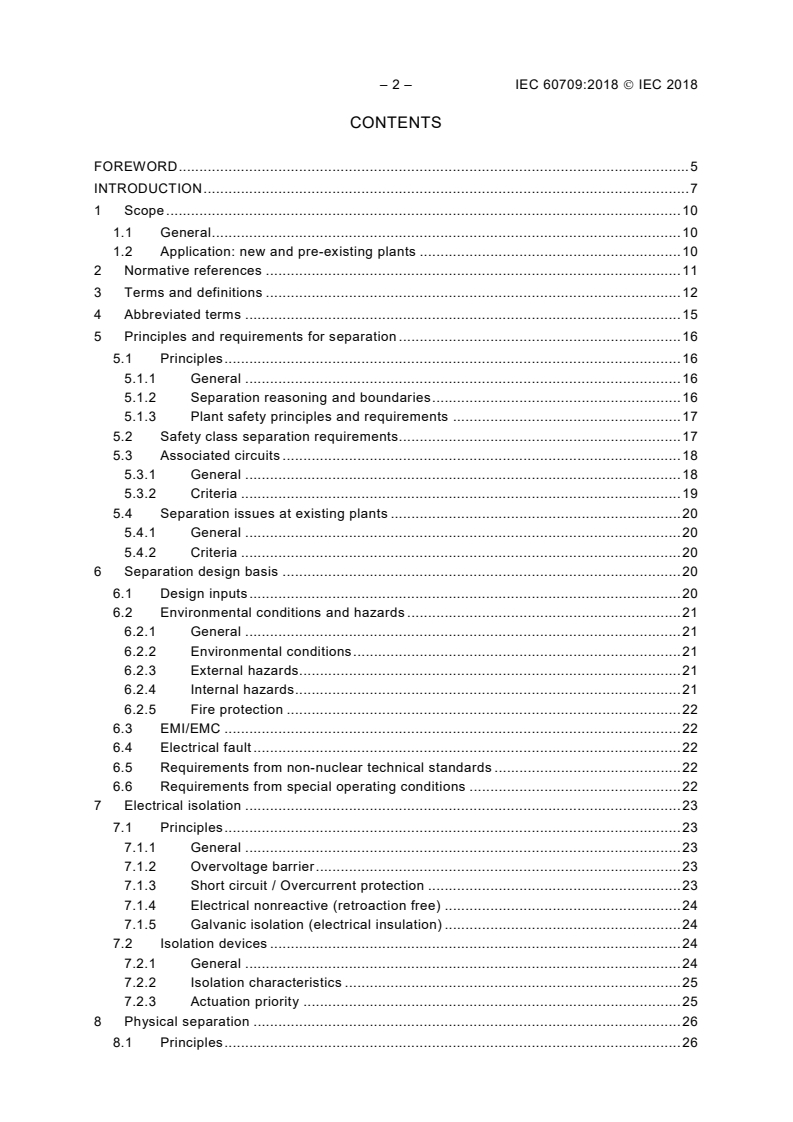
– 2 – IEC 60709:2018 IEC 2018
CONTENTS
FOREWORD . 5
INTRODUCTION . 7
1 Scope . 10
1.1 General . 10
1.2 Application: new and pre-existing plants . 10
2 Normative references . 11
3 Terms and definitions . 12
4 Abbreviated terms . 15
5 Principles and requirements for separation . 16
5.1 Principles . 16
5.1.1 General . 16
5.1.2 Separation reasoning and boundaries . 16
5.1.3 Plant safety principles and requirements . 17
5.2 Safety class separation requirements . 17
5.3 Associated circuits . 18
5.3.1 General . 18
5.3.2 Criteria . 19
5.4 Separation issues at existing plants . 20
5.4.1 General . 20
5.4.2 Criteria . 20
6 Separation design basis . 20
6.1 Design inputs . 20
6.2 Environmental conditions and hazards . 21
6.2.1 General . 21
6.2.2 Environmental conditions . 21
6.2.3 External hazards. 21
6.2.4 Internal hazards . 21
6.2.5 Fire protection . 22
6.3 EMI/EMC . 22
6.4 Electrical fault . 22
6.5 Requirements from non-nuclear technical standards . 22
6.6 Requirements from special operating conditions . 22
7 Electrical isolation . 23
7.1 Principles . 23
7.1.1 General . 23
7.1.2 Overvoltage barrier . 23
7.1.3 Short circuit / Overcurrent protection . 23
7.1.4 Electrical nonreactive (retroaction free) . 24
7.1.5 Galvanic isolation (electrical insulation) . 24
7.2 Isolation devices . 24
7.2.1 General . 24
7.2.2 Isolation characteristics . 25
7.2.3 Actuation priority . 25
8 Physical separation . 26
8.1 Principles . 26
8.1.1 General . 26
8.1.2 Separation by distance . 26
8.1.3 Structural separation . 26
8.2 Separation of cables and cable support structures . 26
8.2.1 General . 26
8.2.2 Divisional separation of redundant cables and cable support structures . 27
8.2.3 Separation of system cables and cable supporting structures of different
safety classes . 27
8.2.4 Separation of signal cables from power cables . 28
8.2.5 Reduced separation distances . 28
8.2.6 Associated circuits . 28
8.2.7 Separation of cables from tubes or pipes . 28
8.2.8 General routing considerations . 28
8.2.9 Identification . 28
8.3 Separation of components inside the I&C and electrical system important to
safety . 28
8.3.1 Divisional separation of redundant components inside the I&C and
electrical system important to safety . 28
8.3.2 Separation of components of different safety classes . 29
8.3.3 Installation of equipment of different voltage levels . 29
8.3.4 Reduced separation distances . 29
8.3.5 Associated circuits . 30
8.3.6 Separation of components from sources of hazards . 30
8.4 Control room cabinets, desks, panels and related cables . 30
9 Verification . 31
Annex A (normative) Relation to IAEA guidelines and IEC 61226 . 32
A.1 Object of this Annex . 32
A.2 Applicability of this document . 32
A.3 IAEA Guidelines, applicable for this document . 32
A.4 IEC standards, applicable for the safety categorization and classification . 32
A.5 Defence in Depth levels, simplified definitions . 33
Annex B (informative) Examples of separation realizations . 34
B.1 Object of this Annex . 34
B.2 Example of physical separation . 34
B.2.1 General . 34
B.2.2 Examples of physical separation by distance . 34
B.2.3 Examples of physical separation by structure . 36
B.3 Example of electrical isolation . 37
B.3.1 General . 37
B.3.2 Examples of overvoltage barriers . 37
B.3.3 Examples of short circuit / overcurrent protection . 38
B.3.4 Examples of galvanic isolation . 39
B.4 Example of EMC protection . 40
B.5 Associated circuits . 41
Annex C (informative) Examples of design errors and I&C and electrical failure events . 43
C.1 Object of this Annex . 43
C.2 Design errors . 43
C.3 I&C and electrical system failure events . 43
C.3.1 General . 43
– 4 – IEC 60709:2018 IEC 2018
C.3.2 Single random failure . 43
C.3.3 Multiple failures from a single common cause . 43
Annex D (informative) Functional independence and independence of communication . 44
D.1 Object of this Annex . 44
D.2 Functional independence . 44
D.2.1 General . 44
D.2.2 Independence from control system . 44
D.3 Independence of communication . 45
Bibliography . 46
Figure 1 – Physical separation by structure or distance . 17
Figure 2 – Separation by electrical isolation . 17
Figure 3 – Electrical Isolation measures and selection of components . 23
Figure B.1 – Separation of cable supporting structures by distance . 35
Figure B.2 – Separation of cable trays by distance. 35
Figure B.3 – Separation by structures . 36
Figure B.4 – Overvoltage barriers in I&C systems . 37
Figure B.5 – Overvoltage protection in electrical systems . 38
Figure B.6 – Short circuit protection in case of a cross-connection . 39
Figure B.7 – Galvanic isolation in I&C systems . 39
Figure B.8 – Galvanic isolation in electrical systems . 40
Figure B.9 – EMC protection of I&C cables . 41
Figure B.10 – Examples of associated circuits . 42
INTERNATIONAL ELECTROTECHNICAL COMMISSION
____________
NUCLEAR POWER PLANTS –
INSTRUMENTATION, CONTROL AND ELECTRICAL
POWER SYSTEMS IMPORTANT TO SAFETY – SEPARATION
FOREWORD
1) The International Electrotechnical Commission (IEC) is a worldwide organization for standardization comprising
all national electrotechnical committees (IEC National Committees). The object of IEC is to promote
international co-operation on all questions concerning standardization in the electrical and electronic fields. To
this end and in addition to other activities, IEC publishes International Standards, Technical Specifications,
Technical Reports, Publicly Available Specifications (PAS) and Guides (hereafter referred to as “IEC
Publication(s)”). Their preparation is entrusted to technical committees; any IEC National Committee interested
in the subject dealt with may participate in this preparatory work. International, governmental and non-
governmental organizations liaising with the IEC also participate in this preparation. IEC collaborates closely
with the International Organization for Standardization (ISO) in accordance with conditions determined by
agreement between the two organizations.
2) The formal decisions or agreements of IEC on technical matters express, as nearly as possible, an international
consensus of opinion on the relevant subjects since each technical committee has representation from all
interested IEC National Committees.
3) IEC Publications have the form of recommendations for international use and are accepted by IEC National
Committees in that sense. While all reasonable efforts are made to ensure that the technical content of IEC
Publications is accurate, IEC cannot be held responsible for the way in which they are used or for any
misinterpretation by any end user.
4) In order to promote international uniformity, IEC National Committees undertake to apply IEC Publications
transparently to the maximum extent possible in their national and regional publications. Any divergence
between any IEC Publication and the corresponding national or regional publication shall be clearly indicated in
the latter.
5) IEC itself does not provide any attestation of conformity. Independent certification bodies provide conformity
assessment services and, in some areas, access to IEC marks of conformity. IEC is not responsible for any
services carried out by independent certification bodies.
6) All users should ensure that they have the latest edition of this publication.
7) No liability shall attach to IEC or its directors, employees, servants or agents including individual experts and
members of its technical committees and IEC National Committees for any personal injury, property damage or
other damage of any nature whatsoever, whether direct or indirect, or for costs (including legal fees) and
expenses arising out of the publication, use of, or reliance upon, this IEC Publication or any other IEC
Publications.
8) Attention is drawn to the Normative references cited in this publication. Use of the referenced publications is
indispensable for the correct application of this publication.
9) Attention is drawn to the possibility that some of the elements of this IEC Publication may be the subject of
patent rights. IEC shall not be held responsible for identifying any or all such patent rights.
International Standard IEC 60709 has been prepared by subcommittee 45A: Instrumentation,
control and electrical power systems of nuclear facilities, of IEC technical committee 45:
Nuclear instrumentation.
This third edition cancels and replaces the second edition published in 2004. This edition
constitutes a technical revision.
This edition includes the following significant technical changes with respect to the previous
edition:
a) include requirements referring to the separation principle in electrical systems important to
safety;
b) define separation criteria for I&C and electrical systems in a generic way;
c) restructure the standard following the criteria;
d) consider interferences between I&C and electrical equipment from different safety
classes;
– 6 – IEC 60709:2018 IEC 2018
e) align with the new revisions of IAEA documents and broaden the scope to include other
aspects of separation;
f) cover new technologies that either present unique separation issues or provide new
means of achieving separation;
g) enhance requirements and guidance for areas of cable congestion, e.g. control room,
cable spreading galleries, etc;
h) introduce the concept of “associated circuits” (from US practice) to deal with equipment
not important to safety and cables that are not separated from safety equipment and
cables;
i) address the implications of low energy circuits, such as the possible use of analysis to
reduce the minimum separation distance;
j) review existing requirements, update terminology and definitions;
k) provide guidance for the application of the standard to existing plants.
The text of this International Standard is based on the following documents:
FDIS Report on voting
45A/1185/FDIS 45A/1195/RVD
Full information on the voting for the approval of this International Standard can be found in
the report on voting indicated in the above table.
This document has been drafted in accordance with the ISO/IEC Directives, Part 2.
The committee has decided that the contents of this document will remain unchanged until the
stability date indicated on the IEC website under "http://webstore.iec.ch" in the data related to
the specific document. At this date, the document will be
• reconfirmed,
• withdrawn,
• replaced by a revised edition, or
• amended.
IMPORTANT – The 'colour inside' logo on the cover page of this publication indicates
that it contains colours which are considered to be useful for the correct
understanding of its contents. Users should therefore print this document using a
colour printer.
INTRODUCTION
a) Background, main issues and organization of the standard
I&C and electrical systems important to safety in nuclear power plants need to tolerate the
effects of plant / equipment faults as well as internal and external hazards. Various
techniques are available to increase the level of tolerability of I&C and electrical systems to
such effects, including the provision of independent systems, subsystems and equipment. For
claims to be made of independence between such systems and equipment, adequate
separation should be provided and maintained. This standard provides generic technical
requirements and recommendations for the implementation of separation in the design of I&C
and electrical systems.
The object of this standard is as follows:
– in Clause 5 to present the principles for separation of I&C and/or electrical systems.
Subclause 5.4 focuses on modernization of existing nuclear power plants;
– in Clause 6, to define the separation design basis, including inputs, and to identify a
certain number of possible causes of internal and external hazards;
– in Clause 7, to establish the electrical isolation measures for I&C and electrical systems
important to safety and also requirements referring isolation devices;
– in Clause 8, to give requirements to be fulfilled for cabling and component separation
within an I&C and electrical system important to safety.
b) Situation of the current standard in the structure of the SC 45A standard series
IEC 60709 is a document of the second level, directly referenced by IEC 61513 and
IEC 63046 in regard to physical separation and electrical isolation being required between
subsystems of different safety trains of I&C and electrical systems important to safety, and
between I&C and electrical systems important to safety and those that are not important to
safety and between different defence in depth levels.
IEC 61226, that is consistent with IAEA SSG-30, establishes the principles of categorization
of I&C and electrical functions and the classification of structures, systems and components
(SSC) according to their level of importance to safety. IEC 61226 refers to IEC 60709 as the
normative standard regarding requirements for separation.
For more details on the relation of this standard to IAEA guidelines and IEC 61226, see
Annex A to this standard.
c) Recommendations and limitations regarding the application of the Standard
IEC 60709 applies to I&C and electrical systems and equipment important to safety. It
establishes requirements for physical and electrical separation as one means to provide
independence between the functions performed in those systems and equipment. Other
aspects of independence that may be required to address concerns of common cause failure
are not included in this standard. Furthermore, separation criteria due to security
requirements are also not considered.
The requirements given in this standard for the separation of safety classes can be applied to
separation for other design constraints, such as the defence in depth concept. These rules
shall be defined at the beginning of a project by a separation concept.
The separation of safety class 1 from other classes, as used in this standard, is only an
example of the application of the requirements of the standard.
– 8 – IEC 60709:2018 IEC 2018
d) Description of the structure of the IEC SC 45A standard series and relationships
with other IEC documents and other bodies documents (IAEA, ISO)
The top-level documents of the IEC SC 45A standard series are IEC 61513 and IEC 63046.
IEC 61513 provides general requirements for I&C systems and equipment that are used to
perform functions important to safety in NPPs. IEC 63046 provides general requirements for
electrical power systems of NPPs; it covers power supply systems including the supply
systems of the I&C systems. IEC 61513 and IEC 63046 are to be considered in conjunction
and at the same level. IEC 61513 and IEC 63046 structure the IEC SC 45A standard series
and shape a complete framework establishing general requirements for instrumentation,
control and electrical systems for nuclear power plants.
IEC 61513 and IEC 63046 refer directly to other IEC SC 45A standards for general topics
related to categorization of functions and classification of systems, qualification, separation,
defence against common cause failure, control room design, electromagnetic compatibility,
cybersecurity, software and hardware aspects for programmable digital systems, coordination
of safety and security requirements and management of ageing. The standards referenced
directly at this second level should be considered together with IEC 61513 and IEC 63046 as
a consistent document set.
At a third level, IEC SC 45A standards not directly referenced by IEC 61513 or by IEC 63046
are standards related to specific equipment, technical methods, or specific activities. Usually
these documents, which make reference to second-level documents for general topics, can be
used on their own.
A fourth level extending the IEC SC45A standard series, corresponds to the Technical
Reports which are not normative.
The IEC SC 45A standards series consistently implements and details the safety and security
principles and basic aspects provided in the relevant IAEA safety standards and in the
relevant documents of the IAEA nuclear security series (NSS). In particular this includes the
IAEA requirements SSR-2/1, establishing safety requirements related to the design of nuclear
power plants (NPPs), the IAEA safety guide SSG-30 dealing with the safety classification of
structures, systems and components in NPPs, the IAEA safety guide SSG-39 dealing with the
design of instrumentation and control systems for NPPs, the IAEA safety guide SSG-34
dealing with the design of electrical power systems for NPPs and the implementing guide
NSS17 for computer security at nuclear facilities. The safety and security terminology and
definitions used by SC 45A standards are consistent with those used by the IAEA.
IEC 61513 and IEC 63046 have adopted a presentation format similar to the basic safety
publication IEC 61508 with an overall life-cycle framework and a system life-cycle framework.
Regarding nuclear safety, IEC 61513 and IEC 63046 provide the interpretation of the general
requirements of IEC 61508-1, IEC 61508-2 and IEC 61508-4, for the nuclear application
sector. In this framework IEC 60880, IEC 62138 and IEC 62566 correspond to IEC 61508-3
for the nuclear application sector. IEC 61513 and IEC 63046 refer to ISO as well as to IAEA
GS-R part 2 and IAEA GS-G-3.1 and IAEA GS-G-3.5 for topics related to quality assurance
(QA). At level 2, regarding nuclear security, IEC 62645 is the entry document for the
IEC SC 45A security standards. It builds upon the valid high level principles and main
concepts of the generic security standards, in particular ISO/IEC 27001 and ISO/IEC 27002; it
adapts them and completes them to fit the nuclear context and coordinates with the
IEC 62443 series. At level 2, IEC 60964 is the entry document for the IEC SC 45A control
rooms standards and IEC 62342 is the entry document for the ageing management standards.
NOTE 1 It is assumed that for the design of I&C systems in NPPs that implement conventional safety functions
(e.g. to address worker safety, asset protection, chemical hazards, process energy hazards) international or
national standards would be applied.
NOTE 2 IEC SC 45A domain was extended in 2013 to cover electrical systems. In 2014 and 2015 discussions
were held in IEC SC 45A to decide how and where general requirements for the design of electrical systems were
to be considered. IEC SC 45A experts recommended that an independent standard be developed at the same level
as IEC 61513 to establish general requirements for electrical systems. Project IEC 63046 is now launched to cover
this objective. When IEC 63046 will be published this NOTE 2 of the introduction of IEC SC 45A standards will be
suppressed.
– 10 – IEC 60709:2018 IEC 2018
NUCLEAR POWER PLANTS –
INSTRUMENTATION, CONTROL AND ELECTRICAL
POWER SYSTEMS IMPORTANT TO SAFETY – SEPARATION
1 Scope
1.1 General
This document is applicable to nuclear power plant instrumentation and control (I&C) and
electrical systems and equipment, whose functions are required to be independent due to
their contribution to:
• a redundant or diverse safety group;
• different defence in depth levels;
• different safety classes and also with non-classified (NC) systems.
It is also applicable to temporary installations which are part of those I&C and electrical
systems important to safety (for example, auxiliary equipment for commissioning tests and
experiments or mobile power supply systems). Clause 7 is intended particularly for electrical
isolation, Clause 8 is intended particularly for the cabling and the arrangement of equipment
of I&C and electrical systems important to safety.
This document applies to I&C and electrical systems of new nuclear power plants and to I&C
and electrical upgrading or back-fitting of existing plants. For existing plants see 1.2 and 5.4.
Where independence is required by general safety standards such as IAEA safety guides,
IEC 61513 (for I&C), IEC 63046 (for electrical systems) and other project constraints, one
aspect of achieving this independence is physical separation and electrical isolation between
the systems and their equipment that perform safety functions. This document defines the
assessments needed and the technical requirements to be met for I&C and electrical systems,
equipment or cables for which separation is required. Those means are to achieve adequate
physical separation and electrical isolation between redundant sections of a system and
between a higher and lower class systems. This separation is needed to prevent or minimise
the impact on safety that could result from faults and failures which could be propagated or
affect several sections of a system or several systems.
The requirements for functions, and their associated systems and equipment, to be
independent are normally defined in detail in the project documentation; the method of
determining and defining these requirements is not the subject of this document.
Following IAEA SSR-2/1 Requirement 21, separation means by physical separation, electrical
isolation, functional independence and independence of communication are considered. In
this document physical separation and electrical isolation are treated. Functional
independence and independence of communication are not considered in this document.
More details referring to functional independence, independence from control systems and
independence of communication are given in Annex D.
1.2 Application: new and pre-existing plants
This document applies to the I&C and electrical of new nuclear power plants as well as to up-
grading or back-fitting of existing plants.
For existing plants, only a subset of requirements is applicable and this subset is normally
specified and argued at the beginning of any project.
2 Normative references
The following documents are referred to in the text in such a way that some or all of their
content constitutes requirements of this document. For dated references, only the edition
cited applies. For undated references, the latest edition of the referenced document (including
any amendments) applies.
IEC 60071 (all parts), Insulation co-ordination
IEC 60332 (all parts), Tests on electric cables under fire conditions
IEC 60364-4-41, Low-voltage electrical installations – Part 4-41: Protection for safety –
Protection against electric shock
IEC 60364-5-52, Low-voltage electrical installations – Part 5-52: Selection and erection of
electrical equipment – Wiring systems
IEC 60364-5-56, Low-voltage electrical installations – Part 5-56: Selection and erection of
electrical equipment – Safety services
IEC 60909 (all parts), Short-circuit currents in three-phase a.c. systems
IEC 60964, Nuclear power plants – Control rooms – Design
IEC 61000 (all parts), Electromagnetic compatibility (EMC)
IEC 61226, Nuclear power plants – Instrumentation and control important to safety –
Classification of instrumentation and control functions
IEC 61439-1, Low voltage switchgear and controlgear assemblies – Part 1: General rules
IEC 61500, Nuclear power plants – Instrumentation and control important to safety – Data
communication in systems performing category A functions
IEC 61513:2011, Nuclear power plants – Instrumentation and control important to safety –
General requirements for systems
IEC 61660 (all parts), Short-circuit currents in d.c. auxiliary installations in power plants and
substations
IEC 62003, Nuclear power plants – Instrumentation and control important to safety –
Requirements for electromagnetic compatibility testing
IEC TR 62096, Nuclear power plants – Instrumentation and control – Guidance for the
decision on modernisation
IEC 62808, Nuclear power plants – Instrumentation and control systems important to safety –
Design and qualification of isolation devices
IEC 63046, Nuclear power plants – Electrical systems – General requirements
IAEA Safety Standard Series No. SSR-2/1:2016, Safety of Nuclear Power Plant: Design
____________
To be published.
– 12 – IEC 60709:2018 IEC 2018
IAEA Safety Guide SSG-30, Safety classification of structures, systems and components in
Nuclear Power Plants
IAEA Safety Guide SSG-34, Design of electrical power systems in Nuclear Power Plants
IAEA Safety Guide SSG-39:2016, Design of instrumentation and control systems in Nuclear
Power Plants
3 Terms and definitions
For the purposes of this document, the following terms and definitions apply.
ISO and IEC maintain terminological databases for use in standardization at the following
addresses:
• IEC Electropedia: available at http://www.electropedia.org/
• ISO Online browsing platform: available at http://www.iso.org/obp
3.1
associated circuit
circuit of a lower safety class that is not physically separated or is not electrically isolated
from the circuit(s) of the higher class by acceptable separation distances, safety class
structures, barriers, or electrical isolation devices, but meets suitable criteria for safety.
Circuits include the interconnecting cabling and the connected loads
3.2
barrier
device or structure interposed between redundant equipment or circuits important to safety, or
between equipment or circuits important to safety and a potential source of damage to limit
damage to the I&C system or electrical system important to safety to an acceptable level
Note 1 to entry: The following definition is to be found in the IAEA Safety Glossary edition 2016: “A physical
obstruction that prevents or inhibits the movement of people, radionuclides or some other phenomenon (e.g. fire),
or provides shielding against radiation”. This IAEA definition is more general but consistent with the definition given
in this document.
3.3
cable route
physical pathway through the plant along which multiple cables can be laid, such as through a
room or duct in the plant building, or a metal duct, tray, or tube, or a duct below or gantry over
roads
3.4
common cause failure
CCF
failures of two or more structures, systems and components due to a single specific event or
cause
EXAMPLE For example, the single specific event or cause of failures (which may be failures of different types)
could be a design deficiency, a manufacturing deficiency, operation and maintenance errors, a natural
phenomenon, a human induced event, saturation of signals, or an unintended cascading effect from any other
operation or failure within the plant or from a change in ambient conditions.
[SOURCE: IAEA Safety Glossary, edition 2016]
3.5
defence in depth
hierarchical deployment of different levels of diverse equipment and procedures to prevent the
escalation of anticipated operational occurrences and to maintain the effectiveness of
physical barriers placed between a radiation source or radioactive material and workers,
members of the public or the environment, in operational states and, for some barriers, in
accident conditions
[SOURCE: IAEA Safety Glossary, edition 2016]
3.6
design extension condition
postulated accident conditions that are not considered for design basis accidents, but that are
considered in the design process of the facility in accordance with best estimate methodology,
and for which releases of radioactive material are kept within acceptable limits. Design
extension conditions comprise conditions in events without significant fuel degradation and
conditions in events with melting of the reactor core
[SOURCE: IAEA Safety Glossary, edition 2016]
3.7
distance
placement of the components being protected sufficiently far away from one another so as to
ensure that they cannot be simultaneously damaged by the considered event
3.8
diversity
presence of two or more independent (redundant) systems or components to perform an
identified function, where the different systems or components have different attributes so as
to reduce the possibility of common cause failure, including common mode failure
[SOURCE: IAEA Safety Glossary, edition 2016]
3.9
division
collection of items, including their interconnections, that form one redundancy of a redundant
system or safety group. Divisions may include multiple channels
N
...