


IEC PAS 63151:2018
(Main)Measurement procedure for the assessment of specific absorption rate of human exposure to radio frequency fields from hand-held and body-mounted wireless communication devices - Vector measurement-based systems (Frequency range of 30 MHz to 6 GHz)
General Information
- Abstract
IEC PAS 63151:2018(E) specifies protocols and test procedures for the reproducible measurement of the peak spatial-average specific absorption rate (psSAR) induced inside a simplified model of the head or the body by radio-frequency (RF) transmitting devices, with a defined uncertainty. It provides requirements for systems using vector measurement-based systems. Such systems determine the psSAR by 3D field reconstruction within the volume of interest by specifying the requirements for the measurement system, calibration, uncertainty assessment and validation methods. The protocols and procedures apply for a significant majority of people including children during use of hand-held and body-worn wireless communication devices.
This PAS is applicable to any wireless communication device intended to be used at a position near the human head or body at distances up to and including 200 mm. This PAS can be employed to evaluate SAR compliance of different types of wireless communication devices used next to the ear, in front of the face, mounted on the body, combined with other RF-transmitting or non-transmitting devices or accessories (e.g. belt-clip), or embedded in garments. The overall applicable frequency range is from 30 MHz to 6 GHz.
The system validation procedures provided within this PAS cover frequencies from 600 MHz to 6 GHz.
Some specifications (e.g., validation antennas and other procedures or requirements) are not yet defined over the full frequency range within the scope of this document but will be included in a future revision.
The device categories covered include but are not limited to mobile telephones, cordless microphones, auxiliary broadcast devices and radio transmitters in personal computers, desktop, laptop devices, multi-band, multi-antenna, and push-to-talk devices.
- Status
- Withdrawn
- Publication Date
- 14-Jan-2018
- Withdrawal Date
- 26-Mar-2020
- Current Stage
- WPUB - Publication withdrawn
- Start Date
- 27-Mar-2020
- Completion Date
- 27-Mar-2020
Buy Documents
IEC PAS 63151:2018 - Measurement procedure for the assessment of specific absorption rate of human exposure to radio frequency fields from hand-held and body-mounted wireless communication devices - Vector measurement-based systems (Frequency range of 30 MHz to 6 GHz) Released:1/15/2018
Buy Documents
IEC PAS 63151:2018 - Measurement procedure for the assessment of specific absorption rate of human exposure to radio frequency fields from hand-held and body-mounted wireless communication devices - Vector measurement-based systems (Frequency range of 30 MHz to 6 GHz) Released:1/15/2018
Get Certified
Connect with accredited certification bodies for this standard

BSMI (Bureau of Standards, Metrology and Inspection)
Taiwan's standards and inspection authority.
Sponsored listings
Frequently Asked Questions
IEC PAS 63151:2018 is a technical specification published by the International Electrotechnical Commission (IEC). Its full title is "Measurement procedure for the assessment of specific absorption rate of human exposure to radio frequency fields from hand-held and body-mounted wireless communication devices - Vector measurement-based systems (Frequency range of 30 MHz to 6 GHz)". This standard covers: IEC PAS 63151:2018(E) specifies protocols and test procedures for the reproducible measurement of the peak spatial-average specific absorption rate (psSAR) induced inside a simplified model of the head or the body by radio-frequency (RF) transmitting devices, with a defined uncertainty. It provides requirements for systems using vector measurement-based systems. Such systems determine the psSAR by 3D field reconstruction within the volume of interest by specifying the requirements for the measurement system, calibration, uncertainty assessment and validation methods. The protocols and procedures apply for a significant majority of people including children during use of hand-held and body-worn wireless communication devices. This PAS is applicable to any wireless communication device intended to be used at a position near the human head or body at distances up to and including 200 mm. This PAS can be employed to evaluate SAR compliance of different types of wireless communication devices used next to the ear, in front of the face, mounted on the body, combined with other RF-transmitting or non-transmitting devices or accessories (e.g. belt-clip), or embedded in garments. The overall applicable frequency range is from 30 MHz to 6 GHz. The system validation procedures provided within this PAS cover frequencies from 600 MHz to 6 GHz. Some specifications (e.g., validation antennas and other procedures or requirements) are not yet defined over the full frequency range within the scope of this document but will be included in a future revision. The device categories covered include but are not limited to mobile telephones, cordless microphones, auxiliary broadcast devices and radio transmitters in personal computers, desktop, laptop devices, multi-band, multi-antenna, and push-to-talk devices.
IEC PAS 63151:2018(E) specifies protocols and test procedures for the reproducible measurement of the peak spatial-average specific absorption rate (psSAR) induced inside a simplified model of the head or the body by radio-frequency (RF) transmitting devices, with a defined uncertainty. It provides requirements for systems using vector measurement-based systems. Such systems determine the psSAR by 3D field reconstruction within the volume of interest by specifying the requirements for the measurement system, calibration, uncertainty assessment and validation methods. The protocols and procedures apply for a significant majority of people including children during use of hand-held and body-worn wireless communication devices. This PAS is applicable to any wireless communication device intended to be used at a position near the human head or body at distances up to and including 200 mm. This PAS can be employed to evaluate SAR compliance of different types of wireless communication devices used next to the ear, in front of the face, mounted on the body, combined with other RF-transmitting or non-transmitting devices or accessories (e.g. belt-clip), or embedded in garments. The overall applicable frequency range is from 30 MHz to 6 GHz. The system validation procedures provided within this PAS cover frequencies from 600 MHz to 6 GHz. Some specifications (e.g., validation antennas and other procedures or requirements) are not yet defined over the full frequency range within the scope of this document but will be included in a future revision. The device categories covered include but are not limited to mobile telephones, cordless microphones, auxiliary broadcast devices and radio transmitters in personal computers, desktop, laptop devices, multi-band, multi-antenna, and push-to-talk devices.
IEC PAS 63151:2018 is classified under the following ICS (International Classification for Standards) categories: 17.220.20 - Measurement of electrical and magnetic quantities; 17.240 - Radiation measurements. The ICS classification helps identify the subject area and facilitates finding related standards.
IEC PAS 63151:2018 is available in PDF format for immediate download after purchase. The document can be added to your cart and obtained through the secure checkout process. Digital delivery ensures instant access to the complete standard document.
Standards Content (Sample)
IEC PAS 63151 ®
Edition 1.0 2018-01
PUBLICLY AVAILABLE
SPECIFICATION
PRE-STANDARD
colour
inside
Measurement procedure for the assessment of specific absorption rate of
human exposure to radio frequency fields from hand-held and body-mounted
wireless communication devices – Vector measurement-based systems
(Frequency range of 30 MHz to 6 GHz)
All rights reserved. Unless otherwise specified, no part of this publication may be reproduced or utilized in any form
or by any means, electronic or mechanical, including photocopying and microfilm, without permission in writing from
either IEC or IEC's member National Committee in the country of the requester. If you have any questions about IEC
copyright or have an enquiry about obtaining additional rights to this publication, please contact the address below or
your local IEC member National Committee for further information.
IEC Central Office Tel.: +41 22 919 02 11
3, rue de Varembé info@iec.ch
CH-1211 Geneva 20 www.iec.ch
Switzerland
About the IEC
The International Electrotechnical Commission (IEC) is the leading global organization that prepares and publishes
International Standards for all electrical, electronic and related technologies.
About IEC publications
The technical content of IEC publications is kept under constant review by the IEC. Please make sure that you have the
latest edition, a corrigenda or an amendment might have been published.
IEC Catalogue - webstore.iec.ch/catalogue Electropedia - www.electropedia.org
The stand-alone application for consulting the entire The world's leading online dictionary of electronic and
bibliographical information on IEC International Standards, electrical terms containing 21 000 terms and definitions in
Technical Specifications, Technical Reports and other English and French, with equivalent terms in 16 additional
documents. Available for PC, Mac OS, Android Tablets and languages. Also known as the International Electrotechnical
iPad. Vocabulary (IEV) online.
IEC publications search - webstore.iec.ch/advsearchform IEC Glossary - std.iec.ch/glossary
The advanced search enables to find IEC publications by a 67 000 electrotechnical terminology entries in English and
variety of criteria (reference number, text, technical French extracted from the Terms and Definitions clause of
committee,…). It also gives information on projects, replaced IEC publications issued since 2002. Some entries have been
and withdrawn publications. collected from earlier publications of IEC TC 37, 77, 86 and
CISPR.
IEC Just Published - webstore.iec.ch/justpublished
Stay up to date on all new IEC publications. Just Published IEC Customer Service Centre - webstore.iec.ch/csc
details all new publications released. Available online and If you wish to give us your feedback on this publication or
also once a month by email. need further assistance, please contact the Customer Service
Centre: sales@iec.ch.
IEC PAS 63151 ®
Edition 1.0 2018-01
PUBLICLY AVAILABLE
SPECIFICATION
PRE-STANDARD
colour
inside
Measurement procedure for the assessment of specific absorption rate of
human exposure to radio frequency fields from hand-held and body-mounted
wireless communication devices – Vector measurement-based systems
(Frequency range of 30 MHz to 6 GHz)
INTERNATIONAL
ELECTROTECHNICAL
COMMISSION
ICS 17.220.20, 17.240 ISBN 978-2-8322-5178-2
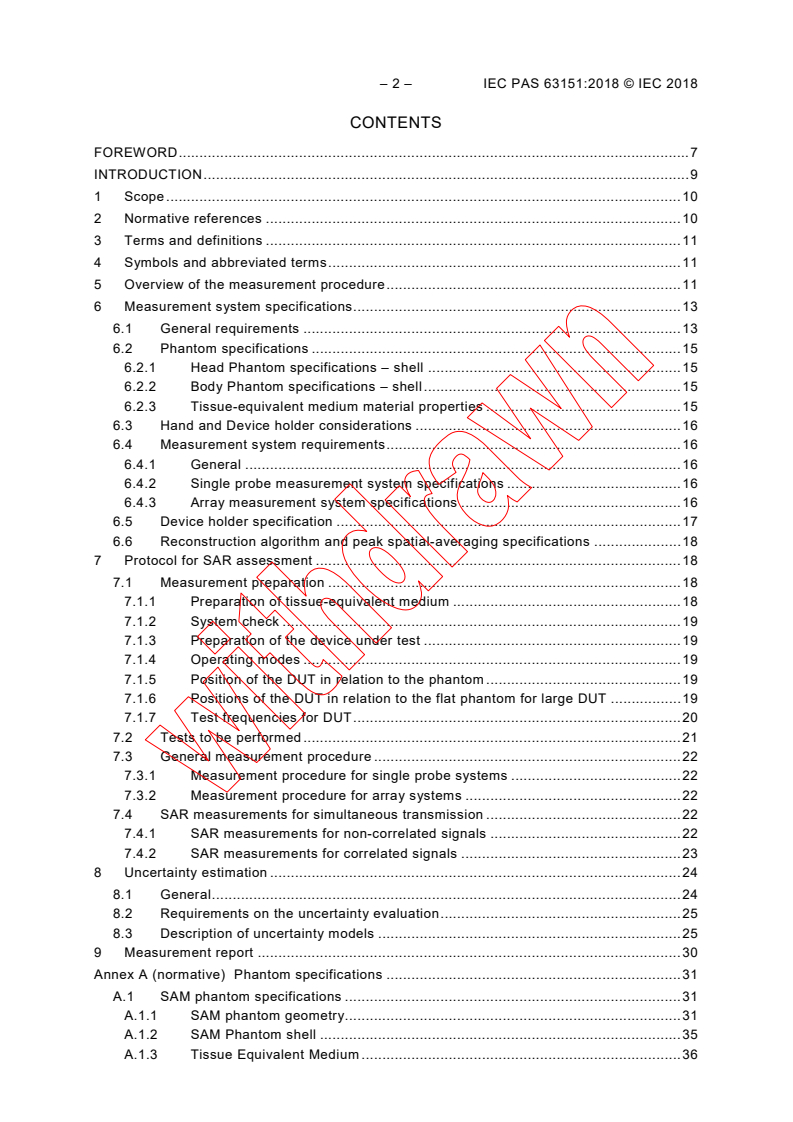
– 2 – IEC PAS 63151:2018 © IEC 2018
CONTENTS
FOREWORD . 7
INTRODUCTION . 9
1 Scope . 10
2 Normative references . 10
3 Terms and definitions . 11
4 Symbols and abbreviated terms . 11
5 Overview of the measurement procedure . 11
6 Measurement system specifications . 13
6.1 General requirements . 13
6.2 Phantom specifications . 15
6.2.1 Head Phantom specifications – shell . 15
6.2.2 Body Phantom specifications – shell . 15
6.2.3 Tissue-equivalent medium material properties . 15
6.3 Hand and Device holder considerations . 16
6.4 Measurement system requirements . 16
6.4.1 General . 16
6.4.2 Single probe measurement system specifications . 16
6.4.3 Array measurement system specifications . 16
6.5 Device holder specification . 17
6.6 Reconstruction algorithm and peak spatial-averaging specifications . 18
7 Protocol for SAR assessment . 18
7.1 Measurement preparation . 18
7.1.1 Preparation of tissue-equivalent medium . 18
7.1.2 System check . 19
7.1.3 Preparation of the device under test . 19
7.1.4 Operating modes . 19
7.1.5 Position of the DUT in relation to the phantom . 19
7.1.6 Positions of the DUT in relation to the flat phantom for large DUT . 19
7.1.7 Test frequencies for DUT . 20
7.2 Tests to be performed . 21
7.3 General measurement procedure . 22
7.3.1 Measurement procedure for single probe systems . 22
7.3.2 Measurement procedure for array systems . 22
7.4 SAR measurements for simultaneous transmission . 22
7.4.1 SAR measurements for non-correlated signals . 22
7.4.2 SAR measurements for correlated signals . 23
8 Uncertainty estimation . 24
8.1 General . 24
8.2 Requirements on the uncertainty evaluation . 25
8.3 Description of uncertainty models . 25
9 Measurement report . 30
Annex A (normative) Phantom specifications . 31
A.1 SAM phantom specifications . 31
A.1.1 SAM phantom geometry. 31
A.1.2 SAM Phantom shell . 35
A.1.3 Tissue Equivalent Medium . 36
A.2 Flat phantom specifications . 37
A.3 Specific phantoms. 38
A.4 Tissue-equivalent medium . 39
Annex B (normative) Calibration and characterization of dosimetric probes. 40
B.1 Introduction . 40
B.2 Types of calibration . 40
B.2.1 Amplitude calibration with analytical fields . 40
B.2.2 Amplitude and phase calibration by transfer calibration . 41
B.2.3 Amplitude and phase calibration using numerical reference . 42
Annex C (informative) Field Reconstruction Techniques . 45
C.1 Introduction . 45
C.2 Objective of Field Reconstruction Techniques . 45
C.3 Background. 45
C.4 Reconstruction Techniques . 47
C.4.1 Expansion Techniques . 47
C.4.2 Source Reconstruction Techniques . 48
C.4.3 Source Base Function Decomposition . 48
C.4.4 Phase Reconstruction . 48
C.4.5 Other Approaches . 48
C.5 Source reconstruction and SAR estimation from fields measured outside the
phantom. 49
Annex D (normative) SAR measurement system verification and validation . 50
D.1 Introduction . 50
D.1.1 Objectives and purpose of system check . 50
D.1.2 Objectives of system validation . 50
D.2 SAR measurement setup and procedure for system check and system
validation . 51
D.2.1 General . 51
D.2.2 Power measurement setups . 52
D.2.3 Procedure to normalize the measured SAR. 53
D.2.4 Power measurement uncertainty . 55
D.3 System check . 56
D.3.1 System check antennas and test conditions . 56
D.3.2 System check acceptance criteria . 56
D.4 System validation . 57
D.4.1 Requirements for system validation antennas and test conditions . 57
D.4.2 Test positions for system validation . 58
D.4.3 System validation procedure based on peak spatial-average SAR . 61
D.4.4 Validation acceptance criteria . 70
Annex E (informative) Interlaboratory comparisons . 71
E.1 Purpose . 71
E.2 Monitor laboratory . 71
E.3 Phantom set-up . 71
E.4 Reference devices . 71
E.5 Power set-up . 71
E.6 Interlaboratory comparison – Procedure. 72
Annex F (normative) Validation antennas . 73
F.1 Introduction . 73
F.2 Standard dipole antenna . 73
– 4 – IEC PAS 63151:2018 © IEC 2018
F.3 VPIFA . 75
F.4 2-PEAK CPIFA . 80
F.5 Additional antennas . 83
Annex G (normative) Calibration of Reference Antennas . 85
G.1 Introduction . 85
G.2 Parameters or quantities and ranges to be determined by calibration method . 86
G.3 Reference Antenna Calibration Setup . 86
G.4 Reference Antenna Calibration procedure . 87
G.4.1 Verification of Return Loss . 87
G.4.2 Calibration of Reference Antennas: Step-by-Step Procedure . 87
G.4.3 Uncertainty Budget of Reference Antenna Calibration . 88
Annex H (normative) General considerations on uncertainty estimation . 93
H.1 Concept of uncertainty estimation . 93
H.2 Type A and Type B evaluation . 94
H.3 Degrees of freedom and coverage factor . 94
H.4 Combined and expanded uncertainties . 95
H.5 Analytical reference functions . 96
Annex I (normative) Evaluation of the measurement system uncertainty . 99
I.1 Measuring system uncertainties to be specified by the manufacturer . 99
I.1.1 Calibration CF. 99
I.1.2 Vector probe or vector probe-array isotropy ISO . 99
I.1.3 Mutual sensor coupling MSC . 100
I.1.4 Scattering within the array AS . 100
I.1.5 System linearity LIN . 102
I.1.6 Sensitivity limit SL . 102
I.1.7 Boundary effect BE . 102
I.1.8 Readout electronics RE . 103
I.1.9 Response time RT . 103
I.1.10 Probe positioning PP . 103
I.1.11 Sampling error SE . 104
I.1.12 Array boundaries AB . 105
I.1.13 Phantom shell PS . 105
I.1.14 Tissue-equivalent material parameters MAT . 106
I.1.15 Phantom Homogeneity HOM . 108
I.2 Uncertainty of post-processing algorithms . 108
I.2.1 Introduction . 108
I.2.2 Evaluation of uncertainty due to reconstruction REC . 108
I.2.3 Impact of noise on interpolation and extrapolation POL . 109
I.2.4 SAR Averaging SAV . 109
I.2.5 SAR scaling SARS . 109
I.2.6 SAR correction for deviations in permittivity and conductivity SC . 109
I.3 Measuring system errors which are dependent on the DUT . 111
I.3.1 Introduction . 111
I.3.2 Probe or probe-array coupling with the DUT PAC . 111
I.3.3 Modulation Response MOD . 112
I.3.4 Integration time IT . 112
I.3.5 Measurement system drift and noise DN . 112
I.4 DUT-related errors or validation antenna related errors and environmental
factors . 114
I.4.1 Device holder DH . 114
I.4.2 Device Positioning DP . 115
I.4.3 Measured SAR drift SD . 115
I.4.4 RF ambient conditions AC . 115
I.4.5 Measurement system immunity/secondary reception MSI . 115
I.4.6 Deviation of experimental antennas DEX . 116
I.4.7 Other uncertainty contributions when using validation antennas OVS . 116
Bibliography . 117
Figure 1 – Evaluation plan checklist . 12
Figure 2 – Illustration of the shape and orientation relative to a curved phantom
surface of the distorted cubic volume for computing peak spatial-average SAR . 18
Figure 3 – Measurements performed by shifting a large device over the efficient
measurement area of the system including overlapping areas – in this case: 6 tests
performed . 20
Figure A.1 – Illustration of dimensions in Table A.1 and Table A.2 . 32
Figure A.2 – Close up side view of phantom showing the ear region . 34
Figure A.3 – Side view of the phantom showing relevant markings, dimensions are in mm. . 34
Figure A.4 – Cross-sectional view of SAM at the reference plane. 36
Figure A.5 – Sagittally bisected phantom with extended perimeter, used for single
probe systems . 37
Figure A.6 – Dimensions of the elliptical phantom . 38
Figure C.1 – Coordinate system for 2D planar measurement-system . 46
Figure C.2 – Generic configuration of SAR measurement system . 46
Figure C.3 – Schematic representation of 2D planar measurement-based SAR system
and its coordinate system . 48
Figure C.4 – Source Reconstruction outside the phantom . 49
Figure D.1 – A Recommended power measurement setup for system check and
system validation . 52
Figure D.2 – Equipment setup for measurement of forward power P . 53
fc
Figure D.3 – Equipment setup for measuring the shorted reverse coupled power P . 54
rcs
Figure D.4 – Equipment setup for measuring the power with the Reference antenna
connected . 54
Figure D.5 – System check and validation locations for the flat phantom for minimal
device specs (the minimal L and W shall be 160 mm x 80 mm) . 59
Figure D.6 – System check and validation locations for the head phantom . 60
Figure D.7 – Definition of rotation angles for dipoles . 61
Figure F.1 – Mechanical details of the standard dipole . 75
Figure F.2 – VPIFA validation antenna . 77
Figure F.3 – Masks for positioning VPIFAs . 78
Figure F.4 – Peak CPIFA at 2450 MHz . 82
Figure F.5 – Tuning structure and matching structure . 82
Figure G.1 – Measurement setup for waveguide calibration of dosimetric probe, and
similar setup (same tissue-equivalent liquid, dielectric spacer, power sensors and
coupler) for antenna calibration . 86
Figure G.2 – Setup for calibration of a reference antenna . 87
– 6 – IEC PAS 63151:2018 © IEC 2018
Figure I.1 – Illustration of the SAR measurements during 8 hours and the centered
moving average . 113
Table 1 – Evaluation plan checklist . 13
Table 2 – Uncertainty budget template for the evaluation of the measurement system
uncertainty of the 1 g or 10 g psSAR to be carried out by the system manufacturer (N =
normal, R = rectangular) . 27
Table 3 – Uncertainty budget template for evaluating the uncertainty in the measured
value of 1 g SAR or 10 g SAR from a DUT (N = normal, R = rectangular). 28
Table 4 – Uncertainty budget template for evaluating the uncertainty in the measured
value of 1 g SAR or 10 g SAR from a validation antenna (N = normal, R = rectangular) . 29
Table 5 – Uncertainty budget template for evaluating the uncertainty in the measured
value of 1 g SAR or 10 g SAR from the system check (N = normal, R = rectangular) . 30
th
Table A.1 – Dimensions used in deriving SAM phantom from the ARMY 90 percentile
male head data (Gordon et al.[61]) . 33
Table A.2 – Additional SAM dimensions compared with selected dimensions from the
th
ARMY 90 -percentile male head data (Gordon et al. [61]) – Specialist head
measurement section . 33
Table A.3 – Dielectric properties of the tissue-equivalent medium . 39
Table B.1 – Uncertainty analysis of single-probe calibration in waveguide . 41
Table B.2 – Uncertainty analysis of transfer calibration of array systems . 42
Table B.3 – Uncertainty analysis of transfer calibration of array systems . 44
Table D.1 – Modulations and multiplexing methods used by radio systems . 58
Table D.2a – Peak spatial SAR (psSAR) averaged over 1g and 10g values for the flat
phantom filled with tissue simulating material for the antennas defined in Annex F.
Modulations are as defined in Table D.1 . 62
Table D.2b – Peak spatial SAR (psSAR) averaged over 1g and 10g values for antenna
generating two peaks on the flat phantom filled with tissue simulating material for the
antennas defined in Annex F. Modulations are as defined in Table D.1 . 64
Table D.3a – Peak spatial SAR (psSAR) averaged over 1g and 10g values on the
head left and right phantom for the antennas defined in Annex F. Modulations are as
defined in Table D.1 . 65
Table D.3b – Peak spatial SAR (psSAR) averaged over 1g and 10g values for antenna
generating two peaks on the head left and right phantom for the antennas defined in
Annex F. Modulations are as defined in Table D.1 . 69
Table F.1 – Mechanical dimensions of the reference dipoles . 74
Table F.2 – Dimensions for VPIFA antennas at different frequencies . 79
Table F.3 – Electric properties for the dielectric layers for VPIFA antennas . 79
Table F.4 – Thickness of substrates and planar metallization . 83
Table F.5 – Dielectric properties for FR4 . 83
Table F.6 – Lengths for the different components . 83
Table G.1 – Example uncertainty budget for reference antenna (DIPOLE) calibration
for 1g and 10g averaged SAR (750 MHz – 3 GHz) . 90
Table G.2 – Example uncertainty budget for reference antenna calibration (PIFA) for 1
g and 10 g averaged SAR (750 MHz – 3 GHz) . 91
Table G.3 – Example uncertainty budget for reference antenna (DIPOLE) calibration
for 1g and 10g averaged SAR (3 – 6 GHz) . 92
Table H.1 – Parameters of analytical reference functions and associated reference
peak 10g SAR value. Reference peak 1g SAR value is 1 W/kg for every function . 98
INTERNATIONAL ELECTROTECHNICAL COMMISSION
____________
MEASUREMENT PROCEDURE FOR THE ASSESSMENT OF
SPECIFIC ABSORPTION RATE OF HUMAN EXPOSURE TO RADIO
FREQUENCY FIELDS FROM HAND-HELD AND BODY-MOUNTED
WIRELESS COMMUNICATION DEVICES –
Vector measurement-based systems
(Frequency range of 30 MHz to 6 GHz)
FOREWORD
1) The International Electrotechnical Commission (IEC) is a worldwide organization for standardization comprising
all national electrotechnical committees (IEC National Committees). The object of IEC is to promote
international co-operation on all questions concerning standardization in the electrical and electronic fields. To
this end and in addition to other activities, IEC publishes International Standards, Technical Specifications,
Technical Reports, Publicly Available Specifications (PAS) and Guides (hereafter referred to as “IEC
Publication(s)”). Their preparation is entrusted to technical committees; any IEC National Committee interested
in the subject dealt with may participate in this preparatory work. International, governmental and non-
governmental organizations liaising with the IEC also participate in this preparation. IEC collaborates closely
with the International Organization for Standardization (ISO) in accordance with conditions determined by
agreement between the two organizations.
2) The formal decisions or agreements of IEC on technical matters express, as nearly as possible, an international
consensus of opinion on the relevant subjects since each technical committee has representation from all
interested IEC National Committees.
3) IEC Publications have the form of recommendations for international use and are accepted by IEC National
Committees in that sense. While all reasonable efforts are made to ensure that the technical content of IEC
Publications is accurate, IEC cannot be held responsible for the way in which they are used or for any
misinterpretation by any end user.
4) In order to promote international uniformity, IEC National Committees undertake to apply IEC Publications
transparently to the maximum extent possible in their national and regional publications. Any divergence
between any IEC Publication and the corresponding national or regional publication shall be clearly indicated in
the latter.
5) IEC itself does not provide any attestation of conformity. Independent certification bodies provide conformity
assessment services and, in some areas, access to IEC marks of conformity. IEC is not responsible for any
services carried out by independent certification bodies.
6) All users should ensure that they have the latest edition of this publication.
7) No liability shall attach to IEC or its directors, employees, servants or agents including individual experts and
members of its technical committees and IEC National Committees for any personal injury, property damage or
other damage of any nature whatsoever, whether direct or indirect, or for costs (including legal fees) and
expenses arising out of the publication, use of, or reliance upon, this IEC Publication or any other IEC
Publications.
8) Attention is drawn to the Normative references cited in this publication. Use of the referenced publications is
indispensable for the correct application of this publication.
9) Attention is drawn to the possibility that some of the elements of this IEC Publication may be the subject of
patent rights. IEC shall not be held responsible for identifying any or all such patent rights.
A PAS is a technical specification not fulfilling the requirements for a standard, but made
available to the public.
– 8 – IEC PAS 63151:2018 © IEC 2018
IEC PAS 63151 has been prepared by IEC technical committee 106: Methods for the
assessment of electric, magnetic and electromagnetic fields associated with human exposure.
The text of this PAS is based on the This PAS was approved for
following document: publication by the P-members of the
committee concerned as indicated in
the following document
Draft PAS Report on voting
106/410/DPAS 106/420/RVDPAS
Following publication of this PAS, which is a pre-standard publication, the technical committee
or subcommittee concerned may transform it into an International Standard.
This PAS shall remain valid for an initial maximum period of 3 years starting from the
publication date. The validity may be extended for a single period up to a maximum of
3 years, at the end of which it shall be published as another type of normative document, or
shall be withdrawn.
This publication has been drafted in accordance with the ISO/IEC Directives, Part 2.
A bilingual version of this publication may be issued at a later date.
IMPORTANT – The 'colour inside' logo on the cover page of this publication indicates
that it contains colours which are considered to be useful for the correct
understanding of its contents. Users should therefore print this document using a
colour printer.
INTRODUCTION
This Publicly Available Specification (PAS) specifies the requirements for vector
measurement-based systems to measure the Specific Absorption Rate (SAR) of devices that
are used in close proximity to the human body or head.
This PAS is published in order to make available the current state of the technology. It is
planned to publish a standard as Part 3 of the IEC 62209 series. When IEC 62209-3 is
published this PAS will be withdrawn.
This PAS acknowledges the need for fast and accurate systems to determine the human
exposure to radio frequency fields from hand-held and body mounted wireless communication
devices.
As SAR measurement systems are used for showing compliance with national and
international exposure limits the test procedures have to be standardized. The standardization
is necessary to achieve comparable results for the approval process.
Vector measurement-based systems and protocols can differ from traditional SAR
measurement systems and protocols. These systems use more advanced field reconstruction
methods, allowing the application of indirect measurement approaches in which the SAR is
evaluated in three dimensions from a limited number of measurement points which may be
located in a limited part of the volume of interest, or even outside this volume. Such new SAR
assessment approaches result in significantly reduced SAR measurement times.
– 10 – IEC PAS 63151:2018 © IEC 2018
MEASUREMENT PROCEDURE FOR THE ASSESSMENT OF
SPECIFIC ABSORPTION RATE OF HUMAN EXPOSURE TO RADIO
FREQUENCY FIELDS FROM HAND-HELD AND BODY-MOUNTED
WIRELESS COMMUNICATION DEVICES –
Vector measurement-based systems
(Frequency range of 30 MHz to 6 GHz)
1 Scope
This Publicly Available Specification (PAS) specifies protocols and test procedures for the
reproducible measurement of the peak spatial-average specific absorption rate (psSAR)
induced inside a simplified model of the head or the body by radio-frequency (RF) transmitting
devices, with a defined uncertainty. It provides requirements for systems using vector
measurement-based systems. Such systems determine the psSAR by 3D field reconstruction
within the volume of interest by specifying the requirements for the measurement system,
calibration, uncertainty assessment and validation methods. The protocols and procedures
apply for a significant majority of people including children during use of hand-held and body-
worn wireless communication devices.
This PAS is applicable to any wireless communication device intended to be used at a
position near the human head or body at distances up to and including 200 mm. This PAS can
be employed to evaluate SAR compliance of different types of wireless communication
devices used next to the ear, in front of the face, mounted on the body, combined with other
RF-transmitting or non-transmitting devices or accessories (e.g. belt-clip), or embedded in
garments. The overall applicable frequency range is from 30 MHz to 6 GHz.
The system validation procedures provided within this PAS cover frequencies from 600 MHz
to 6 GHz.
NOTE Some specifications (e.g., validation antennas and other procedures or requirements) are not yet defined
over the full frequency range within the scope of this document but will be included in a future revision.
The device categories covered include but are not limited to mobile telephones, cordless
microphones, auxiliary broadcast devices and radio transmitters in personal computers,
desktop, laptop devices, multi-band, multi-antenna, and push-to-talk devices.
2 Normative references
The following documents are referred to in the text in such a way that some or all of their
content constitutes requirements of this document. For dated references, only the edition
cited applies. For undated references, the latest edition of the referenced document (including
any amendments) applies.
ISO/IEC Guide 98-3, Uncertainty of measurement – Part 3: Guide to the expression of
uncertainty in measurement (GUM:1995)
ISO/IEC 17025, General requirements for the competence of testing and calibration
laboratories
IEC 62209-1:2016, Measurement procedure for the assessment of specific absorption rate of
human exposure to radio frequency fields from hand-held and body-mounted wireless
communication devices – Part 1: Devices used next to the ear (Frequency range of 300 MHz
to 6 GHz)
IEC 62209-2, Human exposure to radio frequency fields from hand-held and body-mounted
wireless communication devices – Human models, instrumentation, and procedures – Part 2:
Procedure to determine the specific absorption rate (SAR) for wireless communication
devices used in close proximity to the human body (frequency range of 30 MHz to 6 GHz)
IEC 62479, Assessment of the compliance of low-power electronic and electrical equipment
with the basic restrictions related to human exposure to electromagnetic fields (10 MHz to
300 GHz)
IEC TR 62630:2010, Guidance for evaluating exposure from multiple electromagnetic sources
IEC/IEEE 62704 (all parts), Determining the peak spatial-average specific absorption rate
(SAR) in the human body from wireless communications devices, 30 MHz to 6 GHz
3 Terms and definitions
For the purposes of this document, the terms and definitions given in IEC 62209-1,
IEC 62209-2 and the following apply.
ISO and IEC maintain terminological databases for use in standardization at the following
addresses:
• IEC Electropedia: available at http://www.electropedia.org/
• ISO Online browsing platform: available at http://www.iso.org/obp
3.1
vector probe
probe which measures both the magnitude and phase of an electric or magnetic field
3.2
scalar probe
probe which measures only the amplitude of the electric or magnetic field
3.3
vector measurement-based system
system consisting of multiple sensors which together provide information about the amplitude
distribution or the amplitude and phase distribution of the electric or magnetic fields over a
specified volume
3.4
analysis bandwidth (of a signal analyser)
maximum frequency span of observation for a system capable of spectral analysis. The
analysis bandwidth is generally characterized by a certain flatness (± tolerance) of the
responses of the system in the defined range of frequencies
4 Symbols and abbreviated terms
For the purposes of this document, the symbols and abbreviated terms in IEC 62209-1 and
IEC 62209-2 apply.
5 Overview of the measurement procedure
The objective of this clause is to give the user of this PAS a quick overview about the test
procedures in this PAS. The user of the PAS shall refer to the respective clauses for more
details when using the flowchart.
– 12 – IEC PAS 63151:2018 © IEC 2018
Evaluation plan check- list, (see Table 1)
Preliminary actions
Tissue-equivalent liquid dielectric
Uncertainty assessment review for
parameters check (6.2.3 / Annex
dielectric parameters (I.1.4) *
A.1.3 / Table A.3) / (7.1.1) *
some parameters in array systems may
some parameters in array systems may
not be directly verifiable by the user,
not be directly verifiable by the user, therefore shall be provided by the
therefore shall be provided by the system manufacturer
system manufacturer
Measurement system check
(7.1.2 / Annex D.4 / Figure D6)
DUT setup
Device preparation (7.1.3) Positioning of DUT (7.1.5 and 7.1.6)
SAR measurement procedures
General Procedure (7.2) / (7.3)
Array Probes measurement (7.3.2) Single Probe measurement (7.3.1)
Simultaneous transmission (7.4.1) / Test reduction (7.3.1)
(7.4.2) Simultaneous transmission (7.4.2)
Uncertainty evaluation (8)
Array Probes
Single Probe (8)
(8 / Table 2, Table 3, Table 4, Table 5)
Reporting SAR results (9)
IEC
Figure 1 – Evaluation plan checklist
Table 1 – Evaluation plan checklist
Stage Evaluation steps Action
Evaluation plan What type of device is being evaluated? Complete check-list based
check-list on evaluation plan (Table
Review of antenna contained and wireless technologies supported,
1, Figure 1)
Planning of the singly or in combination.
measurement
What are the test positions applicable?
configurations
Working under laboratory conditions and following good laboratory
practice and documentation, prepare to conduct the necessary
evaluation.
Preliminary A dielectric measurement of the tissue simulating medium shall be Shall be conducted before
actions and perfo
...