


IEC 63087:2026
(Main)Assistive listening devices and systems for active assisted living
General Information
- Abstract
IEC 63087:2026 sets out the requirements for the provision of assistive listening systems (ALS) in places or situations where there is a benefit for hearing-aid, cochlear implant, and other hearing device users, compared to listening to the acoustic signal directly at that location.
This document applies to all ALS used for communication, entertainment, or educational purposes in public, private, domestic and public transport installations.
This document does not apply to other forms of audio transmission, for example simultaneous interpretation or audio description or audio-streams other than those broadcast as part of an ALS. However, this document provides useful ancillary information for such systems which can be applied.
Personal listening and intelligibility enhancement devices and systems are also included within the scope as they constitute a special case and incorporate some unique features and requirements (Annex C).
This document does not apply to hearing aids and medical hearing devices themselves or to speech enhancement and communication systems found in some private motor vehicles which are sometimes referred to as assistive listening.
- Status
- Published
- Publication Date
- 17-Sep-2026
- Technical Committee
- TA 16 - Active Assisted Living (AAL), wearable electronic devices and technologies, accessibility and user interfaces
- Drafting Committee
- MT 61937-2 - TC 100/TA 20/MT 61937-2
- Current Stage
- PPUB - Publication issued
- Start Date
- 18-Sep-2026
- Completion Date
- 11-Sep-2026
Buy Documents
iec63087{ed1.0}en - Assistive listening devices and systems for active assisted living
iec63087{ed1.0}fr - Dispositifs et systèmes d'aide à l'audition pour l'assistance à l'autonomie à domicile
Relations
- Effective Date
- 24-May-2024
Buy Documents
iec63087{ed1.0}en - Assistive listening devices and systems for active assisted living
iec63087{ed1.0}fr - Dispositifs et systèmes d'aide à l'audition pour l'assistance à l'autonomie à domicile
Get Certified
Connect with accredited certification bodies for this standard

ANCE
Mexican certification and testing association.

CIS Institut d.o.o.
Personal Protective Equipment (PPE) certification body. Notified Body NB-2890 for EU Regulation 2016/425 PPE.

Intertek Slovenia
Intertek testing, inspection, and certification services in Slovenia.
Sponsored listings
Frequently Asked Questions
IEC 63087:2026 is a standard published by the International Electrotechnical Commission (IEC). Its full title is "Assistive listening devices and systems for active assisted living". This standard covers: IEC 63087:2026 sets out the requirements for the provision of assistive listening systems (ALS) in places or situations where there is a benefit for hearing-aid, cochlear implant, and other hearing device users, compared to listening to the acoustic signal directly at that location. This document applies to all ALS used for communication, entertainment, or educational purposes in public, private, domestic and public transport installations. This document does not apply to other forms of audio transmission, for example simultaneous interpretation or audio description or audio-streams other than those broadcast as part of an ALS. However, this document provides useful ancillary information for such systems which can be applied. Personal listening and intelligibility enhancement devices and systems are also included within the scope as they constitute a special case and incorporate some unique features and requirements (Annex C). This document does not apply to hearing aids and medical hearing devices themselves or to speech enhancement and communication systems found in some private motor vehicles which are sometimes referred to as assistive listening.
IEC 63087:2026 sets out the requirements for the provision of assistive listening systems (ALS) in places or situations where there is a benefit for hearing-aid, cochlear implant, and other hearing device users, compared to listening to the acoustic signal directly at that location. This document applies to all ALS used for communication, entertainment, or educational purposes in public, private, domestic and public transport installations. This document does not apply to other forms of audio transmission, for example simultaneous interpretation or audio description or audio-streams other than those broadcast as part of an ALS. However, this document provides useful ancillary information for such systems which can be applied. Personal listening and intelligibility enhancement devices and systems are also included within the scope as they constitute a special case and incorporate some unique features and requirements (Annex C). This document does not apply to hearing aids and medical hearing devices themselves or to speech enhancement and communication systems found in some private motor vehicles which are sometimes referred to as assistive listening.
IEC 63087:2026 is classified under the following ICS (International Classification for Standards) categories: 13.180 - Ergonomics; 33.160.99 - Other audio, video and audiovisual equipment. The ICS classification helps identify the subject area and facilitates finding related standards.
IEC 63087:2026 has the following relationships with other standards: It is inter standard links to IEC 63087-1:2021. Understanding these relationships helps ensure you are using the most current and applicable version of the standard.
IEC 63087:2026 is available in PDF format for immediate download after purchase. The document can be added to your cart and obtained through the secure checkout process. Digital delivery ensures instant access to the complete standard document.
Standards Content (Sample)
IEC 63087 ®
Edition 1.0 2026-09
INTERNATIONAL
STANDARD
Assistive listening devices and systems for active assisted living
ICS 13.180; 33.160.99 ISBN 978-2-8327-1453-9
All rights reserved. Unless otherwise specified, no part of this publication may be reproduced or utilized in any form or
by any means, electronic or mechanical, including photocopying and microfilm, without permission in writing from either
IEC or IEC's member National Committee in the country of the requester. If you have any questions about IEC copyright
or have an enquiry about obtaining additional rights to this publication, please contact the address below or your local
IEC member National Committee for further information.
IEC Secretariat Tel.: +41 22 919 02 11
3, rue de Varembé info@iec.ch
CH-1211 Geneva 20 www.iec.ch
Switzerland
About the IEC
The International Electrotechnical Commission (IEC) is the leading global organization that prepares and publishes
International Standards for all electrical, electronic and related technologies.
About IEC publications
The technical content of IEC publications is kept under constant review by the IEC. Please make sure that you have the
latest edition, a corrigendum or an amendment might have been published.
IEC publications search - IEC Products & Services Portal - products.iec.ch
webstore.iec.ch/advsearchform Discover our powerful search engine and read freely all the
publications previews, graphical symbols and the glossary.
The advanced search enables to find IEC publications by a
variety of criteria (reference number, text, technical With a subscription you will always have access to up to date
committee, …). It also gives information on projects, content tailored to your needs.
replaced and withdrawn publications.
Electropedia - www.electropedia.org
The world's leading online dictionary on electrotechnology,
IEC Just Published - webstore.iec.ch/justpublished
Stay up to date on all new IEC publications. Just Published containing more than 22 500 terminological entries in English
details all new publications released. Available online and and French, with equivalent terms in 25 additional languages.
once a month by email. Also known as the International Electrotechnical Vocabulary
(IEV) online.
IEC Customer Service Centre - webstore.iec.ch/csc
If you wish to give us your feedback on this publication or
need further assistance, please contact the Customer
Service Centre: sales@iec.ch.
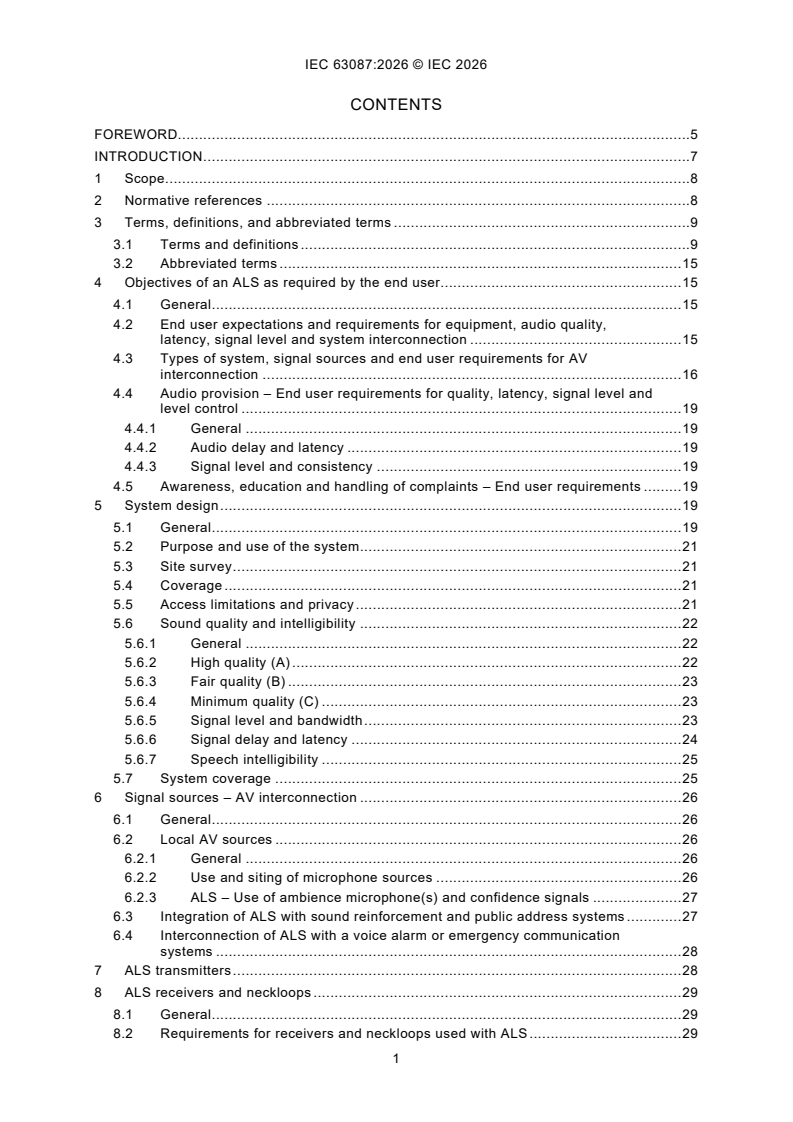
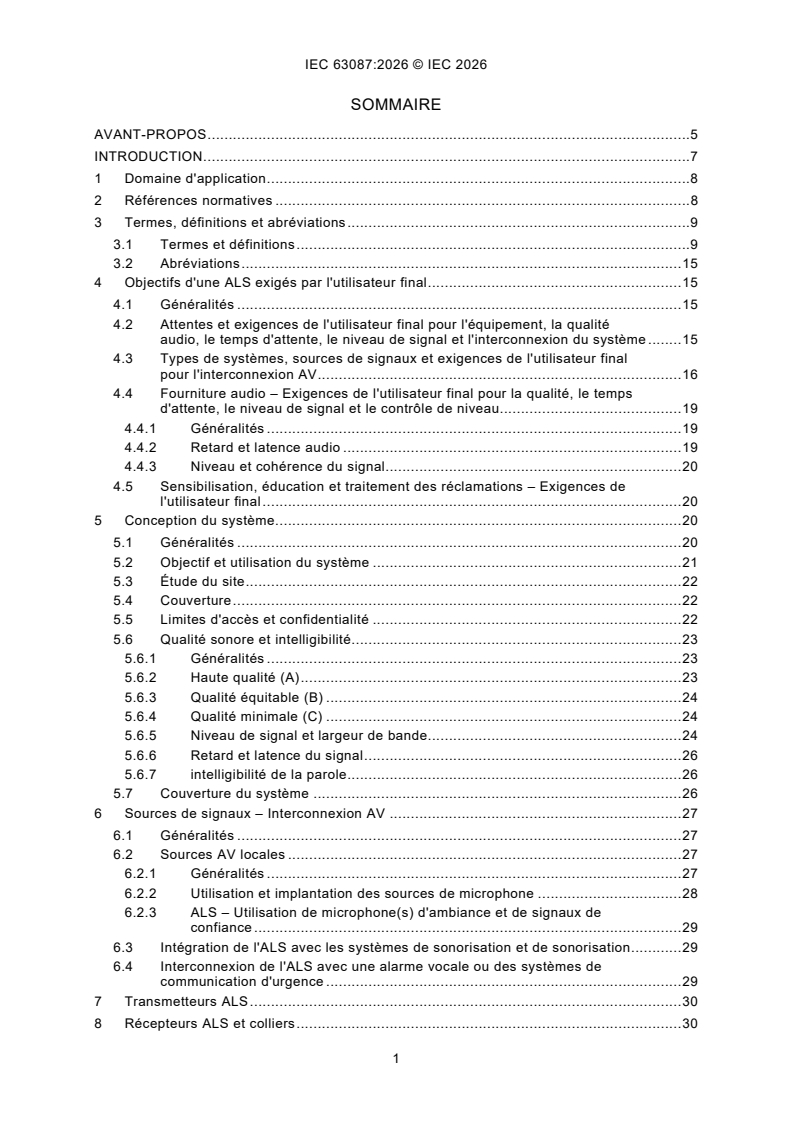
CONTENTS
FOREWORD. 5
INTRODUCTION . 7
1 Scope . 8
2 Normative references . 8
3 Terms, definitions, and abbreviated terms . 9
3.1 Terms and definitions . 9
3.2 Abbreviated terms . 15
4 Objectives of an ALS as required by the end user. 15
4.1 General . 15
4.2 End user expectations and requirements for equipment, audio quality,
latency, signal level and system interconnection . 15
4.3 Types of system, signal sources and end user requirements for AV
interconnection . 16
4.4 Audio provision – End user requirements for quality, latency, signal level and
level control . 19
4.4.1 General . 19
4.4.2 Audio delay and latency . 19
4.4.3 Signal level and consistency . 19
4.5 Awareness, education and handling of complaints – End user requirements . 19
5 System design . 19
5.1 General . 19
5.2 Purpose and use of the system . 21
5.3 Site survey . 21
5.4 Coverage . 21
5.5 Access limitations and privacy . 21
5.6 Sound quality and intelligibility . 22
5.6.1 General . 22
5.6.2 High quality (A) . 22
5.6.3 Fair quality (B) . 23
5.6.4 Minimum quality (C) . 23
5.6.5 Signal level and bandwidth . 23
5.6.6 Signal delay and latency . 24
5.6.7 Speech intelligibility . 25
5.7 System coverage . 25
6 Signal sources – AV interconnection . 26
6.1 General . 26
6.2 Local AV sources . 26
6.2.1 General . 26
6.2.2 Use and siting of microphone sources . 26
6.2.3 ALS – Use of ambience microphone(s) and confidence signals . 27
6.3 Integration of ALS with sound reinforcement and public address systems . 27
6.4 Interconnection of ALS with a voice alarm or emergency communication
systems . 28
7 ALS transmitters . 28
8 ALS receivers and neckloops . 29
8.1 General . 29
8.2 Requirements for receivers and neckloops used with ALS . 29
8.3 Required information . 30
8.3.1 General . 30
8.3.2 Receivers – Audio information . 30
8.3.3 Receivers – User, control, and display information . 30
8.3.4 Neckloops – Audio information . 30
8.3.5 ALS listening devices . 31
9 Venue or facility provision and user requirements . 31
9.1 General . 31
9.2 Staff awareness and training . 32
9.3 Signage . 33
9.4 Monitoring and maintenance . 34
10 Awareness, education and handling of complaints . 34
11 System compliance, testing and certification . 35
11.1 Overview . 35
11.2 General . 36
11.3 Room and equipment layout . 36
11.4 Listening-based assessment . 37
11.5 Objective assessment . 37
11.5.1 System noise . 37
11.5.2 Magnetic noise . 38
11.5.3 Coverage . 38
11.5.4 Frequency response . 38
11.5.5 Latency and system delay . 38
11.5.6 Objective speech intelligibility (STI) . 39
11.6 Access limitations and privacy . 40
11.7 Signage . 40
Annex A (informative) Technology overview . 41
A.1 General . 41
A.2 Hearing loops . 41
A.3 Infrared assistive listening systems . 42
A.4 Radio frequency assistive listening systems . 42
A.5 Audio over wireless networking technology systems (AOWNTS) . 43
A.6 Audio broadcasting systems for hearing aids in the 2,4 GHz band . 43
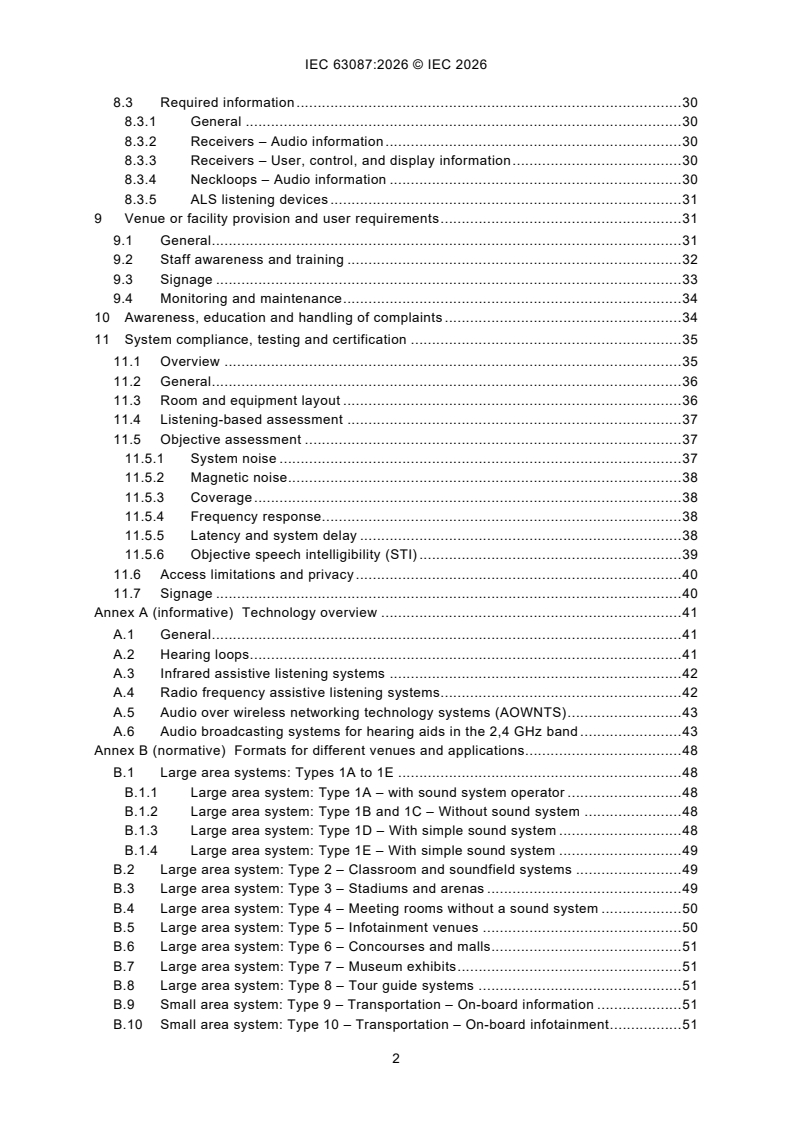
Annex B (normative) Formats for different venues and applications . 48
B.1 Large area systems: Types 1A to 1E . 48
B.1.1 Large area system: Type 1A – with sound system operator . 48
B.1.2 Large area system: Type 1B and 1C – Without sound system . 48
B.1.3 Large area system: Type 1D – With simple sound system . 48
B.1.4 Large area system: Type 1E – With simple sound system . 49
B.2 Large area system: Type 2 – Classroom and soundfield systems . 49
B.3 Large area system: Type 3 – Stadiums and arenas . 49
B.4 Large area system: Type 4 – Meeting rooms without a sound system . 50
B.5 Large area system: Type 5 – Infotainment venues . 50
B.6 Large area system: Type 6 – Concourses and malls . 51
B.7 Large area system: Type 7 – Museum exhibits . 51
B.8 Large area system: Type 8 – Tour guide systems . 51
B.9 Small area system: Type 9 – Transportation – On-board information . 51
B.10 Small area system: Type 10 – Transportation – On-board infotainment . 51
B.11 Small area system: Type 11 – Transportation – On-board communication . 51
B.12 Small area system: Type 12 – Help points, intercoms and safety refuges . 51
B.13 Small area system: Type 13 – Service points and information desks . 52
B.14 Portable and temporary small area systems . 52
B.15 Temporary area coverage systems . 53
B.16 Domestic systems . 53
Annex C (informative) Personal listeners . 54
C.1 Personal systems – Communication . 54
C.1.1 General . 54
C.1.2 Types of personal listener, hearables and remote wireless microphones . 54
C.2 Streaming audio . 56
Annex D (informative) System design checklists . 57
Annex E (normative) Assessment report . 59
E.1 General . 59
E.2 Room or space and equipment layout . 59
E.3 Acoustic noise – Ambient level . 59
E.4 ALS coverage . 60
E.5 Frequency response . 60
E.6 Signal-to-noise ratio – SNR (electronic) . 61
E.7 Signal-to-noise ratio – SNR (acoustic) . 62
E.8 Listening-based test . 62
E.9 Latency and delay . 63
E.10 Speech intelligibility (STI) . 64
E.11 Access limitations and privacy . 64
E.12 Accessibility and signage . 65
Annex F (informative) Example certificate of compliance . 66
Annex G (informative) Information that can usefully be provided on a venue's or
facility's website. 67
Annex H (normative) Latency and measurement of ALS delay. 68
H.1 Audio and acoustic signal delays . 68
H.1.1 General . 68
H.1.2 Difference between audible speech signals (ALS and airborne sound) . 68
H.1.3 Hearing one's own voice through an ALS . 69
H.1.4 Influence of delay on lip-reading and speech reading . 69
H.2 Delay of different transmission channels . 70
H.2.1 General . 70
H.2.2 Total delay of an ALS . 70
H.2.3 Total delay of a loudspeaker system . 71
H.3 Measurement of delay for live speech via loudspeakers . 71
H.3.1 Measurement methods . 71
H.3.2 Inputting the test signal . 71
H.3.3 Time calibration of the measurement system . 71
H.3.4 Measuring the delay of the ALS . 72
H.3.5 Measuring the propagation time of airborne sound via loudspeakers . 72
H.3.6 Determining the propagation time of direct sound from the talker . 72
H.4 Measurement of the difference between image and ALS . 72
H.4.1 Measurement methods . 72
H.4.2 Calibration . 72
H.4.3 Playing or generating the test signal . 72
H.4.4 Measurement of the time difference between image and ALS . 73
H.4.5 Measurement of the difference between image and airborne sound . 73
Annex I (normative) Selection of equipment, operation and maintenance of ALS . 74
I.1 General . 74
I.2 Hearing loops . 74
I.3 IR systems . 74
I.4 RF systems . 75
I.5 Audio over wireless networking technology systems (AOWNTS) . 75
I.6 Audio broadcasting systems for hearing aids in the 2,4 GHz band . 75
Bibliography . 76
Figure 1 – Sign indicating ALS system . 33
Figure 2 – Sign indicating area without compliant ALS coverage . 33
Figure H.1 – Visual and audio signal . 69
Figure H.2 – Addition of a loudspeaker . 69
Figure H.3 – Addition of a video display . 70
Table 1 – ALS formats and requirements . 17
Table A.1 – Assistive listening systems comparison summary . 44
Table D.1 – Assistive listening system – Design information . 57
Table D.2 – Assistive listening system – Proposed implementation . 58
Table E.1 – General information . 59
Table E.2 – Ambient noise level assessment . 60
Table E.3 – ALS coverage assessment . 60
Table E.4 – Frequency response assessment . 61
Table E.5 – Signal-to-noise ratio assessment (electronic) . 61
Table E.6 – Signal to noise ratio assessment (acoustic) . 62
Table E.7 – Listening assessment . 63
Table E.8 – Latency and delay assessment . 63
Table E.9 – Speech intelligibility assessment . 64
Table E.10 – Access and privacy assessment . 64
Table E.11 – Accessibility and signage assessment . 65
Table F.1 – Report form . 66
Table H.1 – Components contributing to the total ALS delay . 70
Table H.2 – Delays in a loudspeaker system . 71
INTERNATIONAL ELECTROTECHNICAL COMMISSION
____________
Assistive listening devices and systems for active assisted living
FOREWORD
1) The International Electrotechnical Commission (IEC) is a worldwide organization for standardization comprising
all national electrotechnical committees (IEC National Committees). The object of IEC is to promote international
co-operation on all questions concerning standardization in the electrical and electronic fields. To this end and
in addition to other activities, IEC publishes International Standards, Technical Specifications, Technical Reports,
Publicly Available Specifications (PAS) and Guides (hereafter referred to as “IEC Publication(s)”). Their
preparation is entrusted to technical committees; any IEC National Committee interested in the subject dealt with
may participate in this preparatory work. International, governmental and non-governmental organizations liaising
with the IEC also participate in this preparation. IEC collaborates closely with the International Organization for
Standardization (ISO) in accordance with conditions determined by agreement between the two organizations.
2) The formal decisions or agreements of IEC on technical matters express, as nearly as possible, an international
consensus of opinion on the relevant subjects since each technical committee has representation from all
interested IEC National Committees.
3) IEC Publications have the form of recommendations for international use and are accepted by IEC National
Committees in that sense. While all reasonable efforts are made to ensure that the technical content of IEC
Publications is accurate, IEC cannot be held responsible for the way in which they are used or for any
misinterpretation by any end user.
4) In order to promote international uniformity, IEC National Committees undertake to apply IEC Publications
transparently to the maximum extent possible in their national and regional publications. Any divergence between
any IEC Publication and the corresponding national or regional publication shall be clearly indicated in the latter.
5) IEC itself does not provide any attestation of conformity. Independent certification bodies provide conformity
assessment services and, in some areas, access to IEC marks of conformity. IEC is not responsible for any
services carried out by independent certification bodies.
6) All users should ensure that they have the latest edition of this publication.
7) No liability shall attach to IEC or its directors, employees, servants or agents including individual experts and
members of its technical committees and IEC National Committees for any personal injury, property damage or
other damage of any nature whatsoever, whether direct or indirect, or for costs (including legal fees) and
expenses arising out of the publication, use of, or reliance upon, this IEC Publication or any other IEC
Publications.
8) Attention is drawn to the Normative references cited in this publication. Use of the referenced publications is
indispensable for the correct application of this publication.
9) IEC draws attention to the possibility that the implementation of this document may involve the use of (a)
patent(s). IEC takes no position concerning the evidence, validity or applicability of any claimed patent rights in
respect thereof. As of the date of publication of this document, IEC had not received notice of (a) patent(s), which
may be required to implement this document. However, implementers are cautioned that this may not represent
the latest information, which may be obtained from the patent database available at https://patents.iec.ch. IEC
shall not be held responsible for identifying any or all such patent rights.
IEC 63087 has been prepared by IEC technical committee 100: Audio, video and multimedia
systems and equipment. It is an International Standard.
This first edition cancels and replaces IEC 63087-1 published in 2021. This edition constitutes
a technical revision.
This edition includes the following significant technical changes with respect to
IEC 63087-1:2021:
a) This first edition represents a different and far more comprehensive approach to the
subject than IEC 63087-1, which will be withdrawn.
The text of this International Standard is based on the following documents:
Draft Report on voting
100/4503/FDIS 100/4534/RVD
Full information on the voting for its approval can be found in the report on voting indicated in
the above table.
The language used for the development of this International Standard is English.
This document was drafted in accordance with ISO/IEC Directives, Part 2, and developed in
accordance with ISO/IEC Directives, Part 1 and ISO/IEC Directives, IEC Supplement, available
at www.iec.ch/members_experts/refdocs. The main document types developed by IEC are
described in greater detail at www.iec.ch/publications.
The committee has decided that the contents of this document will remain unchanged until the
stability date indicated on the IEC website under webstore.iec.ch in the data related to the
specific document. At this date, the document will be
– reconfirmed,
– withdrawn, or
– revised.
INTRODUCTION
The audibility and intelligibility of speech and music can be degraded by the ambient sound and
reverberation of the acoustic space in which it is heard. For a person with hearing difficulties
intelligibility is disproportionately degraded.
An assistive listening system (ALS) enables the undesirable effects of an acoustic space to be
mitigated through the direct transmission or streaming of speech, music or other audio
information to an end-user device (often a hearing-aid or cochlear implant), delivered in a way
that improves the listening experience for the user.
An ALS is particularly beneficial when the listener is located at some distance from a talker or
the source of sound and or when the background noise level is such as to be clearly audible.
In noisy environments, bringing an appropriate pick-up microphone close to the talker or to the
desired sound source can increase the signal-to-noise ratio for the listener by as much as 15 dB
to 20 dB, and in enclosed spaces it can overcome the detrimental effects of reverberation as
compared to the normal listening situation. This can significantly increase speech intelligibility
and reduce listening effort.
An ALS is explicitly designed to deliver audible and intelligible sound wherever the intended
listener is located within a room or space, within a specified coverage area or at a service point,
and in a manner that provides a genuine benefit to the end-user. An ALS can also be provided
as an adjunct facility to an intercom system, for example: ticket machines or station and platform
help points. They are also often found in buses, taxis, and some trains where passenger
announcements and information can be relayed directly to a user's hearing device. Many
airports provide ALS at check-in counters and departure gates as well as in other specific areas
such as baggage reclaim. Systems are also widely found in shops and stores at point-of-sale
locations and at service counters in banks and ticket offices. ALS are also commonly connected
to sound reinforcement and public address systems in a wide variety of venues and sites
including theatres, auditoriums, conference centres, meeting rooms, public buildings, and
houses of worship. Designated seating areas and facilities within sports grounds and stadiums
are also often provided with an ALS where it is not possible to provide complete coverage.
ALSs have also been found to be beneficial for listeners with normal hearing, but who are
listening in less-than-ideal acoustic conditions, such as in lecture theatres and classrooms or
when not listening to their native language. Although predominantly used for speech, an ALS
can also be used to improve the reception of music or musical performances particularly in
situations where both speech and music are present.
Several different transmission technologies are available, and some can be better suited to a
given situation than others. No matter what the transmission medium or situation, the objective
is the same, which is to provide an audible benefit to the intended listener. This document sets
out the technical and operational requirements needed to achieve this, regardless of the
underlying technology.
1 Scope
This document sets out the requirements for the provision of assistive listening systems (ALS)
in places or situations where there is a benefit for hearing-aid, cochlear implant, and other
hearing device users, compared to listening to the acoustic signal directly at that location.
This document applies to all ALS used for communication, entertainment, or educational
purposes in public, private, domestic and public transport installations.
This document does not apply to other forms of audio transmission, for example simultaneous
interpretation or audio description or audio-streams other than those broadcast as part of an
ALS. However, this document provides useful ancillary information for such systems which can
be applied.
Personal listening and intelligibility enhancement devices and systems are also included within
the scope as they constitute a special case and incorporate some unique features and
requirements (Annex C).
This document does not apply to hearing aids and medical hearing devices themselves or to
speech enhancement and communication systems found in some private motor vehicles which
are sometimes referred to as assistive listening.
2 Normative references
The following documents are referred to in the text in such a way that some or all of their content
constitutes requirements of this document. For dated references, only the edition cited applies.
For undated references, the latest edition of the referenced document (including any
amendments) applies.
IEC 60118-4, Electroacoustics - Hearing aids - Part 4: Induction-loop systems for hearing aid
purposes - System performance requirements
IEC 60268-16, Sound system equipment - Part 16: Objective rating of speech intelligibility by
speech transmission index
IEC 62489-1:2010, Electroacoustics - Audio-frequency induction loop systems for assisted
hearing - Part 1: Methods of measuring and specifying the performance of system components
IEC 62489-1:2010/AMD1:2014
IEC 62489-1:2010/AMD2:2017
ISO 7001, Graphical symbols - Registered public information symbols, available
at https://www.iso.org/obp
EN 50332-2, Sound system equipment: Headphones and earphones associated with portable
music players - Maximum sound pressure level measurement methodology - Part 2: Matching
of sets with headphones if either or both are offered separately, or are offered as one package
equipment but with standardised connectors between the two allowing to combine components
of different manufacturers or different design
3 Terms, definitions, and abbreviated terms
For the purposes of this document, the following terms and definitions apply.
ISO and IEC maintain terminological databases for use in standardization at the following
addresses:
– IEC Electropedia: available at http://www.electropedia.org
– ISO Online browsing platform: available at http://www.iso.org/obp
3.1 Terms and definitions
3.1.1
accessibility
degree to which an ALS product (e.g., device, service, and environment) is available to the
intended users and compatible with their listening devices
3.1.2
audio frequency induction loop system
AFILS
system including amplifier(s), microphones and/or other signal sources, in which magnetic fields
are created by the flow of audio-frequency current in a conductor arranged in the form of one
or more loops or a coil or solenoid
Note 1 to entry: AFILS is often called a hearing loop.
3.1.3
assistive listening device
ALD
device that can directly access an ALS – e.g. hearing aid, cochlear implant, hearable, mobile
phone, ALS receiver or personal listener
3.1.4
assistive listening system
ALS
device or system that helps people with hearing impairment to hear and understand wanted
sounds or enables them to access the sound being transmitted by a public address (PA),
paging, sound reinforcement, or dedicated microphone system
Note 1 to entry: Assistive listening systems can also be used by listeners who are not hard of hearing to improve
the clarity and intelligibility of received speech.
Note 2 to entry: A personal listener may connect to an assistive listening system.
3.1.5
audio over wireless networking technology system
AOWNTS
system that enables wireless transmission of audio via a wireless network, allowing the user's
own device (smartphone or tablet) to act as the receiver ®
Note 1 to entry: An example of a wireless networking technology is Wi-Fi .
3.1.6
audiovisual system
AV
system providing both audio and visual program information that can also be part of a video
conferencing system
3.1.7
Auracast™
proprietary audio transmission system using Bluetooth® low energy (LE) available from
Bluetooth® core Specification v5.3 onwards that enables several separate audio streams to be
simultaneously transmitted to multiple compatible listening devices at distances of typically up
to 50 m depending on the local conditions and transmitter power
Note 1 to entry: To allow as many receivers as possible to access an audio stream within the reception range,
Auracast™ does not use a traditional two-way Bluetooth® ʺConnected linkʺ, instead relying on the stream source
operating as a ʺBroadcastʺ transmitter and advertising its availability with a range of quality and access options.
3.1.8
automatic gain control
AGC
means (other than peak clipping) by which the gain is automatically controlled as a function of
the level of the signal being amplified with the objective of providing a stable output signal level
Note 1 to entry: AGC is also often called a leveller.
3.1.9
Bluetooth®
Bluetooth® classic
low power radio system that can continuously stream data over 79 channels in the 2,4 GHz
unlicensed industrial, scientific, and medical (ISM) frequency band
3.1.10
Bluetooth® low energy
BLE
Bluetooth® system designed for very low power operation, transmitting data over 40 channels
in the 2,4 GHz unlicensed ISM frequency band
Note 1 to entry: BLE remains in sleep mode except when a connection is initiated. Power consumption is lower and
data rates are higher than for classic Bluetooth®, but connection is not continuous.
3.1.11
BYOD
bring your own device
scenario in which a user provides their own means to access an ALS
3.1.12
C50
C50 – Clarity
measure of the direct-to-reverberant ratio whereby the sound energy arriving within the first
50 ms after the arrival of the direct sound is divided by the late sound energy arriving after
50 ms
Note 1 to entry: C50 provides a measure of the ratio of useful sound energy to later arriving and reverberant energy
that is considered to inhibit the intelligibility of speech and is often used as a measure of potential intelligibility.
See ISO 3382-1.
3.1.13
critical distance
Dc
distance from a sound source, in a room or enclosed space, were the direct and reverberant
sound energies become equal
3.1.14
cochlear implant
CI
small electronic medical device that electrically stimulates the cochlear nerve to provide a
sensation of sound
Note 1 to entry: CIs comprise two parts, the implant and a control and processing device that is worn behind the
ear in a similar manner to a hearing aid.
Note 2 to entry: CI processing devices are generally fitted with a T-coil and so can be used with hearing loops and
neck-loops.
3.1.15
competent person
person with the relevant current training and experience, and with access to the requisite tools,
equipment, and information, and capable of carrying out a defined task
3.1.16
digital modulation
DM
RF transmission system where the audio information is in the form of a digital stream
3.1.17
ear hook
small inductive device in the form of a hook that sits behind the ear and is placed adjacent to a
hearing device in order to inductively transmit an audio signal to the device's telecoil
3.1.18
echo
undesired signal which arrives at a given point, with sufficient magnitude and delay for it to be
perceptible, as a distinct repetition of the direct signal
Note 1 to entry: The audibility of an acoustic or audio echo depends on the magnitude of the signal and its relative
delay, with perception typically occurring with delays greater than 35 ms to 50 ms.
3.1.19
electromagnetic interference
EMI
interference that is caused by one electrical or electronic device to another by the
electromagnetic fields generated by its operation
3.1.20
emergency sound system
ECS
sound system specifically intended to broadcast emergency announcements and messages
Note 1 to entry: Such systems generally incorporate fault and status monitoring and must meet associated national
or international standards.
3.1.21
hearable
type of personal listener, usually in the form of personal earbuds or earphones that contain both
a pickup microphone and loudspeaker in each unit together with complex speech and noise
suppression processing to provide sound amplification
Note 1 to entry: Hearables are often termed ʺover the counterʺ, non-prescription hearing aid devices.
3.1.22
hearing aid
HA
portable instrument intended to assist the hearing of persons with impaired hearing, usually
consisting of a microphone, amplifier and earphone or bone vibrator
Note 1 to entry: A hearing aid is a medical device selected and fitted by an appropriately trained and competent
hearing care professional.
3.1.23
hearing device
HD
user device which can directly access an ALS – for example, hearing aid, cochlear implant,
hearable, mobile phone, ALS receiver, or personal listener
3.1.24
hearing loop
audio frequency induction loop (AFILS) assistive listening technology
Note 1 to entry: A loop or loops of cable or copper tape and an induction loop amplifier are typically installed at
floor level in a room or area to be covered to create an electromagnetic field that can be picked up by a hearing aid,
cochlear implant or listening device employing a suitable pick up or telecoil. The loop is powered by a current drive
amplifier that may be fed from either a dedicated pick-up microphone or from the output of a sound system.
3.1.25
hearing loss
reduction in hearing acuity
Note 1 to entry: Hearing loss is a common problem caused by exposure to noise, ageing, disease, trauma, and
genetics.
Note 2 to entry: Six levels of hearing loss have been defined by the World Health Organisation: Mild (20 dB to 34 dB
loss), Moderate (35 dB to 49 dB loss), Moderately severe (50 dB to 64 dB loss) Severe (65 dB to 79 dB loss),
Profound (80 dB to 94 dB loss) and Complete or total hearing loss 95 dB or greater loss.
3.1.26
infrared assistive listening system
IR
assistive listening transmission system based on infrared technology
Note 1 to entry: IR systems are often used in environments where it is desired to contain the signal within the
confines of a room.
Note 2 to entry: IR assistive listening receivers can incorporate a neck-loop so that the signal can be received by
a compatible hearing aid or cochlear implant.
3.1.27
international speech test signal
ISTS
signal developed by EHIMA to create reproducible measurement conditions for the purpose of
analysing the processing of speech by a hearing aid and associated equipment
Note 1 to entry: ISTS is a standard test signal which features all or most relevant properties of natural speech, e.g.
the modulation spectrum, the fundamental frequency and its harmonics.
Note 2 to entry: ISTS is based on natural recordings but is largely non-intelligible because of segmentation and
remixing. The signal comprises real speech from multiple talkers but presented in a manner such as to have no
meaning or gaps between words.
3.1.28
loop receiver
device fitted with a telecoil (T-coil) allowing it to pick up signals from a hearing loop
3.1.29
latency
Interval in time between the instant when an audio signal enters a system or electronic device
and the instant when it emerges
Note 1 to entry: Potential causes of latency in an audio system include analogue-to-digital conversion, buffering,
digital signal processing, transmission time, digital-to-analogue conversion, and the speed of sound in the
transmission medium.
3.1.30
lip-sync
synchronisation of the visual image of the face and lips with the associated audio speech signal
Note 1 to entry: To enable lip-reading, the maximum allowable discrepancy between the visual and audio signals
is 45 ms.
3.1.31
long term average speech leve
...
IEC 63087 ®
Edition 1.0 2026-09
NORME
INTERNATIONALE
Dispositifs et systèmes d'aide à l'audition pour l'assistance à l'autonomie à
domicile
ICS 13.180; 33.160.99 ISBN 978-2-8327-1453-9
Droits de reproduction réservés. Sauf indication contraire, aucune partie de cette publication ne peut être reproduite ni
utilisée sous quelque forme que ce soit et par aucun procédé, électronique ou mécanique, y compris la photocopie et
les microfilms, sans l'accord écrit de l'IEC ou du Comité national de l'IEC du pays du demandeur. Si vous avez des
questions sur le copyright de l'IEC ou si vous désirez obtenir des droits supplémentaires sur cette publication, utilisez
les coordonnées ci-après ou contactez le Comité national de l'IEC de votre pays de résidence.
IEC Secretariat Tel.: +41 22 919 02 11
3, rue de Varembé info@iec.ch
CH-1211 Geneva 20 www.iec.ch
Switzerland
A propos de l'IEC
La Commission Electrotechnique Internationale (IEC) est la première organisation mondiale qui élabore et publie des
Normes internationales pour tout ce qui a trait à l'électricité, à l'électronique et aux technologies apparentées.
A propos des publications IEC
Le contenu technique des publications IEC est constamment revu. Veuillez vous assurer que vous possédez l’édition la
plus récente, un corrigendum ou amendement peut avoir été publié.
Recherche de publications IEC - IEC Products & Services Portal - products.iec.ch
webstore.iec.ch/advsearchform Découvrez notre puissant moteur de recherche et consultez
La recherche avancée permet de trouver des publications gratuitement tous les aperçus des publications, symboles
IEC en utilisant différents critères (numéro de référence, graphiques et le glossaire. Avec un abonnement, vous aurez
texte, comité d’études, …). Elle donne aussi des toujours accès à un contenu à jour adapté à vos besoins.
informations sur les projets et les publications remplacées
ou retirées. Electropedia - www.electropedia.org
Le premier dictionnaire d'électrotechnologie en ligne au
IEC Just Published - webstore.iec.ch/justpublished monde, avec plus de 22 500 articles terminologiques en
Restez informé sur les nouvelles publications IEC. Just anglais et en français, ainsi que les termes équivalents
Published détaille les nouvelles publications parues. dans 25 langues additionnelles. Egalement appelé
Disponible en ligne et une fois par mois par email. Vocabulaire Electrotechnique International (IEV) en ligne.
Service Clients - webstore.iec.ch/csc
Si vous désirez nous donner des commentaires sur cette
publication ou si vous avez des questions contactez-
nous: sales@iec.ch.
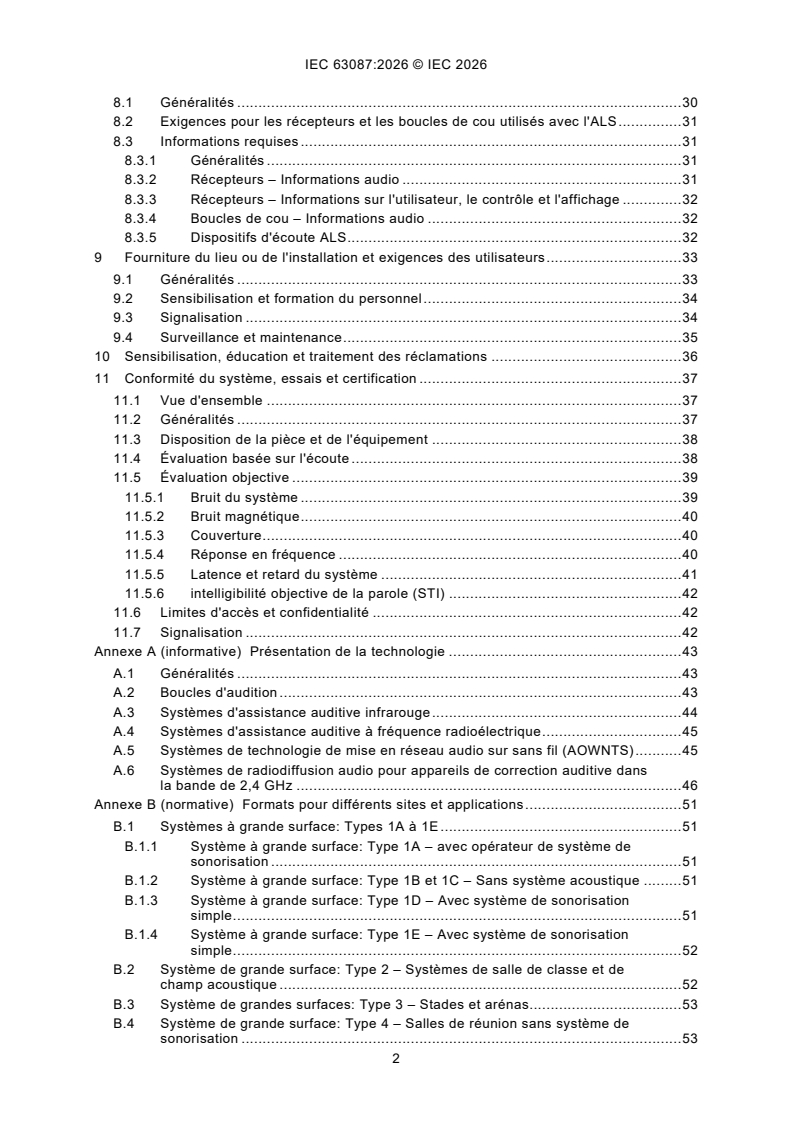
SOMMAIRE
AVANT-PROPOS . 5
INTRODUCTION . 7
1 Domaine d'application . 8
2 Références normatives . 8
3 Termes, définitions et abréviations . 9
3.1 Termes et définitions . 9
3.2 Abréviations . 15
4 Objectifs d'une ALS exigés par l'utilisateur final . 15
4.1 Généralités . 15
4.2 Attentes et exigences de l'utilisateur final pour l'équipement, la qualité
audio, le temps d'attente, le niveau de signal et l'interconnexion du système . 15
4.3 Types de systèmes, sources de signaux et exigences de l'utilisateur final
pour l'interconnexion AV . 16
4.4 Fourniture audio – Exigences de l'utilisateur final pour la qualité, le temps
d'attente, le niveau de signal et le contrôle de niveau . 19
4.4.1 Généralités . 19
4.4.2 Retard et latence audio . 19
4.4.3 Niveau et cohérence du signal . 20
4.5 Sensibilisation, éducation et traitement des réclamations – Exigences de
l'utilisateur final . 20
5 Conception du système . 20
5.1 Généralités . 20
5.2 Objectif et utilisation du système . 21
5.3 Étude du site . 22
5.4 Couverture . 22
5.5 Limites d'accès et confidentialité . 22
5.6 Qualité sonore et intelligibilité . 23
5.6.1 Généralités . 23
5.6.2 Haute qualité (A) . 23
5.6.3 Qualité équitable (B) . 24
5.6.4 Qualité minimale (C) . 24
5.6.5 Niveau de signal et largeur de bande . 24
5.6.6 Retard et latence du signal . 26
5.6.7 intelligibilité de la parole . 26
5.7 Couverture du système . 26
6 Sources de signaux – Interconnexion AV . 27
6.1 Généralités . 27
6.2 Sources AV locales . 27
6.2.1 Généralités . 27
6.2.2 Utilisation et implantation des sources de microphone . 28
6.2.3 ALS – Utilisation de microphone(s) d'ambiance et de signaux de
confiance . 29
6.3 Intégration de l'ALS avec les systèmes de sonorisation et de sonorisation . 29
6.4 Interconnexion de l'ALS avec une alarme vocale ou des systèmes de
communication d'urgence . 29
7 Transmetteurs ALS . 30
8 Récepteurs ALS et colliers . 30
8.1 Généralités . 30
8.2 Exigences pour les récepteurs et les boucles de cou utilisés avec l'ALS . 31
8.3 Informations requises . 31
8.3.1 Généralités . 31
8.3.2 Récepteurs – Informations audio . 31
8.3.3 Récepteurs – Informations sur l'utilisateur, le contrôle et l'affichage . 32
8.3.4 Boucles de cou – Informations audio . 32
8.3.5 Dispositifs d'écoute ALS . 32
9 Fourniture du lieu ou de l'installation et exigences des utilisateurs . 33
9.1 Généralités . 33
9.2 Sensibilisation et formation du personnel . 34
9.3 Signalisation . 34
9.4 Surveillance et maintenance . 35
10 Sensibilisation, éducation et traitement des réclamations . 36
11 Conformité du système, essais et certification . 37
11.1 Vue d'ensemble . 37
11.2 Généralités . 37
11.3 Disposition de la pièce et de l'équipement . 38
11.4 Évaluation basée sur l'écoute . 38
11.5 Évaluation objective . 39
11.5.1 Bruit du système . 39
11.5.2 Bruit magnétique . 40
11.5.3 Couverture . 40
11.5.4 Réponse en fréquence . 40
11.5.5 Latence et retard du système . 41
11.5.6 intelligibilité objective de la parole (STI) . 42
11.6 Limites d'accès et confidentialité . 42
11.7 Signalisation . 42
Annexe A (informative) Présentation de la technologie . 43
A.1 Généralités . 43
A.2 Boucles d'audition . 43
A.3 Systèmes d'assistance auditive infrarouge . 44
A.4 Systèmes d'assistance auditive à fréquence radioélectrique . 45
A.5 Systèmes de technologie de mise en réseau audio sur sans fil (AOWNTS) . 45
A.6 Systèmes de radiodiffusion audio pour appareils de correction auditive dans
la bande de 2,4 GHz . 46
Annexe B (normative) Formats pour différents sites et applications . 51
B.1 Systèmes à grande surface: Types 1A à 1E . 51
B.1.1 Système à grande surface: Type 1A – avec opérateur de système de
sonorisation . 51
B.1.2 Système à grande surface: Type 1B et 1C – Sans système acoustique . 51
B.1.3 Système à grande surface: Type 1D – Avec système de sonorisation
simple . 51
B.1.4 Système à grande surface: Type 1E – Avec système de sonorisation
simple . 52
B.2 Système de grande surface: Type 2 – Systèmes de salle de classe et de
champ acoustique . 52
B.3 Système de grandes surfaces: Type 3 – Stades et arénas . 53
B.4 Système de grande surface: Type 4 – Salles de réunion sans système de
sonorisation . 53
B.5 Système de grande surface: Type 5 – Lieux d'infodivertissement . 54
B.6 Système à grande surface: Type 6 – Hall d'entrée et centre commercial . 54
B.7 Système de grandes surfaces: Type 7 – Expositions au musée . 54
B.8 Système de grande surface: Type 8 – Systèmes de guides touristiques . 54
B.9 Système pour petites surfaces: Type 9 – Transport – Informations
embarquées . 55
B.10 Système de petite surface: Type 10 – Transport – Infodivertissement à bord . 55
B.11 Système de petite surface: Type 11 – Transport – Communication à bord . 55
B.12 Système de petite surface: Type 12 – Points d'aide, interphones et refuges
de sécurité . 55
B.13 Système de petite surface: Type 13 – Points de service et bureaux
d'information . 56
B.14 Systèmes portatifs et temporaires de petite surface . 56
B.15 Systèmes de couverture de zone temporaire . 57
B.16 Systèmes domestiques . 57
Annexe C (informative) Écouteurs personnels . 58
C.1 Systèmes personnels – Communication . 58
C.1.1 Généralités . 58
C.1.2 Types d'écouteurs personnels, d'appareils audibles et de microphones
sans fil à distance . 59
C.2 Diffusion audio en continu . 61
Annexe D (informative) Listes de contrôle de conception du système . 62
Annexe E (normative) Rapport d'évaluation . 64
E.1 Généralités . 64
E.2 Aménagement de la pièce ou de l'espace et de l'équipement . 64
E.3 Bruit acoustique – Niveau ambiant . 64
E.4 couverture ALS . 65
E.5 Réponse en fréquence . 65
E.6 Rapport signal sur bruit – RSB (électronique) . 66
E.7 Rapport signal sur bruit – RSB (acoustique) . 67
E.8 Essai basé sur l'écoute . 68
E.9 Latence et retard . 68
E.10 intelligibilité vocale (STI) . 69
E.11 Limites d'accès et confidentialité . 69
E.12 Accessibilité et signalisation . 70
Annexe F (informative) Exemple de certificat de conformité . 71
Annexe G (informative) Informations qui peuvent être fournies de manière utile sur le
site web d'un lieu ou d'une installation . 72
Annexe H (normative) Latence et mesure du retard ALS . 73
H.1 Retards des signaux audio et acoustiques . 73
H.1.1 Généralités . 73
H.1.2 Différence entre les signaux vocaux sonores (ALS et bruit aérien) . 73
H.1.3 Entendre sa propre voix à travers une SLA . 74
H.1.4 Influence du retard sur la lecture labiale et la lecture vocale . 74
H.2 Retard des différents canaux de transmission . 75
H.2.1 Généralités . 75
H.2.2 Retard total d'une ALS . 76
H.2.3 Retard total d'un système de haut-parleurs . 76
H.3 Mesure du retard pour la parole en direct via des haut-parleurs . 77
H.3.1 Méthodes de mesure . 77
H.3.2 Entrée du signal d'essai . 77
H.3.3 Étalonnage temporel du système de mesure . 77
H.3.4 Mesurage du retard de l'ALS . 77
H.3.5 Mesurage du temps de propagation du son aérien par haut-parleurs . 77
H.3.6 Détermination du temps de propagation du son direct émis par le
locuteur . 77
H.4 Mesure de la différence entre l'image et l'ALS . 78
H.4.1 Méthodes de mesure . 78
H.4.2 Étalonnage . 78
H.4.3 Lecture ou génération du signal d'essai . 78
H.4.4 Mesure de la différence de temps entre l'image et l'ALS . 78
H.4.5 Mesure de la différence entre l'image et le son aérien . 79
Annexe I (normative) Choix de l'équipement, fonctionnement et maintenance de l'ALS . 80
I.1 Généralités . 80
I.2 Boucles d'audition . 80
I.3 Systèmes IR . 81
I.4 Systèmes RF . 81
I.5 Systèmes de technologie de mise en réseau audio sur sans fil (AOWNTS) . 81
I.6 Systèmes de radiodiffusion audio pour appareils de correction auditive dans
la bande de 2,4 GHz . 81
Bibliographie . 83
Figure 1 – Signal indiquant le système ALS . 34
Figure 2 – Zone d'indication de signe sans couverture ALS conforme . 35
Figure H.1 – Signaux visuels et audio . 74
Figure H.2 – Ajout d'un haut-parleur . 75
Figure H.3 – Ajout d'un écran vidéo . 75
Tableau 1 – Formats et exigences ALS . 17
Tableau A.1 – Comparaison des systèmes d'écoute assistée . 47
Tableau D.1 – Système d'écoute assistée – Informations de conception . 62
Tableau D.2 – Système d'assistance à l'écoute – Proposition de mise en œuvre . 63
Tableau E.1 – Informations générales . 64
Tableau E.2 – Évaluation du niveau de bruit ambiant . 65
Tableau E.3 – Évaluation de la couverture SLA . 65
Tableau E.4 – Évaluation de la réponse en fréquence . 66
Tableau E.5 – Évaluation du rapport signal sur bruit (électronique) . 67
Tableau E.6 – Évaluation du rapport signal/bruit (acoustique) . 67
Tableau E.7 – Évaluation de l'écoute . 68
Tableau E.8 – Évaluation du temps d'attente et des retards . 69
Tableau E.9 – Évaluation de l'intelligibilité vocale . 69
Tableau E.10 – Évaluation de l'accès et de la confidentialité . 70
Tableau E.11 – Évaluation de l'accessibilité et de la signalisation . 70
Tableau F.1 – Rapport . 71
Tableau H.1 – Composants contribuant au retard ALS total . 76
Tableau H.2 – Retards dans un système de haut-parleurs . 76
COMMISSION ÉLECTROTECHNIQUE INTERNATIONALE
____________
Dispositifs et systèmes d'aide à l'audition
pour l'assistance à l'autonomie à domicile
AVANT-PROPOS
1) La Commission électrotechnique internationale (IEC) est une organisation mondiale de normalisation composée
de tous les comités électrotechniques nationaux (Comités nationaux IEC). L'IEC a pour objet de promouvoir
la coopération internationale sur toutes les questions de normalisation dans les domaines électrique et
électronique. À cet effet, l'IEC, entre autres activités, publie des Normes internationales, des Spécifications
techniques, des Rapports techniques, des Spécifications accessibles au public (PAS) et des Guides
(ci-après dénommés «Publication(s) IEC»)”). Leur préparation est confiée à des comités techniques; tout comité
national de l'IEC intéressé par le sujet traité peut participer à ces travaux préparatoires. Les organisations
internationales, gouvernementales et non gouvernementales en liaison avec l'IEC participent également
à cette préparation. L'IEC collabore étroitement avec l'Organisation internationale de normalisation (ISO)
dans le respect des conditions déterminées par accord entre les deux organisations.
2) Les décisions ou accords officiels de l'IEC sur les questions techniques expriment, dans la mesure du possible,
un consensus international sur les questions pertinentes, étant donné que chaque comité technique
est représenté par tous les comités nationaux de l'IEC intéressés.
3) Les Publications de l'IEC se présentent sous la forme de recommandations internationales et sont acceptées
par les Comités nationaux de l'IEC en ce sens. Bien que tous les efforts raisonnables soient faits pour s'assurer
que le contenu technique des Publications de l'IEC est exact, l'IEC ne peut être tenue pour responsable
de la manière dont elles sont utilisées ou de toute mauvaise interprétation par un utilisateur final.
4) Afin de promouvoir l'uniformité internationale, les Comités nationaux de l'IEC s'engagent à appliquer
les Publications de l'IEC de manière transparente, dans toute la mesure du possible, dans leurs publications
nationales et régionales. Toute divergence entre une publication IEC et la publication nationale ou régionale
correspondante doit être clairement indiquée dans cette dernière.
5) L'IEC elle-même ne fournit aucune attestation de conformité. Des organismes de certification indépendants
fournissent des services d'évaluation de la conformité et, dans certains domaines, donnent accès aux marques
de conformité IEC. L'IEC n'est pas responsable des services fournis par des organismes de certification
indépendants.
6) Il convient que tous les utilisateurs s'assurent d'avoir la dernière édition de cette publication.
7) Aucune responsabilité ne doit être imputée à l’IEC ou à ses administrateurs, employés, préposés ou mandataires,
y compris les experts individuels et les membres de ses comités techniques et des Comités nationaux de l’IEC,
pour tout préjudice corporel, dommage matériel ou autre dommage de quelque nature que ce soit, direct ou
indirect, ou pour les coûts (y compris les frais de justice) et les dépenses découlant de la publication,
de l’utilisation ou de la confiance accordée à la présente Publication de l’IEC ou à toute autre Publication de l’IEC.
8) L'attention est attirée sur les références normatives citées dans la présente publication. L'utilisation
des publications référencées est indispensable à l'application correcte de la présente publication.
9) L'IEC attire l'attention sur le fait que la mise en œuvre du présent document peut impliquer l'utilisation d'un ou
de plusieurs brevets. L'IEC ne prend pas position quant à la preuve, à la validité ou à l'applicabilité des droits
de propriété revendiqués à cet égard. À la date de publication du présent document, l'IEC n'avait pas reçu
notification d'un ou de plusieurs brevets qui pourraient être nécessaires à sa mise en application.
Toutefois, les responsables de la mise en œuvre sont avertis que cela peut ne pas représenter les informations
les plus récentes, qui peuvent être obtenues à partir de la base de données sur les brevets disponible à l'adresse
https://patents.iec.ch. L'IEC ne saurait être tenue pour responsable d'avoir identifié tout ou partie de tels droits
de propriété.
L'IEC 63087 a été établie par le comité d'études 100 de l'IEC: Systèmes et équipements audio,
vidéo et services de données. Il s'agit d'une Norme internationale.
Cette première édition annule et remplace l'IEC 63087-1 parue en 2021. Cette édition constitue
une révision technique.
Cette édition inclut les modifications techniques majeures suivantes par rapport à l'IEC
63087-1:2021:
a) Cette première édition représente une approche différente et beaucoup plus complète
du sujet que l'IEC 63087-1, qui sera supprimée.
Le texte de la présente Norme internationale est issu des documents suivants:
Projet Rapport de vote
100/4503/FDIS 100/4534/RVD
Le rapport de vote indiqué dans le tableau ci-dessus donne toute information sur le vote ayant
abouti à son approbation.
La langue utilisée pour l'élaboration de la présente Norme internationale est l'anglais.
Le présent document a été rédigé conformément aux directives ISO/IEC, Partie 2, et élaboré
conformément aux directives ISO/IEC, Partie 1 et aux directives ISO/IEC, Supplément IEC,
disponibles à l’adresse www.iec.ch/members_experts/refdocs. Les principaux types
de documents développés par l'IEC sont décrits plus en détail à l'adresse
www.iec.ch/publications.
Le comité a décidé que le contenu de ce document ne sera pas modifié avant la date de stabilité
indiquée sur le site web de l’IEC sous webstore.iec.ch dans les données relatives au document
spécifique. À cette date, le document sera
– reconduit,
– supprimé, ou
– révisé.
INTRODUCTION
L'audibilité et l'intelligibilité de la parole et de la musique peuvent être dégradées
par le son ambiant et la réverbération de l'espace acoustique dans lequel elle est entendue.
Pour une personne ayant des difficultés auditives, l'intelligibilité est dégradée de manière
disproportionnée.
Un système d'assistance à l'écoute (ALS) permet d'atténuer les effets indésirables d'un espace
acoustique par la transmission directe ou la diffusion en continu de la parole, de la musique ou
d'autres informations audio vers un dispositif de l'utilisateur final (souvent un appareil
de correction auditive ou un implant cochléaire), délivré de manière à améliorer l'expérience
d'écoute pour l'utilisateur.
Une SLA est particulièrement utile lorsque l'auditeur est situé à une certaine distance
d'un locuteur ou de la source sonore et/ou lorsque le niveau de bruit de fond est tel qu'il est
clairement audible.
Dans les environnements bruyants, le fait d'amener un microphone capteur approprié
à proximité du locuteur ou de la source sonore souhaitée peut augmenter le rapport signal
sur bruit de l'auditeur de 15 dB à 20 dB, et dans les espaces clos, il peut surmonter les effets
néfastes de la réverbération par rapport à la situation d'écoute normale. Cela peut augmenter
de manière significative l'intelligibilité de la parole et réduire l'effort d'écoute.
Une ALS est explicitement conçue pour délivrer un son audible et intelligible partout où
l'auditeur prévu est situé dans une pièce ou un espace, dans une zone de couverture spécifiée
ou à un point de service, et d'une manière qui procure un réel avantage à l'utilisateur final.
Une ALS peut également être fournie en complément d'un système d'interphone, par exemple:
guichets automatiques ou points d'aide de la gare et de la plate-forme. On les trouve aussi
souvent dans les autobus, les taxis et certains trains où les annonces et les informations
des passagers peuvent être relayées directement sur le dispositif auditif de l'utilisateur.
De nombreux aéroports fournissent des services ALS aux comptoirs d'enregistrement et
aux portes d'embarquement ainsi que dans d'autres domaines spécifiques tels que
la récupération des bagages. Les systèmes sont également largement répandus
dans les magasins et les magasins sur les points de vente et aux comptoirs de services
dans les banques et les guichets. La SLA est également couramment reliée à des systèmes
de sonorisation et de sonorisation dans une grande variété de lieux et de sites, y compris
les théâtres, les auditoriums, les centres de conférence, les salles de réunion, les bâtiments
publics et les lieux de culte. Les zones de repos et les installations désignées dans les terrains
de sport et les stades sont également souvent équipées d'une ALS lorsqu'il n'est pas possible
de fournir une couverture complète.
Les ALS se sont également révélées bénéfiques pour les auditeurs ayant une audition normale,
mais qui écoutent dans des conditions acoustiques moins qu'idéales, comme
dans les amphithéâtres et les salles de classe ou lorsqu'ils n'écoutent pas leur langue
maternelle. Bien qu'elle soit principalement utilisée pour la parole, une ALS peut également
être utilisée pour améliorer la réception de la musique ou des performances musicales,
en particulier dans les situations où la parole et la musique sont présentes.
Plusieurs technologies de transmission différentes sont disponibles, et certaines peuvent être
mieux adaptées à une situation donnée que d'autres. Quel que soit le support de transmission
ou la situation, l'objectif est le même, c'est-à-dire fournir un bénéfice audible à l'auditeur prévu.
Le présent document établit les exigences techniques et opérationnelles nécessaires
pour y parvenir, quelle que soit la technologie sous-jacente.
1 Domaine d'application
Le présent document établit les exigences relatives à la fourniture de systèmes d'aide
à l'audition (SLA) dans les endroits ou situations où il existe un avantage pour les utilisateurs
d'appareils de correction auditive, d'implants cochléaires et d'autres appareils de correction
auditive, par rapport à l'écoute du signal acoustique directement à cet endroit.
Le présent document s'applique à toutes les ALS utilisées à des fins de communication,
de divertissement ou d'éducation dans les installations de transport public, privé, domestique
et public.
Le présent document ne s'applique pas à d'autres formes de transmission audio, par exemple
l'interprétation simultanée ou la description audio ou les flux audio autres que ceux diffusés
dans le cadre d'une ALS. Toutefois, le présent document fournit des informations auxiliaires
utiles pour de tels systèmes qui peuvent être appliqués.
Les dispositifs et systèmes d'amélioration de l'écoute personnelle et de l'intelligibilité
sont également inclus dans le domaine d'application car ils constituent un cas particulier et
intègrent certaines caractéristiques et exigences uniques (Annexe C).
Le présent document ne s'applique pas aux appareils de correction auditive et aux appareils
de correction auditive médicaux eux-mêmes, ni aux systèmes d'amélioration de la parole et
de communication présents dans certains véhicules automobiles privés qui sont parfois appelés
écoute assistée.
2 Références normatives
Les documents suivants sont cités dans le texte de telle sorte qu'ils constituent, pour tout ou
partie de leur contenu, des exigences du présent document. Pour les références datées, seule
l'édition citée s'applique. Pour les références non datées, la dernière édition du document
de référence s'applique (y compris les éventuels amendements).
IEC 60118-4, Électroacoustique - Appareils de correction auditive - Partie 4: Systèmes
de boucles d'induction utilisées à des fins de correction auditive - Exigences de performances
système
IEC 60268-16, Équipements pour systèmes électroacoustiques - Partie 16: Évaluation objective
de l'intelligibilité de la parole au moyen de l'indice de transmission de la parole
IEC 62489-1:2010, Électroacoustique - Systèmes de boucles d'induction audiofréquences
pour améliorer l'audition - Partie 1: Méthodes de mesure et de spécification des performances
des composants de systèmes
IEC 62489-1:2010/AMD1:2014
IEC 62489-1:2010/AMD2:2017
ISO 7001, Symboles graphiques - Symboles destinés à l'information du public, disponible
à l'adresse https://www.iso.org/obp
EN 50332-2, Équipement de systèmes acoustiques : casques et écouteurs associés
avec un baladeur - Méthode de mesure de niveau maximal de pression acoustique - Partie 2 :
adaptation des équipements avec des écouteurs provenant de différents fabricants, ou
provenant d'un équipement complet mais avec des connecteurs normalisés entre les deux,
permettant d'associer des composants provenant de différents fabricants ou bien de conception
différente
3 Termes, définitions et abréviations
Pour les besoins du présent document, les termes et définitions suivants s'appliquent.
L'ISO et l'IEC tiennent à jour des bases de données terminologiques destinées à être utilisées
en normalisation aux adresses suivantes:
– IEC Electropedia: disponible à l'adresse http://www.electropedia.org
– ISO Online browsing platform: disponible à l'adresse http://www.iso.org/obp
3.1 Termes et définitions
3.1.1
accessibilité
degré auquel un produit ALS (par exemple, dispositif, service et environnement) est disponible
pour les utilisateurs prévus et compatible avec leurs dispositifs d'écoute
3.1.2
système de boucle d'induction à fréquence audio
AFILS
système comprenant un ou plusieurs amplificateurs, des microphones et/ou d'autres sources
de signaux, dans lequel des champs magnétiques sont créés par la circulation d'un courant
audiofréquence dans un conducteur disposé sous la forme d'une ou de plusieurs boucles ou
d'une bobine ou d'un solénoïde
Note 1 à l'article: AFILS est souvent appelé boucle d'audition.
3.1.3
dispositif d'assistance à l'écoute
ALD
dispositif qui peut accéder directement à une SLA – par exemple appareil de correction auditive,
implant cochléaire, appareil audible, téléphone mobile, récepteur SLA ou écouteur personnel
3.1.4
système d'assistance à l'écoute
ALS
dispositif ou système qui aide les personnes malentendantes à entendre et à comprendre
les sons désirés ou qui leur permet d'accéder au son transmis par une adresse publique (AP),
un système de radiomessagerie, un système de renforcement acoustique ou un système
de microphone dédié
Note 1 à l'article: Les systèmes d'écoute assistée peuvent également être utilisés par des auditeurs qui ne sont pas
malentendants pour améliorer la clarté et l'intelligibilité de la parole reçue.
Note 2 à l'article: Un auditeur individuel peut se connecter à un système d'assistance à l'écoute.
3.1.5
système de technologie de mise en réseau audio sur sans fil
AOWNTS
système qui permet la transmission sans fil de l'audio via un réseau sans fil, permettant
au propre appareil de l'utilisateur (smartphone ou tablette) d'agir comme récepteur ®
Note 1 à l'article: Un exemple de technologie de mise en réseau sans fil est le Wi-Fi .
3.1.6
système audiovisuel
AV
système fournissant à la fois des informations sur les programmes audio et visuels qui peuvent
également faire partie d'un système de vidéoconférence
3.1.7
Auracast™
système de transmission audio propriétaire utilisant le Bluetooth® basse énergie
(LE) disponible à partir de la Spécification de cœur Bluetooth® v5.3 qui permet à plusieurs flux
audio séparés d'être transmis simultanément à plusieurs dispositifs d'écoute compatibles
à des distances allant généralement jusqu'à 50 m en fonction des conditions locales et
de la puissance de l'émetteur
Note 1 à l'article: Pour permettre au plus grand nombre possible de récepteurs d'accéder à un flux audio
dans la plage de réception, Auracast™ n'utilise pas un Bluetooth® ʺConnected linkʺ bidirectionnel traditionnel,
mais s'appuie sur la source de flux fonctionnant comme un ʺBroadcastʺ émetteur et annonce sa disponibilité
avec une gamme d'options de qualité et d'accès.
3.1.8
commande automatique de gain
AGC
moyen (autre que l'écrêtage de crête) par lequel le gain est commandé automatiquement
en fonction du niveau du signal amplifié dans le but de fournir un niveau de signal de sortie
stable
Note 1 à l'article: L'AGC est aussi souvent appelé un niveleur.
3.1.9
Bluetooth®
Bluetooth® classic
système radio de faible puissance qui peut diffuser en continu des données sur 79 canaux
dans la bande de fréquences 2,4 GHz industrielle, scientifique et médicale (ISM) sans licence
3.1.10
Bluetooth® basse énergie
BLE
Système Bluetooth® conçu pour un fonctionnement à très faible puissance, transmettant
des données sur 40 canaux dans la bande de fréquences ISM sans licence de 2,4 GHz
Note 1 à l'article: Le BLE reste en mode veille sauf lorsqu'une connexion est initiée. La consommation d'énergie
est inférieure et les débits de données sont plus élevés que pour le Bluetooth® classique, mais la connexion n'est pas
continue.
3.1.11
BYOD
apportez votre propre appareil
scénario dans lequel un utilisateur fournit ses propres moyens d'accéder à une ALS
3.1.12
C50
C50 – Clarté
mesure du rapport direct/réverbérant selon laquelle l'énergie acoustique arrivant
dans les 50 premières ms après l'arrivée du son direct est divisée par l'énergie acoustique
tardive arrivant après 50 ms
Note 1 à l'article: C50 fournit une mesure du rapport de l'énergie acoustique utile à l'énergie réverbérante et
à l'énergie arrivant plus tard qui est considérée comme inhibant l'intelligibilité de la parole et est souvent utilisée
comme mesure de l'intelligibilité potentielle. Voir l'ISO 3382-1.
3.1.13
distance critique
Dc
distance à partir d'une source sonore, dans une pièce ou un espace clos, où les énergies
sonores directe et réverbérante deviennent égales
3.1.14
implant cochléaire
CI
petit dispositif médical électronique qui stimule électriquement le nerf cochléaire pour fournir
une sensation sonore
Note 1 à l’article: Les IC comprennent deux parties, l’implant et un dispositif de commande et de traitement
qui est porté derrière l’oreille de la même manière qu’un appareil de correction auditive.
Note 2 à l'article: Les dispositifs de traitement de CI sont généralement équipés d'une bobine en T et
peuvent donc être utilisés avec des boucles d'audition et des boucles de cou.
3.1.15
personne compétente
personne ayant la formation et l'expérience actuelles appropriées, et ayant accès aux outils,
équipements et informations requis, et capable d'effectuer une tâche définie
3.1.16
modulation numérique
DM
Système de transmission RF dans lequel les informations audio se présentent sous la forme
d'un flux numérique
3.1.17
embout auriculaire
petit dispositif inductif sous la forme d'un crochet qui se trouve derrière l'oreille et qui est placé
à côté d'un dispositif d'audition afin de transmettre de manière inductive un signal audio
à la télébobine du dispositif
3.1.18
écho
signal indésirable qui arrive en un point donné, avec une amplitude et un retard suffisants
pour qu'il soit perceptible, comme une répétition distincte du signal direct
Note 1 à l'article: L'audibilité d'un écho acoustique ou audio dépend de l'amplitude du signal et de son retard relatif,
la perception se produisant généralement avec des retards supérieurs à 35 ms à 50 ms.
3.1.19
perturbations électromagnétiques
EMI
interférence causée par un dispositif électrique ou électronique à un autre par les champs
électromagnétiques générés par son fonctionnement
3.1.20
système acoustique de secours
ECS
système de radiodiffusion sonore spécifiquement destiné à diffuser des annonces et
des messages d'urgence
Note 1 à l'article: De tels systèmes intègrent généralement une surveillance des pannes et de l'état et
doivent satisfaire aux normes nationales ou internationales associées.
...