

IEC 62625-2:2016
(Main)Electronic railway equipment - On board driving data recording system - Part 2: Conformity testing
General Information
- Abstract
IEC 62625-2:2016 covers the standardized test methods for verifying the compliance of an On board Driving Data Recording System implementation with the requirements specified by IEC 62625-1. It also covers the conformity testing criteria for designed and manufactured ODDRS. This part of IEC 62625 includes the list of the requirements specified by IEC 62625-1 and the relevant acceptance conditions for ODDRS at design review, type test and routine test phases. For the train level design review and train level test phases, this part provides guidelines for the conformity testing methods to be applied to the ODDRS installed on the train.
- Status
- Published
- Publication Date
- 26-Jan-2016
- Technical Committee
- TC 9 - Electrical equipment and systems for railways
- Drafting Committee
- WG 48 - TC 9/WG 48
- Current Stage
- PPUB - Publication issued
- Start Date
- 27-Jan-2016
- Completion Date
- 31-Jan-2016
Overview
IEC 62625-2:2016 is an international standard published by the International Electrotechnical Commission (IEC) that specifies conformity testing methods for On Board Driving Data Recording Systems (ODDRS) used in electronic railway equipment. This second part of the IEC 62625 series focuses on verifying that ODDRS implementations meet the stringent functional and system requirements outlined in IEC 62625-1. It provides a comprehensive framework for conformity testing during design review, type testing, and routine testing phases to ensure reliable performance and safety of onboard driving data recorders in railway operations.
Key Topics
Conformity Testing Methodology
IEC 62625-2 details standardized test procedures and methodologies for assessing compliance of ODDRS with IEC 62625-1 requirements. It covers testing at both system and train levels, including integrated type tests of ODDRS installed on trains.Functional Requirements Verification
The standard outlines testing for key functions such as recording train data, onboard data protection, data retrieval, and recorded data analysis. It also specifies how to verify optional functions provided by the ODDRS unit.System Requirements Evaluation
Essential system-level criteria such as ODDRS operating modes, recording performance, environmental resilience, availability, security of records, maintainability, data survivability, and power consumption are rigorously tested. The standard defines acceptance conditions tied to these aspects.Implementation Conformity Statements
IEC 62625-2 introduces tools including Functional Implementation Conformity Statements (FICS) and System Implementation Conformity Statements (SICS) to document and assess implementation compliance throughout the testing process.Test Environment and Type Test Arrangements
Requirements for the test setup, including the use of equivalent signal generators and power supplies, ensure repeatability and reliability of type testing. The standard provides guidelines on how to organize integrated ODDRS testing within a train environment.
Applications
Railway Equipment Manufacturers
Companies designing and manufacturing on-board driving data recorders rely on IEC 62625-2 to validate device compliance with international standards, ensuring their products meet strict safety and performance benchmarks before market release.Railway Operators and Regulators
Railway operators use this standard to verify onboard equipment conformity during procurement, installation, and routine maintenance phases. Regulatory bodies adopt the standard as part of certification processes for railway safety and interoperability.Testing Laboratories and Certification Bodies
Test centers performing conformity assessments of electronic railway equipment implement IEC 62625-2 procedures to provide credible and harmonized evaluation results that support international market access.Safety and Quality Assurance Teams
Engineering teams incorporate the IEC 62625-2 testing framework within their quality assurance processes to identify and mitigate risks associated with data recording reliability and integrity in railway systems.
Related Standards
IEC 62625-1: On Board Driving Data Recording System – Functional and System Requirements
Defines the fundamental requirements and performance specifications that IEC 62625-2 tests for conformity.IEC 62998: Electronic Railway Equipment – Data Communication Networks
Addresses communication aspects which may interface with data recorders and impact overall system compliance.IEC 61508: Functional Safety of Electrical/Electronic/Programmable Electronic Safety-related Systems
Provides broader principles on safety lifecycle and reliability applicable to railway equipment including ODDRS.EN 50155: Railway Applications – Electronic Equipment Used on Rolling Stock
Sets environmental and reliability criteria relevant to onboard data recording devices.
By adhering to the IEC 62625-2:2016 standard, stakeholders in the railway sector ensure that On Board Driving Data Recording Systems are rigorously tested for conformity-contributing to enhanced operational safety, system interoperability, and data integrity in modern railway transportation.
Get Certified
Connect with accredited certification bodies for this standard

IRIS Certification (UNIFE)
International Railway Industry Standard certification.

TÜV SÜD Rail GmbH
TÜV SÜD railway certification services.

Bureau Veritas Railway Certification
Railway and transportation certification.
Sponsored listings
Frequently Asked Questions
IEC 62625-2:2016 is a standard published by the International Electrotechnical Commission (IEC). Its full title is "Electronic railway equipment - On board driving data recording system - Part 2: Conformity testing". This standard covers: IEC 62625-2:2016 covers the standardized test methods for verifying the compliance of an On board Driving Data Recording System implementation with the requirements specified by IEC 62625-1. It also covers the conformity testing criteria for designed and manufactured ODDRS. This part of IEC 62625 includes the list of the requirements specified by IEC 62625-1 and the relevant acceptance conditions for ODDRS at design review, type test and routine test phases. For the train level design review and train level test phases, this part provides guidelines for the conformity testing methods to be applied to the ODDRS installed on the train.
IEC 62625-2:2016 covers the standardized test methods for verifying the compliance of an On board Driving Data Recording System implementation with the requirements specified by IEC 62625-1. It also covers the conformity testing criteria for designed and manufactured ODDRS. This part of IEC 62625 includes the list of the requirements specified by IEC 62625-1 and the relevant acceptance conditions for ODDRS at design review, type test and routine test phases. For the train level design review and train level test phases, this part provides guidelines for the conformity testing methods to be applied to the ODDRS installed on the train.
IEC 62625-2:2016 is classified under the following ICS (International Classification for Standards) categories: 31.220.20 - Switches; 45.060.01 - Railway rolling stock in general. The ICS classification helps identify the subject area and facilitates finding related standards.
IEC 62625-2:2016 is available in PDF format for immediate download after purchase. The document can be added to your cart and obtained through the secure checkout process. Digital delivery ensures instant access to the complete standard document.
Standards Content (Sample)
IEC 62625-2 ®
Edition 1.0 2016-01
INTERNATIONAL
STANDARD
NORME
INTERNATIONALE
colour
inside
Electronic railway equipment – On board driving data recording system –
Part 2: Conformity testing
Matériel électronique ferroviaire – Système embarqué d'enregistrement de
données de conduite –
Partie 2: Essais de conformité
All rights reserved. Unless otherwise specified, no part of this publication may be reproduced or utilized in any form
or by any means, electronic or mechanical, including photocopying and microfilm, without permission in writing from
either IEC or IEC's member National Committee in the country of the requester. If you have any questions about IEC
copyright or have an enquiry about obtaining additional rights to this publication, please contact the address below or
your local IEC member National Committee for further information.
Droits de reproduction réservés. Sauf indication contraire, aucune partie de cette publication ne peut être reproduite
ni utilisée sous quelque forme que ce soit et par aucun procédé, électronique ou mécanique, y compris la photocopie
et les microfilms, sans l'accord écrit de l'IEC ou du Comité national de l'IEC du pays du demandeur. Si vous avez des
questions sur le copyright de l'IEC ou si vous désirez obtenir des droits supplémentaires sur cette publication, utilisez
les coordonnées ci-après ou contactez le Comité national de l'IEC de votre pays de résidence.
IEC Central Office Tel.: +41 22 919 02 11
3, rue de Varembé Fax: +41 22 919 03 00
CH-1211 Geneva 20 info@iec.ch
Switzerland www.iec.ch
About the IEC
The International Electrotechnical Commission (IEC) is the leading global organization that prepares and publishes
International Standards for all electrical, electronic and related technologies.
About IEC publications
The technical content of IEC publications is kept under constant review by the IEC. Please make sure that you have the
latest edition, a corrigenda or an amendment might have been published.
IEC Catalogue - webstore.iec.ch/catalogue Electropedia - www.electropedia.org
The stand-alone application for consulting the entire The world's leading online dictionary of electronic and
bibliographical information on IEC International Standards, electrical terms containing 20 000 terms and definitions in
Technical Specifications, Technical Reports and other English and French, with equivalent terms in 15 additional
documents. Available for PC, Mac OS, Android Tablets and languages. Also known as the International Electrotechnical
iPad. Vocabulary (IEV) online.
IEC publications search - www.iec.ch/searchpub IEC Glossary - std.iec.ch/glossary
The advanced search enables to find IEC publications by a 65 000 electrotechnical terminology entries in English and
variety of criteria (reference number, text, technical French extracted from the Terms and Definitions clause of
committee,…). It also gives information on projects, replaced IEC publications issued since 2002. Some entries have been
and withdrawn publications. collected from earlier publications of IEC TC 37, 77, 86 and
CISPR.
IEC Just Published - webstore.iec.ch/justpublished
Stay up to date on all new IEC publications. Just Published IEC Customer Service Centre - webstore.iec.ch/csc
details all new publications released. Available online and If you wish to give us your feedback on this publication or
also once a month by email. need further assistance, please contact the Customer Service
Centre: csc@iec.ch.
A propos de l'IEC
La Commission Electrotechnique Internationale (IEC) est la première organisation mondiale qui élabore et publie des
Normes internationales pour tout ce qui a trait à l'électricité, à l'électronique et aux technologies apparentées.
A propos des publications IEC
Le contenu technique des publications IEC est constamment revu. Veuillez vous assurer que vous possédez l’édition la
plus récente, un corrigendum ou amendement peut avoir été publié.
Catalogue IEC - webstore.iec.ch/catalogue Electropedia - www.electropedia.org
Application autonome pour consulter tous les renseignements
Le premier dictionnaire en ligne de termes électroniques et
bibliographiques sur les Normes internationales,
électriques. Il contient 20 000 termes et définitions en anglais
Spécifications techniques, Rapports techniques et autres
et en français, ainsi que les termes équivalents dans 15
documents de l'IEC. Disponible pour PC, Mac OS, tablettes
langues additionnelles. Egalement appelé Vocabulaire
Android et iPad.
Electrotechnique International (IEV) en ligne.
Recherche de publications IEC - www.iec.ch/searchpub
Glossaire IEC - std.iec.ch/glossary
La recherche avancée permet de trouver des publications IEC 65 000 entrées terminologiques électrotechniques, en anglais
en utilisant différents critères (numéro de référence, texte, et en français, extraites des articles Termes et Définitions des
comité d’études,…). Elle donne aussi des informations sur les publications IEC parues depuis 2002. Plus certaines entrées
projets et les publications remplacées ou retirées. antérieures extraites des publications des CE 37, 77, 86 et
CISPR de l'IEC.
IEC Just Published - webstore.iec.ch/justpublished
Service Clients - webstore.iec.ch/csc
Restez informé sur les nouvelles publications IEC. Just
Published détaille les nouvelles publications parues. Si vous désirez nous donner des commentaires sur cette
Disponible en ligne et aussi une fois par mois par email. publication ou si vous avez des questions contactez-nous:
csc@iec.ch.
IEC 62625-2 ®
Edition 1.0 2016-01
INTERNATIONAL
STANDARD
NORME
INTERNATIONALE
colour
inside
Electronic railway equipment – On board driving data recording system –
Part 2: Conformity testing
Matériel électronique ferroviaire – Système embarqué d'enregistrement de
données de conduite –
Partie 2: Essais de conformité
INTERNATIONAL
ELECTROTECHNICAL
COMMISSION
COMMISSION
ELECTROTECHNIQUE
INTERNATIONALE
ICS 45.060 ISBN 978-2-8322-3106-7
– 2 – IEC 62625-2:2016 © IEC 2016
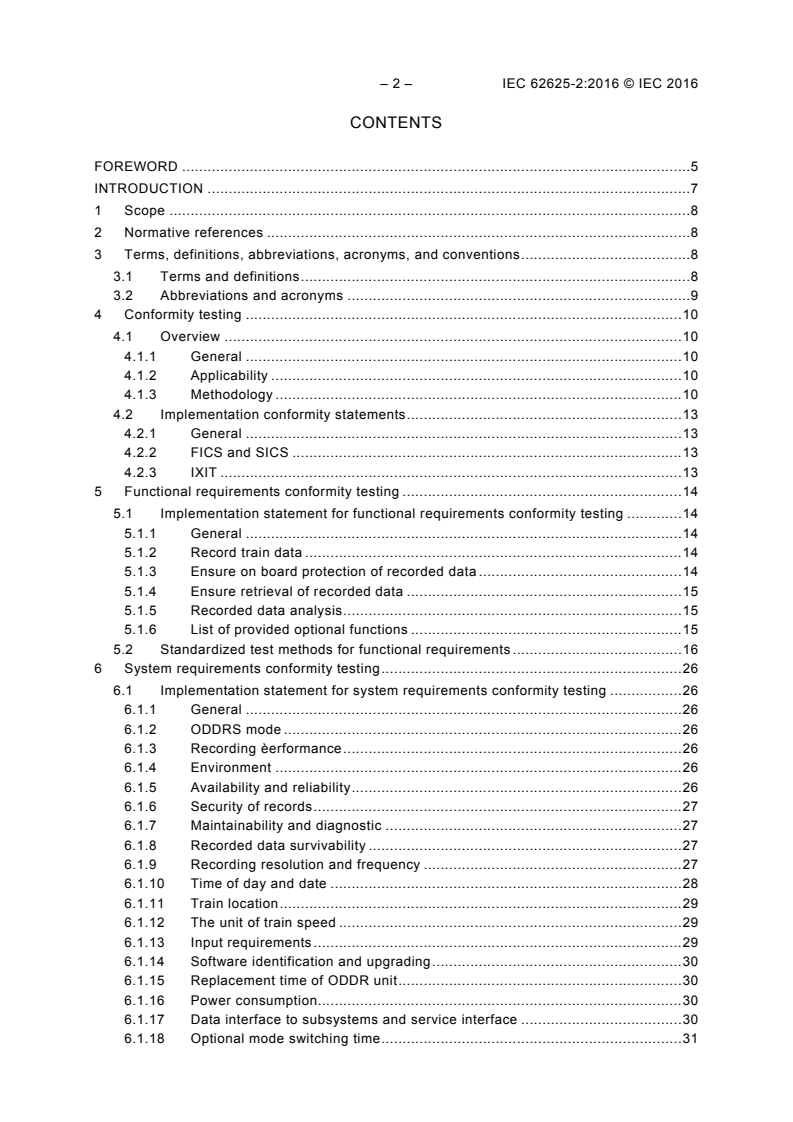
CONTENTS
FOREWORD .5
INTRODUCTION .7
1 Scope .8
2 Normative references .8
3 Terms, definitions, abbreviations, acronyms, and conventions .8
3.1 Terms and definitions .8
3.2 Abbreviations and acronyms .9
4 Conformity testing . 10
4.1 Overview . 10
4.1.1 General . 10
4.1.2 Applicability . 10
4.1.3 Methodology . 10
4.2 Implementation conformity statements . 13
4.2.1 General . 13
4.2.2 FICS and SICS . 13
4.2.3 IXIT . 13
5 Functional requirements conformity testing . 14
5.1 Implementation statement for functional requirements conformity testing . 14
5.1.1 General . 14
5.1.2 Record train data . 14
5.1.3 Ensure on board protection of recorded data . 14
5.1.4 Ensure retrieval of recorded data . 15
5.1.5 Recorded data analysis . 15
5.1.6 List of provided optional functions . 15
5.2 Standardized test methods for functional requirements . 16
6 System requirements conformity testing . 26
6.1 Implementation statement for system requirements conformity testing . 26
6.1.1 General . 26
6.1.2 ODDRS mode . 26
6.1.3 Recording èerformance . 26
6.1.4 Environment . 26
6.1.5 Availability and reliability . 26
6.1.6 Security of records . 27
6.1.7 Maintainability and diagnostic . 27
6.1.8 Recorded data survivability . 27
6.1.9 Recording resolution and frequency . 27
6.1.10 Time of day and date . 28
6.1.11 Train location . 29
6.1.12 The unit of train speed . 29
6.1.13 Input requirements . 29
6.1.14 Software identification and upgrading . 30
6.1.15 Replacement time of ODDR unit . 30
6.1.16 Power consumption . 30
6.1.17 Data interface to subsystems and service interface . 30
6.1.18 Optional mode switching time . 31
6.2 Standardized test methods for system requirements . 31
7 Arrangements for ODDR Unit type test . 44
7.1 Type test with the integrated ODDRS . 44
7.1.1 General . 44
7.1.2 Equivalent signal generator, power supply . 44
7.1.3 Setup of the test environment . 45
Annex A (informative) FICS and SICS structure and instruction . 46
A.1 FICS and SICS pro-forma. 46
A.1.1 General . 46
A.1.2 Abbreviations used in FICS and SICS tables . 46
A.2 FICS and SICS tables . 46
A.2.1 Identification of FICS and SICS . 46
A.2.2 Identification of the implementation under test . 46
A.2.3 Identification of the IUT supplier . 47
A.2.4 Identification of the standards . 47
A.2.5 Global statement of conformity . 48
A.2.6 Level of conformity . 48
A.2.7 FICS and SICS tables structure . 48
Annex B (informative) Methods for testing the parameter values of the protection
capability . 50
B.1 Overview . 50
B.2 General procedure . 50
B.3 Detailed procedure . 50
B.3.1 Protection capability code FA . 50
B.3.2 Protection capability code FB . 51
B.3.3 Protection capability code SA . 51
B.3.4 Protection capability code SB . 52
B.3.5 Protection capability code PA . 52
B.3.6 Protection capability code CA. 52
B.3.7 Protection capability code CB. 53
B.3.8 Protection capability code IA . 53
B.3.9 Protection capability code IB . 53
B.3.10 Protection capability code HA. 54
B.3.11 Protection capability code MA . 54
Bibliography . 55
Figure 1 – Conformity testing process . 11
Figure 2 – Test configurations at the integrated type test . 45
Figure B.1 – Impact shock waveform . 52
Table 1 – FICS pro-forma “Record train data” . 14
Table 2 – FICS pro-forma “Ensure on board protection of recorded data” . 15
Table 3 – FICS pro-forma “Ensure retrieval of recorded data” . 15
Table 4 – FICS pro-forma “Recorded data analysis” . 15
Table 5 – FICS pro-forma “List of provided optional functions” . 15
Table 6 – Standardized test methods for functional requirements . 17
Table 7 – SICS pro-forma “ODDRS mode” . 26
– 4 – IEC 62625-2:2016 © IEC 2016
Table 8 – SICS pro-forma “Recording performance” . 26
Table 9 – SICS pro-forma “Environment” . 26
Table 10 – SICS pro-forma “Availability and reliability” . 27
Table 11 – SICS pro-forma “Security of records” . 27
Table 12 – SICS pro-forma “Maintainability and diagnostic” . 27
Table 13 – SICS pro-forma “Recorded data survivability”. 27
Table 14 – SICS pro-forma “Recording resolution and frequency” . 28
Table 15 – SICS pro-forma “Time of day and date” . 29
Table 16 – SICS pro-forma “Train location” . 29
Table 17 – SICS pro-forma “The unit of train speed” . 29
Table 18 – SICS pro-forma “Input requirements” . 30
Table 19 – SICS pro-forma “Software identification and upgrading” . 30
Table 20 – SICS pro-forma “Replacement time of ODDR unit” . 30
Table 21 – SICS pro-forma “Power consumption” . 30
Table 22 – SICS pro-forma “Data interface to subsystems and service interface” . 31
Table 23 – SICS pro-forma “Optional mode switching time” . 31
Table 24 – Standardized test methods for system requirements . 32
Table A.1 – FICS and SICS identification table . 46
Table A.2 – IUT identification table . 47
Table A.3 – IUT supplier identification table . 47
Table A.4 – Applicable standards identification table . 47
Table A.5 – Global statement table . 48
Table A.6 – FICS and SICS tables format . 49
INTERNATIONAL ELECTROTECHNICAL COMMISSION
____________
ELECTRONIC RAILWAY EQUIPMENT –
ON BOARD DRIVING DATA RECORDING SYSTEM –
Part 2: Conformity testing
FOREWORD
1) The International Electrotechnical Commission (IEC) is a worldwide organization for standardization comprising
all national electrotechnical committees (IEC National Committees). The object of IEC is to promote
international co-operation on all questions concerning standardization in the electrical and electronic fields. To
this end and in addition to other activities, IEC publishes International Standards, Technical Specifications,
Technical Reports, Publicly Available Specifications (PAS) and Guides (hereafter referred to as “IEC
Publication(s)”). Their preparation is entrusted to technical committees; any IEC National Committee interested
in the subject dealt with may participate in this preparatory work. International, governmental and non-
governmental organizations liaising with the IEC also participate in this preparation. IEC collaborates closely
with the International Organization for Standardization (ISO) in accordance with conditions determined by
agreement between the two organizations.
2) The formal decisions or agreements of IEC on technical matters express, as nearly as possible, an
international consensus of opinion on the relevant subjects since each technical committee has representation
from all interested IEC National Committees.
3) IEC Publications have the form of recommendations for international use and are accepted by IEC National
Committees in that sense. While all reasonable efforts are made to ensure that the technical content of IEC
Publications is accurate, IEC cannot be held responsible for the way in which they are used or for any
misinterpretation by any end user.
4) In order to promote international uniformity, IEC National Committees undertake to apply IEC Publications
transparently to the maximum extent possible in their national and regional publications. Any divergence
between any IEC Publication and the corresponding national or regional publication shall be clearly indicated
in the latter.
5) IEC itself does not provide any attestation of conformity. Independent certification bodies provide conformity
assessment services and, in some areas, access to IEC marks of conformity. IEC is not responsible for any
services carried out by independent certification bodies.
6) All users should ensure that they have the latest edition of this publication.
7) No liability shall attach to IEC or its directors, employees, servants or agents including individual experts and
members of its technical committees and IEC National Committees for any personal injury, property damage or
other damage of any nature whatsoever, whether direct or indirect, or for costs (including legal fees) and
expenses arising out of the publication, use of, or reliance upon, this IEC Publication or any other IEC
Publications.
8) Attention is drawn to the Normative references cited in this publication. Use of the referenced publications is
indispensable for the correct application of this publication.
9) Attention is drawn to the possibility that some of the elements of this IEC Publication may be the subject of
patent rights. IEC shall not be held responsible for identifying any or all such patent rights.
Internationals Standard IEC 62625-2 has been prepared by IEC Technical Committee 9:
Electrical equipment and systems for railways.
The text of this standard is based on the following documents:
FDIS Report on voting
9/2081/FDIS 9/2118/RVD
Full information on the voting for the approval of this standard can be found in the report on
voting indicated in the above table.
This publication has been drafted in accordance with the ISO/IEC Directives, Part 2.
– 6 – IEC 62625-2:2016 © IEC 2016
A list of all parts in the IEC 62625 series, published under the general title Electronic railway
equipment – On board driving data recording system, can be found on the IEC website.
The committee has decided that the contents of this publication will remain unchanged until
the stability date indicated on the IEC website under "http://webstore.iec.ch" in the data
related to the specific publication. At this date, the publication will be
• reconfirmed,
• withdrawn,
• replaced by a revised edition, or
• amended.
IMPORTANT – The 'colour inside' logo on the cover page of this publication indicates
that it contains colours which are considered to be useful for the correct
understanding of its contents. Users should therefore print this document using a
colour printer.
INTRODUCTION
In consideration that IEC 62625-1 specifies the ODDRS (On Board Driving Data Recording
System) requirements in terms of functional and system descriptions, a standardized
conformity testing approach was developed in this standard on the base of the ISO/IEC 9646
series standards.
The ISO/IEC 9646 series standards apply to the assessment of communication protocol and
are based on the concept of PICS (Protocol Implementation Conformity Statement) and PIXIT
(Protocol Implementation eXtra Information for Testing). This standard extends the concepts
to functional and system description introducing FICS (Function Implementation Conformity
Statement), SICS (System Implementation Conformity Statement) and IXIT (Implementation
eXtra Information for Testing).
The IEC 62625-1 requirements implementation, formally described by FICS, SICS and IXIT
are verified by design review and other test methods applied to ODDR Unit and ODDRS
installed on the train.
– 8 – IEC 62625-2:2016 © IEC 2016
ELECTRONIC RAILWAY EQUIPMENT –
ON BOARD DRIVING DATA RECORDING SYSTEM –
Part 2: Conformity testing
1 Scope
This part of IEC 62625 covers the standardized test methods for verifying the compliance of
an On board Driving Data Recording System implementation with the requirements specified
by IEC 62625-1.
Furthermore, it covers the conformity testing criteria for designed and manufactured ODDRS.
This part of IEC 62625 includes the list of the requirements specified by IEC 62625-1 and the
relevant acceptance conditions for ODDRS at design review, type test and routine test
phases. For the train level design review and train level test phases, this part provides
guidelines for the conformity testing methods to be applied to the ODDRS installed on the
train.
This part does not cover the conformity assessment schemes that, according to ISO/IEC
Directives Part 2, are the responsibility of ISO policy committee “Committee on conformity
assessment” (ISO/CASCO). Consequently, this part does not include elements related to
conformity assessment aspects other than design review and testing provisions for the
products, processes or services which implements the requirements specified in IEC 62625-1.
This part does not delete, change or interpret the general requirements for conformity
assessment procedures and vocabulary detailed in ISO/IEC 17000.
2 Normative references
The following documents, in whole or in part, are normatively referenced in this document
and are indispensable for its application. For dated references, only the edition cited applies.
For undated references, the latest edition of the referenced document (including any
amendments) applies.
IEC 60571, Railway applications – Electronic equipment used on rolling stock
IEC 61375 (all parts), Electronic railway equipment – Train communication network (TCN)
IEC 62498-1, Railway applications – Environmental conditions for equipment – Part 1:
Equipment on board rolling stock
IEC 62625-1:2013, Electronic railway equipment – On board driving data recording system –
Part 1: System specification
ISO/IEC 8824 (all parts), Information technology – Abstract Syntax Notation One (ASN.1)
3 Terms, definitions, abbreviations, acronyms, and conventions
3.1 Terms and definitions
For the purposes of this document, the following terms and definitions apply.
3.1.1
accident
unintended event or series of events that results in death, injury, loss of a system or service,
or environmental damage
Note 1 to entry: Accidents are divided into the following categories: collisions, derailments, level crossing
accidents, accidents to persons caused by rolling stock in motion, fires and others.
3.1.2
consist
single vehicle or a group of vehicles which are not separated during normal operation
EXAMPLE The vehicles of a consist are steadily connected in a workshop, and automatic couplers are mounted
at both ends of the consist to facilitate the coupling and de-coupling of complete consists in the workshop or
during operation.
Note 1 to entry: A consist may contain one or more traction units.
3.1.3
incident
any occurrence, other than accident or serious accident, associated with the operation of
trains and affecting the safety of operation
3.1.4
non-volatile storage medium
memory and the relevant interface circuitry, which store the data for investigative use in case
of accidents and incidents
Note 1 to entry: The non-volatile storage medium may be protected.
3.1.5
ODDR unit
physical unit which implements the ODDRS
Note 1 to entry: ODDRS may be implemented by one or more ODDR units.
3.1.6
resolution
smallest change in the measurand, or stored quantity, which causes a perceptible change in
the indication
[SOURCE: IEC 60050-311:2001, 311-03-10, modified – ‘stored quantity’ instead of ‘quantity
supplied’ has been used]
3.1.7
test verdict
statement of “pass”, “fail”, or “inconclusive”, as specified in an abstract test case, concerning
conformity of an IUT with respect to the test case when it is executed
3.1.8
train safety function
technical barrier to prevent a hazard to become an accident during the train operation
3.2 Abbreviations and acronyms
CSV Comma Separated Values
DR Design Review
EMC Electromagnetic Compatibility
FICS Function Implementation Conformity Statement
GPS Global Positioning System
– 10 – IEC 62625-2:2016 © IEC 2016
IDRR Integration DR Report
ITTR Integration Type Test Report
IUT Implementation Under Test
IXIT Implementation eXtra Information for Testing
LSB Least Significant Bit
NTP Network Time Protocol
ODDR On Board Driving Data Recording
ODDRS On Board Driving Data Recording System
RAL Colour Standard
SICS System Implementation Conformity Statement
TCMS Train Control and Monitoring System
TCN Train Communication Network
TLDR Train Level Design Review
TLDRR Train Level Design Review Report
TLT Train Level Test
TLTR Train Level Test Report
TT Type Test
USB Universal Serial Bus
UTC Universal Time, Coordinated
XML eXtensible Markup Language
4 Conformity testing
4.1 Overview
4.1.1 General
Clause 4 specifies the process and methodology for the conformity testing, in terms of
procedures, design review requirements, testing requirements, and conformity testing
documentation requirements.
4.1.2 Applicability
This standard is applicable to verify and test ODDRS at sub-system level or at unit level. The
conformity testing shall be performed and concluded for units carrying any function covered
by 4.2 of IEC 62625-1:2013 and respecting the requirements specified by 4.3 of IEC 62625-
1:2013.
4.1.3 Methodology
4.1.3.1 General
The ODDRS conformity testing process shall follow the phases listed below, see Figure 1.
The relevant documentation shall be part of the conformity testing and documentation folder.
Phases of the conformity testing process:
a) Device/function conformity checking
b) Subsystem integration Design Review (DR)
c) Subsystem integration Type Test (TT)
d) Subsystem type and traction unit type – Train Level Design Review (TLDR)
e) Subsystem type and traction unit type – Train Level Type Test (TLTT)
Device/Function
Dev/Funct
Devices /
Device/Function
D B C Test
Function
a) A E Device/Function
test suite
Report
Test procedure
Conformity
Acceptance process
Testing
Documentation
Subsystem
A C
System
B Review the design IDDR
Requirements
b)
of the ODDR Unit Integration
E DR Report
D Test methods DR
in Table 6 and
Integration Design Review
Table 24
Subsystem Type
Integration Test
C
A
Procedure
B
Perform the type test ITTR integration
c)
of the ODDR Unit Type Test Report
Test methods TT
E
D
in Table 6 and
Table 24
Integration Type Test
Subsystem Type + Traction unit type
Type System
A
Requirements
B C
TLDRR Train
Review the integration
d) Conformity testing
Level Design
E design of the ODDRS
D
Test methods
and
on the train Review Report
TLDR in Table 6
Document Folder
and Table 24
Train Level Design Review
Subsystem Type + Traction unit type
Installation Test
procedure
A
B C
Perform tests of the
e) TLTR Train Level
E Test methods TLT ODDRS on the train
D
Test Report
in Table 6 and
Table 24
IEC
Train Level Test
Figure 1 – Conformity testing process
4.1.3.2 Device/function conformity checking
The compliance to the requirements specified by IEC 62625-1:2013 is mandatory for all the
functions/devices composing the ODDR unit. Each device/function shall be verified according
to the provided test procedure.
Considering that the user of this standard is free, at design level, to choose the functions
mapping over devices, several situations may apply:
• One complete function is carried and executed by one device.
• More than one function is carried and executed by one device.
• One function is carried and executed by more devices, each one executing a part (sub-
function) of the complete function.
Following this consideration, the device/function conformity checking is only covering the
capability of the device to execute the functions/sub-functions which are carried by such
device.
The test procedures are defined by the designer. The passing of such test procedure are a
prerequisite to run the tests specified by 4.1.3.4 and 4.1.3.6.
Specific requirements related to practices necessary to assure the integration at ODDR unit
and at train level are to be determined in accordance with relevant railway standards during
the following phases.
– 12 – IEC 62625-2:2016 © IEC 2016
4.1.3.3 Subsystem integration design review
The design review evaluates the design of an ODDR Unit against the requirements specified
by IEC 62625-1:2013, through examination of technical documentation for the IUT together
with any supporting evidence.
The functional and system requirements of ODDR unit shall be listed and described
according to the FICS and SICS specified by the Clauses 5 and 6.
The design review shall also include documentation on reliability, availability, maintainability,
interfaces, installation requirements and constraints.
If there are any changes to the ODDR unit, an evaluation shall be performed in order to
identify if its functionality has been affected and which impact exists on the system. If so, the
relevant test methods shall be applied in order to verify that the ODDR unit still complies with
the requirements of IEC 62625-1:2013.
The Design Review test methods are specified in Table 6 and Table 24 (phase DR).
4.1.3.4 Subsystem integration type test
The aim of the type test of the ODDR Unit is to verify that the functional and system
requirements specified by IEC 62625-1:2013 are met by the ODDR Unit.
The description of functional and system requirements which are implemented by the design
of IUT and are submitted to type test shall be listed and described by the FICS and SICS
specified by the Clauses 5 and 6.
Type test shall be performed on one or more unit of a given design and manufacturing
procedure to ensure the full coverage of the specified requirements.
If there is any change to a previously tested unit, the type test shall repeat at least those test
cases which are affected by the change.
The type test methods are specified in Table 6 and Table 24 (phase TT).
4.1.3.5 Subsystem type and traction unit type – Train level design review
The train level design review verifies the integration of an ODDRS in the train, through
examination of technical documentation together with any supporting evidence.
The train level design review shall include documentation on reliability, availability,
maintainability, interfaces, installation requirements and constraints.
The Train Level Design Review test methods are specified in Table 6 and Table 24 (phase
TLDR).
4.1.3.6 Subsystem type and traction unit type – Train level test
The aim of train level test is to verify some functional and system requirements of the
ODDRS after the installation in the train, in order to assure that the installation has not
affected the fulfilment of those requirements.
The test cases, to be carried out during the train level test, are listed in Table 6 and Table 24.
The Train Level Test methods are specified in Table 6 and Table 24 (phase TLT).
4.2 Implementation conformity statements
4.2.1 General
The functional requirements are verified according to the declaration statements called FICS
which are relevant to 4.2 of IEC 62625-1:2013.
The system requirements are verified according to the declaration statements called SICS
which are relevant to 4.3 of IEC 62625-1:2013.
The supplier shall determine which extra IUT specific information is necessary for testing the
functional and system requirements. The IUT supplier shall complete an IXIT pro-forma with
the necessary information, and make it available.
4.2.2 FICS and SICS
To evaluate the conformity of a particular implementation, it is necessary to have a statement
of the capabilities and options that have been implemented with reference to the
requirements and any features which have been omitted, so that the implementation can be
checked for acceptance against the requirements specified respectively in 4.2 and in 4.3 of
IEC 62625-1:2013, and against those requirements only. Such statements are called
respectively:
• Function Implementation Conformity Statement (FICS).
• System Implementation Conformity Statement (SICS).
The structure and instructions for completion of the FICS and SICS are given in the
informative Annex A.
4.2.3 IXIT
In order to test a function implementation, the test authority needs information relating to the
IUT and its testing environment in addition to that provided by the FICS and SICS. This
"Implementation eXtra Information for Testing" (IXIT) will be provided by the supplier and
system integrator submitting the implementation for testing, as a result of consultation with
the test authority.
The IXIT may contain the following information:
a) information needed by the test authority in order to be able to run the appropriate test
suite on the specific system (e.g. information related to the test method to be used to run
the test cases, addressing information);
b) information already mentioned in the FICS and which needs to be made precise (e.g. a
timer value range which is declared as a parameter in the FICS should be specified in the
IXIT);
c) information to help determine which capabilities stated in the FICS as being supported
are testable and which are not testable;
d) other administrative matters (e.g. the IUT identifier, reference to the related FICS).
The IXIT shall not conflict with the appropriate FICS or SICS.
– 14 – IEC 62625-2:2016 © IEC 2016
5 Functional requirements conformity testing
5.1 Implementation statement for functional requirements conformity testing
5.1.1 General
The following subclauses specify the FICS pro-forma relevant to the functional requirements
which shall be filled by the IUT supplier and provided as part of input documentation to the
verification. Column 2 of Tables 1 to 5 is the reference to the IEC 62625-1:2013 subclause.
For an explanation of the abbreviations used in the tables, refer to A.1.2.
5.1.2 Record train data
The Table 1 shall be filled by the IUT supplier.
Table 1 – FICS pro-forma “Record train data”
Ref. No. Subclause Capability Requirement Value Implementation
class
4.2.1 Protected storage medium m 24 h minimum
capacity
4.2.1 Storage medium capacity m 8 days minimum
At minimum:
4.2.1 Recorded data list m
– Time of day and
date
– Train speed
– Train location
– Driver’s command
relevant to safe
operation
– Actions of safety
functions related
to train operation
NOTE 1 The value of the capabilities “Protected storage medium capacity” and “Storage medium capacity”
depend on, among other things, the capability “Recorded data list” and on the maximum amount of data be
recorded during full train operations.
NOTE 2 For the implementation of the “Recorded data list” refer to Table 2 in IEC 62625-1:2013. The format of
the data is described by the party who submits the IUT to the conformity testing.
5.1.3 Ensure on board protection of recorded data
The Table 2 shall be filled by the IUT supplier.
Table 2 – FICS pro-forma “Ensure on board protection of recorded data”
Ref. No. Subclause Capability Requirement Value Implementation
class
4.2.2 Protection capability m See Table 1 in
IEC 62625-1:2013
4.2.2 Date and time entry by an o n/a Yes / No
authorised personnel
4.2.2 Data retention after loss of m At least one month
power
NOTE According to 4.2.2, the IUT implementation description is clarified: safeguarding against unauthorized
data access and software update, means of preventing, modifying and deleting the recorded data.
5.1.4 Ensure retrieval of recorded data
The Table 3 shall be filled by the IUT supplier.
Table 3 – FICS pro-forma “Ensure retrieval of recorded data”
Ref. No. Subclause Capability Requirement Value Implementation
class
4.2.3 m Removable storage
1 Data extraction means
medium
and/or
Communication
interface
4.2.3 o n/a Yes / No
2 No overwrite mode
4.2.3 o n/a Yes / No
3 Downloading and
recording in parallel
5.1.5 Recorded data analysis
The Table 4 shall be filled by the IUT supplier.
Table 4 – FICS pro-forma “Recorded data analysis”
Ref. No. Subclause Capability Requirement Value Implementation
class
1 4.2.4 Data exchange format m Standard format
(e.g. CSV, XML)
5.1.6 List of provided optional functions
The Table 5 shall be filled by the IUT supplier.
Table 5 – FICS pro-forma “List of provided optional functions”
Ref. No. Subclause Capability Requirement Value Implementation
class
1 4.2.5.1 Display ODDRS status to o n/a Yes / No
the driver
2 4.2.5.2 Make easy the recognition o Orange RAL 2003
of the protected storage
medium
3 4.2.5.3 Provide on-board o n/a Yes / No
communication
– 16 – IEC 62625-2:2016 © IEC 2016
Ref. No. Subclause Capability Requirement Value Implementation
class
4 4.2.5.3 Provide on-board to ground o n/a Yes / No
communication
5 4.2.5.4 Provide low power o n/a Yes / No
management
6 4.2.5.5 Support digital signature o n/a Yes / No
and driver identification
7 4.2.5.6 Provide remote status o n/a Yes / No
information
8 4.2.5.6 Provide remote o n/a Yes / No
initialization function
9 4.2.5.6 Upload new software o n/a Yes / No
10 4.2.5.6 Download diagnostic o n/a Yes / No
logging files
11 4.2.5.6 Provide download tool for o n/a Yes / No
recorded data
5.2 Standardized test methods for functional requirements
The following Table 6 lists all the functional requirements which shall be verified. The table
includes the following columns:
1) reference No;
2) subclause;
3) requirement description;
4) verification context;
5) phase;
6) acceptance criteria;
7) note, if applicable.
Column 1 is an incremental number which identifies the row in the table.
Column 2 is the reference to the IEC 62625-1:2013 subclause listing the requirement which
the IUT shall be verified against.
Column 3 is a brief description of the requirement.
Column 4 describes the context for the verifica
...