

IEC 62479:2010
(Main)Assessment of the compliance of low-power electronic and electrical equipment with the basic restrictions related to human exposure to electromagnetic fields (10 MHz to 300 GHz)
General Information
- Abstract
IEC 62479:2010 provides simple conformity assessment methods for low-power electronic and electrical equipment to an exposure limit relevant to electromagnetic fields (EMF). If such equipment cannot be shown to comply with the applicable EMF exposure requirements using the methods included in this standard for EMF assessment, then other standards, including IEC 62311 or other (EMF) product standards, may be used for conformity assessment.
- Status
- Published
- Publication Date
- 15-Jun-2010
- Technical Committee
- TC 106 - Methods for the assessment of electric, magnetic and electromagnetic fields associated with human exposure
- Drafting Committee
- WG 5 - TC 106/WG 5
- Current Stage
- PPUB - Publication issued
- Start Date
- 16-Jun-2010
- Completion Date
- 30-Jun-2010
Buy Documents
IEC 62479:2010 - Assessment of the compliance of low-power electronic and electrical equipment with the basic restrictions related to human exposure to electromagnetic fields (10 MHz to 300 GHz) Released:6/16/2010
Overview
IEC 62479:2010 outlines straightforward methods for assessing the compliance of low-power electronic and electrical equipment with basic restrictions on human exposure to electromagnetic fields (EMF) in the frequency range of 10 MHz to 300 GHz. Developed by the International Electrotechnical Commission (IEC), this standard is relevant for manufacturers, compliance engineers, and certification bodies involved in the design, assessment, and approval of equipment with low electromagnetic emissions.
IEC 62479:2010 provides practical guidance and routes for determining whether a product’s EMF emissions remain within internationally accepted exposure limits. If equipment does not clearly comply using these simplified procedures, more comprehensive standards, such as IEC 62311 or other specific EMF product standards, should be referenced.
Key Topics
- Scope of Application: Focuses on low-power electrical and electronic devices where the EMF exposure is unlikely to exceed public or occupational safety limits.
- Assessment Methods: Presents four primary routes for demonstrating compliance, including inherent compliance due to physical characteristics, low input/output power, adherence to product-specific power limits, or via calculations and/or measurements.
- Low-Power Exclusion Levels: Defines thresholds for available antenna power or average total radiated power. Devices below these thresholds are deemed compliant without detailed exposure analysis.
- Exposure from Multiple Sources: Considers cumulative EMF exposure from products with more than one transmitting component.
- Uncertainty in Measurements: Sets default and maximum allowed uncertainty values for assessment methods, with guidance for calculating expanded measurement uncertainty.
- Reporting Requirements: Specifies essential documentation and information that must be included in EMF assessment reports for demonstration and repeatability of results.
Applications
IEC 62479:2010 is widely used in the conformity assessment of devices such as:
- Consumer electronics (e.g., laptops, tablets, audio/visual equipment)
- Information technology equipment (ITE) and multimedia equipment (MME)
- Wireless devices, including those operating close to the body
- Industrial and commercial low-power electronic equipment
Typical users of this standard include product manufacturers, importers, regulatory authorities, and certification laboratories. The standard’s simplified approach enables efficient determination of compliance for devices with inherently low emissions, streamlining processes for market access and regulatory approvals.
Compliance benefits:
- Reduces the complexity and cost of EMF testing for low-power equipment.
- Facilitates global market entry by aligning with international EMF safety benchmarks.
- Supports manufacturers in demonstrating due diligence regarding human health and safety.
Related Standards
For equipment that cannot be shown to comply using the methods in IEC 62479:2010, the following EMF standards and guidelines are commonly referenced:
- IEC 62311: Assessment of electronic and electrical equipment related to human exposure restrictions for electromagnetic fields (0 Hz – 300 GHz).
- ICNIRP Guidelines: International recommendations for EMF exposure limits.
- IEEE C95.1: IEEE Standard for Safety Levels with Respect to Human Exposure to Radio Frequency Electromagnetic Fields.
- ISO/IEC 17025: Requirements for the competence of testing and calibration laboratories, relevant for EMF assessment procedures and reports.
These related standards address scenarios where more rigorous or detailed evaluation is needed, or where the operational parameters of the equipment exceed the low-power exclusion thresholds set by IEC 62479:2010.
By following IEC 62479:2010, manufacturers and compliance professionals can efficiently assess and document the EMF safety of low-power devices, ensuring both regulatory compliance and public safety in the rapidly evolving landscape of electronic and wireless products.
Buy Documents
IEC 62479:2010 - Assessment of the compliance of low-power electronic and electrical equipment with the basic restrictions related to human exposure to electromagnetic fields (10 MHz to 300 GHz) Released:6/16/2010
Get Certified
Connect with accredited certification bodies for this standard

BSI Group
BSI (British Standards Institution) is the business standards company that helps organizations make excellence a habit.

BSMI (Bureau of Standards, Metrology and Inspection)
Taiwan's standards and inspection authority.

NYCE
Mexican standards and certification body.
Sponsored listings
Frequently Asked Questions
IEC 62479:2010 is a standard published by the International Electrotechnical Commission (IEC). Its full title is "Assessment of the compliance of low-power electronic and electrical equipment with the basic restrictions related to human exposure to electromagnetic fields (10 MHz to 300 GHz)". This standard covers: IEC 62479:2010 provides simple conformity assessment methods for low-power electronic and electrical equipment to an exposure limit relevant to electromagnetic fields (EMF). If such equipment cannot be shown to comply with the applicable EMF exposure requirements using the methods included in this standard for EMF assessment, then other standards, including IEC 62311 or other (EMF) product standards, may be used for conformity assessment.
IEC 62479:2010 provides simple conformity assessment methods for low-power electronic and electrical equipment to an exposure limit relevant to electromagnetic fields (EMF). If such equipment cannot be shown to comply with the applicable EMF exposure requirements using the methods included in this standard for EMF assessment, then other standards, including IEC 62311 or other (EMF) product standards, may be used for conformity assessment.
IEC 62479:2010 is classified under the following ICS (International Classification for Standards) categories: 01 - GENERALITIES. TERMINOLOGY. STANDARDIZATION. DOCUMENTATION; 17.220.20 - Measurement of electrical and magnetic quantities; 35.020 - Information technology (IT) in general. The ICS classification helps identify the subject area and facilitates finding related standards.
IEC 62479:2010 is available in PDF format for immediate download after purchase. The document can be added to your cart and obtained through the secure checkout process. Digital delivery ensures instant access to the complete standard document.
Standards Content (Sample)
IEC 62479 ®
Edition 1.0 2010-06
INTERNATIONAL
STANDARD
NORME
INTERNATIONALE
Assesment of the compliance of low-power electronic and electrical equipment
with the basic restrictions related to human exposure to electromagnetic fields
(10 MHz to 300 GHz)
Évaluation de la conformité des appareils électriques et électroniques de faible
puissance aux restrictions de base concernant l’exposition des personnes aux
champs électromagnétiques (10 MHz à 300 GHz)
All rights reserved. Unless otherwise specified, no part of this publication may be reproduced or utilized in any form or by
any means, electronic or mechanical, including photocopying and microfilm, without permission in writing from either IEC or
IEC's member National Committee in the country of the requester.
If you have any questions about IEC copyright or have an enquiry about obtaining additional rights to this publication,
please contact the address below or your local IEC member National Committee for further information.
Droits de reproduction réservés. Sauf indication contraire, aucune partie de cette publication ne peut être reproduite
ni utilisée sous quelque forme que ce soit et par aucun procédé, électronique ou mécanique, y compris la photocopie
et les microfilms, sans l'accord écrit de la CEI ou du Comité national de la CEI du pays du demandeur.
Si vous avez des questions sur le copyright de la CEI ou si vous désirez obtenir des droits supplémentaires sur cette
publication, utilisez les coordonnées ci-après ou contactez le Comité national de la CEI de votre pays de résidence.
IEC Central Office
3, rue de Varembé
CH-1211 Geneva 20
Switzerland
Email: inmail@iec.ch
Web: www.iec.ch
About the IEC
The International Electrotechnical Commission (IEC) is the leading global organization that prepares and publishes
International Standards for all electrical, electronic and related technologies.
About IEC publications
The technical content of IEC publications is kept under constant review by the IEC. Please make sure that you have the
latest edition, a corrigenda or an amendment might have been published.
ƒ Catalogue of IEC publications: www.iec.ch/searchpub
The IEC on-line Catalogue enables you to search by a variety of criteria (reference number, text, technical committee,…).
It also gives information on projects, withdrawn and replaced publications.
ƒ IEC Just Published: www.iec.ch/online_news/justpub
Stay up to date on all new IEC publications. Just Published details twice a month all new publications released. Available
on-line and also by email.
ƒ Electropedia: www.electropedia.org
The world's leading online dictionary of electronic and electrical terms containing more than 20 000 terms and definitions
in English and French, with equivalent terms in additional languages. Also known as the International Electrotechnical
Vocabulary online.
ƒ Customer Service Centre: www.iec.ch/webstore/custserv
If you wish to give us your feedback on this publication or need further assistance, please visit the Customer Service
Centre FAQ or contact us:
Email: csc@iec.ch
Tel.: +41 22 919 02 11
Fax: +41 22 919 03 00
A propos de la CEI
La Commission Electrotechnique Internationale (CEI) est la première organisation mondiale qui élabore et publie des
normes internationales pour tout ce qui a trait à l'électricité, à l'électronique et aux technologies apparentées.
A propos des publications CEI
Le contenu technique des publications de la CEI est constamment revu. Veuillez vous assurer que vous possédez
l’édition la plus récente, un corrigendum ou amendement peut avoir été publié.
ƒ Catalogue des publications de la CEI: www.iec.ch/searchpub/cur_fut-f.htm
Le Catalogue en-ligne de la CEI vous permet d’effectuer des recherches en utilisant différents critères (numéro de référence,
texte, comité d’études,…). Il donne aussi des informations sur les projets et les publications retirées ou remplacées.
ƒ Just Published CEI: www.iec.ch/online_news/justpub
Restez informé sur les nouvelles publications de la CEI. Just Published détaille deux fois par mois les nouvelles
publications parues. Disponible en-ligne et aussi par email.
ƒ Electropedia: www.electropedia.org
Le premier dictionnaire en ligne au monde de termes électroniques et électriques. Il contient plus de 20 000 termes et
définitions en anglais et en français, ainsi que les termes équivalents dans les langues additionnelles. Egalement appelé
Vocabulaire Electrotechnique International en ligne.
ƒ Service Clients: www.iec.ch/webstore/custserv/custserv_entry-f.htm
Si vous désirez nous donner des commentaires sur cette publication ou si vous avez des questions, visitez le FAQ du
Service clients ou contactez-nous:
Email: csc@iec.ch
Tél.: +41 22 919 02 11
Fax: +41 22 919 03 00
IEC 62479 ®
Edition 1.0 2010-06
INTERNATIONAL
STANDARD
NORME
INTERNATIONALE
Assesment of the compliance of low-power electronic and electrical equipment
with the basic restrictions related to human exposure to electromagnetic fields
(10 MHz to 300 GHz)
Évaluation de la conformité des appareils électriques et électroniques de faible
puissance aux restrictions de base concernant l’exposition des personnes aux
champs électromagnétiques (10 MHz à 300 GHz)
INTERNATIONAL
ELECTROTECHNICAL
COMMISSION
COMMISSION
ELECTROTECHNIQUE
PRICE CODE
INTERNATIONALE
R
CODE PRIX
ICS 17.220.20; 35.020 ISBN 978-2-88910-989-0
– 2 – 62479 © IEC:2010
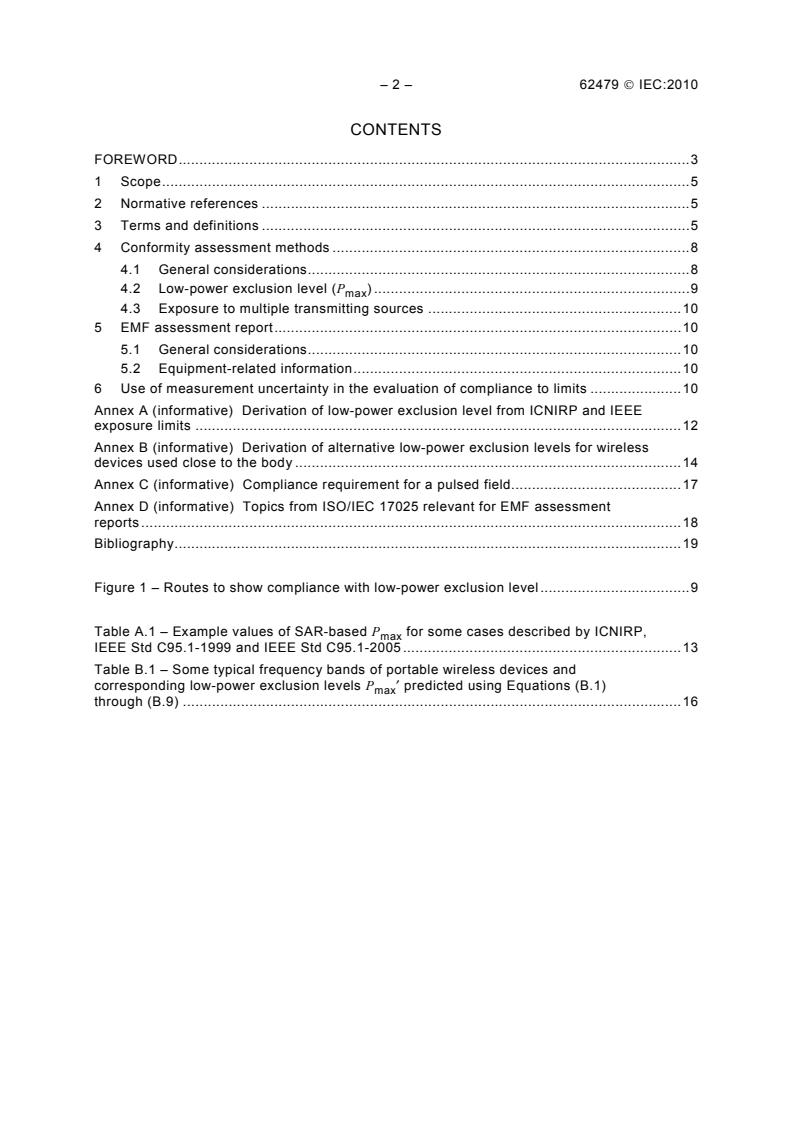
CONTENTS
FOREWORD.3
1 Scope.5
2 Normative references .5
3 Terms and definitions .5
4 Conformity assessment methods .8
4.1 General considerations.8
4.2 Low-power exclusion level (P ) .9
max
4.3 Exposure to multiple transmitting sources .10
5 EMF assessment report.10
5.1 General considerations.10
5.2 Equipment-related information.10
6 Use of measurement uncertainty in the evaluation of compliance to limits .10
Annex A (informative) Derivation of low-power exclusion level from ICNIRP and IEEE
exposure limits .12
Annex B (informative) Derivation of alternative low-power exclusion levels for wireless
devices used close to the body .14
Annex C (informative) Compliance requirement for a pulsed field.17
Annex D (informative) Topics from ISO/IEC 17025 relevant for EMF assessment
reports .18
Bibliography.19
Figure 1 – Routes to show compliance with low-power exclusion level.9
Table A.1 – Example values of SAR-based P for some cases described by ICNIRP,
max
IEEE Std C95.1-1999 and IEEE Std C95.1-2005.13
Table B.1 – Some typical frequency bands of portable wireless devices and
corresponding low-power exclusion levels P ′ predicted using Equations (B.1)
max
through (B.9) .16
62479 © IEC:2010 – 3 –
INTERNATIONAL ELECTROTECHNICAL COMMISSION
____________
ASSESMENT OF THE COMPLIANCE OF LOW-POWER
ELECTRONIC AND ELECTRICAL EQUIPMENT
WITH THE BASIC RESTRICTIONS RELATED TO HUMAN
EXPOSURE TO ELECTROMAGNETIC FIELDS
(10 MHz to 300 GHz)
FOREWORD
1) The International Electrotechnical Commission (IEC) is a worldwide organization for standardization comprising
all national electrotechnical committees (IEC National Committees). The object of IEC is to promote
international co-operation on all questions concerning standardization in the electrical and electronic fields. To
this end and in addition to other activities, IEC publishes International Standards, Technical Specifications,
Technical Reports, Publicly Available Specifications (PAS) and Guides (hereafter referred to as “IEC
Publication(s)”). Their preparation is entrusted to technical committees; any IEC National Committee interested
in the subject dealt with may participate in this preparatory work. International, governmental and non-
governmental organizations liaising with the IEC also participate in this preparation. IEC collaborates closely
with the International Organization for Standardization (ISO) in accordance with conditions determined by
agreement between the two organizations.
2) The formal decisions or agreements of IEC on technical matters express, as nearly as possible, an international
consensus of opinion on the relevant subjects since each technical committee has representation from all
interested IEC National Committees.
3) IEC Publications have the form of recommendations for international use and are accepted by IEC National
Committees in that sense. While all reasonable efforts are made to ensure that the technical content of IEC
Publications is accurate, IEC cannot be held responsible for the way in which they are used or for any
misinterpretation by any end user.
4) In order to promote international uniformity, IEC National Committees undertake to apply IEC Publications
transparently to the maximum extent possible in their national and regional publications. Any divergence
between any IEC Publication and the corresponding national or regional publication shall be clearly indicated in
the latter.
5) IEC itself does not provide any attestation of conformity. Independent certification bodies provide conformity
assessment services and, in some areas, access to IEC marks of conformity. IEC is not responsible for any
services carried out by independent certification bodies.
6) All users should ensure that they have the latest edition of this publication.
7) No liability shall attach to IEC or its directors, employees, servants or agents including individual experts and
members of its technical committees and IEC National Committees for any personal injury, property damage or
other damage of any nature whatsoever, whether direct or indirect, or for costs (including legal fees) and
expenses arising out of the publication, use of, or reliance upon, this IEC Publication or any other IEC
Publications.
8) Attention is drawn to the Normative references cited in this publication. Use of the referenced publications is
indispensable for the correct application of this publication.
9) Attention is drawn to the possibility that some of the elements of this IEC Publication may be the subject of
patent rights. IEC shall not be held responsible for identifying any or all such patent rights.
International Standard IEC 62479 has been prepared by IEC technical committee 106:
Methods for the assessment of electric, magnetic and electromagnetic fields associated with
human exposure.
The text of this standard is based on the following documents:
FDIS Report on voting
106/198/FDIS 106/205/RVD
Full information on the voting for the approval of this standard can be found in the report on
voting indicated in the above table.
This publication has been drafted in accordance with the ISO/IEC Directives, Part 2.
– 4 – 62479 © IEC:2010
The committee has decided that the contents of this publication will remain unchanged until
the stability date indicated on the IEC web site under "http://webstore.iec.ch" in the data
related to the specific publication. At this date, the publication will be
• reconfirmed,
• withdrawn,
• replaced by a revised edition, or
• amended.
62479 © IEC:2010 – 5 –
ASSESMENT OF THE COMPLIANCE OF LOW-POWER
ELECTRONIC AND ELECTRICAL EQUIPMENT
WITH THE BASIC RESTRICTIONS RELATED TO HUMAN
EXPOSURE TO ELECTROMAGNETIC FIELDS
(10 MHz to 300 GHz)
1 Scope
This International Standard provides simple conformity assessment methods for low-power
electronic and electrical equipment to an exposure limit relevant to electromagnetic fields
(EMF). If such equipment cannot be shown to comply with the applicable EMF exposure
requirements using the methods included in this standard for EMF assessment, then other
standards, including IEC 62311 or other (EMF) product standards, may be used for conformity
assessment.
2 Normative references
The following referenced documents are indispensable for the application of this document.
For dated references, only the edition cited applies. For undated references, the latest edition
of the referenced document (including any amendments) applies.
IEC 62311, Assessment of electronic and electrical equipment related to human exposure
restrictions for electromagnetic fields (0 Hz – 300 GHz)
3 Terms and definitions
For the purposes of this document, the following terms and definitions apply.
3.1
available antenna power
the maximum power, averaged over a time interval equal to the averaging time, supplied to
the antenna feed line that can be theoretically delivered by a source having an impedance of
positive real part to a directly connected load when the impedance of the load is widely varied
NOTE 1 The available antenna power is obtained when the resistance of the load is equal to that of the source
and its reactance is equal in magnitude but of opposite sign. However, other scenarios are possible e.g. if the PA
monitors the current rather than the actual power, a changing antenna impedance (when DUT is operated close to
the body) might actually cause a higher output power than the matched load. Then, a push-pull analysis with varied
realistic loads (according to antenna impedance in the vicinity of the body) should be performed.
NOTE 2 In some cases, conditions such as overheating or overvoltage prevent the available antenna power from
being obtained.
NOTE 3 Time average shall be taken during continuous or maximum duty cycle transmission at maximum power
to the extent possible for a given technology.
1)
NOTE 4 Adapted from IEC 60050-702:1992 [11] , 702-07-10.
NOTE 5 Antenna feed line is defined by IEC 60050-712:1992 [12], 712-06-01.
—————————
1)
Figures in square brackets refer to the Bibliography.
– 6 – 62479 © IEC:2010
3.2
average total radiated power
the time average of the total radiated power over a time interval equal to the averaging time.
This time average is taken during continuous or maximum duty cycle transmission at
maximum power to the extent possible for a given technology
NOTE If the user is in the reactive near field of the antenna, the presence of the user may result in a change in
the total radiated power due to a change in the antenna impedance. In this case, the average total radiated power
must be the maximum possible power in the presence of the user.
3.3
averaging time
t
avg
the appropriate time over which exposure is averaged for purposes of determining compliance
with exposure limits
3.4
basic restriction
restriction(s) on exposure to time-varying electric, magnetic, and electromagnetic fields that are based
directly on established health effects
NOTE Depending upon the frequency of the field, the physical quantities used to specify these restrictions are
current density, specific absorption rate (SAR), and power density.
3.5
conformity assessment
demonstration that specified requirements relating to a product, process, system, person or
body are fulfilled
NOTE The subject field of conformity assessment includes activities such as testing, inspection and certification,
as well as the accreditation of conformity assessment bodies.
[ISO 17000:2004 [14], definition 2.1, modified]
3.6
information technology equipment
ITE
any equipment which has a primary function of either (or a combination of) entry, storage,
display, retrieval, transmission, processing, switching, or control, of data and of
telecommunication messages and which may be equipped with one or more terminal ports
typically operated for information transfer
EXAMPLE Types of ITE include data processing equipment, office machines, electronic business equipment and
telecommunication equipment.
3.7
low-power equipment
equipment where the available antenna power and/or the average total radiated power is less
than or equal to the low-power exclusion level
3.8
low-power exclusion level
P
max
specified condition on device output power, which may also depend on other variables such
as frequency and distance of radiating source from persons, such that the exposure level
produced by the source will not exceed a specific basic restriction. If the device output power
is less than P , then the device is deemed to comply with the basic restrictions
max
62479 © IEC:2010 – 7 –
3.9
multimedia equipment
MME
equipment that has the function of information technology equipment (ITE), audio, video or
broadcast-receiving equipment, interaction and/or communication with the user of the product
or combinations of these functions
2)
[CISPR 32____ [9], definition 3.1.17]
3.10
peak radiated power
the maximum instantaneous radiated power
3.11
power density
the power passing through an element of surface normal to the direction of propagation of
energy of an electromagnetic wave divided by the area of the element
[IEC 60050-705:1995 [13], 705-02-03, power flux density]
NOTE Power density is expressed in watts per square meter.
3.12
pulse repetition frequency
PRF
the number of pulses transmitted per unit time
3.13
specific absorption
SA
energy absorbed by (dissipated in) an incremental mass contained in a volume element of
biological tissue when exposure to a radio frequency electromagnetic field occurs
NOTE Specific absorption is expressed in joules per kilogram.
3.14
specific absorption rate
SAR
power absorbed by (dissipated in) an incremental mass contained in a volume element of
biological tissue when exposure to a radio frequency electromagnetic field occurs
NOTE SAR is expressed in watts per kilogram.
3.15
total radiated power
the total power emitted by the equipment in the form of electromagnetic fields in the absence
of any nearby objects (e.g. a human body)
NOTE For transmitters that use antennas, the total radiated power is independent of antenna gain.
3.16
unintentional radiator
non-intentional radiator
electrical or electronic equipment that radiates radio frequency (RF) energy, even though the
emission is not a deliberate or necessary part of its function
EXAMPLE Examples of unintentional radiators include all types of ITE without antenna and/or wireless radio
transmission function.
—————————
2)
In preparation.
– 8 – 62479 © IEC:2010
4 Conformity assessment methods
4.1 General considerations
Compliance of electromagnetic emissions from electronic and electrical equipment with the
basic restrictions usually is determined by measurements and, in some cases, calculation of
the exposure level. If the electrical power used by or radiated by the equipment is sufficiently
low, the electromagnetic fields emitted will be incapable of producing exposures that exceed
the basic restrictions. This standard provides simple EMF assessment procedures for this low
power equipment.
Any relevant compliance assessment procedure which is consistent with the state of the art,
reproducible and gives valid results can be used.
For transmitters intended for use with more than one antenna configuration option, the
combination of transmitter and antenna(s) which generates the highest available antenna
power and/or average total radiated power shall be assessed.
and described as follows, can be used to demonstrate
Four routes, as illustrated in Figure 1
compliance with this standard:
A Typical usage, installation and the physical characteristics of equipment make it
inherently compliant with the applicable EMF exposure levels such as those listed in the
bibliography. This low-power equipment includes unintentional (or non-intentional)
radiators, for example incandescent light bulbs and audio/visual (A/V) equipment,
information technology equipment (ITE) and multimedia equipment (MME) that does not
contain radio transmitters.
NOTE Equipment is described as A/V equipment, ITE or MME if its main use is playback/recording of music,
voice or images, or processing of digital information.
B The input power level to electrical or electronic components that are capable of radiating
electromagnetic energy in the relevant frequency range is so low that the available
antenna power and/or the average total radiated power cannot exceed the low-power
exclusion level defined in 4.2.
C The available antenna power and/or the average total radiated power are limited by
product standards for transmitters to levels below the low-power exclusion level defined
in 4.2.
D Measurements or calculations show that the available antenna power and/or the average
total radiated power are below the low-power exclusion level defined in 4.2.
If none of these routes can be used, then the equipment is deemed to be out of the scope of
this standard and EMF assessment for conformity assessment purposes shall be made
according to other standards, such as IEC 62311 or other EMF product standards.
62479 © IEC:2010 – 9 –
Start
Determine applicable
low-power exclusion
level (see 4.2)
Choose
compliance
route
C D
A B
Inherently
Input power Allowed Measurement
compliant output power or calculation
Further assessment
Meets
NO
needed. Use EMF
low-power
product standards
exclusion
or IEC 62311
level?
YES
Equipment
complies with EMF
basic restrictions
IEC 1246/10
Figure 1 – Routes to show compliance with low-power exclusion level
4.2 Low-power exclusion level (P )
max
Low-power electronic and electrical equipment is deemed to comply with the provisions of this
standard if it can be demonstrated using routes B, C or D that the available antenna power
and/or the average total radiated power is less than or equal to the applicable low-power
exclusion level P .
max
Annex A contains example values for P derived from existing exposure limits listed in the
max
bibliography, such as the ICNIRP guidelines [1], IEEE Std C95.1-1999 [2], and IEEE Std
C95.1-2005 [3] .
For wireless devices operated close to a person’s body with available antenna powers and/or
average total radiated powers higher than the P values given in Annex A, the alternative
max
P values (called P ′), described in Annex B can also be used.
max max
NOTE In order to be able to use the alternative P values (P ′), the device under assessment shall fit within
max max
the scope of applicability of P ′ as defined in Annex B. If P ′ as defined in Annex B is not applicable to a
max max
particular product, then the example values P for the corresponding exposure limits described in Annex A
max
should be used.
For low power equipment using pulsed signals, other limits may apply in addition to those
considered in Annex A and Annex B. Both ICNIRP guidelines [1] and IEEE standards [2] , [3 ]
have specific restrictions on exposures to pulsed fields, and the requirements of those
standards with respect to exposure to pulses shall be met. Annex C discusses this topic
further.
– 10 – 62479 © IEC:2010
4.3 Exposure to multiple transmitting sources
If an equipment under test (EUT) is equipped with multiple intentional radiators, the overall
conformity assessment might require more than just the assessment of conformity of each
one of the radiators separately. The effect of multiple intentional radiators should be
considered in the conformity assessment process.
Technical Report IEC 62630 [8] provides generic guidance on how to assess the EMFs
generated by multiple intentional radiators.
5 EMF assessment report
5.1 General considerations
The means and rationale for determining compliance with the low-power exclusion level shall
be recorded, as shall all information needed for performing repeatable assessments, tests,
calculations, or measurements yielding results within the required calibration and uncertainty
limits.
Further guidelines on the assessment report can be found in 5.10 of ISO/IEC 17025:2005.
Annex D is a sample of what is contained in ISO/IEC 17025 as it might pertain to EMF
assessment reports.
5.2 Equipment-related information
Relevant information concerning the settings of controls and the intended usage of the
equipment shall be recorded. In addition, the following should be included in the assessment
report:
• description of the equipment including type designation, serial number, etc.;
• any instructions needed for a user to properly operate the equipment such that exposures
will be compliant with the basic restrictions;
• provisions for ensuring that the equipment cannot be modified to change its power so that
it could exceed the low-power exclusion level.
6 Use of measurement uncertainty in the evaluation of compliance to limits
The equipment is deemed to fulfil the requirements of this standard if the assessment results
are less than or equal to the limit and if the estimated uncertainty of the assessment results is
less than the maximum measurement uncertainty specified for the assessment method(s) that
are applied. This means that for each assessment route shown in Figure 1, separate
uncertainty estimations must be performed as applicable for the route used. The uncertainty
of the assessment method shall be determined by calculating the expanded uncertainty using
a confidence interval of 95 % (coverage factor k = 1,96).
NOTE 1 The uncertainty of EMF assessment methods is generally given in %. If the uncertainty is stated in non-
linear units, e.g. dB, then this value should be converted into percentage (%) first.
NOTE 2 Guidance about uncertainty estimation can be found in ISO/IEC Guide 98-3:2008, Guide to the
expression of uncertainty in measurement, often referred to as the GUM [1 0 ].
Generally, a relative uncertainty (expanded) of 30 % is used for a number of EMF assessment
methods. Therefore this level of relative uncertainty is used as a default maximum in this
generic standard. The uncertainty values specified for each EMF assessment method are the
maximum allowed uncertainties. If the uncertainty value is not specified, then a default value
of 30 % shall be used.
If the relative uncertainty is less than 30 %, then the measured value L shall be compared
m
directly with the applicable limit L for evaluation of compliance.
lim
62479 © IEC:2010 – 11 –
If the computed uncertainty is larger than 30 %, then the computed uncertainty shall be
included in the evaluation of compliance with the limit as follows (i.e. by adding this computed
value to the measured or computed result).
Equation (1) shall be used to determine whether the measured value L complies with a
m
“reduced” limit if the actual measurement uncertainty of the applicable assessment method is
30 % or more. If the computed assessment uncertainty is larger than the specified maximum
allowed uncertainty value for any particular method and if it is also larger than the maximum
default uncertainty value of 30 %, then a penalty value shall be added to the assessment
result before comparison with the limit.
Conversely, one can also reduce the applicable limit L with the same penalty value, and
lim
compare the actual measured L value with the reduced limit. The right-hand side of
m
Equation (1) shows how the limit L is reduced in case the computed uncertainty is larger
lim
then 30 %.
⎛ ⎞
⎜ ⎟
⎜ ⎟
L ≤ L (1)
m lim
⎜ ⎟
U()L
m
⎜ 0,7 + ⎟
⎜ ⎟
L
⎝ m ⎠
where
L is the measured value;
m
L is the exposure limit;
lim
U(L ) is the absolute value of the expanded uncertainty.
m
EXAMPLE Suppose the relative uncertainty of a certain EMF assessment method is 55 %. Then
U()L
m
= 0,55
L
m
Using Equation (1), the acceptance criterion for the measured value is then:
⎛ ⎞
⎜ ⎟
1 1 1
⎛ ⎞
⎜ ⎟
L ≤ L =⎜ ⎟ L = L = 0,8 L
m lim lim lim lim
⎜ ⎟
U(L ) 0,7 + 0,55 1,25
m ⎝ ⎠
0,7 +
⎜ ⎟
⎜ ⎟
L
⎝ m ⎠
The uncertainty penalty (the amount of reduction of the limit) is then:
U = L − 0,8L = 0,2 L
pen lim lim lim
– 12 – 62479 © IEC:2010
Annex A
(informative)
Derivation of low-power exclusion level from ICNIRP
and IEEE exposure limits
A.1 Introduction
In this annex, values of P (see 4.2 of this standard) are derived from EMF exposure limits
max
3)
listed in [1], [2] and [3] .
NOTE Unless otherwise mentioned in other applicable regulations or standards, the most recent edition IEEE
C95.1-2005 [3] takes precedence over the previous edition IEEE C95.1-1999 [2].
A.2 Low-power exclusion level P based on considerations of SAR
max
When SAR is the basic restriction, a conservative minimum value for P can be derived,
max
equal to the localized SAR limit (SAR ) multiplied by the averaging mass (m):
max
= SAR m (A.1)
P
max max
Example values of P according to Equation (A.1) are provided in Table A.1 for cases
max
described by the ICNIRP guidelines [1], IEEE Std C95.1-1999 [2] and IEEE Std C95.1-2005
[3] where SAR limits are defined. Other exposure guidelines or standards may be applicable
depending on national regulations.
—————————
3)
Figures in square brackets refer to the Bibliography.
62479 © IEC:2010 – 13 –
Table A.1 – Example values of SAR-based P for some cases described by ICNIRP,
max
IEEE Std C95.1-1999 and IEEE Std C95.1-2005
a
Guideline / SAR limit, Averaging Exposure tier Region of
P
max
a
Standard mass, m body
SAR
max
W/kg g mW
2 10 20 General public Head and trunk
4 10 40 General public Limbs
ICNIRP [1]
10 10 100 Occupational Head and trunk
20 10 200 Occupational Limbs
Uncontrolled Head, trunk,
1,6 1 1,6
environment arms, legs
Uncontrolled Hands, wrists,
IEEE Std 4 10 40
environment feet and ankles
C95.1-1999 [2]
Controlled Head, trunk,
8 1 8
environment arms, legs
Controlled Hands, wrists,
20 10 200
environment feet and ankles
Body except
2 10 20 Action level extremities and
pinnae
Extremities and
IEEE Std 4 10 40 Action level
pinnae
C95.1-2005 [3]
Body except
Controlled
10 10 100 extremities and
environment
pinnae
Controlled Extremities and
20 10 200
environment pinnae
a
Consult the appropriate standard for more information and definitions of terms.
A.3 P based on considerations of power density
max
When power density is the basic restriction, a conservative minimum value for P can be
max
derived, equal to the power density limit (S) multiplied by the averaging area (a):
P = S a (A.2)
max
2 2
For example, ICNIRP guidelines [1] provide power density limits of 10 W/m and 50 W/m
over the 10 GHz to 300 GHz frequency range for general public and occupational exposures,
respectively. The averaging area specified by [1] is 20 cm for both cases. Therefore,
Equation (A.2) yields conservative values for P of 20 mW and 100 mW for general public
max
and occupational exposures, respectively. Other exposure guidelines or standards may be
applicable depending on national regulations.
A.4 Averaging time for P
max
The averaging time for P is per the applicable limit in the relevant exposure guidelines or
max
standards.
– 14 – 62479 © IEC:2010
Annex B
(informative)
Derivation of alternative low-power exclusion levels
for wireless devices used close to the body
For wireless devices operated close to a person’s body with output powers higher than the
low-power exclusion levels (P ) given in Annex A, alternative values (P ′) described in
max max
this annex can be applied. Other procedures or requirements may be applicable depending on
national regulations. Other than entire exclusion from any EMF assessment for a given
device, threshold levels of Annex B may be useful to support a reduction in the number of
modes and configurations subject to assessment.
This annex describes formulae to establish P ′ values for the 300 MHz to 6 GHz frequency
max
range for devices that are located within 25 mm of the body. The algorithm is generally
applicable to many popular wireless transmitters such as cellular telephones (GSM, CDMA,
4)
PCS, etc.) , land mobile radios, and wireless local area network (WLAN) devices. The
formulae have been shown to be conservative for a wide variety of antennas typically used on
portable wireless devices, such as dipoles, monopoles, planar inverted-F antennas (PIFAs),
and inverted-F antennas (IFAs). However, the formulae may not apply for wireless devices
having antennas whose directivity is significantly greater than that of a half-wavelength dipole
antenna (i.e., 2,1 dBi). The following description is based on the work in references [4] and
[5], where further details are available.
NOTE The exact range of antenna directivity at which the formula applies is dependent on frequency and distance
and is the subject of future work. In [5], a microstrip patch antenna with a directivity of 6 dBi was analyzed. The
formula did not to provide a conservative P ’ value at the highest frequency (6 GHz) and distance (20 mm)
max
studied. However, the formula was found to be conservative at lower frequencies (2,45 and 3,7 GHz) and at a
shorter distance (10 mm). The formula was also found to be conservative for all frequencies and distances when
antennas with approximately 2 dBi directivity were analyzed. More information can be found in [5 ].
Recent studies by Ali et al. [4] and Sayem et al. [5] demonstrate that the SAR-based low-
power exclusion levels specified in Annex A (P ) are conservatively low. Equation (A.1) in
max
Annex A specifies that a device is compliant with a basic restriction of SAR if the available
max
antenna power and/or the average total radiated power is less than or equal to P = SAR
max max
× m, where m is the appropriate averaging mass. By definition, the power P that is absorbed in
a mass m at an SAR level of SAR is given by P = SAR × m. Equation (A.1) therefore
max max
assumes that P = P (i.e. all of the power radiated by the device is absorbed in the
max
averaging mass m). In reality, however, not all of the power is absorbed in the body and that
which is absorbed is not all concentrated in the averaging mass (i.e. 1 g or 10 g in Annex A).
Based on a systematic study of canonical dipole antennas of different lengths and at different
distances from a flat phantom, a simple equation was developed for predicting alternative
higher values of the low-power exclusion levels, P ′:
max
[ ] (B.1)
P '=exp As + Bs + C ln(BW )+ D
max
where s represents the nearest separation distance between the wireless device and the
user’s body, BW is the free-space antenna bandwidth, and A, B, C and D are third-order
polynomials of frequency. The bandwidth corresponds to |S | ≤ -7 dB, which is the reciprocal
of the radiation quality factor, defined as the ratio between the stored and the radiated
energies of an antenna. In Equation (B.1), s is expressed in mm and BW is expressed in
percent (e.g. enter 10 in the equation if the bandwidth is 10 %). The frequency dependent
parameters A, B, C and D can be found from the following equations, where f is the frequency
in GHz.
—————————
4)
GSM: Global System for Mobile Communications; CDMA: Code Division Multiple Access; PCS: Personal
Communication(s) Service(s)
62479 © IEC:2010 – 15 –
For compliance with the SAR limit of SAR = 2 W/kg averaged over m = 10 g in ICNIRP
max
Guidelines [1] and IEEE Std C95.1-2005 [3], use Equations (B.2) to (B5) in Equation (B.1):
3 2
A=()− 0,4588 f + 4,407 f − 6,112 f + 2,497 /100 (B.2)
3 2
B =()0,1160 f −1,402 f +3,504 f − 0,4367 /1000 (B.3)
3 2
C =()− 0,1333 f +11,89 f −110,8f + 301,4 /1000 (B.4)
3 2
D = −0,03540 f + 0,5023 f − 2,297 f + 6,104 (B.5)
For other values of SAR using an averaging mass of m = 10 g, multiply the final P ′ value
max max
by SAR / 2 W/kg.
max
For compliance with the SAR limit of SAR = 1,6 W/kg averaged over m = 1 g in IEEE Std
max
C95.1-1999 [2] for the uncontrolled environment, use Equations (B.6) to (B.9) in Equation
(B.1):
3 2
A = (− 0,4922 f + 4,831f − 6,620 f + 8,312)/100 (B.6)
3 2
B = (0,1191f −1,470 f + 3,656 f −1,697)/1 000 (B.7)
3 2
C = (− 0,4228 f +13,24 f −108,1f + 339,4)/1 000 (B.8)
3 2
D = −0,02440 f + 0,4075 f − 2,330 f + 4,730 (B.9)
For the SAR = 8 W/kg limit for the controlled environment, multiply the final P ′ value by
max max
a factor of 5.
Table B.1 provides values of P ′ calculated from Equations (B.1) through (B.9) for typical
max
operating frequency bands used by portable wireless devices. The values of P ′ were
max
calculated at s = 5 mm and 25 mm assuming that the –7 dB free-space bandwidth of the
antenna in free space is equal to the frequency band of the communication system.
The values in Table B.1 may be used to get an impression of what kind of low-power
exclusion levels could be expected in these frequency bands. For example, a GSM mobile
telephone typically transmits at an average total radiated power less than or equal to 125 mW
in a bandwidth centred at 1 795 MHz (including the receive band). Table B.1 shows that if the
–7 dB bandwidth of the antenna covers at least the 9,5 % bandwidth of the communication
system, it cannot be exempted from SAR testing if it is held 5 mm from the body, but it could
be exempted at 25 mm distance from the body (e.g. while held in a 25 mm thick carry
accessory).
Table B.1 is intended only as a guide. The reader should always use the correct values of s,
BW, and f that apply to the specific portable wireless device under investigation. Please note
that listing of any particular frequency, mode, and technology is not meant to construe EMF
assessment requirements for device types selected or omitted.
– 16 – 62479 © IEC:2010
Table B.1 – Some typical frequency bands of portable wireless devices and
corresponding low-power exclusion levels P ′ predicted using
max
Equations (B.1) through (B.9)
P ′
max
f BW mW
Example air
interface
GHz % s = 5 mm s = 25 mm
m = 1 g m = 10 g m = 1 g m = 10 g
0,393 3,8 TETRA 97 292 265 526
0,420 4,8 TETRA 98 293 274 541
0,461 3,3 GSM 80 244 233 468
0,485 14,4 APCO 117 337 347 660
0,838 7,6 iDEN 48 148 198 399
0,859 8,1 IS-136 47 145 198 398
0,884 16,7 PDC 54 162 233 456
0,896 5,7 TETRA 40 127 176 360
0,918 4,8 iDEN 37 118 165 342
0,925 7,6 GSM 41 129 185 375
1,465 4,9 PDC 17 60 128 281
1,795 9,5 GSM 13 50 139 308
1,920 7,3 GSM 11 44 132 302
2,045 12,2 UMTS 11 44 146 330
2,350 4,3 WiBro 7,9 34 130 323
2,442 3,4 802.11b 7,3 32 130 328
3,550 14,1 WiMAX 6,7 37 244 657
5,250 3,8 WiMAX 6,8 53 258 845
5,788 1,3 WiMAX 6,2 52 164 564
62479 © IEC:2010 – 17 –
Annex C
(informative)
Compliance requirement for a pulsed field
Both ICNIRP and IEEE have specific restrictions on exposure to pulsed fields. The example
below refers to ICNIRP guidelines [1] because the analysis is straightforward in that case. If
comparison is to be made to the exposure limits of IEEE Std C95.1-1999 [2] or IEEE Std
C95.1-2005 [3], then the requirements of those standards with respect to exposure to pulses
should be met.
The ICNIRP guidelines have a basic restriction on 6-minute time-averaged SAR, SAR , of
avg
2 W/kg in 10 g of tissue in the head and trunk for the general population (see Table A.1,
Annex A). For continuous pulsed signals with duration of less than 30 μs and frequencies
between 300 MHz and 10 GHz there is also a restriction on specific absorption, SA, in the
head, of 2 mJ/kg in 10 g of tissue.
If the SAR averaged across the duration of a pulse is SAR , the pulse duration is δt and the
pulse
repetition period is t = 1/PRF, then if there is one pulse per repetition period
SAR = SAR ()δt t (C.1)
avg pulse
Because
SAR δt = SA (C.2)
pulse
and
1 t = PRF (C.3)
Equation (C.1) can be written as
SAR = SA⋅ PRF (C.4)
avg
If the ICNIRP restrictions for a 6 minute-averaged SAR in the head and trunk and for SA are
substituted into Equation (C.4), then it can be seen that if the pulse repetition frequency is
greater than 1 000 Hz, compliance with the SAR restriction will ensure compliance with the SA
restriction. If the pulse repetition frequency is less than 1 000 Hz, specific consideration will
have to be given to showing compliance with the SA restriction.
– 18 – 62479 © IEC:2010
Annex D
(informative)
Topics from ISO/IEC 17025 relevant for EMF assessment reports
The following items should be addressed when preparing an EMF assessment report. These
items are from 5.10.2 and 5.10.3 of ISO/IEC 17025:2005, and are adapted for an EMF
assessment report application. The information serves as guidance and is thus informative.
Each assessment report shall include at least the following information, unless the laboratory
has valid reasons for not doing so:
a) a title (e.g. "EMF Assessment Report");
b) the name and address of the laboratory, and the location where the assessments and/or
calibrations were carried out, if different from the address of the laboratory;
c) unique identification of the assessment report (such as the serial number), and on each
page an identification in order to ensure that the page is recognized as a part of the
assessment report and a clear identification of the end of the assessment report;
d) the name and address of the client;
e) identification of the method or standard used;
f) a description of, the condition of, and unambiguous identification of the item(s) assessed;
g) the assessment results with, where appropriate, the units of measurement;
h) the name(s), function(s) and signature(s) or equivalent identification of person(s)
authorizing the assessment report;
i) where relevant, a statement to the effect that the results relate only to the items assessed.
NOTE 1 Paper copies of assessment reports should also include the page number and total number of pages.
NOTE 2 It is recommended that laboratories include a statement specifying that the assessment report shall not
be reproduced except in full, without written approval of the laboratory.
In addition to the above requirements, assessment reports shall, where necessary for the
interpretation of the assessment results, include the following:
j) deviations from, additions to, or exclusi
...