

IEC 63269:2022
(Main)Maritime navigation and radiocommunication equipment and systems - Maritime survivor locating devices (man overboard devices) - Minimum requirements, methods of testing and required test results
General Information
- Abstract
IEC 63269:2022 specifies the minimum requirements for aspects related to operation, construction, documentation, methods of testing and required test results for ITU-R M.2135 AMRD Group A man overboard (MOB) devices intended for alerting and locating purposes, as defined by IMO and in accordance with ITU‑R M.493 Class-M. This document consists of three modules where the first module, Module A, covers general requirements and aspects. Further Module B covers AIS technologies and Module C covers DSC technologies that are required within MOB equipment.
This document incorporates the technical characteristics included in applicable ITU recommendations. Where applicable, it also takes into account the ITU Radio Regulations. This document takes into account other associated IEC International Standards and existing national standards, as applicable.
This document defines the requirements for coexistence of AIS and DSC technology incorporated within a single equipment. Only when the equipment complies with the three Modules can it be categorised as AMRD Group A equipment and be entitled to operate on channel AIS 1, channel AIS 2 and channel 70.
- Status
- Published
- Publication Date
- 24-May-2022
- Technical Committee
- TC 80 - Maritime navigation and radiocommunication equipment and systems
- Drafting Committee
- WG 15 - TC 80/WG 15
- Current Stage
- PPUB - Publication issued
- Start Date
- 25-May-2022
- Completion Date
- 10-Jun-2022
Buy Documents
IEC 63269:2022 - Maritime navigation and radiocommunication equipment and systems - Maritime survivor locating devices (man overboard devices) - Minimum requirements, methods of testing and required test results Released:5/25/2022
Overview
IEC 63269:2022 establishes minimum requirements, testing methods, and necessary test results for maritime survivor locating devices, commonly known as man overboard (MOB) devices. These devices are critical safety equipment designed to alert and locate individuals who have fallen overboard, enhancing the chances of survival and rescue at sea. The standard targets ITU-R M.2135 AMRD Group A MOB devices intended for alerting and locating functions, complying with IMO definitions and ITU-R M.493 Class-M requirements.
This standard is comprised of three modules:
- Module A covers common and general operational, constructional, and testing requirements.
- Module B specifies performance and technical requirements related to Automatic Identification System (AIS) technologies.
- Module C addresses Digital Selective Calling (DSC) technology requirements.
By conforming with all three modules, equipment can be classified as AMRD Group A and authorized for operations on AIS channels 1 and 2, and DSC channel 70.
Key Topics
Operational Requirements
Specifications for activation methods, user controls, status indicators, water activation functions, self-tests, and automatic shutdown ensure reliable and user-friendly operation of MOB devices.Construction and Environmental Conditions
Requirements focus on rugged construction, environmental resilience (including water resistance and temperature tolerance), and safe battery usage. Labels and documentation must meet clear standards for identification and user information.GNSS Positioning
Integration of Global Navigation Satellite Systems (GNSS) is essential to provide accurate location data for the survivor, improving search and rescue efficiency.AIS and DSC Integration
The coexistence and interoperability of AIS and DSC technologies in a single device ensure comprehensive alerting capabilities. Rigorous tests verify radio performance, power output, transmission schedules, modulation parameters, receiver sensitivity, and communication protocols.Testing Methodologies and Required Results
Detailed physical, emission, modulation, and functional tests assess compliance. Test setups, performance thresholds, and measurement techniques are specified to ensure uniformity and reliability across devices.
Applications
IEC 63269:2022 is vital for manufacturers, regulatory bodies, maritime operators, and safety inspectors involved in the production, certification, and deployment of man overboard locator devices. Practical applications include:
Marine Safety Equipment Manufacturing
Designing MOB devices that meet international minimum requirements for operational reliability and durability.Certification and Compliance Testing
Guiding laboratories and certification agencies in conducting standardized tests to verify compliance before market release.Maritime Operations
Assisting shipowners and fleet operators in selecting devices that conform to required safety standards and communication protocols, ensuring readiness for emergency response.Search and Rescue Operations
Enhancing effectiveness through devices capable of transmitting precise location and identification signals via AIS and DSC channels.
Related Standards
IEC 63269:2022 complements and references several key international standards and recommendations, including:
- ITU-R M.2135 – Defines AMRD Group A man overboard device classifications.
- IMO Regulations – Provide overarching definitions and safety requirements for maritime equipment.
- ITU-R M.493 Class-M – Specifies performance requirements for digital selective calling equipment.
- Relevant IEC International Standards addressing maritime navigation, electronic communication, and environmental testing norms.
By integrating these interrelated standards, IEC 63269 ensures global harmonization and interoperability of maritime survivor locating equipment.
Keywords: IEC 63269:2022, maritime survivor locating devices, man overboard devices, MOB devices, AIS technology, DSC technology, maritime safety standards, GNSS positioning, IEC maritime standards, man overboard alerting and locating, maritime radiocommunication equipment, AMRD Group A devices, maritime search and rescue equipment.
Buy Documents
IEC 63269:2022 - Maritime navigation and radiocommunication equipment and systems - Maritime survivor locating devices (man overboard devices) - Minimum requirements, methods of testing and required test results Released:5/25/2022
Get Certified
Connect with accredited certification bodies for this standard

DNV
DNV is an independent assurance and risk management provider.

Lloyd's Register
Lloyd's Register is a global professional services organisation specialising in engineering and technology.

FSC International
Forest Stewardship Council certification.
Sponsored listings
Frequently Asked Questions
IEC 63269:2022 is a standard published by the International Electrotechnical Commission (IEC). Its full title is "Maritime navigation and radiocommunication equipment and systems - Maritime survivor locating devices (man overboard devices) - Minimum requirements, methods of testing and required test results". This standard covers: IEC 63269:2022 specifies the minimum requirements for aspects related to operation, construction, documentation, methods of testing and required test results for ITU-R M.2135 AMRD Group A man overboard (MOB) devices intended for alerting and locating purposes, as defined by IMO and in accordance with ITU‑R M.493 Class-M. This document consists of three modules where the first module, Module A, covers general requirements and aspects. Further Module B covers AIS technologies and Module C covers DSC technologies that are required within MOB equipment. This document incorporates the technical characteristics included in applicable ITU recommendations. Where applicable, it also takes into account the ITU Radio Regulations. This document takes into account other associated IEC International Standards and existing national standards, as applicable. This document defines the requirements for coexistence of AIS and DSC technology incorporated within a single equipment. Only when the equipment complies with the three Modules can it be categorised as AMRD Group A equipment and be entitled to operate on channel AIS 1, channel AIS 2 and channel 70.
IEC 63269:2022 specifies the minimum requirements for aspects related to operation, construction, documentation, methods of testing and required test results for ITU-R M.2135 AMRD Group A man overboard (MOB) devices intended for alerting and locating purposes, as defined by IMO and in accordance with ITU‑R M.493 Class-M. This document consists of three modules where the first module, Module A, covers general requirements and aspects. Further Module B covers AIS technologies and Module C covers DSC technologies that are required within MOB equipment. This document incorporates the technical characteristics included in applicable ITU recommendations. Where applicable, it also takes into account the ITU Radio Regulations. This document takes into account other associated IEC International Standards and existing national standards, as applicable. This document defines the requirements for coexistence of AIS and DSC technology incorporated within a single equipment. Only when the equipment complies with the three Modules can it be categorised as AMRD Group A equipment and be entitled to operate on channel AIS 1, channel AIS 2 and channel 70.
IEC 63269:2022 is classified under the following ICS (International Classification for Standards) categories: 47.020.99 - Other standards related to shipbuilding and marine structures. The ICS classification helps identify the subject area and facilitates finding related standards.
IEC 63269:2022 is available in PDF format for immediate download after purchase. The document can be added to your cart and obtained through the secure checkout process. Digital delivery ensures instant access to the complete standard document.
Standards Content (Sample)
IEC 63269 ®
Edition 1.0 2022-05
INTERNATIONAL
STANDARD
NORME
INTERNATIONALE
colour
inside
Maritime navigation and radiocommunication equipment and systems – Maritime
survivor locating devices (man overboard devices) – Minimum requirements,
methods of testing and required test results
Matériels et systèmes de navigation et de radiocommunication maritimes –
Dispositifs de localisation des survivants en mer (dispositifs en cas d'homme à
la mer) – Exigences minimales, méthodes d'essai et résultats d'essai exigés
All rights reserved. Unless otherwise specified, no part of this publication may be reproduced or utilized in any form
or by any means, electronic or mechanical, including photocopying and microfilm, without permission in writing from
either IEC or IEC's member National Committee in the country of the requester. If you have any questions about IEC
copyright or have an enquiry about obtaining additional rights to this publication, please contact the address below or
your local IEC member National Committee for further information.
Droits de reproduction réservés. Sauf indication contraire, aucune partie de cette publication ne peut être reproduite
ni utilisée sous quelque forme que ce soit et par aucun procédé, électronique ou mécanique, y compris la photocopie
et les microfilms, sans l'accord écrit de l'IEC ou du Comité national de l'IEC du pays du demandeur. Si vous avez des
questions sur le copyright de l'IEC ou si vous désirez obtenir des droits supplémentaires sur cette publication, utilisez
les coordonnées ci-après ou contactez le Comité national de l'IEC de votre pays de résidence.
IEC Secretariat Tel.: +41 22 919 02 11
3, rue de Varembé info@iec.ch
CH-1211 Geneva 20 www.iec.ch
Switzerland
About the IEC
The International Electrotechnical Commission (IEC) is the leading global organization that prepares and publishes
International Standards for all electrical, electronic and related technologies.
About IEC publications
The technical content of IEC publications is kept under constant review by the IEC. Please make sure that you have the
latest edition, a corrigendum or an amendment might have been published.
IEC publications search - webstore.iec.ch/advsearchform IEC Products & Services Portal - products.iec.ch
The advanced search enables to find IEC publications by a Discover our powerful search engine and read freely all the
variety of criteria (reference number, text, technical publications previews. With a subscription you will always
committee, …). It also gives information on projects, replaced have access to up to date content tailored to your needs.
and withdrawn publications.
Electropedia - www.electropedia.org
IEC Just Published - webstore.iec.ch/justpublished
The world's leading online dictionary on electrotechnology,
Stay up to date on all new IEC publications. Just Published
containing more than 22 300 terminological entries in English
details all new publications released. Available online and
and French, with equivalent terms in 19 additional languages.
once a month by email.
Also known as the International Electrotechnical Vocabulary
(IEV) online.
IEC Customer Service Centre - webstore.iec.ch/csc
If you wish to give us your feedback on this publication or
need further assistance, please contact the Customer Service
Centre: sales@iec.ch.
A propos de l'IEC
La Commission Electrotechnique Internationale (IEC) est la première organisation mondiale qui élabore et publie des
Normes internationales pour tout ce qui a trait à l'électricité, à l'électronique et aux technologies apparentées.
A propos des publications IEC
Le contenu technique des publications IEC est constamment revu. Veuillez vous assurer que vous possédez l’édition la
plus récente, un corrigendum ou amendement peut avoir été publié.
Recherche de publications IEC - IEC Products & Services Portal - products.iec.ch
webstore.iec.ch/advsearchform Découvrez notre puissant moteur de recherche et consultez
La recherche avancée permet de trouver des publications IEC gratuitement tous les aperçus des publications. Avec un
en utilisant différents critères (numéro de référence, texte, abonnement, vous aurez toujours accès à un contenu à jour
comité d’études, …). Elle donne aussi des informations sur adapté à vos besoins.
les projets et les publications remplacées ou retirées.
Electropedia - www.electropedia.org
IEC Just Published - webstore.iec.ch/justpublished
Le premier dictionnaire d'électrotechnologie en ligne au
Restez informé sur les nouvelles publications IEC. Just
monde, avec plus de 22 300 articles terminologiques en
Published détaille les nouvelles publications parues.
anglais et en français, ainsi que les termes équivalents dans
Disponible en ligne et une fois par mois par email.
19 langues additionnelles. Egalement appelé Vocabulaire
Electrotechnique International (IEV) en ligne.
Service Clients - webstore.iec.ch/csc
Si vous désirez nous donner des commentaires sur cette
publication ou si vous avez des questions contactez-nous:
sales@iec.ch.
IEC 63269 ®
Edition 1.0 2022-05
INTERNATIONAL
STANDARD
NORME
INTERNATIONALE
colour
inside
Maritime navigation and radiocommunication equipment and systems – Maritime
survivor locating devices (man overboard devices) – Minimum requirements,
methods of testing and required test results
Matériels et systèmes de navigation et de radiocommunication maritimes –
Dispositifs de localisation des survivants en mer (dispositifs en cas d'homme à
la mer) – Exigences minimales, méthodes d'essai et résultats d'essai exigés
INTERNATIONAL
ELECTROTECHNICAL
COMMISSION
COMMISSION
ELECTROTECHNIQUE
INTERNATIONALE
ICS 47.020.99 ISBN 978-2-8322-3701-4
– 2 – IEC 63269:2022 © IEC 2022
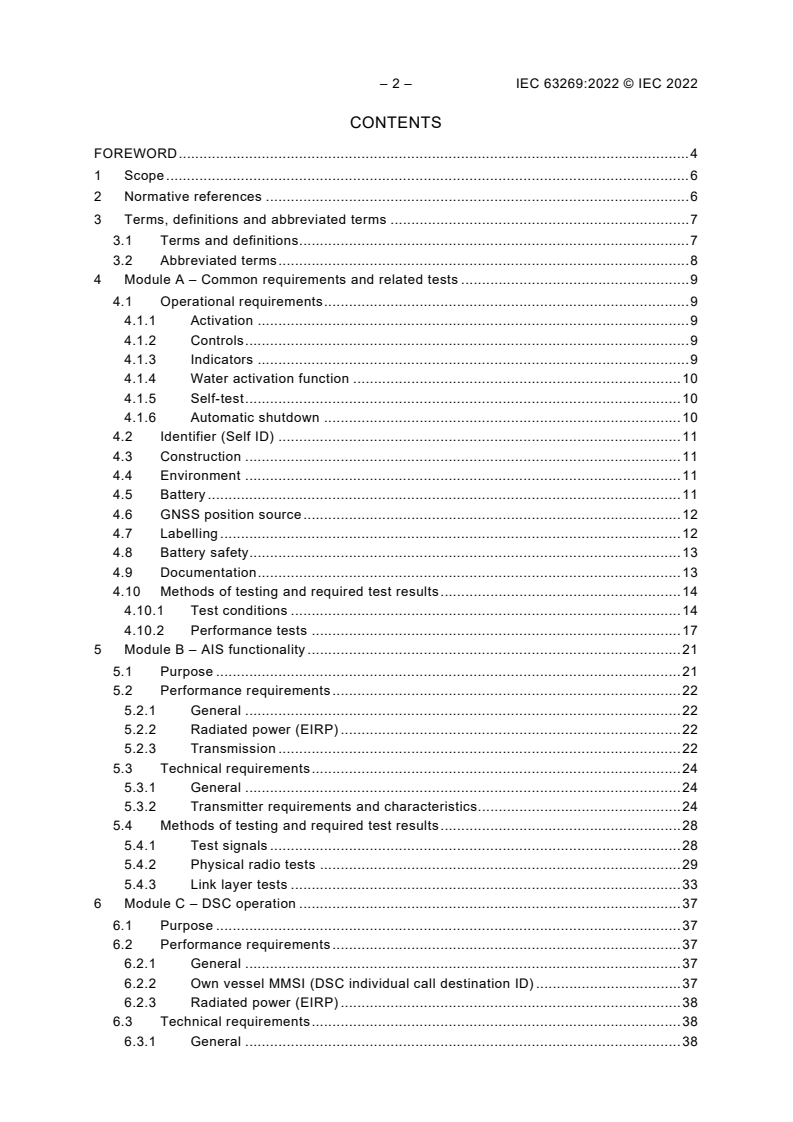
CONTENTS
FOREWORD . 4
1 Scope . 6
2 Normative references . 6
3 Terms, definitions and abbreviated terms . 7
3.1 Terms and definitions . 7
3.2 Abbreviated terms . 8
4 Module A – Common requirements and related tests . 9
4.1 Operational requirements . 9
4.1.1 Activation . 9
4.1.2 Controls . 9
4.1.3 Indicators . 9
4.1.4 Water activation function . 10
4.1.5 Self-test . 10
4.1.6 Automatic shutdown . 10
4.2 Identifier (Self ID) . 11
4.3 Construction . 11
4.4 Environment . 11
4.5 Battery . 11
4.6 GNSS position source . 12
4.7 Labelling . 12
4.8 Battery safety. 13
4.9 Documentation . 13
4.10 Methods of testing and required test results . 14
4.10.1 Test conditions . 14
4.10.2 Performance tests . 17
5 Module B – AIS functionality . 21
5.1 Purpose . 21
5.2 Performance requirements . 22
5.2.1 General . 22
5.2.2 Radiated power (EIRP) . 22
5.2.3 Transmission . 22
5.3 Technical requirements . 24
5.3.1 General . 24
5.3.2 Transmitter requirements and characteristics . 24
5.4 Methods of testing and required test results . 28
5.4.1 Test signals . 28
5.4.2 Physical radio tests . 29
5.4.3 Link layer tests . 33
6 Module C – DSC operation . 37
6.1 Purpose . 37
6.2 Performance requirements . 37
6.2.1 General . 37
6.2.2 Own vessel MMSI (DSC individual call destination ID) . 37
6.2.3 Radiated power (EIRP) . 38
6.3 Technical requirements . 38
6.3.1 General . 38
6.3.2 Transmitter requirements and characteristics . 38
6.3.3 Receiver characteristics. 39
6.3.4 Position indication . 40
6.3.5 GNSS position source. 40
6.4 Methods of testing and required test results – Physical radio . 40
6.4.1 General . 40
6.4.2 DSC transmitter . 41
6.4.3 DSC receiver . 49
6.5 Methods of testing and required test results – Communication . 54
6.5.1 General . 54
6.5.2 Active mode tests . 54
6.5.3 DSC test mode tests . 56
Bibliography . 57
Figure 1 – Test setup . 15
Figure 2 – Power versus time mask . 26
Figure 3 – Burst transmissions in active mode . 27
Figure 4 – Measurement arrangement . 29
Figure 5 – Emission mask . 31
Figure 6 – Measurement arrangement for modulation accuracy . 32
Figure 7 – Emission mask . 44
Figure 8 – Measurement arrangement . 45
Figure 9 – Storage oscilloscope view t , t and t . 46
1 2 3
Figure 10 – SINAD or BER measuring equipment . 52
Table 1 – Maximum values of absolute measurement uncertainties . 17
Table 2 – Active mode transmission schedule . 22
Table 3 – Test mode transmission schedule . 23
Table 4 – Required parameter settings . 24
Table 5 – Required settings of physical layer constants . 25
Table 6 – Modulation parameters of the physical layer . 25
Table 7 – Minimum required transmitter characteristics . 25
Table 8 – Definition of timings . 26
Table 9 – Conducted power – Required results . 30
Table 10 – Peak frequency deviation versus time. 32
Table 11 – Required parameter settings . 38
Table 12 – Minimum required transmitter characteristics . 39
Table 13 – Minimum required receiver characteristics and test signal levels . 39
Table 14 – Resolution bandwidths to be used for the measurement of spurious
emissions . 41
Table 15 – Resolution bandwidths to be used close to the wanted emission for
equipment operating below 1 GHz . 41
Table 16 – Time periods . 44
– 4 – IEC 63269:2022 © IEC 2022
INTERNATIONAL ELECTROTECHNICAL COMMISSION
____________
MARITIME NAVIGATION AND RADIOCOMMUNICATION EQUIPMENT
AND SYSTEMS – MARITIME SURVIVOR LOCATING DEVICES
(MAN OVERBOARD DEVICES) – MINIMUM REQUIREMENTS,
METHODS OF TESTING AND REQUIRED TEST RESULTS
FOREWORD
1) The International Electrotechnical Commission (IEC) is a worldwide organization for standardization comprising
all national electrotechnical committees (IEC National Committees). The object of IEC is to promote international
co-operation on all questions concerning standardization in the electrical and electronic fields. To this end and
in addition to other activities, IEC publishes International Standards, Technical Specifications, Technical Reports,
Publicly Available Specifications (PAS) and Guides (hereafter referred to as “IEC Publication(s)”). Their
preparation is entrusted to technical committees; any IEC National Committee interested in the subject dealt with
may participate in this preparatory work. International, governmental and non-governmental organizations liaising
with the IEC also participate in this preparation. IEC collaborates closely with the International Organization for
Standardization (ISO) in accordance with conditions determined by agreement between the two organizations.
2) The formal decisions or agreements of IEC on technical matters express, as nearly as possible, an international
consensus of opinion on the relevant subjects since each technical committee has representation from all
interested IEC National Committees.
3) IEC Publications have the form of recommendations for international use and are accepted by IEC National
Committees in that sense. While all reasonable efforts are made to ensure that the technical content of IEC
Publications is accurate, IEC cannot be held responsible for the way in which they are used or for any
misinterpretation by any end user.
4) In order to promote international uniformity, IEC National Committees undertake to apply IEC Publications
transparently to the maximum extent possible in their national and regional publications. Any divergence between
any IEC Publication and the corresponding national or regional publication shall be clearly indicated in the latter.
5) IEC itself does not provide any attestation of conformity. Independent certification bodies provide conformity
assessment services and, in some areas, access to IEC marks of conformity. IEC is not responsible for any
services carried out by independent certification bodies.
6) All users should ensure that they have the latest edition of this publication.
7) No liability shall attach to IEC or its directors, employees, servants or agents including individual experts and
members of its technical committees and IEC National Committees for any personal injury, property damage or
other damage of any nature whatsoever, whether direct or indirect, or for costs (including legal fees) and
expenses arising out of the publication, use of, or reliance upon, this IEC Publication or any other IEC
Publications.
8) Attention is drawn to the Normative references cited in this publication. Use of the referenced publications is
indispensable for the correct application of this publication.
9) Attention is drawn to the possibility that some of the elements of this IEC Publication may be the subject of patent
rights. IEC shall not be held responsible for identifying any or all such patent rights.
IEC 63269 has been prepared by IEC technical committee 80: Maritime navigation and
radiocommunication equipment and systems. It is an International Standard.
The text of this International Standard is based on the following documents:
Draft Report on voting
80/1031/FDIS 80/1040/RVD
Full information on the voting for its approval can be found in the report on voting indicated in
the above table.
The language used for the development of this International Standard is English.
This document was drafted in accordance with ISO/IEC Directives, Part 2, and developed in
accordance with ISO/IEC Directives, Part 1 and ISO/IEC Directives, IEC Supplement, available
at www.iec.ch/members_experts/refdocs. The main document types developed by IEC are
described in greater detail at www.iec.ch/standardsdev/publications.
The committee has decided that the contents of this document will remain unchanged until the
stability date indicated on the IEC website under webstore.iec.ch in the data related to the
specific document. At this date, the document will be
• reconfirmed,
• withdrawn,
• replaced by a revised edition, or
• amended.
IMPORTANT – The "colour inside" logo on the cover page of this document indicates that it
contains colours which are considered to be useful for the correct understanding of its
contents. Users should therefore print this document using a colour printer.
– 6 – IEC 63269:2022 © IEC 2022
MARITIME NAVIGATION AND RADIOCOMMUNICATION EQUIPMENT
AND SYSTEMS – MARITIME SURVIVOR LOCATING DEVICES
(MAN OVERBOARD DEVICES) – MINIMUM REQUIREMENTS,
METHODS OF TESTING AND REQUIRED TEST RESULTS
1 Scope
This document specifies the minimum requirements for aspects related to operation,
construction, documentation, methods of testing and required test results for ITU-R M.2135
AMRD Group A man overboard (MOB) devices intended for alerting and locating purposes, as
defined by IMO and in accordance with ITU-R M.493 Class-M. This document consists of three
modules where the first module, Module A, covers general requirements and aspects. Further
Module B covers AIS technologies and Module C covers DSC technologies that are required
within MOB equipment.
This document incorporates the technical characteristics included in applicable ITU
recommendations. Where applicable, it also takes into account the ITU Radio Regulations. This
document takes into account other associated IEC International Standards and existing national
standards, as applicable.
This document defines the requirements for coexistence of AIS and DSC technology
incorporated within a single equipment. Only when the equipment complies with the three
Modules can it be categorised as AMRD Group A equipment and be entitled to operate on
channel AIS 1, channel AIS 2 and channel 70.
2 Normative references
The following documents are referred to in the text in such a way that some or all of their content
constitutes requirements of this document. For dated references, only the edition cited applies.
For undated references, the latest edition of the referenced document (including any
amendments) applies.
IEC 60529, Degrees of protection provided by enclosures (IP Code)
IEC 60945, Maritime navigation and radiocommunication equipment and systems – General
requirements – Methods of testing and required test results
IEC 61108-1, Maritime navigation and radiocommunication equipment and systems – Global
navigation satellite systems (GNSS) – Part 1: Global positioning system (GPS) – Receiver
equipment – Performance standards, methods of testing and required test results
IEC 61108-2, Maritime navigation and radiocommunication equipment and systems – Global
navigation satellite systems (GNSS) – Part 2: Global navigation satellite system (GLONASS) –
Receiver equipment – Performance standards, methods of testing and required test results
IEC 61108-3, Maritime navigation and radiocommunication equipment and systems – Global
navigation satellite systems (GNSS) – Part 3: Galileo receiver equipment – Performance
requirements, methods of testing and required test results
IEC 61108-5, Maritime navigation and radiocommunication equipment and systems – Global
navigation satellite systems (GNSS) – Part 5: BeiDou navigation satellite system (BDS) –
Receiver equipment – Performance equipment – Performance requirements, methods of testing
and required test results
IMO Resolution MSC.81(70), Revised recommendation on testing of life-saving appliances
ITU-R M.493-15, Digital selective-calling system for use in the maritime mobile service
ITU-R M.1371, Technical characteristics for an automatic identification system using time
division multiple access in the VHF maritime mobile band
ITU-T Recommendation O.153, Basic parameters for the measurement of error performance at
bit rates below the primary rate
th
Manual of Tests and Criteria, 7 Revised Edition (ST/SG/AC.10/11/Rev.7), as amended, United
Nations
3 Terms, definitions and abbreviated terms
For the purposes of this document, the following terms, definitions and abbreviated terms apply.
ISO and IEC maintain terminological databases for use in standardization at the following
addresses:
• IEC Electropedia: available at http://www.electropedia.org/
• ISO Online browsing platform: available at http://www.iso.org/obp
3.1 Terms and definitions
3.1.1
freshwater
water having a minimum of salts in solution as contrasted to ocean water which is high in salt
concentration
3.1.2
activation
initial triggering of the MOB device
Note 1 to entry: The activation is when both parts of the two-step procedure are performed.
3.1.3
active mode
activated mode, when the equipment transmits in an emergency situation
3.1.4
armed
state enabling the equipment to be activated manually or automatically
3.1.5
buoyant lanyard
floating string suitable for attaching the MOB to the user’s personal protective equipment
3.1.6
closed loop
individual transmission to own vessel
3.1.7
default
selected by the equipment software in the absence of any operator input
Note 1 to entry: The term "default" can also apply to an action taken.
– 8 – IEC 63269:2022 © IEC 2022
3.1.8
GNSS data
UTC time, position COG and SOG from the GNSS
3.1.9
open loop
transmitting to all ships (broadcast)
3.1.10
symbol
7 binary bits of a 10 bit DSC word that have the information content
3.2 Abbreviated terms
AIS Automatic Identification System
BER Bit Error Ratio
COG Course Over Ground
CRC Cyclic Redundancy Check
DSC Digital Selective Calling
EIRP Effective Isotropic Radiated Power
EPFS Electronic Position Fixing System
EUT Equipment Under Test
FSK Frequency Shift Keying
GMSK Gaussian Minimum Shift Keying
GNSS Global Navigation Satellite System
ID Identity
IMO International Maritime Organization
ITU-R International Telecommunication Union Radiocommunication sector
ITU-T International Telecommunication Union Telecommunication sector
MMSI Maritime Mobile Service Identity
MOB Man OverBoard
NRZI Non Return to Zero, Inverted
RAIM Receiver Autonomous Integrity Monitoring
RF Radio Frequency
SINAD (Signal+Noise+Distortion) to (Noise+Distortion)
SOG Speed Over Ground
SOTDMA Self-Organized Time Division Multiple Access
UTC Coordinated Universal Time
VDL VHF Data Link
VHF Very High Frequency
WGS 84 World Geodetic System 1984
4 Module A – Common requirements and related tests
4.1 Operational requirements
4.1.1 Activation
(See 4.10.2.1.1)
The MOB device shall be:
a) capable of being easily activated by unskilled personnel;
b) fitted with means to prevent inadvertent activation;
c) capable of manual activation and deactivation.
4.1.2 Controls
(See 4.10.2.1.2)
To avoid inadvertent activation, the equipment shall be activated by the use of two simple, but
independent mechanical actions, neither of which on its own shall activate the equipment. The
second mechanical action may be replaced by an immersion sensor. Where the second action
is replaced by an immersion sensor, then the first action shall ensure the equipment is armed
for automatic activation when submerged.
After activation, it shall be simple to deactivate the equipment, and the means to deactivate the
equipment shall be clearly marked. Means shall be provided to avoid inadvertent deactivation.
NOTE Means for preventing inadvertent deactivation can be for example prolonged push of deactivation button,
pressing two buttons simultaneously or a procedure requiring two steps.
All controls necessary for the correct operation of the equipment shall be so designed that
personnel wearing appropriately sized neoprene gloves having a thickness of minimum 5 mm
can activate or deactivate the equipment.
The switch that operates any self-test function shall be so designed that it returns automatically
when released. Activation of the self-test function shall reset automatically after completion of
the test including any required transmission.
4.1.3 Indicators
(See 4.10.2.1.3)
The MOB device shall be equipped with a means which is either visual or audible, or both visual
and audible, to indicate its operational status.
The equipment shall be provided with a visual and/or audible indication that equipment is
activated and that signals are being emitted. The indicator should be sufficiently bright to be
seen by the user in bright daylight.
NOTE Bright daylight in this context is considered to be clear sky with the indicator of the MOB device observed in
direction away from the sun. Shadowing the indicator from the direct light from sun, for example by hand, is expected.
Any audible indicator should have a distinctive alarm tone with a minimum sound output of
85 dBA when measured 10 cm from the equipment.
The indicator(s) shall clearly distinguish between AIS and DSC transmissions and the following
states.
– 10 – IEC 63269:2022 © IEC 2022
When active:
a) the equipment has been activated;
b) the equipment is transmitting without GNSS data;
c) the equipment is transmitting with GNSS data;
d) equipment has received a DSC acknowledgement and the DSC transmitter has been
deactivated remotely;
e) the equipment is inactive.
When self-testing:
f) the equipment is undergoing self-test and is transmitting in self-test mode;
g) the equipment indicates correct reception of the DSC acknowledgement in self-test mode;
h) the equipment has completed a self-test or has been deactivated manually;
i) the equipment cannot complete a DSC test because it has not been programmed with a
destination MMSI;
j) the equipment cannot complete a test because it could not obtain a GNSS position.
4.1.4 Water activation function
(See 4.10.2.1.4, 4.10.2.1.5)
If provided, the water activation function shall be protected against inadvertent activation from
salt-water spray or rain. The act of dropping the equipment into water, as part of the drop test
in IEC 60945, shall not cause the equipment to activate when the equipment has not been
armed.
4.1.5 Self-test
(See 4.10.2.1.6)
The equipment shall include a functional self-test that is functional throughout the operating
temperature range. Testing of AIS, GNSS and DSC functionality may be combined in one test
or as individual test modes.
The equipment shall have self-test pass/fail indicator(s) which shall correctly identify any failure
conditions that have been detected by any of the self-test functions. The self-test pass/fail
indicator shall also clearly indicate that there is insufficient battery capacity to meet the stated
operational lifetime. It shall not be possible for the user to reset this indication.
During self-test, only recognized test messages as defined in the appropriate ITU-R
recommendations shall be transmitted.
The means of activating the self-test feature should prevent the test signal from being
continuously activated.
4.1.6 Automatic shutdown
(See 4.10.2.1.7)
An automatic transmitter shutdown shall be provided to ensure that transmission does not
continue for more than 2 s. This shutdown shall be independent of the operating software.
Even if this function activates, the equipment shall attempt to transmit at the next transmission
schedule time.
4.2 Identifier (Self ID)
(See 4.10.2.2)
The equipment shall be capable of transmitting self-identification. The identification shall be
pre-programmed into the equipment at the time of manufacture and stored in non-volatile
memory. After being programmed, it shall not be possible for user to change the self-
identification.
The equipment identifier is described in ITU-R M.585.
Programming Self ID as 97200yyyy shall be available for testing purposes.
The Self ID for equipment shall be 972xxyyyy, where
• xx = manufacturer ID 01 to 99;
• yyyy = the sequence number 0000 to 9999.
Manufacturer IDs are issued by CIRM . Manufacturers shall only use manufacturer IDs that
have been issued to them by CIRM, except for testing purposes where the ID xx=00 can be
used.
4.3 Construction
(See 4.10.2.3, 4.10.2.4)
The equipment shall:
a) be capable of floating (not necessarily in an operating position) if it is not intended to be
fitted to the lifesaving equipment;
b) be equipped with a buoyant lanyard, suitable for use as a tether;
c) be of a highly visible colour on all surfaces where this will assist visual detection;
d) have a smooth external construction to avoid damaging the lifesaving equipment.
The equipment may optionally have a light to assist detection by human eye for search and
rescue purposes with an intensity of at least 0,75 cd perpendicular to the face of the light source.
NOTE The optional light can be steady or flashing.
4.4 Environment
(See 4.10.2.5)
The equipment shall meet the environmental condition requirements of IEC 60945 for
equipment category "portable".
4.5 Battery
(See 4.10.2.7, 4.10.2.8)
The equipment shall have its own battery or batteries and shall not depend upon any external
source of power for its operation when activated. The batteries shall be an integral part of the
equipment.
___________
Comité International Radio-Maritime, www.cirm.org
– 12 – IEC 63269:2022 © IEC 2022
The life of the battery as defined by its expiry date shall be established by the manufacturer.
The expiry date of the battery shall be the battery cell manufacturing date plus no more than
half the useful life of the battery. The useful life of the battery is defined as the period of time
after the date of battery cell manufacture that the battery will continue to fully operate the
equipment at the required radiated power, after allowing for all losses over the useful life of the
battery. When calculating the useful life of the battery, the following losses, at a temperature of
+20 °C ± 5 °C, shall be included:
a) self-testing, monthly, with GNSS data available where applicable;
b) self-discharge of the battery;
c) stand-by loads.
The manufacturer shall provide evidence to support the above battery life calculations including
the time for self-testing and assuming typical GNSS acquisition time where applicable.
The battery of an armed device shall have a minimum useful life of at least two years. The
installation date shall be no more than one year from the date of manufacture of the battery.
The battery shall be clearly and durably marked with its date of manufacture. The equipment
shall be clearly marked with the expiry date of the battery. The calculation shall assume that
the device is armed on the date of manufacture.
EXAMPLE A battery that has a useful life of 10 years from the date of manufacture cannot have an expiry date that
exceeds 5 years from the date of manufacture and it would have to be capable of providing enough power for 10 years
of self-testing, self-discharge and stand-by loads in addition to the operational power requirement of the device.
The battery shall have sufficient capacity to operate for 12 h over the operating temperature
range of the equipment, and to provide for testing of the functions on the equipment.
It shall not be possible to connect the battery with the polarity reversed. Where individual battery
cells could be fitted, protection for reverse polarity shall be provided within the equipment.
4.6 GNSS position source
(See 4.10.2.9)
An internal GNSS receiver shall be used as the source for equipment position reporting.
The GNSS receiver shall meet the following requirements from at least one of the standards:
IEC 61108-1, IEC 61108-2, IEC 61108-3 or IEC 61108-5 as applicable: position accuracy,
acquisition, sensitivity and dynamic range, position update, effects of specific interfering
signals. The minimum update rate shall be once per minute and provide a resolution of one ten-
thousandth of a minute of arc and use WGS 84 datum.
The manufacturer shall provide evidence that an internal GNSS device cold start is forced at
every activation of equipment ("cold start" refers to the absence of time dependent or position
dependent data in memory, which might affect the acquisition of the GNSS position).
4.7 Labelling
(See 4.10.2.10)
The equipment shall be provided with a label, or labels, permanently affixed to the exterior of
the equipment. All labelling shall be resistant to deterioration by prolonged exposure to sunlight,
and shall not be unduly affected by seawater or oil, and shall be abrasion resistant. The
equipment labelling shall contain the following information:
a) manufacturer serial number;
b) adequate instructions to enable the user to activate or deactivate the equipment;
c) self-test instructions;
d) the name and address of the manufacturer;
e) the equipment model number;
f) regulatory authority markings, if required;
g) a warning to not block the GNSS antenna;
h) the compass safe distance;
i) a warning to the effect that the locating device should not be operated except in an
emergency;
j) the date on which the primary battery will need to be replaced. Simple means shall be
provided for changing this date when the primary battery is replaced;
k) safety warning and disposal statement, as applicable;
l) the Self ID of the equipment (see 4.2).
4.8 Battery safety
(See 4.10.2.11)
Batteries shall meet the requirements of the United Nations' Manual of Tests and Criteria,
Part III, Section 38.3, as amended.
4.9 Documentation
(See 4.10.2.6, 4.10.2.12)
The manufacturer shall provide an operation manual including the following:
a) intended use of an equipment;
b) complete instructions for testing and operating the equipment;
c) general battery information (for example battery replacement instructions, battery type,
safety information regarding battery use and disposal);
d) information on when battery replacement is required;
e) minimum operating life time, operating, and stowage temperature ranges;
f) instructions on actions to be taken in the case of inadvertent activation;
g) a warning to the effect that the device should only be activated in an emergency;
h) information on the intended areas of use, i.e. the equipment is intended to be used on sea
water and may not automatically activate in freshwater such as rivers and lakes;
i) instructions for fitting/attaching the equipment to the user and for correct operation in the
water in an emergency;
j) applicable warning statements;
k) a warning such as the following, "WARNING – This equipment is for use in an emergency only.
It is not intended for routine tracking of persons or property.";
l) a warning such as the following, "WARNING – If self-test is performed more frequently than
stated in manufacturer’s recommendations, then battery life may be reduced.";
m) a warning such as the following. "WARNING – To ensure that the device is fully operational
the battery should be replaced by a new battery after activation in an emergency situation.";
n) generic statement on safety hazards.
– 14 – IEC 63269:2022 © IEC 2022
4.10 Methods of testing and required test results
4.10.1 Test conditions
4.10.1.1 General
The manufacturer shall, unless otherwise agreed, set up the equipment under test (EUT) and
ensure it is operating normally before testing commences.
Electrical power shall be supplied during performance tests by the batteries which form a part
of the EUT. A power supply may be substituted in place of the battery for extreme power supply
tests, see 4.10.1.4.
Within 1 min of activation, the requirements of this document shall be met.
The EUT shall be tested against the general requirements contained in IEC 60945 as applicable
to the equipment category "portable". The low temperature test may be combined with the
battery test. If measurements of compass safe distance are required, then the EUT is not
required to be in the powered condition. The radiated emission test is replaced by the spurious
emission test.
Where access facilities are required to enable any specific test, these shall be provided by the
manufacturer.
For the purposes of IEC 60945, the following apply.
Performance check
Activating the EUT in test mode in accordance with conditions specified in the relevant module
of this document.
Performance test
Activating the EUT in test mode in accordance with conditions specified in the relevant module
of this document.
4.10.1.2 Test setup
Measurement of the radiated signals shall be made at a point 5 m or more from the centre of
the measuring antenna to the EUT. See Figure 1.
The ground plane should be resting on the ground. For an EUT that floats autonomously, the
ground plane should be extended so that it completely encloses and presents a snug fit to the
EUT. For an EUT that attaches to a life jacket or other buoyant device, the EUT shall be
mounted on the buoyant device and deployed in a representative manner on the ground plane
with its antenna base at a height of 10 cm ± 3 cm. An alternative method of mounting the EUT
may be agreed between the manufacturer and the test house and described in the test report.
The measurement antenna shall have vertical polarization mounted on a non-conducting
support with its cable lying horizontally on the boom and run back to the supporting mast. The
other end of the measurement antenna cable shall be connected to a measurement receiver.
The measurement shall be performed on a test site with a conductive ground plane of at least
3 m diameter and the height of the measurement antenna shall be adjusted between 1 m and
4 m to obtain the maximum reading on the measurement receiver. The elevation of the
measurement antenna shall be adjusted according to the dimensions of the EUT and shall be
pointed towards the centre of the antenna of the EUT.
Dimensions in metres
Figure 1 – Test setup
4.10.1.3 Normal and extreme test conditions
For tests at normal and extreme temperatures, measurements shall be made in accordance
with the procedure specified in IEC 60945, equipment category "portable".
Extreme power supply voltage values shall be declared by the manufacturer. For defining the
values, the following applies:
• low temperature with a battery near end of useful life as defined in 4.5 and at the end of the
operation time (12 h); and
• high temperature with a full capacity battery.
4.10.1.4 Extreme power supply volta
...