


IEC 60488-1:2004
(Main)Higher performance protocol for the standard digital interface for programmable instrumentation - Part 1: General
Higher performance protocol for the standard digital interface for programmable instrumentation - Part 1: General
applies to interface systems used to interconnect both programmable and nonprogrammable electronic measuring apparatus with other apparatus and accessories necessary to assemble instrumentation systems. It applies to the interface of instrumentation systems, or portions of them,The basic functional specifications of this standard may be used in digital interface applications that require longer distances, more devices, increased noise immunity, or combinations of these.It bears double logo IEC/IEEE
General Information
- Status
- Published
- Publication Date
- 14-Jul-2004
- Technical Committee
- SC 65C - Industrial networks
- Current Stage
- WPUB - Publication withdrawn
- Start Date
- 31-Oct-2024
- Completion Date
- 31-Oct-2024
Overview
IEC 60488-1:2004 (published jointly as IEEE 488.1‑2003) defines a higher performance protocol for the standard digital interface for programmable instrumentation. It specifies general functional, electrical and mechanical requirements for interface systems that interconnect both programmable and non‑programmable electronic measuring apparatus with controllers, accessories and other instrumentation system components. The standard targets applications requiring longer distances, larger device counts and improved noise immunity and is published as an IEC/IEEE dual‑logo international standard.
Key topics and technical requirements
The standard provides comprehensive functional and system-level guidance without prescribing proprietary implementations. Major topics include:
- Functional specifications for interface roles and message flows: talker, listener, source/acceptor handshake, acceptor extended handshake, controller, service request, parallel poll, device clear and device trigger.
- Remote message coding and transfer and configuration functions for system interoperability.
- Electrical specifications covering driver/receiver states, load and ground requirements, cable characteristics and state‑transition timing.
- Mechanical specifications for connectors, contact assignments, mounting and cable assemblies.
- System design guidelines: data rate considerations, address assignment, AND/OR logic operations, and typical function subsets.
- Informative annexes with timing sequences, implementation examples, parallel polling sequences, EMI mitigation recommendations, and suggested instrument data‑sheet parameters.
Practical applications
IEC 60488-1 is used where reliable digital interfacing of test and measurement equipment is required, including:
- Automated test systems and manufacturing test cells
- Laboratory measurement setups and instrument racks
- Industrial process measurement and monitoring systems
- Test system integration for aerospace, electronics manufacturing and R&D labs
The standard supports robust, multi‑device networks that need deterministic control, structured message handling and enhanced noise immunity over legacy digital interfaces.
Who should use this standard
- Instrument manufacturers specifying interface behavior, connector wiring and electrical limits
- Systems integrators building multi‑instrument automated test systems
- Test engineers designing measurement setups or validating interoperability
- Standards and compliance teams referencing protocol and mechanical/electrical requirements
Related standards
- IEC/IEEE 60488-2: Codes, formats, protocols and common commands (companion document)
- IEEE Std 488.1 (2003) - the IEEE version of this publication
- IEEE Std 488.2 - related companion addressing data formats and higher‑level protocols
For implementation and compliance, consult both Part 1 (general functional and physical requirements) and Part 2 (codes and protocols).
Get Certified
Connect with accredited certification bodies for this standard

BSI Group
BSI (British Standards Institution) is the business standards company that helps organizations make excellence a habit.

National Aerospace and Defense Contractors Accreditation Program (NADCAP)
Global cooperative program for special process quality in aerospace.
BSMI (Bureau of Standards, Metrology and Inspection)
Taiwan's standards and inspection authority.
Sponsored listings
Frequently Asked Questions
IEC 60488-1:2004 is a standard published by the International Electrotechnical Commission (IEC). Its full title is "Higher performance protocol for the standard digital interface for programmable instrumentation - Part 1: General". This standard covers: applies to interface systems used to interconnect both programmable and nonprogrammable electronic measuring apparatus with other apparatus and accessories necessary to assemble instrumentation systems. It applies to the interface of instrumentation systems, or portions of them,The basic functional specifications of this standard may be used in digital interface applications that require longer distances, more devices, increased noise immunity, or combinations of these.It bears double logo IEC/IEEE
applies to interface systems used to interconnect both programmable and nonprogrammable electronic measuring apparatus with other apparatus and accessories necessary to assemble instrumentation systems. It applies to the interface of instrumentation systems, or portions of them,The basic functional specifications of this standard may be used in digital interface applications that require longer distances, more devices, increased noise immunity, or combinations of these.It bears double logo IEC/IEEE
IEC 60488-1:2004 is classified under the following ICS (International Classification for Standards) categories: 17.220.20 - Measurement of electrical and magnetic quantities; 25.040.40 - Industrial process measurement and control; 35.200 - Interface and interconnection equipment. The ICS classification helps identify the subject area and facilitates finding related standards.
IEC 60488-1:2004 is available in PDF format for immediate download after purchase. The document can be added to your cart and obtained through the secure checkout process. Digital delivery ensures instant access to the complete standard document.
Standards Content (Sample)
INTERNATIONAL IEC
STANDARD 60488-1
First edition
2004-07
™
IEEE 488.1
Higher performance protocol for the standard
digital interface for programmable
instrumentation –
Part 1:
General
Reference number
IEC 60488-1(E):2004
IEEE Std. 488.1(E):2003
Publication numbering
As from 1 January 1997 all IEC publications are issued with a designation in the
60000 series. For example, IEC 34-1 is now referred to as IEC 60034-1.
Consolidated editions
The IEC is now publishing consolidated versions of its publications. For example,
edition numbers 1.0, 1.1 and 1.2 refer, respectively, to the base publication, the
base publication incorporating amendment 1 and the base publication incorporating
amendments 1 and 2.
Further information on IEC publications
The technical content of IEC publications is kept under constant review by the IEC,
thus ensuring that the content reflects current technology. Information relating to
this publication, including its validity, is available in the IEC Catalogue of
publications (see below) in addition to new editions, amendments and corrigenda.
Information on the subjects under consideration and work in progress undertaken
by the technical committee which has prepared this publication, as well as the list
of publications issued, is also available from the following:
• IEC Web Site (www.iec.ch)
• Catalogue of IEC publications
) enables you to
The on-line catalogue on the IEC web site (www.iec.ch/searchpub
search by a variety of criteria including text searches, technical committees
and date of publication. On-line information is also available on recently issued
publications, withdrawn and replaced publications, as well as corrigenda.
• IEC Just Published
This summary of recently issued publications (www.iec.ch/online_news/ justpub)
is also available by email. Please contact the Customer Service Centre (see
below) for further information.
• Customer Service Centre
If you have any questions regarding this publication or need further assistance,
please contact the Customer Service Centre:
Email: custserv@iec.ch
Tel: +41 22 919 02 11
Fax: +41 22 919 03 00
INTERNATIONAL IEC
STANDARD 60488-1
First edition
2004-07
™
IEEE 488.1
Higher performance protocol for the standard
digital interface for programmable
instrumentation –
Part 1:
General
Copyright © IEEE 2004 ⎯ All rights reserved
IEEE is a registered trademark in the U.S. Patent & Trademark Office, owned by the Institute of Electrical and Electronics Engineers, Inc.
No part of this publication may be reproduced or utilized in any form or by any means, electronic or
mechanical, including photocopying and microfilm, without permission in writing from the publisher.
International Electrotechnical Commission, 3, rue de Varembé, PO Box 131, CH-1211 Geneva 20, Switzerland
Telephone: +41 22 919 02 11 Telefax: +41 22 919 03 00 E-mail: inmail@iec.ch Web: www.iec.ch
The Institute of Electrical and Electronics Engineers, Inc, 3 Park Avenue, New York, NY 10016-5997, USA
Telephone: +1 732 562 3800 Telefax: +1 732 562 1571 E-mail: stds-info@ieee.org Web: www.standards.ieee.org
Commission Electrotechnique Internationale
International Electrotechnical Commission
Международная Электротехническая Комиссия
– 2 –
IEEE 488.1-2003(E)
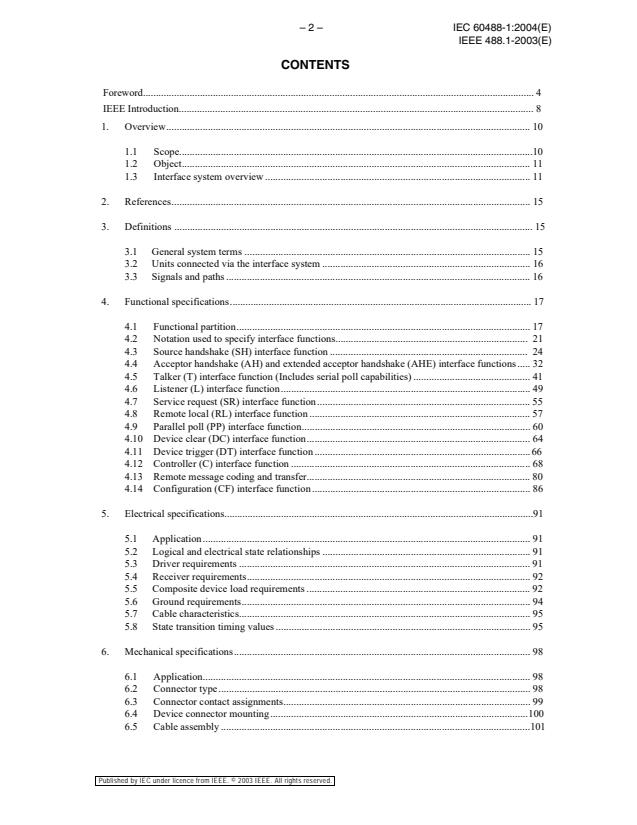
CONTENTS
Foreword. 4
IEEE Introduction. 8
1. Overview. 10
1.1 Scope. 10.
1.2 Object. 11
1.3 Interface system overview . 11
2. References. 15
3. Definitions . 15
3.1 General system terms . 15
3.2 Units connected via the interface system . 16
3.3 Signals and paths . 16
4. Functional specifications. 17
4.1 Functional partition. 17
4.2 Notation used to specify interface functions. 21
4.3 Source handshake (SH) interface function . 24
4.4 Acceptor handshake (AH) and extended acceptor handshake (AHE) interface functions . 32
4.5 Talker (T) interface function (Includes serial poll capabilities) . 41
4.6 Listener (L) interface function. 49
4.7 Service request (SR) interface function . 55
4.8 Remote local (RL) interface function . 57
4.9 Parallel poll (PP) interface function. 60
4.10 Device clear (DC) interface function. 64
4.11 Device trigger (DT) interface function . 66
4.12 Controller (C) interface function . 68
4.13 Remote message coding and transfer. 80
4.14 Configuration (CF) interface function. 86
5. Electrical specifications.91
5.1 Application. 91
5.2 Logical and electrical state relationships . 91
5.3 Driver requirements . 91
5.4 Receiver requirements. 92
5.5 Composite device load requirements . 92
5.6 Ground requirements. 94
5.7 Cable characteristics. 95
5.8 State transition timing values . 95
6. Mechanical specifications. 98
6.1 Application. 98
6.2 Connector type. 98
6.3 Connector contact assignments. 99
6.4 Device connector mounting .100
6.5 Cable assembly .101
Published by IEC under licence from IEEE. © 2003 IEEE. All rights reserved.
– 3 –
IEEE 488.1-2003(E)
7. System applications and guidelines for the designer . 103
7.1 System compatibility. 103
7.2 Data rate consideration. 103
7.3 Device capabilities . 104
7.4 AND and OR logic operations . 104
7.5 Address assignment. 104
7.6 Typical combinations of interface functions.107
7.7 Unimplemented interface message handling .109
8. System requirements and guidelines for the user . 110
8.1 System compatibility . 110
8.2 System installation requirements . 110
8.3 Address assignment . 111
8.4 Cabling restrictions. 112
8.5 Operational sequence guidelines . 112
Annex A (informative) Typical instrument system . 116
Annex B (informative) Handshake process timing sequence. 118
Annex C (informative) Interface function-allowable subsets. 124
Annex D (informative) Interface message reference list. 134
Annex E (informative) Multiline interface messages: ISO code representation. 138
Annex F (informative) Logic circuit implementation. 139
Annex G (informative) Parallel polling sequence . 141
Annex H (informative) Description of interface parameters on data sheets. 142
Annex I (informative) Holdoff considerations for noninterlocked transfers . 146
Annex J (informative) Address switch labeling and interface status indicators . 147
Annex K (informative) Recommended methods for reducing the effects of radiated and conducted
interference for devices specified in this standard. 150
Annex L (informative) List of Participants . 153
Published by IEC under licence from IEEE. © 2003 IEEE. All rights reserved.
– 4 –
IEEE 488.1-2003(E)
INTERNATIONAL ELECTROTECHNICAL COMMISSION
____________
HIGHER PERFORMANCE PROTOCOLE FOR THE STANDARD DIGITAL
INTERFACE FOR PROGRAMMABLE INSTRUMENTATION –
Part 1: General
FOREWORD
1) The International Electrotechnical Commission (IEC) is a worldwide organization for standardization
comprising all national electrotechnical committees (IEC National Committees). The object of IEC is to
promote international co-operation on all questions concerning standardization in the electrical and
electronic fields. To this end and in addition to other activities, IEC publishes International Standards,
Technical Specifications, Technical Reports, Publicly Available Specifications (PAS) and Guides (hereafter
referred to as “IEC Publication(s)”). Their preparation is entrusted to technical committees; any IEC National
Committee interested in the subject dealt with may participate in this preparatory work. International,
governmental and non-governmental organizations liaising with the IEC also participate in this preparation.
IEC collaborates closely with the International Organization for Standardization (ISO) in accordance with
conditions determined by agreement between the two organizations.
2) The formal decisions or agreements of IEC on technical matters express, as nearly as possible, an
international consensus of opinion on the relevant subjects since each technical committee has
representation from all interested IEC National Committees.
3) IEC Publications have the form of recommendations for international use and are accepted by IEC National
Committees in that sense. While all reasonable efforts are made to ensure that the technical content of IEC
Publications is accurate, IEC cannot be held responsible for the way in which they are used or for any
misinterpretation by any end user.
4) In order to promote international uniformity, IEC National Committees undertake to apply IEC Publications
transparently to the maximum extent possible in their national and regional publications. Any divergence
between any IEC Publication and the corresponding national or regional publication shall be clearly
indicated in the latter.
5) IEC provides no marking procedure to indicate its approval and cannot be rendered responsible for any
equipment declared to be in conformity with an IEC Publication.
6) Attention is drawn to the possibility that some of the elements of this IEC Publication may be the subject of
patent rights. IEC shall not be held responsible for identifying any or all such patent rights.
International Standard IEC/IEEE 60488-1 has been processed through subcommittee 65C:
Digital communications, of IEC technical committee 65: Industrial-process measurement
and control.
This standard cancels and replaces the second edition of IEC 60625-1 (1993).
At times in this standard, specific reference is made to IEEE Std 488.1-1987, which constituted
an earlier version of IEEE Std 488.1-2003, the IEEE edition upon which this standard is based.
Where specific dated references were made to the 1987 edition, these references have been
maintained.
Furthermore, it is to be noted that full compatibility of this standard with IEC/IEEE 60488-
2:2004 requires implementation of all revisions indicated previously in the IEEE Introduction.
Therefore, readers of this standard are encouraged to read also the companion standard IEEE
Std 488.2-1987, which constitutes an earlier edition of IEC 60488-2:2004.
The text of this standard is based on the following documents:
IEEE Std FDIS Report on voting
488.1 (2003) 65C/319A/FDIS 65C/343/RVD
Full information on the voting for the approval of this standard can be found in the report on
voting indicated in the above table.
Published by IEC under licence from IEEE. © 2003 IEEE. All rights reserved.
– 5 –
IEEE 488.1-2003(E)
This publication has been drafted in accordance with the ISO/IEC Directives.
The committee has decided that the contents of this publication will remain unchanged until
2009.
IEC/IEEE 60488 consists of the following publications:
• Higher performance protocol for the standard digital interface for programmable
instrumentation – Part 1: General (60488-1).
• Standard digital interface for programmable instrumentation – Part 2: Codes, formats,
protocols and common commands (60488-2).
Published by IEC under licence from IEEE. © 2003 IEEE. All rights reserved.
– 6 –
IEEE 488.1-2003(E)
IEC/IEEE Dual Logo International Standards
This Dual Logo International Standard is the result of an agreement between the IEC and the Institute of
Electrical and Electronics Engineers, Inc. (IEEE). The original IEEE Standard was submitted to the IEC for
consideration under the agreement, and the resulting IEC/IEEE Dual Logo International Standard has been
published in accordance with the ISO/IEC Directives.
IEEE Standards documents are developed within the IEEE Societies and the Standards Coordinating
Committees of the IEEE Standards Association (IEEE-SA) Standards Board. The IEEE develops its standards
through a consensus development process, approved by the American National Standards Institute, which
brings together volunteers representing varied viewpoints and interests to achieve the final product. Volunteers
are not necessarily members of the Institute and serve without compensation. While the IEEE administers the
process and establishes rules to promote fairness in the consensus development process, the IEEE does not
independently evaluate, test, or verify the accuracy of any of the information contained in its standards.
Use of an IEC/IEEE Dual Logo International Standard is wholly voluntary. The IEC and IEEE disclaim liability for
any personal injury, property or other damage, of any nature whatsoever, whether special, indirect,
consequential, or compensatory, directly or indirectly resulting from the publication, use of, or reliance upon
this, or any other IEC or IEEE Standard document.
The IEC and IEEE do not warrant or represent the accuracy or content of the material contained herein, and
expressly disclaim any express or implied warranty, including any implied warranty of merchantability or fitness
for a specific purpose, or that the use of the material contained herein is free from patent infringement.
IEC/IEEE Dual Logo International Standards documents are supplied “AS IS”.
The existence of an IEC/IEEE Dual Logo International Standard does not imply that there are no other ways to
produce, test, measure, purchase, market, or provide other goods and services related to the scope of the
IEC/IEEE Dual Logo International Standard. Furthermore, the viewpoint expressed at the time a standard is
approved and issued is subject to change brought about through developments in the state of the art and
comments received from users of the standard.
Every IEEE Standard is subjected to review at least every five years for revision or reaffirmation. When a
document is more than five years old and has not been reaffirmed, it is reasonable to conclude that its contents,
although still of some value, do not wholly reflect the present state of the art. Users are cautioned to check to
determine that they have the latest edition of any IEEE Standard.
In publishing and making this document available, the IEC and IEEE are not suggesting or rendering
professional or other services for, or on behalf of, any person or entity. Neither the IEC nor IEEE is undertaking
to perform any duty owed by any other person or entity to another. Any person utilizing this, and any other
IEC/IEEE Dual Logo International Standards or IEEE Standards document, should rely upon the advice of a
competent professional in determining the exercise of reasonable care in any given circumstances.
Interpretations – Occasionally questions may arise regarding the meaning of portions of standards as they relate
to specific applications. When the need for interpretations is brought to the attention of IEEE, the Institute will
initiate action to prepare appropriate responses. Since IEEE Standards represent a consensus of concerned
interests, it is important to ensure that any interpretation has also received the concurrence of a balance of
interests. For this reason, IEEE and the members of its societies and Standards Coordinating Committees are
not able to provide an instant response to interpretation requests except in those cases where the matter has
previously received formal consideration.
Comments for revision of IEC/IEEE Dual Logo International Standards are welcome from any interested party,
regardless of membership affiliation with the IEC or IEEE. Suggestions for changes in documents should be in
the form of a proposed change of text, together with appropriate supporting comments. Comments on standards
and requests for interpretations should be addressed to:
Secretary, IEEE-SA Standards Board, 445 Hoes Lane, P.O. Box 1331, Piscataway, NJ 08855-1331, USA and/or
General Secretary, IEC, 3, rue de Varembé, PO Box 131, 1211 Geneva 20, Switzerland.
Authorization to photocopy portions of any individual standard for internal or personal use is granted by the
Institute of Electrical and Electronics Engineers, Inc., provided that the appropriate fee is paid to Copyright
Clearance Center. To arrange for payment of licensing fee, please contact Copyright Clearance Center,
Customer Service, 222 Rosewood Drive, Danvers, MA 01923 USA; +1 978 750 8400. Permission to photocopy
portions of any individual standard for educational classroom use can also be obtained through the Copyright
Clearance Center.
NOTE – Attention is called to the possibility that implementation of this standard may require use of subject
matter covered by patent rights. By publication of this standard, no position is taken with respect to the
existence or validity of any patent rights in connection therewith. The IEEE shall not be responsible for
identifying patents for which a license may be required by an IEEE standard or for conducting inquiries into the
legal validity or scope of those patents that are brought to its attention.
Published by IEC under licence from IEEE. © 2003 IEEE. All rights reserved.
– 7 –
IEEE 488.1-2003(E)
IEEE Standard for Higher
Performance Protocol for the
Standard Digital Interface for
Programmable Instrumentation
Sponsor
Technical Committee on Automated Test Systems and Instrumentation (TC-8)
of the
IEEE Instrumentation and Measurement Society
Approved 10 October 2003
American National Standard Institute
Approved 12 June 2003
IEEE-SA Standards Board
Abstract: This standard applies to interface systems used to interconnect both programmable and
nonprogrammable electronic measuring apparatus with other apparatus and accessories neces-
sary to assemble instrumentation systems. It applies to the interface of instrumentation systems, or
portions of them, in which the
a) Data exchanged among the interconnected apparatus is digital (as distinct from analog)
b) Number of devices that may be interconnected by one contiguous bus does not exceed 15
c) Total transmission path lengths over the interconnecting cables does not exceed 20 m
d) Data rate among devices does not exceed 8 000 000 B/s
The basic functional specifications of this standard may be used in digital interface applications
that require longer distances, more devices, increased noise immunity, or combinations of these.
Different electrical and mechanical specifications may be required (for example, symmetrical cir-
cuit configurations, high threshold logic, special connectors, or cable configurations) for these
extended applications.
Keywords: GPIB, HPIB, HS488, non-interlocked handshake, three-wire handshake
Published by IEC under licence from IEEE. © 2003 IEEE. All rights reserved.
– 8 –
IEEE 488.1-2003(E)
IEEE Introduction
™
IEEE Std 488 has enjoyed continuous and widespread use since its initial publication in 1975. The first
revision occurred in 1978 as a result of practical experience and recognition that certain clauses needed
clarification to improve compatibility among independently designed products. No major changes were
made in 1978; many changes were pure editorial; however, 20 clauses had textual changes with technical
implications, although none contradicted the concepts as defined in the original publication. Supplement A
was introduced in 1980 to correct one minor deficiency in the controller function related to “take control
synchronously.”
In 1987, a systematic review was undertaken as a result of both the normal 5-year review cycle and related
work on IEEE 488 device-dependent message syntax structures. In addition, there was a strong desire on the
part of both IEEE participants and our IEC colleagues to bring equivalent standards (IEC 625-1) into closer
alignment. IEEE Std 488.1-1987 represents the culmination of this review cycle. Again, no major technical
changes were made, and care was exercised to preserve compatibility with earlier versions of IEEE Std 488.
The IEEE Std 488.1-2003 specification adds new interface functions to allow designers the option of
implementing noninterlocked handshake transfers.
In preparing this specification, several stylistic changes to IEEE Std 488.1-1987 were necessary to bring the
document up to IEEE standards. The following changes were made:
— Clause 1, which previously consisted of an overview, definitions, and references, was divided into
three separate sections. Clause 1 now contains the overview, Clause 2 contains references, and
Clause 3 contains definitions.
— The first level of ordered lists was previously numbered (1, 2, 3.). To comply with the IEEE
standards, the first level of ordered lists is now lettered (a, b, c.), and the second level of ordered
lists is numbered (1, 2, 3.).
— In the earlier version of this specification, tables had no grids. Grids have been added to the tables in
this version.
The IEEE 488.1-2003, IEEE Standard for Digital Interface for Programmable Instrumentation, deals with
systems that use a byte-serial, bit-parallel means to transfer digital data among a group of instruments and
system components. The interface system described herein is optimized as an interdevice interface for
system components in relatively close proximity able to communicate over a contiguous party-line bus
system.
This document contains seven sections as follows:
— Clause 1 contains the scope, the object, and summary description of the interface.
— Clause 2 contains helpful references.
— Clause 3 contains basic definitions.
— Clause 4 deals with functional concepts and specifications of the interface system described in this
standard. One or more interface functions contained within a device are each able to process
messages and change states to maintain an orderly flow of information among a set of interconnected
devices.
— Clause 5 deals with the electrical realization of the interface in order to transfer messages among a
set of interconnected devices.
— Clause 6 deals with the mechanical realization of the interface in order to implement the electrical
aspects of the interface system.
— Clause 7 deals with system considerations that must be given to the design of an individual device in
order to make it compatible with other devices of a measurement system.
Published by IEC under licence from IEEE. © 2003 IEEE. All rights reserved.
– 9 –
IEEE 488.1-2003(E)
— Clause 8 deals with system considerations that must be recognized by the user of devices designed in
accordance with this standard.
— Annexes deal with explanatory matter and examples.
— Clause 8 deals with system considerations that must be recognized by the user of devices designed in
In order to interconnect and program equipment designed in accordance with this standard, the user should
accordance with this standard.
have knowledge of Clause 1 and Clause 8. If the coding and transfer of messages is not done automatically
— Annexes deal with explanatory matter and examples.
by the apparatus to be programmed, it will be necessary that the user have knowledge of Clause 4. General
In order to interconnect and program equipment designed in accordance with this standard, the user should
familiarity with the other sections is recommended. The user must also be familiar with device-dependent
have knowledge of Clause 1 and Clause 8. If the coding and transfer of messages is not done automatically
characteristics of apparatus that may be used in a system, but that are beyond the scope of this standard.
by the apparatus to be programmed, it will be necessary that the user have knowledge of Clause 4. General
This standard defines an interface with the objective to assure that messages may be accurately
familiarity with the other sections is recommended. The user must also be familiar with device-dependent
communicated between two or more devices in a system, but it does not guarantee that each device will
characteristics of apparatus that may be used in a system, but that are beyond the scope of this standard.
interpret properly all possible messages sent to it or will properly generate all necessary messages. A wide
This standard defines an interface with the objective to assure that messages may be accurately
latitude of interface capability is permitted within the scope of this standard, which may permit operational
communicated between two or more devices in a system, but it does not guarantee that each device will
incompatibility among interconnected devices.
interpret properly all possible messages sent to it or will properly generate all necessary messages. A wide
Device designers must have sufficient awareness of the characteristics of systems, which might include their
latitude of interface capability is permitted within the scope of this standard, which may permit operational
devices, in order to select correctly among the options provided in this standard. Likewise, system
incompatibility among interconnected devices.
configurators must have sufficient awareness of the options included in each of the devices in their systems
Device designers must have sufficient awareness of the characteristics of systems, which might include their
in order to ensure that the correct communication techniques are used.
devices, in order to select correctly among the options provided in this standard. Likewise, system
This standard does not specify the device-dependent or operational characteristics required for complete
configurators must have sufficient awareness of the options included in each of the devices in their systems
system compatibility. Therefore, following the rules and procedures of this standard alone will not guarantee
in order to ensure that the correct communication techniques are used.
unconditional compatibility.
This standard does not specify the device-dependent or operational characteristics required for complete
The 1987 version of this standard was based on work initiated by the International Electrotechnical
system compatibility. Therefore, following the rules and procedures of this standard alone will not guarantee
Commission (IEC) within Technical Committee 65, Subcommittee 65C, Working Group 3 (formerly TC66/
unconditional compatibility.
WG3), and it follows the general concepts of a standard prepared by the IEC. In 1992, the IEEE technical
The 1987 version of this standard was based on work initiated by the International Electrotechnical
working group enhanced the 1987 standard to improve performance over IEEE Std 488.1-1987.
Commission (IEC) within Technical Committee 65, Subcommittee 65C, Working Group 3 (formerly TC66/
The “helpful note” on metric threads found in previous editions has been deleted because metric thread use
WG3), and it follows the general concepts of a standard prepared by the IEC. In 1992, the IEEE technical
is common IEEE Std 488 practice. Consequently, the recommendation to coat such parts in black material to
working group enhanced the 1987 standard to improve performance over IEEE Std 488.1-1987.
call attention to metric threads is also considered unnecessary. Electrical conductivity on the surface of these
The “helpful note” on metric threads found in previous editions has been deleted because metric thread use
parts is, however, still considered essential.
is common IEEE Std 488 practice. Consequently, the recommendation to coat such parts in black material to
call attention to metric threads is also considered unnecessary. Electrical conductivity on the surface of these
parts is, however, still considered essential.
Patents
Attention is called to the possibility that implementation of this standard may require use of subject matter
covered by patent rights. By publication of this standard, no position is taken with respect to the existence or
Patents
validity of any patent rights in connection therewith. The IEEE shall not be responsible for identifying
Attention is called to the possibility that implementation of this standard may require use of subject matter
patents for which a license may be required by an IEEE standard or for conducting inquiries into the legal
covered by patent rights. By publication of this standard, no position is taken with respect to the existence or
validity or scope of those patents that are brought to its attention. A patent holder has filed a statement of
validity of any patent rights in connection therewith. The IEEE shall not be responsible for identifying
assurance that it will grant licenses under these rights without compensation or under reasonable rates and
patents for which a license may be required by an IEEE standard or for conducting inquiries into the legal
nondiscriminatory, reasonable terms and conditions to all applicants desiring to obtain such licenses. The
validity or scope of those patents that are brought to its attention. A patent holder has filed a statement of
IEEE makes no representation as to the reasonableness of rates and/or terms and conditions of the license
assurance that it will grant licenses under these rights without compensation or under reasonable rates and
agreements offered by patent holders. Further information may be obtained from the IEEE Standards
nondiscriminatory, reasonable terms and conditions to all applicants desiring to obtain such licenses. The
Department.
IEEE makes no representation as to the reasonableness of rates and/or terms and conditions of the license
Interpretations and errata
agreements offered by patent holders. Further information may be obtained from the IEEE Standards
Department.
Interpretations and errata associated with this standard may be found at one of the following Internet
locations:
Interpretations and errata
— http://standards.ieee.org/reading/ieee/interp/
Interpretations and errata associated with this standard may be found at one of the following Internet
— http://standards.ieee.org/reading/ieee/updates/errata/
locations:
— http://standards.ieee.org/reading/ieee/interp/
— http://standards.ieee.org/reading/ieee/updates/errata/
Published by IEC under licence from IEEE. © 2003 IEEE. All rights reserved.
– 10 –
IEEE 488.1-2003(E)
HIGHER PERFORMANCE PROTOCOL
FOR THE STANDARD DIGITAL INTERFACE
FOR PROGRAMMABLE INSTRUMENTATION –
Part 1: General
1. Overview
1.1 Scope
This standard applies to interface systems used to interconnect both programmable and nonprogrammable
electronic measuring apparatus with other apparatus and accessories necessary to assemble instrumentation
systems. It applies to the interface of instrumentation systems, or portions of them, in which the
a) Data exchanged among the interconnected apparatus is digital (as distinct from analog)
b) Number of devices that may be interconnected by one contiguous bus does not exceed 15
c) Total transmission path lengths over the interconnecting cables does not exceed 20 m
d) Data rate among devices does not exceed 8 000 000 B/s
The basic functional specifications of this standard may be used in digital interface applications that require
longer distances, more devices, increased noise immunity, or combinations of these. Different electrical and
mechanical specifications may be required (for example, symmetrical circuit configurations, high threshold
logic, special connectors, or cable configurations) for these extended applications.
This standard may also be applicable to other instrumentation system elements, such as processors, stimulus,
display, or storage devices, and terminal units found useful in instrumentation systems. It applies generally
to laboratory and production test environments that are both electrically quiet and restricted as to physical
dimensions (distances between the system components).
This standard deals only with the interface characteristics of instrumentation systems to the exclusion of
design specifications’ consideration of radio-interface regulations, performance requirements, and safety
requirements of apparatus.
NOTE—For the latter two items, reference is made to IEC 61010-1: 2001, and IEC 60359:2001.
For information on references, see Clause 2.
Published by IEC under licence from IEEE. © 2003 IEEE. All rights reserved.
– 11 –
IEEE 488.1-2003(E)
Throughout this standard, and insofar as further distinction is not necessary, the term “system” denotes the
bit-parallel byte-serial interface system that, in general, includes all circuits, cables, connections, message
repertoire, and control protocol to effect unambiguous data transfer between devices; and the term “device”
or “apparatus” denotes any programmable measurement device or other product connected to the interface
system that communicates information via, and conforms to, the interface system definition.
A primary focus of this standard is to set forth an interface system to interconnect self-contained apparatus
to other apparatus by external means. This same standard may be applied to interconnecting the internal sub-
sections within a self-contained equipment.
1.2 Object
This standard is intended
a) To define a general-purpose system for use in limited-distance applications
b) To specify the device-independent mechanical, electrical, and functional interface requirements that
the apparatus shall meet in order to be interconnected and to communicate unambiguously via the
system
c) To specify the terminology and definitions related to the system
d) To enable the interconnection of independently manufactured apparatus into a single functional
system
e) To permit devices with a wide range of capability—from the simple to the complex—to be intercon-
nected to the system simultaneously
f) To permit direct communication among the devices without requiring all messages to be routed to a
control or intermediate unit
g) To define a system with a minimum of restrictions on the performance characteristics of the devices
connected to the system
h) To define a system that permits asynchronous communication over a wide range of data rates
i) To define a system that, of itself, may be relatively low cost and permits the interconnection of low-
cost devices
j) To define a system that is easy to use
1.3 Interface system overview
1.3.1 Interface system objective
The overall purpose of an interface system is to provide an effective communication link over which
messages are carried in an unambiguous way among a group of interconnected devices.
Messages (quantities of information) carried by an interface system belong to either of two broad categories:
a) Messages used to manage the interface system itself, hereinafter called interface messages
b) Messages used by the devices interconnected via the interface system that are carried by, but not
used or processed by, the interface system directly, hereinafter called device-dependent messages
NOTE—The detailed specification of device-dependent messages is beyond the scope of this standard.
Published by IEC under licence from IEEE. © 2003 IEEE. All rights reserved.
– 12 –
FOR THE STANDARD DIGITAL INTERFACE FOR PROGRAMMABLE INSTRUMENTATION IEEE
IEEE 488.1-2003(E)
Std 488.1-2003
1.3.2 Fundamental communication capabilities
An effective communication link requires three basic functional elements to organize and manage the flow
of information to be exchanged among devices:
a) A device acting as a listener
b) A device acting as a talker
c) A device acting as a controller
In the context of the interface system described by this standard
a) A device with the capability to listen can be addressed by an interface message to receive device-
dependent messages from another device connected to the interface system.
b) A device with the capability to talk can be addressed by an interface message to send device-
dependent messages to another device connected to the interface system.
c) A device with the capability to control can address other devices to listen or to talk. In addition, this
device can send interface messages to command specified actions within other devices. A device
with only this capability neither sends nor receives device-dependent messages.
NOTE—The use of the word controller throughout this standard applies strictly to the management (control) of the
interface system and does not imply the broad capabilities typically associated with the word in the data processing
context. Further classification of the controller will be made in Clause 4 to distinguish between different types of
controller capabilities related to the interface system.
Listener, talker, and controller capabilities occur individually or in any combination in devices
interconnected via the interface system, as shown in Figure 1.
In addition to the basic listener, talker, and controller functions, the system provides interface messages to
accomplish the following operations:
a) A serial poll sequence may be initiated when a device (with talker function) requires some action by
the controller, by transmitting the service request message. The controller will then obtain the status
byte of all possible devices in sequence to ascertain which required service.
b) The Parallel Poll function provides a device with the ability to transmit on the controller’s demand
one bit of status information (request service) simultaneously with several other devices. The
assignment of a data line to a particular device for the response to a parallel poll may be
accomplished through interface messages.
c) The Device Clear and Device Trigger functions provide a device with the ability to be initialized or
triggered, respectively, on command from the controller. This may occur simultaneously with other
selected or all devices in a system.
d) The remote/local function provides a device with the ability to accept program data from the bus,
local data (for example, front panel controls), or both.
Published by IEC under licence from IEEE. © 2003 IEEE. All rights reserved.
– 13 –
IEEE IEEE STANDARD FOR HIGHER PERFORMANCE PROTOCOL
IEEE 488.1-2003(E)
Std 488.1-2003
Device A
Able to talk,
listen, and control
Data Bus
(e.g. calculator)
Device B
Able to talk
and listen
(e.g. digital
multimeter)
Data Byte
Transfer Control
Device C
Only able
to listen
(e.g. signal
generator)
General Interfac
...
Questions, Comments and Discussion
Ask us and Technical Secretary will try to provide an answer. You can facilitate discussion about the standard in here.
Loading comments...