

IEC 62243:2005
(Main)Artificial intelligence exchange and service tie to all test environments (Al-ESTATE)
General Information
- Abstract
Specifications for data interchange and for standard services for the test and diagnostic environment. The purpose of AI-ESTATE is to standardize interfaces between functional elements of an intelligent diagnostic reasoner and representations of diagnostic knowledge and data for use by such diagnostic reasoners. Formal information models are defined to form the basis for a format to facilitate exchange of persistent diagnostic information between two reasoners, and also to provide a formal typing system for diagnostic services. This standard then defines the services to manipulate diagnostic information and to control a diagnostic reasoner.
- Status
- Published
- Publication Date
- 06-Jul-2005
- Technical Committee
- TC 91 - Electronics assembly technology
- Drafting Committee
- WG 15 - TC 91/WG 15
- Current Stage
- DELPUB - Deleted Publication
- Start Date
- 21-Jun-2012
- Completion Date
- 28-Aug-2026
Overview
IEC 62243:2005 (IEEE 1232) - commonly known as AI-ESTATE (Artificial Intelligence Exchange and Service Tie to All Test Environments) is an international dual‑logo standard that specifies formal data models and services for exchanging diagnostic knowledge and controlling intelligent diagnostic reasoners. The standard defines an interchange format, a formal typing system and a set of diagnostic services to manipulate persistent diagnostic information and to control a diagnostic reasoner. AI-ESTATE provides a machine‑processable framework to make diagnostic knowledge portable and interoperable between tools and reasoners.
Key Topics
- Formal information models: Defines core models used for diagnostic exchange such as the Common Element Model, Diagnostic Inference Model, Dynamic Context Model, Enhanced Diagnostic Inference Model and Fault Tree Model.
- Interchange format & binding strategy: Establishes a basis for persistent diagnostic data exchange and strategies to bind models to implementation formats.
- Diagnostic services: Standardized services to create, query, update and control diagnostic models and reasoners (including model management and reasoner manipulation services).
- Typing and extensibility: Provides a formal typing system to ensure consistent interpretation of diagnostic entities and supports extensibility for evolving diagnostic knowledge.
- Operational aspects: Addresses status codes, service order dependence and conformance requirements to ensure predictable behavior across implementations.
- Supporting material: Informative annexes (e.g., overview of EXPRESS) and bibliographic references to help implementers.
Applications
AI-ESTATE is practical for any organization or project needing robust exchange and reuse of diagnostic knowledge across tools and systems:
- Diagnostic tool and reasoner developers - to build interoperable diagnostic engines and integrate third‑party knowledge bases.
- Test and maintenance engineers - to standardize diagnostic representations for automated troubleshooting and remote diagnostics.
- System integrators - to combine diagnostic components from multiple vendors while preserving semantics and behavior.
- Industry sectors - applicable in electronics test, aerospace, automotive, telecommunications, industrial equipment and any domain using model‑based diagnosis. Benefits include reduced re‑integration effort, consistent diagnostic behaviour, and reusable fault models and test knowledge.
Related Standards
- IEEE Std 1232-2002 - AI-ESTATE content is aligned with this IEEE standard (IEC 62243 is the IEC/IEEE dual‑logo publication).
- Informative references in the standard point to express modelling and other test & diagnostic standards; implementers should consult the IEC/IEEE catalog for updates and related documents.
Keywords: IEC 62243, IEEE 1232, AI-ESTATE, diagnostic reasoner, diagnostic exchange, diagnostic services, diagnostic model, fault tree, test and diagnosis.
Relations
- Effective Date
- 05-Sep-2023
Get Certified
Connect with accredited certification bodies for this standard

BSI Group
BSI (British Standards Institution) is the business standards company that helps organizations make excellence a habit.

NYCE
Mexican standards and certification body.
Sponsored listings
Frequently Asked Questions
IEC 62243:2005 is a standard published by the International Electrotechnical Commission (IEC). Its full title is "Artificial intelligence exchange and service tie to all test environments (Al-ESTATE)". This standard covers: Specifications for data interchange and for standard services for the test and diagnostic environment. The purpose of AI-ESTATE is to standardize interfaces between functional elements of an intelligent diagnostic reasoner and representations of diagnostic knowledge and data for use by such diagnostic reasoners. Formal information models are defined to form the basis for a format to facilitate exchange of persistent diagnostic information between two reasoners, and also to provide a formal typing system for diagnostic services. This standard then defines the services to manipulate diagnostic information and to control a diagnostic reasoner.
Specifications for data interchange and for standard services for the test and diagnostic environment. The purpose of AI-ESTATE is to standardize interfaces between functional elements of an intelligent diagnostic reasoner and representations of diagnostic knowledge and data for use by such diagnostic reasoners. Formal information models are defined to form the basis for a format to facilitate exchange of persistent diagnostic information between two reasoners, and also to provide a formal typing system for diagnostic services. This standard then defines the services to manipulate diagnostic information and to control a diagnostic reasoner.
IEC 62243:2005 is classified under the following ICS (International Classification for Standards) categories: 35.040.99 - Other standards related to information coding; 35.060 - Languages used in information technology. The ICS classification helps identify the subject area and facilitates finding related standards.
IEC 62243:2005 has the following relationships with other standards: It is inter standard links to IEC 62243:2012. Understanding these relationships helps ensure you are using the most current and applicable version of the standard.
IEC 62243:2005 is available in PDF format for immediate download after purchase. The document can be added to your cart and obtained through the secure checkout process. Digital delivery ensures instant access to the complete standard document.
Standards Content (Sample)
INTERNATIONAL IEC
STANDARD 62243
First edition
2005-07
IEEE 1232
Artificial intelligence exchange and service tie
to all test environments (AI-ESTATE)
Reference number
IEC 62243(E):2005
IEEE Std. 1232(E):2002
Publication numbering
As from 1 January 1997 all IEC publications are issued with a designation in the
60000 series. For example, IEC 34-1 is now referred to as IEC 60034-1.
Consolidated editions
The IEC is now publishing consolidated versions of its publications. For example,
edition numbers 1.0, 1.1 and 1.2 refer, respectively, to the base publication, the
base publication incorporating amendment 1 and the base publication incorporating
amendments 1 and 2.
Further information on IEC publications
The technical content of IEC publications is kept under constant review by the IEC,
thus ensuring that the content reflects current technology. Information relating to
this publication, including its validity, is available in the IEC Catalogue of
publications (see below) in addition to new editions, amendments and corrigenda.
Information on the subjects under consideration and work in progress undertaken
by the technical committee which has prepared this publication, as well as the list
of publications issued, is also available from the following:
• IEC Web Site (www.iec.ch)
• Catalogue of IEC publications
The on-line catalogue on the IEC web site (www.iec.ch/searchpub) enables you to
search by a variety of criteria including text searches, technical committees
and date of publication. On-line information is also available on recently issued
publications, withdrawn and replaced publications, as well as corrigenda.
• IEC Just Published
This summary of recently issued publications (www.iec.ch/online_news/ justpub)
is also available by email. Please contact the Customer Service Centre (see
below) for further information.
• Customer Service Centre
If you have any questions regarding this publication or need further assistance,
please contact the Customer Service Centre:
Email: custserv@iec.ch
Tel: +41 22 919 02 11
Fax: +41 22 919 03 00
INTERNATIONAL IEC
STANDARD 62243
First edition
2005-07
IEEE 1232
Artificial intelligence exchange and service tie
to all test environments (AI-ESTATE)
© IEEE 2005 Copyright - all rights reserved
IEEE is a registered trademark in the U.S. Patent & Trademark Office, owned by the Institute of Electrical and Electronics Engineers, Inc.
No part of this publication may be reproduced or utilized in any form or by any means, electronic or
mechanical, including photocopying and microfilm, without permission in writing from the publisher.
International Electrotechnical Commission, 3, rue de Varembé, PO Box 131, CH-1211 Geneva 20, Switzerland
Telephone: +41 22 919 02 11 Telefax: +41 22 919 03 00 E-mail: inmail@iec.ch Web: www.iec.ch
The Institute of Electrical and Electronics Engineers, Inc, 3 Park Avenue, New York, NY 10016-5997, USA
Telephone: +1 732 562 3800 Telefax: +1 732 562 1571 E-mail: stds-info@ieee.org Web: www.standards.ieee.org
Commission Electrotechnique Internationale
International Electrotechnical Commission
Международная Электротехническая Комиссия
– 2 – IEC 62243:2005(E)
IEEE 1232-2002(E)
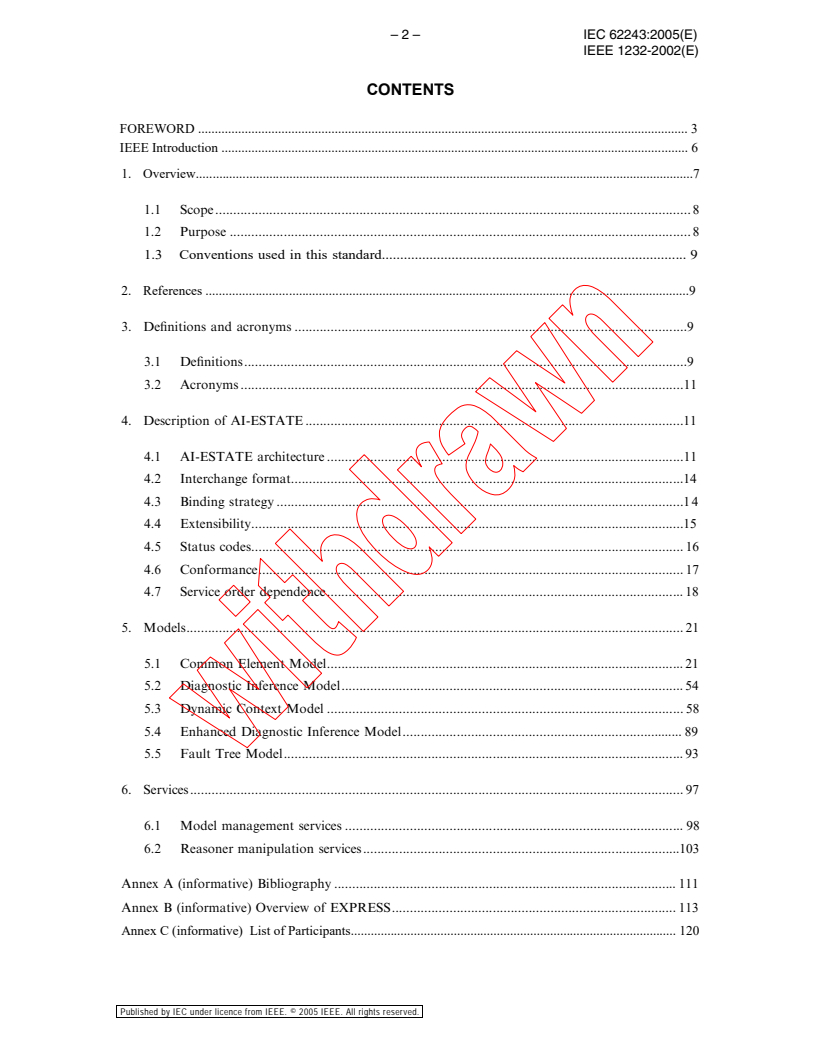
CONTENTS
FOREWORD . 3
IEEE Introduction . 6
1. Overview.7
1.1 Scope.8
1.2 Purpose. 8
1.3 Conventions used in this standard. 9
2. References .9
3. Definitions and acronyms.9
3.1 Definitions.9
3.2 Acronyms.11
4. Description of AI-ESTATE.11
4.1 AI-ESTATE architecture.11
4.2 Interchange format.14
4.3 Binding strategy.14
4.4 Extensibility.15
4.5 Status codes. 16
4.6 Conformance. 17
4.7 Service order dependence. 18
5. Models. 21
5.1 Common Element Model. 21
5.2 Diagnostic Inference Model. 54
5.3 Dynamic Context Model. 58
5.4 Enhanced Diagnostic Inference Model. 89
5.5 Fault Tree Model. 93
6. Services. 97
6.1 Model management services. 98
6.2 Reasoner manipulation services.103
AnnexA (informative) Bibliography. 111
AnnexB (informative) Overview of EXPRESS. 113
Annex C (informative) List of Participants. 120
Published by IEC under licence from IEEE. © 2005 IEEE. All rights reserved.
IEEE 1232-2002(E)
INTERNATIONAL ELECTROTECHNICAL COMMISSION
___________
ARTIFICIAL INTELLIGENCE EXCHANGE AND SERVICE TIE
TO ALL TEST ENVIRONMENTS (AI-ESTATE)
FOREWORD
1) The International Electrotechnical Commission (IEC) is a worldwide organization for standardization
comprising all national electrotechnical committees (IEC National Committees). The object of IEC is to
promote international co-operation on all questions concerning standardization in the electrical and
electronic fields. To this end and in addition to other activities, IEC publishes International Standards,
Technical Specifications, Technical Reports, Publicly Available Specifications (PAS) and Guides (hereafter
referred to as “IEC Publication(s)”). Their preparation is entrusted to technical committees; any IEC National
Committee interested in the subject dealt with may participate in this preparatory work. International,
governmental and non-governmental organizations liaising with the IEC also participate in this preparation.
IEC collaborates closely with the International Organization for Standardization (ISO) in accordance with
conditions determined by agreement between the two organizations.
2) The formal decisions or agreements of IEC on technical matters express, as nearly as possible, an
international consensus of opinion on the relevant subjects since each technical committee has
representation from all interested IEC National Committees.
3) IEC Publications have the form of recommendations for international use and are accepted by IEC National
Committees in that sense. While all reasonable efforts are made to ensure that the technical content of IEC
Publications is accurate, IEC cannot be held responsible for the way in which they are used or for any
misinterpretation by any end user.
4) In order to promote international uniformity, IEC National Committees undertake to apply IEC Publications
transparently to the maximum extent possible in their national and regional publications. Any divergence
between any IEC Publication and the corresponding national or regional publication shall be clearly
indicated in the latter.
5) IEC provides no marking procedure to indicate its approval and cannot be rendered responsible for any
equipment declared to be in conformity with an IEC Publication.
6) Attention is drawn to the possibility that some of the elements of this IEC Publication may be the subject of
patent rights. IEC shall not be held responsible for identifying any or all such patent rights.
International Standard IEC/IEEE 62243 has been processed through IEC technical
committee 93: Design automation.
The text of this standard is based on the following documents:
IEEE Std FDIS Report on voting
1232 (2002) 93/214/FDIS 93/220/RVD
Full information on the voting for the approval of this standard can be found in the report on
voting indicated in the above table.
This publication has been drafted in accordance with the ISO/IEC Directives.
The committee has decided that the contents of this publication will remain unchanged
until 2007.
Published by IEC under licence from IEEE. © 2005 IEEE. All rights reserved.
– 4 – IEC 62243:2005(E)
IEEE 1232-2002(E)
IEC/IEEE Dual Logo International Standards
This Dual Logo International Standard is the result of an agreement between the IEC and the Institute of
Electrical and Electronics Engineers, Inc. (IEEE). The original IEEE Standard was submitted to the IEC for
consideration under the agreement, and the resulting IEC/IEEE Dual Logo International Standard has been
published in accordance with the ISO/IEC Directives.
IEEE Standards documents are developed within the IEEE Societies and the Standards Coordinating
Committees of the IEEE Standards Association (IEEE-SA) Standards Board. The IEEE develops its standards
through a consensus development process, approved by the American National Standards Institute, which
brings together volunteers representing varied viewpoints and interests to achieve the final product. Volunteers
are not necessarily members of the Institute and serve without compensation. While the IEEE administers the
process and establishes rules to promote fairness in the consensus development process, the IEEE does not
independently evaluate, test, or verify the accuracy of any of the information contained in its standards.
Use of an IEC/IEEE Dual Logo International Standard is wholly voluntary. The IEC and IEEE disclaim liability for
any personal injury, property or other damage, of any nature whatsoever, whether special, indirect,
consequential, or compensatory, directly or indirectly resulting from the publication, use of, or reliance upon
this, or any other IEC or IEEE Standard document.
The IEC and IEEE do not warrant or represent the accuracy or content of the material contained herein, and
expressly disclaim any express or implied warranty, including any implied warranty of merchantability or fitness
for a specific purpose, or that the use of the material contained herein is free from patent infringement.
IEC/IEEE Dual Logo International Standards documents are supplied “AS IS”.
The existence of an IEC/IEEE Dual Logo International Standard does not imply that there are no other ways to
produce, test, measure, purchase, market, or provide other goods and services related to the scope of the
IEC/IEEE Dual Logo International Standard. Furthermore, the viewpoint expressed at the time a standard is
approved and issued is subject to change brought about through developments in the state of the art and
comments received from users of the standard.
Every IEEE Standard is subjected to review at least every five years for revision or reaffirmation. When a
document is more than five years old and has not been reaffirmed, it is reasonable to conclude that its contents,
although still of some value, do not wholly reflect the present state of the art. Users are cautioned to check to
determine that they have the latest edition of any IEEE Standard.
In publishing and making this document available, the IEC and IEEE are not suggesting or rendering
professional or other services for, or on behalf of, any person or entity. Neither the IEC nor IEEE is undertaking
to perform any duty owed by any other person or entity to another. Any person utilizing this, and any other
IEC/IEEE Dual Logo International Standards or IEEE Standards document, should rely upon the advice of a
competent professional in determining the exercise of reasonable care in any given circumstances.
Interpretations – Occasionally questions may arise regarding the meaning of portions of standards as they relate
to specific applications. When the need for interpretations is brought to the attention of IEEE, the Institute will
initiate action to prepare appropriate responses. Since IEEE Standards represent a consensus of concerned
interests, it is important to ensure that any interpretation has also received the concurrence of a balance of
interests. For this reason, IEEE and the members of its societies and Standards Coordinating Committees are
not able to provide an instant response to interpretation requests except in those cases where the matter has
previously received formal consideration.
Comments for revision of IEC/IEEE Dual Logo International Standards are welcome from any interested party,
regardless of membership affiliation with the IEC or IEEE. Suggestions for changes in documents should be in
the form of a proposed change of text, together with appropriate supporting comments. Comments on standards
and requests for interpretations should be addressed to:
Secretary, IEEE-SA Standards Board, 445 Hoes Lane, P.O. Box 1331, Piscataway, NJ 08855-1331, USA and/or
General Secretary, IEC, 3, rue de Varembé, PO Box 131, 1211 Geneva 20, Switzerland.
Authorization to photocopy portions of any individual standard for internal or personal use is granted by the
Institute of Electrical and Electronics Engineers, Inc., provided that the appropriate fee is paid to Copyright
Clearance Center. To arrange for payment of licensing fee, please contact Copyright Clearance Center,
Customer Service, 222 Rosewood Drive, Danvers, MA 01923 USA; +1 978 750 8400. Permission to photocopy
portions of any individual standard for educational classroom use can also be obtained through the Copyright
Clearance Center.
NOTE – Attention is called to the possibility that implementation of this standard may require use of subject
matter covered by patent rights. By publication of this standard, no position is taken with respect to the
existence or validity of any patent rights in connection therewith. The IEEE shall not be responsible for
identifying patents for which a license may be required by an IEEE standard or for conducting inquiries into the
legal validity or scope of those patents that are brought to its attention.
Published by IEC under licence from IEEE. © 2005 IEEE. All rights reserved.
IEEE 1232-2002(E)
IEEE Standard for Artificial Intelligence
Exchange and Service
Tie to All Test Environments
(AI-ESTATES)
Sponsor
IEEE Standards Coordinating Committee 20
Approved 13 November 2002
American National Standards Institute
Approved 13 June 2002
IEEE-SA Standards Board
Abstract: AI-ESTATE is a set of specifications for data interchange and for standard services for the
test and diagnostic environment. The purpose of AI-ESTATE is to standardize interfaces between
functional elements of an intelligent diagnostic reasoner and representations of diagnostic knowledge
and data for use by such diagnostic reasoners. Formal information models are defined to form the
basis for a format to facilitate exchange of persistent diagnostic information between two reasoners,
and also to provide a formal typing system for diagnostic services. This standard then defines the
services to manipulate diagnostic information and to control a diagnostic reasoner.
Keywords: AI-ESTATE, diagnosis, diagnostic interference, diagnostic model, diagnostic services,
dynamic content, fault tree, knowledge exchange, system test
Published by IEC under licence from IEEE. © 2005 IEEE. All rights reserved.
– 6 – IEC 62243:2005(E)
IEEE 1232-2002(E)
IEEE Introduction
This AI-ESTATE standard provides a formal framework for exchanging diagnostic knowledge and
constructing diagnostic reasoners. The intent is to providea standard framework for identifying
required information for diagnosis and defining the diagnostic information in a machine-processable
way.Inaddition,softwareinterfacesaredefinedwherebydiagnostictoolscanbedevelopedtoprocess
the diagnostic information in a consistent and reliable way.
Published by IEC under licence from IEEE. © 2005 IEEE. All rights reserved.
IEEE 1232-2002(E)
Artificial intelligence exchange and service
tie to all test environments
(Al-ESTATE)
1. Overview
TheArtificialIntelligenceExchangeandServiceTietoAllTestEnvironments(AI-ESTATE)standard
was developed by the Diagnostic and Maintenance Control (D & MC) Subcommittee of the IEEE
Standards Coordinating Committee 20 (SCC 20) on Test and Diagnosis for Electronic Systems to
serve as a standard for the application of artificial intelligence to system test and diagnosis. This
AI-ESTATEstandarddefinesinterfacesamongreasonersandreasoningsystemusers,testinformation
knowledge bases, and more conventional databases. In addition to interface standards, the AI-
ESTATE standard includes a set of formal data specifications to facilitate the exchange of system
under test related diagnostic information.
This standard describes a set of formal data and knowledge specifications consisting of the logical
representation ofdevices,theirconstituents,thefailuremodesofthose constituents,andtestsofthose
constituents.Thedataandknowledgespecificationprovidesastandardrepresentationofthecommon
data elements required for system test and diagnosis. This will facilitate portability of test-related
knowledge bases for intelligent system test and diagnosis.
The goals of this standard are summarized as follows:
— Incorporate domain specific terminology
— Facilitate portability of diagnostic knowledge
— Permit extensibility of diagnostic knowledge
— Enable the consistent exchange and integration of diagnostic capabilities
This standard provides a controlled extension mechanism to allow inclusion of new diagnostic
technology outside the scope of the AI-ESTATE specification.
Oneofthepurposesofthisstandardistodefineinformationmodelsforknowledgebasestobeusedin
the context of test and diagnosis and, from these models, to derive a data interchange format. The
specifications in this standard shall support fully portable diagnostic knowledge. No host computer
dependence is contained in the AI-ESTATE standard.
Published by IEC under licence from IEEE. © 2005 IEEE. All rights reserved.
– 8 – IEC 62243:2005(E)
IEEE 1232-2002(E)
AI-ESTATE defines key data and knowledge specification formats. Implementations that use only
thesespecificationformatswillbeportable.Thisdoesnotpreclude useofAI-ESTATEinterfaces with
nonconformantspecification formats;however,suchimplementationsmay notbeportable.Asshown
in Figure 1, a diagnostic model can be moved from one AI-ESTATE implementation to another by
translating it into the interchange format. Another AI-ESTATE implementation can then utilize this
information as a complete package by translating the data and knowledge from the interchange
format to its own internal form.
Figure 1—An example of AI-ESTATE’s portability mechanism for data and knowledge
The translation step is not a requirement; an AI-ESTATE implementation may use the interchange
format for its own internal form.
Software specifications defined in this standard will ensure the interchangeability of diagnostic
reasoners through the definition of encapsulated services. This will allow diagnostic reasoners to be
interchanged within an AI-ESTATE conformant system with no effect on the other elements of the
system.
1.1 Scope
The AI-ESTATE standard defines formal specifications for supporting system diagnosis. These
specifications support the exchange and processing of diagnostic information and the control of
diagnostic processes. Diagnostic processes include, but are not limited to, testability analysis,
diagnosability assessment, diagnostic reasoning, maintenance support, and diagnostic maturation.
1.2 Purpose
The AI-ESTATE standard provides formal models of diagnostic information to ensure unambiguous
access to an understanding of the information supporting system test and diagnosis. The standard
TM 1
unifies and expands on the specifications published in IEEE Std 1232 -1995 [B3], IEEE Std
TM TM
1232.1 -1997 [B4], and IEEE Std 1232.2 -1998 [B5].
The numbers in brackets correspond to those of the bibliography in Annex A.
Published by IEC under licence from IEEE. © 2005 IEEE. All rights reserved.
IEEE 1232-2002(E)
1.3 Conventions used in this standard
This standard specifies information models using the EXPRESS language and uses the following
conventions in their presentation:
All specifications in the EXPRESS language are given in the Courier type font. This includes
references to entity and attribute names in the supporting text. The EXPRESS models found in
Clause5 include comment delimiters ‘‘(*’’ and ‘‘*),’’ thus allowing extraction of the models from an
electronic version of the standard for direct use.
Each entity of each EXPRESS schema is presented in a separate subclause. Within a schema,
subclauses are listed in alphabetical order by constants, types, enumerated types, select types, entities,
and then functions. The subclause structure begins with the actual EXPRESS specification, then each
attribute of the entity is described below the attribute definition heading. If any constraints have been
specified, these are described below the formal propositions heading.
This standard uses the vocabulary and definitions of relevant IEEE standards. In case of conflict of
definitions, the following precedence shall be observed: 1) AI-ESTATE definitions (Clause 3);
TM
2) SCC20 documentation and standards; and 3) IEEE 100 , The Authoritative Dictionary of IEEE
Standards Terms, Seventh Edition [B2].
Clause6ofthisstandardpresentstheformalspecificationoftheencapsulatedservicesofthisstandard.
EXPRESS is used to represent the interface of each individual service defining the semantics and type
of the required value to be returned.
2. References
This standard shall be used in conjunction with the following publications.
ISO 10303-11:1994, Industrial Automation Systems and Integration—Product Data Representation
and Exchange—Part 11: Description Methods: The EXPRESS Language Reference Manual.
ISO 10303-21:2002, Industrial Automation Systems and Integration—Product Data Representation
and Exchange—Part 21: Implementation Methods: Clear Text Encoding of the Exchange Structure.
3. Definitions and acronyms
For the purposes of this standard, the following terms and definitions apply. IEEE 100, The
Authoritative Dictionary of IEEE Standards Terms, Seventh Edition [B2], should be referenced for
terms not defined in this clause.
3.1 Definitions
3.1.1 ambiguity: Infaultisolation,theinabilitytolocalizetoasinglediagnosisforarepairlevel,given
asetoftestresults,observations,orotherinformation.
3.1.2 ambiguity group: The collection of all diagnoses that are in ambiguity.
ISO publications are available from the ISO Central Secretariat, Case Postale 56, 1 rue de Varembe´, CH-1211, Gene´ve 20,
Switzerland/Suisse (http://www.iso.ch/). ISO publications are also available in the United States from the Sales Department,
American National Standards Institute, 11 West 42nd Street, 13th Floor, New York, NY 10036, USA (http://www.ansi.org/).
Published by IEC under licence from IEEE. © 2005 IEEE. All rights reserved.
– 10 – IEC 62243:2005(E)
IEEE 1232-2002(E)
3.1.3 application executive: A software component (or the role of a software component) that admin-
isters, and coordinates services to other components within a test system.
3.1.4 diagnosis: The conclusion(s) inferred from tests, observations, or other information.
3.1.5 diagnostic procedure: A structured sequence of tests, observations, and other information used
to localize a fault or faults.
3.1.6 element: ThesmallestentityofanArtificialIntelligenceExchangeandServiceTietoAllTest
Environments(AI-ESTATE)model.Forexample,inaparticularmodel,thesmallesttest,thesmallest
diagnosis,andtheno-faultconclusionareallelements.
3.1.7 failure: Thelossofabilityofarepairitem,equipment,orsystemtoperformarequiredfunction.
Themanifestationofafault.WithinAI-ESTATEmodels,amanifestationisgivenbytheoutcomeof
atest.
3.1.8 false alarm: An indicated fault where no fault exists.
3.1.9 fault: A defect or flaw in a hardware or software component.
3.1.10 fault isolation: The process of reducing the set of diagnoses in ambiguity to a degree sufficient
to undertake an appropriate corrective action.
3.1.11 fault localization: The reduction of ambiguity by the application of tests, observations, or
other information.
3.1.12 interoperability: The ability of two or more systems or elements to exchange information and
to use the information that has been exchanged.
3.1.13 knowledge base: A combination of structure, data, and function used by reasoning systems.
3.1.14 level of maintenance: A level at which test, diagnosis, and repair operates (e.g., maintenance
depot, factory, in the field).
3.1.15 portability: The capability of being moved between systems.
3.1.16 protocol: A set of conventions or rules that govern the interactions of processes or applica-
tions within a computer system or network.
3.1.17 reasoning system: A system that can combine elements of information and knowledge to draw
conclusions.
3.1.18 replaceable unit: Acollectionofoneormorepartsconsideredasasinglepartforthepurposes
ofreplacementandrepairdue.
3.1.19 resource: Any capability that is to be scheduled, assigned, or controlled by the underlying
implementation to assure nonconflicting usage by processes.
3.1.20 service: A software interface providing a means for communicating information between two
applications. An action or response initiated by a process (i.e., server) at the request of some other
process (i.e., client).
3.1.21 system: 1) A collection of interacting, interrelated, or interdependent elements forming a
collective, functioning entity; 2) a set of objects or phenomena grouped together for classification
or analysis; 3) a collection of hardware or software components necessary for performing a high-
level function.
Published by IEC under licence from IEEE. © 2005 IEEE. All rights reserved.
IEEE 1232-2002(E)
3.1.22 test: A set of stimuli, either applied or known, combined with a set of observed responses and
criteria for comparing these responses to a known standard.
3.1.23 test strategy: An approach taken to combine factors including constraints, goals, and other
considerations to be applied to the testing of a system under test.
3.2 Acronyms
AI-ESTATE Artificial Intelligence Exchange and Service Tie to All Test Environments
BIT Built-In Test
CEM Common Element Model
DCM Dynamic Context Model
DIM Diagnostic Inference Model
EDIM Enhanced Diagnostic Inference Model
FTM Fault Tree Model
SNMP Simple Network Management Protocol
UTC Coordinated Universal Time
4. Description of AI-ESTATE
4.1 AI-ESTATE architecture
This standard provides the following:
— Overview of the AI-ESTATE architecture
— Formal definition of diagnostic models for systems under test
— Formal definition of encapsulated software services for diagnostic reasoners
AI-ESTATE focuses on two distinct aspects of the stated purpose. The first aspect concerns the need
to exchange data and knowledge between conformant systems. Two approaches can be taken to
address this need: providing interchangeable files and providing services for retrieving the required
data or knowledge through an information management system. AI-ESTATE is structured such that
either approach can be used. The second aspect concerns the need for functional elements of an
AI-ESTATE conformant system to interact and interoperate. The AI-ESTATE architectural concept
provides for the functional elements to communicate with one another via a ‘‘communication
pathway’’ as depicted in Figure 2. Essentially, this pathway is an abstraction of the services provided
by the functional elements to one another. Thus, the implemented services provide a communication
pathway between the reasoner and the rest of the test system.
Services are provided by reasoners to the other functional elements of an AI-ESTATE conformant
system. Reasoners can include (but are not necessarily limited to) diagnostic systems, test sequencers,
maintenance data feedback analyzers, intelligent user interfaces, and intelligent test programs.
AI-ESTATE will not specify services between functional elements that do not incorporate artificial
intelligence capabilities. Thus, services are provided by a reasoner to the test system, the human
presentation system, a maintenance data/knowledge collection system, and possibly the system under
test. The reasoner shall use services provided by these other systems as required. Note that these
services shall not be specified by the AI-ESTATE standard.
Data interchange formats are specified to provide a means for exchanging knowledge bases between
conformant systems without the need to apply an information management system. Recognizing that
Published by IEC under licence from IEEE. © 2005 IEEE. All rights reserved.
– 12 – IEC 62243:2005(E)
IEEE 1232-2002(E)
Figure 2—AI-ESTATE architectural concept
some applications may provide services for extracting required data or knowledge, services are
specified to permit an application to query the diagnostic system for this purpose.
This standard facilitates the use of standard representations of diagnostic data and knowledge within
thecontextofanAI-ESTATEimplementation.Inspecifyingdataandknowledgeforthesedomains,a
structure has been constructed, as shown in Figure 3. At the top level is the Common Element Model
that specifies elements common to the AI-ESTATE domain of equipment test and diagnosis in its
entirety. Examples of common element constructs arediagnosis (diagnostic conclusions about the
system under test),repair_item (the physical entity being repaired),resource,andtest. These
constructsarecharacterizedbyattributessuchascostsandfailurerates,whicharealsospecifiedinthe
Common Element Model.
Figure 3—Hierarchical structure of AI-ESTATE models
Below this top layer is a layer of application-specific data and knowledge formats (i.e., the Diagnostic
InferenceModel,theEnhancedDiagnosticInferenceModel,andtheFaultTreeModel).Thesemodels
take advantage of the constructs in the Common Element Model and tailor the constructs to the
application’s particular reasoning requirements.
Otherdataandknowledgespecificationformatsareenvisionedandwillbeincludedinfuturerevisions
ofthisstandard.Examplesincludeaconstraint-basedmodel, aBayesiannetworkmodel,andaneural
network model. The Common Element Model has been specified such that other data and knowledge
specification formats can also utilize its constructs as base elements that are tailored to the particular
application’s needs.
Published by IEC under licence from IEEE. © 2005 IEEE. All rights reserved.
IEEE 1232-2002(E)
This standard also defines the encapsulated services to be provided by a diagnostic reasoner in an
AI-ESTATE conformant implementation. All of the basic services are defined relative to the entities
and attributes of the information models. These services can be thought of as reasoner responses to
client requests from the other components of the system architecture, which include the human
presentation (or user interface) system, the maintenance data/knowledge collection (or information
management) system, other reasoners, and test controller(s), as shown in Figure 4. As can be seen in
Figure4,eachoftheelementsthatinterfacewiththereasonerwillprovidetheirownsetofencapsulated
servicestotheirrespectiveclients,but those service definitions are beyondthe scope ofthisdocument.
Figure 4—AI-ESTATE client server view
The definition of these services was performed by first creating accessor services for the static
information models. As the specification of these services became clearer, it became apparent that to
define useful services adequately for an active diagnostic reasoner new entities would have to defined.
These entities represent the context within which reasoning is performed and thereby maintain the
state of the diagnostic process. Thus evolved the Dynamic Context Model as specified in 5.3 of this
standard.ModelmanagementandreasonermanipulationservicesaredefinedinClause6toprovidea
more manageable interface for interacting with the reasoner.
The definition of encapsulated services provides a means for hiding the details of any particular
reasoner implementation. Such services encompass an abstraction of that behavior which is common
to all diagnostic reasoners, regardless of implementation details. Therefore, it is the mechanism of
encapsulation that provides for the interchangeability of diagnostic reasoners within an AI-ESTATE
conformant system.
It should be noted that to be conformant, a reasoner implementation should provide, at the least, a
status indicator (see 4.5) as a response to any service request defined by this specification. The
diagnosticreasonershowninFigure5becomesAI-ESTATEconformantwhenitprovidestheservices
specified by this standard to the application executive client.
In defining the behavior of the diagnostic reasoner, it is reasonable to expect applications to be
developed whereby multiple models are used by a single reasoner or multiple reasoners interact. For
thelatter,itisassumedthattheapplicationexecutivewillberesponsibleformanagingthesereasoners
and reconciling information provided by the reasoners. For the single reasoner, it is assumed that the
reasoner will manage the models and that this management will be based on definition of a consistent
Published by IEC under licence from IEEE. © 2005 IEEE. All rights reserved.
– 14 – IEC 62243:2005(E)
IEEE 1232-2002(E)
Figure 5—IEEE Std 1232-2002 interface layer
name-space with proper scoping defined by the models’ contexts. For reasoners, responsible for
merging information in multiple models (or for editing tools that merge models), it is assumed that
suchamergerwillbeconductedeitherthroughlow-levelmodelmanagementservicesorthroughsome
proprietary mechanism. This standard doesnot define how model mergingis tobe accomplished, and
no specific merger service is provided.
4.2 Interchange format
AI-ESTATE models are intended to facilitate data interchange in the context of test and diagnosis.
The data interchange format will permit exchange of diagnostic models, using a neutral standard
format, thus providing portability of diagnostic knowledge across applications. The inter-
change format used for the models defined in this standard is derived from ISO 10303-21:2002.
Given this exchange structure, it is assumed that one and only one model will be contained in any
given file.
The version of this standard used shall be noted in the header of the exchange file, e.g., IEEE Std
1232-2002.
4.3 Binding strategy
Theintentofthebindingstrategyistoguidesoftwaredevelopersinthecreationofabindinglayerthat
will expose an interface that matches the interface of the AI-ESTATE services as they are specified in
thisstandard.Thebindinglayerwillthusinsulatetheapplicationandthediagnosticreasonerfromany
non-AI-ESTATE details such as connectivity technology, memory management, etc.
An AI-ESTATE software system will consist of at least two components—the application and a
diagnostic reasoner. The diagnostic reasoner will present an interface conformant to IEEE Std
1232-2002; the application will use AI-ESTATE services as needed by calls to this interface.
For each AI-ESTATE service there will be a corresponding function in the binding layer that will be
written in the implementation language. The interfaces provided by the functions should correspond
exactly to the interfaces of the services they implement (or as closely as possible given the constraints
of the implementation language). All other details should be hidden from the client. This implies
that the binding layer provides data-type definitions that correspond to the types specified in this
standard.
The application and diagnostic reasoner programs can be written in different languages as long as the
translation is handled transparently to the two programs, i.e., in the binding layer or lower. When
publishing the interface, it is recommended that documentation of traceability of the elements of the
interface to the services specified in the standard be provided.
Published by IEC under licence from IEEE. © 2005 IEEE. All rights reserved.
IEEE 1232-2002(E)
For example, consider the get_name service as specified in EXPRESS:
FUNCTION get_name
(ID_entity : entity_id):
name_type;
END_FUNCTION;
It has the name get_name, accepts one argument of entity_id, and returns a name_type. The
declaration of a corresponding binding function written in C would be
name_type get_name (entity_id ID_entity);
This might exist in a C header file and would provide the client code with an interface corresponding
exactly to that of the EXPRESS form. For example,
name_type get_name (entity_id ID_entity)
{
name_type name;
.
.
.
name ¼ .; /* Could be a call to a function in the */
/* server-side binding layer.*/
.
.
.
return name;
}
The following C data types could be defined to correspond to the AI-ESTATE types:
typedef char* name_type;
typedef void* entity_id;
TM
For pure object-oriented languages such as Java , the interface shall be presented as methods in
objects. It is suggested that the information model be used to start building the class hierarchy.
4.4 Extensibility
4.4.1 Extending information models
The data and knowledge specification should be sufficiently flexible to allow for differences in the
common tools that might use it, yet also remain formal and rigid enough to support porting of an
AI-ESTATE exchange file to any AI-ESTATE conformant application. This flexibility is achieved by
using the EXTEND schema. In general, an extended schema will not be usable by other AI-ESTATE
conformant applications. In applying the EXTEND schema, the following rules shall apply:
a) An IEEE Std 1232-2002 information model can be extended for any single model, hereafter
referred to as the extended model, by inclusion of one or more schemata that define all entities
used in the extended model. The schemata shall be legal EXPRESS and shall be syntactically
andsemanticallycorrect.Further,extensionsshallnotbeusedtorenameorredefinedatainthe
standard schemata.
b) Data contained in a model definition with an EXTEND schema shall include only entity types
that are declared in IEEE Std 1232-2002, or are legal, previously defined extension entities, as
defined in subsequent requirements.
c) An EXTEND schema entity shall be declared to be a subtype of an entity defined in IEEE Std
1232-2002 or a previously defined EXTEND schema entity.
Published by IEC under licence from IEEE. © 2005 IEEE. All rights reserved.
– 16 – IEC 62243:2005(E)
IEEE 1232-2002(E)
d) A model defined with EXTEND schemata shall not cause an application to reach an invalid
conclusion when processing the model with the extended entities removed. In other words, any
conclusion drawn by a conformant reasoner using an extended model without the extended
entities will be consistent with the information contained in the nonextended model. Further,
consistency cannot be achieved through extension.
e) All schema, entity, type, function, and procedure identifiers declared within the EXTEND
schema shall begin with the prefix ‘‘extend_.’’
f) The EXTEND schema shall use the EXPRESS reference interface specification, ‘‘REFER-
ENCE FROM,’’ to allow visibility of the entities within the EXTEND schema.
The following is an example of EXTEND schema:
SCHEMA extend_schema_a;
REFERENCE FROM common_element_model (outcome, cost);
TYPE extend_attribute_type1 ¼ STRING;
END_TYPE;
TYPE extend_attribute_type2 ¼ REAL;
END_TYPE;
ENTITY extend_ent_a
SUBTYPE OF (cost);
att1 : extend_attribute_type1;
att2 : extend_attribute_type2;
END_ENTITY;
ENTITY extend_ent_b
SUPERTYPE OF (extend_ent_c);
SUBTYPE OF (outcome);
att3 : extend_attribute_type1;
END_ENTITY;
ENTITY extend_ent_c
SUBTYPE OF (extend_ent_b);
att4 : extend_attribute_type1;
att5 : SET OF [0:?] cost;
END_ENTITY;
END_SCHEMA;
4.4.2 Extending services
Anyapplicationcanprovideservicesbeyondthosedefinedinthisstandard;however,suchserviceswill
not be recognized as conforming to the standard.
4.5 Status codes
An AI-ESTATE diagnostic reasoner shall provide a means for its clients to determine the
success or failure of service requests. This shall be implemented by means of the exception
Published by IEC under licence from IEEE. © 2005 IEEE. All rights reserved.
IEEE 1232-2002(E)
entity within the Dynamic Context Model. This entity will assume one of the following mnemonic
values:
Operation_completed_successfully
Nonexistent_data_element_requested
Missing_or_invalid_argument
Operation_out_of_sequence
Invalid_model_schema
Service_not_available
Unknown_exception_raised
The actual mapping will be provided by the implementation.
4.6 Conformance
This subclause defines the requirements for conformance with IEEE Std 1232-2002. It defines the
minimum capabilities that are required and what subsets and extensions are allowed. This standard
specifies minimal conformance for IEEE Std 1232-2002 conformant model development systems and
IEEE Std 1232-2002 conformant application runtime systems. It is expected that actual implementa-
tions will conform at levels beyond the minimal levels.
Extensions to the information models are only allowed through the facility of the EXTEND schema.
An EXTEND schema shall conform to the formal EXPRESS syntax and semantics found in ISO
10303-11:1994. These extensions shall be clearly identified as specified in 4.4 and should be submitted
to the IEEED& MC subcommittee. An implementation may extend the data a
...