

IEC 60984:2014
(Main)Live working - Electrical insulating sleeves
General Information
- Abstract
IEC 60984:2014 is applicable to electrical insulating sleeves for the protection of workers from accidental contact with live electrical conductors, apparatus or circuits. The products designed and manufactured according to this standard contribute to the safety of the users provided they are used by skilled persons, in accordance with safe methods of work and the instructions for use. Unless otherwise stated, in this standard the term "sleeve" is used for "electrical insulating sleeve". This second edition cancels and replaces the first edition, published in 1990 and its Amendment 1 published in 2002. It constitutes a technical revision which includes the following major changes:
- removal of the requirement for an area to mark the date of inspection;
- only the straight mounting method with water electrodes is specified for the dielectric type test;
- the d.c. electric tests are no longer included in the normative part of the document, but a new informative Annex E is added;
- preparation of the elements of evaluation of defects, and general application of IEC 61318:2007;
- in the new normative Annex F, updating of the characteristics of the liquid specified for tests on sleeves of category H, according to the latest edition of ISO 1817;
- introduction of a new normative Annex G on classification of defects;
- introduction of a new informative Annex H on the rationale for the classification of defects;
- and for periodic electrical retesting, recommended voltage limit of the dielectric test methods to 10 kV except in case of the test method with water electrodes and straight mounting.
- Status
- Published
- Publication Date
- 27-Jul-2014
- Technical Committee
- TC 78 - Live working
- Drafting Committee
- WG 13 - TC 78/WG 13
- Current Stage
- PPUB - Publication issued
- Start Date
- 28-Jul-2014
- Completion Date
- 31-Aug-2014
IEC 60984:2014 - Live Working Electrical Insulating Sleeves
Overview
IEC 60984:2014 is an internationally recognized standard published by the International Electrotechnical Commission (IEC) that specifies the safety requirements for electrical insulating sleeves used during live working on electrical conductors, apparatus, or circuits. This second edition supersedes the previous 1990 version and its 2002 amendment, presenting a comprehensive technical revision to ensure enhanced protection for skilled personnel working on energized electrical systems.
The standard covers the design, testing, classification, marking, and usage instructions for insulating sleeves intended to prevent accidental contact with live parts, thus mitigating risk of electrical shock or injury. It applies only to sleeves used in compliance with safe work methods and operated by trained workers.
Key updates in the 2014 edition include:
- Elimination of the mandatory area to mark inspection dates on sleeves.
- Specification of the straight mounting method with water electrodes for dielectric tests.
- Removal of DC electric tests from normative requirements, relocating them to an informative annex.
- Introduction of defect evaluation elements referencing IEC 61318:2007.
- Updates to testing liquids and defect classifications in new normative and informative annexes.
- Recommended dielectric test voltage limits for periodic retesting.
This standard is essential for manufacturers, safety officers, and live-line workers to ensure electrical insulating sleeves meet rigorous safety and performance criteria.
Key Topics
Scope and Definitions
Defines electrical insulating sleeves and their use in live working environments, emphasizing protection for skilled personnel.Classification and Physical Requirements
Sleeves are categorized based on mechanical, thermal, chemical, and electrical resistance properties. Detailed dimensions, thickness, composition, and workmanship guidelines ensure consistent quality.Testing Procedures
Comprehensive tests cover mechanical strength, puncture resistance, dielectric properties (using water electrode straight mounting), ageing, flame retardancy, and environmental resilience including acid, oil, ozone, and low temperature resistance.Marking and Packaging
Sleeves must carry legible markings for identification and usage instructions, supported by secure packaging to preserve product integrity.Instructions for Use and Safety
Clear guidance on storage, inspection before use, handling temperature limits, precautions, and periodic electrical retesting maximize operational safety.Defect Classification
Systematic classification of defects assists in quality control and maintenance decisions.Annexes for Additional Guidance
Informative annexes provide recommendations for sleeve selection relative to system voltages, DC test procedures, and rationale behind defect classifications.
Applications
IEC 60984:2014 is highly relevant across several electrical and industrial sectors where live working is conducted, including:
Utilities and Power Distribution
Enables safe maintenance and operation on energized high-voltage lines by ensuring insulating sleeves protect workers from hazardous electrical contact.Electrical Equipment Manufacturing
Guides the design and production of insulating sleeves that comply with stringent electrical, mechanical, and environmental criteria.Maintenance and Testing Services
Provides protocols for periodic testing and inspection to ensure insulating sleeves remain reliable over time.Safety Training and Compliance
Serves as a foundational reference for training programs and safety audits ensuring live working practices meet international safety standards.
This standard supports occupational safety objectives by reducing incidents of electrical shock injuries, thus preserving human life and operational continuity.
Related Standards
To complement IEC 60984:2014 compliance and enhance workplace safety, consider these related IEC standards:
- IEC 61318:2007 – Procedures for evaluation of defects in insulating equipment.
- IEC 60417-5216 – Symbol for suitability in live working (double triangle marking).
- ISO 1817 – Determination of resistance of rubber to liquids (updated oil resistance testing protocols).
- IEC 61482 – Live working gloves for electrical arc protection.
- IEC 61111 – Insulating gloves for live working.
Adherence to these interconnected standards provides a comprehensive framework for protection during live electrical work, ensuring all safety devices including sleeves, gloves, and tools meet international benchmarks.
Keywords: IEC 60984, electrical insulating sleeves, live working safety, dielectric testing, electrical protection garments, insulating sleeve standards, electrical worker safety, insulating sleeve testing, IEC standards electric safety, live-line maintenance safety.
Relations
- Effective Date
- 05-Sep-2023
- Effective Date
- 05-Sep-2023
- Effective Date
- 05-Sep-2023
- Effective Date
- 05-Sep-2023
- Effective Date
- 05-Sep-2023
Get Certified
Connect with accredited certification bodies for this standard

IMQ S.p.A. (Certification)
Italian electrical product certification.

SLG Prüf- und Zertifizierungs GmbH
German testing and certification body.

UL Solutions
Global safety science company with testing, inspection and certification.
Sponsored listings
Frequently Asked Questions
IEC 60984:2014 is a standard published by the International Electrotechnical Commission (IEC). Its full title is "Live working - Electrical insulating sleeves". This standard covers: IEC 60984:2014 is applicable to electrical insulating sleeves for the protection of workers from accidental contact with live electrical conductors, apparatus or circuits. The products designed and manufactured according to this standard contribute to the safety of the users provided they are used by skilled persons, in accordance with safe methods of work and the instructions for use. Unless otherwise stated, in this standard the term "sleeve" is used for "electrical insulating sleeve". This second edition cancels and replaces the first edition, published in 1990 and its Amendment 1 published in 2002. It constitutes a technical revision which includes the following major changes: - removal of the requirement for an area to mark the date of inspection; - only the straight mounting method with water electrodes is specified for the dielectric type test; - the d.c. electric tests are no longer included in the normative part of the document, but a new informative Annex E is added; - preparation of the elements of evaluation of defects, and general application of IEC 61318:2007; - in the new normative Annex F, updating of the characteristics of the liquid specified for tests on sleeves of category H, according to the latest edition of ISO 1817; - introduction of a new normative Annex G on classification of defects; - introduction of a new informative Annex H on the rationale for the classification of defects; - and for periodic electrical retesting, recommended voltage limit of the dielectric test methods to 10 kV except in case of the test method with water electrodes and straight mounting.
IEC 60984:2014 is applicable to electrical insulating sleeves for the protection of workers from accidental contact with live electrical conductors, apparatus or circuits. The products designed and manufactured according to this standard contribute to the safety of the users provided they are used by skilled persons, in accordance with safe methods of work and the instructions for use. Unless otherwise stated, in this standard the term "sleeve" is used for "electrical insulating sleeve". This second edition cancels and replaces the first edition, published in 1990 and its Amendment 1 published in 2002. It constitutes a technical revision which includes the following major changes: - removal of the requirement for an area to mark the date of inspection; - only the straight mounting method with water electrodes is specified for the dielectric type test; - the d.c. electric tests are no longer included in the normative part of the document, but a new informative Annex E is added; - preparation of the elements of evaluation of defects, and general application of IEC 61318:2007; - in the new normative Annex F, updating of the characteristics of the liquid specified for tests on sleeves of category H, according to the latest edition of ISO 1817; - introduction of a new normative Annex G on classification of defects; - introduction of a new informative Annex H on the rationale for the classification of defects; - and for periodic electrical retesting, recommended voltage limit of the dielectric test methods to 10 kV except in case of the test method with water electrodes and straight mounting.
IEC 60984:2014 is classified under the following ICS (International Classification for Standards) categories: 13.260 - Protection against electric shock. Live working; 29.240.20 - Power transmission and distribution lines; 29.260.99 - Other electrical equipment for working in special conditions; 33.160.25 - Television receivers; 33.160.60 - Multimedia systems and teleconferencing equipment. The ICS classification helps identify the subject area and facilitates finding related standards.
IEC 60984:2014 has the following relationships with other standards: It is inter standard links to IEC 60984:1990/COR2:2000, IEC 60984:1990, IEC 60984:1990/AMD1:2002, IEC 60984:1990/COR3:2005, IEC 60984:1990/COR1:1999. Understanding these relationships helps ensure you are using the most current and applicable version of the standard.
IEC 60984:2014 is available in PDF format for immediate download after purchase. The document can be added to your cart and obtained through the secure checkout process. Digital delivery ensures instant access to the complete standard document.
Standards Content (Sample)
IEC 60984 ®
Edition 2.0 2014-07
INTERNATIONAL
STANDARD
NORME
INTERNATIONALE
Live working – Electrical insulating sleeves
Travaux sous tension – Protège-bras isolants électriques
All rights reserved. Unless otherwise specified, no part of this publication may be reproduced or utilized in any form
or by any means, electronic or mechanical, including photocopying and microfilm, without permission in writing from
either IEC or IEC's member National Committee in the country of the requester. If you have any questions about IEC
copyright or have an enquiry about obtaining additional rights to this publication, please contact the address below or
your local IEC member National Committee for further information.
Droits de reproduction réservés. Sauf indication contraire, aucune partie de cette publication ne peut être reproduite
ni utilisée sous quelque forme que ce soit et par aucun procédé, électronique ou mécanique, y compris la photocopie
et les microfilms, sans l'accord écrit de l'IEC ou du Comité national de l'IEC du pays du demandeur. Si vous avez des
questions sur le copyright de l'IEC ou si vous désirez obtenir des droits supplémentaires sur cette publication, utilisez
les coordonnées ci-après ou contactez le Comité national de l'IEC de votre pays de résidence.
IEC Central Office Tel.: +41 22 919 02 11
3, rue de Varembé Fax: +41 22 919 03 00
CH-1211 Geneva 20 info@iec.ch
Switzerland www.iec.ch
About the IEC
The International Electrotechnical Commission (IEC) is the leading global organization that prepares and publishes
International Standards for all electrical, electronic and related technologies.
About IEC publications
The technical content of IEC publications is kept under constant review by the IEC. Please make sure that you have the
latest edition, a corrigenda or an amendment might have been published.
IEC Catalogue - webstore.iec.ch/catalogue Electropedia - www.electropedia.org
The stand-alone application for consulting the entire The world's leading online dictionary of electronic and
bibliographical information on IEC International Standards, electrical terms containing more than 30 000 terms and
Technical Specifications, Technical Reports and other definitions in English and French, with equivalent terms in 14
documents. Available for PC, Mac OS, Android Tablets and additional languages. Also known as the International
iPad. Electrotechnical Vocabulary (IEV) online.
IEC publications search - www.iec.ch/searchpub IEC Glossary - std.iec.ch/glossary
The advanced search enables to find IEC publications by a More than 55 000 electrotechnical terminology entries in
variety of criteria (reference number, text, technical English and French extracted from the Terms and Definitions
committee,…). It also gives information on projects, replaced clause of IEC publications issued since 2002. Some entries
and withdrawn publications. have been collected from earlier publications of IEC TC 37,
77, 86 and CISPR.
IEC Just Published - webstore.iec.ch/justpublished
Stay up to date on all new IEC publications. Just Published IEC Customer Service Centre - webstore.iec.ch/csc
details all new publications released. Available online and If you wish to give us your feedback on this publication or
also once a month by email. need further assistance, please contact the Customer Service
Centre: csc@iec.ch.
A propos de l'IEC
La Commission Electrotechnique Internationale (IEC) est la première organisation mondiale qui élabore et publie des
Normes internationales pour tout ce qui a trait à l'électricité, à l'électronique et aux technologies apparentées.
A propos des publications IEC
Le contenu technique des publications IEC est constamment revu. Veuillez vous assurer que vous possédez l’édition la
plus récente, un corrigendum ou amendement peut avoir été publié.
Catalogue IEC - webstore.iec.ch/catalogue Electropedia - www.electropedia.org
Application autonome pour consulter tous les renseignements
Le premier dictionnaire en ligne de termes électroniques et
bibliographiques sur les Normes internationales,
électriques. Il contient plus de 30 000 termes et définitions en
Spécifications techniques, Rapports techniques et autres
anglais et en français, ainsi que les termes équivalents dans
documents de l'IEC. Disponible pour PC, Mac OS, tablettes
14 langues additionnelles. Egalement appelé Vocabulaire
Android et iPad.
Electrotechnique International (IEV) en ligne.
Recherche de publications IEC - www.iec.ch/searchpub
Glossaire IEC - std.iec.ch/glossary
Plus de 55 000 entrées terminologiques électrotechniques, en
La recherche avancée permet de trouver des publications IEC
en utilisant différents critères (numéro de référence, texte, anglais et en français, extraites des articles Termes et
comité d’études,…). Elle donne aussi des informations sur les Définitions des publications IEC parues depuis 2002. Plus
projets et les publications remplacées ou retirées. certaines entrées antérieures extraites des publications des
CE 37, 77, 86 et CISPR de l'IEC.
IEC Just Published - webstore.iec.ch/justpublished
Service Clients - webstore.iec.ch/csc
Restez informé sur les nouvelles publications IEC. Just
Published détaille les nouvelles publications parues. Si vous désirez nous donner des commentaires sur cette
Disponible en ligne et aussi une fois par mois par email. publication ou si vous avez des questions contactez-nous:
csc@iec.ch.
IEC 60984 ®
Edition 2.0 2014-07
INTERNATIONAL
STANDARD
NORME
INTERNATIONALE
Live working – Electrical insulating sleeves
Travaux sous tension – Protège-bras isolants électriques
INTERNATIONAL
ELECTROTECHNICAL
COMMISSION
COMMISSION
ELECTROTECHNIQUE
PRICE CODE
INTERNATIONALE
CODE PRIX X
ICS 13.260; 29.240.20; 29.260.99 ISBN 978-2-8322-1782-5
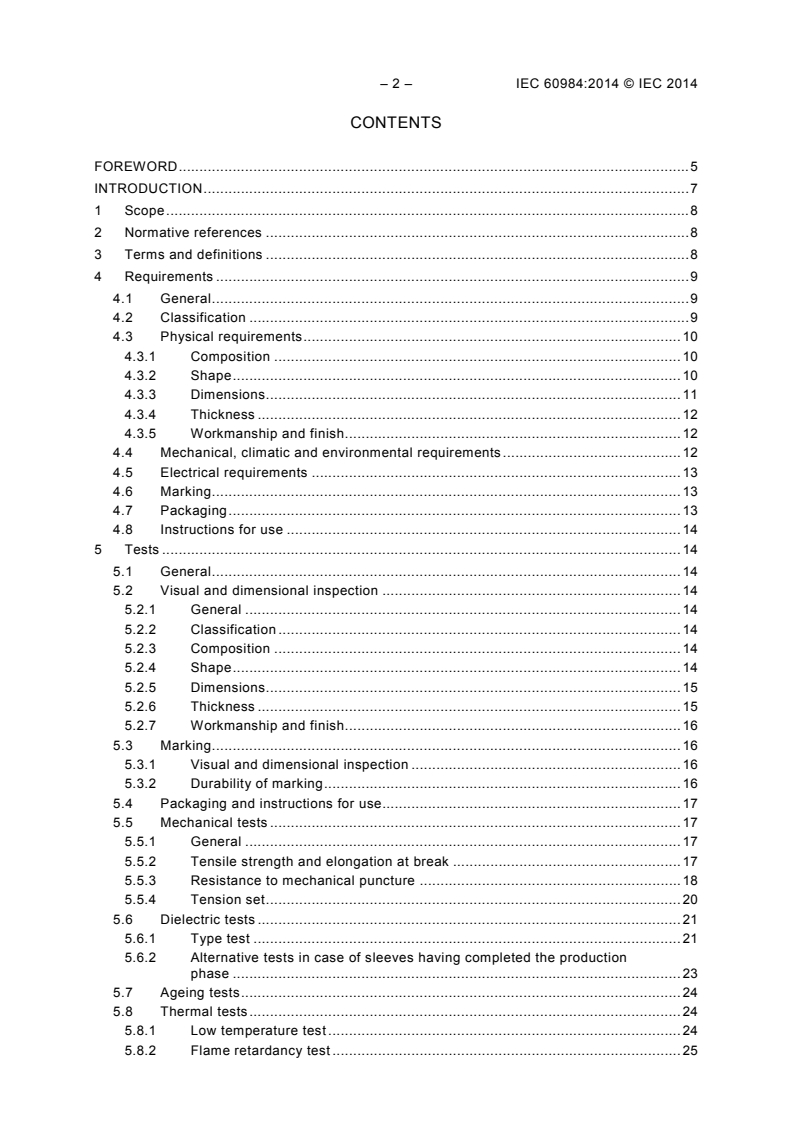
– 2 – IEC 60984:2014 © IEC 2014
CONTENTS
FOREWORD . 5
INTRODUCTION . 7
1 Scope . 8
2 Normative references . 8
3 Terms and definitions . 8
4 Requirements . 9
4.1 General . 9
4.2 Classification . 9
4.3 Physical requirements . 10
4.3.1 Composition . 10
4.3.2 Shape . 10
4.3.3 Dimensions . 11
4.3.4 Thickness . 12
4.3.5 Workmanship and finish . 12
4.4 Mechanical, climatic and environmental requirements . 12
4.5 Electrical requirements . 13
4.6 Marking . 13
4.7 Packaging . 13
4.8 Instructions for use . 14
5 Tests . 14
5.1 General . 14
5.2 Visual and dimensional inspection . 14
5.2.1 General . 14
5.2.2 Classification . 14
5.2.3 Composition . 14
5.2.4 Shape . 14
5.2.5 Dimensions . 15
5.2.6 Thickness . 15
5.2.7 Workmanship and finish . 16
5.3 Marking . 16
5.3.1 Visual and dimensional inspection . 16
5.3.2 Durability of marking . 16
5.4 Packaging and instructions for use. 17
5.5 Mechanical tests . 17
5.5.1 General . 17
5.5.2 Tensile strength and elongation at break . 17
5.5.3 Resistance to mechanical puncture . 18
5.5.4 Tension set . 20
5.6 Dielectric tests . 21
5.6.1 Type test . 21
5.6.2 Alternative tests in case of sleeves having completed the production
phase . 23
5.7 Ageing tests . 24
5.8 Thermal tests . 24
5.8.1 Low temperature test . 24
5.8.2 Flame retardancy test . 25
5.9 Tests on sleeves with special properties . 26
5.9.1 Category A – Acid resistance . 26
5.9.2 Category H – Oil resistance . 26
5.9.3 Category Z – Ozone resistance . 26
5.9.4 Category C – Extremely low temperature resistance . 27
6 Conformity assessment of sleeves having completed the production phase . 27
7 Modifications . 27
Annex A (informative) In-service recommendations . 28
A.1 General . 28
A.2 Storage prior to issue and between use . 28
A.3 Examination before use . 28
A.4 Temperature . 28
A.5 Precautions in use . 28
A.6 Periodic inspection and electrical retesting . 29
A.6.1 General . 29
A.6.2 Electrical retesting − Additional mounting methods for the sleeves . 29
Annex B (normative) Suitable for live working; double triangle (IEC 60417-5216:2002-
10). 33
Annex C (normative) Chronological order for type tests . 34
C.1 General . 34
C.2 Group size requirements . 36
C.2.1 Group 1 . 36
C.2.2 Group 2 . 36
C.2.3 Group 3 . 36
C.2.4 Group 4 – Additional test for sleeves of category A . 36
C.2.5 Group 5 – Additional test for sleeves of category H . 36
C.2.6 Group 6 – Additional test for sleeves of category Z . 36
Annex D (informative) Guidelines for the selection of the class of sleeve in relation to
a.c. nominal voltage of a system . 37
Annex E (informative) Recommendations for d.c. electrical tests and voltage use . 38
E.1 General . 38
E.2 DC dielectric tests . 38
E.2.1 Test equipment . 38
E.2.2 Test procedure . 38
E.3 Recommended maximum use voltage in d.c. installations . 39
Annex F (normative) Liquid for tests on sleeves of category H – Oil resistance . 40
F.1 Particularities of liquid 102 . 40
F.2 Characteristics of oil no. 1 . 40
Annex G (normative) Classification of defects and tests to be allocated . 41
Annex H (informative) Rationale for the classification of defects . 42
Bibliography . 43
Figure 1 – Style A: straight taper sleeve . 10
Figure 2 – Style B, curved elbow sleeve . 11
Figure 3 – Dial-micrometer for measuring sleeve thickness . 16
Figure 4 – Dumb-bell test piece for mechanical tests (plan view) . 17
Figure 5 – Test plates and needle for resistance to mechanical puncture . 19
– 4 – IEC 60984:2014 © IEC 2014
Figure 6 – Water electrodes, straight mounting . 22
Figure 7 – Set-up for low and extremely low temperature folding tests . 24
Figure 8 – Flame retardancy test set-up . 25
Figure A.1 – Water electrodes, inverted mounting . 30
Figure A.2 – Water electrodes, sling mounting . 31
Figure A.3 – Dry electrodes, straight mounting . 32
Table 1 – Special properties . 9
Table 2 – Dimensions* . 11
Table 3 – Maximum sleeve thickness . 12
Table 4 – Sampling plan . 18
Table 5 – Clearance between electrodes . 21
Table 6 – Test voltage . 23
Table C.1 – General type test procedure . 35
Table D.1 – Designation of maximum use a.c. voltage . 37
Table E.1 – Clearance between electrodes . 38
Table E.2 – DC test voltage . 39
Table E.3 – Maximum use voltage . 39
Table F.1 – Characteristics of oil no. 1 . 40
Table G.1 – Classification of defects and associated requirements and tests . 41
Table H.1 – Justification for the type of defect . 42
INTERNATIONAL ELECTROTECHNICAL COMMISSION
____________
LIVE WORKING –
ELECTRICAL INSULATING SLEEVES
FOREWORD
1) The International Electrotechnical Commission (IEC) is a worldwide organization for standardization comprising
all national electrotechnical committees (IEC National Committees). The object of IEC is to promote
international co-operation on all questions concerning standardization in the electrical and electronic fields. To
this end and in addition to other activities, IEC publishes International Standards, Technical Specifications,
Technical Reports, Publicly Available Specifications (PAS) and Guides (hereafter referred to as “IEC
Publication(s)”). Their preparation is entrusted to technical committees; any IEC National Committee interested
in the subject dealt with may participate in this preparatory work. International, governmental and non-
governmental organizations liaising with the IEC also participate in this preparation. IEC collaborates closely
with the International Organization for Standardization (ISO) in accordance with conditions determined by
agreement between the two organizations.
2) The formal decisions or agreements of IEC on technical matters express, as nearly as possible, an international
consensus of opinion on the relevant subjects since each technical committee has representation from all
interested IEC National Committees.
3) IEC Publications have the form of recommendations for international use and are accepted by IEC National
Committees in that sense. While all reasonable efforts are made to ensure that the technical content of IEC
Publications is accurate, IEC cannot be held responsible for the way in which they are used or for any
misinterpretation by any end user.
4) In order to promote international uniformity, IEC National Committees undertake to apply IEC Publications
transparently to the maximum extent possible in their national and regional publications. Any divergence
between any IEC Publication and the corresponding national or regional publication shall be clearly indicated in
the latter.
5) IEC itself does not provide any attestation of conformity. Independent certification bodies provide conformity
assessment services and, in some areas, access to IEC marks of conformity. IEC is not responsible for any
services carried out by independent certification bodies.
6) All users should ensure that they have the latest edition of this publication.
7) No liability shall attach to IEC or its directors, employees, servants or agents including individual experts and
members of its technical committees and IEC National Committees for any personal injury, property damage or
other damage of any nature whatsoever, whether direct or indirect, or for costs (including legal fees) and
expenses arising out of the publication, use of, or reliance upon, this IEC Publication or any other IEC
Publications.
8) Attention is drawn to the Normative references cited in this publication. Use of the referenced publications is
indispensable for the correct application of this publication.
9) Attention is drawn to the possibility that some of the elements of this IEC Publication may be the subject of
patent rights. IEC shall not be held responsible for identifying any or all such patent rights.
International Standard IEC 60984 has been prepared by IEC technical committee 78: Live
working.
This second edition cancels and replaces the first edition, published in 1990 and its
Amendment 1 published in 2002. It constitutes a technical revision.
The major changes are:
– removal of the requirement for an area to mark the date of inspection;
– only the straight mounting method with water electrodes is specified for the dielectric type
test;
– the d.c. electric tests are no longer included in the normative part of the document, but a
d.c. test is suggested at the production level where a d.c. use of sleeves is expected, as
presented in a new informative Annex E;
– preparation of the elements of evaluation of defects, and general application of
IEC 61318:2007;
– 6 – IEC 60984:2014 © IEC 2014
– the normative Annex E on sampling procedure has been deleted (not applicable according
to IEC 61318:2007 );
– the informative Annex F on acceptance and complementary tests has been deleted
(consideration now included in IEC 61318:2007);
– in the new normative Annex F, updating of the characteristics of the liquid specified for
tests on sleeves of category H, according to the latest edition of ISO 1817;
– introduction of a new normative Annex G on classification of defects;
– introduction of a new informative Annex H on the rationale for the classification of defects;
– review of the annex on in-service recommendations;
– for periodic electrical retesting, recommended voltage limit of the dielectric test methods
to 10 kV except in case of the test method with water electrodes and straight mounting;
The text of this standard is based on the following documents:
FDIS Report on voting
78/1042/FDIS 78/1055/RVD
Full information on the voting for the approval of this standard can be found in the report on
voting indicated in the above table.
This publication has been drafted in accordance with the ISO/IEC Directives, Part 2.
Terms defined in Clause 3 are given in italic print throughout this standard.
The committee has decided that the contents of this publication will remain unchanged until
the stability date indicated on the IEC web site under "http://webstore.iec.ch" in the data
related to the specific publication. At this date, the publication will be
• reconfirmed,
• withdrawn,
• replaced by a revised edition, or
• amended.
INTRODUCTION
This document has been prepared according to the requirements of IEC 61477 where
applicable.
The product covered by this standard may have an impact on the environment during some or
all stages of its life cycle. These impacts can range from slight to significant, be of short-term
or long-term, and occur at the global, regional or local level.
Except for a disposal statement in the Instructions for use, this standard does not include
requirements and test provisions for the manufacturers of the product, or recommendations to
the users of the product for environmental improvement. However, all parties intervening in its
design, manufacture, packaging, distribution, use, maintenance, repair, reuse, recovery and
disposal are invited to take account of environmental considerations.
– 8 – IEC 60984:2014 © IEC 2014
LIVE WORKING –
ELECTRICAL INSULATING SLEEVES
1 Scope
This International Standard is applicable to electrical insulating sleeves for the protection of
workers from accidental contact with live electrical conductors, apparatus or circuits.
The products designed and manufactured according to this standard contribute to the safety
of the users provided they are used by skilled persons, in accordance with safe methods of
work and the instructions for use.
Unless otherwise stated, in this standard the term “sleeve” is used for “electrical insulating
sleeve”.
2 Normative references
The following documents, in whole or in part, are normatively referenced in this document and
are indispensable for its application. For dated references, only the edition cited applies. For
undated references, the latest edition of the referenced document (including any
amendments) applies.
IEC 60060-1, High-voltage test techniques – Part 1: General definitions and test requirements
IEC 60060-2, High-voltage test techniques – Part 2: Measuring systems
IEC 60212, Standard conditions for use prior to and during the testing of solid electrical
insulating materials
IEC 60417, Graphical symbols for use on equipment
IEC 61318:2007, Live working – Conformity assessment applicable to tools, devices and
equipment
IEC 61477, Live working – Minimum requirements for the utilization of tools, devices and
equipment
3 Terms and definitions
For the purposes of this document, the terms and definitions given in IEC 61318 as well as
the following apply.
3.1
elastomer
macromolecular material which returns rapidly to its initial dimensions and shape after
substantial deformation by a weak stress and release of the stress
Note 1 to entry: The definition applies under room temperature test conditions.
[SOURCE: ISO 472: 2013, 2.327]
3.2
electrical insulating sleeve
sleeve made of elastomer used in conjunction with an electrical insulating glove to extend
protection against electric shock to the upper arm
Note 1 to entry: Electrical insulating sleeves are designed to protect the worker against inadvertent contacts with
live parts.
Note 2 to entry: The length of the sleeve does not provide protection up to the armpit
[SOURCE: IEC 60743:2013, 8.1.4, modified – The definition is in line with the composition
requirements of the standard for the type of insulating material. The note 2 to entry has been
added to clarify the type of protection offered.]
3.3
formally trained and qualified person
competent person possessing the appropriate practical and theoretical knowledge and having
adequate skill and experience to enable the person to perform the required periodic testing,
interpret the resultant information and from that information determine that the electrical
insulating sleeve is safe to use, and report the importance of any defect found or suspected in
relation to the safety and continued use of the electrical insulating sleeve
3.4
nominal voltage of a system
suitable approximate value of voltage used to designate or identify a system
[SOURCE: IEC 60050-601:1985, 601-01-21]
4 Requirements
4.1 General
The following requirements have been prepared in order that the products covered by this
standard are designed and manufactured to contribute to the safety of the users, provided
they are used by persons skilled for live working, in accordance with safe method of work and
the instructions for use.
4.2 Classification
The sleeves covered by this standard shall be designated as follows:
– by class as class 0, class 1, class 2, class 3 and class 4;
– by style as style A ( Straight taper) and style B (Curved elbow);
– by special properties, by the addition of a suffix to the class of the sleeve as shown in
Table 1:
Table 1 – Special properties
Category Resistant to
A Acid
H Oil
Z Ozone
a
S Oil and ozone
C Extremely low temperature
a
Category S combines the characteristics of Categories H and Z.
– 10 – IEC 60984:2014 © IEC 2014
Guidance as to temperature range at which sleeves can be used is given in Annex A.
4.3 Physical requirements
4.3.1 Composition
The sleeves shall be manufactured of elastomer and produced by a seamless process. The
holes provided in sleeves, for the purposes of strap or harness attachments, shall have non-
metallic reinforcement. The holes shall fit the fixing device of the sleeve harness and should
be nominally 8 mm in diameter.
The cuff and the large opening shall have reinforced edges.
4.3.2 Shape
The shape of the straight taper sleeve (style A) is indicated in Figure 1.
The shape of the curved elbow sleeve (style B) is indicated in Figure 2.
The taper of sleeves should be uniform.
IEC
Key
A overall length
B underarm length
C opening width
D cuff width
Figure 1 – Style A: straight taper sleeve
IEC
Key
A overall length L orientation line
B underarm length
C opening width
D cuff width
Figure 2 – Style B, curved elbow sleeve
4.3.3 Dimensions
Table 2 gives the standard dimensions and tolerances of sleeves. The dimensions are also
shown in Figures 1 and 2.
NOTE Additional dimensions may be available following agreement between manufacturer and client.
Table 2 – Dimensions*
Dimensions
mm
Style Size
A B C D
Style A (Figure 1) Small 630 370 270 140
(straight taper)
Medium 670 410 290 140
Large 720 450 330 175
Extra large 760 500 340 175
Style B (Figure 2) Small 630 370 290 145
(curved elbow)
Medium 670 410 310 145
Large 710 420 330 175
Extra large 750 460 330 180
Tolerances shall be as follows:
Dimension A: ±15 mm;
Dimension B: ±15 mm;
Dimension C: ±15 mm;
Dimension D: ± 5 mm.
– 12 – IEC 60984:2014 © IEC 2014
4.3.4 Thickness
The minimum thickness shall be determined only by the ability to pass the dielectric tests
defined in 5.6.
The maximum thickness of the sleeve on the flat surface (not ribbed area, if present) of a
sleeve shall be as given in Table 3 in order to obtain appropriate flexibility.
Table 3 – Maximum sleeve thickness
Class Thickness
mm
0 1,00
1 1,50
2 2,50
3 2,90
4 3,60
Sleeves of categories A, H, and Z may require additional thickness which shall not exceed
0,6 mm.
4.3.5 Workmanship and finish
Sleeves shall be free on both inner and outer surfaces from harmful physical irregularities that
can be detected by thorough test and inspection.
Harmful physical irregularities shall be defined as any feature that disrupt the uniform, smooth
surface contour, such as pinholes, cracks, blisters, cuts, conductive embedded foreign matter,
creases, pinch marks, voids (entrapped air), prominent ripples and prominent mould marks.
Non-harmful physical irregularities shall be defined as surface irregularities present on the
inner and outer surfaces of the sleeve due to imperfections on forms or molds and inherent
difficulties in the manufacturing process. These irregularities may appear as mould marks that
look like cuts even though they are actually a raised ridge of material, indentations,
protuberances, embedded foreign matter, or colour splashes that are acceptable provided
that:
a) the depression is not larger than 1,6 mm in diameter, has rounded edges and no visible
break in the surface, and cannot be seen on the opposite side when stretched over the
thumb;
b) there are not more than five depressions as described in a) anywhere on the sleeve and
any two are separated by at least 15 mm;
c) the indentations, protuberance or mould marks tend to blend into a smooth slope upon
stretching of the material;
d) the small projections or protuberances represent only a small amount of excess material
that cannot be readily removed with the finger and these projections do not appreciably
affect the stretching of the material.
4.4 Mechanical, climatic and environmental requirements
Sleeves shall withstand the mechanical, climatic and environmental stresses specified in this
standard.
Sleeves with one or more special categories (see Table 1) shall support any related stresses.
4.5 Electrical requirements
Sleeves shall be capable of withstanding the corresponding electrical stresses according to its
electrical class.
4.6 Marking
Each sleeve which is claimed to comply with the requirements of this standard shall bear a
label and/or marking giving the following information:
– symbol IEC 60417-5216:2002-10 – Suitable for live working; double triangle (see
Annex B);
NOTE The exact ratio of the height of the figure to the base of the triangle is 1,43. For the purpose of
convenience, this ratio can be between the values of 1,4 and 1,5.
– number of the relevant IEC standard immediately adjacent to the symbol (IEC 60984);
– name, trade mark, or identification of the manufacturer;
– category if applicable;
– size;
– class;
– "right" or "left";
– month and year of manufacture.
To minimize problems of marking and identification, the following standard abbreviations may
be used:
small (S), medium (M), large (LG), extra large (XLG).
Class 0, Class 1, Class 2, Class 3 and Class 4, right or left shall not be abbreviated.
Marking shall be clearly visible and legible to a person with normal or corrected vision without
additional magnification.
The marking or label shall not impair the quality of the sleeve. It shall be durable and shall
remain visible after being subjected to a durability test (see 5.3.2).
Any additional marking or label shall be subject to agreement between the manufacturer and
the customer.
When a colour code is used for the symbol (double triangle), it shall correspond to the
following:
class 0 – red;
class 1 – white;
class 2 – yellow;
class 3 – green;
class 4 – orange.
4.7 Packaging
Each pair of sleeves shall be packaged in an individual container or package of sufficient
strength to so far as is reasonably practicable, properly protect the sleeves from damage
when transported, handled and stored in accordance with the manufacturers instructions.
The outside of the container or package shall be marked with the name of the manufacturer or
supplier, classification, category, size, length, and style.
– 14 – IEC 60984:2014 © IEC 2014
The type of packaging suitable for transport shall be defined by the manufacturer.
4.8 Instructions for use
The manufacturer shall provide written instructions for use with each packaging of sleeves
covered by this standard.
The instructions for use shall include as a minimum, information such as storage, handling,
disposal, repair and periodic testing and reference to the standard with its date of publication.
Additional information may be provided.
These instructions shall be prepared in accordance with the general provisions of IEC 61477.
5 Tests
5.1 General
The present standard provides testing provisions to demonstrate compliance of the product to
the requirements of Clause 4. These testing provisions are primarily intended to be used as
type test for validation of the design input. Where relevant, alternative means (calculation,
examination, tests, etc.), are specified within the test clauses for the purpose of sleeves
having completed the production phase.
The allocation of the sleeves into various testing groups, the quantity required and the order
in which the type tests are carried out are given in Annex C.
Sleeves shall pass all type tests.
Sleeves which have been subjected to type tests shall not be reused.
Unless otherwise specified, sleeves for type test shall be preconditioned for a period of
2 h ± 0,5 h at a temperature of 23 °C ± 2 °C and 50 % ± 5 % relative humidity.
Where relevant, testing equipments shall comply with IEC 60060-1. Measuring systems shall
comply with IEC 60060-2 unless otherwise specified.
NOTE It is essential that the tests are done by a competent test facility.
5.2 Visual and dimensional inspection
5.2.1 General
Visual inspection shall be carried out by a person with normal or corrected vision without
additional magnification, under normal lighting conditions.
5.2.2 Classification
It shall be checked by visual inspection that the requirements of 4.2 are fulfilled.
5.2.3 Composition
It shall be checked by visual inspection that the requirements of 4.3.1 are fulfilled.
5.2.4 Shape
The shape of the sleeve shall be verified by visual inspection (see 4.3.2).
5.2.5 Dimensions
5.2.5.1 Straight taper sleeves
Dimensions of straight taper sleeves, as illustrated in Figure 1, shall be determined with the
sleeve in a flat condition (that is, with one side firmly and uniformly pressed against the
other). A convenient device for measuring is a board with a centre line upon which the sleeve
is placed on.
– Dimension A – The overall length shall be measured from the outside edge of the cuff to
the upper end of the large opening, parallel to the centre line.
– Dimension B – The underarm length shall be measured from the outside edge of the cuff
to the lower end of the large opening along the centre line.
– Dimension C – The large opening width shall be measured as the maximum width at the
large opening minus twice the sleeve thickness.
– Dimension D – The cuff width shall be measured as the outside width above the
reinforcing edge at the cuff, minus twice the sleeve thickness.
The test shall be considered as passed if the requirements of 4.3.3 are fulfilled.
5.2.5.2 Curved elbow sleeves
Dimensions of curved elbow sleeves, as illustrated in Figure 2, shall be determined with the
sleeve in a flat condition (that is, with one side firmly and uniformly pressed against the
other). The sleeve shall be oriented along a line from the midpoint of the cuff through the
centre of the uppermost button hole.
– Dimension A – The overall length shall be measured from the outside edge at the midpoint
of the cuff to the upper end of the large opening, parallel to the orientation line.
– Dimension B – The underarm length shall be measured from the outside edge at the
midpoint of the cuff to the lowest point of the large opening, parallel to the orientation line.
– Dimension C – The large opening width shall be measured as the maximum width at the
large opening minus twice the sleeve thickness.
– Dimension D – The cuff width shall be measured as the outside width above the
reinforcing edge at the cuff, minus twice the sleeve thickness.
The test shall be considered as passed if the requirements of 4.3.3 are fulfilled.
5.2.6 Thickness
Thickness measurements shall be made at eight or more points uniformly distributed over the
total area of the sleeve.
– 16 – IEC 60984:2014 © IEC 2014
Measurements shall be made with a micrometer (see Figure 3). The micrometer shall be
graduated to within 0,02 mm, have an anvil of 6 mm in diameter, and a presser foot 3,17 mm
± 0,25 mm in diameter. The presser foot shall exert a total force of 0,83 N ± 0,03 N. Sufficient
support shall be given the sleeve so that it will present an unstressed flat surface between the
anvil faces of the micrometer.
IEC
Figure 3 – Dial-micrometer for measuring sleeve thickness
The test shall be considered as passed if the requirements of 4.3.4 are fulfilled.
5.2.7 Workmanship and finish
The workmanship and finish shall be verified by visual inspection and, when found necessary,
by dimensional inspection. The test shall be considered as passed if the requirements of 4.3.5
are satisfied.
5.3 Marking
5.3.1 Visual and dimensional inspection
Compliance with the requirements of 4.6 shall be verified by visual and dimensional
inspection.
5.3.2 Durability of marking
The durability of marking shall be checked by rubbing vigorously for 15 s with a piece of lint-
free cloth soaked in soapy water and then rubbing it for a further 15 s with a piece of lint-free
cloth soaked in isopropanol (CH -CH(OH)-CH ).
3 3
It is the employer’s duty to ensure that any relevant legislation and any specific safety
instructions regarding the use of isopropanol are fully observed.
The test shall be considered as passed if the items of marking remain legible and the letters
do not smear.
Marking produced by an engraving or moulding process shall be deemed to comply without a
test for durability.
5.4 Packaging and instructions for use
The packaging and complete supply of the information required in 4.7 and 4.8 shall be verified
by visual inspection.
5.5 Mechanical tests
5.5.1 General
All mechanical tests shall be performed on test pieces which have been conditioned in
accordance with ISO 23529.
NOTE The properties of vulcanized elastomeric materials change continuously with time, these changes being
particularly rapid in the period immediately following vulcanization.
5.5.2 Tensile strength and elongation at break
5.5.2.1 Type test
Four dumb-bell test pieces each having the outline shown in Figure 4 shall be cut from the
sleeve under test, one from the outer and one from the inner part of the sleeve at each end.
), shall be marked on these test pieces, symmetrically placed
Reference lines, 20 mm apart (lo
on the narrow part of the dumb-bell (see Figure 4).
IEC
Key
Dimensions
mm
A 75
B 12
...