

IEC 60891:2009
(Main)Photovoltaic devices - Procedures for temperature and irradiance corrections to measured I-V characteristics
General Information
- Abstract
IEC 60891:2009 defines procedures to be followed for temperature and irradiance corrections to the measured I-V (current-voltage) characteristics of photovoltaic devices. It also defines the procedures used to determine factors relevant for these corrections. Requirements for I-V measurement of photovoltaic devices are laid down in IEC 60904-1. The main technical changes with regard the previous edition are as follows:
- extends edition 1 translation procedure to irradiance change during I-V measurement;
- adds 2 new translation procedures;
- revises procedure for determination of temperature coefficients to include PV modules;
- defines new procedure for determination of internal series resistance;
- defines new procedure for determination of curve correction factor.
- Status
- Published
- Publication Date
- 13-Dec-2009
- Technical Committee
- TC 82 - Solar photovoltaic energy systems
- Current Stage
- DELPUB - Deleted Publication
- Start Date
- 27-Oct-2021
- Completion Date
- 29-Jun-2018
Overview
IEC 60891:2009 is an international standard developed by the International Electrotechnical Commission (IEC) that defines procedures for temperature and irradiance corrections to the measured current-voltage (I-V) characteristics of photovoltaic (PV) devices. This standard is essential for ensuring accurate and consistent evaluation of PV device performance under variable environmental conditions.
The standard extends beyond simple measurement techniques and includes methodologies for determining correction factors such as temperature coefficients, internal series resistance, and curve correction factors. It complements IEC 60904-1, which outlines requirements for I-V measurement of photovoltaic devices.
Key Topics
Temperature and Irradiance Corrections: The core focus is on procedures to correct measured I-V characteristics to standardized conditions-such as Standard Test Conditions (STC)-accounting for changes in temperature and irradiance.
Correction Procedures:
- Procedure 1: An updated version of the original translation method used previously, rewritten for clarity.
- Procedure 2: An algebraic correction method that offers improved accuracy for significant irradiance changes over 20%.
- Procedure 3: A parameter-independent interpolation technique applicable when at least three I-V curves exist across varying temperature and irradiance.
Determination of Correction Factors:
- Temperature Coefficients: Revised procedures now include PV modules and sub-assemblies, not just single cells.
- Internal Series Resistance: Newly defined method to evaluate this key parameter impacting PV device performance.
- Curve Correction Factor: A novel procedure introduced to enhance correction precision.
Measurement Requirements: All I-V characteristics must be collected according to IEC 60904-1. Reference devices and spectral mismatch corrections are detailed alongside linearity requirements outlined in IEC 60904-10 and IEC 61853-1.
Applications
IEC 60891:2009 is highly applicable in fields involving:
Photovoltaic Module Testing: Laboratories and manufacturers utilize these procedures to standardize I-V characterization of solar cells, modules, and sub-assemblies ensuring performance comparisons are accurate despite variable environmental testing conditions.
Performance Evaluation: Enables determination of accurate performance parameters such as short-circuit current, open-circuit voltage, fill factor, and maximum power output corrected to standard conditions.
Quality Control and Certification: The standard supports conformity assessments and certifications by providing internationally recognized procedures for measurement corrections.
Research and Development: Facilitates consistent data collection and analysis for new photovoltaic technologies under diverse climatic conditions.
System Design and Simulation: Corrected I-V characteristics form the basis for precise system modeling, helping optimize solar power generation.
Related Standards
- IEC 60904-1: Photovoltaic devices-Part 1: Measurements of photovoltaic current-voltage characteristics (guides measurement protocols).
- IEC 60904-2: Requirements for reference solar devices utilized in irradiance measurement.
- IEC 60904-7: Computation of spectral mismatch correction for PV device testing.
- IEC 60904-9: Solar simulator performance requirements ensuring consistent artificial sunlight conditions.
- IEC 60904-10: Methods for assessing linearity of PV devices over irradiance ranges.
- IEC 61853-1: Defines performance testing under varying environmental conditions including linearity.
Practical Value
IEC 60891:2009 provides standardized, precise methods to adjust measured I-V characteristics, enabling stakeholders to:
- Achieve consistent, comparable data regardless of test conditions.
- Minimize measurement uncertainty caused by temperature and irradiance fluctuations.
- Accurately determine performance metrics at Standard Test Conditions, a critical factor in PV product rating and validation.
- Improve reliability in PV device characterization methodologies.
- Support rigorous research and quality assurance activities within the photovoltaic industry.
By adhering to the procedures and correction methods defined in IEC 60891, manufacturers, testing labs, and researchers can ensure internationally comparable results that foster innovation and market confidence in photovoltaic technologies.
Relations
- Effective Date
- 05-Sep-2023
Get Certified
Connect with accredited certification bodies for this standard

DNV
DNV is an independent assurance and risk management provider.

TÜV Rheinland
TÜV Rheinland is a leading international provider of technical services.

TÜV SÜD
TÜV SÜD is a trusted partner of choice for safety, security and sustainability solutions.
Sponsored listings
Frequently Asked Questions
IEC 60891:2009 is a standard published by the International Electrotechnical Commission (IEC). Its full title is "Photovoltaic devices - Procedures for temperature and irradiance corrections to measured I-V characteristics". This standard covers: IEC 60891:2009 defines procedures to be followed for temperature and irradiance corrections to the measured I-V (current-voltage) characteristics of photovoltaic devices. It also defines the procedures used to determine factors relevant for these corrections. Requirements for I-V measurement of photovoltaic devices are laid down in IEC 60904-1. The main technical changes with regard the previous edition are as follows: - extends edition 1 translation procedure to irradiance change during I-V measurement; - adds 2 new translation procedures; - revises procedure for determination of temperature coefficients to include PV modules; - defines new procedure for determination of internal series resistance; - defines new procedure for determination of curve correction factor.
IEC 60891:2009 defines procedures to be followed for temperature and irradiance corrections to the measured I-V (current-voltage) characteristics of photovoltaic devices. It also defines the procedures used to determine factors relevant for these corrections. Requirements for I-V measurement of photovoltaic devices are laid down in IEC 60904-1. The main technical changes with regard the previous edition are as follows: - extends edition 1 translation procedure to irradiance change during I-V measurement; - adds 2 new translation procedures; - revises procedure for determination of temperature coefficients to include PV modules; - defines new procedure for determination of internal series resistance; - defines new procedure for determination of curve correction factor.
IEC 60891:2009 is classified under the following ICS (International Classification for Standards) categories: 27.160 - Solar energy engineering; 43.120 - Electric road vehicles. The ICS classification helps identify the subject area and facilitates finding related standards.
IEC 60891:2009 has the following relationships with other standards: It is inter standard links to IEC 60891:2021. Understanding these relationships helps ensure you are using the most current and applicable version of the standard.
IEC 60891:2009 is available in PDF format for immediate download after purchase. The document can be added to your cart and obtained through the secure checkout process. Digital delivery ensures instant access to the complete standard document.
Standards Content (Sample)
IEC 60891 ®
Edition 2.0 2009-12
INTERNATIONAL
STANDARD
NORME
INTERNATIONALE
Photovoltaic devices – Procedures for temperature and irradiance corrections to
measured I-V characteristics
Dispositifs photovoltaïques – Procédures pour les corrections en fonction de la
température et de l’éclairement à appliquer aux caractéristiques I-V mesurées
All rights reserved. Unless otherwise specified, no part of this publication may be reproduced or utilized in any form or by
any means, electronic or mechanical, including photocopying and microfilm, without permission in writing from either IEC or
IEC's member National Committee in the country of the requester.
If you have any questions about IEC copyright or have an enquiry about obtaining additional rights to this publication,
please contact the address below or your local IEC member National Committee for further information.
Droits de reproduction réservés. Sauf indication contraire, aucune partie de cette publication ne peut être reproduite
ni utilisée sous quelque forme que ce soit et par aucun procédé, électronique ou mécanique, y compris la photocopie
et les microfilms, sans l'accord écrit de la CEI ou du Comité national de la CEI du pays du demandeur.
Si vous avez des questions sur le copyright de la CEI ou si vous désirez obtenir des droits supplémentaires sur cette
publication, utilisez les coordonnées ci-après ou contactez le Comité national de la CEI de votre pays de résidence.
IEC Central Office
3, rue de Varembé
CH-1211 Geneva 20
Switzerland
Email: inmail@iec.ch
Web: www.iec.ch
About the IEC
The International Electrotechnical Commission (IEC) is the leading global organization that prepares and publishes
International Standards for all electrical, electronic and related technologies.
About IEC publications
The technical content of IEC publications is kept under constant review by the IEC. Please make sure that you have the
latest edition, a corrigenda or an amendment might have been published.
ƒ Catalogue of IEC publications: www.iec.ch/searchpub
The IEC on-line Catalogue enables you to search by a variety of criteria (reference number, text, technical committee,…).
It also gives information on projects, withdrawn and replaced publications.
ƒ IEC Just Published: www.iec.ch/online_news/justpub
Stay up to date on all new IEC publications. Just Published details twice a month all new publications released. Available
on-line and also by email.
ƒ Electropedia: www.electropedia.org
The world's leading online dictionary of electronic and electrical terms containing more than 20 000 terms and definitions
in English and French, with equivalent terms in additional languages. Also known as the International Electrotechnical
Vocabulary online.
ƒ Customer Service Centre: www.iec.ch/webstore/custserv
If you wish to give us your feedback on this publication or need further assistance, please visit the Customer Service
Centre FAQ or contact us:
Email: csc@iec.ch
Tel.: +41 22 919 02 11
Fax: +41 22 919 03 00
A propos de la CEI
La Commission Electrotechnique Internationale (CEI) est la première organisation mondiale qui élabore et publie des
normes internationales pour tout ce qui a trait à l'électricité, à l'électronique et aux technologies apparentées.
A propos des publications CEI
Le contenu technique des publications de la CEI est constamment revu. Veuillez vous assurer que vous possédez
l’édition la plus récente, un corrigendum ou amendement peut avoir été publié.
ƒ Catalogue des publications de la CEI: www.iec.ch/searchpub/cur_fut-f.htm
Le Catalogue en-ligne de la CEI vous permet d’effectuer des recherches en utilisant différents critères (numéro de référence,
texte, comité d’études,…). Il donne aussi des informations sur les projets et les publications retirées ou remplacées.
ƒ Just Published CEI: www.iec.ch/online_news/justpub
Restez informé sur les nouvelles publications de la CEI. Just Published détaille deux fois par mois les nouvelles
publications parues. Disponible en-ligne et aussi par email.
ƒ Electropedia: www.electropedia.org
Le premier dictionnaire en ligne au monde de termes électroniques et électriques. Il contient plus de 20 000 termes et
définitions en anglais et en français, ainsi que les termes équivalents dans les langues additionnelles. Egalement appelé
Vocabulaire Electrotechnique International en ligne.
ƒ Service Clients: www.iec.ch/webstore/custserv/custserv_entry-f.htm
Si vous désirez nous donner des commentaires sur cette publication ou si vous avez des questions, visitez le FAQ du
Service clients ou contactez-nous:
Email: csc@iec.ch
Tél.: +41 22 919 02 11
Fax: +41 22 919 03 00
IEC 60891 ®
Edition 2.0 2009-12
INTERNATIONAL
STANDARD
NORME
INTERNATIONALE
Photovoltaic devices – Procedures for temperature and irradiance corrections to
measured I-V characteristics
Dispositifs photovoltaïques – Procédures pour les corrections en fonction de la
température et de l’éclairement à appliquer aux caractéristiques I-V mesurées
INTERNATIONAL
ELECTROTECHNICAL
COMMISSION
COMMISSION
ELECTROTECHNIQUE
PRICE CODE
INTERNATIONALE
R
CODE PRIX
ICS 27.160 ISBN 978-2-88910-316-4
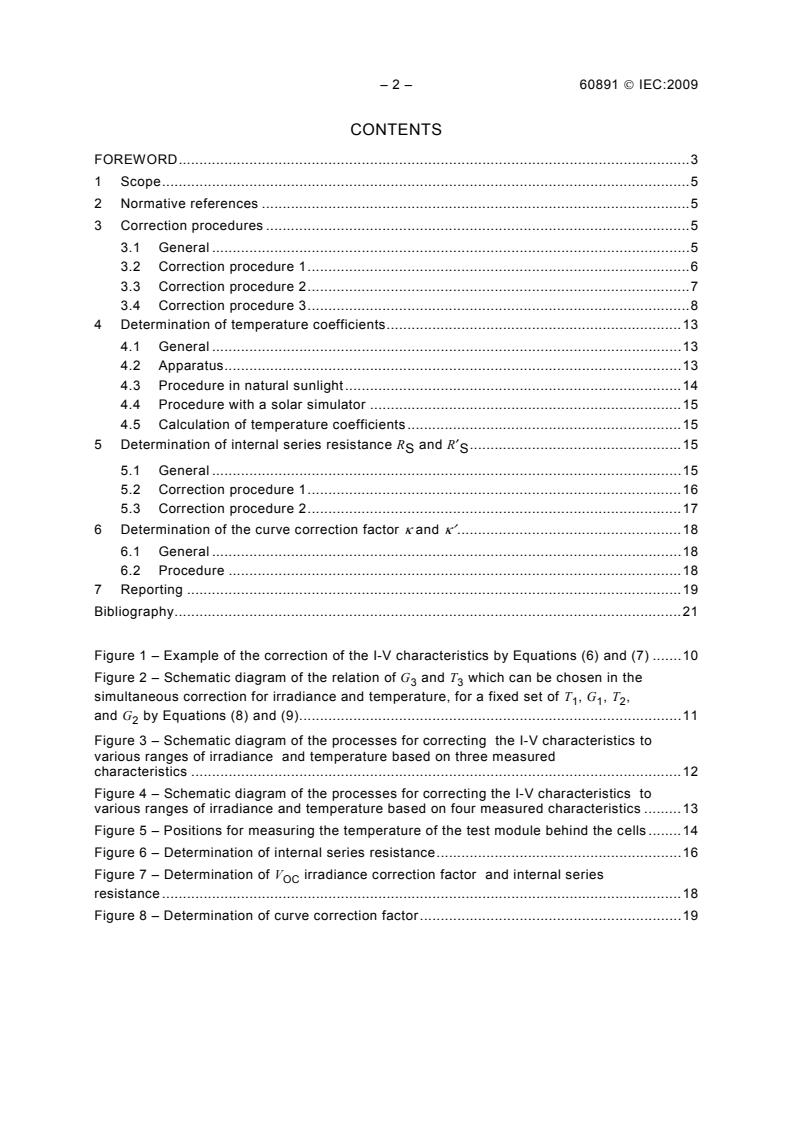
– 2 – 60891 © IEC:2009
CONTENTS
FOREWORD.3
1 Scope.5
2 Normative references .5
3 Correction procedures .5
3.1 General .5
3.2 Correction procedure 1.6
3.3 Correction procedure 2.7
3.4 Correction procedure 3.8
4 Determination of temperature coefficients.13
4.1 General .13
4.2 Apparatus.13
4.3 Procedure in natural sunlight.14
4.4 Procedure with a solar simulator .15
4.5 Calculation of temperature coefficients.15
5 Determination of internal series resistance R and R′ .15
S S
5.1 General .15
5.2 Correction procedure 1.16
5.3 Correction procedure 2.17
6 Determination of the curve correction factor κ and κ′ .18
6.1 General .18
6.2 Procedure .18
7 Reporting .19
Bibliography.21
Figure 1 – Example of the correction of the I-V characteristics by Equations (6) and (7) .10
Figure 2 – Schematic diagram of the relation of G and T which can be chosen in the
3 3
simultaneous correction for irradiance and temperature, for a fixed set of T , G , T ,
1 1 2
by Equations (8) and (9).11
and G
Figure 3 – Schematic diagram of the processes for correcting the I-V characteristics to
various ranges of irradiance and temperature based on three measured
characteristics .12
Figure 4 – Schematic diagram of the processes for correcting the I-V characteristics to
various ranges of irradiance and temperature based on four measured characteristics .13
Figure 5 – Positions for measuring the temperature of the test module behind the cells .14
Figure 6 – Determination of internal series resistance.16
Figure 7 – Determination of V irradiance correction factor and internal series
OC
resistance .18
Figure 8 – Determination of curve correction factor.19
60891 © IEC:2009 – 3 –
INTERNATIONAL ELECTROTECHNICAL COMMISSION
____________
PHOTOVOLTAIC DEVICES – PROCEDURES FOR TEMPERATURE AND
IRRADIANCE CORRECTIONS TO MEASURED I-V CHARACTERISTICS
FOREWORD
1) The International Electrotechnical Commission (IEC) is a worldwide organization for standardization comprising
all national electrotechnical committees (IEC National Committees). The object of IEC is to promote
international co-operation on all questions concerning standardization in the electrical and electronic fields. To
this end and in addition to other activities, IEC publishes International Standards, Technical Specifications,
Technical Reports, Publicly Available Specifications (PAS) and Guides (hereafter referred to as “IEC
Publication(s)”). Their preparation is entrusted to technical committees; any IEC National Committee interested
in the subject dealt with may participate in this preparatory work. International, governmental and non-
governmental organizations liaising with the IEC also participate in this preparation. IEC collaborates closely
with the International Organization for Standardization (ISO) in accordance with conditions determined by
agreement between the two organizations.
2) The formal decisions or agreements of IEC on technical matters express, as nearly as possible, an international
consensus of opinion on the relevant subjects since each technical committee has representation from all
interested IEC National Committees.
3) IEC Publications have the form of recommendations for international use and are accepted by IEC National
Committees in that sense. While all reasonable efforts are made to ensure that the technical content of IEC
Publications is accurate, IEC cannot be held responsible for the way in which they are used or for any
misinterpretation by any end user.
4) In order to promote international uniformity, IEC National Committees undertake to apply IEC Publications
transparently to the maximum extent possible in their national and regional publications. Any divergence
between any IEC Publication and the corresponding national or regional publication shall be clearly indicated in
the latter.
5) IEC itself does not provide any attestation of conformity. Independent certification bodies provide conformity
assessment services and, in some areas, access to IEC marks of conformity. IEC is not responsible for any
services carried out by independent certification bodies.
6) All users should ensure that they have the latest edition of this publication.
7) No liability shall attach to IEC or its directors, employees, servants or agents including individual experts and
members of its technical committees and IEC National Committees for any personal injury, property damage or
other damage of any nature whatsoever, whether direct or indirect, or for costs (including legal fees) and
expenses arising out of the publication, use of, or reliance upon, this IEC Publication or any other IEC
Publications.
8) Attention is drawn to the Normative references cited in this publication. Use of the referenced publications is
indispensable for the correct application of this publication.
9) Attention is drawn to the possibility that some of the elements of this IEC Publication may be the subject of
patent rights. IEC shall not be held responsible for identifying any or all such patent rights.
International Standard IEC 60891 has been prepared by IEC technical committee 82: Solar
photovoltaic energy systems.
This second edition cancels and replaces the first edition issued in 1987 and its Amendment 1
(1992) and constitutes a technical revision.
The main technical changes with regard the previous edition are as follows:
– extends edition 1 translation procedure to irradiance change during I-V measurement;
– adds 2 new translation procedures;
– revises procedure for determination of temperature coefficients to include PV modules;
– defines new procedure for determination of internal series resistance;
– defines new procedure for determination of curve correction factor.
– 4 – 60891 © IEC:2009
The text of this standard is based on the following documents:
FDIS Report on voting
82/581/FDIS 82/588/RVD
Full information on the voting for the approval of this standard can be found in the report on
voting indicated in the above table.
This publication has been drafted in accordance with the ISO/IEC Directives, Part 2.
The committee has decided that the contents of this publication will remain unchanged until
the maintenance result date indicated on the IEC web site under "http://webstore.iec.ch" in
the data related to the specific publication. At this date, the publication will be
• reconfirmed,
• withdrawn,
• replaced by a revised edition, or
• amended.
60891 © IEC:2009 – 5 –
PHOTOVOLTAIC DEVICES – PROCEDURES FOR TEMPERATURE AND
IRRADIANCE CORRECTIONS TO MEASURED I-V CHARACTERISTICS
1 Scope
This standard defines procedures to be followed for temperature and irradiance corrections to
the measured I-V (current-voltage) characteristics of photovoltaic devices. It also defines the
procedures used to determine factors relevant for these corrections. Requirements for I-V
measurement of photovoltaic devices are laid down in IEC 60904-1.
NOTE 1 The photovoltaic devices include a single solar cell with or without a protective cover, a sub-assembly of
solar cells, or a module. A different set of relevant parameters for I-V correction applies for each type of device.
Although the determination of temperature coefficients for a module (or sub-assembly of cells) may be calculated
from single cell measurements, it should be noted that the internal series resistance and curve correction factor
should be separately measured for a module or subassembly of cells.
NOTE 2 The term “test specimen” is used to denote any of these devices.
NOTE 3 Care should be taken regarding the use of I-V correction parameters. The parameters are valid for the
PV device for which they have been measured. Variations may occur within a production lot or the type class.
2 Normative references
The following referenced documents are indispensable for the application of this document.
For dated references, only the edition cited applies. For undated references, the latest edition
of the referenced document (including any amendments) applies.
IEC 60904-1, Photovoltaic devices – Part 1: Measurements of photovoltaic current-voltage
characteristics
IEC 60904-2, Photovoltaic devices – Part 2: Requirements for reference solar devices
IEC 60904-7, Photovoltaic devices – Part 7: Computation of the spectral mismatch correction
for measurements of photovoltaic devices
IEC 60904-9, Photovoltaic devices – Part 9: Solar simulator performance requirements
IEC 60904-10, Photovoltaic devices – Part 10: Methods of linearity measurement
3 Correction procedures
3.1 General
Three procedures for correcting measured current-voltage characteristics to other conditions
of temperature and irradiance (such as STC) can be applied. The first is identical to the
procedure given in Edition 1 of this standard, but the equation has been rewritten for easier
understanding. The second procedure is an alternative algebraic correction method which
yields better results for large irradiance corrections (>20 %). Both procedures require that
correction parameters of the PV device are known. If not known they need to be determined
prior to performing the correction. The third procedure is an interpolation method which does
not require correction parameters as input: It can be applied when a minimum of three
current-voltage curves have been measured for the test device. These three current-voltage
curves span the temperature and irradiance range for which the correction method is
applicable.
– 6 – 60891 © IEC:2009
All methods are applicable to linear devices as defined in IEC 60904-10.
NOTE 1 An estimate on the translation accuracy is required (see Clause 7).
NOTE 2 All PV devices should be linear within a limited range of irradiances and device temperature. Details are
described in IEC 61853-1.
Common to all procedures is that I-V characteristics of the PV device are to be measured in
accordance with IEC 60904-1.
Usually irradiance G shall be calculated from the measured short circuit current (I ) of the
RC
PV reference device as defined in IEC 60904-2, and its calibration value at STC (I ). A
RC,STC
correction should be applied to account for the temperature of the reference device T using
RC
the specified relative temperature coefficient of the reference device (1/°C) which is given at
25 °C and 1 000 W/m .
−2
1 000 Wm ⋅I
RC
G = ⋅[]1− α ⋅()T − 25 °C
RC RC
I
RC,STC
The PV reference device shall either be spectrally matched to the test specimen, or a spectral
mismatch correction shall be performed in conformance with IEC 60904-7. The reference
device shall be linear in short-circuit current, as defined in IEC 60904-10 over the irradiance
range of interest.
3.2 Correction procedure 1
The measured current-voltage characteristic shall be corrected to standard test conditions or
other selected temperature and irradiance values by applying the following equations:
⎛ ⎞
G
⎜ ⎟
I = I + I ⋅ −1 + α ⋅()T − T (1)
2 1 SC 2 1
⎜ ⎟
G
⎝ 1 ⎠
V = V − R ⋅()I − I − κ ⋅ I ⋅(T − T) + β ⋅(T − T) (2)
2 1 S 2 1 2 2 1 2 1
where:
I , V are coordinates of points on the measured characteristics;
1 1
I , V are coordinates of the corresponding points on the corrected characteristic;
2 2
G is the irradiance measured with the reference device;
G is the irradiance at the standard or other desired irradiance;
T is the measured temperature of the test specimen;
T is the standard or other desired temperature;
I is the measured short-circuit current of the test specimen at G and T ;
SC 1 1
α and β are the current and voltage temperature coefficients of the test specimen in the
standard or target irradiance for correction and within the temperature range of
interest;
R is the internal series resistance of the test specimen;
S
κ is a curve correction factor.
60891 © IEC:2009 – 7 –
NOTE 1 As the data point V will be shifted off the current axis when translating from lower to higher irradiance,
oc1
the translated V has to be determined by linear extrapolation from at least 3 data points near and below V or
oc2 oc1
the original IV curve has to be measured sufficiently far beyond V .
oc1
NOTE 2 The units of all correction parameters should be consistent.
NOTE 3 If the test specimen is a module the cell I-V correction parameters can be derived from the
interconnection circuit. These cell parameters may be used to calculate the module I-V correction parameters for
other module types using the same cells.
NOTE 4 For crystalline silicon PV devices α is normally positive and β negative.
Procedures for determination of the I-V correction parameters of the test specimen are
described in sections 4 to 6.
Equation (1) is only applicable for I-V curves measured at irradiances which are constant
during the acquisition of the entire I-V curve. For pulsed solar simulators with decaying
irradiance or any other kind of irradiance fluctuations during I-V measurement Equation (1) is
not applicable as such. In this case, each measured I-V curve has to be corrected to an
equivalent I-V curve at constant irradiance which requires an additional scaling factor in front
of I . For practical reasons this scaling factor is related to the irradiance corresponding to
SC
measured I . For non-constant irradiance Equation (1) will become the following translation
SC
equation.
′ ⎛ ⎞
G G
1 2
⎜ ⎟
I = I + ⋅ I ⋅ −1 + α ⋅()T − T (3)
2 1 SC 2 1
⎜ ⎟
G G '
SC ⎝ 1 ⎠
′
where G is the irradiance value at the time of I measurement and G is the irradiance
SC SC
measured at time of data acquisition of individual I-V data points.
3.3 Correction procedure 2
This procedure is based on the simplified one-diode model of PV devices. The semi-empirical
translation equations contain 5 I-V correction parameters which can be determined by
measurement of I-V curves at different temperature and irradiance conditions. Besides the
temperature coefficients for short circuit current (α) and open circuit voltage (β) an additional
temperature coefficient (κ′) is commonly used which accounts for changes of the internal
series resistance (and fill factor) with temperature.
The correction procedure is defined by the following equations for current and voltage:
G
I = I ⋅()1+ α ⋅()T − T ⋅ (4)
2 1 rel 2 1
G
⎛ ⎞
⎛ ⎞
G
⎜ ⎟
⎜ ⎟ ′ ′
V = V + V ⋅ β ⋅()T − T + a ⋅ln − R ⋅()I − I − κ ⋅ I ⋅(T − T) (5)
2 1 OC1 rel 2 1 S 2 1 2 2 1
⎜ ⎟
⎜ ⎟
G
⎝ 1⎠
⎝ ⎠
where:
I , V are coordinates of points on the measured I-V characteristic;
1 1
I , V are coordinates of the corresponding points on the corrected I-V curve;
2 2
G is the irradiance as measured with the reference device;
G is the target irradiance for the corrected I-V characteristic;
T is the measured temperature of the test specimen;
– 8 – 60891 © IEC:2009
T is the target temperature of the test specimen;
V the open circuit voltage at test conditions;
OC1
α and β are the relative current and voltage temperature coefficients of the test specimen
rel rel
measured at 1 000 W/m . They are related to short circuit current and open circuit
voltage at STC;
a is the irradiance correction factor for open circuit voltage which is linked with the diode
thermal voltage D of the pn junction and the number of cells n serially connected in
S
the module;
R′ is the internal series resistance of the test specimen;
S
κ′ is interpreted as temperature coefficient of the internal series resistance R′
S.
NOTE 1 A typical value for the irradiance correction factor a is 0,06.
NOTE 2 Care should be taken that the numerical values for ′ for procedure 2 may be different to ′ of
R R
S S
correction procedure 1.
3.4 Correction procedure 3
3.4.1 General
This procedure is based on the linear interpolation or extrapolation of two measured I-V
characteristics. It uses a minimum of two I-V characteristics, and requires no correction
parameters or fitting parameters. The measured current-voltage characteristics shall be
corrected to standard test conditions or other selected temperature and irradiance values by
applying the following equations:
V = V + a ⋅()V −V (6)
3 1 2 1
I = I + a ⋅()I − I (7)
3 1 2 1
The pair of (I ,V ) and (I , V ) should be chosen so that I – I = I – I :
1 1 2 2 2 1 SC2 SC1
where:
I , V are coordinates of points on the measured characteristics at an irradiance G and
1 1 1
temperature T .
I , V are coordinates of points on the measured characteristics at an irradiance G and
2 2 2
temperature T .
I , V are coordinates of the corresponding points on the corrected characteristics at an
3 3
irradiance G and temperature T .
3 3
I , I are the measured short-circuit current of the test specimen.
SC1 SC2
a is a constant for the interpolation, which has the relation with the irradiance and
temperature as follows.
G = G + a ⋅ (G − G )
(8)
3 1 2 1
T = T + a ⋅ (T − T )
. (9)
3 1 2 1
60891 © IEC:2009 – 9 –
This method should be applicable to most PV technologies. Equations (6) to (9) can be used
for the irradiance correction, temperature correction, and simultaneous correction of
irradiance and temperature.
3.4.2 Correction for the irradiance and temperature from two measured I-V
characteristics
The procedure to correct the I-V characteristics to the irradiance and temperature (G , T )
3 3
from two I-V characteristics measured at the irradiances and temperatures of (G , T ) and (G ,
1 1 2
T ) is as follows (Figures 1(a) and 1(b)).
a) Measure the two I-V characteristics at the irradiances and temperatures of G , T and G ,
1 1 2
T , respectively (solid lines in Figure 1(a)). Find the values of I and I .
2 SC1 SC2
b) Calculate a by Equation (8) or (9). For example, when the two measured I-V curves were
made at:
G = 1 000 W/m and T = 50 °C
1 1
G = 500 W/m and T = 40 °C.
2 2
And the irradiance of interest is G = 800 W/m :
Then using Equation (8) a = 0,4.
And using Equation (9) T = 46 °C.
c) Choose a point (V , I ) on the I-V characteristic 1. Find a point (V , I ) on the I-V
1 1 2 2
– I = I – I is satisfied (Figure 1(b)).
characteristic 2, so that the relation I
2 1 SC2 SC1
d) Calculate V and I by Equations (6) and (7).
3 3
e) Select multiple sets of data points (V , I ) on the I-V characteristics 1, and calculate (V , I )
1 1 3 3
for each by the procedures (c) and (d).
f) The I-V characteristics 3 at the irradiance G and temperature T are given by the set of
3 3
data points (V , I ) (broken line in Figure 1(b)).
3 3
Figures 1(a) and 1(b) show an example of an irradiance correction. Figures 1(c) shows an
example of a temperature correction. Figure 1(d) shows a simultaneous correction of
irradiance and temperature. When 0 < a < 1, the procedure is interpolation. Otherwise, the
procedure is extrapolation.
It should be noted that when G , G , T and T are fixed, G and T cannot be chosen
1 2 1 2 3 3
independently, because they have the relationships given in Equations (8) and (9) (Figure 2).
For example, when G = 1 000 W/m , T = 20 °C, G = 0 W/m , T = 60 °C (dark I-V curve at
1 1 2 2
60°C), and you wish to have the new curve at G = 750 W/m , a is calculated to be 0,25 by
Equation (8). Therefore, T should be 30 °C from Equation (9).
– 10 – 60891 © IEC:2009
a) b)
G , T G , T
1 1 1 1
I I
sc1 sc1
(V , I )
1 1
I –I
sc1 sc2
I –I
sc1 sc2
G , T
3 3
I –I
sc1 sc2
G , T G , T
2 2 2 2
I I
sc2 sc2
(V , I )
2 2
Voltage Voltage
IEC 2414/09 IEC 2415/09
G , T
I –I
1 1
sc1 sc2
c) I d)
sc1
I
sc1
G , T
2 2
I –I
sc1 sc2
I
sc2
G , T
1 1
I –I
G , T sc1 sc2
3 3
G , T I –I
3 3 sc1 sc2
a 1–a
(V , I )
1 1
(V , I )
2 2
(V , I )
3 3
G , T
2 2
I –I
sc1 sc2 I
sc2
Voltage Voltage
IEC 2416/09 IEC 2417/09
Subfigures (a) and (b) show irradiance corrections, (c) shows a temperature correction and (d) shows simultaneous
correction of irradiance and temperature.
Figure 1 – Example of the correction of the I-V characteristics by
Equations (6) and (7)
NOTES 1 Interpolation usually gives better results than extrapolation.
NOTE 2 When I ≠ I and the corrected I-V characteristics around the open-circuit voltage is required, the
SC1 SC2
measured characteristics should extend beyond V .
oc
NOTE 3 When there are no measured data points which exactly satisfy I = I + (I – I ), the V and I may
2 1 SC2 SC1 2 2
be calculated from interpolation of the data points in the I-V curve 2.
Current
Current
Current Current
60891 © IEC:2009 – 11 –
Simultaneous
, T )
(G
correction of irradiance 1 1
and temperature
a
(G , T )
3 3
1–a
(G , T )
2 2
Irradiance
IEC 2418/09
The solid line and broken line show the range of G and T which are calculable by the interpolation and
3 3
extrapolation, respectively.
Figure 2 – Schematic diagram of the relation of G and T which can be chosen in the
3 3
simultaneous correction for irradiance and temperature, for a fixed set of T , G , T ,
1 1 2
and G by Equations (8) and (9)
3.4.3 Correction to various irradiances and temperatures from three I-V
characteristics
The correction of the I-V characteristics to various ranges of irradiance and temperature is
possible by combining the procedures described in 3.4.2. For example, when three
characteristics measured at irradiances and temperatures of (G , T ), (G , T ) and (G , T ) are
a a b b c c
available as shown in Figure 3(a), the I-V characteristics at any irradiances and temperatures
(G , T ) can be calculated as follows.
n n
a) The characteristics at (G , T ) are calculated from those at (G , T ) and (G , T ).
m m a a b b
b) The characteristics at (G , T ) are calculated from those at (G , T ) and (G , T ).
n n m m c c
2 2
For example, when (G , T ), (G , T ), (G , T ) and (G , T ) are (950 W/m , 15 °C), (850 W/m ,
a a b b c c n n
2 2
25 °C), (1 100 W/m , 30 °C) and (1 000 W/m , 25 °C) respectively, then (G , T ) are
m m
(900 W/m , 20 °C).
Temperature
– 12 – 60891 © IEC:2009
I (V , I )
scc c c
G , T
G , T c c
n n
(G , T )
c c
I –I
scc sca
(V , I )
n n
G , T
a a
(G , T )
n n
(G , T )
b b
(V , I )
I
sca a a
(G , T )
m m
I –I
sca scb
(V , I )
m m
G , T
b b
I
scb
(V , I )
(G , T )
a a b b
Irradiance Voltage
IEC 2419/09 IEC 2420/09
a) b)
The shaded area in (a) shows the range which can be calculated by interpolation only. Sub-figure (b) shows an
example of the I-V characteristics which correspond to (a).
Figure 3 – Schematic diagram of the processes for correcting
the I-V characteristics to various ranges of irradiance
and temperature based on three measured characteristics
3.4.4 Correction to various irradiances and temperatures from four measured I-V
curves
When four I-V characteristics measured at irradiances and temperatures of (G , T ), (G , T ),
a a b b
(G , T ) and (G , T ) are available as shown in Figure 4, the I-V characteristics at any
c c d d
irradiances and temperatures (G , T ) can be calculated as follows. This process is useful for
n n
correction of the characteristics in a wide range of irradiance and temperature. Although the
pair of (G , T ) and (G , T ) to calculate the characteristics at (G , T ) is not unique, good
l l m m n n
correction results are usually available when (G – G )/(G – G ) = (G – G )/(G – G ) is
a l a b c m c d
satisfied.
a) The characteristics at (G , T ) are calculated from those at (G , T ) and (G , T ).
l l a a b b
b) The characteristics at (G , T ) are calculated from those at (G , T ) and (G , T ).
m m c c d d
c) The characteristics at (G , T ) are calculated from those at (G , T ) and (G , T ).
n n l l m m
For example, when (G , T ), (G , T ), (G , T ), (G , T ) and (G , T ) are (500 W/m , 55 °C),
a a b b c c d d n n
2 2 2 2
(400 W/m , 31 °C), (1 000 W/m , 60 °C), (950 W/m , 32 °C) and (800 W/m , 45 °C)
2 2
respectively, then (G , T) and (G , T ) are (450 W/m , 43 °C) and (975 W/m , 46 °C)
l l m m
respectively.
The I-V characteristics in the range of irradiance and temperature shown by the shaded area
of Figure 4 can be calculated by interpolation. The characteristics in the range other than the
shaded area can be calculated by using extrapolation. However, care should be taken that
extensive extrapolation not result in bad correction results and a poor correction accuracy.
Temperature
Current
60891 © IEC:2009 – 13 –
(G , T )
c c
(G , T )
a a
(G , T )
n n
(G , T )
m m
(G , T )
l l
(G , T )
b b
(G , T )
d d
Irradiance
IEC 2421/09
The shaded area shows the range which can be calculated by interpolation only.
Figure 4 – Schematic diagram of the processes for correcting the I-V characteristics
to various ranges of irradiance and temperature based on four measured
characteristics
4 Determination of temperature coefficients
4.1 General
For PV devices temperature coefficients are commonly used for the following parameters:
short-circuit current (α), open-circuit voltage (β) and peak power (δ).
These parameters may be determined from measurements in natural sunlight or simulated
sunlight. The coefficients so determined are valid at the irradiance at which the
measurements were made. For linear PV devices, they are valid over an irradiance range of
±30 % of this level.
The temperature coefficients of a thin-film module may depend upon the irradiation, spectral
irradiance and the thermal history of the module. When temperature coefficients are referred
to, the history concerning the conditions and the results of irradiation along with thermal
history shall be indicated.
See IEC 60904-10 for evaluation of module temperature coefficients at different irradiance
levels.
4.2 Apparatus
The measuring apparatus shall comply with the following:
a) The apparatus and instrumentation shall comply with the requirements of IEC 60904-1.
b) If a solar simulator is used as radiant source it shall comply with class BBB or better in
accordance with IEC 60904-9.
c) The apparatus includes equipment necessary to change the temperature of the test
specimen over the range of interest.
NOTE The following equipment has been used successfully:
– blowers, allowing cooling and heating of the specimen by airflow;
– mounting blocks with variable temperature in close contact with a single cell or an entire module;
Temperature
– 14 – 60891 © IEC:2009
– chambers with a transparent window, where internal temperature can be controlled;
– a removable shade when natural sunlight is used.
d) If the test device is a module, the temperature of the module shall be measured at
approximately the four positions shown in Figure 5 (assuring that each position is directly
behind a cell) and their values averaged.
IEC 2422/09
Figure 5 – Positions for measuring the temperature
of the test module behind the cells
4.3 Procedure in natural sunlight
Measurement in natural sunlight shall only be made when:
– the total irradiance is at least as high as the upper limit of the range of interest;
– the irradiance variation caused by short-term oscillations (clouds, haze, or smoke) is less
than ±2 % of the total irradiance as measured by the reference device;
–1
– the wind speed is less than 2 m⋅s .
NOTE 1 Measurements in natural sunlight shall be made as expeditiously as possible within a few hours on the
same day to minimize the effect of changes in the spectral conditions. If not, spectral corrections may be required.
a) If the test specimen and reference device (IEC 60904-2) are equipped with temperature
controls, set the controls at the desired level.
b) If temperature controls are not used, shade the specimen and the reference device from
the sun and wind until its temperatures are uniform within ±2 °C of the ambient air
temperature. Alternately, allow the test specimen to equilibrate to its stabilized
temperature, or cool the test specimen to a point below the required test temperature and
then let the module warm up naturally. The reference device should also stabilize within
± 2 °C of its equilibrium temperature before proceeding.
NOTE 2 For large-area modules an alternate approach is to use the equivalent cell temperature (ECT) in
accordance with IEC 60904-5, if the temperature requirement is not met.
c) Record the I-V characteristic and temperature of the specimen concurrently with recording
the short-circuit current and temperature of the reference device at the desired
temperatures. If necessary, make the measurements immediately after removing the
shade. Take the values of I , V and P .
SC oc max
60891 © IEC:2009 – 15 –
d) Adjust the device temperature by means of a temperature control or alternately exposing
and shading the test module as required to achieve and maintain the desired temperature.
Alternately, the test device may be allowed to warm-up naturally with the data recording
procedure of item b) performed periodically during the warm-up.
e) Ensure that the test device and reference device temperature are stabilized and remain
constant within ±2 °C and that the irradiance as measured by the reference device
remains constant within ±1 % during the recording period for each data set.
f) If necessary, translate data to the irradiance level for which temperature coefficients shall
be reported using one of the procedures in this standard. The translation can only be
performed within the range of irradiance where the module is linear as defined in
IEC 60904-10.
g) Repeat steps d) through f). Module temperatures shall be such that the range of interest
is at least 30 °C and that it is spanned in at least four approximately equal increments.
4.4 Procedure with a solar simulator
The procedure using a solar simulator is as follows:
a) Heat or cool the module to the temperature of interest until its temperature is uniform
within ±2 °C. Once the module temperature has stabilized, set the irradiance to the
desired level, using the reference device (IEC 60904-2).
b) Record the current-voltage characteristic and temperature of the specimen and take the
values of I , V and P .
SC oc max
c) Change the module temperature in steps of approximately 5 °C over a range of interest of
at least 30 °C and repeat steps a) and b).
4.5 Calculation of temperature coefficients
4.5.1 Plot the values of I , V and P as functions of the device temperature and
sc oc max
construct a least-squares-fit curve through each set of data.
4.5.2 From the slopes of the least squares fit. draw straight lines for current, voltage and
P . Calculate α, the temperature coefficient of short circuit current, β, the temperature
max
coefficient of open circuit voltage, and δ, the temperature coefficient of P , for the module.
max
NOTE 1 See IEC 60904-10 to determine if the test modules can be considered to be linear devices.
NOTE 2 Temperature coefficients are only valid at the irradiance level and spectrum at which they were measured.
NOTE 3 Relative temperature coefficients expressed as percentages can be determined by dividing the calculated
value of α, β, and δ by the values of current, voltage and peak power at 25 °C.
NOTE 4 Because the fill factor of the module is a function of temperature, it is not sufficient to use the product of
α and β as the temperature coefficient of peak power.
5 Determination of internal series resistance R and R′
S S
5.1 General
The experimental method for determination of R or R′ is different for correction procedures
S S
1 and 2 although they both start from the same data set of I-V curves. These parameters may
be determined in natural sunlight or simulated sunlight by the following procedure.
Trace current-voltage characteristics of the test specimen at constant temperature and at
three or more different irradiances (G … G ) covering the range of interest within which the
1 N
curve translation shall be performed. The exact values of irradiances need not be known. For
– 16 – 60891 © IEC:2009
linear devices they can be calculated according to G = I /I × G . During the I-V
N SC,N SC1 1
measurements the device temperature shall be stable within ±2 °C. Plot the I-V curves in a
diagram (Figure 6a).
NOTE For the purpose of changing irradiance, large area meshes with uniform transmittance can be used.
Regarding spectral irradiance, these can be considered as neutral mesh filters.
5.2 Correction procedure 1
5.2.1 Assuming that I is the short-circuit current of the I-V characteristic recorded at
SC1
highest Irradiance G , translate sequentially all other (N–1) curves recorded at lower
irradiance (G . G ) to the G , using R = 0 Ω.
2 N 1 S
5.2.2 Plot the corrected I-V curves in a diagram (Figure 6b).
5.2.3 Change R in steps of 10 mΩ in the positive or negative direction. The proper value of
S
"R " has been determined, if the deviation of maximum output power values of the transposed
S
I-V characteristics coincide within ± 0,5 % or better (see Figure 6c).
a)
b)
Module voltage
IEC 2423/09 Module voltage IEC 2424/09
c)
Module voltage IEC 2425/09
a) Measured I-V characteristics at different irradiances and constant temperature
b) Corrected I-V characteristics at R = 0 Ω
S
c) Corrected I-V characteristics at R = optimal
S
Figure 6 – Determination of internal series resistance
Module current
Module current
Module current
60891 © IEC:2009 – 17 –
5.3 Correction procedure 2
5.3.1 Assuming that I is the short-circuit current of the I-V characteristic recorded at
SC1
highest Irradiance G , translate sequentially all other (N–1) curves recorded at lower
irradiance (G . G ) to the G , using R′ = 0 Ω, a = 0 as starting values using Equations (4)
2 N 1 S
and (5).
5.3.2 Plot the corrected I-V curves in a diagram (see Figure 7b).
NOTE At given start values R’ = 0 Ω, a = 0 only the translated short circuit currents will coincide.
S
5.3.3 Increase the parameter "a" of Equation (5) in steps of 0,001 and keep R′ = 0 Ω. The
S
proper value of "a" has been determined, when the open circuit voltages of the transposed I-V
characteristics coincide within ±0,5 % or better (see Figure 7c).
NOTE 1 If it is not possible to find a suitable parameter resulting in conformance of translated V values, the
OC
correction procedure is not suitable for this PV device technology.
NOTE 2 The V irradiance correction factor is typically < 0,1 for linear PV devices
OC
5.3.4 Fix "a" to the value determined in step 5.3.3. Use n /n × 10 mΩ as an estimate for the
S P
internal series resistance R′ where n is the number of serially connected cells and n is the
S S P
number of parallel connected blocks in the test device.
5.3.5 Change R′ in steps of 10 mΩ in the positive or negative direction. The proper value of
S
"R′ " has been determined, if the deviation of maximum output power values of the
S
transposed I-V characteristics coincide within ±0,5 % or better (see Figure 7d).
– 18 – 60891 © IEC:2009
a)
b)
Module voltage
Module voltage
IEC 2427/09
IEC 2426/09
c)
d)
Module voltage
IEC 2428/09 IEC 2429/09
Module voltage
a) Measured I-V characteristics at different irradiances and constant temperature
b) Corrected I-V characteristics at a =0 and R′ =0 Ω
S
c) Corrected I-V characteristics at a =optimal and R′ =0 Ω
S
d) Corrected I-V characteristics at a =optimal and R′ =optimal
S
Figure 7 – Determination of V irradiance correction factor
OC
and internal series resistance
6 Determination of the curve correction factor κ and κ′
6.1 General
The experimental method for determination of curve correction factors κ and κ′ is identical for
both correction procedures 1 and 2. They may be determined in
...