

IEC 61347-2-14:2018
(Main)Lamp controlgear - Part 2-14: Particular requirements for DC and/or AC supplied electronic controlgear for fluorescent induction lamps
General Information
- Abstract
IEC 61347-2-14:2018 specifies particular safety requirements for electronic controlgear for use on AC supplies up to 1 000 V at 50 Hz or 60 Hz and/or DC supplies with operating frequencies deviating from the supply frequency, associated with fluorescent induction lamps as specified in IEC 62532 and IEC 62639, for high-frequency operation.
- Status
- Published
- Publication Date
- 26-Feb-2018
- Technical Committee
- SC 34C - Auxiliaries for lamps
- Drafting Committee
- PT 61347-2-14 - TC 34/SC 34C/PT 61347-2-14
- Current Stage
- PPUB - Publication issued
- Start Date
- 27-Feb-2018
- Completion Date
- 23-Mar-2018
Buy Documents

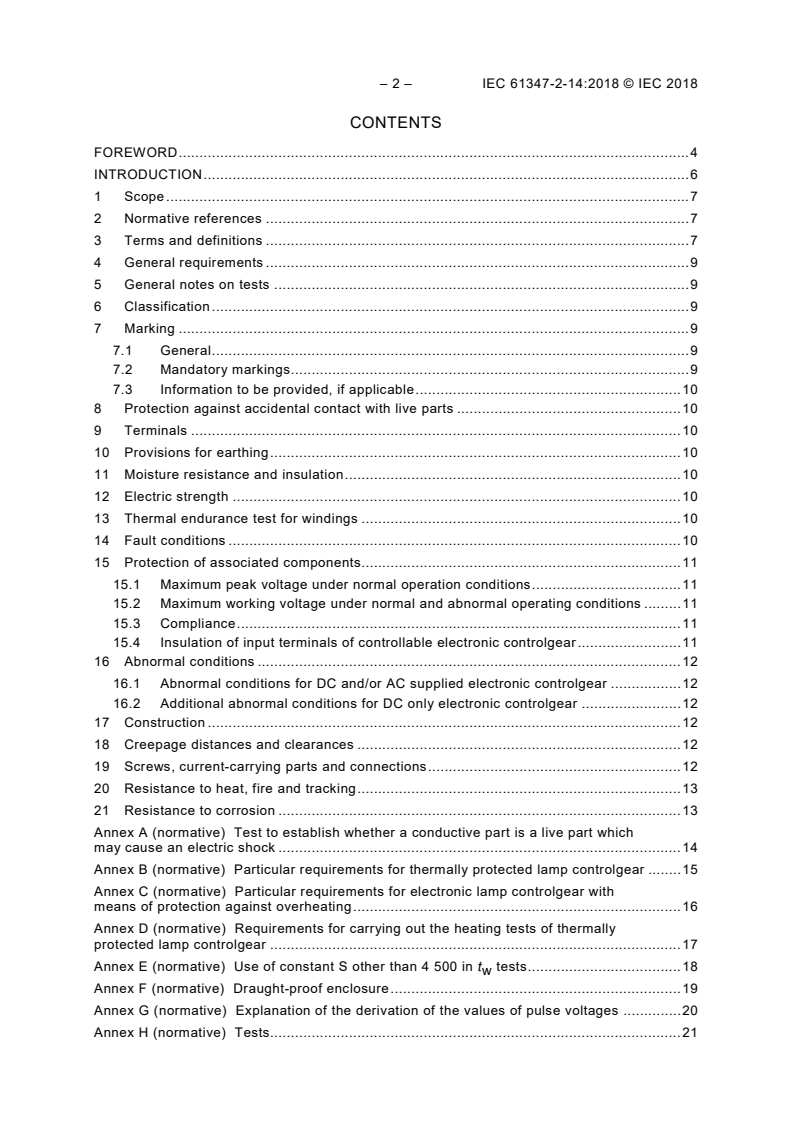
IEC 61347-2-14:2018 - Lamp controlgear - Part 2-14: Particular requirements for DC and/or AC supplied electronic controlgear for fluorescent induction lamps Released:2/27/2018
Overview
IEC 61347-2-14:2018 is an International Electrotechnical Commission standard that specifies particular safety requirements for electronic lamp controlgear intended for use with fluorescent induction lamps. It applies to controlgear powered from AC supplies up to 1 000 V at 50 Hz or 60 Hz and/or DC supplies where the controlgear’s operating frequencies may deviate from the supply frequency. The standard is specifically intended for high‑frequency operation and references lamp characteristics defined in IEC 62532 and IEC 62639.
Key Topics
- Scope of application - controlgear for fluorescent induction lamps operating at high frequencies and on AC (≤1 000 V, 50/60 Hz) and/or DC supplies.
- Particular safety requirements - requirements focused on ensuring safe function of electronic controlgear in the specified electrical environments.
- High-frequency operation considerations - provisions addressing behavior and safety when controlgear operates at frequencies different from the supply frequency.
- Interoperability with lamp standards - requirements aligned with lamp definitions and performance characteristics in IEC 62532 and IEC 62639.
- Verification and testing - provisions to demonstrate compliance through appropriate tests and assessments (electrical and functional checks relevant to high-frequency controlgear).
Note: IEC 61347-2-14 is a part-specific document and complements general requirements found in the broader lamp controlgear series.
Applications
Who uses IEC 61347-2-14:2018 and why:
- Lighting and ballast manufacturers - to design and certify electronic controlgear for fluorescent induction lamps that meet international safety expectations.
- Product development engineers - to ensure electronic controlgear operates safely at high frequencies on intended AC/DC supply configurations.
- Test laboratories and certification bodies - to evaluate conformity of controlgear with the particular safety requirements for induction-lamp applications.
- Procurement and compliance teams - to specify products that meet recognized safety and interoperability criteria in lighting projects.
- Consultants and specifiers - to recommend compliant controlgear solutions for commercial and industrial lighting using induction lamps.
Related Standards
- IEC 62532 - lamp characteristics and terminology for fluorescent induction lamps (referenced in the scope).
- IEC 62639 - additional lamp/fixture definitions related to induction lamps (referenced in the scope).
- IEC 61347-1 - general requirements for lamp controlgear (part 1 of the series); consult this for overarching safety and testing principles.
Keywords: IEC 61347-2-14:2018, lamp controlgear, electronic controlgear, fluorescent induction lamps, safety requirements, AC up to 1000 V, DC supplies, high-frequency operation, IEC 62532, IEC 62639.
Buy Documents
IEC 61347-2-14:2018 - Lamp controlgear - Part 2-14: Particular requirements for DC and/or AC supplied electronic controlgear for fluorescent induction lamps Released:2/27/2018
Get Certified
Connect with accredited certification bodies for this standard

IMQ S.p.A. (Certification)
Italian electrical product certification.

SLG Prüf- und Zertifizierungs GmbH
German testing and certification body.

UL Solutions
Global safety science company with testing, inspection and certification.
Sponsored listings
Frequently Asked Questions
IEC 61347-2-14:2018 is a standard published by the International Electrotechnical Commission (IEC). Its full title is "Lamp controlgear - Part 2-14: Particular requirements for DC and/or AC supplied electronic controlgear for fluorescent induction lamps". This standard covers: IEC 61347-2-14:2018 specifies particular safety requirements for electronic controlgear for use on AC supplies up to 1 000 V at 50 Hz or 60 Hz and/or DC supplies with operating frequencies deviating from the supply frequency, associated with fluorescent induction lamps as specified in IEC 62532 and IEC 62639, for high-frequency operation.
IEC 61347-2-14:2018 specifies particular safety requirements for electronic controlgear for use on AC supplies up to 1 000 V at 50 Hz or 60 Hz and/or DC supplies with operating frequencies deviating from the supply frequency, associated with fluorescent induction lamps as specified in IEC 62532 and IEC 62639, for high-frequency operation.
IEC 61347-2-14:2018 is classified under the following ICS (International Classification for Standards) categories: 17.220.20 - Measurement of electrical and magnetic quantities; 29.140.99 - Other standards related to lamps. The ICS classification helps identify the subject area and facilitates finding related standards.
IEC 61347-2-14:2018 is available in PDF format for immediate download after purchase. The document can be added to your cart and obtained through the secure checkout process. Digital delivery ensures instant access to the complete standard document.
Standards Content (Sample)
SLOVENSKI SIST IEC 61786:2005
STANDARD
junij 2005
Merjenje nizkofrekvenčnih elektromagnetnih polj z vidika izpostavljenosti ljudi
– Posebne zahteve za instrumente in napotki za merjenje
Measurement of low-frequency magnetic and electric fields with regard to exposure
of human beings – Special requirements for instruments and guidance for
measurements
ICS 17.220.20 Referenčna številka
© Standard je založil in izdal Slovenski inštitut za standardizacijo. Razmnoževanje ali kopiranje celote ali delov tega dokumenta ni dovoljeno
NORME
CEI
INTERNATIONALE
IEC
INTERNATIONAL
Première édition
STANDARD
First edition
1998-08
Mesure de champs magnétiques et électriques
à basse fréquence dans leur rapport à l’exposition
humaine – Prescriptions spéciales applicables
aux instruments et recommandations
pour les procédures de mesure
Measurement of low-frequency magnetic
and electric fields with regard to exposure
of human beings – Special requirements for
instruments and guidance for measurements
© IEC 1998 Droits de reproduction réservés ⎯ Copyright - all rights reserved
Aucune partie de cette publication ne peut être reproduite ni No part of this publication may be reproduced or utilized in
utilisée sous quelque forme que ce soit et par aucun any form or by any means, electronic or mechanical,
procédé, électronique ou mécanique, y compris la photo- including photocopying and microfilm, without permission in
copie et les microfilms, sans l'accord écrit de l'éditeur. writing from the publisher.
International Electrotechnical Commission 3, rue de Varembé Geneva, Switzerland
Telefax: +41 22 919 0300 e-mail: inmail@iec.ch IEC web site http: //www.iec.ch
CODE PRIX
Commission Electrotechnique Internationale
XC
PRICE CODE
International Electrotechnical Commission
Pour prix, voir catalogue en vigueur
For price, see current catalogue
61786 © IEC:1998 – 3 –
CONTENTS
Page
FOREWORD . 5
INTRODUCTION . 7
Clause
1 Scope. 9
2 Normative references. 9
3 Definitions. 11
4 Symbols. 21
5 Measurement of alternating magnetic fields . 23
5.1 Instrumentation specifications. 23
5.2 Calibration. 31
5.3 Measurement uncertainty. 39
5.4 Recording and reporting measurement results. 41
5.5 Measurement procedure. 43
6 Measurement of alternating electric fields . 45
6.1 Instrumentation specifications. 45
6.2 Calibration. 49
6.3 Measurement uncertainty. 55
6.4 Recording and reporting measurement results. 55
6.5 Measurement procedure. 57
Annexes
A (normative) Calibration methods. 61
B (normative) Sources of measurement uncertainty . 83
C (informative) General characteristics of quasi-static magnetic
and electric fields . 105
D (informative) Magnetic flux density meters (magnetic field meters) –
Guidance for measurements . 113
E (informative) Electric field strength meters (electric field meters) –
Guidance for measurements . 143
F (informative) Static magnetic field-measuring instrumentation . 165
G (informative) Units . 167
H (informative) Bibliography . 169
61786 © IEC:1998 – 5 –
INTERNATIONAL ELECTROTECHNICAL COMMISSION
____________
MEASUREMENT OF LOW-FREQUENCY MAGNETIC AND ELECTRIC FIELDS
WITH REGARD TO EXPOSURE OF HUMAN BEINGS –
SPECIAL REQUIREMENTS FOR INSTRUMENTS AND
GUIDANCE FOR MEASUREMENTS
FOREWORD
1) The IEC (International Electrotechnical Commission) is a worldwide organization for standardization comprising
all national electrotechnical committees (IEC National Committees). The object of the IEC is to promote
international co-operation on all questions concerning standardization in the electrical and electronic fields. To
this end and in addition to other activities, the IEC publishes International Standards. Their preparation is
entrusted to technical committees; any IEC National Committee interested in the subject dealt with may
participate in this preparatory work. International, governmental and non-governmental organizations liaising
with the IEC also participate in this preparation. The IEC collaborates closely with the International Organization
for Standardization (ISO) in accordance with conditions determined by agreement between the two
organizations.
2) The formal decisions or agreements of the IEC on technical matters express, as nearly as possible, an
international consensus of opinion on the relevant subjects since each technical committee has representation
from all interested National Committees.
3) The documents produced have the form of recommendations for international use and are published in the form
of standards, technical reports or guides and they are accepted by the National Committees in that sense.
4) In order to promote international unification, IEC National Committees undertake to apply IEC International
Standards transparently to the maximum extent possible in their national and regional standards. Any
divergence between the IEC Standard and the corresponding national or regional standard shall be clearly
indicated in the latter.
5) The IEC provides no marking procedure to indicate its approval and cannot be rendered responsible for any
equipment declared to be in conformity with one of its standards.
6) Attention is drawn to the possibility that some of the elements of this International Standard may be the subject
of patent rights. The IEC shall not be held responsible for identifying any or all such patent rights.
International Standard IEC 61786 has been prepared by IEC technical committee 85:
Measuring equipment for electromagnetic quantities.
The text of this standard is based on the following documents:
FDIS Report on voting
85/191/FDIS 85/193/RVD
Full information on the voting for the approval of this standard can be found in the report on
voting indicated in the above table.
Annexes A and B form an integral part of this standard.
Annexes C, D, E, F, G and H are for information only.
Words in bold in the text are defined in clause 3.
61786 © IEC:1998 – 7 –
INTRODUCTION
The increasing interest in characterizing human exposure to quasi-static magnetic and electric
fields in a number of environments has led to the development and marketing of many field
meters with a range of specifications. Sources of quasi-static fields include devices that
operate at power frequencies (50/60 Hz) and produce power frequency and power frequency
harmonic fields, as well as devices which produce fields that are independent of the power
frequency. Examples in the latter category include video display terminals (vertical scan
/
magnetic field), electric railroads (16 Hz and 25 Hz), mass transportation systems (0 Hz to
3 kHz depending on characteristics of adjustable speed drive), commercial airplanes (400 Hz),
induction heaters (50 Hz to 9 kHz), and electric automobiles. Because of differences in the
characteristics of the fields from sources in the various environments, e.g. frequency content,
temporal and spatial variations, polarization, and magnitude, the instrumentation requirements
and measurement procedures will be different in the various environments. Commercially
available instrumentation exists to measure human exposure to the field levels as well as to
other parameters that characterize the fields. The instrumentation and measurement methods,
as they may pertain to human exposure, are the focus of this document. It should be noted that
the parameters that describe quasi-static fields and the mechanisms for their interaction with
humans during magnetic and electric field exposure are still unknown.
The intended users of this International Standard include manufacturers of instrumentation and
groups or individuals interested in characterizing quasi-static magnetic and electric fields as
they relate to human exposure. It is assumed that users intending to perform measurements
have some knowledge of the instrumentation as well as field sources and their characteristics.
In the absence of such knowledge, it is strongly advised that some training be received. This
standard may serve as a textbook for the training process because of the technical information
provided in the annexes.
61786 © IEC:1998 – 9 –
MEASUREMENT OF LOW-FREQUENCY MAGNETIC AND ELECTRIC FIELDS
WITH REGARD TO EXPOSURE OF HUMAN BEINGS –
SPECIAL REQUIREMENTS FOR INSTRUMENTS AND
GUIDANCE FOR MEASUREMENTS
1 Scope
This International Standard provides guidance for measuring the steady-state root-mean-
square (r.m.s.) values of quasi-static magnetic and electric fields which have a frequency
content in the range 15 Hz to 9 kHz. Sources of quasi-static fields include devices that
operate at power frequencies and produce power frequency and power frequency harmonic
fields, as well as devices that produce fields independent of the power frequency. The
magnitude ranges covered by this standard are 100 nT to 100 mT and 1 V/m to 50 kV/m for
magnetic fields and electric fields, respectively. When measurements outside this range are
performed, most of the provisions of this standard will still apply, but certain provisions such as
specified uncertainty and calibration procedure may need modification. Specifically, this
standard
– defines terminology;
– identifies requisite field meter specifications;
– indicates methods of calibration;
– defines requirements on instrumentation uncertainty;
– describes general characteristics of fields;
– surveys operational principles of instrumentation;
– describes measurement methods that achieve defined goals pertaining to human exposure.
Sources of uncertainty during calibration and measurements are also identified and guidance is
provided on how they should be combined to determine total measurement uncertainty. In
regard to electric field measurements, this standard considers only the measurement of the
unperturbed electric field strength at a point in space (i.e. the electric field prior to the
introduction of the field meter and operator) or on conducting surfaces.
NOTE – Some separation between the normative measurement requirements in clauses 5 and 6 and the example
measurement protocols and guidance for measurements in annexes D and E is unavoidable because of format
requirements.
2 Normative references
The following normative documents contain provisions which, through reference in this text,
constitute provisions of this International Standard. At the time of publication, the editions
indicated were valid. All normative documents are subject to revision, and parties to
agreements based on this International Standard are encouraged to investigate the possibility
of applying the most recent editions of the normative documents indicated below. Members of
IEC and ISO maintain registers of currently valid International Standards.
IEC 61000-3-2:1995, Electromagnetic compatibility (EMC) – Part 3: Limits – Section 2: Limits
for harmonic current emissions (equipment input current ≤16 A per phase)
61786 © IEC:1998 – 11 –
IEC 61000-4-2:1995, Electromagnetic compatibility (EMC) – Part 4: Testing and measurement
techniques – Section 2: Electrostatic discharge immunity test – Basic EMC Publication
IEC 61000-4-3:1995, Electromagnetic compatibility (EMC) – Part 4: Testing and measurement
techniques – Section 3: Radiated, radio-frequency, electromagnetic field immunity test
IEC 61000-4-4:1995, Electromagnetic compatibility (EMC) – Part 4: Testing and measurement
techniques – Section 4: Electrical fast transient/burst immunity test – Basic EMC publication
IEC 61000-4-6:1996, Electromagnetic compatibility (EMC) – Part 4: Testing and measurement
techniques – Section 6: Immunity to conducted disturbances, induced by radio-frequency fields
IEC 61000-4-8:1993, Electromagnetic compatibility (EMC) – Part 4: Testing and measurement
techniques – Section 8: Power frequency magnetic field immunity test – Basic EMC Publication
CISPR 11:1990, Limits and methods of measurement of electromagnetic disturbance
characteristics of industrial, scientific and medical (ISM) radio-frequency equipment
ISBN 92-67-01075-1:1993, International vocabulary of basic and general terms in metrology,
International Organization for Standardization.
ISBN 92-67-10188-9:1995, ISO TAG, ISO Technical Advisory Group on Metrology, Working
Group 3, Guide to the expression of uncertainty in measurement.
IEEE Std 539:1990, IEEE Standard Definitions of Terms Relating to Corona and Field Effects of
Overhead Power Lines.
3 Definitions
For the purposes of this International Standard, the following definitions apply.
NOTE – Throughout this standard, the words "magnetic flux density" and "magnetic field" will be considered
synonymous.
3.1 Tests
3.1.1
acceptance tests
contractual test to prove to the customer that the device meets certain conditions of its
specifications
3.1.2
type test
test of one or more devices made to a certain design to show that the design meets certain
specifications
NOTE – This test is normally performed by the designer/manufacturer of the device.
61786 © IEC:1998 – 13 –
3.2 Meters
3.2.1
alternating electric field strength meter
meter designed to measure alternating electric fields. Three types of electric field strength
meters are available: free-body meter, ground reference meter, electro-optic meter.
NOTE – Electric field meters consist of two parts: the probe or field-sensing element, and the detector which
processes the signal from the probe and indicates the r.m.s. value of the electric field with an analogue or digital
display.
3.2.2
electro-optic meter
meter that measures the electric field strength by changes in the transmission of light through a
fibre or crystal which are due to the influence of the electric field
NOTE – While there are several electro-optic methods that can be used for measuring electric fields, e.g. the
Pockels effect, the Kerr effect, and interferometric techniques, this standard only considers electro-optic field
meters that utilize the Pockels effect.
3.2.3
free-body meter
meter that measures the electric field strength at a point above the ground and is supported in
space without conductive contact to earth
NOTE – are commonly constructed to measure the induced current between two isolated parts
Free-body meters
of a conductive body. Since the induced current is proportional to the time derivative of the electric field strength,
the meter's detector circuit often contains an integrating stage in order to recover the waveform of the electric field.
The integrated current waveform also coincides with that of the induced charge. The integrating stage is also
desirable, particularly for the measurement of electric fields with harmonic content, because this stage (i.e. its
integrating property) eliminates the excessive weighting of the harmonic components in the induced current signal.
3.2.4
fluxgate magnetometer
instrument designed to measure magnetic fields by making use of the non-linear magnetic
characteristics of a probe or sensing element that has a ferromagnetic core
3.2.5
ground reference meter
meter that measures the electric field at or close to the surface of the ground, frequently
implemented by measuring the induced current or charge oscillating between an isolated
electrode and ground. The isolated electrode is usually a plate located level with or slightly
above the ground surface.
NOTE – Ground reference meters measuring the induced current often contain an integrator circuit to compensate
for the derivative relationship between the induced current and the electric field.
3.2.6
magnetic flux density meter
meter designed to measure the magnetic flux density
NOTE 1 – Magnetic field meters consist of two parts: the probe or field-sensing element, and the detector which
processes the signal from the probe and indicates the r.m.s. value of the magnetic field with an analogue or digital
display.
NOTE 2 – Several types of meters are in common use, e.g. field meters with coil probes, meters with Hall-effect
probes, and meters that combine two coils with a ferromagnetic core as in a fluxgate magnetometer.
3.2.7
survey meter
lightweight battery-operated meter that gives a real time read-out and that can be held
conveniently by hand in order to conduct survey type measurements in different locations
61786 © IEC:1998 – 15 –
3.2.8
coil probe
magnetic flux density sensor comprised of a coil of wire that produces an induced voltage
proportional to the time derivative of the magnetic field
NOTE 1 – Since the induced voltage is proportional to the time derivative of the magnetic flux density, the detector
circuit of the sensor requires an integrating stage to recover the waveform of the magnetic flux density.
NOTE 2 – This probe can also be used to measure static (d.c.) magnetic flux density if the probe is rotated.
3.2.9
Hall effect probe
magnetic flux density sensor containing an element exhibiting the Hall effect to produce a
voltage proportional to the magnetic flux density
NOTE – Hall effect probes respond to static as well as time-varying magnetic flux densities. Due to limited
sensitivity and saturation problems sometimes encountered when attempting to measure small power frequency flux
densities in the presence of the substantial static geomagnetic flux of the earth, Hall-effect probes have seldom
been used to measure magnetic fields of a.c. power lines.
3.3 Meter characteristics
3.3.1
crest factor
for periodic functions, the ratio of the waveform crest (peak, maximum) value to its r.m.s. value
3.3.2
crosstalk
noise or extraneous signal caused by a.c. or pulse-type signals in adjacent circuits
3.3.3
frequency response
response (reading) of a field meter to a field of constant amplitude but different frequencies
3.3.4
pass-band
(1) (data transmission) a range of frequency spectra which can pass at low attenuation
(2) (circuits and systems) a band of frequencies that pass through a filter with little attenuation
(relative to other frequency bands such as a stop-band)
3.3.5
rectified average (calibrated in r.m.s.) detector (see 3.3.6)
detector circuit that rectifies the signal from the probe and is calibrated to give the correct
r.m.s. value of a sinusoidal field at a given frequency
NOTE – If there are harmonics in the field, a field meter with a rectified average (r.m.s.) detector will not indicate
the true r.m.s. value of the field if the signal from the probe is proportional to the time derivative of the field. If the
detector contains a stage of integration, the error is reduced. The error will also be a function of the phase relation
between the harmonic and fundamental field components [36], [61].
3.3.6
true r.m.s. detector (see rectified average (calibrated in r.m.s.) detector)
detector that contains a circuit component that performs the mathematical operation
61786 © IEC:1998 – 17 –
T
[(vt) dt (1)
]
∫
T
to a periodic signal v(t), where T is the period of the signal.
NOTE 1 – If v(t) is proportional to the time-derivative of the field, the detector circuit also requires a stage of
integration prior to the r.m.s. operation in order to recover the waveform of the magnetic flux density [25], [61]. This
type of detector gives the true r.m.s. value of a field containing harmonics provided that the frequency response of
the detector is flat over the frequency range of interest.
NOTE 2 – If significant levels of harmonics are present in v(t), particular attention should be given to the possibility
of amplifier saturation effects if the integration follows one or more stages of amplification.
3.4 Field characteristics
3.4.1
maximum r.m.s. value of electric field (maximum electric field)
measurement of elliptically polarized quasi-static electric and magnetic fields. At a given point,
the root-mean-square (r.m.s.) value of the semi-major axis of the electric field ellipse
3.4.2
maximum r.m.s. value of magnetic field (maximum magnetic field)
measurement of power frequency electric and magnetic fields. At a given point, the root-mean-
square (r.m.s.) value of the semi-major axis of the magnetic field ellipse
3.4.3
perturbed field
field that is changed in magnitude or direction, or both, by the introduction of an object
NOTE – The electric field at the surface of the object is, in general, strongly perturbed by the presence of the
object. At power frequencies, the magnetic flux density is not, in general, greatly perturbed by the presence of
objects that are free of magnetic materials. Exceptions to this include regions near the surface of thick electrical
conductors and regions far from thick conductors, if the conductor is close to the magnetic field source. The
perturbation in these instances is due to opposing magnetic fields produced by eddy currents in the conductors.
3.4.4
unperturbed field
field at a point that would exist in the absence of persons or movable objects
3.4.5
quasi-static field
field that satisfies the condition f << c÷l, where f is the frequency of the field, c is the speed of
light, and l is a characteristic dimension of the measurement geometry, e.g. the distance
between the field source and the measurement point
NOTE – Power frequency magnetic and electric fields near power lines and appliances are examples of quasi-
static fields.
3.4.6
resultant electric field
electric field given by the expression
22 2
= + + (2)
EE E E
R xy z
where E , E , and E are the r.m.s. values of the three orthogonal field components
x y z
61786 © IEC:1998 – 19 –
The resultant electric field is also given by the expression
2 2
E=+ (3)
EE
max
min
R
where E and E are the r.m.s. values of the semi-major and semi-minor axes of the
max min
electric field ellipse, respectively. The resultant E is always ≥E . If the electric field is
R max
linearly polarized, E = 0 and E = E . If the electric field is circularly polarized, E = E
min R max max min
and E ≈ 1,41 E .
R max
NOTE – The definition of "effective field strength" in CENELEC prestandard ENV 50166-1 [5] is equivalent to the
resultant magnetic field or resultant electric field, as the case may be.
3.4.7
resultant magnetic field
magnetic field given by the expression
22 2
B= + + (4)
B B B
R xy z
where B , B , and B are the r.m.s. values of the three orthogonal field components
x y z
The resultant magnetic field is also given by the expression
2 2
B= + (5)
B B
R max
min
where B and B are the r.m.s. values of the semi-major and semi-minor axes of
max min
the magnetic field ellipse, respectively. The resultant B is always ≥B . If the magnetic field
R max
is linearly polarized, B = 0 and B = B . If the magnetic field is circularly polarized,
min R max
B = B and B ≈ 1,41 B .
max min R max
NOTE – The definition of "effective field strength" in CENELEC prestandard ENV 50166-1 [5] is equivalent to the
resultant magnetic field or resultant electric field, as the case may be.
3.5 Measurements
3.5.1
correction factor
numerical factor by which the uncorrected result of a measurement is multiplied to compensate
for a known error
NOTE – Since the known error cannot be determined perfectly, the compensation cannot be complete.
3.5.2
coverage factor
numerical factor used as a multiplier of the combined standard uncertainty in order to obtain
an expanded uncertainty
NOTE – For a quantity z described by a normal distribution with expectation µ and standard deviation σ, the
z
interval µ ± kσ encompasses 68,27, 95,45, and 99,73 percent of the distribution for a coverage factor k = 1, 2,
z
and 3, respectively.
3.5.3
scale factor
factor by which the instrument reading is multiplied to obtain its input quantity
61786 © IEC:1998 – 21 –
3.5.4
spot measurement (point-in-time measurement)
measurement that is performed at some instant and point in space, that does not provide
information regarding temporal or spatial variations of the field
3.5.5
standard uncertainty
uncertainty of the result of a measurement expressed as a standard deviation
3.5.6
uncertainty of measurement
parameter, associated with the result of a measurement, that characterizes the dispersion of
the values that could reasonably be attributed to the measurand
NOTE – Uncertainty of measurement generally comprises many components. Some of these components may be
estimated on the basis of the statistical distribution of the results of series of measurements, and can be
characterized by experimental standard deviations. Estimates of other components can be based on experience or
other information.
4 Symbols
a = radius of coil probe; radius of spherical electric field probe
2a, 2b = side dimensions of rectangular coil
B = magnetic flux density vector
B = magnetic flux density (fundamental frequency)
f
B = magnetic flux density at jth frequency (j = 1 for fundamental frequency)
j
B = CENELEC magnetic flux density reference level at jth frequency
RLj
B = amplitude of alternating magnetic field
B = resultant magnetic field
R
B = axial magnetic flux density
z
B = r.m.s. values of orthogonal components of magnetic flux density
x,y,z
B , B = r.m.s. values of semi-major and semi-minor axes of magnetic field ellipse
max min
C = stray capacitance of coil probe
c = electro-optic coefficient of Pockels crystal
e
d = spacing of parallel plates; distance from electromagnetic field source
D = electric displacement vector
E = electric field strength
E = electric field at ith frequency (i = 1 for fundamental frequency)
i
E = CENELEC electric field reference level at ith frequency
i
RL
E = resultant electric field
R
E = uniform electric field strength
E′ = electric field in Pockels crystal
E = r.m.s. values of orthogonal components of electric field
x,y,z
E , E = r.m.s. values of semi-major and semi-minor axes of electric field ellipse
max min
61786 © IEC:1998 – 23 –
I = current to magnetic field coils
I = incident light (electro-optic field meter)
i
I = transmitted light (electro-optic field meter)
t
l = Pockels crystal thickness
L = inductance of coil probe
n = index of refraction
N = number of turns of wire (magnetic field coil system)
Q = induced charge
r = distance between magnetic field source and measurement location; resistance
of coil probe and leads
R = approximate input impedance of detector circuit (magnetic field meter)
S = electrode surface area (electric field meter)
t= time
T = period of periodic signal
V = voltage
v(t) = periodic electrical signal
v = coil probe voltage
p
W = ratio of coil probe voltage to induced voltage
Z = impedance in current injection circuit
α = fraction of ith harmonic in magnetic field
i
∆B = largest difference in percentage between magnetic field at centre of single-axis
max1
probe and average field (across area of probe) at maximum reading in dipole
magnetic field
∆B = largest difference in percentage between average resultant magnetic field and
max3
magnetic field at centre of three-axis probe in dipole magnetic field
ε = permittivity of free space
λ = wavelength of light
µ = permeability of free space
φ = magnetic flux
ω = angular frequency of alternating field
5 Measurement of alternating magnetic fields
5.1 Instrumentation specifications
The various types of instrumentation available for characterizing quasi-static magnetic fields
are described in D.1. Sufficient information shall be provided with the instrumentation, including
instrument specifications and a clearly written instruction manual, to enable users to determine
compliance with this standard, to aid them in the proper operation of the field meter, and to
assess the usefulness of the device for the user's application. Complicated operating
61786 © IEC:1998 – 25 –
procedures should be avoided. The instrument specifications that should be provided and/or
satisfied are given below.
NOTE – Instruments not complying with the specifications below may be used if it can be demonstrated that, under
the conditions the instrument is used, the results obtained will not differ significantly from those obtained with a
meter which is in compliance with this standard. For example, a meter with a rectified average detector with or
without an integrating stage may be used if it can be shown that the harmonics in the field are negligible, and if the
instrument has been calibrated for the fundamental frequency in the field.
5.1.1 Instrumental uncertainty
The measuring system for alternating magnetic fields should indicate the r.m.s. value of
uniform magnetic fields with an uncertainty of less than ±(10 % of reading +20 nT) after
correction factors have been applied, if appropriate.
NOTE 1 – The uncertainty of the instrument is determined from several components such as the calibration
uncertainty, temperature drift of the electronics, stability and external noise sources. The above uncertainty is
associated with the design and functioning of the magnetic flux density meter in a nearly uniform field. The 10 %
element refers to the uncertainty during calibration over the frequency range (pass-band) specified for the
instrument and includes uncertainties in the value of the magnetic flux density and additional uncertainties during
the calibration process (see 5.2.2). The coverage factor is 2. The inclusion of 20 nT anticipates instrumental
uncertainties during the calibration of the most sensitive scales and when fields in the order of 0,1 µT are
measured.
NOTE 2 – Other sources of measurement uncertainty and guidelines on the treatment of uncertainties are given in
clause B.1 and 5.3, respectively.
5.1.2 Magnitude range
The magnitude range over which the instrument operates within the specified uncertainty shall
be clearly indicated.
5.1.3 Pass-band
The instrument shall be provided with calibration data or specifications that enable the user to
assess the uncertainty in determining field levels when using the instrument in fields containing
different frequencies. This information should also include the sensitivity of the instrument to
frequencies beyond the intended useful range, e.g. the –3 dB points. The frequency response
of the instrument shall be such that the requirement of the instrumental uncertainty (see 5.1.1)
is fulfilled over the frequency range for which it is intended.
NOTE – The permitted instrumental uncertainty associated with the frequency response is increased to ±20 %
(coverage factor 2) for small personal exposure meters, devices that can be worn, and which periodically record
the power frequency and power frequency harmonic resultant magnetic field (see clause D.1).
5.1.4 Operating temperature and humidity ranges
The temperature and relative humidity ranges over which the instrument operates within the
specified uncertainty should be no less than 0 °C to 45 °C and 5 % to 95 %, respectively.
Sudden temperature changes that can lead to condensation in the instrument should be
avoided (see clause B.1).
5.1.5 Power supplies
If batteries are used, provision should be made to indicate whether the battery condition is
adequate for proper operation of the field meter. Instruments used to record personal exposure
should be capable of at least 8 h operation within their rated uncertainty before replacement or
recharging of the batteries becomes necessary. If rechargeable batteries are used, it is
recommended that the instrumentation is not operated while connected to the mains voltage.
61786 © IEC:1998 – 27 –
When such connections are necessary, it should be demonstrated that stray fields from the
battery charger, conducted disturbances from the mains voltage, and electromagnetic coupling
via the connecting leads (to the battery charger) do not affect the measurement (see 5.1.8).
NOTE – If batteries with ferromagnetic jackets are used in exposure meters, care must be exercised that the
jackets do not significantly influence readings by the instrument (see clause B.1).
5.1.6 Readability of scale
The meter dial markings or digital displays of magnetic field survey meters should be large
enough to be easily read at arm's length. If more than one range of sensitivity is provided, the
full scale value of the selected range should be indicated, and the units should be readily
interpretable. For auto-ranging instrumentation, the magnitude range may be indicated
elsewhere, e.g. in the user manual. The instrumentation should provide a clear indication of the
units being displayed.
NOTE – To comply with this standard, instrumentation marketed prior to the issue of this standard, which does not
indicate the units, should be provided with an appropriate label indicating the units. This may be accomplished by
the user applying a label to the body of the field meter. Alternatively, a label provided by the manufacturer to the
user may be applied by the user.
5.1.7 Instrument dimensions
The dimensions of the enclosure containing the detector circuit and any connecting cables
should be provided. The size of the probes or sensing elements should be appropriate to the
spatial variation of the field measured (see clause B.1). The sensing elements should be of
area 0,01 m , or smaller. With three-axis instruments, the three sensing elements may be
concentric (i.e. coil probes that have a common central point) or, if the sensing elements are
no larger than 0,05 m, they should be as close together as possible (see clause B.1). The
maximum dimension of the volume containing the three coil probes combined should not
exceed 0,2 m. Coil probes should be either circular or square in cross-section; small
deviations from these shapes, for example where concentric coils cross each other, are
permitted.
The locations and orientations of probes that are contained within the housings of magnetic
field meters should be clearly indicated on the instrument or in the instruction manual.
5.1.8 Electromagnetic compatibility
5.1.8.1 Immunity
a) Power frequency electric field
Instrumentation intended for use in the vicinity of high-voltage equipment operating at
power frequencies should not be affected significantly by ambient electric fields as large as
20 kV/m, i.e. the influence of the electric field on the magnetic field reading should be less
than 20 nT. This immunity requirement may need to be increased for some extreme
environments where electric fields as large as 100 kV/m may exist, e.g. near high-voltage
transmission line conductors.
NOTE 1 – Tests for immunity to power frequency electric fields may be performed using the parallel plates
systems described in clause A.2.
NOTE 2 – The proximity effect of the instrument user (see clause B.2) can shield or enhance the electric field,
depending on the geometry of the field and the location of the magnetic field meter relative to the user.
61786 © IEC:1998 – 29 –
b) Radiated electromagnetic fields
The operation of instrumentation shall not be affected by electromagnetic radiation between
80 MHz and 1 GHz for an electric field level of 3 V/m r.m.s. Testing of instrumentation
should be in accord with the methods described in IEC 61000-4-3.
The operation of instrumentation shall not be affected by electromagnetic radiation between
150 kHz and 80 MHz. Tests should be conducted according to the methods described in
IEC 61000-4-6 at a voltage level of 3 V r.m.s. The instrumentation should continue to
operate normally during both of the above tests.
NOTE 1 – Battery-powered equipment (dimension <λ/4) which has no connection(s) to the ground nor to any
other (non-insulated) equipment, and which will not be used during battery charging, does not need to be tested
according to IEC 61000-4-6.
NOTE 2 – It is important to perform the radiated immunity tests over the entire frequency range from 26 MHz to
1 GHz. The lower frequency boundary is important because of the high probability that the instruments will
experience radiation in the 27 MHz citizen's band.
NOTE 3 – The immunity requirements may need to be increased under certain conditions, e.g. during
measurements near radio-broadcasting antennas and mobile telephones (see clause B.1, table B.2).
c) Immunity to transients
Specifications for instrumentation connected to the mains in order to carry out
measurements should also be tested at the a.c. power port (interface of field meter with
external power source or mains) for compliance with IEC 61000-4-4 (electrical fast
transient) for a peak voltage of 2 kV. A temporary degradation of performance during the
test which is self-recoverable is acceptable.
d) Electrostatic discharge (ESD)
During most measurement applications, electrostatic discharges to or from the
instrumentation are not anticipated. However, the enclosure port of the instrumentation
shall be immune to a contact or discharge voltage of at least 2 kV and tested in accordance
with the methods described in IEC 61000-4-2. No degradation of performance shall occur.
5.1.8.2 Emissions
a) Harmonic emissions
The harmonic emissions of instrumentation with a power rating of 50 W or greater shall be
restricted according to the requirements of IEC 61000-3-2.
b) Conducted disturbances – 0,15 MHz to 30 MHz (instrumentation connected to mains)
The limits for mains terminal disturbance voltages may be characterized using quasi-peak
or average detectors and are given below as a function of frequency (see CISPR 11,
class B).
Table 1 – Mains terminal disturbance voltage limits
Frequency band Quasi-peak Average
MHz
dB(µV) dB(µV)
0,15 – 0,50 66 56
Decreasing with logarithm of Decreasing with logarithm of
frequency to 56 frequency to 46
0,50 – 5 56 46
5 – 30 60 50
61786 © IEC:1998 – 31 –
Testing of instrumentation should be in accordance with the methods described in
CISPR 11.
c) Radiated disturbances – 30 MHz to 1 000 MHz
The electromagnetic emissions from instrumentation containing devices operating at
frequencies of 9 kHz or higher shall be limited to the values listed below (see CISPR 11,
class B).
30 dB (µV/m) at 10 m 30 MHz to 230 MHz
37 dB (µV/m) at 10 m 230 MHz to 1 000 MHz
Testing of instrumentation should be in accordance with the methods described in
CISPR 11.
NOTE – The above test requirements have been taken from CISPR 11 and are subject to revision. Tests should
be conducted according to the most recent edition of that standard.
5.1.9 Crest factor
The measuring system should measure correctly the true r.m.s. value of the field, even when
the crest factor of the magnetic field is 3 (see clause B.1).
NOTE – Many practical fields exhibit a large crest factor and the presence of a large crest factor may lead to
unwanted saturation in the amplifier stages of the detector.
5.1.10 Durability
The indicating meter and other system components should be rugged enough to withstand
vibration and shock resulting from transport. A carrying case is desirable.
5.1.11 Weight
The weight of the instrumentation should be provided. The weight of portable instrumentation
should be kept as low as is practical to permit hand-held operation under restrictive conditions,
e.g. in some industrial environments.
5.2 Calibration
5.2.1 General
Measurement systems are required to undergo calibration and verification of their calibration
throughout their service life. The calibration tests referred to in this standard are type tests
and acceptance tests. Type tests are normally performed by the manufacturer on one or
more devices. Acceptance tests are normally performed only once by the manufacturer on
each field meter. Acceptance tests need to be repeated if major changes or repairs of the
instrument have been made. Verification tests are performed at time intervals during use of the
instrument (see 5.2.4). All calibrations should be traceable to national and international
standards through an unbroken chain of calibrations, all having stated uncertainties.
The following three methods of calibration are covered by this standard:
a) calibration by introduction of the field meter probe into a calculated magnetic field (following
measurements of coil dimensions and current to the coil system);
b) calibration using a voltage injection technique, and
c) calibration by comparison with a reference measurement system (see clause A.1).
61786 © IEC:1998 – 33 –
5.2.2 Calibration procedure
Calibrations are required as part of type tests, acceptance tests (see 5.2.1), and periodic
verification tests (see 5.2.4). The procedures of this section should be followed, as appropriate,
in all cases. For calibration of the higher magnitude ranges (i.e. ranges not significantly
influenced by background magnetic fields), the magnetic field probe should be placed in a
nearly uniform field produced by a coil system (see clause A.1). The probe axis should coincide
with the axis of the coil system and the largest departure of the field from the central value
should be less than 1 % over the cross-sectional area of the probe.
NOTE 1 – Information on fields generated by rectangular, square, and circular loop systems (including Helmholtz
coils) is given in [17], [35], [56], [69] and A.1. For example, the magnetic flux density produced by a single square
loop (of many turns of wire) 1 m × 1 m will satisfy the uniformity requirement for a probe with a 0,10 m diameter
(see clause A.1). The loop size may be scaled upwards or downwards for larger or smaller probes, respectively, to
maintain the indicated level of uniformity across the probe. The calibration may also be performed using the voltage
injection technique or by comparison with a reference magnetic field meter (see clause A.1).
NOTE 2 – The field uniformity requirement during calibration may be relaxed for large probes that are used for
determining average values of non-uniform fields and, or for applications where spatial resolution requirements are
not considered important. In this case, the largest departure of the calibration field from the central value should be
≤1,5 % over the cross-sectional area of the probe. For example, the field produced by a square loop 1,3 m × 1,3 m
will satisfy this uniformity requirement for a probe with a 0,20 m diameter.
Calibrations of single-axis field meters and each axis of three-axis field meters should be
performed with
...
IEC 61347-2-14 ®
Edition 1.0 2018-02
INTERNATIONAL
STANDARD
NORME
INTERNATIONALE
Lamp controlgear –
Part 2-14: Particular requirements for DC and/or AC supplied electronic
controlgear for fluorescent induction lamps
Appareillages de lampes –
Partie 2-14: Exigences particulières pour les appareillages électroniques
alimentés en courant continu et/ou alternatif pour les lampes fluorescentes à
induction
All rights reserved. Unless otherwise specified, no part of this publication may be reproduced or utilized in any form
or by any means, electronic or mechanical, including photocopying and microfilm, without permission in writing from
either IEC or IEC's member National Committee in the country of the requester. If you have any questions about IEC
copyright or have an enquiry about obtaining additional rights to this publication, please contact the address below or
your local IEC member National Committee for further information.
Droits de reproduction réservés. Sauf indication contraire, aucune partie de cette publication ne peut être reproduite
ni utilisée sous quelque forme que ce soit et par aucun procédé, électronique ou mécanique, y compris la photocopie
et les microfilms, sans l'accord écrit de l'IEC ou du Comité national de l'IEC du pays du demandeur. Si vous avez des
questions sur le copyright de l'IEC ou si vous désirez obtenir des droits supplémentaires sur cette publication, utilisez
les coordonnées ci-après ou contactez le Comité national de l'IEC de votre pays de résidence.
IEC Central Office Tel.: +41 22 919 02 11
3, rue de Varembé info@iec.ch
CH-1211 Geneva 20 www.iec.ch
Switzerland
About the IEC
The International Electrotechnical Commission (IEC) is the leading global organization that prepares and publishes
International Standards for all electrical, electronic and related technologies.
About IEC publications
The technical content of IEC publications is kept under constant review by the IEC. Please make sure that you have the
latest edition, a corrigenda or an amendment might have been published.
IEC Catalogue - webstore.iec.ch/catalogue Electropedia - www.electropedia.org
The stand-alone application for consulting the entire The world's leading online dictionary of electronic and
bibliographical information on IEC International Standards, electrical terms containing 21 000 terms and definitions in
Technical Specifications, Technical Reports and other English and French, with equivalent terms in 16 additional
documents. Available for PC, Mac OS, Android Tablets and languages. Also known as the International Electrotechnical
iPad. Vocabulary (IEV) online.
IEC publications search - webstore.iec.ch/advsearchform IEC Glossary - std.iec.ch/glossary
The advanced search enables to find IEC publications by a 67 000 electrotechnical terminology entries in English and
variety of criteria (reference number, text, technical French extracted from the Terms and Definitions clause of
committee,…). It also gives information on projects, replaced IEC publications issued since 2002. Some entries have been
and withdrawn publications. collected from earlier publications of IEC TC 37, 77, 86 and
CISPR.
IEC Just Published - webstore.iec.ch/justpublished
Stay up to date on all new IEC publications. Just Published IEC Customer Service Centre - webstore.iec.ch/csc
details all new publications released. Available online and If you wish to give us your feedback on this publication or
also once a month by email. need further assistance, please contact the Customer Service
Centre: sales@iec.ch.
A propos de l'IEC
La Commission Electrotechnique Internationale (IEC) est la première organisation mondiale qui élabore et publie des
Normes internationales pour tout ce qui a trait à l'électricité, à l'électronique et aux technologies apparentées.
A propos des publications IEC
Le contenu technique des publications IEC est constamment revu. Veuillez vous assurer que vous possédez l’édition la
plus récente, un corrigendum ou amendement peut avoir été publié.
Catalogue IEC - webstore.iec.ch/catalogue Electropedia - www.electropedia.org
Application autonome pour consulter tous les renseignements
Le premier dictionnaire en ligne de termes électroniques et
bibliographiques sur les Normes internationales,
électriques. Il contient 21 000 termes et définitions en anglais
Spécifications techniques, Rapports techniques et autres
et en français, ainsi que les termes équivalents dans 16
documents de l'IEC. Disponible pour PC, Mac OS, tablettes
langues additionnelles. Egalement appelé Vocabulaire
Android et iPad.
Electrotechnique International (IEV) en ligne.
Recherche de publications IEC -
Glossaire IEC - std.iec.ch/glossary
webstore.iec.ch/advsearchform
67 000 entrées terminologiques électrotechniques, en anglais
La recherche avancée permet de trouver des publications IEC et en français, extraites des articles Termes et Définitions des
en utilisant différents critères (numéro de référence, texte, publications IEC parues depuis 2002. Plus certaines entrées
comité d’études,…). Elle donne aussi des informations sur les antérieures extraites des publications des CE 37, 77, 86 et
projets et les publications remplacées ou retirées. CISPR de l'IEC.
IEC Just Published - webstore.iec.ch/justpublished Service Clients - webstore.iec.ch/csc
Restez informé sur les nouvelles publications IEC. Just Si vous désirez nous donner des commentaires sur cette
Published détaille les nouvelles publications parues. publication ou si vous avez des questions contactez-nous:
Disponible en ligne et aussi une fois par mois par email. sales@iec.ch.
IEC 61347-2-14 ®
Edition 1.0 2018-02
INTERNATIONAL
STANDARD
NORME
INTERNATIONALE
Lamp controlgear –
Part 2-14: Particular requirements for DC and/or AC supplied electronic
controlgear for fluorescent induction lamps
Appareillages de lampes –
Partie 2-14: Exigences particulières pour les appareillages électroniques
alimentés en courant continu et/ou alternatif pour les lampes fluorescentes à
induction
INTERNATIONAL
ELECTROTECHNICAL
COMMISSION
COMMISSION
ELECTROTECHNIQUE
INTERNATIONALE
ICS 29.140.99 ISBN 978-2-8322-5448-6
– 2 – IEC 61347-2-14:2018 © IEC 2018
CONTENTS
FOREWORD . 4
INTRODUCTION . 6
1 Scope . 7
2 Normative references . 7
3 Terms and definitions . 7
4 General requirements . 9
5 General notes on tests . 9
6 Classification . 9
7 Marking . 9
7.1 General . 9
7.2 Mandatory markings . 9
7.3 Information to be provided, if applicable . 10
8 Protection against accidental contact with live parts . 10
9 Terminals . 10
10 Provisions for earthing . 10
11 Moisture resistance and insulation . 10
12 Electric strength . 10
13 Thermal endurance test for windings . 10
14 Fault conditions . 10
15 Protection of associated components. 11
15.1 Maximum peak voltage under normal operation conditions . 11
15.2 Maximum working voltage under normal and abnormal operating conditions . 11
15.3 Compliance . 11
15.4 Insulation of input terminals of controllable electronic controlgear . 11
16 Abnormal conditions . 12
16.1 Abnormal conditions for DC and/or AC supplied electronic controlgear . 12
16.2 Additional abnormal conditions for DC only electronic controlgear . 12
17 Construction . 12
18 Creepage distances and clearances . 12
19 Screws, current-carrying parts and connections . 12
20 Resistance to heat, fire and tracking . 13
21 Resistance to corrosion . 13
Annex A (normative) Test to establish whether a conductive part is a live part which
may cause an electric shock . 14
Annex B (normative) Particular requirements for thermally protected lamp controlgear . 15
Annex C (normative) Particular requirements for electronic lamp controlgear with
means of protection against overheating . 16
Annex D (normative) Requirements for carrying out the heating tests of thermally
protected lamp controlgear . 17
Annex E (normative) Use of constant S other than 4 500 in t tests . 18
w
Annex F (normative) Draught-proof enclosure . 19
Annex G (normative) Explanation of the derivation of the values of pulse voltages . 20
Annex H (normative) Tests. 21
Annex I (normative) Additional requirements for built-in magnetic ballast with double
or reinforced insulation . 22
Annex J (normative) Particular additional safety requirements for DC and/or AC
supplied electronic controlgear for emergency lighting . 23
J.1 General . 23
J.2 Marking . 23
J.2.1 Mandatory markings . 23
J.2.2 Information to be provided if applicable . 23
J.3 General statement . 23
J.4 Starting conditions . 24
J.5 Operating conditions . 24
J.6 Current . 24
J.7 EMC immunity. 24
J.8 Pulse voltage from central battery systems . 24
J.9 Tests for abnormal conditions . 24
J.10 Temperature cycling test and endurance test . 25
J.11 Functional safety (EBLF) . 25
Annex K (informative) Conformity testing during manufacture . 26
Annex L (normative) Particular additional requirements for controlgear providing SELV . 27
Annex M (informative) Dielectric strength test voltages for controlgear intended for
the use in impulse withstand Category III . 28
Annex N (normative) Requirements for insulation materials used for double or
reinforced insulation . 29
Annex O (normative) Additional requirements for built-in electronic controlgear with
double or reinforced insulation . 30
Annex P (normative) Creepage distances and clearances and distance through
insulation (DTI) for lamp controlgear which are protected against pollution by the use
of coating or potting . 31
Annex Q (informative) Example for U calculation . 32
p
Annex R (informative) Concept of creepage distances and clearances . 33
Annex S (informative) Examples of controlgear insulation coordination . 34
Annex T (informative) Creepage distances and clearances for controlgear with a
higher degree of availability (impulse withstand category III) . 35
Bibliography . 36
Table 1 – Relation between RMS working voltage and maximum peak voltage . 11
Table J.1 – Pulse voltages . 24
– 4 – IEC 61347-2-14:2018 © IEC 2018
INTERNATIONAL ELECTROTECHNICAL COMMISSION
____________
LAMP CONTROLGEAR –
Part 2-14: Particular requirements for DC and/or AC supplied
electronic controlgear for fluorescent induction lamps
FOREWORD
1) The International Electrotechnical Commission (IEC) is a worldwide organization for standardization comprising
all national electrotechnical committees (IEC National Committees). The object of IEC is to promote
international co-operation on all questions concerning standardization in the electrical and electronic fields. To
this end and in addition to other activities, IEC publishes International Standards, Technical Specifications,
Technical Reports, Publicly Available Specifications (PAS) and Guides (hereafter referred to as “IEC
Publication(s)”). Their preparation is entrusted to technical committees; any IEC National Committee interested
in the subject dealt with may participate in this preparatory work. International, governmental and non-
governmental organizations liaising with the IEC also participate in this preparation. IEC collaborates closely
with the International Organization for Standardization (ISO) in accordance with conditions determined by
agreement between the two organizations.
2) The formal decisions or agreements of IEC on technical matters express, as nearly as possible, an international
consensus of opinion on the relevant subjects since each technical committee has representation from all
interested IEC National Committees.
3) IEC Publications have the form of recommendations for international use and are accepted by IEC National
Committees in that sense. While all reasonable efforts are made to ensure that the technical content of IEC
Publications is accurate, IEC cannot be held responsible for the way in which they are used or for any
misinterpretation by any end user.
4) In order to promote international uniformity, IEC National Committees undertake to apply IEC Publications
transparently to the maximum extent possible in their national and regional publications. Any divergence
between any IEC Publication and the corresponding national or regional publication shall be clearly indicated in
the latter.
5) IEC itself does not provide any attestation of conformity. Independent certification bodies provide conformity
assessment services and, in some areas, access to IEC marks of conformity. IEC is not responsible for any
services carried out by independent certification bodies.
6) All users should ensure that they have the latest edition of this publication.
7) No liability shall attach to IEC or its directors, employees, servants or agents including individual experts and
members of its technical committees and IEC National Committees for any personal injury, property damage or
other damage of any nature whatsoever, whether direct or indirect, or for costs (including legal fees) and
expenses arising out of the publication, use of, or reliance upon, this IEC Publication or any other IEC
Publications.
8) Attention is drawn to the Normative references cited in this publication. Use of the referenced publications is
indispensable for the correct application of this publication.
9) Attention is drawn to the possibility that some of the elements of this IEC Publication may be the subject of
patent rights. IEC shall not be held responsible for identifying any or all such patent rights.
International Standard IEC 61347-2-14 has been prepared by subcommittee 34C: Auxiliaries
for lamps, of IEC technical committee 34: Lamps and related equipment.
The text of this International Standard is based on the following documents:
FDIS Report on voting
34C/1374/FDIS 34C/1383/RVD
Full information on the voting for the approval of this International Standard can be found in
the report on voting indicated in the above table.
This document has been drafted in accordance with the ISO/IEC Directives, Part 2.
This document is to be used in conjunction with IEC 61347-1:2015 and
IEC 61347-1:2015/AMD1:2017.
NOTE In this document, the following print types are used:
– Requirements proper: in roman type.
– Test specifications: in italic type.
– Explanatory matter: in smaller roman type.
A list of all parts in the IEC 61347 series, published under the general title Lamp controlgear,
can be found on the IEC website.
The committee has decided that the contents of this document will remain unchanged until the
stability date indicated on the IEC website under "http://webstore.iec.ch" in the data related to
the specific document. At this date, the document will be
• reconfirmed,
• withdrawn,
• replaced by a revised edition, or
• amended.
– 6 – IEC 61347-2-14:2018 © IEC 2018
INTRODUCTION
This document specifies requirements for fluorescent induction lamp controlgear. The
formatting of IEC 61347-2 into separately published parts provides for ease of future
amendments and revisions. Additional requirements will be added as and when a need for
them is recognized.
This document, and the parts which make up IEC 61347-2, in referring to any of the clauses
of IEC 61347-1, specify the extent to which such a clause is applicable and the order in which
the tests are to be performed; they also include additional requirements, as necessary. All
parts which make up IEC 61347-2 are intended to be self-contained and, therefore, do not
include references to each other. However, for the case of emergency lighting lamp
controlgear, some cross-referencing has been used.
Where the requirements of any of the clauses of IEC 61347-1 are referred to in this document
by the phrase ”The requirements of clause n of IEC 61347-1 apply”, this phrase is interpreted
as meaning that all requirements of the clause in question of Part 1 apply, except any which
are clearly inapplicable to the specific type of lamp controlgear covered by this particular part
of IEC 61347-2.
LAMP CONTROLGEAR –
Part 2-14: Particular requirements for DC and/or AC supplied
electronic controlgear for fluorescent induction lamps
1 Scope
This part of IEC 61347 specifies particular safety requirements for electronic controlgear for
use on AC supplies up to 1 000 V at 50 Hz or 60 Hz and/or DC supplies with operating
frequencies deviating from the supply frequency, associated with fluorescent induction lamps
as specified in IEC 62532 and IEC 62639, for high-frequency operation.
For emergency lighting operation, particular requirements for controlgear operated from a
central supply are given in Annex J. Performance requirements appropriate to the safe
operation of emergency lighting are also contained in Annex J.
Requirements for emergency lighting controlgear operating from non-centralized power
supplies are given in IEC 61347-2-7.
NOTE Performance requirements detailed in Annex J are those considered to be safety related with respect to
reliable emergency operation.
2 Normative references
The following documents are referred to in the text in such a way that some or all of their
content constitutes requirements of this document. For dated references, only the edition
cited applies. For undated references, the latest edition of the referenced document (including
any amendments) applies.
IEC 60929:2011, AC and/or DC-supplied electronic control gear for tubular fluorescent lamps
– Performance requirements
IEC 61347-1:2015, Lamp controlgear – Part 1: General and safety requirements
IEC 61347-1:2015/AMD1:2017
IEC 61347-2-7:2011, Lamp controlgear – Part 2-7: Particular requirements for battery
supplied electronic controlgear for emergency lighting (self-contained)
IEC 61347-2-7:2011/AMD1:2017
IEC 61547, Equipment for general lighting purposes – EMC immunity requirements
IEC 62532:2011, Fluorescent induction lamps – Safety specifications
IEC 62639:2012, Fluorescent induction lamps – Performance specification
3 Terms and definitions
For the purposes of this document, the terms and definitions given in IEC 61347-1, IEC 62532
and IEC 62639 and the following apply.
– 8 – IEC 61347-2-14:2018 © IEC 2018
ISO and IEC maintain terminological databases for use in standardization at the following
addresses:
• IEC Electropedia: available at http://www.electropedia.org/
• ISO Online browsing platform: available at http://www.iso.org/obp
3.1
DC and/or AC supplied electronic controlgear
mains/battery-supplied DC only, AC/DC or AC only to AC invertor including stabilizing
elements for starting and operating one or more fluorescent induction lamps, generally at high
frequency
3.2
maximum allowed peak voltage
highest permitted peak voltage across any insulation under open-circuit condition and any
normal and abnormal operating conditions
Note 1 to entry: The maximum peak voltage is related to the declared RMS working voltage (see Table 1).
3.3
emergency lighting
lighting provided for use when the supply to the normal lighting fails
Note 1 to entry: Emergency lighting includes escape lighting and standby lighting.
3.4
rated battery voltage
voltage declared by the battery manufacturer
3.5
rated emergency power supply voltage
rated voltage of the emergency power supply claimed by the manufacturer
3.6
starting aid
device which facilitates the starting of the lamp
Note 1 to entry: A conductive strip affixed to the outer surface of the lamp and a conductive plate which is spaced
within an appropriate distance from a lamp are examples of starting aids.
3.7
ballast lumen factor
ratio of the luminous flux of a reference lamp when the controlgear under test is operated at
its rated voltage and frequency compared with the luminous flux of the same lamp operated
with the appropriate reference ballast supplied at its rated voltage and frequency
3.8
emergency ballast lumen factor
EBLF
ratio of the emergency luminous flux of the lamp supplied by the emergency controlgear to the
luminous flux of the same lamp operated with the appropriate reference ballast at its rated
voltage and frequency
Note 1 to entry: This note only applies to the French language.
3.9
total circuit power
total power dissipated by ballast and lamp in combination, at the rated voltage and frequency
of the ballast
3.10
reference lamp
lamp selected for testing controlgear which, when associated with a reference ballast, has
electrical characteristics which are close to the rated values as stated in the relevant lamp
standard
Note 1 to entry Relevant starting lamp data sheets are contained in IEC 62639.
[SOURCE: IEC 61347-1:2015, 3.3, modified – "ballasts" has been replaced with "controlgear"
and the note has been added.]
4 General requirements
The requirements of IEC 61347-1:2015 and IEC 61347-1:2015/AMD1:2017, Clause 4 apply,
together with the following additional requirement:
DC and/or AC supplied electronic controlgear for emergency lighting shall comply with the
requirements of Annex J.
5 General notes on tests
The requirements of IEC 61347-1:2015 and IEC 61347-1:2015/AMD1:2017, Clause 5 apply
together with the following additional requirement with regard to the number of specimens.
The following number of specimens shall be submitted for testing:
– one unit for the tests of Clauses 6 to 12 and 15 to 21;
– one unit for the test of Clause 14 (additional units or components, where necessary, may
be required in consultation with the manufacturer).
Tests to meet the safety requirements for DC and/or AC supplied electronic controlgear for
emergency lighting are made under the conditions specified in Annex J.
6 Classification
The requirements of IEC 61347-1:2015 and IEC 61347-1:2015/AMD1:2017, Clause 6 apply.
7 Marking
7.1 General
Controlgear which forms an integral part of the luminaire need not be marked.
7.2 Mandatory markings
In accordance with the requirements of IEC 61347-1:2015 and IEC 61347-1:2015/AMD1:2017,
7.2, controlgear, other than integral controlgear, shall be clearly and durably marked with the
following mandatory markings:
a) items a), b), c), d), e), k) and l) of IEC 61347-1:2015 and IEC 61347-1:2015/AMD1:2017,
7.1, together with
b) the symbol for earthing, as applicable;
c) for controllable controlgear, the control terminals shall be identified;
d) a declaration of the maximum working voltage (RMS) according to 15.3 between
– output terminals,
– any output terminal and earth.
– 10 – IEC 61347-2-14:2018 © IEC 2018
Marking for each of these two values shall be in steps of 10 V when the working voltage is
equal to, or less than, 500 V, and in steps of 50 V when the working voltage is higher than
500 V. The marking of maximum working voltage is referenced in two situations, the
maximum between output terminals and the maximum between any output terminal and
earth. It is acceptable for only the higher of these two voltages to be marked.
Marking shall be U-OUT = xx V, where xx is the marked working voltage value.
7.3 Information to be provided, if applicable
In addition to the above mandatory markings, the following information, if applicable, shall be
given either on the controlgear, or be made available in the manufacturer’s catalogue or
similar:
– items h), i), and j) given in IEC 61347-1:2015 and IEC 61347-1:2015/AMD1:2017, 7.1;
– information regarding voltage polarity reversal protection for DC supplied controlgear only.
8 Protection against accidental contact with live parts
The requirements of IEC 61347-1:2015 and IEC 61347-1:2015/AMD1:2017, Clause 10 apply.
9 Terminals
The requirements of IEC 61347-1:2015 and IEC 61347-1:2015/AMD1:2017, Clause 8 apply.
10 Provisions for earthing
The requirements of IEC 61347-1:2015 and IEC 61347-1:2015/AMD1:2017, Clause 9 apply.
11 Moisture resistance and insulation
The requirements of IEC 61347-1:2015 and IEC 61347-1:2015/AMD1:2017, Clause 11 apply.
12 Electric strength
The requirements of IEC 61347-1:2015 and IEC 61347-1:2015/AMD1:2017, Clause 12 apply.
13 Thermal endurance test for windings
The requirements of IEC 61347-1:2015 and IEC 61347-1:2015/AMD1:2017, Clause 13 do not
apply.
14 Fault conditions
The requirements of IEC 61347-1:2015 and IEC 61347-1:2015/AMD1:2017, Clause 14 apply.
For DC only electronic controlgear, the additional fault condition with reversed polarity of the
supply voltage shall be applied.
15 Protection of associated components
15.1 Maximum peak voltage under normal operation conditions
Under conditions of normal operation, verified using the appropriate circuit for ballast testing
in IEC 62639:2012, Clause D.4 and Figure D.3 and under conditions of abnormal operation,
as specified in Clause 16, the voltage at the output terminals shall at no time exceed the
maximum allowed peak value specified in Table 1. Linear interpolation between the given
voltage steps is allowed
Table 1 – Relation between RMS working voltage and maximum peak voltage
Data sheet Voltage at output terminals
62639-IEC-xxxx
xxxx RMS working voltage Maximum allowed peak voltage
V V
0055, 0085 300 1 500
1070, 1100, 1105, 1150 300 2 000
0035 300 2 500
0165 350 1 500
0050 350 2 500
0160, 0260 450 2 500
NOTE The values are aligned with IEC 62532:2011, Tables D.1 and D.2.
15.2 Maximum working voltage under normal and abnormal operating conditions
Under normal operating conditions and abnormal operating conditions as specified in
Clause 16, and from 2 s after the switch is on or from 2 s after the beginning of the starting
process, the voltage at the output terminals shall not exceed the maximum working voltage for
which the controlgear is declared.
15.3 Compliance
For the tests of 15.1 and 15.2, the output voltages measured shall be those between any
output terminal and earth. Additionally, voltages that appear between output terminals shall
be measured in cases where the voltage is present across insulation barriers within
associated components.
15.4 Insulation of input terminals of controllable electronic controlgear
For controllable electronic controlgear, the control input shall be insulated from the mains
circuit by insulation at least equal to basic insulation.
NOTE This requirement does not apply to those controlgear where control signals are injected via the supply
terminals or where the control signals are completely insulated from the controlgear by being transmitted remotely
from infra-red or radio wave transmitters.
If SELV is to be used, then double or reinforced insulation is required.
– 12 – IEC 61347-2-14:2018 © IEC 2018
16 Abnormal conditions
16.1 Abnormal conditions for DC and/or AC supplied electronic controlgear
The DC and/or AC supplied electronic controlgear shall not impair safety when operated
under abnormal conditions at any voltage between 90 % and 110 % of the rated supply
voltage.
Compliance is checked by the following test.
Each of the following conditions shall be applied with the controlgear operating according to
the manufacturer's instructions (including a heat sink, if specified) for 1 h:
a) the lamp or one of the lamps is not inserted; test conducted by nothing connected to the
output;
b) the lamp does not start because one of the wire to the core is broken; test conducted by
cutting one wire close to the controlgear;
c) the lamp does not start because a core is damaged; test conducted by removing the
ferrite;
d) short circuit; test conducted by bridging the output terminals;
e) leaky lamp; test conducted by removing the discharge vessel or breaking the exhaust
tube.
During and at the end of the tests specified under items a) to e), the controlgear shall show no
defect impairing safety nor shall any smoke be produced.
16.2 Additional abnormal conditions for DC only electronic controlgear
If the DC only electronic controlgear is declared by the manufacturer as a protected
controlgear against the reversal polarity of the supply voltage, then the following test is
applied.
The DC only electronic controlgear shall be connected for 1 h with the reversal supply voltage
at the maximum value of the rated voltage with the maximum lamp power declared by the
manufacturer.
During and at the end of the test the DC only electronic controlgear shall operate the lamp(s)
normally without any defects.
17 Construction
The requirements of IEC 61347-1:2015 and IEC 61347-1:2015/AMD1:2017, Clause 15 apply.
18 Creepage distances and clearances
The requirements of IEC 61347-1:2015 and IEC 61347-1:2015/AMD1:2017, Clause 16 apply.
Values for frequencies up to and including 700 kHz, are specified in IEC 61347-1:2015 and
IEC 61347-1:2015/AMD1:2017.
NOTE Values for frequencies above 700 kHz can be considered in future revisions of this document.
19 Screws, current-carrying parts and connections
The requirements of IEC 61347-1:2015 and IEC 61347-1:2015/AMD1:2017, Clause 17 apply.
20 Resistance to heat, fire and tracking
The requirements of IEC 61347-1:2015 and IEC 61347-1:2015/AMD1:2017, Clause 18 apply.
21 Resistance to corrosion
The requirements of IEC 61347-1:2015 and IEC 61347-1:2015/AMD1:2017, Clause 19 apply.
– 14 – IEC 61347-2-14:2018 © IEC 2018
Annex A
(normative)
Test to establish whether a conductive part
is a live part which may cause an electric shock
The requirements of IEC 61347-1:2015 and IEC 61347-1:2015/AMD1:2017, Annex A apply.
Annex B
(normative)
Particular requirements for thermally
protected lamp controlgear
The requirements of IEC 61347-1:2015 and IEC 61347-1:2015/AMD1:2017, Annex B are not
applicable.
– 16 – IEC 61347-2-14:2018 © IEC 2018
Annex C
(normative)
Particular requirements for electronic lamp controlgear
with means of protection against overheating
The requirements of IEC 61347-1:2015 and IEC 61347-1:2015/AMD1:2017, Annex C apply.
Annex D
(normative)
Requirements for carrying out the heating tests
of thermally protected lamp controlgear
The requirements of IEC 61347-1:2015 and IEC 61347-1:2015/AMD1:2017, Annex D apply.
– 18 – IEC 61347-2-14:2018 © IEC 2018
Annex E
(normative)
Use of constant S other than 4 500 in t tests
w
The requirements of IEC 61347-1:2015 and IEC 61347-1:2015/AMD1:2017, Annex E are
applicable.
Annex F
(normative)
Draught-proof enclosure
The requirements of IEC 61347-1:2015 and IEC 61347-1:2015/AMD1:2017, Annex F are
applicable.
– 20 – IEC 61347-2-14:2018 © IEC 2018
Annex G
(normative)
Explanation of the derivation of the values of pulse voltages
The requirements of IEC 61347-1:2015 and IEC 61347-1:2015/AMD1:2017, Annex G are not
applicable.
Annex H
(normative)
Tests
The requirements of IEC 61347-1:2015 and IEC 61347-1:2015/AMD1:2017, Annex H apply.
– 22 – IEC 61347-2-14:2018 © IEC 2018
Annex I
(normative)
Additional requirements for built-in magnetic ballast
with double or reinforced insulation
The requirements of IEC 61347-1:2015 and IEC 61347-1:2015/AMD1:2017, Annex I are not
applicable.
Annex J
(normative)
Particular additional safety requirements for
DC and/or AC supplied electronic controlgear for
emergency lighting
J.1 General
Annex J specifies particular safety requirements of DC and/or AC supplied electronic
controlgear for emergency lighting purposes intended for connection to a centralized
emergency power supply, such as, for example, a central battery supply system.
It does not apply to electronic controlgear used in self-contained emergency lighting
luminaires as this is covered by IEC 61347-2-7.
J.2 Marking
J.2.1 Mandatory markings
Controlgear shall, in addition to the requirements of 7.2, be clearly marked with the following
mandatory marking:
a) DC and/or AC supplied maintained emergency electronic controlgear shall be marked with
the symbol:
EL
b) rated emergency power supply voltage and voltage range.
J.2.2 Information to be provided if applicable
In addition to the above mandatory markings and the requirements of 7.3, the following
information shall either be given on the DC and/or AC supplied electronic controlgear or be
made available in the manufacturer’s catalogue or similar:
a) indication whether a starting aid is needed for the lamp(s);
b) limits of the ambient temperature range within which an independent controlgear will
operate satisfactorily at the declared voltage (range);
c) emergency ballast lumen factor (EBLF).
J.3 General statement
The provisions of IEC 60929:2011, Clause 6 apply at 90 % and 110 % of the rated emergency
power supply voltage.
Furthermore, starting and operation of lamps shall be verified across the widest rated voltage
range.
NOTE A starting aid is only effective when it has an adequate potential difference from one end of the lamp.
– 24 – IEC 61347-2-14:2018 © IEC 2018
J.4 Starting conditions
The controlgear shall start a lamp at 90 % and 110 % of the rated emergency power supply
voltage. Where controlgear is declared for operation at temperatures lower than 10 °C then
the starting condition shall be made at the lowest declared temperature and 90 % of the rated
voltage.
J.5 Operating conditions
The provisions of IEC 60929:2011, Clause 8 apply except where clearly assigned to
electrodes of fluorescent lamps. In addition, tests shall be made with rated DC supply voltage.
J.6 Current
At the rated operating voltage, the supply current shall not differ by more than ±15 % from the
declared value when the controlgear is operated with a reference lamp.
The supply shall be of low impedance and low inductance.
Compliance is checked by measurement.
J.7 EMC immunity
For emergency supplied electronic controlgear the requirements of IEC 61547 apply.
J.8 Pulse voltage from central battery systems
The DC supplied emergency controlgear shall withstand, without failure, any pulses caused
by switching other equipment in the same circuit.
Compliance is checked by operating the ballast at the maximum voltage of the rated voltage
range in association with the appropriate number of lamps and in an ambient temperature of
25 °C. The controlgear shall withstand, without failure, the number of pulse voltages given in
Table J.1 superimposed, with the same polarity, on the supply voltage.
Table J.1 – Pulse voltages
Pulse voltage Period between
each pulse
Number of
Peak value Pulse width at half peak
voltage pulses
s
V ms
3 Equal to design voltage 10 2
NOTE A suitable measuring circuit is shown in IEC 61347-1:2015 and IEC 61347-1:2015/AMD1:2017,
Figure G.2.
J.9 Tests for abnormal conditions
The provisions of this document apply.
J.10 Temperature cycling test and endurance test
The provisions of IEC 61347-2-7:2011 and IEC 61347-2-7:2011/AMD1:2017, Clause 26 apply.
J.11 Functional safety (EBLF)
The appropriate lamp associated with the controlgear shall provide the necessary light output
after change over to the emergency mode. This is verified if the declared emergency ballast
lumen factor (EBLF) is achieved during emergency operation at 25 °C.
Compliance is checked by the following test:
Measurement of EBLF shall be made at 25 °C, using a lamp which has been aged for at least
100 h of the appropriate type and having not been lit for 24 h. The first measurement is made
at the maximum power supply voltage range after 5 s and 60 s and then in steady conditions
at the minimum power supply voltage range.
The lowest value of the values measured at 60 s with maximum power supply voltage or in
steady conditions at minimum power supply voltage shall be retained and compared with the
one measured with the same lamp operating by the appropriate reference ballast. The ratio
shall reach at least the declared EBLF.
The value measured at 5 s at maximum power supply voltage shall reach at least 50 % of
declared EBLF.
NOTE 1 For ballasts declared for use in luminaires for high-risk task area lighting, 60 s is replaced with 0,5 s.
NOTE 2 For specification of a reference ballast, see IEC 61347-1:2015 and IEC 61347-1:2015/AMD1:2017, 3.2.2.
Other methods may apply for determining EBLF in particular methods which record
permanently the luminous flux of the lamp associated to the ballast under test.
– 26 – IEC 61347-2-14:2018 © IEC 2018
Annex K
(informative)
Conformity testing during manufacture
The requirements of IEC 61347-1:2015 and IEC 61347-1:2015/AMD1:2017, Annex K apply.
Annex L
(normative)
Particular additional requirements for controlgear providing SELV
The requirements of IEC 61347-1:2015 and IEC 61347-1:2015/AMD1:2017, Annex L are not
applicable.
– 28 – IEC 61347-2-14:2018 © IEC 2018
Annex M
(informative)
Dielectric strength test voltages for controlgear
intended for the
...