

IEC PAS 63343:2021
(Main)Maritime navigation and radiocommunication equipment and systems - VHF data exchange system - Requirements and methods of testing for stations including ASM functionality
General Information
- Abstract
IEC PAS 63343:2021 specifies technical requirements, methods of test and required test results for equipment implementing ASM part of the VHF Data exchange system (VDES) as defined in ITU-R M.2092.
- Status
- Published
- Publication Date
- 17-Feb-2021
- Technical Committee
- TC 80 - Maritime navigation and radiocommunication equipment and systems
- Current Stage
- PPUB - Publication issued
- Start Date
- 18-Feb-2021
- Completion Date
- 02-Mar-2021
Buy Documents
IEC PAS 63343:2021 - Maritime navigation and radiocommunication equipment and systems - VHF data exchange system - Requirements and methods of testing for stations including ASM functionality Released:2/18/2021
Overview
IEC PAS 63343:2021 is a Publicly Available Specification from the International Electrotechnical Commission that defines requirements and test methods for stations implementing the ASM part of the VHF Data Exchange System (VDES) as referenced in ITU‑R M.2092. The document focuses on technical requirements, performance criteria and required test results for Mobile, Coast and AtoN stations with ASM functionality, and includes detailed test procedures and presentation‑interface (PI) sentence definitions.
Key topics and technical requirements
- Scope and normative references: Establishes the test framework for ASM functionality within VDES, and references ITU‑R M.2092 and IEC interfaces such as IEC 61162 for sentence formatting and talker identifiers.
- General and performance requirements: Specifies functional and performance expectations separately for mobile stations, coast stations and AtoN stations.
- Physical layer tests: Procedures for transmitter characteristics (slotted transmission spectrum, π/4 QPSK timing/power profiles), frequency error measurement, carrier power, and spectral characteristics.
- Receiver performance: Sensitivity, high‑input level performance, co‑channel rejection, adjacent channel selectivity, intermodulation and blocking/desensitisation tests.
- Protocol layer tests: Methods for validating Link, Network and Transport layer behavior specific to ASM operation (including slot selection and quiet‑time criteria).
- Environmental and power tests: Power supply schedules, environmental, safety and special‑purpose tests for maritime equipment.
- Presentation Interface (PI): Annex A provides normative PI sentence formats (IEC 61162 style) for ASM message input/output and status reporting (e.g., AAB, ABB, ADM, ADO, AGB, AMK, ASM, ASQ, ACC).
Practical applications and who uses it
- Equipment manufacturers: Design, validate and demonstrate compliance of VDES/ASM-capable transceivers, modems and integrated navigation systems.
- Test laboratories and certification bodies: Use the specified test methods and required results to certify products for market entry and regulatory compliance.
- Shipyards and system integrators: Validate onboard VDES installations, integration with bridge systems and IEC 61162 interfacing.
- Coast station and AtoN operators: Ensure shoreside VDES equipment meets interoperability and performance expectations for maritime data exchange.
- Regulators and maritime authorities: Reference for interoperability, safety of navigation and spectrum/coexistence management.
Related standards
- ITU‑R M.2092 - definition of VDES and ASM in the radiocommunication context
- IEC 61162 series - maritime data interface sentence formats referenced for PI mapping
Keywords: IEC PAS 63343:2021, VDES, ASM, VHF Data Exchange System, maritime radiocommunication, testing methods, IEC 61162, ITU‑R M.2092.
Buy Documents
IEC PAS 63343:2021 - Maritime navigation and radiocommunication equipment and systems - VHF data exchange system - Requirements and methods of testing for stations including ASM functionality Released:2/18/2021
Get Certified
Connect with accredited certification bodies for this standard

DNV
DNV is an independent assurance and risk management provider.

Lloyd's Register
Lloyd's Register is a global professional services organisation specialising in engineering and technology.

BUREAU VERITAS Certification Germany
Bureau Veritas certification in Germany.
Sponsored listings
Frequently Asked Questions
IEC PAS 63343:2021 is a technical specification published by the International Electrotechnical Commission (IEC). Its full title is "Maritime navigation and radiocommunication equipment and systems - VHF data exchange system - Requirements and methods of testing for stations including ASM functionality". This standard covers: IEC PAS 63343:2021 specifies technical requirements, methods of test and required test results for equipment implementing ASM part of the VHF Data exchange system (VDES) as defined in ITU-R M.2092.
IEC PAS 63343:2021 specifies technical requirements, methods of test and required test results for equipment implementing ASM part of the VHF Data exchange system (VDES) as defined in ITU-R M.2092.
IEC PAS 63343:2021 is classified under the following ICS (International Classification for Standards) categories: 47.020.70 - Navigation and control equipment; 47.060 - Inland navigation vessels; 49.090 - On-board equipment and instruments. The ICS classification helps identify the subject area and facilitates finding related standards.
IEC PAS 63343:2021 is available in PDF format for immediate download after purchase. The document can be added to your cart and obtained through the secure checkout process. Digital delivery ensures instant access to the complete standard document.
Standards Content (Sample)
IEC PAS 63343 ®
Edition 1.0 2021-02
PUBLICLY AVAILABLE
SPECIFICATION
colour
inside
Maritime navigation and radiocommunication equipment and systems –
VHF data exchange system – Requirements and methods of testing for stations
including ASM functionality
All rights reserved. Unless otherwise specified, no part of this publication may be reproduced or utilized in any form
or by any means, electronic or mechanical, including photocopying and microfilm, without permission in writing from
either IEC or IEC's member National Committee in the country of the requester. If you have any questions about IEC
copyright or have an enquiry about obtaining additional rights to this publication, please contact the address below or
your local IEC member National Committee for further information.
IEC Central Office Tel.: +41 22 919 02 11
3, rue de Varembé info@iec.ch
CH-1211 Geneva 20 www.iec.ch
Switzerland
About the IEC
The International Electrotechnical Commission (IEC) is the leading global organization that prepares and publishes
International Standards for all electrical, electronic and related technologies.
About IEC publications
The technical content of IEC publications is kept under constant review by the IEC. Please make sure that you have the
latest edition, a corrigendum or an amendment might have been published.
IEC publications search - webstore.iec.ch/advsearchform IEC online collection - oc.iec.ch
The advanced search enables to find IEC publications by a Discover our powerful search engine and read freely all the
variety of criteria (reference number, text, technical publications previews. With a subscription you will always
committee, …). It also gives information on projects, replaced have access to up to date content tailored to your needs.
and withdrawn publications.
Electropedia - www.electropedia.org
IEC Just Published - webstore.iec.ch/justpublished
The world's leading online dictionary on electrotechnology,
Stay up to date on all new IEC publications. Just Published
containing more than 22 000 terminological entries in English
details all new publications released. Available online and
and French, with equivalent terms in 18 additional languages.
once a month by email.
Also known as the International Electrotechnical Vocabulary
(IEV) online.
IEC Customer Service Centre - webstore.iec.ch/csc
If you wish to give us your feedback on this publication or
need further assistance, please contact the Customer Service
Centre: sales@iec.ch.
IEC PAS 63343 ®
Edition 1.0 2021-02
PUBLICLY AVAILABLE
SPECIFICATION
colour
inside
Maritime navigation and radiocommunication equipment and systems –
VHF data exchange system – Requirements and methods of testing for stations
including ASM functionality
INTERNATIONAL
ELECTROTECHNICAL
COMMISSION
ICS 47.060; 49.090; 47.020.70 ISBN 978-2-8322-9438-3
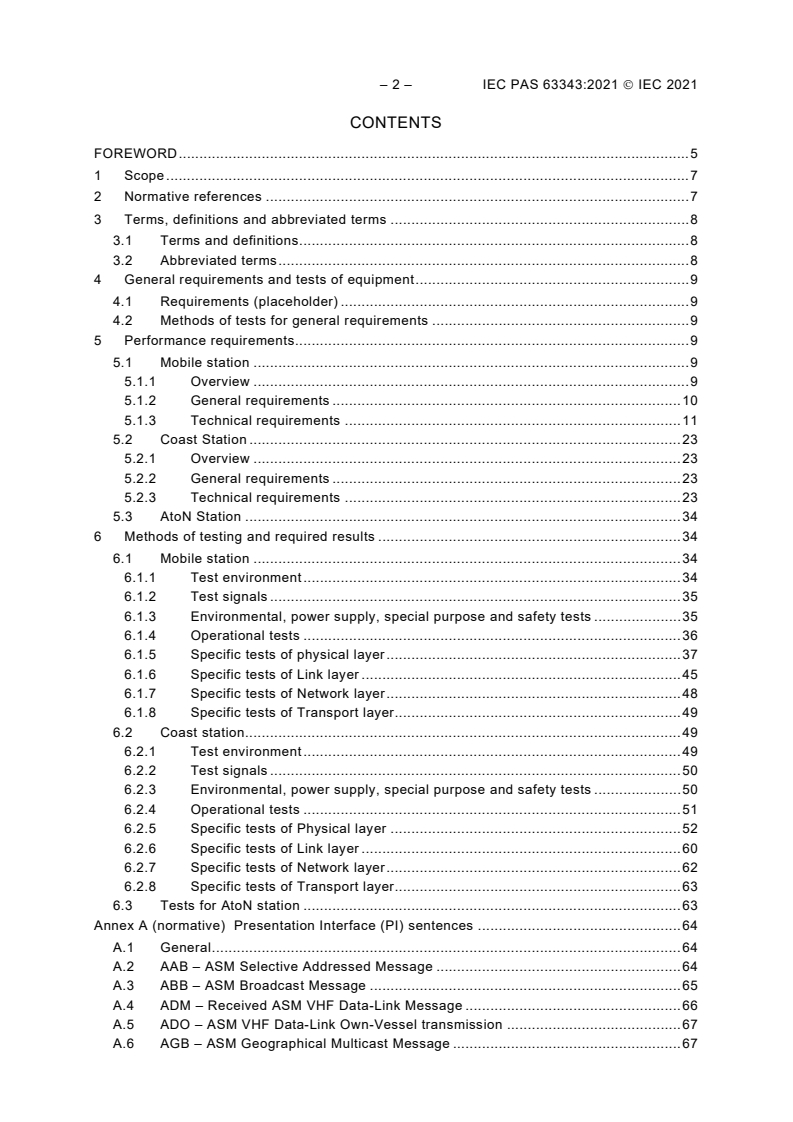
– 2 – IEC PAS 63343:2021 IEC 2021
CONTENTS
FOREWORD . 5
1 Scope . 7
2 Normative references . 7
3 Terms, definitions and abbreviated terms . 8
3.1 Terms and definitions . 8
3.2 Abbreviated terms . 8
4 General requirements and tests of equipment . 9
4.1 Requirements (placeholder) . 9
4.2 Methods of tests for general requirements . 9
5 Performance requirements. 9
5.1 Mobile station . 9
5.1.1 Overview . 9
5.1.2 General requirements . 10
5.1.3 Technical requirements . 11
5.2 Coast Station . 23
5.2.1 Overview . 23
5.2.2 General requirements . 23
5.2.3 Technical requirements . 23
5.3 AtoN Station . 34
6 Methods of testing and required results . 34
6.1 Mobile station . 34
6.1.1 Test environment . 34
6.1.2 Test signals . 35
6.1.3 Environmental, power supply, special purpose and safety tests . 35
6.1.4 Operational tests . 36
6.1.5 Specific tests of physical layer . 37
6.1.6 Specific tests of Link layer . 45
6.1.7 Specific tests of Network layer . 48
6.1.8 Specific tests of Transport layer. 49
6.2 Coast station. 49
6.2.1 Test environment . 49
6.2.2 Test signals . 50
6.2.3 Environmental, power supply, special purpose and safety tests . 50
6.2.4 Operational tests . 51
6.2.5 Specific tests of Physical layer . 52
6.2.6 Specific tests of Link layer . 60
6.2.7 Specific tests of Network layer . 62
6.2.8 Specific tests of Transport layer. 63
6.3 Tests for AtoN station . 63
Annex A (normative) Presentation Interface (PI) sentences . 64
A.1 General . 64
A.2 AAB – ASM Selective Addressed Message . 64
A.3 ABB – ASM Broadcast Message . 65
A.4 ADM – Received ASM VHF Data-Link Message . 66
A.5 ADO – ASM VHF Data-Link Own-Vessel transmission . 67
A.6 AGB – ASM Geographical Multicast Message . 67
A.7 AMK – Addressed and broadcast ASM message acknowledgement . 69
A.8 ASM – ASM Message Assembly . 69
A.9 ASQ – ASM Message Assembly Query . 71
A.10 ACC – "ASM Coast Station Configuration command" . 71
A.11 ??? – "additional ASM Coast Station Configuration" . 71
A.12 ??? – "ASM Coast Station Status sentence" . 72
Bibliography . 73
Figure 1 – Slotted transmission spectrum for ASM . 13
Figure 2 – Transmitter power versus time characteristics for π/4 QPSK (ASM) . 14
Figure 3 – Slot selection Criteria Flow Chart . 22
Figure 4 – Slotted transmission spectrum for ASM . 25
Figure 5 – Transmitter power versus time characteristics for π/4 QPSK (ASM) . 26
Figure 6 – Slot selection Criteria Flow Chart . 33
Figure 7 – Test setup for frequency error measurement . 37
Figure 8 – Test setup for adjacent channel selectivity . 41
Figure 9 – Measurement arrangement for intermodulation . 43
Figure 10 – Measurement arrangement for blocking or de-sensitisation . 44
Figure 11 – Test setup for frequency error measurement . 52
Figure 12 – Test setup for adjacent channel selectivity . 56
Figure 13 – Measurement arrangement for intermodulation . 58
Figure 14 – Measurement arrangement for blocking or de-sensitisation . 59
Table 1 – Slotted transmission spectrum for ASM . 12
Table 2 – Transmitter power versus time characteristics . 14
Table 3 – Receiver requirements without FEC (using Link ID 1) . 15
Table 4 – IEC 61162 Talker Identifiers and Sentence Formatters used for input of data
to Equipment for transmission to ASM VDL . 16
Table 5 – IEC 61162 Sentence Formatters used to output ASM VDL . 16
Table 6 – IEC 61162 Sentence Formatters used to output equipment status and input
related commands . 17
Table 7 – Use of ASM VDL messages . 18
Table 8 – Message 0 description . 19
Table 9 – Quiet time multiplier . 21
Table 10 – Slotted transmission spectrum for ASM . 24
Table 11 – Transmitter power versus time characteristics . 26
Table 12 – Receiver requirements without FEC (using Link ID 1) . 27
Table 13 – IEC 61162 Talker Identifiers and Sentence Formatters used for input of
data to Equipment for transmission to ASM VDL . 28
Table 14 – IEC 61162 Sentence Formatters used to output ASM VDL . 28
Table 15 – IEC 61162 Sentence Formatters used to output equipment status and input
related commands . 29
Table 16 – Use of ASM VDL messages . 30
Table 17 – Message 0 description . 31
Table 18 – Quiet time multiplier . 32
– 4 – IEC PAS 63343:2021 IEC 2021
Table 19 – Power supply test schedule . 36
Table 20 – Carrier power, required results . 38
Table 21 – Used parameters and required results for ASM and VDE sensitivity tests . 40
Table 22 – Used parameters and required results for ASM and VDE high input level
tests . 40
Table 23 – Additional channel combinations used for co-channel rejection tests . 41
Table 24 – Test signals used for adjacent channel selectivity tests . 42
Table 25 – Frequencies for inter-modulation test . 44
Table 26 – Test signals used for inter-modulation test . 44
Table 27 – Frequencies for blocking test . 45
Table 28 – Test signals used for blocking test . 45
Table 29 – Carrier power, required results . 53
Table 30 – Used parameters and required results for ASM and VDE sensitivity tests . 55
Table 31 – Used parameters and required results for ASM and VDE high input level
tests . 55
Table 32 – Additional channel combinations used for co-channel rejection tests . 55
Table 33 – Test signals used for adjacent channel selectivity tests . 56
Table 34 – Frequencies for inter-modulation test . 58
Table 35 – Test signals used for inter-modulation test . 58
Table 36 – Frequencies for blocking test . 59
Table 37 – Test signals used for blocking test . 60
INTERNATIONAL ELECTROTECHNICAL COMMISSION
____________
MARITIME NAVIGATION AND RADIOCOMMUNICATION EQUIPMENT AND
SYSTEMS – VHF DATA EXCHANGE SYSTEM – REQUIREMENTS AND
METHODS OF TESTING FOR STATIONS INCLUDING ASM FUNCTIONALITY
FOREWORD
1) The International Electrotechnical Commission (IEC) is a worldwide organization for standardization comprising
all national electrotechnical committees (IEC National Committees). The object of IEC is to promote international
co-operation on all questions concerning standardization in the electrical and electronic fields. To this end and
in addition to other activities, IEC publishes International Standards, Technical Specifications, Technical Reports,
Publicly Available Specifications (PAS) and Guides (hereafter referred to as "IEC Publication(s)"). Their
preparation is entrusted to technical committees; any IEC National Committee interested in the subject dealt with
may participate in this preparatory work. International, governmental and non-governmental organizations liaising
with the IEC also participate in this preparation. IEC collaborates closely with the International Organization for
Standardization (ISO) in accordance with conditions determined by agreement between the two organizations.
2) The formal decisions or agreements of IEC on technical matters express, as nearly as possible, an international
consensus of opinion on the relevant subjects since each technical committee has representation from all
interested IEC National Committees.
3) IEC Publications have the form of recommendations for international use and are accepted by IEC National
Committees in that sense. While all reasonable efforts are made to ensure that the technical content of IEC
Publications is accurate, IEC cannot be held responsible for the way in which they are used or for any
misinterpretation by any end user.
4) In order to promote international uniformity, IEC National Committees undertake to apply IEC Publications
transparently to the maximum extent possible in their national and regional publications. Any divergence between
any IEC Publication and the corresponding national or regional publication shall be clearly indicated in the latter.
5) IEC itself does not provide any attestation of conformity. Independent certification bodies provide conformity
assessment services and, in some areas, access to IEC marks of conformity. IEC is not responsible for any
services carried out by independent certification bodies.
6) All users should ensure that they have the latest edition of this publication.
7) No liability shall attach to IEC or its directors, employees, servants or agents including individual experts and
members of its technical committees and IEC National Committees for any personal injury, property damage or
other damage of any nature whatsoever, whether direct or indirect, or for costs (including legal fees) and
expenses arising out of the publication, use of, or reliance upon, this IEC Publication or any other IEC Publications.
8) Attention is drawn to the Normative references cited in this publication. Use of the referenced publications is
indispensable for the correct application of this publication.
9) Attention is drawn to the possibility that some of the elements of this IEC Publication may be the subject of patent
rights. IEC shall not be held responsible for identifying any or all such patent rights.
A PAS is an intermediate specification made available to the public and needing a lower level
of consensus than an International Standard to be approved by vote (simple majority).
IEC PAS 63343 has been processed by IEC technical committee 80: Maritime navigation and
radiocommunication equipment and systems.
The text of this PAS is based on the This PAS was approved for
following document: publication by the P-members of the
committee concerned as indicated in
the following document
Draft PAS Report on voting
80/975/DPAS 80/982/RVDPAS
Following publication of this PAS, which is a pre-standard publication, the technical committee
or subcommittee concerned may transform it into an International Standard.
– 6 – IEC PAS 63343:2021 IEC 2021
This PAS shall remain valid for an initial maximum period of 2 years starting from the publication
date. The validity may be extended for a single period up to a maximum of 2 years, at the end
of which it shall be published as another type of normative document, or shall be withdrawn.
IMPORTANT – The "colour inside" logo on the cover page of this document indicates
that it contains colours which are considered to be useful for the correct understanding
of its contents. Users should therefore print this document using a colour printer.
MARITIME NAVIGATION AND RADIOCOMMUNICATION EQUIPMENT AND
SYSTEMS – VHF DATA EXCHANGE SYSTEM – REQUIREMENTS AND
METHODS OF TESTING FOR STATIONS INCLUDING ASM FUNCTIONALITY
1 Scope
This document specifies technical requirements, methods of test and required test results for
equipment implementing ASM part of the VHF Data exchange system (VDES) as defined in
ITU-R M.2092.
This document is intended to be the first step of development of standard(s) describing
equipment that implement functions of VDES in any combination.
NOTE All text of this document whose wording is identical to applicable external references such as ITU
Recommendations is printed in italics, and the reference and associated paragraph numbers are indicated in brackets.
NOTE The intention of text written in notation [Future: text] in this document is to include future placeholder for
topics that are considered important even for the first implementations that may comply with this document.
Requirements set in this document provide means to mitigate adverse interference to Automatic
Identification System (AIS).
2 Normative references
The following documents are referred to in the text in such a way that some or all of their content
constitutes requirements of this document. For dated references, only the edition cited applies.
For undated references, the latest edition of the referenced document (including any
amendments) applies.
IEC 60945:2002, Maritime navigation and radiocommunication equipment and systems –
General requirements – Methods of testing and required test results
IEC 61108 (all parts), Maritime navigation and radiocommunication equipment and systems –
Global navigation satellite systems (GNSS)
IEC 61162-1:2016, Maritime navigation and radiocommunication equipment and systems –
Digital interfaces – Part 1 Single talker and multiple listeners
IEC 61162-450, Maritime navigation and radiocommunication equipment and systems – Digital
interfaces – Part 450: Multiple talkers and multiple listeners – Ethernet interconnection
IEC 61193-2:2007, Quality assessment systems – Part 2: Selection and use of sampling plans
for inspection of electronic components and packages
IEC 61993-2:2018, Maritime navigation and radiocommunication equipment and systems –
Automatic identification systems (AIS) – Part 2: Class A shipborne equipment of the automatic
identification system (AIS) – Operational and performance requirements, methods of test and
required test results
IEC 62320-1:2015, Maritime navigation and radiocommunication equipment and systems –
Automatic identification system (AIS) – Part 1: AIS Base Stations – Minimum operational and
performance requirements, methods of testing and required test results
– 8 – IEC PAS 63343:2021 IEC 2021
ITU-R Recommendation M.1371-5:2014, Technical characteristics for an automatic
identification system using time division multiple access in the VHF maritime mobile frequency
band
ITU-R M.2092-0:2015, Technical characteristics for a VHF data exchange system in the VHF
maritime mobile band
ITU-T O.151:1992, Error performance measuring equipment operating at the primary rate and
above
IALA G1139 Edition 3, 2019, The Technical Specification of VDES
3 Terms, definitions and abbreviated terms
For the purposes of this document, the following terms and definitions apply.
ISO and IEC maintain terminological databases for use in standardization at the following
addresses:
• IEC Electropedia: available at http://www.electropedia.org/
• ISO Online browsing platform: available at http://www.iso.org/obp
3.1 Terms and definitions
3.1.1 Input [verb]
input [verb]
used for data transaction towards the equipment in its Presentation Interface
3.1.2 Output [verb]
output [verb]
used for data transaction from the equipment at its Presentation Interface
3.1.3 Transmit [verb]
transmit [verb]
used when equipment transmits by using VHF radio
3.1.4 Receive [verb]
Receive [verb]
used when equipment receives a radio signal
3.1.5 VDES VDL
VDES VDL
AIS VDL, ASM VDL, VDE TER VDL and VDE SAT VDL
3.2 Abbreviated terms
AIS Automatic Identification System
ASM Application Specific Message
BW Bandwidth
DAC Designated Area Code
EMC Electromagnetic Compatibility
EUT Equipment Under Test
EVM Error Vector Magnitude
FATDMA Fixed Access Time Division Multiple Access
FI Function Identifier
GLONASS Globalnaya Navigazionnaya Sputnikovaya Sistema
GMSK Gaussian Minimum Shift Keying
GNSS Global Navigation Satellite System
HMI Human Machine Interface
IF Intermediate Frequency (of modulator)
MITDMA Multiple Incremental Time Division Multiple Access
PAPR Peak to Average Power Ratio
PEP Peak Envelope Power
PER Packet Error Rate
PI Presentation Interface
RATDMA Random Access Time Division Multiple Access
RF Radio Frequency
RMS Root Mean Square
SAR Search and Rescue
SI Selection Interval
UTC Coordinated Universal Time
VDE VHF Data Exchange
VDES VHF Data Exchange System
VDE SAT VDE Satellite
VDE TER VDE Terrestrial
VDL VHF Data Link
VHF Very High Frequency
VSWR Voltage Standing Wave Ratio
QPSK Quadrature Phase Shift Keying
4 General requirements and tests of equipment
4.1 Requirements (placeholder)
4.2 Methods of tests for general requirements
5 Performance requirements
5.1 Mobile station
5.1.1 Overview
This part specifies the minimum operational and performance requirements, methods of testing
and required test results for ASM Mobile station.
It takes into consideration the technical characteristics of shipborne AIS equipment, included in
recommendation ITU-R M.1371 and IEC 61993-2 (see 5.1.3.11).
ASM mobile station is intended to be used onboard any marine vessel that may operate globally
or regionally anywhere in the world. The main high-level functions of the ASM mobile station
are:
a) transmit through ASM VHF Data Link (ASM VDL) information which is input to ASM mobile
station by other onboard equipment through Presentation Interface (PI);
– 10 – IEC PAS 63343:2021 IEC 2021
b) output all information received from ASM VDL applicable to own station, through PI so that
this information is available to other onboard equipment;
c) handle applicable ASM radio station duties.
In following text, term "Equipment" is used to refer to ASM mobile station.
5.1.2 General requirements
An ASM mobile station shall as a minimum fulfil requirements set in IEC 61193-2, with
exceptions as detailed in this document for interoperability between AIS and ASM transmission
and reception.
5.1.2.1 Marking and identification
Equipment shall be marked as required by IEC 60945:2002, Clause 15. In addition, the
markings shall include:
• details of the power supply from which the equipment is intended to be operated; and,
• if applicable, the date by which batteries need to be replaced.
5.1.2.2 Manuals
Manuals for Equipment shall comply with requirements set in IEC 60945:2002, Clause 14, as
applicable. In addition the manuals shall include:
• the type and details of all external connectors;
• the needed information for correct siting of the antennas;
• description for each alert that may be released by the equipment. The description shall
briefly explain the root causes for each alert, give guidance for users on what implications
the alert has for safe operation of ship and what actions may be necessary to rectify the
alert condition.
5.1.2.3 Quality assurance
The Administration shall require that the manufacturers have a quality control system audited
by a competent authority to ensure continuous compliance with the conditions of conformance
assessment. Alternatively, the Administration may use final product verification procedures
where a competent authority verifies conformance with the certificate of conformance before
the product is installed on board ships.
NOTE The ISO 9000 family standards, as applicable, meets this requirement.
5.1.2.4 Source of UTC
The Equipment shall be provided with a source of UTC, such as GNSS receiver, which is
required for synchronisation purposes.
The internal GNSS receiver shall meet the following requirements of IEC 61108 (all parts):
acquisition, re-acquisition, receiver sensitivity, RF dynamic range, effects of specific interfering
signals, status indications.
5.1.2.5 Human Machine Interface (HMI)
Means shall be provided to allow user to observe operational status of the equipment.
NOTE This requirement can be fulfilled by providing an indicator capable of signalling three states: power off, power
on – operating as intended, power on – not operating as intended.
5.1.2.6 Environmental, power supply, special purpose and safety requirements
Equipment shall as minimum comply with the requirements set for equipment category
"protected" as stated in IEC 60945:2002.
5.1.2.7 EMC
Requirements applicable for Equipment are stated in IEC 60945:2002, Table 6, equipment
category "protected".
5.1.2.8 Compass safe distance
Requirements stated in IEC 60945:2002, 4.5.3, apply to Equipment.
5.1.2.9 Power supply
Manufacturer shall specify the properties of power supply. The power supply shall conform to
applicable requirements in IEC 60945:2002.
5.1.2.10 Update of software
The Equipment shall provide means for updating software of the equipment and to report, on
demand, the current applicable software version.
5.1.3 Technical requirements
5.1.3.1 Transmitter shutdown procedure
(M.1371-5/A2-2.13) An automatic transmitter hardware shutdown procedure and indication shall
be provided in case a transmitter continues to transmit for more than 2 s. This shutdown
procedure shall be independent of software control.
5.1.3.2 Permissible initialization period
The Equipment shall be operational within 2 min of switching on.
5.1.3.3 Transceiver protection
The Equipment shall tolerate failure conditions of disconnected antenna and short circuit of
antenna connector for minimum duration of 60 s. The equipment shall be capable to continue
normal operation within 2 min after either of the failure conditions are rectified.
5.1.3.4 TX malfunction
The Equipment shall be able to detect malfunction of transmitter and signal this condition
through Presentation Interface (see 5.1.3.8.3) and HMI (see 5.1.2.5).
5.1.3.5 Antenna VSWR
Equipment shall be able to detect excess VSWR at antenna and signal this condition through
Presentation Interface (see 5.1.3.8.3) and HMI (see 5.1.2.5).
5.1.3.6 RX malfunction
Equipment shall be able to detect malfunction of receiver and signal this condition through
Presentation Interface (see 5.1.3.8.3) and HMI (see 5.1.2.5).
– 12 – IEC PAS 63343:2021 IEC 2021
5.1.3.7 Physical layer
5.1.3.7.1 TDMA transmitter
The transmitter shall comply with following requirements in addition to IEC 61193-2.
Transmission characteristics as described in Table 1 and Figure 1 shall apply for transmission
of ASM messages.
Table 1 – Slotted transmission spectrum for ASM
Transmitter parameters Requirements Condition
Frequency error ±1,5 ppm Normal
±3 ppm Extreme
Transmit power capability Transmit average power should be 1 W at Conducted
low power setting and 12,5 W at high
power setting.
+2
±1,5 dB normal, dB extreme
−6
Slotted modulation mask ∆fc < ±8 kHz: 0 dBc (PEP of transmitted signal)
±8 kHz < ∆fc < ±16 kHz: below the straight line between
−25 dBc at ±8 kHz and –60 dBc at ±16 kHz
±16 kHz < ∆fc < ±25 kHz: below the straight line between
−60 dBc at ±16 kHz and –70 dBc at ±25 kHz
±25 kHz < ∆fc < ±62,5 kHz: −70 dBc
Spurious emissions −36 dBm 9 kHz to 1 GHz
−30 dBm 1 GHz to 4 GHz
Figure 1 – Slotted transmission spectrum for ASM
For output power less than 1 W, the maximum transmission power level outside ±16 kHz shall
not exceed –36 dBm.
The modulation accuracy shall give an RMS vector error in any burst less than [0,1] and the
peak vector error magnitude shall be less than [0,3] for any symbol.
Requirements on transmitter power versus time characteristics are given in Table 2 and Figure
2. Blue line in Figure 2 is an example of transmitter power during ramp up and ramp down. For
multi-slot transmissions the ramp down and guard periods (from T via T to T ) take place at
E G 0
the end of the last transmission slot and sync sequence and payload period (T … T ) extends
B E
through all transmission slots.
– 14 – IEC PAS 63343:2021 IEC 2021
Table 2 – Transmitter power versus time characteristics
Reference Symbols Time Definition
ms
T 0 0 Start of transmission slot
Power should < –50 dB of P before T
ss 0
0 to 4 0 to 0,416 Power should not exceed +1,5 dB of P
ss
T 4 0,416
B
P = 3,4 dB + mean power measured between T and T
ss B E
b
a a a
T 239 or 244 24,896 / 25,417
E
239 to 243 24,896 to 25,313 or Power should not exceed +1,5 dB of P
ss
or
a
25,417 to 25,833
a
244 to 248
T 248 to 0 25,833 to 26,667 Power should be < –50 dB of P and stay below this for
G ss
the remainder of the transmission slot
a
T can vary based on burst length and can be either at symbol 239 or 244. Ramp down is always 4 symbols
E
in length.
b
3,4 dB represents the 3,35 dB PAPR for the test signal used (pi/4 QPSK).
Figure 2 – Transmitter power versus time characteristics for π/4 QPSK (ASM)
5.1.3.7.2 Receiver requirements
The receiver of the equipment shall comply with the requirements of Table 3.
Table 3 – Receiver requirements without FEC (using Link ID 1)
Receiver parameters Requirements Note
Normal Extreme
20 % PER at
Sensitivity 20 % PER at −107 dBm 3
–104 dBm
20 % PER at -104 dBm at ±250 Hz offset
Error behaviour at high input levels 1 % PER at −77 dBm peak No specific -
1 % PER at −7 dBm peak requirement
Co-Channel rejection 20 % PER at 13 dB No specific 3,2
requirement
20 % PER at 13 dB at unwanted signal
±500 Hz offset
Adjacent channel selectivity 20 % PER at 70 dB No specific 2
requirement
Spurious response rejection 20 % PER at 70 dB No specific 1
requirement
Intermodulation response rejection 20 % PER at 71 dB No specific -
requirement
Spurious emissions −57 dBm (9 kHz to 1 GHz) No specific 1
−47 dBm (1 GHz to 4 GHz) requirement
Blocking 20 % PER at 86 dB No specific 1
requirement
Notes:
1: These parameters are the same as AIS (IEC 61993-2)
2: Interferer is pi/4QPSK continuous PRBS
3: The offsets are half the values used in AIS (61993-2) as the frequency accuracy in ASM is much better
5.1.3.8 Presentation Interface (PI)
The equipment shall have a Presentation Interface (PI) for following functions:
a) input of information from other onboard equipment to be transmitted to other ASM stations
by the Equipment;
b) output of all received ASM VDL data applicable to own station;
c) signal equipment internal status information to and accept related commands from other
onboard equipment.
The Equipment shall be capable of assembling the entire received MITDMA chain and thereafter
output the data using ASM sentence. Information received from incomplete chains shall be
discarded, i.e. the received partial information shall not be output through PI using ASM
sentence. In addition, the Equipment may optionally be capable of outputting all received ASM
VDL radio messages relevant to own station using ADM sentence.
The Equipment shall be capable of assembling the complete payload input by related PI
sentences before scheduling transmission on ASM VDL. If the Equipment detects inconsistency
in the data input through PI (for example checksum error, missing sentence, interrupted input
of sentences), the Equipment shall output negative acknowledgement using AMK sentence and
shall discard information already received.
5.1.3.8.1 Interface for input data to be transmitted to ASM VDL
This interface shall comply with requirements described in IEC 61162-450. Table 4 defines the
IEC 61162-1 talker identifiers and sentence formatters that shall be used when outputting ASM
VDL data. The details of sentence formatters are described in Annex A. The timeout for input
of all sentences required for transmission is 10 s. If the input of all sentences has not been
– 16 – IEC PAS 63343:2021 IEC 2021
completed by the timeout, the Equipment shall output NAK sentence with an appropriate reason
code ("8 = multi-sentence message not accepted due to sentence timeout").
The equipment may offer capability to serve multiple external applications by means of
[IEC 61162-450 TAG block and by use of NAK (on PI related) and AMK (on VDL related)].
Table 4 – IEC 61162 Talker identifiers and sentence formatters
used for input of data to Equipment for transmission to ASM VDL
Talker ID Sentence Direction Note
formatter
a
(any) Input ASM Selective Addressed Message
AAB
a
Input ASM Broadcast Message
ABB
AGB Input ASM Geographical Multicast Message
NAK Output ASM Addressed and Broadcast Message
Acknowledgement for PI
[VA] AMK Output ASM Addressed and Broadcast Message
Acknowledgement
a
Mobile station shall always transmit own (programmed) MMSI and shall ignore the input source ID, if provided
by the input sentence.
The Equipment shall be capable of supporting multiple external equipment through PI.
5.1.3.8.2 Interface to output received ASM VDL information
This interface shall comply with requirements described in IEC 61162-450. Table 5 defines the
IEC 61162-1 sentence formatters that shall be used for output of ASM VDL data from Equipment.
The details of sentence formatters are described in Annex A.
Table 5 – IEC 61162 sentence formatters used to output ASM VDL
Talker ID Sentence Direction Note
formatter
a, c
[VA] Output Received ASM message assembly
ASM
b
Output Received ASM VHF Data-Link Message
ADM
ADO Output ASM VHF Data-Link Own-Vessel Report
a
(any) Input Query for ASM sentence content
ASQ
a
ASM sentence is output when a complete ASM VDL message/MITDMA chain has been received; it can also
be queried by means of ASQ sentence.
b
Implementation of ADM sentence is optional for mobile station as ASM sentence is expected to convey the
information applicable to equipment connected to own station PI.
c
Mobile station shall discard messages having satellite as intended destination (applies to ASM sentence VDL
channel designations 3 and 4).
[The Equipment shall store a minimum of [10] most recently received and successfully
assembled ASM messages. Stored (i.e. successfully assembled) messages shall be output
when ASM sentence is queried using ASQ sentence.]
5.1.3.8.3 Interface for exchanging alert information, equipment status and related
commands
This interface shall comply with requirements described in IEC 61162-450. Table 6 defines the
IEC 61162-1 sentence formatters that shall be used for outputting alerts, equipment status
information to and inputting related commands from other onboard equipment.
Table 6 – IEC 61162 sentence formatters used to output
equipment status and input related commands
Function Sentence formatter Note
Alerts ACN, ARC, ALC, ALF,HBT For details, see IEC 62923 (all parts) and
IEC 61162-1
Local network and HBT Heartbeat between Equipment and external
equipment integrity applications
Configuration EPV [Required property identifiers are to be defined]
Equipment status TXT [Required TXT sentence contents are to be defined]
information
Software version VER See IEC 61162-1
The Equipment shall allow query of output sentences as indicated in Table 5 and Table 6.
Conditions that may cause the Equipment to release alert include but are not restricted to:
• TX fault;
• RX fault;
• antenna fault.
5.1.3.9 Link layer requirements
5.1.3.9.1 General rules
The following general rules apply to Equipment:
• the Equipment shall at least be able to receive and transmit on channels ASM1 and ASM2;
• the Equipment shall, as a default, be identified by its own Unique Identifier on the VDL
interface;
• the Equipment shall autonomously and as a response to query provide a vendor ID using a
self-identification message on AIS VDL;
• the Equipment shall transmit using no more than 50 slots per frame (excluding available
slots for use of retransmission of addressed data) on each of the two ASM channels (100
slots together);
• the equipment shall implement mandatory Quiet Time after each successful MITDMA
transaction or a single non-MITDMA transmission;
• a maximum amount of 15 MITDMA transmissions per frame are allowed;
• transmission of an MITDMA chain shall be completed on same ASM channel (no channel
switching);
• the Equipment shall as a minimum support reception of [10] in-progress MITDMA chains.
In-progress MITDMA chains should be prioritized if the maximum number of supported in-
progress MITDMA chains is exceeded;
• the Equipment shall not transmit bursts exceeding the length of 3 slots;
• received VDL messages shall be passed to the PI as an ASM sentence according to Table 7
if either broadcast or addressed to the own station;
• the Equipment shall transmit messages according to AAB, ABB and AGB sentences that
are input to PI of the Equipment;
• every message transmitted on the VDL shall be passed to the PI as a ADO sentence;
• the TDMA receive process shall not be dependent on slot boundaries.
– 18 – IEC PAS 63343:2021 IEC 2021
5.1.3.9.2 Re-transmissions
Addressed MITDMA chain data that has not been confirmed as received shall be re-transmitted.
Following rules apply for re-transmissions:
• the addressed receiver shall transmit an acknowledgment after receipt of the last block of
the chain or timeout after the latest possible time for the receipt of the last block. The
receiver acknowledgement timeout T is calculated as follows:
ack
T = (number of blocks remaining after the last received block) x 255 slots.
ack
• upon failure to receive an acknowledgement from the addressed station within a timeout,
the Equipment may re-transmit the entire chain if the retry slot budget and retry count so
allows. The transmitter wait-for-ack-from-destination timeout T is referenced from the
wait
start of the first block and is calculated as follows:
T = ((number of blocks in a chain) + 1) x 255 slots
wait
• the amount of 50 slots allowance per frame (see 5.1.3.9.1) does not include re-
transmissions;
• usage of up to 22 slots (3 x 7 + 1) for re-transmission in addition to the transmission limit
(of 50 slots per frame) is allowed;
• the Equipment shall not make more than 3 re-transmission attempts.
5.1.3.9.3 Equipment interaction on the VDL
5.1.3.9.3.1 VDL messages overview
The interaction of the Equipment on the VDL is presented in Table 7.
Table 7 – Use of ASM VDL messages
Message Acc
...