

IEC 62657-2:2013
(Main)Industrial communication networks - Wireless communication networks - Part 2: Coexistence management
General Information
- Abstract
IEC 62657-2:2013 specifies the fundamental assumptions, concepts, parameters, and procedure for wireless communication coexistence; provides guidelines, requirements, and best practices for wireless communication's availability and performance in an industrial automation plant; it covers the life cycle of wireless communication coexistence and provides a common point of reference for wireless communication coexistence for industrial automation sites as a homogeneous guideline to help the users assess and gauge their plant efforts. This first edition cancels and replaces IEC/TS 62657-2, published in 2011. The main changes with respect to the TS are:
- updated the normative references, terms, definitions, symbols, abbreviations;
- corrected spelling;
- changed figures to make them consistent with the text and vice versa;
- added and modified text to make the text more readable.
- Status
- Published
- Publication Date
- 19-Aug-2013
- Technical Committee
- SC 65C - Industrial networks
- Drafting Committee
- WG 17 - TC 65/SC 65C/WG 17
- Current Stage
- DELPUB - Deleted Publication
- Start Date
- 11-May-2017
- Completion Date
- 28-Aug-2026

Overview
IEC 62657-2:2013 is an international standard developed by the International Electrotechnical Commission (IEC) focusing on the coexistence management of wireless communication networks within industrial automation environments. This standard lays out fundamental concepts, parameters, and procedures essential for managing the coexistence of diverse wireless communication systems in industrial plants. It provides comprehensive guidelines and best practices designed to ensure wireless communication availability and performance throughout the lifecycle of industrial automation networks.
The 2013 edition of IEC 62657-2 replaces the earlier Technical Specification IEC/TS 62657-2:2011, updating normative references, terminology, figures, and enhancing the readability of the content. This standard acts as a homogeneous guideline to help users assess coexistence challenges and implement effective coexistence management strategies, mitigating interference and optimizing network performance.
Key Topics
Coexistence Concept in Industrial Automation
Covers the theory behind coexistence management including manual and automated methods. It presents the necessity of coexistence management to prevent interference among wireless systems and improve communication reliability.Parameters for Coexistence Management
Defines a comprehensive set of parameters important for coexistence evaluation, such as antenna gain, bandwidth, bit rate, transmit power, frequency usage, modulation methods, and environmental factors like radio propagation conditions.Coexistence Management Process
Describes phases including investigation, planning, implementation, and operation of coexistence management. Emphasizes the role of a designated coexistence manager responsible for overseeing the process and integrating experts’ support.Information Structures for Coexistence
Details on capturing plant characteristics, application-specific communication requirements, and wireless system/device characteristics that influence coexistence planning and execution.Best Practices and Guidelines
Highlights strategies to minimize interference risks, such as frequency planning, time-domain separation, adaptive mechanisms, and documentation methodologies.
Applications
IEC 62657-2:2013 is highly relevant for industries employing wireless communication networks in automated manufacturing facilities, such as:
Process Automation Plants
Where stable and interference-free wireless communication is critical for control and monitoring operations.Industrial IoT Deployments
Ensuring diverse wireless sensor and actuator networks coexist without degradation of performance.Factory Wireless Networks
Providing frameworks for coexistence management to enable mixed wireless technologies and avoid mutual interference in complex RF environments.Wireless Network Planning and Maintenance
Guiding engineers and network managers in planning new wireless systems or expanding existing ones with consideration of coexistence factors.
By adopting this standard, industrial operators can reduce downtime caused by communication failures, improve wireless network reliability, and comply with international best practices for wireless coexistence.
Related Standards
IEC 62657-1: Covers general requirements for wireless communication in industrial networks, providing foundational aspects complementing Part 2’s focus on coexistence.
IEC 61784: For communication profiles relevant to industrial fieldbuses and higher-layer protocols.
IEEE 802.11 & IEEE 802.15: Wireless communication standards which are often referenced for specific protocol parameters related to coexistence.
ITU-R Recommendations: Radio communication standards and frequency band allocations that align with regulatory frameworks mentioned within IEC 62657-2.
Conclusion
IEC 62657-2:2013 provides essential guidance to manage the coexistence of wireless communication networks in industrial automation. It supports network designers, system integrators, and plant operators in ensuring robust, interference-resilient wireless environments by identifying key parameters, outlining structured management processes, and promoting best practices. Adherence to this standard enhances wireless communication availability and performance, which is pivotal in maintaining high operational efficiency in modern industrial facilities.
Keywords: IEC 62657-2, wireless communication coexistence, industrial automation networks, coexistence management, wireless network interference, industrial wireless networks, coexistence parameters, wireless communication standards, industrial IoT wireless, wireless network planning.
Relations
- Effective Date
- 05-Sep-2023
- Effective Date
- 05-Sep-2023
Get Certified
Connect with accredited certification bodies for this standard

BSI Group
BSI (British Standards Institution) is the business standards company that helps organizations make excellence a habit.

DVS-ZERT GmbH
German welding certification society.

NYCE
Mexican standards and certification body.
Sponsored listings
Frequently Asked Questions
IEC 62657-2:2013 is a standard published by the International Electrotechnical Commission (IEC). Its full title is "Industrial communication networks - Wireless communication networks - Part 2: Coexistence management". This standard covers: IEC 62657-2:2013 specifies the fundamental assumptions, concepts, parameters, and procedure for wireless communication coexistence; provides guidelines, requirements, and best practices for wireless communication's availability and performance in an industrial automation plant; it covers the life cycle of wireless communication coexistence and provides a common point of reference for wireless communication coexistence for industrial automation sites as a homogeneous guideline to help the users assess and gauge their plant efforts. This first edition cancels and replaces IEC/TS 62657-2, published in 2011. The main changes with respect to the TS are: - updated the normative references, terms, definitions, symbols, abbreviations; - corrected spelling; - changed figures to make them consistent with the text and vice versa; - added and modified text to make the text more readable.
IEC 62657-2:2013 specifies the fundamental assumptions, concepts, parameters, and procedure for wireless communication coexistence; provides guidelines, requirements, and best practices for wireless communication's availability and performance in an industrial automation plant; it covers the life cycle of wireless communication coexistence and provides a common point of reference for wireless communication coexistence for industrial automation sites as a homogeneous guideline to help the users assess and gauge their plant efforts. This first edition cancels and replaces IEC/TS 62657-2, published in 2011. The main changes with respect to the TS are: - updated the normative references, terms, definitions, symbols, abbreviations; - corrected spelling; - changed figures to make them consistent with the text and vice versa; - added and modified text to make the text more readable.
IEC 62657-2:2013 is classified under the following ICS (International Classification for Standards) categories: 25.040.40 - Industrial process measurement and control; 33.040.40 - Data communication networks; 35.110 - Networking. The ICS classification helps identify the subject area and facilitates finding related standards.
IEC 62657-2:2013 has the following relationships with other standards: It is inter standard links to IEC TS 62657-2:2011, IEC 62657-2:2017. Understanding these relationships helps ensure you are using the most current and applicable version of the standard.
IEC 62657-2:2013 is available in PDF format for immediate download after purchase. The document can be added to your cart and obtained through the secure checkout process. Digital delivery ensures instant access to the complete standard document.
Standards Content (Sample)
IEC 62657-2 ®
Edition 1.0 2013-08
INTERNATIONAL
STANDARD
NORME
INTERNATIONALE
colour
inside
Industrial communication networks – Wireless communication networks –
Part 2: Coexistence management
Réseaux de communication industriels – Réseaux de communication sans fil –
Partie 2: Gestion de coexistence
All rights reserved. Unless otherwise specified, no part of this publication may be reproduced or utilized in any form
or by any means, electronic or mechanical, including photocopying and microfilm, without permission in writing from
either IEC or IEC's member National Committee in the country of the requester.
If you have any questions about IEC copyright or have an enquiry about obtaining additional rights to this publication,
please contact the address below or your local IEC member National Committee for further information.
Droits de reproduction réservés. Sauf indication contraire, aucune partie de cette publication ne peut être reproduite ni
utilisée sous quelque forme que ce soit et par aucun procédé, électronique ou mécanique, y compris la photocopie et les
microfilms, sans l'accord écrit de la CEI ou du Comité national de la CEI du pays du demandeur.
Si vous avez des questions sur le copyright de la CEI ou si vous désirez obtenir des droits supplémentaires sur cette
publication, utilisez les coordonnées ci-après ou contactez le Comité national de la CEI de votre pays de résidence.
IEC Central Office Tel.: +41 22 919 02 11
3, rue de Varembé Fax: +41 22 919 03 00
CH-1211 Geneva 20 info@iec.ch
Switzerland www.iec.ch
About the IEC
The International Electrotechnical Commission (IEC) is the leading global organization that prepares and publishes
International Standards for all electrical, electronic and related technologies.
About IEC publications
The technical content of IEC publications is kept under constant review by the IEC. Please make sure that you have the
latest edition, a corrigenda or an amendment might have been published.
Useful links:
IEC publications search - www.iec.ch/searchpub Electropedia - www.electropedia.org
The advanced search enables you to find IEC publications The world's leading online dictionary of electronic and
by a variety of criteria (reference number, text, technical electrical terms containing more than 30 000 terms and
committee,…). definitions in English and French, with equivalent terms in
It also gives information on projects, replaced and additional languages. Also known as the International
withdrawn publications. Electrotechnical Vocabulary (IEV) on-line.
IEC Just Published - webstore.iec.ch/justpublished Customer Service Centre - webstore.iec.ch/csc
Stay up to date on all new IEC publications. Just Published If you wish to give us your feedback on this publication
details all new publications released. Available on-line and or need further assistance, please contact the
also once a month by email. Customer Service Centre: csc@iec.ch.
A propos de la CEI
La Commission Electrotechnique Internationale (CEI) est la première organisation mondiale qui élabore et publie des
Normes internationales pour tout ce qui a trait à l'électricité, à l'électronique et aux technologies apparentées.
A propos des publications CEI
Le contenu technique des publications de la CEI est constamment revu. Veuillez vous assurer que vous possédez
l’édition la plus récente, un corrigendum ou amendement peut avoir été publié.
Liens utiles:
Recherche de publications CEI - www.iec.ch/searchpub Electropedia - www.electropedia.org
La recherche avancée vous permet de trouver des Le premier dictionnaire en ligne au monde de termes
publications CEI en utilisant différents critères (numéro de électroniques et électriques. Il contient plus de 30 000
référence, texte, comité d’études,…). termes et définitions en anglais et en français, ainsi que
Elle donne aussi des informations sur les projets et les les termes équivalents dans les langues additionnelles.
publications remplacées ou retirées. Egalement appelé Vocabulaire Electrotechnique
International (VEI) en ligne.
Just Published CEI - webstore.iec.ch/justpublished
Service Clients - webstore.iec.ch/csc
Restez informé sur les nouvelles publications de la CEI.
Just Published détaille les nouvelles publications parues. Si vous désirez nous donner des commentaires sur
Disponible en ligne et aussi une fois par mois par email. cette publication ou si vous avez des questions
contactez-nous: csc@iec.ch.
IEC 62657-2 ®
Edition 1.0 2013-08
INTERNATIONAL
STANDARD
NORME
INTERNATIONALE
colour
inside
Industrial communication networks – Wireless communication networks –
Part 2: Coexistence management
Réseaux de communication industriels – Réseaux de communication sans fil –
Partie 2: Gestion de coexistence
INTERNATIONAL
ELECTROTECHNICAL
COMMISSION
COMMISSION
ELECTROTECHNIQUE
PRICE CODE
INTERNATIONALE
CODE PRIX XC
ICS 25.040.40; 33.040; 35.110 ISBN 978-2-8322-1048-2
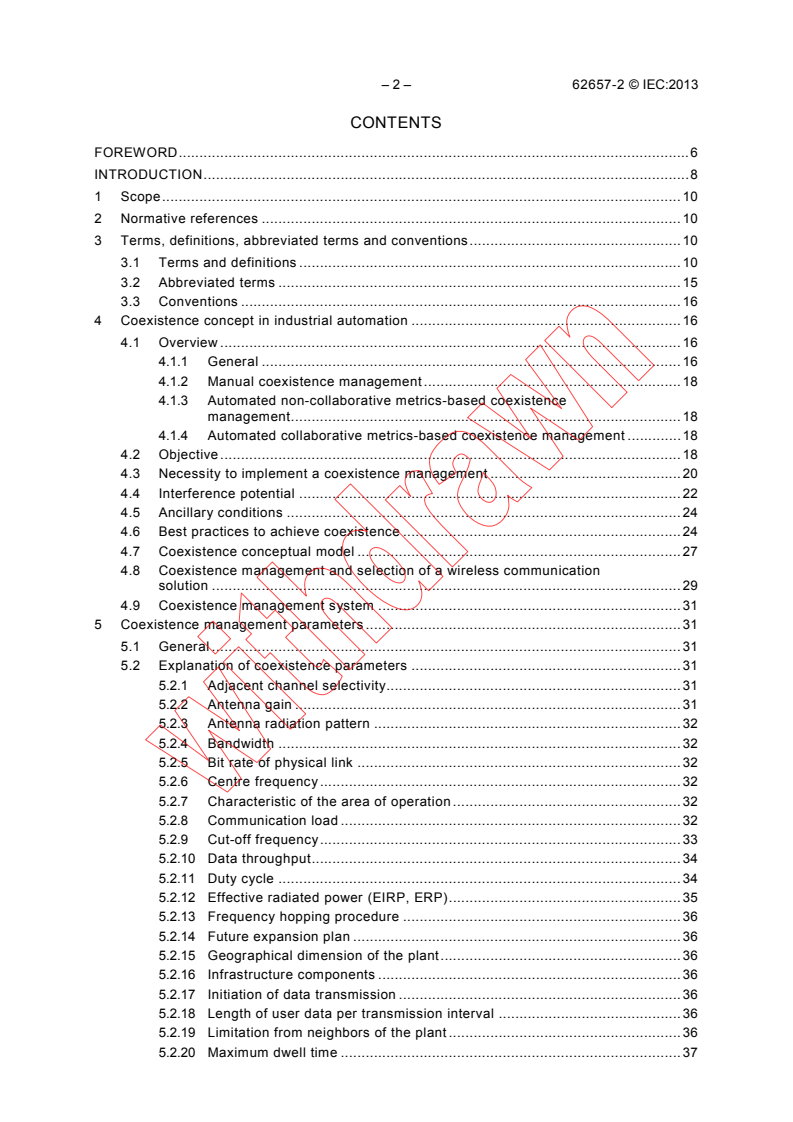
– 2 – 62657-2 © IEC:2013
CONTENTS
FOREWORD . 6
INTRODUCTION . 8
1 Scope . 10
2 Normative references . 10
3 Terms, definitions, abbreviated terms and conventions . 10
3.1 Terms and definitions . 10
3.2 Abbreviated terms . 15
3.3 Conventions . 16
4 Coexistence concept in industrial automation . 16
4.1 Overview . 16
4.1.1 General . 16
4.1.2 Manual coexistence management . 18
4.1.3 Automated non-collaborative metrics-based coexistence
management. 18
4.1.4 Automated collaborative metrics-based coexistence management . 18
4.2 Objective . 18
4.3 Necessity to implement a coexistence management . 20
4.4 Interference potential . 22
4.5 Ancillary conditions . 24
4.6 Best practices to achieve coexistence . 24
4.7 Coexistence conceptual model . 27
4.8 Coexistence management and selection of a wireless communication
solution . 29
4.9 Coexistence management system . 31
5 Coexistence management parameters . 31
5.1 General . 31
5.2 Explanation of coexistence parameters . 31
5.2.1 Adjacent channel selectivity . 31
5.2.2 Antenna gain . 31
5.2.3 Antenna radiation pattern . 32
5.2.4 Bandwidth . 32
5.2.5 Bit rate of physical link . 32
5.2.6 Centre frequency . 32
5.2.7 Characteristic of the area of operation . 32
5.2.8 Communication load . 32
5.2.9 Cut-off frequency . 33
5.2.10 Data throughput . 34
5.2.11 Duty cycle . 34
5.2.12 Effective radiated power (EIRP, ERP) . 35
5.2.13 Frequency hopping procedure . 36
5.2.14 Future expansion plan . 36
5.2.15 Geographical dimension of the plant . 36
5.2.16 Infrastructure components . 36
5.2.17 Initiation of data transmission . 36
5.2.18 Length of user data per transmission interval . 36
5.2.19 Limitation from neighbors of the plant . 36
5.2.20 Maximum dwell time . 37
62657-2 © IEC:2013 – 3 –
5.2.21 Maximum number of retransmissions . 37
5.2.22 Maximum transmitter sequence . 37
5.2.23 Mechanisms for adaptivity . 38
5.2.24 Medium access control mechanism. 39
5.2.25 Modulation . 39
5.2.26 Natural environmental conditions . 39
5.2.27 Device characterization parameters . 39
5.2.28 Other frequency users . 39
5.2.29 Packet loss rate (PLR) . 39
5.2.30 Physical links . 40
5.2.31 Positions of wireless devices and distances between them . 40
5.2.32 Power spectral density (PSD) . 40
5.2.33 Purpose of the automation application . 41
5.2.34 Radio channel . 41
5.2.35 Radio propagation conditions . 41
5.2.36 Receiver blocking . 42
5.2.37 Receiver maximum input level . 42
5.2.38 Receiver sensitivity. 42
5.2.39 Regional radio regulations . 42
5.2.40 Relative movement . 42
5.2.41 Reliability required . 42
5.2.42 Response time . 43
5.2.43 Security level required . 43
5.2.44 Spatial coverage of the wireless communication network . 43
5.2.45 Spurious response . 43
5.2.46 Topology . 44
5.2.47 Total radiated power (TRP). 44
5.2.48 Transmission gap . 44
5.2.49 Transmission interval . 45
5.2.50 Transmission time . 45
5.2.51 Transmitter spectral mask . 47
5.2.52 Type of antenna . 48
5.2.53 Update time . 48
5.2.54 Used frequency bands . 49
5.2.55 Wireless devices . 49
5.2.56 Wireless communication networks . 49
5.2.57 Wireless technology or standard . 50
6 Coexistence management information structures . 50
6.1 General . 50
6.2 General plant characteristic . 51
6.3 Application communication requirements . 52
6.3.1 Overview . 52
6.3.2 Requirements influencing the characteristic of wireless solutions . 52
6.3.3 Performance requirements . 53
6.4 Characteristic of wireless system type and wireless device type . 53
6.4.1 Overview . 53
6.4.2 Characteristic of wireless system type . 54
6.4.3 Characteristic of wireless devices type . 55
6.5 Characteristic of wireless communication solution . 57
– 4 – 62657-2 © IEC:2013
6.5.1 Overview . 57
6.5.2 Characteristic of a wireless network solution . 58
6.5.3 Characteristic of wireless devices solution . 58
7 Coexistence management process . 59
7.1 General . 59
7.1.1 Overview . 59
7.1.2 Documentation . 60
7.1.3 Suitable documentation method . 62
7.1.4 Application of tools . 63
7.2 Establishment of a coexistence management system . 63
7.2.1 Nomination of a coexistence manager . 63
7.2.2 Responsibility of a coexistence manager . 64
7.2.3 Support by radio experts. 64
7.2.4 Training . 64
7.3 Maintaining coexistence management system . 65
7.4 Phases of a coexistence management process . 65
7.4.1 Investigation phase . 65
7.4.2 Planning phase . 68
7.4.3 Implementation phase . 70
7.4.4 Operation phase . 71
8 Coexistence parameter templates. 73
Bibliography . 77
Figure 1 – Area of consideration . 20
Figure 2 – Examples of wireless equipment in industrial environments . 21
Figure 3 – Progression of expense to achieve coexistence corresponding to the
application classes . 24
Figure 4 – Separation of wireless communication systems according to frequency and
time . 25
Figure 5 – Coexistence conceptual model . 28
Figure 6 – Flow chart of the coexistence conceptual model . 29
Figure 7 – Selection of a wireless communication system in the coexistence
management process . 30
Figure 8 – Communication load in case of two wireless devices . 33
Figure 9 – Communication load in the case of several wireless devices . 33
Figure 10 – Cut-off frequencies derived from maximum power level . 34
Figure 11 – Duty cycle . 35
Figure 12 – Maximum dwell time . 37
Figure 13 – Maximum transmitter sequence . 38
Figure 14 – Distance of the radio components . 40
Figure 15 – Power spectral density of an IEEE 802.15.4 system . 41
Figure 16 – Minimum transmission gap . 44
Figure 17 – Communication cycle, application event interval and machine cycle . 45
Figure 18 – Example of the density functions of transmission time . 46
Figure 19 – Example of the distribution functions of transmission time . 47
Figure 20 – Transmitter spectral mask of an IEEE 802.15.4 system . 48
62657-2 © IEC:2013 – 5 –
Figure 21 – Example of distribution functions of the update time . 49
Figure 22 – Principle for use of coexistence parameters . 50
Figure 23 – Parameters to describe the general plant characteristic . 51
Figure 24 – Parameters to describe application communication requirements . 52
Figure 25 – Parameters to describe wireless network type and device type . 54
Figure 26 – Power spectral density and transmitter spectral mask of a DECT system . 56
Figure 27 – Medium utilization in time and frequency of a DECT system . 56
Figure 28 – Parameters to describe a wireless communication solution . 58
Figure 29 – Relations of the documents in a coexistence management system
specification . 62
Figure 30 – Planning of a wireless communication system in the coexistence
management process . 69
Figure 31 – Implementation and operation of a wireless communication system in the
coexistence management process . 72
Table 1 – Classification of application communication requirements . 19
Table 2 – Application profile dependent observation time values . 35
Table 3 – List of parameters used to describe the general plant characteristic . 51
Table 4 – List of parameters used to describe the requirements influencing the
characteristic of wireless solutions . 53
Table 5 – List of parameters used to describe performance requirements . 53
Table 6 – List of parameters used to describe the wireless system type . 55
Table 7 – List of parameters used to describe the transmitter of a wireless device type . 57
Table 8 – List of parameters used to describe the receiver of a wireless device type . 57
Table 9 – List of parameters used to describe a wireless network solution . 58
Table 10 – List of parameters used to describe the transmitter of a wireless device
solution . 59
Table 11 – List of parameters used to describe the receiver of a wireless device
solution . 59
Table 12 – Template used to describe the general plant characteristic . 73
Table 13 – Template used to describe the application communication requirements . 74
Table 14 – Template used to describe the wireless system type . 74
Table 15 – Template used to describe a wireless device type . 75
Table 16 – Template used to describe the wireless network solution . 75
Table 17 – Template used to describe a wireless device solution . 76
– 6 – 62657-2 © IEC:2013
INTERNATIONAL ELECTROTECHNICAL COMMISSION
____________
INDUSTRIAL COMMUNICATION NETWORKS –
WIRELESS COMMUNICATION NETWORKS –
Part 2: Coexistence management
FOREWORD
1) The International Electrotechnical Commission (IEC) is a worldwide organization for standardization comprising
all national electrotechnical committees (IEC National Committees). The object of IEC is to promote
international co-operation on all questions concerning standardization in the electrical and electronic fields. To
this end and in addition to other activities, IEC publishes International Standards, Technical Specifications,
Technical Reports, Publicly Available Specifications (PAS) and Guides (hereafter referred to as “IEC
Publication(s)”). Their preparation is entrusted to technical committees; any IEC National Committee interested
in the subject dealt with may participate in this preparatory work. International, governmental and non-
governmental organizations liaising with the IEC also participate in this preparation. IEC collaborates closely
with the International Organization for Standardization (ISO) in accordance with conditions determined by
agreement between the two organizations.
2) The formal decisions or agreements of IEC on technical matters express, as nearly as possible, an international
consensus of opinion on the relevant subjects since each technical committee has representation from all
interested IEC National Committees.
3) IEC Publications have the form of recommendations for international use and are accepted by IEC National
Committees in that sense. While all reasonable efforts are made to ensure that the technical content of IEC
Publications is accurate, IEC cannot be held responsible for the way in which they are used or for any
misinterpretation by any end user.
4) In order to promote international uniformity, IEC National Committees undertake to apply IEC Publications
transparently to the maximum extent possible in their national and regional publications. Any divergence
between any IEC Publication and the corresponding national or regional publication shall be clearly indicated in
the latter.
5) IEC itself does not provide any attestation of conformity. Independent certification bodies provide conformity
assessment services and, in some areas, access to IEC marks of conformity. IEC is not responsible for any
services carried out by independent certification bodies.
6) All users should ensure that they have the latest edition of this publication.
7) No liability shall attach to IEC or its directors, employees, servants or agents including individual experts and
members of its technical committees and IEC National Committees for any personal injury, property damage or
other damage of any nature whatsoever, whether direct or indirect, or for costs (including legal fees) and
expenses arising out of the publication, use of, or reliance upon, this IEC Publication or any other IEC
Publications.
8) Attention is drawn to the Normative references cited in this publication. Use of the referenced publications is
indispensable for the correct application of this publication.
9) Attention is drawn to the possibility that some of the elements of this IEC Publication may be the subject of
patent rights. IEC shall not be held responsible for identifying any or all such patent rights.
International Standard IEC 62657-2 has been prepared by subcommittee 65C: Industrial
networks, of IEC technical committee 65: Industrial-process measurement, control and
automation.
The text of this standard is based on the following documents:
FDIS Report on voting
65C/736/FDIS 65C/740/RVD
Full information on the voting for the approval of this standard can be found in the report on
voting indicated in the above table.
This first edition cancels and replaces IEC/TS 62657-2, published in 2011.
62657-2 © IEC:2013 – 7 –
The main changes with respect to the TS are:
a) updated the normative references, terms, definitions, symbols, abbreviations;
b) corrected spelling;
c) changed figures to make them consistent with the text and vice versa;
d) added and modified text to make the text more readable.
This publication has been drafted in accordance with the ISO/IEC Directives, Part 2.
A list of all parts of the IEC 62657 series, under the general title Industrial communication
networks – Wireless communication networks, can be found on the IEC website.
The committee has decided that the contents of this publication will remain unchanged until
the stability date indicated on the IEC web site under "http://webstore.iec.ch" in the data
related to the specific publication. At this date, the publication will be
• reconfirmed,
• withdrawn,
• replaced by a revised edition, or
• amended.
IMPORTANT – The 'colour inside' logo on the cover page of this publication indicates
that it contains colours which are considered to be useful for the correct
understanding of its contents. Users should therefore print this document using a
colour printer.
– 8 – 62657-2 © IEC:2013
INTRODUCTION
The market is in need of network solutions, each with different performance characteristics
and functional capabilities, matching diverse application requirements. Industrial automation
applications cover different industrial application domains like:
– process automation, covering for example the following industry branches
• oil & gas, refining,
• chemical,
• pharmaceutical,
• mining,
• pulp & paper,
• water & wastewater,
• steel
– electric power like
• power generation (for example wind turbine),
• power distribution (grid),
– factory automation, covering for example the following industry branches
• food & beverage,
• automotive,
• machinery,
• semiconductor.
Industrial automation applications require behaviors of wireless communication networks that
are different from those that are used for example in telecommunications or for commercial
like a remote control or toy. These industrial automation requirements are identified and
provided in IEC/TS 62657-1.
In industrial automation, many different wireless communication networks may operate in the ®
1 2
same premises. Examples of these networks are IEC 62591 [6] (WirelessHART ),
IEC 62601 [7] (WIA-PA) and IEC/PAS 62734 [9] (ISA100.11a); all these networks use
IEEE 802.15.4 [18] for the process automation applications. Other examples of wireless
networks are specified in IEC 61784-1 [3] and IEC 61784-2 [4] CPs that use IEEE 802.11 [14]
and IEEE 802.15.1 [16] for factory automation applications. Different to wired fieldbuses, the
wireless communication interfaces can interfere with others on the same premises or
environment, disturbing each other. Therefore, without a predictable assuredness of
coexistence, it could be problematic to have multiple wireless communication networks in the
same facility or environment, especially because the time-criticality, the safety and the
security of the operation may not be ensured in such an environment.
This part of the IEC 62657 addresses the coexistence management for a predictable
assuredness of coexistence.
______________
Figures in square brackets refer to the Bibliography.
WirelessHART is the registered trade name of the HART Communication Foundation. This information is given
for the convenience of users of this document and does not constitute an endorsement by IEC of the product
named. Equivalent products may be used if they can be shown to lead to the same results.
62657-2 © IEC:2013 – 9 –
The IEC 62657 series has two parts:
• Part 1: Wireless communication requirements and spectrum considerations
• Part 2: Coexistence management
IEC/TS 62657-1 [8] provides general requirements of industrial automation and spectrum
considerations that are the basis for industrial communication solutions. This second part of
IEC 62657 specifies the coexistence management with a predictable assuredness of
coexistence. It is intended to facilitate harmonization of future adjustments to international,
national, and local regulations.
This Part 2 of IEC 62657 provides the coexistence management concept and process. Based
on the coexistence management process, a predictable assuredness of coexistence can be
achieved for a given spectrum with certain application requirements.
This Part 2 of IEC 62657 provides guidance to the users of wireless communication networks
on selection and proper use of wireless communication networks. To provide suitable wireless
devices to the market, it also serves vendors in describing the behaviors of wireless devices
to build wireless communication networks matching the application requirements.
This Part 2 of IEC 62657 is based on analyses of a number of International Standards, which
focus on specific technologies. The intention of this standard is not to invent new parameters
but to use already defined ones and to be technology independent.
– 10 – 62657-2 © IEC:2013
INDUSTRIAL COMMUNICATION NETWORKS –
WIRELESS COMMUNICATION NETWORKS –
Part 2: Coexistence management
1 Scope
This Part 2 of IEC 62657
• specifies the fundamental assumptions, concepts, parameters, and procedure for wireless
communication coexistence;
• specifies coexistence parameters and how they are used in an application requiring
wireless coexistence;
• provides guidelines, requirements, and best practices for wireless communication's
availability and performance in an industrial automation plant; it covers the life cycle of
wireless communication coexistence;
• helps the work of all persons involved with the relevant responsibilities to cope with the
critical aspects at each phase of life cycle of the wireless communication coexistence
management in an industrial automation plant. Life cycle aspects include: planning,
design, installation implementation, operation, maintenance, administration and training;
• provides a common point of reference for wireless communication coexistence for
industrial automation sites as a homogeneous guideline to help the users assess and
gauge their plant efforts;
• deals with the operational aspects of wireless communication coexistence regarding both
the static human/tool-organization and the dynamic network self-organization.
This Part 2 of IEC 62657 will provide a major contribution to national and regional regulations.
It does not exempt devices to conform to all requirements of national and regional regulations.
EXAMPLE 1 This Part 2 of IEC 62657 could be listed as a harmonized standard in the Official Journal of the
European Union (OJEU) to address the requirements of the European R&TTE directive, Article 3.2 [20], in addition
to other applicable harmonized standards.
EXAMPLE 2 This Part 2 of IEC 62657 could be listed in the Korean Enforcement Decree of the Radio Regulation
Law, Article 18 [21].
2 Normative references
None
3 Terms, definitions, abbreviated terms and conventions
3.1 Terms and definitions
For the purposes of this document, the following terms and definitions apply.
3.1.1
adjacent channel interference
interference that occurs when two or more wireless applications use adjacent frequency
channels
62657-2 © IEC:2013 – 11 –
3.1.2
adjacent channel selectivity
ability of a radio receiver to respond to the desired signal and to reject signals in adjacent
frequency channels
3.1.3
antenna
structure or device used to collect or radiate electromagnetic waves
3.1.4
antenna gain
ratio of the power required at the input of a reference antenna to the power supplied to the
input of the given antenna to produce, in a given direction, the same field strength at the
same distance
[SOURCE: Federal Standard 1037C:1996, modified] [19]
3.1.5
antenna radiation pattern
variation of the field intensity of an antenna as an angular function with respect to the axis
3.1.6
automation application
application of measurement and automatic control in the industrial automation domains
3.1.7
automation application data length
number of octets that are exchanged at the communication interface
3.1.8
bandwidth
difference between upper cut-off frequency and lower cut-off frequency
3.1.9
centre frequency
geometric mean of lower cut-off frequency and upper cut-off frequency of a radio channel
3.1.10
channel occupation
time in which the medium is busy
Note 1 to entry: Beyond the pure transfer of user data, this time includes all time slices necessary to process the
transmission protocol, for example to transfer an acknowledgement.
3.1.11
co-channel
emissions or transmissions in the same frequency channel
[SOURCE: IEC 60050-713:1998, 713-06-23, modified] [1]
3.1.12
coexistence
wireless communication coexistence
state in which all wireless communication solutions of a plant using shared medium fulfill all
their application communication requirements
Note 1 to entry: This is consistent with the definition of coexistence in IEEE 802.15.2-2003 [17].
– 12 – 62657-2 © IEC:2013
3.1.13
coexistence assessment
undertaking of an investigation in order to arrive at a judgment, based on evidence of the
suitability of a set of products and their installation to achieve coexistence
[SOURCE: derived from IEC 62278:2002, 3.2] [5]
3.1.14
coexistence management
process to establish and to maintain coexistence that includes technical and organizational
measures
3.1.15
coexistence planning
process that describes the allocation of wireless communication resources (time, frequencies,
coding, space) to each wireless communication system in order to achieve coexistence
3.1.16
communication interface
exposed interface between an automation application and the wireless component
Note 1 to entry: There is no consistently defined interface for measurement and automation. The interface of the
device might be a serial or a parallel hardware interface, a fieldbus interface, a software interface, or serial,
parallel, discrete, and analog interface.
3.1.17
communication load
requirement of the automation application to transfer a certain amount of user data within a
certain period of time
3.1.18
duty cycle
ratio of the transmitter sequence referenced to a given observation time for the used radio
channel
3.1.19
dwell time
period spent at a particular frequency during any single hop of a frequency hopping system
3.1.20
effective radiated power
ERP
power supplied to the antenna multiplied by antenna gain
3.1.21
frequency band
range in the frequency spectrum that is assigned by regulatory organizations for use for
specific applications
3.1.22
frequency channel
part of a frequency band that is used under a specification (standard or device specification)
by a wireless communication system
Note 1 to entry: The coordinated use of different frequency channels is one of the measures to achieve
coexistence.
62657-2 © IEC:2013 – 13 –
3.1.23
immunity
ability of an item to continue operating properly in the event of an interference, up to a certain
level of interference, and to be resilient above this level
Note 1 to entry: Immunity of an item is achieved by adding to the robustness of the item the ability to be resilient
to interference.
3.1.24
intermodulation sensitivity
levels of out-of-band interfering signals that, when mixed in the receiver front-end, produce an
in-band third order non-linearity product
3.1.25
jitter
time variation of an expected occurrence
Note 1 to entry: Examples are variation of transmission time and update time.
3.1.26
lower cut-off frequency
frequency furthest below the frequency of maximum power where the power spectral density
drops below a certain level
3.1.27
mechanisms for adaptivity
measures to modify one or more of the systems operational parameters in order to improve
the systems robustness against interferences and to minimize the medium utilization
3.1.28
metrics
set of quantitative indicators corresponding to selected properties of a communication device,
equipment, or wireless communication system
3.1.29
plant
the facility under consideration, including its physical area of operation, personnel, equipment
and all other contents
3.1.30
power spectral density
signal power per defined bandwidth
3.1.31
radio channel
span of the frequency spectrum which is characterized by lower cut-off frequency and upper
cut-off frequency or by centre frequency and bandwidth
3.1.32
(radio) resource
means used by multiple wireless communication solutions for the purpose of radio signal
transmission
3.1.33
radio robustness
attribute of wireless communication to fulfill the designated function despite the presence of
other active wireless communication applications interfering in the sphere of influence
Note 1 to entry: This term has the same meaning as the definition of the term coexistence in IEEE 802.15.2-2003,
3.1.2 [17].
– 14 – 62657-2 © IEC:2013
3.1.34
receiver blocking
effect of a strong out-of-band interfering signal on the receiver’s ability to detect a low-level
wanted signal
3.1.35
receiver maximum input level
maximum signal power that the system can tolerate without distortion of the signal
3.1.36
receiver sensitivity
minimal signal power to receive data with a defined bit error rate
3.1.37
robustness
ability of an item to continue operating properly in the event of an interference, up to a certain
level of the interference
Note 1 to entry: The robustness of an item may be increased with measures that modify one or more of its
operational parameters.
3.1.38
shared medium
resource of frequency band in particular area shared by several wireless applications
Note 1 to entry: In the industrial, scientific and medical (ISM)-bands many wireless applications are used. Due to
this joint use, the term shared medium is used in this part of IEC 62657. The frequency bands are used by diverse
ISM and wireless applications.
3.1.39
spurious response
receiver output due to unwanted signals
Note 1 to entry: That means having frequencies other than those of the tuned frequency channel.
3.1.40
total radiated power
spatial power density integrated across the surface of the sphere
3.1.41
transmission gap
gap between two successive channel usages by a transmitter
3.1.42
transmission interval
time difference between two consecutive transfers of user data from the automation
application via the communication interface to the communication module
3.1.43
transmission sequence duration
time that a transmitter uses the spectrum for the specific sequence in order to transfer data
3.1.44
transmitter spectral mask
maximum limit of power spectral density over
...