

IEC TS 60870-5-601:2015
(Main)Telecontrol equipment and systems - Part 5-601: Transmission protocols - Conformance test cases for the IEC 60870-5-101 companion standard
General Information
- Abstract
IEC TS 60870-5-601:2015(E) describes test cases for conformance testing of telecontrol equipment, Substation Automation Systems (SAS) and telecontrol systems, including front-end functions of SCADA. The use of this part of IEC 60870 facilitates interoperability by providing a standard method of testing protocol implementations, but it does not guarantee interoperability of devices. It is expected that using this part of IEC 60870 during testing will minimize the risk of non-interoperability. The goal of this part of IEC 60870 is to enable unambiguous and standardised evaluation of IEC 60870-5 companion standard protocol implementations. The guidelines and conditions for the testing environment are described in IEC 60870-5-6. This new edition includes the following significant technical changes with respect to the previous edition:
- resolving ambiguities and inconsistencies between IEC 0870-5-101:2003 and IEC TS 60870-5-601:2006;
- enhancements and optimisation of test cases which are needed to prove conformance with IEC 60870-5-101:2003.
This publication is to be read in conjunction with IEC 60870-5-101:2003
- Status
- Published
- Publication Date
- 17-Sep-2026
- Technical Committee
- TC 57 - Power systems management and associated information exchange
- Drafting Committee
- WG 3 - TC 57/WG 3
- Current Stage
- PPUB - Publication issued
- Start Date
- 08-Oct-2015
- Completion Date
- 15-Dec-2015
Buy Documents
IEC TS 60870-5-601:2015 - Telecontrol equipment and systems - Part 5-601: Transmission protocols - Conformance test cases for the IEC 60870-5-101 companion standard Released:10/8/2015
IEC TS 60870-5-601:2015+AMD1:2026 CSV - Telecontrol equipment and systems - Part 5-601: Transmission protocols - Conformance test cases for the IEC 60870-5-101 companion standard
Overview
IEC TS 60870-5-601:2015 is a technical specification developed by the International Electrotechnical Commission (IEC) under the reference IEC TS 60870-5-601:2015. This document defines standardized conformance test cases for telecontrol equipment, Substation Automation Systems (SAS), and telecontrol systems, including SCADA front-end functions, using the IEC 60870-5-101 companion standard for transmission protocols. Its purpose is to enable unambiguous, systematic, and repeatable evaluation of IEC 60870-5-101 protocol implementations and to facilitate greater interoperability within telecontrol and automation infrastructures.
By applying the standardized test cases described in IEC TS 60870-5-601, manufacturers, system integrators, and end-users can assess the degree to which their equipment and systems conform to the communication protocol requirements specified in IEC 60870-5-101, thus reducing risks associated with non-interoperability.
Key Topics
IEC TS 60870-5-601:2015 covers several crucial areas:
- Scope of Testing: Defines conformance tests for various telecontrol devices and subsystems, focusing on protocol implementation rather than overall system interoperability.
- Configuration Parameters: Outlines critical configurable items impacting protocol behavior, such as transmission speed, addressing schemes, and supported message types.
- Test Procedures: Provides comprehensive test cases for verifying communication procedures, frame and message formats, and handling of application data.
- Verification & Reporting: Describes methods for automated and manual protocol verification, with clear criteria for marking results as Pass, Fail, Not Applicable, or Not Performed.
- Test Case Classification: Differentiates between mandatory and optional test cases based on device features and implementation, referencing device documentation like PICS and PIXIT.
- Compatibility Management: Addresses potential ambiguities between IEC 60870-5-101 and previous versions or amendments, ensuring that testing aligns with the most current protocol definitions.
- Negative Test Cases: Includes tests to verify correct handling of invalid, unsupported, or unexpected messages, helping prevent non-compliant behavior.
Applications
Applying IEC TS 60870-5-601:2015 has practical value in various industry scenarios:
- Manufacturers: Utilize the standard to validate new telecontrol equipment or protocol stacks for conformance before market release, ensuring robust implementation of IEC 60870-5-101.
- System Integrators: Employ test cases when integrating equipment from multiple vendors into substations, SCADA systems, and Telecontrol networks to minimize interoperability issues.
- Utility Operators: Ensure that devices procured and deployed in critical power system infrastructures conform to international communication standards, promoting operational reliability and vendor-neutral sourcing.
- Quality Assurance: Establish standardized and repeatable test routines in laboratories and certification bodies, improving the efficiency and credibility of conformance assessments.
- Protocol Upgrades: Assess the impact of protocol version changes or configuration modifications, supporting safer rollouts and migrations in complex operational environments.
Related Standards
IEC TS 60870-5-601:2015 is intended to be used in conjunction with other key international standards, especially those in the IEC 60870 series:
- IEC 60870-5-101:2003 – Transmission protocols - Companion standard for basic telecontrol tasks (primary reference for test case definitions).
- IEC 60870-5-6 – Guidelines for conformance testing for IEC 60870-5 companion standards (details test environment and procedures).
- IEC 60870-5-1/2/3/4/5 – Covers frame formats, transmission procedures, application data structures, and basic application functions.
- IEEE 754 – Standard for Binary Floating-Point Arithmetic (referenced where relevant data encoding is assessed).
Adherence to these standards and technical specifications together ensures consistency, reliability, and security across telecontrol and automation environments in the power and utility sectors.
Keywords: IEC TS 60870-5-601:2015, IEC 60870-5-101, conformance testing, telecontrol equipment, SCADA, substation automation, transmission protocols, interoperability, standard test cases, power system management.
Relations
- Effective Date
- 26-Oct-2025
- Effective Date
- 05-Sep-2023
Buy Documents
IEC TS 60870-5-601:2015 - Telecontrol equipment and systems - Part 5-601: Transmission protocols - Conformance test cases for the IEC 60870-5-101 companion standard Released:10/8/2015
IEC TS 60870-5-601:2015+AMD1:2026 CSV - Telecontrol equipment and systems - Part 5-601: Transmission protocols - Conformance test cases for the IEC 60870-5-101 companion standard
Get Certified
Connect with accredited certification bodies for this standard

BSI Group
BSI (British Standards Institution) is the business standards company that helps organizations make excellence a habit.

NYCE
Mexican standards and certification body.

ANCE
Mexican certification and testing association.
Sponsored listings
Frequently Asked Questions
IEC TS 60870-5-601:2015 is a technical specification published by the International Electrotechnical Commission (IEC). Its full title is "Telecontrol equipment and systems - Part 5-601: Transmission protocols - Conformance test cases for the IEC 60870-5-101 companion standard". This standard covers: IEC TS 60870-5-601:2015(E) describes test cases for conformance testing of telecontrol equipment, Substation Automation Systems (SAS) and telecontrol systems, including front-end functions of SCADA. The use of this part of IEC 60870 facilitates interoperability by providing a standard method of testing protocol implementations, but it does not guarantee interoperability of devices. It is expected that using this part of IEC 60870 during testing will minimize the risk of non-interoperability. The goal of this part of IEC 60870 is to enable unambiguous and standardised evaluation of IEC 60870-5 companion standard protocol implementations. The guidelines and conditions for the testing environment are described in IEC 60870-5-6. This new edition includes the following significant technical changes with respect to the previous edition: - resolving ambiguities and inconsistencies between IEC 0870-5-101:2003 and IEC TS 60870-5-601:2006; - enhancements and optimisation of test cases which are needed to prove conformance with IEC 60870-5-101:2003. This publication is to be read in conjunction with IEC 60870-5-101:2003
IEC TS 60870-5-601:2015(E) describes test cases for conformance testing of telecontrol equipment, Substation Automation Systems (SAS) and telecontrol systems, including front-end functions of SCADA. The use of this part of IEC 60870 facilitates interoperability by providing a standard method of testing protocol implementations, but it does not guarantee interoperability of devices. It is expected that using this part of IEC 60870 during testing will minimize the risk of non-interoperability. The goal of this part of IEC 60870 is to enable unambiguous and standardised evaluation of IEC 60870-5 companion standard protocol implementations. The guidelines and conditions for the testing environment are described in IEC 60870-5-6. This new edition includes the following significant technical changes with respect to the previous edition: - resolving ambiguities and inconsistencies between IEC 0870-5-101:2003 and IEC TS 60870-5-601:2006; - enhancements and optimisation of test cases which are needed to prove conformance with IEC 60870-5-101:2003. This publication is to be read in conjunction with IEC 60870-5-101:2003
IEC TS 60870-5-601:2015 is classified under the following ICS (International Classification for Standards) categories: 01 - GENERALITIES. TERMINOLOGY. STANDARDIZATION. DOCUMENTATION; 33.120.10 - Coaxial cables. Waveguides; 33.200 - Telecontrol. Telemetering; 35.110 - Networking. The ICS classification helps identify the subject area and facilitates finding related standards.
IEC TS 60870-5-601:2015 has the following relationships with other standards: It is inter standard links to IEC TS 60870-5-601:2015/AMD1:2026, IEC TS 60870-5-601:2006. Understanding these relationships helps ensure you are using the most current and applicable version of the standard.
IEC TS 60870-5-601:2015 is available in PDF format for immediate download after purchase. The document can be added to your cart and obtained through the secure checkout process. Digital delivery ensures instant access to the complete standard document.
Standards Content (Sample)
IEC TS 60870-5-601 ®
Edition 2.0 2015-10
TECHNICAL
SPECIFICATION
colour
inside
Telecontrol equipment and systems –
Part 5-601: Transmission protocols – Conformance test cases for the
IEC 60870-5-101 companion standard
All rights reserved. Unless otherwise specified, no part of this publication may be reproduced or utilized in any form
or by any means, electronic or mechanical, including photocopying and microfilm, without permission in writing from
either IEC or IEC's member National Committee in the country of the requester. If you have any questions about IEC
copyright or have an enquiry about obtaining additional rights to this publication, please contact the address below or
your local IEC member National Committee for further information.
IEC Central Office Tel.: +41 22 919 02 11
3, rue de Varembé Fax: +41 22 919 03 00
CH-1211 Geneva 20 info@iec.ch
Switzerland www.iec.ch
About the IEC
The International Electrotechnical Commission (IEC) is the leading global organization that prepares and publishes
International Standards for all electrical, electronic and related technologies.
About IEC publications
The technical content of IEC publications is kept under constant review by the IEC. Please make sure that you have the
latest edition, a corrigenda or an amendment might have been published.
IEC Catalogue - webstore.iec.ch/catalogue Electropedia - www.electropedia.org
The stand-alone application for consulting the entire The world's leading online dictionary of electronic and
bibliographical information on IEC International Standards, electrical terms containing more than 30 000 terms and
Technical Specifications, Technical Reports and other definitions in English and French, with equivalent terms in 15
documents. Available for PC, Mac OS, Android Tablets and additional languages. Also known as the International
iPad. Electrotechnical Vocabulary (IEV) online.
IEC publications search - www.iec.ch/searchpub IEC Glossary - std.iec.ch/glossary
The advanced search enables to find IEC publications by a More than 60 000 electrotechnical terminology entries in
variety of criteria (reference number, text, technical English and French extracted from the Terms and Definitions
committee,…). It also gives information on projects, replaced clause of IEC publications issued since 2002. Some entries
and withdrawn publications. have been collected from earlier publications of IEC TC 37,
77, 86 and CISPR.
IEC Just Published - webstore.iec.ch/justpublished
Stay up to date on all new IEC publications. Just Published IEC Customer Service Centre - webstore.iec.ch/csc
details all new publications released. Available online and If you wish to give us your feedback on this publication or
also once a month by email. need further assistance, please contact the Customer Service
Centre: csc@iec.ch.
IEC TS 60870-5-601 ®
Edition 2.0 2015-10
TECHNICAL
SPECIFICATION
colour
inside
Telecontrol equipment and systems –
Part 5-601: Transmission protocols – Conformance test cases for the
IEC 60870-5-101 companion standard
INTERNATIONAL
ELECTROTECHNICAL
COMMISSION
ICS 33.200 ISBN 978-2-8322-2926-2
– 2 – IEC TS 60870-5-601:2015 © IEC 2015
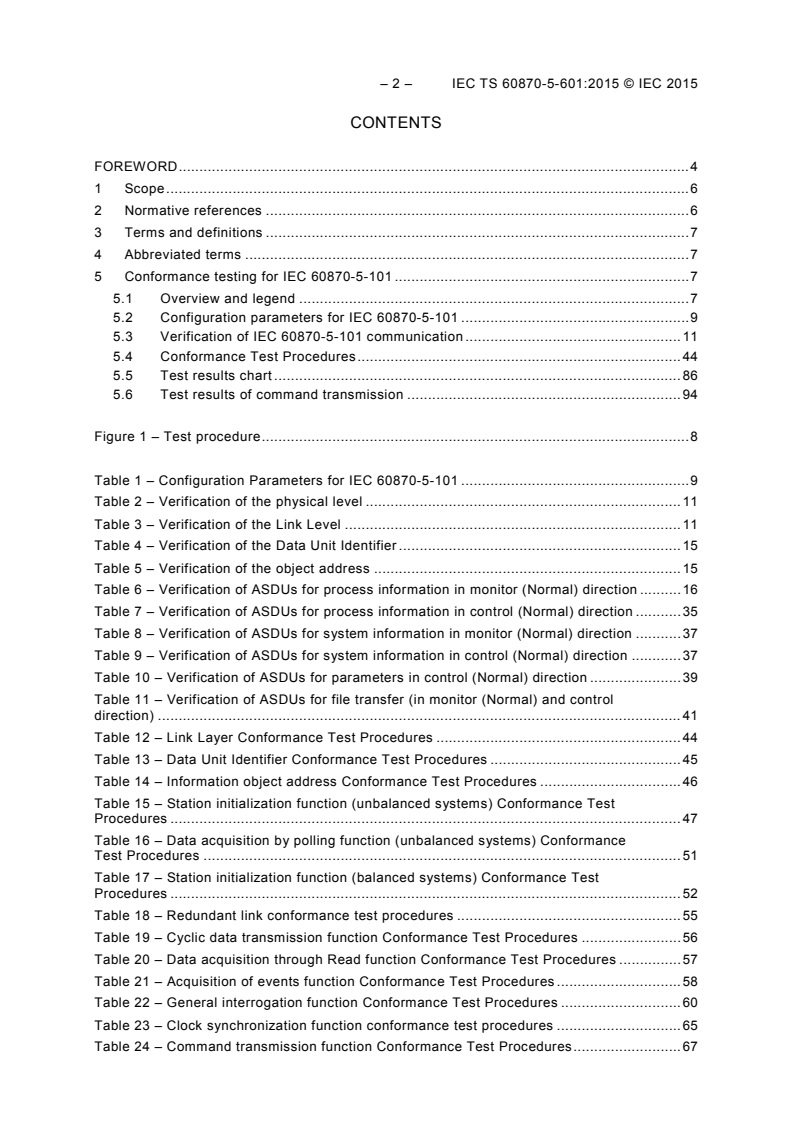
CONTENTS
FOREWORD . 4
1 Scope . 6
2 Normative references . 6
3 Terms and definitions . 7
4 Abbreviated terms . 7
5 Conformance testing for IEC 60870-5-101 . 7
5.1 Overview and legend . 7
5.2 Configuration parameters for IEC 60870-5-101 . 9
5.3 Verification of IEC 60870-5-101 communication . 11
5.4 Conformance Test Procedures . 44
5.5 Test results chart . 86
5.6 Test results of command transmission . 94
Figure 1 – Test procedure . 8
Table 1 – Configuration Parameters for IEC 60870-5-101 . 9
Table 2 – Verification of the physical level . 11
Table 3 – Verification of the Link Level . 11
Table 4 – Verification of the Data Unit Identifier . 15
Table 5 – Verification of the object address . 15
Table 6 – Verification of ASDUs for process information in monitor (Normal) direction . 16
Table 7 – Verification of ASDUs for process information in control (Normal) direction . 35
Table 8 – Verification of ASDUs for system information in monitor (Normal) direction . 37
Table 9 – Verification of ASDUs for system information in control (Normal) direction . 37
Table 10 – Verification of ASDUs for parameters in control (Normal) direction . 39
Table 11 – Verification of ASDUs for file transfer (in monitor (Normal) and control
direction) . 41
Table 12 – Link Layer Conformance Test Procedures . 44
Table 13 – Data Unit Identifier Conformance Test Procedures . 45
Table 14 – Information object address Conformance Test Procedures . 46
Table 15 – Station initialization function (unbalanced systems) Conformance Test
Procedures . 47
Table 16 – Data acquisition by polling function (unbalanced systems) Conformance
Test Procedures . 51
Table 17 – Station initialization function (balanced systems) Conformance Test
Procedures . 52
Table 18 – Redundant link conformance test procedures . 55
Table 19 – Cyclic data transmission function Conformance Test Procedures . 56
Table 20 – Data acquisition through Read function Conformance Test Procedures . 57
Table 21 – Acquisition of events function Conformance Test Procedures . 58
Table 22 – General interrogation function Conformance Test Procedures . 60
Table 23 – Clock synchronization function conformance test procedures . 65
Table 24 – Command transmission function Conformance Test Procedures . 67
Table 25 – Transmission of integrated totals (telecounting) function Conformance Test
Procedures . 74
Table 26 – Parameter loading function Conformance Test Procedures . 78
Table 27 – Test procedure function Conformance Test Procedures . 79
Table 28 – File transfer procedure function Conformance Test Procedures . 80
Table 29 – Delay acquisition procedure function conformance test procedures . 82
Table 30 – Additional Conformance Test Procedures . 83
Table 31 – Negative Conformance Test Procedures. 84
Table 32 – PIXIT related Conformance Test Procedures . 85
Table 33 – Test results chart . 86
Table 34 – Test results of single command transmission . 95
Table 35 – Test results of double command transmission . 96
Table 36 – Test results of regulating step command transmission . 98
Table 37 – Test results of setpoint command transmission . 100
– 4 – IEC TS 60870-5-601:2015 © IEC 2015
INTERNATIONAL ELECTROTECHNICAL COMMISSION
____________
TELECONTROL EQUIPMENT AND SYSTEMS –
Part 5-601: Transmission protocols – Conformance test cases for
the IEC 60870-5-101 companion standard
FOREWORD
1) The International Electrotechnical Commission (IEC) is a worldwide organization for standardization comprising
all national electrotechnical committees (IEC National Committees). The object of IEC is to promote
international co-operation on all questions concerning standardization in the electrical and electronic fields. To
this end and in addition to other activities, IEC publishes International Standards, Technical Specifications,
Technical Reports, Publicly Available Specifications (PAS) and Guides (hereafter referred to as “IEC
Publication(s)”). Their preparation is entrusted to technical committees; any IEC National Committee interested
in the subject dealt with may participate in this preparatory work. International, governmental and non-
governmental organizations liaising with the IEC also participate in this preparation. IEC collaborates closely
with the International Organization for Standardization (ISO) in accordance with conditions determined by
agreement between the two organizations.
2) The formal decisions or agreements of IEC on technical matters express, as nearly as possible, an international
consensus of opinion on the relevant subjects since each technical committee has representation from all
interested IEC National Committees.
3) IEC Publications have the form of recommendations for international use and are accepted by IEC National
Committees in that sense. While all reasonable efforts are made to ensure that the technical content of IEC
Publications is accurate, IEC cannot be held responsible for the way in which they are used or for any
misinterpretation by any end user.
4) In order to promote international uniformity, IEC National Committees undertake to apply IEC Publications
transparently to the maximum extent possible in their national and regional publications. Any divergence
between any IEC Publication and the corresponding national or regional publication shall be clearly indicated in
the latter.
5) IEC itself does not provide any attestation of conformity. Independent certification bodies provide conformity
assessment services and, in some areas, access to IEC marks of conformity. IEC is not responsible for any
services carried out by independent certification bodies.
6) All users should ensure that they have the latest edition of this publication.
7) No liability shall attach to IEC or its directors, employees, servants or agents including individual experts and
members of its technical committees and IEC National Committees for any personal injury, property damage or
other damage of any nature whatsoever, whether direct or indirect, or for costs (including legal fees) and
expenses arising out of the publication, use of, or reliance upon, this IEC Publication or any other IEC
Publications.
8) Attention is drawn to the Normative references cited in this publication. Use of the referenced publications is
indispensable for the correct application of this publication.
9) Attention is drawn to the possibility that some of the elements of this IEC Publication may be the subject of
patent rights. IEC shall not be held responsible for identifying any or all such patent rights.
The main task of IEC technical committees is to prepare International Standards. In
exceptional circumstances, a technical committee may propose the publication of a technical
specification when
• the required support cannot be obtained for the publication of an International Standard,
despite repeated efforts, or
• The subject is still under technical development or where, for any other reason, there is
the future but no immediate possibility of an agreement on an International Standard.
Technical specifications are subject to review within three years of publication to decide
whether they can be transformed into International Standards.
This technical specification is to be used in conjunction with
IEC 60870-5-101:2003/AMD1:2015. IEC 60870-5-101:2003/AMD1:2015 resolves ambiguities
and inconsistencies discovered by users of the standard and was worked out in parallel with
IEC 60870-5-601:2006.
IEC 60870-5-601, which is a technical specification, has been prepared by IEC technical
committee 57: Power systems management and associated information exchange.
This second edition cancels and replaces the first edition published in 2006. This edition
constitutes a technical revision.
This edition includes the following significant technical changes with respect to the previous
edition:
a) Resolving ambiguities and inconsistencies between IEC 60870-5-101:2003 and IEC TS
60870-5-601:2006;
b) Enhancements and optimisation of test cases which are needed to prove conformance
with IEC 60870-5-101:2003;
c) Additional negative test cases made to avoid circulation of messages not conformant with
IEC 60870-5-101:2003.
The text of this technical specification is based on the following documents:
Enquiry draft Report on voting
57/1528/DTS 57/1590/RVC
Full information on the voting for the approval of this technical specification can be found in
the report on voting indicated in the above Table.
This publication has been drafted in accordance with the ISO/IEC Directives, Part 2.
A list of all parts of the IEC 60870 series, under the general title Telecontrol equipment and
systems, can be found on the IEC website.
The committee has decided that the contents of this publication will remain unchanged until
the maintenance result date indicated on the IEC web site under "http://webstore.iec.ch" in
the data related to the specific publication. At this date, the publication will be
• transformed into an International standard,
• reconfirmed,
• withdrawn,
• replaced by a revised edition, or
• amended.
A bilingual version of this publication may be issued at a later date.
IMPORTANT – The 'colour inside' logo on the cover page of this publication indicates
that it contains colours which are considered to be useful for the correct
understanding of its contents. Users should therefore print this document using a
colour printer.
– 6 – IEC TS 60870-5-601:2015 © IEC 2015
TELECONTROL EQUIPMENT AND SYSTEMS –
Part 5-601: Transmission protocols – Conformance test cases for
the IEC 60870-5-101 companion standard
1 Scope
This part of IEC 60870describes test cases for conformance testing of telecontrol equipment,
Substation Automation Systems (SAS) and telecontrol systems, including front-end functions
of SCADA.
The use of this part of IEC 60870 facilitates interoperability by providing a standard method of
testing protocol implementations, but it does not guarantee interoperability of devices. It is
expected that using this part of IEC 60870 during testing will minimize the risk of non-
interoperability.
The goal of this part of IEC 60870 is to enable unambiguous and standardised evaluation of
IEC 60870-5 companion standard protocol implementations. The guidelines and conditions for
the testing environment are described in IEC 60870-5-6. The detailed test cases per
companion standard, containing among others mandatory and optional mandatory test cases
per Basic Application Function, ASDU and transmission procedures, will become available as
a technical specification (TS). Other functionality may need additional test cases but this is
beyond the scope of this part of IEC 60870. For proper testing, it is recommended to define
these additional test cases.
This part of IEC 60870 deals mainly with communication conformance testing; therefore other
requirements, such as safety or EMC are not covered. These requirements are covered by
other standards (if applicable) and the proof of compliance for these topics is done in
accordance with these standards.
2 Normative references
The following documents, in whole or in part, are normatively referenced in this document and
are indispensable for its application. For dated references, only the edition cited applies. For
undated references, the latest edition of the referenced document (including any
1.
amendments) applies
IEC 60870-5-1:1990, Telecontrol equipment and systems – Part 5: Transmission protocols –
Section One: Transmission frame formats
IEC 60870-5-2:1992, Telecontrol equipment and systems – Part 5: Transmission protocols –
Section 2: Link transmission procedures
—————————
The base standard always takes precedence. In case of ambiguity between this part of IEC 60870 and the base
standards (IEC 60870-5-1 to IEC 60870-5-5, IEC 60870-5-101), this part of IEC 60870 needs to be clarified or
amended.
When testing negative behaviour is not described in the base standard, the behaviour described in this part of
IEC 60870 shall prevail and shall be observed.
The conformance statement produced after testing shall indicate any lack of conformance to either the test plan
or the base standard.
IEC 60870-5-3:1992, Telecontrol equipment and systems – Part 5: Transmission protocols –
Section 3: General structure of application data
IEC 60870-5-4:1993, Telecontrol equipment and systems – Part 5: Transmission protocols –
Section 4: Definition and coding of application information elements
IEC 60870-5-5:1999, Telecontrol equipment and systems – Part 5: Transmission protocols –
Section 5: Basic application functions
IEC 60870-5-6, Telecontrol equipment and systems – Part 5-6: Guidelines for conformance
testing for the IEC 60870-5 companion standards
IEC 60870-5-101:2003, Telecontrol equipment and systems – Part 5-101: Transmission
protocols – Companion standard for basic telecontrol tasks
IEC 60870-5-101:2003/AMD1:2015
IEEE 754, Standard for Binary Floating-Point Arithmetic
3 Terms and definitions
For the purposes of this document, the terms and definitions given in IEC 60870-5-6 apply.
4 Abbreviated terms
For the purposes of this document, the abbreviations given in IEC 60870-5-6 apply.
5 Conformance testing for IEC 60870-5-101
5.1 Overview and legend
Procedural and functional testing should always start with the Station Initialization function
and proceeds with the next Basic Application Functions. The procedure in each test case
should be followed, which means that the DUT is able to function as described in the specific
test case.
The test procedures in Tables 1 to 14 should be tested with no errors detected during testing
of all the Basic Application Functions in Tables 15 to 32. These tests are preferably
automatically performed by the used test platform.
In addition to the performance criteria listed in the test procedures, Subclause 5.3 lists the
protocol specifications that should be verified automatically by the testing software or verified
manually by review of the test history log after execution of the test procedures. The
verification should result in no errors detected during the complete test procedure.
This test plan has a direct reference to the PICS and possibly a PIXIT. Without a reference to
a PICS or PIXIT, this test plan is obsolete.
Test case numbering syntax is Subclause number + Table number + test case number.
Test cases are mandatory depending on the description in the column ‘Required’. The
following situations are possible:
– 8 – IEC TS 60870-5-601:2015 © IEC 2015
M = Mandatory test case regardless if enabled in the PICS/PIXIT, not only in one
situation but during execution of all the tests as in the PICS and/or PIXIT
PICS, x.x = Mandatory test case if the functionality is enabled in the PICS (by marking the
applicable check box), with a reference to the Subclause number of the PICS
(x.x); For example: PICS 8.x always refers to IEC 60870-5-101:2003, Clause 8
PIXIT = Mandatory test case if the functionality is enabled/described in the PIXIT.
Verification of these test cases by the user/owner of the PIXIT is required
before the test is started
For each test case, the test results need to be marked in the appropriate column of the test
result chart in 5.5 and 5.6. Each test case can either pass the test (Passed), fail the test
(Failed), be not applicable when the configuration value is not supported by the device (N.A.),
or the test case was not performed (Empty). Ideally there should be no empty boxes when
testing is complete.
For testing reverse direction, the same test procedures apply in the opposite direction
(replace "Controlling" with "Controlled" and vice versa), except for COT44-47 which are only
defined in Monitor direction (only a controlled station is allowed to send these COT).
The test Tables are divided into five subclauses:
– Subclause 5.2, Configuration Parameters for IEC 60870-5-101
– Subclause 5.3, Verification of IEC 60870-5-101 communication
– Subclause 5.4, Conformance Test Procedures
– Subclause 5.5, Test Result Chart
– Subclause 5.6, Test Results of Command Transmission
The procedure to perform all the mandatory test cases according to the PID is shown in
Figure 1.
Tailored
test plan
Test
DUT configured according
to PID as in 5.2
Change the
configuration
Run the conformance test
and repeat
procedures according to 5.4
the tests in Perform each
mandatory test
5.3 and 5.4
case according
to the tailored
Do verification according to 5.3
test plan for the
for the mandatory test cases
configured DUT
Refer to Figure 2 in IEC 60870-5-6
Defects?
IEC
Figure 1 – Test procedure
5.2 Configuration parameters for IEC 60870-5-101
Since IEC 60870-5-101 contains a number of configuration parameters affecting protocol behaviour, it should be tested that the functionality in 5.3
and 5.4 is correct for the configuration(s) in Table 1.
Table 1 – Configuration Parameters for IEC 60870-5-101
Table 1a – Configuration Parameter Values
Test No. Test Description Reference Required
5.2.1.1 System definition Controlling station test (Master) PICS, 8.1
5.2.1.2 Controlled station test (Slave) PICS, 8.1
5.2.1.20 Physical layer Transmission speed(s) in control direction test maximum baud rate, minimum baud IEC 60870-5-101, 5.1 PICS, 8.3
rate, and one other baud rate. Perform all applicable test cases for one baud rate.
For the other tested baud rates, perform the following test cases: 5.4.15.1/5.4.15.10
and 5.4.22.1.
Transmission speed(s) in monitor direction test maximum baud rate, minimum baud
5.2.1.21 IEC 60870-5-101, 5.1 PICS, 8.3
rate, and one other baud rate. Perform all applicable test cases for one baud rate.
For the other tested baud rates, perform the following test cases: 5.4.15.1/5.4.15.10
and 5.4.22.1.
5.2.1.30 Link Layer Unbalanced transmission IEC 60870-5-2, 6 PICS, 8.4
5.2.1.31 Balanced transmission IEC 60870-5-2, 6 PICS, 8.4
5.2.1.40 Address field of the Link Zero (0) octets for address field (balanced only) IEC 60870-5-2, 5.1.3, 6.1.3 PICS, 8.4
5.2.1.41 One (1) octet for address field IEC 60870-5-2, 5.1.3, 6.1.3 PICS, 8.4
5.2.1.42 Two (2) octets for address field IEC 60870-5-2, 5.1.3, 6.1.3 PICS, 8.4
If more than one link address length is supported (see PICS, 8.4), then perform all PICS, 8.4
applicable test cases for one link address length. For the other link address lengths,
perform the following test cases: 5.4.15.1/5.4.15.10 and 5.4.22.1.
5.2.1.50 Frame length Maximum length L (control direction) IEC 60870-5-101, 6.2 PICS, 8.4
5.2.1.51 Maximum length L (monitor direction) IEC 60870-5-101, 6.2 PICS, 8.4
5.2.1.60 Assignment Class 2 Standard assignment of class 2 messages IEC 60870-5-101, 6.2, 7.4.2 PICS, 8.4
messages
5.2.1.61 Special assignments of class 2 messages IEC 60870-5-101, 6.2, 7.4.2 PIXIT
– 10 – IEC TS 60870-5-601:2015 © IEC 2015
Table 1b – Conformance Test Procedures only for system testing (for example in the case of interoperability testing)
Test No. Test Description Reference Required
5.2.1.70 COMMON ADDRESS of One (1) octet for Common Address of ASDU (CASDU) IEC 60870-5-101, 7.2.4 PICS, 8.5
ASDU
5.2.1.71 Two (2) octets for Common Address of ASDU (CASDU) IEC 60870-5-101, 7.2.4 PICS, 8.5
If more than one Common Address of ASDU length is supported (see PICS, 8.5), PICS, 8.5
then perform all applicable test cases for one Common Address of ASDU length. For
the other Common Address of ASDU length, perform the following test cases:
5.4.15.1/5.4.15.10 and 5.4.22.1.
INFORMATION OBJECT
5.2.1.80 One (1) octet for Information Object Address (structured or unstructured) IEC 60870-5-101, 7.2.5 PICS, 8.5
ADDRESS
5.2.1.81 Two (2) octets for Information Object Address (structured or unstructured) IEC 60870-5-101, 7.2.5 PICS, 8.5
5.2.1.82 Three (3) octets for Information Object Address (structured or unstructured) IEC 60870-5-101, 7.2.5 PICS, 8.5
If more than one Information Object Address length is supported (see PICS, 8.5), PICS, 8.5
then perform all applicable test cases for one Information Object Address length. For
the other Information Object Address lengths, perform the following test cases:
5.4.15.1/5.4.15.10 and 5.4.22.1.
5.2.1.90 CAUSE OF One (1) octet for COT field IEC 60870-5-101, 7.2.3 PICS, 8.5
nd
TRANSMISSION
5.2.1.91 Two (2) octets for COT field (2 octet is Originator address) IEC 60870-5-101, 7.2.3 PICS, 8.5
If more than one Cause of Transmission length is supported (see PICS, 8.5), then PICS, 8.5
perform all applicable test cases for one Cause of Transmission length. For the other
Cause of Transmission length, perform the following test cases: 5.4.15.1/5.4.15.10
and 5.4.22.1.
5.2.1.95 Total address length If multiple values for the lengths of the Link address, Common Address of ASDU, IEC 60870-5-101, 7.2.3 PICS, 8.4
Information Object Address or Cause of Transmission can be configured, then
PICS, 8.5
perform test cases 5.4.15.1/5.4.15.10 and 5.4.22.1 for the minimum possible total
length.
5.2.1.96 If multiple values for the lengths of the Link address, Common Address of ASDU, IEC 60870-5-101, 7.2.3 PICS, 8.4
Information Object Address or Cause of Transmission can be configured, then
PICS, 8.5
perform test cases 5.4.15.1/5.4.15.10 and 5.4.22.1 for the maximum possible total
length.
5.2.1.100 System definition System test (in case of interoperability testing) PICS, 8.1
5.2.1.110 Network configuration Point-to-point IEC 60870-5-101, 5.1 PICS, 8.2
5.2.1.111 Multiple point-to-point IEC 60870-5-101, 5.1 PICS, 8.2
5.2.1.112 Multipoint party line IEC 60870-5-101, 5.1 PICS, 8.2
5.2.1.113 Multipoint star IEC 60870-5-101, 5.1 PICS, 8.2
5.2.1.120 Address field of the Link Link address unstructured IEC 60870-5-2, 5.1.3, 6.1.3 PICS, 8.4
5.2.1.121 Link address structured IEC 60870-5-2, 5.1.3, 6.1.3 PICS, 8.4,
PIXIT
5.2.1.130 INFORMATION OBJECT Information Object Address unstructured IEC 60870-5-101, 7.2.5 PICS, 8.5
ADDRESS
5.2.1.131 Information Object Address structured IEC 60870-5-101, 7.2.5 PICS, 8.5
PIXIT
5.3 Verification of IEC 60870-5-101 communication
This subclause lists the protocol specifications that should be verified automatically by the testing software or verified manually by review of the test
history log after execution of the test procedures. Each test case describes a functionality that has passed the test if the functionality as in the
description column was proved to be correct. Correct means: the functionality should be checked either automatically or manually, and also be
checked by the test engineer in a human readable format log-file. For example, to test the IV qualifier of some information elements, the ASDU
containing this element should be sent with the IV=1.This should be automatically checked by the test software or observed by the test engineer in
the log-file. Each test case marked “Passed”, should be verifiable during testing and archived in log-files for post assessment.
To identify if a test case is mandatory, it is necessary to read 5.1 carefully.
Table 2 – Verification of the physical level
Test No. Test Description Reference Required
5.3.2.1 BYTEFRAME Start-/stop-bit, even parity IEC 60870-5-1:1990, 6.2.4.2 M
Table 3 – Verification of the Link Level (1 of 4)
Test No. Test Description Reference Required
5.3.3.10 FT1.2 FRAME LAYOUT Single control character I: E5 IEC 60870-5-1:1990, 6.2.4.2 PIXIT
H
5.3.3.11 (Single, Fixed and Variable) Start character of fixed length frames: 10 IEC 60870-5-1:1990, 6.2.4.2 M
H
5.3.3.12 0 octets (No User data) as Link User data length of fixed length frames IEC 60870-5-1:1990, 6.2.4.2 M
5.3.3.13 Start character of variable length frames: 68 IEC 60870-5-1:1990, 6.2.4.2 M
H
5.3.3.14 Configured number of octets L (repeated) as the maximum number of User IEC 60870-5-1:1990, 6.2.4.2 PICS, 8.4
Data octets from Controlling to Controlled station in variable length frames: Frame length
max. 255
5.3.3.15 Configured number of octets L (repeated) as the maximum number of User IEC 60870-5-1:1990, 6.2.4.2 PICS, 8.4
Frame length
Data octets from Controlled to Controlling station in variable length frames:
max. 255
5.3.3.16 Second start character of variable length frames: 68 IEC 60870-5-1:1990, 6.2.4.2 M
H
5.3.3.17 Single octet Control Field IEC 60870-5-1:1990, 6.2.4.2 M
5.3.3.18 Configured number of octets for Link address field IEC 60870-5-1:1990, 6.2.4.2 M
5.3.3.19 Checksum (8-bit arithmetic sum) IEC 60870-5-1:1990, 6.2.4.2 M
5.3.3.20 Stop character of fixed and variable length frames: 16 IEC 60870-5-1:1990, 6.2.4.2 M
H
– 12 – IEC TS 60870-5-601:2015 © IEC 2015
Table 3 (2 of 4)
Test No. Test Description Reference Required
5.3.3.30 BYTELAG Line idle intervals (stream of "1" bits) between characters of a frame do not IEC 60870-5-1:1990, 6.2.4.2 M
exceed one bit time (octets are received within 110 % of raw transmission time)
IEC 60870-5-101:2003, 6.1
5.3.3.40 CONTROL FIELD High order bit RES = 0 (unbalanced only) IEC 60870-5-2:1992, 5.1.2 PICS, 8.4
Unbalanced
5.3.3.41 DIR = 1 for messages from Controlling station (A) to Controlled station (B) IEC 60870-5-2:1992, 6.1.2 PICS, 8.4
Balanced
(balanced only)
5.3.3.42 DIR = 0 for messages from Controlled station (B) to Controlling station (A) IEC 60870-5-2:1992, 6.1.2 PICS, 8.4
Balanced
(balanced only)
5.3.3.43 PRM = 0 in messages from the Controlled station IEC 60870-5-2:1992, 5.1.2, 6.1.2 M
5.3.3.44 PRM = 0: only FCODEs 0, 1, 8, 9, 11, 14, or 15 (unbalanced only) IEC 60870-5-2:1992, 5.1.2 PICS, 8.4
Unbalanced
5.3.3.45 PRM = 0: only FCODEs 0, 1, 11, 14, or 15 (balanced only) IEC 60870-5-2:1992, 6.1.2 PICS, 8.4
Balanced
5.3.3.46 PRM = 1 in messages from the Controlling station IEC 60870-5-2:1992, 5.1.2, 6.1.2 M
5.3.3.47 PRM = 1: only Primary FCODEs 0, 1, 3, 4, 8, 9, 10 or 11 (unbalanced only) IEC 60870-5-2:1992, 5.1.2 PICS, 8.4
Unbalanced
5.3.3.48 PRM = 1: only Primary FCODEs 0, 1, 2, 3, 4 or 9 (balanced only) IEC 60870-5-2:1992, 6.1.2 PICS, 8.4
Balanced
5.3.3.49 In case of FCV = 1 and FCB unchanged, the last message is repeated IEC 60870-5-2:1992, 5.1.2, 6.1.2 M
5.3.3.50 In case of reset commands F-CODE 0 or 1 FCB = 0 (expect next FCB=1) IEC 60870-5-2:1992, 5.1.2, 6.1.2 M
5.3.3.51 DFC = 0: further messages are acceptable IEC 60870-5-2:1992, 5.1.2, 6.1.2 M
Table 3 (3 of 4)
Test No. Test Description Reference Required
5.3.3.52 DFC = 1: further messages may cause data overflow. Only applicable for IEC 60870-5-2:1992, 5.1.2, 6.3.3 PICS, 8.4
Balanced
Balanced communication
NOTE The following tests are only for Unbalanced systems (PICS 8.4). If ‘M’ is mentioned, the test case is mandatory for unbalanced systems.
5.3.3.60 UNBALANCED Unbalanced transmission IEC 60870-5-2:1992, Clause 5 PICS, 8.4
Unbalanced
TRANSMISSION
PROCEDURE
5.3.3.61 Service S1 – SEND/No reply IEC 60870-5-2:1992, 4.1 PIXIT
5.3.3.62 Service S2 – SEND/CONFIRM expected IEC 60870-5-2:1992, 4.2 M
5.3.3.63 Service S3 – REQUEST/RESPOND expected IEC 60870-5-2:1992, 4.3 M
5.3.3.64 Primary F-CODE 0: answered with Secondary F-CODE 0,1,14,15 IEC 60870-5-2:1992, 4.2.2, 5.1.2 PIXIT
5.3.3.65 Primary F-CODE 1: answered with Secondary F-CODE 0,1,14,15 IEC 60870-5-2:1992, 4.2.2, 5.1.2 PIXIT
5.3.3.66 Primary F-CODE 3: answered with Secondary F-CODE 0,1,14,15 IEC 60870-5-2:1992, 4.2.2, 5.1.2 PIXIT
5.3.3.67 Primary F-CODE 4: not answered by Secondary IEC 60870-5-2:1992, 4.1.2, 5.1.2 PIXIT
5.3.3.68 Primary F-CODE 8: answered with Secondary F-CODE 11, 14, 15 IEC 60870-5-2:1992, 4.3.2, 5.1.2 PIXIT
5.3.3.69 Primary F-CODE 9: answered with Secondary F-CODE 11, 14, 15 IEC 60870-5-2:1992, 4.3.2, 5.1.2 PIXIT
5.3.3.70 Primary F-CODE 10: answered with Secondary F-CODE 8, 9, 14, 15 IEC 60870-5-2:1992, 4.3.2, 5.1.2 PIXIT
5.3.3.71 Primary F-CODE 11: answered with Secondary F-CODE 8, 9, 14, 15 IEC 60870-5-2:1992, 4.3.2, 5.1.2 PIXIT
5.3.3.72 Primary F-CODE 2, 5.7, 12.15: answered with Secondary F-CODE 15 IEC 60870-5-2:1992, 4.2.2, 5.1.2 PIXIT
5.3.3.73 A not supported or implemented F-code is answered with Secondary F-CODE 14 IEC 60870-5-2:1992, 4.2.2, 5.1.2 M
or 15
– 14 – IEC TS 60870-5-601:2015 © IEC 2015
Table 3 (4 of 4)
Test No. Test Description Reference Required
NOTE The following tests are only for Balanced systems (PICS 8.4). If ‘M’ is mentioned, the test case is mandatory for balanced systems.
BALANCED PICS, 8.4
5.3.3.80 Balanced transmission IEC 60870-5-2:1992, Clause 6
Balanced
TRANSMISSION
PROCEDURE
5.3.3.81 Service S1 – SEND/No reply IEC 60870-5-2:1992, 4.1 PIXIT
5.3.3.82 Service S2 – SEND/CONFIRM expected IEC 60870-5-2:1992, 4.2 M
5.3.3.83 Service S3 – REQUEST/RESPOND expected IEC 60870-5-2:1992, 4.3 M
5.3.3.84 Primary F-CODE 0: answered with Secondary F-CODE 0,1,14,15 IEC 60870-5-2:1992, 4.2.2, 6.1.2 PIXIT
5.3.3.85 Primary F-CODE 1: answered with Secondary F-CODE 0,1,14,15 IEC 60870-5-2:1992, 4.2.2, 6.1.2 PIXIT
5.3.3.86 Primary F-CODE 2: answered with Secondary F-CODE 0,1,14,15 IEC 60870-5-2:1992, 4.1.2, 6.1.2 PIXIT
5.3.3.87 Primary F-CODE 3: answered with Secondary F-CODE 0,1,14,15 IEC 60870-5-2:1992, 4.3.2, 6.1.2 PIXIT
5.3.3.88 Primary F-CODE 4: not answered by Secondary IEC 60870-5-2:1992, 4.3.2, 6.1.2 PIXIT
5.3.3.89 Primary F-CODE 9: answered with Secondary F-CODE 11, 14, 15 IEC 60870-5-2:1992, 4.3.2, 6.1.2 PIXIT
5.3.3.90 Primary F-CODE 5.8, 10.15: answered with Secondary F-CODE 15 IEC 60870-5-2:1992, 4.2.2, 6.1.2 PIXIT
5.3.3.91 A not supported or implemented F-code is answered with Secondary F-CODE 14 IEC 60870-5-2:1992, 4.2.2, 6.1.2 M
or 15
5.3.3.100 TIME OUT INTERVAL Maximum time out interval (calculated) IEC 60870-5-2:1992, Clause A.1, PICS, 8.4
case 1, Figure A.2
– Controlling station does a retry when no answer is received
– Controlled station answers always within specified time
5.3.3.101 Controlling station uses the configured maximum number of retries for data link IEC 60870-5-2:1992, Clause 4 PICS, 8.4
services that are unanswered within the time out interval
Table 4 – Verification of the Data Unit Identifier
Test No. Test Description Reference Required
5.3.4.1 TYPE IDENTIFICATION Compatible ASDU type used/accepted for all ASDUs as in the PICS IEC 60870-5-101:2003, 7.2.1.1 PICS, 8.5
5.3.4.10 VARIABLE STRUCTURE Variable structure qualifier SQ=0 (Sequence or Set) as defined for each ASDU M
QUALIFIER
5.3.4.11 SQ:=1 only for COT Spontaneous (3), Cyclic/Periodic (1), Background Scan (2) or IEC 60870-5-101:2003, 7.2.2 PIXIT
Interrogation (20.36). Check the PICS for the supported COT values. Make sure
SQ=1 is only used for ASDU types that admit sequential packing.
5.3.4.12 Variable structure qualifier I (Number of elements) according to transmitted IEC 60870-5-101:2003, 7.2.2 M
number of information elements for each ASDU
5.3.4.13 The number of octets for ASDU are supported as in the PICS IEC 60870-5-101:2003, 7.2 M
5.3.4.20 CAUSE OF TRANSMISSION Originator address of Primary station is 0 if not used IEC 60870-5-101:2003, 7.2.3 PICS, 8.5
5.3.4.21 Originator address identifies source application of Primary station IEC 60870-5-101:2003, 7.2.3 PIXIT
5.3.4.22 IEC 60870-5-101:2003, 7.2.3 PICS, 8.5
Compatible Cause Of Transmission (COT) used/accepted. Check the PICS for the
supported COT values
5.3.4.23 P/N bit = 0: positive confirmation of activation IEC 60870-5-101:2003, 7.2.3 M
5.3.4.24 P/N bit = 1: negative confirmation of activation IEC 60870-5-101:2003, 7.2.3 M
5.3.4.25 Test bit = 0: ASDU generated during normal conditions IEC 60870-5-101:2003, 7.2.3 M
5.3.4.26 Test bit = 1: ASDU generated during test conditions IEC 60870-5-101:2003, 7.2.3 PIXIT
5.3.4.40 IEC 60870-5-101:2003, 7.2.4 PICS, 8.5
COMMON ADDRESS of The options of the Common Address of ASDU (CASDU) are tested and reported in
ASDU 5.5
Table 5 – Verification of the object address
Test No. Test Description Reference Required
5.3.5.50 INFORMATION OBJECT The options of the Information Object Address are tested and reported in 5.5 IEC 60870-5-101:2003, 7.2.5 PICS, 8.5
ADDRESS
– 16 – IEC TS 60870-5-601:2015 © IEC 2015
Table 6 – Verification of ASDUs for process information in monitor (Normal) direction (1 of 19)
Test No. Test Description Reference Required
5.3.6.10 M_SP_NA_1 SIQ with SQ = 0, each element with its own IOA IEC 60870-5-101:2003, 7.3.1.1 PICS, 8.5
ASDU 1
5.3.6.11 SIQ with SQ = 1, with only the IOA of the first element and the following IEC 60870-5-101:2003, 7.3.1.1 PIXIT
Information Elements are identified by numbers incrementing continuously by +1
Single-point information
from this offset (see IEC 60870-5-101:2003, 7.2.2.1)
5.3.6.12 COT as defined in the attached PICS IEC 60870-5-101:2003, 7.3.1.1 PICS, 8.5
5.3.6.13 SIQ SPI = 0 (OFF), 1 (ON) IEC 60870-5-101:2003, 7.2.6.1 PICS, 8.5
5.3.6.14 RES = 0 IEC 60870-5-101:2003, 7.2.6.1 PICS, 8.5
5.3.6.15 BL = 0,1 IEC 60870-5-101:2003, 7.2.6.1 PIXIT
5.3.6.16 SB = 0,1 IEC 60870-5-101:2003, 7.2.6.1 PIXIT
5.3.6.17 NT = 0,1 IEC 60870-5-101:2003, 7.2.6.1 PIXIT
5.3.6.18 IV = 0,1 IEC 60870-5-101:2003, 7.2.6.1 PICS, 8.5
5.3.6.30 M_SP_TA_1 SIQ with SQ = 0, each element with its own IOA IEC 60870-5-101:2003, 7.3.1.2 PICS, 8.5
ASDU 2
5.3.6.31 COT as defined in the attached PICS IEC 60870-5-101:2003, 7.3.1.2 PICS, 8.5
Single-point information
with time-tag
5.3.6.32 SIQ SPI = 0 (OFF), 1 (ON) IEC 60870-5-101:2003, 7.2.6.1 PICS, 8.5
5.3.6.33 RES = 0 IEC 60870-5-101:2003, 7.2.6.1 PICS, 8.5
5.3.6.34 BL = 0,1 IEC 60870-5-101:2003, 7.2.6.1 PIXIT
5.3.6.35 SB = 0,1 IEC 60870-5-101:2003, 7.2.6.1 PIXIT
5.3.6.36 NT = 0,1 IEC 60870-5-101:2003, 7.2.6.1 PIXIT
5.3.6.37 IV = 0,1 IEC 60870-5-101:2003, 7.2.6.1 PICS, 8.5
5.3.6.38 CP24TIME2a milliseconds = 0.59999 IEC 60870-5-101:2003, 7.2.6.19 PICS, 8.5
5.3.6.39 minutes = 0.59 IEC 60870-5-101:2003, 7.2.6.19 PICS, 8.5
5.3.6.40 RES1 = 0 IEC 60870-5-101:2003, 7.2.6.19 PICS, 8.5
5.3.6.41 IV = 0, 1 IEC 60870-5-101:2003, 7.2.6.19 PICS, 8.5
Table 6 (2 of 19)
Test No. Test Description Reference Required
5.3.6.50 M_DP_NA_1 DIQ with SQ = 0, each element with its own IOA IEC 60870-5-101:2003, 7.3.1.3 PICS, 8.5
ASDU 3
5.3.6.51 DIQ with SQ = 1, with only the IOA of the first element and the following IEC 60870-5-101:2003, 7.3.1.3 PIXIT
Information Elements are identified by numbers incrementing continuously by +1
Double-point information
from this offset (see IEC 60870-5-101:2003, 7.2.2.1)
5.3.6.52 COT as defined in the attached PICS IEC 60870-5-101:2003, 7.3.1.3 PICS, 8.5
5.3.6.53 DIQ DPI = 0 (indeterminate or intermediate state), 1 (OFF), 2 (ON), 3 (indeterminate IEC 60870-5-101:2003, 7.2.6.2 PICS, 8.5
state)
5.3.6.54 RES = 0 IEC 60870-5-101:2003, 7.2.6.2 PICS, 8.5
5.3.6.55 BL = 0,1 IEC 60870-5-101:2003, 7.2.6.2 PIXIT
5.3.6.56 SB = 0,1 IEC 60870-5-101:2003, 7.2.6.2 PIXIT
5.3.6.57 NT = 0,1 IEC 60870-5-101:2003, 7.2.6.2 PIXIT
5.3.6.58 IV = 0,1 IEC 60870-5-101:2003, 7.2.6.2 PICS, 8.5
5.3.6.70 M_DP_TA_1 DIQ with SQ = 0, each element with its own IOA IEC 60870-5-101:2003, 7.3.1.4 PICS, 8.5
ASDU 4
5.3.6.71 COT as defined in the attached PICS IEC 60870-5-101:2003, 7.3.1.4 PICS, 8.5
Double-point information
with time-tag
5.3.6.72 DIQ IEC 60870-5-101:2003, 7.2.6.2 PICS, 8.5
DPI = 0 (indeterminate or intermediate state), 1 (OFF), 2 (ON), 3 (indeterminate
state)
5.3.6.73 RES = 0 IEC 60870-5-101:2003, 7.2.6.2 PICS, 8.5
5.3.6.74 BL = 0,1 IEC 60870-5-101:2003, 7.2.6.2 PIXIT
5.3.6.75 SB = 0,1 IEC 60870-5-101:2003, 7.2.6.2 PIXIT
5.3.6.76 NT = 0,1 IEC 60870-5-101:2003, 7.2.6.2 PIXIT
5.3.6.77 IV = 0,1 IEC 60870-5-101:2003, 7.2.6.2 PICS, 8.5
5.3.6.78 CP24TIME2a milliseconds = 0.59999 IEC 60870-5-101:2003, 7.2.6.19 PICS, 8.5
5.3.6.79 Minutes = 0.59 IEC 60870-5-101:2003, 7.2.6.19 PICS, 8.5
5.3.6.80 RES1 = 0 IEC 60870-5-101:2003, 7.2.6.19 PICS, 8.5
5.3.6.81 IV = 0, 1 IEC 60870-5-101:2003, 7.2.6.19 PICS, 8.5
– 18 – IEC TS 60870-5-601:2015 © IEC 2015
Table 6 (3 of 19)
Test No. Test Description Reference Required
5.3.6.90 M_ST_NA_1 VTI with SQ = 0, each element with its own IOA IEC 60870-5-101:2003, 7.3.1.5 PICS, 8.5
ASDU 5
5.3.6.91 VTI with SQ = 1, with only the IOA of the first element and the following IEC 60870-5-101:2003, 7.3.1.5 PIXIT
Information Elements are identified by numbers incrementing continuously by +1
Step-position information
from this offset (see IEC 60870-5-101:2003, 7.2.2.1)
5.3.6.92 COT as defined in the attached PICS IEC 60870-5-101:2003, 7.3.1.5 PICS, 8.5
5.3.6.93 VTI Value valid range -64.+63 IEC 60870-5-101:2003, 7.2.6.5 PICS, 8.5
...
IEC TS 60870-5-601 ®
Edition 2.1 2026-09
TECHNICAL
SPECIFICATION
CONSOLIDATED VERSION
Telecontrol equipment and systems -
Part 5-601: Transmission protocols - Conformance test cases for the
IEC 60870-5-101 companion standard
ICS 33.200 ISBN 978-2-8327-1521-5
All rights reserved. Unless otherwise specified, no part of this publication may be reproduced or utilized in any form or
by any means, electronic or mechanical, including photocopying and microfilm, without permission in writing from either
IEC or IEC's member National Committee in the country of the requester. If you have any questions about IEC copyright
or have an enquiry about obtaining additional rights to this publication, please contact the address below or your local
IEC member National Committee for further information.
IEC Secretariat Tel.: +41 22 919 02 11
3, rue de Varembé info@iec.ch
CH-1211 Geneva 20 www.iec.ch
Switzerland
About the IEC
The International Electrotechnical Commission (IEC) is the leading global organization that prepares and publishes
International Standards for all electrical, electronic and related technologies.
About IEC publications
The technical content of IEC publications is kept under constant review by the IEC. Please make sure that you have the
latest edition, a corrigendum or an amendment might have been published.
IEC publications search - IEC Products & Services Portal - products.iec.ch
webstore.iec.ch/advsearchform Discover our powerful search engine and read freely all the
The advanced search enables to find IEC publications by a publications previews, graphical symbols and the glossary.
variety of criteria (reference number, text, technical With a subscription you will always have access to up to date
committee, …). It also gives information on projects, content tailored to your needs.
replaced and withdrawn publications.
Electropedia - www.electropedia.org
The world's leading online dictionary on electrotechnology,
IEC Just Published - webstore.iec.ch/justpublished
Stay up to date on all new IEC publications. Just Published containing more than 22 500 terminological entries in English
details all new publications released. Available online and and French, with equivalent terms in 25 additional languages.
once a month by email. Also known as the International Electrotechnical Vocabulary
(IEV) online.
IEC Customer Service Centre - webstore.iec.ch/csc
If you wish to give us your feedback on this publication or
need further assistance, please contact the Customer
Service Centre: sales@iec.ch.
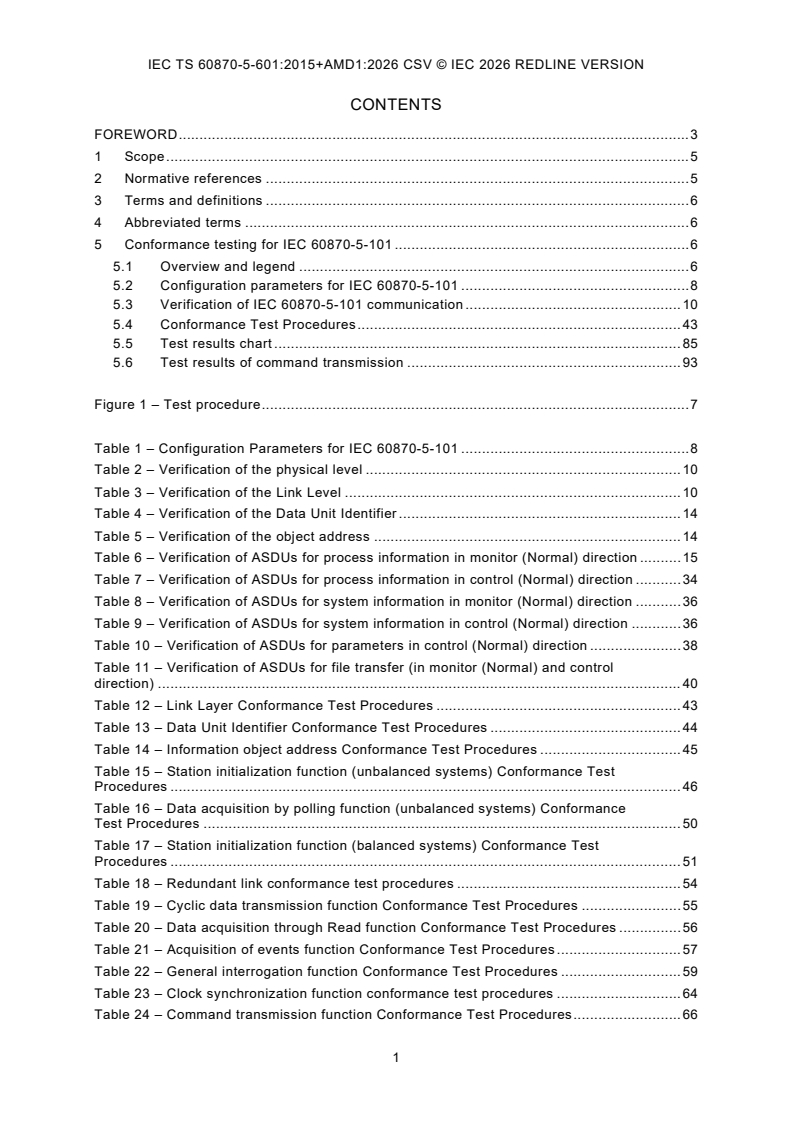
CONTENTS
FOREWORD . 3
1 Scope . 5
2 Normative references . 5
3 Terms and definitions . 6
4 Abbreviated terms . 6
5 Conformance testing for IEC 60870-5-101 . 6
5.1 Overview and legend . 6
5.2 Configuration parameters for IEC 60870-5-101 . 8
5.3 Verification of IEC 60870-5-101 communication . 10
5.4 Conformance Test Procedures . 43
5.5 Test results chart . 85
5.6 Test results of command transmission . 93
Figure 1 – Test procedure . 7
Table 1 – Configuration Parameters for IEC 60870-5-101 . 8
Table 2 – Verification of the physical level . 10
Table 3 – Verification of the Link Level . 10
Table 4 – Verification of the Data Unit Identifier . 14
Table 5 – Verification of the object address . 14
Table 6 – Verification of ASDUs for process information in monitor (Normal) direction . 15
Table 7 – Verification of ASDUs for process information in control (Normal) direction . 34
Table 8 – Verification of ASDUs for system information in monitor (Normal) direction . 36
Table 9 – Verification of ASDUs for system information in control (Normal) direction . 36
Table 10 – Verification of ASDUs for parameters in control (Normal) direction . 38
Table 11 – Verification of ASDUs for file transfer (in monitor (Normal) and control
direction) . 40
Table 12 – Link Layer Conformance Test Procedures . 43
Table 13 – Data Unit Identifier Conformance Test Procedures . 44
Table 14 – Information object address Conformance Test Procedures . 45
Table 15 – Station initialization function (unbalanced systems) Conformance Test
Procedures . 46
Table 16 – Data acquisition by polling function (unbalanced systems) Conformance
Test Procedures . 50
Table 17 – Station initialization function (balanced systems) Conformance Test
Procedures . 51
Table 18 – Redundant link conformance test procedures . 54
Table 19 – Cyclic data transmission function Conformance Test Procedures . 55
Table 20 – Data acquisition through Read function Conformance Test Procedures . 56
Table 21 – Acquisition of events function Conformance Test Procedures . 57
Table 22 – General interrogation function Conformance Test Procedures . 59
Table 23 – Clock synchronization function conformance test procedures . 64
Table 24 – Command transmission function Conformance Test Procedures . 66
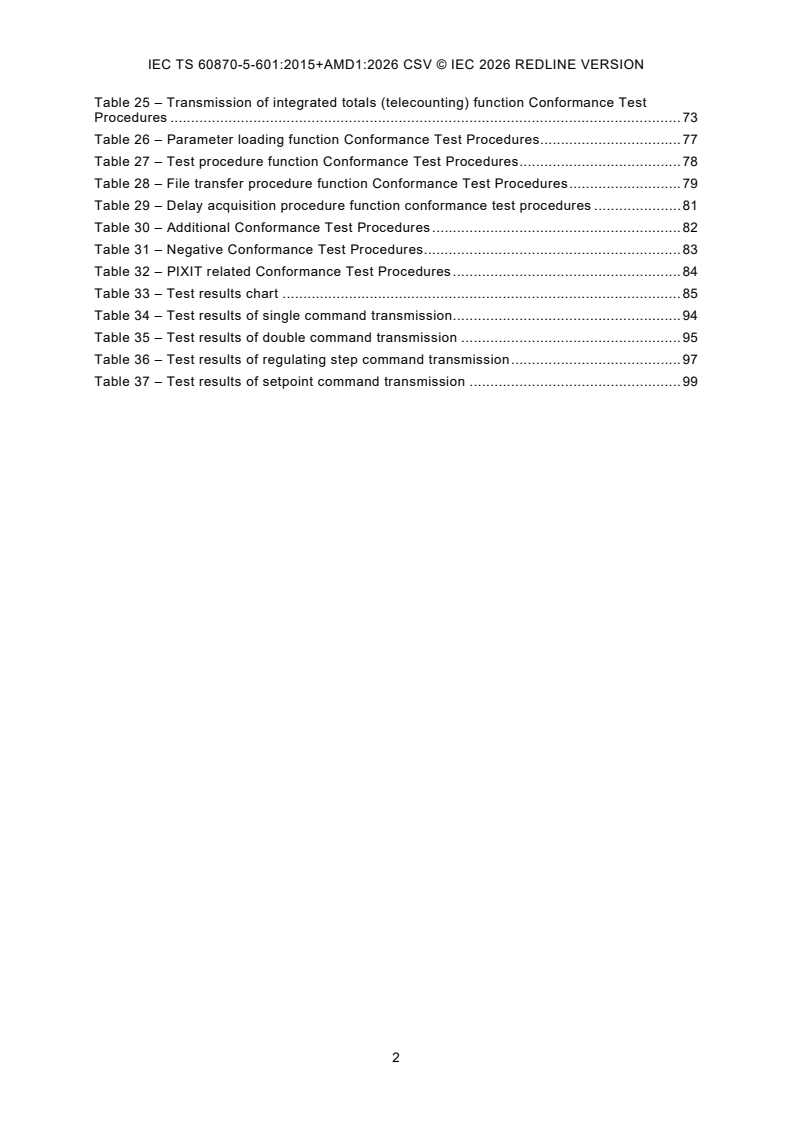
Table 25 – Transmission of integrated totals (telecounting) function Conformance Test
Procedures . 73
Table 26 – Parameter loading function Conformance Test Procedures . 77
Table 27 – Test procedure function Conformance Test Procedures . 78
Table 28 – File transfer procedure function Conformance Test Procedures . 79
Table 29 – Delay acquisition procedure function conformance test procedures . 81
Table 30 – Additional Conformance Test Procedures . 82
Table 31 – Negative Conformance Test Procedures. 83
Table 32 – PIXIT related Conformance Test Procedures . 84
Table 33 – Test results chart . 85
Table 34 – Test results of single command transmission . 94
Table 35 – Test results of double command transmission . 95
Table 36 – Test results of regulating step command transmission . 97
Table 37 – Test results of setpoint command transmission . 99
INTERNATIONAL ELECTROTECHNICAL COMMISSION
____________
Telecontrol equipment and systems -
Part 5-601: Transmission protocols -
Conformance test cases for the IEC 60870-5-101 companion standard
FOREWORD
1) The International Electrotechnical Commission (IEC) is a worldwide organization for standardization comprising
all national electrotechnical committees (IEC National Committees). The object of IEC is to promote
international co-operation on all questions concerning standardization in the electrical and electronic fields. To
this end and in addition to other activities, IEC publishes International Standards, Technical Specifications,
Technical Reports, Publicly Available Specifications (PAS) and Guides (hereafter referred to as "IEC
Publication(s)"). Their preparation is entrusted to technical committees; any IEC National Committee interested
in the subject dealt with may participate in this preparatory work. International, governmental and non-
governmental organizations liaising with the IEC also participate in this preparation. IEC collaborates closely
with the International Organization for Standardization (ISO) in accordance with conditions determined by
agreement between the two organizations.
2) The formal decisions or agreements of IEC on technical matters express, as nearly as possible, an international
consensus of opinion on the relevant subjects since each technical committee has representation from all
interested IEC National Committees.
3) IEC Publications have the form of recommendations for international use and are accepted by IEC National
Committees in that sense. While all reasonable efforts are made to ensure that the technical content of IEC
Publications is accurate, IEC cannot be held responsible for the way in which they are used or for any
misinterpretation by any end user.
4) In order to promote international uniformity, IEC National Committees undertake to apply IEC Publications
transparently to the maximum extent possible in their national and regional publications. Any divergence
between any IEC Publication and the corresponding national or regional publication shall be clearly indicated in
the latter.
5) IEC itself does not provide any attestation of conformity. Independent certification bodies provide conformity
assessment services and, in some areas, access to IEC marks of conformity. IEC is not responsible for any
services carried out by independent certification bodies.
6) All users should ensure that they have the latest edition of this publication.
7) No liability shall attach to IEC or its directors, employees, servants or agents including individual experts and
members of its technical committees and IEC National Committees for any personal injury, property damage or
other damage of any nature whatsoever, whether direct or indirect, or for costs (including legal fees) and
expenses arising out of the publication, use of, or reliance upon, this IEC Publication or any other IEC
Publications.
8) Attention is drawn to the Normative references cited in this publication. Use of the referenced publications is
indispensable for the correct application of this publication.
9) IEC draws attention to the possibility that the implementation of this document may involve the use of (a)
patent(s). IEC takes no position concerning the evidence, validity or applicability of any claimed patent rights in
respect thereof. As of the date of publication of this document, IEC had not received notice of (a) patent(s),
which may be required to implement this document. However, implementers are cautioned that this may not
represent the latest information, which may be obtained from the patent database available at
https://patents.iec.ch. IEC shall not be held responsible for identifying any or all such patent rights.
This consolidated version of the official IEC Standard and its amendment has been prepared
for user convenience.
IEC 60870-5-601 edition 2.1 contains the second edition (2015-10) [documents 57/1528/DTS
and 57/1590/RVC] and its amendment 1 (2026-09) [documents 57/2938/DTS and
57/2978/RVDTS].
In this Redline version, a vertical line in the margin shows where the technical content is
modified by amendment 1. Additions are in green text, deletions are in strikethrough red text.
A separate Final version with all changes accepted is available in this publication.
The main task of IEC technical committees is to prepare International Standards. In
exceptional circumstances, a technical committee may propose the publication of a technical
specification when
• the required support cannot be obtained for the publication of an International Standard,
despite repeated efforts, or
• The subject is still under technical development or where, for any other reason, there is
the future but no immediate possibility of an agreement on an International Standard.
Technical specifications are subject to review within three years of publication to decide
whether they can be transformed into International Standards.
This technical specification is to be used in conjunction with
IEC 60870-5-101:2003/AMD1:2015. IEC 60870-5-101:2003/AMD1:2015 resolves ambiguities
and inconsistencies discovered by users of the standard and was worked out in parallel with
IEC 60870-5-601:2006.
IEC 60870-5-601, which is a technical specification, has been prepared by IEC technical
committee 57: Power systems management and associated information exchange.
This second edition cancels and replaces the first edition published in 2006. This edition
constitutes a technical revision.
This edition includes the following significant technical changes with respect to the previous
edition:
a) Resolving ambiguities and inconsistencies between IEC 60870-5-101:2003 and IEC TS
60870-5-601:2006;
b) Enhancements and optimisation of test cases which are needed to prove conformance
with IEC 60870-5-101:2003;
c) Additional negative test cases made to avoid circulation of messages not conformant with
IEC 60870-5-101:2003.
The text of this technical specification is based on the following documents:
Enquiry draft Report on voting
57/1528/DTS 57/1590/RVC
Full information on the voting for the approval of this technical specification can be found in
the report on voting indicated in the above Table.
This publication has been drafted in accordance with the ISO/IEC Directives, Part 2.
A list of all parts of the IEC 60870 series, under the general title Telecontrol equipment and
systems, can be found on the IEC website.
The committee has decided that the contents of this document and its amendment will remain
unchanged until the stability date indicated on the IEC website under webstore.iec.ch in the
data related to the specific document. At this date, the document will be
– reconfirmed,
– withdrawn, or
– revised.
1 Scope
This part of IEC 60870 describes test cases for conformance testing of telecontrol equipment,
Substation Automation Systems (SAS) and telecontrol systems, including front-end functions
of SCADA.
The use of this part of IEC 60870 facilitates interoperability by providing a standard method of
testing protocol implementations, but it does not guarantee interoperability of devices. It is
expected that using this part of IEC 60870 during testing will minimize the risk of non-
interoperability.
The goal of this part of IEC 60870 is to enable unambiguous and standardised evaluation of
IEC 60870-5 companion standard protocol implementations. The guidelines and conditions for
the testing environment are described in IEC 60870-5-6. The detailed test cases per
companion standard, containing among others mandatory and optional mandatory test cases
per Basic Application Function, ASDU and transmission procedures, will become available as
a technical specification (TS). Other functionality may need additional test cases but this is
beyond the scope of this part of IEC 60870. For proper testing, it is recommended to define
these additional test cases.
This part of IEC 60870 deals mainly with communication conformance testing; therefore other
requirements, such as safety or EMC are not covered. These requirements are covered by
other standards (if applicable) and the proof of compliance for these topics is done in
accordance with these standards.
2 Normative references
The following documents, in whole or in part, are normatively referenced in this document and
are indispensable for its application. For dated references, only the edition cited applies. For
undated references, the latest edition of the referenced document (including any
1.
amendments) applies
IEC 60870-5-1:1990, Telecontrol equipment and systems – Part 5: Transmission protocols –
Section One: Transmission frame formats
IEC 60870-5-2:1992, Telecontrol equipment and systems – Part 5: Transmission protocols –
Section 2: Link transmission procedures
IEC 60870-5-3:1992, Telecontrol equipment and systems – Part 5: Transmission protocols –
Section 3: General structure of application data
IEC 60870-5-4:1993, Telecontrol equipment and systems – Part 5: Transmission protocols –
Section 4: Definition and coding of application information elements
IEC 60870-5-5:1999, Telecontrol equipment and systems – Part 5: Transmission protocols –
Section 5: Basic application functions
—————————
The base standard always takes precedence. In case of ambiguity between this part of IEC 60870 and the base
standards (IEC 60870-5-1 to IEC 60870-5-5, IEC 60870-5-101), this part of IEC 60870 needs to be clarified or
amended.
When testing negative behaviour is not described in the base standard, the behaviour described in this part of
IEC 60870 shall prevail and shall be observed.
The conformance statement produced after testing shall indicate any lack of conformance to either the test plan
or the base standard.
IEC 60870-5-6, Telecontrol equipment and systems – Part 5-6: Guidelines for conformance
testing for the IEC 60870-5 companion standards
IEC 60870-5-101:2003, Telecontrol equipment and systems – Part 5-101: Transmission
protocols – Companion standard for basic telecontrol tasks
IEC 60870-5-101:2003/AMD1:2015
IEEE 754, Standard for Binary Floating-Point Arithmetic
3 Terms and definitions
For the purposes of this document, the terms and definitions given in IEC 60870-5-6 apply.
4 Abbreviated terms
For the purposes of this document, the abbreviations given in IEC 60870-5-6 apply.
5 Conformance testing for IEC 60870-5-101
5.1 Overview and legend
Procedural and functional testing should always start with the Station Initialization function
and proceeds with the next Basic Application Functions. The procedure in each test case
should be followed, which means that the DUT is able to function as described in the specific
test case.
The test procedures in Tables 1 to 14 should be tested with no errors detected during testing
of all the Basic Application Functions in Tables 15 to 32. These tests are preferably
automatically performed by the used test platform.
In addition to the performance criteria listed in the test procedures, Subclause 5.3 lists the
protocol specifications that should be verified automatically by the testing software or verified
manually by review of the test history log after execution of the test procedures. The
verification should result in no errors detected during the complete test procedure.
This test plan has a direct reference to the PICS and possibly a PIXIT. Without a reference to
a PICS or PIXIT, this test plan is obsolete.
Test case numbering syntax is Subclause number + Table number + test case number.
Test cases are mandatory depending on the description in the column ‘Required’. The
following situations are possible:
M = Mandatory test case regardless if enabled in the PICS/PIXIT, not only in one
situation but during execution of all the tests as in the PICS and/or PIXIT
PICS, x.x = Mandatory test case if the functionality is enabled in the PICS (by marking the
applicable check box), with a reference to the Subclause number of the PICS
(x.x); For example: PICS 8.x always refers to IEC 60870-5-101:2003, Clause 8
PIXIT = Mandatory test case if the functionality is enabled/described in the PIXIT.
Verification of these test cases by the user/owner of the PIXIT is required
before the test is started
For each test case, the test results need to be marked in the appropriate column of the test
result chart in 5.5 and 5.6. Each test case can either pass the test (Passed), fail the test
(Failed), be not applicable when the configuration value is not supported by the device (N.A.),
or the test case was not performed (Empty). Ideally there should be no empty boxes when
testing is complete.
For testing reverse direction, the same test procedures apply in the opposite direction
(replace "Controlling" with "Controlled" and vice versa), except for COT44-47 which are only
defined in Monitor direction (only a controlled station is allowed to send these COT).
The test Tables are divided into five subclauses:
– Subclause 5.2, Configuration Parameters for IEC 60870-5-101
– Subclause 5.3, Verification of IEC 60870-5-101 communication
– Subclause 5.4, Conformance Test Procedures
– Subclause 5.5, Test Result Chart
– Subclause 5.6, Test Results of Command Transmission
The procedure to perform all the mandatory test cases according to the PID is shown in
Figure 1.
Tailored
test plan
Test
DUT configured according
to PID as in 5.2
Change the
configuration
Run the conformance test
and repeat
procedures according to 5.4
the tests in Perform each
5.3 and 5.4 mandatory test
case according
to the tailored
Do verification according to 5.3
test plan for the
for the mandatory test cases
configured DUT
Refer to Figure 2 in IEC 60870-5-6
Defects?
IEC
Figure 1 – Test procedure
5.2 Configuration parameters for IEC 60870-5-101
Since IEC 60870-5-101 contains a number of configuration parameters affecting protocol behaviour, it should be tested that the functionality in 5.3
and 5.4 is correct for the configuration(s) in Table 1.
Table 1 – Configuration Parameters for IEC 60870-5-101
Table 1a – Configuration Parameter Values
Test No. Test Description Reference Required
5.2.1.1 System definition Controlling station test (Master) PICS, 8.1
5.2.1.2 Controlled station test (Slave) PICS, 8.1
5.2.1.20 Physical layer Transmission speed(s) in control direction test maximum baud rate, minimum baud IEC 60870-5-101, 5.1 PICS, 8.3
rate, and one other baud rate. Perform all applicable test cases for one baud rate.
For the other tested baud rates, perform the following test cases: 5.4.15.1/5.4.15.10
and 5.4.22.1.
5.2.1.21 Transmission speed(s) in monitor direction test maximum baud rate, minimum baud IEC 60870-5-101, 5.1 PICS, 8.3
rate, and one other baud rate. Perform all applicable test cases for one baud rate.
For the other tested baud rates, perform the following test cases: 5.4.15.1/5.4.15.10
and 5.4.22.1.
5.2.1.30 Link Layer Unbalanced transmission IEC 60870-5-2, 6 PICS, 8.4
5.2.1.31 Balanced transmission IEC 60870-5-2, 6 PICS, 8.4
5.2.1.40 Address field of the Link Zero (0) octets for address field (balanced only) IEC 60870-5-2, 5.1.3, 6.1.3 PICS, 8.4
5.2.1.41 One (1) octet for address field IEC 60870-5-2, 5.1.3, 6.1.3 PICS, 8.4
5.2.1.42 Two (2) octets for address field IEC 60870-5-2, 5.1.3, 6.1.3 PICS, 8.4
If more than one link address length is supported (see PICS, 8.4), then perform all PICS, 8.4
applicable test cases for one link address length. For the other link address lengths,
perform the following test cases: 5.4.15.1/5.4.15.10 and 5.4.22.1.
5.2.1.50 Frame length Maximum length L (control direction) IEC 60870-5-101, 6.2 PICS, 8.4
5.2.1.51 Maximum length L (monitor direction) IEC 60870-5-101, 6.2 PICS, 8.4
5.2.1.60 Assignment Class 2 Standard assignment of class 2 messages IEC 60870-5-101, 6.2, 7.4.2 PICS, 8.4
messages
5.2.1.61 Special assignments of class 2 messages IEC 60870-5-101, 6.2, 7.4.2 PIXIT
Table 1b – Conformance Test Procedures only for system testing (for example in the case of interoperability testing)
Test No. Test Description Reference Required
5.2.1.70 COMMON ADDRESS of One (1) octet for Common Address of ASDU (CASDU) IEC 60870-5-101, 7.2.4 PICS, 8.5
ASDU
5.2.1.71 Two (2) octets for Common Address of ASDU (CASDU) IEC 60870-5-101, 7.2.4 PICS, 8.5
If more than one Common Address of ASDU length is supported (see PICS, 8.5), PICS, 8.5
then perform all applicable test cases for one Common Address of ASDU length. For
the other Common Address of ASDU length, perform the following test cases:
5.4.15.1/5.4.15.10 and 5.4.22.1.
5.2.1.80 INFORMATION OBJECT One (1) octet for Information Object Address (structured or unstructured) IEC 60870-5-101, 7.2.5 PICS, 8.5
ADDRESS
5.2.1.81 Two (2) octets for Information Object Address (structured or unstructured) IEC 60870-5-101, 7.2.5 PICS, 8.5
5.2.1.82 Three (3) octets for Information Object Address (structured or unstructured) IEC 60870-5-101, 7.2.5 PICS, 8.5
If more than one Information Object Address length is supported (see PICS, 8.5), PICS, 8.5
then perform all applicable test cases for one Information Object Address length. For
the other Information Object Address lengths, perform the following test cases:
5.4.15.1/5.4.15.10 and 5.4.22.1.
5.2.1.90 CAUSE OF One (1) octet for COT field IEC 60870-5-101, 7.2.3 PICS, 8.5
TRANSMISSION nd
5.2.1.91 Two (2) octets for COT field (2 octet is Originator address) IEC 60870-5-101, 7.2.3 PICS, 8.5
If more than one Cause of Transmission length is supported (see PICS, 8.5), then PICS, 8.5
perform all applicable test cases for one Cause of Transmission length. For the other
Cause of Transmission length, perform the following test cases: 5.4.15.1/5.4.15.10
and 5.4.22.1.
5.2.1.95 Total address length If multiple values for the lengths of the Link address, Common Address of ASDU, IEC 60870-5-101, 7.2.3 PICS, 8.4
Information Object Address or Cause of Transmission can be configured, then
PICS, 8.5
perform test cases 5.4.15.1/5.4.15.10 and 5.4.22.1 for the minimum possible total
length.
5.2.1.96 If multiple values for the lengths of the Link address, Common Address of ASDU, IEC 60870-5-101, 7.2.3 PICS, 8.4
Information Object Address or Cause of Transmission can be configured, then
PICS, 8.5
perform test cases 5.4.15.1/5.4.15.10 and 5.4.22.1 for the maximum possible total
length.
5.2.1.100 System definition System test (in case of interoperability testing) PICS, 8.1
5.2.1.110 Network configuration Point-to-point IEC 60870-5-101, 5.1 PICS, 8.2
5.2.1.111 Multiple point-to-point IEC 60870-5-101, 5.1 PICS, 8.2
5.2.1.112 Multipoint party line IEC 60870-5-101, 5.1 PICS, 8.2
5.2.1.113 Multipoint star IEC 60870-5-101, 5.1 PICS, 8.2
5.2.1.120 Address field of the Link Link address unstructured IEC 60870-5-2, 5.1.3, 6.1.3 PICS, 8.4
5.2.1.121 Link address structured IEC 60870-5-2, 5.1.3, 6.1.3 PICS, 8.4,
PIXIT
5.2.1.130 INFORMATION OBJECT Information Object Address unstructured IEC 60870-5-101, 7.2.5 PICS, 8.5
ADDRESS
5.2.1.131 Information Object Address structured IEC 60870-5-101, 7.2.5 PICS, 8.5
PIXIT
5.3 Verification of IEC 60870-5-101 communication
This subclause lists the protocol specifications that should be verified automatically by the testing software or verified manually by review of the test
history log after execution of the test procedures. Each test case describes a functionality that has passed the test if the functionality as in the
description column was proved to be correct. Correct means: the functionality should be checked either automatically or manually, and also be
checked by the test engineer in a human readable format log-file. For example, to test the IV qualifier of some information elements, the ASDU
containing this element should be sent with the IV=1.This should be automatically checked by the test software or observed by the test engineer in
the log-file. Each test case marked “Passed”, should be verifiable during testing and archived in log-files for post assessment.
To identify if a test case is mandatory, it is necessary to read 5.1 carefully.
Table 2 – Verification of the physical level
Test No. Test Description Reference Required
5.3.2.1 BYTEFRAME Start-/stop-bit, even parity IEC 60870-5-1:1990, 6.2.4.2 M
Table 3 – Verification of the Link Level (1 of 4)
Test No. Test Description Reference Required
5.3.3.10 FT1.2 FRAME LAYOUT Single control character I: E5 IEC 60870-5-1:1990, 6.2.4.2 PIXIT
H
(Single, Fixed and Variable)
5.3.3.11 Start character of fixed length frames: 10 IEC 60870-5-1:1990, 6.2.4.2 M
H
5.3.3.12 0 octets (No User data) as Link User data length of fixed length frames IEC 60870-5-1:1990, 6.2.4.2 M
5.3.3.13 Start character of variable length frames: 68 IEC 60870-5-1:1990, 6.2.4.2 M
H
5.3.3.14 Configured number of octets L (repeated) as the maximum number of User IEC 60870-5-1:1990, 6.2.4.2 PICS, 8.4
Frame length
Data octets from Controlling to Controlled station in variable length frames:
max. 255
5.3.3.15 Configured number of octets L (repeated) as the maximum number of User IEC 60870-5-1:1990, 6.2.4.2 PICS, 8.4
Frame length
Data octets from Controlled to Controlling station in variable length frames:
max. 255
5.3.3.16 Second start character of variable length frames: 68 IEC 60870-5-1:1990, 6.2.4.2 M
H
5.3.3.17 Single octet Control Field IEC 60870-5-1:1990, 6.2.4.2 M
5.3.3.18 Configured number of octets for Link address field IEC 60870-5-1:1990, 6.2.4.2 M
5.3.3.19 Checksum (8-bit arithmetic sum) IEC 60870-5-1:1990, 6.2.4.2 M
5.3.3.20 Stop character of fixed and variable length frames: 16 IEC 60870-5-1:1990, 6.2.4.2 M
H
Table 3 (2 of 4)
Test No. Test Description Reference Required
5.3.3.30 BYTELAG Line idle intervals (stream of "1" bits) between characters of a frame do not IEC 60870-5-1:1990, 6.2.4.2 M
exceed one bit time (octets are received within 110 % of raw transmission time)
IEC 60870-5-101:2003, 6.1
5.3.3.40 CONTROL FIELD High order bit RES = 0 (unbalanced only) IEC 60870-5-2:1992, 5.1.2 PICS, 8.4
Unbalanced
5.3.3.41 DIR = 1 for messages from Controlling station (A) to Controlled station (B) IEC 60870-5-2:1992, 6.1.2 PICS, 8.4
Balanced
(balanced only)
5.3.3.42 DIR = 0 for messages from Controlled station (B) to Controlling station (A) IEC 60870-5-2:1992, 6.1.2 PICS, 8.4
Balanced
(balanced only)
5.3.3.43 PRM = 0 in messages from the Controlled station IEC 60870-5-2:1992, 5.1.2, 6.1.2 M
5.3.3.44 PRM = 0: only FCODEs 0, 1, 8, 9, 11, 14, or 15 (unbalanced only) IEC 60870-5-2:1992, 5.1.2 PICS, 8.4
Unbalanced
5.3.3.45 PRM = 0: only FCODEs 0, 1, 11, 14, or 15 (balanced only) IEC 60870-5-2:1992, 6.1.2 PICS, 8.4
Balanced
5.3.3.46 PRM = 1 in messages from the Controlling station IEC 60870-5-2:1992, 5.1.2, 6.1.2 M
5.3.3.47 PRM = 1: only Primary FCODEs 0, 1, 3, 4, 8, 9, 10 or 11 (unbalanced only) IEC 60870-5-2:1992, 5.1.2 PICS, 8.4
Unbalanced
5.3.3.48 PRM = 1: only Primary FCODEs 0, 1, 2, 3, 4 or 9 (balanced only) IEC 60870-5-2:1992, 6.1.2 PICS, 8.4
Balanced
5.3.3.49 In case of FCV = 1 and FCB unchanged, the last message is repeated IEC 60870-5-2:1992, 5.1.2, 6.1.2 M
5.3.3.50 In case of reset commands F-CODE 0 or 1 FCB = 0 (expect next FCB=1) IEC 60870-5-2:1992, 5.1.2, 6.1.2 M
5.3.3.51 DFC = 0: further messages are acceptable IEC 60870-5-2:1992, 5.1.2, 6.1.2 M
Table 3 (3 of 4)
Test No. Test Description Reference Required
5.3.3.52 DFC = 1: further messages may cause data overflow. Only applicable for IEC 60870-5-2:1992, 5.1.2, 6.3.3 PICS, 8.4
Balanced
Balanced communication
NOTE The following tests are only for Unbalanced systems (PICS 8.4). If ‘M’ is mentioned, the test case is mandatory for unbalanced systems.
5.3.3.60 UNBALANCED Unbalanced transmission IEC 60870-5-2:1992, Clause 5 PICS, 8.4
Unbalanced
TRANSMISSION
PROCEDURE
5.3.3.61 Service S1 – SEND/No reply IEC 60870-5-2:1992, 4.1 PIXIT
5.3.3.62 Service S2 – SEND/CONFIRM expected IEC 60870-5-2:1992, 4.2 M
5.3.3.63 Service S3 – REQUEST/RESPOND expected IEC 60870-5-2:1992, 4.3 M
5.3.3.64 Primary F-CODE 0: answered with Secondary F-CODE 0,1,14,15 IEC 60870-5-2:1992, 4.2.2, 5.1.2 PIXIT
5.3.3.65 Primary F-CODE 1: answered with Secondary F-CODE 0,1,14,15 IEC 60870-5-2:1992, 4.2.2, 5.1.2 PIXIT
5.3.3.66 Primary F-CODE 3: answered with Secondary F-CODE 0,1,14,15 IEC 60870-5-2:1992, 4.2.2, 5.1.2 PIXIT
5.3.3.67 Primary F-CODE 4: not answered by Secondary IEC 60870-5-2:1992, 4.1.2, 5.1.2 PIXIT
5.3.3.68 Primary F-CODE 8: answered with Secondary F-CODE 11, 14, 15 IEC 60870-5-2:1992, 4.3.2, 5.1.2 PIXIT
5.3.3.69 Primary F-CODE 9: answered with Secondary F-CODE 11, 14, 15 IEC 60870-5-2:1992, 4.3.2, 5.1.2 PIXIT
5.3.3.70 Primary F-CODE 10: answered with Secondary F-CODE 8, 9, 14, 15 IEC 60870-5-2:1992, 4.3.2, 5.1.2 PIXIT
5.3.3.71 Primary F-CODE 11: answered with Secondary F-CODE 8, 9, 14, 15 IEC 60870-5-2:1992, 4.3.2, 5.1.2 PIXIT
5.3.3.72 Primary F-CODE 2, 5.7, 12.15: answered with Secondary F-CODE 15 IEC 60870-5-2:1992, 4.2.2, 5.1.2 PIXIT
5.3.3.73 A not supported or implemented F-code is answered with Secondary F-CODE 14 IEC 60870-5-2:1992, 4.2.2, 5.1.2 M
or 15
Table 3 (4 of 4)
Test No. Test Description Reference Required
NOTE The following tests are only for Balanced systems (PICS 8.4). If ‘M’ is mentioned, the test case is mandatory for balanced systems.
5.3.3.80 BALANCED Balanced transmission IEC 60870-5-2:1992, Clause 6 PICS, 8.4
Balanced
TRANSMISSION
PROCEDURE
5.3.3.81 Service S1 – SEND/No reply IEC 60870-5-2:1992, 4.1 PIXIT
5.3.3.82 Service S2 – SEND/CONFIRM expected IEC 60870-5-2:1992, 4.2 M
5.3.3.83 Service S3 – REQUEST/RESPOND expected IEC 60870-5-2:1992, 4.3 M
5.3.3.84 Primary F-CODE 0: answered with Secondary F-CODE 0,1,14,15 IEC 60870-5-2:1992, 4.2.2, 6.1.2 PIXIT
5.3.3.85 Primary F-CODE 1: answered with Secondary F-CODE 0,1,14,15 IEC 60870-5-2:1992, 4.2.2, 6.1.2 PIXIT
5.3.3.86 Primary F-CODE 2: answered with Secondary F-CODE 0,1,14,15 IEC 60870-5-2:1992, 4.1.2, 6.1.2 PIXIT
5.3.3.87 Primary F-CODE 3: answered with Secondary F-CODE 0,1,14,15 IEC 60870-5-2:1992, 4.3.2, 6.1.2 PIXIT
5.3.3.88 Primary F-CODE 4: not answered by Secondary IEC 60870-5-2:1992, 4.3.2, 6.1.2 PIXIT
5.3.3.89 Primary F-CODE 9: answered with Secondary F-CODE 11, 14, 15 IEC 60870-5-2:1992, 4.3.2, 6.1.2 PIXIT
5.3.3.90 Primary F-CODE 5.8, 10.15: answered with Secondary F-CODE 15 IEC 60870-5-2:1992, 4.2.2, 6.1.2 PIXIT
5.3.3.91 A not supported or implemented F-code is answered with Secondary F-CODE 14 IEC 60870-5-2:1992, 4.2.2, 6.1.2 M
or 15
5.3.3.100 TIME OUT INTERVAL Maximum time out interval (calculated) IEC 60870-5-2:1992, Clause A.1, PICS, 8.4
case 1, Figure A.2
– Controlling station does a retry when no answer is received
– Controlled station answers always within specified time
5.3.3.101 Controlling station uses the configured maximum number of retries for data link IEC 60870-5-2:1992, Clause 4 PICS, 8.4
services that are unanswered within the time out interval
Table 4 – Verification of the Data Unit Identifier
Test No. Test Description Reference Required
5.3.4.1 TYPE IDENTIFICATION Compatible ASDU type used/accepted for all ASDUs as in the PICS IEC 60870-5-101:2003, 7.2.1.1 PICS, 8.5
VARIABLE STRUCTURE
5.3.4.10 Variable structure qualifier SQ=0 (Sequence or Set) as defined for each ASDU M
QUALIFIER
5.3.4.11 SQ:=1 only for COT Spontaneous (3), Cyclic/Periodic (1), Background Scan (2) or IEC 60870-5-101:2003, 7.2.2 PIXIT
Interrogation (20.36). Check the PICS for the supported COT values. Make sure
SQ=1 is only used for ASDU types that admit sequential packing.
5.3.4.12 Variable structure qualifier I (Number of elements) according to transmitted IEC 60870-5-101:2003, 7.2.2 M
number of information elements for each ASDU
5.3.4.13 The number of octets for ASDU are supported as in the PICS IEC 60870-5-101:2003, 7.2 M
5.3.4.20 CAUSE OF TRANSMISSION Originator address of Primary station is 0 if not used IEC 60870-5-101:2003, 7.2.3 PICS, 8.5
5.3.4.21 Originator address identifies source application of Primary station IEC 60870-5-101:2003, 7.2.3 PIXIT
5.3.4.22 Compatible Cause Of Transmission (COT) used/accepted. Check the PICS for the IEC 60870-5-101:2003, 7.2.3 PICS, 8.5
supported COT values
5.3.4.23 P/N bit = 0: positive confirmation of activation IEC 60870-5-101:2003, 7.2.3 M
5.3.4.24 P/N bit = 1: negative confirmation of activation IEC 60870-5-101:2003, 7.2.3 M
5.3.4.25 Test bit = 0: ASDU generated during normal conditions IEC 60870-5-101:2003, 7.2.3 M
5.3.4.26 Test bit = 1: ASDU generated during test conditions IEC 60870-5-101:2003, 7.2.3 PIXIT
5.3.4.40 COMMON ADDRESS of The options of the Common Address of ASDU (CASDU) are tested and reported in IEC 60870-5-101:2003, 7.2.4 PICS, 8.5
ASDU 5.5
Table 5 – Verification of the object address
Test No. Test Description Reference Required
5.3.5.50 INFORMATION OBJECT The options of the Information Object Address are tested and reported in 5.5 IEC 60870-5-101:2003, 7.2.5 PICS, 8.5
ADDRESS
Table 6 – Verification of ASDUs for process information in monitor (Normal) direction (1 of 19)
Test No. Test Description Reference Required
5.3.6.10 M_SP_NA_1 SIQ with SQ = 0, each element with its own IOA IEC 60870-5-101:2003, 7.3.1.1 PICS, 8.5
5.3.6.11 ASDU 1 SIQ with SQ = 1, with only the IOA of the first element and the following IEC 60870-5-101:2003, 7.3.1.1 PIXIT
Information Elements are identified by numbers incrementing continuously by +1
Single-point information
from this offset (see IEC 60870-5-101:2003, 7.2.2.1)
5.3.6.12 COT as defined in the attached PICS IEC 60870-5-101:2003, 7.3.1.1 PICS, 8.5
5.3.6.13 SIQ SPI = 0 (OFF), 1 (ON) IEC 60870-5-101:2003, 7.2.6.1 PICS, 8.5
5.3.6.14 RES = 0 IEC 60870-5-101:2003, 7.2.6.1 PICS, 8.5
5.3.6.15 BL = 0,1 IEC 60870-5-101:2003, 7.2.6.1 PIXIT
5.3.6.16 SB = 0,1 IEC 60870-5-101:2003, 7.2.6.1 PIXIT
5.3.6.17 NT = 0,1 IEC 60870-5-101:2003, 7.2.6.1 PIXIT
5.3.6.18 IV = 0,1 IEC 60870-5-101:2003, 7.2.6.1 PICS, 8.5
5.3.6.30 M_SP_TA_1 SIQ with SQ = 0, each element with its own IOA IEC 60870-5-101:2003, 7.3.1.2 PICS, 8.5
ASDU 2
5.3.6.31 COT as defined in the attached PICS IEC 60870-5-101:2003, 7.3.1.2 PICS, 8.5
Single-point information
with time-tag
5.3.6.32 SIQ SPI = 0 (OFF), 1 (ON) IEC 60870-5-101:2003, 7.2.6.1 PICS, 8.5
5.3.6.33 RES = 0 IEC 60870-5-101:2003, 7.2.6.1 PICS, 8.5
5.3.6.34 BL = 0,1 IEC 60870-5-101:2003, 7.2.6.1 PIXIT
5.3.6.35 SB = 0,1 IEC 60870-5-101:2003, 7.2.6.1 PIXIT
5.3.6.36 NT = 0,1 IEC 60870-5-101:2003, 7.2.6.1 PIXIT
5.3.6.37 IV = 0,1 IEC 60870-5-101:2003, 7.2.6.1 PICS, 8.5
5.3.6.38 CP24TIME2a milliseconds = 0.59999 IEC 60870-5-101:2003, 7.2.6.19 PICS, 8.5
5.3.6.39 minutes = 0.59 IEC 60870-5-101:2003, 7.2.6.19 PICS, 8.5
5.3.6.40 RES1 = 0 IEC 60870-5-101:2003, 7.2.6.19 PICS, 8.5
5.3.6.41 IV = 0, 1 IEC 60870-5-101:2003, 7.2.6.19 PICS, 8.5
Table 6 (2 of 19)
Test No. Test Description Reference Required
5.3.6.50 M_DP_NA_1 DIQ with SQ = 0, each element with its own IOA IEC 60870-5-101:2003, 7.3.1.3 PICS, 8.5
5.3.6.51 ASDU 3 DIQ with SQ = 1, with only the IOA of the first element and the following IEC 60870-5-101:2003, 7.3.1.3 PIXIT
Information Elements are identified by numbers incrementing continuously by +1
Double-point information
from this offset (see IEC 60870-5-101:2003, 7.2.2.1)
5.3.6.52 COT as defined in the attached PICS IEC 60870-5-101:2003, 7.3.1.3 PICS, 8.5
DPI = 0 (indeterminate or intermediate state), 1 (OFF), 2 (ON), 3 (indeterminate
5.3.6.53 DIQ IEC 60870-5-101:2003, 7.2.6.2 PICS, 8.5
state)
5.3.6.54 RES = 0 IEC 60870-5-101:2003, 7.2.6.2 PICS, 8.5
5.3.6.55 BL = 0,1 IEC 60870-5-101:2003, 7.2.6.2 PIXIT
5.3.6.56 SB = 0,1 IEC 60870-5-101:2003, 7.2.6.2 PIXIT
5.3.6.57 NT = 0,1 IEC 60870-5-101:2003, 7.2.6.2 PIXIT
5.3.6.58 IV = 0,1 IEC 60870-5-101:2003, 7.2.6.2 PICS, 8.5
5.3.6.70 M_DP_TA_1 DIQ with SQ = 0, each element with its own IOA IEC 60870-5-101:2003, 7.3.1.4 PICS, 8.5
5.3.6.71 ASDU 4 COT as defined in the attached PICS IEC 60870-5-101:2003, 7.3.1.4 PICS, 8.5
Double-point information
with time-tag
5.3.6.72 DIQ DPI = 0 (indeterminate or intermediate state), 1 (OFF), 2 (ON), 3 (indeterminate IEC 60870-5-101:2003, 7.2.6.2 PICS, 8.5
state)
5.3.6.73 RES = 0 IEC 60870-5-101:2003, 7.2.6.2 PICS, 8.5
5.3.6.74 BL = 0,1 IEC 60870-5-101:2003, 7.2.6.2 PIXIT
5.3.6.75 SB = 0,1 IEC 60870-5-101:2003, 7.2.6.2 PIXIT
5.3.6.76 NT = 0,1 IEC 60870-5-101:2003, 7.2.6.2 PIXIT
5.3.6.77 IV = 0,1 IEC 60870-5-101:2003, 7.2.6.2 PICS, 8.5
5.3.6.78 CP24TIME2a milliseconds = 0.59999 IEC 60870-5-101:2003, 7.2.6.19 PICS, 8.5
5.3.6.79 Minutes = 0.59 IEC 60870-5-101:2003, 7.2.6.19 PICS, 8.5
5.3.6.80 RES1 = 0 IEC 60870-5-101:2003, 7.2.6.19 PICS, 8.5
5.3.6.81 IV = 0, 1 IEC 60870-5-101:2003, 7.2.6.19 PICS, 8.5
Table 6 (3 of 19)
Test No. Test Description Reference Required
5.3.6.90 M_ST_NA_1 VTI with SQ = 0, each element with its own IOA IEC 60870-5-101:2003, 7.3.1.5 PICS, 8.5
5.3.6.91 ASDU 5 VTI with SQ = 1, with only the IOA of the first element and the following IEC 60870-5-101:2003, 7.3.1.5 PIXIT
Information Elements are identified by numbers incrementing continuously by +1
Step-position information
from this offset (see IEC 60870-5-101:2003, 7.2.2.1)
5.3.6.92 COT as defined in the attached PICS IEC 60870-5-101:2003, 7.3.1.5 PI
...