


IEC 61753-021-3:2012
(Main)Fibre optic interconnecting devices and passive components - Performance standard - Part 021-3: Single-mode fibre optic connectors for category U - Uncontrolled environment
General Information
- Abstract
IEC 61753-021-3:2012 defines minimum initial test and measurement requirements and severities which a single-mode connector, either part of a pigtail, or part of a cord, must satisfy in order to be categorized as meeting the IEC standard category U (uncontrolled environment). Keywords: single-mode connector, category U
- Status
- Replaced
- Publication Date
- 04-Dec-2012
- Technical Committee
- SC 86B - Fibre optic interconnecting devices and passive components
- Current Stage
- PPUB - Publication issued
- Start Date
- 05-Dec-2012
- Completion Date
- 15-Dec-2012
Buy Documents
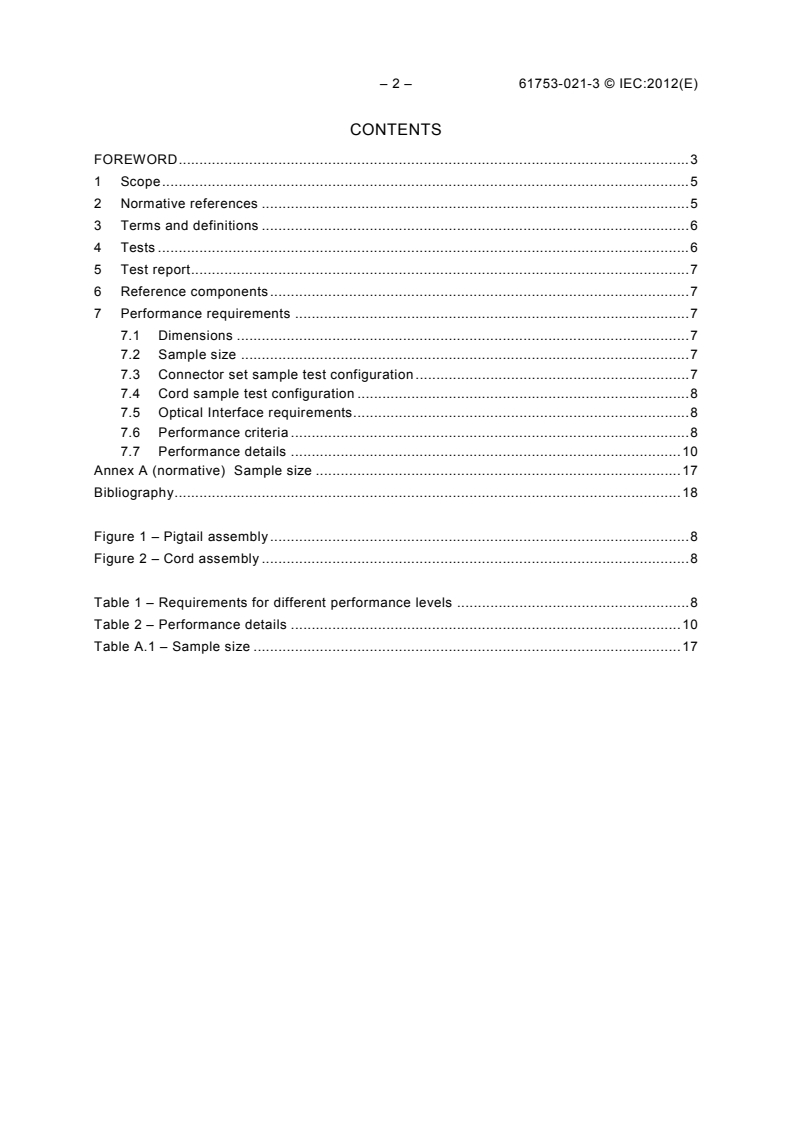
IEC 61753-021-3:2012 - Fibre optic interconnecting devices and passive components - Performance standard - Part 021-3: Single-mode fibre optic connectors for category U - Uncontrolled environment Released:12/5/2012
IEC 61753-021-3:2012 - Fibre optic interconnecting devices and passive components - Performance standard - Part 021-3: Single-mode fibre optic connectors for category U - Uncontrolled environment Released:12/5/2012
Overview
IEC 61753-021-3:2012 specifies performance requirements for single‑mode connectors used in pigtails and cords that must qualify as category U (Uncontrolled environment). The standard defines the minimum initial test and measurement requirements, sample configurations and severities needed to demonstrate that a connector assembly meets IEC performance criteria when exposed to non‑climate‑controlled or field conditions.
Key topics and requirements
- Scope: Applies to single‑mode connector assemblies (pigtails and cords) terminated on IEC 60793‑2‑50 single‑mode fibres (B1.1, B1.3 or B6_a).
- Optical interface and dimensions: Connector dimensions must comply with the IEC 61754 interface series and endface geometry must meet the IEC 61755 optical interface requirements. Non‑compliant endfaces are failures.
- Test methods: Uses basic test procedures from the IEC 61300 series (vibration, mating durability, tensile, impact, temperature, static side load, flexing, attenuation/return‑loss measurements, transient loss, etc.).
- Performance criteria: Defined optical criteria include attenuation and return loss limits. Examples given in the standard:
- Typical attenuation targets: mean ≤ 0.12 dB, max ≤ 0.25 dB for ≥97% of samples.
- Return loss examples: ≥ 60 dB for the higher level and ≥ 45 dB for an alternate level.
- Attenuation variation limits during and after tests: ≤ 0.2 dB for pigtails; for cords ≤ 0.5 dB during and ≤ 0.4 dB after.
- Sample configurations: Defines pigtail and cord assembly configurations; pigtailed leads should be long enough (typically ≥3 m) so splices/connections can remain outside environmental chambers; cords typically 3–5 m.
- Reporting: Fully documented test reports and evidence are required. No reference components are mandated.
Applications and who uses this standard
IEC 61753-021-3 is used by:
- Connector and cable manufacturers to validate product performance for uncontrolled environments.
- Independent test labs performing qualification testing and issuing test reports.
- System designers, specifiers and procurement teams who need objective, repeatable acceptance criteria for single‑mode connector assemblies.
- Network operators and integrators specifying components for field‑deployed links where environmental control is limited.
Typical practical uses: specifying acceptance criteria for pigtails and cords used in field installations, outdoor closures, exchange points or any non‑climate‑controlled sites where robust connector performance for attenuation and return loss is required.
Related standards
- IEC 61753‑1 (general guidance), IEC 61300 series (test methods), IEC 61754 (connector interfaces), IEC 61755 (optical interfaces), IEC 60793‑2‑50 (single‑mode fibre product specs).
Relations
- Effective Date
- 05-Sep-2023
Buy Documents
IEC 61753-021-3:2012 - Fibre optic interconnecting devices and passive components - Performance standard - Part 021-3: Single-mode fibre optic connectors for category U - Uncontrolled environment Released:12/5/2012
IEC 61753-021-3:2012 - Fibre optic interconnecting devices and passive components - Performance standard - Part 021-3: Single-mode fibre optic connectors for category U - Uncontrolled environment Released:12/5/2012
Get Certified
Connect with accredited certification bodies for this standard

IMQ S.p.A. (Certification)
Italian electrical product certification.

SLG Prüf- und Zertifizierungs GmbH
German testing and certification body.

UL Solutions
Global safety science company with testing, inspection and certification.
Sponsored listings
Frequently Asked Questions
IEC 61753-021-3:2012 is a standard published by the International Electrotechnical Commission (IEC). Its full title is "Fibre optic interconnecting devices and passive components - Performance standard - Part 021-3: Single-mode fibre optic connectors for category U - Uncontrolled environment". This standard covers: IEC 61753-021-3:2012 defines minimum initial test and measurement requirements and severities which a single-mode connector, either part of a pigtail, or part of a cord, must satisfy in order to be categorized as meeting the IEC standard category U (uncontrolled environment). Keywords: single-mode connector, category U
IEC 61753-021-3:2012 defines minimum initial test and measurement requirements and severities which a single-mode connector, either part of a pigtail, or part of a cord, must satisfy in order to be categorized as meeting the IEC standard category U (uncontrolled environment). Keywords: single-mode connector, category U
IEC 61753-021-3:2012 is classified under the following ICS (International Classification for Standards) categories: 17.220.20 - Measurement of electrical and magnetic quantities; 29.030 - Magnetic materials; 33.180.20 - Fibre optic interconnecting devices. The ICS classification helps identify the subject area and facilitates finding related standards.
IEC 61753-021-3:2012 has the following relationships with other standards: It is inter standard links to IEC 61753-021-03:2026. Understanding these relationships helps ensure you are using the most current and applicable version of the standard.
IEC 61753-021-3:2012 is available in PDF format for immediate download after purchase. The document can be added to your cart and obtained through the secure checkout process. Digital delivery ensures instant access to the complete standard document.
Standards Content (Sample)
IEC 61753-021-3 ®
Edition 1.0 2012-12
INTERNATIONAL
STANDARD
Fibre optic interconnecting devices and passive components – Performance
standard –
Part 021-3: Single-mode fibre optic connectors for category U – Uncontrolled
environment
All rights reserved. Unless otherwise specified, no part of this publication may be reproduced or utilized in any form
or by any means, electronic or mechanical, including photocopying and microfilm, without permission in writing from
either IEC or IEC's member National Committee in the country of the requester.
If you have any questions about IEC copyright or have an enquiry about obtaining additional rights to this publication,
please contact the address below or your local IEC member National Committee for further information.
IEC Central Office Tel.: +41 22 919 02 11
3, rue de Varembé Fax: +41 22 919 03 00
CH-1211 Geneva 20 info@iec.ch
Switzerland www.iec.ch
About the IEC
The International Electrotechnical Commission (IEC) is the leading global organization that prepares and publishes
International Standards for all electrical, electronic and related technologies.
About IEC publications
The technical content of IEC publications is kept under constant review by the IEC. Please make sure that you have the
latest edition, a corrigenda or an amendment might have been published.
Useful links:
IEC publications search - www.iec.ch/searchpub Electropedia - www.electropedia.org
The advanced search enables you to find IEC publications The world's leading online dictionary of electronic and
by a variety of criteria (reference number, text, technical electrical terms containing more than 30 000 terms and
committee,…). definitions in English and French, with equivalent terms in
It also gives information on projects, replaced and additional languages. Also known as the International
withdrawn publications. Electrotechnical Vocabulary (IEV) on-line.
IEC Just Published - webstore.iec.ch/justpublished Customer Service Centre - webstore.iec.ch/csc
Stay up to date on all new IEC publications. Just Published If you wish to give us your feedback on this publication
details all new publications released. Available on-line and or need further assistance, please contact the
also once a month by email. Customer Service Centre: csc@iec.ch.
IEC 61753-021-3 ®
Edition 1.0 2012-12
INTERNATIONAL
STANDARD
Fibre optic interconnecting devices and passive components – Performance
standard –
Part 021-3: Single-mode fibre optic connectors for category U – Uncontrolled
environment
INTERNATIONAL
ELECTROTECHNICAL
COMMISSION
PRICE CODE
R
ICS 33.180.20 ISBN 978-2-83220-490-0
– 2 – 61753-021-3 © IEC:2012(E)
CONTENTS
FOREWORD . 3
1 Scope . 5
2 Normative references . 5
3 Terms and definitions . 6
4 Tests . 6
5 Test report . 7
6 Reference components . 7
7 Performance requirements . 7
7.1 Dimensions . 7
7.2 Sample size . 7
7.3 Connector set sample test configuration . 7
7.4 Cord sample test configuration . 8
7.5 Optical Interface requirements . 8
7.6 Performance criteria . 8
7.7 Performance details . 10
Annex A (normative) Sample size . 17
Bibliography . 18
Figure 1 – Pigtail assembly . 8
Figure 2 – Cord assembly . 8
Table 1 – Requirements for different performance levels . 8
Table 2 – Performance details . 10
Table A.1 – Sample size . 17
61753-021-3 © IEC:2012(E) – 3 –
INTERNATIONAL ELECTROTECHNICAL COMMISSION
____________
FIBRE OPTIC INTERCONNECTING DEVICES AND
PASSIVE COMPONENTS – PERFORMANCE STANDARD –
Part 021-3: Single-mode fibre optic connectors for category U –
Uncontrolled environment
FOREWORD
1) The International Electrotechnical Commission (IEC) is a worldwide organization for standardization comprising
all national electrotechnical committees (IEC National Committees). The object of IEC is to promote
international co-operation on all questions concerning standardization in the electrical and electronic fields. To
this end and in addition to other activities, IEC publishes International Standards, Technical Specifications,
Technical Reports, Publicly Available Specifications (PAS) and Guides (hereafter referred to as “IEC
Publication(s)”). Their preparation is entrusted to technical committees; any IEC National Committee interested
in the subject dealt with may participate in this preparatory work. International, governmental and non-
governmental organizations liaising with the IEC also participate in this preparation. IEC collaborates closely
with the International Organization for Standardization (ISO) in accordance with conditions determined by
agreement between the two organizations.
2) The formal decisions or agreements of IEC on technical matters express, as nearly as possible, an international
consensus of opinion on the relevant subjects since each technical committee has representation from all
interested IEC National Committees.
3) IEC Publications have the form of recommendations for international use and are accepted by IEC National
Committees in that sense. While all reasonable efforts are made to ensure that the technical content of IEC
Publications is accurate, IEC cannot be held responsible for the way in which they are used or for any
misinterpretation by any end user.
4) In order to promote international uniformity, IEC National Committees undertake to apply IEC Publications
transparently to the maximum extent possible in their national and regional publications. Any divergence
between any IEC Publication and the corresponding national or regional publication shall be clearly indicated in
the latter.
5) IEC itself does not provide any attestation of conformity. Independent certification bodies provide conformity
assessment services and, in some areas, access to IEC marks of conformity. IEC is not responsible for any
services carried out by independent certification bodies.
6) All users should ensure that they have the latest edition of this publication.
7) No liability shall attach to IEC or its directors, employees, servants or agents including individual experts and
members of its technical committees and IEC National Committees for any personal injury, property damage or
other damage of any nature whatsoever, whether direct or indirect, or for costs (including legal fees) and
expenses arising out of the publication, use of, or reliance upon, this IEC Publication or any other IEC
Publications.
8) Attention is drawn to the Normative references cited in this publication. Use of the referenced publications is
indispensable for the correct application of this publication.
9) Attention is drawn to the possibility that some of the elements of this IEC Publication may be the subject of
patent rights. IEC shall not be held responsible for identifying any or all such patent rights.
International Standard IEC 61753-021-3 has been prepared by subcommittee 86B: Fibre optic
interconnecting devices and passive components, of IEC technical committee 86: Fibre optics.
The text of this standard is based on the following documents:
FDIS Report on voting
86B/3495/FDIS 86B/3542/RVD
Full information on the voting for the approval of this standard can be found in the report on
voting indicated in the above table.
This publication has been drafted in accordance with the ISO/IEC Directives, Part 2.
– 4 – 61753-021-3 © IEC:2012(E)
A list of all parts of the IEC 61753 series, published under the general title Fibre optic
interconnecting devices and passive components – Performance standard, can be found on
the IEC website.
The committee has decided that the contents of this publication will remain unchanged until
the stability date indicated on the IEC web site under "http://webstore.iec.ch" in the data
related to the specific publication. At this date, the publication will be
• reconfirmed,
• withdrawn,
• replaced by a revised edition, or
• amended.
A bilingual version of this publication may be issued at a later date.
61753-021-3 © IEC:2012(E) – 5 –
FIBRE OPTIC INTERCONNECTING DEVICES AND
PASSIVE COMPONENTS – PERFORMANCE STANDARD –
Part 021-3: Single-mode fibre optic connectors for category U –
Uncontrolled environment
1 Scope
This part of IEC 61753 defines minimum initial test and measurement requirements and
severities which a single-mode connector, either part of a pigtail, or part of a cord, must
satisfy in order to be categorized as meeting the IEC standard category U (uncontrolled
environment).
2 Normative references
The following documents, in whole or in part, are normatively referenced in this document and
are indispensable for its application. For dated references, only the edition cited applies. For
undated references, the latest edition of the referenced document (including any
amendments) applies.
IEC 60793-2-50:2008, Optical fibres – Part 2-50: Product specifications – Sectional
specification for class B single-mode fibres
IEC 61300-2-1, Fibre optic interconnecting devices and passive components – Basic test and
measurement procedures – Part 2-1: Tests – Vibration (sinusoidal)
IEC 61300-2-2, Fibre optic interconnecting devices and passive components – Basic test and
measurement procedures – Part 2-2: Tests – Mating durability
IEC 61300-2-4, Fibre optic interconnecting devices and passive components – Basic test and
measurement procedures – Part 2-4: Tests – Fibre/cable retention
IEC 61300-2-6, Fibre optic interconnecting devices and passive components – Basic test and
measurement procedures – Part 2-6: Tests – Tensile strength of coupling mechanism
IEC 61300-2-12:2009, Fibre optic interconnecting devices and passive components – Basic
test and measurement procedures – Part 2-12: Tests – Impact
IEC 61300-2-17, Fibre optic interconnecting devices and passive components – Basic test
and measurement procedures – Part 2-17: Tests – Cold
IEC 61300-2-18, Fibre optic interconnecting devices and passive components – Basic test
and measurement procedures – Part 2-18: Tests – Dry heat – High temperature endurance
IEC 61300-2-22, Fibre optic interconnecting devices and passive components – Basic test
and measurement procedures – Part 2-22: Tests – Change of temperature
IEC 61300-2-42, Fibre optic interconnecting devices and passive components – Basic test
and measurement procedures – Part 2-42: Tests – Static side load for connectors
– 6 – 61753-021-3 © IEC:2012(E)
IEC 61300-2-44, Fibre optic interconnecting devices and passive components – Basic test
and measurement procedures – Part 2-44: Tests – Flexing of the strain relief of fibre optic
devices
IEC 61300-3-3, Fibre optic interconnecting devices and passive components – Basic test and
measurement procedures – Part 3-3: Examinations and measurements – Active monitoring of
changes in attenuation and return loss
IEC 61300-3-4, Fibre optic interconnecting devices and passive components – Basic test and
measurement procedures – Part 3-4: Examinations and measurements – Attenuation
IEC 61300-3-6, Fibre optic interconnecting devices and passive components – Basic test and
measurement procedures – Part 3-6: Examinations and measurements – Return loss
IEC 61300-3-28, Fibre optic interconnecting devices and passive components – Basic test
and measurement procedures – Part 3-28: Examinations and measurements – Transient loss
IEC 61300-3-34, Fibre optic interconnecting devices and passive components – Basic test
and measurement procedures – Part 3-34: Examinations and measurements – Attenuation of
random mated connectors
IEC 61753-1:2007, Fibre optic interconnecting devices and passive components performance
standard – Part 1: General and guidance for performance standards
IEC 61754 (all parts), Fibre optic connector interfaces
IEC 61755 (all parts), Fibre optic connector optical interfaces
3 Terms and definitions
For the purposes of this document, the following definitions apply.
3.1
change in attenuation
peak-to-peak variation of attenuation
3.2
sample
complete set of connector components required to provide demountable coupling between
one or more pairs of optical fibres
3.3
pigtail
a cabled fibre or a secondary coated fibre terminated with a connector on one end
3.4
cord
general term for terminated cable assembly
4 Tests
All test methods are in accordance with the relevant parts of IEC 61300 as defined in 7.6 and
7.7.
61753-021-3 © IEC:2012(E) – 7 –
The connectors under test shall be terminated onto single-mode fibre category B1.1, B1.3 or
B6_a of IEC 60793-2-50:2008, depending upon the design of the connector, it will be
terminated with a cabled fibre or a secondary coated fibre. The connector interface standard
shall meet the dimensions of IEC 61754 series and the connector optical interface standard
shall meet the relevant requirements of IEC 61755 series.
Each test defines the number of samples to be evaluated. The sample set used for the first
test is to be composed of randomly selected and previously unstressed new samples.
The optical criteria for each test shall be as defined in 7.6.
5 Test report
Fully documented test reports and supporting evidence shall be prepared and available for
inspection as evidence that the tests have been carried out and the results are satisfactory.
6 Reference components
No reference components are required to perform the tests in this standard.
7 Performance requirements
7.1 Dimensions
Dimensions shall comply with the appropriate IEC interface standard as defined in the
IEC 61754 series.
7.2 Sample size
For the purposes of this standard, a sample is composed of pigtail assemblies and cord
assemblies (see Clause 3). The sample sizes to be used for the tests shall be as defined in
Annex A. There is no defined sequence or grouping in which the tests shall be run. Samples
for the first test (attenuation) are to be randomly selected and randomly mated new products.
Samples for the second test (return loss) are the same plugs selected and mated for the first test.
Samples for subsequent tests may be randomly selected and randomly mated new products
or the same plugs.
7.3 Connector set sample test configuration
Two connector plugs mated with an adaptor with pigtailed leads, as shown in Figure 1.
Each of the pigtailed leads shall be at least 3 m long so that when the sample is located
inside an environmental test chamber the connections may be located outside the chamber.
– 8 – 61753-021-3 © IEC:2012(E)
Adaptor
Chamber
Plug
IEC 2174/12
Figure 1 – Pigtail assembly
7.4 Cord sample test configuration
Cord connected with adaptors to two additional connector plugs with pigtailed leads on either
end, as shown in Figure 2. The cord shall be 3 m to 5 m. Each of the pigtailed leads shall be
long enough so that the splices may be located outside of the environmental test chamber.
Adaptor Adaptor
Chamber
Plug
Pigtailed lead Cord Pigtailed lead
IEC 2175/12
Figure 2 – Cord assembly
7.5 Optical Interface requirements
The connector endface shall comply with the endface geometry requirements of the applicable
IEC optical interface standard as defined in the 61755-3 series. Compliance with the
appropriate optical interface standard shall be confirmed on all samples before the start of
testing and after all of the tests have been completed. Non-compliance with the endface
geometry requirements of the applicable optical interface standard on any connector tested
results in a failure of this performance standard.
7.6 Performance criteria
The optical performance levels shall meet the requirements as defined in Table A.12 of
IEC 61753-1:2007 (see Table 1).
Table 1 – Requirements for different performance levels
Performance Test name Initial During/after test
level
≤ 0,12 dB mean (see N
...
IEC 61753-021-3 ®
Edition 1.0 2012-12
INTERNATIONAL
STANDARD
NORME
INTERNATIONALE
Fibre optic interconnecting devices and passive components – Performance
standard –
Part 021-3: Single-mode fibre optic connectors for category U – Uncontrolled
environment
Dispositifs d'interconnexion et composants passifs fibroniques – Norme de
performance –
Partie 021-3: Connecteurs à fibres optiques unimodales pour la catégorie U –
Environnement non contrôlé
All rights reserved. Unless otherwise specified, no part of this publication may be reproduced or utilized in any form
or by any means, electronic or mechanical, including photocopying and microfilm, without permission in writing from
either IEC or IEC's member National Committee in the country of the requester. If you have any questions about IEC
copyright or have an enquiry about obtaining additional rights to this publication, please contact the address below or
your local IEC member National Committee for further information.
Droits de reproduction réservés. Sauf indication contraire, aucune partie de cette publication ne peut être reproduite
ni utilisée sous quelque forme que ce soit et par aucun procédé, électronique ou mécanique, y compris la photocopie
et les microfilms, sans l'accord écrit de l'IEC ou du Comité national de l'IEC du pays du demandeur. Si vous avez des
questions sur le copyright de l'IEC ou si vous désirez obtenir des droits supplémentaires sur cette publication, utilisez
les coordonnées ci-après ou contactez le Comité national de l'IEC de votre pays de résidence.
IEC Central Office Tel.: +41 22 919 02 11
3, rue de Varembé info@iec.ch
CH-1211 Geneva 20 www.iec.ch
Switzerland
About the IEC
The International Electrotechnical Commission (IEC) is the leading global organization that prepares and publishes
International Standards for all electrical, electronic and related technologies.
About IEC publications
The technical content of IEC publications is kept under constant review by the IEC. Please make sure that you have the
latest edition, a corrigendum or an amendment might have been published.
IEC publications search - webstore.iec.ch/advsearchform IEC online collection - oc.iec.ch
The advanced search enables to find IEC publications by a Discover our powerful search engine and read freely all the
variety of criteria (reference number, text, technical publications previews. With a subscription you will always
committee, …). It also gives information on projects, replaced have access to up to date content tailored to your needs.
and withdrawn publications.
Electropedia - www.electropedia.org
IEC Just Published - webstore.iec.ch/justpublished
The world's leading online dictionary on electrotechnology,
Stay up to date on all new IEC publications. Just Published
containing more than 22 000 terminological entries in English
details all new publications released. Available online and
and French, with equivalent terms in 18 additional languages.
once a month by email.
Also known as the International Electrotechnical Vocabulary
(IEV) online.
IEC Customer Service Centre - webstore.iec.ch/csc
If you wish to give us your feedback on this publication or
need further assistance, please contact the Customer Service
Centre: sales@iec.ch.
A propos de l'IEC
La Commission Electrotechnique Internationale (IEC) est la première organisation mondiale qui élabore et publie des
Normes internationales pour tout ce qui a trait à l'électricité, à l'électronique et aux technologies apparentées.
A propos des publications IEC
Le contenu technique des publications IEC est constamment revu. Veuillez vous assurer que vous possédez l’édition la
plus récente, un corrigendum ou amendement peut avoir été publié.
Recherche de publications IEC - IEC online collection - oc.iec.ch
webstore.iec.ch/advsearchform Découvrez notre puissant moteur de recherche et consultez
La recherche avancée permet de trouver des publications IEC gratuitement tous les aperçus des publications. Avec un
en utilisant différents critères (numéro de référence, texte, abonnement, vous aurez toujours accès à un contenu à jour
comité d’études, …). Elle donne aussi des informations sur adapté à vos besoins.
les projets et les publications remplacées ou retirées.
Electropedia - www.electropedia.org
IEC Just Published - webstore.iec.ch/justpublished
Le premier dictionnaire d'électrotechnologie en ligne au
Restez informé sur les nouvelles publications IEC. Just
monde, avec plus de 22 000 articles terminologiques en
Published détaille les nouvelles publications parues.
anglais et en français, ainsi que les termes équivalents dans
Disponible en ligne et une fois par mois par email.
16 langues additionnelles. Egalement appelé Vocabulaire
Electrotechnique International (IEV) en ligne.
Service Clients - webstore.iec.ch/csc
Si vous désirez nous donner des commentaires sur cette
publication ou si vous avez des questions contactez-nous:
sales@iec.ch.
IEC 61753-021-3 ®
Edition 1.0 2012-12
INTERNATIONAL
STANDARD
NORME
INTERNATIONALE
Fibre optic interconnecting devices and passive components – Performance
standard –
Part 021-3: Single-mode fibre optic connectors for category U – Uncontrolled
environment
Dispositifs d'interconnexion et composants passifs fibroniques – Norme de
performance –
Partie 021-3: Connecteurs à fibres optiques unimodales pour la catégorie U –
Environnement non contrôlé
INTERNATIONAL
ELECTROTECHNICAL
COMMISSION
COMMISSION
ELECTROTECHNIQUE
INTERNATIONALE
ICS 33.180.20 ISBN 978-2-8322-1009-0
– 2 – IEC 61753-021-3:2012 © IEC 2012
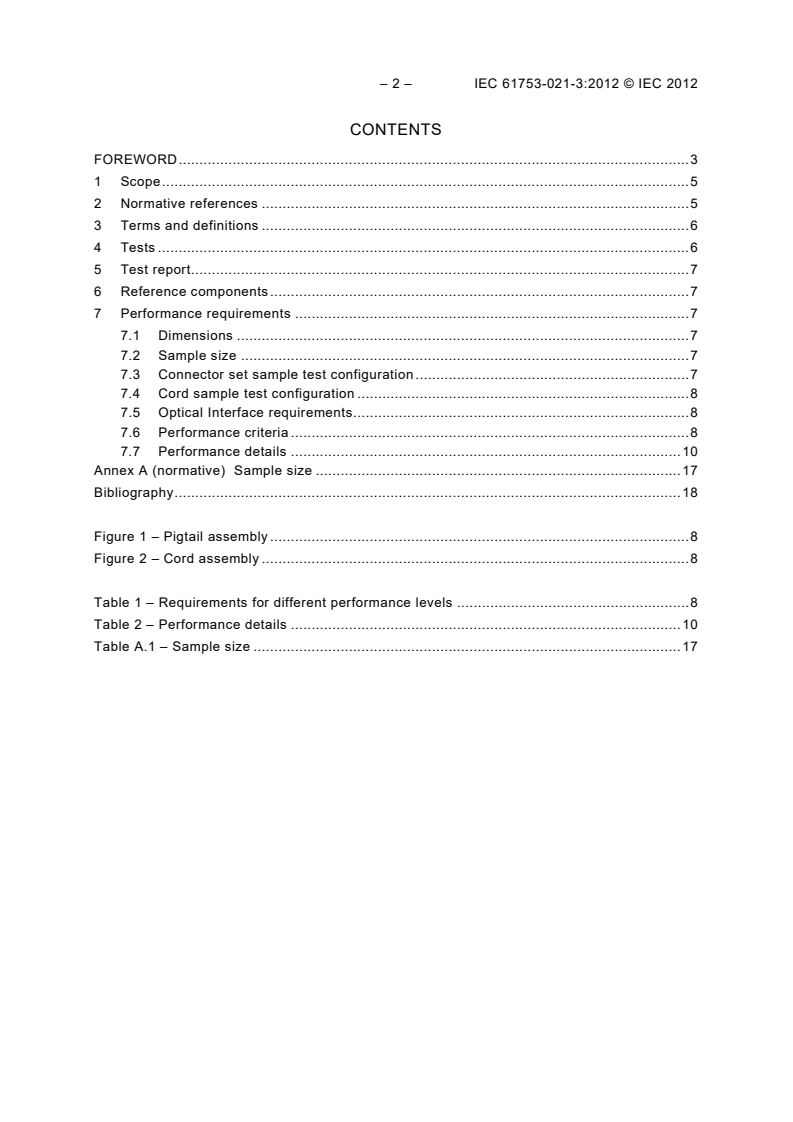
CONTENTS
FOREWORD . 3
1 Scope . 5
2 Normative references . 5
3 Terms and definitions . 6
4 Tests . 6
5 Test report . 7
6 Reference components . 7
7 Performance requirements . 7
7.1 Dimensions . 7
7.2 Sample size . 7
7.3 Connector set sample test configuration . 7
7.4 Cord sample test configuration . 8
7.5 Optical Interface requirements . 8
7.6 Performance criteria . 8
7.7 Performance details . 10
Annex A (normative) Sample size . 17
Bibliography . 18
Figure 1 – Pigtail assembly . 8
Figure 2 – Cord assembly . 8
Table 1 – Requirements for different performance levels . 8
Table 2 – Performance details . 10
Table A.1 – Sample size . 17
INTERNATIONAL ELECTROTECHNICAL COMMISSION
____________
FIBRE OPTIC INTERCONNECTING DEVICES AND
PASSIVE COMPONENTS – PERFORMANCE STANDARD –
Part 021-3: Single-mode fibre optic connectors for category U –
Uncontrolled environment
FOREWORD
1) The International Electrotechnical Commission (IEC) is a worldwide organization for standardization comprising
all national electrotechnical committees (IEC National Committees). The object of IEC is to promote
international co-operation on all questions concerning standardization in the electrical and electronic fields. To
this end and in addition to other activities, IEC publishes International Standards, Technical Specifications,
Technical Reports, Publicly Available Specifications (PAS) and Guides (hereafter referred to as “IEC
Publication(s)”). Their preparation is entrusted to technical committees; any IEC National Committee interested
in the subject dealt with may participate in this preparatory work. International, governmental and non-
governmental organizations liaising with the IEC also participate in this preparation. IEC collaborates closely
with the International Organization for Standardization (ISO) in accordance with conditions determined by
agreement between the two organizations.
2) The formal decisions or agreements of IEC on technical matters express, as nearly as possible, an international
consensus of opinion on the relevant subjects since each technical committee has representation from all
interested IEC National Committees.
3) IEC Publications have the form of recommendations for international use and are accepted by IEC National
Committees in that sense. While all reasonable efforts are made to ensure that the technical content of IEC
Publications is accurate, IEC cannot be held responsible for the way in which they are used or for any
misinterpretation by any end user.
4) In order to promote international uniformity, IEC National Committees undertake to apply IEC Publications
transparently to the maximum extent possible in their national and regional publications. Any divergence
between any IEC Publication and the corresponding national or regional publication shall be clearly indicated in
the latter.
5) IEC itself does not provide any attestation of conformity. Independent certification bodies provide conformity
assessment services and, in some areas, access to IEC marks of conformity. IEC is not responsible for any
services carried out by independent certification bodies.
6) All users should ensure that they have the latest edition of this publication.
7) No liability shall attach to IEC or its directors, employees, servants or agents including individual experts and
members of its technical committees and IEC National Committees for any personal injury, property damage or
other damage of any nature whatsoever, whether direct or indirect, or for costs (including legal fees) and
expenses arising out of the publication, use of, or reliance upon, this IEC Publication or any other IEC
Publications.
8) Attention is drawn to the Normative references cited in this publication. Use of the referenced publications is
indispensable for the correct application of this publication.
9) Attention is drawn to the possibility that some of the elements of this IEC Publication may be the subject of
patent rights. IEC shall not be held responsible for identifying any or all such patent rights.
International Standard IEC 61753-021-3 has been prepared by subcommittee 86B: Fibre optic
interconnecting devices and passive components, of IEC technical committee 86: Fibre optics.
The text of this standard is based on the following documents:
FDIS Report on voting
86B/3495/FDIS 86B/3542/RVD
Full information on the voting for the approval of this standard can be found in the report on
voting indicated in the above table.
This publication has been drafted in accordance with the ISO/IEC Directives, Part 2.
– 4 – IEC 61753-021-3:2012 © IEC 2012
A list of all parts of the IEC 61753 series, published under the general title Fibre optic
interconnecting devices and passive components – Performance standard, can be found on
the IEC website.
The committee has decided that the contents of this publication will remain unchanged until
the stability date indicated on the IEC web site under "http://webstore.iec.ch" in the data
related to the specific publication. At this date, the publication will be
• reconfirmed,
• withdrawn,
• replaced by a revised edition, or
• amended.
FIBRE OPTIC INTERCONNECTING DEVICES AND
PASSIVE COMPONENTS – PERFORMANCE STANDARD –
Part 021-3: Single-mode fibre optic connectors for category U –
Uncontrolled environment
1 Scope
This part of IEC 61753 defines minimum initial test and measurement requirements and
severities which a single-mode connector, either part of a pigtail, or part of a cord, must
satisfy in order to be categorized as meeting the IEC standard category U (uncontrolled
environment).
2 Normative references
The following documents, in whole or in part, are normatively referenced in this document and
are indispensable for its application. For dated references, only the edition cited applies. For
undated references, the latest edition of the referenced document (including any
amendments) applies.
IEC 60793-2-50:2008, Optical fibres – Part 2-50: Product specifications – Sectional
specification for class B single-mode fibres
IEC 61300-2-1, Fibre optic interconnecting devices and passive components – Basic test and
measurement procedures – Part 2-1: Tests – Vibration (sinusoidal)
IEC 61300-2-2, Fibre optic interconnecting devices and passive components – Basic test and
measurement procedures – Part 2-2: Tests – Mating durability
IEC 61300-2-4, Fibre optic interconnecting devices and passive components – Basic test and
measurement procedures – Part 2-4: Tests – Fibre/cable retention
IEC 61300-2-6, Fibre optic interconnecting devices and passive components – Basic test and
measurement procedures – Part 2-6: Tests – Tensile strength of coupling mechanism
IEC 61300-2-12:2009, Fibre optic interconnecting devices and passive components – Basic
test and measurement procedures – Part 2-12: Tests – Impact
IEC 61300-2-17, Fibre optic interconnecting devices and passive components – Basic test
and measurement procedures – Part 2-17: Tests – Cold
IEC 61300-2-18, Fibre optic interconnecting devices and passive components – Basic test
and measurement procedures – Part 2-18: Tests – Dry heat – High temperature endurance
IEC 61300-2-22, Fibre optic interconnecting devices and passive components – Basic test
and measurement procedures – Part 2-22: Tests – Change of temperature
IEC 61300-2-42, Fibre optic interconnecting devices and passive components – Basic test
and measurement procedures – Part 2-42: Tests – Static side load for connectors
– 6 – IEC 61753-021-3:2012 © IEC 2012
IEC 61300-2-44, Fibre optic interconnecting devices and passive components – Basic test
and measurement procedures – Part 2-44: Tests – Flexing of the strain relief of fibre optic
devices
IEC 61300-3-3, Fibre optic interconnecting devices and passive components – Basic test and
measurement procedures – Part 3-3: Examinations and measurements – Active monitoring of
changes in attenuation and return loss
IEC 61300-3-4, Fibre optic interconnecting devices and passive components – Basic test and
measurement procedures – Part 3-4: Examinations and measurements – Attenuation
IEC 61300-3-6, Fibre optic interconnecting devices and passive components – Basic test and
measurement procedures – Part 3-6: Examinations and measurements – Return loss
IEC 61300-3-28, Fibre optic interconnecting devices and passive components – Basic test
and measurement procedures – Part 3-28: Examinations and measurements – Transient loss
IEC 61300-3-34, Fibre optic interconnecting devices and passive components – Basic test
and measurement procedures – Part 3-34: Examinations and measurements – Attenuation of
random mated connectors
IEC 61753-1:2007, Fibre optic interconnecting devices and passive components performance
standard – Part 1: General and guidance for performance standards
IEC 61754 (all parts), Fibre optic connector interfaces
IEC 61755 (all parts), Fibre optic connector optical interfaces
3 Terms and definitions
For the purposes of this document, the following definitions apply.
3.1
change in attenuation
peak-to-peak variation of attenuation
3.2
sample
complete set of connector components required to provide demountable coupling between
one or more pairs of optical fibres
3.3
pigtail
a cabled fibre or a secondary coated fibre terminated with a connector on one end
3.4
cord
general term for terminated cable assembly
4 Tests
All test methods are in accordance with the relevant parts of IEC 61300 as defined in 7.6 and
7.7.
The connectors under test shall be terminated onto single-mode fibre category B1.1, B1.3 or
B6_a of IEC 60793-2-50:2008, depending upon the design of the connector, it will be
terminated with a cabled fibre or a secondary coated fibre. The connector interface standard
shall meet the dimensions of IEC 61754 series and the connector optical interface standard
shall meet the relevant requirements of IEC 61755 series.
Each test defines the number of samples to be evaluated. The sample set used for the first
test is to be composed of randomly selected and previously unstressed new samples.
The optical criteria for each test shall be as defined in 7.6.
5 Test report
Fully documented test reports and supporting evidence shall be prepared and available for
inspection as evidence that the tests have been carried out and the results are satisfactory.
6 Reference components
No reference components are required to perform the tests in this standard.
7 Performance requirements
7.1 Dimensions
Dimensions shall comply with the appropriate IEC interface standard as defined in the
IEC 61754 series.
7.2 Sample size
For the purposes of this standard, a sample is composed of pigtail assemblies and cord
assemblies (see Clause 3). The sample sizes to be used for the tests shall be as defined in
Annex A. There is no defined sequence or grouping in which the tests shall be run. Samples
for the first test (attenuation) are to be randomly selected and randomly mated new products.
Samples for the second test (return loss) are the same plugs selected and mated for the first test.
Samples for subsequent tests may be randomly selected and randomly mated new products
or the same plugs.
7.3 Connector set sample test configuration
Two connector plugs mated with an adaptor with pigtailed leads, as shown in Figure 1.
Each of the pigtailed leads shall be at least 3 m long so that when the sample is located
inside an environmental test chamber the connections may be located outside the chamber.
– 8 – IEC 61753-021-3:2012 © IEC 2012
Adaptor
Chamber
Plug
IEC 2174/12
Figure 1 – Pigtail assembly
7.4 Cord sample test configuration
Cord connected with adaptors to two additional connector plugs with pigtailed leads on either
end, as shown in Figure 2. The cord shall be 3 m to 5 m. Each of the pigtailed leads shall be
long enough so that the splices may be located outside of the environmental test chamber.
Adaptor Adaptor
Chamber
Plug
Pigtailed lead Cord Pigtailed lead
IEC 2175/12
Figure 2 – Cord assembly
7.5 Optical Interface requirements
The connector endface shall comply with the endface geometry requirements of the applicable
IEC optical interface standard as defined in the 61755-3 series. Compliance with the
appropriate optical interface standard shall be confirmed on all samples before the start of
testing and after all of the tests have been completed. Non-compliance with the endface
geometry requirements of the applicable optical interface standard on any connector tested
results in a failure of this performance standard.
7.6 Performance criteria
The optical performance levels shall meet the requirements as defined in Table A.12 of
IEC 61753-1:2007 (see Table 1).
Table 1 – Requirements for different performance levels
Performance Test name Initial During/after test
level
≤ 0,12 dB mean (see Note)
Attenuation
a
B /1
≤ 0,25 dB max.
IEC 61300-3-34
for ≥ 97 % of samples
Performance Test name Initial During/after test
level
Return loss ≥ 60 dB
IEC 61300-3-6
Maximum attenuation variation
≤ 0,2 dB during and after test for
pigtails.
Monitoring change in
Maximum attenuation
attenuation and in return loss
variation ≤ 0,5 dB during and
(multiple path IEC 61300-3-3)
≤ 0,4 dB after test for cords.
Return loss ≥ 60 dB during and
after test
≤0,12 dB mean (see Note)
Attenuation
≤0,25 dB max.
IEC 61300-3-34
for ≥97 % of samples
Return loss ≥45 dB
IEC 61300-3-6
Maximum attenuation variation
a
B /2
≤ 0,2 dB during and after test for
pigtails.
Monitoring change in
Maximum attenuation variation
attenuation and in return loss
≤ 0,5 dB during and ≤ 0,4 dB
(multiple path IEC 61300-3-3)
after test for cords.
Return loss ≥ 45 dB during and
after test
≤ 0,25 dB mean (see Note)
Attenuation
≤ 0,50 dB max.
IEC 61300-3-34
for ≥ 97 % of samples
Return loss
≥ 60 dB
IEC 61300-3-6
Maximum attenuation variation
C/1
≤ 0,2 dB during and after test for
pigtails.
Monitoring change in
Maximum attenuation
attenuation and in return loss
variation ≤ 0,5 dB during and
(multiple path IEC 61300-3-3)
≤ 0,4 dB after test for cords.
Return loss ≥ 60 dB during and
after test
≤ 0,25 dB mean (see Note)
Attenuation
≤ 0,50 dB max.
IEC 61300-3-34
for ≥97 % of samples
Return loss ≥ 45 dB
IEC 61300-3-6
Maximum attenuation variation
C/2
≤ 0,2 dB during and after test for
pigtails.
Monitoring change in
Maximum attenuation variation
attenuation and in return loss
≤ 0,5 dB during and ≤ 0,4 dB
(multiple path IEC 61300-3-3)
after test for cords
Return loss ≥ 45 dB during and
after test
a
Grade B connector attenuation is specified at mode field diameter range 9,2 µm ± 0,4 µm for B1.1 and B1.3
fibres. When connectors terminated with these fibres are intermated with connectors terminated with B6_a
fibres the average attenuation value is expected to increase due to mode field diameter mismatch. The
expected average increase is less than 0,05 dB.
NOTE Initial attenuation requirements of each test in Table 1 are per connection.
– 10 – IEC 61753-021-3:2012 © IEC 2012
7.7 Performance details
Performance details are specified in Table 2.
Table 2 – Performance details
No Test Requirements Details
1 Attenuation See Table 1 for the requirements for IEC 61300-3-4
the different performance levels
(Method C) Device under test (DUT) type 5, Insertion method
Test wavelengths: (C)
1 310 nm ± 30 nm and
Launch mode conditions: only the fundamental
1 550 nm ± 30 nm
mode shall propagate at the connector interface
(launch condition S4 and S5)
and at the detector.
Source characteristics reference to
IEC 61300-3-4 (attenuation).
Specimen shall be optically functioning.
Preconditioning procedure: clean plug and
according to manufacturer’s instructions
See Table 1 for the requirements for
2 Return loss IEC 61300-3-6: Method branching devices
the different performance levels.
Launch fibre length: L > 2 m
Test wavelengths:
Source stability: ± 0,20 dB over the measuring
1 310 nm ± 30 nm and 1 550 nm
period or at least 1 h.
± 30 nm
Detector linearity: within 5 % of the power levels
to be measured.
Directivity: > 65 dB
Specimen shall be optically functioning.
Preconditioning procedure: clean plug and
adaptor according to manufacturer’s instructions.
Alternative method: IEC 61300-3-6:
Method OTDR
Launch fibre length: L1 ≥ 500 m, L2 ≥ 6 m,
L3 ≥ 6 m.
Pulse duration: ≤10 ns.
Specimen shall be optically functioning.
Preconditioning procedure: clean plug and
adaptor according to manufacturer’s instructions
3 Vibration See Table 1 for the requirements for IEC 61300-2-1
(sinusoidal) the different performance levels
Frequency range: 10 Hz to 55 Hz
Test wavelengths:
Change in frequency: 1 oct/min
1 550 nm ± 30 nm
Number of axes: three orthogonal
Number of sweeps (10-55-10 Hz) per axis: 15
Vibration amplitude: 0,75 mm
Sampling rate: before, during and after each
axis.
The measurement interval during the test shall
be < 2 ms and transient monitoring shall be
performed according to IEC 61300-3-28.
Sampling rate note: Attenuation and return loss
decrease is the difference between any
measurement and the initial measurement, and
applies to all measurements. Maximum
attenuation and return loss criteria apply to all
measurements.
Method of mounting: an adaptor shall be
mounted rigidly to the mounting fixture.
Specimen shall be optically functioning.
Preconditioning procedure: clean plug and
adaptor according to manufacturer’s instructions.
The connector samples shall not be uncoupled or
cleaned at any time during the test
Table 2 (2 of 7)
No Test Requirements Details
See Table 1 for the requirements for
4 Cold IEC 61300-2-17
the different performance levels.
Temperature: –25 °C ± 2 °C
Duration of exposure: 96 h
Test wavelengths:
Length of the cable on each side of the
1 550 nm ± 30 nm
connector inside the chamber: 1,5 m minimum.
Sampling rate: before and after test and at a
maximum interval of 1 h during the test.
Preconditioning procedure: before test,
specimens shall be maintained in room
temperature condition for 2 h. Clean plug and
adaptor according to manufacturer’s instructions.
Recovery procedure: after test, specimens shall
be maintained in room temperature condition for
2 h.
The connector samples shall not be uncoupled or
cleaned at any time during the test
See Table 1 for the requirements for
5 Dry heat – IEC 61300-2-18
the different performance levels.
high
Temperature: +70 °C ± 2 °C
temperature
Test wavelengths:
endurance
Duration of exposure: 96 h
1 550 nm ± 30 nm
Length of the cable on each side of the
connector inside the chamber: 1,5 m minimum.
Sampling rate: before and after test and at a
maximum interval of 1 h during the test.
Preconditioning procedure: before test,
specimens shall be maintained in room
temperature condition for 2 h. Clean plug and
adaptor according to manufacturer’s instructions.
Recovery procedure: after test, specimens shall
be maintained in room temperature condition for
2 h.
The connector samples shall not be uncoupled or
cleaned at any time during the test
See Table 1 for the requirements for
6 Damp heat IEC 61300-2-46
the different performance levels.
(cyclic)
Temperature: +25 °C ± 2 °C to +55 °C ± 2 °C
Test wavelengths:
Relative humidity: > 95 % RH (Variant 1)
1 550 nm ± 30 nm
Duration of exposure: 96 h
Length of the cable on each side of the
connector inside the chamber: 1,5 m minimum.
Sampling rate: before and after test and at a
maximum interval of 1 h during the test.
Preconditioning procedure: before test,
specimens shall be maintained in room
temperature condition for 2 h. Clean plug and
adaptor according to manufacturer’s instructions.
Recovery procedure: after test, specimens shall
be maintained in room temperature condition for
2 h.
The connector samples shall not be uncoupled or
cleaned at any time during the test
– 12 – IEC 61753-021-3:2012 © IEC 2012
Table 2 (3 of 7)
No Test Requirements Details
See Table 1 for the requirements for
7 Change of IEC 61300-2-22
the different performance levels.
temperature
High temperature dwell: +70 °C ± 2 °C
Test wavelengths:
Low temperature dwell: –25 °C ± 2 °C
1 550 nm ± 30 nm
Duration at each dwell temperature: 1 h
Ramp time = 1 °C/min
Number of cycles: 12
Length of the cable on each side of the
connector inside the chamber: 1,5 m minimum.
Specimen shall be optically functioning.
Sampling rate: initially at room ambient, after
0,5 h during each dwell (measurements to be
completed during dwell) and at the end of the
test at room ambient.
Preconditioning procedure: before test,
specimens shall be maintained in room
temperature condition for 2 h.
Recovery procedure: after test, specimens shall
be maintained in room temperature condition for
2 h.
The connector samples shall not be uncoupled or
cleaned at any time during the test
See Table 1 for the requirements for
8 Flexing of IEC 61300-2-44
the different performance levels.
the strain
Magnitude of the tensile load: 5 N for connectors
relief of fibre
Test wavelengths:
with reinforced cable.
optic devices
1 310 nm ± 30 nm and 1 550 nm ±
Cycle: ± 90°
30 nm
Number of cycles: 100
NOTE This test only applies to
connectors assembled on reinforced
Rate of application of the tensile load:
cable.
1 N/s for reinforced cable.
Point of application of tensile load: 220 mm to
280 mm from cable entrance to plug.
Sampling rate: initially, during and at the end of
the test. Measurement interval during the test
shall be < 2 ms and transient monitoring shall be
performed according to IEC 61300-3-28.
Method of mounting: an adaptor shall be
mounted rigidly to the test fixture.
Preconditioning procedure: clean plug and
adaptor according to manufacturer’s instructions.
The connector samples shall not be uncoupled or
cleaned at any time during the test
Table 2 (4 of 7)
No Test Requirements Details
See Table 1 for the requirements for
9 Fibre cable IEC 61300-2-4
the different performance levels.
retention
Magnitude and rate of application of the load for
Test wavelengths:
reinforced cables with diameter > 2 mm:
1 550 nm ± 30 nm
100 N ± 2 N at 5 N/s
Magnitude and rate of application of the load for
reinforced cables with diameter ≤ 2 mm:
70 N ± 2 N at 5 N/s
Duration for reinforced cables: 120 s at 70 N or
100 N
Magnitude and rate of application of the load for
secondary coated fibres: 5,0 N ± 0,5 N at 0,5 N/s
Magnitude and rate of application of the load for
primary coated fibres: 2,0 N ± 0,2 N at 0,5 N/s.
Duration for buffered fibres: 60 s at 2 N or 5 N.
Point of application of tensile load: 0,3 m from
the end face of the connector.
Sampling rate: Initially and after the load has
reached its maximum level and been maintained
for a minimum of 30 s.
Specimen shall be optically functioning.
Preconditioning procedure: clean plug and
adaptor according to manufacturer’s instructions
See Table 1 for the requirements for
10 Impact IEC 61300-2-12:2009: Method A
the different performance levels.
Number of drops: 5 for each plug
Test wavelengths:
Drop height: 1,5 m
1 550 nm ± 30 nm
Sampling rate: Initially and after the last drop.
Specimen shall be unmated during drop cycles.
Preconditioning procedure: clean plug and
adaptor according to manufacturer’s instructions.
Place a dust cap over the ferrule to protect the
fibre endface.
Recovery procedure: the connector may be
cleaned after each drop before measurement
See Table 1 for the requirements for
11 Tensile IEC 61300-2-6
the different performance levels.
strength of
Magnitude and rate of application of the load:
coupling
Test wavelengths:
40 N at 2 N/s
mechanism
1 550 nm ± 30 nm
Duration: 120 s
Sampling rate: Initially and after the load has
reached its maximum level and been maintained
for a minimum of 30 s
Specimen shall be optically functioning.
Preconditioning procedure: clean plug and
adaptor according to manufacturer’s instructions
– 14 – IEC 61753-021-3:2012 © IEC 2012
Table 2 (5 of 7)
No Test Requirements Details
See Table 1 for the requirements for
12 Static side IEC 61300-2-42
the different performance levels.
load
Magnitude of the load for reinforced cables: 1 N
Test wavelengths:
Duration for reinforced cables: 1 h
1 550 nm ± 30 nm
Magnitude of the load for buffered fibres: 0,2 N
Duration for buffered fibres: 5 min
Static side load shall be applied in two mutually
perpendicular directions
Sampling rate: Initially and 3 min maximum
intervals
Specimen shall be optically functioning
Preconditioning procedure: clean plug and
adaptor according to manufacturer’s instructions
See Table 1 for the requirements for
13 Mating IEC 61300-2-2
the different performance levels.
durability
Coupling mechanism to be cycled:
Test wavelengths:
plug-adaptor
1 550 nm ± 30 nm
Cycling rate: not less than 3 s between each
In the event that the attenuation
engagement and separation
increases above the allowable limit,
Number of cycles: 500 minimum
the connector may be cleaned as
necessary but not more than 25
Specimen shall be optically functioning
times during the course of the test.
(The measurements at which the
Preconditioning procedure: clean plug and
cleaning takes place shall be
adaptor according to manufacturer’s instructions.
discounted from the test results)
Recovery procedure: the mechanical and optical
alignment parts of the specimen may be cleaned
according to manufacturer’s instructions up to 2
times after the final mating cycle
14 Dust Allowable change in attenuation: IEC 61300-2-27
≤ 0,20 dB at 1 550 nm ± 30 nm Dust particle size: d < 150 µm
Return loss shall be measured before Dust type: talc
and after the test at normal ambient
3 3
Dust concentration: 10,6 g/m ± 7,1 g/m
conditions and shall satisfy the
requirements for the specified class.
Temperature: +35 °C
Attenuation shall be measured before
Relative humidity: 60 %
and after the test at normal ambient
conditions. Duration of test: 10 min
The change in attenuation Configuration:
measurement shall be made against
The configuration shall be a mated pair of
randomly selected plugs.
connectors which once mated for the initial
The initial attenuation shall satisfy measurements shall not be disconnected until
the requirements for the specified after the completion of the test.
attenuation grade
Specimen shall be optically functioning.
Preconditioning procedure.
Clean the mechanical and optical alignment parts
of the specimen according to the manufacturer's
instructions, prior to initial measurement
Table 2 (6 of 7)
Requirements
No Test Details
See Table 1 for the requirements for
15 Torsion IEC 61300-2-5
the different performance levels.
Magnitude and rate of application of the tensile
Test wavelengths:
load:
1 550 nm ± 30 nm
15 N at a speed of 1 N/s for reinforced cable
2 N at a speed of 0,1 N/s for coated fibre
Point of application of tensile load:
0,2 m from the endface of the connector
Duration of the test: 25 cycles ± 180°
Sampling rate:
Losses shall be measured at least once after
the load has reached maximum level.
Specimen shall be optically functioning.
Preconditioning procedure:
Clean the mechanical and optical alignment parts
of the specimen according to the manufacturer's
instructions.
Recovery procedure:
Clean the mechanical and optical alignment parts
of the specimen according to the manufacturer's
instructions before final measurement
See Table 1 for the requirements for
16 Bending IEC 61300-2-7
the different performance levels.
moment
Load: 10 N smoothly applied
Test wavelengths:
Point of application:
1 550 nm ± 30 nm
25 mm from centre line of load defined by
the optical interface.
Sampling rate:
Losses shall be measured at least once after
the load has reached its maximum level and
been maintained for a minimum period of 30 s.
Specimen shall be optically functioning.
Preconditioning procedure:
Clean the mechanical and optical alignment parts
of the specimen according to the manufacturer's
instructions.
Recovery procedure:
The connector may be cleaned after the test
before final measurement
– 16 – IEC 61753-021-3:2012 © IEC 2012
Table 2 (7 of 7)
No Test Requirements Details
17 Salt mist Allowable change in attenuation: IEC 61300-2-26
Salt concentration 5 % NaCl (pH 6,5 to 7,2)
≤ 0,20 dB at 1 550 nm ± 30 nm
Temperature: +35 °C
Return loss shall be measured before
and after the test at normal ambient
Relative humidity: > 85 %
conditions and shall satisfy the
requirements for the specified class.
Duration of test: 96 h
Attenuation shall be measured before
Configuration:
and after the test at normal ambient
conditions. The configuration shall be a mated pair of
connectors which once mated for the initial
The change in attenuation
measurements shall not be disconnected until
measurement shall be made against
after the completion of the test.
randomly selected plugs.
Specimen shall be optically functioning.
The initial attenuation shall satisfy
the requirements for the specified Preconditioning procedure.
performance grade
Clean the mechanical and optical alignment parts
of the specimen according to the manufacturer's
instructions, prior to initial measurement
Annex A
(normative)
Sample size
The tests in Table A.1 are intended to be performed individually on products selected as
defined in 7.2, although products from a previous test may be used if desired. The tests may
also be performed in any order providing the product is selected as defined.
Table A.1 – Sample size
Test Sample size Source
Test no. Pigtail Cord
assembly assembly
1 Attenuation (random mate) 20 5 New
2 Return loss (random mate) 20 5 Test 1
3 Vibration 5 – Test 2
4 Cold 5 5 Test 2
5 Dry heat – high temperature endurance 5 5 Test 2
6 Damp heat (steady state) 5 5 Test 2
7 Change of temperature 5 5 Test 2
8 Flexing of the strain relief of fibre optic 5 5 Test 2
devices
9 Fibre cable retention 5 – Test 2
10 Impact 5 – Test 2
11 Tensile strength of coupling 5 – Test 2
12 Static side load 5 – Test 2
13 Mating durability 5 – Test 2
14 Dust 5 – Test 2
15 Torsion 5 – Test 2
16 Bending moment 5 – Test 2
17 Salt mist 5 – Test 2
– 18 – IEC 61753-021-3:2012 © IEC 2012
Bibliography
IEC 61300-2-19, Fibre optic interconnecting devices and passive components – Basic test
and measurement procedures – Part 2-19: Tests – Damp heat (steady state)
IEC 61755-3 (all parts), Fibre optic connector optical interfaces – Part 3: Optical interface
___________
– 20 – IEC 61753-021-3:2012 © IEC 2012
SOMMAIRE
AVANT-PROPOS . 21
1 Domaine d’application . 23
2 Références normatives . 23
3 Termes et définitions . 24
4 Essais . 25
5 Rapport d’essai . 25
6 Composants de référence . 25
7 Exigences de qualité de fonctionnement . 25
7.1 Dimensions . 25
7.2 Nombre d’échantillons . 25
7.3 Exemple de configuration d’essai d'un jeu de connecteurs . 25
7.4 Configuration d’essai d'échantillon de cordon . 26
7.5 Exigences en matière d'interface optique . 27
7.6 Critères de performance . 27
7.7 Informations détaillées relatives aux performances. 29
Annexe A (normative) Nombre d’échantillons . 37
Bibliographie . 38
Figure 1 – Assemblage de fibres amorces. 26
Figure 2 – Cordon équipé . 26
Tableau 1 – Exigences pour les différents niveaux de performance . 27
Tableau 2 – Informations détaillées relatives aux performances . 29
Tableau A.1 – Nombre d’échantillons . 37
COMMISSION ÉLECTROTECHNIQUE INTERNATIONALE
____________
DISPOSITIFS D'INTERCONNEXION ET COMPOSANTS PASSIFS
FIBRONIQUES – NORME DE PERFORMANCE –
Partie 021-3: Connecteurs à fibres optiques unimodales
pour la catégorie U – Environnement non contrôlé
AVANT-PROPOS
1) La Commission Électrotechnique Internationale (IEC) est une organisation mondiale de normalisation
composée de l'ensemble des comités électrotechniques nationaux (Comités nationaux de l’IEC). L’IEC a pour
objet de favoriser la coopération internationale pour toutes les questions de normalisation dans les domaines
de l'électricité et de l'électronique. À cet effet, l’IEC – entre autres activités – publie des Normes internationales,
des Spécifications techniques, des Rapports techniques, des Spécifications accessibles au public (PAS) et des
Guides (ci-après dénommés "Publication(s) de l’IEC"). Leur élaboration est confiée à des comités d'études, aux
travaux desquels tout Comité national intéressé par le sujet traité peut participer. Les organisations
internationales, gouvernementales et non gouvernementales, en liaison avec l’IEC, participent également aux
travaux. L’IEC collabore étroitement avec l'Organisation Internationale de Normalisation (ISO), selon des
...