

IEC 60364-8-81:2026
(Main)Low-voltage electrical installations - Part 8-81: Functional aspects - Energy efficiency
General Information
- Abstract
IEC 60364-8-81:2026 provides additional requirements, measures and recommendations for the design, erection, operation and verification of all types of low-voltage electrical installation including local production and storage of energy for optimizing the overall efficient use of electricity.
It introduces requirements, recommendations and methods for the design and the energy efficiency (EE) assessment of an electrical installation within the framework of an energy efficiency management approach in order to get the best permanent functionally equivalent service for the lowest electrical energy consumption and the optimal availability and acceptable cost-effectiveness.
These requirements, recommendations and methods apply, within the scope of the IEC 60364 series, for new installations and modification of existing installations.
This document is applicable to the electrical installation of a building or system and does not apply to products. The energy efficiency of products and their operational requirements are covered by the relevant product standards.
It is possible that another standard provides specific requirements for a particular system or installation application (e.g. manufacturing system covered by ISO 20140 series).
This document does not specifically provide requirements for building automation systems. The contribution of building automation systems to improve energy efficiency of the installation is considered.
This group energy efficiency publication is primarily intended to be used as an energy efficiency standard for the low-voltage electrical installations mentioned in the scope, but is also intended to be used by technical committees in the preparation of publications, in accordance with the principles laid down in IEC Guide 118
This first edition cancels and replaces the second edition of IEC 60364-8-1 published in 2019. This edition constitutes a technical revision.
This edition includes the following significant technical changes with respect to the previous edition:
a) modified numbering that allows IEC 60364-7 subparts to amend this document;
b) alignment of the definitions with IEC 60050-826;
c) introduction of minimum energy moment method in Annex A;
d) improvements in Annex B
- Status
- Published
- Publication Date
- 11-Feb-2026
- Technical Committee
- TC 64 - Electrical installations and protection against electric shock
- Drafting Committee
- MT 41 - TC 64/MT 41
- Current Stage
- PPUB - Publication issued
- Start Date
- 12-Feb-2026
- Completion Date
- 27-Feb-2026
Buy Documents

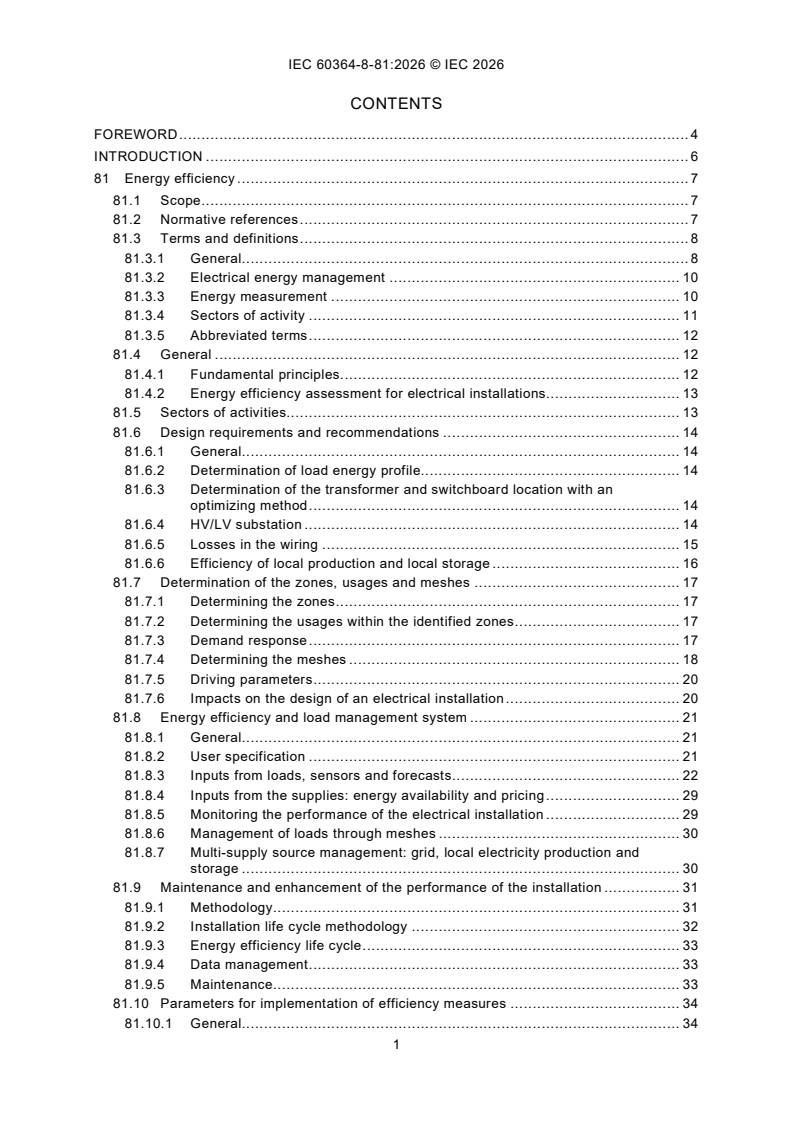
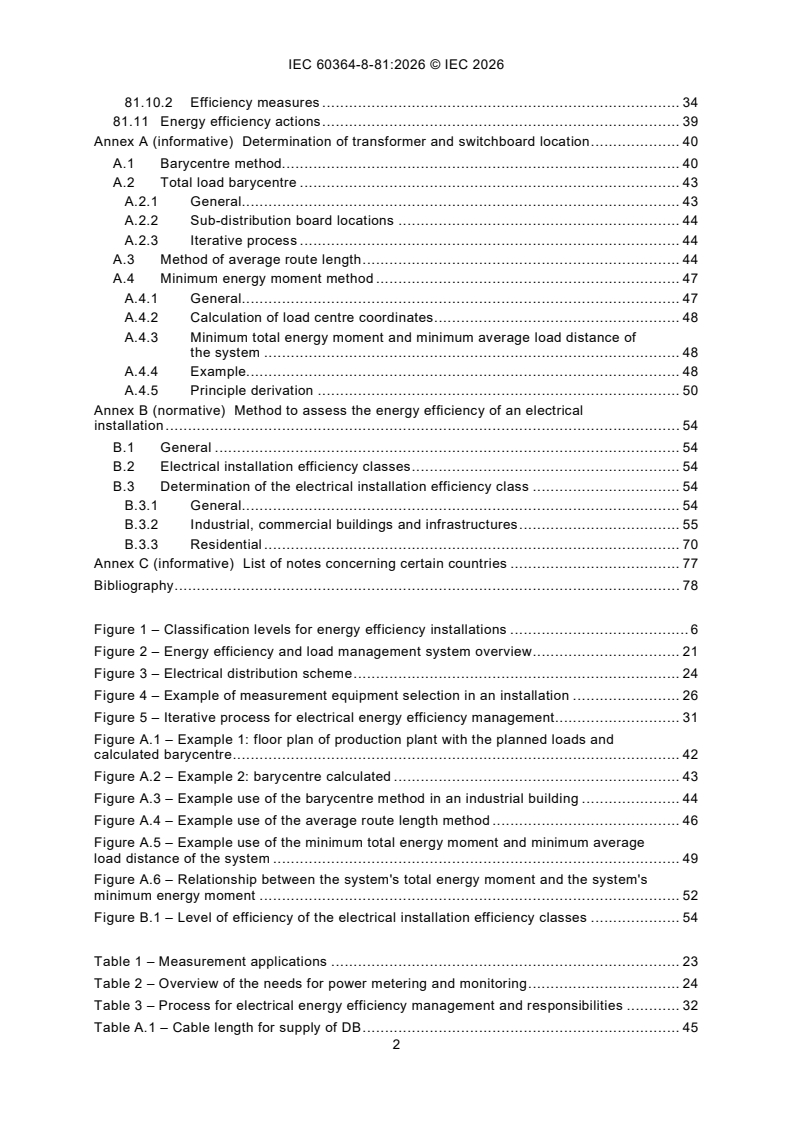
IEC 60364-8-81:2026 - Low-voltage electrical installations - Part 8-81: Functional aspects - Energy efficiency/12/2026
IEC 60364-8-81:2026 - Installations électriques à basse tension - Partie 8-81: Aspects fonctionnels - Efficacité énergétique/12/2026
IEC 60364-8-81:2026 - Low-voltage electrical installations - Part 8-81: Functional aspects - Energy efficiency/12/2026
Overview
IEC 60364-8-81:2026 - Low-voltage electrical installations – Part 8-81: Functional aspects – Energy efficiency is an international standard developed by the IEC that introduces additional requirements, measures, and recommendations for enhancing the energy efficiency of low-voltage electrical installations. This latest edition focuses on both new and existing installations, including those with local energy production and storage, providing a comprehensive framework for optimizing the efficient use of electricity in buildings and systems.
Designed as part of the IEC 60364 series, this standard emphasizes a holistic approach to energy management. It covers the design, erection, operation, and verification stages to achieve functionally equivalent services while minimizing electrical energy consumption, maximizing availability, and ensuring cost-effectiveness. Notably, the document provides a methodology for energy efficiency assessment and is intended for use in conjunction with energy management systems such as those addressed by ISO 50001.
Key Topics
Scope and Applicability
- Applies to all types of low-voltage electrical installations.
- Addresses both new installations and modifications to existing ones.
- Covers electrical installations in buildings or systems, including local power production and storage.
- Does not address product-level energy efficiency, which is covered by specific product standards.
Energy Efficiency Principles
- Promotes optimization of electrical energy usage through design and lifecycle management.
- Emphasizes measurement, monitoring, and management for continuous improvement.
- Introduces concepts such as zones, usages, meshes, and load profiles to structure efficiency analysis.
Energy Management Framework
- Recommends the implementation of energy management systems (EEMS).
- Considers active (e.g., automated controls) and passive (e.g., equipment selection and placement) efficiency measures.
- Recognizes the supportive role of building automation systems in achieving efficiency goals.
Assessment and Verification
- Provides a standardized methodology for energy efficiency assessment.
- Defines efficiency classes for installations, facilitating benchmarking and improvement.
- Introduces the “minimum energy moment method” among other assessment tools for optimizing system layout.
Updated Technical Content
- Realigns definitions with IEC 60050-826.
- Presents improvements to energy efficiency assessment methods, particularly in Annexes A and B.
- New numbering system for greater compatibility with related standards and amendments.
Applications
Implementing IEC 60364-8-81:2026 provides significant practical benefits for a wide range of stakeholders:
Facility Managers & Building Owners
- Optimize operational costs and energy use in commercial, industrial, residential, and infrastructure settings.
- Retrofit or upgrade existing installations for significant improvements in energy performance.
Electrical Designers & Engineers
- Utilize standardized methods to design efficient electrical systems.
- Assess and select layouts, equipment, and control strategies to maximize energy efficiency.
Regulators & Inspectors
- Adopt a unified framework for evaluating and certifying the energy performance of installations.
- Reference standardized efficiency classes for regulatory compliance or incentive programs.
Energy Managers
- Integrate recommended monitoring and management practices for continuous performance improvement.
- Take advantage of data-driven approaches for long-term energy savings.
Technical Committees
- Leverage this publication as a foundation for energy efficiency considerations in sector-specific standards, in accordance with IEC Guide 118.
Related Standards
To ensure comprehensive coverage and compatibility, IEC 60364-8-81:2026 references and complements several other international standards, including:
- IEC 60364 Series: General requirements for low-voltage electrical installations.
- IEC 60050-826: International Electrotechnical Vocabulary (IEV) - Electrical installations.
- IEC 60688: Measuring transducers for electrical quantities.
- IEC 61557-12: Power metering and monitoring devices (PMD).
- IEC 61869-2: Instrument transformers - Current transformers.
- IEC 62053-21/22: Electricity metering equipment for AC active energy.
- ISO 50001: International standard for energy management systems.
- ISO 20140 Series: Manufacturing systems - energy efficiency evaluation (for specific applications).
- IEC Guide 118: Preparation of group energy efficiency publications.
IEC 60364-8-81:2026 is essential for achieving optimal energy efficiency in modern and legacy low-voltage electrical installations, offering a robust, adaptable framework for energy-conscious design, operation, and lifecycle management.
Relations
- Effective Date
- 15-Mar-2024
Buy Documents
IEC 60364-8-81:2026 - Low-voltage electrical installations - Part 8-81: Functional aspects - Energy efficiency/12/2026
IEC 60364-8-81:2026 - Installations électriques à basse tension - Partie 8-81: Aspects fonctionnels - Efficacité énergétique/12/2026
IEC 60364-8-81:2026 - Low-voltage electrical installations - Part 8-81: Functional aspects - Energy efficiency/12/2026
Get Certified
Connect with accredited certification bodies for this standard

DNV
DNV is an independent assurance and risk management provider.

BSI Group
BSI (British Standards Institution) is the business standards company that helps organizations make excellence a habit.

Bureau Veritas
Bureau Veritas is a world leader in laboratory testing, inspection and certification services.
Sponsored listings
Frequently Asked Questions
IEC 60364-8-81:2026 is a standard published by the International Electrotechnical Commission (IEC). Its full title is "Low-voltage electrical installations - Part 8-81: Functional aspects - Energy efficiency". This standard covers: IEC 60364-8-81:2026 provides additional requirements, measures and recommendations for the design, erection, operation and verification of all types of low-voltage electrical installation including local production and storage of energy for optimizing the overall efficient use of electricity. It introduces requirements, recommendations and methods for the design and the energy efficiency (EE) assessment of an electrical installation within the framework of an energy efficiency management approach in order to get the best permanent functionally equivalent service for the lowest electrical energy consumption and the optimal availability and acceptable cost-effectiveness. These requirements, recommendations and methods apply, within the scope of the IEC 60364 series, for new installations and modification of existing installations. This document is applicable to the electrical installation of a building or system and does not apply to products. The energy efficiency of products and their operational requirements are covered by the relevant product standards. It is possible that another standard provides specific requirements for a particular system or installation application (e.g. manufacturing system covered by ISO 20140 series). This document does not specifically provide requirements for building automation systems. The contribution of building automation systems to improve energy efficiency of the installation is considered. This group energy efficiency publication is primarily intended to be used as an energy efficiency standard for the low-voltage electrical installations mentioned in the scope, but is also intended to be used by technical committees in the preparation of publications, in accordance with the principles laid down in IEC Guide 118 This first edition cancels and replaces the second edition of IEC 60364-8-1 published in 2019. This edition constitutes a technical revision. This edition includes the following significant technical changes with respect to the previous edition: a) modified numbering that allows IEC 60364-7 subparts to amend this document; b) alignment of the definitions with IEC 60050-826; c) introduction of minimum energy moment method in Annex A; d) improvements in Annex B
IEC 60364-8-81:2026 provides additional requirements, measures and recommendations for the design, erection, operation and verification of all types of low-voltage electrical installation including local production and storage of energy for optimizing the overall efficient use of electricity. It introduces requirements, recommendations and methods for the design and the energy efficiency (EE) assessment of an electrical installation within the framework of an energy efficiency management approach in order to get the best permanent functionally equivalent service for the lowest electrical energy consumption and the optimal availability and acceptable cost-effectiveness. These requirements, recommendations and methods apply, within the scope of the IEC 60364 series, for new installations and modification of existing installations. This document is applicable to the electrical installation of a building or system and does not apply to products. The energy efficiency of products and their operational requirements are covered by the relevant product standards. It is possible that another standard provides specific requirements for a particular system or installation application (e.g. manufacturing system covered by ISO 20140 series). This document does not specifically provide requirements for building automation systems. The contribution of building automation systems to improve energy efficiency of the installation is considered. This group energy efficiency publication is primarily intended to be used as an energy efficiency standard for the low-voltage electrical installations mentioned in the scope, but is also intended to be used by technical committees in the preparation of publications, in accordance with the principles laid down in IEC Guide 118 This first edition cancels and replaces the second edition of IEC 60364-8-1 published in 2019. This edition constitutes a technical revision. This edition includes the following significant technical changes with respect to the previous edition: a) modified numbering that allows IEC 60364-7 subparts to amend this document; b) alignment of the definitions with IEC 60050-826; c) introduction of minimum energy moment method in Annex A; d) improvements in Annex B
IEC 60364-8-81:2026 is classified under the following ICS (International Classification for Standards) categories: 13.020.01 - Environment and environmental protection in general; 27.015 - Energy efficiency. Energy conservation in general; 91.140.50 - Electricity supply systems. The ICS classification helps identify the subject area and facilitates finding related standards.
IEC 60364-8-81:2026 has the following relationships with other standards: It is inter standard links to IEC 60364-8-1:2019. Understanding these relationships helps ensure you are using the most current and applicable version of the standard.
IEC 60364-8-81:2026 is available in PDF format for immediate download after purchase. The document can be added to your cart and obtained through the secure checkout process. Digital delivery ensures instant access to the complete standard document.
Standards Content (Sample)
IEC 60364-8-81 ®
Edition 1.0 2026-02
INTERNATIONAL
STANDARD
HORIZONTAL PUBLICATION
Low-voltage electrical installations -
Part 8-81: Functional aspects - Energy efficiency
ICS 13.020.01; 27.015; 91.140.50 ISBN 978-2-8327-1034-0
All rights reserved. Unless otherwise specified, no part of this publication may be reproduced or utilized in any form or
by any means, electronic or mechanical, including photocopying and microfilm, without permission in writing from either
IEC or IEC's member National Committee in the country of the requester. If you have any questions about IEC copyright
or have an enquiry about obtaining additional rights to this publication, please contact the address below or your local
IEC member National Committee for further information.
IEC Secretariat Tel.: +41 22 919 02 11
3, rue de Varembé info@iec.ch
CH-1211 Geneva 20 www.iec.ch
Switzerland
About the IEC
The International Electrotechnical Commission (IEC) is the leading global organization that prepares and publishes
International Standards for all electrical, electronic and related technologies.
About IEC publications
The technical content of IEC publications is kept under constant review by the IEC. Please make sure that you have the
latest edition, a corrigendum or an amendment might have been published.
IEC publications search - IEC Products & Services Portal - products.iec.ch
webstore.iec.ch/advsearchform Discover our powerful search engine and read freely all the
The advanced search enables to find IEC publications by a
publications previews, graphical symbols and the glossary.
variety of criteria (reference number, text, technical With a subscription you will always have access to up to date
committee, …). It also gives information on projects, content tailored to your needs.
replaced and withdrawn publications.
Electropedia - www.electropedia.org
IEC Just Published - webstore.iec.ch/justpublished The world's leading online dictionary on electrotechnology,
Stay up to date on all new IEC publications. Just Published containing more than 22 500 terminological entries in English
details all new publications released. Available online and and French, with equivalent terms in 25 additional languages.
once a month by email. Also known as the International Electrotechnical Vocabulary
(IEV) online.
IEC Customer Service Centre - webstore.iec.ch/csc
If you wish to give us your feedback on this publication or
need further assistance, please contact the Customer
Service Centre: sales@iec.ch.
CONTENTS
FOREWORD . 4
INTRODUCTION . 6
81 Energy efficiency . 7
81.1 Scope . 7
81.2 Normative references . 7
81.3 Terms and definitions . 8
81.3.1 General. 8
81.3.2 Electrical energy management . 10
81.3.3 Energy measurement . 10
81.3.4 Sectors of activity . 11
81.3.5 Abbreviated terms . 12
81.4 General . 12
81.4.1 Fundamental principles . 12
81.4.2 Energy efficiency assessment for electrical installations . 13
81.5 Sectors of activities. 13
81.6 Design requirements and recommendations . 14
81.6.1 General. 14
81.6.2 Determination of load energy profile. 14
81.6.3 Determination of the transformer and switchboard location with an
optimizing method . 14
81.6.4 HV/LV substation . 14
81.6.5 Losses in the wiring . 15
81.6.6 Efficiency of local production and local storage . 16
81.7 Determination of the zones, usages and meshes . 17
81.7.1 Determining the zones . 17
81.7.2 Determining the usages within the identified zones . 17
81.7.3 Demand response . 17
81.7.4 Determining the meshes . 18
81.7.5 Driving parameters . 20
81.7.6 Impacts on the design of an electrical installation . 20
81.8 Energy efficiency and load management system . 21
81.8.1 General. 21
81.8.2 User specification . 21
81.8.3 Inputs from loads, sensors and forecasts . 22
81.8.4 Inputs from the supplies: energy availability and pricing . 29
81.8.5 Monitoring the performance of the electrical installation . 29
81.8.6 Management of loads through meshes . 30
81.8.7 Multi-supply source management: grid, local electricity production and
storage . 30
81.9 Maintenance and enhancement of the performance of the installation . 31
81.9.1 Methodology . 31
81.9.2 Installation life cycle methodology . 32
81.9.3 Energy efficiency life cycle . 33
81.9.4 Data management . 33
81.9.5 Maintenance . 33
81.10 Parameters for implementation of efficiency measures . 34
81.10.1 General. 34
81.10.2 Efficiency measures . 34
81.11 Energy efficiency actions . 39
Annex A (informative) Determination of transformer and switchboard location . 40
A.1 Barycentre method. 40
A.2 Total load barycentre . 43
A.2.1 General. 43
A.2.2 Sub-distribution board locations . 44
A.2.3 Iterative process . 44
A.3 Method of average route length . 44
A.4 Minimum energy moment method . 47
A.4.1 General. 47
A.4.2 Calculation of load centre coordinates . 48
A.4.3 Minimum total energy moment and minimum average load distance of
the system . 48
A.4.4 Example. 48
A.4.5 Principle derivation . 50
Annex B (normative) Method to assess the energy efficiency of an electrical
installation . 54
B.1 General . 54
B.2 Electrical installation efficiency classes . 54
B.3 Determination of the electrical installation efficiency class . 54
B.3.1 General. 54
B.3.2 Industrial, commercial buildings and infrastructures . 55
B.3.3 Residential . 70
Annex C (informative) List of notes concerning certain countries . 77
Bibliography . 78
Figure 1 – Classification levels for energy efficiency installations . 6
Figure 2 – Energy efficiency and load management system overview . 21
Figure 3 – Electrical distribution scheme . 24
Figure 4 – Example of measurement equipment selection in an installation . 26
Figure 5 – Iterative process for electrical energy efficiency management . 31
Figure A.1 – Example 1: floor plan of production plant with the planned loads and
calculated barycentre . 42
Figure A.2 – Example 2: barycentre calculated . 43
Figure A.3 – Example use of the barycentre method in an industrial building . 44
Figure A.4 – Example use of the average route length method . 46
Figure A.5 – Example use of the minimum total energy moment and minimum average
load distance of the system . 49
Figure A.6 – Relationship between the system's total energy moment and the system's
minimum energy moment . 52
Figure B.1 – Level of efficiency of the electrical installation efficiency classes . 54
Table 1 – Measurement applications . 23
Table 2 – Overview of the needs for power metering and monitoring . 24
Table 3 – Process for electrical energy efficiency management and responsibilities . 32
Table A.1 – Cable length for supply of DB . 45
Table B.1 – Electrical installation efficiency classes . 55
Table B.2 – Energy efficiency measures . 55
Table B.3 – Determination of energy consumption: coverage . 56
Table B.4 – Main substation: consumption . 57
Table B.5 – Main substation: location . 57
Table B.6 – Method of average route length . 58
Table B.7 – Voltage drop . 58
Table B.8 – Efficiency of transformer . 59
Table B.9 – Efficiency of current-using equipment . 60
Table B.10 – Zone . 60
Table B.11 – Usage . 61
Table B.12 – Demand response: coverage . 61
Table B.13 – Demand response: duration. 62
Table B.14 – Meshes . 62
Table B.15 – Measurement by usages . 63
Table B.16 – Occupancy coverage . 63
Table B.17 – Occupancy measurement . 63
Table B.18 – Energy management system (EEMS) . 64
Table B.19 – HVAC control . 65
Table B.20 – Lighting control . 65
Table B.21 – Performance maintenance process . 65
Table B.22 – Frequency of the performance verification process . 66
Table B.23 – Data management . 66
Table B.24 – Working point of transformer . 67
Table B.25 – Presence of continuous monitoring for large energy using systems . 67
Table B.26 – Power factor . 68
Table B.27 – THD . 68
U
Table B.28 – THD . 68
I
Table B.29 – Renewable energy source . 69
Table B.30 – Electrical energy storage . 70
Table B.31 – Energy efficiency measures parameters . 70
Table B.32 – Determination of energy consumption . 71
Table B.33 – Zones . 71
Table B.34 – Demand response coverage . 72
Table B.35 – Meshes . 72
Table B.36 – Measurement by usages . 73
Table B.37– HVAC control . 73
Table B.38 – Lighting control . 74
Table B.39 – Renewable energy . 74
Table B.40 – Electrical energy storage . 75
Table B.41 – Degree of self-sufficiency . 76
INTERNATIONAL ELECTROTECHNICAL COMMISSION
____________
Low-voltage electrical installations -
Part 8-81: Functional aspects - Energy efficiency
FOREWORD
1) The International Electrotechnical Commission (IEC) is a worldwide organization for standardization comprising
all national electrotechnical committees (IEC National Committees). The object of IEC is to promote international
co-operation on all questions concerning standardization in the electrical and electronic fields. To this end and
in addition to other activities, IEC publishes International Standards, Technical Specifications, Technical Reports,
Publicly Available Specifications (PAS) and Guides (hereafter referred to as "IEC Publication(s)"). Their
preparation is entrusted to technical committees; any IEC National Committee interested in the subject dealt with
may participate in this preparatory work. International, governmental and non-governmental organizations liaising
with the IEC also participate in this preparation. IEC collaborates closely with the International Organization for
Standardization (ISO) in accordance with conditions determined by agreement between the two organizations.
2) The formal decisions or agreements of IEC on technical matters express, as nearly as possible, an international
consensus of opinion on the relevant subjects since each technical committee has representation from all
interested IEC National Committees.
3) IEC Publications have the form of recommendations for international use and are accepted by IEC National
Committees in that sense. While all reasonable efforts are made to ensure that the technical content of IEC
Publications is accurate, IEC cannot be held responsible for the way in which they are used or for any
misinterpretation by any end user.
4) In order to promote international uniformity, IEC National Committees undertake to apply IEC Publications
transparently to the maximum extent possible in their national and regional publications. Any divergence between
any IEC Publication and the corresponding national or regional publication shall be clearly indicated in the latter.
5) IEC itself does not provide any attestation of conformity. Independent certification bodies provide conformity
assessment services and, in some areas, access to IEC marks of conformity. IEC is not responsible for any
services carried out by independent certification bodies.
6) All users should ensure that they have the latest edition of this publication.
7) No liability shall attach to IEC or its directors, employees, servants or agents including individual experts and
members of its technical committees and IEC National Committees for any personal injury, property damage or
other damage of any nature whatsoever, whether direct or indirect, or for costs (including legal fees) and
expenses arising out of the publication, use of, or reliance upon, this IEC Publication or any other IEC
Publications.
8) Attention is drawn to the Normative references cited in this publication. Use of the referenced publications is
indispensable for the correct application of this publication.
9) IEC draws attention to the possibility that the implementation of this document may involve the use of (a)
patent(s). IEC takes no position concerning the evidence, validity or applicability of any claimed patent rights in
respect thereof. As of the date of publication of this document, IEC had not received notice of (a) patent(s), which
may be required to implement this document. However, implementers are cautioned that this may not represent
the latest information, which may be obtained from the patent database available at https://patents.iec.ch. IEC
shall not be held responsible for identifying any or all such patent rights.
IEC 60364-8-81 has been prepared by IEC technical committee 64: Electrical installations and
protection against electric shock. It is an International Standard.
This first edition cancels and replaces the second edition of IEC 60364-8-1 published in 2019.
This edition constitutes a technical revision.
This edition includes the following significant technical changes with respect to the previous
edition:
a) modified numbering that allows IEC 60364-7 subparts to amend this document;
b) alignment of the definitions with IEC 60050-826;
c) introduction of minimum energy moment method in Annex A;
d) improvements in Annex B;
The text of this International Standard is based on the following documents:
Draft Report on voting
64/2799/FDIS 64/2818/RVD
Full information on the voting for its approval can be found in the report on voting indicated in
the above table.
The language used for the development of this International Standard is English.
This document was drafted in accordance with ISO/IEC Directives, Part 2, and developed in
accordance with ISO/IEC Directives, Part 1 and ISO/IEC Directives, IEC Supplement, available
at www.iec.ch/members_experts/refdocs. The main document types developed by IEC are
described in greater detail at www.iec.ch/publications.
It has the status of a group energy efficiency publication in accordance with IEC Guide 118.
A list of all parts in the IEC 60364 series, published under the general title Low-voltage electrical
installations, can be found on the IEC website.
The reader's attention is drawn to the fact that Annex C lists all of the "in-some-country" clauses
on differing practices of a less permanent nature relating to the subject of this document.
The committee has decided that the contents of this document will remain unchanged until the
stability date indicated on the IEC website under webstore.iec.ch in the data related to the
specific document. At this date, the document will be
– reconfirmed,
– withdrawn, or
– revised.
INTRODUCTION
The optimization of electrical energy usage can be facilitated by appropriate design and
installation considerations. An electrical installation can provide the required level of service
and safety for the lowest electrical consumption. This is considered by designers as a general
requirement of their design procedures in order to establish the best use of electrical energy.
In addition to the many parameters taken into account in the design of electrical installations,
more importance is nowadays focused on reducing losses within the system and its use. It is
important therefore that the design of the whole installation takes into account inputs from
users, suppliers and utilities.
It is important that this document covers existing electrical installations in buildings, in addition
to new installations. It is in the refurbishment of existing buildings that significant overall
improvements in energy efficiency can be achieved.
The optimization of the use of electricity is based on energy efficiency management, which is
based on the price of electricity, electrical consumption and real-time adaptation. Efficiency is
checked by measurement during the whole life of the electrical installation. This helps identify
opportunities for any improvements and corrections. Improvements and corrections can be
implemented by redesign or equipment replacement. The aim is to provide a design for an
efficient electrical installation which allows an energy management process to suit the user's
needs, and in accordance with an acceptable investment. This document first introduces the
different measures to provide an energy efficient installation based on kilowatt-hour (kWh)
saving. It then provides guidance on giving priority to the measures depending on the return of
investment, in other words the saving of electrical energy and reduction of electrical power
costs divided by the amount of investment.
This document is intended to provide requirements and recommendations for the electrical part
of the energy management system addressed by ISO 50001.
It introduces requirements, recommendations and methods for the design and the energy
efficiency assessment of an electrical installation within the framework of an energy efficiency
management approach in order to get the best permanent functionally equivalent service for
the lowest electrical energy consumption and the most acceptable energy availability and
economic balance.
The assessment method described in Annex B based on the electrical energy efficiency of the
installation allows a classification of an energy efficiency installation according to the levels in
Figure 1.
NOTE Account can be taken, if appropriate, of induced works (civil works, compartmentalization) and the necessity
to expect, or not, the modifiability of the installation.
Figure 1 – Classification levels for energy efficiency installations
This document introduces requirements and recommendations to design the adequate
installation in order to give the tenant or the user or, for example, the energy manager the ability
to improve the management of the energy performance of the installation.
All requirements and recommendations of this document enhance the requirements contained
in Parts 1 to 8 of the IEC 60364 series.
81 Energy efficiency
81.1 Scope
This part of IEC 60364 provides additional requirements, measures and recommendations for
the design, erection, operation and verification of all types of low-voltage electrical installation
including local production and storage of energy for optimizing the overall efficient use of
electricity.
It introduces requirements, recommendations and methods for the design and the energy
efficiency (EE) assessment of an electrical installation within the framework of an energy
efficiency management approach in order to get the best permanent functionally equivalent
service for the lowest electrical energy consumption and the optimal availability and acceptable
cost-effectiveness.
These requirements, recommendations and methods apply, within the scope of the IEC 60364
series, for new installations and modification of existing installations.
This document is applicable to the electrical installation of a building or system and does not
apply to products. The energy efficiency of products and their operational requirements are
covered by the relevant product standards.
It is possible that another standard provides specific requirements for a particular system or
installation application (e.g. manufacturing system covered by ISO 20140 series).
This document does not specifically provide requirements for building automation systems. The
contribution of building automation systems to improve energy efficiency of the installation is
considered.
This group energy efficiency publication is primarily intended to be used as an energy efficiency
standard for the low-voltage electrical installations mentioned in the scope, but is also intended
to be used by technical committees in the preparation of publications, in accordance with the
principles laid down in IEC Guide 118.
81.2 Normative references
The following documents are referred to in the text in such a way that some or all of their content
constitutes requirements of this document. For dated references, only the edition cited applies.
For undated references, the latest edition of the referenced document (including any
amendments) applies.
IEC 60688, Electrical measuring transducers for converting AC and DC electrical quantities to
analogue or digital signals
IEC 61557-12, Electrical safety in low voltage distribution systems up to 1 000 V AC and
1 500 V DC - Equipment for testing, measuring or monitoring of protective measures - Part 12:
Power metering and monitoring devices (PMD)
IEC 61869-2, Instrument transformers - Part 2: Additional requirements for current transformers
IEC 62053-21, Electricity metering equipment - Particular requirements - Part 21: Static meters
for AC active energy (classes 0,5, 1 and 2)
IEC 62053-22, Electricity metering equipment - Particular requirements - Part 22: Static meters
for AC active energy (classes 0,1 S, 0,2 S and 0,5 S)
IEC Guide 118, Preparation of basic and group energy efficiency publications including energy
efficiency aspects
81.3 Terms and definitions
For the purposes of this document, the following terms and definitions apply.
ISO and IEC maintain terminology databases for use in standardization at the following
addresses:
– IEC Electropedia: available at https://www.electropedia.org/
– ISO Online browsing platform: available at https://www.iso.org/obp
81.3.1 General
81.3.1.1
zone
area or surface defining a part of an installation
2 2
Note 1 to entry: A zone can be, for example, a kitchen of 20 m or a storage area of 500 m .
81.3.1.2
current-using equipment
electric equipment intended to convert electric energy into another form of energy
Note 1 to entry: Light, heat, and mechanical energy are examples of other forms of energy.
[SOURCE: IEC 60050-826:2022, 826-16-02, modified – Note 1 to entry has been reworded.]
81.3.1.3
electrical installation
assembly of electrical equipment to fulfil specific purposes
[SOURCE: IEC 60050-826:2022, 826-10-01]
81.3.1.4
usage
type of application for which electricity is used
EXAMPLE Lighting, heating.
81.3.1.5
load energy profile
figure representing the energy consumption (Y-axis) within a period of time (X-axis) based on
measurements for a mesh or a group of meshes
EXAMPLE Hourly consumption of energy for a period of a week.
81.3.1.6
power demand profile
figure representing the power demand (Y-axis) for a given integration period within a period of
time (X-axis) based on measurements for a mesh or a group of meshes
81.3.1.7
electrical energy efficiency
EEE
optimized usage of electrical energy
Note 1 to entry: The optimization includes both technical, economic and environmental aspects.
[SOURCE: IEC 60050-826:2022, 826-19-01]
81.3.1.8
mesh
one or more circuits of the electrical installation for one or more zones including one or more
services supplying a group of electrical equipment for the purpose of electrical energy efficiency
81.3.1.9
active electrical energy efficiency measure
operational measure either manually or automatically controlled for optimizing the energy usage
of the electrical installation
EXAMPLE Thermostat control, occupancy lighting control, building optimization control systems.
[SOURCE: IEC 60050-826:2022, 826-19-02, modified – EXAMPLE has been added.]
81.3.1.10
passive electrical energy efficiency measure
measure for optimizing the energy usage of the electrical installation by selection and erection
of electrical equipment other than control equipment
EXAMPLE Selection and location of transformer, cross-section of cables, routing of wiring system, sub-division of
circuits.
[SOURCE: IEC 60050-826:2022, 826-19-03, modified – EXAMPLE has been added.]
81.3.1.11
electrical installation efficiency class
defined level of energy efficiency for an electrical installation
81.3.1.12
driving parameter
external factor that affects energy efficiency
EXAMPLE Regulation, environmental conditions, occupancy, energy prices and management requirements, mode
of operation, duty cycle, load curves, state, operating, parameters, indoor temperature, lighting levels, production
volume.
81.3.1.13
barycentre method
procedure to optimize the position of energy source(s) and loads in consideration of energy
efficiency
81.3.1.14
energy efficiency assessment
process to determine the electrical installation efficiency class of an installation
81.3.2 Electrical energy management
81.3.2.1
electrical energy management system
EEMS
system monitoring, operating, controlling and managing energy resources and loads of the
installations
81.3.2.2
load shedding
method of optimizing demand by controlling the electrical loads for variable periods of time
81.3.2.3
demand response
change in electric usage by end-user customers from their normal consumption patterns in
response to changes in the price of electricity over time, or to incentive payments designed to
induce lower electricity use at times of high wholesale market prices or when system reliability
is jeopardized
81.3.2.4
user interface
means that allows the user to monitor or control the electrical installation, or both, locally or
remotely
EXAMPLE Visual or audible signal, local display, remote display, push button.
81.3.3 Energy measurement
81.3.3.1
measurement
process of obtaining one or more values that can reasonably be attributed to a quantity
[SOURCE IEC 60050-112:2010, 112-04-01, modified – The notes to entry have been deleted.
81.3.3.2
monitoring
continuing procedure for the collection and assessment of pertinent information, including
measurements, for the purpose of identifying deviations and determining the effectiveness of
the plans and procedures
[SOURCE: IEC 60050-881:1983, 881-16-02, modified – In the definition, "identifying deviations
and" has been added and "for radiation protection" has been deleted.]
81.3.3.3
power metering and monitoring device
PMD
combination in one or more devices of several functional modules dedicated to metering and
monitoring electrical parameters in energy distribution systems or electrical installations, used
for applications such as energy efficiency, power monitoring and network performance
81.3.3.4
billing
process that allows energy suppliers or their representatives to invoice their customers in
accordance with a defined contract
Note 1 to entry: These applications can be covered by international standards, regulations such as measuring
instruments directive (MID) in Europe or National Measurement Institute (NMI) in Australia, or utility specifications.
81.3.3.5
sub-billing
process that allows the property manager to allocate an energy invoice from the energy supplier
and charges as appropriate to specific tenants
81.3.3.6
cost allocation
process that allows a facility manager to account for energy costs from internal cost centres
that consume energy
EXAMPLE Process line, test and inspection, administration.
81.3.3.7
estimation
process of judging one or more values that can be attributed to a quantity
Note 1 to entry: Estimation by a competent person can provide data of a reasonable accuracy.
81.3.3.8
forecast
estimate of the expected value of a parameter at a given future date
81.3.3.9
total harmonic distortion of the voltage wave
THD
U
ratio of the RMS value of the harmonic content of an alternating quantity (voltage) to the RMS
value of the fundamental component of the quantity (voltage)
81.3.3.10
total harmonic distortion of the current wave
THD
I
ratio of the RMS value of the harmonic content of an alternating quantity (current) to the RMS
value of the fundamental component of the quantity (current)
81.3.3.11
degree day
unit representing a fall of 1 °C below a specified average outdoor temperature for one day
Note 1 to entry: The degree day is used to determine the heating requirements of buildings.
Note 2 to entry: The specified average outdoor temperature is usually 18 °C.
81.3.4 Sectors of activity
81.3.4.1
residential installation
premises designed and constructed for private habitation and including associated areas
Note 1 to entry: Associated areas include common areas, garages, gardens, pools.
81.3.4.2
commercial installation
premises designed and constructed for commercial operations
EXAMPLE Offices, retail, distribution centres, public buildings, banks, hotels, hospitals, schools.
81.3.4.3
industrial installation
premises designed and constructed for manufacturing and processing operations
EXAMPLE Factories, workshops.
81.3.4.4
infrastructure installation
system or premises designed and constructed for transport or utility operations
EXAMPLE Airport terminals, port facilities, transport facilities.
81.3.5 Abbreviated terms
BS bonus
DB distribution board
DSO distribution system operator
EEE electrical energy efficiency
EM energy management
HVAC heating, ventilation and air conditioning
HV/LV high voltage / low voltage
ICT information and communications technologies
KPI key performance indicator
MA performance maintenance
PDS power drive system
PM power monitoring
PMD power metering and monitoring device
PV photovoltaic
THD total harmonic distortion
UPS uninterruptible power supplies
2D two-dimensional
3D three-dimensional
81.4 General
81.4.1 Fundamental principles
81.4.1.1 Safety of the electrical installation
The requirements and recommendations of this part of IEC 60364 do not impair safety
requirements included in other parts of the IEC 60364 series.
81.4.1.2 Availability of electrical energy and user decision
Energy efficiency management shall not reduce electrical availability or services or operation
below the level desired by the user.
The electrical installation shall have provisions for overriding the energy efficiency management
settings in accordance with the user's decision.
EXAMPLE 1 If someone is ill, the user can decide to heat the room to a higher temperature, even during peak
consumption.
EXAMPLE 2 If a company receives an urgent delivery order, there can be a need for the workshop to operate at an
unexpected hour.
81.4.1.3 Design principles
The design principles of this document take into account the following aspects:
– load energy profile (active and reactive energy);
– availability of local generation and storage;
– reduction of energy losses in the electrical installation;
– the arrangement of the circuits with regard to energy efficiency (meshes, see 81.7.4);
– the customer's power use distribution over time;
– the tariff structure offered by the supplier of the electrical energy;
– maintaining the quality of service and the performance of the electrical installation.
In order to verify the achievement of electrical energy efficiency measures, an overall energy
efficiency assessment should be made.
81.4.2 Energy efficiency assessment for electrical installations
81.4.2.1 General
Assessment of installations shall be performed in accordance with Annex B. This assessment
should be achieved preferably by measurement. It can be alternatively achieved by calculation.
The frequency of periodic inspection of an installation shall be determined having regard to the
type of installation and equipment, its use and operation, the frequency and quality of
maintenance, factors liable to influence energy efficiency and the external influences to which
it is subjected. The results and recommendations of the previous report, if any, shall be taken
into account.
The maximum interval for follow-up energy efficiency assessments should not exceed:
– five years for commercial;
– three years for industrial and infrastructure.
81.4.2.2 Action plan following an assessment in accordance with Annex B
Where assessment is performed on a new installation and the assessment identified an
electrical installation efficiency class lower than required, the identified variances shall be
corrected.
Where periodic assessment identifies that the electrical installation efficiency class is not at the
expected level, an action plan should be taken to achieve the required or desired electrical
installation efficiency class.
81.5 Sectors of activities
For electrical energy efficiency (EEE), four sectors are identified, each having particular
characteristics requiring specific methodology of implementation:
– residential installations;
– commercial installations;
– industrial installations;
– infrastructure installations.
Categorization is intended to facilitate the comparison between similar installations.
Users of this document, such as local authorities, design institutes, building owners, architects,
facility managers, should consider assigning specific installation types (sub-sectors) to one of
the above sectors of activity.
81.6 Design requirements and recommendations
81.6.1 General
While designing an electrical installation, the following shall be taken into account:
– the load energy profile (active and reactive energy);
– the minimization of energy losses in the electrical installation by means of:
• optimal location of the transformers, local production and switchboard (barycentre),
• location of HV/LV substation,
• reduction of losses in wiring;
– local production and storage.
81.6.2 Determination of load energy profile
The prospective load energy profile within the installation shall be determined.
If measurements are not available, the main loads (based on equipment rating) including
expected duration of operation should be identified. This consumption can then be summed to
create a load energy profile.
81.6.3 Determination of the transformer and switchboard location with an optimizing
method
Account shall be taken of the building's use, construction and space availability for the best
position to be obtained, but this should be determined with the building designers and owners
prior to construction. To keep the wiring losses to a minimum, the main distribution transformers
and switchboards shall be located, with consideration to the building constraints, in such a way
as to keep distances to main loads to a minimum. The methods used for determining the position
can be used to determine the optimal available site for the distribution equipment and
transformers.
The barycentre method is an iterative process that can be used to determine
– whether the load distribution is uniform, or of localized type,
– whether the loads or other equipment should be relocated, and
– the total load barycentre location.
See examples of calculations in Annex A.
81.6.4 HV/LV substation
81.6.4.1 General
To find the optimal solution for the transformer, the following shall be considered:
– the optimum number and location of HV/LV substation
...
IEC 60364-8-81 ®
Edition 1.0 2026-02
NORME
INTERNATIONALE
PUBLICATION HORIZONTALE
Installations électriques à basse tension -
Partie 8-81: Aspects fonctionnels - Efficacité énergétique
ICS 13.020.01; 27.015; 91.140.50 ISBN 978-2-8327-1034-0
Droits de reproduction réservés. Sauf indication contraire, aucune partie de cette publication ne peut être reproduite ni
utilisée sous quelque forme que ce soit et par aucun procédé, électronique ou mécanique, y compris la photocopie et
les microfilms, sans l'accord écrit de l'IEC ou du Comité national de l'IEC du pays du demandeur. Si vous avez des
questions sur le copyright de l'IEC ou si vous désirez obtenir des droits supplémentaires sur cette publication, utilisez
les coordonnées ci-après ou contactez le Comité national de l'IEC de votre pays de résidence.
IEC Secretariat Tel.: +41 22 919 02 11
3, rue de Varembé info@iec.ch
CH-1211 Geneva 20 www.iec.ch
Switzerland
A propos de l'IEC
La Commission Electrotechnique Internationale (IEC) est la première organisation mondiale qui élabore et publie des
Normes internationales pour tout ce qui a trait à l'électricité, à l'électronique et aux technologies apparentées.
A propos des publications IEC
Le contenu technique des publications IEC est constamment revu. Veuillez vous assurer que vous possédez l’édition la
plus récente, un corrigendum ou amendement peut avoir été publié.
Recherche de publications IEC - IEC Products & Services Portal - products.iec.ch
webstore.iec.ch/advsearchform Découvrez notre puissant moteur de recherche et consultez
La recherche avancée permet de trouver des publications gratuitement tous les aperçus des publications, symboles
IEC en utilisant différents critères (numéro de référence, graphiques et le glossaire. Avec un abonnement, vous aurez
texte, comité d’études, …). Elle donne aussi des toujours accès à un contenu à jour adapté à vos besoins.
informations sur les projets et les publications remplacées
ou retirées. Electropedia - www.electropedia.org
Le premier dictionnaire d'électrotechnologie en ligne au
IEC Just Published - webstore.iec.ch/justpublished monde, avec plus de 22 500 articles terminologiques en
Restez informé sur les nouvelles publications IEC. Just anglais et en français, ainsi que les termes équivalents
Published détaille les nouvelles publications parues. dans 25 langues additionnelles. Egalement appelé
Disponible en ligne et une fois par mois par email. Vocabulaire Electrotechnique International (IEV) en ligne.
Service Clients - webstore.iec.ch/csc
Si vous désirez nous donner des commentaires sur cette
publication ou si vous avez des questions contactez-
nous: sales@iec.ch.
SOMMAIRE
AVANT-PROPOS . 5
INTRODUCTION . 7
81 Efficacité énergétique . 9
81.1 Domaine d'application . 9
81.2 Références normatives . 9
81.3 Termes et définitions. 10
81.3.1 Généralités . 10
81.3.2 Management de l'énergie électrique . 12
81.3.3 Mesurage de l'énergie . 12
81.3.4 Secteurs d'activités . 14
81.3.5 Abréviations . 14
81.4 Généralités . 15
81.4.1 Principes fondamentaux . 15
81.4.2 Évaluation de l'efficacité énergétique pour les installations électriques . 15
81.5 Secteurs d'activités . 16
81.6 Exigences et recommandations relatives à la conception . 16
81.6.1 Généralités . 16
81.6.2 Détermination du profil d'énergie de la charge . 16
81.6.3 Détermination de l'emplacement du transformateur et du tableau de
distribution par une méthode d'optimisation . 17
81.6.4 Poste HT/BT . 17
81.6.5 Pertes dans le câblage . 18
81.6.6 Efficacité de la production locale et du stockage local . 19
81.7 Détermination des zones, des utilisations et des mailles . 19
81.7.1 Détermination des zones . 19
81.7.2 Détermination des utilisations dans les zones identifiées . 20
81.7.3 Gestion de la demande . 20
81.7.4 Détermination des mailles . 20
81.7.5 Paramètres de pilotage . 23
81.7.6 Impacts sur la conception d'une installation électrique . 23
81.8 Système de gestion de l'efficacité énergétique et des charges . 24
81.8.1 Généralités . 24
81.8.2 Spécification de l'utilisateur . 24
81.8.3 Données d'entrée issues des charges, des capteurs et des prévisions . 25
81.8.4 Données d'entrée issues des alimentations: disponibilité et tarification
de l'énergie . 32
81.8.5 Surveillance des performances de l'installation électrique . 32
81.8.6 Gestion des charges par le biais de mailles . 33
81.8.7 Gestion de plusieurs sources d'alimentation: réseau, production et
stockage locaux de l'électricité . 34
81.9 Maintenance et amélioration des performances de l'installation . 34
81.9.1 Méthodologie . 34
81.9.2 Méthodologie du cycle de vie de l'installation . 35
81.9.3 Cycle de vie de l'efficacité énergétique. 36
81.9.4 Gestion des données . 36
81.9.5 Maintenance . 37
81.10 Paramètres de mise en œuvre des mesures pour l'efficacité . 37
81.10.1 Généralités . 37
81.10.2 Mesures pour l'efficacité . 37
81.11 Actions pour l'efficacité énergétique . 43
Annexe A (informative) Détermination de l'emplacement des transformateurs et des
tableaux de distribution . 44
A.1 Méthode du barycentre . 44
A.2 Barycentre de la charge totale . 47
A.2.1 Généralités . 47
A.2.2 Emplacements des tableaux de distribution secondaires . 48
A.2.3 Processus itératif . 48
A.3 Méthode de la longueur de parcours moyenne . 49
A.4 Méthode du moment d'énergie minimal . 51
A.4.1 Généralités . 51
A.4.2 Calcul des coordonnées du centre de la charge . 52
A.4.3 Moment d'énergie total minimal et distance de charge minimale
moyenne du système. 52
A.4.4 Exemple. 52
A.4.5 Détermination de principe . 54
Annexe B (normative) Méthode d'évaluation de l'efficacité énergétique d'une
installation électrique . 58
B.1 Généralités . 58
B.2 Classes d'efficacité des installations électriques . 58
B.3 Détermination de la classe d'efficacité de l'installation électrique . 58
B.3.1 Généralités . 58
B.3.2 Bâtiments et infrastructures industriels et commerciaux . 59
B.3.3 Installations résidentielles . 74
Annexe C (informative) Liste des notes concernant certains pays . 81
Bibliographie . 83
Figure 1 – Niveaux de classification des installations efficaces sur le plan énergétique. 7
Figure 2 – Vue d'ensemble d'un système de gestion de l'efficacité énergétique et des
charges . 24
Figure 3 – Schéma de distribution électrique . 27
Figure 4 – Exemple de choix de matériel de mesure dans une installation . 29
Figure 5 – Processus itératif de la gestion de l'efficacité de l'utilisation de l'énergie
électrique . 34
Figure A.1 – Exemple 1: schéma d'implantation de l'installation de production avec les
charges prévues et le barycentre calculé . 46
Figure A.2 – Exemple 2: barycentre calculé. 47
Figure A.3 – Exemple d'utilisation de la méthode du barycentre dans un bâtiment
industriel . 48
Figure A.4 – Exemple d'utilisation de la méthode de la longueur de parcours moyenne. 50
Figure A.5 – Exemple d'utilisation du moment d'énergie total minimal et de la distance
de charge minimale moyenne du système . 53
Figure A.6 – Relation entre le moment d'énergie total et le moment d'énergie minimal
du système . 56
Figure B.1 – Niveau d'efficacité des classes d'efficacité des installations électriques . 58
Tableau 1 – Applications de mesure . 26
Tableau 2 – Vue d'ensemble des besoins pour le comptage et la surveillance de
l'énergie . 27
Tableau 3 – Processus de gestion de l'efficacité de l'utilisation de l'énergie électrique
et responsabilités . 35
Tableau A.1 – Longueur de câble d'alimentation du DB . 49
Tableau B.1 – Classes d'efficacité des installations électriques . 59
Tableau B.2 – Mesures pour l'efficacité énergétique . 59
Tableau B.3 – Détermination de la consommation d'énergie: couverture . 60
Tableau B.4 – Poste principal: consommation . 61
Tableau B.5 – Poste principal: emplacement . 61
Tableau B.6 – Méthode de la longueur de parcours moyenne . 62
Tableau B.7 – Chute de tension . 63
Tableau B.8 – Efficacité du transformateur . 63
Tableau B.9 – Efficacité du matériel d'utilisation . 64
Tableau B.10 – Zone . 64
Tableau B.11 – Utilisations . 65
Tableau B.12 – Gestion de la demande: couverture . 66
Tableau B.13 – Gestion de la demande: durée . 66
Tableau B.14 – Mailles . 66
Tableau B.15 – Mesurage par utilisations . 67
Tableau B.16 – Couverture de l'occupation . 68
Tableau B.17 – Mesurage de l'occupation . 68
Tableau B.18 – Système de management de l'énergie électrique (EEMS) . 68
Tableau B.19 – Commande HVAC . 69
Tableau B.20 – Commande d'éclairage . 69
Tableau B.21 – Processus de maintien des performances . 70
Tableau B.22 – Fréquence du processus de vérification des performances. 70
Tableau B.23 – Gestion des données . 71
Tableau B.24 – Point de fonctionnement du transformateur . 71
Tableau B.25 – Présence d'une surveillance continue pour systèmes gros
consommateurs d'énergie . 72
Tableau B.26 – Facteur de puissance . 72
Tableau B.27 – THD . 73
U
Tableau B.28 – THD . 73
I
Tableau B.29 – Source d'énergie renouvelable . 74
Tableau B.30 – Stockage d'énergie électrique . 74
Tableau B.31 – Paramètres des mesures pour l'efficacité énergétique . 75
Tableau B.32 – Détermination de la consommation d'énergie . 75
Tableau B.33 – Zones . 76
Tableau B.34 – Couverture de la gestion de la demande . 76
Tableau B.35 – Mailles . 77
Tableau B.36 – Mesurage par utilisations . 77
Tableau B.37 – Commande HVAC . 78
Tableau B.38 – Commande d'éclairage . 78
Tableau B.39 – Énergies renouvelables . 79
Tableau B.40 – Stockage d'énergie électrique . 80
Tableau B.41 – Degré d'autosuffisance . 80
COMMISSION ÉLECTROTECHNIQUE INTERNATIONALE
____________
Installations électriques à basse tension -
Partie 8-81: Aspects fonctionnels - Efficacité énergétique
AVANT-PROPOS
1) La Commission Électrotechnique Internationale (IEC) est une organisation mondiale de normalisation composée
de l'ensemble des comités électrotechniques nationaux (Comités nationaux de l'IEC). L'IEC a pour objet de
favoriser la coopération internationale pour toutes les questions de normalisation dans les domaines de
l'électricité et de l'électronique. À cet effet, l'IEC – entre autres activités – publie des Normes internationales,
des Spécifications techniques, des Rapports techniques, des Spécifications accessibles au public (PAS) et des
Guides (ci-après dénommés "Publication(s) de l'IEC"). Leur élaboration est confiée à des comités d'études, aux
travaux desquels tout Comité national intéressé par le sujet traité peut participer. Les organisations
internationales, gouvernementales et non gouvernementales, en liaison avec l'IEC, participent également aux
travaux. L'IEC collabore étroitement avec l'Organisation Internationale de Normalisation (ISO), selon des
conditions fixées par accord entre les deux organisations.
2) Les décisions ou accords officiels de l'IEC concernant les questions techniques représentent, dans la mesure du
possible, un accord international sur les sujets étudiés, étant donné que les Comités nationaux de l'IEC intéressés
sont représentés dans chaque comité d'études.
3) Les Publications de l'IEC se présentent sous la forme de recommandations internationales et sont agréées
comme telles par les Comités nationaux de l'IEC. Tous les efforts raisonnables sont entrepris afin que l'IEC
s'assure de l'exactitude du contenu technique de ses publications; l'IEC ne peut pas être tenue responsable de
l'éventuelle mauvaise utilisation ou interprétation qui en est faite par un quelconque utilisateur final.
4) Dans le but d'encourager l'uniformité internationale, les Comités nationaux de l'IEC s'engagent, dans toute la
mesure possible, à appliquer de façon transparente les Publications de l'IEC dans leurs publications nationales
et régionales. Toutes divergences entre toutes Publications de l'IEC et toutes publications nationales ou
régionales correspondantes doivent être indiquées en termes clairs dans ces dernières.
5) L'IEC elle-même ne fournit aucune attestation de conformité. Des organismes de certification indépendants
fournissent des services d'évaluation de conformité et, dans certains secteurs, accèdent aux marques de
conformité de l'IEC. L'IEC n'est responsable d'aucun des services effectués par les organismes de certification
indépendants.
6) Tous les utilisateurs doivent s'assurer qu'ils sont en possession de la dernière édition de cette publication.
7) Aucune responsabilité ne doit être imputée à l'IEC, à ses administrateurs, employés, auxiliaires ou mandataires,
y compris ses experts particuliers et les membres de ses comités d'études et des Comités nationaux de l'IEC,
pour tout préjudice causé en cas de dommages corporels et matériels, ou de tout autre dommage de quelque
nature que ce soit, directe ou indirecte, ou pour supporter les coûts (y compris les frais de justice) et les dépenses
découlant de la publication ou de l'utilisation de cette Publication de l'IEC ou de toute autre Publication de l'IEC,
ou au crédit qui lui est accordé.
8) L'attention est attirée sur les références normatives citées dans cette publication. L'utilisation de publications
référencées est obligatoire pour une application correcte de la présente publication.
9) L'IEC attire l'attention sur le fait que la mise en application du présent document peut entraîner l'utilisation d'un
ou de plusieurs brevets. L'IEC ne prend pas position quant à la preuve, à la validité et à l'applicabilité de tout
droit de brevet revendiqué à cet égard. À la date de publication du présent document, l'IEC n'avait pas reçu
notification qu'un ou plusieurs brevets pouvaient être nécessaires à sa mise en application. Toutefois, il y a lieu
d'avertir les responsables de la mise en application du présent document que des informations plus récentes
sont susceptibles de figurer dans la base de données de brevets, disponible à l'adresse https://patents.iec.ch.
L'IEC ne saurait être tenue pour responsable de ne pas avoir identifié de tels droits de brevets.
L'IEC 60364-8-81 a été établie par le comité d'études 64 de l'IEC: Installations électriques et
protection contre les chocs électriques. Il s'agit d'une Norme internationale.
Cette première édition annule et remplace la deuxième édition de l'IEC 60364-8-1 parue
en 2019. Cette édition constitue une révision technique.
Cette édition inclut les modifications techniques majeures suivantes par rapport à l'édition
précédente:
a) numérotation révisée pour permettre l'amendement du présent document avec les
sous-parties de l'IEC 60364-7;
b) alignement des définitions sur l'IEC 60050-826;
c) ajout de la méthode du moment d'énergie minimal à l'Annexe A;
d) améliorations de l'Annexe B.
Le texte de cette Norme internationale est issu des documents suivants:
Projet Rapport de vote
64/2799/FDIS 64/2818/RVD
Le rapport de vote indiqué dans le tableau ci-dessus donne toute information sur le vote ayant
abouti à son approbation.
La langue employée pour l'élaboration de cette Norme internationale est l'anglais.
Ce document a été rédigé selon les Directives ISO/IEC, Partie 2, il a été développé selon les
Directives ISO/IEC, Partie 1 et les Directives ISO/IEC, Supplément IEC, disponibles sous
www.iec.ch/members_experts/refdocs. Les principaux types de documents développés par
l'IEC sont décrits plus en détail sous www.iec.ch/publications.
Ce document a le statut d'une publication de groupe sur l'efficacité énergétique conformément
au Guide 118 de l'IEC.
Une liste de toutes les parties de la série IEC 60364, publiées sous le titre général Installations
électriques à basse tension, se trouve sur le site web de l'IEC.
L'attention du lecteur est attirée sur le fait que l'Annexe C énumère tous les articles traitant des
différences temporaires "inhérentes à certains pays", concernant le sujet du présent document.
Le comité a décidé que le contenu de ce document ne sera pas modifié avant la date de stabilité
indiquée sur le site web de l'IEC sous webstore.iec.ch dans les données relatives au document
recherché. À cette date, le document sera
– reconduit,
– supprimé, ou
– révisé.
INTRODUCTION
L'optimisation des utilisations de l'énergie électrique peut être facilitée par des considérations
appropriées en matière de conception et d'installation. Une installation électrique peut fournir
le niveau exigé de service et de sécurité pour la plus faible consommation électrique possible.
Les concepteurs prennent en compte cette disposition comme une exigence générale de leurs
procédures de conception afin d'établir le meilleur usage de l'énergie électrique. Outre les
nombreux paramètres pris en compte dans la conception des installations électriques, une plus
grande importance est désormais accordée à la réduction des pertes au sein du système et à
l'utilisation du système. Il est donc important que la conception de l'ensemble de l'installation
prenne en compte les données d'entrée des utilisateurs, des fournisseurs et des régies
d'électricité.
Il est important que le présent document couvre aussi bien les installations électriques
existantes que les nouvelles installations dans les bâtiments. Des améliorations significatives
globales peuvent être apportées à l'efficacité énergétique par la rénovation des bâtiments
existants.
L'optimisation de l'utilisation de l'électricité repose sur la gestion de l'efficacité énergétique qui
repose elle-même sur le prix de l'électricité, la consommation électrique et l'adaptation en
temps réel. L'efficacité est contrôlée par des mesurages pendant toute la durée de vie de
l'installation électrique. Cette procédure permet d'identifier toutes les possibilités
d'améliorations et de corrections. Ces améliorations et corrections peuvent être mises en œuvre
par reprise de la conception ou par remplacement du matériel. L'objectif est de fournir une
conception pour une installation électrique efficace qui permet de mettre en œuvre un
processus de management de l'énergie adapté aux besoins de l'utilisateur, et ce, pour un
investissement acceptable. Le présent document décrit d'abord les différentes mesures
fondées sur les économies d'énergie en kilowattheures (kWh) pour procurer une installation
efficace sur le plan énergétique. Il fournit ensuite des recommandations pour établir la priorité
des mesures en fonction du retour sur investissement, autrement dit l'économie d'énergie
électrique et la réduction des coûts de l'énergie électrique divisées par le montant des
investissements.
Le présent document vise à fournir les exigences et les recommandations pour la partie
électrique du système de management de l'énergie traité par l'ISO 50001.
Il fournit les exigences, les recommandations et les méthodes applicables à la conception et à
l'évaluation de l'efficacité énergétique d'une installation électrique dans le cadre d'une
approche de gestion de l'efficacité énergétique afin d'obtenir la meilleure qualité de service
permanente fonctionnellement équivalente pour la consommation d'énergie électrique la plus
faible, ainsi que l'équilibre disponibilité-coûts le plus acceptable.
La méthode d'évaluation décrite à l'Annexe B fondée sur l'efficacité de l'utilisation de l'énergie
électrique de l'installation permet de classer les installations efficaces sur le plan énergétique
selon les niveaux représentés à la Figure 1.
NOTE Le cas échéant, les tâches induites (travaux de génie civil, compartimentation) et la nécessité de pouvoir
modifier ou non l'installation peuvent être prises en compte.
Figure 1 – Niveaux de classification des installations efficaces sur le plan énergétique
Le présent document définit les exigences et les recommandations pour concevoir l'installation
adéquate afin d'offrir au locataire, à l'utilisateur ou, par exemple, au responsable énergie la
possibilité d'améliorer la gestion des performances énergétiques de l'installation.
Toutes les exigences et recommandations définies dans le présent document renforcent les
exigences contenues dans les Parties 1 à 8 de la série IEC 60364.
81 Efficacité énergétique
81.1 Domaine d'application
La présente partie de l'IEC 60364 fournit des exigences, des mesures et des recommandations
supplémentaires pour la conception, la mise en œuvre, le fonctionnement et la vérification de
tous types d'installations électriques à basse tension comportant la production locale et le
stockage local de l'énergie pour optimiser l'utilisation efficace globale de l'électricité.
Elle fournit les exigences, les recommandations et les méthodes applicables à la conception et
à l'évaluation de l'efficacité énergétique (EE) d'une installation électrique dans le cadre d'une
approche de gestion de l'efficacité énergétique afin d'obtenir la meilleure qualité de service
permanente fonctionnellement équivalente pour la consommation d'énergie électrique la plus
faible, ainsi que la disponibilité optimale et une rentabilité acceptable.
Ces exigences, recommandations et méthodes s'appliquent, dans les limites du domaine
d'application de la série IEC 60364, aux nouvelles installations et à la modification des
installations existantes.
Le présent document s'applique à l'installation électrique d'un bâtiment ou d'un système, mais
ne s'applique pas aux produits. L'efficacité énergétique et les exigences opérationnelles des
produits sont couvertes par les normes de produits pertinentes.
Il est possible qu'une autre norme fournisse des exigences spécifiques à un système particulier
ou à une application d'installation particulière (par exemple, le système de fabrication couvert
par la série ISO 20140).
Le présent document ne traite pas spécifiquement des systèmes d'automatisation de bâtiments.
La contribution des systèmes d'automatisation de bâtiments à l'amélioration de l'efficacité
énergétique de l'installation est prise en compte.
La présente publication de groupe sur l'efficacité énergétique est principalement destinée à
être utilisée comme une norme d'efficacité énergétique pour les installations électriques à
basse tension citées dans le domaine d'application, mais elle est également destinée à être
utilisée par les comités d'études lors de l'élaboration de publications, conformément aux
principes fixés dans le Guide 118 de l'IEC.
81.2 Références normatives
Les documents suivants sont cités dans le texte de sorte qu'ils constituent, pour tout ou partie
de leur contenu, des exigences du présent document. Pour les références datées, seule
l'édition citée s'applique. Pour les références non datées, la dernière édition du document de
référence s'applique (y compris les éventuels amendements).
IEC 60688, Transducteurs électriques de mesure convertissant les grandeurs électriques
alternatives ou continues en signaux analogiques ou numériques
IEC 61557-12, Sécurité électrique dans les réseaux de distribution basse tension jusqu'à
1 000 V c.a. et 1 500 V c.c. - Dispositifs de contrôle, de mesure ou de surveillance de mesures
de protection - Partie 12: Dispositifs de comptage et de surveillance du réseau électrique (PMD)
IEC 61869-2, Transformateurs de mesure - Partie 2: Exigences supplémentaires concernant
les transformateurs de courant
IEC 62053-21, Équipement de comptage de l'électricité - Exigences particulières -
Partie 21: Compteurs statiques d'énergie active en courant alternatif (classes 0,5, 1 et 2)
IEC 62053-22, Équipement de comptage de l'électricité - Exigences particulières -
Partie 22: Compteurs statiques d'énergie active en courant alternatif (classes 0,1 S, 0,2 S
et 0,5 S)
Guide 118 de l'IEC, Élaboration des publications fondamentales et de groupe sur l'efficacité
énergétique, y compris les aspects d'efficacité énergétique
81.3 Termes et définitions
Pour les besoins du présent document, les termes et définitions suivants s'appliquent.
L'ISO et l'IEC tiennent à jour des bases de données terminologiques destinées à être utilisées
en normalisation, consultables aux adresses suivantes:
– IEC Electropedia: disponible à l'adresse https://www.electropedia.org/
– ISO Online browsing platform: disponible à l'adresse https://www.iso.org/obp
81.3.1 Généralités
81.3.1.1
zone
surface ou superficie qui définit une partie d'une installation
2 2
Note 1 à l'article: Une zone peut, par exemple, être une cuisine de 20 m ou une aire de stockage de 500 m .
81.3.1.2
matériel d'utilisation
matériel électrique destiné à transformer l'énergie électrique en une autre forme d'énergie
Note 1 à l'article: L'énergie lumineuse, l'énergie calorifique et l'énergie mécanique sont des exemples d'autres
formes d'énergie.
[SOURCE: IEC 60050-826:2022, 826-16-02, modifiée – La Note 1 à l'article a été reformulée.]
81.3.1.3
installation électrique
ensemble de matériels électriques en vue d'une application donnée
[SOURCE: IEC 60050-826:2022, 826-10-01]
81.3.1.4
utilisation
type d'application pour lequel l'électricité est utilisée
EXEMPLE Éclairage, chauffage.
81.3.1.5
profil d'énergie de la charge
chiffre représentant la consommation d'énergie (axe Y) dans une période de temps (axe X)
basée sur des mesures relevées pour une maille ou un groupe de mailles
EXEMPLE Consommation horaire d'énergie sur une semaine.
81.3.1.6
profil de demande en énergie
chiffre représentant la demande en énergie (axe Y) pour une période d'intégration donnée dans
une période de temps (axe X) basée sur des mesures relevées pour une maille ou un groupe
de mailles
81.3.1.7
efficacité de l'utilisation de l'énergie électrique
EEE
utilisation optimisée de l'énergie électrique
Note 1 à l'article: L'optimisation comprend à la fois des aspects techniques, économiques et environnementaux.
[SOURCE: IEC 60050-826:2022, 826-19-01]
81.3.1.8
maille
un ou plusieurs circuits de l'installation électrique pour une ou plusieurs zones qui comportent
un ou plusieurs services qui alimentent un groupe de matériels électriques pour les besoins de
l'efficacité de l'utilisation de l'énergie électrique
81.3.1.9
mesure active pour l'efficacité de l'utilisation de l'énergie électrique
mesure opérationnelle à commande manuelle ou automatique destinée à optimiser la
consommation d'énergie de l'installation électrique
EXEMPLE Commande thermostatique, commande d'éclairage d'occupation, systèmes de commande d'optimisation
de bâtiments.
[SOURCE: IEC 60050-826:2022, 826-19-02, modifié – Des exemples ont été ajoutés.]
81.3.1.10
mesure passive pour l'efficacité de l'utilisation de l'énergie électrique
mesure pour l'optimisation de la consommation d'énergie de l'installation électrique par le choix
et le montage de matériels électriques autres que les appareils de commande
EXEMPLE Choix et emplacement des transformateurs, section des câbles, acheminement des canalisations,
subdivision des circuits.
[SOURCE: IEC 60050-826:2022, 826-19-03, modifié – Des exemples ont été ajoutés.]
81.3.1.11
classe d'efficacité de l'installation électrique
niveau défini d'efficacité énergétique pour une installation électrique
81.3.1.12
paramètre de pilotage
facteur externe qui a une incidence sur l'efficacité énergétique
EXEMPLE Règlements, conditions d'environnement, occupation, prix de l'énergie et exigences de gestion, mode
de fonctionnement, cycle de service, courbes de charge, état, fonctionnement, paramètres, température interne,
niveaux d'éclairage, volume de production.
81.3.1.13
méthode du barycentre
procédure qui permet d'optimiser la position de la ou des sources d'énergie et la position des
charges par rapport à l'efficacité énergétique
81.3.1.14
évaluation de l'efficacité énergétique
procédé qui permet de déterminer la classe d'efficacité d'une installation électrique
81.3.2 Management de l'énergie électrique
81.3.2.1
système de management de l'énergie électrique
EEMS
système qui assure la surveillance, l'exploitation, le contrôle et la gestion des ressources
énergétiques et charges des installations
Note 1 à l'article: L'abréviation "EEMS" est dérivée du terme anglais développé correspondant "electrical energy
management system".
81.3.2.2
délestage
méthode d'optimisation de la demande en contrôlant les charges électriques pendant des
périodes de temps variables
81.3.2.3
gestion de la demande
variation de l'utilisation de l'électricité par les consommateurs finaux par rapport à leurs modes
de consommation normaux en réponse aux variations du prix de l'électricité dans le temps ou
aux paiements incitatifs destinés à inciter à une consommation d'électricité plus faible en
période de prix élevés du marché ou lorsque la fiabilité du système est compromise
81.3.2.4
interface utilisateur
moyen qui permet à l'utilisateur de surveiller ou de commander l'installation électrique, ou les
deux, de manière locale ou à distance
EXEMPLE Signal visuel ou sonore, affichage local, affichage distant, bouton-poussoir.
81.3.3 Mesurage de l'énergie
81.3.3.1
mesurage
processus consistant à obtenir expérimentalement une ou plusieurs valeurs que l'on peut
raisonnablement attribuer à une grandeur
[SOURCE IEC 60050-112:2010, 112-04-01, modifié – Le terme admis "mesure" et les notes à
l'article ont été supprimés.
81.3.3.2
surveillance
recueil et évaluation, assurés de façon continue, des informations appropriées, y compris les
mesurages, ayant pour objet d'identifier les écarts et de déterminer l'efficacité des moyens et
des méthodes
[SOURCE: IEC 60050-881:1983, 881-16-02, modifiée – Dans la définition, "les mesures" a été
remplacé par "les mesurages", "d'identifier les écarts et" a été ajouté et "de protection contre
les rayonnements" a été supprimé.]
81.3.3.3
dispositif de comptage et de surveillance de l'énergie
PMD
combinaison en un ou plusieurs dispositifs de plusieurs modules fonctionnels destinés à
mesurer et à surveiller les paramètres électriques dans les réseaux de distribution d'énergie ou
les installations électriques, utilisés pour des applications telles que l'efficacité énergétique, la
surveillance de l'alimentation et les performances du réseau
Note 1 à l'article: L'abréviation "PMD" est dérivée du terme anglais développé correspondant "power metering and
monitoring device".
81.3.3.4
facturation
processus qui permet aux fournisseurs d'énergie ou à leurs représentants de facturer leurs
clients selon un contrat défini
Note 1 à l'article: Ces applications peuvent être couvertes par des normes internationales, des règlements, tels que
la directive instruments de mesure (MID) en Europe ou le National Measurement Institute (NMI) en Australie, ou par
les spécifications des régies d'électricité.
81.3.3.5
sous-facturation
processus qui permet au gestionnaire immobilier de ventiler une facture d'énergie du
fournisseur d'énergie et de facturer les locataires spécifiques suivant le cas
81.3.3.6
répartition des coûts
processus qui permet à un gestionnaire de site de prendre en compte les coûts de l'énergie
imputés aux centres internes de coûts qui consomment de l'énergie
EXEMPLE Chaîne de fabrication, essai et examen, administration.
81.3.3.7
estimation
processus visant à évaluer une ou plusieurs valeurs qui peuvent être attribuées à une grandeur
Note 1 à l'article: L'estimation réalisée par une personne compétente peut fournir des données dont la précision
est raisonnable.
81.3.3.8
prévision
estimation de la valeur attendue d'un paramètre à une date ultérieure donnée
81.3.3.9
taux de distorsion harmonique total de l'onde de tension
THD
U
rapport de la valeur efficace du résidu harmonique d'une grandeur (tension) alternative à la
valeur efficace de la composante fondamentale de cette grandeur (tension)
Note 1 à l'article: L'abréviation "THD" est dérivée du terme anglais développé correspondant "total harmonic
distortion".
81.3.3.10
taux de distorsion harmonique total de l'onde de courant
THD
I
rapport de la valeur efficace du résidu harmonique d'une grandeur (courant) alternative à la
valeur efficace de la composante fondamentale de cette grandeur (courant)
Note 1 à l'article: L'abréviation "THD" est dérivée du terme anglais développé correspondant "total harmonic
distortion".
81.3.3.11
degré jour
unité qui représente une baisse de 1 °C au-dessous d'une température extérieure moyenne
spécifiée pendant une journée
Note 1 à l'article: Le degré jour est utilisé pour déterminer les besoins en chauffage des bâtiments.
Note 2 à l'article: La température extérieure moyenne spécifiée est habituellement de 18 °C.
81.3.4 Secteurs d'activités
81.3.4.1
installation résidentielle
locaux conçus et construits pour l'habitation privée et qui comprennent des zones associées
Note 1 à l'article: Les zones associées comprennent les parties communes, les garages, les jardins, les
bassins/piscines.
81.3.4.2
installation commerciale
locaux conçus et construits à des fins commerciales
EXEMPLE Bureaux, bâtiments de vente au détail, centres de distribution, bâtiments publics, banques, hôtels,
hôpitaux, écoles.
81.3.4.3
installation industrielle
locaux conçus et construits à des fins de fabrication et de transformation
EXEMPLE Usines, ateliers.
81.3.4.4
installation d'infrastructure
système ou locaux conçus et construits à des fins de transport ou d'exploitation d'une régie
d'électricité
EXEMPLE Terminaux d'aéroports, aménagements portuaires, installations pour le transport.
81.3.5 Abréviations
BS bonus
DB (Distribution Board) tableau de distribution
DSO (Distribution System Operator) opérateur de réseau de distribution
EEE (Electrical Energy Efficiency) efficacité de l'utilisation de l'énergie électrique
EM (Energy Management) management de l'énergie
HVAC (Heating, Ventilation and Air chauffage, ventilation et climatisation
Conditioning)
HT/BT haute tension / basse tension
TIC technologies de l'information et de la
communication
IPC indicateur de performance clé
MA (Performance Maintenance) maintien des performances
PDS (Power Drive System) entraînement électrique de puissance
PM (Power Monitoring) surveillance de l'alimentation
PMD (Power Metering And dispositif de comptage et de surveillance de
Monitoring Device) l'énergie
PV photovoltaïque
THD (Total Harmonic Distortion) taux de distorsion harmonique total
ASI alimentations sans interruption
2D bidimensionnel
3D tridimensionnel
81.4 Généralités
81.4.1 Principes fondamentaux
81.4.1.1 Sécurité de l'installation électrique
Les exigences et recommandations définies dans la présente partie de l'IEC 60364 ne
compromettent pas les exigences de sécurité incluses dans les autres parties de la série
IEC 60364.
81.4.1.2 Disponibilité de l'énergie électrique et décision de l'uti
...
IEC 60364-8-81 ®
Edition 1.0 2026-02
INTERNATIONAL
STANDARD
NORME
INTERNATIONALE
HORIZONTAL PUBLICATION
PUBLICATION HORIZONTALE
Low-voltage electrical installations -
Part 8-81: Functional aspects - Energy efficiency
Installations électriques à basse tension -
Partie 8-81: Aspects fonctionnels - Efficacité énergétique
ICS 13.020.01, 27.015, 91.140.50 ISBN 978-2-8327-1034-0
All rights reserved. Unless otherwise specified, no part of this publication may be reproduced or utilized in any form or
by any means, electronic or mechanical, including photocopying and microfilm, without permission in writing from either
IEC or IEC's member National Committee in the country of the requester. If you have any questions about IEC copyright
or have an enquiry about obtaining additional rights to this publication, please contact the address below or your local
IEC member National Committee for further information.
Droits de reproduction réservés. Sauf indication contraire, aucune partie de cette publication ne peut être reproduite ni
utilisée sous quelque forme que ce soit et par aucun procédé, électronique ou mécanique, y compris la photocopie et
les microfilms, sans l'accord écrit de l'IEC ou du Comité national de l'IEC du pays du demandeur. Si vous avez des
questions sur le copyright de l'IEC ou si vous désirez obtenir des droits supplémentaires sur cette publication, utilisez
les coordonnées ci-après ou contactez le Comité national de l'IEC de votre pays de résidence.
IEC Secretariat Tel.: +41 22 919 02 11
3, rue de Varembé info@iec.ch
CH-1211 Geneva 20 www.iec.ch
Switzerland
About the IEC
The International Electrotechnical Commission (IEC) is the leading global organization that prepares and publishes
International Standards for all electrical, electronic and related technologies.
About IEC publications
The technical content of IEC publications is kept under constant review by the IEC. Please make sure that you have the
latest edition, a corrigendum or an amendment might have been published.
IEC publications search - IEC Products & Services Portal - products.iec.ch
webstore.iec.ch/advsearchform Discover our powerful search engine and read freely all the
The advanced search enables to find IEC publications by a publications previews, graphical symbols and the glossary.
variety of criteria (reference number, text, technical With a subscription you will always have access to up to date
committee, …). It also gives information on projects, content tailored to your needs.
replaced and withdrawn publications.
Electropedia - www.electropedia.org
IEC Just Published - webstore.iec.ch/justpublished The world's leading online dictionary on electrotechnology,
Stay up to date on all new IEC publications. Just Published containing more than 22 500 terminological entries in English
details all new publications released. Available online and and French, with equivalent terms in 25 additional languages.
once a month by email. Also known as the International Electrotechnical Vocabulary
(IEV) online.
IEC Customer Service Centre - webstore.iec.ch/csc
If you wish to give us your feedback on this publication or
need further assistance, please contact the Customer
Service Centre: sales@iec.ch.
A propos de l'IEC
La Commission Electrotechnique Internationale (IEC) est la première organisation mondiale qui élabore et publie des
Normes internationales pour tout ce qui a trait à l'électricité, à l'électronique et aux technologies apparentées.
A propos des publications IEC
Le contenu technique des publications IEC est constamment revu. Veuillez vous assurer que vous possédez l’édition la
plus récente, un corrigendum ou amendement peut avoir été publié.
Recherche de publications IEC - IEC Products & Services Portal - products.iec.ch
webstore.iec.ch/advsearchform Découvrez notre puissant moteur de recherche et consultez
La recherche avancée permet de trouver des publications gratuitement tous les aperçus des publications, symboles
IEC en utilisant différents critères (numéro de référence, graphiques et le glossaire. Avec un abonnement, vous aurez
texte, comité d’études, …). Elle donne aussi des toujours accès à un contenu à jour adapté à vos besoins.
informations sur les projets et les publications remplacées
ou retirées. Electropedia - www.electropedia.org
Le premier dictionnaire d'électrotechnologie en ligne au
IEC Just Published - webstore.iec.ch/justpublished monde, avec plus de 22 500 articles terminologiques en
Restez informé sur les nouvelles publications IEC. Just anglais et en français, ainsi que les termes équivalents
Published détaille les nouvelles publications parues. dans 25 langues additionnelles. Egalement appelé
Disponible en ligne et une fois par mois par email. Vocabulaire Electrotechnique International (IEV) en ligne.
Service Clients - webstore.iec.ch/csc
Si vous désirez nous donner des commentaires sur cette
publication ou si vous avez des questions contactez-
nous: sales@iec.ch.
CONTENTS
FOREWORD . 4
INTRODUCTION . 6
81 Energy efficiency . 7
81.1 Scope . 7
81.2 Normative references . 7
81.3 Terms and definitions . 8
81.3.1 General. 8
81.3.2 Electrical energy management . 10
81.3.3 Energy measurement . 10
81.3.4 Sectors of activity . 11
81.3.5 Abbreviated terms . 12
81.4 General . 12
81.4.1 Fundamental principles . 12
81.4.2 Energy efficiency assessment for electrical installations . 13
81.5 Sectors of activities. 13
81.6 Design requirements and recommendations . 14
81.6.1 General. 14
81.6.2 Determination of load energy profile. 14
81.6.3 Determination of the transformer and switchboard location with an
optimizing method . 14
81.6.4 HV/LV substation . 14
81.6.5 Losses in the wiring . 15
81.6.6 Efficiency of local production and local storage . 16
81.7 Determination of the zones, usages and meshes . 17
81.7.1 Determining the zones . 17
81.7.2 Determining the usages within the identified zones . 17
81.7.3 Demand response . 17
81.7.4 Determining the meshes . 18
81.7.5 Driving parameters . 20
81.7.6 Impacts on the design of an electrical installation . 20
81.8 Energy efficiency and load management system . 21
81.8.1 General. 21
81.8.2 User specification . 21
81.8.3 Inputs from loads, sensors and forecasts . 22
81.8.4 Inputs from the supplies: energy availability and pricing . 29
81.8.5 Monitoring the performance of the electrical installation . 29
81.8.6 Management of loads through meshes . 30
81.8.7 Multi-supply source management: grid, local electricity production and
storage . 30
81.9 Maintenance and enhancement of the performance of the installation . 31
81.9.1 Methodology . 31
81.9.2 Installation life cycle methodology . 32
81.9.3 Energy efficiency life cycle . 33
81.9.4 Data management . 33
81.9.5 Maintenance . 33
81.10 Parameters for implementation of efficiency measures . 34
81.10.1 General. 34
81.10.2 Efficiency measures . 34
81.11 Energy efficiency actions . 39
Annex A (informative) Determination of transformer and switchboard location . 40
A.1 Barycentre method. 40
A.2 Total load barycentre . 43
A.2.1 General. 43
A.2.2 Sub-distribution board locations . 44
A.2.3 Iterative process . 44
A.3 Method of average route length . 44
A.4 Minimum energy moment method . 47
A.4.1 General. 47
A.4.2 Calculation of load centre coordinates . 48
A.4.3 Minimum total energy moment and minimum average load distance of
the system . 48
A.4.4 Example. 48
A.4.5 Principle derivation . 50
Annex B (normative) Method to assess the energy efficiency of an electrical
installation . 54
B.1 General . 54
B.2 Electrical installation efficiency classes . 54
B.3 Determination of the electrical installation efficiency class . 54
B.3.1 General. 54
B.3.2 Industrial, commercial buildings and infrastructures . 55
B.3.3 Residential . 70
Annex C (informative) List of notes concerning certain countries . 77
Bibliography . 78
Figure 1 – Classification levels for energy efficiency installations . 6
Figure 2 – Energy efficiency and load management system overview . 21
Figure 3 – Electrical distribution scheme . 24
Figure 4 – Example of measurement equipment selection in an installation . 26
Figure 5 – Iterative process for electrical energy efficiency management . 31
Figure A.1 – Example 1: floor plan of production plant with the planned loads and
calculated barycentre . 42
Figure A.2 – Example 2: barycentre calculated . 43
Figure A.3 – Example use of the barycentre method in an industrial building . 44
Figure A.4 – Example use of the average route length method . 46
Figure A.5 – Example use of the minimum total energy moment and minimum average
load distance of the system . 49
Figure A.6 – Relationship between the system's total energy moment and the system's
minimum energy moment . 52
Figure B.1 – Level of efficiency of the electrical installation efficiency classes . 54
Table 1 – Measurement applications . 23
Table 2 – Overview of the needs for power metering and monitoring . 24
Table 3 – Process for electrical energy efficiency management and responsibilities . 32
Table A.1 – Cable length for supply of DB . 45
Table B.1 – Electrical installation efficiency classes . 55
Table B.2 – Energy efficiency measures . 55
Table B.3 – Determination of energy consumption: coverage . 56
Table B.4 – Main substation: consumption . 57
Table B.5 – Main substation: location . 57
Table B.6 – Method of average route length . 58
Table B.7 – Voltage drop . 58
Table B.8 – Efficiency of transformer . 59
Table B.9 – Efficiency of current-using equipment . 60
Table B.10 – Zone . 60
Table B.11 – Usage . 61
Table B.12 – Demand response: coverage . 61
Table B.13 – Demand response: duration. 62
Table B.14 – Meshes . 62
Table B.15 – Measurement by usages . 63
Table B.16 – Occupancy coverage . 63
Table B.17 – Occupancy measurement . 63
Table B.18 – Energy management system (EEMS) . 64
Table B.19 – HVAC control . 65
Table B.20 – Lighting control . 65
Table B.21 – Performance maintenance process . 65
Table B.22 – Frequency of the performance verification process . 66
Table B.23 – Data management . 66
Table B.24 – Working point of transformer . 67
Table B.25 – Presence of continuous monitoring for large energy using systems . 67
Table B.26 – Power factor . 68
Table B.27 – THD . 68
U
Table B.28 – THD . 68
I
Table B.29 – Renewable energy source . 69
Table B.30 – Electrical energy storage . 70
Table B.31 – Energy efficiency measures parameters . 70
Table B.32 – Determination of energy consumption . 71
Table B.33 – Zones . 71
Table B.34 – Demand response coverage . 72
Table B.35 – Meshes . 72
Table B.36 – Measurement by usages . 73
Table B.37– HVAC control . 73
Table B.38 – Lighting control . 74
Table B.39 – Renewable energy . 74
Table B.40 – Electrical energy storage . 75
Table B.41 – Degree of self-sufficiency . 76
INTERNATIONAL ELECTROTECHNICAL COMMISSION
____________
Low-voltage electrical installations -
Part 8-81: Functional aspects - Energy efficiency
FOREWORD
1) The International Electrotechnical Commission (IEC) is a worldwide organization for standardization comprising
all national electrotechnical committees (IEC National Committees). The object of IEC is to promote international
co-operation on all questions concerning standardization in the electrical and electronic fields. To this end and
in addition to other activities, IEC publishes International Standards, Technical Specifications, Technical Reports,
Publicly Available Specifications (PAS) and Guides (hereafter referred to as "IEC Publication(s)"). Their
preparation is entrusted to technical committees; any IEC National Committee interested in the subject dealt with
may participate in this preparatory work. International, governmental and non-governmental organizations liaising
with the IEC also participate in this preparation. IEC collaborates closely with the International Organization for
Standardization (ISO) in accordance with conditions determined by agreement between the two organizations.
2) The formal decisions or agreements of IEC on technical matters express, as nearly as possible, an international
consensus of opinion on the relevant subjects since each technical committee has representation from all
interested IEC National Committees.
3) IEC Publications have the form of recommendations for international use and are accepted by IEC National
Committees in that sense. While all reasonable efforts are made to ensure that the technical content of IEC
Publications is accurate, IEC cannot be held responsible for the way in which they are used or for any
misinterpretation by any end user.
4) In order to promote international uniformity, IEC National Committees undertake to apply IEC Publications
transparently to the maximum extent possible in their national and regional publications. Any divergence between
any IEC Publication and the corresponding national or regional publication shall be clearly indicated in the latter.
5) IEC itself does not provide any attestation of conformity. Independent certification bodies provide conformity
assessment services and, in some areas, access to IEC marks of conformity. IEC is not responsible for any
services carried out by independent certification bodies.
6) All users should ensure that they have the latest edition of this publication.
7) No liability shall attach to IEC or its directors, employees, servants or agents including individual experts and
members of its technical committees and IEC National Committees for any personal injury, property damage or
other damage of any nature whatsoever, whether direct or indirect, or for costs (including legal fees) and
expenses arising out of the publication, use of, or reliance upon, this IEC Publication or any other IEC
Publications.
8) Attention is drawn to the Normative references cited in this publication. Use of the referenced publications is
indispensable for the correct application of this publication.
9) IEC draws attention to the possibility that the implementation of this document may involve the use of (a)
patent(s). IEC takes no position concerning the evidence, validity or applicability of any claimed patent rights in
respect thereof. As of the date of publication of this document, IEC had not received notice of (a) patent(s), which
may be required to implement this document. However, implementers are cautioned that this may not represent
the latest information, which may be obtained from the patent database available at https://patents.iec.ch. IEC
shall not be held responsible for identifying any or all such patent rights.
IEC 60364-8-81 has been prepared by IEC technical committee 64: Electrical installations and
protection against electric shock. It is an International Standard.
This first edition cancels and replaces the second edition of IEC 60364-8-1 published in 2019.
This edition constitutes a technical revision.
This edition includes the following significant technical changes with respect to the previous
edition:
a) modified numbering that allows IEC 60364-7 subparts to amend this document;
b) alignment of the definitions with IEC 60050-826;
c) introduction of minimum energy moment method in Annex A;
d) improvements in Annex B;
The text of this International Standard is based on the following documents:
Draft Report on voting
64/2799/FDIS 64/2818/RVD
Full information on the voting for its approval can be found in the report on voting indicated in
the above table.
The language used for the development of this International Standard is English.
This document was drafted in accordance with ISO/IEC Directives, Part 2, and developed in
accordance with ISO/IEC Directives, Part 1 and ISO/IEC Directives, IEC Supplement, available
at www.iec.ch/members_experts/refdocs. The main document types developed by IEC are
described in greater detail at www.iec.ch/publications.
It has the status of a group energy efficiency publication in accordance with IEC Guide 118.
A list of all parts in the IEC 60364 series, published under the general title Low-voltage electrical
installations, can be found on the IEC website.
The reader's attention is drawn to the fact that Annex C lists all of the "in-some-country" clauses
on differing practices of a less permanent nature relating to the subject of this document.
The committee has decided that the contents of this document will remain unchanged until the
stability date indicated on the IEC website under webstore.iec.ch in the data related to the
specific document. At this date, the document will be
– reconfirmed,
– withdrawn, or
– revised.
INTRODUCTION
The optimization of electrical energy usage can be facilitated by appropriate design and
installation considerations. An electrical installation can provide the required level of service
and safety for the lowest electrical consumption. This is considered by designers as a general
requirement of their design procedures in order to establish the best use of electrical energy.
In addition to the many parameters taken into account in the design of electrical installations,
more importance is nowadays focused on reducing losses within the system and its use. It is
important therefore that the design of the whole installation takes into account inputs from
users, suppliers and utilities.
It is important that this document covers existing electrical installations in buildings, in addition
to new installations. It is in the refurbishment of existing buildings that significant overall
improvements in energy efficiency can be achieved.
The optimization of the use of electricity is based on energy efficiency management, which is
based on the price of electricity, electrical consumption and real-time adaptation. Efficiency is
checked by measurement during the whole life of the electrical installation. This helps identify
opportunities for any improvements and corrections. Improvements and corrections can be
implemented by redesign or equipment replacement. The aim is to provide a design for an
efficient electrical installation which allows an energy management process to suit the user's
needs, and in accordance with an acceptable investment. This document first introduces the
different measures to provide an energy efficient installation based on kilowatt-hour (kWh)
saving. It then provides guidance on giving priority to the measures depending on the return of
investment, in other words the saving of electrical energy and reduction of electrical power
costs divided by the amount of investment.
This document is intended to provide requirements and recommendations for the electrical part
of the energy management system addressed by ISO 50001.
It introduces requirements, recommendations and methods for the design and the energy
efficiency assessment of an electrical installation within the framework of an energy efficiency
management approach in order to get the best permanent functionally equivalent service for
the lowest electrical energy consumption and the most acceptable energy availability and
economic balance.
The assessment method described in Annex B based on the electrical energy efficiency of the
installation allows a classification of an energy efficiency installation according to the levels in
Figure 1.
NOTE Account can be taken, if appropriate, of induced works (civil works, compartmentalization) and the necessity
to expect, or not, the modifiability of the installation.
Figure 1 – Classification levels for energy efficiency installations
This document introduces requirements and recommendations to design the adequate
installation in order to give the tenant or the user or, for example, the energy manager the ability
to improve the management of the energy performance of the installation.
All requirements and recommendations of this document enhance the requirements contained
in Parts 1 to 8 of the IEC 60364 series.
81 Energy efficiency
81.1 Scope
This part of IEC 60364 provides additional requirements, measures and recommendations for
the design, erection, operation and verification of all types of low-voltage electrical installation
including local production and storage of energy for optimizing the overall efficient use of
electricity.
It introduces requirements, recommendations and methods for the design and the energy
efficiency (EE) assessment of an electrical installation within the framework of an energy
efficiency management approach in order to get the best permanent functionally equivalent
service for the lowest electrical energy consumption and the optimal availability and acceptable
cost-effectiveness.
These requirements, recommendations and methods apply, within the scope of the IEC 60364
series, for new installations and modification of existing installations.
This document is applicable to the electrical installation of a building or system and does not
apply to products. The energy efficiency of products and their operational requirements are
covered by the relevant product standards.
It is possible that another standard provides specific requirements for a particular system or
installation application (e.g. manufacturing system covered by ISO 20140 series).
This document does not specifically provide requirements for building automation systems. The
contribution of building automation systems to improve energy efficiency of the installation is
considered.
This group energy efficiency publication is primarily intended to be used as an energy efficiency
standard for the low-voltage electrical installations mentioned in the scope, but is also intended
to be used by technical committees in the preparation of publications, in accordance with the
principles laid down in IEC Guide 118.
81.2 Normative references
The following documents are referred to in the text in such a way that some or all of their content
constitutes requirements of this document. For dated references, only the edition cited applies.
For undated references, the latest edition of the referenced document (including any
amendments) applies.
IEC 60688, Electrical measuring transducers for converting AC and DC electrical quantities to
analogue or digital signals
IEC 61557-12, Electrical safety in low voltage distribution systems up to 1 000 V AC and
1 500 V DC - Equipment for testing, measuring or monitoring of protective measures - Part 12:
Power metering and monitoring devices (PMD)
IEC 61869-2, Instrument transformers - Part 2: Additional requirements for current transformers
IEC 62053-21, Electricity metering equipment - Particular requirements - Part 21: Static meters
for AC active energy (classes 0,5, 1 and 2)
IEC 62053-22, Electricity metering equipment - Particular requirements - Part 22: Static meters
for AC active energy (classes 0,1 S, 0,2 S and 0,5 S)
IEC Guide 118, Preparation of basic and group energy efficiency publications including energy
efficiency aspects
81.3 Terms and definitions
For the purposes of this document, the following terms and definitions apply.
ISO and IEC maintain terminology databases for use in standardization at the following
addresses:
– IEC Electropedia: available at https://www.electropedia.org/
– ISO Online browsing platform: available at https://www.iso.org/obp
81.3.1 General
81.3.1.1
zone
area or surface defining a part of an installation
2 2
Note 1 to entry: A zone can be, for example, a kitchen of 20 m or a storage area of 500 m .
81.3.1.2
current-using equipment
electric equipment intended to convert electric energy into another form of energy
Note 1 to entry: Light, heat, and mechanical energy are examples of other forms of energy.
[SOURCE: IEC 60050-826:2022, 826-16-02, modified – Note 1 to entry has been reworded.]
81.3.1.3
electrical installation
assembly of electrical equipment to fulfil specific purposes
[SOURCE: IEC 60050-826:2022, 826-10-01]
81.3.1.4
usage
type of application for which electricity is used
EXAMPLE Lighting, heating.
81.3.1.5
load energy profile
figure representing the energy consumption (Y-axis) within a period of time (X-axis) based on
measurements for a mesh or a group of meshes
EXAMPLE Hourly consumption of energy for a period of a week.
81.3.1.6
power demand profile
figure representing the power demand (Y-axis) for a given integration period within a period of
time (X-axis) based on measurements for a mesh or a group of meshes
81.3.1.7
electrical energy efficiency
EEE
optimized usage of electrical energy
Note 1 to entry: The optimization includes both technical, economic and environmental aspects.
[SOURCE: IEC 60050-826:2022, 826-19-01]
81.3.1.8
mesh
one or more circuits of the electrical installation for one or more zones including one or more
services supplying a group of electrical equipment for the purpose of electrical energy efficiency
81.3.1.9
active electrical energy efficiency measure
operational measure either manually or automatically controlled for optimizing the energy usage
of the electrical installation
EXAMPLE Thermostat control, occupancy lighting control, building optimization control systems.
[SOURCE: IEC 60050-826:2022, 826-19-02, modified – EXAMPLE has been added.]
81.3.1.10
passive electrical energy efficiency measure
measure for optimizing the energy usage of the electrical installation by selection and erection
of electrical equipment other than control equipment
EXAMPLE Selection and location of transformer, cross-section of cables, routing of wiring system, sub-division of
circuits.
[SOURCE: IEC 60050-826:2022, 826-19-03, modified – EXAMPLE has been added.]
81.3.1.11
electrical installation efficiency class
defined level of energy efficiency for an electrical installation
81.3.1.12
driving parameter
external factor that affects energy efficiency
EXAMPLE Regulation, environmental conditions, occupancy, energy prices and management requirements, mode
of operation, duty cycle, load curves, state, operating, parameters, indoor temperature, lighting levels, production
volume.
81.3.1.13
barycentre method
procedure to optimize the position of energy source(s) and loads in consideration of energy
efficiency
81.3.1.14
energy efficiency assessment
process to determine the electrical installation efficiency class of an installation
81.3.2 Electrical energy management
81.3.2.1
electrical energy management system
EEMS
system monitoring, operating, controlling and managing energy resources and loads of the
installations
81.3.2.2
load shedding
method of optimizing demand by controlling the electrical loads for variable periods of time
81.3.2.3
demand response
change in electric usage by end-user customers from their normal consumption patterns in
response to changes in the price of electricity over time, or to incentive payments designed to
induce lower electricity use at times of high wholesale market prices or when system reliability
is jeopardized
81.3.2.4
user interface
means that allows the user to monitor or control the electrical installation, or both, locally or
remotely
EXAMPLE Visual or audible signal, local display, remote display, push button.
81.3.3 Energy measurement
81.3.3.1
measurement
process of obtaining one or more values that can reasonably be attributed to a quantity
[SOURCE IEC 60050-112:2010, 112-04-01, modified – The notes to entry have been deleted.
81.3.3.2
monitoring
continuing procedure for the collection and assessment of pertinent information, including
measurements, for the purpose of identifying deviations and determining the effectiveness of
the plans and procedures
[SOURCE: IEC 60050-881:1983, 881-16-02, modified – In the definition, "identifying deviations
and" has been added and "for radiation protection" has been deleted.]
81.3.3.3
power metering and monitoring device
PMD
combination in one or more devices of several functional modules dedicated to metering and
monitoring electrical parameters in energy distribution systems or electrical installations, used
for applications such as energy efficiency, power monitoring and network performance
81.3.3.4
billing
process that allows energy suppliers or their representatives to invoice their customers in
accordance with a defined contract
Note 1 to entry: These applications can be covered by international standards, regulations such as measuring
instruments directive (MID) in Europe or National Measurement Institute (NMI) in Australia, or utility specifications.
81.3.3.5
sub-billing
process that allows the property manager to allocate an energy invoice from the energy supplier
and charges as appropriate to specific tenants
81.3.3.6
cost allocation
process that allows a facility manager to account for energy costs from internal cost centres
that consume energy
EXAMPLE Process line, test and inspection, administration.
81.3.3.7
estimation
process of judging one or more values that can be attributed to a quantity
Note 1 to entry: Estimation by a competent person can provide data of a reasonable accuracy.
81.3.3.8
forecast
estimate of the expected value of a parameter at a given future date
81.3.3.9
total harmonic distortion of the voltage wave
THD
U
ratio of the RMS value of the harmonic content of an alternating quantity (voltage) to the RMS
value of the fundamental component of the quantity (voltage)
81.3.3.10
total harmonic distortion of the current wave
THD
I
ratio of the RMS value of the harmonic content of an alternating quantity (current) to the RMS
value of the fundamental component of the quantity (current)
81.3.3.11
degree day
unit representing a fall of 1 °C below a specified average outdoor temperature for one day
Note 1 to entry: The degree day is used to determine the heating requirements of buildings.
Note 2 to entry: The specified average outdoor temperature is usually 18 °C.
81.3.4 Sectors of activity
81.3.4.1
residential installation
premises designed and constructed for private habitation and including associated areas
Note 1 to entry: Associated areas include common areas, garages, gardens, pools.
81.3.4.2
commercial installation
premises designed and constructed for commercial operations
EXAMPLE Offices, retail, distribution centres, public buildings, banks, hotels, hospitals, schools.
81.3.4.3
industrial installation
premises designed and constructed for manufacturing and processing operations
EXAMPLE Factories, workshops.
81.3.4.4
infrastructure installation
system or premises designed and constructed for transport or utility operations
EXAMPLE Airport terminals, port facilities, transport facilities.
81.3.5 Abbreviated terms
BS bonus
DB distribution board
DSO distribution system operator
EEE electrical energy efficiency
EM energy management
HVAC heating, ventilation and air conditioning
HV/LV high voltage / low voltage
ICT information and communications technologies
KPI key performance indicator
MA performance maintenance
PDS power drive system
PM power monitoring
PMD power metering and monitoring device
PV photovoltaic
THD total harmonic distortion
UPS uninterruptible power supplies
2D two-dimensional
3D three-dimensional
81.4 General
81.4.1 Fundamental principles
81.4.1.1 Safety of the electrical installation
The requirements and recommendations of this part of IEC 60364 do not impair safety
requirements included in other parts of the IEC 60364 series.
81.4.1.2 Availability of electrical energy and user decision
Energy efficiency management shall not reduce electrical availability or services or operation
below the level desired by the user.
The electrical installation shall have provisions for overriding the energy efficiency management
settings in accordance with the user's decision.
EXAMPLE 1 If someone is ill, the user can decide to heat the room to a higher temperature, even during peak
consumption.
EXAMPLE 2 If a company receives an urgent delivery order, there can be a need for the workshop to operate at an
unexpected hour.
81.4.1.3 Design principles
The design principles of this document take into account the following aspects:
– load energy profile (active and reactive energy);
– availability of local generation and storage;
– reduction of energy losses in the electrical installation;
– the arrangement of the circuits with regard to energy efficiency (meshes, see 81.7.4);
– the customer's power use distribution over time;
– the tariff structure offered by the supplier of the electrical energy;
– maintaining the quality of service and the performance of the electrical installation.
In order to verify the achievement of electrical energy efficiency measures, an overall energy
efficiency assessment should be made.
81.4.2 Energy efficiency assessment for electrical installations
81.4.2.1 General
Assessment of installations shall be performed in accordance with Annex B. This assessment
should be achieved preferably by measurement. It can be alternatively achieved by calculation.
The frequency of periodic inspection of an installation shall be determined having regard to the
type of installation and equipment, its use and operation, the frequency and quality of
maintenance, factors liable to influence energy efficiency and the external influences to which
it is subjected. The results and recommendations of the previous report, if any, shall be taken
into account.
The maximum interval for follow-up energy efficiency assessments should not exceed:
– five years for commercial;
– three years for industrial and infrastructure.
81.4.2.2 Action plan following an assessment in accordance with Annex B
Where assessment is performed on a new installation and the assessment identified an
electrical installation efficiency class lower than required, the identified variances shall be
corrected.
Where periodic assessment identifies that the electrical installation efficiency class is not at the
expected level, an action plan should be taken to achieve the required or desired electrical
installation efficiency class.
81.5 Sectors of activities
For electrical energy efficiency (EEE), four sectors are identifi
...